>

Martyred for the Gospel

Martyred for the Gospel
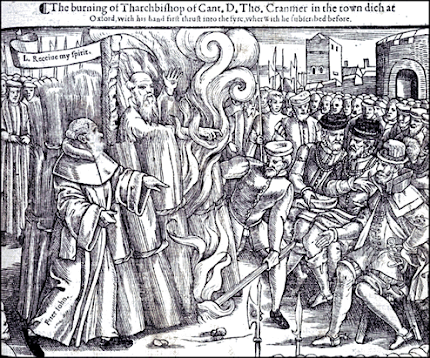
The burning of Tharchbishop of Cant. D. Tho. Cranmer in the town dich at Oxford, with his hand first thrust into the fyre, wherwith he subscribed before. [Click on the picture to see Cranmer's last words.]

Daily Bible Verse

Monday, May 29, 2006

Unity At All Cost?

I'm amazed at the current state of Evangelical churches in general and of the continuing Anglican movement in particular. Churches and denominations are quick to unite in "common cause" against what they consider liberal trends in the communion such as the ordination of homosexual priests, the consecration of homosexual bishops, and a disregard for the literal deity of Christ and His resurrection from the dead.

However, when it comes to other essentials of the Christian Gospel, such as the five solas of the Protestant Reformation, they are quick to forget that the English Reformation was every bit Protestant. The Thirty-Nine Articles of Religion makes it clear that Anglicanism was a moderate form of Calvinism/Augustinianism and that the English church was and should be forever Protestant. Anglo-Catholicism is a restorationist movement in the sense that it is an attempt to return to the errors of the Roman Catholic era both before and after the claims of papal supremacy were issued.

However, the Protestant Reformation is the true restorationist movement. The Reformers certainly sought to restore the church to the doctrines taught by Christ and the Apostles, though many of them erred by going too far, including Zwingli, who denied that the sacraments are a means of grace.

We ought to be continually seeking to reform the church and to restore it to its original message and purity, while at the same time making that Gospel message intelligible to modern generations. We should never change the faith that was once delivered to the saints. Although the modern mindset is anti-supernatural and closed to divine revelation, we should never capitulate to a materialistic philosophy that in the end leads to totalitarian governments who carry the materialistic argument to the natural conclusion that human beings are not divinely created nor inherently valuable but only a commodity to be exploited for political and earthly gain.

The common cause we might share with Roman Catholics and the Eastern Orthodox traditions on earth might be relevant in the political realm. However, to enter into common cause with churches or denominations which openly deny the Gospel and issue forth anathemas against the Gospel is to commit theological suicide. Such theological suicide would include entering into compromise concordats with Anglican bodies within the communion or outside the communion in the continuing Anglican movement.

We who are confessing Anglicans ought to be willing to sacrifice peace for the sake of truth. While unity in the faith is desirable, unity cannot override the abiding obligation to remain true to the faith once delivered to the saints.

Saturday, May 27, 2006

Theonomy And the Moral Law

This post will not be long or drawn out. It won't be documented well either. However, I wish to express in brief one of my primary objections to theonomy/reconstruction. It seems to me that the civil laws of the theocracy of Israel, as it is described in the Old Testament, are not identical with the moral law itself. The major flaw of theonomy is in making the logical leap from "moral" implications of civil/criminal laws in the Old Covenant to the idea that codified law in the Old Covenant are the same thing as the "moral law."

The two concepts are not identical. For one thing, there is a distinction between particular laws applying to specific crimes/circumstances and general laws that are meant to cover categories of sins that are forbidden by their very nature in the moral law of God that flows from God's very essence as a holy God. The case law of Leviticus would differ in detail and degree from the summary of the moral law as given in the decalogue or ten commandments.

The moral law is revealed from God through many prophets and apostles from Genesis to Revelation, while the civil and ceremonial laws of Israel are only given through Moses. The first moral law revealed to man is, "Thou shalt not eat of the tree of the knowledge of good and evil." In other words, the moral law forbids man from participating in evil. What is more, the moral law is communicated to man in creation. Adam and Eve are created in the image and likeness of God and the moral law is written into their hearts. Though this image has been corrupted, it is not totally gone. All men know by their conscience that they have sinned precisely because God has revealed it to them in creation of the things visible and by way of the image of God within them. We can in fact find the law and the gospel in every book of the Bible from cover to cover.

Moreover, it is pointless to return to a time of theocratic rule when there is no one like Moses left to run the nations of today. The prophet like Moses was and is Jesus Christ; He, too, is no longer with us in body but has ascended into heaven. As John Calvin put it, nations have a liberty of conscience to form civil and criminal laws in accordance with the moral law but they are no longer obliged to render the same punishments of the Old Covenant civil sanctions. Even the Westminster Standards and other Reformed confessions and catechisms acknowledge that the civil laws of the biblical nation of Israel passed away with that nation.

Also, theonomy tends to use doublespeak. When theonomists say they believe in justification by faith alone, they compromise this doctrine by issuing the proclamation that we are obligated to see the criminal code of ancient Israel as equal to the moral law and therefore binding upon us. This becomes a form of judaizing and legalism every bit as problematic as the Roman Catholic denial of justification by faith and faith alone.

Of course we recognize the third use of the moral law as a guide to Christian living and the process of sanctification. But that is different from using external codes to force unbelievers to conform to outward forms of law that can never justify us before God. Admittedly, all Christians accept that civil laws of society must be moral to one degree or another. But this is different from establishing Christianity, albeit an ecumenical Christianity, as the national religion and forbidding other sects and religions from public practice. This flies in the very face of a pluralistic and democratic society where the freedom of religion is the very bedrock of our constitution and bill of rights.

Theonomy is divisive in another way, also. When theonomists label everyone who dares to disagree with them as "antinomian" it commits the fallacy of overgeneralization. Not everyone who is opposed to theonomy/reconstruction would advocate antinomianism or lawlessness as permissible under a Reformed understanding of justification by faith and faith alone. Luther, Calvin and the other Reformers would deny that justification by faith and faith alone leads to antinomianism, since all of the reformers also held a high view of the doctrine of sanctification.

While theonomy may not be heretical on the primary level like Mormonism and Jehovah's Witnesses, it is heretical/divisive/schismatic on the secondary level in that it has caused severe internal dissension and dispute to the point of fracturing Christian churches, denominations, and evangelical fellowship. May we be ever vigilant against heresies that arise within as well as without the church.

In Christ,

Charlie

Wednesday, May 24, 2006

Further Discussion With Father McDonnell

Fr. McDonnell,

Labels can be deceptive. First Things is "ultra conservative" according to you? Isn't that a label? First Things is not a "magazine" but a theological journal. Magazines are written for popular audiences while journals like First Things are written for those who have an understanding of theology, sociology, psychology, etc. I am not Roman Catholic but I find the articles written there to be well thought out and honest for the most part. Had you bothered to read the article I sent you, you would have seen that the author holds a similar view to yours--that Protestants are moving closer to the Roman Catholic view.

My point stands. The Protestant Reformers are still under the anathemas of Rome and so are all who still agree with them. As Dr. Michael Horton puts it:

  • The language is, of course, more conciliatory, but the point is not the tone but the content of what is affirmed and denied. My own criticism of the impressive initiative known as “Evangelicals and Catholics Together” (ECT) some years ago was not that such dialogue should not exist or that real consensus on many issues was impossible from the outset, but that the consensus reached affirmed agreement in the gospel while acknowledging disagreement on justification, merit, purgatory, indulgences, and the redemptive intercession of anyone other than Christ. Yet, in step with other recent agreements, here it is only the evangelicals who have moved, accepting the view that justification by grace alone through faith alone because of Christ alone is not essential to the gospel.

    http://www.modernreformation.org/mh05unity.htm


Why should you be surprised that there are conservative Evangelicals who still adhere to the 5 solas of the Protestant Reformation, who are not willing to move away from what we consider to be the very essence of the Gospel? I suspect it is because you are on the "ultra liberal" end of the spectrum.

Sincerely,

Charlie J. Ray

----- Original Message -----
From: McDonnell, Fr. Kilian
To: Charlie Ray
Sent: Tuesday, May 23, 2006 8:43 PM
Subject: RE: Post pentecostal/charismatic


Dear Mr. Ray: Labels can be deceptive, and if you stay with them you miss a lot…..The Missouri Synod theologians in the dialogue were not there on their own initiative. They were officially appointed by the Missouri Synod to be its representatives…..The lifting of the anathemas might be online. Go to Google and do a search on “Catholic anathemas lifted” or something like that. Sincerely, Kilian, osb

Tuesday, May 23, 2006

Further Discussion With Father Kilian McDonnell

Dear Father McDonnell,

Labels serve to identify theological commitments. Pentecostals are pentecostals, neo-orthodox is neo-orthodox, Lutherans are Lutherans, Roman Catholics are Roman Catholics. Conservatives have certain theological commitments and liberals have others.

I would not be surprised that there are liberals within the Missouri Synod, too. However, if you are saying that the anathemas I quoted have been lifted, I would love to see the official documents from Rome on that issue. Perhaps these are available online?

Sincerely,

Charlie J. Ray, M.Div.

----- Original Message -----
From: McDonnell, Fr. Kilian
To: Charlie Ray
Sent: Monday, May 22, 2006 9:44 PM
Subject: RE: Post pentecostal/charismatic
Dear Mr. Ray: It appears to me that you discuss labels (liberal, conservative) instead of issues. The Vatican lifted the anathemas concerning justification. By the way, Missouri Synod theologians were part of the Lutheran/Catholic dialogue. Sincerely, KiIian McDonnell,osb


Dear Father McDonnell,

According to the article I just read in First Things, the anathemas have not been lifted. What has happened is that both sides have said that the anathemas from the 16th century from both churches no long apply to either church today. That flies in the face of your statement that the anathemas are no longer the official position of Rome.

  • "The American dialogue had important repercussions. An ecumenical group of Protestant and Catholic theologians in Germany in 1985 undertook a study of the condemnations issued by each church in the sixteenth century. Concluding that none of these condemnations held against the partner church today, this study proposed that the churches make binding pronouncements to the effect that those condemnations should no longer be cited as if they still held against the other church. The canons on justification in the Council of Trent and in the Lutheran Book of Concord figured prominently in this study."
  • ******
  • "...Most importantly for our present purposes, the Catholic Response raises the question whether the Lutheran positions as explained in the Joint Declaration really escape the anathemas of the Council of Trent. Without repeating the exact words of the Official Response, I can indicate some of the objections it poses regarding the first, second, fourth, and seventh of the issues I have mentioned in my summary of the Joint Declaration."
    From First Things at http://www.firstthings.com/ftissues/ft9912/articles/dulles.html


I guess that I and other conservative Protestants of the Reformed and Lutheran faith are still under the anathemas of the Council of Trent because those are precisely the views that we hold to in as much as they were also the views of the Reformers who were condemned by those same anathemas. The anathemas have NOT been lifted and you know this full well.

I'm really disappointed that you're being so disingenuous, Fr. McDonnell. Honesty would go much further in a true dialogue with those who differ with you.

Sincerely,


Charlie Ray

Monday, May 22, 2006

Justification by Faith Alone Condemned by Rome

According to the charismatic Roman Catholic scholar, Father Kilian McDonnell, the canons of the Council of Trent never condemned the doctrine of justification by faith alone but rather the Reformers' view of it. There's a newer view of justification by faith alone around and it's spelled out in a document published out of the Lutheran/Roman Catholic dialogue. Here's Fr. McDonnell's comment to me via e-mail:

  • The Council of Trent did condemn some Reformation doctrines, but not justification by faith alone, which is in the Pauline letters. What Trent condemned was a certain understanding of justification. If you look at the volumes on justification that came out of the Lutheran/Catholic dialogue, either the dialogues in the USA or international, will find a much more nuanced view.

This is the most blatant form of doublespeak. It pretends that Rome did not condemn the view espoused by the Protestant Reformers while at the same time acknowledging that it DID condemn that particular view. What Fr. McDonnell is saying is that essentially the Lutherans have moved closer to the Roman view. Rome is not and will not move toward the view that sparked off the Protestant Reformation in the first place. If there is to be any compromise, it will be on the part of Protestants. Furthermore, the Lutherans involved in the dialogue McDonnell mentions were not conservative, evangelical Lutherans from the Missouri or Wisconsin synods but from the more mainline denominations like the Evangelical Lutheran Church of America and European Lutherans who are also theologically liberal.

It's sad that evangelical churches in the United States are selling out to theological liberalism in droves. The term "evangelical" doesn't mean that much anymore.

For the complete text of Fr. McDonnell's remarks to me, see the post previous to this one.

An E-mail From Father Kilian McDonnell

Thanks for your reply, Father McDonnell. However, I remain unconvinced. The Lutheran/Roman Catholic dialogues took place between liberal mainline Lutheran denominations and not conservative "evangelical" Lutherans. The Alliance of
Confessing Evangelicals in particular has issued statements like the Cambridge Declaration to refute the so-called compromises between Rome and Protestants.

Rome seems to want Protestants to come over their side, which isn't a compromise at all but rather a selling out of the Reformation. Justification is imputed righteousness according to the Protestant Reformers. Rome still teaches infused righteousness and as far as I know the anathemas of the canons of Trent are still in effect. The real problem today is that theological liberals are no longer committed to conservative theology or to the principles of the Protestant Reformation. The five solas would be particularly important.

Anyway, I know you don't have time to debate via e-mail. I'm no scholar but I have a B.A. from an Assemblies of God college and a Master of Divinity from Asbury Theological Seminary in Wilmore, Kentucky. Amazing that my conversion to Calvinism happened at an Arminian seminary.

By the way, I also find it troubling that the Society for Pentecostal Studies seems to have no problem with inviting heretics like oneness pentecostals to participate. It seems to me that the Athanasian Creed rules out non-trinitarians.

The peace of God,

Charlie J. Ray

P.S. You might find these links interesting:

An Appeal to Evangelicals
http://www.alliancenet.org/partner/Article_Display_Page/0,,PTID307086CHID560462CIID1415576,00.html

The Cambridge Declaration
http://www.alliancenet.org/partner/Article_Display_Page/0,,PTID307086CHID560218CIID1411364,00.html

----- Original Message -----
From: McDonnell, Fr. Kilian
To: Charlie Ray
Sent: Sunday, May 21, 2006 10:27 AM
Subject: RE: Post pentecostal/charismatic

Dear Mr. Ray: Grace and Peace: I did my doctoral dissertation on John Calvin’s doctrine of the church and the Lord’s Supper, which was printed by both Oxford University Press, and Princeton University Press. I say this simply to indicate that I know something of Calvin’s doctrine. He was a great theologian, and I learned much from him that I must, as a Roman Catholic, accept…. I was in official Vatican dialogues with the World Alliance of Reformed Churches, and nationally with the Lutheran/Catholic Dialogue. The Council of Trent did condemn some Reformation doctrines, but not justification by faith alone, which is in the Pauline letters. What Trent condemned was a certain understanding of justification. If you look at the volumes on justification that came out of the Lutheran/Catholic dialogue, either the dialogues in the USA or international, will find a much more nuanced view. You can also find a meeting point in the commentary on Romans by the Jesuit Joseph Fitzmyer, which is in the Anchor Bible series of commentaries. This commentary is used in some Lutheran seminaries…..You should also know that the anathema’s against the Lutherans made by Trent was lifted by the Vatican some ten years ago. We are not in total agreement, but the areas of agreement are greater than you e-mail seems to indicate…..Yes, it is true, I did not speak officially for the Catholic Church in that statement on forgiveness. One does what one can. But when I made it I was the Vatican appointed Catholic chair in the official Classical Pentecostal/Roman Catholic dialogue….Nice chatting with you. Sincerely, Kilian McDonnell,osb
From: Charlie Ray [mailto:guapoduck1959@cfl.rr.com] Sent: Friday, May 19, 2006 1:07 PMTo: McDonnell, Fr. KilianSubject: Post pentecostal/charismatic

Dear Dr. McDonnell,

I read with interest your article asking for Pentecostal forgiveness for the sins of the Roman Catholic Church and of Roman Catholics against them. I can't help thinking of the similar sins committed by Rome against the early Protestant Reformers like Martin Luther and John Calvin.

Your apology seems to ring empty, however, since you have no authority to speak for the Roman Catholic Church in any official capacity on this issue, as you admitted in the article (http://www.pctii.org/cyberj/cyberj7/confession.html). It seems to me that there are even more important issues at stake here. Justification by faith alone is still a doctrine that was officially condemned at the Council of Trent and therefore all Protestants, including Pentecostals are officially anathema by the Church of Rome.

I was a Pentecostal for over ten years but I left the movement after I seriously investigated the doctrinal foundations for their theology. Since that time I have become a devout and committed Calvinist and an adherent of Reformed theology within the context of an Anglican liturgy.

I have some sympathies with the Roman Catholic emphasis on sacramental theology and liturgy but the similarities stop there. Until Rome is willing to admit its errors during the Reformation and to remove its blanket condemnations of Reformed/Lutheran/Protestant doctrinal positions, there can be no unity.

Sincerely yours,

Charlie J. Ray

http://www.alliancenet.org/partner/Article_Display_Page/0,,PTID307086CHID560462CIID1415576,00.html

Saturday, May 20, 2006

Those Opposing Theonomy Should Get the Death Penalty

I won't take the time to do a full rebuttal to the pro-theonomy article online at http://www.forerunner.com/theofaq.html. But to begin with I would like to point out that theonomy reconstructionism in general has rejected the traditional Reformed position that the civil laws of the theocracy of ancient Israel passed away with that nation. Practically all the Reformed confessions of faith and catechisms hold this position and so does John Calvin in his Institutes of the Christian Religion and other writings. Theonomists only want to rule out the dietary laws and ceremonial laws of the Old Covenant and whatever else was specifically fulfilled in the New Covenant through Jesus Christ.

Theonomists often will say that they only want the civil/governmental law to be enforced and that they are not talking about justification by grace alone through faith alone. But it becomes increasingly obvious that they are inferring justification/sanctification issues based on their interpretation of the moral law of the Old Covenant/Old Testament as the same as the civil laws of ancient Israel. Anyone who disagrees with them is automatically an "antinomian," which they try to say comes solely from dispensationalism and the John Darby/Scofield Bible tradition. However, this is misleading and absolutely wrong. Most Reformed believers are not antinomian nor are most Arminians and Wesleyan Holiness folks, to name but a few. Dispensationalism does not have the far reaching effects on evangelical Christianity that theonomists/reconstructionists imagine. The article states that:

  • A Christian is not under the Law as a means of obtaining salvation; nor are we under the curse of the Law since we were justified by faith. Yet when modern evangelicals claim, "I'm not under the Law," what they often mean is that they are not in favor of it or they are not keeping it. Such a view is called: antinomianism (anti-Law) -- a heresy.
  • http://www.forerunner.com/theofaq.html

What we have here is a conflation of two different issues under one idea. For the theonomist anyone who happens to disagree with his definition of "moral law" as the same as the civil laws of the theocratic ancient nation of Israel is automatically an antinomian and a heretic and presumably under the theonomic form of civil government, worthy of the death penalty since that was the penalty exercised under the Old Covenant and in some Puritan communities like Geneva and those in the New World.

Don't take it lightly. If you're opposed to theonomy, theonomists would like to have the death penalty imposed against you according to future civil laws that would be voted in by a society dominated by theonomists. Presumably every denomination would now become reformed at least on the idea of the covenants and theonomic in their views on the moral law being equal with the civil laws imposed in the theocracy of Israel in the Old Testament. If this thought doesn't scare you, nothing will.

More on theonomy in an upcoming post. Please stay tuned.

Friday, May 05, 2006

Justification by Faith Alone

According to a recent broadcast on The White Horse Inn radio program, over 31% of respondents at a recent evangelical ministers' conference did not know the correct answer to the question: Is justification by faith alone or by faith and works together? This is an appalling statistic considering that these are the men who are teaching and preaching the gospel from the pulpits.

It is becoming increasingly clear that evangelical Christianity is in terrible trouble. Essential doctrines like the trinity and the deity of Christ are under attack by oneness pentecostals and by the word of faith movement. Yet evangelical theologians and pastors are not sounding the alarm. What then should we do?

The only option at this point is to begin to confront the heretical departures from the Christian faith and to teach and preach the truth. Sometimes this will require a radical departure from churches which have compromised the faith to the point of heterodoxy and even outright heresy. True Christian faith requires that we become part of a local congregation but what happens if there is no local congregation that is faithful to the gospel of Jesus Christ and apostolic doctrine?

I pray that Christ will return soon because the current state of the church leaves one wondering if there is any true church left? The true church is the one where the gospel is rightly preached and the sacraments are rightly administered. Come soon Lord Jesus!

Support Reasonable Christian Ministries with your generous donation.