>

Martyred for the Gospel

Martyred for the Gospel
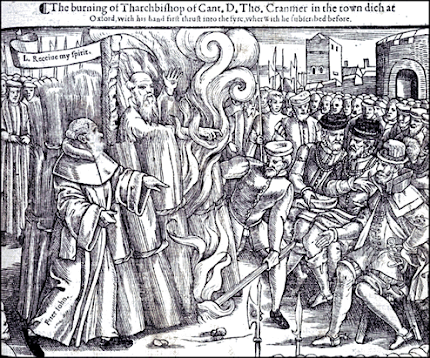
The burning of Tharchbishop of Cant. D. Tho. Cranmer in the town dich at Oxford, with his hand first thrust into the fyre, wherwith he subscribed before. [Click on the picture to see Cranmer's last words.]

Daily Bible Verse

Friday, June 30, 2006

Unity and Diversity in Spiritual Formation

Recently in a chatroom I was in conversation with someone whom I have chatted intermittently with many times over the years. This person would never tell me her church's statement of faith and even denying that it had one at all. However, she finally gave me a website where I tracked down the statement of faith. Her pastor and church are from a dispensational theological background and her pastor was a graduate of Dallas Theological Seminary, one of the flagship dispensationalist schools in the country.

My complaint with the church is that it seems doctrinal teaching is falling by the wayside. The Wednesday and Thursday services are aimed at expositional teaching straight from the Bible in the original Koine Greek. I find it commendable that the pastor is taking time to teach church members the original languages.

However, if any one discipline in the Christian life is emphasized above all else it may become unhealthy and even disasterous to the individual and to the body of Christ as a whole. I can liken this to a savant child who can excel at math or music but cannot speak about any subject coherently or even dress himself or herself. There are savants who are geniuses at reproducing music they've heard, including classical music of great complexity. There are savants who are geniuses at math and can perform math seemingly with the speed of a calculator or a computer. But they are so handicapped in all the other areas of their existence as to almost possess no human personality or soul.

In the same way, churches which ignore church history, systematic theology, and church discipline are creating Christians who very much resemble savants. They may quote Scripture or even know Greek grammar and how to parse verbs and conjugate nouns, adjectives, and articles. But they have little to no knowledge of the first 2,000 years of church history, the history of their own church's theological tradition, or systematic and dogmatic theology. What good is it to create a savant with a wealth of knowledge about one small part of Christianity but with no overall general knowledge of the entire faith? While it is true that we can become so focused on the particulars that we lose sight of the larger picture, (we cannot see the forest for the trees), it is also true that we must focus on the particulars of the faith so that we can have a better understanding with more precise thinking and better definition. But if we focus on only ONE particular to the exclusion of all else, then we have lost sight not only of the forest but of all the other individual trees as well.

It is truly sad that most Christians have no idea what the Protestant Reformation was about, what caused it, or why it is essential for Evangelicals to hold fast to the principles established in that reform. We may have unity in the body of Christ but that unity comes at the cost of cancers that eat away at the health. To feed on only sugar and not meat is to have one's health ruined. The teeth fall out, diabetes sets in, and the body in general deteriorates. This is the state of Evangelical churches today which focus only on popular music which merely recites a meaningless chorus like a mantra in endless repetition. God is not a girlfriend who needs us to woo Him. Rather He is a God who is to be understood and to be emotionally connected with. To focus on only one aspect of God at the expense of who He is in totality is to become like a savant with great gifts but no personality, no depth, and no true understanding.

If the Renaissance teaches us anything as Christians it is that we should develop every area of our being so that we may worship God with all that we have. This means the mind and the intellect is as important as our emotions or our sanctification. It means that doctrine and a systematic understanding of the Bible is essential and that church history is completely relevant to understanding where we are today. The old cliche applies to Evangelicalism: " Those who forget the past are doomed to repeat it."

May the peace of God be with you!

Thursday, June 29, 2006

Split in the Episcopal Church USA Becoming Reality

You must listen to this radio broadcast of the Albert Mohler program.


Anglicans Move Toward Schism -- A Lesson For The Global Church

Guest: Rev. David Roseberry

Click here: http://www.albertmohler.com/radio_show.php?cdate=2006-06-29

Does the World Need A Savior?

In the newest Superman movie, Superman takes Lois Lane for a spin around the world. As they are hovering above the earth in embrace, Superman says to her, "You wrote that the world doesn't need a savior. But I hear people crying out for a savior all the time."

I won't review the movie, though I think it was much better than the previous Superman movies and well worth going to see. The point I wanted to focus on, however, is the question raised by the character of Superman. Does the world need a savior?

It is interesting that most of the comic book genre focuses on the problems raised by moral evil; more specifically, the major theme is almost always good versus evil. In fact, this theme goes back as far as language itself. The earliest stories told and the earliest written literature we have in almost any language in some way directly deals with the problem of evil or the theme of good versus evil.

Somehow inherent in the human condition is a perceived struggle within the conscience and with the environment that involves a need to understand suffering and hardship and why humans mistreat each other. Most of the time this goes back to some conception of evil, that is, something within us that has the intent of doing wrong or harm to others or which places the self above all else, even at the risk of self destruction.

We can all remember those movies where greed overcomes the group seeking a valuable treasure and the wicked begin to plot against each other so that he or she is the one who gets the wealth at the end. Unfortunately, the corrupt wind up murdering each other until the hero, the only one who is good, wins in the end and usually does not keep the treasure himself or herself but gives it to its rightful owner or to charity, etc.

Moreover, the world is indeed crying out for a savior. People suffer from abuse, famine, disease, crime, political oppression and a host of other evils. What is the solution for their suffering? Who can answer their cry for a savior? I don't believe modern myths can do much except give modern people a short reprieve. Once the movie is over it is back to real life. It is indeed ironic that the world is crying out for a savior but they refuse to accept the savior that God has sent to bring the very relief they cry out for.

Originally, evil has its source in the rebellion of Lucifer, one of the chief angels in heaven, who led a rebellion of a third of the angels. But the rebellion continued when Adam and Eve allowed Satan to deceive them into disobeying God. Ever since Adam and Eve rebelled against God moral evil and environmental evil has been a part of the human predicament. Not only do we suffer at the hands of men born into sin and wicked from birth but each of us sins and brings suffering upon everyone else around us. Furthermore, the entire earth groans under the strain of sin. We have natural disasters and calamities, environmental pollution, famines, earthquakes, floods, hurricanes and tsunamis. Humans sin against each other individually and collectively as groups and as nations. Sociological, psychological, and philosophical issues intimately connected to the fall carry tremendous ramifications for humankind both individually and socially.

Indeed, the Christian savior who is the answer to all of these problems is no superman with superhuman or magical powers like the Superman character in the movies. Superman is a popular myth like Santa Claus rather than a god. But the Christian savior is fully human and not some alien from another planet. Jesus Christ, in order to fully identify with us, assumed a true human nature into the Godhead. God the Son, the second person of the Godhead, became human in every sense that we are human and became vulnerable and mortal just as we are. But the miracle is that He did this without becoming less than God. He is one person perfectly uniting two natures in that one person, yet without confusing the two natures or separating them.

The kind of savior we need to deliver us from our sins and propitiate the wrath of God against us as sinners, rebels and wicked humans is one who shares our humanity as a creature, who is perfectly righteous and has never sinned and who is truly divine. But why do we need this kind of savior? The Heidelberg Catechism answers those questions this way:


LORD'S DAY 5


12.
Q.
Since, according to God's righteous judgment we deserve temporal and eternal punishment, how can we escape this punishment and be again received into favour?
A.
God demands that His justice be satisfied.1 Therefore we must make full payment, either by ourselves or through another.2
1 Ex 20:5; 23:7; Rom 2:1-11. 2 Is 53:11; Rom 8:3, 4.
13.
Q.
Can we by ourselves make this payment?
A.
Certainly not. On the contrary, we daily increase our debt.1
1 Ps 130:3; Mt 6:12; Rom 2:4, 5.
14.
Q.
Can any mere creature pay for us?
A.
No. In the first place, God will not punish another creature for the sin which man has committed.1 Furthermore, no mere creature can sustain the burden of God's eternal wrath against sin and deliver others from it.2
1 Ezek 18:4, 20; Heb 2:14-18. 2 Ps 130:3; Nahum 1:6.
15.
Q.
What kind of mediator and deliverer must we seek?
A.
One who is a true1 and righteous2 man, and yet more powerful than all creatures; that is, one who is at the same time true God.3
1 1 Cor 15:21; Heb 2:17. 2 Is 53:9; 2 Cor 5:21; Heb 7:26. 3 Is 7:14; 9:6; Jer 23:6; Jn 1:1; Rom 8:3, 4.


LORD'S DAY 6

16.
Q.
Why must He be a true and righteous man?
A.
He must be a true man because the justice of God requires that the same human nature which has sinned should pay for sin.1 He must be a righteous man because one who himself is a sinner cannot pay for others.2
1 Rom 5:12, 15; 1 Cor 15:21; Heb 2:14-16. 2 Heb 7:26, 27; 1 Pet 3:18.
17.
Q.
Why must He at the same time be true God?
A.
He must be true God so that by the power of His divine nature1 He might bear in His human nature the burden of God's wrath,2 and might obtain for us and restore to us righteousness and life.3
1 Is 9:6. 2 Deut 4:24; Nahum 1:6; Ps 130:3. 3 Is 53:5, 11; Jn 3:16; 2 Cor 5:21.
18.
Q.
But who is that Mediator who at the same time is true God and a true and righteous man?
A.
Our Lord Jesus Christ,1 whom God made our wisdom, our righteousness and sanctification and redemption (1 Corinthians 1:30).
1 Mt 1:21-23; Lk 2:11; 1 Tim 2:5; 3:16.

From: http://www.canrc.org/resources/bop/hcat/hcat2.html

Yes, the world is crying out for a savior. I believe every human being inherently knows there is a God and that we are guilty before Him, despite their rejection of Him and their denial of His existence. It is this guilt that drives us to cry out for relief, for a savior. And it is the suffering we bring upon ourselves and our neighbor through individual and collective sins that drives us to cry out for a savior. The need for deliverance from wars, calamities and natural disasters drives us to cry out for a savior. The knowledge of our impending death and our mortality moves us to cry out for a savior. And who is the only savior who can do all of this for us and for the whole world? His name is Jesus Christ!

The peace of God be with you!

Charlie

Monday, June 26, 2006

One Holy Catholic and Apostolic Church

In our worship services in the Anglican tradition we usually recite the Apostles Creed or the Nicene Creed, which has a section that says we are part of "one holy catholic and apostolic church" or "one catholic and apostolic church." This phrase is inferred from Saint Paul's epistle to the Ephesians:

  • "Endeavouring to keep the unity of the Spirit in the bond of peace. There is one body, and one Spirit, even as ye are called in one hope of your calling; One Lord, one faith, one baptism, One God and Father of all, who is above all, and through all, and in you all." (Ephesians 4:3-6, KJV) [1]

Church history is full of theological controversies and theological debates from opposing parties. These challenges to the faith delivered to us by the apostles had to be answered and clarified. Many of these controversies forced the church to further define and explain doctrines that were already in existence but not yet clearly explicated. The controversies over the incarnation of Christ as fully human while remaining fully divine led to a more detailed understanding of the triunity of the Godhead.

Moreover, Tertullian, in the second century, was the first church father to try to explain the trinity in formal terms. There are those today who take this to mean that the doctrine of the trinity is not taught in Holy Scripture at all and that the first century apostles did not teach or understand the Godhead in this way.

This raises a question. Are the Roman Catholics and the Eastern Orthodox Churches correct that oral tradition is also divine revelation on an equal par with Holy Scripture? If so, then their use of it appears to be more of a doctrine of ongoing revelation. While it is true that the first century Christians reinterpreted the Old Testament in terms of an ongoing revelation from God, it does not follow that the church after the time of the apostles has the authority to add further doctrine to Scripture. First of all, the first century church used the Septuagint as their translation of the Old Testament. Their understanding of the prophecies in Scripture were therefore colored by their use of the Greek translation of the Scriptures. But even this is not a hard and fast rule since Jesus Himself would have been reading the Tanakh and probably not the Septuagint.

There is a valid point that in the first three centuries of the church there was no canon of Scripture that was officially recognized, including the Old Testament. Not even the Jews had an official canon of the Tanakh. However, this does not justify making oral tradition of equal authority with Holy Scripture since we can tell from reading the church fathers that their opinions were often heretical. Origen, for example, was a univeralist and was posthumously condemned as a heretic. This is precisely why Protestants insist that the only binding "oral traditions" are those that we have recorded for us in Holy Scripture. To insist that oral tradition or "holy tradition" is divine revelation on an equal foundation with Holy Scripture is to essentially reopen the canon. How do we decide what is divine revelation and what is not? Anyone reading the ante-nicene, nicene and post-nicene church fathers will immediately notice that this is a mixed bag. It therefore follows that if the written accounts of the traditions handed down to us from the church fathers are heterodox or even heretical in some cases, then the oral traditions are likely to be in error to one degree or another as well.

Jaroslav Pelican makes the argument that the Tanakh had no vowel pointings until the Masoretes in reaction to Christianity provided these textual additions based on their oral traditions of what those pointings were supposed to be. In several cases their oral tradition amazingly contradicts the Septuagint, which would have been translated by Jews of a much earlier period who would have been familiar with both the Hebrew and Greek languages of the time and with the Hebrew oral traditions that guided their translation from Hebrew to Greek. So who is correct?

The consistent Protestant position is that only the original autographs are inerrant and infallible. Textual transmission is prone to error as well, as the thousands of Greek manuscripts attest. Granted, the majority of these errors are spelling, reduplication of letters or words, words omitted, or glosses accidentally put into the text by later scribes, or the attempts of scribes to smooth out unclear, rough readings or readings that did not agree with their own theology. This would not make the textual tradition untrustworthy because the science of textual criticism has verified that our extant textual tradition is highly reliable in spite of these minor variant readings in the majority of cases.

Pelican's analogy of the oral tradition of the Masoretes fails in the final analysis, however. As I said, the textual transmission process is highly accurate while the opinions of the church fathers are a mixed bag. And as I pointed out, even the Masoretes had an agenda in reaction to Christianity. All of these factors must be taken into account.

These are difficult issues no doubt. But we know that the trinity is not a matter of progressive revelation since the doctrine can be clearly seen in Scripture, even though it is not fully defined there. The fact that the modalists, arians, and other challenges to the orthodox doctrine failed points us in the direction that the apostolic tradition, both oral and written, upheld the trinity. This can be difficult because Protestants hold that only Scripture is inerrant and infallible and divine while the oral traditions are not. That means that the church fathers who support the trinity are not speaking infallibly or without error. This presents a problem with modern heretics who distort the Scriptures to support aberrant views of the trinity. It seems that we can be caught between a rock and a hard place at this point. Do we give in to Rome and Constantinople and fall into the slippery slope of oral traditions that lead to ongoing revelations that add doctrines like veneration of icons, saints and prayers to the saints? I think not. Despite the difficulties we must uphold the Scriptures as the final authority in all matters of faith and practice.

This does not mean that we throw out the authority of creeds, councils and the church. It merely means that we must test them by the Scriptures. This is the safeguard that keeps us from inventing a new sect or cult. We cannot allow ongoing revelation in the form of holy tradition, nor can we allow private interpretation to the point that the Scriptures are twisted to create new religions that have nothing to do with Christianity as it existed from the beginning.

The peace of God.


[1] The Holy Bible : King James Version. 1995 (Electronic edition of the 1769 edition of the 1611 Authorized Version.). Oak Harbor, WA: Logos Research Systems, Inc.

Saturday, June 24, 2006

Anglo-Catholic Schizophrenia

My comments will be in bold face type:

Dave Hodges said...
"[I]n fact, the Anglo-Catholic tradition, the Roman Catholic tradition, and the Eastern Orthodox tradition are all preaching another gospel and another Christ from the gospel and the Christ that Paul preached."And that's precisely what Arians, Sabellians, Marcionites, Nestorians, Monophysites, Monothelites, Petrobruscans, Docetists, Jehovah's Witnesses, Mormons, and the Moonies would say. Everybody claims that those who disagree with them are preaching a "different Gospel".

Any Gospel that denies the 5 solas is a false Gospel because it is precisely in Scripture that we learn who Christ is. The Anglo-Catholics are out of apostolic succession because their holy orders are invalid. Repent and return to Rome!

The Catholics think the evangelical Protestants are teaching a different Gospel because they deny St. James II:xxiv. <<<<http://reasonablechristian.blogspot.com/2006/06/articles-covering-good-works.html).


The Council of Trent condemned Luther precisely because his teachings did not conform to Holy Writ. So we ask ourselves, what did St. Paul preach? <<<<< href="http://www.xanga.com/MysteriumFidei/494806080/item.html" rel="nofollow">A short post on the "essentials" of salvation.
12:35 PM, June 19, 2006

<<<<<< It seems to me that Anglo-Catholics are just another schism. Most Anglo-Catholics are not even in communion with Canterbury and are therefore no better than the "schisms" you mentioned:) Furthermore, even if you are in communion with Canterbury, there are schisms within the Anglican Communion itself. Do you consecrate homosexual priests? Ordain women and practicing homosexuals to the priesthood and consecrate them to the office of bishop? Does apostolic succession include false doctrine like infused righteousness, denying the physical/bodily resurrection of Jesus Christ, and universal salvation?

And as I mentioned above, even Canterbury has invalid holy orders since the first Protestant Archbishop was improperly consecrated. There was only one ordained bishop there and the other two were not valid bishops. So it appears that Anglicans are just another schism from Rome and no better than Luther who inspired them.

John Henry Newman converted to Rome, which is the logical conclusion of his position. I think to be consistent Anglo-Catholics should convert to Roman Catholicism. After all, they have invalid holy orders and they are not even consistent with the Protestant doctrines of the Articles of Religion. The Articles of Religion forbid invoking the saints, transubstantiation, and a host of other doctrines that are "repugnant to Scripture." You can't have it both ways. Either remain faithful to the Thirty-Nine Articles of Religion as they are plainly written, or return to Rome. It is dishonest to re-interpret the Articles to fit with preconceived doctrines that are hostile to the original intent of the Articles. There is no way to avoid this.

While I have some sympathies with you regarding the fragmented nature of the visible church as it exists in the Protestant world, I note that this is not limited to Protestants. There are divisions between Rome and the East and a host of other traditions that predate the Protestant Reformation. Schism is sometimes good in case of heresy, which the ecumenical councils were careful to denounce in their quest to define what apostolic and Scriptural religion was.

I myself am in sympathy with the Alliance of Confessing Evangelicals. This group has noted that Evangelicals for the most part are ignorant of the "catholic" nature of the original Reformers and they are ignorant of their own confessions of the faith. However, in my journey with Christ, I came to appreciate the "catholic" nature of the original Reformers and that is precisely why I became an Evangelical/Protestant/Reformed Anglican. My definition of Reformed Anglican is Calvinistic/Protestant and Reformed. These overtones of compromise with Rome that Anglo-Catholics advocate are anathema to the Gospel and to the Anglican and Reformed and catholic faith. Perhaps you should go and read the sermons of Cranmer, Ridley, Latimer and Hooker again? Read the first six homilies again. These express what "Reformed" Anglicanism IS. 19th century Tractarianism is NOT what the Protestant and Anglican Church became in the 16th century. If you disagree with the Protestant Anglicans, then go become a Roman Catholic. But don't expect Protestants to stand by idly while you make shipwreck of the faith.

African Bishops Respond to ECUSA's 2006 General Election

The impending split within the Anglican Communion looms larger than ever. It seems to me that the Episcopal Church USA is determined to go its own way despite the concerns of the larger communion. Homosexual priests and bishops are unscriptural since homosexual behavior is condemned by Holy Scripture and by church tradition. The consistent position of the church universal has been to uphold the Scriptures and to forbid sexual immorality.

Just as disturbing is the insistence of the 2006 general convention of ECUSA to elect a woman as the presiding bishop. Again, the traditional position of most churches has been to ordain men only to the priesthood or ministry. Only with the Methodists in the nineteenth century and the pentecostals in the 20th century do we begin to see this tradition changed. With the advent of liberal theology, modernism, and postmodernism we begin to see a compromise of biblical teaching.

While women may indeed have careers in other fields, it by no means follows that they should be teachers in authority in the church. In this we must follow the Scriptures and tradition. Nowhere in Holy Scripture do we see women ordained as priests, bishops, deacons, apostles, pastors, teachers, or evangelists.

The African bishops are right to call ECUSA to repent over these matters. However, I don't see that happening. I'm afraid that what will happen is the conservative side of the communion will break fellowship with the more liberal provinces of the USA, Canada, and perhaps Great Britain. Even the Archbishop seems to be a progressive liberal with little concern for what God says in Holy Scripture against sodomites and homosexuals.

Perhaps a split would be in the best interest of all involved? Let the wicked have their own church and let the righteous stay faithful to God. Perhaps this is blunt but we should stop compromising the faith just to make the politically correct happy in their sins.

May God grant us the grace to remain faithful.

(Click on the title link above to see the remarks of Bishop Peter Akinola).

Tuesday, June 20, 2006

Does the End Result Justify the Means?

I sometimes get frustrated when people who are supposed to be Christians buy into the unethical views of the liberal media. Simply because a particular view is broadcast on the evening news some Christians will immediately accept it as if there were nothing wrong with that view.

I am speaking in particular of the debate over stem cell research. There seems to be many Christians who have bought into the idea that it is ok to use the stem cells from embryos or aborted fetuses/babies to do research for the curing of other human ailments, including spinal paralysis and alzheimer's disease. Even the former first lady, Nancy Reagan, is in favor of using stem cells from aborted fetuses and embryos to do research that might cure the disease that took her husband from her in his remaining years. All these emotional appeals tug at one's heart but we must refrain from basing our ethnics on emotive reasoning, however passionate the plea.

What is wrong with using body parts from aborted fetuses? Does the end justify the means? What if cures can be effected through this sort of research? That's rather like asking if it's ok to use the body parts of an adult victim of murder to save someone else's life? Just because there's a body there does not make it right to use the parts to save someone else. Are we really just spare parts? Is a murdered fetus just an "it" or does it have a soul that is now in heaven? The implications of treating the human body as just another biological machine depreciates the value and sanctity of each individual human life. It undercuts the very meaning and definition of "human rights." Each person is unique, created in the image and likeness of God by virtue of our descent from Adam and Eve. To pit one human life against another is to violate the very nature of the command, "You shall love your neighbor as yourself."

Maybe I'm not being clear. Maybe I'm a bit emotive in my reasoning as well. All I know is that intuitively and biblically I believe that using aborted babies or fetuses for research is ethically, morally, and theologically wrong. May God judge between us.

Sunday, June 18, 2006

George Whitefield on the 17th Article of Religion

  • But passing by this, as also your equivocal definition of the word grace, and your false definition of the word free, and that I may be as short as possible, I frankly acknowledge: I believe the doctrine of reprobation, in this view, that God intends to give saving grace, through Jesus Christ, only to a certain number, and that the rest of mankind, after the fall of Adam, being justly left of God to continue in sin, will at last suffer that eternal death which is its proper wages.
  • This is the established doctrine of Scripture, and acknowledged as such in the 17th article of the Church of England, as Bishop Burnet himself confesses. Yet dear Mr. Wesley absolutely denies it.
  • http://www.graceonlinelibrary.org/articles/full.asp?id=4129

This quote is from Whitefield's letter to John Wesley debating the issue of election from a Calvinist perspective. Wesley, an Arminian, had attacked the reformed view. We might note that Whitefield clearly sees double predestination as the subject of Article Seventeen and he appeals to Bishop Burnet to substantiate that view.

(Article 17 is linked here: http://www.churchofengland.freeserve.co.uk/x39arts.htm#art17).

Again, the evidence that Anglo-Catholics are misreading the Articles of Religion and the Prayer Book is overwhelming. Wesley himself knew what the article said yet persisted in re-inventing the Articles to fit his Arminianism. The Methodist Book of Discipline is good evidence of this since we find there a serious editing of the Articles of Religion.

Sincerely in Christ,

Charlie

A.A. Hodge and Two Parties of the Reformation

  • 10. Into what two great parties has the Protestant world always been divided?
  • The whole Protestant world from the time of the Reformation has been divided into two great families of churches classified severally as LUTHERAN, or those whose character was derived from Luther and Melanchthon; and as reformed or those who have received the characteristic impress of Calvin. The LUTHERAN family of churches comprises all of those Protestants of Germany, of Hungary, and the Baltic provinces of Russia, who adhere to the Augsburg confession, together with the national churches of Denmark and of Norway and Sweden, and the large denomination of the name in America. These are estimated as amounting to a population of about twenty-five million pure Lutherans, while the Evangelical Church of Prussia, which was formed of a political union of the adherents of the two confessions, embraces probably eleven-and-a-half million. Their Symbolical Books are the Augsburg Confession and Apology, the Articles of Smalcald, Luther's Larger and Smaller Catechism, and, as received by the Stricter party, the Formula Concordiae. The CALVINISTIC or REFORMED churches embrace, in the strict usage of the term, all those Protestant Churches which derive their Theology from Geneva; and among these, because of obvious qualifying conditions, the Episcopal Churches of England, Ireland, and America form a subdivision by themselves; and the Wesleyan Methodists, who are usually classed among the Reformed because they were historically developed from that stock, are even yet more distinctly than the parent church of England removed from the normal type of the general class. In a general sense, however, this class comprises all those churches of Germany which subscribe to the Heidelburg Catechism, the churches of Switzerland, France, Holland, England, and Scotland, the Independents and Baptists of England and America, and the various branches of the Presbyterian Church in England, Ireland, and America. These embrace about eight million German Reformed in the Reformed church of Hungary; twelve million and a half Episcopalians; Presbyterians six million; Methodists, three million and a half; Baptists, four million and a half; and independents' one million and a half;--in all about thirty-eight millions.
  • The principal confessions of the Reformed Church are the Gallic, Belgic, 2d Helvetic, and Scotch Confessions; the Heidelburg Catechism; the Thirty-nine Articles of the Church of England; the Canons of the Synod of Dort, and the Confession and Catechisms of the Westminster Assembly.
  • http://www.graceonlinelibrary.org/articles/full.asp?ID=67%7C67%7C605

A.A. Hodge calls the Thirty-Nine Articles of Religion a "principle confession" of the Reformed Church. But earlier in the presentation he says that the Church of England and the Episcopal and Wesleyan churches that are indebted to it are not strictly "Reformed" in the Calvinist sense. I think Hodge is ambiguous on this point. Though a staunch Arminian himself, Wesley was highly influenced by the Moravians, a decidedly Calvinist group. Additionally, I might mention that Wesley was influenced by George Whitefield, the father of the Calvinist side of the Methodists. But in general no one can deny that the Book of Common Prayer and the Thirty-Nine Articles of Religion are Calvinist in tone and purpose. So it is clear to me that Anglicanism, despite many defections, belongs to the Calvinistic side of the Reformation and ought to be restored to that insofaras it is possible through reform and restoration from within.

As an aside, we should also note that semi-pelagianism is the position of the Eastern Orthodox churches according to Hodge:

  • 6. What was the origin of the Middle or Semipelagian system? In the meantime, while the Pelagian controversy was at its height, John Cassian, of Syrian extraction and educated in the Eastern Church, having removed to Marseilles, in France, for the purpose of advancing the interests of monkery in that region, began to give publicity to a scheme of doctrine occupying a middle position between the systems of Augustine and Pelagius. This system, whose advocates were called Massilians from the residence of their chief, and afterward Semipelagians by the Schoolmen, is in its essential principles one with that system which is now denominated Arminianism, a statement of which will be given in a subsequent part of this chapter. Faustus, bishop of Priez, in France, from A. D. 427 to A. D. 480, was one of the most distinguished and successful advocates of this doctrine, which was permanently accepted by the Eastern Church, and for a time was widely disseminated throughout the Western also, until it was condemned by the synods of Orange and Valence, A. D. 529.
  • http://www.graceonlinelibrary.org/articles/full.asp?ID=67%7C67%7C605

Moreover, I think Hodge oversimplifies the Wesleyan and and Methodist and Anglican churches because he does not particularize and specify their connection with Arminianism and thus with semi-pelagianism. In the strictest sense, Methodists are not Reformed since they adhere to Arminianism and are linked indirectly to semi-pelagianism.

Additionally, I am appreciative of the Augustinianism of Roman Catholic theologians like Thomas Aquinas but the prevalence of semi-pelagianism in their communion makes that almost irrelevant. It seems to me that the visible church is divided internally and externally and that the only hope for unity lies with the restoration of the biblical doctrine of justification by faith alone as the Gospel message.

A.A. Hodge's Outlines of Theology, though sometimes cumbersome reading, is a succinct and accurate summary of the Reformed faith in a systematic form. I highly recommend it to every Reformed and Anglican believer. I read somewhere that Charles Spurgeon required every ministry candidate to master Hodge's Outlines, even though he disagreed with the Presbyterian view concerning paedo or infant baptism.

Saturday, June 17, 2006

Anglican Formularies


  • Surely much of the dissension within Anglican churches since the mid-nineteenth century is the bitter fruit of not respecting the original intent of our framers. When the Anglican formularies become a kind of wax nose that can be shaped by partisans who were avowed enemies of the principles of the English Reformers, then is it any wonder that Anglicanism is in dire straights? As many of us are now involved in the recovery of authentic Anglicanism in North America, let us not shrink from the hard work of understanding the original intent of the Articles and the even harder job of really applying them to the teaching and practice of our congregations.

    GILLIS J. HARP is Professor of History, Grove City College, Grove City, USA
  •  
  • http://www.churchsociety.org/churchman/documents/Cman_116_3_Harp.pdf
The so-called "via media" principle of Anglicanism has tolerated outright heresy, including the ordination of practicing homosexuals and even the denial of the deity of Jesus Christ and the resurrection of Jesus Christ. I think Professor Gillis makes an excellent point here. Is Anglicanism just a collection of disjointed sects that have nothing in common except an artificial communion that is merely superficial and not genuine? How can those who are strong advocates of the Protestant and Evangelical views on justification by faith alone be in true communion with those who advocate a form of justification that is based on the Roman Catholic version of infused righteousness? How can those of us who believe that apostolic doctrine is the same as the Protestant understanding of the Gospel be in communion with those who believe that tradition is equal with Holy Scripture?

These are questions worth asking. I wonder how sincere the framers of the agreement between the Reformed Episcopal Church and the Anglican Province in America really are?

Charlie

Tuesday, June 13, 2006

Articles Covering Good Works

DH said:


  • Generally speaking your explanations of the articles sound good. Despite what you may think of me, Article XI is one of my favorite 39 Articles and I use it a lot. Would I be "bending the meaning" of the Articles if I were to say that Article XI perfectly summarizes the doctrine of faith alone by putting it into the right context -- faith is in Christ's merit that assumes righteousness. The problem I find is that every time I turn around someone has taken this doctrine and twisted it into something that was never intended that makes faith alone into antinomian individualistic form of Christianity.What about Articles XII, XIII, and XIV? You left these out but I think these are very important in helping to understand XI by condemning the medieval Roman system of merit and treasury of merit and setting the stage for clarifying the confusion over purgatory. God bless you.

I hope you'll forgive me for saying that I think you've been misled by strawman misrepresentations of the Protestant position as "antinomian." While this might have been true of certain elements of the Anabaptist or Radical Reformation, it is most certainly not true of the English or the Continental Reformers as you yourself pointed out when you cited Articles Twelve, Thirteen, and Fourteen:

  • XII. Of Good Works.
    ALBEIT that Good Works, which are the fruits of Faith, and follow after Justification, cannot put away our sins, and endure the severity of God's Judgement; yet are they pleasing and acceptable to God in Christ, and do spring out necessarily of a true and lively Faith, insomuch that by them a lively Faith may be as evidently known as a tree discerned by the fruit.
  • XIII. Of Works before Justification.
    WORKS done before the grace of Christ, and the Inspiration of his Spirit, are not pleasant to God, forasmuch as they spring not of faith in Jesus Christ, neither do they make men meet to receive grace, or (as the School-authors say) deserve grace of congruity: yea rather, for that they are not done as God hath willed and commanded them to be done, we doubt not but they have the nature of sin.
  • XIV. Of Works of Supererogation.
    VOLUNTARY Works besides, over, and above, God's Commandments, which they call Works of Supererogation, cannot be taught without arrogancy and impiety: for by them men do declare, that they do not only render unto God as much as they are bound to do, but that they do more for his sake, than of bounden duty is required: whereas Christ saith plainly, When ye have done all that are commanded to you, say, We are unprofitable servants. http://www.churchofengland.freeserve.co.uk/x39arts.htm#art12

Clearly, justification and sanctification are distinct from each other, though, as the Epistle of James points out, sanctification naturally follows after justification and without sanctification faith is dead. I think the misunderstanding flows out of Rome's confusion of sanctification with justification.

In the Roman Catholic view, justification is two-fold. The Roman view is the same as that of the Protestant view in that at initial conversion we are justified by the merits of Christ and that all of our sins are wiped out. The difference is that the Roman Catholic view holds that righteousness is inherently infused into the human heart so that we become actually righteous rather than forensically, legally "declared" righteous, which is what the Greek word literally means.

The problem is not just the view that righteousness is infused, however. The Roman church goes on to say that after baptism or conversion every sin depletes this infused righteousness. Moreover, it is similar to a battery being drained; every sin reduces the level of righteousness so that the sinner now has to make up for the loss by expiating his own sins through the sacrament of penance, the purchase of indulgences, or doing time in purgatory after death. So the problem becomes a replacing of imputation with a doctrine of infusion. The secondary problem is that one's sins after the initial infusion call for one to expiate one's own sins instead of saying that Christ paid for all of our sins, past, present, and future. This does not mean that we have a license to sin or that we don't need to repent, etc. It simply means that we don't need to expiate our sins by indulgences, penances and purgatory. Christ paid for it all by both his active obedience in living a perfect life and meriting our salvation for us and by passive obedience and dying in our place to take the curse of the law in His own body on the tree.

I can quote Richard Hooker on this point:

  • There is a glorifying righteousness of men in the world to come; and there is a justifying and a sanctifying righteousness here. The righteousness wherewith we shall be clothed in the world to come is both perfect and inherent. That whereby we are justified is perfect, but not inherent. That whereby we are sanctified, inherent, but not perfect. This openeth a way to the plain understanding of that grand question, which hangeth yet in controversy between us and the Church of Rome, about the matter of justifying righteousness.
    First, although they imagine that the mother of our Lord and Saviour Jesus Christ were, for his honour, and by his special protection, preserved clean from all sin, yet touching the rest they teach, as we do, that all have sinned; that infants who did never actually offend have their natures defiled, destitute of justice, and averted from God.[See Council of Trent, sess V, decree concerning original sin. 4] They teach, as we do, that God doth justify the soul of man alone, without any other coefficient cause of justice; that, in making man righteous none do work efficiently with God, but God.[Trent VI,ch 7] They teach, as we do, that unto justice no man ever attained, but by the merits of Jesus Christ.[Ibid] They teach, as we do, that although Christ as God be the efficient, as man the meritorious, cause of our justice, yet in us also there is something required.[TrentjVI ch 4,5; canons 4,9] God is the cause of our natural life; in him we live: but he quickeneth not the body without the soul in the body. Christ hath merited to make us just; but as a medicine which is made for health doth not heal by being made but by being applied, so by the merits of Christ there can be no justification without the application of his merits. Thus far we join hands with the Church of Rome. http://www.ccel.org/ccel/hooker/just.ii.html
  • Wherein then do we disagree? We disagree about the nature of the very essence of the medicine whereby Christ cureth our disease; about the manner of applying it; about the number and the power of means, which God requireth in us for the effectual applying thereof to our soul's comfort.
    When they are required to show what the righteousness is whereby a Christian man is justified, they answer that it is a divine spiritual quality, which quality, received into the soul, doth first make it to be one of them who are born of God; and, secondly, endue it with power to bring forth such works as they do that are born of him; even as the soul of man, being joined unto his body, doth first make him to be in the number of reasonable creatures, and, secondly, enable him to perform the natural functions which are proper to his kind; that it maketh the soul gracious and amiable in the sight of God, in regard whereof it is termed grace; that by it, through the merit of Christ, we are delivered as from sin, so from eternal death and condemnation, the reward of sin. This grace they will have to be applied by infusion, to the end that, as the body is warm by the heat which is in the body, so the soul might be righteous by inherent grace; which grace they make capable of increase; as the body may be more and more warm, so the soul more and more justified, according as grace shall be augmented; the augmentation whereof is merited by good works, as good works are made meritorious by it.[Trent VI, ch 10] Wherefore the first receipt of grace is in their divinity the first justification; the second thereof, the second justification.
    As grace may be increased by the merit of good works, so it may be diminished by the demerit of sins venial; it may be lost by mortal sin.[Trent VI, chs 14,15] Inasmuch, therefore, as it is needful in the one case to repair, in the other to recover, the loss which is made, the infusion of grace hath her sundry after-meals; for which cause they make many ways to apply the infusion of grace. It is applied unto infants through baptism, without either faith or works, and in them it really taketh away original sin and the punishment due unto it; it is applied unto infidels and wicked men in their first justification through baptism, without works, yet not without faith; and it taketh away both sin actual and original, together with all whatsoever punishment eternal or temporal thereby deserved. Unto such as have attained the first justification, that is to say, the first receipt of grace, it is applied further by good works to the increase of former grace, which is the second justification. If they work more and more, grace doth more and more increase, and they are more and more justified.
    To such as have diminished it by venial sins it is applied by holy water, Ave Marias, crossings, papal salutations, and such like, which serve for reparations of grace decayed. To such as have lost it through mortal sin, it is applied by the sacrament (as they term it) of penance; which sacrament hath force to confer grace anew, yet in such sort that, being so conferred, it hath not altogether so much power as at the first. For it only cleanseth out the stain or guilt of sin committed, and changeth the punishment eternal into a temporary satisfactory punishment here, if time do serve, if not, hereafter to be endured, except it be either lightened by masses, works of charity, pilgrimages, fasts, and such like; or else shortened by pardon for term, or by plenary pardon quite removed and taken away.[Trent VI, ch 14]
    This is the mystery of the man of sin. This maze the Church of Rome doth cause her followers to tread when they ask her the way of justification.
  • *****
  • You see therefore that the Church of Rome, in teaching justification by inherent grace, doth pervert the truth of Christ, and that by the hands of his Apostles we have received otherwise than she teacheth. http://www.ccel.org/ccel/hooker/just.iii.html

As to your charge that the Reformed view tends toward "antinomianism," let me quote from Hooker's Discourse On Justification once more regarding his view of "inherent sanctification." I hope you will forgive the lengthy quotes but I think that context is important. I would highly recommend that you carefully read the entire sermon, since it is highly relevant to this discussion:

  • Now concerning the righteousness of sanctification, we deny it not to be inherent; we grant that, unless we work, we have it not; only we distinguish it as a thing in nature different from the righteousness of justification: we are righteous the one way by the faith of Abraham, the other way, except we do the works of Abraham, we are not righteous. Of the one, St. Paul, "To him that worketh not, but believeth, faith is counted for righteousness.[Rom 4:5] Of the other, St. John, "He is righteous who worketh righteousness.[1 Jn 3:7] Of the one, St. Paul doth prove by Abraham's example that we have it of faith without works.[Rom 4] Of the other, St. James by Abraham's example, that by works we have it, and not only by faith.[Jas 2:18ff] St. Paul doth plainly sever these two parts of Christian righteousness one from the other; for in the sixth to the Romans he writeth, "Being freed from sin and made servants of God, ye have your fruit in holiness, and the end everlasting life.[Rom 6:22] "Ye are made free from sin and made servants unto God"; this is the righteousness of justification; "Ye have your fruit in holiness": this is the righteousness of sanctification. By the one we are interested in the right of inheriting; by the other we are brought to the actual possessing of eternal bliss, and so the end is everlasting life. http://www.ccel.org/ccel/hooker/just.iv.html

So it is plain that those who accuse the English Reformers of antinomianism are either deliberately creating a strawman or they are misreading the Articles, the Prayer Book, and the English Reformers. The Roman error lies in the idea of infusion and in the idea that justification is the same as sanctification and that we must replace the depletion of the infused righteousness. As Hooker points out, justification is not faith plus good works. Rather justification is without merits and we need no further expiation for our sins nor do we need to recharge our righteousness since we are credited with all the righteousness of Christ by legal declaration. However, as Hooker points out, we avoid antinomianism by our insistence that justification is followed by an inherent sanctification, even though our sanctification is and always will be imperfect in this life. Sanctification is the way that we show we have the righteousness of sanctification and that we have true faith that is the sole basis of our justification before God. I hope you will indulge me one last quote from Hooker on this point:

  • There is a glorifying righteousness of men in the world to come; and there is a justifying and a sanctifying righteousness here. The righteousness wherewith we shall be clothed in the world to come is both perfect and inherent. That whereby we are justified is perfect, but not inherent. That whereby we are sanctified, inherent, but not perfect. http://www.ccel.org/ccel/hooker/just.ii.html
  • ***
  • Indeed, God doth liberally promise whatsoever appertaineth to a blessed life unto as many as sincerely keep his law, though they be not able exactly to keep it. Wherefore we acknowledge a dutiful necessity of doing well, but the meritorious dignity of well doing we utterly renounce. We see how far we are from the perfect righteousness of the law. The little fruit which we have in holiness, it is, God knoweth, corrupt and unsound: we put no confidence at all in it, we challenge nothing in the world for it, we dare not call God to a reckoning, as if we had him in our debt-books. Our continual suit to him is, and must be, to bear with our infirmities, to pardon our offences. http://www.ccel.org/ccel/hooker/just.iv.html

The phrase, "pardon our offenses" is almost a direct quote from the service of the Lord's Supper. I seem to recall the service also reflects the Protestant view:

  • We do not presume to come to this thy Table, 0 merciful Lord, trusting in our own righteousness, but in thy manifold and great mercies. We are not worthy so much as to gather up the crumbs under thy Table. But thou art the same Lord, whose property is always to have mercy:
  • **
  • ...And although we be unworthy, through our manifold sins, to offer unto thee any sacrifice, yet we beseech thee to accept this our bounden duty and service; not weighing our merits, but pardoning our offences,....
  • From the 1662 Book of Common Prayer http://www.eskimo.com/~lhowell/bcp1662/communion/index.html

I do hope you will take the time to read the extensive quotes and to read the entire Discourse On Justification by Richard Hooker. Hooker's view is clearly the Protestant one and completely in line with both Calvinism and Lutheranism.

In addition, I would also like to point out that Article Twenty-Two forbids prayers to the saints and calls this "repugnant" to Holy Scripture, a reference back to Article XX which says the church has no authority to require of us that which is repugnant to Scripture. Article Fourteen refers to the Roman idea that the "saints" are those who have gone above and beyond the call of duty and have done "supererogatory works" making them worthy of being called saints. This would tie in the Roman Catholic doctrine of the treasury of merits whereby we may invoke the saints to assist us with penance and restoring lost righteousness, etc. Also, Article Fourteen quotes from Jesus' statement in Luke's Gospel:

  • "Doth he thank that servant because he did the things that were commanded him? I trow not. So likewise ye, when ye shall have done all those things which are commanded you, say, We are unprofitable servants: we have done that which was our duty to do." (Luke 17:9-10, KJV) [1]

I might also mention that Article Nineteen specifically say that the eastern churches and Rome are all in error: "As the Church of Jerusalem, Alexandria, and Antioch, have erred; so also the Church of Rome hath erred. not only in their living and manner of Ceremonies, but also in matters of Faith." I can only conclude that Anglo-Catholics have deliberately tried to pre-empt and subvert the Articles of Religion and the Prayer Book to their own purposes. While traditions of men and the church which are adiaphora are left to the individual churches and the liberty of conscience, those things that are "repugnant to Scripture" are forbidden. This would include transubstantiation, prayers to the saints, purgatory, infused righteousness, and a host of other doctrines of the Romish church that Anglo-Catholics have appropriated and employed in their services and ceremonies.

In fairness to the APA I intend to read the agreement about Anglican beliefs and practices again and thoroughly critique it in light of the historic documents of the English Reformation. To ignore Cranmer's work or that of Hooker, as Anglo-Catholics do, is disingenuous. However, I am extremely suspicious of their honesty, knowing that Bishop Grundorf is Anglo-Catholic and so is the parish over which he is the dean. Moreover, St. Albans' Cathedral utilizes the Anglican Missals in some of their weekly services, though not on Sunday morning worship that I know of.

Let me quote Bishop Cheney in reference to Anglo-Catholicism once more in case you missed it:

  • Two systems, the exact opposite of each other, have been struggling for supremacy within her. The Ptolemaic theory in regard to the movements of the planets around their centre, and that of Sir John Herschel, are not more utterly irreconcilable than these two systems of Theology. I stand here to-night, and I make the assertion without the fear of contradiction, that the gospel that my dear brother (who has said some hard things about me) preaches in Trinity Church, is as utterly irreconcilable with that which is preached in the cathedral on West Washington street, as these two systems of astronomy. They are utterly and wholly and radically different from each other. Now I can make discordant elements in chemistry blend together. I can take two substances that struggle in the crucible, and, by the mystic processes of the art I have learned, can make them combine in perfect peace. But here there is no possible accord. If the doctrine of justification by faith in the blood of Jesus, is the truth of God, then justification by sacraments is a lie, whose author is the Father of lies. There is no possible ground on which to stand between the two. If the one is true, the other is false. Like the Arve and the Rhone, like the Ottawa and the St. Lawrence, the same external boundaries may indeed contain them, but their waters refuse to mingle.
  • The theory of the High Church party, down at its very foundation, is that, while the Bible is indeed the inspired word of God, it is to be received by the people, only with the authoritative interpretation of the Church. In other words, if I believe that the Bible teaches me a certain truth, and yet my minister tells me that that truth is not in the Bible. I must accept the teaching of my pastor, because he is the representative of the Church, rather than the plain unvarnished statements of the Scripture that God inspired.
  • The theory of the Low Church party, on the other hand, has ever been that which Chillingworth announced long years ago--that the sole rule of faith and practice is the Bible and the Bible alone; that Scripture is to be interpreted to the Christian conscience, not by Churches, not by Councils, not by creeds, not by confessions of faith, not by doctrines of any human authority whatever, but by the Spirit of God sought in prayer.
    Between these two systems there can be no harmony.
  • To reconcile them is as impossible as to make truth and error a perfect unit But, if both these opposites had remained dormant, the work of Reform might have been indefinitely postponed.

I hope this helps you to understand why I believe that Protestants have the higher ground against Anglo-Catholics. The Articles of Religion are on our side and must be taken at face value, as the introduction to the Articles plainly says. I'm also on solid ground in saying that the Reformed Episcopal Church is not being true to the Declaration of Principles or the reasons that were given for the schism from the Protestant Episcopal Church in 1873. I think apostasy and deception creep in slowly, rather like a frog who is sitting in a pan of water that gradually comes to a boil. What really peeves me is when Anglo-Catholics try to make it appear that Protestant Anglicans are the ones who are unfaithful to the English Reformation. What Anglo-Catholics ought to do is be honest and say they don't really believe the Articles at face value. This would be the right thing to do. Even better, maybe they should follow John Henry Newman and convert to Rome? (http://www.victorianweb.org/religion/jhnbio.html). While I am not a Puritan and I don't particularly like very low church worship, I am thoroughly and complete Calvinist in my doctrine, though not in my view of ecclesiastical polity or liturgical practice. I do not believe we have to remove the vestments, the ecumenical creeds, common prayer, or the altar. But I do believe that we must stick to a literal and plain reading of the Articles and the Prayer Book. To do otherwise is to be dishonest and to equivocate.

In Christ,

Charlie


[1] The Holy Bible : King James Version. 1995 (Electronic edition of the 1769 edition of the 1611 Authorized Version.). Oak Harbor, WA: Logos Research Systems, Inc.

Monday, June 12, 2006

Post-Pentecostal/Charismatic

I found an excellent testimony on why Steven Harris decided to leave his charismatic church (http://worldofsven.co.uk/theology/archives/theologytheologyarchive_2005-w38.php). I could identify with most of what he has said in his blog post, though I would add that the charismatic movement as a whole is plagued with heterodoxy and even outright heresy, especially the Word of Faith movement and the Oneness Pentecostal movement.

I also find the miracle claims made by charismatics to be misleading and deceptive. The real issue isn't cessationism--it's credibility. Even if we grant that the Bible does not teach cessationism, it becomes problematic to find miracles today that are verifiable and documented. Anecdotal evidence does not meet the biblical criteria nor does it meet the modern expectations for credibility. If we accept every miracle claim just based on the word of the witnesses, then we might be obligated to accept miracles in other religions. We might even be deceived by cheap parlor tricks that any magician could pull off equally well. It would do us well to subject "miracle" claims to the test of experienced debunkers who know sleight-of-hand tricks and how people can be manipulated psychologically and through misdirection.

Sincerely in Christ,

Charlie

Reasonable Christian: Catholic?

Reasonable Christian: Catholic?

Reasonable Christian: Compromising the Gospel?

Reasonable Christian: Compromising the Gospel?

Reasonable Christian: Former Archbishop of Canterbury Criticizes Successor

Reasonable Christian: Former Archbishop of Canterbury Criticizes Successor

Reasonable Christian: Richard Hooker on Justification by Faith Alone

Reasonable Christian: Richard Hooker on Justification by Faith Alone

Reasonable Christian: Rich Christians In An Age Of Hunger: Moving From Affluence To Generosity

Reasonable Christian: Rich Christians In An Age Of Hunger: Moving From Affluence To Generosity

Richard Hooker on Justification by Faith Alone

  • Indeed, God doth liberally promise whatsoever appertaineth to a blessed life unto as many as sincerely keep his law, though they be not able exactly to keep it. Wherefore we acknowledge a dutiful necessity of doing well, but the meritorious dignity of well doing we utterly renounce. We see how far we are from the perfect righteousness of the law. The little fruit which we have in holiness, it is, God knoweth, corrupt and unsound: we put no confidence at all in it, we challenge nothing in the world for it, we dare not call God to a reckoning, as if we had him in our debt-books. Our continual suit to him is, and must be, to bear with our infirmities, to pardon our offences.

Richard Hooker, Master of the Temple, 1585.

http://www.ccel.org/ccel/hooker/just.iv.html

While I'm no expert on Richard Hooker's theology, it seems apparent to me from his sermon on justification by faith alone that he is no Anglo-Catholic, despite his willingness to overlook the ignorance of those living in previous centuries who were still under wrong ideas and imperfect theology of the Romish and popish system. Anglo-Catholics can hardly appeal to Hooker as an incipient Anglo-Catholic.

Sunday, June 11, 2006

Former Archbishop of Canterbury Criticizes Successor

Carey blames successor for 'strife' dividing Anglicans

By Francis Elliott

Published: 11 June 2006

Lord Carey, the former Archbishop of Canterbury, has delivered a damning assessment of his successor, saying the Anglican communion is now riven by "bitterness, hostility, isunderstanding and strife". Weeks after being urged to refrain from criticising Dr Rowan Williams, the former leader of the Church of the England has mounted a frontal assault on liberals he blames for dividing Anglicans. In a speech in the US reported by The Sunday Telegraph Lord Carey attacks those like Dr Williams who believe gay clergy should be accepted into the Church. "[The Bible] is unequivocal in its condemnation of practising homosexuality. It cannot be dismissed as having no consequence today," he told the Virginia Theological Seminary. The endorsement by Dr Williams of civil partnerships was "a serious and extraordinary departure from the Church's practice".

In the clearest attack yet on his successor, Lord Carey said the Anglican communion has fallen apart since he retired four years ago. "When I left office at the end of 2002 I felt the Anglican communion was in good heart. It is difficult to say in what way we are now a communion. Bitterness, hostility and strife now separate provinces from one another and divide individual provinces." The speech follows an open letter sent to Lord Carey last month asking him to stop commenting on sensitive issues. Lord Carey, the former Archbishop of Canterbury, has delivered a damning assessment of his successor, saying the Anglican communion is now riven by "bitterness, hostility, misunderstanding and strife".

Weeks after being urged to refrain from criticising Dr Rowan Williams, the former leader of the Church of the England has mounted a frontal assault on liberals he blames for dividing Anglicans. In a speech in the US reported by The Sunday Telegraph Lord Carey attacks those like Dr Williams who believe gay clergy should be accepted into the Church.

"[The Bible] is unequivocal in its condemnation of practising homosexuality. It cannot be dismissed as having no consequence today," he told the Virginia Theological Seminary. The endorsement by Dr Williams of civil partnerships was "a serious and extraordinary departure from the Church's practice".

In the clearest attack yet on his successor, Lord Carey said the Anglican communion has fallen apart since he retired four years ago. "When I left office at the end of 2002 I felt the Anglican communion was in good heart. It is difficult to say in what way we are now a communion. Bitterness, hostility and strife now separate provinces from one another and divide individual provinces."

The speech follows an open letter sent to Lord Carey last month asking him to stop commenting on sensitive issues.

http://news.independent.co.uk/uk/this_britain/article756044.ece

Compromising the Gospel?

In a press release defining the view of Anglican faith and practice held in common by both the Reformed Episcopal Church and the Anglican Province of America we're told:

  • Both the Reformed Episcopal Church and the Anglican Province of America recognize the Thirty-nine Articles of Religion as one of their formularies. This was also true for both sides of the Evangelical/Catholic debate within nineteenth-century Anglicanism.

Apparently, from the outset the major differences between the two positions are glossed over by simply saying that both sides recognize the Thirty-Nine Articles of Religion as one of their formularies. However, the theological divide between the two positions is essentially insurmountable unless one side or the other recants or repents or changes its theology. The doctrines of the Protestant Reformation cannot be reconciled with Romish and Anglo-Catholic perversions of the Gospel, no matter how much either side may wish it. It would seem apparent to any truly Reformed and Protestant Anglican observer that the Reformed Episcopal Church has sold out its founding bishops to Anglo-Catholicism and Tractarianism. Bishop Cummins and Bishop Cheney would roll over in their graves. Here's what Bishop Cheney said about the two positions:

  • I answer, that reform in the Episcopal Church is the direct result in the first place of intellectual and spiritual growth. "Two nations are in thy womb---two manner of people shall be separated from thy bowels," was God's declaration to Rebekah before the birth of Esau and Jacob. The same strange statement could have been made to the Episcopal Church from the very hour of the Reformation down to the present day. Two systems, the exact opposite of each other, have been struggling for supremacy within her. The Ptolemaic theory in regard to the movements of the planets around their centre, and that of Sir John Herschel, are not more utterly irreconcilable than these two systems of Theology. I stand here to-night, and I make the assertion without the fear of contradiction, that the gospel that my dear brother (who has said some hard things about me) preaches in Trinity Church, is as utterly irreconcilable with that which is preached in the cathedral on West Washington street, as these two systems of astronomy. They are utterly and wholly and radically different from each other. Now I can make discordant elements in chemistry blend together. I can take two substances that struggle in the crucible, and, by the mystic processes of the art I have learned, can make them combine in perfect peace. But here there is no possible accord. If the doctrine of justification by faith in the blood of Jesus, is the truth of God, then justification by sacraments is a lie, whose author is the Father of lies. There is no possible ground on which to stand between the two. If the one is true, the other is false. Like the Arve and the Rhone, like the Ottawa and the St. Lawrence, the same external boundaries may indeed contain them, but their waters refuse to mingle.

While Bishop Cheney does not explicitly say so, the doctrine of justification by faith and faith alone IS the Gospel he is referring to here. If justification is by faith and faith alone, then justification CANNOT be by both faith AND works, as Anglo-Catholics consistently teach. Therefore, the Reformed Episcopal Church is essentially forsaking the Gospel of Jesus Christ and betraying its founding bishops and church fathers by compromising with the Anglican Province of America, an overtly and openly semi-pelagian and Anglo-Catholic denomination which tolerates doctrines that are Romish and repugnant to the Holy Scriptures and in open violation of the original intent of the Thirty-Nine Articles of Religion. While the Anglican Province of America gives lip service to the Thirty-Nine Articles of Religion, it does not view the Articles as a "confessional" statement of faith. Mixing Anglo-Catholicism with the Reformed Anglican faith is like trying to mix oil with water.

Even more disturbing is the APA's claim to be an "Evangelical" church. This is like saying the Pope is a Protestant. It is an outright lie and a deception meant to deceive ignorant Evangelical parishioners into accepting Anglo-Catholicism. The idea that the Oxford martyrs would have accepted the Anglican Province of America's views on the Articles of Religion is just preposterous, ridiculous and fallacious.

Even more disturbing is the wholesale defection of the presiding bishops of the Reformed Episcopal Church. Bishops who once proclaimed the Reformed and Protestant faith are now redefining the faith once delivered to the saints so that they are compromising with a gospel of works righteousness that is no Gospel at all. As the Apostle Paul put it:

  • "I marvel that you are turning away so soon from Him who called you in the grace of Christ, to a different gospel, which is not another; but there are some who trouble you and want to pervert the gospel of Christ. But even if we, or an angel from heaven, preach any other gospel to you than what we have preached to you, let him be accursed. As we have said before, so now I say again, if anyone preaches any other gospel to you than what you have received, let him be accursed. For do I now persuade men, or God? Or do I seek to please men? For if I still pleased men, I would not be a bondservant of Christ." (Galatians 1:6-10, NKJV) [1]

There are those who would accuse me of being anti-ceremonial and low church. However, this is not true at all. I admire the high church worship that includes the vestments and a weekly celebration of the Lord's Supper. However, that does not entail that we must sell out to Anglo-Catholicism or another gospel. Anglo-Catholics tend to say that they are faithful to the 1928 Book of Common Prayer, all the while using the Anglican Missal, which is simply the Roman Catholic liturgy put into an Anglican format. To offer prayers to Mary is not simply adiaphora, it is heresy that is repugnant to Holy Scripture. There can be no compromise with Romish and Eastern Orthodox doctrines that violate the very nature of sound doctrine and Sola Scriptura.

Perhaps I will come across as a radical. Perhaps I will be labelled a rabble rouser. Perhaps I will be called a troublemaker and a schismatic. But the English Reformers died for their faith. I can do no less than to stand firm as they did. Even Bishop Charles Cheney was willing to suffer being defrocked by the Protestant Episcopal Church because he refused to compromise the Gospel of Jesus Christ.

I find it amazing that more members of the Reformed Episcopal Church are not upset by this proposed merger. Maybe they are ignorant of the historical roots of the Reformed Episcopal Church? Maybe they are just willing to forget the past as if it never happened? I for one call for every true Christian in the Reformed Episcopal Church to stand up and be heard. Let your objections be known before this atrocious compromise with another gospel be made complete.

In Christ,

Charlie


[1] The New King James Version. 1996, c1982 (electronic ed.). Nashville: Thomas Nelson.

Saturday, June 10, 2006

Catholic?

Ah, the tactics of the devil are still to twist, distort and lie. I have offended an unbeliever, DH, who adheres to the lies of Satan in order to justify his apostasy from the faith once delivered to the saints. In order to do this he has to misrepresent what I said and then to continue on in a deliberate misreading of the Thirty-Nine Articles, an accusation I made against Anglo-Catholicism which he has yet to defend rationally. Evasion seems to be about the best defense he can offer:


  • I have been carrying on a conversation with the blogger of Reasonable Christian the past two days. I found the posts there to be very sectarian and somewhat offensive. Nevertheless keeping to the theme I have set for the blogasphere, I intend to dispel mis-information wherever I see it. In one post the blogger claims adherence to the Anglican Formularies. In another he claims the 5 sola's of the reformation to be supreme. What got the water boiling was that he pretty much thinks any one who uses the label catholic is apostate. He commented on the Union between the APA and REC by stating that he believed the REC had left the faith by uniting with the Anglican Province of America claiming that the APA did not accept the 39 Articles of Religion as though they were fibbing about adherence to them.

First off, the REC and the APA have not yet united as one denomination, though this is the goal. They merely have a concordat at this time. I don't object to being disagreed with but I do object to being blatantly misquoted and misrepresented. First of all, I do not object to the term "catholic" since it simply means "universal." I DO object to Anglo-Catholicism, the Tractarian Movement, etc., which is a departure from the English Reformation and a subtle if not blatant attempt to re-interpret the Thirty-Nine Articles of Religion in Roman Catholic and Anglo-Catholic terms. This is not only dishonest but an outright distortion of the original intent of the Articles and of the English Reformers who died for the cause of the Protestant faith in England. I might quote from Bishop Cheney, of the Reformed Episcopal Church, at the risk of being redundant:

  • The theory of the High Church party, down at its very foundation, is that, while the Bible is indeed the inspired word of God, it is to be received by the people, only with the authoritative interpretation of the Church. In other words, if I believe that the Bible teaches me a certain truth, and yet my minister tells me that that truth is not in the Bible. I must accept the teaching of my pastor, because he is the representative of the Church, rather than the plain unvarnished statements of the Scripture that God inspired.
  • The theory of the Low Church party, on the other hand, has ever been that which Chillingworth announced long years ago--that the sole rule of faith and practice is the Bible and the Bible alone; that Scripture is to be interpreted to the Christian conscience, not by Churches, not by Councils, not by creeds, not by confessions of faith, not by doctrines of any human authority whatever, but by the Spirit of God sought in prayer.
  • Between these two systems there can be no harmony. To reconcile them is as impossible as to make truth and error a perfect unit. But, if both these opposites had remained dormant, the work of Reform might have been indefinitely postponed.
  • http://anglicanhistory.org/usa/rec/cec_dec1873.html

Bishop Cheney was disciplined, persecuted and forced out of the Protestant Episcopal Church because he opposed Anglo-Catholicism and the high church movement. His sermon at his election as a Reformed Episcopal bishop is proof enough of this. If I am a sectarian, then I gladly accept the title along with Bishop Cheney, who stood for the Gospel and for what he sincerely believed to be the truth.

Anglo-Catholicism has been the originator of disinformation and misinformation since its inception in the Tractarian movement of the 19th century. In fact, the Thirty-Nine Articles of Religion contain all five of the solas of the Protestant Reformation. We might also note the admonition given in the king's preface to the Thirty-Nine Articles of Religion:

  • That for the present, though some differences have been ill raised, yet We take comfort in this, that all Clergymen within Our Realm have always most willingly subscribed to the Articles established; which is an argument to Us, that they all agree in the true, usual, literal meaning of the said Articles; and that even in those curious points, in which the present differences lie, men of all sorts take the Articles of the Church of England to be for them; which is an argument again, that none of them intend any desertion of the Articles established.
  • That therefore in these both curious and unhappy differences, which have for so many hundred years, in different times and places, exercised the Church of Christ, We will, that all further curious search be laid aside, and these disputes shut up in God's promises, as they be generally set forth to us in the holy Scriptures, and the general meaning of the Articles of the Church of England according to them. And that no man hereafter shall either print, or preach, or draw the Article aside any way. but shall submit to it in the plain and full meaning thereof: and shall not put his own sense or comment to be the meaning of the Article, but shall take it in the literal and grammatical sense.
  • http://www.churchofengland.freeserve.co.uk/x39arts.htm#artpre

As to the point that the five solas are contained in the Thirty-Nine Articles of Religion let me quote the appropriate passages. However, due to time constraints I will skip around a bit instead of trying to maintain a strict sequence of the solas:

  • VI. Of the Sufficiency of the holy Scriptures for salvation.
  • HOLY Scripture containeth all things necessary to salvation: so that whatsoever is not read therein, nor may be proved thereby, is not to be required of any man, that it should be believed as an article of the Faith, or be thought requisite or necessary to salvation. In the name of the holy Scripture we do understand those Canonical Books of the Old and New Testament, of whose authority was never any doubt in the Church.

In Article Six we see that both the Protestant doctrine of the sufficiency of Scripture for salvation AND the doctrine of Scripture alone (sola scriptura) as the final authority in matters of faith and practice are taught. I might add that the Sixth Article also declares that only the Sixty-Six books of the Protestant canon are the inspired word of God, though the apocryphal books may be read for edification and not as a source of authoritative doctrine or as a source of divine revelation.

This is an aside to theonomists but the judicial laws of the Old Testament are null and void according to Article Seven: Although the Law given from God by Moses, as touching Ceremonies and Rites, do not bind Christian men, nor the Civil precepts thereof ought of necessity to be received in any commonwealth; yet not withstanding, no Christian man whatsoever is free from the obedience of the Commandments which are called Moral.

In Article Eleven we are told that justification is based ONLY on the merits of Christ!

  • XI. Of the Justification of Man.
  • WE are accounted righteous before God, only for the merit of our Lord and Saviour Jesus Christ by Faith, and not for our own works or deservings : Wherefore, that we are justified by Faith only is a most wholesome Doctrine, and very full of comfort, as more largely is expressed in the Homily of Justification.

I might note here that The Homily of Justification most clearly lays out the Protestant understanding of justification by faith alone (sola fide): http://www.anglicanlibrary.org/homilies/bk1hom03.htm. This homily is titled HOMILY ON THE SALVATION OF MANKIND, but I do believe it is the same homily referred to in Article Eleven since the topic throughout is justification by faith only/alone.

Ok, so far we have two of the five solas (sola scriptura and sola fide) of the English and Continental Reformation stated openly and plainly in the Thirty-Nine Articles of Religion. Let's continue on.

Articles Fifteen and Eighteen cover the third sola (solus christus). Christ alone is without sin and through Christ alone may we be saved:

  • XV. Of Christ alone without Sin.
    CHRIST in the truth of our nature was made like unto us in all things, sin only except, from which he was clearly void, both in his flesh, and in his spirit. He came to be the Lamb without spot, who, by sacrifice of himself once made, should take away the sins of the world, and sin, as Saint John saith, was not in him. Be all we the rest, although baptized, and born again in Christ, yet offend in many things; and if we say we have no sin, we deceive ourselves, and the truth is not in us.
  • XVIII. Of obtaining eternal Salvation only by the Name of Christ.
    THEY also are to be had accursed that presume to say, That every man shall be saved by the Law or Sect which he professeth, so that he be diligent to frame his life according to that Law, and the light of Nature. For holy Scripture doth set out unto us only the Name of Jesus Christ, whereby men must be saved.

The doctrine of salvation by grace alone is established in the article on free will:

  • X. Of Free-Will.
    THE condition of Man after the fall of Adam is such, that he cannot turn and prepare himself, by his own natural strength and good works, to faith, and calling upon God: Wherefore we have no power to do good works pleasant and acceptable to God, without the grace of God by Christ preventing us, that we may have a good will, and working with us, when we have that good will.

This is clearly an Augustinian view since Augustine argued this very point against the pelagian heresy. If we contribute nothing to what is pleasing to God apart from a grace that is given beforehand, then grace must precede faith. So here we see the doctrine of sola gratia. Justification comes by grace alone through faith alone. To further prove this I will quote from the homily:

  • Let vs all confesse with mouth and heart, that we be full of imperfections: Let vs know our owne workes, of what imperfection they be, and then wee shall not stand foolishly and arrogantly in our owne conceits, nor challenge any part of iustification by our merites or workes. For truely there be imperfections in our best workes: wee doe not loue GOD so much as wee are bound to doe, with all our heart, minde, and power: we doe not feare GOD so much as wee ought to doe: we doe not pray to GOD, but with great and many imperfections: we giue, forgiue, beleeue, liue, and hope vnperfectly: we speake, thinke, and doe imperfectly: we fight against the deuill, the world, and the flesh imperfectly: Let vs therefore not be ashamed to confesse plainely our state of imperfection: yea, let vs not bee ashamed to confesse imperfection, euen in all our best workes.
  • http://www.anglicanlibrary.org/homilies/bk1hom02.htm

If we see ourselves as sinners, we cannot and will not challenge the doctrine of justification by grace alone by appealing to our merits or works.

Finally, all of the glory goes to God alone. This is the fifth sola, which in Latin is soli deo gloria. We find this sola in Article Seventeen primarily:

  • XVII. Of Predestination and Election.
    PREDESTINATION to Life is the everlasting purpose of God, whereby (before the foundations of the world were laid) he hath constantly decreed by his counsel secret to us, to deliver from curse and damnation those whom he hath chosen in Christ out of mankind, and to bring them by Christ to everlasting salvation, as vessels made to honour. Wherefore, they which be endued with so excellent a benefit of God be called according to God's purpose by his Spirit working in due season : they through Grace obey the calling : they be justified freely : they be made sons of God by adoption : they be made like the image of his only-begotten Son Jesus Christ: they walk religiously in good works, and at length, by God's mercy, they attain to everlasting felicity. http://www.churchofengland.freeserve.co.uk/x39arts.htm#art12

I'm only quoting part of the article to highlight the emphasis on God's eternal decrees. However, it should become clear that if God is the source of all that we are and of our eternal salvation, it follows from the article that glory goes to God and God alone. We share none of the glory or credit if in fact God has predestined us as his elect. This article teaches both an Augustinian and a moderate Calvinistic view of double predestination, as can plainly be seen from the text of the article.

I could go on to prove total depravity as the view of the Homilies and the Thirty-Nine Articles. Double predestination is also taught in the articles, as Article Seventeen proves. So it goes without saying that Anglo-Catholics are dishonest and without justification in re-interpreting the Articles in a Roman Catholic or Anglo-Catholic manner. The true "catholic" faith is Protestant, confessing, creedal and, above all else, subject to the final authority of Holy Scripture and not bishops or the church.

Bishop Cheney on Reforming the Church

The Reformed Episcopal ChurchA Sermon Preached in Christ Church, Chicago
Sunday Evening, December 7, 1873by the Rev. Charles Edward Cheney, D.D.
Chicago: Perry, Morris & Sultzer, 1874.

"But we desire to hear of thee what them thinkest; for as concerning this sect, we know that everywhere it is spoken against. "--Acts xxviii., 32.

Reform and Revolution in theory are two entirely different elements in human history. I may remodel my dwelling, change its whole appearance, even make transformations of the chambers that it contains within, and yet leave the foundation wholly undisturbed. I may lop off the branches from my orchard whose fruit the curculio has stung, or where the caterpillars have woven their nests amid the blushing fruit, without tearing up the roots of the majestic tree out the soil in which they have been securely planted. So, precisely, it is very natural to believe that we can give new shape to ancient institutions--that we can remodel the State, that we can adapt the Church to the wants of human society in the age in which we live, without upheaving the foundations either of political or ecclesiastical security. It seems fair to reason that we may apply the pruning knife of Reform to the excrescences of error, and may touch the torch of truth to the nests where the writhing caterpillars of falsehood have made their home, and yet leave the roots of the Church untouched and undisturbed. But, brethren, practically, Reform and Revolution go hand in hand; and the reason for it, is one that is obvious to every man who studies the question attentively. For men's affections are very often like the ivy that clings to decayed and ruinous and dangerous walls, that need to be removed. There is no abuse of ecclesiastical prerogative so far-stretched in its assumptions--there is no claim of inherent power so monstrous in its character--there is no perversion of the Scriptures so contrary to the whole tenor of the Word of God--there is no multiplying of ceremonial so burdensome and yet so puerile--there are no traditions so utterly Godless that they make the word of God of none effect; there is no canon, or rubric, so created and moulded and directed for the very purpose of persecution, that it does not find its advocates and friends not only among those who are merely professing Christians, but even among those who are the real and true and lowly disciples of the Saviour. And hence the reformer, in the apprehension of most men, becomes a revolutionist. To many minds he who takes up the work of reform in the Church or in the State is a Vandal, laying unhallowed hands upon things that men for ages have held sacred. These errors that gradually insinuate themselves into the Church, fly to the sanctuary of prejudice deep in human hearts. Here they lay hold upon the horns of the altar and cry out piteously, "These that have turned the world upside down have come hither also." Such an experience was that of early Christianity. The text is but one testimony out of multitudes that I might have adduced, alike in the Bible and in profane history, that the Church of Christ, as it was originally planted on this earth, was everywhere spoken against. No man could justly charge the early-preachers of the truth that they subverted the principles of public morality. No man could honestly accuse the Apostles of the Lord Jesus Christ, that they undermined the deep foundations of private purity of character. But they did touch much that men had long held sacred. The world rang with denunciations of that which they were doing."

*****

In the sluggish waters of one of our western streams, a friend of mine found last year a wondrous water-lily. In its broad leaf, and in its perfect blossom, he recognized at a glance the lotus that Egyptian monarchs sculptured on their tombs. He naturally asked what brought it here? What strange causes could have conspired together to have taken from Egypt's torrid clime the symbol of a despotism that nourished five thousand years ago, and have transplanted it to our northern skies, to our modern civilization, and to our atmosphere of freedom and equality? So, to-day, if we have transplanted Episcopacy--Episcopacy that, I do not hesitate to say, has been, in every age since the Reformation, more or less, in proportion to the degree that the truth has been suppressed or developed--has been the symbol of despotic power and ecclesiastical arrogance--into the atmosphere of evangelical religion; if it is the same historic Church, and yet changed in its circumstances and relations, we naturally expect the question: "Why?" I do not shrink from meeting it. I answer, that reform in the Episcopal Church is the direct result in the first place of intellectual and spiritual growth. "Two nations are in thy womb---two manner of people shall be separated from thy bowels," was God's declaration to Rebekah before the birth of Esau and Jacob. The same strange statement could have been made to the Episcopal Church from the very hour of the Reformation down to the present day. Two systems, the exact opposite of each other, have been struggling for supremacy within her. The Ptolemaic theory in regard to the movements of the planets around their centre, and that of Sir John Herschel, are not more utterly irreconcilable than these two systems of Theology. I stand here to-night, and I make the assertion without the fear of contradiction, that the gospel that my dear brother (who has said some hard things about me) preaches in Trinity Church, is as utterly irreconcilable with that which is preached in the cathedral on West Washington street, as these two systems of astronomy. They are utterly and wholly and radically different from each other. Now I can make discordant elements in chemistry blend together. I can take two substances that struggle in the crucible, and, by the mystic processes of the art I have learned, can make them combine in perfect peace. But here there is no possible accord. If the doctrine of justification by faith in the blood of Jesus, is the truth of God, then justification by sacraments is a lie, whose author is the Father of lies. There is no possible ground on which to stand between the two. If the one is true, the other is false. Like the Arve and the Rhone, like the Ottawa and the St. Lawrence, the same external boundaries may indeed contain them, but their waters refuse to mingle.

The theory of the High Church party, down at its very foundation, is that, while the Bible is indeed the inspired word of God, it is to be received by the people, only with the authoritative interpretation of the Church. In other words, if I believe that the Bible teaches me a certain truth, and yet my minister tells me that that truth is not in the Bible. I must accept the teaching of my pastor, because he is the representative of the Church, rather than the plain unvarnished statements of the Scripture that God inspired.

The theory of the Low Church party, on the other hand, has ever been that which Chillingworth announced long years ago--that the sole rule of faith and practice is the Bible and the Bible alone; that Scripture is to be interpreted to the Christian conscience, not by Churches, not by Councils, not by creeds, not by confessions of faith, not by doctrines of any human authority whatever, but by the Spirit of God sought in prayer.

Between these two systems there can be no harmony. To reconcile them is as impossible as to make truth and error a perfect unit But, if both these opposites had remained dormant, the work of Reform might have been indefinitely postponed.

****

The thinker who starts with putting an infallible interpretation of the Church upon the Scripture, will unquestionably go on to a more highly organized ecclesiastical system, because the Church greedily demands it. He must have a sacrificing priesthood, because that will give the Church more spiritual power. He must have the confessional, because that rivets that power upon the people. He must have the body and the blood of Christ present in the bread and in the wine, because that dogma elevates the doctrine of the Church above the word of God. He must teach that every baptized infant is regenerate in the hour that the drops of water are sprinkled upon its brow, because by that act, it is placed within the Church; and he wants to have it unmistakably taught that the act of regeneration is something of ecclesiastical rather than of divine accomplishment.

On the other hand, the thinker who starts with the Bible, and the Bible alone, as the foundation of all divine truth, inevitably will push on to his conclusions also; and he will discover that the divine authority of Bishops is the figment of human fancy. He will discover that rites and ceremonies may be multiplied to a point where they will become intolerable bondage. He will come on to feel that the teaching of the Gospel is above sacraments and symbols and rites and ceremonies. He will come to that point, above all things else, where he will feel that, as high above all ecclesiastical authority as heaven is higher than the earth, is the enlightened Christian conscience. And when men follow out these diverging paths because they think and investigate, and push their premises to their ultimate conclusions, they must burst the shell that holds them together.

****

Moreover the growth of Ritualism is another element that has developed this reform. Last year I stood one day in front of Baliol College, in the city of Oxford. There in the street, just in front of that venerable building, buried amid the stone, yet perfectly perceptible, was an ancient iron cross laid down so as to form a portion of the pavement. What did it signify? What was it to you or me, or any other traveler that might chance to pass that way? It was everything to us, if we are Protestants. It marked the spot where Cranmer died. It was the place where the man who had once recanted the truth of God, thrust the hand that signed that recantation into the fire and let it burn, and said, "Unworthy hand! Unworthy hand!" It was a sacred spot to a Protestant; and yet for what did Cranmer die? For what died his companions who went equally up to glory from that place in a chariot of fire? They died rather than believe the essential errors of the Church of Rome. Life was worthless to them if the soul was to be in bondage to the Papal power. Has Rome changed since that day? Ah! she never changes. It is her boast that she never changes. If it was worth the sacrifice of life then, it is worth it to-day; and brethren, if not, Cranmer was a fool, Ridley was a madman, Latimer was a driveling idiot to give life away for a mere figment of the fancy.

http://anglicanhistory.org/usa/rec/cec_dec1873.html

Support Reasonable Christian Ministries with your generous donation.