>

Martyred for the Gospel

Martyred for the Gospel
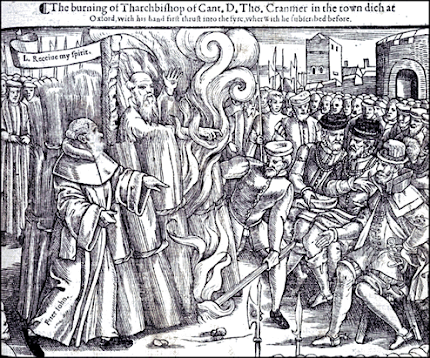
The burning of Tharchbishop of Cant. D. Tho. Cranmer in the town dich at Oxford, with his hand first thrust into the fyre, wherwith he subscribed before. [Click on the picture to see Cranmer's last words.]

Daily Bible Verse

Sunday, July 30, 2006

My Comment on Barthian Theology at Chaos and Old Night

Have you read Carl F.H. Henry's God, Revelation and Authority? Henry gives the best critique of neo-orthodoxy and Barth I've ever read. Essentially, Henry's position is that the Bible IS God's Word. Thus, there are propositional truths throughout the Bible that can be understood through reason. In that case, even the unbeliever can understand the Bible even though he or she may disagree with what it says or proposes.

The trouble with Barth is that he has bought into Kantian philosophy and rejects the idea that revelation can exist in any objective form here and now. Thus, the only way to understand anything from God is by an existential encounter or mystical experience. The problem I have with this approach is that it winds up conceding back to liberal theology that truth is relative and therefore beyond our reach except on a personal level.

I will admit that I haven't read much of Barth's theology firsthand but I will do so. I have, however, read all six volumes of Carl Henry's theology. I have read some of Barth firsthand but there is so much material wouldn't wouldn't know where to begin. However, my philosophy is that we should know our OWN theology so well that when we encounter something false we will know it immediately. If I spent all my time reading Mormon theology and not Evangelical theology, pretty soon I would find myself becoming a Mormon. I think that is what happened with Jarislav Pelikan, a former Lutheran, who converted to Eastern Orthodoxy. Those who do not know their own tradition well before dialog and interaction with other traditions open themselves to conversion. Faith seeks understanding and not the other way around.

I don't mind reading liberal theology but I need edification, too. Thus, I spend a lot of time reading Evangelical theology and classical Calvinist theolisn't. That isn't to say that I haven't studied modern theology. I heard Wolfhart Pannenberg, Jurgen Moltmann, and Peter Stuhlmacher lecture when I was in seminary. Probably others as well, but those three come to mind just offhand.

I guess we shouldn't be so enamored with world famous liberal theologians that we neglect to do our own theology and offer critical responses to modern theology. Again, in my opinion, Carl F. H. Henry has done the best job I have seen to this point. Most other so-called "Evangelicals" are selling out to liberalism in droves. I might mention Gregory Boyd and Clark Pinnock as two examples of this.

The term "Evangelical" is getting so vague lately as to become practically meaningless. Under the influence of increasingly "neo-orthodox" influences in Evangelical seminaries and the Pentecostal/Charismatic movement, evangelicalism seems to be selling out to experience and existentialism rather than keeping a firm hold on dogmatic theology and doctrinal concerns that Scripture itself raises.

I personally disagree with Kantian philosophy and with existentialism, which is also why I reject Barthian theology. Donald Bloesch's critique of Carl Henry in his systematic theology reveals the dangers of rejecting the Scriptures as an objective revelation from God. What we are left with is shifting sand and a lot of gray area. Bloesch is a Barthian theologian and part of the Evangelical side of the charismatic movement. He claims to be a "Reformed" theologian but I have my doubts about that.

Just my thoughts on the discussion at hand. I still think even with the nuances you mentioned, that Barth's rejection of propositional truth and of the objective nature of God's revelation to man in the Scriptures is way off base.

Sincerely,

Charlie Ray

Friday, July 28, 2006

An Open Letter to Bishop Royal Grote

Dear Bishop Grote,

I recently re-read Bishop Cheney's sermon preached on Sunday Evening, December 7, 1873 in which he strongly and severely criticized the Anglo-Catholic interpretation of the Gospel and of the Thirty-nine Articles of Religion. Honestly, I was first drawn to the Reformed Episcopal Church because I saw that it was committed to the clearly Protestant doctrines as outlined in the Thirty-nine Articles of Religion. It saddens me that the whole reason for being of the Reformed Episcopal Church is now being cast aside as if it never happened in the first place.

I happen to agree with Bishop Cheney's sermon (see http://anglicanhistory.org/usa/rec/cec_dec1873.html) and I fail to understand how the REC could be in common cause with Anglo-Catholics or even consider merging with a decidedly Anglo-Catholic denomination like the Anglican Province of America. I have visited Bishop Grundorf's parish and I have seen and heard for myself that they are indeed Anglo-Catholic and have a different understanding of justification by faith alone than that which is outlined in the Thirty-nine Articles of Religion or in the homilies. Even Richard Hooker's Justification Discourse clearly contradicts the views of the Anglican Province of America (see http://www.ccel.org/ccel/hooker/just.toc.html).

The very core of the Gospel is justification by faith apart from our own merits and to confuse sanctification with justification is to commit an egregious error such that the gospel being preached is no longer the Gospel of Jesus Christ or the Gospel that Paul declared to be his own Gospel. Righteousness is in no wise infused into the heart or inherent but is instead a judicial/forensic declaration whereby the guilty sinner is declared to be not guilty, despite the fact that he is still a sinner.

I feel that the Reformed Episcopal Church has compromised the Gospel of Jesus Christ and is headed in the direction of heterodoxy if not outright heresy. The REC is essentially redefining the Thirty-nine Articles of Religion so that it can accommodate itself to union with those who deny the very Gospel itself. Make no mistake about it--this is a historic moment for the REC. It is in short order becoming just another broad church where doctrine is irrelevant and unity is more important than truth.

Of course, the issues facing the Anglican Communion at large are important. No one wants to see homosexual and women priests or bishops. However, it is just as serious a departure from the faith once delivered to the saints when a communion or province accepts definitions of the Gospel that depart from Holy Scripture and from the Protestant document we know and love as the Thirty-nine Articles of Religion.

I feel abandoned by my bishops and by the Reformed Episcopal Church as a whole. It saddens me to see the REC go astray like so many other broad churches of our day. The Evangelical movement has become so confused that the word "Evangelical" has become practically meaningless. In a day and time when the Gospel needs to be honored above ecumenical concerns for unity, the REC has apparently decided that the Gospel is merely some ambiguous and muddy thing that can be shaped to man's views at whim.

Sincerely yours in Christ,

Charlie J. Ray

Former deacon with the REC

Tuesday, July 25, 2006

The State of the Evangelical Churches Today

Considering the condition or state of today's Evangelical movement and its constituent denominations and churches is a difficult task. However, judging from the quality of the publications coming from the various publishing organs and the quality of the sermons being delivered, we are in a dismal mess.

Additionally, the quality of education at most Evangelical colleges and seminaries in theological matters is growing worse instead of better. Most programs are focusing on business administration and church growth principles instead of giving students the ammunition to confront neo-orthodoxy, modernism, and postmodernism head on. Instead of presenting an intellectual apologetic or helping students to develop such an apologetic, most seminaries simply report the current and past views and positions with little or no critical evaluation of said positions. Basically, taking that approach leads to a practical education of students in liberal theology and neo-orthodoxy. While I'm not suggesting that seminaries neglect educating students about these issues, I am critical of seminaries which do not critically engage the material or show possible alternatives to these extremely liberal positions.

An additional problem is the so-called church growth movement, which is simply a form of liberalism that has infiltrated Evangelicalism at its weakest point: pragmatism. Most Evangelicals have a great concern for evangelism and spreading the Gospel of Jesus Christ all over the world. This genuine passion for souls has led to a form of pragmatism that is in effect producing the exact reverse of the alleged intent.

In Matthew 28:18-20 Jesus tells us to go into all the world and to "make disciples" of people from every nation and tribe. However, making disciples implies that we ought to be teaching them something. Jesus himself was known as a teacher of theology who utilized parables in his sermons and practical applications of these sermons that could be readily understood.

However, what we see in the church growth model are mega churches which give sermons that address felt needs rather than the prophetic message of Jesus Christ and his apostles and prophets. Instead of teaching the plain meaning of the Scriptures and giving doctrinal instruction, Evangelicalism has sold out to existentialist concerns of the immediate moment by addressing the immediate concerns of people. While this will certainly produce results and draw a crowd, it does not address the concerns emphasized by the Bible itself. Essentially, the church growth movement focuses on the here and now rather than on the eternal truths of divine revelation emphasized by Jesus Himself and by Paul. To ignore revelation in favor of existentialism is to invite heresy and apostasy on a grand scale.

While there is definitely a concern for the difficulties of this life addressed in the Scriptures, there is also a concern for the hereafter. This life is temporal and temporary, fleeting, passing. Eternity shall last forever and ever and on and on. We should indeed live a life that addresses our personal and family needs, but that does not deal with the ultimate question. Where will we spend eternity? Do Evangelicals really believe in the immortality of the soul anymore? Judging from the pragmatic effects of their ministries at this time, I can only conclude that they don't.

A great many Evangelicals no longer accept the doctrine of infallibility and inerrancy of Scripture, creation ex nihilo, or the sovereignty of God in providence. Evangelicalism has basically become humanistic and anthropocentric rather than christocentric and theocentric in its theology and its praxis. The greatest weakness of Evangelicalism has turned out to be an accommodation to the current culture, which, instead of changing the society and the culture to a more Christian worldview, has changed and tweaked Christianity in its Evangelical form into something quite different. In essence, Evangelicalism, while being critical of liberalism and modernism on the surface of things, has become just another form of liberalism and modernism in the facade of a conservative Christian worldview. I say facade because it is merely a front. On a closer critical evaluation, Evangelicalism holds some of the very views it claims to prophetically challenge.

What is the solution to this dilemma? My first suggestion is that Evangelical colleges and seminaries need to be willing to critically evaluate the church growth movement and pragmatism. There needs to be a greater balance between what works and what is prophetically true. Success is not the only measure of truth, though we must certainly acknowledge that without some measure of success Christianity as a religion would not exist at all. The real measure of success isn't practical results but theological fidelity to the message of the Gospel of Jesus Christ as it is revealed in Holy Scripture. It is in making disciples who understand the Scriptures both systematically and contextually.

Secondly, despite modernism's revulsion, rote memorization of Scriptures, creeds, and catechisms are a must. Churches need to do a much better job of discipling both new converts and long standing members in Scripture and creed. Most people today cannot even recite the ten commandments or the apostles' creed. The gross ignorance of most church members is just one indicator of the poor quality of most Christian discipleship programs within Evangelicalism. While rote memorization is not the only solution, it is part of a integrated Christian education program that doesn't ignore instruction in favor of mere moralism and pietism. Knowledge includes rote memorization as well as being able to articulate what it is that we know. If have memorized the multiplication tables or mathematical formulas, why is that we cannot memorize key Scripture verses, catechisms, and creeds?

If the current condition of Evangelical denominations is any indicator, if the losing of the culture and theological wars within mainline Protestant denominations are any indication, Christianity is headed for a great apostasy like we have never seen before. The Episcopal Church USA even ordains openly homosexual priests and consecrates openly homosexual bishops. If the situation gets any worse I will have to wonder if the Holy Spirit has withdrawn Himself in preparation for the final judgment?

Those of us who are trying to remain faithful to the Holy Scriptures must pray for God to intervene and to bring a revival of truth to Evangelicalism and to the Christian church as a catholic or universal entity.

May God have all the glory!

Sunday, July 16, 2006

Do Faith-Based Programs Violate Separation of Church and State?

In a recent Christianity Today article, "Imprisoned Ministry," the question was raised as to whether or not faith-based programs to reform prison inmates violate the principle of separation of church and state. Having worked as a state prison chaplain in Florida for almost four years, I believe that my opinion is qualified from that experience.

At one time I was committed to faith-based programs and believed that such programs could indeed effect lasting change and reform of criminals who really wanted help. However, the longer I worked as a chaplain the more I came to realize how deeply rooted social and psychological problems are with men and women who wind up incarcerated. Of course, being a theologian of sorts, I realize that the root of all dysfunctional behavior is the fall of mankind into rebellion and sin against God and that all of Adam's descendants, both male and female, are counted guilty of Adam and Eve's original sin and also inherit a complete and total corruption or depravity within their human nature. This total depravity does not mean that all of us are as wicked as we could be in our actions but that every single human being has had every area of the human nature affected and corrupted by sin, including the mind, will, heart, and soul.

The fact of the matter is that sin is both an individual and a social problem. Extremely right wing conservatives in the political arena tend to downplay the responsibility and accountability of society in creating dysfunctional and oppressive social structures and circumstances that contribute to the deterioration of the family and to social problems like crime, drug and alcohol abuse, domestic violence, abortion, prostitution, and juvenile delinquency. Of course, everyone agrees that individuals own responsibility and accountability for their own choices and actions in life. But the problem is that the Bible itself sees sin as more than just individual choices. Scripture clearly raises the issue of familial, tribal and even national sins. And sometimes in Scripture we see God punish whole families and tribes for the sins of their leaders. At Ai, for example, Achan and his whole family and all of his animals are destroyed as a result of his stealing valuables as booty when such items were under a ban during the holy war that God had called for (see Joshua 7:1-26). The nation of Israel itself was divided and taken into captivity to Assyria and Babylon in 722 B.C. and 586 B.C. respectively.

Personally, I believe that our nation as a whole bears some of the responsibility for social problems, since the Bible itself takes that position. The Bible also provides for "welfare" programs to help the needy, the alien, the widow and the orphan. Interestingly, the Bible even provides for the support of a professional priesthood. What is different today, however, is that we no longer live under the direct revelation of God through a prophet like Moses. The ancient nation of Israel was a theocracy and had a prophet who spoke face to face with God. Furthermore, the United States today is a secular nation which also upholds the principles of religious freedom and the separation of church and state. There is to be no interference of the state in religious matters or in the church. Additionally, there is to be no state supported church nor should public tax monies go to establish a religion, church, or religious interest, be it atheistic or overtly religious. The law of the land should neither establish secular humanism nor atheism as a official "religion" anymore than it should establish traditional Christianity as its "official" religion. It is often a balancing act to know how to bring about this plurality of religions and non-religions so that the law is upheld without discriminating against any particular group whether it be religious or non-religious.

Having said all of that, I believe that the Prison Fellowship programs as stated in the Christianity Today article do indeed violate the separation of church and state. My original understanding of the program was that all staff would be paid by funds raised through local churches. Instead we find that the program director and others are paid from taxpayers' funds. Not only does this establish Prison Fellowship as a government sponsored religious institution, but it also undermines the vitality of churches and true faith. When churches become state sponsored the inevitable end is that faith is weakened and religious fervor is dampened. People tend to take religion for granted and the church grows increasingly stagnant. Attendance drops and the church loses the power to transform individuals and society through its prophetic witness to Jesus Christ.

While the success rate of the Prison Fellowship program looks great on paper and the recidivism rate is much lower than other programs at first glance, this positive assessment is only apparent before considering those who drop out of the program. Further examination shows that about 58% of all inmates drop out. Since Prison Fellowship allows non-Christians to participate, I'm guessing that mostly non-Christian inmates are dropping out. Thus, this is further evidence that the state is essentially endorsing Christianity as an official religion. Can you imagine what Christians would say if some Islamic organization were getting this sort of special treatment and endorsement by state and federal governments?

It is my opinion that only those inmates who are sincere about a transformation in their life will be able to benefit from a faith-based program. Furthermore, even those who are sincere often come back to prison because of a lack of support from family and church on the outside. To measure the success of a program solely on recidivism rates misses the point completely. Of course, we should be concerned about recidivism rates. But if we are concerned about recidivism, then churches ought to be doing more to integrate the homeless, the poor, and the ex-prisoner into society and into the life of their parishes and churches!

It is precisely for these reasons that the government should not be using taxpayer funds to endorse any faith-based programs of any kind. To do so is to essentially support the conversion of inmates to a particular religion through a governmental means. Moreover, I am opposed to giving tax funds to the Salvation Army or Roman Catholic social service organizations for the same reasons. If churches wish to have programs to help the poor, let them raise their own funds to do so. Let religious organizations practice what they preach and encourage charity and generosity to the less fortunate and let their ministers and leaders demonstrate this by their own example. They should take lower salaries or give more of their salaries to charity, particularly those ministers who benefit from a wealthy parish or church.

I believe that government agencies should feel free to refer those in need to various religious programs that are compatible with the individual's own beliefs; however, the government should not be in the business of religion or supporting religion with tax funds. Moreover, my opinion has changed because from my experience, not even faith-based programs are that successful. Social problems and individual dysfunction is so ingrained because of the sinfulness of human beings and of social structures that real, practical change can only come about by a direct intervention by God Himself. This does not excuse us from making an effort to help the poor and the prisoner and the homeless, however (see Matthew 25:31-46; James 2). We should support non-religious social programs paid for by taxpayer funds. But to use those same funds to sponsor one religion above another under the guise of transformational programs is both misguided and unconstitutional. Not only that but they don't seem to be working. If anything, governmental endorsement of religion weakens not only our religious freedom but also the vitality of religion itself. The ancient nation of Israel was a theocracy yet having a national religious identity did not prevent national apostasy and eventual disintegration and the judgment of God.

I believe Christians should continue to participate in the political process and to work for the reform of the nation and society. We want to uphold human rights from a biblical perspective. But in doing so we should not sell out to endorsing big business to the neglect of the poor, nor should we sell out to immorality in the name of helping the poor. Furthermore, we should never allow any single religious group to receive tax funds or government support since this amounts to a violation of church and state. The Republican experiment in faith-based programs seems to be a dismal failure at this point. Perhaps in another post I will examine the issue of separation of church and state regarding public education.

Peace!

[Postscript: The argument over justification by faith alone is often challenged by an appeal to James 2:17-26. However, both those advocating justification by faith alone and those advocating a justification by our own merits overlook the context of James chapter 2. The immediate issue and the immediate context of James' remarks is not justification itself but charity to the poor and favoritism toward the wealthy and the middle class. Christians should also note that Matthew 25 makes it clear that individuals and the church as a whole will be judged according to how we have ministered to the less fortunate. I believe the Bible does teach a preferential option for the poor. Anyone reading the Bible in context cannot avoid this implication except by a sinful hardening of the heart and a natural propensity to covetousness and idolatry. Luke's account of the rich young ruler and other stories is proof of this, as well as Matthew's sermon on the mount.]

Friday, July 14, 2006

Ambiguity and Deceit in Public Speech

I am increasingly less tolerant with doublespeak in the political and public arena these days. Why can't politicians and preachers just speak plainly and tell us what they really believe on an issue? Jimmy Carter claims to be an "evangelical" and a "conservative Christian" and a "born again Christian." Yet Carter denies that there is a common faith because he believes that faith is what the individual believes apart from his church or denomination. In effect, Carter is making individualism the primary basis for faith. But this gets back to the biblical problem where every man does what is right in his own eyes.

Carter vilifies "fundamentalist" Christians while claiming to be a "conservative" himself. What Carter really means is that any Christian who disagrees with him is a "fundamentalist." In all reality, Carter is a theological liberal and his identification of himself as a "conservative" Christian is a misnomer (see Albert Mohler's comments at http://www.baptist2baptist.net/b2barticle.asp?ID=39 ). Not surprisingly, the largest Baptist denomination in the United States is the Southern Baptist Convention and is "conservative" and not "fundamentalist." It's popular to use labels to discredit one's opponents while condemning those who use labels to identify their positions. Carter is guilty of this by labeling his opponents as "fundamentalists," yet Carter himself disdains being called what he really is: a theological liberal. Not all evangelical Christians are fundamentalists. The trouble is liberals are trying to pre-empt our own labels and nomenclature to deceive people into thinking that liberals are actually conservatives. The situation has gotten so bad that the term "evangelical" is practically meaningless these days. (See Carter's remarks at http://www.yuricareport.com/Dominionism/JimmyCarterChristianRightIsntChristian.html).

Christians realized too late that Jimmy Carter was a liar. Moreover, he claimed to be against abortion but when the rubber met the road he was a radically pro-choice president and basically lied to the American people about his true position. In fact, it was this lie which cost him re-election in 1980.

The war of words and rhetoric has become so blurred that it is practically impossible to trust what any politician says in public anymore. The reason is that so many of them use doublespeak to hide their true position. Carter is no different. If only Carter would be honest and stop trying to vilify those who sincerely disagree with him as "fundamentalists," then we could have a real dialogue and an honest discussion. As it stands, men like Jimmy Carter have simply muddied the water, hiding their true beliefs behind a smoke screen of ambiguity.

In fact, this should be a red flag to all of us. Anytime a person's words don't line up with his actions, you can bet that his words are meaningless and more likely to be doublespeak of the kind mentioned in the George Orwell novel, 1984. It's rather like Hitler's propaganda that had so-called "Christians" agreeing with the genocide of the Jewish people. Carter's statement that he is opposed to abortion while publicly endorsing and actively promoting "a woman's right to choose" is on the same level as a German Christian saying that he opposes the genocide of the Jews while at the same time participating in genocide by active government legislation pushing the agenda of genocide. It's time for Christians to stop allowing such deception to pass by without shouting the alarms from the rooftops.

Democrats have publicly stated that they don't care if they get the conservative Christian vote. Well, until they change their party platform and remove abortion and gay rights as planks, until they stop their aggressive anti-Christian policies, they will most certainly lose any appeal to conservative and evangelical Christians.

Jimmy Carter has said that "fundamentalist" Christians vote Republican because they hate the poor and they are prejudiced. But Carter is misreading the situation. Many conservative Christians vote Republican because they are forced to do so by moral conscience that overrides the other issues. I would be more than willing to vote for Democrats if they would stop with their anti-Christian agenda. In fact, I happen to agree with many of Carter's views regarding our care and support of the less fortunate and I agree that society and government bear some of the responsibility for poverty and crime since these are sociological problems as well as the problems of individuals who act in irresponsible ways.

I have much empathy for the poor and it appalls me that Republicans and the far right commentators like Rush Limbaugh, Sean Hannity, and Bill O'Reilly can be so insensitive and so ignorant of the real situation regarding social problems like poverty, unemployment, drug abuse, crime, prostitution, and other social issues. But the reason I cannot bring myself to vote for any Democrat is that no Democrat I know of rejects the party planks for pro-choice on abortion and unrestrained views regarding "gay rights." I don't reject gay rights as far as equal housing and employment. But when it comes to giving them special privileges like civil partnerships and gay marriage and all the rest, I think gays and lesbians should have no more rights than any other single American. I draw the line there.

Democrats just don't get it. I hope they keep losing elections until they get the message. My advice to conservative Christians is to keep boycotting the Democratic Party by voting Republican; or they could start a new party that rejects the abuses of the Democratic party on moral issues like abortion and gay rights and rejects the abuses of the Republican party on issues like homelessness, medical care, poverty, crime, etc. At any rate, voting for Democrats right now would be like voting for the antichrist. While the Republican party has its share of apostates, at least it isn't openly hostile to the morality of the Bible as traditional Christians see it.

I don't personally identify completely with any political party. My faith stands or falls apart from politics. However, I do see myself obligated to uphold God's moral law. The quandary is that neither the Democrats nor the Republicans uphold God's moral law. One party is in favor of murdering the unborn and the other is oppressing the poor. What shall we do? Voting for either party is condoning one evil or the other. I guess for me it comes down to voting for the lesser of two evils. At this point in time I believe conservative Christians should keep voting for Republican candidates who do not give in to judicial legislation from the bench, who refuse to give in to double-talk about abortion and other moral issues that concern every Christian. Outright murder of the unborn overrides the issues of medical care, poverty and crime until such time as Democrats repent of their sin.

May the peace of God be with you!

Tuesday, July 11, 2006

The Articles of Religion: Guest Remarks

The following article is from The Tradition Protestant Episcopal Church website. I have made minor corrections in brackets where capitalization, punctuation, and word omission errors occur in the text. However, the general thrust of the article is in agreement with my own views on the Articles:

The Articles of Religion

C.W.F. Smith

Until the middle of the 17th century there was no significant attack upon the Articles of Religion. But with the rise of Latitudinarians in the late 17th century (Church rationalists who were indifferent to some ecclesiastical norms) there began a strong tradition which became increasingly uneasy with the Articles on Sin (IX, X), on Justification (XI, XII, XIII) and on Predestination (XVII).

The first objections to the Articles, however, were from the opposite tradition. In the 16th century puritan Anglicans objected to the language of salvation which did not appear to them to measure up to the rigor of their understanding of Calvin's teaching. The Anglican Articles are, on these points, continually disappointing to tidy minds, but they represent the commendable insight expressed later by Charles Simeon who refused, he said, "to be any more systematic than Holy Scripture" on these matters.

The next significant attack on the Articles was from John Henry Newman in his well known Tract 90. Here the insistence was not that the Articles, like the law, were impotent to redeem but, implicity, they were the"wrong" Articles. The "correct" Articles would be those of the Council of Trent (1545-1563), the doctrinal standard of Roman Catholicism since the 16th century. His ingenious attempt to reconcile these doctrinal differences by interpreting the Anglican articles so they would agree with the Roman Catholic Council failed and the result was his choice between the two; and he became a Roman Catholic.

The precedent of "interpreting" the Articles to make them fit one's express disagreement with them was at first hailed as a liberating device by the Tractarians [and] [sic] (the) their descendants. [B]ut what was sauce for the Anglo-Catholic goose became sauce for the Liberal gander. If the Articles could be interpreted by some to repudiate the Reformation, then they could be interpreted by others to repudiate the teachings of Chalcedon and the Creeds.

Many are offended by the Articles of the Anglican Reformation because their ecumenical hope is with Roman Catholicism, but this hope does not seem to include a trust that Roman [Catholicism] may one day repent of any explicitly and admittedly non-biblical dogmas. These dogmas are: The Immaculate Conception, 1854; The Infallibility of the Papacy, 1870 and The Bodily Assumption of the Virgin Mary, 1950. Each of these doctrines is at odds with the teachings of the Articles as are those medieval and Tridentine (counter-Reformation) doctrines of compulsory celibacy, indulgences, works of supererogation, and the teaching that tradition has equal authority with Scripture. These are still the official teaching of post-Vatican II Roman Catholics.

The dislike of the Articles from the opposite, or liberal, side when it is a matter of substance, and not merely a general antipathy to any form of doctrinal statement, would almost invariably apply not only to the Thirty-Nine Articles but to Scripture itself. [T]he great mystery of election and predestination is, more frequently than not, swept aside and the tension [between free] will and grace resolved by a Plagianism sufficiently crude to embarrass even Erasmus! Anselm's doctrine of the Atonement, Aquinas' teaching on Predestination, and Augustine's opinions on the Nature of Man are unfailingly dismissed by contemporary Pelagians as "Calvinist"!

There should be no argument that the Thirty-Nine Articles are less than perfect, represent a 16th century formulation and are, as they themselves make explicitly clear, subject to the higher claims of Scripture. There cannot, however, be any doubt that they represent an official and duly constituted statement of the doctrine in Anglicanism.

Traditional Protestant Episcopal Church

From: http://www.reformer.org/articles/articles.cgi?action=fullscreen&primary_key=6

Support Reasonable Christian Ministries with your generous donation.