>

Martyred for the Gospel

Martyred for the Gospel
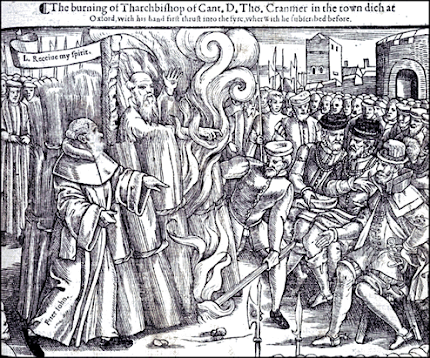
The burning of Tharchbishop of Cant. D. Tho. Cranmer in the town dich at Oxford, with his hand first thrust into the fyre, wherwith he subscribed before. [Click on the picture to see Cranmer's last words.]

Daily Bible Verse

Wednesday, September 26, 2007

Ultimatum?


Many conservatives in the Episcopal Church USA seemed to think September 30th would be a time where a real decision would be made by the Primates of the Anglican Communion regarding the apostasy of the Episcopal Church. But those of us wise enough to know the tactics of the enemy saw through it all. Of course the ECUSA House of Bishops met on September 30th and was expected to respond to the call of the primates of the Global South and Asia to promise not to ordain more openly gay priests or consecrate more gay bishops.

But knowing that the Archbishop of Canterbury, Rowan Williams, is himself a theological liberal who has ordained an openly homosexual priest and privately agrees with the homosexual agenda, why would we be surprised that the ultimatum issued by the primates is really not an ultimatum at all?

Furthermore, promising not to ordain more gay priests or consecrate more gay bishops does not go far enough. The conservative primates ought to demand that the ECUSA House of Bishops should remove the homosexual bishop of New Hampshire, Gene Robinson. The visible church should as much as possible seek to establish born again, Bible believing ministers as its leaders. To know that a minister is a theological liberal, or even worse, openly gay and living a sexually immoral lifestyle is beyond comprehension.

What is more, the so-called Conservatives who are part of the continuing Anglican movement here in the USA are no better than the liberals they are criticizing. The Anglo-Catholics twist and distort Scripture and the Thirty-Nine Articles of Religion to justify their Romish doctrines, which no self-respecting Reformed person would ever tolerate given the historical, cultural, and Scriptural foundations of the English and Continental Protestant Reformation. Anglo-Catholics in the continuing movement and in the common cause against the homosexual agenda and theological liberalism are just as lost, just as much part of the satanic attack against the true universal church of Jesus Christ as any liberal in the Episcopal Church.

Why? Simply because they reject outright the Scriptural doctrines established by the Bible from the beginning. Sola Scriptura, Sola Fide, Solus Christus, Sola Gratia, and Soli Gloria Deo. Scripture alone is the final authority in matters of doctrine, not bishops or churches. If the current situation in the Anglican Communion doesn't convince you, take a long look at church history. At one point, most of the bishops of the Catholic Church of fourth and fifth centuries were Arian rather than trinitarian and saw Jesus as an angelic being slightly lower than God.

Moreover, both the Eastern Orthodox churches and the Western Roman Catholic Church accept icons, veneration of the saints, real presence of Christ in the eucharist and a host of other departures from the apostolic doctrine given by Christ Himself. I can further add that both the East and the West deny justification by faith alone and make faith plus good works a condign merit that can earn one's salvation. Such views make slight of the perfect life of Jesus Christ who never sinned in thought, word, or deed. Such views make slight of the cross of Jesus Christ where He died a sinner's death in our place to purchase once and for all His elect from their sins past, present and future.

Not only do the liberals not get it but the conservatives in the Anglican communion don't get it either. They somehow think that conservative Anglo-Catholics are preaching the "Gospel" when what they are actually doing is preaching a counterfeit gospel of works righteousness. Salvation is a free gift that cannot be earned or merited or deserved.

Ephesians 2:8-9 (KJV)


8 For by grace are ye saved through faith; and that not of yourselves: it is the gift of God: 9 Not of works, lest any man should boast. [1]

To compromise with the House of Bishops and allow the homosexuals in office to remain there is tantamount to letting the devil have his way in the visible church. To compromise with the partners in common cause, like the American Anglican Council and the Anglican Communion Network, is no better option since they are in common cause with Anglo-Catholics who preach another gospel:

Galatians 1:6-12 (KJV)


6 I marvel that ye are so soon removed from him that called you into the grace of Christ unto another gospel: 7 Which is not another; but there be some that trouble you, and would pervert the gospel of Christ. 8 But though we, or an angel from heaven, preach any other gospel unto you than that which we have preached unto you, let him be accursed. 9 As we said before, so say I now again, If any man preach any other gospel unto you than that ye have received, let him be accursed.

10 For do I now persuade men, or God? or do I seek to please men? for if I yet pleased men, I should not be the servant of Christ. 11 But I certify you, brethren, that the gospel which was preached of me is not after man. 12 For I neither received it of man, neither was I taught it, but by the revelation of Jesus Christ. [2]


The warning in 2 Corinthians is relevant as well:

2 Corinthians 11:1-8 (KJV)


1 Would to God ye could bear with me a little in my folly: and indeed bear with me. 2 For I am jealous over you with godly jealousy: for I have espoused you to one husband, that I may present you as a chaste virgin to Christ. 3 But I fear, lest by any means, as the serpent beguiled Eve through his subtilty, so your minds should be corrupted from the simplicity that is in Christ. 4 For if he that cometh preacheth another Jesus, whom we have not preached, or if ye receive another spirit, which ye have not received, or another gospel, which ye have not accepted, ye might well bear with him.

5 For I suppose I was not a whit behind the very chiefest apostles. 6 But though I be rude in speech, yet not in knowledge; but we have been throughly made manifest among you in all things. 7 † Have I committed an offence in abasing myself that ye might be exalted, because I have preached to you the gospel of God freely? 8 I robbed other churches, taking wages of them, to do you service. [3]

Unfortunately, the theological liberals in ECUSA will continue to lie and to stall to get their way. They will continue to preach a false gospel which allows for homosexual immorality and other sexual immorality. They will continue to deny the resurrection of Christ, the miracles of the Bible and the authority of Scripture. Reformed and Evangelical Anglicans ought to be looking for the exit door.

Even more unfortunately, the Anglican Communion Network and the American Anglican Council are not preaching the Gospel either. What they are preaching is Anglo-Catholic doctrine or charismatic/pentecostal doctrine. Both either outright lie or secretly distort the doctrines of grace to the point that the Gospel no longer exists.

It is time for Bible believing Protestant and Evangelical Anglicans to form their own communions apart from compromisers with the devil. Only a few of these denominations exist. However, I think I can safely recommend the Traditional Protestant Episcopal Church and the Church of England Continuing.

May the peace of God be with you!

Charlie

For a better understanding of the context of my remarks see:


http://www.anglicancommunion.org/acns/digest/index.cfm

and
http://www.christianitytoday.com/ct/2007/septemberweb-only/139-21.0.html

Also,see this article at the Sydney Anglican Church League site:

Thursday 27th September 2007

“Episcopal Bishops Reject Anglican Church’s Orders”

“Bishops of the Episcopal Church on Tuesday rejected demands by leaders of the worldwide Anglican Communion to roll back the church’s liberal stance on homosexuality, increasing the possibility of fracture within the communion and the Episcopal Church itself.After nearly a week of talks at their semiannual meeting in New Orleans, the House of Bishops adopted a resolution that defied a directive by the Anglican Communion’s regional leaders, or primates, to change several church policies regarding the place of gay men and lesbians in their church. But the bishops also expressed a desire to remain part of the communion, and they appeared to be trying to stake out a middle ground that would allow them to do so....

”A comprehensive report from The New York Times.

http://www.acl.asn.au/

http://www.nytimes.com/2007/09/26/us/26episcopal.html?_r=1&n=Top/Reference/Times%20Topics/People/B/Banerjee,%20Neela&oref=slogin

For information about the liberal position of the Archbishop of Canterbury see:

http://timescolumns.typepad.com/gledhill/2007/09/rowan-williams-.html


[1] The Holy Bible : King James Version. electronic ed. of the 1769 edition of the 1611 Authorized Version. Bellingham WA : Logos Research Systems, Inc., 1995

[2] Ibid.

[3] Ibid. † A Greek word occurs that is not directly translated in the King James Version. Greek Strongs: 2228

Sunday, September 23, 2007

James White Versus Bishop John Spong on Homosexuality


http://www.aomin.org/catalog/product_info.php?products_id=688

Who Was Bishop J. C. Ryle: James White Versus Bishop Spong Part 2


You can purchase a DVD or CD of this debate at: http://www.aomin.org/catalog/product_info.php?products_id=688

Dr. James White's Debate With Bishop John Spong of the Episcopal Church USA


This one speaks for itself! But you should pay particular attention to what Spong says at the end of the discussion when he says that the Bible is not the Word of God but rather Spong "hears" the word of God through the reading of the Bible. This is essentially the neo-orthodox view of revelation that was popularized by Karl Barth. What is especially disturbing is that many Reformed and Evangelical seminaries are now buying into Barthian theology. Look where neo-orthodoxy leads. Ultimately, it leads back to theological liberalism and postmodern thinking.

The current state of the Episcopal Church USA is a result of compromising with theological pluralism, i.e., the "middle way of Anglicanism", and compromising with theological liberalism and neo-orthodoxy. If Christianity is to survive as a universal religion, then Protestants need to speak up and speak out as Dr. James White is doing.

The so-called "conservatives" of the dispute in the Anglican tradition represented by the American Anglican Council and the Anglican Communion Network are headed toward the same kind of result that we already see in Bishop Spong and the ECUSA denomination. It's only a matter of time before the slippery slope brings the current conservative Anglicans back to the theological liberalism rampant today. Compromising the Protestant and Evangelical and Reformed emphasis of the Thirty-Nine Articles of Religion in order to make peace with Anglo-Catholics always leads to liberalism down the road. It's just a matter of time. There is no middle way between truth and heresy!


Charlie

P.S. You can purchase a DVD of this debate at http://www.aomin.org/catalog/product_info.php?products_id=688

Monday, September 17, 2007

A Critique of the Equivocating Statements Made by the Bishops of the Reformed Episcopal Church, Part One

The task before me and the mountain of evidence against the bishops of the Reformed Episcopal Church makes it difficult to decide where to begin. However, in the following discussion I shall attempt to outline the arguments made by the Reformed Episcopal Church for discarding their adherence to the reformed and evangelical tradition in favor of a merger with Anglo-Catholicism. In my opinion this departure also constitutes a departure from the very Gospel itself since there can be no middle way between truth and error, nor can there be more than one Gospel of Jesus Christ. I would further like to distinguish between what I would call "Christian" in the sense of biblical and universally accepted doctrine and so-called "christians" who claim a broad consensus based on a very minimal doctrinal content and deny the essentials of the very Gospel itself as defined by Holy Scripture and as that Gospel was preached and taught by the English and Continental Reformers during the sixteenth century Protestant Reformation. While this task is daunting, complicated and difficult to tackle, I shall give it my very best effort.

In preparation for this critique you might want to read the following two articles produced by the bishops of the Reformed Episcopal Church and the Anglican Province of America: "True Unity by the Cross," and "Statement of Anglican Belief and Practice: A Joint Statement by the Reformed Episcopal Church and the Anglican Province of America concerning Anglican Belief & Practice." Please note that the first article on true unity was produced last year, 2006. Also note that the bishop who ordained me, James West, is a signatory of the document.

The problem with the REC's position on the merger is that it sacrifices the essentials of the Christian faith in favor of a minimalistic view which only includes the Apostles' Creed and other universally accepted doctrines while at the same time rejecting the Evangelical and Protestant fundamentals which are universally accepted by all Protestants. There can be no union with churches which reject the Evangelical nature of Holy Scripture and the essential doctrines of the Protestant Reformation because these doctrines are derived from Holy Scripture.

Of course the REC claims that it has not forsaken the Gospel, denied the authority of Scripture or placed tradition ahead of Scripture on the three legged stool of Scripture, tradition and reason within the Anglican tradition. But anyone reading the two documents, "A True Unity of the Cross" and the statement of joint belief and practice with the Anglican Province of America can see that this is not true. A bold claim is made on page two of the "True Unity" document that makes an immediately disparaging remark about the motives of those who would oppose a merger with Anglo-Catholics:

"For so long we have watched tragic fragmentation develop among the Anglican family in this part of the world. The cause has been largely due to the erosion of the Gospel and faithfulness to God’s Word in the Episcopal Church and the Anglican Church of Canada. Unfortunately most of the splintering has been needless. Group after group has formed around personalities, instead of the Gospel. The result has been the proliferation of around fifty (at last count) different Anglican jurisdictions mostly too small to number. Instead of joining already established churches such as the Reformed Episcopal Church and the Anglican Province of America, others have been created."

While this sounds noble and the tone seems irenic and reasonable at first, I would ask you to look closer. First of all, it is suggested that those who disagree with the REC and APA are somehow automatically and by default centering around personalities with charismatic leadership rather than around the Gospel. This would assume that the REC and the APA are in fact preaching the Gospel, which I would deny, especially regarding the APA. Now this is just an ad hominem attack against those who openly disagree with the merger since common sense and reason shows that it is not necessarily or by default true that new churches and splinter groups begin because they are following "personalities" rather than the Gospel. I might mention that both the REC and the APA are open to this charge as well since the leaders who founded both churches seem to have been charismatic personalities.

Might it be that other continuing Anglican churches disagree strongly with compromising with Anglo-Catholics in the so-called "middle way" of Anglicanism? Why is it that unity must come at the cost of sacrificing the principle of sola Scriptura and misreading the Thirty-Nine Articles of Religion by a hermeneutic that did not exist until nineteen century Tractarianism came along?

Going a bit further in the document, the REC bishops say:

"In the past, divisions caused by false teaching have allowed true believers to unite around the Truth of God’s Word, starting with the great Ecumenical Councils. Those Councils that crafted the foundational creedal statements of the Church united Christianity. Heresy divides. Orthodoxy unites."

At first look this too sounds like a noble cause. But as you read on you will discover that the only issue of "orthodoxy" the REC and the APA seem to be concerned about is the homosexuality issue. This leads one to believe that the only false teaching that should concern us is the immorality of practicing homosexuality, ordaining homosexuals, etc. But this begs the question, "Might there be doctrinal issues other than moral ones that are just as important to true Christianity?" The faith once delivered to the saints (Jude 1:3) would include the doctrine of Scripture alone as the final word in all matters of faith. The faith once delivered to the saints would also include the doctrine of justification by faith alone, which Paul's epistles to the Romans and the Galatians establishes firmly. Thus, since Anglo-Catholicism openly and vehemently rejects both these doctrines, they cannot make a claim to be preaching the "Gospel." There is only one Gospel and to preach another gospel is to promote heresy and division and an unorthodox version of Christianity which is no Christianity at all.

Next the document goes through a lengthy discussion claiming to base unity on biblical principles as it is taught in John 17 where Jesus prays for the unity of his disciples and followers. Unfortunately, this lengthy discussion is a mere rabbit trail designed to get the uninformed on board, to misdirect the issues toward "unity" or ecumenical concerns. Unfortunately, the "biblical" principles mentioned nowhere include the doctrine of justification by faith alone, which is considered to be "necessary doctrine" by one no less formidable giant of the Reformed Anglican Church than Archbishop Thomas Cranmer. To prove this let me just briefly cite from an article by Archbishop Cranmer called "Necessary Doctrine":

"Now they that think they may come to justification by performance of the law, by their own deeds and merits, or by any other mean than is above rehearsed, they go from Christ, they renounce his grace: Evacuati estis a Christo, saith St. Paul, Gal. v., quicunque, in lege, judificamini, a gratia excidistis. They be not partakers of the justice, that he hath procured, or the merciful benefits that be given by him. For St. Paul saith a general rule for all them that will seek such by-paths to obtain justification; those, saith he, which will not knowledge the justness or righteousness which cometh by God, but go about to advance their own righteousness, shall never come to that righteousness which we have by God (Rom. 10:1-4); which is the righteousness of Christ: by whom only all the saints in heaven, and all other that have been saved, have been reputed righteous, and justified. So that to Christ our only Saviour and Redeemer, on whose righteousness both their and our justification doth depend, is to be transcribed all the glory thereof."

(From Necessary Doctrine. Please click on the web view if you do not see the sermon appear directly.)

Obviously, Cranmer considered justification by faith alone to be an essential and necessary doctrine, as anyone reading this sermon can tell. Furthermore, the Thirty-Nine Articles of Religion plainly state the doctrine of justification by faith alone and there can be no other interpretation acceptable:

"11 The justification of man
We are accounted righteous before God solely on account of the merit of our Lord and Saviour Jesus Christ through faith and not on account of our own good works or of what we deserve. Consequently the teaching that we are justified by faith alone is a most wholesome and comforting doctrine. This is taught more fully in the homily on Justification." (From Article 11).

What is more Articles 9 through 18 deal with the sinfulness of humankind, the loss of free will in matters of faith through the fall and how good works relate to one who is justified by faith alone. These articles are to be understood as an essential matter of faith and the Articles of Religion are to be taken as a Protestant "confession" of the faith of the Church of England.

King Charles I made this statement and all ministers of the Church of England were required to sign off on this document yearly:

Extracts from the Declaration of

His Majesty King Charles I
...the Articles of the Church of England... do contain the true doctrine of the Church of England agreeable to God's Word... no man hereafter shall either print, or preach, to draw the Article aside any way, but shall submit to it in the plain and full meaning thereof: and shall not put his own sense or comment to the meaning of the Article, but shall take it in the literal and grammatical sense.


However, the REC and the APA say that the meaning of the Articles is open to interpretation and otherwise equivocate and evade the plain truth of the matter. I will now cite from "True Unity" to again demonstrate the obvious departure of the REC and APA from the historical confession of faith:

"Questions have been raised about matters touching the Articles of Religion. In Anglicanism there have been evangelical and catholic ways of interpreting the Articles. According to the historic preface to the articles in the early 17th century, however, it seems that a normal, grammatical and historical interpretation of the Articles of Religion was the intended hermeneutical method. This approach would re-enforce the essential/non essential distinction. It would not commend an exclusively evangelical or catholic interpretation. At times, a literal/grammatical interpretation would allow for both, but always stopping short of Roman Catholic and more extreme Protestant dogma.

"Some articles describe teachings as not found in “Holy Writ,” meaning anywhere in
Scripture (Article 28). In other articles it is stated that a teaching is not commanded by Christ, which means it could be allowed but not required because it is based on some other part of the Scriptures (Article 25). Certain teachings are condemned as “repugnant to the plain words of Scripture” (Article 28)." (From pages 11 and 12 of "True Unity." )


At first this appears to concede to the plain meaning of the text of the Thirty-Nine Articles of religion. However, notice the qualifying statement that, "In Anglicanism there have been evangelical and catholic ways of interpreting the articles." This sounds like the English Reformers were somehow open to Roman Catholic views. However, this is totally and completely misleading as any objective reading of the historical situation of the English Reformation shows. The Anglo-Catholics are here essentially admitting that most of their views come from Roman Catholicism, by the way. But even more deceptive is the deliberate confusing of the term "catholic" with Roman Catholicism. Wait a minute. Do not Protestants also adhere to the "catholic" creeds? Of course they do. But this does not in anyway mean they are open to Roman Catholic views. Here we are seeing the deliberate hijacking of the term "catholic" to mean what it never meant to the English Reformers and is in fact a deliberate misrepresentation of the intent and plain meaning of the Thirty-Nine Articles.

One wonders if the the plain meaning of the Thirty-Nine Articles of Religion is considered "extreme Protestant dogma" in the view of the REC and APA, especially since Anglo-Catholic views are condemned right along with the Roman Catholic and Eastern Orthodox views known to the Reformers? The Articles of Religion obviously commend an "evangelical and protestant catholic "view but NOT an Anglo-Catholic or Roman Catholic or Eastern Orthodox view of things. The document is obviously thoroughly PROTESTANT but keeping what is universally accepted among all in the matters of the creeds, the deity of Christ, etc.

At this point I will take a brief intermission. I will issue part two and three in the coming days where I will deal with the REC and APA view of Scripture and tradition and how the REC has completely forsaken sola Scriptura. I will also further critique their outright denial of the Thirty-Nine articles on issues of sola Scriptura and a more subtle and deceptive use of the term "adiaphora" and a supposed compatibility of evangelical practice with Ango-Catholic practice at some "secondary" level of worship. Please forgive this cliff hanger but I do not wish to make the posts so long that it becomes impractical to read it all in one sitting.

The peace of God be to all who love the Scriptures as the only rule of faith and practice!

Saturday, September 08, 2007

Recovering Confessional Anglicanism

I won't write a new article here but I do wish to highly recommend an article from The Church Society website, "Recovering Confessional Anglicanism." Please do read this excellent article outlining the critical differences between Anglo-Catholicism and Reformed/Evangelical Anglicanism, which is faithful to the historical English Reformation.

Quote:

“When I use a word,” Humpty Dumpty said, in rather a scornful tone, “it means just what I choose it to mean—neither more nor less.”

“The question is,” said Alice, “whether you CAN make words mean so many different things.”

“The question is,” said Humpty Dumpty, “which is to be master—thatʼs all.”
(from Through the Looking Glass)

If the story of North American Anglicanism in the last generation has demonstrated anything, it is the catastrophic consequences of ignoring our Reformation formularies. Forgetting the Thirty-Nine Articles has, of course, been part of a larger assault on traditional doctrine. Relegating the Articles to the ʻHistorical Documentsʼ section of the 1979 American BCP was a small part of this shift but a revealing one nonetheless. As the costly results of a nonconfessional Anglicanism continue to work themselves out in the Episcopal Church and in the Anglican Church of Canada, orthodox Anglicans have homework to do. We need to revisit the Reformation formularies, study them afresh and work to restore them to a central place in the teaching and life of whatever orthodox body emerges from the current mess. A critical part of this study is learning how to interpret the Articles correctly in the wake of decades of misinterpretation and obfuscation.

My approach in the following essay is both descriptive (surveying quickly some of the history of interpretation) and also prescriptive, that is, arguing for what I think is the most responsible, historically-informed and fruitful way to read, understand and apply the Articles today.

Unquote.

From "Recovering Confessional Anglicanism, " by Gillis J. Harp, The Churchman, 116, vol.3.

(Click on the title above to read the entire article in pdf format. You'll need Adobe Acrobat Reader.)

Monday, September 03, 2007

What Is Sola Fide (Faith Alone)?

I have been thinking deeply about the state of "Reformed" Anglicanism lately and it is becoming more obvious to me that "evangelical" and "reformed" Anglicans in general have failed to call Anglo-Catholicism what it essentially is: a false gospel. This seems to be because the common enemy of conservative Anglo-Catholics and conservative Evangelicals is the theological and moral liberalism of the mainline Episcopal Church USA and other more modernist and postmodernist provinces within the Anglican Communion worldwide. (Please click on the title to see an appropriate definition of sola fide).

It seems to me that those who are "professional" clergy are in fear of temporal consequences in this life. Essentially, they become more concerned about losing their parish properties and their incomes for living and their retirements than about maintaining a significant witness to the Gospel of Jesus Christ.

Here is the problem. How do we define the Gospel of Jesus Christ? If we define the Gospel as merely preserving the morality of the Bible in the area of sexual ethics, then we might as well join the Roman Catholic Church, the Eastern Orthodox Church or the Anglo-Catholics who remain conservative in theology, practice, ethics and morality. After all, all of these groups stand against abortion and homosexual behavior as well as homosexual marriage. But are they preaching the Gospel of Jesus Christ or are they preaching another gospel altogether? (Galatians 1:6-10).

If we define the Gospel as the Apostle Paul defines it, if we define the Gospel as the English and Continental Reformers of the Protestant Reformation define it, then the resounding answer must be an unequivocal no. If there is one universal and catholic and "evangelical" essential of the Gospel, that one essential according to Scripture and according to the Reformers is justification by faith alone or "sola fide." This is the great divide between Eastern Orthodoxy/Roman Catholicism and the vast majority of Protestants.

Make no mistake about it. Even if the Eastern and Western churches who oppose the Protestant Reformation agree with the first four ecumenical councils and the later councils on the doctrine of Christ, such as Chalcedon, that would not necessarily mean they are true churches. Even if the East and West agree with the catholic creeds and hold the trinity and the deity of Christ as essential to true faith, this would not make these churches true. There is more to true Christianity than merely the catholic creeds. If Holy Scripture is the final authority then we must conclude that salvation is by faith and faith alone, apart from the merits of good works.

What fellowship does light have with darkness? Who can mix oil with water? Apparently, Anglicans can manage this sort of compromise quite well, judging from the compromises we see among so-called "conservative" Anglicans who are joining forces with Anglo-Catholics in the fight against homosexual marriage and the ordination of homosexuals as priests and consecration of homosexuals as bishops in some provinces of the Anglican Communion.

An apostate is an apostate whether such person be a practicing homosexual who happens to be a bishop or priest or whether such person masquerades as a true churchman on the conservative side of the homosexuality issue while at the same time denying the true Gospel of Jesus Christ by holding views contrary to Scripture and the Thirty-Nine Articles of Religion. This is especially true regarding essential doctrines of the Gospel like justification by faith alone, Sola Scriptura, salvation by Christ alone, etc. Additionally, heresies like veneration of and prayers to the saints, transubstantiation and a host of other departures from the faith must never be tolerated.

Moreover, the true churchman and genuine Christian must choose between pleasing God or pleasing man. The Christian must be willing to sacrifice the temporal pleasures and necessities of this life for the sake of the eternal rewards given to those who obey the Gospel of Jesus Christ. Remember the martyrs who literally died for the sake of the Gospel. Remember Archbishop Thomas Cramner who considered justification by faith alone so essential to the faith that he gave his life in opposition to the Roman Catholic doctrine of faith plus works. Remember the English Reformers who were burned because they refused to compromise with man's doctrines. What good is it to defeat homosexual marriage and ordination only to sacrifice the very Gospel of Jesus Christ on the altar of good works?

While the Reformed view does not deny the necessity of good works as a fruit of true regeneration and conversion, it by no means makes good works the source or cause or ground of the sinner's justification before God. The only merits which stand before God's judgment are the merits of Jesus Christ. All the good works in the world are worthless if not done by faith in Jesus Christ because even one failure or one sin deserves eternal punishment. There is only one way to heaven and that is through faith in Jesus Christ and the finished work of the cross. There is absolutely nothing the sinner can add to what Christ Jesus did in his earthly ministry or in his atoning sacrifice on the cross for the sins of the elect in the whole world throughout the ages.

It is precisely for this reason that I cannot in good conscience endorse the American Anglican Council or the Anglican Communion Network. Both of these organizations are in common cause with Anglo-Catholics and are therefore compromising the Gospel of Jesus Christ. I can mention the Anglican Mission in America, the Reformed Episcopal Church and others who have compromised with Anglo-Catholicism. Unfortunately, it seems that The Church Society is willing to compromise with Anglo-Catholics even though officially their doctrinal position is Reformed and Protestant.

Yes, there are many articles among them claiming to uphold "biblical authority" and saying that church councils may err. But this overlooks their denial of Reformed teaching of Scripture and the Articles of Religion. Also, Anglo-Catholics only admit councils err in regard to homosexuality and ordination of women in the present. Otherwise, they try to maintain some sort of view of revelation which includes an infallible Holy Tradition which goes beyond Holy Scripture. Anglo-Catholics speak with a forked tongue and refuse to accept the Thirty-Nine Articles of Religion as the articles are plainly stated.

Sadly, Evangelicalism as a whole seems to be losing touch with Scripture and with the Protestant Reformation since most Evangelicals think the differences between Roman Catholics and Protestants have all but disappeared. Even notables like Billy Graham have made this false judgment. It only goes to show that appearances can be deceiving.

Ecumenical concerns and fellowship concerns should and must take a backseat to the Gospel. What fellowship does Belial have with God? I know this is a strong statement considering the emphasis today on evangelical unity. But a false unity and fellowship is no unity at all. It is merely compromise at the cost of the souls of many who think they have believed but have been deceived by a false gospel.

May God have mercy on us all!


Romans 4:1-8

1 What then shall we say was gained by [1] Abraham, our forefather according to the flesh? 2 For if Abraham was justified by works, he has something to boast about, but not before God. 3 For what does the Scripture say? “Abraham believed God, and it was counted to him as righteousness.” 4 Now to the one who works, his wages are not counted as a gift but as his due. 5 And to the one who does not work but believes in [2] him who justifies the ungodly, his faith is counted as righteousness, 6 just as David also speaks of the blessing of the one to whom God counts righteousness apart from works:

7 “Blessed are those whose lawless deeds are forgiven,
and whose sins are covered;
8 blessed is the man against whom the Lord will not count his sin.”

Romans 4:1-8
English Standard Version

Support Reasonable Christian Ministries with your generous donation.