>

Martyred for the Gospel

Martyred for the Gospel
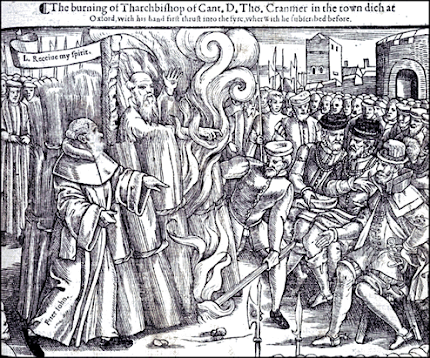
The burning of Tharchbishop of Cant. D. Tho. Cranmer in the town dich at Oxford, with his hand first thrust into the fyre, wherwith he subscribed before. [Click on the picture to see Cranmer's last words.]

Daily Bible Verse

Monday, December 29, 2008

The Consolation of Israel: A Sermon Outline

(This sermon is an outline and does not necessarily contain all the remarks I made during the delivery. The sermon was preached on December 28, 2008 at Christ Episcopal Church, Longwood, Florida).


The Consolation of Israel

Texts: Psalm 132; Isaiah 40:1-11; Luke 2:22-40

Introduction:

A preacher, who was "humor impaired," attended a conference to help encourage and better equip pastors for their ministry. Among the speakers were many well known and dynamic speakers. One such speaker boldly approached the pulpit and, gathering the entire crowd's attention, said, "The best years of my life were spent in the arms of a woman who wasn't my wife!" The crowd was shocked! He followed up by saying, "And that woman was my mother!" The crowd burst into laughter and he delivered the rest of his talk, which went over quite well. The next week the pastor decided he'd give this humor thing a try and he would use the same joke in his sermon. As he with confidence approached the pulpit that Sunday, he began to rehearse the joke in his head. Suddenly it seemed a bit foggy to him. Stepping to the microphone he said loudly, "The greatest years of my life were spent in the arms of another woman who was not my wife!" The congregation inhaled half the air in the room. After standing there for almost 10 seconds in the stunned silence, trying to recall the second half of the joke, the pastor finally blurted out, "...and I can't remember who she was!"

In the modern world we have everything figured out and demythologized. We can recognize even the revealed secrets of the masters of illusion and magic. Moreover, we have a hard time acknowledging that there is a supernatural origin for the universe and our very being. The idea of God's providential guidance of all things seems a bit harsh to us. For example, in September of 1996 Baylor University did a somewhat biased survey asking people how they viewed God:

The survey asked respondents to agree or disagree with any of 10 descriptions of their "personal understanding of what God is like," including phrases such as "angered by my sins" or "removed from worldly affairs." They could check off 16 adjectives they believe describe God, including words such as "absolute," "wrathful," "forgiving," "friendly" or "distant."

When USA TODAY asked people similar questions, it found views as varied as those of self-described fundamentalist Brian Snider of Madison, Ala., and Marilyn McGuire, who says she sees God in every sunrise and sunset, flower and kitten at her home on Orcas Island near Seattle.

Snider, 46, says God is "involved in the affairs of men at all times and he does judge us. ... We still believe he is angry at sin."

McGuire, in her late 60s and once an active Episcopalian, now rejects all dogma. "I have my own system of what I think is true and sacred. I try to keep myself peaceful and keep myself in a loving state.”


Today individual men and women no longer see themselves at the mercy of God or the natural environment. We have come to see ourselves as in control of our own lives and our environment. In essence, we have made ourselves into little gods (See Psalm 82:6-8).

However, in the past humanity saw the supernatural everywhere and even acts of nature were seen as actions taken by the hand of God (Isaiah 45:7). While I would not advocate returning to a premodern world-view of superstition and ignorance, neither would I advocate a world-view where we think we have everything figured out. As Christians we must believe that God does reveal Himself through the natural universe in a general or natural revelation (Romans 1:18-20). But we also believe that God reveals Himself in special revelation through Jesus Christ and the Holy Scriptures (Hebrews 1:1-3; 2 Timothy 3:15-16). Moreover, there exists a great deal of mystery and awe in the world even in modern times. Particularly at the birth of a child we are naturally drawn into a sense of awe and wonder at the miracle of life. However, in the case of the baby Jesus we see God working in many mysterious and supernatural ways which are totally unique. Especially as Christians we ought to see that God providentially works through the history of salvation and through the OT nation of Israel to bring to us the Messiah, Jesus Christ, the Savior of the world.

Without controversy Christians should understand that the Old Testament predicts the coming of Jesus Christ.

  1. The book of Isaiah is perhaps the longest book of the Bible and is probably the most quoted in the New Testament and the New Testament has more allusions to Isaiah than any other book of the Old Testament. In particular, we ought to recognize that the Jews of Jesus' time were most familiar with the Septuagint Greek translation of the Hebrew Old Testament, which Luke and Paul quote extensively.
  2. The Book of Isaiah was written by the prophet of the same name who lived in the 8th century before Christ and was a witness of the siege of Jerusalem in 701 B.C. During the reign of Hezekiah. Sennacherib of Assyrian came against the southern kingdom of Judah at that time. Surely Isaiah would have known about the fall of the northern kingdom of Samara to the Assyrians in 722 B.C.
  3. While some scholars would question the unity of the book of Isaiah, the overwhelming evidence is that it is the work of Isaiah, the son of Amoz. When the Babylonians sent envoys to investigate Judah, Hezekiah foolishly allowed them to see all the national treasures (Isaiah 39), prompting Isaiah to predict the fall of Jerusalem over 100 years later in the year 586 B.C. Thus, the second half of Isaiah from chapter 40-66 deals with Isaiah's vision of the fall and exile of Judah to Babylon.
  4. In Isaiah 40:1-2 we commanded to comfort the people of God. And in verse 2 we are told literally to speak to the heart of Jerusalem. “Speak tenderly to Jerusalem, and cry to her that her warfare is ended, that her iniquity is pardoned, that she has received from the Lord’s hand double for all her sins."

In modern times we have a problem acknowledging the sovereignty of God.

  1. In both the OT and in the NT God is represented as both loving and kind and as angry with sinners because of their rebellion against Him.
  2. However a constant theme of the OT is God's judgments against Israel when His people departed from obedience to God and His moral law. The ten tribes of the Northern Kingdom of Samaria fell to the Assyrians in 722 B.C. because of idolatry when Jeroboam erected two golden calves to be worshipped in the place of God at an alternate temple built there (See 1 Kings 12:26-33). However, Judah, under the rule of Solomon and later his son Rehoboam was no less guilty of idolatry and had also worshipped other gods: “because they have forsaken me and worshiped Ashtoreth the goddess of the Sidonians, Chemosh the god of Moab, and Milcom the god of the Ammonites, and they have not walked in my ways, doing what is right in my sight and keeping my statutes and my rules, as David his father did.” (1 Ki 11:33).


The prophet Isaiah accurately predicted the fall of Jerusalem to Babylon and the Babylonian captivity and exile over 100 years before the actual events took place.

  1. It would have been these prophecies in Isaiah 40-66 of which Simeon and Anna would have been thinking when they were waiting so patiently for a deliverer to arise and to redeem Israel from its current state of captivity to the Roman Empire.
  2. When God punished Israel in the past He always kept a remnant of faithful believers because of His promise to David that he would always have an heir on the throne. At the time of the dividing of the northern kingdom of Samaria from the southern kingdom of Judah, Jeroboam is given the 10 tribes of the north but the promise made to David is to be preserved through Judah and its capitol city, Jerusalem:

1 Kings 11:32-39 (ESV) 32 (but he shall have one tribe, for the sake of my servant David and for the sake of Jerusalem, the city that I have chosen out of all the tribes of Israel), 33 because they have forsaken me and worshiped Ashtoreth the goddess of the Sidonians, Chemosh the god of Moab, and Milcom the god of the Ammonites, and they have not walked in my ways, doing what is right in my sight and keeping my statutes and my rules, as David his father did. 34 Nevertheless, I will not take the whole kingdom out of his hand, but I will make him ruler all the days of his life, for the sake of David my servant whom I chose, who kept my commandments and my statutes. 35 But I will take the kingdom out of his son’s hand and will give it to you, ten tribes. 36 Yet to his son I will give one tribe, that David my servant may always have a lamp before me in Jerusalem, the city where I have chosen to put my name. 37 And I will take you, and you shall reign over all that your soul desires, and you shall be king over Israel. 38 And if you will listen to all that I command you, and will walk in my ways, and do what is right in my eyes by keeping my statutes and my commandments, as David my servant did, I will be with you and will build you a sure house, as I built for David, and I will give Israel to you. 39 And I will afflict the offspring of David because of this, but not forever.’ ”

  1. So in the time of Isaiah the Assyrians besiege Jerusalem and take vast amounts of tribute. But because of God's promises to David Jerusalem does not ultimately fall, even though only a small remnant survives the siege. It is because of these promises that Jerusalem does not fall in the lifetime of Hezekiah who foolishly revealed the remaining national treasures to envoys from Babylon. (See Isaiah 39:1ff).
  2. But because of this foolish act on the part of King Hezekiah, Isaiah rightly predicts the fall of Judah and Jerusalem to the Babylonians over 100 years later. See (Isaiah 39:1-8; 40-66).


God, being merciful and loving toward His people Israel, always keeps His promises and never finally and completely rejects His people.

  1. Even though Israel deserved punishment because they had committed idolatry by serving other gods, the Lord still promised restoration and a pardon for all her sins: Isaiah 40:1-2 (ESV) 1 “Comfort, comfort my people, says your God. 2 Speak tenderly to Jerusalem, and cry to her that her warfare is ended, that her iniquity is pardoned, that she has received from the Lord’s hand double for all her sins.”
  2. In the time of Nehemiah and Ezra Israel is restored to the land after being exiled in Babylon. However, this was not to last and the kingdom of Judah would be dominated by the Greeks of Alexander the Great's time and then the Romans would rule over them.

But Israel is never without hope.

  1. Today the OT nation of Israel is no longer the sole means of redemption for humanity. The OT nation of Israel is in fact a foreshadowing of the coming of the Holy Spirit to institute the NT church which began on the day of Pentecost (See Acts 2).
  2. Rather, as the Apostle Paul tells us in the closing to the Epistle to the Galatians, the church has become the means by which God pardons and accepts both Jews and Gentiles alike:

Galatians 6:15-16 (ESV) 15 For neither circumcision counts for anything, nor uncircumcision, but a new creation. 16 And as for all who walk by this rule, peace and mercy be upon them, and upon the Israel of God.

Today our sole hope is in Jesus Christ.

  1. The church being today the "Israel of God", like the nation of Israel in the Old Testament, has often gone into apostasy and error. However, God's promises to David are still in effect through the NT church and God has promised that He would not forsake His people forever.
  2. Even when the vast majority of the churches go astray God promises to keep a remnant for himself:

Romans 11:1-7 (ESV)1 “I ask, then, has God rejected his people? By no means! For I myself am an Israelite, a descendant of Abraham, a member of the tribe of Benjamin. 2 God has not rejected his people whom he foreknew. Do you not know what the Scripture says of Elijah, how he appeals to God against Israel? 3 “Lord, they have killed your prophets, they have demolished your altars, and I alone am left, and they seek my life.” 4 But what is God’s reply to him? “I have kept for myself seven thousand men who have not bowed the knee to Baal.” 5 So too at the present time there is a remnant, chosen by grace. 6 But if it is by grace, it is no longer on the basis of works; otherwise grace would no longer be grace. 7 What then? Israel failed to obtain what it was seeking. The elect obtained it, but the rest were hardened,...”

I believe that this is precisely why the Nunc Dimittis (Luke 2:29-32) has such a prominent part in the 1662 Book of Common Prayer and is included in practically all subsequent versions in the Evening Prayer service. It is precisely because God has promised salvation through Jesus Christ to both Jews and Gentiles who will believe that He is the promised Messiah. Nunc Dimittis means, “Now I can depart...” The phrase comes from the first part of Luke 2:29 in the Latin Vulgate.


Conclusion:


Today the consolation of Israel is a promise of pardon for the sins of the church, the Israel of God. It is a promise of reconciliation and restoration for God's election. When Simeon and Anna entered the temple and saw the baby Jesus at the time of his mother's purification they knew immediately by the supernatural revelation of God that this was the promised Messiah who would bring consolation and peace to the nation of Israel, foreshadowing the New Testament church. It is no accident or coincidence that Simeon and Anna entered the temple at the precise time of the arrival of the baby Jesus and His mother, Mary. Rather, it is the providence of God directing their steps so that they would know that God had indeed answered their prayers. Likewise, it is no accident that you are here this morning. God has brought you here to worship Him and to hear His word.


Jesus Christ truly is the hope of all people who will believe in Him. He alone can pardon and redeem us from our sins before Almighty God. God loves us so much that He sent His Son Jesus Christ as a tiny baby who had to grow up just as we do. He had to learn to walk and talk. He was weaned from His mother and later went to school with the other children to learn to read and write. He was both fully human and fully divine, though He gave up the free exercise of His divine prerogatives. Yet it is this tiny child, who was revealed supernaturally to the two witnesses of Simeon and Anna at the temple, who was predestined from before creation to be the Savior of His people Israel. Today Israel has become the church of Jesus Christ and He is the light of salvation for both Jews and Gentiles who will understand that He is tenderly calling us to repentance.

Luke 2:29-32 (ESV) 29 “Lord, now you are letting your servant depart in peace, according to your word; 30 for my eyes have seen your salvation 31 that you have prepared in the presence of all peoples, 32 a light for revelation to the Gentiles, and for glory to your people Israel.”

Glory be to the Father, and to the Son, and to the Holy Ghost; As it was in the beginning, is now, and ever shall be, world without end. Amen.

Saturday, December 27, 2008

J. I. Packer on Particular Redemption


DEFINITE REDEMPTION: JESUS CHRIST DIED FOR GOD’S ELECT

I am the good shepherd; I know my sheep and my sheep know me—just as the Father knows me and I know the Father—and I lay down my life for the sheep. JOHN 10:14, 15

Definite redemption, sometimes called “particular redemption,” “effective atonement,” and “limited atonement,” is an historic Reformed doctrine about the intention of the triune God in the death of Jesus Christ. Without doubting the infinite worth of Christ’s sacrifice or the genuineness of God’s “whoever will” invitation to all who hear the gospel (Rev. 22:17), the doctrine states that the death of Christ actually put away the sins of all God’s elect and ensured that they would be brought to faith through regeneration and kept in faith for glory, and that this is what it was intended to achieve. From this definiteness and effectiveness follows its limitedness: Christ did not die in this efficacious sense for everyone. The proof of that, as Scripture and experience unite to teach us, is that not all are saved.

The only possible alternatives are (a) actual universalism, holding that Christ’s death guaranteed salvation for every member of the human race, past, present, and future, or (b) hypothetical universalism, holding that Christ’s death made salvation possible for everyone but actual only for those who add to it a response of faith and repentance that was not secured by it. The choices are, therefore, an atonement of unlimited efficacy but limited extent (Reformed particularism), one of unlimited extent but limited efficacy (hypothetical universalism), or one of unlimited efficacy and unlimited extent (actual universalism). Scripture must be the guide in choosing between these possibilities.

Scripture speaks of God as having chosen for salvation a great number of our fallen race and having sent Christ into the world to save them (John 6:37-40; 10:27-29; 11:51-52; Rom. 8:28-39; Eph. 1:3-14; 1 Pet. 1:20). Christ is regularly said to have died for particular groups or persons, with the clear implication that his death secured their salvation (John 10:15-18, 27-29; Rom. 5:8-10; 8:32; Gal. 2:20, 3:13-14; 4:4-5; 1 John 4:9-10; Rev. 1:4-6; 5:9-10). Facing his passion, he prayed only for those the Father had given him, not for the “world” (i.e., the rest of mankind, John 17:9, 20). Is it conceivable that he would decline to pray for any whom he intended to die for? Definite redemption is the only one of the three views that harmonizes with this data.

There is no inconsistency or incoherence in the teaching of the New Testament about, on the one hand, the offer of Christ in the gospel, which Christians are told to make known everywhere, and, on the other hand, the fact that Christ achieved a totally efficacious redemption for God’s elect on the cross. It is a certain truth that all who come to Christ in faith will find mercy (John 6:35, 47-51, 54-57; Rom. 1:16; 10:8-13). The elect hear Christ’s offer, and through hearing it are effectually called by the Holy Spirit. Both the invitation and the effectual calling flow from Christ’s sin-bearing death. Those who reject the offer of Christ do so of their own free will (i.e., because they choose to, Matt. 22:1-7; John 3:18), so that their final perishing is their own fault. Those who receive Christ learn to thank him for the cross as the centerpiece of God’s plan of sovereign saving grace.

J. I. Packer

CONCISE
THEOLOGY
A Guide to Historic Christian Beliefs
J. I. Packer

Tyndale House Publishers, Inc.
Wheaton, Illinois
Packer, J. (1993). Concise theology : A guide to historic Christian beliefs. Wheaton, IL: Tyndale House.
Copyright 1993 by Foundation for Reformation

Monday, December 22, 2008

Double Predestination and the 39 Articles of Religion

"Forasmuch then as our turning away from God is our own act, and this is evil will; but our turning to God is not possible, except He rouses and helps us, and this is good will,—what have we that we have not received? But if we received, why do we glory as if we had not received? Therefore, as “he that glorieth must glory in the Lord,” Isa. xlv. 25; Jer. ix. 23, 24; 1 Cor. i. 31. it comes from His mercy, not their merit, that God wills to impart this to some, but from His truth that He wills not to impart it to others. For to sinners punishment is justly due..."

Saint Augustine of Hippo

There are those who would say that the Thirty-Nine Articles of Religion do not teach double predestination but only single predestination. However, Article 17 clearly teaches both election and reprobation. Traditional Calvinism understands predestination to include all the works of God (see Ephesians 1:11). The doctrine of God which would properly explicate His being, power, and character must acknowledge that God foresees the future in every single detail and that nothing happens that was not foreseen by God (Acts 4:27-28; Proverbs 16:33). In such a case, nothing is therefore contingent in the mind of God for He knows exactly what will happen.

It therefore follows that if nothing is uncertain in the unfolding of the details of all future events in God's mind, then the future must be predetermined. And if the future is predetermined, then who determined it? The answer can only be God. In fact, this is what we call the doctrine of providence. God is in control of all events that happen in our world, both good and bad (see Isaiah 45:7). Of course, some things God directly controls and others God controls through secondary means, by permitting free moral agents or sinful men to act according to their sinful natures. Thus, God is not the author of moral sin nor can He be charged with injustice or evil (James 1:13-18).

There are those who would say that God would be unfair if He predestined reprobation or if He somehow predetermined reprobation so that it is in fact most certain to happen. However, to arrive at this conclusion is to commit intellectual suicide and to deny the very Bible that we say we believe. First off, God by very nature must be omniscient or else He is something less than God. God by both rational and biblical definitions is all knowing and foreknows the future. Moreover, the Bible clearly says that God created everything good and yet He knew the fall would happen and had already planned redemption prior to creation (see Revelation 13:8). Thus, we can say that God created Adam knowing that Adam would freely rebel. And in that sense we must say that God predetermined or decreed the fall prior to Adam's creation. If God foreknows the future and determines it, then there is no way out of it. Otherwise, the only option left is that God does not foreknow the future and the future is uncertain. Such a view is essentially either process theology or open theism.

But if we accept God's foreknowledge, it biblically follows and logically follows that God works all things according to His purpose (see Ephesians 1:11). Therefore, to say that God only predetermines the election of believers but not the reprobation of unbelievers is schizophrenic. Such a proposition is based more on objections of the wicked than on logic or Scripture. When Christians are more concerned about offending "seekers" than about contending for the truth (see Jude 3) the inevitable result is a compromise of biblical doctrine, which in turn leads to more compromise down the road and eventually ends in theological liberalism. The idea that God can legitimately condemn us all simply on the basis of His holiness and justice is offensive to sinners who do not understand that they are not only guilty of Adam's original sin but guilty also of every single actual sin they have ever committed. The short of it is that it is arrogant at best to question God's justice. (See Romans 9:14-20).

If we acknowledge that God predetermines election before the creation of the world and that election is particular and specific to individuals, which it necessarily must be if God in fact foreknows who is elect, then it logically and biblically follows (based on Romans 3:5-6 and Romans 9:10-24), that reprobation is likewise predetermined. Thus, the Bible teaches both God's absolute sovereignty, in election and reprobation according to His divine decrees before creation, and man's full accountability for original sin and all actual sins committed.

Those who refuse to acknowledge the full impact of the fall of man in light of God's absolute sovereignty and the divine decrees made before the creation of the world are in denial of the obvious if they try to make preterition some sort of cosmic accident for which God is somehow not accountable. But if God is God-and He IS- then we must say that God is fully accountable for preterition or passing over the reprobate in both the divine decrees and in the actual giving of regeneration. And furthermore, God is completely and totally just and morally lawful in doing so. Why? Because God is holy and anyone who is a sinner is deserving of justice, which is eternal damnation. Therefore, the fact that God saves anyone at all is an act of mercy, not something we "deserve" because we just happened by some capricious act of our own will to choose Jesus Christ. No, we choose Jesus because He first chose us! (See John 15:16). Jesus in fact says that we must be born again, which is interestingly in the passive voice indicating that we are acted upon passively and not that we somehow make ourselves born again by an act of the will. No! The text of John 3 says that the Holy Spirit is acting sovereignly in regeneration like the wind that blows. No one knows where the wind will blow and likewise we do not know who will be regenerated by the Holy Spirit until we see the results of it (see John 3:3-8). Just as we do not have the power to make ourselves be born naturally so the second birth is also a sovereign act of God the Holy Spirit!

Thus, it is a logical contradiction to say that if God chooses the elect and passes over the reprobate and leaves them in their sinful rebellion without giving them new birth that this somehow means God only predetermines the one and not the other. If God chooses us and rejects others based on His sovereign choice, then the only logical conclusion is double predestination. But to make matters even more clear let me say that I do not believe in double predestination because it is logical, though it is logical. I believe in double predestination because it is taught over and over in the Bible! Romans 9:21-23 clearly teaches this doctrine. But there are many other passages which teach that reprobation is a divine sentence of God based on God's sovereign will before creation and based on Adam's original sin and the actual sins of every individual born since Adam's rebellion. (See 1 Peter 2:8; Jude 4; Matthew 11:25-26).

Furthermore, if Anglicans are to be consistent with their own confession of faith, which is the Thirty-Nine Articles of Religion, then they must acknowledge that Article Seventeen teaches double predestination. Why do I insist upon this? It is because practically all of the Protestant Reformers were indeed Augustinians in their basic theology. This would include the English Reformers such as Archbishop Thomas Cranmer, Bishop Latimer, Bishop Ridley, etc. and it would include the continental Reformers like Martin Luther, John Calvin, Ulrich Zwingli, et. al. Moreover, the plain teaching of Article Seventeen makes it clear that reprobation is a divine sentence of God:

Predestination to life is the everlasting purpose of God, whereby, before the foundations of the world were laid, He hath constantly decreed by His counsel secret to us, to deliver from curse and damnation those whom He hath chosen in Christ out of mankind, and to bring them by Christ to everlasting salvation as vessels made to honour. Wherefore they which be endued with so excellent a benefit of God be called according to God's purpose by His Spirit working in due season; they through grace obey the calling; they be justified freely; they be made sons of God by adoption; they be made like the image of His only-begotten Son Jesus Christ; they walk religiously in good works; and at length by God's mercy they attain to everlasting felicity.

As the godly consideration of Predestination and our Election in Christ is full of sweet, pleasant, and unspeakable comfort to godly persons and such as feel in themselves the working of the Spirit of Christ, mortifying the works of the flesh and their earthly members and drawing up their mind to high and heavenly things, as well because it doth greatly establish and confirm their faith of eternal salvation to be enjoyed through Christ, as because it doth fervently kindle their love towards God: so for curious and carnal persons, lacking the Spirit of Christ, to have continually before their eyes the sentence of God's Predestination is a most dangerous downfall, whereby the devil doth thrust them either into desperation or into wretchlessness of most unclean living no less perilous than desperation.

Furthermore, we must receive God's promises in such wise as they be generally set forth in Holy Scripture; and in our doings that will of God is to be followed which we have expressly declared unto us in the word of God. (See Article Seventeen).


As you can clearly see from the context, for the reprobate "predestination" is a "sentence." In other words, the reprobate are predestined by a divine sentence against them just as the elect are predestined to eternal salvation. Both doctrines imply the other equally. While God does pass over the reprobate, preterition does not preclude double predestination but rather affirms it! Just as predestination to life of certain individuals is a divine decree made before the foundation of the world, so reprobation and a passing over or preterition of certain individuals is likewise a divine decree or "sentence of predestination" made before the foundation of the world. God in making His decrees does so based on the fact that He contemplated all mankind as sinful and wicked. His choice of some over others is based solely on mercy and grace and His sovereign will and not based on anything good or worthy in any of us. He could have justly damned all of us but instead decided to show mercy on some and planned before creation to redeem all of the sinful elect through Christ (See Revelation 13:8; Genesis 3:15; 1 Thessalonians 5:9; Acts 2:23; 1 Peter 1:19-20).

While the doctrine of predestination of both the elect and the reprobate may be offensive and a stumbling block to the wicked, we as Christians are obligated to stand firmly upon Holy Scripture and to teach what it clearly teaches. Just as we cannot compromise the cross simply because it is controversial (see 1 Corinthians 1:18-25) and makes the unbeliever offended, so we cannot compromise the doctrine of God's sovereignty in election and reprobation. If the Bible teaches God's sovereignty in providence and the decrees to election and salvation, then we also must teach it. While Scripture teaches both God's sovereignty and man's accountability to accept or reject the Gospel of Jesus Christ, we cannot and must not compromise either doctrine simply because we fear to offend the wicked.


5 But if our unrighteousness serves to show the righteousness of God, what shall we say? That God is unrighteous to inflict wrath on us? (I speak in a human way.) 6 By no means! For then how could God judge the world? (Romans 3:5-6).

The Fourth Sunday in Advent.

The Collect.

O LORD, raise up (we pray thee) thy power, and come among us, and with great might succour us; that whereas, through our sins and wickedness, we are sore let and hindered in running the race that is set before us, thy bountiful grace and mercy may speedily help and deliver us; through the satisfaction of thy Son our Lord, to whom with thee and the Holy Ghost be honour and glory, world without end. Amen.

The Collect from the First Sunday in Advent is to be repeated every day, with the other Collects in Advent, until Christmas-Eve.

The First Sunday of Advent.

The Collect.

ALMIGHTY God, give us grace that we may cast away the works of darkness, and put upon us the armour of light, now in the time of this mortal life in which thy Son Jesus Christ came to visit us in great humility; that in the last day, when he shall come again in his glorious majesty to judge both the quick and the dead, we may rise to the life immortal; through him who liveth and reigneth with thee and the Holy Ghost, one God, now and for ever. Amen.

Sunday, December 14, 2008

God's Appointed Means of Grace

Often when witnessing to the unchurched I run into the excuse that church is unnecessary for salvation. "All I have to do is pray, read the Bible, and worship God at home," they will say. The problem with this view is that it is unbiblical. Of course, Jesus in the Bible tells us that where two or three are gathered together He would be present. (See Matthew 18:15-20). However, the context of Matthew 18:15-20 is church discipline. So the two or three gathered together refers to the process of confronting the person who is in violation of the moral law of God and breaking covenant with God and His church.


In verse 15 we are told to go to the person in private. A one on one discussion of the problem is the first step in the process of reconciliation of the one who is going astray. In verse 16 we are told to take "two or three" other believers who are members of the church to confront the person who refuses to repent or turn from the sin which has taken him or her into bondage. In verse 17 the final step is to explain the problem before the church and if the rebellious person still refuses to turn from the sin besetting him or her, then they are to be shunned or "treated as a Gentile or a tax collector."


Where two or three are gathered together there is authority to bind or loose within the church. Jesus Himself gives authority to Christians to excommunicate and shun those who are in doctrinal error or caught up in any sort of blatant immorality. (See verses 18-20).


An excuse commonly given by those who refuse to come to church is that the church is full of hypocrites and sinners. On that point I would agree. However, there is a sense in which all of us are hypocrites and sinners since the Apostle Paul says that all have sinned and fallen short of the glory of God. (See Romans 3:9-20). Since we are all sinners, we should be careful about being harsh in church discipline and discipline should always be done with gentleness, love and concern for the person who is out of God's revealed will. (See Galatians 6:1). The purpose of church discipline is to bring reconciliation and restoration into the communion and fellowship of the church. However, where such reconciliation is impossible, then shunning and excommunication are the only options left.


Another point in answer to the objection that the church is full of hypocrites is that usually the person who refuses to come to church is in fellowship with hooligans, criminals and even drug addicts in some cases. As young man growing up my father used to say that you become who you run with. If your friends are drug addicts, eventually you will become a drug addict. If your friends are pulling you toward a life of ruin and destruction, it would be illogical to say that the church is full of hypocrites for that would make you yourself the biggest hypocrite of all for you are saying in so many words that you are a better Christian than the "hypocrite" at church! And all the while you yourself are using drugs that rob you of your fellowship with God and other Christians. You are using drugs which rob you of your youth and destroy your health, your well being and your mental abilities to think clearly and logically.


God established His church on earth as an appointed means for Christians to hear the word of God preached, to bring salvation to the unchurched, and to establish the new covenant through baptism and the Lord's supper. While it is often difficult to find a church which honestly holds to the principles of the Bible alone as our source of doctrine and faith, we are nevertheless obligated to be part of the communion of saints on earth as the normative means of finding peace with God and having faith in Jesus Christ.


10For with the heart one believes and is justified, and with the mouth one confesses and is saved. 11For the Scripture says,(A) "Everyone who believes in him will not be put to shame." 12(B) For there is no distinction between Jew and Greek;(C) for the same Lord is Lord of all,(D) bestowing his riches on all who call on him. 13For(E) "everyone who calls on the name of the Lord will be saved."


14How then will they call on him in whom they have not believed? And how are they to believe in him(F) of whom they have never heard?[a] And how are they to hear(G) without someone preaching? (Romans 10:10-14).


Beloved brethren, let us not forsake the assembling of ourselves together for the worship of Jesus Christ as some do. But instead, let us come together for fellowship, encouragement, for instruction in doctrine and righteousness that we all may grow in the grace and the knowledge of our Lord and Savior Jesus Christ. Let us not judge one another but encourage one another and all the more so as we see the day of our own death approaching. Some day we will all stand before God to be judged. Christians will lose their rewards for disobedience. But they will endure to the end. Those who refuse to be part of the fellowship on earth might squeak in at the last second. But how sad that we wait till the end to receive God's blessings. And how sad that some are cut off in their sins and leave us wondering where they will spend eternity.


It is arrogant to say that we do not need church or God. It is arrogant to say that we do not believe in God. A radical individualism is in effect to put ourselves in God's place and to usurp His glory as our own. True humility acknowledges that we do not belong to ourselves but to God. How we live our lives determines who we worship. If we worship and glorify God, that will be reflected in our willingness to submit to the Bible and to become part of God's family or communion here on earth. On the other hand, if we become proud, arrogant and boastful then we will try become a god of our own and disown the Creator who made us. It is a fearful thing to fall into the hands of the living God.


May the peace of God be with us all!

Tuesday, December 09, 2008

The Order for the Burial of the Dead

Last Sunday, December 8, one of my uncles died in Georgia. Funerals remind us that we too are mortal and will stand before God in the judgment some day. May we be found in Christ on that great day. I invite you to read the service for burial found in the 1662 Book of Common Prayer.

Sunday, December 07, 2008

1st and 2nd Sunday in Advent: The Collects from the 1662 Book of Common Prayer


The Collect.
ALMIGHTY God, give us grace that we may cast away the works of darkness, and put upon us the armour of light, now in the time of this mortal life in which thy Son Jesus Christ came to visit us in great humility; that in the last day, when he shall come again in his glorious majesty to judge both the quick and the dead, we may rise to the life immortal; through him who liveth and reigneth with thee and the Holy Ghost, one God, now and for ever. Amen.

This Collect is to be repeated every day, with the other Collects in Advent, until Christmas-Eve.

The Collect.
BLESSED Lord, who hast caused all holy Scriptures to be written for our learning; Grant that we may in such wise hear them, read, mark, learn, and inwardly digest them, that by patience and comfort of thy holy Word, we may embrace, and ever hold fast, the blessed hope of everlasting life, which thou hast given us in our Saviour Jesus Christ.
Amen.

Friday, December 05, 2008

Selling Out to the Church Growth Movement: A Mess of Pottage

Unfortunately, Evangelicalism as a whole is selling out to theological liberalism through the back door. The principle of dumbing down the Gospel and the Scriptures for the sake of drawing in "seekers" is essentially to reject the Gospel for the sake of pleasing sinful men who have no desire for the things of God unless we cater to their sinful and selfish "needs." Such a compromise is to seek to please man rather than to please God.

While such pragmatic approaches can and do "succeed" from a numerical perspective, what these techniques do is to take a child of hell and make him or her ten times more a child of hell. The only legitimate way to convert a sinner is to preach the law of God which reveals us as sinners deserving of God's wrath and then to give the sinner the good news that Christ lived a perfect life of obedience and died on the cross for our sins, both of which are vicarious substitutions for us and imputed to us.

If we truly believe in God's sovereignty, then we should trust God and God alone to save sinners. Our job is to preach the Gospel faithfully and to preach the Bible by sound exposition and sound exegetical hermeneutics. The mess of pottage of Charles Finney's revivalism is merely carried to the infinite degree in the church growth movement where every sort of manipulation is fair game in getting the pragmatic results. But Evangelicals have forgotten that God calls us to be faithful, not merely successful! Success without faithfulness to the moral law and the Gospel is merely liberalism rehashed.

Have we forgotten that in the Scriptures often there were often only one or two faithful men among the crowd. In Isaiah there is a faithful remnant when the rest of Israel had become apostate. I could mention Abel; Abraham, Isaac and Jacob; Noah and Moses who all remained faithful, despite their sins and shortcomings.
Again, the nineteenth century William Carey (who was a Calvinist) became a missionary to India and after many long years there only won one convert! Yet today there is a thriving Evangelical and Reformed church in India. Would that God would raise up such men today! Would that God would raise up men willing to suffer being despised and rejected by men so that the true Gospel may go forth with the power of the Holy Spirit! May God grant us the grace to make each of us one of those men!


2 Corinthians 6:17 (ESV)17 Therefore go out from their midst, and be separate from them, says the Lord, and touch no unclean thing; then I will welcome you,


May the peace of God be with you!

Charlie

Support Reasonable Christian Ministries with your generous donation.