Martyred for the Gospel

Martyred for the Gospel
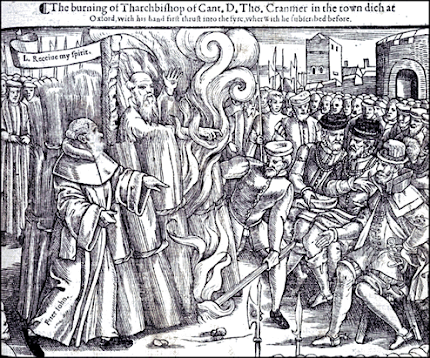
The burning of Tharchbishop of Cant. D. Tho. Cranmer in the town dich at Oxford, with his hand first thrust into the fyre, wherwith he subscribed before.

Bible Gateway Verse of the Day

Daily Bible Verse

Collect of the Day

1662 Book of Common Prayer

The Twenty-second Sunday after Trinity.

The Collect.

LORD, we beseech thee to keep thy household the Church in continual godliness; that through thy protection it may be free from all adversities, and devoutly given to serve thee in good works, to the glory of thy Name; through Jesus Christ our Lord. Amen.

Saturday, February 28, 2009

John MacArthur: The Perseverance of the Saints, Part 1

The Perseverance of the Saints, Part 1

This is a radio message by John MacArthur on the Grace to You radio program. This is an excellent explanation of the doctrine of security and perseverance in a biblical context.

Peace!

John MacArthur Comments on Works Righteousness

John MacArthur and R. C. Sproul Comment on Contemporary Christian Music

What Is Sola Scriptura? Do We Reject All Tradition?

The doctrine we call "sola Scriptura" refers to one of the five solas of the Protestant Reformation. The term "sola" is Latin and means something that stands alone or is completely unique. What we mean by sola Scriptura is that Scripture alone is the final revelation from God and is the sole authority for the church and for the individual in doctrinal matters and in matters of morality and Christian living (See 39 Articles, Article VI) .

However, this does not mean that we throw out all church tradition and simply interpret the Bible any way we like (Article XX). May it never be. While Protestants reject the Roman Catholic position that Scripture is insufficient of itself and needs an infallible interpretation they call "Holy Tradition", that does not mean that all tradition is bad and rejected. The Roman Catholic error is that they have added Tradition as a revelation from God on equal standing with Holy Scripture. Unfortunately, this "Tradition" changes from one generation to the next and is essentially a form of ongoing revelation resident in the authority of popes and bishops and the magisterium.

The opposite extreme is the radical reformation whereby all tradition is thrown out altogether and a method of interpreting the Bible is so individualized that the collective understanding of Scripture as a communion of saints is rejected. We must remember that there is no private interpretation of Scripture (2 Peter 1:19-21). However, the Protestant Reformation principle of private interpretation has to do with the placing of the Bible in the hands of every Christian to read and learn for himself or herself what the Bible actually says. This in no way meant that Christians could re-invent Christianity as they saw fit. Rather it meant that Christians no longer needed a priest to mediate between them and the reading of the Bible. The Protestant understanding is that believers together came to a common understanding of Scripture and the church and church councils were secondary authorities which could and often did err.

In other words, the Protestant Reformation absolutely did not promote a congregationalist approach to ecclesiology or polity. While the focus is on the visible church as a local congregation where the Gospel is rightly preached, the sacraments are rightly administered, and church discipline is rightly administered (Article XIX), this does not automatically negate universal councils of regional churches or associations of church or of presbyteries of churches (Article XXI). The principle of sola Scriptura upholds a catholic or ecumenical dimension to Christian teaching and doctrine. In fact, this is absolutely essential to the doctrine of sola Scriptura because we would not be able to distinguish false doctrine from true doctrine without it. The corrective emphasized by the English Reformers was not individuals alone or local churches alone but rather all three together: individual believers, local churches, and church councils/confessions of faith (the 39 Articles very existence testifies to the catholic or ecumenical dimension of the English and Protestant Reformation!).

What makes Christianity true as opposed to Mormonism or Jehovah's Witnesses or other attacks against biblical Christianity? It is in fact a body of doctrinal beliefs which have been handed down to us in and through the canon of Scripture which contains the only authoritative and infallible record of the teachings of Jesus Christ and the original apostles (Jude 1:3-4). Church councils are held so that we can hash out what is heresy and what is true and biblical teaching. Thus, although church councils err, we cannot lightly throw out church tradition simply on the basis of one individual's opinion on a particular passage of Scripture.

In light of this, we cannot reject the doctrine of the trinity without placing ourselves outside the realm of orthodox Christianity. Protestants do not believe we should re-invent Christianity as we go along. To the contrary, what we must do is to read the Bible and interpret it properly (2 Timothy 2:15). A proper interpretation of Scripture is not a hyper or super individualistic reader response method. We do not ask, "What does this mean to me?" Rather, a true and accurate understanding of Scripture takes into account the historical and grammatical method of interpretation and not an allegorical method where meanings are changed without regard to the literary context of the verse within the passage, the chapter, the book, and the Bible as a whole. We must also take into account the historical and cultural setting of the Scripture passages in question. Furthermore, even though tradition could be wrong, we cannot lightly overturn tradition by individualistic interpretations of Scripture. This is how cults and heretical movements are started. Rather we must also consider church tradition in the church fathers, intervening times, the Reformation, and up until today.

Therefore, when the plain meaning of a passage upholds a view that all can see and such an interpretation is also held by most Christians universally in times past and up to today, the onus or burden of proof lies with the individual or group promoting the divisive interpretation to prove that the church and tradition is wrong. I would contend that this is the case with Michael Servetus who challenged the doctrine of the trinity. Even the Protestant Reformers saw that this was not the Biblical doctrine taught from the beginning.

Another example, though not as extreme as the case with Servetus, is David Broughton Knox's rejection of water baptism as a command of Jesus Christ in Matthew 28:18-20 and other passages such as Acts 22:16. Knox's view spiritualizes the references to "baptism" taken universally by the majority of Christians to refer to water baptism. He does this by reading other texts referring to baptism with the Spirit (Mark 1:8-10) on the texts referring to water baptism. While it is admirable that Knox wished to refute the doctrine of baptismal regeneration, he went too far in the other direction and in fact adopts an heretical or divisive position which goes beyond what the English and Continental Reformers believed. Knox in fact rejects the sacraments altogether. This is odd, particularly since the 39 Articles of Religion clearly upholds the doctrine of water baptism and so did all of the English Reformers who gave their lives for the sake of the biblical understanding of the Gospel. While the 39 Articles are a secondary authority, they are indeed binding doctrine and are not optional for anyone who is a Protestant, low church, and Evangelical Anglican. Unless and until the Articles can be universally overturned on any point of doctrine by Scriptural proofs and an authoritative Protestant council, we are not free to re-invent the Anglican faith. This applies to the extremes imposed by Anglo-Catholic heresies read into the Bible and the Articles of Religion and it applies to individualistic extremes, on the other hand, of those who adopt a more Anabaptist or radical approach to the interpretation of Holy Scripture. (Some elements of the Sydney Diocese).

Thus, the doctrine of sola Scriptura rules out both the view of "Tradition" as a revelation from God equal to Scripture and it rules out the idea that we can interpret the Bible any way we like. No, the Protestant Reformers had it right. We accept both Scripture and tradition as authoritative sources of doctrine. The difference, however, is that the Protestant view is that tradition is subject to be corrected by Scripture since sinful humans both individually and collectively are subject to err. This is why the Protestant principle of sola Scriptura also includes the idea of ecclesia semper reformanda, which means "the church is always reforming" itself by the light of Holy Scripture.

So sola Scriptura upholds the traditional view of the sacraments as institutions made by Jesus Christ himself in the holy Scriptures and that view is confirmed by the universally held doctrines of water baptism and the Lord's supper in the church since the time of Christ. While we might disagree on the details of the two sacraments, the force of both Scripture and the catholic or universal Protestant position makes the two sacraments binding doctrine and not merely optional or up to individual choice. We are to follow the example of Jesus in being baptized in water himself (Matthew 3:13-17) and we must recognize that Jesus authorized his own disciples to do Christian baptism (John 4:1-2). The fact is that water baptism is emphasized over and over again in the New Testament as a sign of a true and lively faith, membership in the visible church, and regeneration. This does not mean that regeneration is connected to the water or in the power of the water but rather that the water represents what has happened through the ordo salutis principles of election, predestination, regeneration, repentance, conversion, justification, sanctification and glorification. Taking regeneration out of the context of Holy Scripture, the ordo salutis, or the sacramental sign is to depart from orthodox Christianity and to initiate a divisive and heretical movement away from the church and from the teaching of Scripture. The simple answer is that the sacraments are outward signs connected to the church while the inward grace is not connected to the sacrament itself but rather takes place in the souls and the hearts of true believers. This is the doctrine taught by Archbishop Thomas Cranmer and the 1662 Book of Common Prayer and the 39 Articles of Religion. Thus, the sacraments are not absolutely necessary for justification, sanctification or salvation if access to them is denied. This does not mean, however, that the sacraments are optional or unnecessary when in fact they are commanded in Holy Scripture and upheld in our confessions of faith both in apostolic times all the way up to the Protestant Reformation and even until this very day. It is on this latter point that David Broughton Knox has departed from the English Reformation.

Lord have mercy!

Christ have mercy!

Lord have mercy!

This article is also published at VirtueOnline.

Archbishop Peter Jensen: The Doctrine of Scripture

Peter Jensen is the Evangelical leader of the Sydney Diocese in Australia. This podcast discussion on the Doctrine of Scripture concerns the difference between the Protestant view of Scripture as the final authority in matters of doctrine, faith, and practice versus the Roman Catholic view that Tradition is equal to Scripture. What is the revelation of God? According to the Protestant view, the Bible is the only revelation of God given to us and even what we know about Jesus Christ is recorded in its pages.

Friday, February 27, 2009

R. C. Sproul Comments on the Difference Between Justification and Salvation


Roman Catholic theology confuses justification with sanctification. On the other hand many Evangelicals confuse justification with salvation as if the two were equivalent terms, resulting in an "incipient antinomianism" or lawlessness. In this video, R.C. Sproul explains that salvation is the point at which we repent, i.e. conversion; salvation is a process of sanctification (however imperfect that sanctification may be); and salvation is completed at the point of our death (often called "glorification"). Justification is a legal or forensic declaration of not guilty and the merits of Christ's perfect life are credited to us. Christ suffers in our place on the cross and bears all the penalty for our sins in the past, in the present, and in the future. This substitutionary atonement satisfies God's law, the just penalty of the law, and removes our guilt.

The basis for our justification is not sanctification. The sole basis for our justification is Christ and his holy life and his atoning death. However, our salvation includes all three aspects I mentioned earlier. That is, salvation is our justification, sanctification and our glorification.

R.C. also mentions the ordo salutis. Roughly speaking, the ordo salutis is the logical and/or temporal order in which our salvation is unfolded. According to Reformed theology, this would be election, predestination, regeneration, conversion/repentance, justification, sanctification, and glorification.

One of the major issues leading to the division between Roman Catholicism and the Protestant Reformation is the distinction between justification and sanctification. Justification and sanctification must always be distinguished from each other. Justification is our legal declaration of "not guilty" based on the substitutionary atonement of Christ on the cross. Christ died for our sins to justify us before God in the final judgment. It is outside of us and is an objective fact based on what Christ completed for us by meriting eternal life for us in his perfect obedience on earth and by dying in our place for our sins on the cross. Roman Catholicism committed the error of confusing sanctification, which is an inherent process inside our souls where we are made more and more like Christ as we live a Christian life, with justification. The Roman Catholics can never be sure they are saved because they base their salvation on obedience rather than on justification by faith alone. For Roman Catholics justification is inherent in the soul and the sinner is made actually righteous. This flies in the face of Romans 7 where Paul clearly says that we remain sinners even after we have been declared righteous and begin the process of living a sanctified life.

This is why low church Anglicanism has absolutely nothing in common with high church Anglicanism. High church Anglicanism commits the same theological error which the Roman Catholics have committed. It has confused justification with sanctification and ignores the fact that justification is a legal or forensic declaration and is absolutely not the process of being inherently and progressively sanctified in our walk with Christ.

Tuesday, February 24, 2009

David Broughton Knox Denies the Sacrament of Water Baptism: Changing Views?

Unfortunately, I have discovered that the late David Broughton Knox later in life changed his views on the two sacraments in the Bible and the 39 Articles of Religion. He came later to view the sacrament of baptism at least as unbiblical. This is indeed unfortunate because it in effect makes him a sectarian rather than someone in the tradition of the Archbishop of Canterbury during the English Reformation, Thomas Cranmer, who held that the Protestant view of the sacraments was indeed the "catholic" one. Even more unfortunately, the son of the late David Broughton Knox, holds the same views as his father.

Since my position is one of a "confessing" Evangelical, --I believe that confessional statements of what we believe the Bible teaches are absolutely necessary to mark out clearly for others what we believe and where we stand-- it follows that I adhere to the plain teaching of the 39 Articles of Religion as a document which is binding on the conscience of ministers and officers of the church. To deny any one of the Articles is essentially to exclude oneself from the Anglican church/denomination/communion. I find it particularly troubling that one who represents himself as a low church, Evangelical Anglican could in good conscience pretend to be an Anglican while denying the very document we confess as a unified body of believers. To deny the Protestant document in any part is really to adopt the same tactic of the Anglo-Catholics only it is done from a more Anabaptist approach.

At any rate, you can judge for yourself from the following comments posted by William Scott:

William said...

Here is just a sample of D.Broughton Knox's unfortunate belief that baptism was an optional rite and not a true Sacrament instituted by Christ (New Testament Baptism, in D. Broughton Knox Selected Works, Volume II):


"If the significance of the rite is changed to a confession of Christ, confession of Christ is better made by the mouth (Rom 10:10) within the congregation, but better still in the outside world at work or at school. To confess Christ by being immersed under water is only practised because it is believed that Jesus sent us to baptise with water. But, as Paul makes clear, this is not the case."

"Water baptism was an apostolic custom and there is no reason that those who wish to continue it should not do so, so long as they do not impose on the rite a meaning inimical to the gospel. Its New Testament meaning is [primarily] applicable in countries where the gospel is news. But it might be thought that in many heathen cultures today the better way to indicate repentance is by the changed life itself. There may be some heathen countries where water baptism for new converts is unwise, because of the angry hostility provoked. But the changed life and the meek and reverent answer to any query about the reason for the obvious hope that the Christian now has (1 Peter 3:15) may lead to further conversions." (p308-309)


Blessings in Christ,
William Scott

Charlie J. Ray said...

William, you are misrepresenting DB Knox. I have a copy of his small commentary on the 39 Articles where he affirms that there are 2 sacraments. I think you are taking him out of context.

What he said was that baptism is not absolutely essential to salvation and there could be notable exceptions to the practice of baptism. However, I wouldn't go that far though I do agree with Knox that Cranmer made a sharp distintion between the element of water and the grace given to the believer through the sign of baptism. There is no power in the water whatsoever to regenerate. I hope we are clear on that.

*********
William Scott said:

On DB Knox--I believe his views on the sacraments became more radical throughout his life--this could possibly be an explanation for the seemingly different position on the sacraments in the book of DB Knox which you have (or he could just be retaining the traditional term "sacrament" (but in a very loose sense) for baptism).

But what I am saying--at least as concerns his view on baptism in his later years is the position maintained by virtually everyone I have spoken with (Sydney Anglican ministers and others) who are familiar with D.B.Knox and his writings.

[Longer quote of DB Knox in next post]


Now a much longer example of what I'm talking about regarding D.B. Knox's denial of baptism as a sacrament instituted by Christ can be seen in the following quote (this an excerpt from D.B.Knox's writings provided on another forum discussing D.B.Knox's views):

This section can be found in “D.Broughton Knox Selected Works Volume II - Church and Ministry”; ed. K. Birkett; Matthias Media 2003; p277-282.

Beginning of Quote/
THE BAPTISM OF THE GREAT COMMISSION
Paul’s use of the word ‘baptism’ with regard to the discipling of the Israelites under the leadership of Moses (1 Cor 10:2) is semimetaphoric. Water baptism, the washing of the body to indicate the cleansing of the life from old habits and actions, is used by him in its derived meaning of discipleship, but water is fading into the background. There was water in the sea and in the clouds. In this sense the Israelites could be said to be in the midst of water, but no water touched them. The concept of cleansing (cf Acts 22:16) has quite disappeared and in its place the derived meaning of baptism as accepting the teaching and submitting to the leader as disciples has taken its place.

A fully metaphorical use of the concept of baptizing as discipling is in Jesus’ last words to his apostles in Matthew 28. He is sending them to bring the nations of the world into the knowledge of the triune God. They are to disciple the nations, and to convey to them the teaching of their new Lord. The nations and their cultures are to be transformed through the knowledge of the truth. Jesus calls this ‘baptizing the nations’. He commanded the eleven disciples

Go and make all the nations disciples, baptizing them into the name of the Father and of the Son and of the Holy Spirit, teaching them to observe all whatever I commanded you (Matt 28:19-20).

This ‘great commission’ of Jesus contains no reference to administering water baptism. The reference to baptizing is entirely metaphorical in line with other uses of the word by Jesus. It is a command to proclaim the news of the Messiah’s coming to the nations to make them disciples of the true God, to immerse the nations into the revealed character of God so that their whole way of life is changed and their cultures sanctified (cf Rev 21:24).

This conclusion is supported by the following considerations.
Our Lord used the words ‘baptism’ and ‘baptize’ in purely metaphorical ways without any reference to water.

(a) Thus he spoke of his death as his baptism on two occasions as recorded in the Gospels. “I have a baptism to be baptized with” (Luke 12:50); “are you able to drink of the cup I drink or to be baptized with the baptism I am baptized with” (Mark 10:38).

(b) The baptism of the Spirit which Jesus predicted the disciples would experience was also a purely metaphorical baptism with no reference or relationship to water baptism.

Jesus contrasted baptism with the Spirit very sharply with water baptism. The one excluded the other. He told his disciples: “John indeed baptized with water, but you will be baptized with the Holy Spirit” (Acts 1:5). When this promise was fulfilled a few days later in the upper room, it was fulfilled in circumstances which excluded any association with water baptism. This confirms the conclusion that when Jesus spoke of baptizing with the Holy Spirit, the word ‘baptizing’ was purely metaphorical. The same is true of John the Baptist’s and of Paul’s use of the phrase ‘baptizing in the Holy Spirit’.

Like Jesus, John contrasted baptism in the Spirit as sharply as possible with water baptism. “I baptize you with water unto repentance he shall baptize you in the Holy Spirit and fire, whose fan is in his hand and he shall thoroughly cleanse his threshing floor” (Matt 3:11 - 12). John’s baptism was a real baptism of cleansing of the body with water; the Messiah’s baptism was a metaphorical baptism and a metaphorical cleansing. But the experience would be real enough; it would be the removal by the Spirit of God of evil persons from among the people of God by the fire of judgement, metaphorical fire but real judgement, real cleansing of the people of God.

That ‘baptize’ in the phrase ‘baptize in the Spirit’ is metaphorical is confirmed by Paul’s language. He wrote to the Corinthians: “In one Spirit into one body we were all baptized, whether Jews or Greeks, whether slave or free, and we were all made to drink of one Spirit” (1 Cor 12:13). There are two references in this verse to the experience of Christians receiving the one Spirit of God who unites us into one body of Christ. Both references are couched in water terms. This is natural. In the Old Testament, water, the life-giving element in an arid land, was frequently used as a symbol of the Spirit of God (cf Ezek 36:25; Joel 2 et al,). The second water term, ‘drink’, in Paul’s verse is plainly metaphorical. He wrote that Christians all drink of the one Spirit. To drink of the Spirit is a water metaphor, based on Jesus’ own language in John 4:14 and 7:37. This uncontrovertable water metaphor for receiving the Spirit in the second half of the parallel carries with it the metaphorical character of the reference to water in the first half of the parallel. ‘Baptized in the Spirit’ and ‘made to drink of the Spirit’ are both metaphors. If the first half of the parallel were real water, it would make the second half very harsh phraseology.

A confirmation that Jesus’ reference to baptism in the great commission is purely metaphorical, and not a command to administer water baptism, is the fact that none of the references to water baptism in Acts or in 1 Corinthians 1 suggest that water baptism as practised by the apostles was baptism into the name of the Trinity. It is always baptism into the name of Jesus or of the Lord Jesus, or into the name of Christ (1 Cor 1:13). Thus Peter, in his sermon on the day of Pentecost, invited his hearers to repent and be baptized in the name of Jesus Christ. He could hardly have said these words if he had understood Jesus to have commanded him some ten days before to baptize converts into the name of the Father and of the Son and of the Holy Spirit.

Jesus’ words in the great commission did not have reference to the administration of the rite of water baptism, as though our Lord’s last words to his disciples on the eve of his ascension to his throne of glory was to instruct them in the use of a ritual formula, but it was a commission to preach the gospel of the forgiveness of sins in his name to all the nations. The other Gospels’ reporting of the same commission confirm this interpretation. Luke has “repentance and forgiveness of sins should be preached in his name unto all the nations” (Luke 24:47) and in Acts 1:8 “you shall be my witnesses ... unto the uttermost parts of the earth”. John has “as the Father has sent me, so I send you ... whosoever sins you forgive, they are forgiven ... “ (John 20:21).

Matthew reports Jesus’ words as: “Disciple all the nations, baptizing them into the name of the Father, and of the Son and of the Holy Spirit, teaching them to observe all things I commanded you” (Matt 28:19-20). ‘To disciple’, ‘to baptize’ and ‘to teach’ are here synonyms. Jesus is commanding his apostles to bring the whole world into the knowledge of the true God and as a consequence to Christianize the cultures of the world so that they might bring their contributions to the city of God (Rev 21:26). Isaiah had prophesied these things (Isa 60:3). Note that it is the nations that are to be baptized. By the preaching of the gospel they are to accept the lordship of the Christ, and to obey all that he as their leader commands. The nations of the world are to be baptized into the triune God as the nation of Israel was baptized into Moses. The phrase ‘to baptize the nations’ is itself plainly metaphorical. Only individuals can be the subjects of water baptism and the whole context confirms that the word here is fully metaphorical and has no reference to water baptism.

This conclusion is made more sure by Paul’s remarks in 1 Corinthians 1. He regarded water baptism as of no importance. He cannot remember whom he baptized two or three years before, only few though they were. And he added emphatically “The Lord did not send me to baptize” (1 Cor 1:17). It is inconceivable that Paul could have said this if the Lord had commanded his apostles in his last solemn commission to administer water baptism, for Paul was vividly conscious that there was nothing lacking in his commission as Christ’s apostle: “In nothing was I being the very chiefest apostle” (2 Cor 12:11); “I reckon I am not a whit behind the very chiefest of the apostles” (2 Cor 11:5).

Paul was pre-eminently the apostle of the nations. “He that wrought for Peter unto the apostleship of the circumcision wrought for me unto the apostleship of the nations” (Gal 2:8). If in his last commission Jesus had sent his apostles to “make disciples of all the nations, baptizing them” with water baptism, it is inconceivable that Paul, the apostle of the nations, could have said “Christ did not send me to administer water baptism”, if Christ had sent all the other apostles to do this very thing to converts from the nations!

Jesus told his apostles to disciple all the nations. The way his words are often translated, “to make disciples of all nations”, allows for a misconception to arise. It is the nations that are to be discipled, baptized and taught, not merely individuals out of the nations. The gospel will heal the nations and in the book of Revelation the nations shall walk in the light of the glory of God and bring their treasures to the heavenly Jerusalem (Rev 21:24, 26; 22:2). This glorious result of the exaltation of the Messiah had been prophesied in the Old Testament (Isa 11:10, 12; 25:7; 49:6, 7; 52:15). All the nations, that is the peoples and their cultures, are to be Christianized by the knowledge of the triune God. Christ’s commission to his followers is to baptize the nations, to bring them under his leadership, as their Lord and their teacher.

(A Footnote: The Greek of Matthew 28:19-20 supports the metaphorical interpretation of ‘baptizing’ in this verse. The main verb is ‘disciple [the nations], the three other verbs are all supporting participles. The main verb is an aorist, that is, it is punctiliar describing a distinct action. The participle ‘go’ is similarly an aorist. The two other participles which follow are both in the present tense, implying ongoing activity. The nations are to be discipled by being immersed into the full knowledge of the triune God and what this implies for Christian living: that is, they are to be progressively taught of the true God and the body of doctrine which Christ revealed. It is worth noting that two important early manuscripts, Vatican and Beza, have altered the present participle ‘baptizing’ into an aorist to conform to the punctiliar action of water baptism, which is experienced once and is not an ongoing activity. By the time these manuscripts were copied the ecclesiastical interpretation of this verse was dominant, and has remained dominant until the present.)

The conclusion is clear. ‘Baptize’ in Matthew 28 is fully metaphorical, as were both the other two applications of the word by Jesus (Spirit baptism and suffering baptism). In none of these three uses of the metaphor of baptism by Jesus is there any reference to the practice of water baptism, inaugurated by John and continued by his disciples, not only into the ministry of Jesus while John was alive (John 4:2), but also into the apostolic age after Jesus’ ascension (Acts 2:38). But it is worth noting again that Jesus himself did not follow this practice of administering water baptism (John 4:2), and Paul regarded it as a matter of indifference, having no relationship to the gospel he was commissioned to preach. In fact he put the two activities in sharp contrast (1 Cor 1:17) for the emphasis in the Greek falls heavily on “not to baptize”.
/End of Quote


Blessings in Christ,
William Scott


Charlie's comment: After reading this extended quote I came to the conclusion that David Broughton Knox in his final years allowed his critics to push him to make illogical and unjustified interpretations of Scripture passages that are understood by every major denomination and church tradition to refer to water baptism. One of the most critical of these misinterpretations is Knox's denial of Matthew 28:18-20 as a reference to Christ's command to baptize with water. Knox takes the allegorical method of interpretation to justify this highly questionable view of Matthew 28:18ff. Most Evangelicals prefer the historical/grammatical approach to biblical exegesis, hermeneutics and interpretation. This only goes to show that even Evangelicals can go either liberal or off into allegorical interpretation methods along the lines of the church father Origen or that of modern day charismatics and pentecostals.

Sunday, February 22, 2009

J. C. Ryle on the Authority of the Thirty-nine Articles of Religion

In KNOTS UNTIED, the famous Evangelical and low church bishop, J. C. Ryle makes it clear that he believes the Thirty-nine Articles are indeed a confession of faith and constitute binding doctrine which all Anglicans should believe at face value as they are plainly stated. Ministers in the Church of England were at one time required to believe them in every detail but today they are only required to sign them as a "general" statement of belief giving them an "out" and inviting divisions and heresies within the Anglican Communion. I believe the Thirty-nine Articles are a statement of the Protestant faith and that they are "catholic" only in the sense that they represent an Evangelical and Protestant and Reformed understanding of Anglicanism. They are in no wise "Catholic" in the sense of being Anglo-Catholic or Roman Catholic. They are "catholic" with a small "c" as in "universally accepted." That is they are universal on the point of the ecumenical creeds accepted by all churches, including the East and Roman Catholicism and Protestantism. But regarding the five solas of the Protestant and English Reformation they are only "universal" or "catholic" as they conform to the major doctrines accepted among the Protestant side of Anglicanism. Thus, the term "catholic" is applied only to Protestant doctrine and not Anglo-Catholicism or Roman Catholicism. There is no "via media" between Protestantism and Roman Catholicism and thus Anglo-Catholic revisionism is an illegitimate reading of the Thirty-nine Articles of Religion. Ryle makes this very clear in this comment at the Church Society webite, J.C. Ryle on the 39 Articles:


I pass over the obvious suspiciousness of any Churchman ignoring the Articles, giving them the cold shoulder, and talking only about the Prayer-book, when he is speaking of the tests of a Churchman's religion. That many do so it is quite needless to say. Yet the fifth Canon, of 1604, contains the following words:

"Whosoever shall hereafter affirm that any of the Thirty-nine Articles agreed upon by the Archbishops and Bishops of both provinces, in the Convocation holden at London in the year of our Lord God 1562, for avoiding diversities of opinion, and establishing of consent touching true religion, are in any part superstitious, or erroneous, or such as he may not with a good conscience subscribe unto, let him be excommunicated ipso facto , and not restored but only by the Archbishops, after his repentance and public revocation of such his wicked errors."

Plain language that! Certain Churchmen who are fond of pelting Evangelical Churchmen with Canons would do well to remember that Canon.

Please note that Ryle cites the fifth Canon against the Anglo-Catholics who accept the Prayer Book but not the Thirty-nine Articles as a statement of faith or confession of faith which is binding on the conscience. While the Articles are not a "creed" they are a confession of faith and are therefore binding doctrine, particularly for ministers. I would contend that the fifth Canon applies not only to Anglo-Catholic departures from the Articles but also to Anabaptist departures from the Articles, including a denial of the two sacraments in Article XXV. If the Thirty-nine Articles are merely optional then we might as well throw them out and become Anabaptists. We can just all become lone ranger Christians and reject the church and sacraments altogether. But obviously that is not the position of the Reformation. The true church is marked by the right preaching of the Word, the right administration of the sacraments, and church discipline.

J.C. Ryle goes on to say that though grace is not tied directly to the sacraments, the sacraments are nevertheless a necessary sign for believers. The sacraments accomplish nothing for those who are not truly converted, however:

(3) Let us mark, in the next place, as we read the Articles, their wise, discreet, and well-balanced statements about the Sacraments. They declare plainly the divine authority of Baptism and the Lord's Supper. They use high and reverent language about them both, as means of grace, "by the which God doth work invisibly in us, and doth not only quicken, but strengthen and confirm our faith in Him." (Article XXV.)

But after saying all this, it is most instructive to observe how carefully the Articles repudiate the Romish doctrine of grace being imparted by the Sacraments ex opere operato. "The Sacraments," says the Twenty-fifth Article, "were not ordained of Christ to be gazed upon, or to be carried about, but that we should duly use them. And in such only as worthily receive the same they have a wholesome effect or operation."

Now if there is any one thing that is laid to the charge of us evangelical clergy, it is this - that we deny sacramental grace. "Excellent, worthy, hard-working men," we are sometimes called; "but unhappily they do not hold right church views about the Sacraments." Men who talk in this manner are talking rashly, and saying what they cannot prove. Evangelical clergymen yield to none in willingness to give rightful honour to Baptism and the Lord's Supper. All we say is, that grace is not tied to the Sacraments, and that a man may receive them, and be none the better for it. And what is all this but the doctrine of the Thirty-nine Articles? (J. C. Ryle on the 39 Articles).

From these remarks it can be clearly seen that even low church Evangelicals do not reject the two sacraments of baptism and the Lord's Supper. It is indeed sad that some have decided they have more authority than the Bible or the church. Whether it be the extremist views of Anglo-Catholics or the sectarian views of Anabaptists, both are equally condemned by Scripture, the church, and the Articles of Religion. I think Ryle has it correct.

Saturday, February 21, 2009

Francis Schaeffer: What does Roman Catholicism, humanism, and cultural relativism have in common?


Francis Schaeffer lays out clearly here the theological and philosophical roots which underlie the Roman Catholic emphasis on tradition, merits, and man's ability/inherent righteousness. This then ties in directly with modern theological liberalism and is, in my opinion, a return in essence to the ancient heresy of pelagianism or the idea that man is able to reason properly apart from the Spirit of God. Obviously, this also has implications for the Tractarian movement and the Anglo-Catholic departure from sola Scriptura. I would contend that Anglo-Catholicism is the very reason we see the Anglican Communion buying into secular humanism and the idea that homosexuality is actually good rather than evil. Conservative Anglo-Catholicism eventually leads back to theological liberalism and pelagianism and eventually antinomianism for the simple reason that it exalts human reasoning above God's revelation in Holy Scripture. The emphasis on so-called "holy" tradition is in fact an emphasis on Aquinas' view that philosophy could be done apart from God's revelation. Hence, Van Til's critique of classical apologetics seems to be legitimate according to Schaeffer's analysis.


Peace.

Fundamental Errors of the Seeker Sensitive Movement

Preachers of the Gospel: Are You Really Needed?


While this commencement address is for the law school at Washington and Lee University, I think it applies to the ministry as well. I have no idea what Mr. Grisham's religious faith is or even if he is a Christian. But I do know that just as in law there is an oversupply of lawyers so in ministry Evangelical colleges and seminaries have produced a vast oversupply of ministers when compared to available churches or available resources to plant new churches. Many of these men have extensive debt after school and have no viable pulpit ministry. Does this mean that they are now worthless and useless?

I have to give a resounding, "No." Despite the fact that Evangelical colleges and seminaries sometimes have taken advantage of those who aspire to ministry in order to boost their enrollment levels, those of us who believe in the sovereignty of God must look to God's greater glory in all of this. Instead of seeking the glory of men in grandiose cathedrals or megachurch ministries, we ought to do what God have given us to do and do it with our might. (Ecclesiastes 9:10). Instead of seeking our own fortune or our own glory we ought to take the position which John Baptist advocated: "He must increase, but I must decrease." (John 3:30). Instead of lamenting our lack of success we ought to see this as an opportunity to minister in obscure places so that we may bring greater glory to God and reap an eternal reward.

While the lawyer's primary focus is law and justice, the minister's primary focus is the Gospel of Jesus Christ. That does not take away the secondary role of the minister as one who cares for the poor and the oppressed. However, anytime we place social justice above the Gospel we end up the here and now and the focus of Holy Scripture on eternal matters is lost. Evangelicals must keep Jesus Christ at the center without caving in to the social gospel which is no gospel at all.

My advice to ministers who have no pulpit is to teach a Sunday school class at your church. Visit a jail or prison and give the inmates sound teaching from the Bible. Visit a hospital or a homeless shelter and listen and give pastoral care to the hurting. I myself started out preaching in jails and prisons and going on prison crusades. Make yourself available to teach and minister the Gospel wherever you are and forget about your own personal aspirations. We are not in this for our own personal aggrandizement. We are in this for the eternal matters. This world will pass away but God's Word is forever settled in the heavens. (1 Corinthians 7:29-31; Psalm 119:89-90).

In fact, I get suspicious any time a minister puts his own name on the ministry organization which he leads. This betrays right away that there is a secondary motive for the promotion of individuals rather than Christ. The Apostle Paul deals with this issue as well: "What then is Apollos? What is Paul? Servants through whom you believed, as the Lord assigned to each. I planted, Apollos watered, but God gave the growth. So neither he who plants nor he who waters is anything, but only God who gives the growth." (1 Corinthians 3:5-7). Even the Apostle Paul did not want the ministry to be named after himself!

Do not follow men but follow Christ. Test all things by the Holy Scriptures. And finally, if you are called to minister, make yourself available wherever you are and teach the Bible with your determination and might. You are indeed needed. The needs far exceed the apparent oversupply of ministers if you will only make yourself available.


Peace.

Friday, February 20, 2009

The Gift of Healing: Dr. Alan Cairns

Thursday, February 19, 2009

Where We Stand: The Evangelical Connexion of the Free Church of England: Part Two

5. CONTEMPORARY REVISIONISM

But have renounced the hidden things of dishonesty, not walking in craftiness, nor handling the word of God deceitfully; but by manifestation of the truth commending ourselves to every man's conscience in the sight of God. (2 Corinthians 4:2)

Anglicanism generally, in matters of faith and morals, is engaged in a process of revisionism which not only alters the history and theological confessions of "mainstream denominations," but has chosen the way of cultural relativism with regard to Scripture itself. The FCE Evangelical Connexion is made up of those who willingly or unwillingly, can no longer participate in the structures of the Denomination to which they have given loyal support and service for many years.

A working document, AGENDA FOR RENEWAL, described as "controversial" by the present Primus of the FCE in his Church Magazine, was produced to define our position. It centres around ten points, all designed to take the FCE back to its original roots. One very significant point was to put the evangelical ecumenical unity back on the Agenda. The document did not get the necessary backing but has now be re-introduced by Dr. John Fenwick. He turns the argument for evangelical ecumenism into a proposition for modern ecumenism. He is a former ecumenical officer to the Archbishop of Canterbury. Dr. Fenwick was originally turned down for membership of the FC of E by the then Primus, Rt. Revd. Arthur Bentley-Taylor, and this was a significant factor in the pressure brought to bear upon Bishop Bentley-Taylor, making him step down as Primus and Bishop of the northern diocese.

6. CHURCH DISCIPLINE AND CHRISTIAN LOVE

1Brethren, if a man be overtaken in a fault, ye which are spiritual, restore such an one in the spirit of meekness; considering thyself, lest thou also be tempted.

2Bear ye one another's burdens, and so fulfil the law of Christ. (Galatians 6:1-2)

Readers of the new FCE YEAR BOOK need to be aware that much more lies behind reference to the Court of Discipline (p. 23) than meets the eye. Bearing in mind recent ecclesiatical politics, contemporary ecclesiastical revisionism, unconstitutional behavior, failure to recognise the proper procedure in bringing the charges, admission by the present Primus, in whose Diocese the charges were brought that they were inspired by personal malice against Bishop Bentley-Taylor, being brought by a minister who does not even have a church in the denomination, and by one who could not possibly have known the truth, or otherwise, of many of these so-called charges, it is clear they were designed to effect a resignation. This is acknowledged in the YEAR BOOK, "Dr. Shove had indicated that he reserved the right to bring the charges again if Bishop Bentley-Taylor withdrew his resignation." In fact, Bishop Bentley-Taylor retired from his jurisdiction as Primus and Northern Diocese Bishop. He never wrote a letter of resignation. He was "resigned" by the Free Church of England Council, a totally irregular procedure.

This present writer can assure readers of the YEAR BOOK that not one biblical, confessional, or moral issue, was levelled against Rt. Revd. Arthur Bentley-Taylor, who is a person of immense integrity and Christian character. The whole procedure was a travesty of truth and a denial of the Gospel principle, even if wrong, "to restore such an one in the spirit of meekness." This dastardly act will go down in the annuls of the Free C of E as one of its most unloving, unchristian, and shameful acts in recent history. The former Primus was under the counsel and advice of two physicians at the time.

[Part Three will be presented tomorrow].

Preaching: Putting Your Heart into the Sermon

[I borrowed the following entry from a post at the Puritan Board. It is entitled, Putting Your Heart into the Sermon].

In his book The Christian Ministry, Charles Bridges writes, "The Minister, that does not manifestly put his heart into his sermon, will never put his sermon into the hearts of his people." How true this statement is. Every preacher should strive to preach to the hearts of his people with great fervency and love for them. The preacher should strive to be plain in his speech rather than eloquent with his words. He should strive to be useful to the lowest of men rather than seek praise by appealing to the highest of men. The goal of preaching is not to bring glory and praise to the speaker but rather to let the Word of God have its perfect work in the hearts of the congregation. The people need the living water and the bread of life not the fine delicacies of high minded, intellectual oratory. Preachers, preach it plain, preach it simple, preach it fervently and through your preaching always love your people as Christ first loved you."

Wednesday, February 18, 2009

Cranmer on Eating and Drinking the Body and Blood of Christ

[I tried to post the following comment at A Response to Dr. Barker's Presentation of Cranmer and Calvin on the Sacraments. You can also read and hear a series of lectures on the Presbyterian view of the sacraments at Corrigenda Denuo.]

Your understanding of Cranmer's theology of the Lord's supper is deficient and based on selective prooftexting. In other places in Cranmer's Works, published by the Parker Society, Cranmer says practically the same thing Calvin does. For example, Cranmer devotes an entire book to the subject, "The Fourth Book is of the Eating and Drinking of the Body and Blood of our Saviour Christ." Let me give you some highlights of that book:

"Thus on every side the Scripture condemneth the adversaries of God's word.

"And this wickedness of the papists is to be wondered at, that they affirm Christ's flesh, blood, soul, holy Spirit, and his Deity to be in a man that is subject to sin and a limb of the Devil. They be wonderful jugglers and conjurers, that with certain words can make God and the Devil to dwell together in one man, and make him both the temple of God and the temple of the Devil. It appeareth that they be so blind, that they cannot see the light from the darkness, Belial from Christ, nor the table of the Lord from the table of devils.

"Thus is confuted this third intolerable error and heresy of the papists, that they which be the limbs of the Devil do eat the very body of Christ and drink his blood, manifestly and directly contrary to the words of Christ himself, who saith, Whosoever eateth my flesh, and drinketh my blood, hath everlasting life.

"But lest they should seem to have nothing to say for themselves, they allege St. Paul, in the eleventh to the Corinthians, where he saith, He that eateth and drinketh unworthily, eateth and drinketh his own damnation, not discerning the Lord's body.

"But St. Paul in that place speaketh of the eating of the bread and drinking of the wine, and not of the corporal eating of Christ's flesh and blood, as it is manifest to every man that will read the text: for these be the words of St. Paul: Let a man examine himself, and so eat of the bread, and drink of the cup; for he that eateth and drinketh unworthily eateth and drinketh his own damnation, not discerning the Lord's body.

"In these words St. Paul's mind is, that forasmuch as the bread and the wine in the Lord's Supper do represent unto us the very body and blood of our Saviour Christ, by his own institution and ordinance; therefore, although he sit in heaven at his Father's right hand, yet should we come to this mystical bread and wine with faith, reverence, purity, and fear, as we would do, if we should come to see and receive Christ himself sensibly present. For unto the faithful, Christ is at his own holy table present with his mighty Spirit and grace, and is of them more fruitfully received, than if corporally they should receive him bodily present. And therefore they that shall worthily come to this God's board, must after due trial of themselves consider, first who ordained this table, also what meat and drink they shall have that come thereto, and how they ought to behave themselves thereat. He that prepared the table is Christ himself. The meat and drink wherewith he feedeth them that come thereto as they ought to do, is his own body, flesh, and blood. They that come thereto must occupy their minds in considering, how his body was broken for them, and his blood shed for their redemption. And so ought they to approach this heavenly table with all humbleness of heart, and godliness of mind, as to the table wherein Christ himself is given. And they that come otherwise to this holy table, they come unworthily, and do not eat and drink Christ's flesh and blood, but eat and drink their own damnation; because they do not duly consider Christ's very flesh and blood, which be offered there spiritually to be eaten and drunken, but despising Christ's most holy Supper, do come thereto as to other common meats and drinks, without regard of the Lord's body, which is the spiritual meat of that table."
[Cranmer's Works, Book IV, Chapter VI-VII].

This passage taken with the other passages where Cranmer establishes that the tokens are an outward sign of the inward faith in the one sacrifice shows that Cranmer's view is close to Calvin's view. Faith is the means of feeding on the body and blood of Christ in the one sacrifice at the cross. Just as the bread and wine feed our physical body so by faith the soul is nourished and feeds upon the body and blood of Christ in the one sacrifice at the cross. So while you are correct that the tokens and the body and blood are not inseparably connected, you are wrong that you think Cranmer would say the sacraments are not essential to faith. This is absolutely wrong. The sacraments are not merely optional but essential to true and lively faith and they that use them with a lively and true faith feed upon the body and blood of Christ by faith. The wicked do not eat the body and blood because they have no true and lively faith. However, since they have no real faith, by eating the bread and wine unworthily, they eat and drink to their own damnation. This is very close to both Calvin and Zwingli's view and is very far from the Anabaptist view which make the sacraments merely ordinances or empty signs of a mere memorial. No, for Cranmer, the sacraments are an outward sign of an inward grace and that grace is sovereignly bestowed at regeneration and then repentance and exhibited by a true and lively faith. While one cannot feed upon Christ except by faith, this in no wise makes the sacraments merely optional for Cranmer. For Cranmer the table is to be approached with reverence because the sacrament represents the very body and blood of Christ shed for us on Calvary. Keep in mind that in this context Cranmer is not talking about faith in general but the mode and manner in which we eat the body and drink the blood of Christ in the sacrament!

In another place Cranmer says:

"By these words of Cyril appeareth his mind plainly, that we may not grossly and rudely think of the eating of Christ with our mouths, but with our faith, by which eating, although he be absent hence bodily, and be in the eternal life and glory with his Father, yet we be made partakers of his nature, to be immortal, and have eternal life and glory with him.

"And thus is declared the mind as well of Cyril as of Hilarius.

"And here may be well enough passed over Basilius, Gregorius Nyssenus, and Gregorius Nazianzenus, partly because they speak little of this matter, and because they may be easily answered unto by that which is before declared and often repeated, which is, that a figure hath the name of the thing whereof it is the figure, and therefore of the figure may be spoken the same thing that may be spoken of the thing itself.

"And as concerning the eating and drinking of Christ's flesh and drinking of his blood, they spake of the spiritual eating and drinking thereof by faith, and not of corporal eating and drinking with the mouth and teeth.

"Likewise Eusebius Emissenus is shortly answered unto; for he speaketh not of any real and corporal conversion of bread and wine into Christ's body and blood, nor of any corporal and real eating and drinking of the same, but he speaketh of a sacramental conversion of bread and wine, and of a spiritual eating and drinking of the body and blood. After which sort, Christ is as well present in baptism (as the same Eusebius plainly there declareth) as he is in the Lord's table: which is, not carnally and corporally, but by faith, and spiritually. But of this author is spoken before more at large in the matter of transubstantiation.

"And now I will come to the saying of St. Ambrose, which is always in their mouths. 'Before the consecration,' saith he, as they allege, 'it is bread; but after the words 'of consecration it is the body of Christ.'

"For answer hereunto, it must be first known what consecration is.

"Consecration is the separation of any thing from a profane and worldly use unto a spiritual and godly use.

"And therefore when usual and common water is taken from other uses, and put to the use of baptism, in the name of the Father, and of the Son, and of the Holy Ghost, then it may rightly be called consecrated water, that is to say, water put to a holy use.

"Even so when common bread and wine be taken and severed from other bread and wine, to the use of the holy communion, that portion of bread and wine, although it be of the same substance that the other is from which it is severed, yet it is now called consecrated or holy bread and holy wine.

"Not that the bread and wine have or can have any holiness in them, but that they be used to an holy work, and represent holy and godly things. And therefore St. Dionyse calleth the bread holy bread, and the cup an holy cup, as soon as they be set upon the altar to the use of the holy communion.

"But specially they may be called holy and consecrated, when they be separated to that holy use by Christ's own words, which he spake for that purpose, saying of the bread, This is my body; and of the wine, This is my blood.

"So that commonly the authors, before those words be spoken, do take the bread and the wine but as other common bread and wine; but after those words be pronounced over them, then they take them for consecrated and holy bread and wine.

"Not that the bread and wine can be partakers of any holiness or godliness, or can be the body and blood of Christ; but that they represent the very body and blood of Christ, and the holy food and nourishment which we have by him. And so they be called by the names of the body and blood of Christ, as the sign, token, and figure is called by the name of the very thing which it showeth and signifieth."

[Works, Book III, Chapter XV].

Thus, your statement, "Cranmer held that eating and drinking the body and the blood of Christ is nothing but believing," implies that Cranmer did not relate eating and drinking the body and blood to the sacrament but merely to faith in the cross in general. That could not be further from the truth since Cranmer teaches both faith in the cross and a faith in eating the bread and the wine as consecrated elements representing the true body and blood sacrificed for us on the cross. So for Cranmer, like Calvin, the mode of eating the body and the blood of Christ is faith in what Christ did for us on Calvary. Just as the body is fed by the bread and wine, which are the outward signs, so when we eat the consecrated elements of bread and wine the soul feeds upon the body and the blood of Christ given for us at Calvary. Not only so but Cranmer even says that the consecrated elements, though not the real body and blood of Christ, are called by the name of the thing signified! So to divorce Cranmer's "mode" from the consecrated elements is to misread Cranmer.

Your other comment that "feeding on Christ is simply believing, and therefore may take place within or without the context of the Church's ministry" is just plain wrong. The Thirty-nine Articles, which Cranmer helped to craft, clearly advocates the Reformed view of the sacraments where Article XIX says that the true church is indicated by the preaching of the true Gospel and the right administration of the sacraments. Article XXIII says that no man may preach or administer the sacraments unless he has been duly called and ordained. Thus, it would be strange to divorce the sacraments from "a true and lively faith" as Cranmer understood that term. Even more to the point, the Article XXV says that God through the sacrament " doth work invisibly within us and doth not only quicken, but also strengthen and confirm, our faith in him." It would be odd for Cranmer and the English Reformers to say this if the sacraments are merely optional and not a vital part of our obedience to God and the means of strengthening our faith. If the mode of eating is merely believing and not sacramental then it would be even more strange for Cranmer to say in Article XXVIII that "the bread which we break is a partaking of the body of Christ, and likewise the cup of blessing is a partaking of the blood of Christ."

Thus, the sacrament of the Lord's Supper is not optional but necessary as a means of feeding and nourishing the soul through the signs of bread and wine which are called by the names of the things which they signify: the body and the blood of Jesus Christ. So I would say that your premise is wrong. For Cranmer the ministry of the Church is not optional but instrumental in conveying to us the Word of God and the right administration of the sacraments, which in turn nourish our faith and are a means of grace.


In Christ,

Charlie

Where We Stand: The Evangelical Connexion of the Free Church of England: Part One

[In my search on the internet to find likeminded Anglicans who are Evangelicals first and Anglicans second, I have found a remnant in several pockets around the world. Probably the most famous of these is the Sydney Diocese in Australia. However, others exist in England and I was pleasantly surprised to find that many of the members of the sister church of the Reformed Episcopal Church, The Free Church of England, have left that church and created the Evangelical Connexion of the Free Church of England. The following letter was delivered to the 2005 Convocation of the Evangelical Connexion by Dr. J. Barry Shucksmith, the current bishop. I trust that you will immediately recognize that I fully agree with Dr. Shucksmith's position and my goal here in the United States is to reform Anglican churches wherever possible and to plant new Anglican churches which will be faithful to the Gospel, to Evangelical theology, to Protestant and Reformed theology, and to the five solas of the Reformation. While I stand with a small remnant of true Anglicans, we like Gideon can win the victory because God will always preserve His church. The gates of hell will come crashing down before the truth. Believers need to turn the world upside down for the cause of Jesus Christ. Make no mistake about it. Anglo-Catholics and Roman Catholics are preaching another gospel and those who tolerate a little poison are poisoning the entire church with divisions, strife and false teaching. To view the Evangelical Connexion post click on the title above or click, Where We Stand.]

Bishop's Letter for Convocation 2005

1. EARLY HISTORY

"But now they desire a better country, that is an heavenly; wherefore God is not ashamed to be called their God: for he hath prepared for them a city." (Hebrews 11:16)

"For I am not ashamed of the gospel of Christ; for it is the power of God unto salvation to everyone that believeth; to the Jew first, and also to the Greek for therein is the righteousness of God revealed from faith to faith; as it is written, the just shall live by faith." (Romans 1:16-17)


If the words "evangelical", "protestant" and "reformed" mean anything at all they identify the Free Church of England, in its early history as a one-party church. Indeed, evangelical secessions from the Church of England in both 18th and 19th centuries can hardly have been for the purpose of creating a broader Church. Latitudinarian and High Churchmanship was not threatened when James Shore (1844) declared himself the first member of the "free" Church of England. Those who argue otherwise need to study the Constitution and Canons Ecclesiastical of the Free Church of England and with a marker-pen highlight the use of the word "evangelical". It occurs many times, as do the words "protestant" and "reformed". "Evangelical" means "a gospel church". "Protestant" means "salvation by grace alone, in Christ alone". "Reformed" means "Calvinistic" as opposed to "Roman Catholic", "Lutheran", or "Via Media".

Sadly, many members of the (old) Free Church of England no longer seem confident in maintaining this position. They want a bigger pond in which to swim, or fish, as the case may be. The present Primus, Rt. Revd. Kenneth Powell, is on record as saying he "wants a broad, more inclusive church". He participates in modern ecumenical services. He attended (without knowledge of the then Primus or Convocation) the Enthronement of the present Archbishop of Canterbury. He was a greatly disappointed man when the talks for a closer relationship with the Church of England failed. He is in close relationship with the newly-designed REC and has never spoken against the REC/APA Concordat. Despite claiming to be an evangelical churchman, he has done everything possible to remove, or effectively negate, leading evangelical churchman from the Denomination. He has gathered around him several dominate people who would be insulted if referred to as conservative evangelicals. According to the latest Yearbook, he believes biblical doctrine is subservient to "Christian love" (p. 20 Report of the Acting Bishop Primus). While having many personal qualities, including managerial skills and exemplary energy, the tragedy is that the FCE is now led by a man who has never attended a theological institution or undergone any significant form of training for Christian ministry. Despite a lifetime of dedicated service, he appears not to understand the theological and historical position of his own Church and is preparing to 'sell his evangelical birthright for a mess of pottage.'

2. EVANGELICAL FOUNDATION

"All scripture is given by inspiration of God, and is profitable, for reproof, for correction, for instruction in righteousness..." (2 Timothy 3:16)

"The Free Church of England holds to... the faith once delivered unto the saints, and declares its belief in the Holy Scriptures of the Old and New Testaments as the Word of God, and the SOLE Rule of Faith and Practice..." FCE Constitution, Article 1., Declaration of Principles).


The Constitutional position of the Free Church of England is absolutely clear for those who have eyes to see. It is a sola scriptura Church. Legally, it can only proceed by reference to the Convocation under the supreme authority of the Word of God. But, in recent years, the authority of the Convocation has been weakened by upgrading the limited "ad interim powers" of the General Council to a more important functional level. For example, the new Year Book speaks about the status of those who do not recognise the jurisdiction of the present bishops (p. 24) as being now outside the Denomination. At the time, General Council, without reference to Convocation, made this primary decision. It has also, similarly, made a decision to remove all who join the FCE (Evangelical Connexion) from the Communion Roll of local churches, without any reference to the local churches concerned, without discussing the matter at Convocation, or citing the Constitution and Canonical authority for doing so.

3. NEW TESTAMENT BISHOPS

"To all the saints which are at Philippi, with the bishops and deacons." (Philippians 1:1)

"A bishop must have a good report of them which are without; lest he fall into reproach and the snare of the devil." (1 Timothy 3:7)


"This Church recognizes and adheres to Episcopacy, not as of Divine Right, but as a very ancient and desirable form of Church polity... the Episcopate is an office proceeding from the Presbyterate--primus inter pares--and not an order in succession to the Apostolate and maintains the ecclesiastical parity of Presbyters..." (FCE Constitution and Declaration of Principles)

FCE bishops were never intended to be the same as C of E bishops. Anyone familiar with the early history of Bishop George Cummins (who effectively gave episcopal orders to the FCE) will know his mind on episcopacy. He was even embarrassed to wear the robes of a bishop. The REC booklet, What Reformed Episcopalians Believe (Charles Edward Cheney) was a textbook for the REC/FCE for years. Cheney describes episcopacy as "a presiding officer among his fellow presbyters" (page 62). But the present (two) bishops of the FCE have now made membership of the church/denomination dependent on accepting their episcopal oversight, while excluding many of the presbyters upon which their own authority/function, as bishops, depends. Therefore, we can only assume, that episcopacy is being raised to a new level and promoted as a separate order from the presbyterate. This is contrary to the clear and limited function of episcopacy in the canons and constitution where presbyteral parity is affirmed.

4. MODERN ECUMENISM

"Sanctify them through thy truth: thy Word is truth." (John 17:17)

"'To remain divided is sinful! Did not our Lord pray that they may be one, even as we are one?' (John 17:22). A chorus of ecumenical voices keep harping the unity tune. What they are saying is, Christians of all doctrinal shades and beliefs must come together in one visible organization, regardless... unite, unite! Such teaching is false, reckless and dangerous. Unity without truth is hazardous." (C. H. Spurgeon)


The Free Church of England has its own history, seen largely to be the work of Bishop Frank Vaughn, and published by authority of Convocation. But both Kenneth Powell (Primus and Southern Diocese) and Bishop John McClean (Northern Diocese) have given wholehearted support to Dr. John Fenwick's new book, THE FREE CHURCH OF ENGLAND, without authority of Convocation. There is much in this book which is commendable, scholarly, and worthy of consideration. But its greatest weakness lies in developing the theory that 'the Free C of E could be described as England's best-kept secret'. It is absurd to try and prove that a 1927 Consitutional reference, 'this Church will maintain communion with all Christian Churches and will set forward, so far as in it lieth, quietness, peace, and love, among all Christian people,' can apply to the modern ecumenical movement. The Ecumenical Movement embraces so many who deny the preceding doctrinal tenets of the FCE DECLARATION OF PRINCIPLES. There is also growing evidence that the modern ecumenical movement is developing into an inter-faith project.

[This is part one of an ongoing series of posts quoting from Bishop Shucksmith's letter to the Convocation 2005.]

Tuesday, February 17, 2009

Dr. Richard Turnbull: The Identity of Evangelicals

Click on the title of this entry to see the video of Dr. Richard Turnbull, principal of Wycliffe Hall, Oxford. This is a lecture from 2006 on the topic of Evangelical theology and its distinctives.

While I agree with Turnbull's assessment, he does not go far enough. The doctrine of justification by faith alone, or sola fide, is an essential doctrine of the Protestant/Evangelical faith. At his recent lecture at the Wycliffe Hall Winter Conference in Orlando, February, 2009, Turnbull noticeably did not say anything about the 5 solas of the Protestant Reformation. I agree we ought to be on guard against theological liberalism. However, to compromise with Anglo-Catholicism is essentially to set out on the road toward theological liberalism. Scripture alone is the final authority in all matters of faith and doctrine and Anglo-Catholics absolutely do not believe the doctrine of sola Scriptura.

I did e-mail Dr. Turnbull after his lecture at Reformed Theological Seminary and tell him what I thought. He was surprised to say the least. He approached me the next day and asked if I had e-mailed him. He remarked that he's often been attacked by the left but never from the right. I realize that he is fighting a different sort of battle in England but the fact remains that there are five solas of the Protestant Reformation. If we leave out even one of these solas, we are no longer in the Evangelical camp. Evangelicalism is not Evangelical without the Protestant Reformation. We ought to stand together and pray for one another but we should never hesitate to point out weaknesses in our position to one another and to challenge one another do do better!

Be that as it may, this is a lecture worthy of your attention.

Soli Deo Gloria!

Charlie

Monday, February 16, 2009

James I. Packer's Last Crusade


[Top photo: Charlie J. Ray with James I. Packer. Next: David Knox with his former professor. Bottom: Video interview with James I. Packer]

I recently heard James Packer lecture at the Wycliffe Hall Winter Conference in Orlando, February 12-14, 2009. Packer's last crusade, according to Packer, is to re-emphasize the catechumenate ministry of the church. It is an admirable and lofty goal to put Christian education back in the center of the Christian church, as difficult as that might be. Dr. Packer even mentioned the catechism of Thomas Becon, which was published by the Parker Society and is a classic example of a Reformed and Protestant and Anglican catechumenate ministry. Sadly, these days Christian education, if it exists at all in the church, is superficial. Moreover, Packer contends that catechetical emphases need to be recovered in the ministry of Anglican churches.


While I greatly admire Dr. Packer, I am disappointed that he signed the Evangelicals and Catholics Together document, which is a compromise of the Gospel with a deficient gospel taught by the Roman Catholic Church. In this discussion, he contrasts primary and secondary issues. However, the Gospel is defined by the five solas of the Protestant Reformation: faith alone, grace alone, Scripture alone, Christ alone, glory to God alone. While the universal creeds define what the three major branches of Christianity believe, the second part of the universal faith has to do with soteriology or how we are saved. In other words, Christianity is based on the tri-unity of God but that is not all there is to Christianity. We must also believe the Evangelical faith in order to be saved. Both Anglo-Catholicism and Roman Catholicism teach idolatry through worshiping the bread and wine in the communion rather than viewing them as symbols and tokens of our faith pointing us to faith in Christ. An absolute essential of the Christian faith is that we worship Christ and Christ alone. Justification by faith alone and the substitutionary atonement of Christ on the cross are essentials of the Gospel, not secondary issues as Packer would have us believe. They are indeed primary issues whereby the church either stands or falls.

In other words, the homosexuality issue is not the problem. It is a symptom of a greater problem. Anthropocentric or man-centered theology or doctrine always leads to pelagianism which is the earliest form of theological liberalism. Pelagianism appeals to man's own abilities and man's own inherent righteousness rather than recognizing that we are miserable sinners until God sovereignly bestows His grace upon us to believe. And even then we are still both sinners and saints until Christ completes the work in us at the hour of our death. Any viable theology of the church must be God-centered and Christ-centered rather than man-centered.

Dr. Packer has made wonderful contributions to our understanding of the Puritans and to Reformed theology; however, in my opinion, his desire to be irenic and tolerant has led him to compromise too much with Anglo-Catholics in the Anglican Communion and with Roman Catholics at large. I prefer the position of the Sydney Diocese in Australia as it was expressed by Phillip Jensen who said that we are "co-belligerents" with the conservative Anglo-Catholics on the issue of homosexuality. However, Evangelicals and Anglo-Catholics are worlds apart when we examine what the Gospel actually is. Anglo-Catholics in fact have a "deficient gospel," as Phillip Jensen put it.

At the conference in Orlando, Dr. Packer upheld the Lambeth quadrilateral of 1886-1888 as an organ of unity within Anglicanism. The historical irony here should not be missed. The Chicago-Lambeth quadrilateral was formulated within a decade of the departure of the Reformed Episcopalians from the Protestant Episcopal Church in 1873. The significance of this departure is that the triumphalistic attitude and theology of the Anglo-Catholics could not tolerate the Evangelical party within the Episcopal church and the straw which broke the camel's back was that David Cummins, the assistant bishop in Kentucky, had open communion and shared pulpits with the Presbyterians. At this point the Anglo-Catholics forced the Reformed Episcopalians out of the Protestant Episcopal Church. Nothing has changed much since then except that Evangelicals are still marginalized and barely tolerated by conservative Anglo-Catholics today. Thus, I for one think it is misleading to uphold the Lambeth quadrilateral as a point of unity, since the "Anglican quadrilateral" was composed and put forward by Anglo-Catholics seeking to further buttress their position against the Evangelicals.

Packer also said that the Thirty-nine Articles are a source of unity in the Anglican Communion. However, I must say that I disagree with him here as well for the simple reason that the Thirty-nine Articles of Religion are Protestant and put forward a Reformed and Protestant view of the Christian faith. Anglo-Catholics, on the other hand, re-interpret the Articles to make the Articles fit with their semi-Roman Catholic theology. This is precisely why the Articles are not a point of unity. They are indeed a point of contention and disunity within the Anglican Communion. Just as Scripture has only one viable interpretation which we must discover by comparing Scripture with Scripture, so the Thirty-nine Articles of Religion have only one plain meaning and it is not the meaning Anglo-Catholics assign to them. In other words, tradition is not revelation from God on equal par with Holy Scripture as the Anglo-Catholics teach. Anyone who has read the works of Archbishop Thomas Cranmer can discern the intention Cranmer and the other English Reformers had in mind when they composed the Thirty-nine Articles of Religion and the 1552/1662 editions of the Book of Common Prayer and it certainly was not the Anglo-Catholic view. The short of it is that Packer is smoothing over primary issues which are boiling below the surface and eventually that conflict will come to a pressure point.

In the question and answer session after lunch on Friday, February 13, 2009 I was able to ask Dr. Packer the following question and you can judge for yourself from his answer:

Moderator: Charlie, you had a question?

Charlie: Ummm... Well, I'm a little bit on the low church side of things and so I hope you'll forgive me for asking a blunt question. But what is your view of the Thirty-nine Articles as a confession of faith? And as you know the Anglo-Catholic and the low church side disagree sometimes on how to interpret the Thirty-nine Articles and I'm wondering how we can walk in unity and yet disagree on some of the interpretation of the Articles? If you would so kind as to comment?

James Packer: Well, I will comment but I will comment briefly because I've been asked to do that. If was going to give an answer which was—how shall I say it?--safeguarded on both sides I would want to come back to them and say, “Specifics please?” Which Articles have you in mind when you say that? And I would grill you about that. However, the short answer is that on the primary matters during dissension between—I've said this before—what's primary and what's secondary. On the primary matters I maintain that there is consensus. It is only on secondary matters that there is disagreement on the exegesis perhaps of certain stratas of sacramental teaching and if you are agreed on what's primary you can think and let think, to use John Wesley's phrase, on what is secondary. End of our answer. Next question please?


May God grant us the grace to stand against wiles of the devil which have infiltrated and corrupted Christ's church to one degree or another. May we ever proclaim the propositional truths of Holy Scripture and stand for the Gospel of Jesus Christ and the doctrines of grace.

Soli Deo Gloria!

Charlie

The Gift of Faith: The Rest of the Story!


For those of you who have not studied Greek this video will be an eye opener. Having studied New Testament Greek myself I can tell you that what Jim McClarty is saying here is absolutely true.

Soli Deo Gloria!

Saturday, February 14, 2009

Ecology of a Cracker Childhood: Janisse Ray's Religious Upbringing


I have not said much about my family. However, I have a famous cousin, Janisse Ray, who is a published author and a naturalist. Janisse has dedicated her life to preserving the Georgia longleaf pine and other wild plants and wildlife. Janisse's father, Frank Ray, is the brother of my father, C. J. Ray, who is now deceased.

What her book, Ecology of a Cracker Childhood, does not give much detail about is the religious tradition with which her father was and is affiliated. While the politically correct media moguls lament the horrible conditions of being ill fated to grow up in a religious home where religion is forced upon the children, the Christian world celebrates the idea that some families still read the Bible and pray.

That being said I must say that my uncle Frank's religion is a harsh and judgmental one in comparison to the rest of the Evangelical world. The irony here is that while the political left harshly condemns this sort of religion, my uncle's religion is actually derived from an African American denomination considered as a heretical cult rather than an orthodox and mainline denomination. In fact, the tradition I am speaking of is the apostolic pentecostal movement or "oneness" pentecostal tradition. What makes this particular branch of the pentecostal movement especially controversial is the fact that the doctrine of the trinity is denied and instead a modalistic view of the godhead is adopted. The churches affiliated with the various oneness pentecostal denominations are extremely sectarian and fundamentalist, most using the King James Version of the Bible as the only "inspired" translation of the Bible there is.

However, Uncle Frank's denomination is even more sectarian than most because fellowship with other oneness pentecostal denominations, like the United Pentecostal Church International, is rejected. The name of the church Uncle Frank follows is The True Word: Apostolic Ministries of America, Inc., which was founded by a black man known as Bishop S.C. Johnson, who Uncle Frank listened to by AM radio and shortwave radio for years. Uncle Frank has not attended any church in many years because he believes that they are all apostate and false churches. This not only includes the apostolic pentecostal churches in the area but also the oneness pentecostal churches, both of which also do not fellowship with broader Evangelical denominations for the simple reason that there is a mutual animosity between the trinitarian denominations and the modalistic pentecostals. The True Word ministry was founded in Philadelphia and is now a somewhat successful ministry, aside from the fact that its doctrine is heretical and unorthodox.

Where to begin describing how the oneness pentecostals came about in the first place is difficult but I shall make the attempt. When the pentecostal revival broke out at the Azusa Street Mission, affiliated with the African Methodist Episcopal Church, in Los Angeles, California on April 14, 1906 under the leadership of a black man named William J. Seymour, it was fully trinitarian as all the Methodist churches were then and are today. While the African Methodist Episcopal Church was part of the Wesleyan holiness tradition, Seymour's theological training ironically came from a white Wesleyan holiness preacher named Charles Parham, who was extremely racist.

The genesis of the pentecostal movement was initially trinitarian since the majority of those participating in the Azusa revival were Christians from other denominations which were in fact trinitarian. The trinity is and has been one of the universally accepted doctrines of the Christian faith since apostolic times and was later more fully developed and fleshed out by the church fathers, including Tertullian. As the doctrine was attacked by those without and within the church, the first four ecumenical or universal councils of Christianity stated more fully what the churches believed the Scriptures teach about the trinity or tri-unity of God as one being and three distinct yet unified persons, Father, Son, and Holy Spirit.

What is interesting is that initially all pentecostals were trinitarians. However, when the New Issue broke out around 1914 that all changed. Until that point the Assemblies of God, one of the largest pentecostal denominations today, had no formal statement of beliefs. However, in 1916 after the controversial modalist view of the godhead threatened orthodoxy, the Assemblies of God formulated the Sixteen Fundamental Truths to counter charges of heresy against their pentecostal beliefs. While the Assemblies of God and other mainline and classical pentecostal denominations still formally deny the oneness teaching, the irony today is that the heresy of modalism is now tolerated and even embraced by leading pentecostal scholars at the Society for Pentecostal Studies and by the denominational leadership of the Assemblies of God (baptistic pentecostal in the line of William H. Durham) and the Church of God, Cleveland, Tennessee (wesleyan and three step pentecostal) and others. The reason for this is that the gifts of the Holy Spirit and Spirit baptism are seen as the sole basis for fellowship rather than a commitment to sound doctrine and the historic Christian faith as well as the orthodoxy espoused by the Protestant Reformation in England and Europe. (For a more indepth discussion of the theological roots of pentecostalism see Assessing the Roots).

The key doctrinal position of pentecostal teaching common to both wesleyan and baptistic pentecostals, is the doctrine of initial physical evidence, which says that the first or initial outward sign of the inward grace of Holy Spirit baptism is speaking in an unknown tongue. (See Acts 2:1-4; 10:44-48; 19:1-7). This doctrine is also part of the oneness pentecostal distinctives. However, the oneness pentecostals derive more from the wesleyan holiness side and also emphasize salvation as a three step process. Wesleyan pentecostals such as the Church of God, Cleveland, Tennessee believe that salvation is obtained by faith through justification, regeneration, and the new birth. This is the first work of grace. The second work of grace is in line with the wesleyan doctrine of entire sanctification where the heart is made clean. The third step is then the baptism with the Holy Spirit as evidenced by the initial physical sign of speaking in tongues. Spirit baptism is intended to empower the believer supernaturally to perform signs and wonders and to empowerment to witness the Gospel of Jesus Christ. The baptistic pentecostals such as the Assemblies of God believe only in two steps of grace: new birth and Spirit baptism. The baptistic pentecostals also believe sanctification comes with the second work of grace, the baptism with the Holy Spirit.

However, the oneness pentecostals believe that salvation is only possible after three events are completed: repentance (deliverance from sin, i.e. entire sanctification), being baptized in water according to the formula in Acts 2:38 and being baptized with the Holy Spirit with the initial physical evidence of speaking in tongues or glossolalia (Acts 2:1-4). The following paragraph from the United Pentecostal Church International's website illustrates this view:

Salvation

Salvation consists of deliverance from all sin and unrighteousness through the blood of Jesus Christ. The New Testament experience of salvation consists of repentance from sin, water baptism in the name of the Lord Jesus Christ for the remission of sins, and the baptism of the Holy Ghost, after which the Christian is to live a godly life (Acts 2:36-41).

In fact, it is the doctrine of water baptism in the name of Jesus Christ only which pushed the oneness pentecostals in the direction of modalism. What is particularly troubling is that the modalistic view was allegedly given by divine revelation during a camp meeting where evangelist R.E. McAlister emphasized Acts 2:38:

The modern beginnings of Oneness

The Pentecostal movement was from its inception Trinitarian. It was from the revival at the Azusa Street Mission from 1906 to 1909 that the Pentecostal experience spread throughout the world. When this modern day revival had first occurred with the baptism of the Holy Spirit and speaking in tongues, it was upholding Trinitarianism.

Their message of Oneness was first delivered to the Pentecostals that fateful day on 1913 in a camp meeting in Arroyo Seco, California, where hundreds of preachers were attending. The truth of the Oneness of God was given accompanied by the new revelation of baptism in the name of Jesus. Evangelist R.E. McAlister was selected to preach on the subject of water baptism. He began with the accepted baptismal message and spoke on the different modes of baptism, mentioning trine immersion by which the candidate was immersed three times face forward. He summed it up by “they justify their method, by saying that baptism is in the likeness of Christ's death, and make a point from scripture that Christ bowed his head when he died.” that to them, it was necessary to baptize once for each person in the Godhead (Father, Son, and Holy Ghost). He concluded his message abruptly by saying that the Scriptural answer to this was that the Apostles invariably baptized all their converts once in the name of Jesus Christ. He ended by stating the words Father, Son, and Holy Ghost were never used by the early church in Christian baptism .

McAlister introduced in 1913 a “new thing,” a Jesus name baptismal formula-- that had no mention of the Father and the Holy Spirit. McAlister was taken aside at the time and told not to preach the this new theory about the “baptismal formula.”

However, many hearing McAllister speak received the new revelation of the name Jesus. Three important men attended and were influenced by this new revelation, these were Frank Ewart, G.T.Haywood, Glenn Cook.

By the spring of 1914, Ewart accepted the “new found truth “became one of its leading advocates. Ewart reached the conclusion that the singular “name” in Matthew 28:19 was Jesus Christ. He came to believe that the one true God who had revealed himself as Father, in the Son, and as the Holy Spirit was none other than Jesus Christ. To support this view, he pointed to Colossians 2:9, which states that in Jesus dwells all the fullness of the Godhead bodily.

Ewart explained his discovery to other Pentecostal ministers, some of whom rejected his teaching, but others enthusiastically embraced it. On April 15, 1914, Ewart rebaptized Glenn A. Cook, his assistant and a veteran evangelist of the Azusa Street Mission, in the name of Jesus Christ, and Cook rebaptized Ewart. This would set in motion an issue that would divide the Pentecostal movement between the Trinitarians and the Jesus Name only, or Oneness, believers. After Ewart and Cook were rebaptized, they began to rebaptize thousands of Pentecostals with the shorter new found formula “in Jesus name.” Claiming those baptized with Mt. 28:18-20 were not valid, it must be “in the name of Jesus” (only). Anyone baptized in the threefold name of “Father, Son and Holy Spirit”, must renounce that baptism and be rebaptized with the right words said over them, before they can be regarded as biblically baptized. Today it is added one must speak in tongues to have salvation. This evidence of receiving the Holy Spirit (i.e. speaking in tongues) must be present or they are not born again, and they cannot enter the Kingdom of God.

Many of you are now asking, "What does all this have to do with your cousin, Janisse Ray?" I have given all this background information to show that the theology of her father, who is a lay preacher in the apostolic pentecostal tradition, is extremely sectarian by anyone's doctrinal standards, including modern day pentecostals. Some oneness pentecostals, such as T.D. Jakes, have gone mainstream and charismatic. (See also T.D. Jakes). Jakes is widely accepted today among prosperity preachers and was even invited to pray at the inauguration of President Barack Obama. The fact that some oneness pentecostals are willing to fellowship with other charismatics and vice versa is surely a sign that theological liberalism has set in even among fundamentalist oneness pentecostals. On this point at least, my uncle Frank is consistent with the classical oneness pentecostals that separation is called for between trinitarians and modalists. Trinitarians are in line with the apostolic teaching of Jesus and the early church while oneness pentecostals are categorized by Sabellian modalism and a denial of the dual nature of Christ as both God and man. (See Gregory Boyd's critique of oneness pentecostal theology and problems associated).

But realistically the legalistic and sectarian and even cultic aspects of oneness/apostolic pentecostalism is what emotionally and psychologically damaged my cousin and ultimately turned her against Christianity. This is unfortunate. However, I would say that all Christian denominations have a potential to degenerate into legalism anytime that sanctification is emphasized above the doctrine of justification by faith alone and apart from good works. This is particularly true of the wesleyan holiness movement where outward obedience is emphasized over an admission that the heart is renewed while some aspects of the old nature remain. The standards of holiness for membership in the oneness pentecostal churches are generally these:

It is also expected that UPC members consistently comply with several "holiness standards," including, but not limited to, the following:
  • Women should wear skirts, but never pants or slacks.
  • Women should never cut their hair.
  • Women should not wear jewelry or makeup.
  • Men should only have short, conservative haircuts.
  • Men should not wear facial hair.
  • No one should own a TV.
  • No one should watch movies at a theater.
  • No one should wear shorts, or anything that would expose the legs.
  • No one should go swimming in a public place.

These "standards" vary a little bit from church to church, but most are consistently taught within the UPC (some of the more "liberal" Oneness churches do not teach these kinds of "standards.")

While many of these holiness standards were inherited from the wesleyan holiness churches and perpetuated in the classical pentecostal churches for many years, most classical pentecostal churches have since relaxed these legalistic and cultural guidelines. I graduated from Southeastern College of the Assemblies of God in 1991. At that time one of the codes of conduct was that students and professors would not attend theater or movies. Ironically, during one summer I violated that policy and went to see, "Dances with Wolves," the Kevin Costner movie when it first came out. Three of the professors from the college were also in attendance! I will not name them for the sake of privacy. For all practical purposes the rule was merely a symbol of the past which no one agreed with or even kept. I suspect that rule has been changed at Southeastern University today. (Southeastern University is the new name of the school since its emphasis changed from a ministerial focus to a liberal arts focus).

While most of these standards are only practiced by small country churches in the more classical Pentecostal churches, most of them have died out even in some large metropolitan oneness pentecostal churches. However, for the most part these standards are still in effect in the oneness/apostolic pentecostal denominations across the board.

Having visited pentecostal churches in both the oneness and the trinitarian traditions, I can understand the emphasis on being set apart from the rest of the world. However, the wesleyan arminian tradition in general has institutionalized legalism based on outward appearances despite the fact that their doctrine officially teaches that sanctification is a cleansing of the heart. Unfortunately, this teaching arises out of John Wesley's understanding of sin as a violation of a known moral law of God rather than as any inherent corruption, any sin committed in ignorance of God's moral law, any sinful thought, anything done in violation of God's law, or any omission of doing what God commands. The 1662 Book of Common Prayer's Morning Prayer service has an excellent exhortation, general confession, and general absolution of sin from a more Reformed perspective:

DEARLY beloved brethren, the Scripture moveth us, in sundry places, to acknowledge and confess our manifold sins and wickedness; and that we should not dissemble nor cloak them before the face of Almighty God our heavenly Father; but confess them with an humble, lowly, penitent, and obedient heart; to the end that we may obtain forgiveness of the same, by his infinite goodness and mercy. And although we ought, at all times, humbly to acknowledge our sins before God; yet ought we chiefly so to do, when we assemble and meet together to render thanks for the great benefits that we have received at his hands, to set forth his most worthy praise, to hear his most holy Word, and to ask those things which are requisite and necessary, as well for the body as the soul. Wherefore I pray and beseech you, as many as are here present, to accompany me with a pure heart, and humble voice, unto the throne of the heavenly grace, saying after me;

A general Confession to be said of the whole Congregation after the Minister, all kneeling.
ALMIGHTY and most merciful Father; We have erred, and strayed from thy ways like lost sheep. We have followed too much the devices and desires of our own hearts. We have offended against thy holy laws. We have left undone those things which we ought to have done; And we have done those things which we ought not to have done; And there is no health in us. But thou, O Lord, have mercy upon us, miserable offenders. Spare thou them, O God, who confess their faults. Restore thou them that are penitent; According to thy promises declared unto mankind in Christ Jesu our Lord. And grant, O most merciful Father, for his sake; That we may hereafter live a godly, righteous, and sober life, To the glory of thy holy Name. Amen.

The Absolution, or Remission of sins, to be pronounced by the Priest alone, standing; the people still kneeling.
ALMIGHTY God, the Father of our Lord Jesus Christ, who desireth not the death of a sinner, but rather that he may turn from his wickedness, and live; and hath given power, and commandment, to his Ministers, to declare and pronounce to his people, being penitent, the Absolution and Remission of their sins : He pardoneth and absolveth all them that truly repent, and unfeignedly believe his holy Gospel. Wherefore let us beseech him to grant us true repentance, and his Holy Spirit, that those things may please him, which we do at this present; and that the rest of our life hereafter may be pure, and holy; so that at the last we may come to his eternal joy; through Jesus Christ our Lord.

Sadly, those of the non-Christian world do not recognize the distinctions between the different traditions within the Protestant side of Christianity or the distinctions between Protestant and Roman Catholic and Eastern Orthodoxy. The main reason I am a Reformed Christian and Evangelical is that I understand that my salvation is totally based on God and not on my own obedience, sanctification, or efforts. Salvation is all of God from beginning to end. I can trust God to save me apart from my own merits or my own meager attempts at personal holiness. Sanctification and holiness are always partial and incomplete in this life and we can never arrive until the hour of our death and glorification. This is precisely why justification is objective, forensic, and outside of us. Our salvation and justification is completely founded upon the objective work of Christ for us on the cross and not upon anything we do. Even our faith is a gift of God. Salvation truly is an amazing grace.

Moreover, suffering in this life is a result of Adam's rebellion against God. Many times suffering comes from man's false attempts to build religious towers of Babel to reach God. The oneness pentecostal magnification of the sectarianism and legalism of the wesleyan holiness movement is just one example of this. Unfortunately, such cultic and manipulative religious beliefs turn people against God rather than toward His mercy, grace and kindness.

God's grace is irresistible, however. Once we realize that God is not eager to condemn the ungodly but rather to forgive us and accept us unconditionally, then we can experience His mercy and forgiveness. When God truly touches the heart we are drawn irresistibly into a personal relationship with Jesus Christ. I lament man's religious manipulations and pray that God would reveal His mercy to all of His straying sheep who have not yet been brought into the flock. I pray that God will grant this grace to everyone in my family, especially Janisse.

GLORY be to God on high, and in earth peace, good will towards men. We praise thee, we bless thee, we worship thee, we glorify thee, we give thanks to thee for thy great glory, O Lord God, heavenly King, God the Father Almighty.

O Lord, the only begotten Son Jesu Christ; O Lord God, Lamb of God, Son of the Father, that takest away the sins of the world, have mercy upon us. Thou that takest away the sins of the world, have mercy upon us. Thou that takest away the sins of the world, receive our prayer. Thou that sittest at the right hand of God the Father, have mercy upon us.

For thou only art holy; thou only art the Lord; thou only, O Christ, with the Holy Ghost, art most high in the glory of God the Father. Amen.


(Agnus Dei, 1662 Book of Common Prayer).

I will comment later on John Wesley's doctrine of justification by faith alone and how that has been compromised in the modern holiness movement, especially in legalistic denominations like the oneness pentecostal churches.

[Note: For an excellent discussion of the sociological roots of pentecostalism among the lower classes see Vision of the Disinherited: The Making of American Pentecostalism, by Robert M. Anderson. (Peabody: Hendrikson, 1992).]

Friday, February 13, 2009

9 Marks Interview with Phillip Jensen

This is an audio interview with Sydney Anglican and evangelist, Phillip Jensen, who is also the brother of Peter Jensen, Archbishop of Sydney. In this interview Phillip discusses the historical development of the Sydney Diocese and its theological commitment to evangelicalism and reformed theology. Also interesting is his view on why Anglo-Catholicism of the Oxford Movement led to the theological liberalism we see today in the Anglican Communion at large and in the Episcopal Church in the USA. According to Jensen, Anglo-Catholicism and evangelicalism are inherently worlds apart in their theological orientation. For those concerned about the future of evangelicalism in the new Anglican Churches of North America, this is a must hear audio discussion.

In Christ,

Charlie

Thursday, February 12, 2009

A Great God, A Great City


The Big Day In Sermon from Sydneyanglicans.net on Vimeo.

This is a sermon preached by Archbishop Peter Jensen of the Sydney Diocese of Australia. I have a great respect for Rev. Jensen since I have recently discovered that he is a five point Calvinist and a Reformed and Evangelical Anglican who refuses to compromise with Roman Catholicism and Anglo-Catholicism. May God bless his ministry and bring many souls to conversion to Christ.

Religious Persecution Intensifies in the UK

In a recent case in Canada a clergyman was fined and threatened with jail if he did not recant his public statements in the newspaper that homosexuality was a sinful condition and a sinful lifestyle. Now in the UK we have a case of a five-year-old girl and her mother being persecuted because of their religious beliefs and daring to discuss their faith in public. How much longer can this sort of abuse of governmental authority go on in the name of political correctness? See Teacher Scolds Girl.

Wednesday, February 11, 2009

Peter Jensen: Why I Am A Protestant

Why I Am a Protestant Christian is a clear exposition and lecture upon the differences between Reformed Anglicanism and Roman Catholicism/Anglo-Catholicism. There can be no compromise with Anglo-Catholics or Tractarians. The Archbishop of Sydney, Peter Jensen lays out clearly why Reformed Anglicanism is opposed to Roman Catholic and Anglo-Catholic distortions of the gospel. There is only one Gospel. I was especially pleased that Rev. Jensen mentions the Five Solas of the Protestant Reformation. Even more interesting is the fact that Peter Jensen adheres to the Canons of Dordt in all five points of Calvinism, including the doctrine of limited atonement or particular atonement. You can hear him discuss this in his message, Why I Am a Reformed Christian.

Soli Deo Gloria!

Christless Christianity

Do we look inside ourselves and trust ourselves or do we trust in God?

Archbishop Peter Jensen Podcasts: Why I Am a Protestant, Reformed, Evangelical Christian

[Click on the title or on the link at Peter Jensen].

Are Roman Catholics proselytizing the Evangelical Anglicans in Sydney? According to Peter Jensen, this was the impetus for his series of messages explaining his position on the Gospel and the implications for living in a pluralistic society and the dual tendencies of sectarianism versus an overly generalized ecumenicalism. For anyone interested in the current state of the Anglican Communion and how the Reformed and Evangelical faith is expressed in that context this series of messages is a must hear.

Peace!

Charlie

Tuesday, February 10, 2009

Podcasts on the New Perspective on Paul and the Federal Vision

I have discovered a wealth of podcasts which are downloadable over at the Monergism website. The section on the New Perspective on Paul are especially good and well worth your time if you want to understand what all the controversy is about regarding the Federal Vision heresy in the Presbyterian Church in America and the New Perspectives on Paul movement within Evangelical theological circles. I found the lectures by Guy Prentiss Waters especially helpful. In the question and answer section at the end of his lecture on the Federal Vision, Waters says that the Federal Vision view opens the door for reformed believers to be converted to high church Anglo-Catholicism, Eastern Orthodoxy, and Roman Catholicism. This is similar to the problem presented by Billy Graham, Charles Colson and others who are pushing for the acceptance of Roman Catholics and the Eastern Orthodox as "fellow Christians" rather than merely members of apostate visible churches and therefore in need of conversion to Christ and to the true Gospel.

May the peace of God be with you.

Monday, February 09, 2009

Jeff Noblit: A Reformed Southern Baptist: The BIBLE Driven Church


Is your church Bible driven?

Double Predestination

The Good Person Test


Are you a good person?

Sunday, February 08, 2009

"I Believe in 'Free-will' So I Can Boast Myself." (Regeneration Precedes Faith)

Saturday, February 07, 2009

The Reformed Evangelist

[Click on the title or click here to view The Reformed Evangelist blog and vlog].

For those who think that Calvinists are not good evangelists let me say that only Calvinists can consistently preach the Gospel to the lost and devastate the arguments of unbelievers. Why? It is because only Calvinists understand that all mankind is under the curse of God's law and all men, women and children deserve God's wrath and are objects of God's wrath unless and until they are regenerated by the Holy Spirit and brought to faith, repentance and conversion.

In my earlier years I was unknowingly headed toward the doctrines of grace and God's sovereignty. I did my share of street preaching and prison and jail ministry. I preached to the worst of the worst because I, like most people, understood that these people deserved God's wrath. But this is where Arminians are inconsistent. This is where Anglo-Catholics and Roman Catholics are inconsistent. Arminians, Anglo-Catholics, and Roman Catholics have an inherent element in their theology where they believe that man is sinful but he is still good and has some ability to do good and to please God. This is precisely where liberalism begins. It is a slightly wrong doctrine which downplays man's sinful propensity to commit idolatry. Wherever man denies he has sinned and that he is inherently sinful, wicked and without merit before Almighty God, the end result is theological liberalism, heterodoxy and heresy.

Paul says no one is good, no not even one. No one deserves mercy before God on the day of judgment. We all deserve hell. Unless and until we acknowledge this basic truth taught by the Apostle Paul we can in no wise enter into the kingdom of heaven. When you have reached the end of your own resources, when you acknowledge that you cannot save yourself or even sustain your own life, then and only then can you become a Christian. When you reach the place where you can cry out, "God, have mercy on me a sinner," then you are ready to repent and to stop trusting in your own merits, your own righteousness, and your own resources to justify yourself before God. There is nothing we can contribute to our salvation, justification or glorification. Jesus Christ supplied everything and unless we throw ourselves upon His mercy we cannot be saved.

Show me just one Arminian who teaches this? Show me just one Anglo-Catholic who does not justify himself in his own eyes and before God? Show me just one Roman Catholic who is not trusting in his own goodness and his own merits to justify himself? Obviously, only the Protestant and Reformed view is biblical, true, and correct. God reveals His truth only in Scripture and in Jesus Christ. Unless you believe Moses and the prophets you cannot be saved.

Peace!

Charlie

Sunday, February 01, 2009

Mount Zion Pulpit: The Puritans and the Anglican Prayer Book on Marriage

To hear the audio sermon on the Puritan view of marriage click here to download the MP3 file.

Evangelicalism Stands or Falls with Calvinism

"The world should realize with increased clearness that Evangelicalism stands or falls with Calvinism."

- B.B. Warfield (1851-1921)