Martyred for the Gospel

Martyred for the Gospel
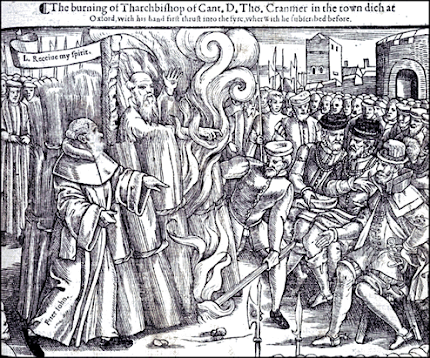
The burning of Tharchbishop of Cant. D. Tho. Cranmer in the town dich at Oxford, with his hand first thrust into the fyre, wherwith he subscribed before.

Bible Gateway Verse of the Day

Daily Bible Verse

Collect of the Day

1662 Book of Common Prayer

The Twenty-second Sunday after Trinity.

The Collect.

LORD, we beseech thee to keep thy household the Church in continual godliness; that through thy protection it may be free from all adversities, and devoutly given to serve thee in good works, to the glory of thy Name; through Jesus Christ our Lord. Amen.

Friday, July 31, 2009

Part VIII: Chapter Five of Thirty-Nine Articles: The Historic Basis of Anglican Faith: The Doctrine of Ministry


"It recognizes the fact of ministry, and states that those who minister publicly in the congregation should not do so till their call is confirmed by 'men who have public authority given unto them in the Congregation, to call and send Ministers into the Lord's vineyard.' But who these men are the Article does not specify, and so does not tie the doctrine of the Church of England to any one form of church polity."


Thirty-Nine Articles: The Historic Basis of Anglican Faith


A book by David Broughton Knox (Sydney: Anglican Church League, 1967). Revised 1976.


The author: Canon David Broughton Knox, B.A., A. L. C. D., B.D., M.Th., D. Phil. (Oxford), was Principal of Moore Theological College, Sydney, Australia. Ordained in 1941 he served in an English parish and as a chaplain in the Royal Navy before becoming a tutor at Moore College 1947-53. On leave in England he was tutor and lecturer in New Testament at Wycliffe Hall, Oxford 1951-53 and Assistant Curate in the parish of St. Aldale's, Oxford. He became Vice Principal of Moore College in 1954 and Principal in 1959. He was elected Canon of St. Andrew's Cathedral in 1960. His other books include "The Doctrine of Faith in the Reign of Henry VIII" (London: James Clarke, 1961).


David Broughton Knox also founded George Whitefield College in South Africa in 1989.


Table of Contents.


Chapter Five


The Teaching of the Articles


The Doctrine of Ministry


The pages of the New Testament show that in each Christian church there were various ministries. The Spirit of God was the source of these ministries, distributing to each church member a gift of ministry in accordance with the divine will. The New Testament enjoins on Christians the duty of recognizing these ministries which have God for their source, and of accepting from God what He gives for them through their ministers. But the New Testament does not descend to details with regard to the ministry. It would appear that there was considerable diversity amongst New Testament churches not only as to the form of ministry but also as to the duties of office-bearers, such as elders, and as to the way in which the church recognized and commissioned the ministers.


Article 23 'Of Ministering in the Congregation' follows the example of the New Testament, in that it could not be more general in its terms. It recognizes the fact of ministry, and states that those who minister publicly in the congregation should not do so till their call is confirmed by 'men who have public authority given unto them in the Congregation, to call and send Ministers into the Lord's vineyard.' But who these men are the Article does not specify, and so does not tie the doctrine of the Church of England to any one form of church polity.


It is, of course, well-known that the Church of England has retained the polity of episcopacy. However, none of its formularies goes beyond saying that episcopacy is an ancient form of church polity stretching back to the time of the apostles. This much is stated in the Preface to the Ordinal, which adds that it is the Church of England's intention to continue this polity of bishops, priests and deacons. What the Preface omits to say is significant in view of ecumenical discussion. For example, it is not said that it is a polity enjoined in Scripture, or that it is the only valid form of Christian ministry, or even that it is the best form.


Although Anglicans are not required to affirm that episcopacy is the best form of church ministry they are required to recognize that it is a valid ministry, not contrary to Scripture, for Article 36 affirms that the Church of England Ordinal contains nothing 'superstitious and ungodly', nor is it to be thought defective as a form of service for the ordering of ministry.


It is also worthy of notice that the language of the Church of England formularies is careful not to contradict the view held, for example, by Jerome and other Church Fathers, that bishops and priests belong to the one order of ministry. Thus Article 36 speaks of the consecration of archbishops and bishops, but of the ordering of priests and deacons. The same distinction is made in the page headings of the Ordinal, while the Preface speaks of 'these orders', not 'three orders', as it is sometimes misread.


The Seventh Sunday after Trinity.
The Collect.
LORD of all power and might, who art the author and giver of all good things; Graft in our hearts the love of thy Name, increase in us true religion, nourish us with all goodness, and of thy great mercy keep us in the same; through Jesus Christ our Lord. Amen.

Wednesday, July 29, 2009

Part VII: Chapter Five of Thirty-Nine Articles: The Historic Basis of Anglican Faith

"All remembrance of Jesus by a regenerate, Spirit-filled soul is full of precious fellowship. His Spirit is present to our spirit whenever we relate ourselves to Him in our thoughts, consequently the notion of a bare remembrance of Jesus in the Lord's Supper is an impossible notion with regard to anyone who is in a spiritual relationship with the Lord."


Thirty-Nine Articles: The Historic Basis of Anglican Faith


A book by David Broughton Knox (Sydney: Anglican Church League, 1967). Revised 1976.


The author: Canon David Broughton Knox, B.A., A. L. C. D., B.D., M.Th., D. Phil. (Oxford), was Principal of Moore Theological College, Sydney, Australia. Ordained in 1941 he served in an English parish and as a chaplain in the Royal Navy before becoming a tutor at Moore College 1947-53. On leave in England he was tutor and lecturer in New Testament at Wycliffe Hall, Oxford 1951-53 and Assistant Curate in the parish of St. Aldale's, Oxford. He became Vice Principal of Moore College in 1954 and Principal in 1959. He was elected Canon of St. Andrew's Cathedral in 1960. His other books include "The Doctrine of Faith in the Reign of Henry VIII" (London: James Clarke, 1961).


David Broughton Knox also founded George Whitefield College in South Africa in 1989.


Table of Contents.


Chapter Five


The Teaching of the Articles


The Lord's Supper


The Lord's Supper (or literally 'dinner') is a communion, that is, a fellowship with the Lord, and with one another in the presence of the Lord. The basis of the fellowship of the Lord's dinner is His death on Calvary for the sins of the world. He designated the food of the meal as a sacrament or sign of His body given for us and His blood shed for us for the forgiveness of our sins. As we share in this fellowship in the way that He has commanded we acknowledge and proclaim the great fact of His saving death, His sacrifice of Himself which He made for our sakes and which is the ground of the covenant of our relationship with God; we remember Jesus our Redeemer, our Lord and our coming King Who has appointed us a place at His table in His kingdom; we have fellowship with Him and He with us. "He dines with us and we with Him." (Rev. 3:20). All remembrance of Jesus by a regenerate, Spirit-filled soul is full of precious fellowship. His Spirit is present to our spirit whenever we relate ourselves to Him in our thoughts, consequently the notion of a bare remembrance of Jesus in the Lord's Supper is an impossible notion with regard to anyone who is in a spiritual relationship with the Lord.


By coming to Him and believing in Him we feed on Him the living bread which came down from heaven, we become one loaf with Him (John 6:32-35, I Corinthians 10:17). We eat His flesh which He gave for the life of the world and we drink His blood which was given for us and which cleanses us from all sin. Our souls rise in communal thanksgiving, the offering of the sacrifice of praise; and we pledge ourselves to His obedience in offering ourselves, our souls and bodies, to be a reasonable, holy and living sacrifice to Him.


The word "sacrament" is a synonym for the word "sign" and the one word may be substituted for the other without any change in meaning. The Lord's Supper is the sacrament of our redemption. It remains a sacrament, that is, it is not to be identified with the thing signified, for that would annihilate the sign which the Lord appointed and would overthrow the nature of a sacrament.


The bread and the wine are a sign or sacrament of the Lord's Body and Blood given in death for our sins, that is, they are a sign of Christ crucified for us. Our Lord's presence is not indicated by way of a sign, but is experienced through the Spirit, in reality, in accordance with His promise, by those who receive the benefit of his passion, the forgiveness of their sins.


By faith we take and eat and drink the Body and the Blood of Christ (whereof the bread and wine is a sacrament), that is, by faith we partake of His death for us, and of all its benefits. Christ in his death for us (or putting it another way, the Body and Blood of Christ) is present only sacramentally, that is to say, only by a sign (the bread and the wine) of this death being present.


But it is not Christ's presence, or Christ as present, which we eat and drink. We eat and drink the signs of His atoning death. They remain nothing but signs -- bare signs if you like to put it thus. His presence, in His risen power, is due to His promise to be among those who meet in His name, and the manner of His presence is His Spirit which He gives to all who believe in Him. He is indeed present, and we partake of that presence, if we wish to put it thus (for it is a person who is present), by fellowship with Him, as with faith we eat and drink the sign (or sacrament) which speaks to us of him.


"His presence" and "His body and blood" are not identical concepts. The true feeding on the body and blood of Christ in the Lord's Supper depends on the reality of His spiritual presence in the heart and the mind of the worshipper. His spiritual presence is not to be thought of as dependent on a 'real presence' of his body and blood but it is the same presence in the Lord's Supper as in every other aspect of the Christian life, it is the presence of Spirit to our spirit made real by God's word, conscious in the mind of the Christian. The Lord's Supper, with the signs of His death intergrated within it, is a very vivid bringing to mind of Christ and His word and so becomes a deep fellowship with Christ. It is not, however, any different sort of fellowship from that which the Christian enjoys with the Lord in His daily life outside the congregation. But it has the added dimension of being enjoyed in the company and fellowship of others who are enjoying this same fellowship with Christ at the same time so that the consciousness of the presence of Christ's body (i.e. our fellow Christians in their relationship to Jesus) should be no less vivid than the consciousness of the presence of the Lord Jesus present to our spirit (I Corinthians 11:29). We and our fellow Christians were crucified with Christ on the Cross (Galatians 2:20). We have been formed into a unity through being in that crucified body (Ephesians 2:16). The Lord's Supper is a celebration of that event. That is why it is necessary to recognize the body and consider one another, if we are to eat the Lord's Dinner and not merely eat our own dinner (I Corinthians 11:29; I Corinthians 11:20-21).


The grace (that is, the gift or benefit from God) of this sacrament is fellowship with Christ in the Spirit on the basis of the forgiveness of our sins. No greater grace, gift or benefit is possible in this life, and it is brought about on every heart felt remembrance of Christ, a remembrance which the Lord's Supper especially and vividly evokes as we eat and drink together in obedience to our Lord's command, "Do this in remembrance of Me."


Those who, without repentance and faith, eat the bread and the wine in the context of the Lord's Supper eat the sign of His death but they are not brought into any relationship with Christ thereby. "They in no wise partake of Christ" (Article 29). For they do not recognise the divine fellowship of redeemed and Redeemer, which is the Lord's Dinner, nor acknowledge the basis of that fellowship, namely, that "Christ died for our sins according to the Scriptures" (I Corinthians 15:3).


[For previous chapters of this book see: Chapter 1, Chapter 2, Chapter 3, Chapter 4.1, Chapter 4.2, and Chapter 5.1].


The Seventh Sunday after Trinity.

The Collect.

LORD of all power and might, who art the author and giver of all good things; Graft in our hearts the love of thy Name, increase in us true religion, nourish us with all goodness, and of thy great mercy keep us in the same; through Jesus Christ our Lord. Amen.

Sunday, July 26, 2009

Augustus Toplady on the Security of the Believer

From the Introduction to Historic Proof of the Doctrinal Calvinism of the Church of England.

"I affirm, that all they be blasphemers to God, that do slander the truth in predestination; that say, If I be once in, I cannot be out, do what evil I will or can: all such do declare themselves to be reprobates, and children of God's ire and wrath, rather than any of his. For whosoever delighteth in those things which God hateth and abhorreth, doth declare himself to be none of God's: but, if he be any of his, he will give him repentance, for to know the truth, by his Spirit. For the Spirit maketh intercession for the saints, according to the pleasure of God. For we know that all things work for the best, unto them that love God, who are called of purpose. For those which he knew before, lie also ordained before, that they should be like fashioned unto the shape (i. e. here, to the gracious, hereafter, to the glorious, resemblance) of his Son.

"And seeing God hath made all his elect like to the shape (the spiritual and moral similitude) of Jesus Christ, how is it possible, that any of them can fall away? Whosoever he be, that doth so hold, is against God and Christ; and may as well say, that our Lord and Saviour Jesus Christ may perish as any of them; for Christ said unto the Father, Then hast loved them as thou hast loved me; although Christ spake these words to the comfort of his disciples at the present, so likewise is it to the comfort of all us, his chosen. Those that St. Paul speaketh of that God knew before, he meant by it, all his elect; and immediately be addeth, saying, Whom he appointed before, them also he called and whom he called, them also he justified; and whom he justified, them also he glorified. What shall we then say to these things? If God be on our side, who can be against us? That is to say, if God have appointed to glorify us and to save us, who can then deny (deprive) him of any of us, or take us out of his hands ?

"My sheep, saith Christ, hear my voice, and I know them, and they follow me; and I give unto them eternal life, and they shall never perish. O, most worthy Scriptures! which ought to compel us to have a faithful remembrance, and to note the tenor thereof; which is, the sheep of Christ shall never perish.

"Doth Christ mean part of his elect, or all, think you? I do hold, and affirm, and also faithfully believe, that he meant all his elect, and not part, as some do full ungodly affirm. I confess and believe assuredly, that there shall never any of them perish: for I have good authority so to say; because Christ is my author, and saith, if it were possible, the very elect should be deceived. Ergo, it is not possible that they can be so deceived, that they shall ever finally perish, or be damned: wherefore, whosoever doth affirm that there maybe any (i. e. any of the elect) lost, doth affirm that Christ hath a torn body."36

The Seventh Sunday after Trinity.
The Collect.
LORD of all power and might, who art the author and giver of all good things; Graft in our hearts the love of thy Name, increase in us true religion, nourish us with all goodness, and of thy great mercy keep us in the same; through Jesus Christ our Lord. Amen.

Toplady: Calvinism


IV. James Bainham, a gentleman of birth and learning, by profession a lawyer, of the Middle Temple, suffered at the stake in 1532. His judgment concerning the evangelical doctrines, sufficiently appears from one of his answers, on his first trial before Stokesley, bishop of London. "All godliness," said the martyr, "is given of God by his abundant grace: the which no man of himself can keep, but it" [i.e. the retaining, as well as the reception, of grace] "must be given him of God."7 So highly was this chosen vessel favoured in his last moments, that, when his legs and arms were half consumed by the flames, he addressed the spectators in these memorable words: "O ye Papists, ye looked for miracles. Here you may see a miracle; for, in this fire, I feel no more pain, than if I were on a bed of down. It is to me a bed of roses."
 
 
The Sixth Sunday after Trinity.
The Collect.
O GOD, who hast prepared for them that love thee such good things as pass man's understanding; Pour into our hearts such love toward thee, that we, loving thee above all things, may obtain thy promises, which exceed all that we can desire; through Jesus Christ our Lord. Amen.

Saturday, July 25, 2009

Augustus Toplady: The Catholic Church Is Invisible

III. Mr. Thomas Bilney, who had been the instrument of bishop Latimer's conversion, was burned in 1531. Among the articles of his examination before Tonstal, bishop of London, were the following: "Whether he believed the Catholic Church may err in the faith, or no? And whether he thought the Catholic Church is only a spiritual Church, intelligible and known only to God?" To this double interrogatory, Bilney answered in these words "The Catholic Church" [i.e. the universal Church of God's predestinated people,] "can by no means err in faith: for it is the whole congregation of the elect; and so known only unto God, who knoweth who are his."4 Two other ensnaring questions were put to this holy man: "Whether he believed all things, pertaining to salvation and damnation, to come of necessity, and nothing to be in our own wills? And, whether he believed God to be the author of all evil?"5 He discreetly answered, "God is the author of the punishment Only, but not of the. offence."6 He would never have been put to the test of such queries as these, if he had not been considered as a known predestinarian.
From:

Historic Proof of the Doctrinal Calvinism of the Church of England

Augustus Toplady


SECTION XII.

The Judgment of the most eminent English Martyrs, who suffered for the Gospel, prior to the Settlement of the Reformation.

The Sixth Sunday after Trinity.
The Collect.
O GOD, who hast prepared for them that love thee such good things as pass man's understanding; Pour into our hearts such love toward thee, that we, loving thee above all things, may obtain thy promises, which exceed all that we can desire; through Jesus Christ our Lord. Amen.

Friday, July 24, 2009

Part VI: Chapter Five of Thirty-Nine Articles: The Historic Basis of Anglican Faith


". . . it is faith in God and in His promise which brings the blessing promised, whether it be salvation or any other gift. Consequently the Articles make it abundantly clear that if the sacraments are received without faith on the part of the recipient, they are as ineffective as is the Word heard but not believed."


Thirty-Nine Articles: The Historic Basis of Anglican Faith


A book by David Broughton Knox (Sydney: Anglican Church League, 1967). Revised 1976.


The author: Canon David Broughton Knox, B.A., A. L. C. D., B.D., M.Th., D. Phil. (Oxford), was Principal of Moore Theological College, Sydney, Australia. Ordained in 1941 he served in an English parish and as a chaplain in the Royal Navy before becoming a tutor at Moore College 1947-53. On leave in England he was tutor and lecturer in New Testament at Wycliffe Hall, Oxford 1951-53 and Assistant Curate in the parish of St. Aldale's, Oxford. He became Vice Principal of Moore College in 1954 and Principal in 1959. He was elected Canon of St. Andrew's Cathedral in 1960. His other books include "The Doctrine of Faith in the Reign of Henry VIII" (London: James Clarke, 1961).


David Broughton Knox also founded George Whitefield College in South Africa in 1989.


Table of Contents.


Chapter Five


The Teaching of the Articles


IV: The Sacraments and the Church


The Thirty-Nine Articles aim to block off any loophole by which the idea that salvation results from our own actions -- an idea very congenial to our natural way of thinking -- might find lodgement again among the doctrines held by the Church of England. History shows that the sacraments are especially liable to be interpreted in this way. They are easily misinterpreted as religious works, by doing which the sinner obtains grace from God. Consequently the Articles are careful to define the sacraments as essentially God's Word to us. They speak and witness to us "of grace, and God's good will towards us". (Article 25). As in the written word of Scripture, so in the acted word of the sacraments, it is faith in God and in His promise which brings the blessing promised, whether it be salvation or any other gift. Consequently the Articles make it abundantly clear that if the sacraments are received without faith on the part of the recipient, they are as ineffective as is the Word heard but not believed. Thus Article 29 declares that "such as be void of a lively faith", although they partake of the bread and wine in the Lord's Supper, "yet in no wise are they partakers of Christ." This absolute negative -- nullo modo, (See Latin translation of Article 29) "in no way" -- effectively excludes the notion that Christ is in some sense associated with the bread and wine in a local manner so that those who receive the bread and wine, even without faith, in some sense receive Christ.


Christ dwells in the hearts of the worshippers by faith. He is present to their personalities by His Spirit, and this is the only manner of His presence in His Supper. This is unequivocally stated in Article 28. "The Body of Christ is given, taken, and eaten, in the Supper, only after an heavenly and spiritual manner. And the means whereby the Body of Christ is received and eaten in the Supper is Faith."


Baptism is spoken of in the same way. It is a "visible sign" of "the promises of the forgiveness of sin, and of our adoption to be the sons of God by the Holy Ghost" (Article 27).


The same Article likens baptism to an instrument of conveyance. Waterland commented: "A deed of conveyance, or any like instrument under hand and seal, is not a real estate, but it conveys one, and it in effect the estate itself, as the estate goes along with it, and as the right, title, and property (which are real acquirements) are as it were bound up in it and subsist in it" (Works, VII, p. 147). The deeds remain parchment and wax. They are not the property itself. But they are not merely parchment and wax, nor are they merely reminders of the property. The person who receives them receives the property; yet on one important condition: he must be the duly qualified person to receive them, otherwise the deeds convey nothing to him. So the sacraments convey eternal life by way of promise to those (and only those) who perceive and believe that promise.


The sacraments are God's sacraments, God's gracious words of promise to us. Through them God holds out to us everlasting life in Christ. This becomes ours by our response of faith. They are therefore God's instruments, not our works. As Article 25 puts it, "by the which he doth strengthen and confirm our Faith in him". This being the case, an unworthy minister does not hinder the salutary effects of the sacraments, for so long as the promise is clear through them, that promise may be received by faith (Article 26).


The sacraments embody the promise, as does the Word. But they are not self-explanatory, as the Word is, conveying its own meaning by its inherent intelligibility. They depend upon the Word for their actions to be symbolic and meaningful. They are therefore signs of God's grace only so long as they are understood in the context of the Word. But when accompanied by the explanatory Word (whether explicit or implicit) they become "effectual signs". The signs are effectual in two senses: not only effectual because the actions of which they consist, i.e., washing and eating, lend themselves to conveying helpfully the message of forgiveness and incorporation into Christ, but effectual because, like the Word, being clear messengers of God's grace, they are the means of bringing the promised blessings to those who believe and who express their faith in the promise by using its signs. Thus Article 25 describes the sacraments as "sure witnesses, and effectual signs of grace, and God's good will towards us".


Though the sacraments depend upon the Word for their character as signs, they go beyond the Word inasmuch as they are actions. They impress God's promises on our minds not merely by the sense of hearing but by sight and touch, and so they fortify faith. Moreover, they enable the believer to signify his response to the promises by his actions and not merely by his mental attitude or words. For example, he looks "to God for a clear conscience" (I Peter 3:21, R.S.V.) as he engages in the sacramental expression of this in baptism.


Because the sacraments are actions, acted promise and acted response, they may be spoken of as seals which confirm the promise in our consciousness. Although the New Testament does not refer to the sacraments in this way, it was a favourite thought amongst the Reformers and finds a place in the Articles (Article 27). It is the promise of adoption which the Articles speaks of as sealed by the sacrament of baptism. The thing promised, namely our adoption itself, is sealed to us by the presence of the Holy Spirit in our hearts. "Because you are sons God sent the Spirit of his son into your hearts." (Galatians 4:6).


The sacraments, being religious actions in which we engage, are easily thought of as primarily our actions, undertaken either for God's honour, or to obtain some merit or grace. In particular the Lord's supper is sometimes thought of as an offering we make to God. Since the offering made by Christ is the only offering that can be made on behalf of sinners which is acceptable to God, the Lord's supper has been interpreted as an offering associated in various ways with the offering of Christ on Calvary. Article 31 severely condemns this notion. Christ's offering was made once for all and is complete in every respect.


The sacraments express primarily not our action but God's; yet they are actions which incorporate our response to Him. That response is always and only faith, embodied by the outward action of receiving the sign of God's proffered blessing. Promise and response, both coalescing in symbolic action, make up the sacrament. Actions which obscure the promise or which symbolize the wrong response destroy the sign. Thus three current malpractices of the time -- non-communicating attendance at the Lord's supper, the reservation of the consecrated bread and wine, and their adoration -- are all condemned in the last paragraph of Article 25 on the ground that they are distortions of the sacraments from their purpose and proper use according to the mind of Christ.

[Charlie's note: Since Chapter 5 is lengthy I will be breaking it into different sections and posting it on different days of the week. The next section will deal with the Lord's supper.]


The Sixth Sunday after Trinity.


The Collect.

O GOD, who hast prepared for them that love thee such good things as pass man's understanding; Pour into our hearts such love toward thee, that we, loving thee above all things, may obtain thy promises, which exceed all that we can desire; through Jesus Christ our Lord. Amen.


Recommended Resource: Dr. Michael Horton's Adult Bible Class

I highly recommend the following teaching series which is available online at Christ United Reformed Church.  Dr. Michael Horton's systematic theology class for his Adult Bible Class is an excellent resource for anyone wishing to learn more about the Bible and Christian faith from a Reformed perspective.  You can listen to the podcasts at Adult Bible Class.


The Sixth Sunday after Trinity.

The Collect.

O GOD, who hast prepared for them that love thee such good things as pass man's understanding; Pour into our hearts such love toward thee, that we, loving thee above all things, may obtain thy promises, which exceed all that we can desire; through Jesus Christ our Lord. Amen.

Tuesday, July 21, 2009

Part V: Thirty-Nine Articles: The Historic Basis of Anglican Faith: Predestination


Thirty-Nine Articles: The Historic Basis of Anglican Faith


A book by David Broughton Knox (Sydney: Anglican Church League, 1967). Revised 1976.


The author: Canon David Broughton Knox, B.A., A. L. C. D., B.D., M.Th., D. Phil. (Oxford), was Principal of Moore Theological College, Sydney, Australia. Ordained in 1941 he served in an English parish and as a chaplain in the Royal Navy before becoming a tutor at Moore College 1947-53. On leave in England he was tutor and lecturer in New Testament at Wycliffe Hall, Oxford 1951-53 and Assistant Curate in the parish of St. Aldale's, Oxford. He became Vice Principal of Moore College in 1954 and Principal in 1959. He was elected Canon of St. Andrew's Cathedral in 1960. His other books include "The Doctrine of Faith in the Reign of Henry VIII" (London: James Clarke, 1961).


David Broughton Knox also founded George Whitefield College in South Africa in 1989.


Table of Contents.


Chapter 4


Predestination


Predestination is the sheet anchor of the doctrine of grace. This is illustrated by the Epistle to the Romans in which St. Paul establishes that our salvation rests on God's grace exclusively. He cites the two twins, Esau and Jacob, as the classic example, commenting 'Though they were not yet born and had done nothing, either good or bad, in order that God's purpose of election might continue, not because of works but because of his call, she [Rebecca] was told, "The elder will serve the younger"' (Romans 9:11-12, R.S.V.).


So in the Thirty-Nine Articles the doctrine of election is fundamental to the sovereignty of grace. Article 17, the longest of the Articles, deals with topic. (1) Its first sentence affirms that all who reach heaven do so because before the foundation of the world God chose them and unalteringly decreed to confer on them this benefit. (2) The second sentence lists the seven stages of the progress of the elect from 'curse and damnation' to 'everlasting salvation' -- God's call, their response through grace, their free justification, their adoption as God's sons, the formation of a Christlike character within them, their expression of this in a life of good works, 'and at length, by God's mercy, they attain to everlasting felicity.' We note here the two-sidedness of grace: God's sovereign initiative works through the faculties of our nature. God calls, we respond; God justifies, adopts, sanctifies, we live out a Christian life and finally attain to everlasting felicity. But our response is not to be regarded as our own contribution to our salvation but is itself God's gift, 'They through grace obey', 'At length, by God's mercy, they attain'.


It is the same group of persons who pass through these seven stages, and in this respect the article is reminiscent of St. Paul's 'golden chain' in Romans 8:29 f. However, in these two opening sentences the Article does not go beyond Augustine in affirming the irresistibility of grace and the effectual character of God's call. The indefectibility and perseverance of the saints is not touched on till the third sentence which comprises the second paragraph. In this third sentence the Article sides clearly with Calvin, going beyond Augustine who taught that the gift of perseverance is not given to all the regenerate and that it is consequently possible to fall from a state of salvation and be eternally lost. The consequence of this possibility is that no one would know whether he is elect, apart from a special personal revelation from God. Thus Thomas Aquinas wrote: 'No one can know whether he has sanctifying grace' (Summa Theol. II. 112. 5); and the Council of Trent affirmed: 'Except by special revelation, it cannot be known whom God has chosen unto Himself' (Session VI, Chapter 12). However, in its second paragraph Article 17 affirms (3) that our predestination and election in Christ may be known to us and be the subject of our meditation, yielding 'sweet, pleasant, and unspeakable comfort'. (4) This knowledge or certification of our election results from knowledge of the promises of God, and from our perception of the working of God's Spirit within us. Consequently we know that we are within the unbroken chain of God's purposes of blessing leading to eternal felicity. (5) This knowledge yields not only 'comfort' but increase in active godliness. For love kindles love, and a knowledge of God's steadfast love in delivering us from the curse and damnation we deserve and leading us without fail to 'eternal Salvation to be enjoyed through Christ', fervently kindles love towards God.'


A perception of the working of the Spirit of Christ in us is the assurance that God has adopted us as sons and chosen us in Christ; but an absence of this Spirit is no sign that a man is not elect (for all the elect begin in this state!). Nevertheless it may be so construed by the spiritually unenlightened, as experience shows. The Article, recognizing this, affirms (6) that the doctrine of predestination is a doctrine for the believer.


The Christian should always view the doctrine of predestination from the standpoint of his position in Christ. Looking backward he sees God's eternal grace choosing him in Christ, calling him, adopting him, glorifying him. As he looks forward he rejoices in the sure hope of salvation, for God is faithful, who called him and will confirm him to the end (I Corinthians 1:8; Philippians 1:6; I Thessalonians 5:24). However, if it is separated from our experience in Christ and from our faith in God, it becomes a merely speculative doctrine (for example in the phrase, 'once saved always saved' which contains no reference to God at all). It then has no religious value, and some of its apparent deductions may run counter to Christian conduct. Consequently in the Article's fourth sentence and last paragraph it is affirmed (7) that we must regulate our deductions from the doctrine of predestination by the plain teaching of Scripture; for example (a) we must not despair of God's promises, arguing that we are non-elect, nor (b) must we presume on our election to the neglect of the clearly revealed will of God as to our duty and the way we are to live our lives.


The Article confines itself to discussing 'Predestination to Life'. It does not touch on reprobation (or preterition). [Charlie's comment: But Article 17 does say that the non-elect are under God's sentence: . . . so for curious and carnal persons, lacking the Spirit of Christ, to have continually before their eyes the sentence of God's Predestination is a most dangerous downfall, whereby the devil doth thrust them either into desperation or into wretchlessness of most unclean living no less perilous than desperation.] The omission is not a denial of the doctrine of reprobation, as is sometimes assumed, but a recognition of the over-whelming predominance of the doctrine of predestination to life in the treatment of the subject in Scripture, compared with the mystery of reprobation which is only touched on in half a dozen passages in Scripture. Predestination to life is a constant topic of Scripture, and consequently appropriately finds a prominent place in the Articles.


The seventeenth Article not only accompanies Calvin beyond the point where Augustine stopped short, but it effectively excludes an Arminian interpretation of predestination. Arminius, a Dutch theologian of the early seventeenth century, following many predecessors stretching back to the days before Augustine, based God's predestination not on His good pleasure (and so entirely within Himself) but on His foresight of how a man would respond to the opportunities of repentance and faith granted him. For Arminius, God's predestination (or decision about a man's future) follows the foresight of man's own decision. In this way the scriptural word 'predestination' is retained, but is evacuated of any real meaning. However, the Article clearly excludes this Arminian interpretation, for such a doctrine that our predestination is dependent on the exercise of our own will could never be twisted to become 'a most dangerous downfall' were an unspiritual person to have it 'continually before his eyes', for it is the very thing which such people normally imagine to be the case. Nor could it ever lead to desperation or unclean living, for it bases 'predestination' entirely on the quality of a man's continual response to the Gospel.


These warnings of the Article confirm that its subject is the doctrine of absolute and unconditional election, for they deal with false and erroneous deductions which are sometimes made from this doctrine. The warnings are irrelevant in Arminian 'predestination'.


Article 18 concludes the group of articles (9-18) which deal specifically with individual salvation. It anathematizes the latitudinarian spirit which would open the gate of heaven to all who live a decent life. The doctrine of predestination (as expounded in Article 17) particularizes salvation and grounds it exclusively on Christ's merits and God's free gift; but the logical outcome of rejection of this doctrine is that God's salvation is generalized into the possibility of salvation, so that actual salvation comes to depend on the quality of a man's response, and not exclusively on God's grace. The quality of this response becomes the essential differentiating element in salvation. The doctrinal tendency to find a place for man's will in the ground of his salvation reaches its logical conclusion in the view 'That every man shall be saved by the Law or Sect which he professeth, so that he be diligent to frame his life according to that law, and the light of Nature'. This view the Article anathematizes, 'For holy Scripture doth set out unto us only the Name of Jesus Christ, whereby men must be saved.' (See Acts 4:12). If we think of our natural state as sinners as being 'without God', and 'children of wrath', and spiritually 'dead' (Ephesians 2) the doctrine of Articles 17 and 18 is unavoidable.


Article 18 contains the only anathema in the Thirty-Nine Articles. Significantly enough it is directed against the full-blown form of the doctrine that salvation depends on man's own works; for it was this doctrine of works that was the basic quarrel that the Reformers had with the papal system of religion. At the time of the Reformation their opponents would have agreed with the Reformers in the sentiments of Article 18. But in the passage of the centuries the Roman doctrine of works has expressed itself within the Roman Communion in very similar language to that anathematized by the Article. Thus Hans Kung has written: 'Yvonne (a Protestant) . . . can win eternal life if she lives according to her conscience and keeps God's commandments.'i Kung speaks similarly of how 'a pagan . . . can be saved'.ii Support for this doctrine of salvation through following the light of conscience is sometimes sought in the Epistle to the Romans, chapters one and two. But in these chapters the apostle is not dealing with the salvation of the Gentiles but with the responsibility involved in possessing a conscience, and the culpability that comes from not following it. He concludes this argument: 'We before laid to the charge both of Jews and Greeks, that they are all under sin . . . ' For they are all under law, either of Scripture or of nature, 'that every mouth may be stopped, and all the world may be brought under the judgment of God: because by the works of the law shall no flesh be justified in his sight' (Romans 9:9, 19f, R.S.V.). The possibility of salvation through the light of nature is no longer a private opinion amongst Roman Catholics but has been endorsed by the Second Vatican Council. In paragraph 16 of its Constitution On the Church, which was promulgated in November 1964, the Second Vatican Council declared:


The plan of salvation also includes those who acknowledge the Creator. In the first place among these there are the Moslems . . . Those also can attain a salvation who through no fault of their own do not know the Gospel of Christ or His Church, yet sincerely seek God and moved by grace strive by their deeds to do His will as it is known to them through the dictates of conscience. Nor does Divine Providence deny the helps necessary for salvation to those who, without blame on their part, have not yet arrived at an explicit knowledge of God and with His grace strive to live a good life.


It is difficult to see how in practice this is distinguishable from Pelagianism.


[For previous chapters of this book see: Chapter 1, Chapter 2, Chapter 3, and Chapter 4.1.]


iThat the World May Believe, p. 5.

iiIbid., p. 83.


The Sixth Sunday after Trinity.
The Collect.

O GOD, who hast prepared for them that love thee such good things as pass man's understanding; Pour into our hearts such love toward thee, that we, loving thee above all things, may obtain thy promises, which exceed all that we can desire; through Jesus Christ our Lord. Amen.

Monday, July 20, 2009

Excerpt: The Reformed Doctrine of Predestination

The doctrine of Predestination receives comparatively little attention in our day and it is very imperfectly understood even by those who are supposed to hold it most loyally. It is a doctrine, however, which is contained in the creeds of most evangelical churches and which has had a remarkable influence both in Church and State. The official standards of the various branches of the Presbyterian and Reformed Churches in Europe and America are thoroughly Calvinistic. The Baptist and Congregational Churches, although they have no formulated creeds, have in the main been Calvinistic if we may judge from the writings and teachings of their representative theologians. The great free church of Holland and almost all the churches of Scotland are Calvinistic. The Established Church of England and her daughter, the Episcopal Church of America, have a Calvinistic creed in the Thirty-nine Articles. The Whitefield Methodists in Wales to this day bear the name of "Calvinistic Methodists."

Among the past and present advocates of this doctrine are to be found some of the world's greatest and wisest men. It was taught not only by Calvin, but by Luther, Zwingli, Melanchthon (although Melanchthon later retreated toward the Semi-Pelagian position), by Bullinger, Bucer, and all of the outstanding leaders in the Reformation. While differing on some other points they agreed on this doctrine of Predestination and taught it with emphasis. Luther's chief work, "The Bondage of the Will," shows that he went into the doctrine as heartily as did Calvin himself. He even asserted it with more warmth and proceeded to much harsher lengths in defending it than Calvin ever did. And the Lutheran Church today as judged by the Formula of Concord holds the doctrine of Predestination in a modified form. The Puritans in England and those who early settled in America, as well as the Covenanters in Scotland and the Huguenots in France, were thorough-going Calvinists; and it is little credit to historians in general that this fact has been so largely passed over in silence. This faith was for a time held by the Roman Catholic Church, and at no time has that church ever openly repudiated it. Augustine's doctrine of Predestination set against him all the half-hearted elements in the Church and arrayed him against every man who belittled the sovereignty of God. He overcame them, and the doctrine of Predestination entered the belief of the universal Church. The great majority of the creeds of historic Christendom have set forth the doctrines of Election, Predestination, and final Perseverance, as will readily be seen by any one who will make even a cursory study of the subject. On the other hand Arminianism existed for centuries only as a heresy on the outskirts of true religion, and in fact it was not championed by an organized Christian church until the year 1784, at which time it was incorporated into the system of doctrine of the Methodist Church in England. The great theologians of history, Augustine, Wycliffe, Luther, Calvin, Zwingli, Zanchius, Owen, Whitefield, Toplady, and in more recent times Hodge, Dabney, Cunningham, Smith, Shedd, Warfield, and Kuyper, held this doctrine and taught it with force. That they have been the lights and ornaments of the highest type of Christianity will be admitted by practically all Protestants. Furthermore, their works on this great subject have never been answered. Then, too, when we stop to consider that among non-Christian religions Mohammedanism has so many millions who believe in some kind of Predestination, that the doctrine of Fatalism has been held in some form or other in several heathen countries, and that the mechanistic and deterministic philosophies have exerted such great influences in England, Germany, and America, we see that this doctrine is at least worthy of careful study.

From the time of the Reformation up until about one hundred years ago these doctrines were boldly set forth by the great majority of the ministers and teachers in the Protestant churches; but today we find far the greater majority holding and teaching other systems. It is only rarely that we now come across those who can be called "Calvinists without reserve."

Loraine Boettner, The Reformed Doctrine of Predestination. Introduction.

The Sixth Sunday after Trinity.
The Collect.
O GOD, who hast prepared for them that love thee such good things as pass man's understanding; Pour into our hearts such love toward thee, that we, loving thee above all things, may obtain thy promises, which exceed all that we can desire; through Jesus Christ our Lord. Amen.

Sunday, July 19, 2009

Quote of the Day: Michael Horton

Wichita, Kan.: I have visited some of the Christian Bible Colleges around the country and have sat in some of the classes being offered. I have also visited churches planted by these colleges and they all have become infected by this virus and are now promoters of this Christless Christianity. Question: Since this problem is so sweeping across the country and denominations, do I contact the Presidents of these Colleges? What can we say or do to change the tide? Or are we on the "Downgrade" that Charles Spurgeon warned us about so many years ago?

Michael S. Horton: You put your finger on a major argument in my book. Conservatives often identify "Christless Christianity" with liberalism. However, it is hard to find Christ-centered preaching in so-called "Bible-believing" churches today. Everybody seems to be interested in other things these days.

The prophets, Jesus, Paul, Augustine, the Protestant Reformers, Spurgeon, and countless others had to confront the heresy of self-salvation. It is our default setting to believe that we are basically good people who could be a little better with the right game-plan, support-network, and coaching. "God helps those who help themselves": according to surveys, most evangelicals thought that this was a biblical quotation, when it actually comes from Ben Franklin. The Good News that the Bible proclaims, however, is that God saves those who cannot save themselves.

The first thing we have to realize if there is going to be genuine reformation in the churches today is that the self-trust that engenders Christless Christianity is not just a problem in some times and places, but is the natural drift of our fallen heart. We have to be taught out of it our whole lives as Christians. One generation assumes the gospel; the next generation forgets it; the next one abandons it. But each of us will be constantly tempted to fall back on ourselves instead of on Christ unless Christ is seen as the center and circumference of the church's preaching, teaching, the sacraments, and mission.

Thursday, July 16, 2009

Chapter Four: The Teaching of the Articles: III. The Doctrine of Salvation

Part IV


Thirty-Nine Articles: The Historic Basis of Anglican Faith


A book by David Broughton Knox (Sydney: Anglican Church League, 1967). Revised 1976.


The author: Canon David Broughton Knox, B.A., A. L. C. D., B.D., M.Th., D. Phil. (Oxford), was Principal of Moore Theological College, Sydney, Australia. Ordained in 1941 he served in an English parish and as a chaplain in the Royal Navy before becoming a tutor at Moore College 1947-53. On leave in England he was tutor and lecturer in New Testament at Wycliffe Hall, Oxford 1951-53 and Assistant Curate in the parish of St. Aldale's, Oxford. He became Vice Principal of Moore College in 1954 and Principal in 1959. He was elected Canon of St. Andrew's Cathedral in 1960. His other books include "The Doctrine of Faith in the Reign of Henry VIII" (London: James Clarke, 1961).


David Broughton Knox also founded George Whitefield College in South Africa in 1989.


Table of Contents.


Chapter Four


The Teaching of the Articles


III: The Doctrine of Salvation


The Reformers' great concern was that the Church should know and preach the Gospel of the grace of God. The basis of the Gospel of grace is the doctrine that God has provided a full and complete ground of salvation in the death of Christ. This is affirmed in Article 31 and referred to in Articles 2, 15, and 28. Salvation becomes ours by way of God's promise (based on Christ's death) and our believing the promise. Article 7 refers to the promise; Article 11 refers to our response of faith. This latter Article states that God judges us worthy of ourselves but only on account of Christ's worthiness. Faith is the means by which we participate in this salvation -- faith in God known in the death and resurrection of Jesus. We make no contribution from ourselves to our salvation. From Beginning to end it is of God's grace. Our Justification, or our being accepted as worthy by God, does not wait on any 'work' of ours which we may accomplish in the time-process in which our life is set. It is simultaneous with our apprehension, in the inmost recess of our personality, of the grace of God in Christ and it precedes any action of our will from which 'works' flow. We are saved by God solely on the basis of Christ's 'works' and the means whereby God saves us is our believing His truth.


The knowledge that our salvation is of God and is not suspended, even in part, on the outcome of our own vacillating efforts is a doctrine full of great strength, nerving us to battle and endure for our Saviour even in the face of defeat. Article 11 'Of the Justification of Man', which succinctly states this key doctrine, deserves to be quoted in full. 'We are accounted righteous before God only for the merit of our Lord and Saviour Jesus Christ by Faith, and not for our own works or deservings: Wherefore, that we are justified by Faith only is a most wholesome Doctrine, and very full of comfort, as more largely is expressed in the Homily of Justification.' (The homily referred to is the third of the first book of the Homilies of the Church of England.)


The doctrine of salvation of a sinner entirely by the grace of God greatly enhances our understanding of the love of God, and redounds to God's glory; but it is not a doctrine which would have occurred to anyone if it were not taught in Scripture. All mankind is conscious from time to time of guilt, and it seems natural that the way, if any, to expiate guilt is by some action of our own, perhaps a sacrifice or prayer, perhaps more ascetic and painful action, perhaps reformation of life. But the Reformers saw that the Bible taught that none of these things was the ground, or shared in the ground, of our forgiveness and salvation. However, the biblical doctrine is so strange to our natural ideas, and the activity of our wills as the ground (or contributing vitally to the ground) of salvation is so congenial to human thought, that whenever the Bible is not carefully read and expounded, or whenever it is no longer regarded as authoritative, the Gospel of God's grace is lost (or at least obscured) and no longer has the liberating and exhilarating effect on our life that it should have.


Many of the Articles are devoted to cutting off the ways by which history showed the Gospel of God's grace could be eroded or diluted by the doctrine of salvation by our works. Articles 9 and 10 teach that human nature, since the advent of sin, no longer has the power to enable it to act in a way that is pleasing to God. Article 9 speaks of 'original or birth-sin', that bias of our nature which draws us to act against the will of God known to us in our conscience. God did not create mankind thus and it meets with God's disapproval. This bias towards in remains in us even after our adoption as God's children, so that the apostle Paul can speak of 'the sin which dwells in me' (Romans 7:17, R.S.V.) and of the 'flesh' whose desires run counter to those of the Holy Spirit, so that we are not able to do what we would (Galatians 5:17). Such a nature is no satisfactory basis for winning our way to heaven by our own works. We are always in need of forgiveness.


Article 10 speaks of the weakness of our will, which of itself can never choose God. As fallen sinners our nature is self-centred, not God centred; though a moment's reflection shows that this is wrong in a creature -- in a being, that is, who is not self-sufficient but is contingent and dependent, as we know ourselves to be. However, we have not the strength of will to abandon this self-centredness of ourselves so as to become God-centred. Our wills simply serve our nature, which is now self-centred. They cannot change our basic nature. Such being the case, it is impossible that our will should be the means of our salvation.


Articles 9 and 10 make clear that in ourselves there remains no way by which we can begin to return to God. This idea is highly uncongenial to our natural way of thinking. It can only be maintained so long as it is recognized as clearly taught in Scripture, and so long as Scripture in its plain meaning remains authoritative for the Christian.


Article 11 states that the way of salvation is by the merit of Christ, though faith. Article 12 is a postscript to Article 11, explaining the place of good works and Christian conduct. Our salvation is not based on our conduct, but Christian conduct is the consequence of our salvation. Good works are an outward indication of our new relationship to God, 'By them a lively faith may be as evidently known as a tree discerned by the fruit.' However, our conduct is never as perfect as it should be; it can therefore never merit our salvation, for taken by itself it comes short, and so deserves God's condemnation.


If a Christian's life on earth is never free from the taint of the old nature, so that his acceptance with God always depends on his relationship with Christ and never on his works viewed in themselves (so much is stated in Article 12), it follows a fortiori that a man's life before he comes under the leading of the Holy Spirit as a Christian cannot win God's favour. This is stated in Article 13. The teaching of this Article has met with hostile comment in some modern Christian circles. This is through a misapprehension of the meaning of the language of the Article, which must be construed in close connection with Article 12. The latter states that the Christian's imperfect works are only (fully) pleasing to God because they are seen in the context of a Christian's standing in Christ. For in themselves these imperfections call out 'the severity of God's judgement', since God is holy. The imperfect works (and even the best are such) of those as yet outside of Christ do not share in the benefit of forgiveness that is through Christ. It is therefore inevitable that when brought to the bar of God's judgement such works must be described as 'not pleasant to God', for inevitably 'they have the nature of sin'. The Article is concerned to show that sinners cannot in any way merit God's salvation; this remains wholly a gift of God's grace and mercy. Merited salvation is not mercy but reward.


Article 14 makes clear that no Christian can exceed God's requirements, so as to put himself in God's debt. It is directed against the Roman Catholic doctrine of works of supererogation. At first sight it may seem extraordinary that any Christian should think that he can be better than God requires. yet the concept is inherent in salvation by merit. For this implies a standard to be attained, and if this is to be fixed within the capacity of the ordinary Christian to attain, plainly the more saintly can exceed it. The overplus of merit is then available for assignment, by papal indulgence, to penitents whose own merits come short of the standard. The Article, basing itself on Scripture, denies the possibility of exceeding God's requirements and says that the notion cannot be entertained without arrogancy and impiety. [Editor's note: See Luke 17:7-10].


Article 15 insists that no one but Christ attains to God's requirements. 'All the rest . . . offend in many things.'


Article 16 teaches that no sinner should despair, for there is always a place of forgiveness and restoration for those who repent.


1662 Book of Common Prayer


Collect of the Day

The Fifth Sunday after Trinity.

The Collect.

GRANT, O Lord, we beseech thee, that the course of this world may be so peaceably ordered by thy governance, that thy Church may joyfully serve thee in all godly quietness; through Jesus Christ our Lord. Amen.

Sunday, July 12, 2009

Re: Cranmer's Sermon on Baptism: Cranmer's Catechism

I don't blame you for giving up, Ken.  I would give up as well if I had been so soundly refuted in a debate.  Next time, check your facts before engaging the other side.
 
In Christ,
 
Charlie
----- Original Message -----
Sent: Sunday, July 12, 2009 6:20 PM
Subject: Re: Cranmer's Sermon on Baptism: Cranmer's Catechism

Yes, it was a heretical document in which the Lutheran World Federation (ELCA and its overseas counterparts) gave away the store.  They're about as Lutheran as PCUSA is Reformed.   One LCMS dogmatician referred to the document as the "Augsburg Concession," and the faculties of both LCMS seminaries rejected the document as entirely unsatisfactory.
 
In any event, I don't think we need to exchange any more emails.   I consider our conversation to be at an end; any further emails from you will be unopened and unanswered. 
 
Ken
 
In a message dated 7/12/2009 2:59:52 P.M. Central Daylight Time, cranmer1959@gmail.com writes:
If you want to talk about heresy, let's talk about the Joint Declaration on Justification.  Correct me if I'm wrong, but wasn't that a "Lutheran" compromise with the Roman Catholic Church????

Particular Atonement


Does Christ actually redeem all men who have sinned? Or does He redeem only those who believe? Does "all" literally mean every single individual?

2 Peter 3:9 and God's Will for the Elect


Is God schizophrenic? Does God have a double mind in the matter of election and reprobation? If God predestined the elect and decrees both election and reprobation, then how do we reconcile 2 Peter 3:9 with Romans 9?

Re: Cranmer's Sermon on Baptism: Cranmer's Catechism


"For we deem it no less absurd to place Christ under the bread or couple him with the bread, than to transubstantiate the bread into his body."

Article 24, Consensus of Tigurinus.

Author: John Calvin.


"The Consenus Tigurinus is relatively unknown but very important for conclusively demonstrating how far apart Lutheranism is from Calvinism when it comes to the doctrine of the Lord's Supper. This confession of faith was written by John Calvin himself, who leaves no doubt that he comes down quite decidedly on the side of the spiritualizing interpretation of the Lord's Supper, as held by Zwingli and his later followers, and thus effectively denies the actual presence of the body and blood of Christ under the bread and wine, referring to this belief in this document as a "perverse and impious superstition." This is a very important document for understanding the context in which Lutheran had to do battle against the false doctrine of the Reformed Church, as led by Calvin. The Formula of Concord, prepared in 1577, was a decisive response that unified Lutherans in their opposition to Calvinism, and to those who were secretly or openly attempting to move the Lutheran Church away from Luther's teachings of the Supper and toward the Reformed/Calvinist view."


The Book of Concord: Editor's Introduction


Ken,

You have not understood Calvin or Berkhof and you are reading Lutheranism into the Reformed position just as your paper attempted to do.

The Reformed Confessions express the "orthodox" Reformed position if you had bothered to consult them.

The Belgic Confession, for example says:
Article 33: Of the Sacraments.
We believe, that our gracious God, on account of our weakness and infirmities hath ordained the sacraments for us, thereby to seal unto us his promises, and to be pledges of the good will and grace of God toward us, and also to nourish and strengthen our faith; which he hath joined to the Word of the gospel, the better to present to our senses, both that which he signifies to us by his Word, and that which he works inwardly in our hearts, thereby assuring and confirming in us the salvation which he imparts to us. For they are visible signs and seals of an inward and invisible thing, by means whereof God worketh in us by the power of the Holy Ghost. Therefore the signs are not in vain or insignificant, so as to deceive us. For Jesus Christ is the true object presented by them, without whom they would be of no moment. Moreover, we are satisfied with the number of sacraments which Christ our Lord hath instituted, which are two only, namely, the sacrament of baptism, and the holy supper of our Lord Jesus Christ.

Article 34: Of Holy Baptism.
We believe and confess that Jesus Christ, who is the end of the law, hath made an end, by the shedding of his blood, of all other sheddings of blood which men could or would make as a propitiation or satisfaction for sin: and that he, having abolished circumcision, which was done with blood, hath instituted the sacrament of baptism, instead thereof; by which we are received into the Church of God, and separated from all other people and strange religions, that we may wholly belong to him, whose ensign and banner we bear: and which serves as a testimony to us, that he will forever be our gracious God and Father. Therefore he has commanded all those, who are his, to be baptized with pure water, "in the name of the Father, and of the Son, and of the Holy Ghost": thereby signifying to us, that as water washeth away the filth of the body, when poured upon it, and is seen on the body of the baptized, when sprinkled upon him; so doth the blood of Christ, by the power of the Holy Ghost, internally sprinkle the soul, cleanse it from its sins, and regenerate us from children of wrath, unto children of God. Not that this is effected by the external water, but by the sprinkling of the precious blood of the Son of God; who is our Red Sea, through which we must pass, to escape the tyranny of Pharaoh, that is, the devil, and to enter into the spiritual land of Canaan. Therefore the ministers, on their part, administer the sacrament, and that which is visible, but our Lord giveth that which is signified by the sacrament, namely, the gifts and invisible grace; washing, cleansing and purging our souls of all filth and unrighteousness; renewing our hearts, and filling them with all comfort; giving unto us a true assurance of his fatherly goodness; putting on us the new man, and putting off the old man with all his deeds. Therefore we believe, that every man, who is earnestly studious of obtaining life eternal, ought to be but once baptized with this only baptism, without ever repeating the same: since we cannot be born twice. Neither doth this baptism only avail us, at the time when the water is poured upon us, and received by us, but also through the whole course of our life; therefore we detest the error of the Anabaptists, who are not content with the one only baptism they have once received, and moreover condemn the baptism of the infants of believers, whom we believe ought to be baptized and sealed with the sign of the covenant, as the children in Israel formerly were circumcised, upon the same promises which are made unto our children. And indeed Christ shed his blood no less for the washing of the children of the faithful, than for adult persons; and therefore they ought to receive the sign and sacrament of that, which Christ hath done for them; as the Lord commanded in the law, that they should be made partakers of the sacrament of Christ's suffering and death, shortly after they were born, by offering for them a lamb, which was a sacrament of Jesus Christ. Moreover, what circumcision was to the Jews, that baptism is for our children. And for this reason Paul calls baptism the circumcision of Christ.

Article 35: Of the Holy Supper of our Lord Jesus Christ.
We believe and confess, that our Savior Jesus Christ did ordain and institute the sacrament of the holy supper, to nourish and support those whom he hath already regenerated, and incorporated into his family, which is his Church. Now those, who are regenerated, have in them a two-fold life, the one corporal and temporal, which they have from the first birth, and is common to all men: the other spiritual and heavenly, which is given them in their second birth, which is effected by the word of the gospel, in the communion of the body of Christ; and this life is not common, but is peculiar to God's elect. In like manner God hath given us, for the support of the bodily and earthly life, earthly and common bread, which is subservient thereto, and is common to all men, even as life itself. But for the support of the spiritual and heavenly life, which believers have, he hath sent a living bread, which descended from heaven, namely, Jesus Christ, who nourishes and strengthens the spiritual life of believers, when they eat him, that is to say, when they apply and receive him by faith in the spirit. Christ, that he might represent unto us this spiritual and heavenly bread, hath instituted an earthly and visible bread, as a sacrament of his body, and wine as a sacrament of his blood, to testify by them unto us, that, as certainly as we receive and hold this sacrament in our hands, and eat and drink the same with our mouths, by which our life is afterwards nourished, we also do as certainly receive by faith (which is the hand and mouth of our soul) the true body and blood of Christ our only Savior in our souls, for the support of our spiritual life. Now, as it is certain and beyond all doubt, that Jesus Christ hath not enjoined to us the use of his sacraments in vain, so he works in us all that he represents to us by these holy signs, though the manner surpasses our understanding, and cannot be comprehended by us, as the operations of the Holy Ghost are hidden and incomprehensible. In the meantime we err not, when we say, that what is eaten and drunk by us is the proper and natural body, and the proper blood of Christ. But the manner of our partaking of the same, is not by the mouth, but by the spirit through faith. Thus then, though Christ always sits at the right hand of his Father in the heavens, yet doth he not therefore cease to make us partakers of himself by faith. This feast is a spiritual table, at which Christ communicates himself with all his benefits to us, and gives us there to enjoy both himself, and the merits of his suffering and death, nourishing, strengthening and comforting our poor comfortless souls by the eating of his flesh, quickening and refreshing them by the drinking of his blood. Further, though the sacraments are connected with the thing signified, nevertheless both are not received by all men: the ungodly indeed receives the sacrament to his condemnation, but he doth not receive the truth of the sacrament. As Judas, and Simon the sorcerer, both indeed received the sacrament, but not Christ, who was signified by it, of whom believers only are made partakers. Lastly, we receive this holy sacrament in the assembly of the people of God, with humility and reverence, keeping up amongst us a holy remembrance of the death of Christ our Savior, with thanksgiving: making there confession of our faith, and of the Christian religion. Therefore no one ought to come to this table without having previously rightly examined himself; lest by eating of this bread and drinking of this cup, he eat and drink judgment to himself. In a word, we are excited by the use of this holy sacrament, to a fervent love towards God and our neighbor. Therefore we reject all mixtures and damnable inventions, which men have added unto, and blended with the sacraments, as profanations of them: and affirm that we ought to rest satisfied with the ordinance which Christ and his apostles have taught us, and that we must speak of them in the same manner as they have spoken.
I'm sure you also recognize that Calvin himself took part in the Consensus of Tigurinus. So how could the Consensus of Tigurinus not reflect Calvin's view of the sacraments? That "confession" says:

Article 2. A True Knowledge of the Sacraments from the Knowledge of Christ.

As the sacraments are appendages of the gospel, he only can discourse aptly and usefully of their nature, virtue, office, and benefit, who begins with Christ: and that not by adverting cursorily to the name of Christ, but by truly holding for what end he was given us by the Father, and what blessings he has conferred upon us.

Article 6. Spiritual Communion. Institution of the Sacraments.

The spiritual communion which we have with the Son of God takes place when he, dwelling in us by his Spirit, makes all who believe capable of all the blessings which reside in him. In order to testify this, both the preaching of the gospel was appointed, and the use of the sacraments committed to us, namely, the sacraments of holy Baptism and the holy Supper.

Article 7. The Ends of the Sacraments

The ends of the sacraments are to be marks and badges of Christian profession and fellowship or fraternity, to be incitements to gratitude and exercises of faith and a godly life; in short, to be contracts binding us to this. But among other ends the principal one is, that God may, by means of them, testify, represent, and seal his grace to us. For although they signify nothing else than is announced to us by the Word itself, yet it is a great matter, first, that there is submitted to our eye a kind of living images which make a deeper impression on the senses, by bringing the object in a manner directly before them, while they bring the death of Christ and all his benefits to our remembrance, that faith may be the better exercised; and, secondly, that what the mouth of God had announced is, as it were, confirmed and ratified by seals.

Article 8. Gratitude.

Now, seeing that these things which the Lord has given as testimonies and seals of his grace are true, he undoubtedly truly performs inwardly by his Spirit that which the sacraments figure to our eyes and other senses; in other words, we obtain possession of Christ as the fountain of all blessings, both in order that we may be reconciled to God by means of his death, be renewed by his Spirit to holiness of life, in short, obtain righteousness and salvation; and also in order that we may give thanks for the blessings which were once exhibited on the cross, and which we daily receive by faith.

Article 9. The Signs and the Things Signified Not Disjoined but Distinct.

Wherefore, though we distinguish, as we ought, between the signs and the things signified, yet we do not disjoin the reality from the signs, but acknowledge that all who in faith embrace the promises there offered receive Christ spiritually, with his spiritual gifts, while those who had long been made partakers of Christ continue and renew that communion.

Article 10. The Promise Principally to Be Looked To in the Sacraments.

And it is proper to look not to the bare signs, but rather to the promise thereto annexed. As far, therefore, as our faith in the promise there offered prevails, so far will that virtue and efficacy of which we speak display itself. Thus the substance of water, bread, and wine, by no means offers Christ to us, nor makes us capable of his spiritual gifts. The promise rather is to be looked to, whose office it is to lead us to Christ by the direct way of faith, faith which makes us partakers of Christ.

Article 11. We Are Not to Stand Gazing on the Elements.

This refutes the error of those who stand gazing on the elements, and attach their confidence of salvation to them; seeing that the sacraments separated from Christ are but empty shows, and a voice is distinctly heard throughout proclaiming that we must adhere to none but Christ alone, and seek the gift of salvation from none but him.

Article 12. The Sacraments Effect Nothing by Themselves.

Besides, if any good is conferred upon us by the sacraments, it is not owing to any proper virtue in them, even though in this you should include the promise by which they are distinguished. For it is God alone who acts by his Spirit. When he uses the instrumentality of the sacraments, he neither infuses his own virtue into them nor derogates in any respect from the effectual working of his Spirit, but, in adaptation to our weakness, uses them as helps; in such manner, however, that the whole power of acting remains with him alone.

Article 13. God Uses the Instrument, but All the Virtue Is His.

Wherefore, as Paul reminds us, that neither he that planteth nor he that watereth is any thing, but God alone that giveth the increase; so also it is to be said of the sacraments that they are nothing, because they will profit nothing, unless God in all things make them effectual. They are indeed instruments by which God acts efficaciously when he pleases, yet so that the whole work of our salvation must be ascribed to him alone.

Article 14. The Whole Accomplished by Christ.

We conclude, then, that it is Christ alone who in truth baptizes inwardly, who in the Supper makes us partakers of himself, who, in short, fulfils what the sacraments figure, and uses their aid in such manner that the whole effect resides in his Spirit.

Article 15. How the Sacraments Confirm.

Thus the sacraments are sometimes called seals, and are said to nourish, confirm, and advance faith, and yet the Spirit alone is properly the seal, and also the beginner and finisher of faith. For all these attributes of the sacraments sink down to a lower place, so that not even the smallest portion of our salvation is transferred to creatures or elements.

Article 16. All Who Partake of the Sacraments Do Not Partake of the Reality.

Besides, we carefully teach that God does not exert his power indiscriminately in all who receive the sacraments, but only in the elect. For as he enlightens unto faith none but those whom he hath foreordained to life, so by the secret agency of his Spirit he makes the elect receive what the sacraments offer.

Article 17. The Sacraments Do Not Confer Grace.

By this doctrine is overthrown that fiction of the sophists which teaches that the sacraments confer grace on all who do not interpose the obstacle of mortal sin. For besides that in the sacraments nothing is received except by faith, we must also hold that the grace of God is by no means so annexed to them that whoso receives the sign also gains possession of the thing. For the signs are administered alike to reprobate and elect, but the reality reaches the latter only.

Article 18. The Gifts Offered to All, but Received by Believers Only.

It is true indeed that Christ with his gifts is offered to all in common, and that the unbelief of man not overthrowing the truth of God, the sacraments always retain their efficacy; but all are not capable of receiving Christ and his gifts. Wherefore nothing is changed on the part of God, but in regard to man each receives according to the measure of his faith.

Article 19. Believers Before, and Without the Use of the Sacraments, Communicate with Christ.

As the use of the sacraments will confer nothing more on unbelievers than if they had abstained from it, nay, is only destructive to them, so without their use believers receive the reality which is there figured. Thus the sins of Paul were washed away by baptism, though they had been previously washed away. So likewise baptism was the laver of regeneration to Cornelius, though he had already received the Holy Spirit. So in the Supper Christ communicates himself to us, though he had previously imparted himself, and perpetually remains in us. For seeing that each is enjoined to examine himself, it follows that faith is required of each before coming to the sacrament. Faith is not without Christ; but inasmuch as faith is confirmed and increased by the sacraments, the gifts of God are confirmed in us, and thus Christ in a manner grows in us and we in him.

Article 20. The Benefit Not Always Received in the Act of Communicating.

The advantage which we receive from the sacraments ought by no means to be restricted to the time at which they are administered to us, just as if the visible sign, at the moment when it is brought forward, brought the grace of God along with it. For those who were baptized when mere infants, God regenerates in childhood or adolescence, occasionally even in old age. Thus the utility of baptism is open to the whole period of life, because the promise contained in it is perpetually in force. And it may sometimes happen that the use of the holy Supper, which, from thoughtlessness or slowness of heart does little good at the time, afterward bears its fruit.

Article 21. No Local Presence Must Be Imagined.

We must guard particularly against the idea of any local presence. For while the signs are present in this world, are seen by the eyes and handled by the hands, Christ, regarded as man, must be sought nowhere else than in Heaven, and not otherwise than with the mind and eye of faith. Wherefore it is a perverse and impious superstition to inclose him under the elements of this world.

Article 22. Explanation of the Words "This Is My Body."

Those who insist that the formal words of the Supper, "This is my body; this is my blood," are to be taken in what they call the precisely literal sense, we repudiate as preposterous interpreters. For we hold it out of controversy that they are to be taken figuratively, the bread and wine receiving the name of that which they signify. Nor should it be thought a new or unwonted thing to transfer the name of things figured by metonymy [modern spelling: metonymy] to the sign, as similar modes of expression occur throughout the Scriptures, and we by so saying assert nothing but what is found in the most ancient and most approved writers of the Church.

Article 23. Of the Eating of the Body.

When it is said that Christ, by our eating of his flesh and drinking of his blood, which are here figured, feeds our souls through faith by the agency of the Holy Spirit, we are not to understand it as if any mingling or transfusion of substance took place, but that we draw life from the flesh once offered in sacrifice and the blood shed in expiation.

Article 24. Transubstantiation and Other Follies.

In this way are refuted not only the fiction of the Papists concerning transubstantiation, but all the gross figments and futile quibbles which either derogate from his celestial glory or are in some degree repugnant to the reality of his human nature. For we deem it no less absurd to place Christ under the bread or couple him with the bread, than to transubstantiate the bread into his body. [This one clearly refutes the Lutheran view!]

Article 25. The Body of Christ Locally in Heaven.

And that no ambiguity may remain when we say that Christ is to be sought in Heaven, the expression implies and is understood by us to intimate distance of place. For though philosophically speaking there is no place above the skies, yet as the body of Christ, bearing the nature and mode of a human body, is finite and is contained in Heaven as its place, it is necessarily as distant from us in point of space as Heaven is from Earth.

Article 26. Christ Not to Be Adored in the Bread.

If it is not lawful to affix Christ in our imagination to the bread and the wine, much less is it lawful to worship him in the bread. For although the bread is held forth to us as a symbol and pledge of the communion which we have with Christ, yet as it is a sign and not the thing itself, and has not the thing either included in it or fixed to it, those who turn their minds towards it, with the view of worshipping Christ, make an idol of it.

The Consensus of Tigurinus

The Reformed position is that the sacraments are not a "bare memorial" but that they are indeed "outward signs" and "tokens" of an "inward grace" which is infused into the "heart" of the believer. Likewise, there is no "real presence in, with, or under the elements of water, bread or wine". See Article 24.

I can also cite the Westminster Confession and I have already quoted Calvin from the Institutes to show how you took him out of context as is typical of those with an agenda and refuse to examine the greater context of the remarks in question. Quoting Berkhof and Calvin out of context is disingenuous at best.

CHAPTER XXVII.

Of the Sacraments.

I. Sacraments are holy signs and seals of the covenant of grace, immediately instituted by God, to represent Christ and his benefits, and to confirm our interest in him: as also to put a visible difference between those that belong unto the Church, and the rest of the world; and solemnly to engage them to the service of God in Christ, according to his Word.

II. There is in every sacrament a spiritual relation, or sacramental union, between the sign and the thing signified; whence it comes to pass that the names and effects of the one are attributed to the other.

III. The grace which is exhibited in or by the sacraments, rightly used, is not conferred by any power in them; neither doth the efficacy of a sacrament depend upon the piety or intention of him that doth administer it, but upon the work of the Spirit, and the word of institution, which contains, together with a precept authorizing the use thereof, a promise of benefit to worthy receivers.

IV. There be only two sacraments ordained by Christ our Lord in the gospels, that is to say, Baptism and the Supper of the Lord: neither or which may be dispensed by any but a minister of the Word, lawfully ordained.

V. The sacraments of the Old Testament, in regard of the spiritual things thereby signified and exhibited, were, for substance, the same with those of the New.

CHAPTER XXVIII.

Of Baptism.

I. Baptism is a sacrament of the New Testament, ordained by Jesus Christ, not only for the solemn admission of the party baptized into the visible Church, but also to be unto him a sign and seal of the covenant of grace, or his ingrafting into Christ, of regeneration, of remission of sins, and of his giving up unto God, through Jesus Christ, to walk in newness of life: which sacrament is, by Christ's own appointment, to be continued in his Churchy until the end of the world.

II. The outward element to be used in the sacrament is water, wherewith the party is to be baptized in the name of the Father, and of the Son, and of the Holy Ghost, by a minister of the gospel, lawfully called thereunto.

III. Dipping of the person into the water is not necessary; but baptism is rightly administered by pouring or sprinkling water upon the person.

IV. Not only those that do actually profess faith in and obedience unto Christ, but also the infants of one or both believing parents are to be baptized.

V. Although it be a great sin to contemn or neglect this ordinance, yet grace and salvation are not so inseparably annexed unto it as that no person can be regenerated or saved without it, or that all that are baptized are undoubtedly regenerated.

VI. The efficacy of baptism is not tied to that moment of time wherein it is administered; yet, notwithstanding, by the right use of this ordinance, the grace promised is not only offered, but really exhibited and conferred by the Holy Ghost, to such (whether of age or infants) as that grace belongeth unto, according to the counsel of God's own will, in his appointed time.

VII. The sacrament of Baptism is but once to be administered to any person.

CHAPTER XXIX.

Of the Lord's Supper.

I. Our Lord Jesus, in the night wherein he was betrayed, instituted the sacrament of his body and blood, called the Lord's Supper, to be observed in his Church unto the end of the world; for the perpetual remembrance of the sacrifice of himself in his death, the sealing all benefits thereof unto true believers, their spiritual nourishment and growth in him, their further engagement in and to all duties which they owe unto him; and to be a bond and pledge of their communion with him, and with each other, as members of his mystical body.

II. In this sacrament Christ is not offered up to his Father, nor any real sacrifice made at all for remission of sins of the quick or dead, but a commemoration of that one offering up of himself, by himself, upon the cross, once for all, and a spiritual oblation of all possible praise unto God for the same; so that the Popish sacrifice of the mass, as they call it, is most abominably injurious to Christ's one only sacrifice, the alone propitiation for all the sins of the elect.

III. The Lord Jesus hath, in this ordinance, appointed his ministers to declare his word of institution to the people, to pray, and bless the elements of bread and wine, and thereby to set them apart from a common to an holy use; and to take and break the bread, to take the cup, and (they communicating also themselves) to give both to the communicants; but to none who are not then present in the congregation.

IV. Private masses, or receiving this sacrament by a priest, or any other, alone; as likewise the denial of the cup to the people; worshipping the elements, the lifting them up, or carrying them about for adoration, and the reserving them for any pretended religious use, are all contrary to the nature of this sacrament, and to the institution of Christ.

V. The outward elements in this sacrament, duly set apart to the uses ordained by Christ, have such relation to him crucified, as that truly, yet sacramentally only, they are sometimes called by the name of the things they represent, to wit, the body and blood of Christ; albeit, in substance and nature, they still remain truly, and only, bread and wine, as they were before.

VI. That doctrine which maintains a change of the substance of bread and wine, into the substance of Christ's body and blood (commonly called transubstantiation) by consecration of a priest, or by any other way, is repugnant, not to Scripture alone, but even to common-sense and reason; overthroweth the nature of the sacrament; and hath been, and is, the cause of manifold superstitions, yea, of gross idolatries.

VII. Worthy receivers, outwardly partaking of the visible elements in this sacrament, do then also inwardly by faith, really and indeed, yet not carnally and corporally, but spiritually, receive and feed upon Christ crucified, and all benefits of his death: the body and blood of Christ being then not corporally or carnally in, with, or under the bread and wine; yet as really, but spiritually, present to the faith of believers in that ordinance, as the elements themselves are to their outward senses. [Again, this refutes the Lutheran view directly!].

VIII. Although ignorant and wicked men receive the outward elements in this sacrament, yet they receive not the thing signified thereby; but by their unworthy coming thereunto are guilty of the body and blood of the Lord, to their own damnation. Wherefore all ignorant and ungodly persons, as they are unfit to enjoy communion with him, so are they unworthy of the Lord's table, and can not, without great sin against Christ, while they remain such, partake of these holy mysteries, or be admitted thereunto.

The Westminster Confession

If as you say, the "real" Reformed position according to "Calvin" and "Berkhof" is essentially "Lutheran", it would be odd indeed for the Consensus of Tigurinus to refute the Lutheran view since Calvin authored it! Likewise, my former quotes from the Institutes prove that your understanding of Calvin is removed from context. I can prove the same of Cranmer's views on both baptism and the Lord's Supper, despite Cranmer's use of the Lutheran catechisms on baptism if not the Lord's Supper.

Essentially, the division between Lutherans and Reformed Christians, including Reformed Anglicans, is there for good reason. The two positions are world's apart since Lutherans insist on the consubstantiation view where Christ's body and blood are joined in, with and under the bread and wine, which is idolatry since no mere created item can contain the divine.

Sincerely in Christ,

Charlie

----- Original Message -----
Sent: Sunday, July 12, 2009 12:02 PM
Subject: Re: Cranmer's Sermon on Baptism: Cranmer's Catechism

I don't believe that I ever wrote the word "legalistic," because I don't like that term-- it is too often used by liberals as a way of attacking any firm doctrine. I think you're grafting what someone else said onto my paper. Indeed, I suspect your vituperative initial response to me was based less on the paper than on associating it with other things that people, including Lutherans, have said about Reformed doctrine.
I did write that the Reformed position, WHEN THEY INSIST THAT GRACE IS NOT MEDIATE, and I carefully noted that there is a felicitous inconsistency in Reformed writings, becomes dependent on a feeling. If there is no objective conveyance of grace through the Sacraments, then how do you know you are saved? By the internal testimony of the Spirit? Hold it--how do you know that it is the internal testimony of the Spirit? You don't--you only have a feeling. But when you know that God's grace has come on you through the appointed means, you can say, "God has had mercy on me, through His Word, as I heard it preached, as I read it, as I received it joined to the element of water in Baptism, and as I received it joined to the elements of bread and wine in the Communion."
The conventional Reformed dogmatics are that "The Holy Spirit does not need a vehicle." Whether He needs one is irrelevant; He does use vehicles of Word and Sacrament to do His work, and that was the point of the paper. I noted that there are Reformed writings that differ from the general Reformed position, quoting Calvin and Berkhof as Reformed writers who did recognize the Sacraments as means, and not merely outward signs, of grace. So my critique of the Reformed position does not apply, or at least does not apply fully, where the Reformed believe in accordance with the Calvin and Berkhof statements. It does apply where the Reformed believe that the Sacraments are only signs, with no effect actually attached to them.
Ken
In a message dated 7/12/2009 7:07:23 A.M. Central Daylight Time, cranmer1959@gmail.com writes:
you have attacked the Reformed position as "legalistic"

The death of Martin Hengel, a great scholar of Christian antiquity. Tubingen University, Germany

1662 Book of Common Prayer
Collect of the Day
The Fifth Sunday after Trinity.
The Collect.
GRANT, O Lord, we beseech thee, that the course of this world may be so peaceably ordered by thy governance, that thy Church may joyfully serve thee in all godly quietness; through Jesus Christ our Lord. Amen.

Saturday, July 11, 2009

Church Society: Private Confession and the English Reformers

Issues Doctrine Private Confession

Church Society: Private Confession

Also known as Auricular Confession

This article is prompted by at a statement in the 1995 report of the Anglican-Roman Catholic International Commission entitled "Life in Christ".

In section 46 of Life in Christ it states:


The Reformers' emphasis on the direct access of the sinner to the forgiving and sustaining Word of God led Anglicans to reject the view that private confession before a priest was obligatory, although they continued to maintain that it was a wholesome means of grace, and made provision for it in the Book of Common Prayer for those with an unquiet and sorely troubled conscience.

This is misleading, and apparently deliberately so. As anyone with an understanding of the history of the Church of England will know the English Reformers did not simply set out a better way but totally rejected the medieval practice of private or auricular confession believing it to be an abuse. The reason that the report is misleading is because it fails to point out that the context of this confession is the service for the Visitation of the Sick. Such a confession would be private only because it takes place in the person's home (or hospital these days) because that person is unable to be present at the public meeting of the church for public confession. No provision is made for any other situation.

It is also misleading to describe private confession as a means of grace. That is part of the medieval sacramentalist teaching of the Roman Church which was all part of its abuses and still persists today. Private confession is not a sacrament and Anglicans explicitly reject the idea that it is.

Of course if someone has a troubled conscience they may want to seek help and comfort from a fellow believer, but that person does not need to be a minister.

Our authorized book of Homilies state:

It is most evident and plain, that this auricular confession hath not its warrant of God's word.

Whilst John Sharp a former Archbishop of York wrote:


"Could they produce but one text of the Bible to prove this Auricular Sacramental Confession of Sins to a Priest was recommended by our Lord or his Apostles, or that it was practised by any Christian, either of the clergy or laity, or so much as mentioned by the holy men of that time, something might be said. But this they cannot do, and therefore to impose their doctrine on all the Christian world is most intolerable."—

And former Archbishop of Canterbury, John Tillotson wrote:


"… the necessity of confessing our Sins to Men (that is to the priest), in order to the forgiveness of them, is a great point of difference between us and the Church of Rome, it being by them esteemed a necessary Article of Faith, but by us, so far from being necessary to be believed, that we do not believe it to be true."

References:

  • Homily on Repentance (No 32) Part 2
  • Sharp - Dis. on Prov. xxviii. 13. Rat. Def. Dis. xviii. p. 249.
  • Tillotson - Sermon cvi. Works, vol. ii. p. 8. London, 1712.

The latter two are quoted from Voices of the Church of England on Auricular Confession - Church Association Tract 27

David Phillips, July 2009

Note from Charlie J. Ray:

It has been pointed out to me that Archbishop Thomas Cranmer did allow for private confession for those who had fallen into grievous sins after baptism and were now struggling with the assurance of their justification even after they had repented. Cranmer says the following in his Catechism of 1549:

Now the sum of the commission which Christ gave to his disciples was this, that they should preach repentance and forgiveness of sins in his name: and he added thereto both a promise and a threatening, saying, " He that will believe and be baptized shall be saved, but he that will not believe shall be damned." Wherefore all things which the ministers of the church do say or do to us, ought to be directed to this end, that they may loose us, and declare unto us the forgiveness of our sins, when we truly repent and believe in Christ. But when we do not repent us of our sin, and forsake the same, or do not believe the Gospel, then they ought to bind or reserve sin, and to declare unto us, that if we still continue in sin, we shall be damned for ever. And when the ministers do thus execute their commission, then they obey God, and whose sins soever they forgive in earth, their sins be forgiven in heaven also: and contrariwise, whomsoever they bind in earth, their sins be bound also in heaven.

But if the ministers would enterprise to do contrary to their commission, that is to say, to forgive sins to unrepentant sinners and unbelievers; or to bind their sins, and deny them absolution that be repentant and trust in the mercy of God; then they should not do well, nor their act should be of any force, but they should deceive themselves and others also: and then should that be true that Christ speaketh in the Gospel, "When the blind leadeth the blind, both fall into the ditch." But when the ministers do truly execute their office, you ought, good children, to take great comfort, and to confirm your faith thereby, that you may stedfastly believe, and in all temptations answer your adversary the devil after this manner: God hath sent to me one of his ministers; he in the name and place of God hath declared to me the forgiveness of my sins, and hath baptized me in the assurance of the same: wherefore I doubt not but that my sins be forgiven, and that I am made the son and heir of God. Thus, good children, you ought generally in all temptations to fortify your faith, and to comfort yourselves with the authority of God's word; but specially you shall learn this also, that our Lord Jesus Christ did intend, by this authority of the keys, to comfort the troubled consciences of them, that, after their baptism, do fall into heinous offences.

For it is not so easy a thing to rise again from sin, as the mad and blind world do think; but when the devil and our faith shall skirmish together, then, in those straits and troubles of conscience, we have need of the help of some true minister of the church, which (as it were in our swooning) may lift us up with the word of God, comfort, and refresh us. As the wise King Solomon doth declare by this sentence : "Woe to the man which is alone, for when he falleth, he hath no man to lift him up again." And our Lord Jesus Christ doth speak so oftentimes in the Gospel of the authority of the keys, and hath added so great promises to the same, that it may well appear, by the earnestness of Christ's words, how careful he was for troubled consciences, and how fatherly an affection he had to comfort the same. Wherefore it undoubtedly followeth, that we have great need of this comfort, and that it is much to be esteemed and set by. For first of all, our Saviour Christ, before he gave these keys indeed, he promised to Peter that he would give them, saying, "I will give to thee the keys of the kingdom of heaven: whatsoever thou shalt bind on earth shall be bound in heaven, and whatsoever thou shalt loose upon earth shall be also loosed in heaven."

Secondarily, Christ doth teach us how we shall use these keys, both in open and in secret sins. Of the use of the keys in open sins Christ speaketh these words: "If thy brother trespass against thee, go and tell him his fault between him and thee alone. If he hear thee, thou hast won thy brother: but if he hear thee not, then take yet with thee one or two, that upon the mouth of two or three witnesses every word may stand. If he hear not them, tell it unto the congregation: if he hear not the congregation, let him be unto thee as an heathen and publican, "Verily I say unto you, Whatsoever ye bind on earth shall be bound in heaven: and whatsoever ye loose on earth shall be loosed in heaven." And of the use of the keys in privy and secret sins, our Saviour Christ hath taught us by his own deed and example. For to the man that was sick of the palsy, Christ said thus: "Son, conceive a stedfast faith, thy sins be forgiven thee." And as touching binding of sins, he said to the hard-hearted and stubborn Jews, "If you were blind, you should have no sin: but now because you say you see, your sin abideth still," that is to say, it is not forgiven.

Thirdly, our Saviour Christ, after his resurrection, gave the keys to his Apostles (as before he had promised), breathing upon them and saying, " Receive the Holy Ghost; whose sins ye shall forgive, they are forgiven." Now forasmuch as our Saviour Christ, in giving the keys, did promise us so great comfort, did so diligently teach the use of them, and did so faithfully and lovingly ordain and command them, and put them (as it were) into the hands of his Apostles and their successors, we ought in no wise to despise this great authority which God hath given unto men, but thankfully to use it. For know this for a surety, good children, that it is a very great offence against God, little to care for his great gifts and benefits. Therefore when we fall again to great sins after that we are once baptized, we ought not to walk in a certain retchlessness*, thinking that our sins be forgiven us, only because God is merciful. (For this opinion or wavering imagination is more weak and feeble than that in the fear and battle of the conscience, it is able to stand against the violent force and crafty assaults of the devil.) But in this fight between our conscience and the devil our great trust and comfort is the sure word and work of God, which may ascertain us that our sins are forgiven, that is to say, when we obtain forgiveness of our sins and absolution of the ministers of the church, to whom Christ hath delivered the keys, and hath promised, saying, " Whose sins ye shall forgive in earth, their sins be forgiven in heaven also."

[* or, recklessness].
In short, Cranmer's view of absolution as a sacrament has to do with Gospel repentance and Gospel assurance and absolutely nothing to do with the Roman Catholic doctrine of penance as a sacrament, meriting forgiveness by doing penances and good works, etc. This should be abundantly clear from the larger context of the sermon on baptism.


Charlie

The Fourth Sunday after Trinity.
The Collect.
O GOD, the protector of all that trust in thee, without whom nothing is strong, nothing is holy; Increase and multiply upon us thy mercy; that, thou being our ruler and guide, we may so pass through things temporal, that we finally lose not the things eternal: Grant this, O heavenly Father, for Jesus Christ's sake our Lord. Amen.

Part III: Thirty-Nine Articles: The Historic Basis of Anglican Faith

Part III

Thirty-Nine Articles: The Historic Basis of Anglican Faith


A book by David Broughton Knox (Sydney: Anglican Church League, 1967). Revised 1976.


The author: Canon David Broughton Knox, B.A., A. L. C. D., B.D., M.Th., D. Phil. (Oxford), was Principal of Moore Theological College, Sydney, Australia. Ordained in 1941 he served in an English parish and as a chaplain in the Royal Navy before becoming a tutor at Moore College 1947-53. On leave in England he was tutor and lecturer in New Testament at Wycliffe Hall, Oxford 1951-53 and Assistant Curate in the parish of St. Aldale's, Oxford. He became Vice Principal of Moore College in 1954 and Principal in 1959. He was elected Canon of St. Andrew's Cathedral in 1960. His other books include "The Doctrine of Faith in the Reign of Henry VIII" (London: James Clarke, 1961).


David Broughton Knox also founded George Whitefield College in South Africa in 1989.


Table of Contents.


"Over against the Council of Trent the Church of England affirmed the sufficiency of Holy Scripture as the source of God's revelation, and not only its sufficiency but also its self-sufficiency. It needs no outside interpretation."


Chapter Three


The Teachings of the Articles


II: The Authority of Holy Scripture


The Articles highlight the supernatural character of Christianity. Since its truths are not to be read in the book of nature, whether of the natural world around us or the natural working of mind or conscience within us, it becomes a matter of importance to ascertain where a knowledge of this supernatural religion is to be found. The Articles are clear that God's revelation is contained in Holy Scripture (Article 6), which is defined as 'God's Word written' (Article 20).


There was no controversy at the time the Articles were composed with regard to the supernatural character of the Word of Scripture. Christianity was recognized by all as a religion of revelation and all confessed that that revelation rested on the Word of God -- for revelation can have no other base. It was further agreed by all that the Bible was the Word of God. But at this point a disagreement of enormously important consequences developed which may be stated briefly in a twofold question: (a) Was the Bible the only Word of God, that is, the only source of revelation? (b) Was the revelation contained in the Bible clear and perspicuous, so as to be self-interpreting?


The Council of Trent had affirmed in its fourth session that ' it receives and venerates with equal affection of piety and reverence' Holy Scripture and ecclesiastical tradition, and this was universally taken to mean that tradition ranked on an equality with Scripture as a source of God's revelation. The effect of this was, in fact, to subordinate Scripture to tradition, as tradition was so much more voluminous than Scripture and was explicit on topics absent from -- or at best, obscure in -- Scripture.


Ecclesiastical tradition in itself is an amorphous concept. So many of the sentiments of the Fathers and later church authors are no longer regarded as true, and so many features of church rites have been superseded, that a criterion is needed to distinguish true tradition from the fallacious in which it is embedded. If this criterion is not to be the written word of Holy Scripture, as the Articles maintain, it has to be the dominant current teaching of the organized Church. It follows that if tradition is to share the unique authority of Holy Scripture as a guide to faith and conduct, the current teaching office of the Church ( in the Roman Church, the papacy) must in turn be endowed with infallibility; for only by coincidence with the current teaching of the Church can the authentic tradition be defined and separated from erroneous opinions of the church authors, amongst which it is to be found. As Pope Pius IX put it, 'I am tradition'. In this way both Holy Scripture and also tradition itself, as something subsisting in the past, are subordinated to current church teaching, which, as a consequence, is all that the ordinary Christian needs to be in contact with.


Thus Trent, by placing Scripture and tradition on an equality, ensured that Scripture would be effectively subordinated to the current teaching of the Church, so that Scripture could no longer fulfill its proper role (which inalienably belongs to it as the Word of God) of correcting current church teaching and practice.


The subordination of Scripture to current church teaching was strengthened by the Roman Catholic insistence (in answer to our second question) that Scripture is not clear nor perspicuous, but obscure in its meaning, so that its teaching cannot be gathered from its pages by the ordinary method or reading them, but needs an interpreter to inform the reader of its meaning. This interpreter is said to be the Church as endowed by God with infallibility for this purpose. The result of such teaching is that there is little reason for the ordinary Christian to read the Bible, for he will be misled unless he follows closely the guidance of the Church in his reading; whereas by going directly to this teaching of the Church he will have not only an infallible but also a fuller and clearer guide to the revelation of God.


Over against the Council of Trent the Church of England affirmed the sufficiency of Holy Scripture as the source of God's revelation, and not only its sufficiency but also its self-sufficiency. It needs no outside interpretation.


Article 6 states quite plainly the sufficency of Scripture as the source of divine revelation. 'Holy Scripture containeth all things necessary to salvation.' Since revelation, or the action of God in making Himself known to men, is for the purpose of salvation, the statement that Holy Scripture contains all things necessary to salvation implies that there are no fresh truths of revelation to be discovered either in nature or in church history and tradition which are not to be found in Scripture. Nature, the work of the Creator, certainly illustrates the divinity of God -- 'The heavens declare the glory of God' (Ps. 19:1), and human history provides many examples of God's providential care -- for those who have eyes to see God's hand. But the Articles affirm that ultimately there is only one source of our knowledge of God as Saviour, Holy Scripture, or 'God's Word written'.


The Articles are careful to avoid a common modern mistake of making a division between God's Word written and Jesus Christ, the living Word. The Articles reflect the recognition that a knowledge of Jesus, the Word of God, is inseparable from a knowledge of God revealed throughout the Old and New Testaments. Article 7 affirms that Christ is the voice behind all Scripture. 'Both in the Old and New Testament everlasting life is offered to Mankind by Christ, who is the only Mediator between God and man.'


Holy Scripture is the instrument by which God's salvation is brought to men. It is a suitable instrument because salvation comes to us in the form of a promise couched in the words of Scripture and based on the acts of God narrated in Scripture. The promise is God's promise, whether spoken by the Holy Spirit through the words of a prophet or prophetic writer, or from the lips of our Lord Himself or His apostles. The promise is held out for us for acceptance -- 'offered' as the Articles puts it. Since it is God's promise it is a reliable and unfailing promise which will not deceive those who by believing it put their trust in Him who makes this promise of eternal life.


Article 6 affirms not only the sufficiency of Scripture but also its self-sufficiency. Scripture is self-interpreting, that is to say, that it has the properties of any other carefully written book in that its meaning is intelligible to the reader. This is implied by the statement of the Article, 'Whatsoever is not read therein, nor may be proved thereby, is not to be required of any man, that it should be believed as an article of the Faith, or be thought requisite or necessary to salvation.' This sentence rests the knowledge of revelation contained in the Bible on our natural faculties and abilities. A complete knowledge of revelation may be obtained simply by reading the Bible and by straightforward deductions from its statements. By these affirmations the Articles excludes the necessity for an authorized interpreter of the Bible.


There is nothing surprising that this should be the case. The gift of intelligence, which finds expression in reading with comprehension and drawing plain deductions from statements, is one of God's highest gifts to mankind and it would indeed be remarkable if, in giving us a revelation of Himself designed to lead to our salvation, God by-passed this gift and gave us a revelation in written form which could not be safely understood without the aid of an outside interpreter.


The affirmation that the Scriptures are clear and perspicuous can be put to the test very simply by reading them, if not in the original languages, at least in a good translation, of which there are several in English. Their clarity and perspicuity will become immediately evident.


An intellectual apprehension of what the Scriptures are saying is not difficult and does not require an outside interpreter. However, acceptance of the truth of what is being said, and apprehension of our own relationship to it, is another matter and comes about only when the Spirit of God writes His Word on our heart, that is, touches the inmost point of our personality so that we align ourselves with what is being said. This in turn leads to a much deeper apprehension and understanding of what the Bible is all about. It is here that the 'church', i.e. the Christian fellowship, plays its vital role in a Christian's understanding of the Bible. God has set Christians in community in order that each should minister to other, so that all may grow together into the fullness of the likeness of Christ. We cannot 'go it alone' as Christians. We each help each other to a fuller understanding of God's revelation, not in an infallible way but by drawing attention to the plain teaching of Scripture and its implications for life, and by witnessing to its verification in experience. This is what preaching should consist in -- exposition of the teaching of Scripture and its application to life's situation. In so far as modern preaching fails to do this, progress of the Christian community in the knowledge and ways of God comes to a halt.


It is sometimes objected that the numerous denominations of protestantism are a sign that the humble and straightforward reading of Scripture as the Word of God within the Christian fellowship is insufficient to lead to a sure knowledge of the mind of God. But an examination of these differences will show that they concerned with matters not contained in Scripture, matters 'not to be read therein nor to be proved thereby.' Thus these differences do not prove that Scripture is either insufficient or unclear; rather they show that Christians quarrel and divide about things not sufficiently important to be included by the Spirit of God amongst the matters treated of in Holy Scripture. On such a matter, whether it is episcopacy, or adult baptism, or any of the other points that divide protestant denominations, Article 6 states definitively that it is 'not to be required of any man, that is should be believed as an article of the Faith.' The way forward in church union is to recognize these matters of indifference for what they are and not to allow them for a moment to be barriers to full Christian fellowship across the denominations. For fellowship is the Christian's duty.


The Thirty-Nine Articles state that all revelation given for salvation is contained in Holy Scripture. This follows from the statement that all necessary articles of faith are contained in Scripture; for nothing that God has revealed is unnecessary or optional for belief. It follows that individuals as well as all human institutions ought to be subject to the mind of God as revealed in Holy Scripture, and in particular that Christians and the corporate Christian fellowship (or 'church') and the institutions which are based on this fellowship ought to be subject to Holy Scripture. None of the Articles specifically formulates this duty of individual and institution to conform to the direction of Holy Scripture, but the subjection of church activities to Holy Scripture is clear from the language of many of the Articles. The most conspicuous example is Article 8 'Of the Creeds'. This Article shows that the Church of England accepts the Creeds -- those most venerable of all church traditions -- not because of their own intrinsic authority but because 'they may be proved by most certain warrants of Holy Scripture.'


Ecumenical (or general) councils of the church -- the most authoritative organ of the voice of the organizational church -- are judged by the same standards. Article 21 asserts: 'Things ordained by them [general councils] as necessary to salvation have neither strength nor authority, unless it may be declared that they be taken out of Holy Scripture.'


Article 20 states that the Church in arranging its domestic life and worship is at no point to come into conflict with Scripture, and this principle is illustrated in the language of many of the subsequent Articles which condemn various practices current in the religious life of the times, as for example the use of a language not understood by the congregation (Article 24), the forbidding of the clergy to marry (Article 32), the reservation and adoration of the sacrament (Article 28), and indulgences, adoration of images and relics, and prayers to the saints (Article 22). The reasons given for rejection of all these practices is that they are contrary to or unsupported by Holy Scripture.


'Secular' institutions, in particular the government, are subject to the same test. 'We give . . . to our Princes . . . that only prerogative, which we see to have been given always to all godly Princes in Holy Scriptures by God Himself' (Article 37).


[For other chapters of this book see: Chapter 1, Chapter 2, Chapter 3, Chapter 4.1, Chapter 4.2, Chapter 5.1, Chapter 5.2, and Chapter 5.3].


The Fourth Sunday after Trinity.
The Collect.
O GOD, the protector of all that trust in thee, without whom nothing is strong, nothing is holy; Increase and multiply upon us thy mercy; that, thou being our ruler and guide, we may so pass through things temporal, that we finally lose not the things eternal: Grant this, O heavenly Father, for Jesus Christ's sake our Lord. Amen.

Wednesday, July 08, 2009

Part II: Thirty-Nine Articles: The Historical Basis of the Anglican Faith

Part II

Thirty-Nine Articles: The Historic Basis of the Anglican Faith


A book by David Broughton Knox (Sydney: Anglican Church League, 1967). Revised 1976.


The author: Canon David Broughton Knox, B.A., A. L. C. D., B.D., M.Th., D. Phil. (Oxford), was Principal of Moore Theological College, Sydney, Australia. Ordained in 1941 he served in an English parish and as a chaplain in the Royal Navy before becoming a tutor at Moore College 1947-53. On leave in England he was tutor and lecturer in New Testament at Wycliffe Hall, Oxford 1951-53 and Assistant Curate in the parish of St. Aldale's, Oxford. He became Vice Principal of Moore College in 1954 and Principal in 1959. He was elected Canon of St. Andrew's Cathedral in 1960. His other books include "The Doctrine of Faith in the Reign of Henry VIII" (London: James Clarke, 1961).


David Broughton Knox also founded George Whitefield College in South Africa in 1989.


Table of Contents.


Chapter 2


The Teaching of the Articles


I. The Doctrine About God


The Thirty-Nine Articles state on their title page that they were drawn up with a view to obtaining a common consent within the Church of England on matters which were disputed at the time. This purpose is the explanation of the proportion of space given to various topics, which is governed by the keenness of the debate rather than by the intrinsic importance of the subject. Yet most of the important doctrines of the faith are in fact covered by the Articles. The most noteworthy omission is eschatology, that is, the doctrine of the last things and the return of Christ. In this doctrine the compilers of the Articles do not go beyond the statement of the Creeds (which are endorsed in Article 8). This brevity of statement is not in this case the absence of controversy, because the subject was hotly discussed at the time, but rather because the compilers did not wish to dogmatize about the details in so uncertain a matter, but were content to reaffirm the plain teachings of Scripture, as enshrined in the Creeds, 'He shall come again to judge the living and the dead.'


The first five Articles succinctly summarize the Christian doctrine of God. They deal with an area of doctrine on which there was general agreement at the time. But their inclusion not only fills out a most important aspect of doctrine; these Articles are of great value in view of disputes within the Church of England at present. In particular two basic doctrines are clearly enunciated in these first five Articles, the sovereignty of God and the finished work of Christ.


Article 1 begins by affirming the uniqueness of God -- 'There is but one living and true God' -- and ascribes to God 'infinite power'. He is 'the Maker, Preserver of all things'. The absolute sovereignty and control of God over all His creation is an essential doctrine if religion is to flourish and flower. The implicit childlike faith which is characteristic of the Christian religion is impossible unless it is founded on the knowledge of God's infinite power. Trusting prayer is based on a knowledge of God's sovereignty.


There is a notion common these days that God's power is limited -- self-limited by the laws of nature. The notion is similar to the rightly discredited idea that God is 'a God of the gaps', that is, that He operates only in those areas which are still gaps in our knowledge of the working of the laws of nature. However, God is the author of the laws of nature and He is not thwarted in His purposes by them, nor limited in His power. He works His purposes through nature which He created. Because He is an 'unchanging God'. He works uniformly and not capriciously and so we designate the observed uniformity of nature as 'laws of nature'. However, God is not limited in His freedom of action by this regularity, known to us as 'laws of nature'. Yet many modern Christians have fallen into this mistake. For example, they are diffident in praying for seasonable weather, on the view that the weather is controlled by meteorological laws and that as a consequence God has limited Himself in this area. But if limited here, He is limited everywhere, so that all prayer becomes impossible. For there are, in fact, no 'gaps' in nature, though there may still be gaps in our knowledge. But God works through the laws of nature. His sovereignty is not in the slightest degree affected by them. It is God who sends the rain, so Jesus taught. Droughts are His judgment; the drought and the breaking of the drought of Elijah's time were the result of prayer, according to James. If we prefer to think of the weather as caused by meteorological laws, we must remember that these are secondary causes. God's 'infinite power' is primary and we may have access to Him by prayer.


The sovereignty of God is the basis of the Christian faith, but is not in itself sufficient to sustain the childlike glad trust in God which characterizes Christianity. To a knowledge of God's sovereignty must be added a knowledge of His wisdom and His love. Thus the Article affirms a God of 'infinite power, wisdom and goodness'. Unlimited in these three attributes, God is one in whom we may put our complete trust. The Bible abounds in examples of this God-honouring trust. Thus Job, suffering fearful 'blows of fate', recognizes that ultimately there is no such thing as fate or chance but all is under the disposition of a wise and loving God. 'The Lord gave, and the Lord hath taken away; blessed be the name of the Lord' (Job 1:21).


A knowledge of God's infinite power, wisdom, and goodness' is the basis of Christian character and conduct. This is illustrated in the life of Joseph. His faith in God's all-controlling providence raised him above the vindictiveness which assails our common humanity and which his brothers assumed he would be subject to. He was free from vengeful thoughts and able to forgive freely because he recognized that it was not his brothers but God who ultimately shaped the details of his life. 'It was not you who sent me here, but God' (Genesis 45:8). 'As for you, you meant evil against me here, but God meant it for good, to bring it about that many people should be kept alive' (Genesis 50:20). This last verse reflects the truth that God's absolute sovereignty does not diminish the reality of our decisions or our responsibility for them.


Humility is characteristic of the Christian ideal and results from a recognition of a loving and wise God's sovereign control of all details of life. 'Humble yourselves therefore under the mighty hand of God, that he may exalt you in due time.' (I Peter 5:6). This sentiment is most admirably illustrated in our Lord's life and summarized in His words, 'The cup which my father hath given me, shall I not drink it?' (John 18:11).


Belief in God who is 'of infinite power, wisdom and goodness, the Maker and Preserver of all things' is basic to Christian faith, and though it is played down if not directly denied in many modern theologies, it is boldly affirmed in this opening sentence of the Articles. Article 1 also affirms the spirituality of God and His unity in trinity. The terms it uses in definition of the Trinity are based on our Lord's last commission to the eleven disciples (Matthew 28:20) when He sent them in the name of God to preach the Gospel to all nations. In this commission Jesus expanded the well known Old Testament phrase 'the name of Jehovah' into 'the name of the Father, the Son, and the Holy Ghost', not thereby changing the disciples' religion but revealing more fully the eternal character of the Lord whom they had worshipped all their life.


Article 5 'Of the Holy Ghost' expands into a short sentence what is stated in the last phrase of Article 1 about the equality in all respects of the Holy Spirit with the other two persons of the Trinity.


The three intervening Articles deal with the person and work of the Son. They affirm with the greatest clarity the supernatural element which characterized the life and death of Jesus. His person is supernatural, being the union of the Godhood and manhood without the loss of any of the essential features of either. The Article affirms the central Christian truth that in Jesus, God has entered into a new and initimate relationship with that part of His creation we know as mankind. God has always been in relationship with His creation. But in the incarnation God entered into a new and unique relationship with men; a relationship which He does not intend to terminate, and which is designed to lead men into eternal fellowship with God through salvation, that is to say, through the forgiveness of their sins. This is a message of a supernatural objective and end. This is the authentic Christian message and it is clearly enunciated in Article 2.


Article 2 affirms unequivocally the historicity of the supernatural birth of Jesus. He was born of a virgin He was eternally pre-existent before His birth. The literal historicity of the resurrection of Jesus is the subject of Article 4. The language could not be more straightforward or plain, in its affirmation of Christ's real resurrection, of His ascension into heaven, of His present reign and of His return to judge the world at the last day.


The person of Christ cannot be separated from the work of Christ if thinking about His person is to avoid becoming merely speculative. On the other hand the work of Christ cannot be understood unless it is seen in the light o the knowledge of His person, who it was who died and rose and will return. Revelation alone gives the key to understanding the meaning of life of Him who 'went about doing good'. The Thirty-Nine Articles rightly hold in close relationship the person of Christ--true God and true man--and the work of Christ. Article 2 affirms that He died 'to reconcile his Father to us, and to be a sacrifice, not only for original guilt, but also for all actual sins of men'. The phrase 'to reconcile his Father to us' has been criticised as unbiblical doctrine, on the ground that in the parable of the Prodigal it is the son who needs to be reconciled to his father; but this is only one aspect of the matter. The reiterated New Testament concept of the wrath of God against sinners, and the curse under which sinners stand (that is, the curse of God, for ultimately it can have no other source) is a full vindication of the phrase. Christ has delivered us from God's wrath and from God's curse, to use the language of Scripture. That is to say, His death had an objective efficacy of removing a barrier of guilt which prevented our holy God from receiving us into full and intimate fellowship with Himself, which is eternal life. This barrier God has Himself removed, through the death of Christ. 'God so loved the world, that he gave his only begotten Son . . .' (John 3:16).


The Articles affirm that Christ's death is efficacious for salvation and the restoration of fellowship, and moreover that it is completely efficacious, needing no supplementing from our side. 'The offering of Christ once made is that perfect redemption, propitiation, and satisfaction, for all the sins of the whole world, both original and actual; and there is none other satisfaction for sin, but that alone' (Article 31).


Article 15 also holds in close unity the person and work of Christ. He was truly and fully human 'Christ in the truth of our nature was made like unto us in all things, sin only except'; and the purpose of His incarnation was to accomplish His redemptive death. 'He came to be the Lamb without spot, who, by sacrifice of himself once made, should take away the sins of the world.'


[For other chapters of this book see: Chapter 1, Chapter 2, Chapter 3, Chapter 4.1, Chapter 4.2, Chapter 5.1, Chapter 5.2, and Chapter 5.3].


The Fourth Sunday after Trinity.
The Collect.
O GOD, the protector of all that trust in thee, without whom nothing is strong, nothing is holy; Increase and multiply upon us thy mercy; that, thou being our ruler and guide, we may so pass through things temporal, that we finally lose not the things eternal: Grant this, O heavenly Father, for Jesus Christ's sake our Lord. Amen.

Tuesday, July 07, 2009

Cranmer's Catechism: Baptism

Wherefore you shall thank God with all your heart which hath brought you to baptism. And when you believe in the name of Christ, and love the Gospel, and are glad and diligent to hear the same, then this is a sure token that by the Gospel you have received the Holy Ghost.
***

Furthermore, he that is a sinner, and not baptized, although he had the Holy Ghost to this effect, to help him to fight against sin, yet oftentimes he is overcome and falleth to sin. And although he doth oftentimes overcome sin, yet this is a great unperfectness that he doth it not willingly, but that this fight against sin is tedious and grievous unto him. Wherefore he is ever in peril, lest he be overcome of sin. And in case he doth manfully withstand sin, yet he seeth that his justice and obedience be too weak and imperfect to stand before the judgment of God (as indeed no man, not the holiest, is able to stand before the judgment of God by his own righteousness). But when in baptism the righteousness of Christ is given and imputed to him, then he is delivered from all those perils. For he knoweth for a surety, that he hath put upon him Christ, and that his weakness and imperfection is covered and hid with the perfect righteousness and holiness of Christ.

Wherefore after baptism he doth not trust in his own righteousness, but in Christ only. And he is no more pensive or doubtful considering his own weakness, but he is joyful, because he considereth that he is made partaker of Christ's righteousness. And this again is a great alteration and renewing of the inward man.

These new affections and spiritual motions are in the souls of such as are born again by baptism, but they are unknown to worldly men and such as be not led by the Spirit of God. And when they, that believe and be baptized, do continue in this their faith to the end of their lives, then God shall raise them up from death to life, that they may be immortal and live everlastingly with Christ. And then when sin and the kingdom of death are utterly abolished and destroyed, we shall be perfectly holy and righteous both in body and soul. And for this cause our Saviour Christ doth call in the Gospel the rising again, from death, a regeneration or a second begetting. All these things doth baptism work in us, when we believe in Christ. And therefore Christ saith, " He that will believe and be baptized shall be saved, but he that will not believe shall be damned." Wherefore, good children, learn diligently, I pray you, the fruit and operation of baptism. For it worketh forgiveness of sin, it delivereth from death and power of the devil, it giveth salvation and everlasting life to all them that believe, as the words of Christ's promise do evidently witness.

Thirdly, if a man ask you how can water bring to pass so great things ? ye shall answer, Verily, the water worketh not these things, but the word of God which is joined to the water, and faith which doth believe the word of God. For without the word of God, water is water and not baptism, but when the word of the living God is joined to the water, then it is baptism, and water of wonderful wholesomeness, and the bath of regeneration and renewing of the Holy Ghost, whom he poured upon us plenteously by Jesus Christ, our Saviour, that we, being made righteous by his grace, may be heirs of everlasting life.


http://books.google.com/books?id=sL5sAAAAMAAJ&pg=PA305&dq=cranmer+catechism&output=text#c_top

Obviously, Cranmer ties baptism to the word of God and the gospel, true faith and true repentance.

Charlie


The Fourth Sunday after Trinity.
The Collect.
O GOD, the protector of all that trust in thee, without whom nothing is strong, nothing is holy; Increase and multiply upon us thy mercy; that, thou being our ruler and guide, we may so pass through things temporal, that we finally lose not the things eternal: Grant this, O heavenly Father, for Jesus Christ's sake our Lord. Amen.

Monday, July 06, 2009

Reformed Anglican Response to a Lutheran Churchman on "The Means of Grace."

The following remarks are in reference to a Lutheran article posted at Reformation Today, A Lutheran Churchman: Ken Howes on "The Means of Grace."

Ken,

If anything, Cranmer was closer to Calvin and Zwingli on the sacraments, though I'm sure he was influenced by Luther on soteriology. Your implied remark that I'm more Puritan than Anglican is ridiculous. The English Reformers may not have been Puritans but they were every bit as concerned about reform as the Puritans and the Continental Reformers. This is why the 39 Articles soundly denounce justification by works, that works are acceptable to God before conversion, or that works can give Christians any sort of supererogatory status.

Also, Samuel Leuenberger's book, Archbishop Thomas Cranmer's Immortal Bequest makes it clear that there was at least one Puritan in Cranmer's panel of advisors--John Hooper. The Lutheran influence is limited at best as can be seen clearly in Cranmer's views on the Lord's supper, which you yourself admit were strongly against the Lutheran view in the 42 Articles and were softened in the 39 Articles because the Lutherans were no longer in contention at that time.

Luther was great on the soteriological issues but he completely blew it with his view that the body of Christ is divine after the resurrection rather than human. This is so obviously a monophysite error that almost anyone can figure it out. The human nature is not omnipresent. After the resurrection the glorified human nature of Christ remains human and is not divine. Christ is thus both divine and human perfectly united in one person as the Definition of Chalceon established.

Thus, the only way to partake of the body and blood of Christ, which is in heaven, is by faith. We lift up our hearts to the heavenly realms by faith because that is where Christ is in bodily form. While he may be present to us through the Holy Spirit, the Spirit of Christ, this is not a bodily presence but only a divine presence in and with believers, not in and with the bread and wine. Cranmer called the consecrated bread and wine by the names of what they signfied or represented but he adamantly insisted that they were not the true body and blood of Christ, which can only be in heaven at the Father's right hand. The Supper is a spiritual "object lesson" where we feed by faith on the body and blood of Christ in heaven, though we physically eat bread and wine to feed and nourish our physical body. Let me quote from Cranmer to substantiate at least part of what I'm saying here:

For some of them say, that by this pronoun demonstrative, "this," Christ understood not the bread nor wine, but his body and blood.

And other some say, that by the pronoun, "this," he meant neither the bread nor wine, nor his body nor blood, but that he meant a particular thing uncertain, which they call individuum vagum, or individuum in genere, I trow some mathematical quiddity, they cannot tell what.

But let all these papists together show any one authority, either of Scripture, or of ancient author, either Greek or Latin, that saith as they say, that Christ called not bread and wine his body and blood, but individuum vagum; for my part I shall give them place, and confess that they say true.

And if they can show nothing for them of antiquity, but only their own bare words, then it is reason that they give place to the truth confirmed by so many authorities, both of Scripture and of ancient writers, which is, that Christ called very material bread his body, and very wine made of grapes his blood.

Now this being fully proved, it must needs follow consequently, that this manner of speaking is a figurative speech: for in plain and proper speech it is not true to say, that bread is Christ's body, or wine his blood. For Christ's body hath a soul, life, sense, and reason: but bread hath neither soul, life, sense, nor reason.

Likewise in plain speech it is not true, that we eat Christ's body, and drink his blood. For eating and drinking, in their proper and usual signification, is with the tongue, teeth, and lips to swallow, divide, and chaw in pieces: which thing to do to the flesh and blood of Christ, is horrible to be heard of any Christian.

So that these speeches, "To eat Christ's body," "and drink his blood," "To call bread his body," "or wine his blood," be speeches not taken in the proper signification of every word, but by translation of these words, "eating" and "drinking," from the signification of a corporal thing to signify a spiritual thing; and by calling a thing that signifieth, by the name of the thing which is signified thereby: which is no rare nor strange thing, but an usual manner and phrase in common speech.

[Archbishop Thomas Cranmer. A Defense of the True and Catholic Doctrine of the Sacrament of the Body and Blood of Our Saviour Christ. (East Essex: Focus Ministries Trust, 1987). Reprint.
This is why your accusation that the reformed view is actually semi-pelagian or based on feeling is completely off the mark. Zwingli, Cranmer and Calvin had it right while Luther went off the deep end, which is why there was never a reconciliation on the sacraments between the English/Continental Reformers and the Lutherans. At least the Continental Reformers came to the Consensus of Tigurinus, though that too failed to bring any lasting unity.

Faith is not a "feeling." It is a direct divine gift given directly to the soul simultaneously with regeneration, repentance, and conversion. The sacraments are there to make our faith outwardly manifest as a tangible object lesson that all can understand and to bind us together in the local church with a common faith. Baptism does not in and of itself save but it does initially make us members of the local church. Your quotation of Calvin is out of context on the issue baptism as well. Reading Lutheran baptismal regeneration into the text is disingenuous at best.

You said, "Calvin wrote that 'it is beyond any question that we put on Christ in baptism, and that we are baptized for this end—that we may be one with him." He writes further that "by baptism we are admitted into a participation of (Christ's) grace.'"

Calvin's view is one of spiritual union with Christ by faith. So his remarks do not support your Lutheran view of baptismal regeneration. We are one with Christ through an act of faith, baptism. By faith we accept Christ and are baptized into the body of Christ, the church. This is a sign of our spiritual union with him, which is a real participation of grace. Baptism itself is merely an empty ritual without true regeneration and true faith.

In Calvin's discussion of icons and images he allows only two "images" for the Christian church:

A little farther on he says, "Images are more capable of giving a wrong bent to an unhappy soul, from having mouth, eyes, ears, and feet, than of correcting it, as they neither speak, nor see, nor hear, nor walk." This undoubtedly is the reason why John (1 John 5:21) enjoins us to beware, not only of the worship of idols, but also of idols themselves. And from the fearful infatuation under which the world has hitherto laboured, almost to the entire destruction of piety, we know too well from experience that the moment images appear in churches, idolatry has as it were raised its banner; because the folly of manhood cannot moderate itself, but forthwith falls away to superstitious worship. Even were the danger less imminent, still, when I consider the proper end for which churches are erected, it appears to me more unbecoming their sacredness than I well can tell, to admit any other images than those living symbols which the Lord has consecrated by his own word: I mean Baptism and the Lord's Supper, with the other ceremonies. By these our eyes ought to be more steadily fixed, and more vividly impressed, than to require the aid of any images which the wit of man may devise. Such, then, is the incomparable blessing of images—a blessing, the want of which, if we believe the Papists, cannot possibly be compensated!89

89 The French is "qu'il n'y ait nulle recompense qui vaille un marmouset guignant à travers et faisant la mine tortue;"—that no compensation can equal the value of a marmoset looking askance and twisting its face.


Calvin, J., & Beveridge, H. (1996). Institutes of the Christian religion (electronic ed.) (I, xi, 13). Oak Harbor, WA: Logos Research Systems.

Calvin's allusion to fixing our eyes on baptism and the Lord's supper are parallel to fixing our eyes on Jesus, the author and finisher of our faith (Hebrews 12:2). If you will read the verse Calvin alludes to, you will see that it also says that Christ is seated at the right hand of the Father, which is also repeated in the Apostles' Creed.

Clearly, Calvin's view of spiritual union by faith is not one supporting baptismal regeneration as your secondary source seems to insist. Rather let Calvin speak for himself:

16. But as God has manifested himself more clearly by the advent of Christ, so he has made himself more familiarly known in three persons. Of many proofs let this one suffice. Paul connects together these three, God, Faith, and Baptism, and reasons from the one to the other—viz. because there is one faith he infers that there is one God; and because there is one baptism he infers that there is one faith. Therefore, if by baptism we are initiated into the faith and worship of one God, we must of necessity believe that he into whose name we are baptised is the true God. And there cannot be a doubt that our Saviour wished to testify, by a solemn rehearsal, that the perfect light of faith is now exhibited, when he said, "Go and teach all nations, baptising them in the name of the Father, and of the Son, and of the Holy Spirit," (Mt. 28:19), since this is the same thing as to be baptised into the name of the one God, who has been fully manifested in the Father, the Son, and the Spirit. Hence it plainly appears, that the three persons, in whom alone God is known, subsist in the Divine essence. And since faith certainly ought not to look hither and thither, or run up and down after various objects, but to look, refer, and cleave to God alone, it is obvious that were there various kinds of faith, there behaved also to be various gods. Then, as the baptism of faith is a sacrament, its unity assures us of the unity of God. Hence also it is proved that it is lawful only to be baptised into one God, because we make a profession of faith in him in whose name we are baptised. What, then, is our Saviour's meaning in commanding baptism to be administered in the name of the Father, and the Son, and the Holy Spirit, if it be not that we are to believe with one faith in the name of the Father, and the Son, and the Holy Spirit?98 But is this any thing else than to declare that the Father, Son, and Spirit, are one God? Wherefore, since it must be held certain that there is one God, not more than one, we conclude that the Word and Spirit are of the very essence of God.

98 98 The French entirely omits the three previous sentences, beginning, "Then, as," &c.


Calvin, J., & Beveridge, H. (1996). Institutes of the Christian religion (electronic ed.) (I, xiii, 16). Oak Harbor, WA: Logos Research Systems.

The means by which we are converted is the preaching of the Gospel, not through ex opere operato sacraments as you yourself said in your article. Even for Luther the sacraments are a means of preaching the Word. Thus, a sacrament without the Word is useless! Your paper only mentions the Word in union with the sacraments in passing while Luther tied the two together in union the one with the other as a Gospel principle. In other words, the sacraments are in essence another way of preaching the Word! Luther's understanding of real presence and baptismal regeneration are meaningless outside of his view of them as united with the Gospel and the Word.


Regarding absolution the English Reformers did not absolutely forbid private confession but they did forbid the sacrament of penance which contradicts the doctrine of justification by faith alone since the Roman doctrine of penance requires that justification must be restored inherently in the heart by works of merit. This is why in the 1662 Book of Common Prayer the only absolution you will find is in tandem with public and general confession of sin. The "absolution" is a public and general absolution precisely because Cranmer and the other Reformers saw that penitential sentences bring forth our guilt before God, we admit we have sinned in thought, word and deed daily and weekly, and we receive forgiveness by confessing our sins to God and receiving the grace of forgiveness in a restatement of the Gospel of grace and being justified by faith alone. Therefore, we may come boldly to the throne of grace together as the people of God and receive forgiveness together as the body of Christ. Private confessions are to be privately done between the believer and Christ Himself. The Roman doctrine of penance in essence downplays total depravity/inability and the perfect requirements of God's Law so that they can "appear" before men to be meriting their salvation.

In fact, this is why there is a reciting of the Decalogue or Ten Commandments every time the Lord's Supper was observed with each commandment being followed with the Augustinian prayer: "Lord, have mercy upon us, and incline our hearts to keep this law." After the final commandment is read the final prayer reads, "Lord, have mercy upon us, and write all these thy laws in our hearts, we beseech thee." It is to show that we are miserable sinners and we deserve nothing no matter how much we repent. Thus, true repentance is not trusting in our own righteousness but in God's mercy in the Gospel! (See the Prayer of Humble Access).

Thus, the Law serves to convict us of our sins, followed by a general confession and a general absolution which are in tune with a Reformed and Augustinian understanding of Law and Gospel:

ALMIGHTY God, Father of our Lord Jesus Christ, Maker of all things, judge of all men; We acknowledge and bewail our manifold sins and wickedness, Which we, from time to time, most grievously have committed, By thought, word, and deed, Against thy Divine Majesty, Provoking most justly thy wrath and indignation against us. We do earnestly repent, And are heartily sorry for these our misdoings; The remembrance of them is grievous unto us; The burden of them is intolerable. Have mercy upon us, Have mercy upon us, most merciful Father; For thy Son our Lord Jesus Christ's sake, Forgive us all that is past; And grant that we may ever hereafter Serve and please thee In newness of life, To the honour and glory of thy Name; Through Jesus Christ our Lord. Amen.

ALMIGHTY God, our heavenly Father, who of his great mercy hath promised forgiveness of sins to all them that with hearty repentance and true faith turn unto him; Have mercy upon you; pardon and deliver you from all your sins; confirm and strengthen you in all goodness; and bring you to everlasting life; through Jesus Christ our Lord. Amen.
I have no problem with your Lutheran views as long as you properly represent those you have opposed, namely the Zwinglians and the Calvinists and the Anglicans on the Cranmerian side of the English Reformation. Hint, stop using secondary sources for your information and go straight to the original sources: the horse's mouth. I would have presented Zwingli's view if time had permitted but suffice it to say that Zwingli's view is not that of a "bare memorial." The Consensus of Tigurinus is proof enough of that:

Article 6. Spiritual Communion. Institution of the Sacraments.

The spiritual communion which we have with the Son of God takes place when he, dwelling in us by his Spirit, makes all who believe capable of all the blessings which reside in him. In order to testify this, both the preaching of the gospel was appointed, and the use of the sacraments committed to us, namely, the sacraments of holy Baptism and the holy Supper.

Article 7. The Ends of the Sacraments

The ends of the sacraments are to be marks and badges of Christian profession and fellowship or fraternity, to be incitements to gratitude and exercises of faith and a godly life; in short, to be contracts binding us to this. But among other ends the principal one is, that God may, by means of them, testify, represent, and seal his grace to us. For although they signify nothing else than is announced to us by the Word itself, yet it is a great matter, first, that there is submitted to our eye a kind of living images which make a deeper impression on the senses, by bringing the object in a manner directly before them, while they bring the death of Christ and all his benefits to our remembrance, that faith may be the better exercised; and, secondly, that what the mouth of God had announced is, as it were, confirmed and ratified by seals.

Consensus Tigurinus.


Charlie


----- Original Message -----
Sent: Sunday, July 05, 2009 5:47 PM
Subject: Re: Your article

I'm well aware that Cranmer adopted a Calvinist view on the Sacrament late in his life. That does not mean he bought the whole package or that the Church of England did. That's why there were Puritans and Separatists. People like you--including my own forebears--were dissatisfied with the compromises with Lutheranism and wanted a European-type Reformed church. They weren't going to get that from Elizabeth or her successors.
Luther did write in such a way in The Bondage of the Will as to suggest that he supported double predestination. This was by no means his last word on the subject.
Smalcald Articles III.IV

IV. Of the Gospel.

We will now return to the Gospel, which not merely in one way gives us counsel and aid against sin; for God is superabundantly rich [and liberal] in His grace [and goodness]. First, through the spoken Word by which the forgiveness of sins is preached [He commands to be preached] in the whole world; which is the peculiar office of the Gospel. Secondly, through Baptism. Thirdly, through the holy Sacrament of the Altar. Fourthly, through the power of the keys, and also through the mutual conversation and consolation of brethren, Matt. 18:20: Where two or three are gathered together, etc.

From the Large Catechism:

52] Therefore we pray here in the first place that this may become effective with us, and that His name be so praised through the holy Word of God and a Christian life that both we who have accepted it may abide and daily grow therein, and that it may gain approbation and adherence among other people and proceed with power throughout the world, that many may find entrance into the Kingdom of Grace, be made partakers of redemption, being led thereto by the Holy Ghost, in order that thus we may all together remain forever in the one kingdom now begun.

53] For the coming of God's Kingdom to us occurs in two ways; first, here in time through the Word and faith; and secondly, in eternity forever through revelation. Now we pray for both these things, that it may come to those who are not yet in it, and, by daily increase, to us who have received the same, and hereafter in eternal life. 54] All this is nothing else than saying: Dear Father, we pray, give us first Thy Word, that the Gospel be preached properly throughout the world; and secondly, that it be received in faith, and work and live in us, so that through the Word and the power of the Holy Ghost Thy kingdom may prevail among us, and the kingdom of the devil be put down, that he may have no right or power over us, until at last it shall be utterly destroyed, and sin, death, and hell shall be exterminated, that we may live forever in perfect righteousness and blessedness.

No, Luther wasn't a Calvinist.

If you're going to continue with the nonsense about "ignorance" and "trying to fool" people, just stop emailing me. I don't need that garbage in my inbox.
Ken
In a message dated 7/5/2009 4:19:12 P.M. Central Daylight Time, cranmer1959@gmail.com writes:
You might fool people who don't know their theology or the English Reformation but the fact of the matter is that Cranmer is the major force behind the English Articles of Religion and the 1662 Prayer Book. Read his theology on the Lord's Supper and get back to me.
The Anglican Reformation was somewhere between Zwingli and Calvin. It most certainly had nothing to do with Luther who had attacked the king and was therefore on the outs.

Sunday, July 05, 2009

Thirty-Nine Articles: The Historic Basis of Anglican Faith

Thirty-Nine Articles


A book by David Broughton Knox (Sydney: Anglican Church League, 1967).


The author: Canon David Broughton Knox, B.A., A. L. C. D., B.D., M.Th., D. Phil. (Oxford), was Principal of Moore Theological College, Sydney, Australia. Ordained in 1941 he served in an English parish and as a chaplain in the Royal Navy before becoming a tutor at Moore College 1947-53. On leave in England he was tutor and lecturer in New Testament at Wycliffe Hall, Oxford 1951-53 and Assistant Curate in the parish of St. Aldale's, Oxford. He became Vice Principal of Moore College in 1954 and Principal in 1959. He was elected Canon of St. Andrew's Cathedral in 1960. His other books include "The Doctrine of Faith in the Reign of Henry VIII" (London: James Clarke, 1961).


David Broughton Knox also founded George Whitefield College in South Africa in 1989.


Table of Contents


Chapter 1


The Present Status of the Articles


At the back of every copy of the Church of England Prayer Book are printed thirty-nine short statements about the Christian faith. These Articles of Religion were first drawn up by the Church of England in 1553, were revised and somewhat abbreviated in 1562 and ratified and made binding on the clergy in 1571. Since then, the Thirty-Nine Articles have continued to be an authoritative statement of the beliefs and teaching of the Church of England. For example, at the present time every Church of England clergyman ordained in England is told at his ordination: "The Church of England . . . has borne witness to Christian truth in its historic formularies, the Thirty-Nine Articles of Religion . . . " and the ordinand is required to affirm: "I declare my belief in the faith . . . to which the historic formularies of the Church of England bear witness . . . " The same declaration must be made on appointment to a parish or bishopric.


It will be seen that the Thirty-Nine Articles are not only an historical document of the sixteenth century, setting out the doctrinal position of the Church of England at the time of the Reformation when it declared itself a national church free from overseas control; they remain a guide to the doctrines which the ministers of the Church of England are required to believe and teach. They therefore merit careful examination by those who are interested in discovering the historical doctrinal position of the Church of England.


The Thirty-Nine Articles as a doctrinal confession are not restricted to England. They are also incorporated in many of the constitutions of churches of the Anglican Communion elsewhere. When settlers from England migrated overseas they took with them their ways of worship. Thus, during the last two centuries especially, the Church of England has expanded overseas through the migration of settlers to the new colonies as well as through the activity of missionaries both within and beyond the borders of the old colonial empire. The churches which came into being as a consequence were organized at first as a part of the Church of England; but at the present time almost all have been formed into self-governing denominations, though continuing in close fellowship and communion with the Church of England at home. These churches, with the Anglican churches of the British Isles, form what is called the Anglican Communion. It is interesting to see how the Thirty-Nine Articles have been treated in the constitutions which govern the fellowship of these churches. The great majority have adopted the Articles in some way, either by incorporating them in their constitution, or by approving of them by canon, or by including them in their Prayer Book, or by the requirements of clerical subscription, or by the examination of ordinands in the teaching contained in the Articles. Thus, the Protestant Episcopal Church in the United States of America, the Church of England in Australia, the Anglican Church of Canada, the Church of the Anglican Provinces of New Zealand, South Africa, West Africa, Uganda and Japan, are all committed to the teaching contained in the Articles, and within the British Isles itself the autonomous Anglican Churches in Ireland, Wales, and Scotland have all adopted the Thirty-Nine Articles as their doctrinal standard. However, not all the churches of the Anglican Communion have adopted the Articles. For example, the Church of India, Pakistan, Burma and Ceylon, and the Church of the Province of Central Africa have omitted the Articles from their doctrinal basis. In the Anglican Church in China and in the West Indies the position of the Articles as the doctrinal basis of the Church is not clarified, while in the Church of the Province of East Africa, each diocese is at liberty to adopt the Articles or not at its discretion.


It would, however, be a mistake to think that those Anglican provinces overseas which have accepted the Articles have done so simply as a legacy from the past without deliberately committing themselves to the doctrines contained therein. Their constitutions are comparatively of recent origin, drawn up after careful deliberation. The Church of England in Australia adopted a new constitution only as recently as 1961. In this constitution the Thirty-Nine Articles were give a prominent place under 'Ruling Principles'. To quote that constitution, the Book of Common Prayer of 1662 and the Thirty-Nine Articles are the 'authorized standard . . . of worship and doctrine', and no action of the Church or of any of its ministers can be legitimately discharged within the Church, if it contravenes any principle of doctrine of the Articles. At his ordination a minister of the Church of England in Australia is required to make the following declaration:


The Church of England in Australia, being an Apostolic Church, receives and retains the Catholic Faith, which is grounded in Holy Scripture and expressed in the Creeds, and within its own history, in the Thirty-Nine Articles, in the Book of Common Prayer and in the Ordering of Bishops, Priests and Deacons. Accordingly, I, A. B., do solemnly make the following declaration:

"I firmly and sincerely believe the Catholic Faith and I give my assent to the doctrine of the Church of England in Australia as expressed in the Thirty-Nine Articles of Religion, the Book of Common Prayer and the Ordering of Bishops, Priests and Deacons; I believe that doctrine to be agreeable to the Word of God."


In view of these facts, the Articles cannot be said to be merely a period piece in the life of the Churches of the Anglican Communion, but are still reiterated as the doctrinal expression of Anglicanism and are required to be believed and assented to by the great majority of the clergy exercising their ministry within it. It might therefore surprise the general reader without first-hand knowledge of the state of thought within the Church of England at present, to be told by Canon G. W. H. Lampe, Ely Professor of Divinity at Cambridge, that "The articles do not now represent the general mind of the church." i


However undesirable such a dichotomy between the official profession and actual opinion amongst the clergy may be, the existence of the divergence is confirmed by the Dean of St. Paul's Cathedral, London, the Very Reverend W. R. Matthews, who wrote in 1961: "It would be difficult to find any intelligent churchmen who would accept the articles in their plain meaning." ii But though this statement may be judged to be exaggerated, it shows that there is a wide divergence between the teaching of the Articles and the teaching of many of those who have assented to the Articles. Because of this, Dean Matthews advocated that the Articles should be revised so that they reflect current opinion amongst present-day clergy. He wrote: "The fundamental complaint I have to make is that the articles do not represent the present mind of the Church." iii Professor Lampe is of the same opinion. "If the articles were to serve their original purpose today, it would be by representing the common mind, as far as possible, of the Church of England. This they plainly do not."


It will be agreed that it is not a happy thing that there should be a contradiction between what the clergy officially profess and what they believe and teach. The two should coincide.


It is true that documents cannot coerce belief; but the Word of God can evoke it. Consequently, in estimating what place the Articles should play in the life of the Church in the future, it is important to examine their teaching and their presuppositions in comparison with the teaching of Christ and Holy Scripture. This will be attempted briefly in the following chapters.


For clergy of the Church of England, and for members of the Church of England in Australia there are further important reasons for being acquainted with what the Articles teach and their Scriptural basis.


The Church of England in September 1, 1975 reaffirmed its judgement that the doctrine of the Thirty-Nine Articles is a true reflection of the Christian faith revealed in Holy Scripture and from that date onwards requires all its ministers to declare that this is also their opinion. It is therefore a matter of importance to re-examine the contents and scriptural basis of the Articles.


The Church of England in Australia in 1961 adopted the principles of doctrine contained in the articles as part of its standard of doctrine and worship, so that nothing that contravenes these principles of doctrine can be validly enacted or performed in that denomination. But a standard that is unknown is useless as a standard. Consequently, it becomes a matter of great importance that members of the Church of England in Australia should be knowledgeable on the teaching of the Articles.


Table of Contents for this book.

iThe Articles of the Church of England, 1964, p. 107.

iiThe Thirty-Nine Articles, London, 1961, p. 17.

iiiIbid., p. 9.


The Fourth Sunday after Trinity.

The Collect.

O GOD, the protector of all that trust in thee, without whom nothing is strong, nothing is holy; Increase and multiply upon us thy mercy; that, thou being our ruler and guide, we may so pass through things temporal, that we finally lose not the things eternal: Grant this, O heavenly Father, for Jesus Christ's sake our Lord. Amen.

Of Predestination and Election

Article XVII

Of Predestination and Election

Predestination to life is the everlasting purpose of God, whereby, before the foundations of the world were laid, He hath constantly decreed by His counsel secret to us, to deliver from curse and damnation those whom He hath chosen in Christ out of mankind, and to bring them by Christ to everlasting salvation as vessels made to honour. Wherefore they which be endued with so excellent a benefit of God be called according to God's purpose by His Spirit working in due season; they through grace obey the calling; they be justified freely; they be made sons of God by adoption; they be made like the image of His only-begotten Son Jesus Christ; they walk religiously in good works; and at length by God's mercy they attain to everlasting felicity.

As the godly consideration of Predestination and our Election in Christ is full of sweet, pleasant, and unspeakable comfort to godly persons and such as feel in themselves the working of the Spirit of Christ, mortifying the works of the flesh and their earthly members and drawing up their mind to high and heavenly things, as well because it doth greatly establish and confirm their faith of eternal salvation to be enjoyed through Christ, as because it doth fervently kindle their love towards God: so for curious and carnal persons, lacking the Spirit of Christ, to have continually before their eyes the sentence of God's Predestination is a most dangerous downfall, whereby the devil doth thrust them either into desperation or into wretchlessness of most unclean living no less perilous than desperation.


Furthermore, we must receive God's promises in such wise as they be generally set forth in Holy Scripture; and in our doings that will of God is to be followed which we have expressly declared unto us in the word of God.

Clearly, Article 17 does say that reprobation is a "sentence of God's predestination" and that those who lack the Spirit of Christ (clearly God does not give them His Spirit and that too is a divine "decree") are under the divine "sentence" of reprobation. (See Romans 9:11-16).

The Fourth Sunday after Trinity.
The Collect.
O GOD, the protector of all that trust in thee, without whom nothing is strong, nothing is holy; Increase and multiply upon us thy mercy; that, thou being our ruler and guide, we may so pass through things temporal, that we finally lose not the things eternal: Grant this, O heavenly Father, for Jesus Christ's sake our Lord. Amen.

Of the Lord's Supper

Article XXVIII

Of the Lord's Supper

The Supper of the Lord is not only a sign of the love that Christians ought to have among themselves, one to another, but rather it is a sacrament of our redemption by Christ's death: insomuch that to such as rightly, worthily, and with faith receive the same, the bread which we break is a partaking of the body of Christ, and likewise the cup of blessing is a partaking of the blood of Christ.

Transubstantiation (or the change of the substance of bread and wine) in the Supper of the Lord, cannot be proved by Holy Writ, but is repugnant to the plain words of Scripture, overthroweth the nature of a Sacrament, and hath given occasion to many superstitions.

The body of Christ is given, taken, and eaten in the Supper, only after an heavenly and spiritual manner. And the mean whereby the body of Christ is received and eaten in the Supper is faith.

The Sacrament of the Lord's Supper was not by Christ's ordinance reserved, carried about, lifted up, or worshipped.


The short answer is NOT.  The means of receiving is spiritually and BY FAITH, not through a real presence in, with, or under the elements.

Lutheranism and all other views incorporating "real presence" LOSES hand down to anyone willing to read the documents as they are plainly stated and with the understanding of the intention of Cranmer and the other Reformers who framed them.

Charlie

Re: Your "article"

Ken,
You are reading Lutheran theology into Anglicanism. It plainly says "it is also a SIGN of regeneration or new-birth" and that we are "grafted into the Church" by baptism. But being a member of the church is not necessarily a guarantee of election, regeneration or salvation since the wicked may also be members of the church and later commit apostasy.

Article XXV

Of the Sacraments

Sacraments ordained of Christ be not only badges or tokens of Christian men's profession, but rather they be certain sure witnesses and effectual signs of grace and God's good will towards us, by the which He doth work invisibly in us, and doth not only quicken, but also strengthen and confirm, our faith in Him.

There are two Sacraments ordained of Christ our Lord in the Gospel, that is to say, Baptism and the Supper of the Lord.

Those five, commonly called Sacraments, that is to say, Confirmation, Penance, Orders, Matrimony, and Extreme Unction, are not to be counted for Sacraments of the Gospel, being such as have grown partly of the corrupt following of the Apostles, partly are states of life allowed in the Scriptures; but yet have not the like nature of Sacraments with Baptism and the Lord's Supper, for that they have not any visible sign or ceremony ordained of God.

The Sacraments were not ordained of Christ to be gazed upon or to be carried about, but that we should duly use them. And in such only as worthily receive the same, have they a wholesome effect or operation: but they that receive them unworthily, purchase to themselves damnation, as S. Paul saith.

Against Lutheranism, there is no "objective" presence of the body and blood of Christ in the bread and wine or with the bread and wine but IN those who "worthily" receive him. And what is the only "worthy" way to receive him? BY FAITH. This can be proved from the 1662 BCP where the recipients are told:

THE Body of our Lord Jesus Christ, which was given for thee, preserve thy body and soul unto everlasting life. Take and eat this in remembrance that Christ died for thee, and feed on him in thy heart by faith with thanksgiving.

And the Minister that delivereth the Cup to any one shall say,

THE Blood of our Lord Jesus Christ, which was shed for thee, preserve thy body and soul unto everlasting life. Drink this in remembrance that Christ's Blood was shed for thee, and be thankful.

The body and blood of Christ do preserve our body and soul unto everlasting life. But since the body and blood of Christ is on the right hand of the Father in heaven, the ONLY way to partake of it is BY FAITH. Cranmer's position is clear on this point and his theology is the theology of the 1662 BCP AND the 39 Articles of Religion.

The Anglican emphasis here is on worthy receivers and on faith as the means of partaking, NOT consubstantiation OR real presence.

The "black rubric" IS in the 1662 Book of Common Prayer AND the 39 Articles clearly say that the body of Christ is NOT chewed with the teeth. The 1662 BCP is our standard, not the 1552 or 1559 BCP. HELLO!
Again regarding baptism:

Article XXVII

Of Baptism

Baptism is not only a sign of profession and mark of difference whereby Christian men are discerned from other that be not christened, but is also a sign of regeneration or new birth, whereby, as by an instrument, they that receive baptism rightly are grafted into the Church; the promises of the forgiveness of sin, and of our adoption to be the sons of God, by the Holy Ghost are visibly signed and sealed; faith is confirmed, and grace increased by virtue of prayer unto God. The baptism of young children is in any wise to be retained in the Church as most agreeable with the institution of Christ.
Odd that all these references to "signs, tokens, remembrance, signed and sealed, confirmed, faith, prayer, etc." are there IF the sacraments in and of themselves are the "direct" instrument of grace rather than merely the "outward sign" of an "invisible grace"!!!
Even Wesley got this and he was an Arminian! Only a Lutheran with an agenda could ignore the obvious here, especially if he or she has read Cranmer's treatise on the Lord's Supper.
Even your own quotes below shoot yourself in the foot: "faith which believes that sins are forgiven, is required".
I think you ought to stick to Lutheranism because you have no knowledge of Anglicanism, Cranmer, or Calvin and insist on reading your own agenda into OUR documents. It's not only dishonest, it's ignorant at best.
I might add that Luther believed in double predestination as his treatise on The Bondage of the Will clearly proves. It is Melanchthon who backs off on the double decrees to predestination and reprobation. Luther clearly saw that there is no free will.
Charlie
----- Original Message -----
Sent: Sunday, July 05, 2009 2:20 PM
Subject: Re: Your "article"

Charlie, I don't attempt to "fool" anyone. This paper never pretended to be an Anglican paper. It is a Lutheran paper written and presented at a Lutheran convention last month.
As to baptismal regeneration, it is affirmed in the 39 Articles. No, the opus operatum is not--but Lutherans do not believe the opus operatum, either. The article on Baptism makes clear that the view contrary to baptismal regeneration is rejected, and is, in fact, in complete accord with the Augsburg Confession, which, for its part, rejects the opus operatum.
XXVII. Of Baptism.
Baptism is not only a sign of profession, and mark of difference, whereby Christian men are discerned from others that be not christened, but it is also a sign of Regeneration or New-Birth, whereby, as by an instrument, they that receive Baptism rightly are grafted into the Church; the promises of the forgiveness of sin, and of our adoption to be the sons of God by the Holy Ghost, are visibly signed and sealed, Faith is confirmed, and Grace increased by virtue of prayer unto God.

The Baptism of young Children is in any wise to be retained in the Church, as most agreeable with the institution of Christ.

Article IX: Of Baptism.

1] Of Baptism they teach that it is necessary 2] to salvation, and that through Baptism is offered the grace of God, and that children are to be baptized who, being offered to God through Baptism are received into God's grace.

3] They condemn the Anabaptists, who reject the baptism of children, and say that children are saved without Baptism.

Article XIII: Of the Use of the Sacraments.

1] Of the Use of the Sacraments they teach that the Sacraments were ordained, not only to be marks of profession among men, but rather to be signs and testimonies of the will of God 2] toward us, instituted to awaken and confirm faith in those who use them. Wherefore we must so use the Sacraments that faith be added to believe the promises which are offered and set forth through the Sacraments.

3] They therefore condemn those who teach that the Sacraments justify by the outward act, and who do not teach that, in the use of the Sacraments, faith which believes that sins are forgiven, is required.

No question, the articles on the Eucharist (28 and 29) are pre-Tigurine Calvinism. They were toned down from a Zwinglian position expressed in the 42 Articles and the 1552 BCP. The 1559 BCP similarly removed the Black Rubric. The Calvinists having gotten their way on the Eucharist, the Lutherans got an article on predestination that says nothing about reprobation and is effectively a Lutheran statement of that issue.

Ken

In a message dated 7/5/2009 8:25:39 A.M. Central Daylight Time, cranmer1959@gmail.com writes:
You may fool Phil but I see right through you. Your view is Lutheran at best and not Anglican. The 39 Articles of Religion clearly reject baptismal regeneration and any idea of real prensence or consubstantiation. In fact, if you read Cranmer on the Lord's Supper you will understand the 39 Articles because the voice of Cranmer rings through even in the 1662 BCP and the 39 Articles. We interpret the 1662 BCP by way of the 39 Articles and not the other way around.

Hugh Latimer on Justification by Faith Alone

Quacunque serif tasunl, ad nostram doctrinam scripta sunt.Rom. xv. 4. All things that be written, they be written to be our doctrine.

O how happy are we, that it hath pleased Almighty God to vouchsafe that his Son should sweat blood for the redeeming of our sins! And, again, how unhappy are we, if we will not take it thankfully, that were redeemed so painfully! Alas, what hard hearts have we! Our Saviour Christ never sinned, and yet sweat he blood for our sins. We will not once water our eyes with a few tears. What an horrible thing is sin; that no other thing would remedy and pay the ransom for it, but only the blood of our Saviour Christ! There was nothing to pacify the Father's wrath against man, but such an agony as he suffered. All the passion of all the martyrs that ever were, all the sacrifices of patriarchs that ever were, all the good works that ever were done, were not able to remedy our sin, to make satisfaction for our sins, nor anything besides, but this extreme passion and blood-shedding of our most merciful Saviour Christ.

But to draw toward an end. What became of this threefold prayer ? At the length, it pleased God to hear his Son's prayer; and send him an angel to corroborate, to strengthen, to comfort him. Christ needed no angel's help, if he had listed to ease himself with his deity. He was the Son of God: what then? Forsomuch as he was man, he received comfort at the angel's hand; as it accords to our infirmity. His obedience, his continuance, and suffering, so pleased the Father of heaven, that for his Son's sake, be he never so great a sinner, leaving his sin, and repenting for the same, he will owe him such favour as though he had never committed any sin. The Father of heaven will not suffer him to be tempted with this great horror of death and hell to the uttermost, and above that he is able to bear. Look for it, my friends, by him and through him, we shall be able to overcome it. Let us do as our Saviour Christ did, and we shall have help from above, we shall have angels' help: if we trust in him, heaven and earth shall give up, rather than we shall lack help. He saith he is Adjutor in necessitatibus, " an helper in time of need."


When the angel had comforted him, and when this horror of death was gone, he was so strong, that he offered himself to Judas; and said, " I am he." To make an end: I pray you take pains : it is a day of penance, as we use to say, give me leave to make you weary this day. The Jews had him to Caiaphas and Annas, and there they whipped him, and beat him : they set a crown of sharp thorns upon his head, and nailed him to a tree: yet all this was not so bitter, as this horror of death, and this agony that he suffered in the garden, in such a degree as is due to all the sins of the world, and not to one man's sins. Well; this passion is our remedy ; it is the satisfaction for our sins.

The Fourth Sunday after Trinity.

The Collect.

O GOD, the protector of all that trust in thee, without whom nothing is strong, nothing is holy; Increase and multiply upon us thy mercy; that, thou being our ruler and guide, we may so pass through things temporal, that we finally lose not the things eternal: Grant this, O heavenly Father, for Jesus Christ's sake our Lord. Amen.

Archbishop Thomas Cranmer: Necessary Doctrine

"Now they that think they may come to justification by performance of the law, by their own deeds and merits, or by any other mean than is above rehearsed, they go from Christ, they renounce his grace: Evacuati estis a Christo, saith St. Paul, Gal. v., quicunque, in lege, judificamini, a gratia excidistis. They be not partakers of the justice, that he hath procured, or the merciful benefits that be given by him."

To know how we obtain our justification, it is expedient to consider, first, how naughty and sinful we are all, that be of Adam's kindred; and contrariwise, what mercifulness is in God, which to all faithful and penitent sinners pardoneth all their offences for Christ's sake. Of these two things no man is lightly ignorant that ever hath heard of the fall of Adam, which was to the infection of all his posterity; and again, of the inexplicable mercy of our heavenly Father, which sent his only begotten Son to suffer his most grievous passion for us, and shed his most precious blood, the price of our redemption. But it is greatly to be wished and desired, that as all Christian men do know the same, so that every man might acknowledge and undoubtedly believe the same to be true and verified, even upon himself; so that both he may humble himself to God and knowledge himself a miserable sinner not worthy to be called his son; and yet surely trust, that to him being repentant God's mercy is ready to forgive. And he that seeth not these two things verified in himself, can take no manner of emolument and profit by acknowledging and believing these things to be verified in others. But we cannot satisfy our minds or settle our conscience that these things are true, saving that we do evidently see that God's word so teacheth us.


The commandments of God lay our faults before our eyes, which putteth us in fear and dread, and maketh us see the wrath of God against our sins, as St. Paul saith, Per legem agnitio peccati, et, Lex iram operatur, and maketh us sorry and repentant, that ever we should come into the displeasure of God, and the captivity of the Devil. The gracious promises of God by the mediation of Christ showeth us, (and that to our great relief and comfort,) whensoever we be repentant...we have forgiveness of our sins, [are] reconciled to God, and accepted, and reputed just and righteous in his sight, only by his grace and mercy, which he doth grant and give unto us for his dearly beloved Son's sake, Jesus Christ; who paid a sufficient ransom for our sins; whose blood doth wash away the same; whose bitter and grievous passion is the only pacifying oblation, that putteth away from us the wrath of God his Father; whose sanctified body offered on the cross is the only sacrifice of sweet and pleasant savour, as St. Paul saith: that is to say, of such sweetness and pleasantness to the Father, that for the same he accepteth and reputeth of like sweetness all them that the same offering doth serve for.


These benefits of God with innumerable other, whosoever expendeth, and well pondereth in his heart, and thereby conceiveth a firm trust and feeling of God's mercy, whereof springeth in his heart a warm love and fervent heat of zeal towards God, it is not possible but that he shall fall to work, and be ready to the performance of all such works as he knoweth to be acceptable unto God. And these works only which follow our justification, do please God; for so much as they proceed from an heart endued with pure faith and love to God. But the works which we do before our justification, be not allowed and accepted before God, although they appear never so good and glorious in the sight of man. For after our justification only begin we to work as the law of God requireth. Then we shall do all good works willingly, although not so exactly as the law requireth by mean of infirmity of the flesh. Nevertheless, by the merit and benefit of Christ, we being sorry that we cannot do all things no more exquisitely and duly, all our works shall be accepted and taken of God, as most exquisite, pure, and perfect.


Now they that think they may come to justification by performance of the law, by their own deeds and merits, or by any other mean than is above rehearsed, they go from Christ, they renounce his grace: Evacuati estis a Christo, saith St. Paul, Gal. v., quicunque, in lege, judificamini, a gratia excidistis. They be not partakers of the justice, that he hath procured, or the merciful benefits that be given by him. For St. Paul saith a general rule for all them that will seek such by-paths to obtain justification; those, saith he, which will not knowledge the justness or righteousness which cometh by God, but go about to advance their own righteousness, shall never come to that righteousness which we have by God (Rom. 10:1-4); which is the righteousness of Christ: by whom only all the saints in heaven, and all other that have been saved, have been reputed righteous, and justified. So that to Christ our only Saviour and Redeemer, on whose righteousness both their and our justification doth depend, is to be transcribed all the glory thereof.

The Fourth Sunday after Trinity.

The Collect.

O GOD, the protector of all that trust in thee, without whom nothing is strong, nothing is holy; Increase and multiply upon us thy mercy; that, thou being our ruler and guide, we may so pass through things temporal, that we finally lose not the things eternal: Grant this, O heavenly Father, for Jesus Christ's sake our Lord. Amen.

Fw: he gets one thing right!


The Fourth Sunday after Trinity.

The Collect.

O GOD, the protector of all that trust in thee, without whom nothing is strong, nothing is holy; Increase and multiply upon us thy mercy; that, thou being our ruler and guide, we may so pass through things temporal, that we finally lose not the things eternal: Grant this, O heavenly Father, for Jesus Christ's sake our Lord. Amen.


Hugh McCann said:

This Robert Hart post below is profound in it simplicity, and, by my reckoning, RIGHT ON. Why? (I never thought you'd ask!)

Contra Taylor and Virtue, Rev Hart has it right on at least two counts. He writes:

Ptay12 - You are simply wrong, and so is my friend David Virtue. We are neither 57 nor 75 varieties. We are at most two: The united Continuum of ACC-UECNA-ACPK and the Romeward leaning TAC.

(1) Taking Hart's distinction, the two groups ARE the two wings of Anglicanism: Both are sacerdotal, mystical, irrational, (semi)Pelagian, and confused over and disdainful of the Reformation doctrines of grace (or worse, NOT confused, just rejecting the Articles outright!).

One is tolerant of liberal thought (TAC), and the other more conservative (TUC). The latter apparently hoists the Host higher. While they all have pretty, pointy hats and big sticks, one has more gold brocade on its frocks.

(2) There ARE indeed two roads, as our Savior explained. One broad, one narrow; one easy, one hard. But they are not divided as Hart would have it.

Rather (as in #1, above), all the Anglican alphabet soup is ONE BIG, FAT ROAD: a self-righteous, works-righteousness amalgam of spiky folk & low-church folks, from male-only clergy to lesbian priestesses, from "We are the One True Church," to "How come we're not Roman Catholic?," etc. The overriding principle for all in the soup is God's love for all humanity.

The other, harder, skinnier road is outside the camp: one of God's sovereign grace, sola scriptura, and God's glory as the overarching principle of redemptive history. These are in the Articles. That's why both groups in Hart's soup can't stand 'em.

Yours for truth,

Hugh McCann


Friday, July 03, 2009

The Reformation Day Declaration: Digital Signature List

[The following declaration is posted at The Trinity Foundation.  I strongly encourage all who are opposed to the erosion of biblical truth and the five solas of the Protestant Reformation to read and sign this document online.  You can view the original webpage at The Reformation Day Declaration.]


The Reformation Day Declaration

We, the undersigned, urge all Christians to stand boldly against those who are not being "straightforward about the truth of the gospel"(Galatians 2:14).

We repudiate the expressions of the doctrine of justification contained in the North American documents "Evangelicals and Catholics Together" and "The Gift of Salvation," and the European document, "The Joint Declaration on the Doctrine of Justification," all written and endorsed by those who, in the interest of organizational unity, are willing to compromise between the Roman Church-State and the Reformation. In these documents Rome actually concedes nothing, while the Biblical and Reformed doctrine of justification by faith alone is either abandoned or ignored.

We reject the "New Perspective on Paul," advanced by writers such as James D.G. Dunn, E. P. Sanders, and N. T. Wright, that argues that Martin Luther and John Calvin at the time of the Reformation misunderstood what the Apostle Paul taught about justification and so constructed an erroneous and misleading doctrine of justification that Protestantism has unwittingly followed to this day.

We denounce the new perspective on covenant and salvation variously styled "Federal Vision," "covenantal nomism," " Neolegalism," and the "Auburn Avenue Theology." This theology, based on the false doctrine of Norman Shepherd and others, contradicts the doctrine of justification as enunciated by Scripture and the Reformed confessions. Instead of doing the honorable thing, that is, leaving their communions, many Ministers and Elders in Reformed communions are perverting the Gospel and causing division within their communions with their false teaching that the Christian's justification is not by faith alone in the all-sufficient work of Jesus Christ, but is rather the eschatological result of the believer's lifelong faithfulness to Christ as seen in his imperfect works of obedience.

These teachers have rejected the clear Biblical teaching that justification is an act of God's free grace alone in which, forgiving believers of all their sins, He irrevocably imputes to them the perfect righteousness of his Son Jesus Christ as the ground of their justification. In no way do the imperfect works of the regenerate effect, augment, or change their justification before God. Justification is an act of God whereby He declares those for whom Christ died legally righteous forever the moment they place their faith in Christ. (See John 15:4-6, Acts 13:38-39; Galatians 2:16; Romans 1:16-17; 3:21-22, 28; 4:4-15; 2 Corinthians 5:21; Ephesians 2:8-10; 1 Peter 2:4-5.)

These teachers, either minimizing or denying the imputation of Christ's active obedience to believers, teach that justification is not a purely forensic declaration but a transforming activity in which the believer's obedience also plays a significant role. This false doctrine of justification includes within it the lie of Satan that Christ's righteousness is not sufficient for salvation and that an earned righteousness on the part of the believer is necessary for his justification before God.

For these reasons, it is necessary to protest and oppose this widespread false teaching within Reformed churches and to warn these errant Ministers and Elders, as the Apostle Paul declares, that those who would intermingle the believer's obedience with Christ's obedience as the ground or instrument of their final justification before God stand under God's own anathema (Galatians 1:8-9). They have made Christ's life and death of no value to them (Galatians 5:2), they have alienated themselves from Christ (Galatians 5:4a), they have annulled the grace of God (Galatians 2:21), and they have fallen away from grace (Galatians 3:10; 5:4b), because they are trusting in a "different gospel that is no gospel at all" (Galatians 1:6-7).

In order that what Christ said of the Philadelphians — you "have kept my word, and have not denied my name" (Revelation 3:8) — he may also say of us today; and

In order to preserve the doctrinal purity and unity of the Reformed churches; and

In order to urge these false teachers to remove themselves from their offices, or be removed by faithful Christians if they do not repent of their errors, we urge that all who love the one true Gospel of our Lord Jesus Christ join with us and sign this Reformation Day Declaration.

Adopted at Nottingham, Pennsylvania, October 31, 2004.

Robert L. Reymond Professor Emeritus, Knox Theological Seminary

Mike Oliver
Lt. Col. USAF (Retired)

Johnnie Oliver
Carlsbad, NM

Dr. Clinton S. Foraker Pastor, Calvert Reformed Presbyterian Church Calvert, Maryland

Tanya Foraker

Olga Foraker

Dr. Jeffery Sheely, Pastor Grace Presbyterian Church Hanover, Pennsylvania

Arlyn Wilkening
Calvert Reformed Presbyterian Church

Paul M. Elliott
Ruling Elder
Grace Presbyterian Church Hanover, Pennsylvania

Carol Lewis

Pat Lewis

Virgina Steenstra

Beverly Sheely

Betty Bange
Spring Grove, Pennsylvania

Suellen Renley
Calvert Reformed Presbyterian Church

John W. Robbins
The Trinity Foundation


Please contact
The Trinity Foundation
to sign the Statement.
Or fill out the
Signature Form
 
 
The Third Sunday after Trinity.
The Collect.
O LORD, we beseech thee mercifully to hear us; and grant that we, to whom though hast given an hearty desire to pray, may by thy mighty aid be defended and comforted in all dangers and adversities; through Jesus Christ our Lord. Amen.

Thursday, July 02, 2009

John Piper Invites Doug Wilson to Desiring God National Conference

The following news is from The Trinity Foundation:


John Piper Endorses Doug Wilson

June 2009


John Piper has gone from defending Doug Wilson (and N. T. Wright as seen around the 43 minute mark of the video at http://theresurgence.com/driscoll_piper_chandler_2008-02-26_video_tnc_qa) [go to the last quarter of the video to see the relevant discussion of Doug Wilson's theology] to inviting him to come and speak at his Desiring God National Conference titled "With Calvin in the Theater of God" (information at Events


Piper even gives his rationale for why he invited Wilson, which can be seen at http://www.desiringgod.org/Blog/1878_why_doug_wilson_is_speaking_at_dgs_fall_conference/


As part of his rationale, he quotes Doug Wilson giving an analogy about the difference between "good advice" and "good news." Piper draws the conclusion from this analogy that Doug Wilson has the Gospel right. He even has a video of Wilson's testimony immediately after his rationale.


Further, in the June 2009 edition of Christianity Today, Piper continues his teaching on "future justification:

Present justification is based on the substitutionary work of Christ alone, enjoyed in union with him through faith alone. Future justification is the open confirmation and declaration that in Christ Jesus we are perfectly blameless before God. This final judgment accords with our works. That is, the fruit of the Holy Spirit in our lives will be brought forward as the evidence and confirmation of true faith and union with Christ. Without that validating transformation, there will be no future salvation.


Notice the last sentence - "Without that validating transformation, there will be no future salvation." Our "present justification" is not enough to save us; rather it is our works done in union with Christ, which will determine our "future justification" and salvation. Peter Leithart has said the said the same thing. In fact it is one of the teachings of the Federal Vision. Is it any wonder that Piper has invited Wilson, the leading proponent of the Federal Vision, to speak with him at a conference?


Tom Juodaitis, http://www.trinityfoundation.org/


The Third Sunday after Trinity.

The Collect.

O LORD, we beseech thee mercifully to hear us; and grant that we, to whom though hast given an hearty desire to pray, may by thy mighty aid be defended and comforted in all dangers and adversities; through Jesus Christ our Lord. Amen.

Wednesday, July 01, 2009

Guest Commentary by Hugh McCann

Transubstantiation: Romish & icky
There appear to be a host of anti-papist articles in the 39. To wit:

6 ~ Apocrypha ain't canon.
10 ~ Man's total depravity.
11 ~ Sola Fides, Baby!
12,13,14 ~ "NOT of works, lest any man should boast."
15 ~ Mary & Co. not without sin.
17 ~ Ouch!
18 ~ Whither triumphant church intercession?
20 ~ Church subservient to Writ.
21 ~ Councils may and have erred.
22 ~ "The Romish doctrine concerning Purgatory, Pardons, worshipping and adoration as well of Images as of Relics, and also Invocation of Saint, is a fond thing vainly invented, and grounded upon no warranty of Scripture; but rather repugnant to the word of God."
24 ~ If Latin can't be understanded of the people, don't use it!
25 ~ TWO sacraments (count 'em: 1, 2), not 7; the 5 are of "corrupt following of the Apostles." And don't worship the cookie!
28 ~ Transub: "Repugnant, overthroweth, superstition."
30 ~ Let my people drink!
31 ~ Jesus paid it all; Masses "are blasphemous fables and dangerous deceits."
32 ~ Let my clergy marry!
34 ~ Some traditions are flexible.

As I recall the early proponents of these paid with their lives...

Reposted from the commentary at VOL: Transubstantiation????


The Third Sunday after Trinity.
The Collect.
O LORD, we beseech thee mercifully to hear us; and grant that we, to whom thou hast given an hearty desire to pray, may by thy mighty aid be defended and comforted in all dangers and adversities; through Jesus Christ our Lord. Amen.