>

Martyred for the Gospel

Martyred for the Gospel
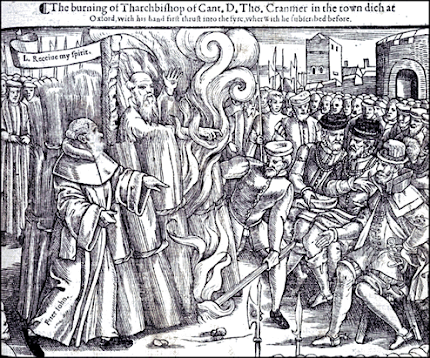
The burning of Tharchbishop of Cant. D. Tho. Cranmer in the town dich at Oxford, with his hand first thrust into the fyre, wherwith he subscribed before. [Click on the picture to see Cranmer's last words.]

Daily Bible Verse

Friday, July 31, 2009

Part VIII: Chapter Five of Thirty-Nine Articles: The Historic Basis of Anglican Faith: The Doctrine of Ministry


"It recognizes the fact of ministry, and states that those who minister publicly in the congregation should not do so till their call is confirmed by 'men who have public authority given unto them in the Congregation, to call and send Ministers into the Lord's vineyard.' But who these men are the Article does not specify, and so does not tie the doctrine of the Church of England to any one form of church polity."

Thirty-Nine Articles: The Historic Basis of Anglican Faith

A book by David Broughton Knox (Sydney: Anglican Church League, 1967). Revised 1976.

The author: Canon David Broughton Knox, B.A., A. L. C. D., B.D., M.Th., D. Phil. (Oxford), was Principal of Moore Theological College, Sydney, Australia. Ordained in 1941 he served in an English parish and as a chaplain in the Royal Navy before becoming a tutor at Moore College 1947-53. On leave in England he was tutor and lecturer in New Testament at Wycliffe Hall, Oxford 1951-53 and Assistant Curate in the parish of St. Aldale's, Oxford. He became Vice Principal of Moore College in 1954 and Principal in 1959. He was elected Canon of St. Andrew's Cathedral in 1960. His other books include "The Doctrine of Faith in the Reign of Henry VIII" (London: James Clarke, 1961).

David Broughton Knox also founded George Whitefield College in South Africa in 1989.

Chapter Five

The Teaching of the Articles

The Doctrine of Ministry

The pages of the New Testament show that in each Christian church there were various ministries. The Spirit of God was the source of these ministries, distributing to each church member a gift of ministry in accordance with the divine will. The New Testament enjoins on Christians the duty of recognizing these ministries which have God for their source, and of accepting from God what He gives for them through their ministers. But the New Testament does not descend to details with regard to the ministry. It would appear that there was considerable diversity amongst New Testament churches not only as to the form of ministry but also as to the duties of office-bearers, such as elders, and as to the way in which the church recognized and commissioned the ministers.

Article 23 'Of Ministering in the Congregation' follows the example of the New Testament, in that it could not be more general in its terms. It recognizes the fact of ministry, and states that those who minister publicly in the congregation should not do so till their call is confirmed by 'men who have public authority given unto them in the Congregation, to call and send Ministers into the Lord's vineyard.' But who these men are the Article does not specify, and so does not tie the doctrine of the Church of England to any one form of church polity.

It is, of course, well-known that the Church of England has retained the polity of episcopacy. However, none of its formularies goes beyond saying that episcopacy is an ancient form of church polity stretching back to the time of the apostles. This much is stated in the Preface to the Ordinal, which adds that it is the Church of England's intention to continue this polity of bishops, priests and deacons. What the Preface omits to say is significant in view of ecumenical discussion. For example, it is not said that it is a polity enjoined in Scripture, or that it is the only valid form of Christian ministry, or even that it is the best form.

Although Anglicans are not required to affirm that episcopacy is the best form of church ministry they are required to recognize that it is a valid ministry, not contrary to Scripture, for Article 36 affirms that the Church of England Ordinal contains nothing 'superstitious and ungodly', nor is it to be thought defective as a form of service for the ordering of ministry.

It is also worthy of notice that the language of the Church of England formularies is careful not to contradict the view held, for example, by Jerome and other Church Fathers, that bishops and priests belong to the one order of ministry. Thus Article 36 speaks of the consecration of archbishops and bishops, but of the ordering of priests and deacons. The same distinction is made in the page headings of the Ordinal, while the Preface speaks of 'these orders', not 'three orders', as it is sometimes misread.

Next Section


The Seventh Sunday after Trinity.

The Collect.


LORD of all power and might, who art the author and giver of all good things; Graft in our hearts the love of thy Name, increase in us true religion, nourish us with all goodness, and of thy great mercy keep us in the same; through Jesus Christ our Lord. Amen.

Wednesday, July 29, 2009

Part VII: Chapter Five of Thirty-Nine Articles: The Historic Basis of Anglican Faith

"All remembrance of Jesus by a regenerate, Spirit-filled soul is full of precious fellowship. His Spirit is present to our spirit whenever we relate ourselves to Him in our thoughts, consequently the notion of a bare remembrance of Jesus in the Lord's Supper is an impossible notion with regard to anyone who is in a spiritual relationship with the Lord."


Thirty-Nine Articles: The Historic Basis of Anglican Faith

A book by David Broughton Knox (Sydney: Anglican Church League, 1967). Revised 1976.

The author: Canon David Broughton Knox, B.A., A. L. C. D., B.D., M.Th., D. Phil. (Oxford), was Principal of Moore Theological College, Sydney, Australia. Ordained in 1941 he served in an English parish and as a chaplain in the Royal Navy before becoming a tutor at Moore College 1947-53. On leave in England he was tutor and lecturer in New Testament at Wycliffe Hall, Oxford 1951-53 and Assistant Curate in the parish of St. Aldale's, Oxford. He became Vice Principal of Moore College in 1954 and Principal in 1959. He was elected Canon of St. Andrew's Cathedral in 1960. His other books include "The Doctrine of Faith in the Reign of Henry VIII" (London: James Clarke, 1961).

David Broughton Knox also founded George Whitefield College in South Africa in 1989.

Chapter Five

The Teaching of the Articles

The Lord's Supper

The Lord's Supper (or literally 'dinner') is a communion, that is, a fellowship with the Lord, and with one another in the presence of the Lord. The basis of the fellowship of the Lord's dinner is His death on Calvary for the sins of the world. He designated the food of the meal as a sacrament or sign of His body given for us and His blood shed for us for the forgiveness of our sins. As we share in this fellowship in the way that He has commanded we acknowledge and proclaim the great fact of His saving death, His sacrifice of Himself which He made for our sakes and which is the ground of the covenant of our relationship with God; we remember Jesus our Redeemer, our Lord and our coming King Who has appointed us a place at His table in His kingdom; we have fellowship with Him and He with us. "He dines with us and we with Him." (Rev. 3:20). All remembrance of Jesus by a regenerate, Spirit-filled soul is full of precious fellowship. His Spirit is present to our spirit whenever we relate ourselves to Him in our thoughts, consequently the notion of a bare remembrance of Jesus in the Lord's Supper is an impossible notion with regard to anyone who is in a spiritual relationship with the Lord.

By coming to Him and believing in Him we feed on Him the living bread which came down from heaven, we become one loaf with Him (John 6:32-35, I Corinthians 10:17). We eat His flesh which He gave for the life of the world and we drink His blood which was given for us and which cleanses us from all sin. Our souls rise in communal thanksgiving, the offering of the sacrifice of praise; and we pledge ourselves to His obedience in offering ourselves, our souls and bodies, to be a reasonable, holy and living sacrifice to Him.

The word "sacrament" is a synonym for the word "sign" and the one word may be substituted for the other without any change in meaning. The Lord's Supper is the sacrament of our redemption. It remains a sacrament, that is, it is not to be identified with the thing signified, for that would annihilate the sign which the Lord appointed and would overthrow the nature of a sacrament.

The bread and the wine are a sign or sacrament of the Lord's Body and Blood given in death for our sins, that is, they are a sign of Christ crucified for us. Our Lord's presence is not indicated by way of a sign, but is experienced through the Spirit, in reality, in accordance with His promise, by those who receive the benefit of his passion, the forgiveness of their sins.

By faith we take and eat and drink the Body and the Blood of Christ (whereof the bread and wine is a sacrament), that is, by faith we partake of His death for us, and of all its benefits. Christ in his death for us (or putting it another way, the Body and Blood of Christ) is present only sacramentally, that is to say, only by a sign (the bread and the wine) of this death being present.

But it is not Christ's presence, or Christ as present, which we eat and drink. We eat and drink the signs of His atoning death. They remain nothing but signs -- bare signs if you like to put it thus. His presence, in His risen power, is due to His promise to be among those who meet in His name, and the manner of His presence is His Spirit which He gives to all who believe in Him. He is indeed present, and we partake of that presence, if we wish to put it thus (for it is a person who is present), by fellowship with Him, as with faith we eat and drink the sign (or sacrament) which speaks to us of him.

"His presence" and "His body and blood" are not identical concepts. The true feeding on the body and blood of Christ in the Lord's Supper depends on the reality of His spiritual presence in the heart and the mind of the worshipper. His spiritual presence is not to be thought of as dependent on a 'real presence' of his body and blood but it is the same presence in the Lord's Supper as in every other aspect of the Christian life, it is the presence of Spirit to our spirit made real by God's word, conscious in the mind of the Christian. The Lord's Supper, with the signs of His death intergrated within it, is a very vivid bringing to mind of Christ and His word and so becomes a deep fellowship with Christ. It is not, however, any different sort of fellowship from that which the Christian enjoys with the Lord in His daily life outside the congregation. But it has the added dimension of being enjoyed in the company and fellowship of others who are enjoying this same fellowship with Christ at the same time so that the consciousness of the presence of Christ's body (i.e. our fellow Christians in their relationship to Jesus) should be no less vivid than the consciousness of the presence of the Lord Jesus present to our spirit (I Corinthians 11:29). We and our fellow Christians were crucified with Christ on the Cross (Galatians 2:20). We have been formed into a unity through being in that crucified body (Ephesians 2:16). The Lord's Supper is a celebration of that event. That is why it is necessary to recognize the body and consider one another, if we are to eat the Lord's Dinner and not merely eat our own dinner (I Corinthians 11:29; I Corinthians 11:20-21).

The grace (that is, the gift or benefit from God) of this sacrament is fellowship with Christ in the Spirit on the basis of the forgiveness of our sins. No greater grace, gift or benefit is possible in this life, and it is brought about on every heart felt remembrance of Christ, a remembrance which the Lord's Supper especially and vividly evokes as we eat and drink together in obedience to our Lord's command, "Do this in remembrance of Me."

Those who, without repentance and faith, eat the bread and the wine in the context of the Lord's Supper eat the sign of His death but they are not brought into any relationship with Christ thereby. "They in no wise partake of Christ" (Article 29). For they do not recognise the divine fellowship of redeemed and Redeemer, which is the Lord's Dinner, nor acknowledge the basis of that fellowship, namely, that "Christ died for our sins according to the Scriptures" (I Corinthians 15:3). 


[For previous chapters of this book see: Chapter 1, Chapter 2, Chapter 3, Chapter 4.1, Chapter 4.2, and Chapter 5.1].


The Seventh Sunday after Trinity.

The Collect.

LORD of all power and might, who art the author and giver of all good things; Graft in our hearts the love of thy Name, increase in us true religion, nourish us with all goodness, and of thy great mercy keep us in the same; through Jesus Christ our Lord. Amen.

Sunday, July 26, 2009

Augustus Toplady on the Security of the Believer

From the Introduction to Historic Proof of the Doctrinal Calvinism of the Church of England.

"I affirm, that all they be blasphemers to God, that do slander the truth in predestination; that say, If I be once in, I cannot be out, do what evil I will or can: all such do declare themselves to be reprobates, and children of God's ire and wrath, rather than any of his. For whosoever delighteth in those things which God hateth and abhorreth, doth declare himself to be none of God's: but, if he be any of his, he will give him repentance, for to know the truth, by his Spirit. For the Spirit maketh intercession for the saints, according to the pleasure of God. For we know that all things work for the best, unto them that love God, who are called of purpose. For those which he knew before, lie also ordained before, that they should be like fashioned unto the shape (i. e. here, to the gracious, hereafter, to the glorious, resemblance) of his Son.

"And seeing God hath made all his elect like to the shape (the spiritual and moral similitude) of Jesus Christ, how is it possible, that any of them can fall away? Whosoever he be, that doth so hold, is against God and Christ; and may as well say, that our Lord and Saviour Jesus Christ may perish as any of them; for Christ said unto the Father, Then hast loved them as thou hast loved me; although Christ spake these words to the comfort of his disciples at the present, so likewise is it to the comfort of all us, his chosen. Those that St. Paul speaketh of that God knew before, he meant by it, all his elect; and immediately be addeth, saying, Whom he appointed before, them also he called and whom he called, them also he justified; and whom he justified, them also he glorified. What shall we then say to these things? If God be on our side, who can be against us? That is to say, if God have appointed to glorify us and to save us, who can then deny (deprive) him of any of us, or take us out of his hands ?

"My sheep, saith Christ, hear my voice, and I know them, and they follow me; and I give unto them eternal life, and they shall never perish. O, most worthy Scriptures! which ought to compel us to have a faithful remembrance, and to note the tenor thereof; which is, the sheep of Christ shall never perish.

"Doth Christ mean part of his elect, or all, think you? I do hold, and affirm, and also faithfully believe, that he meant all his elect, and not part, as some do full ungodly affirm. I confess and believe assuredly, that there shall never any of them perish: for I have good authority so to say; because Christ is my author, and saith, if it were possible, the very elect should be deceived. Ergo, it is not possible that they can be so deceived, that they shall ever finally perish, or be damned: wherefore, whosoever doth affirm that there maybe any (i. e. any of the elect) lost, doth affirm that Christ hath a torn body."36

The Seventh Sunday after Trinity.
The Collect.
LORD of all power and might, who art the author and giver of all good things; Graft in our hearts the love of thy Name, increase in us true religion, nourish us with all goodness, and of thy great mercy keep us in the same; through Jesus Christ our Lord. Amen.

Toplady: Calvinism


IV. James Bainham, a gentleman of birth and learning, by profession a lawyer, of the Middle Temple, suffered at the stake in 1532. His judgment concerning the evangelical doctrines, sufficiently appears from one of his answers, on his first trial before Stokesley, bishop of London. "All godliness," said the martyr, "is given of God by his abundant grace: the which no man of himself can keep, but it" [i.e. the retaining, as well as the reception, of grace] "must be given him of God."7 So highly was this chosen vessel favoured in his last moments, that, when his legs and arms were half consumed by the flames, he addressed the spectators in these memorable words: "O ye Papists, ye looked for miracles. Here you may see a miracle; for, in this fire, I feel no more pain, than if I were on a bed of down. It is to me a bed of roses."
 
 
The Sixth Sunday after Trinity.
The Collect.
O GOD, who hast prepared for them that love thee such good things as pass man's understanding; Pour into our hearts such love toward thee, that we, loving thee above all things, may obtain thy promises, which exceed all that we can desire; through Jesus Christ our Lord. Amen.

Saturday, July 25, 2009

Augustus Toplady: The Catholic Church Is Invisible

III. Mr. Thomas Bilney, who had been the instrument of bishop Latimer's conversion, was burned in 1531. Among the articles of his examination before Tonstal, bishop of London, were the following: "Whether he believed the Catholic Church may err in the faith, or no? And whether he thought the Catholic Church is only a spiritual Church, intelligible and known only to God?" To this double interrogatory, Bilney answered in these words "The Catholic Church" [i.e. the universal Church of God's predestinated people,] "can by no means err in faith: for it is the whole congregation of the elect; and so known only unto God, who knoweth who are his."4 Two other ensnaring questions were put to this holy man: "Whether he believed all things, pertaining to salvation and damnation, to come of necessity, and nothing to be in our own wills? And, whether he believed God to be the author of all evil?"5 He discreetly answered, "God is the author of the punishment Only, but not of the. offence."6 He would never have been put to the test of such queries as these, if he had not been considered as a known predestinarian.
From:

Historic Proof of the Doctrinal Calvinism of the Church of England

Augustus Toplady


SECTION XII.

The Judgment of the most eminent English Martyrs, who suffered for the Gospel, prior to the Settlement of the Reformation.

The Sixth Sunday after Trinity.
The Collect.
O GOD, who hast prepared for them that love thee such good things as pass man's understanding; Pour into our hearts such love toward thee, that we, loving thee above all things, may obtain thy promises, which exceed all that we can desire; through Jesus Christ our Lord. Amen.

Friday, July 24, 2009

Part VI: Chapter Five of Thirty-Nine Articles: The Historic Basis of Anglican Faith


". . . it is faith in God and in His promise which brings the blessing promised, whether it be salvation or any other gift. Consequently the Articles make it abundantly clear that if the sacraments are received without faith on the part of the recipient, they are as ineffective as is the Word heard but not believed."


Thirty-Nine Articles: The Historic Basis of Anglican Faith


A book by David Broughton Knox (Sydney: Anglican Church League, 1967). Revised 1976.


The author: Canon David Broughton Knox, B.A., A. L. C. D., B.D., M.Th., D. Phil. (Oxford), was Principal of Moore Theological College, Sydney, Australia. Ordained in 1941 he served in an English parish and as a chaplain in the Royal Navy before becoming a tutor at Moore College 1947-53. On leave in England he was tutor and lecturer in New Testament at Wycliffe Hall, Oxford 1951-53 and Assistant Curate in the parish of St. Aldale's, Oxford. He became Vice Principal of Moore College in 1954 and Principal in 1959. He was elected Canon of St. Andrew's Cathedral in 1960. His other books include "The Doctrine of Faith in the Reign of Henry VIII" (London: James Clarke, 1961).


David Broughton Knox also founded George Whitefield College in South Africa in 1989.


Chapter Five


The Teaching of the Articles


IV: The Sacraments and the Church


The Thirty-Nine Articles aim to block off any loophole by which the idea that salvation results from our own actions -- an idea very congenial to our natural way of thinking -- might find lodgement again among the doctrines held by the Church of England. History shows that the sacraments are especially liable to be interpreted in this way. They are easily misinterpreted as religious works, by doing which the sinner obtains grace from God. Consequently the Articles are careful to define the sacraments as essentially God's Word to us. They speak and witness to us "of grace, and God's good will towards us". (Article 25). As in the written word of Scripture, so in the acted word of the sacraments, it is faith in God and in His promise which brings the blessing promised, whether it be salvation or any other gift. Consequently the Articles make it abundantly clear that if the sacraments are received without faith on the part of the recipient, they are as ineffective as is the Word heard but not believed. Thus Article 29 declares that "such as be void of a lively faith", although they partake of the bread and wine in the Lord's Supper, "yet in no wise are they partakers of Christ." This absolute negative -- nullo modo, (See Latin translation of Article 29) "in no way" -- effectively excludes the notion that Christ is in some sense associated with the bread and wine in a local manner so that those who receive the bread and wine, even without faith, in some sense receive Christ.


Christ dwells in the hearts of the worshippers by faith. He is present to their personalities by His Spirit, and this is the only manner of His presence in His Supper. This is unequivocally stated in Article 28. "The Body of Christ is given, taken, and eaten, in the Supper, only after an heavenly and spiritual manner. And the means whereby the Body of Christ is received and eaten in the Supper is Faith."

Baptism is spoken of in the same way. It is a "visible sign" of "the promises of the forgiveness of sin, and of our adoption to be the sons of God by the Holy Ghost" (Article 27).


The same Article likens baptism to an instrument of conveyance. Waterland commented: "A deed of conveyance, or any like instrument under hand and seal, is not a real estate, but it conveys one, and it in effect the estate itself, as the estate goes along with it, and as the right, title, and property (which are real acquirements) are as it were bound up in it and subsist in it" (Works, VII, p. 147). The deeds remain parchment and wax. They are not the property itself. But they are not merely parchment and wax, nor are they merely reminders of the property. The person who receives them receives the property; yet on one important condition: he must be the duly qualified person to receive them, otherwise the deeds convey nothing to him. So the sacraments convey eternal life by way of promise to those (and only those) who perceive and believe that promise.


The sacraments are God's sacraments, God's gracious words of promise to us. Through them God holds out to us everlasting life in Christ. This becomes ours by our response of faith. They are therefore God's instruments, not our works. As Article 25 puts it, "by the which he doth strengthen and confirm our Faith in him". This being the case, an unworthy minister does not hinder the salutary effects of the sacraments, for so long as the promise is clear through them, that promise may be received by faith (Article 26).


The sacraments embody the promise, as does the Word. But they are not self-explanatory, as the Word is, conveying its own meaning by its inherent intelligibility. They depend upon the Word for their actions to be symbolic and meaningful. They are therefore signs of God's grace only so long as they are understood in the context of the Word. But when accompanied by the explanatory Word (whether explicit or implicit) they become "effectual signs". The signs are effectual in two senses: not only effectual because the actions of which they consist, i.e., washing and eating, lend themselves to conveying helpfully the message of forgiveness and incorporation into Christ, but effectual because, like the Word, being clear messengers of God's grace, they are the means of bringing the promised blessings to those who believe and who express their faith in the promise by using its signs. Thus Article 25 describes the sacraments as "sure witnesses, and effectual signs of grace, and God's good will towards us".


Though the sacraments depend upon the Word for their character as signs, they go beyond the Word inasmuch as they are actions. They impress God's promises on our minds not merely by the sense of hearing but by sight and touch, and so they fortify faith. Moreover, they enable the believer to signify his response to the promises by his actions and not merely by his mental attitude or words. For example, he looks "to God for a clear conscience" (I Peter 3:21, R.S.V.) as he engages in the sacramental expression of this in baptism.


Because the sacraments are actions, acted promise and acted response, they may be spoken of as seals which confirm the promise in our consciousness. Although the New Testament does not refer to the sacraments in this way, it was a favourite thought amongst the Reformers and finds a place in the Articles (Article 27). It is the promise of adoption which the Articles speaks of as sealed by the sacrament of baptism. The thing promised, namely our adoption itself, is sealed to us by the presence of the Holy Spirit in our hearts. "Because you are sons God sent the Spirit of his son into your hearts." (Galatians 4:6).


The sacraments, being religious actions in which we engage, are easily thought of as primarily our actions, undertaken either for God's honour, or to obtain some merit or grace. In particular the Lord's supper is sometimes thought of as an offering we make to God. Since the offering made by Christ is the only offering that can be made on behalf of sinners which is acceptable to God, the Lord's supper has been interpreted as an offering associated in various ways with the offering of Christ on Calvary. Article 31 severely condemns this notion. Christ's offering was made once for all and is complete in every respect.


The sacraments express primarily not our action but God's; yet they are actions which incorporate our response to Him. That response is always and only faith, embodied by the outward action of receiving the sign of God's proffered blessing. Promise and response, both coalescing in symbolic action, make up the sacrament. Actions which obscure the promise or which symbolize the wrong response destroy the sign. Thus three current malpractices of the time -- non-communicating attendance at the Lord's supper, the reservation of the consecrated bread and wine, and their adoration -- are all condemned in the last paragraph of Article 25 on the ground that they are distortions of the sacraments from their purpose and proper use according to the mind of Christ.


Next Section


The Collect.

O GOD, who hast prepared for them that love thee such good things as pass man's understanding; Pour into our hearts such love toward thee, that we, loving thee above all things, may obtain thy promises, which exceed all that we can desire; through Jesus Christ our Lord. Amen.


Recommended Resource: Dr. Michael Horton's Adult Bible Class

I highly recommend the following teaching series which is available online at Christ United Reformed Church.  Dr. Michael Horton's systematic theology class for his Adult Bible Class is an excellent resource for anyone wishing to learn more about the Bible and Christian faith from a Reformed perspective.  You can listen to the podcasts at Adult Bible Class.


The Sixth Sunday after Trinity.

The Collect.

O GOD, who hast prepared for them that love thee such good things as pass man's understanding; Pour into our hearts such love toward thee, that we, loving thee above all things, may obtain thy promises, which exceed all that we can desire; through Jesus Christ our Lord. Amen.

Tuesday, July 21, 2009

Part V: Thirty-Nine Articles: The Historic Basis of Anglican Faith: Predestination


Thirty-Nine Articles: The Historic Basis of Anglican Faith

A book by David Broughton Knox (Sydney: Anglican Church League, 1967). Revised 1976.

The author: Canon David Broughton Knox, B.A., A. L. C. D., B.D., M.Th., D. Phil. (Oxford), was Principal of Moore Theological College, Sydney, Australia. Ordained in 1941 he served in an English parish and as a chaplain in the Royal Navy before becoming a tutor at Moore College 1947-53. On leave in England he was tutor and lecturer in New Testament at Wycliffe Hall, Oxford 1951-53 and Assistant Curate in the parish of St. Aldale's, Oxford. He became Vice Principal of Moore College in 1954 and Principal in 1959. He was elected Canon of St. Andrew's Cathedral in 1960. His other books include "The Doctrine of Faith in the Reign of Henry VIII" (London: James Clarke, 1961).

David Broughton Knox also founded George Whitefield College in South Africa in 1989.


Chapter 4

Predestination

Predestination is the sheet anchor of the doctrine of grace. This is illustrated by the Epistle to the Romans in which St. Paul establishes that our salvation rests on God's grace exclusively. He cites the two twins, Esau and Jacob, as the classic example, commenting 'Though they were not yet born and had done nothing, either good or bad, in order that God's purpose of election might continue, not because of works but because of his call, she [Rebecca] was told, "The elder will serve the younger"' (Romans 9:11-12, R.S.V.).

So in the Thirty-Nine Articles the doctrine of election is fundamental to the sovereignty of grace. Article 17, the longest of the Articles, deals with topic. (1) Its first sentence affirms that all who reach heaven do so because before the foundation of the world God chose them and unalteringly decreed to confer on them this benefit. (2) The second sentence lists the seven stages of the progress of the elect from 'curse and damnation' to 'everlasting salvation' -- God's call, their response through grace, their free justification, their adoption as God's sons, the formation of a Christlike character within them, their expression of this in a life of good works, 'and at length, by God's mercy, they attain to everlasting felicity.' We note here the two-sidedness of grace: God's sovereign initiative works through the faculties of our nature. God calls, we respond; God justifies, adopts, sanctifies, we live out a Christian life and finally attain to everlasting felicity. But our response is not to be regarded as our own contribution to our salvation but is itself God's gift, 'They through grace obey', 'At length, by God's mercy, they attain'.

It is the same group of persons who pass through these seven stages, and in this respect the article is reminiscent of St. Paul's 'golden chain' in Romans 8:29 f. However, in these two opening sentences the Article does not go beyond Augustine in affirming the irresistibility of grace and the effectual character of God's call. The indefectibility and perseverance of the saints is not touched on till the third sentence which comprises the second paragraph. In this third sentence the Article sides clearly with Calvin, going beyond Augustine who taught that the gift of perseverance is not given to all the regenerate and that it is consequently possible to fall from a state of salvation and be eternally lost. The consequence of this possibility is that no one would know whether he is elect, apart from a special personal revelation from God. Thus Thomas Aquinas wrote: 'No one can know whether he has sanctifying grace' (Summa Theol. II. 112. 5); and the Council of Trent affirmed: 'Except by special revelation, it cannot be known whom God has chosen unto Himself' (Session VI, Chapter 12). However, in its second paragraph Article 17 affirms (3) that our predestination and election in Christ may be known to us and be the subject of our meditation, yielding 'sweet, pleasant, and unspeakable comfort'. (4) This knowledge or certification of our election results from knowledge of the promises of God, and from our perception of the working of God's Spirit within us. Consequently we know that we are within the unbroken chain of God's purposes of blessing leading to eternal felicity. (5) This knowledge yields not only 'comfort' but increase in active godliness. For love kindles love, and a knowledge of God's steadfast love in delivering us from the curse and damnation we deserve and leading us without fail to 'eternal Salvation to be enjoyed through Christ', fervently kindles love towards God.'

A perception of the working of the Spirit of Christ in us is the assurance that God has adopted us as sons and chosen us in Christ; but an absence of this Spirit is no sign that a man is not elect (for all the elect begin in this state!). Nevertheless it may be so construed by the spiritually unenlightened, as experience shows. The Article, recognizing this, affirms (6) that the doctrine of predestination is a doctrine for the believer.

The Christian should always view the doctrine of predestination from the standpoint of his position in Christ. Looking backward he sees God's eternal grace choosing him in Christ, calling him, adopting him, glorifying him. As he looks forward he rejoices in the sure hope of salvation, for God is faithful, who called him and will confirm him to the end (I Corinthians 1:8; Philippians 1:6; I Thessalonians 5:24). However, if it is separated from our experience in Christ and from our faith in God, it becomes a merely speculative doctrine (for example in the phrase, 'once saved always saved' which contains no reference to God at all). It then has no religious value, and some of its apparent deductions may run counter to Christian conduct. Consequently in the Article's fourth sentence and last paragraph it is affirmed (7) that we must regulate our deductions from the doctrine of predestination by the plain teaching of Scripture; for example (a) we must not despair of God's promises, arguing that we are non-elect, nor (b) must we presume on our election to the neglect of the clearly revealed will of God as to our duty and the way we are to live our lives.

The Article confines itself to discussing 'Predestination to Life'. It does not touch on reprobation (or preterition). [Charlie's comment: But Article 17 does say that the non-elect are under God's sentence: . . . so for curious and carnal persons, lacking the Spirit of Christ, to have continually before their eyes the sentence of God's Predestination is a most dangerous downfall, whereby the devil doth thrust them either into desperation or into wretchlessness of most unclean living no less perilous than desperation.] The omission is not a denial of the doctrine of reprobation, as is sometimes assumed, but a recognition of the over-whelming predominance of the doctrine of predestination to life in the treatment of the subject in Scripture, compared with the mystery of reprobation which is only touched on in half a dozen passages in Scripture. Predestination to life is a constant topic of Scripture, and consequently appropriately finds a prominent place in the Articles.

The seventeenth Article not only accompanies Calvin beyond the point where Augustine stopped short, but it effectively excludes an Arminian interpretation of predestination. Arminius, a Dutch theologian of the early seventeenth century, following many predecessors stretching back to the days before Augustine, based God's predestination not on His good pleasure (and so entirely within Himself) but on His foresight of how a man would respond to the opportunities of repentance and faith granted him. For Arminius, God's predestination (or decision about a man's future) follows the foresight of man's own decision. In this way the scriptural word 'predestination' is retained, but is evacuated of any real meaning. However, the Article clearly excludes this Arminian interpretation, for such a doctrine that our predestination is dependent on the exercise of our own will could never be twisted to become 'a most dangerous downfall' were an unspiritual person to have it 'continually before his eyes', for it is the very thing which such people normally imagine to be the case. Nor could it ever lead to desperation or unclean living, for it bases 'predestination' entirely on the quality of a man's continual response to the Gospel.

These warnings of the Article confirm that its subject is the doctrine of absolute and unconditional election, for they deal with false and erroneous deductions which are sometimes made from this doctrine. The warnings are irrelevant in Arminian 'predestination'.

Article 18 concludes the group of articles (9-18) which deal specifically with individual salvation. It anathematizes the latitudinarian spirit which would open the gate of heaven to all who live a decent life. The doctrine of predestination (as expounded in Article 17) particularizes salvation and grounds it exclusively on Christ's merits and God's free gift; but the logical outcome of rejection of this doctrine is that God's salvation is generalized into the possibility of salvation, so that actual salvation comes to depend on the quality of a man's response, and not exclusively on God's grace. The quality of this response becomes the essential differentiating element in salvation. The doctrinal tendency to find a place for man's will in the ground of his salvation reaches its logical conclusion in the view 'That every man shall be saved by the Law or Sect which he professeth, so that he be diligent to frame his life according to that law, and the light of Nature'. This view the Article anathematizes, 'For holy Scripture doth set out unto us only the Name of Jesus Christ, whereby men must be saved.' (See Acts 4:12). If we think of our natural state as sinners as being 'without God', and 'children of wrath', and spiritually 'dead' (Ephesians 2) the doctrine of Articles 17 and 18 is unavoidable.

Article 18 contains the only anathema in the Thirty-Nine Articles. Significantly enough it is directed against the full-blown form of the doctrine that salvation depends on man's own works; for it was this doctrine of works that was the basic quarrel that the Reformers had with the papal system of religion. At the time of the Reformation their opponents would have agreed with the Reformers in the sentiments of Article 18. But in the passage of the centuries the Roman doctrine of works has expressed itself within the Roman Communion in very similar language to that anathematized by the Article. Thus Hans Kung has written: 'Yvonne (a Protestant) . . . can win eternal life if she lives according to her conscience and keeps God's commandments.'i Kung speaks similarly of how 'a pagan . . . can be saved'.ii Support for this doctrine of salvation through following the light of conscience is sometimes sought in the Epistle to the Romans, chapters one and two. But in these chapters the apostle is not dealing with the salvation of the Gentiles but with the responsibility involved in possessing a conscience, and the culpability that comes from not following it. He concludes this argument: 'We before laid to the charge both of Jews and Greeks, that they are all under sin . . . ' For they are all under law, either of Scripture or of nature, 'that every mouth may be stopped, and all the world may be brought under the judgment of God: because by the works of the law shall no flesh be justified in his sight' (Romans 9:9, 19f, R.S.V.). The possibility of salvation through the light of nature is no longer a private opinion amongst Roman Catholics but has been endorsed by the Second Vatican Council. In paragraph 16 of its Constitution On the Church, which was promulgated in November 1964, the Second Vatican Council declared:

The plan of salvation also includes those who acknowledge the Creator. In the first place among these there are the Moslems . . . Those also can attain a salvation who through no fault of their own do not know the Gospel of Christ or His Church, yet sincerely seek God and moved by grace strive by their deeds to do His will as it is known to them through the dictates of conscience. Nor does Divine Providence deny the helps necessary for salvation to those who, without blame on their part, have not yet arrived at an explicit knowledge of God and with His grace strive to live a good life.

It is difficult to see how in practice this is distinguishable from Pelagianism.


[For previous chapters of this book see: Chapter 1, Chapter 2, Chapter 3, and Chapter 4.1.]

iThat the World May Believe, p. 5.
iiIbid., p. 83.

The Sixth Sunday after Trinity.
The Collect.

O GOD, who hast prepared for them that love thee such good things as pass man's understanding; Pour into our hearts such love toward thee, that we, loving thee above all things, may obtain thy promises, which exceed all that we can desire; through Jesus Christ our Lord. Amen.

Monday, July 20, 2009

Excerpt: The Reformed Doctrine of Predestination

The doctrine of Predestination receives comparatively little attention in our day and it is very imperfectly understood even by those who are supposed to hold it most loyally. It is a doctrine, however, which is contained in the creeds of most evangelical churches and which has had a remarkable influence both in Church and State. The official standards of the various branches of the Presbyterian and Reformed Churches in Europe and America are thoroughly Calvinistic. The Baptist and Congregational Churches, although they have no formulated creeds, have in the main been Calvinistic if we may judge from the writings and teachings of their representative theologians. The great free church of Holland and almost all the churches of Scotland are Calvinistic. The Established Church of England and her daughter, the Episcopal Church of America, have a Calvinistic creed in the Thirty-nine Articles. The Whitefield Methodists in Wales to this day bear the name of "Calvinistic Methodists."

Among the past and present advocates of this doctrine are to be found some of the world's greatest and wisest men. It was taught not only by Calvin, but by Luther, Zwingli, Melanchthon (although Melanchthon later retreated toward the Semi-Pelagian position), by Bullinger, Bucer, and all of the outstanding leaders in the Reformation. While differing on some other points they agreed on this doctrine of Predestination and taught it with emphasis. Luther's chief work, "The Bondage of the Will," shows that he went into the doctrine as heartily as did Calvin himself. He even asserted it with more warmth and proceeded to much harsher lengths in defending it than Calvin ever did. And the Lutheran Church today as judged by the Formula of Concord holds the doctrine of Predestination in a modified form. The Puritans in England and those who early settled in America, as well as the Covenanters in Scotland and the Huguenots in France, were thorough-going Calvinists; and it is little credit to historians in general that this fact has been so largely passed over in silence. This faith was for a time held by the Roman Catholic Church, and at no time has that church ever openly repudiated it. Augustine's doctrine of Predestination set against him all the half-hearted elements in the Church and arrayed him against every man who belittled the sovereignty of God. He overcame them, and the doctrine of Predestination entered the belief of the universal Church. The great majority of the creeds of historic Christendom have set forth the doctrines of Election, Predestination, and final Perseverance, as will readily be seen by any one who will make even a cursory study of the subject. On the other hand Arminianism existed for centuries only as a heresy on the outskirts of true religion, and in fact it was not championed by an organized Christian church until the year 1784, at which time it was incorporated into the system of doctrine of the Methodist Church in England. The great theologians of history, Augustine, Wycliffe, Luther, Calvin, Zwingli, Zanchius, Owen, Whitefield, Toplady, and in more recent times Hodge, Dabney, Cunningham, Smith, Shedd, Warfield, and Kuyper, held this doctrine and taught it with force. That they have been the lights and ornaments of the highest type of Christianity will be admitted by practically all Protestants. Furthermore, their works on this great subject have never been answered. Then, too, when we stop to consider that among non-Christian religions Mohammedanism has so many millions who believe in some kind of Predestination, that the doctrine of Fatalism has been held in some form or other in several heathen countries, and that the mechanistic and deterministic philosophies have exerted such great influences in England, Germany, and America, we see that this doctrine is at least worthy of careful study.

From the time of the Reformation up until about one hundred years ago these doctrines were boldly set forth by the great majority of the ministers and teachers in the Protestant churches; but today we find far the greater majority holding and teaching other systems. It is only rarely that we now come across those who can be called "Calvinists without reserve."

Loraine Boettner, The Reformed Doctrine of Predestination. Introduction.

The Sixth Sunday after Trinity.
The Collect.
O GOD, who hast prepared for them that love thee such good things as pass man's understanding; Pour into our hearts such love toward thee, that we, loving thee above all things, may obtain thy promises, which exceed all that we can desire; through Jesus Christ our Lord. Amen.

Sunday, July 19, 2009

Quote of the Day: Michael Horton

Wichita, Kan.: I have visited some of the Christian Bible Colleges around the country and have sat in some of the classes being offered. I have also visited churches planted by these colleges and they all have become infected by this virus and are now promoters of this Christless Christianity. Question: Since this problem is so sweeping across the country and denominations, do I contact the Presidents of these Colleges? What can we say or do to change the tide? Or are we on the "Downgrade" that Charles Spurgeon warned us about so many years ago?

Michael S. Horton: You put your finger on a major argument in my book. Conservatives often identify "Christless Christianity" with liberalism. However, it is hard to find Christ-centered preaching in so-called "Bible-believing" churches today. Everybody seems to be interested in other things these days.

The prophets, Jesus, Paul, Augustine, the Protestant Reformers, Spurgeon, and countless others had to confront the heresy of self-salvation. It is our default setting to believe that we are basically good people who could be a little better with the right game-plan, support-network, and coaching. "God helps those who help themselves": according to surveys, most evangelicals thought that this was a biblical quotation, when it actually comes from Ben Franklin. The Good News that the Bible proclaims, however, is that God saves those who cannot save themselves.

The first thing we have to realize if there is going to be genuine reformation in the churches today is that the self-trust that engenders Christless Christianity is not just a problem in some times and places, but is the natural drift of our fallen heart. We have to be taught out of it our whole lives as Christians. One generation assumes the gospel; the next generation forgets it; the next one abandons it. But each of us will be constantly tempted to fall back on ourselves instead of on Christ unless Christ is seen as the center and circumference of the church's preaching, teaching, the sacraments, and mission.

Thursday, July 16, 2009

Chapter Four: The Teaching of the Articles: III. The Doctrine of Salvation

Part IV

Thirty-Nine Articles: The Historic Basis of Anglican Faith

A book by David Broughton Knox (Sydney: Anglican Church League, 1967). Revised 1976.

The author: Canon David Broughton Knox, B.A., A. L. C. D., B.D., M.Th., D. Phil. (Oxford), was Principal of Moore Theological College, Sydney, Australia. Ordained in 1941 he served in an English parish and as a chaplain in the Royal Navy before becoming a tutor at Moore College 1947-53. On leave in England he was tutor and lecturer in New Testament at Wycliffe Hall, Oxford 1951-53 and Assistant Curate in the parish of St. Aldale's, Oxford. He became Vice Principal of Moore College in 1954 and Principal in 1959. He was elected Canon of St. Andrew's Cathedral in 1960. His other books include "The Doctrine of Faith in the Reign of Henry VIII" (London: James Clarke, 1961).

David Broughton Knox also founded George Whitefield College in South Africa in 1989.


Chapter Four

The Teaching of the Articles

III: The Doctrine of Salvation

The Reformers' great concern was that the Church should know and preach the Gospel of the grace of God. The basis of the Gospel of grace is the doctrine that God has provided a full and complete ground of salvation in the death of Christ. This is affirmed in Article 31 and referred to in Articles 2, 15, and 28. Salvation becomes ours by way of God's promise (based on Christ's death) and our believing the promise. Article 7 refers to the promise; Article 11 refers to our response of faith. This latter Article states that God judges us worthy of ourselves but only on account of Christ's worthiness. Faith is the means by which we participate in this salvation -- faith in God known in the death and resurrection of Jesus. We make no contribution from ourselves to our salvation. From Beginning to end it is of God's grace. Our Justification, or our being accepted as worthy by God, does not wait on any 'work' of ours which we may accomplish in the time-process in which our life is set. It is simultaneous with our apprehension, in the inmost recess of our personality, of the grace of God in Christ and it precedes any action of our will from which 'works' flow. We are saved by God solely on the basis of Christ's 'works' and the means whereby God saves us is our believing His truth.

The knowledge that our salvation is of God and is not suspended, even in part, on the outcome of our own vacillating efforts is a doctrine full of great strength, nerving us to battle and endure for our Saviour even in the face of defeat. Article 11 'Of the Justification of Man', which succinctly states this key doctrine, deserves to be quoted in full. 'We are accounted righteous before God only for the merit of our Lord and Saviour Jesus Christ by Faith, and not for our own works or deservings: Wherefore, that we are justified by Faith only is a most wholesome Doctrine, and very full of comfort, as more largely is expressed in the Homily of Justification.' (The homily referred to is the third of the first book of the Homilies of the Church of England.)


The doctrine of salvation of a sinner entirely by the grace of God greatly enhances our understanding of the love of God, and redounds to God's glory; but it is not a doctrine which would have occurred to anyone if it were not taught in Scripture. All mankind is conscious from time to time of guilt, and it seems natural that the way, if any, to expiate guilt is by some action of our own, perhaps a sacrifice or prayer, perhaps more ascetic and painful action, perhaps reformation of life. But the Reformers saw that the Bible taught that none of these things was the ground, or shared in the ground, of our forgiveness and salvation. However, the biblical doctrine is so strange to our natural ideas, and the activity of our wills as the ground (or contributing vitally to the ground) of salvation is so congenial to human thought, that whenever the Bible is not carefully read and expounded, or whenever it is no longer regarded as authoritative, the Gospel of God's grace is lost (or at least obscured) and no longer has the liberating and exhilarating effect on our life that it should have.


Many of the Articles are devoted to cutting off the ways by which history showed the Gospel of God's grace could be eroded or diluted by the doctrine of salvation by our works. Articles 9 and 10 teach that human nature, since the advent of sin, no longer has the power to enable it to act in a way that is pleasing to God. Article 9 speaks of 'original or birth-sin', that bias of our nature which draws us to act against the will of God known to us in our conscience. God did not create mankind thus and it meets with God's disapproval. This bias towards in remains in us even after our adoption as God's children, so that the apostle Paul can speak of 'the sin which dwells in me' (Romans 7:17 ESV [R.S.V.]) and of the 'flesh' whose desires run counter to those of the Holy Spirit, so that we are not able to do what we would (Galatians 5:17). Such a nature is no satisfactory basis for winning our way to heaven by our own works. We are always in need of forgiveness.

Article 10 speaks of the weakness of our will, which of itself can never choose God. As fallen sinners our nature is self-centred, not God centred; though a moment's reflection shows that this is wrong in a creature -- in a being, that is, who is not self-sufficient but is contingent and dependent, as we know ourselves to be. However, we have not the strength of will to abandon this self-centredness of ourselves so as to become God-centred. Our wills simply serve our nature, which is now self-centred. They cannot change our basic nature. Such being the case, it is impossible that our will should be the means of our salvation.


Articles 9 and 10 make clear that in ourselves there remains no way by which we can begin to return to God. This idea is highly uncongenial to our natural way of thinking. It can only be maintained so long as it is recognized as clearly taught in Scripture, and so long as Scripture in its plain meaning remains authoritative for the Christian.


Article 11 states that the way of salvation is by the merit of Christ, though faith. Article 12 is a postscript to Article 11, explaining the place of good works and Christian conduct. Our salvation is not based on our conduct, but Christian conduct is the consequence of our salvation. Good works are an outward indication of our new relationship to God, 'By them a lively faith may be as evidently known as a tree discerned by the fruit.' However, our conduct is never as perfect as it should be; it can therefore never merit our salvation, for taken by itself it comes short, and so deserves God's condemnation.

If a Christian's life on earth is never free from the taint of the old nature, so that his acceptance with God always depends on his relationship with Christ and never on his works viewed in themselves (so much is stated in Article 12), it follows a fortiori that a man's life before he comes under the leading of the Holy Spirit as a Christian cannot win God's favour. This is stated in Article 13. The teaching of this Article has met with hostile comment in some modern Christian circles. This is through a misapprehension of the meaning of the language of the Article, which must be construed in close connection with Article 12. The latter states that the Christian's imperfect works are only (fully) pleasing to God because they are seen in the context of a Christian's standing in Christ. For in themselves these imperfections call out 'the severity of God's judgement', since God is holy. The imperfect works (and even the best are such) of those as yet outside of Christ do not share in the benefit of forgiveness that is through Christ. It is therefore inevitable that when brought to the bar of God's judgement such works must be described as 'not pleasant to God', for inevitably 'they have the nature of sin'. The Article is concerned to show that sinners cannot in any way merit God's salvation; this remains wholly a gift of God's grace and mercy. Merited salvation is not mercy but reward.


Article 14 makes clear that no Christian can exceed God's requirements, so as to put himself in God's debt. It is directed against the Roman Catholic doctrine of works of supererogation. At first sight it may seem extraordinary that any Christian should think that he can be better than God requires. yet the concept is inherent in salvation by merit. For this implies a standard to be attained, and if this is to be fixed within the capacity of the ordinary Christian to attain, plainly the more saintly can exceed it. The overplus of merit is then available for assignment, by papal indulgence, to penitents whose own merits come short of the standard. The Article, basing itself on Scripture, denies the possibility of exceeding God's requirements and says that the notion cannot be entertained without arrogancy and impiety. [Editor's note: See Luke 17:7-10 ESV].

Article 15 insists that no one but Christ attains to God's requirements. 'All the rest . . . offend in many things.'

Article 16 teaches that no sinner should despair, for there is always a place of forgiveness and restoration for those who repent.

Next Chapter


1662 Book of Common Prayer

Collect of the Day

The Fifth Sunday after Trinity.

The Collect.

GRANT, O Lord, we beseech thee, that the course of this world may be so peaceably ordered by thy governance, that thy Church may joyfully serve thee in all godly quietness; through Jesus Christ our Lord. Amen.

Support Reasonable Christian Ministries with your generous donation.