>

Martyred for the Gospel

Martyred for the Gospel
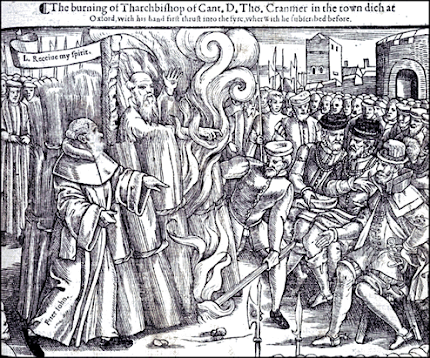
The burning of Tharchbishop of Cant. D. Tho. Cranmer in the town dich at Oxford, with his hand first thrust into the fyre, wherwith he subscribed before. [Click on the picture to see Cranmer's last words.]

Daily Bible Verse

Thursday, October 29, 2009

The Fundamentals

While the original edition of The Fundamentals might be slightly out of date, it seems to me that the essential arguments are still valid today. In the light of entire denominations and many "evangelical" seminaries selling out to higher criticism, it is apparent that there is a tremendous need for neo-fundamentalists to answer the theological left on these issues. If the Bible is merely an "inspired story" and is not based in historical facts and an infallibly recorded inerrant and divinely inspired text, then what we have left is merely an evangelical form of neo-orthodoxy. It seems to me that liberalism and neo-orthodoxy are on the rise and conservatives need to rise to the occasion. Harold Lindsell's book, The Battle for the Bible, is proving to be prophetic. While I do not necessarily hold to a literal six day creation, Professor Herman Hanko, professor emeritus, of the Protestant Reformed Theological Seminary, makes valid observations about higher criticism in the following article he also calls The Battle for the Bible.


The following review of Lindsell's book by Donald Dayton demonstrates clearly the proclivity evangelical Arminians have for compromising with higher criticism, pragmatism, and theological liberalism in general: The Battle for the Bible: Renewing the Inerrancy Debate. The fact that Dayton's article is published in a theologically liberal journal (Christian Century) simply proves my point that Asbury Theological Seminary and the scholars who associate themselves with the Wesleyan-holiness tradition and pentecostalism in general are apt to sell out to subjectivism and liberalism because essentially their theology is irrational. This is why neo-orthodoxy is an out for liberal minded Arminians in dealing with the apparent conflict between modernism and neo-fundamentalism. This is the way Arminian higher education has chosen to go. Apparently, many "reformed" seminaries are following suit.

J. Gresham Machen's Comment on Federal Vision and the New Perspectives on Paul

Certainly, then, Paul was no advocate of an undogmatic religion; he was interested above everything else in the objective and universal truth of his message. So much will probably be admitted by serious historians, no matter what their own personal attitude toward the religion of Paul may be. Sometimes, indeed, the modern liberal preacher seeks to produce an opposite impression by quoting out of their context words of Paul which he interprets in a way as far removed as possible from the original sense. The truth is, it is hard to give Paul up. The modern liberal desires to produce upon the minds of simple Christians (and upon his own mind) the impression of some sort of continuity between modern liberalism and the thought and life of the great Apostle. But such an impression is altogether misleading. Paul was not interested merely in the ethical principles of Jesus; he was not interested merely in general principles of religion or of ethics. On the contrary, he was interested in the redeeming work of Christ and its effect upon us. His primary interest was in Christian doctrine, and Christian doctrine not merely in its presuppositions but at its center. If Christianity is to be made independent of doctrine, then Paulinism must be removed from Christianity root and branch.


J. Gresham Machen

Christianity and Liberalism: Doctrine

J. Gresham Machen: Christianity and Liberalism

The introduction to J. Gresham Machen's book, Christianity and Liberalism, is as relevant today as it was when Machen wrote it. Machen is almost prophet in the way he describes the public school system as a means to establish materialism, atheism, and socialism as a new form of government tyranny. Clearly socialism seeks to make everyone conform to the political correctness of the day and to stifle freedom of thought and any dissent from the government's party line.

We ought to pay particular attention to this threat given the Obama administration's all out assault against classical and traditional Christianity. The religion of Obama's state is liberal Christianity which is not Christianity at all but is instead another religion altogether. Everyone ought to read this little book by J. Gresham Machen. It is insightful regarding the attempts being made by the religious left to silence Christianity. The recent attacks by ABC of Australia in their biased reporting on the Sydney Diocese and on the GAFCON conference headed by Archbishop Peter Akinola is another example of how liberal Christianity is not Christianity at all but rather something else. The complete ignorance of people like the Archbishop of Canterbury, Rowan Williams, and Bishop N. T. (Tom) Wright, the bishop of Durham, only proves that liberal Christianity is completely bankrupt and a sell out to paganism and political correctness.

Wright's remarks in the video from Compass ABC (toward the end of the hour long program) reveal him as the imposter everyone has suspected him to be. Wright's agenda in the New Perspectives on Paul was not to discover what Scripture says but a covert attempt to subvert the evangelical movement into liberalism via clever dissimulation and subterfuge. Unfortunately, given the recent compromises with the Federal Vision and New Perspectives on Paul in both the Presbyterian Church of America and the denomination founded by Machen himself, the Orthodox Presbyterian Church, it looks like the pagan religion of liberalism has found a foothold in the evangelical movement.


But we need not despair. God always maintains a remnant, even when the vast majority are fooled by the devices of the enemy. (Ephesians 6:10-12).


Romans 11:1-5 (ESV)1 I ask, then, has God rejected his people? By no means! For I myself am an Israelite, a descendant of Abraham, a member of the tribe of Benjamin. 2 God has not rejected his people whom he foreknew. Do you not know what the Scripture says of Elijah, how he appeals to God against Israel? 3 "Lord, they have killed your prophets, they have demolished your altars, and I alone am left, and they seek my life." 4 But what is God’s reply to him? "I have kept for myself seven thousand men who have not bowed the knee to Baal." 5 So too at the present time there is a remnant, chosen by grace.

Wednesday, October 28, 2009

ABC in Australia: Special on Peter Akinola

I really love how the liberal media portrays the conservatives as those who are "tearing the Anglican Communion apart." It is totally ridiculous. Really the ones who are tearing the Anglican Communion apart are the liberals and the Anglo-Catholics. Click on ABC Compass to see the video.


In particular pay close attention to the comments of Bishop Tom Wright who "claims" to be an "evangelical" yet he is bashing the global south and Peter Jensen in Sydney. Go to minute mark 37 minutes and compare Akinola with Wright. Who is standing for truth? If this does not expose Tom Wright as a false prophet, I don't know what else could convince you!

R. Scott Clark: John Piper Has Selectively Read Doug Wilson

Tuesday, October 27, 2009

A Reformation Day Tribute to Archbishop Thomas Cranmer


I cannot confirm that all these quotes are actually written by Thomas Cranmer and at least one of them is a quote from the Bible. However, the extent to which even modern English is still influenced by the 1662 Book of Common Prayer is truly amazing. Note especially the quotes from traditional marriage vows used across many denominations. This is a truly moving piece for Reforming Anglicans. It saddens me that Tractarians and Anglo-Catholics do not get it. The Scriptures and the Gospel cost Cranmer his very life.

May we never forget. Anglicans all over the world should remember the father of the English Reformation this Sunday, which will be Reformation Sunday all around the world.

Lawson Stone Refuses to Particularize His Understanding of Inerrancy: Evasive Maneuvers of the Theological Left

I will admit up front that I do not have a Th.D. or Ph.D. in Old Testament exegesis. That being said, however, I wonder how I can be characterized as using a fallacious form of logic called "begging the question" when in fact all I really did was beg for a rational answer to a perfectly legitimate and rational question: What is your definition of the term "biblical inerrancy"? How does your understanding of inerrancy affect and guide your use of higher criticism and hermeneutics of the Old Testament? As you can see, Lawson Stone would prefer to take evasive maneuvers rather than give a legitimate and particular answer to a legitimate and particular question. It is an honest and sincere question on my part.

For the record, this is the typical tactic taken by dissimulators in high places. When called to defend their point of view rationally and apologetically they are either unwilling to do so or unable to do so. Rather the answer is usually a fallacious appeal to their own academic authority. Such approaches to apologetics are not only irrational and unjustified but they are really meant to hide the true position taken by the person defending himself or herself by evasive and ambiguous answers like the one Lawson Stone gives below. The fact of the matter is that dissimulators have much to lose by being honest and forthright about their real convictions and logical propositions.


Lawson Stone is a professor of old testament at the "Evangelical" Wesleyan seminary we know as Asbury Theological Seminary. When the plow boy understands the Bible better than seminary professors, then we might have something.


You can read the exchange in Face Book below:


Reasonable Christian October 25 at 7:23am

You keep evading the real point, Lawson. If you REALLY want to answer my concerns I am inviting you to post a paper in response. How are you defining "inerrancy"? (Chicago Declaration on Inerrancy) or some other definition? Secondly, exactly which parts of the Pentateuch are you saying are incorporated myths??? How can Jesus refer to Moses as the author of the Pentateuch while higher criticism often denies the very existence of Moses?  Also, need I remind you that orthodox Protestant and Neo-Fundamentalist theology (Evangelicalism is too broad a term) "confess" that ONLY the Bible is infallible and inerrant and the inspired Word of God. Thus, as detailed and organized as modern textual and higher criticism might be, it is prone to err just as any church council is. So, in short, you don't get to rant on about genre criticism and expect me to just buy it on your word and authority, particularly when I take that together with a whole host of other departures I observed while at Asbury. A few of which I mentioned as an aside in the article you commented on.  I may not have been the best student at Asbury due to personal problems and due to feeling the pressure of being more conservative on just about everything but I can assure you I'm not stupid.  People in the real world want to know why Christians believe the Bible is true and authoritative on theological and moral issues. Your higher critical views are critically unexamined and were unconvincing in my opinion.  So, if you wish to do some "apologetics" I'm willing to post what you say on my blog and then I will respond to it. It's up to you. Until then it seems to me that you wish to just take a pot shot instead of explaining your view so that a "popular" audience can understand it. I do have a fair reading audience so here's your chance to defend your view in non-technical language. Avoid the jargon you use at the academy and speak plainly. If you can! I get irritated at folks who hide what they really believe behind clever double talk.
Sincerely Charlie


Lawson Stone
October 25 at 7:40pm Report

I see little point in continuing the conversation Charlie. You have begged every question and armored yourself with your impenetrable ego. I wish you God's best in all your endeavors.

Issues, Etc.: The Gospel Driven Life and a Discussion with Mike Horton

You will not want to miss this extremely challenging discussion of the Protestant Reformation between a conservative Lutheran minister and Mike Horton, a conservative Reformed minister. Is the Protestant Reformation over? How many churches are having a Reformation Sunday service next week? Maybe your church needs to think about doing something like this so that we do not lose touch with what the Bible is all about!

You can hear the discussion by suscribing to the podcast at Issues, Etc. or by clicking here to download the MP3 at Kim Riddlebarger's blog, The Riddleblog.

Saturday, October 24, 2009

Tim Keller and Triperspectivalism

Tim Keller's Review of Willow Creek: What About Gospel Clarity? by Rick Phillips at Reformation21.

Am I the only one who thinks people like John Frame and Tim Keller are undermining the Gospel? Maybe not!

Friday, October 23, 2009

The Steve Winter Oneness Pentecostal Band


Someone pointed me to this youtube video. At first I thought they were Johnny and Edgar Winter, a popular 70's heavy metal band. But then it dawned on me from the lyrics who this guy is. Steve Winter has been around since at least the 1990s in Fidonet (before Al Gore invented the internet). I have been reading James White's debates against Steve Winter's oneness pentecostal heresies at least as far back as 1995 when I bought my first 286 computer.

While I don't agree with Winter's theology or his nasty debate tactics back then, I must admit I'm impressed with the band. Nothing approaching professional level mixing and such but the music itself is fairly close to the 70's style rock I was used to back then. I guess you never know when you will encounter the unexpected!

I wonder if Steven Winter is in favor of legalizing marijuana?


Charlie

If There Is Any Doubt That Atheists Are Out to "Convert" People.....


Atheists love to caricature Christians and mock but their arguments are by and large based on ridicule rather than rational arguments as this piece on the Bill Maher show illustrates profoundly. Even Dawkins admits he's unable to "prove" God does not exist.

Also, it should be pointed out that Christians do not believe in "imaginary friends" or "fairies" or "Santa Claus" or whatever other non sequitur you wish to add to the mix. Rather the ontological argument from Scripture comes into play here. Scripture describes God as the source of all being and existence itself. He is God alone and there are no other gods. There is no being above which we can imagine other than the God who is omnipotent, omniscient, and omnipresent as described in the divine revelation of Holy Scripture.

To say that one snake spoke is not irrational since that is inspired in Scripture and even atheists must admit that we cannot prove a universal negative. It be impossible to prove that no single snake in all of history ever spoke even once. Exactly "how" the snake spoke is another issue altogether. Whether it was miraculous and supernatural or an auditory miracle similar to a visionary experience is really beside the point. Scripture is God's special revelation to mankind through Christ Jesus and the apostles and prophets and we must take seriously the propositional truth claims made there, even if many of those claims are miraculous or a supernatural intervention by God into the natural realm.

Furthermore, since atheist arguments are not based on science anymore than divine revelation is based on empirical science, we must say that atheism is a philosophical worldview rather than a default position taken by the scientific community itself. Doing science as an empirical method means scientists operate in the realm of natural revelation, which assumes that God has created a universe which is consistently uniform and which uniformity makes science possible in the first place. Even this uniformity, however, is to be scrutinized as new discoveries in physics and general relativity have shown.

Dawkins cannot reproduce evolution in an empirical experiment so therefore it is simply a theoretical reconstruction of facts put together based on certain materialistic presuppositions. The short answer is that even if evolution were established fact rather than theory, it would not rule out or falsify the belief in God since metaphysics, philosophy, and theology are all beyond the realm of logical positivism or empirical science. Atheists are inconsistent because they triumphalistically "assume" they are right while admitting their position is essentially not scientific at all but rather a philosophical interpretation via a materialistic worldview.

The real point of contention is that atheists cannot say where the universe ultimately came from at all and neither can empirical science. This is in fact beyond the realm of pure empirical science and lies rather in the realm of philosophy, logic, and theology. In these areas "science" simply makes educated or speculative guesses and the vast majority of these "guesses" are not provable or falsifiable from a logical and rational standpoint.

Atheists are hoping to "convert" people based on doubts they can raise by emotivistic ridicule and ad hominem against "stupid" people who are "silly enough to believe in talking snakes." But this is an irrational and illogical argument and is in fact based more on strawman caricatures than on the rational and logical defense which thinking Christians offer to these sorts of criticism. It would do us well to remember Dawkins' concession that he does not really know if there is a God or not and that he cannot prove his "belief" that there is no God, hence the need to persuade people based on ridicule and mockery rather than rational and logical arguments. Atheism is essentially an irrational assumption which goes beyond reason itself.

If any atheist wishes to prove Christianity wrong, it is falsifiable. All he or she has to do is to produce the bones of Jesus, which would falsify the resurrection.

In Christ,

Charlie

The Dispute Between John Frame and Michael Horton

John Frame reveals many confused ideas about the Scriptures and the Reformed confessions in his diatribe against Michael Horton's new book, Christless Christianity. (See John Frame's book review). Frame constantly confuses law and Gospel, even failing to recognize what even basic Reformed believers understand: the New Testament contains imperatives and commands, which are inherently statements of the moral law. That would include many sayings of Jesus in the sermons on the mount and in the command to "repent" and "believe" the Gospel. That Frame does not get this is indeed alarming.

What is also alarming is the fact that Frame thinks Joel Osteen is just fine. But Frame seems to be totally ignorant of the theological roots of Osteen's teaching. It is a well documented fact that John Osteen, the father of Joel Osteen, was a health and wealth preacher. The theology of the health and wealth movement comes from its father, Kenneth Hagin, and others who followed him. Indeed, the roots of Hagin's teaching comes from Christian Science and New Thought as it was imbibed and distributed in the writings of E.W. Kenyon, a Baptist revivalist of the 1940s. In his book, A Different Gospel, D. R. McConnell documented the outright pelagiarism of Kenyon by Hagin. McConnell traces Kenyon's exposure to Christian Science to Kenyon's training in oratory at Emerson College, Boston Massachusetts. Kenyon imbibed unbiblical doctrines of Christ's person and nature and other ideas like positive confession directly from Christian Science and New Thought, popular at Emerson College. Kenyon then combined this with his Baptist faith and wrote books on the topic. Thus, for Frame to endorse Osteen and his prosperity gospel is to endorse a different gospel (Galatians 1:6-8) and a different Jesus (2 Corinthians 11:3-4).

Furthermore, I think Horton was trying to be conciliatory in the opening remarks of his book, Christless Christianity. In fact, what he is saying is that many churches are preaching a false gospel. This might mean your church as well.

Frame continually confuses sanctification and justification in this review and seems to think that modern psychological terms are rightly read into the Scriptures. I cannot understand why Frame claims that Horton is being divisive when in fact Frame's own views are divisive and unconfessional. Horton is much more confessional and in adherence with Scripture than Frame, though I have problems with Horton's endorsement of common grace and his view of the two kingdoms as an endorsement of that common grace.

I think Frame's critique speaks for itself. In the past, he obviously has not seriously interacted with any of the complaints against himself regarding his endorsement of Norman Shepherd, who was deposed from Westminster Theological Seminary, Philadelphia. Frame's endorsement of triperspectivalism is inherently subjective as R. Scott Clark has pointed out, so it is not surprising that Frame sides with the subjectivists, the legalists, and the outright heretics (Joel Osteen). Frame's inherent irrationalism is obvious to anyone who has studied Gordon H. Clark's presuppositional apologetics and his critique of Frame's mentor, Cornelius Van Til. It is Frame's commitment to irrationalism in fact which leads him to contradict himself over and over again in this critique of Horton who is at least consistently confessional in his approach to the law and Gospel distinction.

Since I'm not worried about offending a popular audience as the folks at the White Horse Inn are, I can openly say that I believe most of the churches teaching the things Horton condemns are indeed "christless" and therefore apostate. I hope John Frame gets the message before it is too late.

Charlie

Government Intrusion Into the Free Speech and the Freedom of Religion Is in Full Swing


The Nineteenth Sunday after Trinity.
The Collect.
O GOD, forasmuch as without thee we are not able to please thee; Mercifully grant, that thy Holy Spirit may in all things direct and rule our hearts; through Jesus Christ our Lord. Amen.

The Narcissism of Evangelical Latitudinarism

Dr. R. Scott Clark of Westminster Seminary, California has written an insightful article at Heidelblog on the unintended consequences of having a broad evangelicalism with minimalist doctrinal tendencies. You will most certainly profit from a careful reading of his comments at: The Narcissism of Evangelical Latitudinarianism.
Charlie

Thursday, October 22, 2009

John Frame Reviews "Christless Christianity: A Response from the White Horse Inn

Do we follow "character" or do we follow the truth? Frame seems to think character trumps the Gospel. Unfortunately, I heard Phillip Jensen make the same sort of comment at the Gospel Growth conference. Jensen also thinks character matters more than one's faithfulness to Scripture and the Reformed confessions!

See: John Frame: Response by the White Horse Inn blog.

Obama and the FCC Soon to Censor Freedom of Speech on the Internet

It's ironic that the liberals claim the political right wants to censor American freedom of speech but in fact it is the political left which wishes to shut down free speech and free religion. If the left can shut up the dissident opinions of the people then they can control the nation. What we are seeing is a massive move toward a totalitarian government run by atheist socialists and other vocal opponents of the freedom of religion and the free speech guaranteed to individual Christians and local congregations.

Another move toward censorship was the recent boycott of the Fox News channel by the White House. Obama and his cronies are out to re-engineer democracy to fit their civil religion of atheism, theological relativism, and theological liberalism/postmodernism. If the White House can shut up the political right, the theological conservatives who oppose social engineering like homosexual marriage and non-traditional family models, then they can shut out their political and religious enemies from free access to democratic principles and the bill of rights.

Every Christian should be alarmed by the current trends of the government which are openly and vocally hostile to the freedom of religion and freedom of speech. Showtime and HBO have stepped up their propaganda campaigns against the freedom of religion and freedom of speech. "Outrage," a documentary on HBO, attacked the right of Christians to say that homosexuality is a sinful behavior, lifestyle and predisposition. Showtime aired a program utilizing hate speech against the Roman Catholic Church. While I'm as opposed to the Roman Catholic Church as any truly Reformed person should be, I also recognize that in a free society and a democratic republic there is no established church. This would include excluding the establishing of liberal mainline theology and religion as the defacto religion of the state.


It would also include allowing all denominations the freedom to practice their religion and beliefs free from government interference. So conservative Evangelicals should have the right to assemble, to distribute religious materials and tracts freely in the public realm, and to openly evangelize or proselytize in the public arena. Freedom of religion means a free exchange of religious ideas and not government interference.

If we allow this take over of the internet by an Obama run FCC we are going to see Fox News and conservative politics censored and shut down. We will also see religious organizations targeted and harassed by government officials who oppose the freedom of speech and freedom of religion for dissidents like myself.

Every concerned citizen should call or write or e-mail their elected officials and voice their concerns over this government take over. This could be the first step toward a totalitarian socialist take over by Obama and his cronies.

To see the link to the news story click on: John McCain Sponsors Bill

Church Mouse on Postmodernism

Every now and then we come across a blog with an article with which we can heartily agree. Ironically, the Church Mouse is an Anglo-Catholic. There might be hope for Anglo-Catholicism if this fellow is any indication. I am a Reformed and Calvinist Anglican of the five point, Dortian variety. I argue my position because I believe it is right and true. The fact that we have an Anglo-Catholic layperson quoting John MacArthur's comments against the postmodern worldview shows that the Reformed message is gaining ground. When even lay persons within the Anglo-Catholic tradition begin to see that truth is absolute and not relative then we have accomplished something.

This should speak volumes to those who wonder why I oppose high church Lutheranism (where the sacramental elements can be venerated, lifted up, and adored as "adiaphora"), why I oppose Anglo-Catholicism (where the 39 Articles are rejected or reinterpreted and the five solas of the English Reformation are rejected), and why I oppose the modern church growth/charismatic/pentecostal movement (where objective truth is rejected in favor of experientialism, subjectivism, and anti-intellectualism).

You can read the article at: John MacArthur on Postmodernism.

Wednesday, October 21, 2009

Why Evangelicalism Is a Failure: A Critique of American, Australian and English Evangelicalism

The problem with broad Evangelicalism is that it has no doctrinal moorings or confession of faith to which members are faithful. This is why Evangelicals in the Church of England cannot decide if Anglo-Catholics are heretics or just separated brethren.


It is also why Evangelicalism in the US is selling out to cultural relativism, experientialism, subjectivism, and the church growth movement. Unfortunately, it looks very much like the Sydney Anglicans have bought into the Charles Finney pragmatism and pelagianism of the American revivalistic scene since the 19th century Evangelical revivals here.


The old adage that "doctrine divides" seems to be the clarion call of Evangelicals today. Unfortunately, those who do not remember the past are doomed to repeat it. The Disciples of Christ have no creed but Christ and no emphasis on Scripture because of the idea that "doctrine divides." Amazingly, the Disciples of Christ developed out of the Cane Ridge Revivals just north of Lexington, Kentucky. If anyone looks closely at the Disciples of Christ today it is one of the most theologically liberal and relativistic denominations there is.


Here in the Orlando area we have Northland: A Church Distributed, led by Joel Hunter. Hunter is decidedly liberal in his political ideas and unwittingly liberal in his Evangelicalism. In his prayer for Obama's presidency, Hunter prayed that everyone should "acknowledge God however they conceive of Him." If this is not theological liberalism I don't know what is.


When Evangelicals sell out to pragmatism as Sydney Anglicanism is doing then the result is not deeper Christian relationships but superficiality and a selling out of the Gospel to popular culture. In short, Sydney is unwittingly going liberal by fighting liberalism with emotionalism, experientialism and an emphasis on experiential reading of the Bible.


We don't learn theology by osmosis. Simply reading Scripture without understanding is not preaching the Gospel. The Bible contains propositional truth claims and those claims must be seriously dealt with. Such understanding comes from human reasoning which is illuminated by the Holy Spirit and the new birth. Contrary to what Neil Macken, the minister of Northmead Anglicans, said in the Compass interview at ABC of Sydney, true Christianity is not an experience even if that experience is experienced through the Bible. On the contrary, true Christianity is understanding and believing the propositional truth claims recorded in the Bible. When we believe in Jesus we must also believe what Jesus said about Himself and what Jesus claimed to be true. This is not an emotional encounter or an "experience." Rather it is simply believing that what Jesus said is true and understanding it. When we understand the truth and believe it we can be saved through a new birth, a new way of thinking. In fact, the new birth precedes our change of mind and is given to us to enable us to believe in the first place.


Sydney's new emphasis on contemporary worship and being culturally relevant "works" pragmatically. What they don't understand is that such approaches, as Michael Horton and the White Horse Inn rightly point out, lead ultimately right back to natural religion, pelagianism, and theological relativism. We cannot afford to "dumb down" the Gospel, the Bible, or theology so that we can be culturally relevant. On the contrary, what we need to do is simply preach the Gospel faithfully!


One way to preach the Gospel faithfully is to adhere to a solid Reformed confession of faith. Confessions of faith keep preachers and congregations honest and call them to interpret Scripture consistently and to rightly divide the word of truth. (2 Timothy 2:15). Sydney Anglicans think throwing out the 1662 Book of Common Prayer and selling out to cultural relativism and experientialistic methods of evangelism is the way to grow as a denomination. However, if the Cane Ridge Revivals prove anything at all it is that dumbing down the Bible and confessional understandings of the Bible is the shortest route straight back to the theological relativism you are trying to avoid!


The theological roots of the church growth movement in the 20th century lie with Donald McGavran and Peter Wagner, both charismatic leaders. And their methods are grounded in the theological pragmatism of both Charles Finney and the Cane Ridge Revivals. Evangelicalism ever since has been infected with an inherent pelagianism and pragmatism which in effect is ultimately as liberal as the mainline denominations who keep traditional forms but re-interpret them in liberal ways. Ironically, McGavran was the son of Disciples of Christ missionaries in India. Is it any wonder then that McGavran uses social sciences rather that theological methods for his principles of church growth?


Throwing out traditional worship--out with the old, in with the new--may win short term gains but in the end it is simply sugar-coated liberalism hiding in the guise of Evangelicalism. If we follow the logic that traditional liturgy is bad, then traditional Scripture could very well be next. It is not the liturgy that is bad but the content and interpretation of the liturgy which is bad. In other words, we need a return to the 1662 Book of Common Prayer and the 39 Articles. I would not be opposed to translating these into modern forms of English but to sacrifice the theology of the Book of Common Prayer through reductionism is about as reasonable as cutting out the parts of Scripture one does not agree with. While the 1662 Book of Common Prayer is not inspired, it does contain about 90% Scripture.


Worship and liturgy are didactic. We are teaching people a worldview and propositional truths through the liturgy. To cut out the reading of the decalogue from the liturgy at communion removes the law--law and Gospel are intimately interrelated. One cannot preach the Gospel without also preaching the law. Evangelicals in their ignorance are in fact just promoting a new form of liberalism without realizing it. Northland: A Church Distributed and other such churches like Willow Creek are ample proof of where this sort of sellout to cultural relativism leads. History itself proves this out as well when we examine the Disciples of Christ and the idea that the only creed we have is Christ or the only creed we have is Scripture. Scripture must be interpreted and even the doctrine of Sola Scriptura does not mean that individuals get to re-invent Christianity. That sort of thinking is incipient relativism.


This is precisely where I strongly disagree with Phillip Jensen. He claimed at the recent Chicago conference, Gospel Growth/People Growth, that he is a "re-inventor." His approach is that "sheep are stupid and you have to tell them what to do." This is essentially top down authority much like that of Anglo-Catholicism. In other words, the sheep are stupid and let's keep them that way so they will do what we tell them to do. Nevermind the priesthood of believers and sola Scriptura!


To the contrary, we do not need to "re-invent" Christianity. What we need to do is to be faithful to the right preaching of the law and the Gospel. When liberals re-interpret the prayer book and the sacraments we need to remind them that the sacraments point to the Word and not the other way around, as Peter Jensen said in a recent interview.


There will always be a temptation to sellout the Gospel for the sake of success and pragmatic results. But what good is that if we win many disciples only to make them ten times more a child of hell as the liberals are doing? (Matthew 23:15). No, we need to be faithful to Christ not only in our interpretation of Scripture but also in the Reformed liturgies like the 1662 BCP and the Reformed confession we have in the 39 Articles of Religion. I would be interested in knowing if Sydney Anglicans are using the 1662 BCP and the 39 Articles as part of their catechism, training and discipling of new converts? If not, then what they are doing is simply producing more superficial sheep who know nothing about what Jesus truly said and nothing about who He really is.

In Christ,

Charlie

Sydney Diocese Loses $160 Million in Stock Market Crisis

Tuesday, October 20, 2009

Anglicanism Sydney Style

You might want to visit the ABC Compass website where you will see a critical examination of the Sydney Diocese of Australia and an interview with the archbishop there, Peter Jensen. While I may not agree with all the aspects of the contemporary worship, I do admire Sydney's open defiance of politically correct views and theological relativism. (See the Anglican Church League link).


Also, about half-way through the video you will see a communion service in black and white at Moore College in the 1950's. The gray-haired clergyman on the right is David Broughton Knox. Also, David Knox, my rector and the son of Broughton Knox, tells me that the interview with Peter Jensen was conducted in the living room of the home in which David grew up.


The open hostility of the liberal news media is apparent. What is particularly amusing is the idea that conservatives are the ones tearing the Anglican Communion apart. Such could not be further from the truth. Even conservative Anglo-Catholics are bailing out and heading to Rome over this revisionism--not that Rome is the answer but that theological liberalism is the divisive factor here. You will also note in the video that the liberal congregation is elderly and seems to be dying out. Even though they claim to be "inclusive" they can't even put forward any homosexuals whom they claim to be including.


It is also obvious that ABC wants to downplay the popularity of Sydney Anglicans by showing a small evening youth service rather than a thriving morning service attended by hundreds or even thousands. I don't particularly like downplaying traditional hymns because those hymns teach Scriptural and theological truths. But the positive is that they are teaching straight from Scripture. No one can fault them for that.

What I do fault the Sydney Anglicans for--at least from what is said in the interviews--is a sell out to contemporary culture and to spiritual "experience" as a means of evangelism. While this approach is pragmatic and "works" one has to wonder if in the end the results will be the same as what we are seeing here in the US. Evangelicalism as a whole has forgotten the biblical foundations and are more concerned with marketing techniques and packaging the Gospel in the cultural trends that will draw people to church. When this becomes the focus it is not long before liberalism and cultural relativism again rears its ugly head. Throwing out everything old simply because the liberals have re-interpreted the symbols makes about as much sense as throwing out the Bible simply because liberals have re-interpreted the Scriptures to fit their liberal views. We must interpret Scripture faithfully by reason and not by our existential "experience" of Jesus. Jesus is defined by Scripture and not by our "experience" of him in some ineffable encounter in a moment of ecstatic ecstacy. Truth is expressed in propositional form in Scripture and we must never forget that God intends for us to worship Him with our minds as well as with our emotions. We must have an accurate cognitive and rational understanding of who God is and who Jesus is.

Judge for yourself: Anglicanism Sydney Style.


Sincerely yours in Christ,


Charlie

Pope Makes Provisions for Disaffected Anglicans to Join the RCC

The Church Society new agency, Evangelical News, has posted an article outlining Pope Benedict's plan to allow Anglicans to join the Roman Catholic Church as congregations or individuals without giving up marriage or the English liturgy. See: EV News.org, Pope announces plans for Anglicans to join Rome.

Monday, October 19, 2009

Justification and Judgment: Matthew 7:21-23, by John W. Robbins

Justification and Judgment

John W. Robbins

Not everyone who says to me, 'Lord, Lord,' shall enter the Kingdom of Heaven, but he who does the will of my Father in Heaven. Many will say to me in that day, 'Lord, Lord, have we not prophesied in your name, cast out demons in your name, and done many wonders in your name?' And then I will declare to them, 'I never knew you; depart from me, you who practice lawlessness!' -Matthew 7:21-23

This passage of Scripture is widely misunderstood. The Baptist John MacArthur, the Christian Reformed Norman Shepherd, and Pope John Paul II all misunderstand the passage, and they misunderstand it in essentially the same way. They all--Baptist, Reformed, and Romanist--appeal to verse 21 for the same reason: It seems to teach salvation by doing, rather than by mere believing. After all, Jesus does say that it is only those who do the will of his Father who will enter the Kingdom of Heaven.

In his book, The Gospel According to Jesus, John MacArthur cites this passage and asserts: Real faith is as concerned with doing the will of God as it is with affirming the facts of true doctrine (189). Real faith, saving faith, according to MacArthur, is as much about doing as it is about believing, for Jesus brought a message of works (79). In his book, The Call of Grace, Norman Shepherd tells us that The consequence of disobedience is exclusion from the kingdom of heaven (49). So a believer may be excluded from the Kingdom for his disobedience, because belief alone is not enough. To faith one must add covenant faithfulness. And the most eloquent statement of the three, the Catechism of the Catholic Church, paragraph 1821, cites Matthew 7:21 as Scriptural support for its statement that In every circumstance each one of us should hope, with the grace of God, to persevere 'to the end' and to obtain the joy of heaven, as God's eternal reward for the good works accomplished with the grace of Christ.

Notice that the Catholic Catechism mentions grace twice in this single sentence. Many non-Catholics labor under the mistaken impression that the Roman Church-State teaches salvation by works apart from the grace of God and Christ. But it does not, and this paragraph reflects its teaching that the good works Christians do are done by the grace of God and Christ. This common misrepresentation and misunderstanding of Romanist doctrine has contri-buted to (or is caused by) a misunderstanding of Biblical doctrine. Our works, our doing, the Bible teaches, contribute nothing whatsoever to our salvation. They are neither an instrument for our justification nor a condition of our salvation. The difference between the Bible and Rome is not that Rome teaches salvation by faith and works-without-grace, while the Bible teaches salvation by faith and works-with-grace. The difference between the Bible and Rome is that the Bible teaches that our salvation does not depend on our works at all (whether allegedly done by the grace of God or not), while Rome asserts that our salvation depends in part on our works. The Bible affirms sola fide; Rome denies it.

But let us return to the text.

Verse 21: Not everyone who says to me, Lord, Lord, shall enter the Kingdom of Heaven, but he who does the will of my Father in Heaven.

At first glance, verse 21 seems to be saying that the decisive difference between those who are excluded and those who are admitted into the Kingdom of Heaven is the difference between empty professors and actual doers of the Word. It is not those who say, "Lord, Lord," but those who actually do the will of the Father, who are admitted into Heaven. In verse 21, Jesus seems to be making the same distinction that James makes in 2:14: What does it profit, my brethren, if someone says he has faith but does not have works? Can faith save him? The contrast in James is between a person who says something with his lips, but does not give evidence of his faith by his works. But, unlike James, Jesus does not explicitly mention belief in verse 21; he mentions doing and saying, asserting that doing the will of the Father in Heaven is required to get into the Kingdom of Heaven, but saying Lord, Lord is not enough.

Again, at first glance, verse 21 seems to contradict verses such as Acts 16:31: "Believe on the Lord Jesus Christ and you will be saved...." and Romans 3:28: "Therefore we conclude that a man is justified by faith apart from the deeds of the law"; and Ephesians 2:8-9: "For by grace you have been saved through faith, and that not of yourselves; it is the gift of God, not of works, lest anyone should boast"; and scores more verses that deny salvation comes by doing.

This apparent contradiction in the New Testament raises a further difficulty: Does the Bible contradict itself? Many scholars say, Yes, it does. Or if they are coy rather than candid, they say the Scriptures contain tensions, paradoxes, and antinomies. The scholars apparently never consider the possibility that they have misunderstood the Scriptures. They are quick to attribute logical difficulties to the revealed propositions (and they always add that it is pious and humble to do so), but they do not even contemplate the possibility that they might not understand the text. That would be unthinkable! Imagine! Professors and theologians not understanding the text! Impossible! Therefore, the text itself must be paradoxical.

But as Christians we ought to be humble and say, Of course the Scriptures contain no contradictions, no paradoxes, no antinomies, and no tensions. When we come to what seems to be a contradiction in our theology, we must check our premises, return to the propositions of Scripture, and conform our thoughts to what the non-contradictory Scriptures say.

The first glance reading of verse 21 raises still another problem: Does Jesus teach legalism? Here I am using the word legalism in its proper sense: the notion that one can obtain, in whole or in part, salvation by doing, rather than by mere belief. The Pope, Shepherd, and MacArthur all appeal to this verse because they all believe that Jesus does in fact teach salvation by doing here-that he here denies the sufficiency of belief alone for salvation. The central problem in verse 21 is the meaning of Jesus' phrase: he who does the will of my Father in Heaven. The Pope, MacArthur, and Shepherd all appeal to this verse because they believe that that phrase means works. But that interpretation, of course, implies that the Bible contradicts itself. And that interpretation of the phrase cannot be correct, because of what verse 22 says.

Verse 22: Many will say to me in that day, Lord, Lord, have we not prophesied in your name, cast out demons in your name, and done many wonders in your name?

Now if we understand verse 21 as the Pope, MacArthur, and Shepherd understand it, what Jesus says in verse 22 is both unexpected and inexplicable.

If Jesus' point in verse 21 were that faith is not enough, that good works, or covenant faithfulness, or obedience is also necessary in order to be saved, then Jesus should have said something like this in verse 22: Many will say to me in that day, 'Lord, Lord, we trusted in you alone, we had faith in you alone, we believed the Bible and your words.' But of course Jesus says nothing of the sort. Instead, he reports that many people will appear before him at the Judgment and will talk about their works, not their faith. These people-the ones who present works-will be excluded from the Kingdom of Heaven.

Let us examine this verse carefully.

First, Jesus says Many. At first glance, verse 21 suggests that there will be only a few among those who will say, Lord, Lord who will be excluded from the Kingdom of Heaven. Jesus had said, Not everyone, and, sinners that we are, we jumped to the conclusion that he meant almost everyone. But here in verse 22 he says many. Many will come before Christ Jesus and speak to him, saying, Lord, Lord, and they will be excluded from the Kingdom of Heaven.

Second, many will speak to Jesus in that day: the Day of Judgment, when every person will give an account of every thought, word, and deed done in the body. We each will give an account of our lives to God. There is no escaping this Judgment, no parole, no continuance, no diversion. The author of Hebrews 9:27 writes: It is appointed for men to die once, but after this the Judgment. Those are two appointments each one of us will keep: death and Judgment. We will be on trial for our lives. We will not be appearing in this court as witnesses, victims, or jurors, but as defendants.

Third, each of us will speak directly to Jesus; there will be no attorneys, no priests, no pastors, no bishops, no archbishops, no popes, no confessors, no counselors, no elders, no deacons, no church, no parents, and no friends to represent us and to speak for us. We will each speak directly to Jesus. We will be held individually accountable by God.

This is the basis of the idea of individual responsibility, not merely in theology, but in law as well. Individual responsibility is one of the pillars of Christian jurisprudence, and those who rant against the individual and individualism are merely displaying their ignorance of, or their rejection of, what the Bible teaches about the role and the significance of the individual person. We will each be summoned to this divine court to face the Creator of the universe. What will we say in that Day?

Jesus in his mercy tells us what many will say to him in that Day: First, they will acknowledge the Lordship of Jesus Christ, addressing him as Lord. Not only will they say it once, they will repeat it: Lord, Lord. Recognizing the gravity of the situation, they will plead for their lives. This repetition of Lord may also suggest that they think they are on familiar terms with Jesus.

Next, they will ask Jesus a series of questions, calling the Christ himself as a witness in their defense. Notice that they will not directly assert that they have done good works. They will speak in interrogative, not declarative, sentences. Because of this, their defense will actually be much stronger than their own mere declarations would have been: They will call Christ Jesus himself as their defense witness. They will ask him to testify to the facts of their lives: their prophesying, exorcising, and wonderworking.

Some commentators have tried to dismiss the claims of these defendants by suggesting that they will lie or exaggerate, that they really will not have done what they will claim to have done. There is nothing in the text that supports such an accusation. That misinterpretation is a desperate device to evade what Jesus is telling us in this passage. The defendants will make no direct assertions. They will ask questions. They will address those questions to Jesus, whom they will acknowledge as Lord. They will ask him to testify to the truth of their claims. They actually will have done these things on Earth: prophesying, casting out demons, and performing wonders.

Now the fact that many people will have done these things on Earth implies several things.

First, it implies that these people are not mere professors, without works and without practice, as we may have concluded from our superficial reading of verse 21. They are not pew warmers; they are not spiritual spectators; they are not churchgoers who show up only on Easter and Christmas; they are not those who have no works. These people have many works, and they will call on Jesus himself to testify to their works on Earth. Theirs is not mere lip service; theirs is not an empty profession. They will have been very active in church and in other religious endeavors.

Second, not only are these people active in the churches, they are church leaders. They prophesy, they preach, they proselytize, they teach; they cast out demons, they exorcise; they perform many wonders-not just a few, but many wonders. These are things publicly done, not things done in a corner or in the privacy of one's own home.

Third, they will do all these works in the name of Jesus Christ. Notice that the defendants will use the phrase in your name repeatedly: They will prophesy in Jesus' name; they will cast out demons in Jesus' name; they will perform many wonders in Jesus' name. They will be leaders in professedly Christian churches. They are not Buddhists, performing these things in the name of Buddha. Nor are they Hindus, performing these works in the name of Shiva or some other Hindu god. Nor are they Muslims, doing these things in the names of Allah or Mohammed. Nor are they Jews, doing these things in the name of Abraham. These are not pagans ignorant of the name of Jesus; they are professing Christians who will do all these works in the name of Jesus Christ.

Because they were doing these things in the name of Jesus while on Earth, they must have known something about Jesus, perhaps even that he is God. Some demons know no less, such as the one whose conversation with Jesus is reported in Mark 1:24: "Let us alone! What have we to do with you, Jesus of Nazareth? Did you come to destroy us? I know who you are-the Holy One of God!"

Did these defendants know as much as that demon? They were as lost as that demon. This implies, among other things, that simply acknowledging Jesus as Lord, as the Holy One of God, is not sufficient for salvation. Do not the Scriptures say that every knee will bow and every tongue confess that Jesus is Lord? And do not the Scriptures say that some people will not be saved? It therefore follows that confessing Jesus as Lord is insufficient for salvation; one must also confess him as Savior.

Now, consider the irony of the exegetical situation. Proponents of Lordship Salvation such as Shepherd and MacArthur appeal to this passage in Matthew 7 to support their view that belief alone in the Lord Jesus Christ is not enough for salvation, that we must also practice the Lordship of Christ by faithfully performing works in order to be saved. Yet this passage clearly teaches that some of those who confess Jesus as Lord and perform amazing works will be excluded from the Kingdom of Heaven. Therefore, one may acknowledge the Lordship of Christ, perform many wonderful works, and still go to Hell. Jesus himself here warns us that many who confess his Lordship and perform many works will go to Hell. Obviously the passage does not mean what the Pope, MacArthur, and Shepherd think it means. It is not a contrast between mere believers (who are lost) and workers (who are saved), for Jesus himself says that the workers are lost.

Fourth, because these men were visible church leaders on Earth, we know that the visible church is not the Kingdom of Heaven, for these men are excluded from the Kingdom of Heaven.

Let us turn our attention briefly to the sorts of works these church leaders will have done. They will have prophesied in the name of Jesus; they will have cast out demons in the name of Jesus; they will have performed wonders in the name of Jesus. Now, these are not only works; they are extraordinary and supernatural works. In fact, they are the greatest works done by men and among men, to use John Gill's phrase. None of us, perhaps a few of us, but certainly not this writer, has done anything remotely as great or as impressive as these works. Our works are ordinary: attending church, being good neighbors, giving money to the church and to the poor, taking care of our families, and so on.

Now here is the question: If none of us has done or will do anything like the works these men will have done, and if these men are lost, then what hope is there for us? If Jesus himself turns these men out of the Kingdom of Heaven-these many men who have performed such great works in the name of Jesus-what hope have we? If these very active, professing Christians, these church leaders, will be sent to Hell, what hope have we of gaining Heaven?

The answer is, We have no hope, if, like these men, we rely on our works. If we believe that our works help obtain our salvation, we have no hope of Heaven, no matter how great our works, no matter how faithful our obedience, regardless of whether we act in the name of Jesus, or whether we confess Jesus as Lord. If we rely on our obedience or our covenant faithfulness or our good works, we are lost.

This is the crux of the passage, and of salvation. When these church leaders give their defense at the Judgment, they will offer their works as Exhibits A, B, and C. Their plea to Jesus will be their works-works done in the name of Jesus, to be sure, but works nonetheless. And far from lessening their guilt, doing their works in the name of Jesus increases their guilt before God.
Far from teaching a message of works, Jesus warns us that anyone who comes before him at the Judgment and offers his works, his covenant faithfulness, or his life as his defense will be sent to Hell. Far from teaching that our works are necessary for our salvation, Jesus here teaches that all our works contribute not one whit to our salvation.

Why will many men not be admitted into the Kingdom of Heaven? What is wrong with their defense? Jesus tells us plainly: They will plead their own lives and Christian works.

What their defense should be is not their works, but the imputed righteousness of Christ. Many will be sent to Hell because they will not mention that they are sinners saved only by the righteousness of the Man Christ Jesus.

They will not mention the perfect life, sinless death, and resurrection of Jesus Christ. They will not mention the righteousness of Jesus Christ imputed to those who believe in him. They will not mention the substitutionary atonement of Jesus Christ for his people. They will not mention that Jesus Christ earned their salvation for them. They will not mention that Jesus Christ suffered the penalty of Hell due to them, that Jesus satisfied the justice of the Father in their behalf.

In short, they will not confess Jesus as Saviour, even while they confess him as Lord.

Jesus in his mercy has told us one thing that will happen on the Day of Judgment. This is not a parable; this is not a metaphor. This is prophecy. It is exactly what many scholars deny prophecy is: future history. When Jesus here uses the verb will, when he speaks in the future tense, he speaks literally, and these events must happen. We ought to heed his warning and realize that if we rely on anything we do-faithful church attendance, tithing, serving as a church officer, writing, speaking, teaching, holding crusades attended by millions, raising money, giving alms to the poor, building hospitals, Christian schools, churches, baptism, participation in the Lord's Supper--we are lost. All our righteousnesses--Isaiah does not say unrighteousnesses--are as filthy rags.

Jesus tells us that many people at the Judgment will argue that they deserve Heaven, that they have a right to Heaven because they have done many wonderful works in the name of Jesus. They will not acknowledge their depravity, for they think they are good men. They will not acknowledge the Satisfaction and Atonement of Jesus, because they do not believe it. Their prayer will not be, God, be merciful to me a sinner, but, Jesus, I did many wonderful works in your name, and now you ought to reward me with Heaven. Whatever these churchgoers and church leaders may believe about themselves and about Jesus, they do not believe in their own depravity, nor in the imputed righteousness of Christ. They do not believe that the only way to Heaven is through Jesus Christ. In short, they do not believe the Gospel, and that is why they are damned.

The vivid warning that Jesus gives us in this passage is not merely about the futility of working for salvation. It is also a warning about believing some things about God and Jesus, but not believing the Gospel. James tells us that demons believe in one God-and they are lost. That means that monotheism per se will not save anyone. Mark tells us that one demon recognized Jesus as the Holy One of God, and that demon was lost. That means that acknowledging Jesus as the Messiah per se will not save anyone. (And if anyone suggests that it is obedience that makes faith saving, it seems that no one obeys Jesus Christ more quickly in the New Testament than the demons to whom he speaks.)

Paul picks up on this point in Galatians, where he damns everyone, man or angel, who brings a message other than justification by faith alone. Presumably the false teachers in Galatia who were urging the Christians there to supplement their faith with works not only believed in God and in Jesus as the Son of God, but in the infallibility of the Scriptures (the Old Testament) and in Jesus' miracles as well. Perhaps they even believed in his resurrection. But a belief in Jesus' resurrection per se will save no one. That is why unbelieving, apostate churches can recite the early creeds of the church: While they contain some truth (and some error), the creeds do not contain the Gospel. Consider, for example, the Apostles' Creed. The received form reads:

I believe in God the Father Almighty, Maker of heaven and earth, and in Jesus Christ, his only Son, our Lord, who was conceived by the Holy Ghost, born of the Virgin Mary, suffered under Pontius Pilate, was crucified, dead, and buried; he descended into Hell; the third day he rose from the dead; he ascended into Heaven, and sitteth on the right hand of God the Father Almighty; from thence he shall come to judge the quick and the dead.

I believe in the Holy Ghost, the Holy Catholic Church, the forgiveness of sins, the resurrection of the body, and the life everlasting.

What is missing from the Apostles' Creed? Read it again: There is no mention of God's law, no mention of Adam's sin, no statement that Jesus suffered and died for the sins of his people, no mention of his representative obedience and vicarious death, no mention of redemption, no mention of his perfect righteousness imputed to sinners, no mention of justification through belief alone. Jesus' descent into Hell, an event that did not occur, is mentioned, and the mention of forgiveness of sins is vague enough to leave open the possibility that the Holy Catholic Church forgives sins. The Nicene Creed (A.D. 325) omits any mention of sin, mentions the word salvation, but can hardly be said to present an explanation of it. The A.D. 381 enlargement adds some explanation, but also adds the error that water baptism remits sin.

What we need to believe was stated by Paul in Romans 3:20-28:

Therefore by the deeds of the law no flesh will be justified in his sight, for by the law is the knowledge of sin. But now the righteousness of God apart from the law is revealed, being witnessed by the Law and the Prophets, even the righteousness of God which is through faith in Jesus Christ to all and on all who believe. For there is no difference: For all have sinned and fall short of the glory of God, being justified freely by his grace through the redemption that is in Christ Jesus, whom God set forth to be a propitiation by his blood, through faith, to demonstrate his righteousness, because in his forbearance God had passed over the sins that were previously committed, to demonstrate at the present time his righteousness, that he might be just and the justifier of the one who has faith in Jesus. Where is boasting then? It is excluded. By what law? Of works? No, but by the law of faith. Therefore we conclude that a man is justified by faith apart from the deeds of the law.

Verse 23: And then I will declare to them, I never knew you; depart from me, you who practice lawlessness.

Notice the "and then." Jesus pronounces judgment only after hearing the pleas and defenses of the men on trial. If any judge ever had the right to condemn a defendant without hearing his defense, this judge has. But he is so scrupulous about God's law-and his law became the model for due process in civilizations influenced by Christianity-that Jesus does not pronounce judgment until after the defendants have presented their defenses.

Jesus' declaration, I never knew you, eliminates another common perversion of this passage. Some commentators have suggested that the men Jesus will send to Hell were once believers, and they performed their good works while they were believers; but they did not persevere; they were not faithful to the covenant, so they lost their final justification. But that is not what Jesus will say to them: He will say, I never knew you. He will not say, I formerly knew you, but you were unfaithful to the covenant. Nor will he say, I knew you once, but you disobeyed my commandments. Jesus will say, I never knew you. These people, these church leaders, were never Christians. They were never foreknown, elected, called, regenerated, justified, adopted, reconciled, or sanctified. They may have been baptized, confirmed, chrismated, ordained, and canonized, but they were never born again. They were active churchgoers and church leaders; they did many extraordinary and wonderful works, all in the name of Jesus; but they were never Christians. Christ Jesus never knew them.

This declaration eliminates Romanist and Arminian doctrine, with its saved on Sunday, lost on Monday soteriology, as well as the Neo-legalism of men like Norman Shepherd and Steven Schlissel. The final salvation of Christians-their admittance into the Kingdom of Heaven-just like their election, calling, regeneration, adoption, justification, reconciliation, and sanctification, depends not one whit on our good works, but on the perfect righteousness of Christ alone imputed, not infused, to us through belief alone. Believers have salvation-we possess eternal life-at the first moment of belief, and the gift of salvation is irrevocable.

Notice that Christ Jesus is the only door to Heaven; he admits and excludes. Christ Jesus will send these professing Christians to Hell. Notice that Christ Jesus is the only way to Heaven. It is his life, work, and death alone that entitles sinners to Heaven. Notice that Christ Jesus is the only life. When he says, Depart from me, he is condemning these men to everlasting death. That is what Hell is: separation from Christ.

Jesus will describe these people as you who practice lawlessness. Now if we had seen these people on Earth-and perhaps we have seen some of them-we may not have reached that conclusion. After all, we would have seen these church leaders prophesying, casting out demons, and performing supernatural wonders, all in the name of Jesus. The Roman Catholic Church-State would have declared them saints. The ersatz Evangelicals would have made them best-selling authors and celebrities. But Jesus calls them you who practice lawlessness. Why?

He has already told us why. All of these extraordinary and wonderful works done in the name of Jesus are lawlessness, because they are done for the purpose of obtaining salvation. These works are lawlessness because they involve an illegal use of the law. The law, Paul tells us, is given for the knowledge of sin. It is not given that we sinners might use it to gain entrance into Heaven. Conviction of sin, not salvation, is the purpose of the law. Legalism, because it is an illegal use of the law, is lawlessness. But we know that the law is good if one uses it lawfully, Paul told Timothy. But using the law in an effort to obtain Heaven is not lawful; it is an illegal use of the law; it is lawlessness.

But if we see some of these men on Earth, we are able to recognize them as false teachers, not because of what they do, but because of what they say: They teach salvation by faith and works, by faith and obedience, by faith and covenant faithfulness. They teach on Earth what they will tell the Lord Jesus Christ at the Judgment. That is what they believe.

The simple and obvious notion that false teaching is the indicator by which we recognize false teachers clarifies and explains the meaning of this whole passage. In the verses immediately prior to verse 21, Jesus had been warning of false prophets. He said,

Beware of false prophets who come to you in sheep's clothing, but inwardly they are ravenous wolves. You will know them by their fruits. Do men gather grapes from thornbushes or figs from thistles? Even so, every good tree bears good fruit, but a bad tree bears bad fruit. A good tree cannot bear bad fruit, nor can a bad tree bear good fruit. Every tree that does not bear good fruit is cut down and thrown into the fire. Therefore by their fruits you will know them. (Matthew 7:15-20)

The trees that are cut down and thrown into the fire in verse 19 are the men Jesus commands to depart from him in verse 23. They are the men who have done spectacular works in the name of Jesus on Earth. This implies, please note, that the fruit by which we are to know them is not primarily their works, perhaps not their works at all, but their doctrine, their teaching. We have become so accustomed to thinking of fruit as behavior that we have missed Jesus' point in his warning against false prophets: They are recognized by their doctrine. What they teach is their fruit. That is why John gives us a doctrinal test in 2 John 1:7, 9-11:

For many deceivers have gone out into the world who do not confess Jesus Christ as coming in the flesh. This is a deceiver and an antichrist..... Whoever transgresses and does not abide in the doctrine of Christ does not have God. He who abides in the doctrine of Christ has both the Father and the Son. If anyone comes to you and does not bring this doctrine, do not receive him into your home or greet him, for he who greets him shares in his evil deeds.

The notion that fruit is doctrine or teaching, rather than works or behavior, is so clearly taught in Scripture that the dominance of the incorrect view must be attributed to our inability to read. For example, Jesus in Matthew 12:32-37 says,

Either make the tree good and its fruit good, or else make the tree bad and its fruit bad; for a tree is known by its fruit. Brood of vipers! How can you, being evil, speak good things? For out of the abundance of the heart the mouth speaks. A good man out of the good treasure of his heart brings forth good things, and an evil man out of the evil treasure brings forth evil things. But I say to you that for every idle word men may speak, they will give account of it in the Day of Judgment. For by your words you will be justified, and by your words you will be condemned.

Fruit is a metaphor for words, doctrine, speaking, teaching. Evil fruit is false teaching; good fruit is true teaching; and we are to judge men by their fruit, that is, their teaching. This is entirely consistent with the tests prescribed in the Old Testament (Deuteronomy 13:1-18 and 18:15-21) for false prophets: The tests were doctrinal. The Israelites were to disbelieve false prophets even if they performed miracles and foretold the future.

Jesus prescribes a doctrinal test for false prophets because a behavioral test is unreliable. We all have known unbelievers whose behavior is better than that of some Christians. And if fruit means behavior, and we must judge them by their fruit, then we must conclude that they are Christians, despite what they say. In fact, this misunderstanding of fruit as behavior has led people to say such foolish things as That Mormon is such a godly man; or He is a good Christian man, when all he is is considerate.

One Last Question

There is, however, one final question with which we have to deal. In verse 21, Jesus used the phrase: he who does the will of my Father in Heaven. What does this phrase mean, if it does not mean works?

The answer may be found in John 6:40, where Jesus says, "This is the will of him who sent me, that everyone who sees the Son and believes in him have everlasting life," and in John 6:28-29: "Then they said to him, 'What shall we do, that we may work the works of God?' Jesus answered and said to them, 'This is the work of God, that you believe in him whom he sent.'"

The phrase Jesus used in Matthew 7:21, "he who does the will of my Father in Heaven," is equivalent to believe the Gospel. Far from teaching that our works save us, the passage teaches that even extraordinary, spectacular, and wonderful works are of no value in obtaining salvation, and that the only instrument of salvation is simple belief of the Gospel. Faith alone unites us to Christ. Faith alone is the instrument of salvation. By faith alone we are justified and sanctified. By faith alone we receive the imputed righteousness of Christ. By faith alone we are admitted into the Kingdom of Heaven.

What will be your plea, your defense, in the Day of Judgment? Your good works? Your obedience? Your covenant faithfulness? Or will your defense be the righteousness of Christ alone? Anyone who relies on his own works (whether allegedly done by the grace of God or not), or some combination of his works and Christ's works, will not enter Heaven. Anyone who thinks he deserves Heaven because of his Christian works will not enter Heaven. Miracles, prophecies, and casting out demons will not help: Judas Iscariot did all three.

A thousand years ago Anselm wrote a tract for dying men, telling them what they ought to say at the Day of Judgment. Here is an excerpt from the tract:

Come, then, while life remains in you. In his death alone place your whole trust; in nothing else place any trust;....with this alone cover yourself wholly; and if the Lord your God wills to judge you, say: Lord, between your judgment and me I present the death of our Lord Jesus Christ; in no other way can I contend with you. And if he shall say that you are a sinner, say: Lord, I interpose the death of our Lord Jesus Christ between my sins and you. If he should say that you deserve condemnation, say: Lord, I set the death of our Lord Jesus Christ between my evil deserts and you, and his merits I offer for those which I ought to have and have not. If he says that he is angry with you, say: Lord, I oppose the death of our Lord Jesus Christ between your wrath and me. And when you have completed this, say again: Lord, I set the death of our Lord Jesus Christ between me and you.

Our only hope in life and death is our Lord Jesus Christ. Nothing less, no one else, will save. That, not works, is the message of Matthew 7:21-23.


The Bible alone is the Word of God.

The Trinity Foundation hereby grants permission to all readers to download, print, and distribute on paper or electronically any of its Reviews, provided that each reprint bear our copyright notice, current addresses, and telephone numbers, and provided that all such reproductions are distributed to the public without charge. The Reviews may not be sold or issued in book form, CD-ROM form, or microfiche.


Copyright (C) 1998-2009 The Trinity Foundation
Post Office 68, Unicoi, Tennessee 37692
Phone: 423.743.0199 Fax: 423.743.2005


The Nineteenth Sunday after Trinity.

The Collect.

O GOD, forasmuch as without thee we are not able to please thee; Mercifully grant, that thy Holy Spirit may in all things direct and rule our hearts; through Jesus Christ our Lord. Amen.
Church of England Spends 16 Million Pounds for Bishops

A waste of British tax monies? You decide: Cost of 113 Bishops Rises by 13.5%

Christian Family Fellowship MP3 Sermons

I am placing here a link to Christian Family Fellowship's sermon audio page because I believe the church is committed to the essentials of the Reformed faith, especially the doctrines of grace and justification by faith alone. Please note especially the sermons by Hugh McCann whom I met via his comments over at VirtueOnline. Hugh is one of those brothers who refuses to compromise the Holy Scriptures or the doctrines of grace or the five solas of the Protestant Reformation.

While polemics and apologetics are not popular, these are essential to a reforming and healthy Christian church. A congregation which will not stand for the truth of the Gospel will fall for anything.

You will want to pay particular attention to Hugh's sermon from Galatians 1:10-12.

It is my pleasure to recommend these sermons to you as a resource!

Charlie

Evangelism and the Eternal Purpose of God

Click here to listen to my latest audio sermon at Christ Church Longwood, October 18, 2009. The sermon is called, Evangelism and the Eternal Purpose of God.

Theological Education: The Next Battlefield

Mark Thompson, professor of theology at Moore Theological College in Sydney, has made interesting remarks concerning the threat of liberal theology even in the Global South. (See Theological Education: The Next Battlefield). The strategy of the liberals is to infiltrate the seminaries in Africa and Asia with the liberal revisionist views they hold. If American seminaries are any indication, this strategy seems to be working.

Already we see Asbury Seminary and Fuller Seminary going to the far left of neo-evangelicalism. And there are indications that Westminster Seminary in Pennsylvania and Reformed Thelogical Seminary (Orlando, Jackson, et. al. campuses) are moving in the direction of neo-nomianism via compromises with the Federal Visionists/NPP, theonomy, etc. Asbury and Fuller have so embraced higher criticism that such views are no longer critically examined but are taught as if this were the correct view. Asbury's Old Testament department is for all practical purposes neo-orthodox with Von Rad and Eichrodt's textbooks being the favored view. One professor there, Lawson Stone, openly advocates the view that Genesis 1-11 is myth and that the Old Testament is not a historical account but rather contains saga, legend and myth.

The New Testament department is not much better at Asbury since the synoptic problem is solved by appealing to late compilations by communities of faith rather than upholding apostolic authorship. Judging from what I have seen of Westminster and other seminaries, this is a nationwide trend among Evangelical seminaries. There was a time when conservative scholars actually sought to refute higher critical views. These days, however, what we see is a wholesale adoption of higher criticism with the idea that we can imbibe this stuff and put it to use to defend Evangelical practice. Unfortunately, what happens when one imbibes theological revisionism and relativism is that Evangelicalism becomes increasingly theologically revisionist itself and adopts liberal relativism as its modus operandi.

What is sorely needed today is a neo-fundamentalism as rigorous as the neo-fundamentalism of J. Gresham Machen and Carl F. H. Henry. Henry, despite the claims of neo-evangelicals, would be better described as a neo-fundamentalist in the line of Machen. I think Henry would be appalled at the current compromises we see developing in "Evangelical" seminaries today.

Sincerely in Christ,

Charlie

Justification by Faith Alone Versus Justification by Faith Plus Works

This is the central issue of the Reformation. Reformation 101. Justification is a fiat once-for-all declaration that occurs the moment someone first believes. We are accounted as righteous not because of anything or any change that occurs within us, or, that we are by any means actually righteous, but are accounted as righteous because of Christ’s righteousness (His active and passive obedience, i.e., His life) imputed to us.


The following is a comment from an article, "Fiducial Joksters," by Sean Gerety at the God's Hammer blog:


We can see exactly what the pope means by “justification” and why he says “faith alone is true” provided it is definitionally related to charity and the works of love. According to Razinger, it is through faith that we are “conformed to Christ” and it is this process that ultimately justifies us before the throne of God. The problem should be obvious and what Razinger attributes to justification Luther rightly attributes to sanctification. This is the central issue of the Reformation. Reformation 101. Justification is a fiat once-for-all declaration that occurs the moment someone first believes. We are accounted as righteous not because of anything or any change that occurs within us, or, that we are by any means actually righteous, but are accounted as righteous because of Christ’s righteousness (His active and passive obedience, i.e., His life) imputed to us. By contrast, sanctification is an ongoing process that occurs throughout a believers life whereby we are being formed by the work of the Spirit more and more into the likeness of Christ as we mortify the work of the flesh and grow in personal or subjective righteousness. However, sanctification contributes absolutely nothing to our justification. While sanctification naturally follows or flows from justification, the two doctrines are necessarily and logically distinct. It’s absurd that anyone would ever think God’s work in us could ever satisfy God’s absolute standard of justice apart from us as long as the stain of sin remains. Purgatory isn’t going to help anyone either. The ongoing transformation that occurs as the result of our progressive sanctification is something that is never perfected in this life (Methodists notwithstanding), is wrought with sin even in the seemingly most sanctified sinner (see 1 Tim 1:15, Romans 7), and, again, contributes absolutely nothing to our justification before the bar of God’s justice. That’s why it should be no surprise that the pope appeals to Galatians 5:6 in support of Rome’s scheme of justification. It is the faith that works through love and not faith alone that justifies.


In other words, Rome's view is justification by works since even "love" is a work.


Charlie

Saturday, October 17, 2009

Anglo-Catholicism, Paganism, and Islam


Sent: Saturday, October 17, 2009 11:25 AM
Subject: post retried at VOL

I try again:

Re: FOUR STRANDS OF ANGLICAN SPIRITUALITY

 
"Evangelical Anglo-Catholic Charismatic" may "seem like a pretty good balance," but how is such "balance" to be viewed Scripturally?

Given the vast size of the Bible, earlier pilgrims saw the wisdom and necessity of confessions and statements of faith to articulate their convictions. Most viewers of this website are ostensibly adherents to the 39 Articles of Religion. These are decidedly evangelical, Calvinistic (or sovereign grace), and anti-Romish.

"Anglo-Catholic" generally means one who acknowledges the legitimacy if not the supremacy of the Roman pontiff. Evangelicals see him as an anti-Christ, one arrogating to himself the rights and responsibilities of Jesus himself, as our "vicar" or surrogate.

Anglo-Catholics are sacerdotal, "sensing" or "feeling" in the communion (which they often mis-label "the mass") something more akin to transubstantiation than the Articles allow. This is usually attended with pomp and ritual likewise disallowed by the Articles. Hence the need to ignore or rationalize away the Articles!

A knowledgeable Articular, evangelical Anglican can no more embrace Anglo-Catholicism than he can Islam or paganism. To do so is to deny Christ of the Bible whom Cranmer and Co. found by God's grace. Chesterton, Newman and countless others have done their best to obscure him and lead folks out of the Way, astray to the harlot of Rome.

Thankfully, we have our Lord's promise: My sheep hear my voice, and I know them, and they follow me. I give them eternal life, and they will never perish, and no one will snatch them out of my hand. (John 10:27f.)

Yours for truth,

Hugh


Hotmail: Powerful Free email with security by Microsoft. Get it now.

The Split Between Martyn-Lloyd Jones and James Packer: Against Heresies Blog

I was pointed to a profoundly insightful article describing the split between James Packer and Martyn-Lloyd Jones. This is probably the most succinct and to the point explanation of why Packer sold out to ecumenicalism rather than standing for the truth of the Protestant Reformation.

Packer's Compromise with Evangelicals and Catholics Together Didn't Just Happen

Click on the title for the link to Heidelblog's article.

Wednesday, October 14, 2009

Re: Fwd: Posting and Domination

I have it clearly posted on my blog that all e-mails to me are in the public domain. But thanks for letting us know that opposing false teaching is against the policy of VirtueOnline.

I don't work for a secular denomination. I work for the Lord Jesus Christ and believe the Bible is the final authority. I'm free to preach because I preach for free. I earn my living elsewhere. Therefore, your false authority doesn't apply to me.

Have a good day,


Charlie


--------------------------------------------------
From: "Robert Turner" <webmaster@virtueonline.org>
Sent: Wednesday, October 14, 2009 7:40 PM
To: "Charlie J. Ray" <cranmer1959@gmail.com>
Cc: <david@virtueonline.org>; "Paul Taylor" <paul@virtueonline.org>
Subject: Re: Fwd: Posting and Domination

> On Wed, Oct 14, 2009 at 7:52 PM, Charlie J. Ray <cranmer1959@gmail.com>
> wrote:
>> Mr. Turner:
>>
>> I don't recall condemning anyone. What I said was that Anglo-Catholicism
>> preaches another Gospel.
>
> You condemn others when you call them apostate. To apostate is to be
> outside the faith. VOL's policy is to prohibit such condemnations on
> our website.
>
>> Since this is the policy of your blog, I will be
>> posting your e-mail to me to notify others.
>
> Then this will be the last email you receive from me. My message to
> you was private and not meant for public circulation.
>

Re: Fwd: Posting and Domination

Mr. Turner:

I don't recall condemning anyone.  What I said was that Anglo-Catholicism preaches another gospel.  Since this is the policy of your blog, I will be posting your e-mail to me to notify others.
 
There is nothing in the policy about posting answers to points raised.  All of my comments have been scholarly and to the point.  Even in my comments to the transexual, which you seem to think is a "Christian", I clearly pointed out that the Bible forbids self-mutilation and that God creates men as men and women as women.  Do you really think God makes mistakes?
 
Sadly, VirtueOnline and the new province you are so proud of is simply another liberal church which preaches another gospel and has no idea whatsoever what Scripture teaches.


I do not compromise.  Roman Catholics, Anglo-Catholics, and the Eastern Orthodox are condemned in the 39 Articles as "in error."  While I do not have the authority to judge where souls spend eternity, I do have the right to condemn false doctrine and I will continue to do so. 

However, I do thank you for admitting that you are biased in favor of heresy, which only confirms that VirtueOnline is apostate and sworn to uphold a false gospel.  I for one am not intimidated by your false authority.  If anything, you have only made me even more determined to sound the alarm and preach against AC-NA and your website.
 
Again, thanks for the heads up.

Sincerely,

Charlie

--------------------------------------------------
From: "Robert Turner" <webmaster@virtueonline.org>
Sent: Wednesday, October 14, 2009 12:30 PM
To: <cranmer1959@gmail.com>
Cc: "Paul Taylor" <paul@virtueonline.org>; "David Virtue" <david@virtueonline.org>
Subject: Fwd: Posting and Domination

> Charlie,
>
> There is a significant difference between posting comments that engage
> the issues and dominating the discussion with language that is baiting
> and inflammatory.
>
> I deleted many of your comments at the end of David's piece on Bob
> Duncan for these reasons. Posting 6 or more comments in succession
> drives away other posters and makes the conversation confusing.
>
> Calling Anglo-Catholics, Orthodox and Roman Catholics apostate is
> inflammatory rhetoric that VOL expressly forbids. We do this to keep
> the conversation civil and engaged on the issues. It is not the
> purpose of VOL to convert people to a specific theological position;
> be it Evangelical, Reformed, Catholic, Roman or any other. Our good
> friend Phil Veitch thinks we are ducking our Christian responsibility
> with this position, but this is where we are none the less. We will
> preach Christ and him crucified and raised from the dead for our
> justification, but we have readers from across the church catholic.
>
> My instructions to you at the present time relative to posting on VOL are to:
> a) stick to the issues and not the personalities. Talk about
> justification if you like. But do so without condeming those who
> disagree with you.
> b) engage one issue at a time. If you wish to write 5 pages, please
> post that on your own blog; and feel free to include a link to that
> posting on VOL.
>
> All VOL members should feel free to post and express their opinion.
> Threads that are dominated by one poster discourage discussion.
>
> Best Regards,
> -Robert
> --
> Robert Turner
> webmaster, VOL
> http://www.VirtueOnline.org
>
>
>
> --
> Robert Turner
> webmaster, VOL
> http://www.VirtueOnline.org
>

Support Reasonable Christian Ministries with your generous donation.