>

Martyred for the Gospel

Martyred for the Gospel
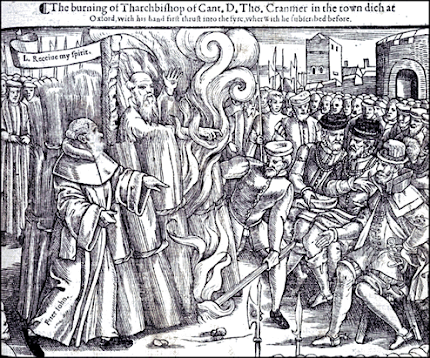
The burning of Tharchbishop of Cant. D. Tho. Cranmer in the town dich at Oxford, with his hand first thrust into the fyre, wherwith he subscribed before. [Click on the picture to see Cranmer's last words.]

Daily Bible Verse

Friday, December 31, 2010

Luther: The Pharisee and the Tax Collector

From Luther’s comments on Luke 18:9-14,

13. Well, I said before, that the Pharisee is neither censured nor condemned because he does the works of the law, or else we would have to condemn God’s gift and his law, and praise the contrary. Yet this I say, that here the person is placed before the judgment seat of God, and finds it different there than before the judgment of this world, that although he has indeed some beautiful, praiseworthy gifts, yet a great blot of shame cleaves to them, because he misuses these gifts, and in Gods sight is entirely destroyed by them.

For with these gifts he is here accused of transgressing against both God and man, against both tables of the law. For in the first commandment especially and in the highest terms, presumption is forbidden, that a man should not trust in himself or in his own gifts, or take pleasure in himself; as this work-righteous person does, who struts forth and is tickled with the gifts he has received from God, and makes an idol of them and worships himself, as though he were the excellent holy man, whom alone God is bound to respect and honor.

14. This is already the great sin and vice where he runs counter against God himself, of course blind and hardened, like an unbelieving heathen or Turk, who knows nothing of God, is without repentance, and on account of his great holiness will know nothing of sin, and fears not the wrath of God. He presumes to stand firm by his own works, and does not see that he and all men, even the true saints themselves with all their own righteousness and life, cannot stand before God; but are guilty of his wrath and condemnation, as David testifies in Ps., 130:3: “If thou, Jehovah, shouldest mark iniquities, O Lord, who could stand?” And Ps. 143:2: “Enter not into judgment with thy servant; for in thy sight no man living is righteous.” Therefore he does not seek either grace or forgiveness of sins, nor does it occur to him that he stands in need of them.

From: The Pharisee and the Publican

Thursday, December 30, 2010

Avoid many kinds of texts... Martin Luther

In the first place, let the preacher above all be careful to avoid many kinds of or various texts and forms of the Ten Commandments, the Lord's Prayer, the Creed, the Sacraments, etc., but choose one form to which he adheres, and which he inculcates all the time, year after year. For [I give this advice, however, because I know that] young and simple people must be taught by uniform, settled texts and forms, otherwise they easily become confused when the teacher to-day teaches them thus, and in a year some other way, as if he wished to make improvements, and thus all effort and labor [which has been expended in teaching] is lost.

Martin Luther

From:  Preface to the Small Catechism
--
Reasonable Christian Blog Glory be to the Father, and to the Son : and to the Holy Ghost; Answer. As it was in the beginning, is now, and ever shall be : world without end. Amen. 1662 Book of Common Prayer

Watching Car Crashes « God's Hammer

OK, Sean Gerety and I have had our differences over the Definition of Chalcedon, 451 A.D. and how Dr. Gordon H. Clark interpreted Scripture in light of the Definition of Chalcedon. Be that as it may, Mr. Gerety is surely right about the Federal Visionist takeover of the Presbyterian Church in America. Who would have thought that such a thing would happen just a few years ago? It seems that the takeover is accelerating rather than slowing down. Put that with the Reformed Baptists who are obsessed with personal piety above the doctrines of grace and you have a real mixture for heterodoxy and heresy.


Watching Car Crashes « God's Hammer

Quote of the Day: A. A. Hodge on Supererogation and Hyper Sanctification

A man truly loving holiness and hating sin, himself a redeemed sinner preaching to his fellow-sinners, cannot stultify himself and mock them by telling them to be good as they can with all their might, and God will bless them. He must either preach despair, or an adequate expiation and gracious reconciliation as the basis of all real reform. The opposite method, unhappily becoming less infrequent than hitherto, is an evident symptom of a miserably low moral standard. The age-spirit which doubts about the reality and eternity of future punishment naturally ceases to emphasize justification on the basis of vicarious expiation, and to postpone it as the consequent of regeneration, sanctification, and the life work which follows. The end is evident and inevitable. Without antecedent reconciliation men cannot be truly sanctified. So the same low sense of sin which leads to the ignoring of justification, or to its removal from its position as the beginning and fountain of all practical grace, will necessarily lead to the denial of the soul’s need to any grace, and of its obligation to any law. Legalism makes fair professions; but, beginning with the denial of innate sinfulness and moral impotency, it proceeds logically to ignore the abomination of sin and the excellence of virtue, and ends in an abyss of license which confounds all moral distinctions.

[From:  The Ordo Salutis].

--
Reasonable Christian Blog Glory be to the Father, and to the Son : and to the Holy Ghost; Answer. As it was in the beginning, is now, and ever shall be : world without end. Amen. 1662 Book of Common Prayer

Wednesday, December 29, 2010

The Clark/Van Til Controversy: The Text of a Complaint

The Text of a Complaint

Against Actions of the Presbytery of Philadelphia

In the Matter of the Licensure and Ordination of Dr. Gordon H. Clark

[Note: I am typing the full text of this article by hand from a PDF file posted at the God's Hammer blog by Sean Gerety regarding the Clark/Van Til controversy. I am providing a link to the original document file. After I complete the text of the complaint made by Dr. Cornelius Van Til and his supporters, I will be doing the same for the answer to the complaint given by Dr. Clark and his supporters. Note: When reading the PDF file for the answer given by Dr.. Clark right click on the page and rotate clockwise several times until you get it in the landscape orientation. I am posting what I have typed so far and will be making more posts as time permits. If you wish to read the entire document you are free to click on the links above. Charlie.]

The following is the full text of a complaint signed by a minority in the Presbytery of Philadelphia of The Orthodox Presbyterian Church against the action of that presbytery in the matter of the licensure and ordination of the Rev. Gordon H. Clark, Ph.D. The complaint was presented and read on the floor of presbytery at its meeting on November 20, 1944.

To John P. Galbraith, Stated Clerk of The Presbytery of Philadelphia:

And now, this sixth day of October, A.D. 1944, come under the undersigned and complain against the action of the Presbytery of Philadelphia in holding a “special meeting” of the Presbytery on July 7, 1944 and against several actions and decisions taken at that meeting, to wit:

1. The decision to find the call for the meeting in order;

2. The decision to sustain the examination in theology of Dr. Gordon H. Clark;

3. The decision to waive the requirement of two years of study in a theological seminary;

4. The decision to proceed to license Candidate Gordon H. Clark to preach the gospel;

5. The action of licensing Dr. Gordon H. Clark;

6. The decision to deem the examination for licensure sufficient for ordination; and

7. The decision to ordain Dr. Gordon H. Clark at a subsequent meeting of the Presbytery called for that purpose.

In support of the complaint against the decision to find the call for the meeting in order the following considerations are set forth:

The special meeting of the Presbytery of Philadelphia held at the Mediator Orthodox Presbyterian Church in Philadelphia on July 7, 1944 was an illegal meeting. In support of this conclusion the following evidence is cited:

1. a. The Form of the Government of the Orthodox Presbyterian Church read, “The presbytery shall meet on its own adjournment; and when any emergency shall require a meeting sooner than the time to which it stands adjourned, the moderator, or, in case of his absence, death, or inability to act, the stated clerk, shall, with the concurrence or at the request of two ministers and two elders, the elders being of different congregations, call a special meeting” (Chapter X, section 9).

b. The Form of Government of the Orthodox Presbyterian Church reads, “And in the case of the moderator of the presbytery, he shall likewise be empowered, on any extraordinary emergency, to convene the judicatory by a circular letter before the ordinary time of meeting” (Chapter XIX, section 2).

c. The moderator of the Presbytery of Philadelphia when requested at the meeting of July 7, 1944 to state the nature of the emergency which provided the occasion for the special meeting offered no evidence of the existence of an emergency, extraordinary or otherwise. Rather, the moderator stated that the meeting was justified because it suited the convenience of Dr. Gordon H. Clark and declared that other special meetings constituted a precedence for this meeting. Nor has any other evidence of the existence of an emergency been presented to the presbytery or the complainants.

d. Thus the meeting of the Presbytery of Philadelphia on July 7, 1944 was called, and held, in violation of the Form of Government of the Orthodox Presbyterian Church.

2. a. The provision of the Form of Government of the Orthodox Presbyterian Church quoted above are taken verbatim from the Form of the Presbyterian Church in the U.S.A., except that in the second quotation the word “a” is a substitute for the word “his”. These provisions have stood in the Form of Government since its adoption by the Synod of New York and Philadelphia in 1788, preparatory to the convening of the first General Assembly in the following year.

Prior to 1788, the Synod of New York and Philadelphia, the parent of the General Assembly, and the highest judicatory then existing, had been governed by the action in 1729 of the Synod of Philadelphia in declaring that they judge the directory for worship, discipline, and government of the church, commonly annexed to the Westminster Confession, to be agreeable in substance to the word of God, and founded thereupon, and therefore do earnestly recommend the same to all their members, to be by them observed as near as circumstances will allow, and Christian prudence direct” (Records of the Presbyterian Church in the United States of America, Philadelphia, (904, p. 95). Since that directory made no specific provision concerning special meetings, the question arose, in the course of time, as to the calling of special meetings, and a query on the subject was brought in to the Synod of New York and Philadelphia in 1760, which query read as follows:

How many ministers are necessary to request the moderator of the commission of the Synod, or of any of our Presbyteries, to oblige the moderator to call any of these judicatures to do occasional business?” The Synod replied to the query:

The Synod judge, that meetings of judicatures, pro re nata, can only be necessary on account of important occurrences unknown at their last meeting, and which cannot be safely deferred till their stated meeting, such as scandal raised on a minister's character, tending to destroy his usefulness, and bring reproach on religion; or feuds in a congregation threatening its dissolution; or some dangerous error, or heresy broached; but not for matters judicially deferred by the judicature, except some unforeseen circumstance occurs, which makes it appear that some principal things on which the judgment depends may then be had, and cannot be obtained if it is deferred till their stated meeting; nor, for any matters that ordinarily come in at their stated meetings” (op. cit., p. 305).

This action constituted a precedent for the Form of Government when it was adopted in 1788 and illuminates its meaning. Furthermore the action was printed in Samuel J. Baird: A Collection of the Acts, Deliverances, and Testimonies of The Supreme Judicatory of the Presbyterian Church, from its Origin in America to the Present Time, the ancestor of the Presbyterian Digest, when it first appeared in 1856. It was reprinted in the second edition. It was carried over into The Presbyterian Digest by William E. Moore and still appears in the latest edition of the Digest, that of 1938. It constitutes an unbroken tradition.

b. The special meeting of the Presbytery of Philadelphia of July 7, 1944 falls under the direct condemnation of this precedent, since it did not deal with an occurrence unknown at the last meeting, nor with a judicial matter, but did deal with a matter that ordinarily “comes in” at a stated meeting.

3. a. The term “pro re nata” was used in connection with special meetings by the Synod of 1760. It has been an historical usage of the Presbyterian Church in the U.S.A. since that time, perhaps before it, in application to special meetings. J. Aspinwall Hodge uses it in his What is Presbyterian Courts? (Philadelphia, 1882).

The definition of “pro re nata” in the Oxford English Dictionary reads, “'for the affair born, i.e. arisen'; for some contingency arising unexpectedly or without being provided for; for an occasion as it arises” (vol. VIII, p. 1398). J. Aspinwall Hodge, in the work just mentioned, says:

When may 'pro re nata' meetings be called?

They may be called 'on account of important occurrences unknown at their last meeting, and which cannot be safely deferred till their stated meeting'” (p. 228).

b. The meeting of July 7, 1944 thus violates not only the Form of Government of the Orthodox Presbyterian Church, and the historical precedence and tradition of the Presbyterian church but the very definition of a pro re nata meeting.

4. a. It has been argued that the Presbytery of Philadelphia has occasionally met in special sessions when no emergency was present and that precedent was thus established for such procedure. But that is only to say that Presbytery has at times erred in this respect. It goes without saying that one error does not justify another. However, the complainants hold that there is no evidence that, as a matter of fact, the Presbytery of Philadelphia has in other instances transgressed the provisions of the constitution concerned. The minutes of the Presbytery of Philadelphia contained in the record books of the Presbytery in August, 1944 record twenty-one special meetings, as distinct from regular or adjourned meetings, whose minutes have been approved to date.

Of that number, nineteen were concerned entirely with the approval of the sending of calls, the reception of churches, the installation of pastors, the dismissal of members, the erasure of the names of members, the dissolution of pastoral relationships, the notifying sessions of dissolutions, the declaring of pulpits vacant, the acceptance of resignations from offices in this connection, the granting of permission to reside without the bounds of presbytery and the ordination of candidates without further examination. In short, they dealt either with changes of pastoral or ecclesiastical status which had arisen in the interval between stated meetings or were for the purpose of ordaining candidates without further examination.

Of the two remaining meetings, one was called in answer to a special request from the Redeemer Church and appointed a committee to confer with the congregation of that church; and the other was called to deal with the report of a committee to prepare an answer to the request of the Presbytery of Ohio and was called in accordance with the direction of the previous regular meeting ordering the committee to present its recommendations at the “earliest possible moment”.

b. The minutes of the Presbytery therefore indicate that in the past the Presbytery has held special meetings only when matters concerning pastoral relationships or the ordination of men already examined were concerned, where a new matter had suddenly arisen, or where the presbytery itself had directed action at the “earliest possible moment”. No special meeting comparable to the meeting of July 7, 1944 has ever been held by the Presbytery of Philadelphia.

We conclude therefore that the meeting of July 7th was unconstitutional. It was clearly illegal in the light of the specific requirements of the Form of Government that the calling of special meetings is justified only when an emergency exists. It also stands condemned in the light of historic precedent.

In the light of the foregoing considerations the complainants request that the meeting of the Presbytery of Philadelphia held on July 7, 1944 be found to have been illegally convened and that its acts and decisions and the acts and decisions issuing therefrom be declared null and void.

In support of the complaint against the actions and decisions numbered 2 to 7 the following considerations are set forth:

I. The Christian doctrine of the knowledge of God is distinguished as well by its affirmation of the incomprehensibility of God as by its assertion of his knowability. The point does not need to be labored that the knowability of God lies at the very foundation of Christianity. That God can be known, and that he has given a knowledge of himself through his works and words, is pervasively taught in the Scriptures. The possibility and actuality of true religion depend upon the light and truth which God communicates to men. Skepticism and agnosticism are thoroughly anti-Christian.

In avoiding skepticism and agnosticism, however, Christianity has been insistent that the knowledge of God which is possible for men, possible because of the fact of divine revelation, is not and can never become comprehension of God. The doctrine of the incomprehensibility of God is as ultimate and foundational as the doctrine of his knowability. The doctrine of the incomprehensibility of God is not a mere qualification of his knowability; it is not the doctrine that God can be known only if he makes himself known and in so far as he makes himself known. It is rather the doctrine that God because of his very nature must remain incomprehensible to man. The question of the power of God to reveal himself to man does not enter into the elements of this doctrine. Because of his very nature as infinite and absolute the knowledge which God possesses of himself and of all things must remain a mystery which the infinite mind of man cannot penetrate. "The divine knowledge as human, even when that human knowledge is a knowledge communicated by God.”

The sentence should read:

“The divine knowledge as divine, transcends human knowledge as human, even when that human knowledge is a knowledge communicated by God.”

I'm hoping maybe Hugh might be willing to proof these, but once I can get these proofed we should be good to go. Man may possess true knowledge as he thinks God's thoughts after him. But because God is God, the creator,, and man is man, the creature, the difference between the divine knowledge and the knowledge possible to man may never be conceived of merely in quantitative terms, as a difference in degree rather than a difference in kind. Otherwise the Creator-creature relationship is broken down at a most crucial point, and there is an assault upon the majesty of God.

The doctrine of the divine incomprehensibility is not a specifically Reformed doctrine. In view, however, of the peculiar emphasis of the Reformed theology upon the divine sovereignty and transcendence, it is not surprising that it has been most careful to state and expound it. As indicative of the place occupied by this doctrine in Reformed thought mention may be made of the fact that in the monumental work of Bavinck, the first subject treated under the doctrine of God is his incomprehensibility, and that, only after devoting 28 pages to this subject, does he proceed to deal with the knowability of God.

A few quotations from Reformed writers will serve to set forth more adequately the classic doctrine of incomprehensibility. Calvin's teaching, because of the unique place which his thought occupies in the history of Reformed thought, is of special interest. Calvin says that the divine essence is incomprehensible, that his majesty is not to be perceived by the human senses, that what God is in himself we cannot know, that from the nature of the case we may learn from his divine activities only what he is to us, that it would be presumptuous curiosity to attempt to examine into his essence, that rather we must be content to adore, to fear and to reverence him (Institutes, v. 1, 9; ii. 2; x. 2; cf. Warfield, Calvin and Calvinism, pp. 150ff.).

Charnock sets forth the incomprehensibility of God both in his discourse entitled, “On God's Being a Spirit” and in that entitled, “On God's Knowledge”:

God is therefore a Spirit incapable of being seen, and infinitely incapable of being understood. . . . There is such a disproportion between an infinite object and a finite sense and understanding, that it is utterly impossible either to behold or comprehend him.” (Discourses on the Existence and Attributes of God, New York, 1886, pp. 184f.).

We cannot have an adequate or suitable conception of God: He dwells in inaccessible light; inaccessible to the acuteness of our fancy, as well as the weakness of our sense. If we could have thoughts of him as high and excellent as his nature, our conceptions must be as infinite as his nature. All our imaginations of him cannot represent him, because every created species is finite; it cannot therefore represent to us a full and substantial notion of an infinite Being. . . . Yet God in his word is pleased to below his own excellency, and point us to those excellencies in his works, whereby we may ascend to the knowledge of those excellencies which are in his nature. But the creatures, whence we draw our lessons, being finite, it is utterly impossible to have a notion of God commensurate to the immensitiy and spirituality of his being” (idem, p. 196. See also pp. 183, 451, 358).

J. H. Thornwell in his lecture on “The Nature and Limits of our Knowledge of God” (Collected Writings, Vol. I, Richmond, 1871) also clearly draws a qualitative distinction between the divine knowledge and the knowledge that is possible to man. While the whole discussion on pp. 104-142 is pertinent a few quotations must suffice here:

His infinite perfections are veiled under finite symbols. It is only the shadow of them that falls upon the human understanding” (p. 118).

Again the difference betwixt Divine and human knowledge is not only simply of degree. It is a difference in kind. God's knowledge is not like ours, and therefore we are utterly unable to think it as it is in Him. We can only think it under the analogy of ours in the sense of a similarity of relations” (pp. 121f.).

This protest is only a series of negations—it affirms simply what God is not, but by no means enables us to conceive what He really and positively is. It is the infinite and absolute applied to the attributes which we are striving to represent. Still these negative notions are of immense importance. They are clear and pregnant confessions that there is a transcendent reality beyond all that we are able to conceive or think in comparison with which our feeble thoughts are but darkening counsel by words without knowledge” (p. 122).

Most heresies have risen from believing the serpent's lie, that our faculties were a competent measure of universal truth. We reason about God as if we possessed an absolute knowledge. The consequence is, we are lost in confusion and error. . . . It is so easy to slide into the habit of regarding the infinite and the finite as only different degrees of the same thing, and to reason from one to the other with the same confidence with which, in other cases, we reason from the less to the greater, that the caution cannot be too much insisted upon that God's thoughts are not our thoughts, nor God's ways our ways” (pp. 140f.).

Our ignorance of the Infinite is the true solution of the most perplexing problems which encounter us at every step in the study of Divine truth. We have gained a great point when we have found that they are truly insoluble—that they contain one element which we cannot understand, and without which the whole must remain an inexplicable mystery. The doctrines of the Trinity, of the Incarnation, of the Prescience of God and the Liberty of Man, the Permission of the Fall, the Propagation of Original Sin, the Workings of Efficacious Grace, all these are facts which are clearly taught; as facts they can be readily accepted, but they defy all efforts to reduce them to science. . . . Our wisdom is to believe and adore” (pp. 141f.).

Although Charles Hodge's particular treatment of the doctrine of incomprehensibility is brief, it is to the point, and likewise bases the doctrine upon the distinction in nature between the Almighty and the creature:

"When it is said that God can be known, it is not meant that He can be comprehended. To comprehend is to have a complete and exhaustive knowledge of an object. It is to understand its nature and its relations. . . . God is past finding out. We cannot understand the Almighty to perfection. . . . Such knowledge is clearly impossible in a creature, either of itself or of anything outside of itself” (Systematic Theology, I, p. 337).

It is included in what has been said, that our knowledge of God is partial and inadequate. There is infinitely more in God than we can have any idea of; and what we do know, we know imperfectly” (ibid.).

Shedd is also worth hearing. He says:

Man knows the nature of finite spirit through his own self-consciousness, but he knows that of the Infinite spirit only analogically. Hence some of the characteristics of the Divine nature cannot be known by a finite intelligence. For example, how God can be independent of the limitations of time and have an eternal mode of consciousness that is without succession, including all events simultaneously in one omniscient intuition, is inscrutable to man, because he himself has no such consciousness” (Dogmatic Theology, I, p. 152).

Although God is an inscrutable mystery, he is yet an object of thought” (idem, p. 156).

Finally, a few sentences from Bavinck.

This doctrine of the incomprehensibility of God and of the unknowability of his essence becomes also the point of departure and the founational thought of Christian theology. God is not exhausted in his revelation, whether in creation or re-creation. He cannot fully communicate himself to his creatures because they would then themselves have to be God. There is therefore no adequate knowledge of God” (Gereformeerde Dogmatiek, II, p. 10).

There is no knowledge of God as he is in himself. We are men and he is the Lord our God. . . . He is infinitely far exalted above our conception, our thought, our language. He is not to be compared with any creature. . . . He can be apprehended, not comprehended. --Thus speaks the whole of Scripture and the whole of Christian theology. And when a superficial nationalism has thought an adequate knowledge of God possible, Christian theology has always fought it most strenuously” (p. 23).

The knowledge that we possess of God is altogether distinctive. It can be called a positive knowledge in so far as through it we recognize a being who is infinitely different from all finite creatures. It is, on the other hand, negative because we cannot ascribe a single predicate to God as we conceive of such a predicate in his creatures. And it is therefore analogical because it is the knowledge of a being who in himself is unknowable but nevertheless can make something of himself known to his creatures” (p. 24).

Christian theology beholds here an adorable mystery. It is completely incomprehensible for us that and how God can reveal himself and to an extent make himself known in the creature, the eternal in time, the immeasurable in space, the infinite in the finite, the unchangeable in change, being in becoming, that which is already as if it existed in that which does not exist. This mystery is not to be comprehended, it can alone be gratefully acknowledged” (pp. 24f.)

Mystery is the element in which theology lives” (p. 1).

That this doctrine of the incomprehensibility of God as expounded by Reformed theology is the doctrine of the Confession of Faith, II, 1, and of the Larger Catechism, 7, cannot be doubted. In the nature of the case the doctrinal standards do not expound the meaning of the word “incomprehensible” where it is employed. Nevertheless, its meaning does not remain uncertain because of its uniform significance in the history of Christian thought which constitutes the background of the formulation of these standards. The context provided by the standards themselves, moreover, serves to confirm this conclusion. In describing God as “infinite in being and perfection” and as “most absolute” (II, 1) and as having “all life, glory, goodness, blessedness, in and of himself” and as being “alone in and unto himself all-sufficient” (II, 2) the Confession clearly conceives of the nature and attributes of God as beingg infinitely exalted above the nature and qualities of the creature whether in this life or in the life to come. More specifically, when it speaks of the knowledge of God as infinite (II, 2) that knowledge of God is evidently thought of as differing from the knowledge possible to the creature in a qualitative sense, and not merely in degree. And nothing is more obvious than that in characterizing God as “incomprehensible”, the Confession does not mean merely that God is unknown unless he reveals himself. God does not become less incomprehensible through the historical process of revelation. Rather his incomprehensibility is viewed as an attribute of God as he is in himself, without which he would not be God, as absolute and unalterable as his immutability, his omnipotence and the other attributes referred to in the same sentence (II, 1). Now since God is incomprehensible, his revelation of himself cannot have the purpose of providing an adequate or exhaustive knowledge of himself; the revelation is directed to the needs of men (Confession I, 1). Nor does the doctrine of the plainness of Scripture (I, 7) mean that the revelation which God has been pleased to give of himself is meant to be exhaustively understood. It is indeed inherently perspicuous, and it is plain to man in the sense that man “may attain unto a sufficient understanding” of “those things which are necessry to be known, believed, and observed, for salvation”, but this is far from implying that there are not mysteries set forth in the divine revelation that are quite beyond the powers of the finite mind to comprehend.

That this doctrine of the divine incomprehensibility is the teaching of the Scriptures does not require any elaborate proof. The doctrine is taught in many passages and is implicit in the doctrine of the divine transcendence which is everywhere taught or presupposed in Scripture. A few of the most explicit passages may be passed in review. The proof-text supplied with the reference in the Confession is Psalm 145:3. “His greatness is unsearchable.” Isaiah 40:28 also states that “there is no searching of his understanding” while Job 11:7 f. asks, “Canst thou by searching find out God? Canst thou find out the Almighty to perfection? It is high as heaven: what canst thou do? Deeper than Sheol; what canst thou know?” In these passages far more is taught than that man is dependent upon the divine revelation for knowledge of God; there is a reverent acknowledging of the exceeding greatness of God and of his knowledge which man as a creature cannot know in any adequate way. Even more clearly perhaps, the gulf which separates the divine knowledge from human knowledge is set forth in Isaiah 55:8, 9. “For my thoughts are not your thoughts, neither are your ways my ways, saith Jehovah. For as the heavens are higher than the earth, so are my ways higher than your ways, and my thoughts than your thoughts.” In I Timothy 6:16 the Lord of Lords is described as “dwelling in light unapproachable, whom no man hath seen or can see”, thus indicating not merely that God is invisible because of his spirituality but also that the light in which God dwells is so glorious that man the creature may never trespass or even draw near to contemplate God as he is in himself. Only the divine Son has that adequate knowledge of God which makes a revelation of God possible (John 1:18; 6:46). Only the Son has a knowledge of the Father that is on a level with the Father's knowledge of the Son; only the Son's knowledge of the Father is exhaustive knowledge; the knowledge which men may come to possess of the Father and of the Son is knowledge on a lower level, apprehension but not comprehension, for otherwise mere men would have to be accorded a place alongside of Christ who alone “knows the Father” (Mt. 11:27; Luke 10:22. Cf. Also Romans 11:33; Deuteronomy 29:29).


[Click here to see Part Two].


--
Reasonable Christian Blog Glory be to the Father, and to the Son : and to the Holy Ghost; Answer. As it was in the beginning, is now, and ever shall be : world without end. Amen. 1662 Book of Common Prayer

A Primitive Baptist Perspective on Reprobation


Tuesday, December 28, 2010

J. I. Packer: Arminianism Is Semi-Pelagianism

[The following is an excerpt from J. I. Packer's Introductory Essay to John Owen's, Death of Death in the Death of Christ.  Charlie.]

First, it should be observed that the “five points of Calvinism,” so-called, are simply the Calvinistic answer to a five-point manifesto (the Remonstrance) put out by certain “Belgic semi-Pelagians” in the early seventeenth century. The theology which it contained (known to history as Arminianism) stemmed from two philosophical principles: first, that divine sovereignty is not compatible with human freedom, nor therefore with human responsibility; second, that ability limits obligation. (The charge of semi-Pelagianism was thus fully justified.) From these principles, the Arminians drew two deductions: first that since the Bible regards faith as a free and responsible human act, it cannot be caused by God, but is exercised independently of Him; second, that since the Bible regards faith as obligatory on the part of all who hear the gospel, ability to believe must be universal. Hence, they maintained, Scripture must be interpreted as teaching the following positions: (1.) Man is never so completely corrupted by sin that he cannot savingly believe the gospel when it is put before him, nor (2.) is he ever so completely controlled by God that he cannot reject it. (3.) God’s election of those who shall be saved is prompted by His foreseeing that they will of their own accord believe. (4.) Christ’s death did not ensure the salvation of anyone, for it did not secure the gift of faith to anyone (there is no such gift); what it did was rather to create a possibility of salvation for everyone if they believe. (5.) It rests with believers to keep themselves in a state of grace by keeping up their faith; those who fail here fall away and are lost. Thus, Arminianism made man’s salvation depend ultimately on man himself, saving faith being viewed throughout as man’s own work and, because his own, not God’s in him.

The Synod of Dort was convened in 1618 to pronounce on this theology, and the “five points of Calvinism” represent its counter-affirmations. They stem from a very different principle—the biblical principle that “salvation is of the Lord”; and they may be summarized thus: (1.) Fallen man in his natural state lacks all power to believe the gospel, just as he lacks all power to believe the law, despite all external inducements that may be extended to him. (2.) God’s election is a free, sovereign, unconditional choice of sinners, as sinners, to be redeemed by Christ, given faith and brought to glory. (3.) The redeeming work of Christ had as its end and goal the salvation of the elect. (4.) The work of the Holy Spirit in bringing men to faith never fails to achieve its object. (5.) Believers are kept in faith and grace by the unconquerable power of God till they come to glory. These five points are conveniently denoted by the mnemonic TULIP: Total depravity, Unconditional election, Limited atonement, Irresistible grace, Preservation of the saints.  [See Canons of Dort.  Charlie.]

--
Reasonable Christian Blog Glory be to the Father, and to the Son : and to the Holy Ghost; Answer. As it was in the beginning, is now, and ever shall be : world without end. Amen. 1662 Book of Common Prayer

Monday, December 27, 2010

John Robbins: Foreward to Saving Faith


Faith and Saving Faith, by Gordon H. Clark

[Click on the title to see the original site where this was posted.  Charlie.]


FOREWORD

LONG BEFORE the Neo-orthodox theologians thought of saying that faith is an encounter with a divine Person rather than assent to a proposition, preachers who ought to have known better taught that faith is trust in a person, not belief in a creed. This writer, when a teenager, was told that some people would miss Heaven by twelve inches—the distance between the head and the heart—because they believed the Gospel with their heads but not with their hearts. Today it is easier for a camel to pass through the eye of a needle than it is to find a minister—a conservative minister—who does not believe and teach that one must have a "personal relationship" with Christ in order to be saved. But what that "personal relationship" consists of is either not made explicit or, when made explicit, contradicts what the Bible teaches about saving faith. The result is that both Christians and non-Christians are either needlessly confused or totally misled. Perhaps the world is not responding to the churches' message because the message is garbled. Neither the churches nor the world knows exactly what to do to have eternal life.

Statements such as these about the head and the heart and trusting a person, not believing a creed, are not only false; they have also created the conditions for the emergence of all sorts of religious subjectivism, from Modernism to the Charismatic movement and beyond. No one will miss Heaven by twelve inches, for there is no distance between the head and the heart: "As a man thinks in his heart, so is he." The head/heart dichotomy is a figment of modern secular psychology, not a doctrine of divine revelation. St. Sigmund, not St. John, controls the pulpit in nearly all churches.

Further, "trust in a person" is a meaningless phrase unless it means assenting to certain propositions about a person, propositions such as "I believe in God the Father Almighty…and in Jesus Christ his only Son, our Lord, who was conceived by the Holy Ghost, born of the Virgin Mary, suffered under Pontius Pilate, was crucified, dead, and buried; the third day he rose again from the dead; he ascended into Heaven, and sits on the right hand of God the Father Almighty; from thence he shall come to judge the living and the dead." Trust in Christ, unless it includes belief of these propositions—as well as the Gospel of justification by faith—is totally without value. "Christ" means these propositions—and a lot more, to be sure, but at least these. No one who trusts in the Christs of Karl Barth, Paul Tillich, C. S. Lewis, or N. T. Wright will be saved.

As for having a "personal relationship" with Christ, if the phrase means something more than assenting to true propositions about Jesus, what is that something more? Feeling warm inside? Coffee has the same effect. Surely "personal relationship" does not mean what we mean when we say that we know someone personally: Perhaps we have shaken his hand, visited his home or he ours, or eaten with him. John had a "personal relationship" with Christ in that sense, as did all the disciples, including Judas Iscariot. But millions of Christians have not, and Jesus called them blessed: They have not seen and yet have believed. The difference between Judas Iscariot and the other disciples is not that they had a "personal relationship" with Jesus and he did not, but that they believed, that is, assented to, certain propositions about Jesus, while Judas did not believe those propositions. Belief of the Gospel, nothing more and nothing less, is what separates the saved from the damned. Those who maintain that there is something more than belief needed for justification, are, quite literally, beyond belief.

Since we first published Faith and Saving Faith twenty years ago in 1983 (the book was largely ignored by the clergy and the churches), there has been a widespread defection from the Gospel of Jesus Christ in Reformed churches—both Baptist and Presbyterian—a defection specifically from the doctrine of justification by faith alone. That defection is accelerating.

Several factors have contributed to the growing rejection of the Gospel in the churches, and one of those factors is confusion about the nature of faith. That confusion is common to those who oppose the doctrine of justification by faith alone, and to some of those who defend it. Faith, rather than being recognized as belief of a statement, that is, intelligent assent to an understood proposition - and saving faith being belief of the truth, that is, intelligent assent to Biblical propositions—rather than faith being understood in Scriptural terms, faith is seen as something more than belief—as "commitment to a person," "trust of a person," "encounter with a person," "surrender to a person;" or a "personal relationship." This common viewpoint is not in accord with Scripture, for it makes a fatal dichotomy between persons and propositions, and regards faith as trust in or commitment to a person, rather than belief of a proposition.

Those who deny justification by faith alone may say that saving faith includes, or is identical to, obedience and good works. They define that vague "something more than belief" as something "objective": baptism, obedience, and good works. The deniers of justification by faith alone begin by agreeing with those who confusedly defend justification by faith alone: Faith is not "mere assent." Faith is more than belief, they say. Thus those who deny justification by faith alone, and many of those who wish to defend it, are united in this opinion—which Dr. Clark shows by painstaking exegesis of Scripture to have no support in Scripture—that faith is not intelligent assent to an understood proposition, not "mere" belief, but something more.

Deniers of justification by faith alone may say that faith is not mere assent, for it is obedience as well. They make the vague "something more than assent" definite by their assertion that saving faith includes works. This allows them—watch their sleight-of-hand carefully—to assert that justification by faith alone is true, as the Westminster Confession teaches, because they have redefined faith to include works. So when they assert that "justification is by faith alone," they mean, justification is by works, too."

Many of those who wish to defend justification by faith alone are embarrassed because of their agreement with the deniers of justification that faith is not mere belief, not intelligent assent to an understood proposition. And they should be embarrassed, for their faulty understanding of faith has opened the door to the current widespread denial of justification by faith alone.


Faith and Saving Faith is not primarily about the doctrine of justification by faith alone, but its exegesis and analysis are fundamental to that doctrine. To understand the doctrine of justification by faith alone, one must understand the doctrine of faith, as well as the doctrine of justification. Err on either doctrine, and one errs on the doctrine of justification by faith alone. So one might misunderstand justification as a process, or progressive, or two-staged, or based on infused righteousness, or conditioned on one's obedience, rather than as an irrevocable legal act of God. And one might misunderstand faith as a complex psychological feat, which, if it is not performed satisfactorily by the sinner, and confirmed by meticulous introspection, cannot justify. One can snake faith into a work such as "complete commitment: "'unconditional surrender," "life-changing encounter," and "total trust." Many people, including many teachers in conservative churches and schools, are offended by the simplicity of the Gospel, and add to the statements of Scripture. They thus destroy the assurance of Christians by making them wonder if they have "surrendered" enough, "trusted" enough, or been "committed" enough to be saved.


This creates a spiritual climate of doubt in which those who deny justification by faith alone can flourish. To those who have been needlessly worried by this un-Scriptural doctrine of faith as a complex psychological feat, the deniers of justification by faith alone say: Look, we offer you assurance of salvation: Look to your baptism, look to your works, which are visible and objective and photographable. Who can tell if you have performed some complicated psychological feat or not? But everyone can tell whether you have been baptized, or if you are doing good works. So rest your assurance on those visible, photographable," objective" things.

Both the defenders and deniers of justification by faith alone need to learn the lessons about faith that Scripture teaches. One of them is this:
The strength or kind of faith required is nowhere stated in Scripture. The Holy Spirit has said nothing as to quantity or quality on which so many dwell and over which they stumble, remaining all their days in darkness and uncertainty. It is simply in believing—feeble as our faith may be—that we are invested with this righteousness of Christ. For faith is not work, nor merit, nor effort, but the cessation from all these and the acceptance in place of them of what another has done -done completely and forever. The simplest, feeblest faith suffices: It is not the excellence of our act of faith that does anything for us, but the excellence of him who suffered for sin—the just for the unjust—that he might bring us to God…Many a feeble hand—perhaps many a palsied one—was laid on the head of the burnt offering (Leviticus 1:4), but the feebleness of that palsied touch did not alter the character of the sacrifice or make it less available in all its fullness for him who brought it…The weakest touch sufficed to establish the connection between it and him. (Horatius Bonar, The Everlasting Righteousness, 40-41)

Unintentionally and unwittingly, the defenders of justification by faith alone, by their un-Scriptural doctrine of faith (which makes faith a complex psychological act rather than simple assent to the truth), have created and sustained the theological climate in which those who deny justification by faith alone can flourish. The defenders of justification by faith alone have asserted that it is not enough to believe the Gospel, for even the demons believe the Gospel, and the demons are lost. Belief is not enough, they say. In order to be saved, one must do more than believe; one must commit, surrender, trust, encounter, relate, or emote.

The deniers of justification by faith alone agree: It is not enough to believe the Gospel in order to be saved. But rather than urging people to perform some further psychological task in addition to belief, they tell them to do good works in order to be saved. Their works (or their baptism) will complete what is lacking in belief alone. In this way, both the defenders and the deniers of justification by faith alone have lost sight of what in fact saves: The perfect, imputed righteousness of Christ, completely outside the sinner, and received by the simple instrument of belief alone.

The current controversy over justification has broken out in conservative churches because Christians recognize that the Bible denies justification by works, whether works are regarded as a ground, condition, or an instrument of justification. But what most Christians have not yet recognized is that the common Protestant view of saving faith as something more than belief of the Gospel has fueled and will continue to fuel denials of justification by faith alone so long as it prevails. Until faith is understood as mere belief- the Bible makes no distinction between the two words - the justification controversy will continue, and those defending justification by faith alone will continue to be embarrassed by their agreement with the deniers of justification, that belief of the Gospel is not enough for salvation.

In the pages that follow, Dr. Clark defends the view that faith is assent to a proposition, and that saving faith is assent to propositions found in the Bible. Saving faith is neither an indescribable encounter with a divine Person, nor heart knowledge as opposed to head knowledge. According to the author of Hebrews, those who come to God must believe at least two propositions: That he is God, and that he is a rewarder of them that diligently seek him. Mindless encounters and non-intellectual relationships are not saving faith. Truth is propositional, and one is saved and sanctified only through believing true statements. Faith comes by hearing, and hearing comes by the Word of Cod.

The anti-intellectual cast of virtually all modern thought, from the university chair to the barroom stool, controls the pulpits as well. It is this pious anti-intellectualism that emphasizes encounter rather than information, emotion instead of understanding, "personal relationship" rather than knowledge. But Christians, Paul wrote, have the mind of Christ. Our relationship to him is intellectual. And since Christ is his mind and we are ours, no relationship could be more intimate than that. That is precisely why the Scriptures use the analogy of marriage to illustrate the intellectual relationship between Christians and Christ - and marriage is an inadequate illustration, for the penetration of minds is far more profound and intimate than marriage.

This recognition of the primacy of the intellect, the primacy of truth, is totally missing from contemporary theology. One of the twentieth-century's greatest theologians and writers, J. Gresham Machen, wrote a book titled What Is Faith? fifty years ago. His words are as appropriate today as they were then:
This anti-intellectual tendency in the modern world is no trifling thing; it has its roots deep in the entire philosophical development of modern times. Modern philosophy ...has had as its dominant note, certainly as its present day result, a depreciation of the reason and a skeptical answer to Pilate's question, "What is truth?" This attack upon the intellect has been conducted by men of marked intellectual powers; but an attack it has been all the same. And at last the logical results of it, even in the sphere of practice, are beginning to appear. A marked characteristic of the present day is a lamentable intellectual decline, which has appeared in all fields of human endeavor except those that deal with purely material things. The intellect has been browbeaten so long in theory that one cannot be surprised if it is now ceasing to function in practice ....

As over against this anti-intellectual tendency in the modern world, it will be one chief purpose of the present little book to defend the primacy of the intellect, and in particular to try to break down the false and disastrous opposition which has been set up between knowledge and faith.
That, too, is a chief purpose of this little book. The following pages argue that it is rational to believe what God says; it is irrational to disbelieve God. No argument is more urgently needed than that.

John W. Robbins


--
Reasonable Christian Blog Glory be to the Father, and to the Son : and to the Holy Ghost; Answer. As it was in the beginning, is now, and ever shall be : world without end. Amen. 1662 Book of Common Prayer

Saturday, December 25, 2010

Saving Faith

Saving Faith

Friday, December 24, 2010

FoxNews.com - Pat Robertson Stirs the Pot Over Marijuana Laws

FoxNews.com - Pat Robertson Stirs the Pot Over Marijuana Laws

The Mythology of Scientism Can Believe in Time Travel But Not the Sovereignty of God

this Jesus, delivered up according to the definite plan and foreknowledge of God, you crucified and killed by the hands of lawless men. (Acts 2:23 ESV)


Paul Washer Teaches Justification by Faith Plus Works


Paul Washer teaches justification by faith plus works.

[The comments below are taken from Monty Collier's page at YouTube.  Collier is an advocate of propositional truth and follows the theology and apologetics of Gordon H. Clark.  The deceitfulness of works as the basis of assurance means that the Christian can have no assurance of salvation whatsoever since no amount of good works could ever pay the debt we owe for our sins.  Only Christ has fully obeyed the law of God and only a divine man could possibly fulfill the law and pay the debt of our eternal punishment.  He lived a sinless life and died on the cross to redeem God's chosen people, elect from before the foundation of the world.  --Charlie--].


RedBeetle | July 23, 2009
The devil never tires of trying to introduce salvation by works into the minds of Bible believing Christians.

Consider Paul Washers popular sermon nicknamed, "The Shocking Youth Message." It is shocking, but only because Washer claims to believe in Justification By Faith Alone, then proceeds to teach justification by faith and works.

Listen to Paul Washer's evil sermon by clicking this link:
http://www.youtube.com/watch?v=cncEhC...


Read Particular Baptist John Gill's exposition of Matthew 7:21-23 by clicking this link:
http://www.freegrace.net/gill/


Read Calvinist / Dr. John W. Robbins' essay titled, "The Gospel According To John MacArthur" by clicking this link:
http://www.trinityfoundation.org/jour...

Read Horatius Bonar's excellent work on the doctrine of assurance by clicking this link:
http://www.trinityfoundation.org/jour...

Particular Baptist John Bunyan taught that our assurance was based only on the Gospel and the promises of God annexed to it. John Bunyan wrote the following:

"Now, I say, he "hath peace through the blood of His cross," and sees himself reconciled to God by the death of His Son; (Col. i. 20, 21;) or else his comfort will be questioned by him. It is not every promise that cometh now upon his heart, that will serve his turn; no, but he must see whether Jesus be presented to the soul in and through that promise; now if hope leap, as I may so say, it is because the Lord's promise sounds aloud in his heart, coming to him big with the love and pardoning grace of God in Jesus Christ. This, I say, is the first and principle joy that the soul hath, that is quickened and brought into the covenant of grace."

(Doctrine Of Law And Grace Unfolded, chapter 9, page 158)

Wednesday, December 22, 2010

Shedd's Comment on the Consensus Tigurinus

"The Consensus Tigurinus was composed by Calvin himself, in 1549, and was adopted by the Zurich theologians. It comprises twenty-six articles, which treat only of the sacrament of the Supper. It grew out of a desire upon the part of Calvin, to effect a union among the Reformed upon the doctrine of the Eucharist. The attitude of Calvin respecting the Sacramentarian question was regarded by the Lutherans, as favourable rather than otherwise to their peculiar views. His close and cordial agreement with Luther upon the fundamental points in theology, together with the strength of his phraseology when speaking of the nature of the Eucharist, led the Swiss Zuinglians to deem him as on the whole further from them than from their opponents. In this Consensus Tigurinus, he defines his statements more distinctly, and left no doubt in the minds of the Zurichers that he adopted heartily the spiritual and symbolical theory of the Lord's Supper. The course of events afterwards showed that Calvin's theory really harmonized with Zuingle's."

[Source: A History of Christian Doctrine By William Greenough Thayer Shedd, 1863.]   From:  The Book of Concord:  Consensus Tigurinus.
--
Reasonable Christian Blog Glory be to the Father, and to the Son : and to the Holy Ghost; Answer. As it was in the beginning, is now, and ever shall be : world without end. Amen. 1662 Book of Common Prayer

Video Training for Bibleworks 8 at Luther Seminary - Free Range Learning Blog


Bibleworks 8 Video Training: Luther Seminary - Free Range Learning Blog

Support Reasonable Christian Ministries with your generous donation.