>

Martyred for the Gospel

Martyred for the Gospel
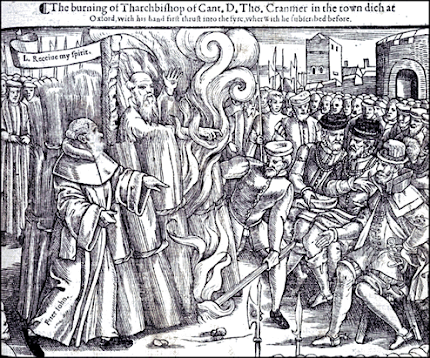
The burning of Tharchbishop of Cant. D. Tho. Cranmer in the town dich at Oxford, with his hand first thrust into the fyre, wherwith he subscribed before. [Click on the picture to see Cranmer's last words.]

Daily Bible Verse

Sunday, April 24, 2011

Nicole_Interview_MLSpring08.pdf (application/pdf Object)

Roger Nicole_Interview_MLSpring08.pdf (application/pdf Object)

Statement on Scripture by Concerned Erskine Faculty Members - Reformation21 Blog

Statement on Scripture by Concerned Erskine Faculty Members - Reformation21 Blog

Good Friday Statement on Scripture by Concerned Erskine Faculty Members

The following is a lead for a story posted at The Aquila Report concerning the intrusion of Barthian theology at Erskine Seminary in South Carolina. I might add that this acceptance of Barthianism is present at several Southern Baptist seminaries including Southern Baptist Theological Seminary, Louisville, Kentucky. I know this because of several debates I had a couple of years back with students from that school who were supporters of Barth's theology, which is essentially a form of liberal Arminianism or Socinianism blended with Evangelical theology. As you know this can and does lead to outright liberalism. Here's the lead in:


We represent a wide range of theological specialties and different denominational affiliations, but we are united in our affirmation of the church's historic doctrine of Scripture.


While some have thought that what has been termed the "battle for the Bible" was successfully concluded in evangelical circles almost three decades back, there can be little doubt at this point that the doctrine of Scripture is now a front-burner issue among American Evangelicals.

In particular, there is increasing interest in the formulations of Karl Barth, whose dialectical theology is thought by some to provide a more "dynamic" and satisfying view of the Bible and its authority, and whose polemic against "inerrancy in the original autographs" is increasingly influential in some quarters.

The recent reactivation of the International Council on Biblical Inerrancy is but one indication of the concerns that many have regarding such developments.

The statement below addresses the problem of Barthian views of Scripture in a particular institutional context. It has been signed by five esteemed colleagues and myself. I am honored to join with these faithful men and to post the text of the statement on this blog. An exploration of issues related to the broader background for this statement can be found on this site.


GOOD FRIDAY STATEMENT BY CONCERNED FACULTY MEMBERS
OF ERSKINE THEOLOGICAL SEMINARY AND ERSKINE COLLEGE

The ARP Church has historically held to a high view of Scripture as inerrant in the original autographs (see Historical Addendum below). It has consistently rejected Barthian and Neo-Orthodox refusals to speak of the inerrancy of Scripture and to affirm unequivocally that Scripture is, rather than becomes, the Word of God. Furthermore, the clear lesson of history is that Barthian fuzziness on the inspiration and authority of Scripture has had a disastrous impact on the mission and witness of the Church in Europe, Great Britain, North America, and elsewhere.

Despite these clear affirmations by the ARP Church, of which Erskine Theological Seminary and Erskine College are agencies, after decades of theological conflict between the Church and the Seminary over the inspiration and authority of the Bible, Barthianism continues to be tolerated at Erskine Seminary.

In recent years, one faculty member has publicly and privately expressed his strong opposition to the stated position of the General Synod of the ARP Church regarding Scripture. We are profoundly disappointed that some in the Erskine administration and board find it acceptable for those who hold Barthian views of Holy Scripture to teach their viewpoint at Erskine.

Some may say that debates over the inerrancy of Scripture are nothing more than semantics, arguments among theologians who are more interested in precise definitions of words than they are the peace of the church. We regret that characterization of the issue. Pious-sounding bromides regarding Scripture are no substitute for a clear articulation of the church's historic doctrine of Scripture, especially when such bromides conceal positions that fatally undercut the church's confidence in our God-breathed book, the Bible. The inerrancy of Scripture is not a second or third order issue, but one of critical importance for the life and well-being of the church. As much as we dislike controversy, we are compelled to say that this is not a matter for equivocation or compromise. Rather, we must be clear in our articulation of the doctrine and resolute in our stance.


To read the rest of the story click here: Good Friday Statement on Scripture by Concerned Erskine Faculty Members


Saturday, April 23, 2011

Anglicans Ablaze: The Thirty-Nine Articles Explored

Anglicans Ablaze: The Thirty-Nine Articles Explored

Arminian theology is evangelical theology (long) | Roger E Olson

Looks like Roger Olson is not happy with the advances Calvinist theology is making these days. Perhaps Mr. Olson should work at actually answering Calvinism rather than continually using straw man arguments that do not deal with the real issues at all?


Arminian theology is evangelical theology (long) | Roger E Olson

Tuesday, April 12, 2011

EV News :: Statement from Church Society regarding Bishop of Salisbury

The appointment of the Revd Nicholas Holtam as the next Bishop of Salisbury is a regrettable and retrograde step. In his public ministry Mr Holtam has actively promoted erroneous teaching on the issue of human sexuality, which puts him at odds with the declared mind of the House of Bishops, the General Synod of the Church of England and the 1998 Lambeth Conference, makes him unfit for ministry in the Church of England let alone as a Bishop. In particular, like many in the Church, he has been unwilling to accept the clear teaching of Scripture on the proper place of sexual union.
To read the rest of the article click here: EV News :: Statement from Church Society regarding Bishop of Salisbury


Sunday, April 10, 2011

Responses to Lane and Others on Recovering Reformed Worship « Heidelblog

R. Scott Clark laments the loss of the Psalter in Reformed worship. Odd that Puritanism ultimately leads to a rejection of God's prescription for worship and to liberalism. The same can be said for Anglicanism which has rejected the full reading of the Psalter and the Old and New Testament lessons of the 1559 and 1662 lectionary. God's Word exceeds human paraphrasing every time. Why? Because the tendency towards idolatry in the human heart exists by virtue of original sin and the remaining depravity and corruption of the human heart. Trusting the word of a pastor when he paraphrases is equally dangerous. The priesthood of believers calls every Christian to search the Scriptures to see if these things are so (John 5:39-40; Acts 17:11 ; 2 Timothy 3:15; Luke 24:47; 1 John 4:1).

The theology of hymns both ancient and modern are subject to be tested by Scripture. Why not purify worship by making the Scriptures the focus of our liturgy rather than man-made paraphrases? Surely R. Scott Clark has a valid point here. If Reformed worship is to be recovered there needs to be a return to Scripture as the basis of worship. For Anglicans there is no better liturgy and Scriptural worship than the 1662 Book of Common Prayer. Reformed Anglicans ought to consider purifying their liturgy by returning to the 1662 lectionary and psalter and rejecting modern hymnology. Although Reformed Anglicans follow the "normative principle of worship" that principle is not that far removed from the "regulative principle of worship". The most pure form of Anglican worship is the 1662 Book of Common Worship, although some would argue for the 1552 or the 1559 BCP.

To read Dr. Clark's analysis of Lane Keister's more liberal view of the regulative principle click on the link below:

Responses to Lane and Others on Recovering Reformed Worship « Heidelblog


Saturday, April 09, 2011

Conceding That Roman Catholics Are "Saved" Betrays an Underlying Pelagianism

Anyone who thinks Roman Catholics are born again Christians simply because "they believe in Jesus" is basically saying that good works rather than faith is the deciding factor in salvation.  It means that whoever is saying such a foolish thing does not believe that justification is by faith alone.

Where then is boasting? It is excluded. By what kind of law? By one of works? No, on the contrary, by a law of faith. 28 For we conclude that a man is justified by faith apart from the works of the law. (Romans 3:27-28 CSB)

Peace,

Charlie
--

Reasonable Christian Blog Glory be to the Father, and to the Son : and to the Holy Ghost; Answer. As it was in the beginning, is now, and ever shall be : world without end. Amen. 1662 Book of Common Prayer

Abortion’s Role in Budget Dispute Shows Conservatives’ Sway - NYTimes.com

Abortion’s Role in Budget Dispute Shows Conservatives’ Sway - NYTimes.com

Sunday, April 03, 2011

Evangelical Christianity: Selling the Gospel for Personal Profit


Evangelical Christianity: Selling the Gospel for Personal Profit

In the 16th century the Protestant Reformation was sparked by the controversial issue of the selling of indulgences by the Roman Catholic Church. The fund raising tactic was designed for the purpose of underwriting the cost of building Saint Peter's Basilica, which by today's monetary values would be a multimillion dollar project. Additionally, pilgrimages to Jerusalem, relics of the saints and the cross, were sources of income for the Roman Catholic Church and for Saxon princes who owned such relics. Most of the relics were of course spurious but that did not deter the big business aspect of the selling of such relics for a sizable profit. The Shroud of Turin is most likely another of these pricey spurious relics meant to generate monetary income for its owner, the Roman Catholic Church.

During the 1980's when the American economy boomed the Evangelical churches in general benefited from the generosity of a prospering laity and a growth in new membership. In particular the Pentecostal/Charismatic churches were beneficiaries of this economic boom and time of prosperity. The church growth movement was born out of the application of Charles Finney's pelagian theology of psychological manipulation and pragmatics above the Reformation principle of doctrinal purity and faithfulness to Scripture. In fact, the church growth movement was initiated by Pentecostal/Charismatic leaders Donald McGraven and Peter Wagoner. Rick Warren, a Southern Baptist pastor, applied these same techniques to become wealthy and personally prosperous. His book, The Purpose Driven Life, is simply a sociological reapplication of Finney's theology of pragmatism and the church growth theology of McGraven and Wagoner. (See Purpose Driven Church).

Basically, Evangelical Christianity, including the majority of “reformed” churches, has become less concerned with catechesis, confessions of faith, or Scriptural teaching. The new emphasis is on pragmatic results and gaining new members so that the church--especially the pastors on staff--can prosper. In short, bigger churches means bigger salaries for church staff and greater personal wealth for the pastors of those churches. The same can be said for para church organizations such as The White Horse Inn. The irony here is that The White Horse Inn began as a prophetic critique of the church growth movement and the wider Evangelical emphasis on pragmatism and a practical pelagianism. Now even Mike Horton and The White Horse Inn is marketing the message of Modern Reformation with e-mail and advertising. I was especially shocked to see that Horton will be sponsoring a Modern Reformation Cruise where participants will come up with their own 95 new theses for a modern reformation. It seems that the critics have become what they have criticized. The temptation for personal profit is too much for even Mike Horton.

Equally disappointing is the mass marketing of Christian education at Christian colleges and seminaries. Christian institutions have taken advantage of government subsidized student loans so that these colleges and seminaries could increase enrollment and thereby profit the staff and teaching professors of those institutions with extravagant salaries on par with those of the pastors and staff of mega churches. In fact, the banks and Sallie Mae have no fear of losing their loans since the federal government guarantees the loans. But these so-called helps to the poor to better themselves through higher education are actually taking advantage of the poor. Those who are unable to find good jobs after they receive their degrees are unable to file bankruptcy in order to clear the unpayable debt. In the end Christian institutions, the banks, and the Federal government all participate together in a huge loan sharking scheme which benefits few of the recipients of student loans with better employment and opportunity.

Higher education is now big business. Marketing information is bought and sold through websites which claim to offer jobs and employment but whose real purpose is to recruit students for state and independent universities and colleges. Why? Because the staff and professors of these institutions have federally guaranteed student loans as a solid foundation for their extravagant salaries. Ironically, Evangelical colleges and seminaries have sold out to monetary gain at the expense of their students. There is little concern for the fact that Evangelical colleges and seminaries produce a huge oversupply of trained pastors for a relatively small opportunity base for employment in local churches. The trend toward mega churches and a de-emphasis on a multiplicity of smaller mid-sized congregations with highly trained clergy is in effect leaving many graduates disillusioned with Evangelical Christianity.

Many of these highly educated Evangelicals have been forced back into blue collar jobs which actually pay more. Most are unable to find even bi-vocational positions at smaller churches due to this same over supply of educated clergy. In Pentecostal/Charismatic churches this is even more problematic since most of the more successful mega church pastors have little to no theological education, a fact that perpetuates the dumbing down of the theology of Scripture and the Gospel.

The fact is most Evangelical churches have little to no concern for outreach to the lower classes and instead follow the church growth paradigm of reaching out to the “target audience”. Ironically, this “target audience” is almost always a more affluent middle to upper middle class, which of course produces more financial income for the church and for missions and outreach. Unfortunately, mission and outreach almost always means more middle class congregations which in turn produce more income for the pastors and staff so they can live a middle class or upper middle class lifestyle and pay off their own educational loans.

The system is inherently built on covetousness and greed. The epistle of James is a scathing critique of modern Evangelicalism. However, you will not see even many Reformed pastors properly exegete James 2 on this issue. Usually the emphasis is sidelined into the faith and works controversy of the Protestant Reformation while ignoring the plain meaning of the text which is clearly the issue of favoring the rich over the poor and taking advantage of the poor for personal profit:

My brothers, show no partiality as you hold the faith in our Lord Jesus Christ, the Lord of glory. 2 For if a man wearing a gold ring and fine clothing comes into your assembly, and a poor man in shabby clothing also comes in, 3 and if you pay attention to the one who wears the fine clothing and say, "You sit here in a good place," while you say to the poor man, "You stand over there," or, "Sit down at my feet," 4 have you not then made distinctions among yourselves and become judges with evil thoughts? 5 Listen, my beloved brothers, has not God chosen those who are poor in the world to be rich in faith and heirs of the kingdom, which he has promised to those who love him? 6 But you have dishonored the poor man. Are not the rich the ones who oppress you, and the ones who drag you into court? 7 Are they not the ones who blaspheme the honorable name by which you were called? 8 If you really fulfill the royal law according to the Scripture, "You shall love your neighbor as yourself," you are doing well. 9 But if you show partiality, you are committing sin and are convicted by the law as transgressors. 10 For whoever keeps the whole law but fails in one point has become accountable for all of it. (James 2:1-10 ESV)

Unfortunately it does not appear that the new Calvinists are any different from Evangelicalism at large. Covetousness and greed seem to have prevailed over the emphasis on preaching the Gospel to all without showing favoritism. I was recently excommunicated from a local Presbyterian Church in America for daring to criticize the pastor's “Evangelical” ecumenicalism, which was in effect simply a form of theological liberalism embracing Roman Catholicism and any other generic Christian church which adhered to the three ecumenical creeds. The reason for this ecumenicalism is obviously to appeal to a wider audience in hopes of making the church grow numerically. Ironically, this emphasis reduces the appeal of the church since it makes it simply another broad evangelical church rather than a uniquely Reformed church which is faithful to Scripture, the Protestant Reformation, and the Reformed Standards.

Evangelical and Reformed churches these days are more concerned for the personal profit of their leaders than for a genuine preaching of the Gospel promiscuously to every social class, gender, culture, nation and tribe. The mission field is wide open here in the United States. We have more Mexican and Hispanic immigrants than ever before but few Evangelical churches are reaching out to these lower class immigrants yet these same churches raise significant funds to send a handful of missionaries to third world countries.

Moreover, most Evangelical churches are more concerned with tithing than with doctrinal purity or the Gospel of free grace. This emphasis on meritorious rewards for faithfulness and good works is in effect a new pelagianism. Unfortunately it appears that even Mike Horton and The White Horse Inn has been seduced by the opportunity for personal profit. Even Reformed seminaries are more concerned for raising their enrollments than with doctrinal purity or real mission outreach to all people without favoritism.

May the peace of God be with you,

Charlie
--
Reasonable Christian Blog Glory be to the Father, and to the Son : and to the Holy Ghost; Answer. As it was in the beginning, is now, and ever shall be : world without end. Amen. 1662 Book of Common Prayer

2012 White Horse Inn Caribbean Cruise

2012 White Horse Inn Caribbean Cruise

Support Reasonable Christian Ministries with your generous donation.