>

Martyred for the Gospel

Martyred for the Gospel
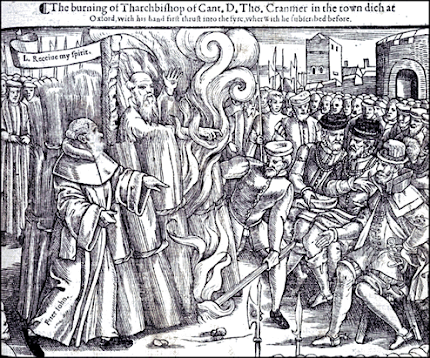
The burning of Tharchbishop of Cant. D. Tho. Cranmer in the town dich at Oxford, with his hand first thrust into the fyre, wherwith he subscribed before. [Click on the picture to see Cranmer's last words.]

Daily Bible Verse

Wednesday, November 30, 2011

Gordon H. Clark: Quote of the Day

Barth and Brunner . . . admit that there are doctrines in the Bible, or at least the Bible contains material out of which doctrines can be developed. Then too these doctrines can in some loose sense be called the Word of God. But in a stricter sense they are not really the Word: In THE DIVINE-HUMAN ENCOUNTER Brunner declares, 'Neither the spoken words of the Apostles nor their conceptual content are the Word itself, but only its frame. . . . God and conceptuality are mutually exclusive.' ....And in case the reader cannot see the damage this statement does to doctrine, Brunner, again in THE DIVINE-HUMAN ENCOUNTER, explicitly maintains that "God can . . . speak his Word to a man even through false doctrine." Gordon H. Clark, CHRISTIAN PHILOSOPHY, pages 343-44.

Unfortunately the vast majority of "Evangelicals agree with Barth and Brunner rather than with Clark.  They say that doctrine is not important and that salvation is a personal encounter with Jesus Christ in "mystical union".  That's even the argument of most of the faculty members at Westminster Theological Seminary, Pennsylvania.  Unfortunately, Neo-Orthodoxy seems to have taken over even many in the broader spectrum of the Reformed movement.

Peace,

Charlie
--

Reasonable Christian Blog Glory be to the Father, and to the Son : and to the Holy Ghost; Answer. As it was in the beginning, is now, and ever shall be : world without end. Amen. 1662 Book of Common Prayer

Tuesday, November 29, 2011

Gordon H. Clark: Quote of the Day: The Bible Is the Word of God

What annoys Euclid and Spinoza is that this theology can operate on a single axiom.  The single axiom is:  The Bible is the Word of God.  But though single, it is fruitful because there is embedded in it the law of contradiction, plus the nature of God, as argued above, plus the thousands of propositions thus declared true.

On this latter point the form of deduction can be maintained.  From the one axiom it follows syllogistically that such and such a sentence in Scripture is true because it is the Word of God.

In the next place,  as would not be the case if each Biblical proposition were singly and strictly regarded itself as an axiom, the truths of Scripture can be arranged in patterns of logical subordination.  The doctrines of  total depravity, unconditional election, limited atonement, irresistible grace, and the perseverance of the saints are far from being an illogical disjointed aggregation.  The opponents of this theology have never charged it with being illogical; the standard objection is that it is too logical.  Let it pass:  We have already paid our respects to irrationality.

Gordon H. Clark, Christian Philosophy, (Unicoi: Trinity Foundation, 2004), page 320.
--

Reasonable Christian Blog Glory be to the Father, and to the Son : and to the Holy Ghost; Answer. As it was in the beginning, is now, and ever shall be : world without end. Amen. 1662 Book of Common Prayer

Monday, November 28, 2011

Clark's Answer to Van Til: On Intellect, Will, and Emotions: Part 8


Clark's Answer to Van Til: On Intellect, Will, and Emotions: Part 8

[The following is the continuation of The Answer given by Dr. Gordon H. Clark and his supporters to The Complaint by Dr. Cornelius Van Til and his supporters. The Answer will be given in installments as time permits. To read the pdf image file click on the links above. The following is Clark's response to Van Til in regards to his views on human psychology. See Part One, Part Two, Part Three, Part Four, Part Five, Part Six, and Part Seven. See also, The Answer, in PDF].

On Intellect, Will, and Emotions

The second theological section of the Complaint treats of two subjects: first, the problem of emotions in God; and, second, the problem of the relation between man's intellectual activity and his emotional and volitional activities. The first of these problems is discussed on pages 25, 26, 29, 30, 31, and 36 of the Complaint. The Answer will consider this problem before commencing discussion of the remainder of pages 25-41, in which the complainants state their views of the second problem.

The dispute takes its rise from the statement in the Confession that “God is without body, parts, or passions.” The continental creeds generally do not contain this phrase. It is found in the Irish Articles of 1615, and seems to have been adopted by the Westminster Assembly from the Thirty Nine Articles of 1563. The first of these Articles says, “Deus aeternus, incorporeus, impartibilis, impassibilis,” i.e., “God, everlasting, without body, parts, or passions.” As the Latin text was definitive, and as the meaning of impassibilis in the previous history of philosophy and theology is fairly clear, the basic theological problem is whether or not an emotional God is impassibilis[See:  Thirty-nine Articles of Religion:  Article I.  --Charlie].


The concept of passion or passibility as a technical term, here denied of God, was originated by Aristotle. His basic definition in Metaphysics D 21 is, “'Affection' means (1) a quality in respect of which a thing can be altered . . . (2) the already actualized alterations; (3) especially, injurious alterations and movements, and, above all, painful injuries; (4) experiences pleasant or painful, when on a large scale, are called 'affections.'” In De Anima III, 3, 429 a 7, he uses the same word for emotions. Cf. Notes, R. D. Hicks, in Aristotle, De Anima, 403 a 16. St. Augustine lists (Confessions X, 22) lust, happiness, fear, and sadness as the four perturbations or passions of the soul. Descartes wrote a Treatise on the Passions of the Soul. He lists six basic passions: admiration, love, hate, desire, joy and sadness; and connects them closely with bodily disturbances. Very obviously emotions are included in the sphere of passions. In the history of theology, philosophy, and language, therefore, it is not unusual, rather it is usual, to find emotions classed as one species of the genus passion. Passion is the wider term and emotion is included under it. Therefore, the complainants ought not to object to this linguistic usage. They may themselves wish to define the terms so as to exclude emotion from passion. Let them do so: They have no right to object to the more usual usage. Emotion, therefore, as Dr. Clark defines it, is included in the concept of passion which the Confession denies to God.

The Complaint (P. 8, 1; O. 29) suggests that Dr. Clark's definition of emotion is an a priori oddity. If this were true, which it is not, still there would be no ground for complaint. The confusion in the argument of the Complaint becomes obvious by an analysis of the definition of emotion which the complainants wish to substitute for Dr. Clark's definition. The complainants want to define emotion as (P. 8, 1; O. 30), “something which arouses the will and thus determines action.” From this definition follows one of two consequences. First, if the term retains any of its colloquial connotations, then anger and hate may determine actions, for colloquially they are emotions; but the cool, unemotional calculation of a business venture could never arose the will, for such an activity is intellectual. Or, second, if the complainants admit that considerations of truth sometimes influence conduct, then they are guilty of the a priori oddity of calling intellectual activity an emotion. The desire to substitute another definition of emotion for Dr. Clark's definition is not a proper ground for complaint.

The final reference to this subject is (P. 9, 2-3; O. 36), “A recollection of Dr. Clark's forthright denial of anything that might be called 'emotion' in God, cited above, will thus impress us that he not only does violence to the Scriptural and Reformed doctrine . . .” Dr. Clark never made any “forthright denial of anything that might be called 'emotion' in God.” Love or wrath “might be called an emotion.” Dr. Clark did not deny love and wrath to God. He holds that while some people might call God's love and wrath emotions, it is better to classify them as volitions. In this Dr. Clark is accord with a large section of the history of theology, and even of literary usage. As an example of literature (not of Reformed theology), it is possible to cite Pascal on page 24 of Everyman's translation: “It is natural for the mind to believe, and for the will to love.” As an example of Calvinistic thought these phrases of Augustus Toplady are appropriate (Complete Works, 1869, pp. 106, 107, and 687): God “is not, for instance, irascible and appeasable; liable to the emotions of joy and sorrow; or in any respect passive.” “When love is predicated of God, we do not mean that he is possessed of it as a passion or affection. . . . Love, therefore, when attributed to him signifies . . . his everlasting will, purpose, and determination to deliver, bless and saved his people.”

R. L. Dabney, Syllabus and Notes, 1927, page 153, supports Dr. Clark's views in a particularly clear manner:

Our Confession says, that God hath neither parts nor passions. That He has something analogous to what are called in man active principles, is manifest, for He will and acts; therefore He must feel. But these active principles must not be conceived of as emotions, in the sense of ebbing and flowing accesses of feeling. In other words, they lack that agitation and rush, that change from cold to hot, and hot to cold, which constitute the characteristics of passion in us. They are, in God, an ineffable, fixed, peaceful, unchangeable calm, although the springs of volition. That such principles may be, although incomprehensible to us, we may learn from this fact: That in the wisest and most sanctified creatures, the active principles have least of passion and agitation, and yet they are by no means become inefficacious as springs of action—e.g., moral indignation in the holy and wise parent or ruler. That the above conception of the calm immutability of God's active principles is necessary, appears from the following: The agitations of literal passions are incompatible with His blessedness. The objects of those feelings are as fully present to the Divine Mind at one time as another; so that there is nothing to cause ebb or flow. And that ebb would constitute a change in Him. When, therefore, the Scriptures speak of God as becoming wroth, as repenting, as indulging His fury against His adversaries, in connection with some particular event occurring in time, we must understand them anthropologically. What is meant is, that the outward manifestations of His active principles were as though these feelings then arose.”

The evidence in the Complaint is that the complainants know and admit that Dr. Clark is in agreement with the Confession. On page 51 the complainants admit: “In this connection reference must again be made to Dr. Clark's view that God has no emotions. If his definition of emotion be granted, God certainly has none.” In other words, the complainants know and admit that when Dr. Clark says that God has no emotions, his thought is correct. And yet knowing this, they spend some six pages trying to represent him as seriously out of accord with the Confession.

(pages 26-28a of The Answer).


--
Reasonable Christian Blog Glory be to the Father, and to the Son : and to the Holy Ghost; Answer. As it was in the beginning, is now, and ever shall be : world without end. Amen. 1662 Book of Common Prayer

Wesleyan Arminian: Jerry Walls on Problems With Calvinism

Jerry Walls unwittingly causes many Arminians to jump ship to the true Gospel expressed by classical Calvinism. I was one of those students who thought through the arguments for libertarian free will and its implications and ultimately decided that such a view is actually Pelagianism rehashed. Jerry Walls is an apologetics and Christian philosophy professor at Asbury Theological Seminary, which is part of the Evangelical Wesleyan holiness movement. I chose that seminary because in 1992 I was still an Arminian Pentecostal on the Assemblies of God side of things. Odd but often hearing the opposing arguments often pushes one in a direction unintended by the arguments themselves.

See how many theological errors and logical inconsistencies you can spot in Walls' arguments by clicking on this link and viewing the video: Wesleyan Arminian: Jerry Walls on Problems With Calvinism


Triablogue: Van Til's Serious Trinitarian Theology

The following is an article written by James Anderson defending Cornelius Van Til's assertion that God is both one Person and three Persons from the charge of modalism. (The author on the article is not identified but I got the link from Anderson's response to Gary Crampton here: Response to Gary Crampton). You can judge for yourself whether or not Anderson is successful in that endeavor. The introduction reads:

Now, I entirely agreed with Steve that the heresy of modalism is quite at odds with Van Til’s trademark emphasis on the equal ultimacy of the One and the Many in the ontological Trinity. But I also suggested that Van Til’s remarks about the uni-personality of God, rather than contradicting this point, were in fact motivated by it.


To read the response click here: Triablogue: Van Til's Serious Trinitarian Theology

Addendum:  I posted the following comment over at Triablogue regarding Clark's theology of the Trinity and the Incarnation.  Since Triablogue is moderated I do not know if my comment will be posted or not.  Here's my comment:

The argument that Clark's view is social trinitarianism may be somewhat accurate.  However, when Clark's view is attacked as "eschewing of nominalism" this criticism misses the point.  What point is that?  Anyone reading Clark's Christian Philosophy, (Unicoi: Trinity Foundation, 2004), can see that Clark rejects ALL secular philosophies as absolute failures and that therefore the ONLY approach that is legitimate is divine revelation.  In other words, reason is only relevant as interpreted via the presupposed divine revelation of Holy Scripture.  Since Holy Scripture reveals God not as "one Person" but as a Tri-Personal being, it follows that Clark's view is not open to Tritheism.  Scripture is not open to that charge and thus only by exalting reason above revelation could Clark's view be charged with tritheism.  The same argument could be made for Clark's view of the incarnation, by the way.  Simply because Christ has two wills and that the incarnation entails two persons perfectly united in the incarnation does not make Clark's view Nestorian nor does it make Clark irrational.  Scripture is the final authority, not rationalism.

Van Til's appeal to analogy is simply a modified form of Barthianism where the Word of God is rendered ineffable and inaccessible except by direct existential encounter.  Such a view is essentially man centered and from below.  Clark's demolition of Kierkegaard and Kant essentially deconstructs both Barthianism and, by implication, Van Til's distinction between univocal and analogical interpretation of Scripture.  Either Scripture is God's Word OR is it not.

Charlie J. Ray


Witnessing to a Neo-Kuyperian

The following discussion took place in FaceBook as well.  The person is question identifies himself by the moniker, A Wretch Saved.  In this instance I am defending the doctrines of grace against someone who wishes to mix semi-Arminian doctrines with the doctrines of grace:

Actually labels serve as a useful way of identifying the doctrines of a person.  I am not a hyper-Calvinist since I do not reject evangelism, missions, or preaching the Gospel to the lost as a necessary means or instrument for the conversion of the elect.  In fact, I would go so far as to say that none of the elect will be converted through any other means than the preaching of the Gospel and believing that Gospel.  (Romans 10:13-14).

Basically modern day neo-Kuyperians have introduced contradictory doctrines that have never been a part of classical Calvinism.  The doctrine of "common grace" is not a Calvinist doctrine but an Arminian doctrine.  The idea that God wants to save the reprobate but does not want to save the reprobate would be irrational.  The Arminians believe God favors the reprobate and wants to save the reprobate but is unable to do so.  How many steps away from that doctrine are you?

If Jesus died on the cross for the reprobate in any sense whatever, then what you are believing is a form of Amyraldianism or Arminianism, not classical Reformed theology or biblical theology.  Christ died only for the elect and grace is always particular and irresistible, not general and ineffectual.  [Addendum:  is the atonement defectible?  If so, it is powerless to save anyone in particular!]

Basically, most neo-Calvinists think that justification by faith alone is a non-essential doctrine better called an adiaphora.  For them the Protestant Reformation is over, Arminians, Roman Catholics, and the Eastern Orthodox are all truly converted Christians despite the fact that they deny the five solas of the Reformation and the very Gospel itself.

No, hyper-Calvinists would actually agree with your liberalism since hyper-Calvinists do not believe the elect actually need to be converted through believing the truth or the true Gospel.

Sincerely yours,

Charlie
--

Reasonable Christian Blog Glory be to the Father, and to the Son : and to the Holy Ghost; Answer. As it was in the beginning, is now, and ever shall be : world without end. Amen. 1662 Book of Common Prayer

Witnessing to an Arminian

The following discussion took place in FaceBook messaging.  I will only use the first name to preserve the privacy of the lady in question:

Sue, did your Jesus die on the cross for those who were already in hell?  Did he die on the cross for all of those who would go to hell after he hung there for the sins of the whole world?  If so, then the Jesus you believe in is not the same Jesus of the Bible.  The Jesus who is revealed in the Bible died to save His people from their sins.  (Matthew 1:21).  He died only for His sheep (John 10:11, 15) and not one of them will be lost:

 but you do not believe because you are not among my sheep. 27 My sheep hear my voice, and I know them, and they follow me. 28 I give them eternal life, and they will never perish, and no one will snatch them out of my hand. 29 My Father, who has given them to me, is greater than all, and no one is able to snatch them out of the Father's hand. (John 10:26-29 ESV)

Anyone can claim to be a Christian.  But if that person does not believe in the right Jesus--not a Jesus of their own making--they are lost.  The liberals believe in a Jesus who is not god but only a good teacher and a moral man.  Muslims say Jesus is a prophet only.  The Mormons say that Jesus is the brother of the devil and only one god among many gods.   Who do you say He is?

Please note that John 10:26 says, "but you do not believe because you are not among my sheep."  The Pharisees were very religious people.  They prayed, paid tithes, made disciples and converts, and did many good works.  But Jesus called them a brood of vipers who made their converts children of hell.

Just as true believers are known to have true faith by their good works following after faith, so true believers are also known by their right doctrine/belief.  There is only one Gospel (Galatians 1:6-9), one Jesus (2 Corinthians 11:3-4), and one faith (Ephesians 4:5-6; Jude 1:3-4).  Christians are to "earnestly contend for the faith once delivered to the saints" (Jude 1:3).  That faith is a certain and specific set of essential doctrines of the Christian religion.  It would mean that those who do not manifest a true profession of faith have not yet been truly converted. 

What are those essentials of the Christian faith?  There are many.  However, among those essentials is the fact that Christ died for the elect alone and that not one of them will be lost (Matthew 24:24).  The Trinity is non-negotiable as well (2 Corinthians 13:14; Matthew 28:18-20).  The full deity of Christ as both God and man in one Person is non-negotiable (Colossians 1:19; Colossians 2:9).

At the end of time God will gather His elect from all over the world:

And he will send out his angels with a loud trumpet call, and they will gather his elect from the four winds, from one end of heaven to the other. (Matthew 24:31 ESV)

These persons were chosen before the foundation of the world and before they did either good or evil:

even as he chose us in him before the foundation of the world, that we should be holy and blameless before him. In love (Ephesians 1:4 ESV)

though they were not yet born and had done nothing either good or bad--in order that God's purpose of election might continue, not because of works but because of him who calls-- 12 she was told, "The older will serve the younger." 13 As it is written, "Jacob I loved, but Esau I hated." (Romans 9:11-13 ESV)

Since Arminianism contradicts the doctrines of grace, they have more in common with the Roman Catholics than with the biblical Christian faith.  Arminians, like Catholics, believe that the elect can be lost, that Christ died for those He would not actually save, and that justification and sanctification are the same thing.  In the end it is the blending of sanctification and justification infused into the heart that earns or merits salvation for the Arminian and the Catholic.  Arminians give lip service to justification by faith alone but when we look deeper it is obvious that they reject the doctrine of imputed righteousness (Romans 4:4-8).

While I might agree that you could be one of God's elect, it is not clear that you are truly converted at this point, Sue.  I say that because you reject several of the doctrines that are essential to true faith.  Believing in one God is not enough.  Believing in a Jesus who fits your own ideas of what Jesus or God should be like is not enough.  You must be sanctified by the truth:

Sanctify them in the truth; your word is truth. 18 As you sent me into the world, so I have sent them into the world. 19 And for their sake I consecrate myself, that they also may be sanctified in truth. 20 "I do not ask for these only, but also for those who will believe in me through their word, (John 17:17-20 ESV)

May God grant you the grace to believe the simple Gospel message:  Salvation is ALL of God.

all the inhabitants of the earth are accounted as nothing, and he does according to his will among the host of heaven and among the inhabitants of the earth; and none can stay his hand or say to him, "What have you done?" (Daniel 4:35 ESV)


--
Reasonable Christian Blog Glory be to the Father, and to the Son : and to the Holy Ghost; Answer. As it was in the beginning, is now, and ever shall be : world without end. Amen. 1662 Book of Common Prayer

Sunday, November 27, 2011

Why Arminians Are Not Saved

"But," it may be argued, "if we are saved because we are orthodox, doesn't that make salvation a result of works?" This argument is really a subtle twisting of what has been said here. No one is suggesting that we are saved because of our orthodox doctrine. On the contrary, what we are suggesting is that orthodox doctrine is a necessary result of being saved. To claim otherwise would be to deny the sovereignty of the Holy Spirit, even over the thoughts of men. Salvation is not dependent on orthodoxy any more than it is dependent on good works, but both will certainly come to be manifested in every child of God (Romans 8:9).


The following article is from a controversial blog called Outside the Camp.  While I do not endorse everything on that blog the article below articulates something close to my own position on Arminianism and by implication, Roman Catholicism, Anglo-Catholicism, and Eastern Orthodoxy.  Anyone who is consistent with what Arminianism teaches is in effect denying the sovereignty of God in salvation and denying the Gospel.  Semi-pelagianism by definition places the ultimate sovereignty for salvation in the hands of capricious sinner who are in bondage to their own totally corrupted nature.  --Charlie


Three Reasons Why Arminians Are Not Saved
 
by Christopher Adams

 [For a printer-friendly PDF version of this article, click HERE]


One of the most important issues faced by those who profess to believe the doctrines of grace (commonly called "Calvinism") is how to relate to professing Christians who reject the doctrines of grace. Should they be approached as brothers in Christ? Should we take their "conversion experience" at face value? In answering these questions, the writer would like to submit the following Three Reasons Why Arminians Are Not Saved.

Reason Number One: Arminians are not saved because they worship an idol. By an idol, I mean "a god who cannot save." But wait a minute, you say, don't they worship Jesus? No, as a matter of fact, they don't. They may say they worship Jesus, but the jesus they worship simply cannot save. The Pharisees said they believed in God and even convinced themselves they believed in God, but their faith was really in a god who could not save them; their faith was not in the one true God. This is obvious from the fact that when the one true God come to live among them, they blasphemed him and had him executed. The Pharisees had made an idol out of their idea of God; hence they were just as lost as those who worshiped a carved idol named Moloch. Forming an image in our brains and calling it "Jesus" is no more evidence of salvation than carving a wooden idol and calling it "God." Either way the individual is in gross idolatry. And the end of those who worship idols is to become like their idols (Psalm 115:8). Arminians have a god who is unable to turn the will of man as he pleases.  [Compare that to Proverbs 21:1 --Charlie]. They may firmly believe that he is able to move mountains, cause thunder and lightning, and ordain the stars in their courses, but he is powerless before the Almighty Human Will, and the blood of the only begotten son is shed for those who are in hell in a powerless atonement. This is not the God of the Bible (Psalm 115:3, Proverbs 1:21). This "god" is neither a just God nor a Savior (Isaiah 45:21). This "god" simply cannot save (Isaiah 45:20). This "god" is a broken staff, piercing the hand of the one leaning on it. This "god" is a lie from hell and is destined to return there. And those who follow him to the end are destined to return there with him.

What was God's complaint to apostate Israel? "... thou thoughtest that I was altogether [such an one] as thyself ..." (Psalm 50:21). Arminians have fashioned a god in their own image. They are no more saved than the Jews who had done exactly the same thing.

Reason Number Two: Arminians are not saved because they do not believe the truth. This is related to the previous reason but has more to do with the evidence of a person's salvation. 

Any Calvinist who defends the salvation of Arminians must explain 2 Thessalonians 2:12, which says, "That they all might be damned who believe not the truth ..." Some use the excuse that Arminians believe the important, essential doctrines of Scripture. But do they?

Every member of the Godhead is associated with the truth (Psalm 31:5; John 14:6,17). Those who are saved love the truth (Titus 1:1; John 3:21), because it was the instrument of their second birth (James 1:18; Ephesians 1:13). More to the point, they love the truth because God has predestined them to love it (2 Thessalonians 2:13); therefore, the elect sheep know the voice of their Shepherd (John 10:14) and they inevitably follow him. In fact, those who do not hear the voice of the Shepherd are simply not sheep (John 10:26)! Why does God predestine his sheep to love his truth and follow him alone? The reason is given in Isaiah 48, verses 9-11:

"For my name's sake will I defer mine anger, and for my praise will I refrain for thee, that I cut thee not off. ... For mine own sake, [even] for mine own sake will I do [it]: for how should [my name] be polluted? and I will not give my glory unto another."  (Isaiah 48:9-11).
 
God's glory is the only reason he does anything. It is the reason Jesus came to the earth (John 12:27-28), it is the reason he saved his church (Ephesians 1:12), and it is the reason he will some day return to take his church home (2 Thessalonians 1:10). It is the very reason for the existence of creation (Romans 9:23). Now if God wills to be glorified by his church, what possible reason could he have for allowing them to attribute the source of their faith to their own free wills? This would strip God of his rightful, unshared glory in salvation. He does not leave his people in ignorance any more than he leaves them to wallow in their sin (1 John 3:9). Therefore, the glory of God absolutely demands that we judge Arminians lost.

The teaching that God could not, or would not, irresistibly lead his people to believe and confess the true Gospel is a teaching that presents God as being as weak and powerless as the Arminian god. In fact, that line of thinking is really the result of a very subtle form of works-based sanctification. It tacitly assumes that God does the initial work of changing the heart from stone to flesh but then allows that changed heart to choose its own way. If this were true, it would mean that such "innocent" aids to religion as idols and images would be helpful, even necessary. On the contrary, God does not allow a regenerated person to freely develop his theology any more than he allows a regenerated person to freely persist in sin. Instead, he places his Holy Spirit within that person, and the Spirit sovereignly leads the person into all truth (John 16:13).

Moreover, there are three truths into which the Spirit specifically leads us: Sin, Righteousness, and Judgment (John 16:8-11). Let us examine each truth in more detail. 

First, why will he teach us about sin? The answer is given in verse 9: "... Because they believe not on me." This is obviously the doctrine of Total Depravity. Every regenerate sinner has been taught by God the Holy Spirit that he is a vile, helpless, wretched sinner, totally void of righteousness, and absolutely unable to come to saving faith on his own. Every regenerate sinner has been taught by God the Holy Spirit that unless God himself intervenes to save him, the sinner will be eternally lost (Psalm 130:3; John 6:45). The saved sinner may not use the words "Total Depravity," but he will always understand his innate inability to please God and will never believe that his own efforts or decisions were what brought him into favor with God. Arminians teach just the opposite when they proclaim that God saves a sinner based on the actions or decisions of the sinner (John 1:12; Romans 9:16) or when they proclaim that God will save a sinner based on foreknowledge of what the sinner will do. 

Second, why will he teach us about Righteousness? The answer is given in verse 10: "...because I am going to the Father, and you will no longer see Me." Here, Jesus is teaching that the Holy Spirit will teach every believer that Christ, by his bloody death on the Cross, produced a righteousness that appeases the Father's righteous anger against everyone whom Christ represented. The Holy Spirit teaches every regenerate sinner about the doctrine of Limited Atonement. [Particular atonement.  --Charlie].  The saved sinner may not use the words "Limited Atonement" or "Particular Redemption," but he will always understand that Jesus has effectually established peace between himself and God and will never believe that anyone for whom Christ died could ever come under the wrath of God again. Arminians teach exactly the opposite when they proclaim that Jesus poured out his precious blood, even for those who will suffer the Father's wrath eternally in Hell (Jeremiah 6:14; Galatians 1:8-9).

Third, why will he teach us about Judgment? The answer is given in verse 11: "... because the ruler of this world has been judged." Here, Jesus is teaching that the Holy Spirit will teach every believer that Jesus has undone the works of the Devil and forcibly released the Devil's captives (Luke 11:21-22; 1 John 3:8; 5:19). They can never return to the lies and snares of Satan (John 10:5). The Holy Spirit teaches every regenerate sinner about the doctrines of Irresistible Grace and Perseverance of the Saints. The saved sinner may not use the words "Irresistible Grace" or "Perseverance of the Saints," but he will always understand that his conversion and perseverance come from the Holy Spirit, and he will never believe that his conversion and perseverance come from his own strength. Arminians teach the very opposite when they proclaim that a child of God may become a child of the devil again (Matthew 13:11-17).

Again, a saved sinner may not necessarily use all the same words that I have used here, but he will never believe the opposite of these doctrines, nor will he ever oppose them when confronted with them (1 Cor 2:12).

Reason Number Three: Arminians are not saved because they hate the truth. This reason also has more to do with the evidence of a person's salvation.

Look again at 2 Thessalonians 2:12, especially the latter part of the verse. "That they all might be damned who believed not the truth, but had pleasure in unrighteousness." Arminians certainly have pleasure in unrighteousness. They believe that Jesus poured out his blood to redeem millions of people whom God sends to hell anyway. And Arminians certainly have pleasure in what is false. Arminianism is the fulfillment of the oldest lie in existence: You will become like God. Or, what the natural man really wants to hear: You will become more powerful than God. When Arminians proclaim a god who is powerless before the human will, they proclaim the same old lie that is so tickling to unregenerate ears. And this is exactly the point: the one who hates the truth is the natural, unregenerate man. By nature, men love darkness (John 3:19); by nature, men hate the light (John 3:20); only those who have had their nature changed come to the light (John 3:21). Since Arminians hate the light of truth and love the darkness and lies, we are forced to conclude that they are unregenerated. Natural man (the Arminian) hates the truth of God's Sovereignty (Psalm 15:3; Romans 9:20).

"But," it may be argued, "if we are saved because we are orthodox, doesn't that make salvation a result of works?" This argument is really a subtle twisting of what has been said here. No one is suggesting that we are saved because of our orthodox doctrine. On the contrary, what we are suggesting is that orthodox doctrine is a necessary result of being saved. To claim otherwise would be to deny the sovereignty of the Holy Spirit, even over the thoughts of men. Salvation is not dependent on orthodoxy any more than it is dependent on good works, but both will certainly come to be manifested in every child of God (Romans 8:9).

Again, the writer has often heard it asserted that "one does not have to be orthodox to be saved, because even the demons believe in God." But let us compare Scripture with Scripture. "But without faith it is impossible to please [him], for he that cometh to God must believe that he is and [that] he is a rewarder of them that diligently seek him" (Hebrews 11:6). Notice how this verse is constructed: He (who has faith) must believe -- and then there are two things to be believed. Notice also that what follows is a pair of facts: God's existence and his benevolence toward the elect. James 2:19 says that the demons believe in the existence of God, and this is one of the necessary facts according to Hebrews 11:6. But since they don't believe that he is a merciful God, they tremble at the thought of his divine wrath that must someday fall on them. Are the demons really orthodox? They believe some things about God but not the right things. They believe some of the truth about God but not the whole truth. And without the whole truth they are not really orthodox. So we see that orthodoxy is a necessary result of salvation after all.

Again, it is objected that no mere human being can fully understand God, because we are finite and he is infinite (Isaiah 55:9). This objection is easily met when we remember that the people of God are those who are indwelt by the Holy Spirit. In this way a finite human being is able to truly understand the infinite God, because the infinite Holy Spirit is teaching him. 

Lastly, it is often argued that Arminians must be saved because they perform such good works. Few Calvinists would seriously and openly insist that we are saved because of our works; yet when the salvation of Arminians is questioned, the typical response is to point to their good works. They are fervent in prayer, joyous in worship, and zealous for good works. And above all, they are determined soul-winners, always talking about God and busy making converts. But to assert that one is saved because of any of these actions is a flat denial of Salvation by Grace Alone. Justification is a gift; it can never be earned (Romans 4:24, Titus 3:5). But, by the same token, these good works can never be used as proof of one's salvation. The Pharisees were also fervent in prayer (Luke 18:11-12), joyous in worship (Matthew 6:5), and zealous for good works (Matthew 23:23,27,29; see also Romans 10:2-3). Above all, they were determined soul-winners, crossing land and sea to make one convert. And yet what was the result of their soul "winning"? "... you make them twice as much a son of hell as yourselves" (Matthew 23:15). Since the Pharisees were obviously unsaved, it must be that the flesh is very good at reproducing good works without ever being pleasing to God. However, works that are done in the flesh are still an abomination to God, no matter how they appear to men.

The context of 2 Thessalonians 2:12 is even more explicit about this point. "And will all deceivableness of unrighteousness in them that perish; because they received not the love of the truth, that they might be saved. And for this cause God shall send them a strong delusion, that they should believe a lie ..." Notice that those who are saved love the truth and the unsaved do not. Notice also that God causes them to believe a lie, with the intent of righteously sending them away from his presence forever. God hates them, as he hated Esau. Dare we say that those whom God hates are saved?

The very fact that there is any debate over this issue indicates that the majority of professing Calvinist churches are not true churches at all. There is often heard the plea for tolerance, based on the mistaken notion that doctrine is of little importance. On the contrary -- purity of the doctrine of the gospel (the doctrine of salvation, or soteriology) is an essential fruit of salvation. Being able to define "soteriology" isn't necessary; being able to state the five points of Calvinism isn't necessary; but loving the truth and giving all glory to the only living and true God is necessary. Arminians do exactly the opposite when they try to reserve some of that glory for themselves; it is not a 'sincere misunderstanding of gospel doctrine' but a determined rebellion against the only living and true God and a stench in his nostrils.

The fact that Arminians are unsaved also leads us to a few conclusions:

1. We must not fellowship with Arminians. They are members of the whore church, and if we do not come out from among them, we share in their sins (Revelation 18:4). Of course, this will mean that not only are some precious friendships lost, but families will be divided as well. But is this not the very effect the gospel is supposed to have? "Think not that I am come to send peace on earth. I came not to send peace, but a sword. For I am come to set a man at variance against his father, and the daughter against her mother, and the daughter in law against her mother in law. And a man's foes [shall be] they of his own household" (Matthew 10:34-36).

2. We must treat them as unsaved. It does no good to let an Arminian go on thinking he has the truth when he doesn't. We should witness to them the true gospel of grace. God is glorified when we speak the truth in love (Ephesians 4:15) but not when we suppress the truth for the sake of group harmony.

3. We must be willing to exercise church discipline on those who turn out to be Arminians or consider Arminians to be their brothers in Christ. Part of the reason the bulk of the professing church has apostatized is that it is generally unwilling to discipline members for doctrinal reasons. Of course, this calls for sound judgment on the part of elders, but allowing heresy to remain in a church for the sake of building up the membership list is inexcusable.

Calvinists need to learn that the power of God does not lie in relationships with Arminians and Arminian ministries. The power of God is in the Gospel and the Gospel alone. But the true power of the Gospel will not be manifested unless it is preached in all its fullness, both as a savor of life unto life and as a savor of death unto death. The Gospel condemns Arminians as enemies of God, enemies of the Cross, and enemies of the Gospel. Turn away from them, lest you share in their condemnation (2 John 11, Rev 18:4).

--
Reasonable Christian Blog Glory be to the Father, and to the Son : and to the Holy Ghost; Answer. As it was in the beginning, is now, and ever shall be : world without end. Amen. 1662 Book of Common Prayer

Anglo-Reformed Evangelist: George Whitefield: Quote of the Day


Saturday, November 26, 2011

Robin Jordan: Anglicans Ablaze: The Curse of Trust in Man: Fatal Weaknesses in the Anglican Mission


"In demanding miracles from us, they act dishonestly; for we have not coined some new gospel, but retain the very one the truth of which is confirmed by all the miracles which Christ and the apostles ever wrought. But they have a peculiarity which we have not--they can confirm their faith by constant miracles down to the present day! "   --John Calvin


Robin Jordan of the Anglicans Ablaze blog has written an accurate critique of the Anglican Mission in America and its bishop, Chuck Murphy. You will do well to follow these developments closely, particularly if you are part of the Reformed and Evangelical side of the Anglican Communion. According to Robin, there seems to be a connection between the charismatic theology of Murphy and the adoption of outright Roman Catholic ecclesiology. But since this is essentially the position of the charismatic and pentecostal movement to begin with I cannot say that I am surprised. The charismatic/pentecostal movement ultimately does not place final authority in the Scriptures or in credal statements drawn from Scripture but in the direct infusion of the Holy Spirit in their leaders via the baptism of the Holy Spirit. For the pentecostal and the charismatic the final authority is not Scripture but the doctrine of the Holy Spirit, which is usually interpreted to mean that whatever is not "contrary" to Scripture is permissible. That is, what is normative is not Scripture but instead additional revelations, words of knowledge, tongues and interpretation, miracles, healings, etc., et. al., take on a practical equality with Scripture in actual practice.

Although the Anglican Reformation did reject the Puritan theology of the regulative principle of worship in favor of the normative principle of worship, they did not intend by this to allow for unbiblical ecclesiology or extra-biblical revelations. Instead their intention was to utilize common prayer and liturgy to instill the doctrines of grace and the five solas in the minds and hearts of the people. Learning by rote, despite modern protestations against it, is in fact a good way to promote truth. This is why even fundamentalist Baptists encourage the memorization of Scripture. Roman Catholics promoted their extra-biblical traditions by rote memorization and a continual recitation of such doctrines in the liturgy. The genius of Archbishop Thomas Cranmer was in applying this method in promoting the scriptural truths of the Bible recovered through the critical study of the original language texts of the Bible and a study of the patristics. For Reformed Anglicans the principle of lex orandi, lex credendi trumps the ad hoc approach to liturgy applied by the Puritans. It is not in fact repetition or written prayers that are wrong. It is the content of those prayers which matters most. The Anglo-Catholic Gregory Dix said that Cranmer's genius was that he had taught the doctrine of justification by faith alone through the liturgy of his reformed prayer book of 1552, which is essentially preserved in the 1662 edition of the Book of Common Prayer.

Wayne Grudem has argued that these secondary revelations are not actually considered equal to Scripture in the charismatic movement but his argument fails. Essentially, Arminianism itself is semi-pelagian. Combine Arminianism with the doctrines and ecstatic experiences of the charismatic movement and you have all the ingredients for adding a human or man-made tradition alongside Scripture as part of the total picture of divine revelation. (Compare 2 Timothy 3:15-17; 2 Peter 1:19-21; 2 Peter 3:15-16) For Roman Catholics Tradition is divine revelation. Scripture and Tradition are equally divine revelation and are merely flip sides of the same coin. Anglo-Catholics are essentially on the same page with the Roman Catholics. When one considers the lethal combination of Anglo-Catholicism with charismatic theology such as that of Chuck Murphy and the Anglican Mission in America it is no surprise that Murphy thinks he has divine authority directly from God and can rebel against the House of Bishops in Rwanda. While Grudem and the charismatics officially deny that Tradition is equal to Scripture, in actual practice pentecostals and charismatics treat the prophetic messages of their "anointed" leaders as if those messages were in fact the very oracles of God rather than secondary level opinions that may or may not be confirmed as Grudem would have us believe. Being familiar with both Anglo-Catholic and charismatic theology, it is easy for me to see that both these views are focused on theology from below and a man-centered theology rather than theology from above which is rooted solely in a divine revelation that is encapsulated in Holy Scripture as the inspired, infallible, inerrant and true Word of God in written form. (For a critique of the charismatic view see: The Gift of Prophecy: Is It for Today?

The charismatic movement, like the Roman Catholic Church, does not ultimately seek to prove its case solely from Scripture. Instead the emphasis is on ongoing signs, wonders and miracles to confirm that their doctrines and ecstatic experiences are genuine. This explains why the vast majority of charismatic and pentecostal scholars are hostile toward Evangelicalism in general and Calvinism in particular. It was John Calvin who first challenged the Roman Catholic Church on its false premise that miracles confirmed their extra-biblical traditions. In his prefatory address to the King of France in his magnum opus, The Institutes of the Christian Religion, Calvin denounces the Papist view as unbiblical:

Nevertheless, they cease not to assail our doctrine, and to accuse and defame it in what terms they may, in order to render it either hated or suspected. They call it new, and of recent birth; they carp at it as doubtful and uncertain; they bid us tell by what miracles it has been confirmed; they ask if it be fair to receive it against the consent of so many holy Fathers and the most ancient custom; they urge us to confess either that it is schismatical in giving battle to the Church, or that the Church must have been without life during the many centuries in which nothing of the kind was heard. Lastly, they say there is little need of argument, for its quality may be known by its fruits, namely, the large number of sects, the many seditious disturbances, and the great licentiousness which it has produced. No doubt, it is a very easy matter for them, in presence of an ignorant and credulous multitude, to insult over an undefended cause; but were an opportunity of mutual discussion afforded, that acrimony which they now pour out upon us in frothy torrents, with as much license as impunity, [12] would assuredly boil dry.

1. First, in calling it new, they are exceedingly injurious to God, whose sacred word deserved not to be charged with novelty. To them, indeed, I very little doubt it is new, as Christ is new, and the Gospel new; but those who are acquainted with the old saying of Paul, that Christ Jesus "died for our sins, and rose again for our justification" (Rom. 4:25), will not detect any novelty in us. That it long lay buried and unknown is the guilty consequence of man's impiety; but now when, by the kindness of God, it is restored to us, it ought to resume its antiquity just as the returning citizen resumes his rights.

2. It is owing to the same ignorance that they hold it to be doubtful and uncertain; for this is the very thing of which the Lord complains by his prophet, "The ox knoweth his owner, and the ass his master's crib; but Israel doth not know, my people doth not consider" (Isaiah 1:3). But however they may sport with its uncertainty, had they to seal their own doctrine with their blood, and at the expense of life, it would be seen what value they put upon it. Very different is our confidence--a confidence which is not appalled by the terrors of death, and therefore not even by the judgment--seat of God.

3. In demanding miracles from us, they act dishonestly; for we have not coined some new gospel, but retain the very one the truth of which is confirmed by all the miracles which Christ and the apostles ever wrought. But they have a peculiarity which we have not--they can confirm their faith by constant miracles down to the present day! Way rather, they allege miracles which might produce wavering in minds otherwise well disposed; they are so frivolous and ridiculous, so vain and false. But were they even exceedingly wonderful, they could have no effect against the truth of God, whose name ought to be hallowed always, and everywhere, whether by miracles, or by the natural course of events. The deception would perhaps be more specious if Scripture did not admonish us of the legitimate end and use of miracles. Mark tells us (Mark 16:20) that the signs which followed the preaching of the apostles were wrought in confirmation of it; so Luke also relates that the Lord "gave testimony to the word of his grace, and granted signs and wonders to be done" by the hands of the apostles (Acts 14:3). Very much to the same effect are those words of the apostle, that salvation by a preached gospel was confirmed, "The Lord bearing witness with signs and wonders, and with divers miracles" (Heb. 2:4). Those things which we are told are seals of the gospel, shall we pervert to the subversion of the gospel? What was destined only to confirm the truth, shall we misapply to the confirmation of lies? The proper course, therefore, is, in the first instance, to ascertain and examine the doctrine which is said by the Evangelist to precede; then after it has been proved, but not till then, it may receive confirmation from miracles. But the mark of sound doctrine given by our Saviour himself is its tendency to promote the glory not of men, but of God (John 7:18; 8:50). Our Saviour having declared this to be test of doctrine, we are in error if we regard as miraculous, works which are used for any other purpose than to magnify the name of God. (From: Prefatory Address).


It is clear enough that Calvin's remarks here apply equally well to the charismatic/pentecostal movement as it does to Roman Catholicism or even Eastern Orthodoxy. The born again believer needs nothing more than Holy Scripture to know what he believes and why he believes it (2 Timothy 3:15, 16, 17). It is Scripture alone that provides the believer with the assurance that his sins are forgiven (Matthew 26:28; Acts 26:18), the Christ died for the sins of His elect (Matthew 1:21; John 1:29; John 10:11, 15; John 15:13; Acts 20:28; 1 John 2:2; Revelation 5:9; 1 Peter 1:18-19; Ephesians 1:7), and that all the promises of God are true (2 Corinthians 1:20; 2 Corinthians 7:1; Romans 15:8; Galations 3:21-22).

To read Robins assessment of the ongoing situation in the Anglican Mission in America click here:
Anglicans Ablaze: The Curse of Trust in Man: Fatal Weaknesses in the Anglican Mission

Reasonable Christian: A Short Catechism for Young Churchmen, Chiefly on the Thirty-nine Articles

Reasonable Christian: A Short Catechism for Young Churchmen, Chiefly on the Thirty-nine Articles

Friday, November 25, 2011

The Creature/Creator Distinction in the Moral Law of God: Gordon H. Clark Quote of the Day

True it is that if a man, a created being, should cause or try to cause another man to sin, this attempt would be sinful.  The reason is plain.  The relation of one man to another is entirely different from the relation of God to any man.  God is the creator;  man is a creature.  . . . God has absolute and unlimited rights over all created things.   --  Gordon H. Clark


The following is quoted from Gordon H. Clark's section on "God and Evil" in Christian Philosophy:  The Works of Gordon Haddon Clark, Volume 4.  Reprint.  (Unicoi: Trinity Foundation, 2004).  Pages 268-269.   See Trinity Foundation.

"The distinction between first and secondary causation -- explicitly maintained in the Westminster Confession -- has not always been appreciated, even by those who are in general agreement.  John Gill, for example, who is so excellent on so much, failed to grasp the distinction between the immediate author and the ultimate cause.  For this reason there are some faulty passages in his otherwise fine work.  Such is the difficulty of the problem and so confused are the discussions from the time of the patristics to the present day, that some of the best Calvinists have not extricated themselves completely from Scholastic errors.  Not only Berkouwer, but even Jonathan Edwards, in spite of Calvin, still spoke about God's permission of sin.

"When, accordingly, the discussion comes to God's being the author of sin, one must understand the question to be, Is God the immediate cause of sin?  Or, more clearly, Does God commit sin?  This a question concerning God's holiness.  Now, it should be evident that God no more commits sin than he is writing these words.  Although the betrayal of Christ was foreordained from eternity as a means of effecting the atonement, it was Judas, not God, who betrayed Christ.  The secondary causes in history are not eliminated by divine causality, but rather they are made certain.  And the acts of these secondary causes, whether they be righteous acts or sinful acts, are to be immediately referred to the agents; and it is these agents who are responsible.

"God is neither responsible nor sinful, even though he is the only ultimate cause of everything.  He is not sinful because in the first place whatever God does is just and right.  It is just and right simply in virtue of the fact that he does it.  Justice or righteousness is not  a standard external to God to which God is obligated to submit.  Righteousness is what God does.  Since God caused Judas to betray Christ, this causal act is righteous and not sinful.  By definition God cannot sin.  At this point it must be particularly pointed out that God's causing a man to sin is not sin.  There is no law, superior to God, which forbids him to decree sinful acts.  Sin presupposes a law, for sin is lawlessness.  Sin is any want of conformity unto or transgression of the law of God.  But God is 'Ex-Lex.'

"True it is that if a man, a created being, should cause or try to cause another man to sin, this attempt would be sinful.  The reason is plain.  The relation of one man to another is entirely different from the relation of God to any man.  God is the creator;  man is a creature.  And the relation of a man to the law is equally different from the relation of God to the law.  What holds in the one situation does not hold in the other.  God has absolute and unlimited rights over all created things.  Of the same lump he can make one vessel for honor and another for dishonor.  The clay has no claims on the potter.  Among men, on the contrary, rights are limited."
--

Reasonable Christian Blog Glory be to the Father, and to the Son : and to the Holy Ghost; Answer. As it was in the beginning, is now, and ever shall be : world without end. Amen. 1662 Book of Common Prayer

Wednesday, November 23, 2011

A Biblical Overview of Union with Christ - ReformedForum.org

This series of lectures I post not by way of recommendation but for your critical review. The Trinity Foundation has raised red flags against both Richard Gaffin and Lane Tipton, whom the Clarkians identify as defenders of the proponents of the Federal Vision. On Gaffin see: Gaffin Defends Dennis Kinnaird and OPC Acquits Kinnaird, Indicts Itself

Unfortunately, Lane Tipton is no better than Gaffin since he insists that justification by faith alone is not the sine qua non of the Protestant Reformation of or the Reformed tradition. He wants to paradoxically unite justification with sanctification in the subjective/existential and mystical union with Christ. This is essentially to commit the error of Osiander, whom Calvin condemned. While Tipton does repudiate the New Perspectives on Paul view that union with Christ replaces justification by faith alone as a forensic and declarative righteousness, Tipton's view confuses justification and sanctification by raising union with Christ above the forensic nature of justification and making justification by faith alone a side issue. Although Tipton acknowledges imputed righteousness is the basis for sanctification, his change in emphasis amounts to heresy since to emphasize one doctrine out of place is to obscure the greater truth and what is most important. The Protestant Reformation was not fought over union with Christ. The straw that broke the camel's back was the issue of justification by faith alone. When Luther said, "Here I stand. I can do nothing else," it sparked the fire that led to the Reformation. Without Luther there would be no Calvin or any of the other Reformers. In fact, Tipton's assertion that there was disagreement on this issue between Lutherans and Calvinists during the Reformation period is flat out wrong.

You can see Tipton's remarks here: http://zomobo.net/play.php?id=B4Vicmwwo9M


Click here to hear the lectures by Gaffin and Tipton: A Biblical Overview of Union with Christ - ReformedForum.org

Addendum:   Oddly enough the Westminister Standards do not elevate union with Christ to the level that Gaffin and Tipton give it.  Union with Christ is only mentioned three times that I can find while an entire chapter is dedicated to the doctrine of justification by faith alone:

65. What special benefits do the members of the invisible church enjoy by Christ?
Answer: The members of the invisible church by Christ enjoy union and communion with him in grace and glory.1
See also: WCF 26.1

1 John 17:21; Eph. 2:5,6; John 17:24

66. What is that union which the elect have with Christ?
Answer: The union which the elect have with Christ is the work of God's grace,1 whereby they are spiritually and mystically, yet really and inseparably, joined to Christ as their head and husband;2 which is done in their effectual calling.3
See also: WCF 26.1

1 Eph. 1:22; Eph. 2:6-8
2 1 Cor. 6:17; John 10:28; Eph. 5:23,30
3 1 Pet. 5:10; 1 Cor. 1:9

****
Chapter 26: Of the Communion of Saints

1. All saints, that are united to Jesus Christ their Head, by His Spirit, and by faith, have fellowship with Him in His graces, sufferings, death, resurrection, and glory:1 and, being united to one another in love, they have communion in each other's gifts and graces,2 and are obliged to the performance of such duties, public and private, as do conduce to their mutual good, both in the inward and outward man.3
See also: WLC 65-66

1 1 John 1:3; Eph. 3:16-19; John 1:6; Eph. 2:5,6; Phil. 3:10; Rom. 6:5,6; 2 Tim. 2:12
2 Eph. 4:15,16; 1 Cor. 12:7; 1 Cor. 3:21-23; Col. 2:19
3 1 Thess. 5:11,14; Rom. 1:11,12,14; 1 John 3:16-18; Gal. 6:10


Thus Saith R. Scott Clark: Van Til Was Wrong on God Being One Person

R. Scott saith:

I’ve given up trying to be reasonable with Sean. I’ve begged and pleaded with him to speak in reasoned tones here and he refuses so he’s gone. I don’t have time to baby sit every comment.

I would be happy to have a reasoned, thoughtful discussion about these issues with reasoned, thoughtful people but he seems unwilling.

Speaking theologically, on the key issue between CVT and G. C. see my essay on the Free Offer. At stake is the distinction between the Creator and the creature, which is fundamental to Reformed theology. Do they have much in common on other points? Yes, but the Gordon Clarkian zealots seem unwilling to recognize that and thus they make genuine conversation all but impossible. In this respect they manifest the QIRC. They’re not interested in getting things right but in being right. Their identity rests in being Clarkians. In contrast, I’ve not hesitated to offer criticisms, even strongly worded criticisms of Van Til — so much so that some Van Tillians have accused me of departing from the true Van Tillian faith. I think CVT’s language about God being “one person” was a monumental mistake. It is utterly incompatible with the catholic faith confessed in the catholic creeds and Reformed confessions. CVT made other pedagogical mistakes. I’ve criticized his historical accounts as unreliable in important ways. See RRC where I criticized him in print for this very thing.

I’ve yet to see one of the G. Clarkian zealots criticize G. Clark for anything. Zip. Zero. Nada.  So, Slabbert, in this case I do not believe that I’m being unreasonable.

People should read the Muether bio. It’s very well done. It’s not hagiography, unlike some accounts, and it’s a excellent step forward toward genuine dialog with people who want to do more than to score partisan debating points.
…From die Heidelblog…

This was quoted in the comments at God's Hammer by Hugh McCann.  Unfortunately Clark deleted the Heidelblog for reasons we can only speculate about.  Too bad.  To see the original comment and article click here:  Scaring Sacred Cows

If R. Scott Clark were honest he would have to admit that he has not read Gordon H. Clark carefully.  Nowhere does GHC deny the creature/Creator distinction.  CVT's view of analogy in fact undermines the inspiration, authority and inerrancy of Scripture and the logical propositions divinely revealed in Scripture.  As I further study and read GHC I have concluded that Clark deserved none of the opprobrium directed at him by the neo-legalists who have descended from Cornelius Van Til's legacy.  The best the neo-legalists can do is accuse the Clarkians of antinomianism, a charge that does not stick.  On the other hand, the OPC and PCA have sold out to the Auburn Avenue heresy by and large.  The advocates of the Federal Vision have been found not guilty of heresy charges and so goes the whole rotten denomination.

As for not questioning Gordon H. Clark, that cannot be said about me since I am still thinking through GHC's view of the incarnation.  There are indeed some inconsistencies in GHC.  His view that God can change the moral law at will seems to be at odds with God's unchangeable nature.  (See Christian Philosophy, pages 236-237).  For the moral law to change would imply that God's nature or being is subject to change.  At any rate, no theologian is infallible, including Gordon H. Clark.

Charlie
--
Reasonable Christian Blog Glory be to the Father, and to the Son : and to the Holy Ghost; Answer. As it was in the beginning, is now, and ever shall be : world without end. Amen. 1662 Book of Common Prayer

A Sermon by Gordon H. Clark: Hath God Said? (PDF)


. . .We no longer listen for the voice of God; we pay attention to the demands of society.

Society, the society in which we live, is the supreme judge of our conduct. But if this modern humanistic theory is true, several interesting conclusions follow. When in Rome do as the Romans do, they say. Conform to the society in which you live. If this be good advice, then was it not right and good for Germans under Hitler to massacre the Jews? If society establishes the rules of conduct, an anti-semitic society justifies anti-semitic conduct. It was not Hitler's lieutenants, it was not Goering and Goebels who were antisocial; it was Pastor Niemoeller who was anti-social.  That was why he was put into a concentration camp.  He did not conform to the code of society. Similarly, just before the Protestant Reformation the city of Florence was licentious and gay.  Savonarola appeared and rebuked them for their sins. Savonarola was anti-social, and they burned him at the stake. Society was the judge.

And why should not society be the judge, if God has not spoken? Why isn't anti-semitism right and good, if God has not said, Thou shalt not kill? If God has not spoken, why should not society murder those who disagree with it? 

If the current move in our nation toward intolerance for Christian dogma continues there may come a time when totalitarian government takes precedence and Christianity will no longer be tolerated.  That is a very real possibility given the rhetoric of Bill Maher and others in the media and in public education.

To read the whole sermon you'll need Adobe Reader because the sermon is posted in PDF format. Click here to see the sermon preached by Clark on the radio in 1948: Hath God Said?, by Gordon H. Clark

Tuesday, November 22, 2011

Gillis Harp Proposal: A North American Affiliate of Church Society


Dear friends:
 
I have been active in evangelical Anglican circles in North America since the 1980s.  Recently, I have thought about establishing an organization that would bring together conservative evangelical Anglicans (both clergy and laymen) regardless of their current denominational affiliation.  While in Britain this past July, I was approached by a couple board members of the English Church Society and asked if I'd be interested in starting a North American affiliate of their body.  I am writing to ask if you would be interested in discussing the creation of such a fellowship.

If you are unfamiliar with Church Society, please click on the link below.
 
http://www.churchsociety.org/
 
Please respond to this email if you would be interested in meeting sometime in 2012 to discuss this proposal.
 
Warm regards in Christ,
 
Gillis Harp
Grove City College
Grove City, PA
RefEpisc AT hotmail DOT com


--

Reasonable Christian Blog Glory be to the Father, and to the Son : and to the Holy Ghost; Answer. As it was in the beginning, is now, and ever shall be : world without end. Amen. 1662 Book of Common Prayer

Support Reasonable Christian Ministries with your generous donation.