

Westminster Seminary California - Resources - When the Good News Becomes Bad by R. Scott Clark:: Westminster Seminary California
Beza's Motto
15 hours ago

Parallel to these socio-economic developments has been another, religious, aspect. Among American neo-evangelicals there has been a reluctance to embrace labels. There has been strong drive among [sic] to emphasize a personal relationship with the risen Christ but the list of Christian doctrines considered necessary for the faith has been gradually shrinking for decades. The doctrine of the church and identification with particular ecclesiastical and theological traditions rarely made the list. Evangelistic crusades were trans-denominational and personal, immediate, religious experience of the risen Christ was front and center.
In 1763, the peaceful settlement of Conestoga Indians near present-day Millersville, Pennsylvania (Lancaster County) was attacked by a group of Pennsylvania frontiersmen known as the Paxton Boys. Angry over the lack of help from the colonial government in the defense of their homes and farms for Indian raids, the Paxton Boys massacred a number of Indians at the village before riding on to Lancaster and killing the rest of the tribe, which had been placed in the Lancaster Jail (today the Fulton Opera House) for their own protection. Pennsylvania’s governor John Penn condemned the attack and local Renaissance man Benjamin Franklin published a pamphlet defending the Native Americans and attacking the Paxton Boys for their murderous spree. In response, Barton published his own pamphlet – supporting the actions of the Paxton Boys and attacking the Native Americans. Many historians have debated why Barton defended such a murderous bunch as the Paxton Boys and betrayed those very Native Americans he was offered spiritual guidance to.
(Past History Examiner writings: "The Paxton Boy Massacure [sic] and Working Towards Forgiveness")
Myers writes in his new book that Barton, despite his success as a minister, was a extremely insecure man, unwilling to take a stand against some of the same people he had minister too [sic] in his early days (a.k.a. the Paxton Boys) in the western territories. Driven, so claims Myers, by a “profound need to be liked” Barton gave into peer pressure and threw his Native American congregation “under the bus” so-to-speak in order to maintain his image as popular frontier minister. Myers also makes the accusation that Barton’s writing of the pro-Paxton Boy pamphlet was motivated by financial incentives as well. After the massacre of the Conestoga Indians, 400 acres that had once been their village became part of Barton’s personal farm.

The complexity of its continuing power is not undervalued, as Paul goes on to point out in Romans 7. The normal Christian life is a struggle-neither a surrender to sin nor a freedom from sin, but a constant battle. Repentance is never complete in this life, any more than is faith. We turn from our sins and then find ourselves repeating them. But we get back up and keep carrying our cross, knowing that it is not our cross that saves us but Christ's. This life, therefore, may not look like sterling victory, but it is nonetheless the daily outworking of that victory that has already been accomplished. Paul's argument, then, is this: Christ has saved you to the uttermost, from both sin's guilt and dominion. Therefore, why do you continue to live as if this were not the case? You are not a defeated slave of sin, so why do you act like it so often? Today, we are already as believers baptized into Christ's death and raised in the newness of his life. One day, we will finally be free from the very presence of sin. Only then will there no longer be struggle."
An aversion to doctrine caused some thoroughly orthodox young evangelicals to decline to sign the Manhattan Declaration (which defends human life, traditional marriage, and religious liberty), even though the document is rooted in Scripture. As one young evangelical explained to me, "We don't like dogmatic statements that a lot of people have to sign." What about the Nicene Creed or the Westminster Confession of Faith? [See link at Anglicans Ablaze: Doctrinal Bootcamp].
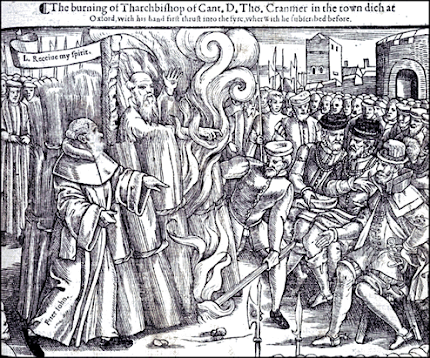
Christians are heirs of a 2,000-year tradition of proclaiming God's word, seeking justice in our societies, resisting tyranny, and reaching out with compassion to the poor, oppressed and suffering.Already we have confusion. The Declaration says that "Christians" have advocated social justice and "resisted tyranny, reaching out with compassion to the poor, oppressed and suffering." And who are these "Christians" Colson is talking about? Apparently the pope is included, the same popes who cursed and condemned Protestants and burned Protestants at the stake! Colson lauds the "papal edicts of the 16th and 17th centuries" simply because they stood on the right side of the slavery issue. Excuse me but who was it who decided to burn the English martyrs at the stake? Has Colson not read Fox's Book of Martyrs? I might add Colson conveniently glosses over the fact that John Wesley vehemently attacked both George Whitefield and Augustus Toplady for being Calvinists and preaching the doctrines of grace. I wonder how Wesley related to William Wilberforce on a personal level since Wilberforce was also a committed Calvinist?
While fully acknowledging the imperfections and shortcomings of Christian institutions and communities in all ages, we claim the heritage of those Christians who defended innocent life by rescuing discarded babies from trash heaps in Roman cities and publicly denouncing the Empire's sanctioning of infanticide. We remember with reverence those believers who sacrificed their lives by remaining in Roman cities to tend the sick and dying during the plagues, and who died bravely in the coliseums rather than deny their Lord.
After the barbarian tribes overran Europe, Christian monasteries preserved not only the Bible but also the literature and art of Western culture. It was Christians who combated the evil of slavery: Papal edicts in the 16th and 17th centuries decried the practice of slavery and first excommunicated anyone involved in the slave trade; evangelical Christians in England, led by John Wesley and William Wilberforce, put an end to the slave trade in that country. Christians under Wilberforce's leadership also formed hundreds of societies for helping the poor, the imprisoned, and child laborers chained to machines. [See, Read the Declaration].
DECLARATION
We, as Orthodox, Catholic, and Evangelical Christians, have gathered, beginning in New York on September 28, 2009, to make the following declaration, which we sign as individuals, not on behalf of our organizations, but speaking to and from our communities. We act together in obedience to the one true God, the triune God of holiness and love, who has laid total claim on our lives and by that claim calls us with believers in all ages and all nations to seek and defend the good of all who bear his image. We set forth this declaration in light of the truth that is grounded in Holy Scripture, in natural human reason (which is itself, in our view, the gift of a beneficent God), and in the very nature of the human person. We call upon all people of goodwill, believers and non-believers alike, to consider carefully and reflect critically on the issues we here address as we, with St. Paul, commend this appeal to everyone's conscience in the sight of God. [Ibid.]
While the whole scope of Christian moral concern, including a special concern for the poor and vulnerable, claims our attention, we are especially troubled that in our nation today the lives of the unborn, the disabled, and the elderly are severely threatened; that the institution of marriage, already buffeted by promiscuity, infidelity and divorce, is in jeopardy of being redefined to accommodate fashionable ideologies; that freedom of religion and the rights of conscience are gravely jeopardized by those who would use the instruments of coercion to compel persons of faith to compromise their deepest convictions. [Ibid.]
We are Christians who have joined together across historic lines of ecclesial differences to affirm our right—and, more importantly, to embrace our obligation—to speak and act in defense of these truths. We pledge to each other, and to our fellow believers, that no power on earth, be it cultural or political, will intimidate us into silence or acquiescence. It is our duty to proclaim the Gospel of our Lord and Savior Jesus Christ in its fullness, both in season and out of season. May God help us not to fail in that duty. [Ibid.]
The psychology of boot camp is instructive. The first six weeks are spent—figuratively speaking, mostly—beating out of recruits every habit, attitude, and preconceived notion about life and the world. You are told you are worthless and are "not a special snowflake," as Campbell says. You are now part of the Marine Corps and will do what the drill instructor says. Period. [Doctrinal Boot Camp].If this sort of thinking does not alarm Calvinists, I wonder what would alarm them? Colson reveals his true motive here. He wants to brainwash Christians and have them blindly follow their pastors and other religious leaders without question. He advocates "beating out" of new converts any tendency to read and study Scripture for themselves or think for themselves. Such a view not only throws out the priesthood of believers but it totally rejects the doctrine of private interpretation of Scripture. (See 1 John 4:1-3; John 5:39; 2 Timothy 3:15-17; 2 Timothy 2:15; 2 Peter 1:19-21; 2 John 1:7-11). Private interpretation does not exclude confessions of faith in writing or the creeds. But it does mean that the Christian is to examine fallible documents by the Word of God and that would include examining the contents of sermons and testing those sermons by the creeds, confessions and by the ultimate and final rule of faith: Holy Scripture. Sola Scriptura!
We believe that we ought to discern diligently and very carefully from the Word of God what is the true church, for all sects which are in the world today claim for themselves the name of church.[1] We are not speaking here of the hypocrites, who are mixed in the church along with the good and yet are not part of the church, although they are outwardly in it.[2] We are speaking of the body and the communion of the true church which must be distinguished from all sects that call themselves the church.
The true church is to be recognized by the following marks: It practises the pure preaching of the gospel.[3] It maintains the pure administration of the sacraments as Christ instituted them.[4] It exercises church discipline for correcting and punishing sins.[5] In short, it governs itself according to the pure Word of God,[6] rejecting all things contrary to it[7] and regarding Jesus Christ as the only Head.[8] Hereby the true church can certainly be known and no one has the right to separate from it.
Those who are of the church may be recognized by the marks of Christians. They believe in Jesus Christ the only Saviour,[9] flee from sin and pursue righteousness,[10] love the true God and their neighbour[11] without turning to the right or left, and crucify their flesh and its works.[12] Although great weakness remains in them, they fight against it by the Spirit all the days of their life.[13] They appeal constantly to the blood, suffering, death, and obedience of Jesus Christ, in whom they have forgiveness of their sins through faith in Him.[14]
The false church assigns more authority to itself and its ordinances than to the Word of God. It does not want to submit itself to the yoke of Christ.[15] It does not administer the sacraments as Christ commanded in His Word, but adds to them and subtracts from them as it pleases. It bases itself more on men than on Jesus Christ. It persecutes those who live holy lives according to the Word of God and who rebuke the false church for its sins, greed, and idolatries.[16]
These two churches are easily recognized and distinguished from each other.
[1] Rev 2:9. [2] Rom 9:6. [3] Gal 1:8; 1 Tim 3:15. [4] Acts 19:3-5; 1 Cor 11:20-29. [5] Mt 18:15-17; 1 Cor 5:4, 5, 13; 2 Thess 3:6, 14; Tit 3:10. [6] Jn 8:47; Jn 17:20; Acts 17:11; Eph 2:20; Col 1:23; 1 Tim 6:3. [7] 1 Thess 5:21; 1 Tim 6:20; Rev 2:6. [8] Jn 10:14; Eph 5:23; Col 1:18. [9] Jn 1:12; 1 Jn 4:2. [10] Rom 6:2; Phil 3:12. [11] 1 Jn 4:19-21. [12] Gal 5:24. [13] Rom 7:15; Gal 5:17. [14] Rom 7:24, 25; 1 Jn 1:7-9. [15] Acts 4:17, 18; 2 Tim 4:3, 4; 2 Jn 9. [16] Jn 16:2.
One concept that have [sic] been used to justify the befouling of the stream is the theory of the Anglican Church as a via media, or middle path. Tractarian, later Roman Catholic John Henry Newman first proposed this theory in the nineteenth century. Tractarian Edward Bouvrie Pusey would modify it and former Unitarian and one-time Tractarian Frederick Maurice would popularize it. In his theory Newman postulated that the Anglican Church was a middle path between Protestantism and Roman Catholicism. In Newman’s theory the path was actually dead center between Protestantism and Roman Catholicism but veered toward Roman Catholicism. Later Newman would reject the concept of the Anglican Church as via media as untenable, and would convert to Roman Catholicism. The Our Lady of Walsingham Personal Ordinariate in England and Wales has adopted Newman as its patron saint. In Pusey’s modification of Newman’s theory the Anglican Church was a separate branch of Catholic Christianity alongside of Eastern Orthodoxy and Roman Catholicism. Maurice’s concept of the Anglican Church as a via media was more dynamic and future-oriented than Newman’s and Pusey’s. Maurice saw the Anglican Church as changing and evolving, moving progressively toward being a Church that would incorporate the best elements of the different traditions in Christianity. The Anglican Church would be the church of the future. Of the three theories, Maurice’s would grab the popular imagination.
If the Anglican Communion is to be reformed again it needs to hear and heed these crucial truths:To read the full article, click here:
2. The Spirit of God never leads people in ways contrary to the teaching of Scripture, which he has been instrumental in producing. Jesus' promise of the Spirit to his disciples was not that the Spirit will lead the churches on from Scripture into truth which somehow supersedes it, but that he will ensure that Jesus' words are heard until the end of the age (John 16:13–14). To pit the Spirit against the Scriptures is to fail to understand either.
The Australian community suffered a severe shock when Darwin was devastated by a cyclone on Christmas Day. Now that the rescue operation has been completed and thoughts are turning to rehabilitation, we should reflect and assess what the disaster means. Hard on the heels of Darwin came the Hobart bridge tragedy, where further lives were lost suddenly and unexpectedly. In between the two events, newspapers have been reporting on the destruction of Pakistan (where thousands of people have lost their lives) and the famine in North Africa (which has brought death to tens of thousands, particularly in Ethiopia). Misfortune and sorrow overtake all of us during life, and sometimes we suffer more severely than others.
The Bible story of Job is an illustration: he was an excellent man—upright and generous—one who feared and reverenced God, as chapters 30 and 31 of the Book of Job make clear. Yet he suffered terrible misfortune: he lost all his property, he lost his family through a whirlwind, and he lost his own health for a long period of time. Yet it is plain that these events were under the control of God. Though they did not originate with God but with Satan, in the end they brought a very great blessing to Job in the form of deepening experience and fellowship with his Heavenly Father. So misfortune which overtakes Christians should be turned into blessings, for that is the purpose that God allows them. The only real blessing that counts in the end is a deepening experience of God, and we may rejoice in our trials if this is the outcome.
But there is a further very important point to stress. If looked at carefully, it will be seen that we deserve every misfortune that comes into our life (even though God intends it not for judgement, but for blessing). We deserve God’s judgement because we do not fear and reverence God in the way we should. We are not single-minded in serving God as, for example, our Lord Jesus Christ was. Anything short of his perfect character is wrong, and deserves correction and punishment. Thus we deserve the very misfortunes that overtakes us, and we should accept them as stepping stones back to God.
But we must not think that those who suffer are more deserving of judgement than those who escape; we all deserve it equally. This was the message that Jesus emphasized in the catastrophes that took place in the community during his ministry. Pilate the Roman governor had executed some Galileans, and Jesus asked his hearers whether they thought that these victims were more deserving of their fate than those who escaped. This would perhaps be the natural view, but our Lord repudiates it. I quote his words from Luke 13:2-3: “Do you think that these Galileans were worse sinners than all the other Galileans, because they suffered thus? I tell you, no; but unless you repent, you will all likewise perish.” Our Lord then went on to comment on another incident: it would seem that a tower had collapsed in Siloam and killed some of those standing close by. Jesus again asked his hearers, “[T]hose eighteen upon whom the tower of Siloam fell and killed them, do you think that they were worse offenders than all the others who dwelt in Jerusalem? I tell you, no; but unless you repent, you will all likewise perish.”1 We may conclude that those who suffered as a result of the cyclone in Darwin or the accident at Hobart were not necessarily any worse than their fellow citizens, but the point that Jesus underlined was that we all deserve judgement and we will all receive it unless we repent of our godlessness: “Unless we repent, we will all likewise perish”. Jesus’ words were literally and terribly fulfilled a few years later in the destruction of Jerusalem and in invasions by Roman armies, ravaging the countryside. His hearers suffered much more fearful and terrible deaths than the Galileans or those on whom the tower fell.
The lesson to us Australians should be plain: are we going to sink back into complacency, pleasure seeking, money making and sexual indulgence? Or will we repent and wake up to God, who controls all the events of life and our eternal destinies? Nothing happens purposelessly. The collapse of the tower of Siloam should have been a warning that all deserve the same fate. The loss of life and loss of property in Darwin and Hobart should be a warning to us too. We deserve the same judgement. Our Lord warns that unless we Australians repent and cleanse our lives and our society, we will all likewise perish—perish not only as a nation overwhelmed by some enemy, but perish also individually and eternally. That is what we deserve and that is what we will inevitably receive, unless we repent of our godlessness and selfishness, recognize Jesus as the Lord and saviour to whom we look for forgiveness and salvation, and hallow God’s name in our own lives as well as in our national life.
God’s judgement is a very unpleasant subject to speak about or to preach about. But it is the most real factor in life. We are surrounded by the judgements of God, and we do ourselves or others no kindness by skating lightly over or ignoring the reality of judgement. However we must always speak of it as persons equally deserving of it, yet saved from it, I trust, by the love of the Lord Jesus Christ who bore it for us.
Do you sense the justice and imminence of God’s judgement? Then repent, turn back to God, fear and honour him, acknowledge Jesus as the Lord and call on him, and he will save you, now and always. He will change you from being under God’s wrath into being in his presence so that even death, whenever it comes, will no longer be a part of God’s judgement. Instead death will be transformed into a gateway for fuller fellowship and joy in the presence of God.
1. Luke 13:4-5.
The focus of the medieval (and Roman) doctrine of justification is the Spirit’s work in us, by which he creates condign merit, i.e., merit that meets the terms of justice, which God must recognize. In the medieval and Roman system the ground of acceptance with God is Spirit-wrought sanctity within us by grace and cooperation with grace.
So, when the Westminster assembly confessed that the ground of justification is outside of us (iustitia aliena) it was standing with Luther and Calvin and the Protestants over against the medieval church and Trent. This is exactly what is meant by the words of WCF 11.1
by accounting and accepting their persons as righteous; not for anything wrought in them, or done by them, but for Christ’s sake alone….
Reasonable Christian Blog Glory be to the Father, and to the Son : and to the Holy Ghost; Answer. As it was in the beginning, is now, and ever shall be : world without end. Amen. 1662 Book of Common Prayer
"In the first place many men want peace at any price. They automatically flee from trouble. With them it is virtually a principle to never oppose anyone. In contrast, Athanasius is honored because he stood firmly against something. For this reason his epitaph, engraved on the soul of history, reads Athanasius contra mundum." Gordon H. Clark, The Trinity. (Jefferson: The Trinity Foundation, 1985) p. 20.Contra mundum means "against the world".
4. This catholic Church hath been sometimes more, sometimes less visible.1 And particular Churches, which are members thereof, are more or less pure, according as the doctrine of the Gospel is taught and embraced, ordinances administered, and public worship performed more or less purely in them.2
--------------------------------------------------------------------------------
1 Rom. 11:3,4; Rev. 12:6,14
2 Rev. 2 and 3 throughout; 1 Cor. 5:6,7
5. The purest Churches under heaven are subject both to mixture and error;1 and some have so degenerated, as to become no Churches of Christ, but synagogues of Satan.2 Nevertheless, there shall be always a Church on earth, to worship God according to His will.3
See also: WLC 61
--------------------------------------------------------------------------------
1 1 Cor. 13:12; Rev. 2 and 3; Matt. 13:24-30,47
2 Rev. 18:2; Rom. 11:18-22
3 Matt. 16:18; Ps. 72:17; Ps. 102:28; Matt. 28:19,20
6. There is no other head of the Church but the Lord Jesus Christ.1 Nor can the Pope of Rome, in any sense, be head thereof; [but is that Antichrist, that man of sin, and son of perdition, that exalteth himself in the church against Christ, and all that is called God.2 ]
--------------------------------------------------------------------------------
1 Col. 1:18; Eph. 1:22
2 Matt. 23:8-10; 2 Thess. 2:3,4,8,9; Rev. 13:6 [From Westminster Confession, Chapter 19: Of the Church.]
Article XIX
Of the Church
The visible Church of Christ is a congregation of faithful men, in the which the pure word of God is preached and the sacraments be duly ministered according to Christ's ordinance in all those things that of necessity are requisite to the same. As the Church of Jerusalem, Alexandria, and Antioch have erred: so also the Church of Rome hath erred, not only in their living and manner of ceremonies, but also in matters of faith. (See Article XIX).
Rev. Larrison's response is just further evidence of the decline in the knowledge and teaching of the Reformed standards. His view seems to be to not make waves and not to teach the Westminster Standards or make an issue of them lest any potential new member be offended, particularly if they happen to be Arminian. However, his broad evangelical strategy does not seem to be working since the membership of the church is dwindling. In fact, a couple of young families left since I have been visiting in the past few years when I came home to visit relatives.
"In the first place many men want peace at any price. They automatically flee from trouble. With them it is virtually a principle to never oppose anyone. In contrast, Athanasius is honored because he stood firmly against something. For this reason his epitaph, engraved on the soul of history, reads Athanasius contra mundum." Gordon H. Clark, The Trinity. (Jefferson: The Trinity Foundation, 1985) p. 20.Contra mundum means "against the world".
Reasonable Christian Blog Glory be to the Father, and to the Son : and to the Holy Ghost; Answer. As it was in the beginning, is now, and ever shall be : world without end. Amen. 1662 Book of Common Prayer
Who we are
At All Saints Dallas we believe God reveals his love to us through the Scriptures, the Spirit and the Sacraments, the three streams of a life giving church.
All Saints Dallas is a Christ centered, Bible teaching, Spirit filled liturgical church. Upholding the Biblical and historic essentials of the Christian faith, all of the teaching, preaching and worship seek to offer a vibrant, living relationship with Christ. Here you can expect a rich, authentic worship experience and a thoughtful liturgy offering a connection to an ancient faith. You can expect to encounter the living God who leads, restores, heals and transforms our lives.
Reasonable Christian Blog Glory be to the Father, and to the Son : and to the Holy Ghost; Answer. As it was in the beginning, is now, and ever shall be : world without end. Amen. 1662 Book of Common Prayer
The Anglican Catholic group was not alone in its discomfort with Queen Elizabeth's determined resolution to stand still religiously after 1559. The Reformed Church of England was agreed in one important principle with the Lutherans, that of the so-called normative principle: the English Reformation was generally conducted along the lines that whatever is not prohibited in Scripture is permitted, as long as it is agreeable to the peace and unity of the Church. The Church of England, for example, therefore retained bishops whereas the Reformed on the continent (following the regulative principle, that whatever is not commanded is prohibited) generally abandoned episcopacy in favour of Presbyterianism. Not everyone was in agreement with this way of settling matters: the puritans of the late sixteenth century continued to seek further reformation of church government and the abolition of various practices which they considered to be a hangover from the medieval past, such as the sign of the cross used in baptism or the use of the surplice and other vestments. (Pp. 15-16)I am posting this comment to my blog since you have disabled commenting on your own blog. I happen to agree with R. Scott Clark's view that there needs to be a recovery of the Reformed Confessions, although I do disagree with Clark's view of regulative worship. J.I. Packer is now advocating a recovery of the practice of catechesis of new church members and current church members. The Anglican Formularies function as a Reformed Confession of the Anglo-Reformed faith. That would include following the Anglo-Reformed view of the vestments expressed by the ornaments rubric under Edward VI and not the revisionist interpretation of that rubric by high church Arminians and Anglo-Catholics. Basically, high church Arminians are in collusion with the Anglo-Catholics whether they admit such or not. That does not mean that the normative principle permits idolatrous practices like the veneration of bread and wine, the saints, or prayers to Mary and the saints. I hardly believe that Luther himself would have permitted such a thing.

 Posts
All Comments
Posts
All Comments


