>

Martyred for the Gospel

Martyred for the Gospel
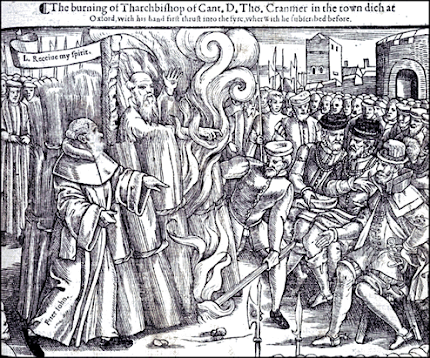
The burning of Tharchbishop of Cant. D. Tho. Cranmer in the town dich at Oxford, with his hand first thrust into the fyre, wherwith he subscribed before. [Click on the picture to see Cranmer's last words.]

Daily Bible Verse

Sunday, February 27, 2011

Reasonable Christian: The Noetic Effects of Sin: Subjectivity and Objectivity in Telling History: A Response to Carl Trueman's Interview on the Reformed Forum

Reasonable Christian: The Noetic Effects of Sin: Subjectivity and Objectivity in Telling History: A Response to Carl Trueman's Interview on the Reformed Forum

Reasonable Christian: Chuck Colson: Advocate of the Manhattan Declaration and Latitudinarian "Evangelicalism"

Reasonable Christian: Chuck Colson: Advocate of the Manhattan Declaration and Latitudinarian "Evangelicalism"

Don’t Like Labels…or Commitment? « Heidelblog

R. Scott Clark evaluates the modern church growth movement and its tendency to minimize doctrinal commitments:

Parallel to these socio-economic developments has been another, religious, aspect. Among American neo-evangelicals there has been a reluctance to embrace labels. There has been strong drive among [sic] to emphasize a personal relationship with the risen Christ but the list of Christian doctrines considered necessary for the faith has been gradually shrinking for decades. The doctrine of the church and identification with particular ecclesiastical and theological traditions rarely made the list. Evangelistic crusades were trans-denominational and personal, immediate, religious experience of the risen Christ was front and center.

To read the entire article, click here: Don’t Like Labels…or Commitment? « Heidelblog


Friday, February 25, 2011

Obama Administration Drops Defense of Anti-Gay Marriage Law - FoxNews.com

Obama Administration Drops Defense of Anti-Gay Marriage Law - FoxNews.com

Anglicans Ablaze: New Book Puts Pennsylvania Minister in a New Light

Talk about historical precedents. Looks like compromising one's commitment to the Gospel in The Episcopal Church is nothing new:

In 1763, the peaceful settlement of Conestoga Indians near present-day Millersville, Pennsylvania (Lancaster County) was attacked by a group of Pennsylvania frontiersmen known as the Paxton Boys. Angry over the lack of help from the colonial government in the defense of their homes and farms for Indian raids, the Paxton Boys massacred a number of Indians at the village before riding on to Lancaster and killing the rest of the tribe, which had been placed in the Lancaster Jail (today the Fulton Opera House) for their own protection. Pennsylvania’s governor John Penn condemned the attack and local Renaissance man Benjamin Franklin published a pamphlet defending the Native Americans and attacking the Paxton Boys for their murderous spree. In response, Barton published his own pamphlet – supporting the actions of the Paxton Boys and attacking the Native Americans. Many historians have debated why Barton defended such a murderous bunch as the Paxton Boys and betrayed those very Native Americans he was offered spiritual guidance to.

(Past History Examiner writings: "The Paxton Boy Massacure [sic] and Working Towards Forgiveness")

Myers writes in his new book that Barton, despite his success as a minister, was a extremely insecure man, unwilling to take a stand against some of the same people he had minister too [sic] in his early days (a.k.a. the Paxton Boys) in the western territories. Driven, so claims Myers, by a “profound need to be liked” Barton gave into peer pressure and threw his Native American congregation “under the bus” so-to-speak in order to maintain his image as popular frontier minister. Myers also makes the accusation that Barton’s writing of the pro-Paxton Boy pamphlet was motivated by financial incentives as well. After the massacre of the Conestoga Indians, 400 acres that had once been their village became part of Barton’s personal farm.
Click here for the link to the original article: Anglicans Ablaze: New Book Puts Pennsylvania Minister in a New Light

'The most dangerous place for an African-American is in the womb': Controversial anti-abortion billboard taken down | Mail Online


Odd that freedom of speech only applies to the propaganda of the state religion of atheism, secularism, and the anti-Christian suppression of freedom of religion. What is even more disturbing is that liberal African-Americans are now labeling theologically conservative African-Americans like Reverend Stephen Broden as "borderline" racist.

Click here to read the entire article: 
'The most dangerous place for an African-American is in the womb': Controversial anti-abortion billboard taken down | Mail Online

Archbishop Peter Jensen at the service for Christchurch NZ : Anglican Church League, Sydney, Australia

Archbishop Peter Jensen at the service for Christchurch NZ : Anglican Church League, Sydney, Australia

the synoptic problem

the synoptic problem

Thursday, February 24, 2011

Reasonable Christian: Book Review: The True Profession of the Gospel: Augustus Toplady and Reclaiming Our Reformed Foundations

Reasonable Christian: Book Review: The True Profession of the Gospel: Augustus Toplady and Reclaiming Our Reformed Foundations

Monergism :: Dispensationalism

Monergism :: Dispensationalism

Pentecostalism: Blessing or Heresy?

Pentecostalism

Underdog Theology: The Double Benefit of Christ and the Struggling Christian

Mike Horton:

The complexity of its continuing power is not undervalued, as Paul goes on to point out in Romans 7. The normal Christian life is a struggle-neither a surrender to sin nor a freedom from sin, but a constant battle. Repentance is never complete in this life, any more than is faith. We turn from our sins and then find ourselves repeating them. But we get back up and keep carrying our cross, knowing that it is not our cross that saves us but Christ's. This life, therefore, may not look like sterling victory, but it is nonetheless the daily outworking of that victory that has already been accomplished. Paul's argument, then, is this: Christ has saved you to the uttermost, from both sin's guilt and dominion. Therefore, why do you continue to live as if this were not the case? You are not a defeated slave of sin, so why do you act like it so often? Today, we are already as believers baptized into Christ's death and raised in the newness of his life. One day, we will finally be free from the very presence of sin. Only then will there no longer be struggle."


Underdog Theology: The Double Benefit of Christ and the Struggling Christian


What Happens When You Don’t Have a Category for Wisdom or Nature (1) « Heidelblog

The implications of Dr. R. Scott Clark's discussion of nature, creation, and the redefinition of male and female roles extend also to the arena of multisexuality. Transexuality and medical surgery or mutilation for the purpose of artificially attempting to change someone's God given gender is in effect a rebellion against the Creator. (Romans 1:18-32). Basically, the overemphasis on individualism coupled with the fallen state of humanity results in rebellion against nature as God has created it.

What Happens When You Don’t Have a Category for Wisdom or Nature (1) « Heidelblog


Wednesday, February 23, 2011

Pamphlets and Articles

Pamphlets and Articles: Common Grace

Pastor Dave is Looking for Courageous Calvinism in the PCA « Heidelblog

Pastor Dave is Looking for Courageous Calvinism in the PCA « Heidelblog

Chuck Colson: Advocate of the Manhattan Declaration and Latitudinarian "Evangelicalism"


Chuck Colson in an article posted at Christianity Today said:

An aversion to doctrine caused some thoroughly orthodox young evangelicals to decline to sign the Manhattan Declaration (which defends human life, traditional marriage, and religious liberty), even though the document is rooted in Scripture. As one young evangelical explained to me, "We don't like dogmatic statements that a lot of people have to sign." What about the Nicene Creed or the Westminster Confession of Faith?  [See link at Anglicans Ablaze: Doctrinal Bootcamp].

I almost choked on my coffee when I read that line.  Colson thinks that an "aversion" to doctrine caused folks like me not to sign the Manhattan Declaration?    I thought to myself, "Chuck, you have GOT to be kidding me????"   It is NOT an aversion to doctrine that caused many Reformed folks not to agree with the Manhattan Declaration.  In fact it was a CONCERN FOR DOCTRINE that caused us not to sign on the dotted line.  Why?  Because the Manhattan Declaration, like the other ecumenical documents endorsed by Colson, says that Roman Catholics and the Eastern Orthdox believe the same Gospel that Protestants believe.  That could not be further from the truth.  The fact is the anathemas of the 16th century canons of the Council of Trent still condemn Protestants.   To assume that Roman Catholics and other churches which teach faith plus good works as the basis for justification and salvation are "Christian" is to set naive people up to be deceived. 

One Presbyterian Church in America pastor recently told me that all that is necessary for salvation is that a church adheres to the three ecumenical creeds.   (See, How Far Has the PCA Fallen?) I guess that means that you don't need to believe that Scripture is the final authority?  Church tradition is an additional revelation alongside Scripture and you had better believe what the modern day apostles of Roman Catholicism and Eastern Orthdoxy tell you else you're violating God's Word revealed to them?

What exactly does the Manhattan Declaration say which is objectionable to born again and Reformed Christians?  Let me show you.  The Preamble says:

Christians are heirs of a 2,000-year tradition of proclaiming God's word, seeking justice in our societies, resisting tyranny, and reaching out with compassion to the poor, oppressed and suffering.

While fully acknowledging the imperfections and shortcomings of Christian institutions and communities in all ages, we claim the heritage of those Christians who defended innocent life by rescuing discarded babies from trash heaps in Roman cities and publicly denouncing the Empire's sanctioning of infanticide. We remember with reverence those believers who sacrificed their lives by remaining in Roman cities to tend the sick and dying during the plagues, and who died bravely in the coliseums rather than deny their Lord.

After the barbarian tribes overran Europe, Christian monasteries preserved not only the Bible but also the literature and art of Western culture. It was Christians who combated the evil of slavery: Papal edicts in the 16th and 17th centuries decried the practice of slavery and first excommunicated anyone involved in the slave trade; evangelical Christians in England, led by John Wesley and William Wilberforce, put an end to the slave trade in that country. Christians under Wilberforce's leadership also formed hundreds of societies for helping the poor, the imprisoned, and child laborers chained to machines.  [See, Read the Declaration].

Already we have confusion.  The Declaration says that "Christians" have advocated social justice and "resisted tyranny, reaching out with compassion to the poor, oppressed and suffering."  And who are these "Christians" Colson is talking about?  Apparently the pope  is included, the same popes who cursed and condemned Protestants and burned Protestants at the stake!   Colson lauds the "papal edicts of the 16th and 17th centuries" simply because they stood on the right side of the slavery issue.  Excuse me but who was it who decided to burn the English martyrs at the stake?  Has Colson not read Fox's Book of Martyrs?  I might add Colson conveniently glosses over the fact that John Wesley vehemently attacked both George Whitefield and Augustus Toplady for being Calvinists and preaching the doctrines of grace.  I wonder how Wesley related to William Wilberforce on a personal level since Wilberforce was also a committed Calvinist?

So what else is there in the Declaration to which I object on doctrinal grounds? 

DECLARATION

We, as Orthodox, Catholic, and Evangelical Christians, have gathered, beginning in New York on September 28, 2009, to make the following declaration, which we sign as individuals, not on behalf of our organizations, but speaking to and from our communities. We act together in obedience to the one true God, the triune God of holiness and love, who has laid total claim on our lives and by that claim calls us with believers in all ages and all nations to seek and defend the good of all who bear his image. We set forth this declaration in light of the truth that is grounded in Holy Scripture, in natural human reason (which is itself, in our view, the gift of a beneficent God), and in the very nature of the human person. We call upon all people of goodwill, believers and non-believers alike, to consider carefully and reflect critically on the issues we here address as we, with St. Paul, commend this appeal to everyone's conscience in the sight of God.  [Ibid.]
Did you get that?  Colson uses deliberately ambiguous terms to sucker and deceive Evangelicals.  The terms "Orthodox" and "Catholic" mean "right doctrine" and "universal" in some contexts.  No Christian would disagree that we need to believe the right doctrines or that we need to advocate a universally applicable Gospel to all nations (Matthew 28:18-20; Mark 16:15-16; Acts 1:8).  But Colson and the other authors of the Manhattan Declaration do not mean any of that here.  The reference is clearly to the Eastern Orthodox Church and the Roman Catholic Church.  The document conveniently overlooks the Great Schism of 1054 between the Eastern Orthodox Church and Rome over the issue of papal supremacy and it overlooks the Protestant Reformation as if neither of those cataclysmic events ever took place! 

The next paragraph sounds majestic but further confuses the Gospel by implying that basis for unity between Christians is not the Gospel and the Holy Scriptures but "moral" concerns:

While the whole scope of Christian moral concern, including a special concern for the poor and vulnerable, claims our attention, we are especially troubled that in our nation today the lives of the unborn, the disabled, and the elderly are severely threatened; that the institution of marriage, already buffeted by promiscuity, infidelity and divorce, is in jeopardy of being redefined to accommodate fashionable ideologies; that freedom of religion and the rights of conscience are gravely jeopardized by those who would use the instruments of coercion to compel persons of faith to compromise their deepest convictions.  [Ibid.]
And finally the punch line:

We are Christians who have joined together across historic lines of ecclesial differences to affirm our right—and, more importantly, to embrace our obligation—to speak and act in defense of these truths. We pledge to each other, and to our fellow believers, that no power on earth, be it cultural or political, will intimidate us into silence or acquiescence. It is our duty to proclaim the Gospel of our Lord and Savior Jesus Christ in its fullness, both in season and out of season. May God help us not to fail in that duty.  [Ibid.]
Did you get that?  The Manhattan Declaration says that the Eastern Orthodox Church, Roman Catholicism, and Evangelicals are all proclaiming "the Gospel of our Lord and Savior Jesus Christ in its fullness . . ."

And Chuck Colson has the nerve to say that R.C. Sproul is a young, orthodox and naive Evangelical who refused to sign the Manhattan Declaration because Sproul has an "aversion to doctrine"?  (See, Sproul:  Why I Did Not Sign the Manhattan Declaration).   The utter absurdity of such a statement is ridiculous.  It is not merely the young who have refused to sign.  Many of us have a mind and have rejected the Manhattan Declaration on doctrinal grounds and not because of an "aversion to doctrine". 

If the Manhattan Declaration is any indication, theological liberalism is setting in.  Colson's theology is latitudinarian at best.  Major "Evangelical" magazines are selling out the Gospel to a false gospel of good works and moralism.  If The Episcopal Church and the Anglican provinces in the UK and Canada are any indication we can clearly see where Colson's thinking leads.  It leads to theological and ecclesiastical relativism, modernism, liberalism and eventually apostasy.  Basically for Colson and his liberal cronies co-belligerency becomes accepting Roman Catholics and the Eastern Orthodox as "Christians" and as "brothers" in Christ.  But are they?  Not according to the historical evidence and the Reformed Confessions of Faith:  Westminster Standards, Three Forms of Unity, and the Anglican Formularies.  (The Anglican Formularies are The Thirty-nine Articles of Religion of 1571, the 1662 Book of Common Prayer, and the Ordinal, which is included in the 1662 Book of Common Prayer).

What is ironic is that the Westminster Confession of 1646 said that the Roman Catholic Church and Eastern Orthodoxy were "synagogues of satan" because of their level of doctrinal impurity.  It also said that the pope  was an "antichrist".   (See, Chapter 25. Of the Church.  Westminster Confession, 1646.  See also, Article 19 of the Thirty-nine Articles of Religion.  See also, Belgic Confession: Chapter 25, of the Marks of the True Church).

For Colson becoming a Christian is some vague Christianity of the last 2,000 years, presumably a Christianity that includes all the heresies of medieval Catholicism and Eastern Orthodoxy.  And even more disturbing, Colson expects Christians to blindly follow the leader to hell if necessary.  He uses the brainwashing techniques used in military boot camp as an illustration:

The psychology of boot camp is instructive. The first six weeks are spent—figuratively speaking, mostly—beating out of recruits every habit, attitude, and preconceived notion about life and the world. You are told you are worthless and are "not a special snowflake," as Campbell says. You are now part of the Marine Corps and will do what the drill instructor says. Period.  [Doctrinal Boot Camp].
If this sort of thinking does not alarm Calvinists, I wonder what would alarm them?  Colson reveals his true motive here.  He wants to brainwash Christians and have them blindly follow their pastors and other religious leaders without question.  He advocates "beating out" of new converts any tendency to read and study Scripture for themselves or think for themselves.  Such a view not only throws out the priesthood of believers but it totally rejects the doctrine of private interpretation of Scripture.   (See 1 John 4:1-3; John 5:39; 2  Timothy 3:15-17; 2 Timothy 2:15; 2 Peter 1:19-21; 2 John 1:7-11). Private interpretation does not exclude confessions of faith in writing or the creeds.  But it does mean that the Christian is to examine fallible documents by the Word of God and that would include examining the contents of sermons and testing those sermons by the creeds, confessions and by the ultimate and final rule of faith:  Holy Scripture.  Sola Scriptura!

Colson's view is more in line with the top down mentality of Roman Catholicism than with the Protestant Reformation.  One has to suspect that his view has been tainted by reconstructionism and theonomy, another theological error which Colson endorses.  In fact, the Manhattan Declaration and other ecumenical compromises are the perfect illustration of why theonomy and reconstructionism are in fact theological heresies.  Both emphasize the here and now and social action above the two kingdom theology of Scripture and therefore preach another gospel, which is no gospel at all.  (Galatians 1:6-9; 2 Corinthians 11:3-4).  Fact is, Roman Catholics and theonomy have more in common with each other than theonomy has in common with the true Gospel and biblical Christianity as it is expounded in the Westminster Standards, the Three Forms of Unity, and the Anglican Formularies.


May the peace of God be with you,

Charlie


Postscript:  Belgic Confession:  Chapter 25,  Of the Marks of the True Church


We believe that we ought to discern diligently and very carefully from the Word of God what is the true church, for all sects which are in the world today claim for themselves the name of church.[1] We are not speaking here of the hypocrites, who are mixed in the church along with the good and yet are not part of the church, although they are outwardly in it.[2] We are speaking of the body and the communion of the true church which must be distinguished from all sects that call themselves the church.


The true church is to be recognized by the following marks: It practises the pure preaching of the gospel.[3] It maintains the pure administration of the sacraments as Christ instituted them.[4] It exercises church discipline for correcting and punishing sins.[5] In short, it governs itself according to the pure Word of God,[6] rejecting all things contrary to it[7] and regarding Jesus Christ as the only Head.[8] Hereby the true church can certainly be known and no one has the right to separate from it.

Those who are of the church may be recognized by the marks of Christians. They believe in Jesus Christ the only Saviour,[9] flee from sin and pursue righteousness,[10] love the true God and their neighbour[11] without turning to the right or left, and crucify their flesh and its works.[12] Although great weakness remains in them, they fight against it by the Spirit all the days of their life.[13] They appeal constantly to the blood, suffering, death, and obedience of Jesus Christ, in whom they have forgiveness of their sins through faith in Him.[14]

The false church assigns more authority to itself and its ordinances than to the Word of God. It does not want to submit itself to the yoke of Christ.[15] It does not administer the sacraments as Christ commanded in His Word, but adds to them and subtracts from them as it pleases. It bases itself more on men than on Jesus Christ. It persecutes those who live holy lives according to the Word of God and who rebuke the false church for its sins, greed, and idolatries.[16]

These two churches are easily recognized and distinguished from each other.


[1] Rev 2:9. [2] Rom 9:6. [3] Gal 1:8; 1 Tim 3:15. [4] Acts 19:3-5; 1 Cor 11:20-29. [5] Mt 18:15-17; 1 Cor 5:4, 5, 13; 2 Thess 3:6, 14; Tit 3:10. [6] Jn 8:47; Jn 17:20; Acts 17:11; Eph 2:20; Col 1:23; 1 Tim 6:3. [7] 1 Thess 5:21; 1 Tim 6:20; Rev 2:6. [8] Jn 10:14; Eph 5:23; Col 1:18. [9] Jn 1:12; 1 Jn 4:2. [10] Rom 6:2; Phil 3:12. [11] 1 Jn 4:19-21. [12] Gal 5:24. [13] Rom 7:15; Gal 5:17. [14] Rom 7:24, 25; 1 Jn 1:7-9. [15] Acts 4:17, 18; 2 Tim 4:3, 4; 2 Jn 9. [16] Jn 16:2.


--
Reasonable Christian Blog Glory be to the Father, and to the Son : and to the Holy Ghost; Answer. As it was in the beginning, is now, and ever shall be : world without end. Amen. 1662 Book of Common Prayer

Reasonable Christian: Table of Contents: 39 Articles: The Historic Basis of Anglican Faith

Reasonable Christian: Table of Contents: 39 Articles: The Historic Basis of Anglican Faith, by D. Broughton Knox

Tuesday, February 22, 2011

The Heritage Anglican Network: A Clear Flowing Stream

Robin Jordan said:

One concept that have [sic] been used to justify the befouling of the stream is the theory of the Anglican Church as a via media, or middle path. Tractarian, later Roman Catholic John Henry Newman first proposed this theory in the nineteenth century. Tractarian Edward Bouvrie Pusey would modify it and former Unitarian and one-time Tractarian Frederick Maurice would popularize it. In his theory Newman postulated that the Anglican Church was a middle path between Protestantism and Roman Catholicism. In Newman’s theory the path was actually dead center between Protestantism and Roman Catholicism but veered toward Roman Catholicism. Later Newman would reject the concept of the Anglican Church as via media as untenable, and would convert to Roman Catholicism. The Our Lady of Walsingham Personal Ordinariate in England and Wales has adopted Newman as its patron saint. In Pusey’s modification of Newman’s theory the Anglican Church was a separate branch of Catholic Christianity alongside of Eastern Orthodoxy and Roman Catholicism. Maurice’s concept of the Anglican Church as a via media was more dynamic and future-oriented than Newman’s and Pusey’s. Maurice saw the Anglican Church as changing and evolving, moving progressively toward being a Church that would incorporate the best elements of the different traditions in Christianity. The Anglican Church would be the church of the future. Of the three theories, Maurice’s would grab the popular imagination.


To read the rest of the article, click here: The Heritage Anglican Network: A Clear Flowing Stream


Theological Theology: An Exposition of the Theses -2

Mark Thompson of Moore Theological College said:
If the Anglican Communion is to be reformed again it needs to hear and heed these crucial truths:


2. The Spirit of God never leads people in ways contrary to the teaching of Scripture, which he has been instrumental in producing. Jesus' promise of the Spirit to his disciples was not that the Spirit will lead the churches on from Scripture into truth which somehow supersedes it, but that he will ensure that Jesus' words are heard until the end of the age (John 16:13–14). To pit the Spirit against the Scriptures is to fail to understand either.
To read the full article, click here:

Theological Theology: An Exposition of the Theses -2


“Justification” and “righteousness” are not the same « Forget the Channel

“Justification” and “righteousness” are not the same « Forget the Channel

The Sola Panel | Responding to disaster


"God’s judgement is a very unpleasant subject to speak about or to preach about. But it is the most real factor in life. We are surrounded by the judgements of God, and we do ourselves or others no kindness by skating lightly over or ignoring the reality of judgement. However we must always speak of it as persons equally deserving of it, yet saved from it, I trust, by the love of the Lord Jesus Christ who bore it for us." --D. Broughton Knox--


The following is quoted from a radio talk given by D. Broughton Knox, an Evangelical Anglican who was part of the Sydney Diocese of the Anglican Church in Australia. It's taken from the Sola Panel website. The quote is from Volume III of the Selected Works, although no page numbers are given.


The Australian community suffered a severe shock when Darwin was devastated by a cyclone on Christmas Day. Now that the rescue operation has been completed and thoughts are turning to rehabilitation, we should reflect and assess what the disaster means. Hard on the heels of Darwin came the Hobart bridge tragedy, where further lives were lost suddenly and unexpectedly. In between the two events, newspapers have been reporting on the destruction of Pakistan (where thousands of people have lost their lives) and the famine in North Africa (which has brought death to tens of thousands, particularly in Ethiopia). Misfortune and sorrow overtake all of us during life, and sometimes we suffer more severely than others.

The Bible story of Job is an illustration: he was an excellent man—upright and generous—one who feared and reverenced God, as chapters 30 and 31 of the Book of Job make clear. Yet he suffered terrible misfortune: he lost all his property, he lost his family through a whirlwind, and he lost his own health for a long period of time. Yet it is plain that these events were under the control of God. Though they did not originate with God but with Satan, in the end they brought a very great blessing to Job in the form of deepening experience and fellowship with his Heavenly Father. So misfortune which overtakes Christians should be turned into blessings, for that is the purpose that God allows them. The only real blessing that counts in the end is a deepening experience of God, and we may rejoice in our trials if this is the outcome.

But there is a further very important point to stress. If looked at carefully, it will be seen that we deserve every misfortune that comes into our life (even though God intends it not for judgement, but for blessing). We deserve God’s judgement because we do not fear and reverence God in the way we should. We are not single-minded in serving God as, for example, our Lord Jesus Christ was. Anything short of his perfect character is wrong, and deserves correction and punishment. Thus we deserve the very misfortunes that overtakes us, and we should accept them as stepping stones back to God.

But we must not think that those who suffer are more deserving of judgement than those who escape; we all deserve it equally. This was the message that Jesus emphasized in the catastrophes that took place in the community during his ministry. Pilate the Roman governor had executed some Galileans, and Jesus asked his hearers whether they thought that these victims were more deserving of their fate than those who escaped. This would perhaps be the natural view, but our Lord repudiates it. I quote his words from Luke 13:2-3: “Do you think that these Galileans were worse sinners than all the other Galileans, because they suffered thus? I tell you, no; but unless you repent, you will all likewise perish.” Our Lord then went on to comment on another incident: it would seem that a tower had collapsed in Siloam and killed some of those standing close by. Jesus again asked his hearers, “[T]hose eighteen upon whom the tower of Siloam fell and killed them, do you think that they were worse offenders than all the others who dwelt in Jerusalem? I tell you, no; but unless you repent, you will all likewise perish.”1 We may conclude that those who suffered as a result of the cyclone in Darwin or the accident at Hobart were not necessarily any worse than their fellow citizens, but the point that Jesus underlined was that we all deserve judgement and we will all receive it unless we repent of our godlessness: “Unless we repent, we will all likewise perish”. Jesus’ words were literally and terribly fulfilled a few years later in the destruction of Jerusalem and in invasions by Roman armies, ravaging the countryside. His hearers suffered much more fearful and terrible deaths than the Galileans or those on whom the tower fell.

The lesson to us Australians should be plain: are we going to sink back into complacency, pleasure seeking, money making and sexual indulgence? Or will we repent and wake up to God, who controls all the events of life and our eternal destinies? Nothing happens purposelessly. The collapse of the tower of Siloam should have been a warning that all deserve the same fate. The loss of life and loss of property in Darwin and Hobart should be a warning to us too. We deserve the same judgement. Our Lord warns that unless we Australians repent and cleanse our lives and our society, we will all likewise perish—perish not only as a nation overwhelmed by some enemy, but perish also individually and eternally. That is what we deserve and that is what we will inevitably receive, unless we repent of our godlessness and selfishness, recognize Jesus as the Lord and saviour to whom we look for forgiveness and salvation, and hallow God’s name in our own lives as well as in our national life.

God’s judgement is a very unpleasant subject to speak about or to preach about. But it is the most real factor in life. We are surrounded by the judgements of God, and we do ourselves or others no kindness by skating lightly over or ignoring the reality of judgement. However we must always speak of it as persons equally deserving of it, yet saved from it, I trust, by the love of the Lord Jesus Christ who bore it for us.

Do you sense the justice and imminence of God’s judgement? Then repent, turn back to God, fear and honour him, acknowledge Jesus as the Lord and call on him, and he will save you, now and always. He will change you from being under God’s wrath into being in his presence so that even death, whenever it comes, will no longer be a part of God’s judgement. Instead death will be transformed into a gateway for fuller fellowship and joy in the presence of God.
1. Luke 13:4-5.

To view the original posting click here: The Sola Panel | Responding to disaster

D. Broughton Knox Selected Works: Volume III: The Christian Life. Tony Payne and Karen Beilharz, eds. (Kingsford: Matthias Media, 2006). Pp. 201-203.

Maybe They Really Don’t Get It « Heidelblog

R. Scott Clark goes over Reformed theology 101 once more. He says that the Federal Vision error is the same as the Roman Catholic error, which is to confuse justification with sanctification. Justification is based on the works of Christ accomplished for us and outside of us and is therefore perfect. Sanctification is accomplished inside our hearts and souls and is progressive and imperfect, never fully arriving in this life to a point of perfection. We do strive for perfection but only in glorification at our death do we become sinlessly perfect in ourselves.


The focus of the medieval (and Roman) doctrine of justification is the Spirit’s work in us, by which he creates condign merit, i.e., merit that meets the terms of justice, which God must recognize. In the medieval and Roman system the ground of acceptance with God is Spirit-wrought sanctity within us by grace and cooperation with grace.

So, when the Westminster assembly confessed that the ground of justification is outside of us (iustitia aliena) it was standing with Luther and Calvin and the Protestants over against the medieval church and Trent. This is exactly what is meant by the words of WCF 11.1

by accounting and accepting their persons as righteous; not for anything wrought in them, or done by them, but for Christ’s sake alone….


To read the rest of Dr. Clark's article click here:

Maybe They Really Don’t Get It « Heidelblog


Monday, February 21, 2011

Reasonable Christian: How Far Has the Presbyterian Church in America Fallen?

Reasonable Christian: How Far Has the Presbyterian Church in America Fallen?

Christless Christianity

Christless Christianity: A New Reformation, by Mike Horton
--

Reasonable Christian Blog Glory be to the Father, and to the Son : and to the Holy Ghost; Answer. As it was in the beginning, is now, and ever shall be : world without end. Amen. 1662 Book of Common Prayer

How Far Has the Presbyterian Church in America Fallen?

"In the first place many men want peace at any price.  They automatically flee from trouble.  With them it is virtually a principle to never oppose anyone.  In contrast, Athanasius  is honored because he stood firmly against something.  For this reason his epitaph, engraved on the soul of history, reads Athanasius contra mundum."  Gordon H. Clark, The Trinity.  (Jefferson: The Trinity Foundation, 1985) p. 20.

Contra mundum means "against the world".


How Far Has the Presbyterian Church in America Fallen?

by Charlie J. Ray


I recently moved back to my hometown in Bowling Green, Florida.  As a Reformed Anglican, I immediately began looking for a good Reformed church.  Since most Anglican churches or Episcopal churches are either charismatic, Anglo-Catholic, or liberal or some combination of the three there is little choice for the Anglo-Reformed person except to seek refuge in a Reformed church of some other denomination.  Unfortunately in many small southern towns there are few choices.  As far as I know the only Reformed church in Wauchula, which is the county seat and about five miles away, is a small church in the Presbyterian Church in America, namely Faith Presbyterian Church.  The only other option is an Associate Reformed Presbyterian church in Bartow, Florida, which is around 20 miles from here in Polk County, Florida.

The only option for a Reformed person--particularly disaffected Reformed Anglicans--here is to seek refuge in another Reformed denomination.  That usually means a Presbyterian church or a Dutch Reformed church if possible.  The Reformed Baptist option is a distant third option.


The only calvinistic Baptists in our area are the Primitive Baptist denominations.  Since my late maternal grandfather was a Primitive Baptist I investigated out of curiosity.  Unfortunately, what I found was an extreme anti-intellectualism and a lack of theologically trained ministers.  The Mount Enon Primitive Baptist Association of Florida actually has a fairly good doctrinal statement in The Articles of Faith.  The problem is I found that most of its ministers, being lay ministers, are taught orally with not much reading other than the Bible itself.  Several of the ministers told me that in other areas of the world where the Gospel has not been preached that God sovereignly elects and many of them will be saved.  (See Thirty-nine Articles of Religion, Article XVIII).  This is inherently a form of universalism and outright denies that God has appointed the means of saving His elect through the preaching of the Gospel and the right administration of the sacraments or "ordinances" if you prefer the Baptist term.  Primitive Baptists do not believe in evangelism, missions, Sunday school or Christian education of any kind.  That would explain why the denomination remains just a handful of people and seems to be a dying religion.  In fact, if you find fifteen or twenty people show up for church it is usually because they are a migrating congregation.  What I mean by that is the people, like the pastors, itinerate from one church to another on given Sundays.  Payne's Creek Primitive Baptist Church meets on the third Sunday of the month and Corinth Primitive Baptist meets on the first Sunday.  Both of these churches are near my home.  When I visited I found some of the folks there had driven from St. Petersburg, Lakeland, Ocala, Okeechobee and others were local.  This gives the illusion of life but given the sparsity of churches and the great distance between them it shows that the Primitive Baptist denomination is virtually on the edge of dying out, judging from what I have observed in the Mount Enon Primitive Baptist Association.  (See Primitive Baptist churches in Florida).  So it would appear that the Primitive Baptists are not a viable option either, although the Primitive Baptists do use wine for communion.  That would mean that they do properly administer the sacrament.

The only other option for disaffected Reformed Anglicans or Reformed Episcopalians is Peace Valley Lutheran Church, Wauchula, Florida, which is part of the Lutheran Church Missouri Synod.  I enjoyed taking communion with the Lutherans since their observance of the Lord's Supper most closely resembles the 1662 Book of Common Prayer.  In fact, I might need to find out when they regularly have communion since the PCA here does not properly administer the sacrament.  I say that because the Presbyterians here, following the Methodists, use grape juice rather than wine and wine is obviously the biblical precedent for the elements:  bread and wine.

The local Episcopal Church USA or The Episcopal Church is St. Ann's Episcopal Church and is basically a mission church served by a retired chaplain, Jim McConnell, who itinerates between five mission churches.  He is also extremely Anglo-Catholic complete with bells and smells and all the popery that comes with that package.

I have been somewhat regularly attending Faith Presbyterian Church because I attended there as a pre-teen when the pastor was  Russ Toms, who guided the congregation during the controversy over women's ordination in the mid 1970s.  The church eventually split, giving up its property rights to the Presbyterian Church in the United States, now known as the Presbyterian Church in the United States of America.  You can read a brief history of the formation of the church on the Genealogy web, Faith Presbyterian Church.  Rev. Toms is now with the Lord but his wife still attends at Faith Presbyterian.

The current pastor is Brook Larrison (1995-present), who converted from the Christian Missionary Alliance to the PCA because he became more Reformed in his theology.  Unfortunately, the congregation today is aging with only one or two young families.  The congregation is maybe a quarter of the size it was under the leadership of Reverend Toms in the mid-1970s.

I found several things that I personally disliked just walking in the door.  First of all, the worship service is low church for even a Presbyterian congregation--although in Reformed Anglicanism Evangelicals are low church without rejecting the 1662 Book of Common Prayer in worship or the more Reformed vestments of the Ornaments Rubric of Edward VI's second year.  I say this because during worship, although many hymns are sung,  there is a period where there is about 5 minutes wasted while the congregation sits to hear a pre-recorded "pop" contemporary Christian song played over the public address audio system.  The theology of these kinds of songs is often questionable for one thing.  The other objection I have is why is the congregation sitting passively instead of being involved in the liturgy at this point?  The other observation I made was that the hymnal was not the Trinity Hymnal or any other distinctively Reformed hymn book but something more broadly Evangelical.

On the positive side there is a congregational confession of sin and a reciting of either the Apostles' Creed or the Nicene Creed.  The confession of sin is actually taken from the Morning Prayer service from the 1662 on about every other Sunday.  The other Sundays an ad hoc confession of sin is built using random Scriptures.  There is no lectionary followed, however.  This means that there is no reading from the Psalter, often no Old Testament text, no reading from the Epistles or the Gospel unless it is a short pericope for the topical sermon.  The sermons are generally thirty minutes in length and often contain mostly law, though there are gospel references thrown in.  But the familiar pattern of law-gospel becomes gospel-law or even mostly law I've noticed.  The solution seems to be more law rather than more gospel for Rev. Larrison.

Although Rev. Larrison's sermons are fairly Reformed, I've noticed that many of his sermons are topical rather strictly expositional.  He also deviates into the political realm and what I would call reconstructionist themes, although I am unsure whether or not he would consider himself a reconstructionist.  I would love to hear him preach through a book of the Bible but that does not appear to be part of his preaching plan.

My main objection so far, however, occurred in last Sunday's adult Sunday school class.  The regular teacher is Doc Helveston, a former Reformed Baptist.  Saturday night Doc had a severe stroke and was unable to teach so the pastor, Brook Larrison took over.  This was to be the first Sunday of covering new material, which was to be a class on the cult utilizing Ruth Tucker's book, Another Gospel.  During the discussion, Brook explained the marks of a cult as believing in special revelation apart from the Bible, hyper-authoritarianism, extreme peer pressure and "mind control", etc.  But as he was explaining that Christian denominations are within the realm of orthodox Christianity he made the following blunder:  he said that what constitutes an orthodox Christian church is adhering to the three ecumenical creeds.   Now on the surface this sounds great.  But on deeper reflection it really means that Scripture is not the final authority but rather the creeds take the forefront.

So I pressed the issue and asked, "But what about Roman Catholics and the Eastern Orthodox?  Are they Christians?" 

To which Brook responded, "Yes, they are."

So being the pig-headed fundamentalist I am, I said, "Well, I fail to see how anyone could be genuinely Christian who is a member of the Roman Catholic Church and believes what that church teaches.  They teach false doctrine like works righteousness, prayers to the saints and Mary, that tradition is equal to Scripture and is special revelation from God, etc."

Brook responded, "But they do believe in Jesus and I would not want to judge who is saved and who is not.  Although I agree with you that the Roman Catholic Church has teachings that we do not agree with I cannot say that Roman Catholics are not Christians."

My response was, "Well, we can argue from here to eternity about whether or not individuals in the Roman Catholic Church are saved.  But the fact is the Westminster Confession of 1647 called the Roman Catholic Church a 'synagogue of satan' and the pope was called an "antichrist".  I don't see how someone can believe in Jesus if they are being taught false doctrine week after week.  A truly born again Christian would leave the Roman Catholic Church and look for a true church that preaches the Gospel.  The definition of a true church according to the magisterial Reformers is a congregation where the Gospel is rightly preached and where the sacraments are rightly administered.  The Roman Catholic Church fails on both counts since it preaches salvation by works and administers seven sacraments in a sacerdotal system."  [Those are not the exact words but a rendering of them as I remember it unfolding].

Actually, this issue goes all the way back to Charles Hodge of the Old Princeton Seminary who challenged his Presbyterian denomination when it ruled that baptism in the Roman Catholic Church was invalid because it was improperly administered and because the Roman Catholic Church is essentially preaching another gospel.  The legacy of Hodge and his adherence to common grace has led to the current state of apostasy at Princeton Seminary and the Presbyterian Church USA.  Hodge's view was that Roman Catholics are indeed "Christians" at least in a secondary sense, although one gets the impression that Hodge thought that Roman Catholics were not in need of conversion and were "saved".

Unfortunately, these days, co-belligerency has led many Evangelicals and even Reformed persons to accept the Roman Catholic Church and Eastern Orthodoxy as legitimate churches simply because they affirm the creeds.  But this ignores the fact that Roman Catholics and the Eastern Orthodox are semi-pelagian on soteriological issues, including rejecting Augustinianism and the doctrine by which a church stands or falls, justification by faith alone.  While most Protestant denominations, including the semi-pelagian Arminian Wesleyans, still accept the doctrine of justification by faith alone and the other four solas--grace alone, Scripture alone, Christ alone, and all glory to God alone--Roman Catholics and the Eastern Orthodox reject all five solas and instead practice idolatry, preach salvation by works, and make tradition special revelation equal with Scripture, etc.  Roman Catholics go even further and say that the pope is the vicar of Christ on earth. 

The Reformed response in the 16th century was to say that impure churches which mixed faith with works were "synagogues of satan" and that the pope was an "antichrist":


4. This catholic Church hath been sometimes more, sometimes less visible.1 And particular Churches, which are members thereof, are more or less pure, according as the doctrine of the Gospel is taught and embraced, ordinances administered, and public worship performed more or less purely in them.2


--------------------------------------------------------------------------------

1 Rom. 11:3,4; Rev. 12:6,14

2 Rev. 2 and 3 throughout; 1 Cor. 5:6,7

5. The purest Churches under heaven are subject both to mixture and error;1 and some have so degenerated, as to become no Churches of Christ, but synagogues of Satan.2 Nevertheless, there shall be always a Church on earth, to worship God according to His will.3

See also: WLC 61


--------------------------------------------------------------------------------

1 1 Cor. 13:12; Rev. 2 and 3; Matt. 13:24-30,47

2 Rev. 18:2; Rom. 11:18-22

3 Matt. 16:18; Ps. 72:17; Ps. 102:28; Matt. 28:19,20

6. There is no other head of the Church but the Lord Jesus Christ.1 Nor can the Pope of Rome, in any sense, be head thereof; [but is that Antichrist, that man of sin, and son of perdition, that exalteth himself in the church against Christ, and all that is called God.2 ]


--------------------------------------------------------------------------------

1 Col. 1:18; Eph. 1:22

2 Matt. 23:8-10; 2 Thess. 2:3,4,8,9; Rev. 13:6   [From Westminster Confession, Chapter 19:  Of the Church.]

What is a true church anyway?  The Thirty-nine Articles of Religion  states the doctrine clearly and succinctly:

Article XIX
Of the Church


The visible Church of Christ is a congregation of faithful men, in the which the pure word of God is preached and the sacraments be duly ministered according to Christ's ordinance in all those things that of necessity are requisite to the same. As the Church of Jerusalem, Alexandria, and Antioch have erred: so also the Church of Rome hath erred, not only in their living and manner of ceremonies, but also in matters of faith.  (See Article XIX).

Rev. Larrison's response is just further evidence of the decline in the knowledge and teaching of the Reformed standards.  His view seems to be to not make waves and not to teach the Westminster Standards or make an issue of them lest any potential new member be offended, particularly if they happen to be Arminian.   However, his broad evangelical strategy does not seem to be working since the membership of the church is dwindling.  In fact, a couple of young families left since I have been visiting in the past few years when I came home to visit relatives.

I have to wonder why Presbyterians are ashamed of being distinctly Reformed and why they are downplaying their own doctrinal standards?  The Presbyterian Church in Wauchula was once a thriving church when its ministers preached expository sermons and focused on teaching people the Reformed faith.  But when latitudinarianism sets in via the reconstructionist co-belligerency mindset, then the gospel gets lost in postmillennialist optimism for political change.  Whatever happened to the two kingdom theology of the Presbyterian churches?  Documents like the Manhattan Declaration and Evangelicals and Catholics Together have brought in liberalism, latitudinarianism, and compromise of the gospel and the doctrines of grace.  Although conservatives see this as fighting the culture war against political liberalism, they have unwittingly sold out the gospel to law, relativism, and cultural accommodation--something they "think" they are opposing!  Perhaps more folks ought to read Mike Horton's book, Christless Christianity?

I have been criticized for being too narrow and pig-headed.  But remember that the church which stands for nothing will fall for anything.  I do consider myself a "neo-fundamentalist" and Anglo-Reformed.  However, I do not reject theological education and I'm certainly not anti-intellectual.  The current state of a broader orthodoxy in Evangelicalism has for all practical purposes tried to erase the Protestant Reformation and remove the anathemas of Council of Trent and other Roman Catholic denunciations of Protestants as "heretics".  But the fact remains that the great divide between Rome and Geneva/Wittenberg/Canterbury still exists today.  Those who ignore it do so at the peril of their own souls and the souls of those who are under their pastoral oversight and care.  Latitudinarian tendencies are an incipient form of theological liberalism and relativism and ultimately lead to the apostasy of individuals and of the denominations of which they are members.

While I am not saying that I would not recommend Faith Presbyterian Church, Wauchula, Florida, I am saying that the church is in shambles if judged by the Reformed standards.  The true congregation ought to be continually reforming itself and part of that reformation is being distinctively and unashamedly Reformed and unwilling to compromise those distinctives merely to "appear" acceptable to the local Arminian churches and/or visitors.  It is not the minister's place to keep the people ignorant but to instruct them.  Catechesis and expository preaching are essential to a healthy and growing church both in the spiritual and in the numerical side of growth.  I would hope that more people would be brought to understand the doctrines of grace.  Bringing more Arminians to attend a church so it can be just another church that stands for nothing does not further the gospel or the Reformed understanding of the sovereignty of God and the doctrines of grace accomplishes little more than leavening a Reformed church with semi-pelagian members who will inevitably undermine the Reformed faith and the Protestant Reformation.  It has been my observation that churches which grow are churches that boldly preach the law and gospel in proper balance and perspective, not churches which warble on the fundamentals of the Reformed faith.

Sincerely yours in Christ,

Charlie

May the peace of the Lord be with you!


--
Reasonable Christian Blog Glory be to the Father, and to the Son : and to the Holy Ghost; Answer. As it was in the beginning, is now, and ever shall be : world without end. Amen. 1662 Book of Common Prayer

Sunday, February 20, 2011

Churches Stir Up Controversy - Fox News Video - FoxNews.com

I guess Jesus is not the only way of salvation for these Methodists:

Churches Stir Up Controversy - Fox News Video - FoxNews.com

Gordon H. Clark: Athanasius contra mundum.

"In the first place many men want peace at any price.  They automatically flee from trouble.  With them it is virtually a principle to never oppose anyone.  In contrast, Athanasius  is honored because he stood firmly against something.  For this reason his epitaph, engraved on the soul of history, reads Athanasius contra mundum."  Gordon H. Clark, The Trinity.  (Jefferson: The Trinity Foundation, 1985) p. 20.

Contra mundum means "against the world".


--

Reasonable Christian Blog Glory be to the Father, and to the Son : and to the Holy Ghost; Answer. As it was in the beginning, is now, and ever shall be : world without end. Amen. 1662 Book of Common Prayer

Doc Helveston (23)

All of you on Facebook please pray for Doc Helveston. He teaches Sunday school at Faith Presbyterian Church, Wauchula. He's had a major stroke last night and is in the VA hospital in Tampa, Florida.

Doc Helveston (23)

All Saints Church Dallas: Dallas, TX > Events > Tim Keller at Anglican 1000 Summit

It appears that Tim Keller is welcome among Anglo-Catholics. I guess that means he's not speaking out against the Tractarians?

All Saints Church adheres to the "convergence" view. In other words, there is nothing wrong with Anglo-Catholicism or the Charismatic movement. Why can't we all just get along?

Who we are

At All Saints Dallas we believe God reveals his love to us through the Scriptures, the Spirit and the Sacraments, the three streams of a life giving church.

All Saints Dallas is a Christ centered, Bible teaching, Spirit filled liturgical church. Upholding the Biblical and historic essentials of the Christian faith, all of the teaching, preaching and worship seek to offer a vibrant, living relationship with Christ. Here you can expect a rich, authentic worship experience and a thoughtful liturgy offering a connection to an ancient faith. You can expect to encounter the living God who leads, restores, heals and transforms our lives.

Sometimes we can be so "broad" as to become for all practical purposes just another latitudinarian church. Read "liberal". Additionally, R. Scott Clark has rightly pointed out the problem of using the triperspectivalist view as a method of doing theology. See R. Scott Clark on Tim Keller and Triperspectivalism.

To see the original site where Tim Keller gave his talks click here:

All Saints Church Dallas: Dallas, TX Events Tim Keller at Anglican 1000 Summit

To hear Tim Keller's talks for yourself, visit Anglo-Reformed.


Westminster Confession: Chapter 25 Of the Church

4. This catholic Church hath been sometimes more, sometimes less visible.1 And particular Churches, which are members thereof, are more or less pure, according as the doctrine of the Gospel is taught and embraced, ordinances administered, and public worship performed more or less purely in them.2


--------------------------------------------------------------------------------

1 Rom. 11:3,4; Rev. 12:6,14

2 Rev. 2 and 3 throughout; 1 Cor. 5:6,7

5. The purest Churches under heaven are subject both to mixture and error;1 and some have so degenerated, as to become no Churches of Christ, but synagogues of Satan.2 Nevertheless, there shall be always a Church on earth, to worship God according to His will.3

See also: WLC 61


--------------------------------------------------------------------------------

1 1 Cor. 13:12; Rev. 2 and 3; Matt. 13:24-30,47

2 Rev. 18:2; Rom. 11:18-22

3 Matt. 16:18; Ps. 72:17; Ps. 102:28; Matt. 28:19,20

6. There is no other head of the Church but the Lord Jesus Christ.1 Nor can the Pope of Rome, in any sense, be head thereof; [but is that Antichrist, that man of sin, and son of perdition, that exalteth himself in the church against Christ, and all that is called God.2 ]


--------------------------------------------------------------------------------

1 Col. 1:18; Eph. 1:22

2 Matt. 23:8-10; 2 Thess. 2:3,4,8,9; Rev. 13:6


--

Reasonable Christian Blog Glory be to the Father, and to the Son : and to the Holy Ghost; Answer. As it was in the beginning, is now, and ever shall be : world without end. Amen. 1662 Book of Common Prayer

Latimer Trust: The True Profession of the Gospel

Latimer Trust: The True Profession of the Gospel

The Normative Principle of Worship

[Click here to see the article posted at the Anglo-Reformed blog:  Regulative Principle of Worship????].

Barton,

The fellow you're citing is an advocate of the "regulative" principle of worship, which means that anything that is not specifically commanded in Scripture for worship is forbidden in worship.  The irony here is that the author is himself going beyond the "broader Reformed" center!  The Anglican Reformers upheld a "magisterial" view meaning that they held to a "normative" principle of worship.  The normative principle of worship means that unless Scripture "forbids" something in worship, like idolatry, it is permitted.  That's why we can in good conscience utilize the 1662 Book of Common Prayer.  The more radical Puritans rejected the prayer book altogether. Lee Gatiss, in his new book, The True Profession of the Gospel, says:

The Anglican Catholic group was not alone in its discomfort with Queen Elizabeth's determined resolution to stand still religiously after 1559.  The Reformed Church of England was agreed in one important principle with the Lutherans, that of the so-called normative principle: the English Reformation was generally conducted along the lines that whatever is not prohibited in Scripture is permitted, as long as it is agreeable to the peace and unity of the Church.  The Church of England, for example, therefore retained bishops whereas the Reformed on the continent (following the regulative principle, that whatever is not commanded is prohibited) generally abandoned episcopacy in favour of Presbyterianism.  Not everyone was in agreement with this way of settling matters:  the puritans of the late sixteenth century continued to seek further reformation of church government and the abolition of various practices which they considered to be a hangover from the medieval past, such as the sign of the cross used in baptism or the use of the surplice and other vestments.  (Pp. 15-16)

I am posting this comment to my blog since you have disabled commenting on your own blog.  I happen to agree with R. Scott Clark's view that there needs to be a recovery of the Reformed Confessions, although I do disagree with Clark's view of regulative worship.  J.I. Packer is now advocating a recovery of the practice of catechesis of new church members and current church members.  The Anglican Formularies function as a Reformed Confession of the Anglo-Reformed faith.  That would include following the Anglo-Reformed view of the vestments expressed by the ornaments rubric under Edward VI and not the revisionist interpretation of that rubric by high church Arminians and Anglo-Catholics.  Basically, high church Arminians are in collusion with the Anglo-Catholics whether they admit such  or not.  That does not mean that the normative principle permits idolatrous practices like the veneration of bread and wine, the saints, or prayers to Mary and the saints.  I hardly believe that Luther himself would have permitted such a thing. 

I should also point out that the reason high church Arminians in the Anglican Communion favor the "Lutheran" view is that they side with the more semi-pelagian side of Lutheranism, i.e. Philip Melanchthon.  Lee Gatiss argues that point effectively in his book as well.

Peace,


Charlie


The book is published by Latimer Trust.

For the original article by Alan Strange see Rejoinder to Clark Response to Review.  It looks like Strange is complaining about Clark's evaluation of Jonathan Edwards among other things.  I would agree that both Clark and Muller have overreached in their critique of Edwards in some ways.


--
Reasonable Christian Blog Glory be to the Father, and to the Son : and to the Holy Ghost; Answer. As it was in the beginning, is now, and ever shall be : world without end. Amen. 1662 Book of Common Prayer

Saturday, February 19, 2011

"Common Grace Considered": What of I Tim. 2:4 & I Tim. 4:10? (51)

"Common Grace Considered": What of I Tim. 2:4 & I Tim. 4:10? (51)

Book Review: Grounded in the Gospel: Building Believers the Old-Fashioned Way by Packer and Parrett « Heidelblog

Book Review: Grounded in the Gospel: Building Believers the Old-Fashioned Way by Packer and Parrett « Heidelblog

Book Review: The True Profession of the Gospel: Augustus Toplady and Reclaiming Our Reformed Foundations


At every Coronation for over three hundred years, British Monarchs have promised to maintain, 'the true profession of the gospel . . . the Protestant Reformed religion.' At a time when many Evangelicals and Anglicans are questioning their theology and re-thinking their identity, it is more important than ever for us to remember this gospel of sovereign grace.” --Lee Gatiss--


A Critical Review of THE TRUE PROFESSION OF THE GOSPEL: AUGUSTUS TOPLADY AND RECLAIMING OUR REFORMED FOUNDATIONS, by Lee Gatiss

Charlie J. Ray

[See Latimer Trust Dot Org].

Lee Gatiss. The True Profession of the Gospel: Augustus Toplady and Reclaiming Our Reformed Foundations. (London: Latimer Trust, 2010). 131 pages.

Anglo-Reformed Evangelicals will appreciate the work of Lee Gatiss in this concise survey of the Reformed theological tradition in the Church of England from the time of the English Reformation up to the eighteenth century Arminian and Calvinist controversies between John Wesley and George Whitefield and between Wesley and Augustus Toplady. The material comes from Gatiss' studies for a series of lectures given for the Fellowship of Word and Spirit conference in 2009. The lectures then inspired Gatiss toward this focus in his thesis for a master of theology at Westminster Theological Seminary in Philadelphia. He did his undergraduate work in the United Kingdom at New College, Oxford and Oak Hill College, London.  [I mistakenly called New College an evangelical college earlier.  I believe Oak Hill College is evangelical.]

What I particularly like about this book is Reverend Gatiss' irenic tone while at the same time making pointedly critical observations about the state of the Anglican church primarily in the United Kingdom; his observations apply with equal ultimacy to the Anglican Communion around the world. He begins with an assessment of the modern situation in the Evangelical and Anglican movement and how it relates to the more latitudinarian and liberal parties as well as the Anglo-Catholic and Tractarian parties within Anglicanism. In particular, the controversies over the biblical, moral and ethical stances taken by the Global South against theological relativism and omnisexuality or pansexuality in the more “civilized” provinces in the U.K., U.S.A. and Canada has heated things up considerably. Gatiss describes this conflict as a midlife crisis:

No-one can deny that paroxysms of doubt and division, fuelled by lust (for illicit sex or simply money and power), have wracked both constituencies on a global scale. The result is a confusion about the character of Evangelicalism and the identity of Anglicanism—who is 'in,' who is 'out,' what is authentic and what an intrusive novelty? This should be unsurprising given the levels of theological experimentation and cultural accommodation that have been tried. (P. 3).

The real point or thesis of the book is the discussion of what true Anglicanism is or at least should be given its historical roots in the English Reformation and even before the Reformation. For Lee Gatiss what constitutes “true” Anglicanism is the oath taken by the monarch at Coronation services in the Church of England. Yes, that still implies a divine connection between rulers and their accountability to God. The oath taken by Queen Elizabeth II was “to the utmost of her power” to uphold “the true profession of the gospel . . . the Protestant Reformed religion” (p. 5). Unfortunately, revisionists will always seek a way to spin or revise that concept to justify their departure from it. This also raises the question of the reification of the term “Reformed” as Carl Trueman discusses historical fallacies in his new book, Histories and Fallacies: Problems Faced in the Writing of History, (Wheaton: Crossway, 2010).


Given the brevity of this book, Gatiss expertly summarizes the modern situation, the history of the unique English expression of the Reformed theology which was taking place throughout the world during the English Reformation, and the subsequent Evangelical revivals in the eighteenth century. Moreover, the latter part of the book gives an overview of Augustus Toplady's life and his contribution to the apologetic for the Anglo-Reformed tradition in the Church of England. I found the discussion of the polemical rhetoric between John Wesley and Augustus Toplady particularly stimulating since I did my seminary training at Asbury Theological Seminary, Wilmore, Kentucky.  [Asbury is part of the Wesleyan holiness tradition and was started in reaction to the modernist controversies of the 1920s.]

Gatiss' supervisor for his Th. M. was none other than Carl Trueman, professor of historical theology at Westminster Seminary, Philadelphia. His other supervisor for his dissertation was Dr. Garry Williams of the John Owen Centre in London. As I noted in an earlier post, Trueman has a high view of English common sense philosophy and empirical philosophy in the telling of history. Undoubtedly, however, depending on who is doing the telling, there are presupposed assumptions so that there is no such thing as a reified “objectivity” in doing historiography. This is no less true of Gatiss in his telling of the Anglican Reformed history and the remarkable influence of Augustus Toplady during his short life (November 4, 1740 – August 11, 1778). In this case, those who lean toward Evangelicalism and a broader tradition of Reformed theology in the Church of England and Anglicanism at large will find the book uplifting and validating. Gatiss convincingly argues that the Anglo-Reformed movement is the real position of the Church of England and it is upon this bedrock that the Anglican Communion thrived during the seventeenth and eighteenth centuries.

On the other hand, liberalism, according to Gatiss, is an insidious and parasitic disease that “will ultimately suck the life out of any ecclesiastical witness to Christian truth so that it becomes little more than a pious spiritualised veneer for worldliness and moralism” (p. 4). He rightly points out that “inclusivism” and “pluriformity” are no marks of the “genius of Anglicanism” but instead are the Achilles heel which cripples any attempt to bring the church back to its Reformed roots. Even more pointedly he observes that those in power are often the modernists and revisionists and their telling of the history amounts to what I myself can only call propaganda designed to marginalize Evangelicals and the ministers who preach sovereign grace.

History is so often written by the victors as a way of manipulating their defeated opponents into accepting a new self-identity as the weak and deservedly marginalised losers. This is what coaxes many Evangelicals to leave behind the simple faith of their youth . . . Once they have gained entry into the 'inner circle,' too often they willingly connive at the marginalisation of those with whom they were formerly associated.

This is the familiar story of those who sell out the Gospel in order to attain worldly success as “company men” faithful to the more “tolerant” and “moderate” religion of the elite liberals. I can testify to this personally since I was at one time ordained as a deacon with the Reformed Episcopal Church and was eventually forced out by an Anglo-Catholic minister who was at one time a minister with the Orthodox Presbyterian Church. The REC has in recent years gone completely over to the Tractarians and the Anglo-Catholics, a development which Allen C. Guelzo documented in his book, For the Union of Evangelical Christendom: The Irony of the Reformed Episcopalians, (University Park: Pennsylvania State University, 1994). Guelzo's book predicted the apostasy of the REC into Tractarianism and that prognostication has come to full and complete fruition. The irony, of course, is that the raison d'être of the REC in 1873 when it seceded from the Protestant Episcopal Church was that Evangelicals and their theology were not tolerated by the high church Anglo-Catholics. The issue causing the final split was that the Evangelicals were having open communion and open pulpits with Presbyterians, something the Tractarian bishops of nineteenth century America could not and would not tolerate.

But Gatiss argues that genuine Anglicanism was always Reformed and the revisionists simply have an agenda to dissimulate.  His book focuses on Augustus Toplady's defense of the Reformed tradition in the face of the Arminian attacks leveled against it by John Wesley and his followers.  Moreover, Wesley's vitriolic rhetoric was over the top, often provoking a similar response from Toplady, although the author admits that Toplady should have handled himself better in his response.

The book argues that prior to the eighteenth century Calvinist/Arminian controversy the overt connection between Arminianism and the movement back toward a more Roman Catholic position is exemplified in Archbishop Laud. This is perhaps why modern “orthodox” high churchmen and Anglo-Catholics reverence Laud above measure and denigrate the magisterial English Reformers as “Puritans”. Gatiss seems to agree that the English Reformers were indeed Puritans. However, I would want to make a distinction between the more extreme Puritans who rejected all vestments including the cassock and surplice, which the author does mention in his discussion of the normative principle of worship in contrast to the regulative principle of worship.  (Pp. 15-16). Cranmer's genius was in not advocating the rejection of the prayer book altogether but in teaching the law and gospel and the doctrines of grace in a completely reformed liturgy. This has been argued convincingly in Samuel Leuenberger's article at the Churchman, Archbishop Cranmer's Immortal Bequest and in his book, Archbishop Cranmer's Immortal Bequest: The Book of Common Prayer of the Church of England : An Evangelistic Liturgy, (Wipf & Stock, 2004). I would have liked to have seen more discussion of Toplady's understanding of the use of the 1662 Prayer Book and how it in fact teaches the Reformed and Evangelical faith as Cranmer understood it. To be fair, the author does say that Toplady utilized the Thirty-nine Articles to defend the Reformed character of the English church.  

However, it should be pointed out that how we worship and pray teaches theology, lex orandi, lex credendi.” If Reformed Anglicans are serious about the Protestant and Reformed religion then they ought to be serious about teaching the laity the Reformed faith via the Scriptures and the Anglican Formularies, which would include re-emphasizing the use of the 1662 Book of Common Prayer in the liturgy and re-emphasizing catechesis, as James I. Packer has argued in his “last crusade”. Moreover, Toplady's gifts as a writer of poetry and hymns shows his concern to teach theology through worship.


The discussion of the Thirteen Articles and the Henrician connection to the “Philipist” Lutherans is excellent. Gatiss effectively rebuts the contention by modern high churchmen that the English Reformation was primarily in agreement with the Melanchthonian Lutherans on predestination, the sacraments, and the so-called “adiaphora” of statues and icons. Furthermore, in the section where Toplady defends the Reformed view Gatiss shows convincingly the weaknesses of Nowell's and Heylyn's Arminian perspective. Advocates of the more semi-pelagian side of the Lutheran tradition in Philip Melanchthon tend to read that into the English Reformation in an attempt to undercut the clearly Calvinistic center of English theology. Some in that school of thought find Arminianism everywhere including the sermons of Latimer and Ridley and in the Homily on “declining from God.” While it is true that Latimer was somewhat ambiguous and tended toward what could be called a “pre-Arminian” view, to then extend that to the rest of what was going on in England at the time of the Reformation is overreaching. The Arminians' abrupt dismissal of what could only be called a strong pre-Reformed theological tradition and presence in the English church and the nation at large even prior to the actual Reformation is soundly refuted by Toplady and his legacy continues today.

Gatiss' rebuttal of the Laudian revisionists is stinging:

Yet the Laudian agenda was more positively presented by its most prominent propagandist Peter Heylyn as the rediscovery of the original foundations of the Reformation. Over time Heylyn developed patterns of defence for the new theology and ecclesiastical style which would be used well into the future. One popular Arminian ploy (borrowed from Romanist polemics) was to intimate that Reformed theology was an insidiously 'foreign' influence, emanating particularly from Switzerland but also from the foreign wives of men like Cranmer, Hooper, and Coverdale. Yet in an attempt to distance the Church of England from Calvinism, Heylyn enthusiastically linked Laudianism to Melanchthhonian Lutheranism.

Heylyn made this link for several reasons. First, the Lutherans had retained images in churches as well as 'Popish' apparel which was popular with the Laudians, while remaining firmly Protestant. Second, post-Luther Lutheranism owed more to Luther's successor, Philip Melanchthon, on the topics of free will and predestination than to Luther's own 'Calvinism avant la lettre' as will be seen in his great exchange with Erasmus in The Bondage of the Will. Melanchthon's early work, the Loci Communes (1521), shows certain affinities at points with the common Protestant thrust of the Thirty-nine Articles, but later in his career Melancthon changed his mind . . . Third, there was polemical distance between the German Lutherans and the Reformed due particularly to their inability to agree on the Lord's Supper . . .

For these reasons, a link between later Lutheranism and Arminianism was often embraced by polemicists such as Heylyn. (Pp. 21-22).

The connection between the high church Arminians and popish tendencies is one that should not be overlooked. Gatiss 'work is particularly helpful here in flushing out the deceptions of high churchmen who are working against Evangelicals and the Anglo-Reformed movement and who are in collusion with the Tractarians. Co-belligerence with conservative Anglo-Catholics and high church Arminians against theological liberalism, according to Gatiss, must not be mistaken for agreement on soteriological issues:

Alliances for limited co-belligerence are one thing: expressions of full communion and fellowship with those who deny the basic tenets of Reformed (and therefore truly Anglican and Evangelical) theology, however, would give away something extraordinarily precious. That could be a step in the direction of the doctrinally latitudinarian (or as it is called today, 'generously orthodox') stance of Gilbert Burnet and John Wesley . . . History demonstrates that a liberalising tide is not easily turned back. (P. 125).

While I found the telling of the historical theological perspective and the historiography of Toplady compelling and convincing, I must admit that Gatiss is preaching to the choir here. The Anglo-Catholics and high church Arminians will be unconvinced. But it is useful that Gatiss defends Toplady's thesis that Arminianism is inherently opposed to the doctrines of grace and the sovereignty of God and therefore is an overt move back toward Roman Catholicism. The connection to the conspiracy theory of Jesuit encouragement of the Remonstrants and of their working through the high church Laudians under Charles I cannot be dismissed out of hand.

Additionally, Gatiss' rebuttal of the Anglo-Catholic hijacking of Richard Hooker for their cause is also commendable:

Richard Hooker (1554-1600) is often seen as the theologian of the via media (between Geneva and Rome) thanks in part to the revisionist efforts of the Oxford Movement in the nineteenth century. Yet properly set in his own context, Hooker can also be seen as standing within this mainstream of sixteenth century Reformed orthodoxy. . . . “Hooker, and the Church of England, embraced the Reformation and in fact willingly adopted a Reformed position in all cardinal tenets.” (See p. 17).

I first noticed this when reading through a publication of one of Hooker's writings at the 1928 Prayer Book Society and compared their edition with a classical edition in Google books which proved that the edition used by PBS was indeed an expurgated, censored copy removing any references to anything that would contradict the revisionist reading of Hooker.

Although The True Profession of the Gospel is only 131 pages it is chock full of historical facts and events. What is especially enjoyable is Gatiss' discussion of other contemporary events going on at the same time Toplady was engaged in the Calvinist/Arminian debates. This tends to bring the whole contemporary era to life and it made an indelible impression in my mind as to what was actually happening and why. This is the greatest strength of the book in my opinion. Gatiss is able to tell the story in its historical setting in such a convincing way that it becomes obvious that the “true profession of the gospel” is indeed “the Protestant and Reformed religion.”

The greatest weakness of the book, however, is that the Reformed center is never clearly identified. What I did like was that Toplady clearly showed that the English Reformed tradition was not simply an import from Geneva or Zurich. Rather, the English Reformed tradition was home grown. Put that in your pipe and smoke it! What Gatiss says he has tried to argue is that

Toplady defended the idea that Anglicanism and Evangelicalism were Reformed. Indeed, how they could trace their roots back many centuries to anti-Pelagianism within the mainstream church and not just to the traditional radical succession of Wycliffe, the Lollard, and Hus. This descriptive task is undertaken in imitation of Toplady's own conviction that what once was Anglican and Evangelical now ought to be considered authentically so again. To be Reformed in either movement is not to be a gate crasher but to assert a rightful claim to the doctrinal heritage. This claim needs pressing more firmly, more often. (P. 122).

My only complaint is that sometimes too broad a view of what is “Reformed” Anglicanism can give too much leeway to the moderate Calvinist view or Amyraldianism. The trouble with Amyraldianism is that for all practical purposes—where the rubber meets the road—it leads back in the Arminian direction and not in the more Reformed direction. Gatiss realizes this and argues strongly for double predestination and particular atonement while advocating unity with the moderates. He also argues strongly that the British delegation to the Synod of Dort (1611-1618) shows the English Church had a vested interest in Reformed theology and represented a tradition committed to both double predestination and particular atonement, although Gatiss does concede that some of the delegates were likely moderates on those issues. (Pp. 18-20).

Finally, his perception on the situation with the New Perspectives on Paul are hinted at toward the end of the book. I particularly liked his observation on the compromise of any idea of a “future justification”:

To those who speak of a second justification by works at the last day, Toplady says (while expounding Latimer's writings) that “works . . . will not be the ground even of that public and declarative justification, which will be predicated of the elect at that awful season.” . . . and digresses a little . . . to establish that “If righteousness, either justification itself, or any part of the righteousness which justifies, come by the law, accrue, though ever so remotely, to any sinner, by or through his own conformity to the moral law; then it would follow that Christ is dead in vain.” (Page 111).

However, Gatiss seems to be unaware that John Piper holds a version of justification as a future “vindication” which is not that far removed from the same view espoused by N. T. Wright:

Piper: Present justification is based on the substitutionary work of Christ alone, enjoyed in union with him through faith alone. Future justification is the open confirmation and declaration that in Christ Jesus we are perfectly blameless before God. This final judgment accords with our works. That is, the fruit of the Holy Spirit in our lives will be brought forward as the evidence and confirmation of true faith and union with Christ. Without that validating transformation, there will be no future salvation. (See: Piper on Future Justification and Christianity Today: The Justification Debate).

Unfortunately, in Gatiss' list of international “Reformed” stars or “charismatic” leaders he has chosen men who have in one way or another compromised conservative adherence to Reformed teaching, including John Piper (future vindication) and Tim Keller (triperspectivalism). (p. 123). He also too lightly overlooks the inherent problems the “Reformed” Baptists have when they accept an Anabaptist view of the sacraments and credo-baptism, both of which have more in common with Arminianism than with a strictly Reformed understanding of election (infant baptism) and the magisterial Reformers' emphasis on a “right” preaching of the Law and Gospel and “duly” administering the two sacraments.  Gatiss sees this in the Arminian doctrine of universal atonement but fails to see the same problem with the hyper-pietism of some branches of Puritanism and the Reformed Baptists. Moreover, rejecting the sacraments of baptism and the Lord's Supper and assuming they are mere memorials leads to this kind of depersonalized emphasis:

The idea of Christ's personal atonement for 'me' in Galatians 2:20 becomes entirely impersonal if universalised, and the cross is thus evacuated of any special importance in assuring the believer, who may turn elsewhere for assurance instead (such as to their works or experience) rather than to the particular love of God to his people as demonstrated at the cross. (P. 85).

Of course, this is not to say that Cranmer's view is real presence but only that Cranmer's view would have been in complete accord with Calvin's carefully worked out Consensus of Tigerinus.

It seems to me that Gatiss has been overly influenced by what I would call “Evangelical” ecumenicalism, although he does not go as far as a Mark Noll. It is true that we should not be overly narrow in our fellowship. At the same time we ought to judge our fellowship case by case. As the old saying goes, “The devil is in the details.”

I was pleased to note that Gatiss did see that GAFCON's foundational documents conveniently left out the word “alone” in the doctrine of justification by faith. (P. 5, footnote 6.). His strong allusion that perhaps the Sydney Anglicans were too quick to enter full fellowship and communion with the largely Anglo-Catholic GAFCON and Anglican Church in North America is a warning we all need to hear:

A global attempt to make the Anglican Communion merely Christian again (without distinctively Evangelical and Reformed emphases such as justification by faith alone) is seen by many as a spiritual advance . . .

In historical perspective this reveals just how much ground has been lost.  Co-belligerence in the face of aggressive liberal intolerance is not necessarily a bad thing, though it has its dangers if not kept in proper perspective. . . . Alliances easily forged in time of need can become insidiously corrupting. (P. 5).

While some of the discussion about the dispute between Whitefield and Wesley is well known, the way Gatiss tells the story is fresh and invigorating. His portrayal of Wesley's use of atheistic arguments against the sovereignty of God are priceless. I completely agreed with his assessment of Wesley as a Pelagian, a title Wesley seemed to wear proudly. (P. 77). It seems to me that the general view that Arminianism and Anglo-Catholicism are at heart Pelagianism revived is an accurate one. It could be that the natural born Pelagianism of most people makes Wesley more successful than Whitefield in preserving the results of revival rather than Wesley's alleged organizational skills. Human pride can be deceiving. But that should be no surprise to those who understand the biblical doctrine of total inability.

I highly recommend this book and this review barely scratches the surface of the material covered, including an enlightening discussion of Whitefield's view of the covenant of redemption or pactum salutis. (Pp. 45-47). Although there is no extensive bibliography, the material has thorough footnotes to sources. The possibilities for further studies supporting the thesis that the Anglican Communion is most Anglican when it is faithful to its Reformed roots in the indigenous English church are endless. More studies in the direction Gatiss has presented are crucial to promoting an Anglo-Reformed perspective and bringing this perspective home to local congregations. I would hope that this book will be read far and wide by those who wish to bring vitality and truth back to the Anglican Communion. Ecclesia semper reformanda est!


--
Reasonable Christian Blog Glory be to the Father, and to the Son : and to the Holy Ghost; Answer. As it was in the beginning, is now, and ever shall be : world without end. Amen. 1662 Book of Common Prayer

Support Reasonable Christian Ministries with your generous donation.