>

Martyred for the Gospel

Martyred for the Gospel
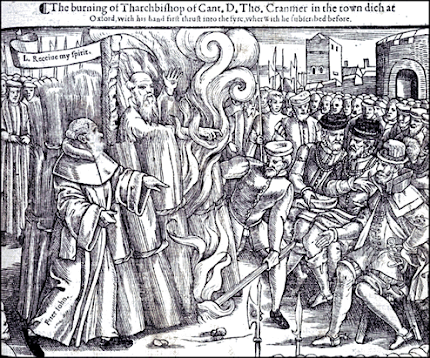
The burning of Tharchbishop of Cant. D. Tho. Cranmer in the town dich at Oxford, with his hand first thrust into the fyre, wherwith he subscribed before. [Click on the picture to see Cranmer's last words.]

Daily Bible Verse

Sunday, March 13, 2011

Clark's Answer to Van Til: On Incomprehensibility: Part Four


[The following is the continuation of The Answer given by Dr. Gordon H. Clark and his supporters to The Complaint by Dr. Cornelius Van Til and his supporters. The Answer will be given in installments as time permits. To read the pdf image file click on the links. The following is from the chapter "On Incomprehesibility". See Part One, Part Two, and Part Three.]


Clark's Answer to Van Til: On Incomprehensibility: Part Four


The method the complainants have pursued is to center attention on one accident of a proposition and then tenacity to assume that there is nothing more to be said. Because each proposition is numerically distinct, they infer that there is nothing except numerical distinction.

Later in the Complaint they offer a reason for their concern over what may seem arid logical technicalities. They assert (P. 7, 3; O. 28) “This knowing of propositions cannot, in the nature of the case, reflect or inspire any recognition by man of his relation to God, for the simple reason that the propositions have the same content, mean the same, to God and man.” If this pronouncement be applied to a concrete case, it means that the truth “Christ died for our sins” cannot reflect or inspire recognition of man's relation to God. Why propositions, such as “Christ died for our sins” cannot reflect the truth of God, the complainants do not explain. They simply make an ex cathedra statement. One may ask, of what use are all the propositions of Scripture, if they do not reflect God and his relation to man? And if propositions cannot inspire any recognition by man of his relation to God, why should anyone preach the gospel? Dr. Clark believes that the preaching of the gospel, not without the regenerating or illuminating power of the Holy Ghost, is for the express purpose of teaching man what to believe concerning God and what duty God requires of man. Since Scripture is in propositional form, the assumption of the Complaint that no statement in the Bible can reflect or inspire any recognition by man of his relation to God is both absurd and unscriptural. The second part of the same sentence purports to give a reason for the first part: propositions cannot inspire recognition of God, “for the simple reason that propositions have the same content, mean the same, to God and man.” The complainants therefore deny that propositions have the same meaning for God and man. But this denial nullifies the Bible from cover to cover. The same idea is found in another place. The Complainant infers as an untenable conclusion from Dr. Clark's views that therefore (P. 5, 2; O. 20) “a proposition would have to have the same meaning for man as for God.” Here is the basic difference in this matter for Dr. Clark and the Complainant. He holds that propositions have a single meaning, the same for God and man. The Complainant evidently assumes that a given proposition has two entirely different meanings. One of these meanings man can grasp; the other meaning God alone knows and man has no idea at all of what God means. But if this were so, what would become of the doctrine of verbal inspiration? The proposition, Christ died for our sins, has a single, definite, plain meaning. To say that God places some other, undiscoverable meaning upon these words is to empty the Bible of truth and to deny that really reveals God's mind. This logical deduction from the Complaint is to be repudiated.

Involved in the discussion of these same pages of the Complaint is the role of reason in religious knowledge. “It will be observed that Dr. Clark does not claim to derive this judgment from Scripture; it is rather regarded as an axiom of reason” (P. 5, 2; O. 19). The complainants also say (P. 5, 2; 9. 20) “and it may not be overlooked in this connection that Dr. Clark does not claim Scriptural proof for his fundamental assumption as to the character of knowledge.” One might guess that the complainants would demand exegetical proof even for the theorems of geometry. Later they say (P. 6, 3; O. 24, 25) “And that he is in error seems to be due to the fact that he does not approach the doctrine by way of an exegesis of Scripture. His approach, on the contrary, while admittedly taking into account certain teachings of Scripture, is to a large extent rationalistic. His argument is built up from certain principles derived from reason. One cannot expect a sound theology to proceed from a faulty method. In short, therefore, we hold that both the formulation of this doctrine and the method by which it is reached are out of harmony with orthodox Presbyterianism.”

It has already been shown that Dr. Clark's position agrees with Scripture, but the implication of this charge seems to be that an appeal to principles of reason is out of harmony with orthodox Presbyterianism. Now in the first place, some of this discussion is not so far removed from Scripture as the complainants seem to think. It is true that the assertion “truth may always be expressed in propositions” is not a conclusion based on the exegesis of a certain number of Scriptural passages. The doctrine of the federal headship of Adam may be deduced by exegesis from Romans 5:12ff.; and the unity of the covenant of grace is supported by Galatians 3. There is no single passage from which by exegesis one can deduce that truth may always be expressed in propositions. But it must be insisted upon that the Bible as a whole is written in propositional form. The propositions of the Bible are not propositions about propositions; that is, the Bible is not a textbook on logic. But the Bible is logical; its teaching is propositional; and in view of the fact that God chose words and propositions for his revelation, in view of the fact that God did not choose some non-propositional form of revelation, one should be cautious of disparaging propositions. There is therefore Scriptural support, even if not exegetical support, for the propositional view of truth.

In the second place, and now directly to the point, an appeal to principles of reason is not out of harmony with orthdox Presbyterianism. We trust it will be granted that William Brenton Greene, late professor of apologetics in Princeton Seminary, was an orthodox Presbyterian. The following quotation from The Function of Reason in Christianity, by W. Brenton Greene, Jr., in The Presbyterian and Reformed Review, Vol. VI, 1895, pages 499ff., illustrates a view that has had wide acceptance.

For all that logically precedes the Scriptures, as the being of God, the need of a written revelation, etc., we must go back to philosophy, to reason pure and simple . . . . Hence Henry B. Smith has well said: “If we cannot construct the foundations and the outworks of the Christian System on impregnable grounds; if we cannot show the possibility of miracles, and of a revelation; if we cannot prove—absolutely prove—the existence of a wise, intelligent, personal, and providential Ruler of all things: then we are merged in infidelity, or given over to an unfounded faith. If we cannot settle these points on the field of open discussion, we cannot settle them at all.” . . . Reason should distinguish among the interpretations of the Scriptures between what is above reason in the true sense of beyond it, and what is above reason in the wrong sense of out of relation to it, or contrary to it. That is, as a revelation must evince rationally its right to be believed; so, as has been seen, it itself can contain nothing irrational or impossible. In deciding what is thus, however, the reason must act rationally and not capriciously. Its judgments must be guided by principles which commend themselves to the common consciousness of men, such as, that that is impossible which involves a contradiction; that it is impossible that revelation should deny any well authenticated truth, whether of intuition, experience, or science; that it is impossible for what reason cannot try to comprehend to be true. All this must be so; for God, who is the Supreme Reason, cannot but be rational and hence self-consistent.”

The italicized phrase is a little awkward in expression, but its implications for the doctrine of incomprehensibility are tremendous.


(See Page 18).


Part Five


--
Reasonable Christian Blog Glory be to the Father, and to the Son : and to the Holy Ghost; Answer. As it was in the beginning, is now, and ever shall be : world without end. Amen. 1662 Book of Common Prayer

Friday, March 11, 2011

Peace (with Evangelicalism) in Our Time « Heidelblog

Peace (with Evangelicalism) in Our Time « Heidelblog

Update: How Far Has the Presbyterian Church in America Fallen?

Update: How Far Has the Presbyterian Church in America Fallen?

It seems that my public remarks in response to a public statement by Brook Larrison, pastor of Faith Presbyterian Church, Wauchula, Florida was not well received. In response to my remarks in the blog article, How Far Has the Presbyterian Church in America Fallen?, I received the following certified letter in the mail from the moderator and session of Faith Presbyterian Church:

March 9, 2011

Charlie J. Ray

The Session of Faith Presbyterian Church in the Spirit of Christ, wishes to express to you our deep concern for your Christian witness and character, in light of your posting on your blog, Reasonable Christian, with the lead article, “How Far Has the Presbyterian Church in America Fallen?” dated February 22, 2011.

In this article you repesent that you have partaken of the Sacrament of Communion in the worship service of Faith Presbyterian Church. One of the church's Ruling Elders has bore witness that you indeed have taken of the Communion elements in the past. Since you are not a member of FPC and since the Lord's Table is open only to those who are members of FPC or members in good standing of their Evangelical church, the Session had requested of you on Sunday, February, February 27, 2011 to produce the contact information of the church which has ecclesiastical jurisdiction over you. Our request has been met with silence. Unfortunately, the Session is left to conclude that you consider yourself above our spiritual authority while you attend Faith Presbyterian Church. As such the Session, is left to conclude that one, either you are a member in good standing and will not produce the information, for fear of being exposed to your Evangelical church, for your harsh attack upon Faith Presbyterian Church, Rev. Larrison and the Presbyterian Church in America, or second, you are not a member in good standing of any Evangelical church, which means you have misrepresented yourself to the Session and congregation of Faith and have with forethought and defiance partaken of the Sacrament of Communion in clear rebellion against the spiritual oversight of the Session of this church.

Therefore, the Session of Faith Presbyterian Church, Wauchula, Florida, hereby denies you future access to the Sacrament of Communion until such time as you truly repent of your misleading and false statements contained in your opinion blog of February, 22, 2011, and until such time as you can produce such testimonials that you are indeed a member in good standing of some Evangelical church.

The Session of Faith Presbyterian church,

B. T. Larrison, Emerson Jones, Joe Vance

It would be odd that I refused to comply with a request as to what church I belong to since in conversation I have several times told Brook Larrison that I was a member of Christ Church Longwood, in Longwood, Florida and that the pastor there is David Knox. Furthermore, I never received any phone calls or e-mails from Brook Larrison at any time saying that there was a problem with my Christian testimony.

It is clearly marked on my blog that I have both a bachelor of arts and a master of divinity from accredited schools. I have also been ordained as a prison chaplain with both the Assemblies of God and the Southern Baptist Convention at different points in the past. I was also a Free Methodist youth minister and an ordained deacon with the Reformed Episcopal Church at one time.

The accusation that I have misrepresented myself is utterly ridiculous. The idea that I think the authority of Faith Presbyterian Church does not trump Holy Scripture, however, is absolutely true. I hold to the doctrine of the priesthood of believers and the doctrine of Sola Scriptura. It would necessarily follow that if church members are subject to the authority of a local congregation then those who are in service to that congregation are under the authority of Holy Scripture as the final Word of God and the final authority.

If, however, a minister or a congregation opposes God's Word, then it is up to whoever is willing to sound the alarm to do so publicly. As I stated in my other blog article, the pastor, Brook Larrison, openly approved of the Roman Catholic Church as a true church and a legitimate way of salvation for those who are members of that church. I stand by my main point in that article that such ministers and such churches who support justification by works righteousness are preaching another gospel and another Christ (Galatians 1:6-9; 2 Corinthians 11:3, 4).

I have never made my position a secret, even to my former pastor, David Knox of Christ Church Longwood. I have always held that Anglo-Catholics, the Eastern Orthodox, and the Roman Catholic Church are teaching another gospel and are synagogues of satan. In saying so, I stand in the tradition of the Protestant Reformation:

Chapter 25: Of the Church


1. The catholic or universal Church, which is invisible, consists of the whole number of the elect, that have been, are, or shall be gathered into one, under Christ the Head thereof; and is the spouse, the body, the fulness of Him that filleth all in all.1


See also: WLC 64


--------------------------------------------------------------------------------


1 Eph. 1:10,22,23; Eph. 5:23,27,32; Col. 1:18


2. The visible Church, which is also catholic or universal under the Gospel [not confined to one nation, as before under the law], consists of all those throughout the world that profess the true religion;1 and of their children:2 and is the kingdom of the Lord Jesus Christ,3 the house and family of God,4 out of which there is no ordinary possibility of salvation.5


See also: WLC 62


--------------------------------------------------------------------------------


1 1 Cor. 1:2; 1 Cor. 12:12,13; Ps. 2:8; Rev. 7:9; Rom. 15:9-12


2 1 Cor. 7:14; Acts 2:39; Ezek. 16:20,21; Rom. 11:16; Gen. 3:15; Gen. 17:7


3 Matt 13:47; Isa. 9:7


4 Eph. 2:19; Eph. 3:15


5 Acts 2:47


3. Unto this catholic visible Church Christ hath given the ministry, oracles, and ordinances of God, for the gathering and perfecting of the saints, in this life to the end of the world: and doth, by His own presence and Spirit, according to His promise, make them effectual thereunto.1


--------------------------------------------------------------------------------


1 1 Cor. 12:28; Eph. 4:11,12,13; Matt. 28:19,20; Isa. 59:21


4. This catholic Church hath been sometimes more, sometimes less visible.1 And particular Churches, which are members thereof, are more or less pure, according as the doctrine of the Gospel is taught and embraced, ordinances administered, and public worship performed more or less purely in them.2


--------------------------------------------------------------------------------


1 Rom. 11:3,4; Rev. 12:6,14


2 Rev. 2 and 3 throughout; 1 Cor. 5:6,7


5. The purest Churches under heaven are subject both to mixture and error;1 and some have so degenerated, as to become no Churches of Christ, but synagogues of Satan.2 Nevertheless, there shall be always a Church on earth, to worship God according to His will.3


See also: WLC 61


--------------------------------------------------------------------------------


1 1 Cor. 13:12; Rev. 2 and 3; Matt. 13:24-30,47


2 Rev. 18:2; Rom. 11:18-22


3 Matt. 16:18; Ps. 72:17; Ps. 102:28; Matt. 28:19,20


6. There is no other head of the Church but the Lord Jesus Christ.1 Nor can the Pope of Rome, in any sense, be head thereof; [but is that Antichrist, that man of sin, and son of perdition, that exalteth himself in the church against Christ, and all that is called God.2 ]


--------------------------------------------------------------------------------


1 Col. 1:18; Eph. 1:22


2 Matt. 23:8-10; 2 Thess. 2:3,4,8,9; Rev. 13:6


In the light of the above, I can only conclude that either Brook Larrison does not agree with the Westminster Confession of Faith or that he does not understand it. I believe it is the former and not the latter.

Clearly membership in the visible church is predicated only upon a true profession of the Christian faith and not on membership in a congregation. This is particularly true since the vast majority of Evangelical churches today are Arminian and therefore have more in common with the semi-pelagianism of Rome than with the doctrines of grace as they are taught in Holy Scripture and in the Protestant Reformation.

The doctrine by which a true church or congregation stands or falls, according to Martin Luther, is the doctrine of justification by faith alone. Since the Reverend Brook Larrison directly opposed that doctrine by affirming that those who are members of a church that officially and methodically teaches doctrines directly opposed to Holy Scripture and the Westminster Confession of Faith as well as contrary to the doctrines of Scripture outlined in The Thirty-nine Articles of Religion, I can only conclude that Mr. Larrison is an advocate of works righteousness rather than justification by faith alone. I am open to hearing his response in writing but unless and until he repents or explains his endorsement of the Roman Catholic Church as a true church and that members of that church can be saved despite their open acceptance of the official teaching of the RCC then I cannot offer my endorsement of Mr. Larrison or Faith Presbyterian Church, Wauchula, Florida.

Regarding my view of the Presbyterian Church in America, it is a well documented fact that the PCA has openly refused to discipline several of its ministers who openly preach and teach the heresy of the Federal Vision view. You can see many articles on that topic at the blog of Wes White, Johannes Weslianus, who is a PCA pastor in South Dakota. R. Scott Clark has also documented the problems with the Federal Vision in the PCA at his blog, Heidelblog.

What is ironic here is that Brook Larrison has my cell phone number since I called him last week after Doc Helveston had a major stroke and was hospitalized. He also has my e-mail address. I never received any formal request for information concerning my membership in an Evangelical church. This is despite the fact that I taught Sunday school at Christ Church Longwood, Longwood, Florida and that I preached from the pulpit several times at Christ Church.

It seems obvious to me that Mr. Larrimore thinks that the priesthood of believers is rescinded at Faith Presbyterian Church and that he and his session do not have to answer to God or to God's Holy Scriptures. Every believer has the right to call out false teaching and to do so publicly when such teaching is presented publicly. Unless and until Mr. Larrison explains why someone who agrees with the official teaching of Rome can be saved I cannot in good conscience recommend Faith Presbyterian Church to any true Christian believer.


Sincerely yours in Christ,


Charlie J. Ray

P.S.  The anathemas of the Council of Trent stand as the official teaching of the Roman Catholic Church to this day.  I would also add that failure to read an exhortation to self examination prior to administering the Lord's Supper constitutes a violation of the principle of a duly ordered ministration of the sacrament.  The failure to use the biblically instituted elements of bread and wine is also a violation of that same principle.




--
Reasonable Christian Blog Glory be to the Father, and to the Son : and to the Holy Ghost; Answer. As it was in the beginning, is now, and ever shall be : world without end. Amen. 1662 Book of Common Prayer

Council of Trent | Protestant | Anathema | Justification

Council of Trent | Protestant | Anathema | Justification

Truth Matters: Why the Church of England?, by Jonathan Fletcher

[The following is from Reform in the Church of England.]


Sadly this question is now being asked quite frequently by good Christian people as they witness the denials of basic doctrines, the departure from biblical ethics and the divisions that are all too obvious in the Church of England. So why should we bother? There are at least three great reasons for remaining committed to the Church of England.

First, because of the clear doctrinal basis on which it is founded. The theological foundation of the Church of England is legally expressed in the Thirty-nine Articles, the Book of Common Prayer and the Book of Homilies. These have been justly described as the best expression of the Protestant Reformation. Here we find a clear statement as to the authority, supremacy and sufficiency of the Bible in all matters of faith and practice. The articles on the order for Holy Communion reveal that Christ's death on the cross is to be understood as propitiating God's wrath and so satisfying His holy justice. The articles explaining the doctrine of the Church (the gathering of faithful men and women) and its ministry and sacraments are truly evangelical. Yet at the same time there is a breadth in the articles so that there is provision both for adult baptism and infant baptism. There is a place for bishops but they are not essential. These are our title deeds. They are worth contending for. They belong to us, and we belong to them.

Secondly, we bother with the Church of England because of its glorious liturgy.  This may surprise some, but not only does the Book of Common Prayer (supremely in the order for the Lord's Supper) express Protestant truths, but it models the ingredients for a congregational gathering. Even if we do not use the Book of Common Prayer itself we should learn from the model it provides for that meeting. (And note that the word ‘worship' is never used to describe the gathering. It only occurs in the marriage service - ‘with my body I thee worship'.) The introduction to the order for morning and evening prayer spells out the five reasons why Christians gather to encourage one another. We are to confess our sins; give God our adoring praise; bring Him our gratitude and thanksgiving; listen to His holy Word as it is read and preached (the Prayer Book is full of Scripture); and pray for others as well as ourselves. There is a wonderful rhythm of Word and then response, Word and then response. The principles that lie behind each gathering are clear. Everything must be intelligible - therefore no strange language, whether Latin or anything else. The rubrics explain what is happening at every stage of the service. It must be congregational - so there are many opportunities for congregational participation in the Confession, the Response, the Creed, the Thanksgiving, and much singing. It must be biblical, hence the presence of so much of the Bible in every service. It must be edifying - we do not come to church primarily for God's sake but first that we might be reminded of what He has said (therefore a pulpit) and what He has done (therefore a Holy Table) and so be encouraged to keep going for another week. We are also an ‘open' church, so that our meetings should be accessible to outsiders - the meetings are not for ‘family only'.

Thirdly, historically the Church of England has proved to have great strategic significance. It is not just that the Book of Common Prayer is part of the law of this land, but in a very real way the Church of England is indeed the Church of this land - whether established or disestablished. In many places, especially in inner-city areas or country villages, where other denominations have had to close their churches, the Anglican parish church still stands. For varying reasons many still gather at their parish church, and we dare not leave them as sheep without a shepherd. Significant spiritual movements have occurred when the pulpits of our parishes have been occupied by faithful, biblical preachers.  In many, many places the Church of England is still the best boat to fish from.  We shall be mocked for this idea, it can be overstated, and it is only valid in the light of our first reason, but fishing, of course, is what we're about.

So, yes, we are Evangelicals first and foremost, but in England at any rate Anglican Evangelicals, and the Church of England is definitely worthy of our continued commitment.

Written by Jonathan Fletcher


--

Reasonable Christian Blog Glory be to the Father, and to the Son : and to the Holy Ghost; Answer. As it was in the beginning, is now, and ever shall be : world without end. Amen. 1662 Book of Common Prayer

Saturday, March 05, 2011

Reasonable Christian: Cessationism Versus Continuationism: Why The Pentecostal/Charismatic Attack On Reformed and Protestant Theology Fails

Reasonable Christian: Cessationism Versus Continuationism: Why The Pentecostal/Charismatic Attack On Reformed and Protestant Theology Fails

The Lesson of David Swing - Reformation21 Blog

Odd that the Neo-Kuyperians appeal to Clark's theology of "propositional" truth when it suits them.

The Lesson of David Swing - Reformation21 Blog

Clark's Answer to Van Til: On Incomprehensibility: Part Three

[The following is the continuation of The Answer given by Dr. Gordon H. Clark and his supporters to The Complaint by Dr. Cornelius Van Til and his supporters. The Answer will be given in installments as time permits. To read the pdf image file click on the links. The following is installment one of the chapter on incomprehensibility. See Part One and Part Two.]


Clark's Answer to Van Til: On Incomprehensibility: Part Three

The most plausible passage that the complainants cite in support of their position is Isaiah 55:8, 9. If their doctrine is not found here, it is difficult to see where in Scripture it may be found. The passage is: “For my thoughts are not your thoughts, neither are your ways my ways, saith Jehovah. For as the heavens are higher than the earth, so are my ways higher than your ways, and my thoughts than your thoughts.” At first glance this passage may seem favorable to the position of the complainants. It seems to teach that we cannot think God's thoughts—we cannot even think God's thoughts after him. But since, as has been seen, this idea is not supported by the other passages cited, one should be wary of jumping to the conclusion that it is inescapably taught here. The context of these verses aids in understanding the prophet's meaning. In a wonderful passage commanding the wicked to return unto the Lord, the promise is held out that God will abundantly pardon, “for my thoughts are not your thoughts, neither are you ways my ways.” The point is that man would say that the wicked should never be pardoned, or could never be pardoned. That is the way a man would think. God, however, thinks differently. He knows something that man does not know. God knows that he will send his Son to bear the penalty of sin, so that justice and mercy may meet. Thus God's ways and thoughts with reference to salvation were as different from man's as heaven is high above the earth. The significance of the verses therefore lies in a comparison between human thoughts about salvation and God's thoughts about it. God had plans about sending a substitutionary Saviour, which were not revealed to man, and those plans were so wonderful that there was no comparison with earthly standards. Of course there are two levels indicated in this passage: on the divine level there is rational knowledge, while on the human level are ignorance and false ideas. There are two levels, to be sure, but not two levels of knowledge. One should therefore hesitate to claim that this passage teaches that the “gulf which separates divine knowledge from human knowledge” is unbridgable by God if he chooses to bridge it, for in the case in question as a matter of fact he did bridgge it in sending the Saviour. Now we can see and understand partially, at least, but nevertheless truly, the reason by God could pardon repentant sinners in the Old Testament dispensation. We conclude therefore that even this most plausible passage cited does not really support the complainants' position regarding the incomprehensibility of God.

Brief reference should be made to certain passages which among many others more pointedly support Dr. Clark's contention that God is truly knowable insofar as he reveals himself to man. John 17:3 says, “This life is eternal that should know thee the only true God, and him whom thou didst send, even Jesus Christ.” Knowing God is said to be the essence of eternal life. No limits are placed on the amount of knowledge man may have about God. Other verses teach that man can know only what the Son reveals, but the assumption is clear that the Son can reveal to his people whatever he chooses. And it is assumed that such knowledge is true and valid for both God and man. Doubtless it would be only such knowledge as a creature could comprehend, but no limit is set for the comprehension of revealed truth. The manner of God's knowing would of course be different, and would eternallly remain incomprehensible to man, but there is no evidence that there are any items of knowledge about God which God could not reveal to us, did he choose to do so.

The second passage is John 7:17: “If any man willeth to do his will, he shall know of the teaching whether it is of God.” Here we have described the true way to true knowledge of God-revealed doctrine. Willing to do God's will is the way of knowledge of God's revelation. Certainly knowledge of God-revealed truth is here set as a goal before the man who wills to do God's will. Man may never reach the goal of perfect knowledge of revealed truth, but no barrier of mystery is here “set forth in divine revelation that” is “quite beyond the powers of the finite mind to comprehend.” On the contrary it is implied that there are no such barriers in revealed truth for the one who wills to do God's will.

The third passage is: “Whatsoever things were written aforetime were written for our learning” (Romans 15:4; cf. 1 Corinthians 10:11). Insofar as God has revealed truth to man he clearly intends man to strive to understand God's meaning. The Presbytery finds nothing in Scripture implying that God places a different meaning on a proposition from that which he intends man to understand. When Scripture says, “Ye shall know the truth” (John 8:32), certainly the assumption is that it it the same truth for both God and man. When Christ told the disiciples “Howbeit when he, the Spirit of truth is come, he will guide you into all truth” (John 16:13), he certainly implied that under the Holy Spirit's guidance man can investigate all revealed truth, and the assumption seems to be that the Holy Spirit could, if he chose, reveal any particular truth to man. That is not to claim that man can sometime in eternity become omniscient by the comprehension of one truth after another as God reveals them to him. Man's knowledge would always be temporar, and could never include either the immediate, intuitive knowledge of God, or the knowledge of all the relationships and implications of any and all propositions. The necessary content of omnisicence includes knowledge of what is to man the infinite future, the past in all its content, and all the infinite relationships and implications of all items of knowledge, past, present and future, as well as the infinite self-consciousness of God, both of his own Triune nature and of the manner in which he knows the universe, including the knowledge that God has of what is possible for him to do but which he will never do. Man can never become omniscient by adding one item of knowledge to another throughout eternity.

Several other passages of Scripture set forth Dr. Clark's view of the matter. Psalm 36:9, “In thy light shall we see light,” does not say that we shall see merely some analogical reflection of the light. A similar meaning is embedded in Psalm 43:3, “Send out thy light and thy truth, let them lead me.” Particularly significant is 1 Corinthians 13:12, “Now I know in part, but then shall I know even as I am known,” for no limit is placed on the knowledge redeemed men man acquire in heaven. If the redeemed are to know as God knows them, it would seem that God will reveal a much greater amount of knowledge in the future life than we now expect. Furthermore this verse implies that though our present knowledge is partial, it is nevertheless true knowledge of the same meaning that God has.

This is far from the so-called quantitative view of truth which the complainants charge would destroy the gulf separating divine knowledge and human knowledge, and so break down the distinction between the Creator and the creature. They have failed in their theory to grasp the correct meaning of omniscience, and they also fail to see the significance of the Scriptural injunction to “grow in knowledge” (2 Peter 3:18). Where in Scripture is there evidence that a truth or a proposition is qualitatively different for God and man? Where can one find the idea in Scripture that God's knowledge and man's knowledge do not coincide at any single point?

Even on the complainants' charge, that “Dr. Clark denies that there is any qualitative distinction between the contents of the knowledge of God and the contents of the knowledge possible to man, but rather in so far as there is any distinction between these two the distinction is merely quantitative” (P. 5, 1; O. 19), it does not follow that the distinction between the creature and the Creator is broken down thereby, or that there is “an assault upon the majesty of God” (P. 3, 1; O. 9). When the meaning of omniscience is understood as above, man's increase by revelation in knowledge on the temporal plane would, throughtout eternity, still fall infinitely short of omniscience. As a matter of fact, however, as will be seen later, Dr. Clark does not deny the qualitative distinction between God's knowledge and man's.

In the Confession of Faith there is even less support for the strange doctrine that there are mysterious areas of knowledge which God has, incapable of being revealed by God to man or of being understood by man even if God revealed them. In the Confession, II, 1, and the Larger Catechism, question 7, the word “incomprehensible” occurs as one of the attibutes of God. No theory of incomprehensibility is taught, and no explanation is given of the sense in which the term is used, though a hint is perhaps given as to the meaning by the choice of the proof text selected. The chosen text is Psalm 145:3, “His greatness is unsearchable.” As already shown, this supports the view of Dr. Clark, that man cannot by his own efforts search out or discover knowledge about the greatness of God. Dr. Clark stands by the doctrine taught in the Confession.

The Presbytery concludes, therefore, that neither in Scripture nor in the Confession is there any evidence that God, if he chooses, cannot reveal any item of knowledge to man; nor would man cease to be a creature by understanding or seeking to understand such a revelation; nor is there any evidence that a proposition is qualitatively different for God and man; nor that God's knowledge and man's knowledge do not coincide at any single point.

Having contrasted the basic contention of the Complainant regarding the knowledge of God and his incomprehensibility with the position taken by Dr. Clark on these points, and having shown that both Scripture and the Confession of Faith support Dr. Clark's position rather than that of the Complainant, it is necessary to proceed to an analysis of the Complainant itself.

The first of three numbered steps asserts that “the fundamental assumption made by Dr. Clark is that truth, whether in the divine mind or in the human mind, is always propositional.” The Presbytery replies to this assertion by pointing out that there is nothing in the transcript to justify it. The transcript is very imperfect and at times unintelligible, but the passages cited in the Complaint have nothing to do with truth as it is in the divine mind. The three passages cited speak only of truth as it is in the human mind, and therefore the Complainant misrepresents Dr. Clark. Dr. Clark has said that all truth can be expressed in propositions, but this does not mean that God thinks in propositions. The complainants in order to be fair should have noted that in the transcript (26, 1-9 and 27, 24-28, 22) Dr. Clark denies what they assert in the Complaint.

The first of these passages reads: “Q. Dr. Clark, you have said that man's knowledge is of a series of propositions, that is, discursively. A. Yes. Q. That God's knowledge is intuitive. A. Yes. Q. Do you mean by that, that God sees everything in all its infinite relation, all at one glance?” A.Yes, that is awkward language but I don't know any better, if you don't press me too hard on it.” The second passage contains these words: “Q. Do you believe that God's intuitive knowledge is the same as our discursive knowledge? A. Well, I guess not, two times two is four, both for God and for us, that is the expression of God's knowledge and if we don't know the object that God knows, then we are in absolute ignorance. Q. Would you mind repeating your statement or Mr. Andrews' statement, what was it? MR. ANDREWS: As I recall it, it was: 'God's knowledge is intuitive and He sees and knows everything in all of its infinite relations at one glance.'” These two passages of the transcript, though brief, incomplete, and defective, show clearly that Dr. Clark does not hold God's knowledge to be propositional. The complainants in their charge above have ignored the record.

With this first point based on a false statement, the remainder of step one loses all compulsion. For example, the complainants say (P. 5, 2; O. 19), “This view of truth, it will be noted, conceives of truth as fundamentally quantitative . . .” Even in the case of man, who can think only discursively, this conclusion does not follow. From the fact that each proposition may be numbered the complainants have inferred that truth is numerical or quantitative. This is extremely bad logic. The fallacy consists in stressing a fact of minor importance as as to give the impression that no other factor is involved. It is true that men know several propositions and each proposition is distinct. A mind that knows nine propositions may be said to know more than a mind that knows six. But how insignificant the mere quantity is may be grasped if we consider that one mind may know six integrated propositions, while the other mind has nine pieces of disconnected information. Not only may the information two minds have be distinguished by the degree of logical connection among its parts, but also there is a difference in the relative importance of the judgments. For example, two minds may both know six propositions, but one mind knows six general rules while the other has six particular facts. The number of propositions, the quantity as the Complaint calls it, is the same in both instances, but the former is the better mind. The complainants therefore have no evidence that Dr. Clark holds truth to be fundamentally quantitative.

Hence the complainants have failed to understand Dr. Clark and have seriously distorted and misrepresented his views. They imply (P. 5, 2; O. 20) that Dr. Clark considers that “knowledge is a matter of propositions divorced from the knowing subject, that is, of self-contained, independent statements.” This is entirely gratuitous, for there is no evidence whatsoever to support it. Dr. Clark rejects the idea that truth is independent of God. The complainants (P. 6, 2; O. 22) also say “the approach of Dr. Clark is quantitative through and through.” They are also wrong (P. 5, 3; O. 21) where they say he resolves “knowledge into detached items.” It is therefore by a disregard both of logic and of the evidence that the Complaint can conclude that (P. 5, 2; O. 19) “This view of truth, it will be noted conceives of truth as fundamentally quantitative.” As has been shown, the Complaint is at least inaccurate where (P. 5, 1; O. 19) it says that Dr. Clark holds that the distinction between God's knowledge and man's is “merely quantitative.”

[See Part Four].


--
Reasonable Christian Blog Glory be to the Father, and to the Son : and to the Holy Ghost; Answer. As it was in the beginning, is now, and ever shall be : world without end. Amen. 1662 Book of Common Prayer

Thursday, March 03, 2011

Funeral Picketing Is Free Speech, Court Rules - NYTimes.com

The Supreme Court gets this one right. While no one likes what this Primitive Baptist group has to say, if we deny them the right to speak freely then the freedom of speech for everyone else is undermined. Besides, the Westboro Baptist Church might have a point that the United States is under God's judgment for its many departures from the biblical revelation of God's moral law. Deistic moralism seems to be the position of many "Evangelical" theologians these days, including the ever popular Carl Trueman, professor of historical theology at Westminster Theological Seminary in Philadelphia.

This is encouraging, especially since many on the socialist and liberal left want to shut down the freedom of speech for religious groups and even infringe on the freedom of religion. Speaking out against homosexual sins is both a freedom of speech and a freedom of religion.


Funeral Picketing Is Free Speech, Court Rules - NYTimes.com


The Answer: Gordon H. Clark's Response Part Two: On Incomprehensibility


[The following is the continuation of The Answer given by Dr. Gordon H. Clark and his supporters to The Complaint by Dr. Cornelius Van Til and his supporters. The Answer will be given in installments as time permits. To read the pdf image file click on the links. The following is installment one of the chapter on incomprehensibility.]


On Incomprehensibility

In turning from the legal aspect of the Complaint to the theological aspects, the Presbytery wishes first of all to underscore the tenuous subtlety of the questions involved. Note well that Dr. Clark without equivocation subscribed to the Westminster Confession of Faith. The second examination concerned itself largely with the philosophical implications of certain phrases in the Confession and the particular interpretations which the questioners, now the complainants, placed upon them. This fact must be made clear to everyone who desires to see this Complaint in its true light. Dr. Clark accepts the Westminster Confession of Faith. The complainants found no objection to Dr. Clark's doctrinal views under the heading of the verbal and plenary inspiration of Scripture, the creation, providence and miracles, or the fall of man. The complainants have not attempted to attack Dr. Clark's doctrine of the atonement, effectual calling, justification by faith, sanctification, or eschatology. It is therefore not surprising that at the most largely attended meeting of the Presbytery of Philadelphia in history Dr. Clark's examination in theology was sustained by more than a three-fourths vote of the Presbytery. Even some of the complainants themselves at that meeting of Presbytery voted to sustain the examination in theology. More than three-fourths of the Presbytery of Philadelphia were satisfied of Dr. Clark's adherence to the Westminster Confession of Faith.

And now a Complaint against the Presbytery is signed by thirteen persons alleging errors in Dr. Clark's views regarding (1) the incomprehensibility of God and the relationship of God's knowledge to man's knowledge; (2) the relationships among the intellect, will, and emotions; (3) the relationship between divine sovereignty and human responsibility; (4) the offer of the gospel to man. Underlying all the charges is an assumption that Dr. Clark's thinking “bears all the earmarks of rationalism, humanistic intellectualism” and “vicious independence from God” (P. 10, 2; O. 40).

The first section of the Complaint is concerned with the doctrine of the incomprehensibility of God. Before analyzing this section step by step the Presbytery thinks it best to make some general observations on the doctrine in question. The Complaint, as will be seen, charges “that Dr. Clark's view of the incomprehensibility of God is definitely at variance with the meaning that this doctrine has had in Christian theology” (P. 5, 1; O. 18). This charge assumes that throughout Christian theology this doctrine has had but one definite meaning, for the Complaint (P. 4, 2; O. 15) also refers to “its uniform significance in the history of Christian thought”; the charge assumes that the complainants' theory is that one definite meaning; and that Dr. Clark in disagreeing with them rejects this uniform element in Christian theology. These assumptions, however, are false. The incomprehensibility of God, as explained by Dionysus the Areopagite, is quite different from the doctrine as explained by Charles Hodge. A comparison between two other theologians might show other differences, even though less violent. The assumption that it is possible to determine “the meaning that this doctrine has had in Christian theology” is therefore a false assumption. Furthermore, several of the particular points at issue in this Complaint have received far from exhaustive treatment in the history of theology. The Presbytery cannot assert that no book or manuscript has ever discussed these points, but it can assert that there is no well defined position recognized by any large number of theologians.

The view of the Complaint is that “God because of his very nature must remain incomprehensible to man” (P. 2, 3: O. 8); it is “not the doctrine that God can be known only if he makes himself known and in so far as he makes himself known” (ibid.). Moreover all knowledge which man can attain differs from the knowledge of God “in a qualitative sense and not merely in degree” (P. 4, 2; O. 15). Thus God's knowledge and man's knowledge do not “coincide at any single point” (P. 5, 3; O. 21). A proposition does not “have the same meaning for man as for God” (P. 5, 2; O. 20). Man's knowledge is “analogical to the knowledge God possesses, but it can never be identified with the knowledge” which God “possesses of the same proposition” (P. 5, 3; O. 21). “The divine knowledge as divine transcends human knowledge as human, even when that human knowledge is a knowledge communicated by God” (P. 3, 1; O. 9).“Because of his very nature as infinite and absolute the knowledge which God posseses of himself and of all things must remain a mystery which the finite mind of man cannot penetrate” (ibid.). This latter statement does not mean merely that man cannot penetrate this mystery unaided by revelation; it means that even revelation by God could not make man understand the mystery, for the preceding sentences assert that it is the nature of God that renders him incomprehensible, not the lack of a revelation about it. As the analysis proceeds, these quotations with the argument from which they are taken will be seen to imply two chief points. First, there is some truth that God cannot put into propositional form; this portion of truth cannot be expressed conceptually. Second, the portion of truth that God can express in propositional form never has the same meaning for man as it has for God. Every proposition that man knows has a qualitatively different meaning for God. Man can grasp only an analogy of the truth, which, because it is an analogy, is not the truth itself.

On the other hand Dr. Clark contends that the doctrine of the incomprehensibilty of God as set forth in Scripture and in the Confession of Faith includes the following points: 1. The essence of God's being is incomprehensible to man except as God reveals truths concerning his own nature; 2. The manner of God's knowing an eternal intuition, is impossible for man; 3. Man can never know exhaustively and completely God's knowledge of any truth in all its relationships and implications; because every truth has an infinite number of relationships and implications and since each of these implications in turn has other infinite implications, these must ever, even in heaven, remain inexhaustible for man; 4. But, Dr. Clark maintains, the doctrine of the incomprehensibility of God does not mean that a proposition, e. g., two times two are four, has one meaning for man and a qualitatively different meaning for God, or that some truth is conceptual and other truth is non-conceptual in nature.

Here is the crux of the issue. By insisting that God's knowledge is qualitatively different from that of man and that “his knowledge and our knowledge” do not “coincide at any single point,” the Complaint is advancing a theory of a two-fold truth; while Dr. Clark holds that the nature of truth is one, that if man knows any item of truth, both God and man know that same identical item, and that on this item God's knowledge and man's knowledge coincide. According to the Complaint man can never know even one item of truth God knows; man can know only an “analogical” truth, and this analogical truth is not the same truth that God knows, for the truth that God knows is “qualitatively” different, and God cannot reveal it to man because man is a creature. To repeat: the truth that God knows and the truth that man knows are never the same truth, for they do not “coincide at any single point.” God's knowledge therefore would be incomprehensible to man for the specific reason that God could not reveal any particular fact about it without destroying the “Creator-creature relationship.” Dr. Clark holds that God can reveal any item of knowledge in propositional form without destroying the Creator-creature relationship, and that such a revealed proposition has the same meaning for God and for man when, as is sometimes the case, man understands it. Now, what is the meaning of the doctrine of the incomprehensibility of God taught in Scripture and the Confession of Faith? Though the Complaint asserts that its “doctrine of incomprehensibility is the teaching of Scripture” and that it is “taught in many passages and is implicit in the doctrine of the divine transcendence which is everywhere taught or presupposed in Scripture,” it cites only a few passages, doubtless chosen because they are thought to present the strongest Scriptural proof of the doctrine. The first of these passages is Psalm 145:3, “His greatness is unsearchable.” The second passage cited is Isaiah 40:28, “There is no searching of his understanding.” And the third is from an uninspired speaker in Job 11:7, 8, “Canst thou by searching find out God? Canst thou find out the Almighty to perfection? It is as high as heaven: what canst thou do? Deeper than Sheol; what canst thou know?” The Hebrew root for search in these three passages is chaqar, which means to search or to examine. The passages all teach that man by his own unaided efforts cannot search out God's greatness or understanding. They do not teach that God cannot reveal any particular proposition about his greatness, for they are in fact themselves propositions about the greatness and understanding of God. How much God will reveal to man is quite another question; but these verses do not imply that there is a phase of God's knowledge that God cannot reveal, if he chooses to do so. And they certainly do not imply that some truth is non-conceptual in nature. Just what sort of truth would non-conceptual truth be?

1 Timothy 6:16, “dwelling in light unapproachable, whom no man hath seen or can see,” is quoted as proving that “man the creature may never trespass or even draw near to contemplate God as he is in himself” (P. 4, 3; O. 17). But this is not what the verse says. The verse does not say that man cannot contemplate or think about God; it says that man cannot see him. Theophilus, quoted by Meyer, in loc., understands the verb to see literally, and makes the verse mean that God is an invisible spirit. It is the mystic Dionysius who takes the verb to see in the intellectual sense of to contemplate, and makes the verse mean that God is unthinkable. That this mystical interpretation of negative theology is wrong, and that the verb to see in this particular verse must be understood literally, is substantiated by Job 19:26, 27, “yet in my flesh (or, without my flesh) shall I see God; whom I shall see for myself.” Superficially, Job seems to contradict Paul. The Hebrew verb in Job, chazah, often means to contemplate. It must mean contemplation here, for the literal meaning of physical sight would make the verse inconsistent with the Scriptural teaching of the spirituality of God. The literal meaning in Job would make the verse untrue. Hence Job definitely asserts that man will contemplate God. Since 1 Timothy 6:16 cannot contradict the teaching of Job, it must refer to literal sight, not to contemplation, and therefore the exegesis of the Complaint is thus shown to be mistaken. The spirituality and the invisibility of God, not his unthinkability, is also taught in John 1:18 and John 6:46, and to this teaching the former of these verses expressly adds the fact of revelation. Therefore these verses should not have been cited to prove that God has knowledge which he cannot reveal to man.

Deuteronomy 29:29, “The secret things belong unto Jehovah God; but the thinks that are revealed belong unto us and to our children forever,” also supports Dr. Clark's view of the knowledge of God. Man cannot of himself discover God's secrets; he can know only what God reveals to him; but when truths are revealed, they are revealed to be understood, for they “belong unto us and to our children forever.” Further, no one has a right to set a limit on the power of God to reveal in heaven any item which is now among the secret things. Until it is revealed, man cannot discover it; it is indeed incomprehensible because it is unrevealed.

Two other passages cited likewise agree with Dr. Clark's view: Matthew 11:27 (and Luke 10:22), “Neither doth any know the Father, save the Son, and he to whomsoever the Son willeth to reveal him.” Only the Son has that original and underived knowledge of the Father, which can initiate a revelation. Man cannot know God unless the Son “willeth to reveal him.” But when the Son reveals God, man can know him truly insofar as he is revealed, and that knowledge is true knowledge, true both for God and for man.

Romans 11:33, cited in the Complaint but not quoted, also teaches the same Scriptural doctrine that Dr. Clark accepts. None of these verses gives a hint of the Complaint's strange teaching that there is a part of God's knowledge which he cannot reveal to man, did he choose to do so, without destroying the distinction between the Creator and the creature. It is pertinent to ask just how the distinction between the Creator and the creature would be destroyed, if God made man understand some given item of knowledge so that God's knowledge and man's knowledge coincided at the point revealed by God to man. Of course God's knowledge of the subject would not be exhausted by what he revealed to man, but insofar as man understood the one revealed truth, his knowledge would coincide with that part of God's knowledge that God has chosen to reveal. The given proposition would be true both for God and for man; but what God does not reveal remains incomprehensible.


--
Reasonable Christian Blog Glory be to the Father, and to the Son : and to the Holy Ghost; Answer. As it was in the beginning, is now, and ever shall be : world without end. Amen. 1662 Book of Common Prayer

Support Reasonable Christian Ministries with your generous donation.