>

Martyred for the Gospel

Martyred for the Gospel
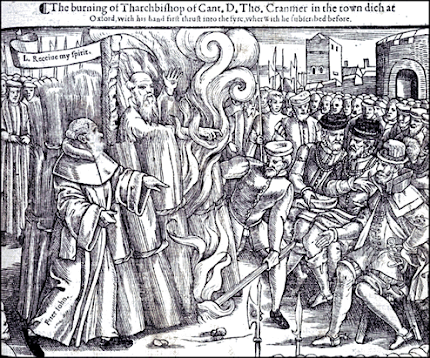
The burning of Tharchbishop of Cant. D. Tho. Cranmer in the town dich at Oxford, with his hand first thrust into the fyre, wherwith he subscribed before. [Click on the picture to see Cranmer's last words.]

Daily Bible Verse

Wednesday, June 29, 2011

Reasonable Christian: The Myth of Common Grace: The Trinity Review

Reasonable Christian: The Myth of Common Grace: The Trinity Review

The Myth of Common Grace: The Trinity Review

The Trinity Review from March/April of 1987 quotes Benjamin B. Warfield to demonstrate that the Reformed view advocates not just the plain declarations of Scripture but also what can be logically derived from the doctrine of perspicuity. Quoting from Warfield:

[T]he recent plea against the use of human logic in determining doctrine has been most sharply put forward in order to justify the rejection of a doctrine which is explicitly taught, and that repeatedly, in the very letter of Scripture; if the plea is valid at all, it destroys at once our confidence in all doctrines, no one of which is ascertained or formulated without the aid of human logic." 6


In contrast to this Scriptural view, Van Til denies the possibility of a deductive system and asserts that the "analogical truths" we have all appear to be contradictory. Apart from this unscriptural denial of the role of logic and the perspicuity of Scripture, one must ask the question: What is the meaning of a "system" of non- deducible paradoxes?

Although Westminster Seminary’s apologetics professor John Frame endorses Van Tilianism, he presents an excellent analysis of Van Til’s proposal:

" ... the necessity of formulating doctrines in ‘apparently contradictory’ ways certainly increases the difficulty of developing a ‘system of doctrine,’ especially a system such as Van Til himself advocates.... How may it be shown that one doctrine ‘requires’ another, when our paradoxical formulations fail even to show how the two are compatible?

To read the entire article click here: The Myth of Common Grace


A Guide for Young Christians | Crosswork.org

When God saves us sinners, he causes us to believe certain propositions about himself and about ourselves—ideas that we formerly thought were not true. In an instant, God resurrects us from the spiritual death of unbelief and makes us understand and believe the truth about both Jesus Christ and ourselves. Scripture refers to this event by using several figures of speech: being born again, being born from above, enlightening the mind, being resurrected from the dead, and giving us a heart of flesh for our heart of stone. What this figurative language literally means (and if you do not know what figurative language literally means, you do not know what it means) is that God affects our minds directly, causing us to accept as true, ideas we formerly thought were not true. He gives truth—figuratively called “light” in Scripture—directly to our minds. John Robbins


To read more click here: A Guide for Young Christians | Crosswork.org


Saturday, June 25, 2011

When They Say Secret, They Mean Secret « Johannes Weslianus

One has to wonder why this trial is secret when Peter Leithart has made no secret of what he believes.

When They Say Secret, They Mean Secret « Johannes Weslianus


Reasonable Christian: Did Gordon H. Clark Cross the Line into Nestorianism?

Although I agree with most of Gordon H. Clark's works, his final book was over the line since he endorsed the Nestorian view. This should not mean we ought to totally disregard Clark's earlier work.

Reasonable Christian: Did Gordon H. Clark Cross the Line into Nestorianism?


Anglican Mainstream » Blog Archive » What New Yorkers Really Think about Same-Sex “Marriage”


Anglican Mainstream » Blog Archive » What New Yorkers Really Think about Same-Sex “Marriage”

The All Sufficiency of Christ

The All-Sufficiency of Christ

by S. M. Baugh, Westminister Seminary, California

Is faith in Jesus Christ all that I need to be justified? Has Christ really done it all for me? Today we face a variety of teachings which directly or indirectly erode Paul’s gospel by telling us that faith in Christ is just not quite enough. We must add some little pinch of our own: a little holiness, a good work here or there—some little extra to ensure our place in heaven. But Paul’s answer to this is a resounding affirmation of the all-sufficiency of our Savior: “I have been crucified with Christ. It is no longer I who live, but Christ who lives in me. And the life I now live in the flesh I live by faith in the Son of God, who loved me and gave himself for me.”

To read the rest of the article click here:  The All-Sufficiency of Christ
--

Reasonable Christian Blog Glory be to the Father, and to the Son : and to the Holy Ghost; Answer. As it was in the beginning, is now, and ever shall be : world without end. Amen. 1662 Book of Common Prayer

New York Becomes the Sixth State to Legalize Gay Marriage - FoxNews.com

If anyone doubts that Christianity is on the way out in the United States, just keep watching the news headlines. There will come a time when Christians will be persecuted for their faith. This is just more evidence that tolerance for "fundamentalist" Christians is waining. Speaking out against homosexual sin will become a "hate" crime and preaching the moral law of God against such sins will be censored and silenced. How long before the wrath of God falls on the United States of America?

But understand this, that in the last days there will come times of difficulty. (2 Timothy 3:1 ESV)

Indeed, all who desire to live a godly life in Christ Jesus will be persecuted, 13 while evil people and impostors will go on from bad to worse, deceiving and being deceived. 14 But as for you, continue in what you have learned and have firmly believed, knowing from whom you learned it 15 and how from childhood you have been acquainted with the sacred writings, which are able to make you wise for salvation through faith in Christ Jesus. (2 Timothy 3:12-15 ESV)


In the Bible God sometimes uses pagan nations to punish the wayward Israel.

And Nebuchadnezzar king of Babylon came to the city while his servants were besieging it, 12 and Jehoiachin the king of Judah gave himself up to the king of Babylon, himself and his mother and his servants and his officials and his palace officials. The king of Babylon took him prisoner in the eighth year of his reign 13 and carried off all the treasures of the house of the LORD and the treasures of the king's house, and cut in pieces all the vessels of gold in the temple of the LORD, which Solomon king of Israel had made, as the LORD had foretold. (2 Kings 24:11-13 ESV)


It is true that the United States is not a theocracy led by a prophet of God. But that does not remove the fact that God can and does render justice against even nations today. I view the 9/11 attack as God demonstrating His justice even though it was executed by radical Muslims who are not saved. Earthquakes, tsunamis, famines and even wars are all examples of God's judgment against humankind. God is in absolute control of all that happens (Isaiah 45:7). The modern aversion to the providence of God is simply another example of the apostasy of most so-called Christians into the false religion of man-centered theology. Most modern "Christians" view God as some sort of heavenly bellhop whom they think will jump at their command.

The truth, however, is that God is the Sovereign King and LORD of all creation and the entire universe. He will do as He pleases with sinners, having mercy on whom He will have mercy and hardening whom He will harden. This hardening effect is evident in the state of New York since the gay rights agenda is now the civil law there. But it is not a sign of democracy and God's blessing on the United States. Instead it is a sign of God's judgment against America. God has hardened the hearts of the New York legislators just as He hardened the heart of Pharaoh (Romans 9:11-22). Since Adam's rebellion in the garden of Eden all mankind has been justly under a curse from God and all mankind has become the enemy of God subject to His wrath against sin and rebellion (Romans 3:10-23; Romans 5:12-21). How foolish to rebel against the Creator of the universe!

The Christian who believes in the sovereign grace of God and the Gospel of Jesus Christ will not reject the Reformed understanding of Scripture expressed in the Thirty-nine Articles of Religion/1662 Book of Common Prayer, the Westminister Standards, and the Three Forms of Unity. The Christian who believes in the final authority of Holy Scripture above man's opinion will stand firm against the onslaught of atheist humanism, religious pluralism, and modern socialism.

For the wrath of God is revealed from heaven against all ungodliness and unrighteousness of men, who by their unrighteousness suppress the truth. 19 For what can be known about God is plain to them, because God has shown it to them. 20 For his invisible attributes, namely, his eternal power and divine nature, have been clearly perceived, ever since the creation of the world, in the things that have been made. So they are without excuse. 21 For although they knew God, they did not honor him as God or give thanks to him, but they became futile in their thinking, and their foolish hearts were darkened. (Romans 1:18-21 ESV)

For this reason God gave them up to dishonorable passions. For their women exchanged natural relations for those that are contrary to nature; 27 and the men likewise gave up natural relations with women and were consumed with passion for one another, men committing shameless acts with men and receiving in themselves the due penalty for their error. 28 And since they did not see fit to acknowledge God, God gave them up to a debased mind to do what ought not to be done. (Romans 1:26-28 ESV)

You shall not lie with a male as with a woman; it is an abomination. (Leviticus 18:22 ESV)

If a man lies with a male as with a woman, both of them have committed an abomination; they shall surely be put to death; their blood is upon them. (Leviticus 20:13 ESV)

Or do you not know that the unrighteous will not inherit the kingdom of God? Do not be deceived: neither the sexually immoral, nor idolaters, nor adulterers, nor men who practice homosexuality, 10 nor thieves, nor the greedy, nor drunkards, nor revilers, nor swindlers will inherit the kingdom of God. (1 Corinthians 6:9-10 ESV)

. . . understanding this, that the law is not laid down for the just but for the lawless and disobedient, for the ungodly and sinners, for the unholy and profane, for those who strike their fathers and mothers, for murderers, 10 the sexually immoral, men who practice homosexuality, enslavers, liars, perjurers, and whatever else is contrary to sound doctrine, (1 Timothy 1:9-10 ESV)


Scripture is clear that homosexuality is an abomination. At one time this was not an issue even in the nation at large, although the United States has never been a "Christian nation" per se. The United States was, however, influenced by the Christian faith from its inception. With the advent of the liberal left, atheism, and socialism in the Democratic Party, however, there has been a vicious effort to marginalize Christianity and Christian morality. Make no mistake about it. The Democratic Party has declared war on Christianity. Apparently even some in the Republican Party are out to join the godless assault of the socialists and communists. It would seem that conservative Christians have no choice except to continue to preach the Gospel at the risk of their own life, liberty and religious freedom.

But as for you, O man of God, flee these things. Pursue righteousness, godliness, faith, love, steadfastness, gentleness. 12 Fight the good fight of the faith. Take hold of the eternal life to which you were called and about which you made the good confession in the presence of many witnesses. 13 I charge you in the presence of God, who gives life to all things, and of Christ Jesus, who in his testimony before Pontius Pilate made the good confession, 14 to keep the commandment unstained and free from reproach until the appearing of our Lord Jesus Christ, 15 which he will display at the proper time--he who is the blessed and only Sovereign, the King of kings and Lord of lords, 16 who alone has immortality, who dwells in unapproachable light, whom no one has ever seen or can see. To him be honor and eternal dominion. Amen. (1 Timothy 6:11-16 ESV)

Click here to see the news story: New York Becomes the Sixth State to Legalize Gay Marriage - FoxNews.com


From Exception to Rule: How Error Replaces Truth in the Church

The following is an article written for Issues, Etc. Journal by Todd Wilken, a minister in the Lutheran Church Missouri Synod.  I think the article is just as appropriate for Reformed denominations as for conservative Lutherans.

From Exception to Rule:  How Error Replaces Truth in the Church

by Todd Wilken


As I write this, the largest Presbyterian denomination in America has just officially permitted non-celibate homosexuals to serve as pastors. 

The Presbyterian Church USA joins three other US Protestant denominations in doing so. The United Church of Christ was the earliest in 1985, declaring itself “open and affirming.” The Episcopal Church USA and the Evangelical Lutheran Church in America followed suit in 2009. The United Methodist Church will likely be next. 

Each of these denominations once held a Biblical view of homosexuality. Each of them now repudiate the Bible’s teaching on homosexuality. None of this happened overnight. No denomination suddenly reverses itself on a clear Biblical teaching. It happens gradually, yet intentionally. It is no accident that some of the largest Protestant denominations have replaced a once all-male, celibate or married clergy with non-celibate gay, lesbian, bisexual and transgendered clergy.

This change didn’t happened [sic] overnight. This change didn’t happened [sic] by accident. What began as an exception to the rule, is now the rule.

To read the rest of Todd Wilken's article click here:  From Exception to Rule:  How Error Replaces Truth in the Church   (The article is in PDF format and is published in the Issues, Etc. Journal).


--
Reasonable Christian Blog Glory be to the Father, and to the Son : and to the Holy Ghost; Answer. As it was in the beginning, is now, and ever shall be : world without end. Amen. 1662 Book of Common Prayer

Friday, June 24, 2011

Reasonable Christian: The Error of Theonomy in a Nutshell, by Greg Loren Durand

Reasonable Christian: The Error of Theonomy in a Nutshell, by Greg Loren Durand

Part Seven: The Answer to the Complaint Against Dr. Gordon H. Clark

Clark's Answer to Van Til: On Incomprehensibility: Part Seven

[The following is the continuation of The Answer given by Dr. Gordon H. Clark and his supporters to The Complaint by Dr. Cornelius Van Til and his supporters. The Answer will be given in installments as time permits. To read the pdf image file click on the links. The following is installment one of the chapter on incomprehensibility. See Part One, Part Two, Part Three, Part Four, Part Five, and Part Six. See also, The Answer, in PDF].


The Complaint teaches that the truth man may have is an analogy of the truth that God has; i.e., man may have a resemblance of the truth God has; but he cannot have God's truth itself. He has only an analogy of it. The complainants would doubtless say that we must accept this dogma because God reveals it in the Bible. But where in the Bible is such a revelation found? It is not a valid deduction from the Creator-creature relationship. A valid deduction from this relationship would be that man can think only God's thoughts after him and cannot originate thoughts not already in God's mind. And such thoughts would have to have the same meaning for both God and man; they would not be mere analogies of God's meaning. The manner of God's thinking is different from the thinking processes of man, but the result of man's thinking, if his thinking is true, is that he understands at least the one truth that God thinks. Furthermore, the assumption that man knows his truth to be analogical of God's truth because God reveals it to be analogical, results in startling consequences. How could one know that this assumption itself is the truth as it is for God? On the complainants' theory the proposition “the truth man has is analogical” is itself only an analogy. It is not the truth that God has. Nor could man know that it was God who was revealing such a proposition, for again the proposition “God is revealing that truth is analogical” is only an analogy of the truth. One can only be sure that such a proposition is not God's truth. On the complainants' theory there is no way of ever crossing over from an analogy of truth to the truth itself. All our thinking is shutup in analogies and resemblances and cannot coincide with God's truth at even a single point. This position really cuts all connection between God's knowledge and man's knowledge and plunges us into unmitigated skepticism.

If the complainants cannot know what God means, how can they know God does not mean this or that? They affirm that there is a resemblance or analogy between the truth God knows and the qualitative different truth man knows. But by what right do they assert a resemblance when they cannot describe the qualitative difference? Or, how can they assert that two things resemble each other when they have never known and can never know one of them? One can say that two men resemble each other if one has seen both men. But one cannot legitmately affirm a resemblance between a man one has seen and a man one has not seen. Similarly, if a man knew God's meaning, he could compare it with his own and remark the similarity or difference. If I know your opinion, I can say it is similar to or dissimilar from mine. But if I do not know your opinion, I have no way of knowing whether your opinion is the same or contradictory of mine. Similarly if man's knowledge and God's knowledge do not “coincide at any single point,” then for all we know, perhaps Christ did not die for our sins. And the complainants wish to make their views a test for orthodoxy! Where in the Westminster Confession of Faith is there any such philosophy?

[During the preparation of this reply, a phrase was noted in The Presbyterian Guardian to the effect that those who signed the Complaint do not altogether agree with what it says. On page 351, column 3, of The Presbyterian Guardian of December 10, 1944, this sentence appears: “The complainants, to be sure, have made plain that, on their view, the knowledge which man may come to enjoy of a proposition cannot be at variance with the meaning of a proposition for God, since it must be analogical.” If, however, the complainants have made this plain, they have not made it plain in the Complaint. It is in fact doubtful that they have made it plain anywhere. They have not made it plain in the editorial from which the sentence is quoted. Aside from the absense of any definition of the word “analogical,” the phrase “at variance with” is unsatisfactory. The proposition “Joseph was sold into Egypt” is not at variance with the proposition “David was a great king.” Are we therefore to suppose that one of these is analogical of the other and that God may place the meaning of the first of these propositions upon the second? If one is interested in a philosophic theory of knowledge, the phrase “at variance with” does not solve any epistemological problem. Undefined words and sweeping phrases do not help one to think clearly. A moment's reflection will suffice to show that no true proposition is “at variance with” any other true proposition. Note the usage of this phrase in the Complaint (P. 5, 1; O. 18), quoted above in the third paragraph of this section On Incomprehensibility. Therefore to say that the meaning God places on a proposition is not “at variance with” the meaning man finds in it, is to say very little indeed. The serious matter, however, is not what the complainants say they now believe. The serious matter is what they wrote and signed in the Complaint. If the Orthodox Presbyterian Church in an unfortunate moment approves the Complaint it will be the wording of the Complaint that will define the position of the Church. The Presbytery cannot take into account the changing views of the complainants as individuals. It is called on to answer the Complaint. And the action of the Church in any formal vote will be an action on the Complaint as written and signed.]

In step three of the argument the complainants make certain admissions. They admit (P. 6, 2; O. 23) that Dr. Clark distinguishes between God's knowing a truth and man's knowing a truth. But then the complainants fail to give due weight to these, their own, admissions. Though they admit that Dr. Clark asserted this distinction, they have argued as if he had not. They attempt to justify their ignoring of the evidence. The complainants admit that Dr. Clark makes a qualitative distinction between God's knowledge and man's knowledge because he recognizes the fundamental difference between the mode of God's knowing and that of man. Then the complainants make the astounding statement, “however, this admission does not affect the point at issue here since the doctrine of the mode of the divine knowledge is not a part of the doctrine of the incomprehensibility of his knowledge. The latter is concerned only with the contents of the divine knowlege” (P. 6, 2; O. 23). The complainants actually assert that the mode of God's knowledge is not a part of the doctrine of incomprehensibility. One or two quotations from great Reformed theologians will suffice to disprove this assertion. A great theologian of the Northern Presbyterian Church, Robert J. Breckenridge, in his The Knowledge of God Objectively Considered, (1858), page 275, says “the mode in which the divine Intelligence conceives all things, distinctively, at the same time, and by one act, is wholly beyond our comprehension; that intelligence is therefore incomprehensible” (cf. pp. 285-287). Dr. Breckenridge says that the mode of God's knowing is indeed a part of God's incomprehensibility. Charnock also shows that the complainants have misunderstood the doctrine of God's incomprehensibility. In Discourse VIII, On God's Knowledge, he first speaks of the infinite number of truths God understands. On page 408 he says, “Who, then, can fathom that whereof there is no number?” This is the quantitative of mathematical concept of an infinite number of propositions which displeases the complainants. After enumerating through many pages the numberless objects of God's knowledge, Charnock finally (page 451) comes to the mode of God's knowing. There he says, “As God therefore is in being and perfection, infinitely more above a man than a man is above a beast, the manner of his knowledge must be infinitely more above a man's knowledge, than the knowledge of a man is above that of a beast; our understanding can clasp an object in a moment that is at a great distance from our sense; our eye, by one elevated motion, can view the heavens; the manner of God's understanding must be inconceivably above our glimmerings; as the manner of his being is infinitely more perfect than all created understandings. Indeed, the manner of God's knowledge can no more be known by us than his essence can be known by us; and the same incapacity in man, which renders him unable to comprehend the being of God, renders him as unable to comprehend the manner of God's understanding.” And then follows a discussion of the manner of God's knowing in which the usual distinction between intuition and discursion is made, as Dr. Clark made it I his examination. In the face of this the Complaint asserts that the mode of God's knowing is not a part of the doctrine of incomprehensibility, and on the basis of this ex cathedra announcement tries to justify its ignoring and distorting of the evidence.

The numerous quotations made by the complainants at the beginning of their argument will now be seen to have little to do with the charges against Dr. Clark. In general, the quotations say that man's knowledge is finite, limited, and partial; it differs from God's knowledge not merely in degree but also in kind. “To comprehend,” say Charles Hodge, “is to have a complete and exhaustive knowledge of an object.” But the quotations provide no basis for asserting that God cannot express himself in words; that words cannot inspire any recognition by man of his relation to God; that the statements in the Bible mean one thing for man and something qualitatively different for God; or that the mode of God's knowing is not a part of the doctrine of God's comprehensibility.

The Presbytery must emphasize that on these matters concerning the philosophic implications of God's knowledge and man's knowledge very little has been written by Reformed theologians. It is a field of doctrine that is almost unexplored. In fact it is remarkable how little appears in print on the subject beyond the first generalities. In view of this situation it is highly improper for the Complainant to dogmatize. It may be that this discussion will further the search for the truth, but it most certainly calls for caution and humility rather than for a Complaint.

In conclusion the Presbytery believes that this section of the Complaint utterly fails to prove that Dr. Clark is out of accord with the system of doctrine taught in the Westminster Confession of Faith; the items which the complainants insist upon are far removed from the system of doctrine of the Confession; they are not strictly theological doctrines at all, but tenuous implications from these doctrines; and the implications may well be fallacious. Therefore this section of the Complaint fails to show that the Presbytery of Philadelphia was in error in licensing and ordaining Dr. Clark.

[This concludes the Presbytery's response to the section of the Complaint on the incomprehensibility of God.  See page 25 of The Answer.]


--
Reasonable Christian Blog Glory be to the Father, and to the Son : and to the Holy Ghost; Answer. As it was in the beginning, is now, and ever shall be : world without end. Amen. 1662 Book of Common Prayer

Biblical Philosophy: Was Carl F. H. Henry a Rationalist?

The following is an excerpt from a short paper by G. Wright Doyle. It is included in his book, Carl Henry: Theologian for All Seasons:

In Christian apologetics, “rationalism” may describe the conviction that “if proper evidence is produced in favor of Christian faith a listener will, as a rational being, inevitably come to faith” or that “rational” evidence for the truth claims of the Bible are sufficient to persuade an honest seeker.


As Ovey rightly points out, “The current climate of postmodernism is unfavourable to rationalism in many of the above senses.” Postmoderns reject the idea of any universal truth (except their own assertion of universal relativism!) and suspect that “reason” is only a weapon in the hands of those with an agenda. “For this reason the charge that Christian belief is ‘rationalist’ can be devastating in a postmodern context.”

When Henry’s opponents brand his theological method as “rationalistic,” therefore, they score a rhetorical victory without really having to substantiate their charge.

To read the entire paper click here: Biblical Philosophy: Was Carl F. H. Henry a Rationalist?


Thursday, June 23, 2011

JOURNAL_MASTER_4.pdf (application/pdf Object)

Todd Wilken, Lutheran Church Missouri Synod, discusses how three major denominations, once orthodox on the homosexuality issue, have now replaced all male clergy with gay, lesbian and transgendered clergy:

We have watched exception-minded churches and denominations “exception” their way into apostasy. The exception-mentality in the Church must be replaced with a Truth-mentality.

How? Intolerance --patient, careful, loving but total intolerance of error in the Church. There is no exception to the Truth. In the Church, Truth should make no exception for error.

JOURNAL_MASTER_4.pdf (application/pdf Object)

Imputation of Christ's Righteousness In Justification Versus Impartation And Infusion In The Heresies Of Roman Catholic Teaching - SermonAudio.com

Imputation of Christ's Righteousness In Justification Versus Impartation And Infusion In The Heresies Of Roman Catholic Teaching - SermonAudio.com

New Anglican Mission Society announced : Anglican Church League, Sydney, Australia

New Anglican Mission Society announced : Anglican Church League, Sydney, Australia

Reasonable Christian: Table of Contents: 39 Articles: The Historic Basis of Anglican Faith

Reasonable Christian: Table of Contents: 39 Articles: The Historic Basis of Anglican Faith

Wednesday, June 22, 2011

Hope for Meaghan

Please pray for Meaghan Gerety, fifteen-year-old daughter of Sean Gerety. Sean does the God's Hammer blog, which is dedicated to Reformed theology and the Scripturalist apologetics of Gordon H. Clark.


Hope for Meaghan

God's Hammer

I have had a couple of serious theological disagreements with Sean Gerety. However, I decided to visit his blog today and found that his fifteen-year-old daughter Meaghan was in a terrible automobile accident and has severe head trauma and injuries. Please pray for Sean and his family and the family of the driver.

You can read Sean's prayer request by clicking here: God's Hammer


A bridge too far – the battle over a literal Adam

If there was no literal and historical persons, Adam and his wife Eve, then there can be no fall and no need for salvation. Neo-orthodoxy, old earth creation, theistic evolution, and every other view that undermines a literal six day creation and the seventh day rest by God. If the Bible is not true, then everything else is simply glorified mythology and religion is simply a humanistic creation to give meaning to human existence.

To read more at the Aquila Report, click here: A bridge too far – the battle over a literal Adam


Athanasian Creed. 1662 Book of Common Prayer

At Morning Prayer.

Upon these Feasts; Christmas Day, the Epiphany, Saint Matthias, Easter Day, Ascension Day, Whitsunday, Saint John Baptist, Saint James, Saint Bartholomew, Saint Matthew, Saint Simon and Saint Jude, Saint Andrew, and upon Trinity Sunday, shall be sung or said at Morning Prayer, instead of the Apostles' Creed, this Confession of our Christian Faith, commonly called the Creed of Athanasius, by the Minister and people standing.


Quicunque vult.

WHOSOEVER will be saved : before all things it is necessary that he hold the Catholick Faith.
Which Faith except every one do keep whole and undefiled : without doubt he shall perish everlastingly.
And the Catholick Faith is this: That we worship one God in Trinity, and Trinity in Unity;
Neither confounding the Persons : nor dividing the Substance.
For there is one Person of the Father, another of the Son : and another of the Holy Ghost.
But the Godhead of the Father, of the Son, and of the Holy Ghost, is all one : the Glory equal, the Majesty co-eternal.
Such as the Father is, such is the Son : and such is the Holy Ghost.
The Father uncreate, the Son uncreate : and the Holy Ghost uncreate.
The Father incomprehensible, the Son incomprehensible : and the Holy Ghost incomprehensible.
The Father eternal, the Son eternal : and the Holy Ghost eternal.
And yet they are not three eternals : but one eternal.
As also there are not three incomprehensibles, nor three uncreated : but one uncreated, and one incomprehensible.
So likewise the Father is Almighty, the Son Almighty : and the Holy Ghost Almighty.
And yet they are not three Almighties : but one Almighty.
So the Father is God, the Son is God : and the Holy Ghost is God.
And yet they are not three Gods : but one God.
So likewise the Father is Lord, the Son Lord : and the Holy Ghost Lord.
And yet not three Lords : but one Lord.
For like as we are compelled by the Christian verity to acknowledge every Person by himself to be both God and Lord;
So are we forbidden by the Catholick Religion : to say, There be three Gods, or three Lords.
The Father is made of none : neither created, nor begotten.
The Son is of the Father alone : not made, nor created, but begotten.
The Holy Ghost is of the Father and of the Son : neither made, nor created, nor begotten, but proceeding.
So there is one Father, not three Fathers; one Son, not three Sons : one Holy Ghost, not three Holy Ghosts.
And in this Trinity none is afore, or after other : none is greater, or less than another;
But the whole three Persons are co-eternal together : and co-equal.
So that in all things, as is aforesaid : the Unity in Trinity and the Trinity in Unity is to be worshipped.
He therefore that will be saved : must think thus of the Trinity.
Furthermore, it is necessary to everlasting salvation : that he also believe rightly the Incarnation of our Lord Jesus Christ.
For the right Faith is, that we believe and confess : that our Lord Jesus Christ, the Son of God, is God and Man;
God, of the substance of the Father, begotten before the worlds : and Man of the substance of his Mother, born in the world;
Perfect God and perfect Man : of a reasonable soul and human flesh subsisting.
Equal to the Father, as touching his Godhead : and inferior to the Father, as touching his manhood;
Who, although he be God and Man : yet he is not two, but one Christ;
One, not by conversion of the Godhead into flesh : but by taking of the Manhood into God;
One altogether; not by confusion of Substance : but by unity of Person.
For as the reasonable soul and flesh is one man : so God and Man is one Christ;
Who suffered for our salvation : descended into hell, rose again the third day from the dead.
He ascended into heaven, he sitteth at the right hand of the Father, God Almighty : from whence he will come to judge the quick and the dead.
At whose coming all men will rise again with their bodies : and shall give account for their own works.
And they that have done good shall go into life everlasting : and they that have done evil into everlasting fire.
This is the Catholick Faith : which except a man believe faithfully, he cannot be saved.

Glory be to the Father, and to the Son, and to the Holy Ghost;
As it was in the beginning, is now, and ever shall be, world without end. Amen.


Athanasian Creed.

The Psalms (Days 22-28).

31. O that men would therefore praise the Lord for his goodness : and declare the wonders that he doeth for the children of men!
32. That they would exalt him also in the congregation of the people : and praise him in the seat of the elders!
33. Who turneth the floods into a wilderness : and drieth up the water-springs.
34. A fruitful land maketh he barren : for the wickedness of them that dwell therein.
35. Again, he maketh the wilderness a standing water : and water-springs of a dry ground.
36. And there he setteth the hungry : that they may build them a city to dwell in;
37. That they may sow their land, and plant vineyards : to yield them fruits of increase.
38. He blesseth them so that they multiply exceedingly : and suffereth not their cattle to decrease.
39. And again, when they are minished and brought low : through oppression, through any plague or trouble;
40. Though he suffer them to be evil intreated through tyrants : and let them wander out of the way in the wilderness;
41. Yet helpeth he the poor out of misery : and maketh him households like a flock of sheep.
42. The righteous will consider this, and rejoice : and the mouth of all wickedness shall be stopped.
43. Whoso is wise will ponder these things : and they shall understand the loving-kindness of the Lord.


The Psalms (Days 22-28).


Reasonable Christian: Update: How Far Has the Presbyterian Church in America Fallen?

Reasonable Christian: Update: How Far Has the Presbyterian Church in America Fallen?

Reasonable Christian: How Far Has the Presbyterian Church in America Fallen?

Reasonable Christian: How Far Has the Presbyterian Church in America Fallen?

Reasonable Christian: Sola Fide: The Protestant Doctrine of Justification by Faith Alone in the Thirty-nine Articles of Religion

This is an article I wrote for VirtueOnline. Unfortunately my relationship with VirtueOnline has degenerated since I made a point of letting the Anglo-Catholics there know that I consider them to be heretics in need of conversion to the true and catholic faith which is Reformed, Protestant and Calvinist. Anglicanism is not and never has been Anglo-Catholic, although prior to the Reformation England was dominated by the papists. To read my article click here:

Reasonable Christian: Sola Fide: The Protestant Doctrine of Justification by Faith Alone in the Thirty-nine Articles of Religion


Tuesday, June 21, 2011

YouTube - Unconditional Election / Predestination Unto Life


YouTube - Unconditional Election / Predestination Unto Life

The_Growth_of_Government_in_the_United_States,_John_Robbins.mp3 (audio/mpeg Object)

John Robbins recorded this lecture several years ago.  He himself is now with the Lord but his insights into the growth of the U.S. economy and the growth of big government are still relevant.

The_Growth_of_Government_in_the_United_States,_John_Robbins.mp3 (audio/mpeg Object)

Monday, June 20, 2011

Reasonable Christian: Mere Christianity: Many Rooms of Relativism

Reasonable Christian: Mere Christianity: Many Rooms of Relativism

EV News :: Church clears the way for celibate gay bishops

EV News :: Church clears the way for celibate gay bishops

Doctrine

Doctrine
by Scott Price

The following is a quote taken from Dr. John Robbins forward to Dr. Gordon H. Clark's book, Faith and Saving Faith, on page vi-vii:

"The difference between Judas and the other disciples is not that they had a "personal" relationship with Jesus and he did not, but that they believed, that is, assented to certain propositions about Jesus, while Judas did not believe those propositions. Belief of the truth, nothing more or less, is what separates the saved from the damned. Those who maintain that there is something more than belief, are, quite literal, beyond belief." Jan 31, 1983

Several things run through my mind when the issue of conversion is brought up. One is the idea of what is called "cold, dead, orthodoxy, or doctrine". There is no such thing! People may be cold and dead but not truth or true doctrine. Do a word study on the word "doctrine" and you'll soon find it is vital and that God holds it in high regard.

Secondly, people say you arrive at doctrine through Christ not Christ through doctrine. My question is how can a person come to Christ unless they are taught certain doctrines about this Christ. Can a person savingly come to a christ who is not God, who is a sinner, who did not resurrect, who did not bear their sins on the tree, who did not come in the flesh, who is a bastard child of a Roman solider, etc.? You can not just go up to a person who knows nothing about Christ and tell them to believe on Christ and let that person fill in his own blanks. The blanks are DOCTRINE and God uses doctrine as a means so faith can logically, rationally, intellectually willingly, lovingly, irresistibly, grab a hold of the Christ DOCTRINALLY explained. Of course this will not happen until the Holy Spirit reveals this Christ spiritually and grants faith to the person.

These same folks cry that you must trust Christ not doctrine. You must believe in HIM, not doctrine ABOUT him. The above explanation should take care of the same argument. Some of these statements are made by people too lazy to put forth their effort to try to insure their congregations any doctrinal purity. Maybe some do not want their "authority" challenged when doctrinal details are questioned.

Some of the time people giving these arguments say it is their job only to declare the gospel and not their job to explain it. Without explanation of the gospel there will be much trouble. People will be free to develop their own perverted conclusions if there are no barriers doctrinally explained to guide them. The Spirit of God uses means to convert sinners. In other words they need to know what the gospel is NOT as well as what gospel is.

Part of what the gospel is NOT is salvation by going about to establish a righteousness of your own. This is something that is missing today: a repentance of self righteousness. If the imputed righteousness of the LORD JESUS CHRIST (HIM) is the only ground of salvation that demands our justification then this means our own righteousness not only forms no part of the ground of our salvation but must be hated and repented of.

Today in some Calvinistic circles self righteousness is not exposed as evil but sometimes is encouraged through legalism. Touch not, taste not, handle not based assurance is promoted. Sincerity replaces doctrine. Unity replaces truth. Cute little sayings replace theology. Works get added to grace. Christ's character is dishonored. Man's pride is exalted. Dung and filthy rags somehow are now on the same playing field as grace. How did this happen? A distain of the doctrine that we are supposed to promote and not suppress. It comes from trying to trim the sharp edges off the offense of the gospel by removing words such as "ALONE" from doctrinal statements.

Both salvation and true assurance is in the object of our faith, HIM AND HIS RIGHTEOUSNESS. Repent daily from all else as any hope of salvation or assurance and we will have the peace that only HE can give.


Doctrine


Saturday, June 18, 2011

Quote of the Day: The Answer Given by Dr. Gordon Clark and the Philadelphia Presbytery, Page 21

"What Dr. Clark said was that though God's knowledge of a truth is different from man's knowledge of the same truth, it is none the less the same truth that they both know; if indeed man knows anything. The Complaint avers that it is a prerequisite of ministerial good standing to believe that God's knowledge and man's knowledge do not “coincide at any single point” (P. 5, 3; O. 21). It tries to set up as a test of orthodoxy the denial that man knows even one truth God knows. If therefore God knows that two times two are four, and that Christ died for our sins, man cannot know these propositions. Man and God, according to the Complaint, cannot know the same truth, because God's knowledge and man's knowledge do not “coincide at any single point.” And this view the Complainants are attempting to make a test of orthodoxy. In reply the Presbytery wishes to suggest that if man does not know at least one truth that God knows, if man's knowledge and God's knowledge do not coincide in at least one detail, then man knows nothing at all. God knows all truth, and if man's mind cannot grasp even one truth, then man's mind grasps no truth. Far from being a test of orthodoxy this test imposed by the Complaint is nothing else than skeptism and irrationalism." From The Answer. The Philadelphia Presbytery's response to The Complaint.... Orthodox Presbyterian Church...
--

Reasonable Christian Blog Glory be to the Father, and to the Son : and to the Holy Ghost; Answer. As it was in the beginning, is now, and ever shall be : world without end. Amen. 1662 Book of Common Prayer

Clark's Answer to Van Til: On Incomprehensibility: Part Six

Clark's Answer to Van Til: On Incomprehensibility: Part Six

[The following is the continuation of The Answer given by Dr. Gordon H. Clark and his supporters to The Complaint by Dr. Cornelius Van Til and his supporters. The Answer will be given in installments as time permits. To read the pdf image file click on the links. The following is installment one of the chapter on incomprehensibility. See Part One, Part Two, Part Three, Part Four, and Part Five.]


Continued from page 20 of The Answer.

In studying this subject one should be careful to avoid certain apparently common confusions. Strict accuracy is required. The word knowledge has two meanings; both are good English; but the one should never be taken for the other. When one says, This man has great knowledge, the word refers to the objects, i.e., the truths or propositions he knows. On the other hand when one, Man has discursive knowledge, the word refers, not to the objects known, but to the manner of knowing. The simple phrase God's knowledge may bear either meaning, but what is true of one meaning is not necessarily truth of the other meaning. In the phrase God's knowledge of a proposition the word knowledge refers to the intuitional character of his knowing. It cannot refer to the content known, for if it did, the phrase could be exactly reproduced as God's object of an object, or God's truth of a truth, or God's proposition of a proposition. The complainants in attacking Dr. Clark's position are not concerned with knowledge in the sense of the manner of knowing. They distinguish and they admit Dr. Clark distinguishes between intuition and discursion, but they claim that the manner of God's knowing is no part of the doctrine of incomprehensibility. Hence the theory of the Complaint is that the objects or truths known by God are different from those known by man. Another possible confusion arises from the ambiguity of the word meaning. Sometimes meaning means implication; as for example when one says, The clouds in the sky tonight mean rain tomorrow. Thus it is possible to say that God sees more meaning in a particular proposition than man does because he sees its far reaching implications. This, however, is not the meaning of meaning in this discussion. The Complaint (P. 6, 1-2; O. 23) definitely sets aside this meaning as irrelevant. Therefore those who study the Complaint and this reply must restrict themselves to another and more basic meaning of meaning. This more basic meaning is simply the particular truth itself. The proposition, Two times two are four, apart from anything it implies, means just what it says. It is difficult, in fact it is impossible to express the meaning of this proposition in any terms simpler than the words, Two times two are four. It is in this sense that the Complaint asserts that such a proposition has two different meanings. Though these distinctions are clear and elementary, experience shows that they are often confused.

What Dr. Clark said was that though God's knowledge of a truth is different from man's knowledge of the same truth, it is none the less the same truth that they both know; if indeed man knows anything. The Complaint avers that it is a prerequisite of ministerial good standing to believe that God's knowledge and man's knowledge do not “coincide at any single point” (P. 5, 3; O. 21). It tries to set up as a test of orthodoxy the denial that man knows even one truth God knows. If therefore God knows that two times two are four, and that Christ died for our sins, man cannot know these propositions. Man and God, according to the Complaint, cannot know the same truth, because God's knowledge and man's knowledge do not “coincide at any single point.” And this view the Complainants are attempting to make a test of orthodoxy. In reply the Presbytery wishes to suggest that if man does not know at least one truth that God knows, if man's knowledge and God's knowledge do not coincide in at least one detail, then man knows nothing at all. God knows all truth, and if man's mind cannot grasp even one truth, then man's mind grasps no truth. Far from being a test of orthodoxy this test imposed by the Complaint is nothing else than skepticism and irrationalism.

The Church has a right to know what sort of strange doctrine the Complaint is making a test of orthodoxy. Does it mean that God in knowing that two times two are four also sees intuitively the logical connection with some theorem of higher mathematics not yet discovered by man? Does the Complaint mean that as God thinks “Christ died for our sins,” he also understands far-reaching consequences man has not dreamed of? No, this is not the point the Complaint is making. As the transcript shows Dr. Clark holds that God knows all these implications. But this view of Dr. Clark is what the Complaint rejects as a “quantitative” view of truth. The Complaint is not arguing that God knows more propositions. Its point is that the first proposition itself, viz., two times two are four in its narrowest and minimal significance, is qualitatively different for God. What is this qualitative difference? This is a question the Complaint has not answered. The ordinarily recognized qualities of simple propositions are: affirmative, negative, universal, particular, true, and false. Do the complainants hold that a proposition which is affirmative for man is negative for God? Or is a proposition that is true for God false for man? What the qualitative difference is that they have in mind, they have not divulged. But if they cannot state clearly what this qualitative difference is, how can such an unknown quality be made a test of orthodoxy?

At any rate the Complaint definitely states that man's knowledge and God's knowledge “do not coincide at any single point”. This assertion does not refer to the modes of knowing truth, as will be made quite evident in step three. It refers strictly to the truth itself. The Complaint teaches that any given proposition does not mean the same thing for God as it means for man. “Two times two are four” is a given proposition; therefore it means one thing for man; and something qualitatively different for God. The truth “Christ died for our sins,” does not have the same meaning for man and for God. May it mean for God that Christ did not die for our sins? The complainants of course would deny that it could quite mean that. But does not their philosophy give them reason for making such a denial?


Continued from page 22 of The Answer.
--
Reasonable Christian Blog Glory be to the Father, and to the Son : and to the Holy Ghost; Answer. As it was in the beginning, is now, and ever shall be : world without end. Amen. 1662 Book of Common Prayer

Good Works Can't Save

Why Our Good Works Cannot Save Us

Excerpted from Ray Pritchard, "Sola Fide: By Faith Alone," Series: The Four "Solas," © 1997,

Delivered on July 13, 1997 to Calvary Memorial Church, Oak Park, Illinois. Online: available at http://www.cmcop.org/sermons/071397.HTM, Accessed: July 18, 2002.


But why is it that good works cannot save us? Here are five answers to that question. First, good works can't cancel your sin but sin ruins your good works. Suppose you invite me over for breakfast one morning and offer to fix a three-egg omelet. As you begin to cook, I smell a putrid odor coming from the kitchen. What's that awful smell? Oh, it's just a rotten egg. But don't worry, I added a few good eggs that will cancel out the rottenness. Do you think I would eat your omelet? Not for a million dollars. Why? Because goodness doesn't cancel rottenness but rottenness ruins goodness. The same is true in the spiritual realm. You can’t be good enough to cancel out the putrid effect of your own sins.

Second, good works can't save you because God doesn't grade on a curve. He demands absolute perfection. If you understand the Bible, you know that it only takes one sin to send you to hell. Let's suppose that you somehow only committed three sins a day. That's impossible for most of us because we commit that many sins before getting out of bed in the morning. But let's give you credit for being very, very good. And let's further suppose that you never committed more than three sins a day for your entire life. That would be over 1000 sins a year, which would mean that in 70 years you would end up with over 70,000 sins on your record. Now let's further suppose that those sins were really speeding tickets. If a police officer stopped you for running a red light and discovered that you had 70,000 outstanding speeding tickets on your record, what would he do with you? You'd end up in jail so long they would throw away the key. Do you think God is any different? But you and I commit far more than three sins a day. Our sins are like a mountain-so high we can’t climb over it, so wide we can't walk around it, so deep we can't tunnel under it. Our sins are so great that our works could never save us.

Third, good works can't save you because you can never be good enough long enough. Just when you get a "good streak" going, you sin and have to start all over again.

Fourth, you can never be sure you've done enough. That's why most religious people have no assurance of their salvation. They truly believe that being good will get them to heaven. But as we've already seen, "doing good" is never good enough because we can never do enough to pay for our own sins.

There is one more answer to consider. Good works can't save you because if they could, you wouldn't need Jesus at all. Why would Jesus die on the cross if somehow you could save yourself? When we get to heaven, no one will be able to say, "You and me, Jesus, we did it together. I baked the cookies and you died on the cross." It's either all by Jesus or all by your own efforts – and nothing in between.


Good Works Can't Save


Marriage License—in Bed with the State!

Marriage License—in Bed with the State!

Tuesday, June 14, 2011

Clark's Answer to Van Til: On Incomprehensibility: Part Five

Clark's Answer to Van Til: On Incomprehensibility: Part Five

[The following is the continuation of The Answer given by Dr. Gordon H. Clark and his supporters to The Complaint by Dr. Cornelius Van Til and his supporters. The Answer will be given in installments as time permits. To read the pdf image file click on the links. The following is installment one of the chapter on incomprehensibility. See Part One, Part Two, Part Three, and Part Four.]

Continued from page 18 of the PDF file of The Answer:

This quotation from W. Brenton Greene, Jr., particularly his approval of the two sentences from Henry B. Smith, may seem rationalistic to those who have not been raised in the Presbyterian tradition. The Presbytery does not insist that Greene's position must be accepted. The point is that here is a man whom all ought to recognize as orthodox; he was not only a Presbyterian minister, he was the professor of apologetics in what was at that time the citadel of Presbyterian orthodoxy. And this professor of apologetics gives a wider scope to reason that does Dr. Clark. If, as the Complaint argues, “One cannot expect a sound theology to proceed from a faulty method,” if, that is, a faulty method vitiates a man's doctrine of the atonement and all other doctrines, then according to the argument of the Complaint Greene's theological views must have been thoroughly heretical because his method is even more “rationalistic” than that alleged of Dr. Clark. If the Orthodox Presbyterian Church is ready to require subscription to a particular apologetic, let this change come by an open attempt to amend the Confession of Faith and not by the indirect method of a Complaint against a particular action of one Presbytery.

A. A. Hodge, also, in his Outlines of Theology appeals to reason. On page 19, 8, 2d, he refers to “the light of nature.” Just below he speaks of “the demonstration of the a-priori possibility of a supernatural revelation.” On page 37 he answers Hume by an appeal to “a universal and necessary judgment of reason.” On page 45 he says, “It is certain that the intuitions of necessary truth are the same in all men. They are not generalizations from experience, but are presupposed in all experience.” See in particular his defense of natural theology on page 53, 1, 1st, page 54, 2, 2d; also page 61, 10. On page 62, 14, 1st, he also says, “Reason is the primary revelation God has made to man, necessarily presupposed in every subsequent revelation of whatever kind . . . Hence no subsequent revelation can contradict reason acting legitimately within its own sphere . . . To believe is to assent to a thing as true, but to see that it contradicts reason, is to see that it is not (italics his) true.” Again on page 63, 15, 1st, “The first principles of a true philosophy are presupposed in all theology, natural and revealed. 2d, The Scriptures, although not designed primarily to teach philosophy, yet necessarily presuppose and involve the fundamental principles of a true philosophy.”

If the complainants object to Dr. Clark's method as unsound, they must also repudiate the methods of old Princeton as “out of harmony with orthodox Presbyterianism.” The Presbytery does not assert that the Confession requires adherence to everything in the Princeton apologetic. Other forms of apologetics may also be permitted. But without specifically amending our standards any attempt to exalt one method as alone orthodox and to repudiate all appeal to the a-priori truths of reason is intolerable.

Here some analysis is required of the charges of “humanistic intellectualism” later made against Dr. Clark at two points (P. 7, 3; O. 29; and P. 10, 2; O. 40) and of rationalism in the theological sense (P. 10, 2; O. 40; and P. 10, 3; O. 41; P. 6, 3; O. 25). The Complaint does not charge Dr. Clark with the Sophistic man-measure theory or its modern equivalent, pragmatism. It is therefore admitted on all hands that Dr. Clark does not make the human mind the standard of truth. Intellectualism, as opposed to pragmatism, holds that truth is immutable and independent of man. Dr. Clark holds the usual form of intellectualism, that truth is indeed independent of man, though not independent of God; and this position coupled with Dr. Clark's acceptance of the Scriptures as the only rule of faith and practice disposes of the added charge of rationalism.

While the tenor of the Complainant is anti-intellectualism, it is hard to find in a doctrinally conscious Christianity any reason for opposing intellectualism. The Complaint, however goes further and charges Dr. Clark with “humanistic” intellectualism. In using the notion of humanism, the Complainant obviously does not refer to the Renaissance phenomenon of the study of the classics or to the modern study of the humanities. Humanism in modern philosophical terminology is but a polite term for atheism. Although humanism is predominately pragmatic and anti-intellectualistic, a theory of humanistic intellectualism would hold that immutable truth depends neither upon God nor man, but finally and ultimately upon the spatial, corporeal universe or some other alleged ground. It is questionable whether the Complaint really means what it seems to say in charging Dr. Clark with “humanistic intellectualism,” for this would be to accuse him of atheism. Such a charge would be nothing less than calumny and slander.

Since step two of the argument of this part of the Complaint depends on or repeats step one, not much more in the way of a reply is needed. It ought to be pointed out, however, that step two begins with a false statement. The Complainant says, “Dr. Clark holds that man's knowledge of a proposition, if it is really knowledge, is identical with God's knowledge of the same proposition.” The complainants refer to seven passages in the transcript to support their contention. Not one of the seven references says anything remotely resembling the sentence above, and two of the seven directly contradict it. Page 18, line 23 of the transcript is one of these references. The passage, obviously incorrectly reported in detail, reads, “ I know of two points, often this subject. That is—the method of knowledge—knowing, is, in the case of God not acquisitional, but in our case it is. That is one point of it, and the only other point that has reference to the subject is: The object known, such as two times two equals four. I hold that that is the same as it is for God, but the method of knowing it is entirely different.” On the same page of the transcript (18, 5) Dr. Clark had said, “Briefly I should say that God's knowledge is intuitive and ours indispersive?” (sic). The other of the two references expressing essentially the same thought is 28, 14-22. In other words, Dr. Clark in the transcript says God's knowledge of a given object is not the same as man's knowledge of the same object. And the complainants after reading these passages say that “Dr. Clark holds that man's knowledge of a proposition . . . is identical with God's knowledge of the same proposition.” The Complaint therefore has attempted to put into Dr. Clark's mouth the very position he explicitly denied.

(See page 20 of The Answer).

Support Reasonable Christian Ministries with your generous donation.