>

Martyred for the Gospel

Martyred for the Gospel
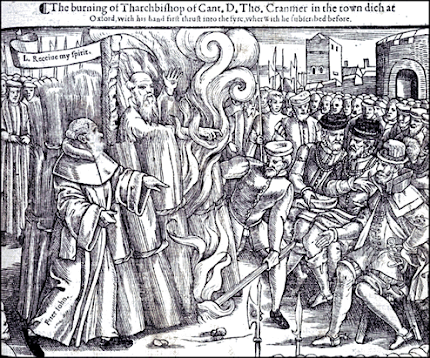
The burning of Tharchbishop of Cant. D. Tho. Cranmer in the town dich at Oxford, with his hand first thrust into the fyre, wherwith he subscribed before. [Click on the picture to see Cranmer's last words.]

Daily Bible Verse

Wednesday, February 29, 2012

The Real Presence: Church Association Tract 025


THE REAL PRESENCE


I. It is of the utmost importance that we rightly understand the meaning of the expression “the Real Presence;” as otherwise we may be contending against what is not maintained, or rejecting what ought to be embraced most firmly.

II. The Church of England nowhere uses the phrase, “The Real Presence” in reference to the Lord’s Supper. It was an expression equivalent in the minds of the Reformers to the Popish doctrine of Transubstantiation. Thus Cranmer speaks of “The Popish doctrine of Transubstantiation, of the real presence of CHRIST’s flesh and blood in the sacrament of the altar, as they call it.”

Still, a real presence of CHRIST not only may be, but must be maintained by every true Christian; a real presence, that is of “CHRIST and his Holy Spirit by their mighty and sanctifying power, virtue, and grace, not in or under the form of bread and wine, but in all them that worthily receive the same.” Nor is this real presence confined to the right use of the Lord’s Supper. It is also to be maintained in the right use of all the ordinances of CHRIST’S Church, and all the means of grace whether public or private.

III. The Ritualists, however, use the expression, if not exactly in the Popish sense as equivalent to transubstantiation yet to express substantially the same doctrine; and to deny this is a mere juggle of words without meaning. Their doctrine is this:

That by virtue of consecration the Body and Blood of our Saviour, CHRIST, are present really and truly, but spiritually and ineffably under the form of bread and wine.” “This presence is conferred by the word of CHRIST, as spoken by the priest, through the operation of the HOLY GHOST, irrespective of faith and of any personal qualification, either in the consecrator or receiver.” (Declaration of twenty-one priests : and Mackonochie’s pastoral.)

This language is plain. It matters not whether it be called transubstantiation or consubstantiation; superlocal or supralocal; ineffable, transcendental, mysterious or spiritual. The meaning is plain, viz., that the real Body and Blood of CHRIST are really and truly present on the table, under the form of bread and wine.

IV. It is not necessary at present to point out that if this be so, the Adoration of the Host, and the Sacrifice of the Mass are but legitimate consequences of the doctrine; but the object of this paper is to prove that the doctrine of the Real Presence, as thus defined, is contrary to the Church of England.

1. In the Prayer of Consecration, we ask GOD to grant that “we receiving these his creatures of bread and wine, according to our Saviour JESUS CHRIST’S holy institution, in remembrance of his death and passion, may be partakers of his most blessed body and blood.” [Nota bene: To see the Prayer of Consecration go to the Holy Communion service and scroll down to just below the Prayer of Humble Access. Charlie.]

This petition would be wholly needless if CHRIST were really present under the form of bread and wine; for in that case he that received the one must also receive the other. The petition therefore would be, not that we may be partakers, but that we may be worthy partakers.

Church Association Tract 025 Page 2 of 4

2. In the second post communion prayer, we thank GOD for that he does “vouchsafe to feed us, who have duly received these holy mysteries (i.e. sacred emblems) with the spiritual food of the most precious Body and Blood of our Saviour, CHRIST.

Here the reception of the Body and Blood is confined to those who “duly receive.” Not so, however, if the Real Presence be under the form of bread and wine, irrespective of any personal qualification on the part of the receiver.

3. In the declaration, at the end of the Communion Service, we are told that “no adoration ought to be done unto any Corporal Presence of CHRIST’S natural Flesh and Blood. For the natural Body and Blood of our Saviour, CHRIST, are in Heaven, and not here;” it being against the truth of CHRIST’S natural Body to be at one time in more places than one.

Note here—any Corporal Presence is denied by the Church. The word corporal means bodily, and can mean nothing else. So that the Church rejects any bodily presence of CHRIST: no matter what words are used to mystify plain people, such as supra-local, ineffable, and mysterious; to all such we reply, the Church rejects any bodily presence whatever.

The Ritualists try to evade the force of this by saying, that, whilst the natural Body of CHRIST is in heaven, the spiritual Body is on the table. What ridiculous absurdity, and heretical withal. Has CHRIST two bodies, a natural and a spiritual: one in heaven and the other on earth? It would be an insult to the understanding of a child to attempt to refute that, which carries its own refutation with it; just as much to assert that one and one make three.

4. In the Communion of the Sick we are told that “if the sick man do truly repent him of his sins, and steadfastly believe in the Blood of CHRIST shed for his redemption, he doth eat and drink the Body and Blood of Christ profitably to his soul’s health, although he do not receive the Sacrament with his mouth.

Here we have Real Presence in the soul of the penitent believer independent of the Sacrament altogether.

The Catechism teaches us “that the Body and Blood of CHRIST are verily and indeed taken and received by the faithful in the LORD’S Supper.” This limitation of the reception to the personal qualification of the receiver, the faithful, is fatal to the idea of a real presence independent of faith. The faithful, and the faithful only, i.e. those, who are indeed believers in CHRIST, find a real presence; a real presence of CHRIST within their hearts, not in the elements.

6. The 28th Article declares that “the Body of CHRIST is given, taken, and eaten in the Supper only after an heavenly and spiritual manner. And the mean whereby the Body of CHRIST is received and eaten in the Supper is Faith.”

This would not be true if the Body is eaten by the mouth; for this is not spiritual, but natural and carnal. Nor is it true, that the Mean—the one, only, mean of reception is Faith, if we receive it also in the hand. The doctrine of the 28th Article is therefore against the notion of the Ritualistic Real Presence, and agrees with the beautiful expression of Hooker, that “Faith is the only hand which putteth on Christ to justification, and Christ the only garment which being so put on covereth the shame of our defiled natures.”

7. The 29th Article is “of the wicked who eat not the Body of CHRIST in the Lord’s Supper.”

This one Article is conclusive, if even it stood alone; for it declares that “the wicked, and such as be void of a living faith, although they do carnally and visibly press with their teeth the Sacrament of

Church Association Tract 025 Page 3 of 4

the Body and Blood of CHRIST, yet in no wise are partakers of Christ; but rather to their condemnation, do eat and drink the sign or Sacrament of so great a thing.”

Note here—those, that are destitute of a living faith, are in no wise partakers of CHRIST, although they do eat and drink the outward sign or Sacrament. This would not be true if there were a Real Presence irrespective of faith; for then they would in some wise, even if to their condemnation, receive CHRIST. But now they “in no wise” receive the Body, but only the sign of the Body.

Observe, too, the contrast between the statements in the Catechism and in this place.

The faithful receive the Body and Blood of CHRIST verily and indeed in the Lord’s Supper; yea, whether they receive the Lord’s Supper or not. (Vide Communion of Sick.)

The faithless are in no wise partakers of CHRIST, whether they eat the Sacrament or no. (Art. xxix.)

It is evident, therefore, that the doctrine of the Church is in perfect accordance with that of Holy Scripture on this subject. CHRIST is the bread of life. He that cometh to me, saith the Saviour, shall hunger; he that believeth on me shall never thirst. Therefore, to come is to eat; to believe is to drink. Again: “he that believeth on me hath everlasting life; and whoso eateth my flesh and drinketh my blood hath everlasting life.” The same result—everlasting life—is connected with believing on CHRIST, or eating his flesh and drinking his blood. These expressions then are equivalent—mean the same spiritual action; unless indeed we maintain, that we can have eternal life by eating without believing, or by believing without eating.

V. The Ritualistic Real Presence is contrary to the views of the Reformers.

Cranmer says—

They say that CHRIST is corporally under or in the form of bread and wine, we say that CHRIST is not there, neither corporally nor spiritually; but in them that worthily eat and drink the bread and wine he is spiritually, and corporally in heaven. (P.S. p. 5.)

Hooker says—

The Real Presence of CHRIST’S most blessed Body and Blood is not therefore to be sought for in the Sacrament, but in the worthy receiver of the Sacrament.” (Vol. ii. p. 5.)

Jeremy Taylor—

CHRIST is present in the Sacrament to our spirits only, i.e. not present to any other sense but that of faith. CHRIST is present as the Spirit of GOD is present in the hearts of the faithful by blessing and grace.” (p. 522.)

Where, now, is the difference? Here by ‘spiritually,’ they mean present after the manner of a spirit; by ‘spiritually,’ we mean present to our spirits only; that is, so as Christ is not present to any other sense but that of faith, a spiritual susception.” (Real Presence, p. 15.)

Again—

But we by the real spiritual presence of Christ do understand Christ to be present, as the Spirit of God is present in the hearts of the faithful by blessing and grace.” (Ibid.)

Lastly—to quote the Judgment of the Privy Council in the Bennett case, delivered June 8th, 1872—we read,

Church Association Tract 025 Page 4 of 4

Any other presence than this—ANY PRESENCE WHICH IS NOT A PRESENCE TO THE SOUL OF THE FAITHFUL RECEIVER—the Church does not by her Articles and Formularies affirm, or require her ministers to accept. This cannot be stated too plainly.”

Protestant Churchmen, enough has now been written, not merely to assert, but to prove that the doctrine of the Real Presence as taught by the Ritualists of our day, is unscriptural, anti-Reformational, and expressly condemned by the formularies of the Church.

Wherever this doctrine is held, it is accompanied by the blasphemous Sacrifice of the Mass and the idolatrous worship of the Host. Already, this is the case in countless churches throughout the land. If the plague be not arrested and eliminated from the National Church, it must lose its hold on public opinion and fall. Let us make an effort to prevent such a catastrophe.

--  Glory be to the Father, and to the Son : and to the Holy Ghost; As it was in the beginning, is now, and ever shall be : world without end. Amen.

Calvinist Cartoons: When Analogy Breaks Down


The Clark/Van Til controversy rages on.  Saying that all Scripture is analogical is essentially semi-neo-orthodox theology since even historical events, parables, analogies, metaphors, and anthropomorphisms can only be understood by the propositional truth claims they make.  Matthew 4:4; John 10:35.  This is courtesy of Calvinist Cartoons.

Vincent Murphy » O God the Father, of heaven : have mercy upon us miserable sinners

Vincent Murphy » O God the Father, of heaven : have mercy upon us miserable sinners

Sunday, February 26, 2012

The Lutheran Doctrine of Salvation, Charles Hodge

Charles Hodge
[I have no reason to doubt Charles Hodge in his description of the Lutheran position below.  Clearly this idea that there is contingency as to who will be reprobate or elect has more to do with the semi-pelagian view of Rome.  Luther's view, as argued in The Bondage of the Will, is that there is no contingency with God and that everything that happens is God's will.]

"As this system was illogical and contrary to the clear declarations of Scripture, it did not long maintain its ground. Non-resistance to the grace of God, passively yielding to its power, is something good. It is something by which one class is favourably distinguished from another; and therefore the reason why they, rather than others, are saved, is to be referred to themselves and not to God, who gives the same grace to all. The later Lutheran theologians, therefore, have abandoned the ground of the "Form of Concord," and teach that the objects of election are those whom God foresaw would believe and persevere in faith unto the end."  Charles Hodge

You openly declare that the immutable will of God is to be known, but you forbid the knowledge of His immutable prescience. Do you believe that He foreknows against His will, or that He wills in ignorance? If then, He foreknows, willing, His will is eternal and immovable, because His nature is so: and, if He wills, foreknowing, His knowledge is eternal and immovable, because His nature is so. From which it follows unalterably, that all things which we do, although they may appear to us to be done mutably and contingently, and even may be done thus contingently by us, are yet, in reality, done necessarily and immutably, with respect to the will of God. For the will of God is effective and cannot be hindered; because the very power of God is natural to Him, and His wisdom is such that He cannot be deceived. And as His will cannot be hindered, the work itself cannot be hindered from being done in the place, at the time, in the measure, and by whom He foresees and wills.  --Martin Luther, The Bondage of the Will:  The Sovereignty of God.

    It is not easy to give the Lutheran doctrine on this subject, because it is stated in one way in the early symbolical books of that Church, and in a somewhat different way in the "Form of Concord," and in the writings of the standard Lutheran theologians. Luther himself taught the strict Augustinian doctrine, as did also Melancthon in the first edition of his "Loci Communes." In the later editions of that work Melancthon taught that men cooperate with the grace of God in conversion, and that the reason why one man is regenerated and another not is to be found in that cooperation. This gave rise to the protracted and vehement synergistic controversy, which for a long time seriously disturbed the peace of the Lutheran Church. This controversy was for a time authoritatively settled by the "Form of Concord," which was adopted and enjoined as a standard of orthodoxy by the Lutherans. In this document both the doctrine of cooperation and that of absolute predestination were rejected. It taught the entire inability of the natural man for anything spiritually good; and therefore denied that he could either prepare himself for regeneration or cooperate with the grace of God in that work. It refers the regeneration of the sinner exclusively to the supernatural agency of the Holy Spirit. It is the work of God, and in no sense or degree the work of man. But it teaches that the grace of God may be effectually resisted, and that the reason why all who hear the gospel are not saved is that some do thus resist the influence which is brought to bear upon them, and others do not. While, therefore, regeneration is exclusively the work of the Spirit, the failure of salvation is to be referred to the voluntary resistance of offered grace. As this system was illogical and contrary to the clear declarations of Scripture, it did not long maintain its ground. Non-resistance to the grace of God, passively yielding to its power, is something good. It is something by which one class is favourably distinguished from another; and therefore the reason why they, rather than others, are saved, is to be referred to themselves and not to God, who gives the same grace to all. The later Lutheran theologians, therefore, have abandoned the ground of the "Form of Concord," and teach that the objects of election are those whom God foresaw would believe and persevere in faith unto the end. 

    According to this scheme, God, (1.) From general benevolence or love to the fallen race of man, wills their salvation by a sincere purpose and intention. "Benevolentia Dei universalis," says Hollaz, "non est inane votum, non sterilis velleitas, non otiosa complacentia, qua quis rem, quae sibi placet, et quam in se amat, non cupit officere aut consequi adeoque mediis ad hunc finem ducentibus non vult uti; sed est voluntas efficax, qua Deus salutem hominum, ardentissime amatam, etiam efficere atque per media sufficientia et efficacia consequi serio intendit."4 (2.) Te give effect to this general purpose of benevolence and mercy towards men indiscriminately, God determined to send his Son to make a full satisfaction for their sins. (3.) To this follows (in the order of thought) the purpose to give to all men the means of salvation and the power to avail themselves of the offered mercy. This is described as a "destinatio mediorum, juibus tum aeterna salus satisfactione Christi parta, turn vires credendi omnibus hominibus offeruntur, ut satisfactionem Christi ad salutem acceptare et sibi applicare queant."5 (4.) Besides this, voluntas generalis (as relating to all men) and antecedens, as going before any contemplated action of men, there is a voluntas specialis, as relating to certain individual men, and consequens, as following the foresight of their action. This voluntas specialis is defined as that "quae peccatores oblata salutis media amplectentes aeterna salute donare constituit."6 So Hutter7 says, "Quia (Deus) praevidit ac praevidit maximam mundi partem mediis salutis locum minime relicturam ac proinde in Christum non credituram, ideo Deus de illis tantum salvandis fecit decretum, quos actu in Christum credituros praevidit." Hollaz expresses the same view:8 "Electio hominum, peccato corruptorum, ad vitam aeternam a Deo misericordissimo facta est intuitu fidei in Christum ad finem usque vitae perseverantis." Again: "Simpliciter quippe et categorice decrevit Deus hunc, ilium, istum hominem salvare, quia perseverantem ipsius in Christum fidem certo praevidit."9

 
    The Lutheran doctrine, therefore, answers the question, Why one man is saved and another not? by saying, Because the one believes and the other does not. The question, Why God elects some and not others, and predestinates them to eternal life? is answered by saying, Because He foresees that some will believe unto the end, and others will not. If asked, Why one believes and another not? the answer is, Not that one cooperates with the grace of God and the other does not; but that some resist and reject the grace offered to all, and others do not. The difficulty arising from the Lutheran doctrine of the entire corruption of our fallen nature, and the entire inability of the sinner to do anything spiritually good, is met by saying, that the sinner has power to use the means of grace, he can hear the word and receive the sacraments, and as these means of grace are imbued with a divine supernatural power they produce a saving effect upon all who do not voluntarily and persistently resist their influence. Baptism, in the case of infants, is attended by the regeneration of the soul; and therefore all who are baptized in infancy have a principle of grace implanted in them, which, if cherished, or, if not voluntarily quenched, secures their salvation. Predestination in the Lutheran system is confined to the elect. God predestinates those who He foresees will persevere in faith unto salvation. There is no predestination of unbelievers unto death.

Distinctive Vestments, by J. C. Ryle


Bishop J. C. Ryle


DISTINCTIVE VESTMENTS


BY REV. CANON J. C. RYLE

VICAR OF STRADBROKE

WHAT is the meaning of the expression which heads this paper? What are these “distinctive vestments,” about which there is so much controversy among Churchmen? Are they of any real importance? Ought they to be formally sanctioned or not? To these questions it is proposed in this paper to supply an answer. “Distinctive Vestments,” then, are certain articles of ministerial dress, which some clergymen wish to be allowed to wear in the celebration of the Lord’s Supper, and declare they cannot be satisfiedunless they are allowed. It is asserted that these vestments are specially and peculiarly connectedwith the office which the clergyman performs in that sacrament, and that he ought to be allowed to wear them in that part of his ministrations, if in no other.

Now, what are these famous “Vestments” to which such importance is attached? It may be useful to have our minds clearly informed about this. A surplice, a hood, and a scarf, most people understand. But what are these “distinctive vestments?” They are described in the Directorium Anglicanum, and in Dr. Blakeney’s admirable work on the Prayer Book, a book which every faithful Churchman ought to read in the present day. The three principal vestments are these:

1. The alb: a linen garment, fitting close to the body, reaching to the feet, and bound with a girdle.

2. The chasuble: a silken robe, worn over the alb, richly embroidered, and open in front.

3. The cope: a garment of a circular form, something like a poncho, with an opening for the head, cut out at the sides for the arms, leaving a straight pendent piece behind and before.


Such are the articles of dress which are disturbing the Church of England at the present time. Such is the apparel which many tell us is almost essential for the right celebration of the Lord’s Supper. Such are the “distinctive vestments,” which, it is commonly reported, many members of Convocation are actually prepared to advise Parliament to sanction! Now the grave question which I want all faithful Churchmen in this day to consider is this:—Is there any real objection to these articles of dress being worn by those clergymen who like them, in celebrating the Lord’s Supper? Is there any good and solid reason why clergymen; who, beside a surplice, a hood, and a scarf, wish to wear an alb, a chasuble, and a cope, should not be allowed to wear them? Let us see. The first idea of many innocent and simple-minded Churchmen is to let every clergyman do as he likes, and to allow the widest liberty and toleration.—“Where is the use,” they say, “of making such a stir about a mere question of outward apparel? Why not let people alone, if they are earnest and hard-working clergymen? Why not allow them to indulge their taste? What can it really signify in the end? How can a few chasubles, and copes, and albs do any harm to the Church of England?”—To all who talk and think in this way I venture to offer a few plain facts about these “vestments,” which cannot be disputed, and I invite them to consider them well. Most of them are historical facts, which any intelligent reader can verify for himself. I challenge all who are disposed to make light of the “vestment” question, to look these facts fairly in the face.

Church Association Tract 033 Page 2 of 4

1. It is a fact that there is not the slightest proof in Scripture, that any “distinctive vestments” were worn, or considered necessary for the due celebration of the Lord’s Supper, in the days of the Apostles. These “vestments” are purely and entirely an invention of a later age and of uninspired men. The gorgeous dress of the high-priest in the Mosaic dispensation was never meant to be a pattern to the Christian Church. It was part of a typical system, which was ordained for a special purpose, and was intended to pass away.

2. It is a fact that the use of these “distinctive vestments” is one of the many distinctive marks of the Church of Rome. That unhappy Church connects them closely with that crowning error and blasphemous delusion in her theological system—the sacrifice of the Mass!

3. It is a fact that in the beginning of the English Reformation, when our Reformers were only half enlightened, the use of these distinctive vestments was expressly ordered. The first Prayer Book of Edward the VIth, put forth in 1549, contains the following words in the rubric before the Communion Service:—“The priest shall put upon him the vestment appointed for the ministration of the Holy Communion, that is to say, a white alb plain, with a vestment or cope.”

4. It is a fact that, as soon as our Reformers saw Scriptural truth fully and clearly, they expressly forbade the clergy to use these “distinctive vestments.” The second Prayer Book of Edward the VIth, put forth in 1552, contains the following words at the beginning of the morning service, “The priest shall wear neither alb, vestment, nor cope,—but he shall have and wear a surplice only.”

5. It is a fact that when the English Reformation was begun over again in the difficult days of Elizabeth, after Bloody Mary’s destructive reign, the only rubric put forth about the ministers’ dress, expressly omits to mention the “distinctive vestments,” and only directs, in vague and general language, “such ornaments to be used as were in use in the second year of Edward VI.”—But that these “ornaments” did not mean the famous Popish “vestments,” as some assert now-a-days, is made as nearly certain as possible by two historical facts. One is, that in the first year of her reign, Elizabeth issued “injunctions” ordering ministers to “wear such seemly habits as were most commonly received in the LATTER DAYS of King Edward VI.”—The other is, that in 1564, the Queen issued “advertisements,” in which it is ordered that “every minister saying prayers or administering sacraments shall wear a comely surplice.” Neither in the injunctions or advertisements are the alb, the cope, or the chasuble mentioned.—Cardwell’s Documentary Annals, vol. i. p. 193, 292.

6. It is a fact that in 1569, Archbishop Parker, the first primate under Elizabeth, issued “Articles of inquiry” for the whole province of Canterbury, containing the following question:—“Whether your priests, curates, or ministers do use in the times of the celebration of divine service to wear a surplice, as prescribed by the Queen’s injunctions and the book of Common Prayer.”—CardweIl’s Documentary Annals, vol. i. 321.

7. It is a fact that in 1576 Archbishop Grindal, the second primate under Elizabeth, issued “articles of inquiry” for the whole province of Canterbury, in which he expressly asks “whether all vestments, albs, tunicles, &c., and such other relics and monuments of superstition and idolatry, be utterly defaced, broken and destroyed.”—Parker Society, Grindal’s Remains, p. 159. The same inquiry was made by Aylmer, Bishop of London in 1577, and by Sandys, Archbishop of York in 1578. Whether it is in the least likely that such an imperious Sovereign as Queen Elizabeth would have allowed such inquiries to be made, if the “ornaments rubric” legalized the vestments, is a question I leave to any one of common sense to answer!

8. It is a fact that the Canons of 1604 say nothing about “distinctive vestments,” as essential to the due celebration of the Lord’s Supper. The 58th canon simply orders that “Every minister saying the public prayers, or ministering the sacraments, or other rites of the Church, shall wear a decent and comely surplice.” This canon is the more remarkable, because the 24th canon orders the cope to

Church Association Tract 033 Page 3 of 4

be worn “in cathedrals” by those who administer the communion. However much we may regret that the “cope” is sanctioned in cathedrals, it must be remembered that the chasuble and not the cope, is peculiarly the sacrificial garment. The use of the chasuble is not ordered.

9. It is a fact that at the last revision of our Prayer Book, in the year 1662, nothing whatever was done to restore the “distinctive vestments,” and not a word was added to our rubrics that could justify the use of them.

10. It is a fact that for nearly three hundred years these “distinctive vestments” have never been used in the parish churches of the Church of England. Whatever some men may please to say, in the present day, about the lawfulness of alb, chasuble or cope, there is no getting over the fact that all custom is dead against them, and that from the first days of Queen Elizabeth they have been disused and laid aside.

11. It is a fact that the attempt to revive the use of “distinctive vestments,” in the celebration of the Lord’s Supper, is a thing of entirely modern date. It began with a party in the Church, which boldly avows its desire to unprotestantize the Church of England. It is pressed forward and supported almost entirely by those churchmen who, both in doctrine and practice, are making unmistakeable approaches toward the Church of Rome, and regard the Lord’s Supper as a sacrifice.

12. Last, but not least, it is a fact that the principal advocates of the Ritualistic movement in the Church of England, distinctly and expressly avow that the “distinctive vestments” in the Lord’s Supper are not taken up and pressed upon us as a mere matter of taste, but as sacrificial garments and the outward expression of an inward doctrine. That doctrine is nothing less than the Romish doctrine of a real corporal presence, a real sacrifice, a really sacrificing priest, and a real altar in the sacrament of the Lord’s Supper. That this is the fact any one may satisfy himself by reading the evidence of Mr. Bennett, the Vicar of Frome, given before the Royal Commissioners in 1867, (First report, p. 72.) Mr. Bennett, in reply to a question, distinctly told the Commissioners that “the use of the chasuble involved the doctrine of sacrifice,” and that “he considered he offered a propitiatory sacrifice in the Lord’s Supper.”

I lay these twelve facts before my readers, and commend them to their serious attention. I entreat them, mark, learn, and inwardly digest them. I unhesitatingly assert, in the face of these facts, that it is impossible to defend the use of the “distinctive vestment’s” in the celebration of the Lord’s Supper, either by Scripture, the Prayer Book, the law of the land, or custom. Reason and common sense alike, condemn them. I assert furthermore that it is no trifling matter to allow any clergyman to use these vestments, that the allowance will be the concession of a great principle, and that any effort that may be made, either in Convocation or Parliament, to obtain sanction for them, ought to be firmly resisted by every faithful Churchman.

I now call on every one who really loves the Church of England to use every effort to prevent “distinctive vestments” being sanctioned by the law of the land. If any doubting, hesitating, peace loving Churchman asks me why, I offer him the following reasons:

(a.) Because the “distinctive vestments” are utterly without warrant of Scripture, are not in the slightest degree essential to the due celebration of the Lord’s Supper, and are not of the slightest use to the souls of Christian worshippers.

(b.) Because the “distinctive vestments” were deliberately rejected and expressly forbidden by the English Reformers at the brightest period of the Reformation, and to sanction the use of them again would be an insult to the memory of the very men who were martyred at Oxford and Smithfield.

Church Association Tract 033 Page 4 of 4

(c.) Because the Church of England has done well enough without the “distinctive vestments” for three hundred years, and at the present time does not need more “ornaments,” but more preaching the Gospel and more holy living among its ministers.

(d.) Because the immense majority of the laity do not want the “distinctive vestments” to be worn by the clergy, and are quite satisfied with the customary surplice and hood. They wish for no innovation in the dress of ministers, and are likely to regard the sanction of them with annoyance and disgust. In short, the “vestments” may bring on secession, disruption and disestablishment.

(e.) Because the “distinctive vestments” are avowedly connected with one of the worst and most dangerous doctrines of the Church of Rome—viz., the sacrifice of the mass; and the sanction of them would therefore be displeasing to God, because highly dishonouring to the priestly office and finished work of our Lord Jesus Christ.

(f.) Because the adoption of the “distinctive vestments” is justly calculated to give great offence to the whole body of English nonconformists, and is likely to alienate them more and more from the Established Church, and to render reunion and comprehension impossible.

(g.) Because the sanction of the “distinctive vestments” would be a public declaration to the whole world, that the clergy of the Church of England wish to go back from the pure and Scriptural principles of Protestantism, on which the Church was first established, and to make a nearer approach to the Church of Rome, from which their forefathers seceded. In short, the “vestments” are a direct retrograde step towards Popery.

(h.) Because the sanction of “distinctive vestments” will more than ever separate the clergy of the Church of England into two opposing parties—those who wear sacrificial garments at the Lord’s table, and those who do not wear them. So far from the liberty to wear them promoting peace, it will only increase and multiply our “unhappy divisions.”

(i.) Because the sanction of “distinctive vestments” will only please a small minority of restless Churchmen, who have long avowed their dislike to Protestantism, while it will seriously offend that large mass of English people who are deeply attached to the principles of the Reformation. For these reasons I now call on all Churchmen who love the old Church of England, on all English Christians who love Christ, on all who dislike priestcraft or sacerdotalism, to unite as one man inresisting the efforts now being made to obtain a legal sanction for the use of “distinctive vestments” in the Established Church, at the Lord’s Supper. For peace sake let us be ready to concede much.

On indifferent matters let us allow the utmost liberty to men’s consciences. But we must never give up Christ’s truth,—If any persons want to have the sacrament of the Lord’s Supper formally declared to be a sacrifice, or want a sacrificial dress to be formally legalised at the Communion table of the Church of England, let us resolve firmly, that we will never, never, never consent.—Let our common watchword throughout England and Wales be this,—a Protestant Established Church, or else no Established Church at all! No compromise with Popery, whatever be the consequence! No peace with Rome! Those that want “the mass” ought to go outside the Church of England.

See also:  Church Association Tracts

Rock of Ages (Christian hymn) - Wikipedia, the free encyclopedia

"When my eyelids close in death" was originally written as "When my eye-strings break in death".[1]

There has been speculation that, though Toplady was a Calvinist, the words, "Be of sin the double cure, Save from wrath, and make me pure," suggest that he agreed with the teachings of his contemporary, John Wesley, who taught the “double cure,” in which a sinner is saved by the atonement of Jesus, and cleansed from inbred sin by the infilling of the Holy Spirit.[2] However, the original line was "Be of sin the double cure, Save me from its guilt and power," as seen in the published works of Toplady in 1794.[3]

Some contemporary artists, including Amy Grant in her recent rendition, prefer the original words, "Be of sin the double cure, Save me from its guilt and power," possibly suggesting their disagreement with the holiness movement doctrine of two works of grace.


Click here to see the article at Wikipedia and read the lyrics to the famous hymn: Rock of Ages (Christian hymn) - Wikipedia, the free encyclopedia


The Glory of God's Sustaining Grace When Our Prayers Aren't Answered


The theology of non-cessationism often has to explain why their hypothetical--that God can and does answer their prayers supernaturally on the spot--and God almost never does so. In fact in the case of a physical disability like blindness, deafness, crippling diseases, autism, etc., the prayers usually are never answered. There are no documented miracles where physical disabilities are instantly healed. The gentleman in this story who prayed for the blind and autistic boy had obviously been deceived by one of the charlatans who promised that God does this sort of thing all the time. Trouble is the "testimonies" of the non-cessationist are never verifiable or falsifiable and there is no real way to confirm their anecdotal evidence. This is where Scripture, which infallibly and inerrantly records miracles, and modern testimonies get blurred together. The Scriptures are God's inspired words and every miracle in Scripture actually happened. Modern testimonies, on the other hand, may or may not be true. Con artists always insist that they get results from their prayers. Usually the motive is, "We have the supernatural power of God like the apostles in the Bible and those 'other churches' are traditionalists who don't get results because of their lack of faith.'" Or just maybe the non-cessationists are gullible and have been duped like the people in the story of the emperor's new clothes? No one has the courage to admit that they are not getting the promised results when they ask God for extraordinary, super-impossible miracles.

The peer pressure to go along with the masquerade in these non-cessationist churches is overwhelming. Even when the results are negative for these kinds of prayer they will still obstinately insist that God does this all the time. I wish I could tell you that I witnessed these kinds of miracles all the time when I was in the Pentecostal/Charismatic movement. I did see lots of showmanship but not one verifiable, bona fide supernatural healing of a physical disability. Most miracles are "perceived" healings of invisible medical problems that cannot be seen or verified by the audience. And cancer? Often when healing is claimed the cancer comes back from remission and the supernaturalists have to cover the lack of results by blaming the person with the cancer. Obviously the sick person lost their healing through doubt, unbelief, etc. This is a sign of Christian Science and other mind cults, not the supernatural power of God in the Scriptures.

The miracles of Jesus and the apostles in Scripture point to the uniqueness of Jesus as the Son of God, who is both God and man in one person. (Matthew 16:3; 24:24; Mark 16:20; Acts 2:22, 43). He was supernaturally conceived by the Holy Spirit in the virgin Mary's womb. He knew things supernaturally that no other man since has known. (John 1:48). He and His Father are one. (John 10:30). No one else on earth can make those kinds of claims. For that reason it is unnecessary for any further signs, wonders, or miracles today--although God can do them. Even the verse about all things are possible with God is in reference to the salvation of covetous rich men, not supernatural miracles. (Matthew 19:27; Mark 10:27; Luke 18:27). However, it was not possible for Jesus to remain dead in the grave because God is omnipotent and because it was planned by God's predestination and foreknowledge. (Acts 2:22, 23, 24). The bottom line is that all we know about Jesus is recorded in Scripture. If they will not hear Moses and the prophets or Jesus Christ, who will they hear? (John 12:47, 48; Luke 16:29, 30, 31).

To read the story from a follower of John Piper's Desiring God ministry, click here: The Glory of God's Sustaining Grace When Our Prayers Aren't Answered

Addendum: Yes, John Piper is a non-cessationist. Although he pretends to oppose prosperity preaching, one of the selling points of his church is that he does not "put God in a box" and try to tame Him. God can do what He jolly well wants, right? If God wants to do a miracle, then, "Go ahead, God! You have my permission!" As if God needs our permission to do anything? This is really just a clever reversal of the situation on the part of the false teachers. God can do whatever He wants. It is the non-cessationist who is putting God in a box and claiming that God won't do x or y unless we pray or ask or give Him permission. The purpose of faith is not to let God out of a hypothetical Arminian box! No! God is sovereign and does whatever He has determined to do from before the creation of the world. Nothing happens without God's set plan and foreknowledge. (Acts 2:22-24; Ephesians 1:4-11).  Basically, prayer is for "our" benefit and makes us more conscious of God's purposes in our lives.  When God does what we ask, it builds our confidence in God's grace towards us.  When God tests our faith our confidence is shaken temporarily but after the trial is over we can see that God was there all along.  Either way, our part is to believe God's promises!  (2 Corinthians 1:20).  Ultimately, those promises are for salvation, not having all our worldly needs met when we want them met. 

This is just another example of a triumphalistic theology of glory, not a theology of the cross.


Wednesday, February 22, 2012

First Century fragment of Mark’s Gospel found: The Church of England Newspaper, February 17, 2012 p 6. « Conger

First Century fragment of Mark’s Gospel found: The Church of England Newspaper, February 17, 2012 p 6. « Conger

Was Gordon H. Clark a Nestorian Heretic? The Incarnation

On the left is the orthodox teaching and on the right is the Nestorian heresy.  Mary is called the "God bearer" because the son she gave birth to is fully God.  The Nestorian error calls Mary the Christ bearer because there is no complete union of the two natures in Jesus Christ.  The two natures are loosely associated in a "relationship".
"Clark is here proving that not only empirical science is subject to correction but so is theological and philosophical science apparently."  --Charlie J. Ray

[11/18/2013.  Addendum: I no longer believe that Clark was guilty of Nestorianism.  I am letting this article stand as written to show the process of my thinking.  Basically, Clark defines the "person" as the propositions he thinks.  Thus, the divine Person of the Logos thinks what only God can think and what only the second Person of the Godhead thinks.  This is also what distinguishes the three Persons of the Trinity.  Clark's thought evolved over the years as well.  Anyone reading his books can see that he earlier on did not challenge the traditional view that Christ is one Person with two natures.  But the philosophical and logical mind of Clark could not be content with apparent contradictions.  So Clark tackled the apparent paradox of the incarnation.  He has been falsely accused of rationalism because of this.  But would that not also make the theologians who formulated the Definition of Chalcedon guilty of "rationalism"?  Also, it should be noted that Dr. Clark distinguished between common, every day language and technical definitions.  He rejected the idea of "religion" because the word is undefined.  But he acknowledged that the word is useful in everyday language.  The same can be said of the traditional language that Jesus is one Person in two natures.  Technically, if He had two wills, divine and human, he must have had two minds and two persons united in one incarnate Jesus Christ.  Charlie]


Similarly Titus 2:13.  The King James version has it:  "the great God and our Savior Jesus Christ."  This allows the objector to separate the great God from our Lord Jesus Christ.  But the sense, even in the King James version, and even more so by the usual rules of Greek grammar, does not permit this separation, for the subject matter is the glorious return of our Lord.  One person returns:  not the Father, but the Son.  Hence the great God and Jesus is the same person. --Gordon H. Clark, The Trinity.


Due to recent ad hominem attacks in a Facebook forum I am compelled to post a brief statement in response to a debate that occurred at the God's Hammer blog a year or so ago.  You can read a few of the posts that I did at my blog during that period here:  The Incarnation Debate.  This response is not a formal paper but an ad hoc response due to the controversy being rehashed in a Facebook forum.

Unfortunately, the followers of Clark are not as well trained in logic as Clark himself was.   That being the case, along with the noetic effects of sin, human beings often make mistakes in reasoning from the logical propositions recorded in Scripture.  The logic of Scripture is not the problem but our ability to reason properly remains.  That being the case the debate over just how Jesus Christ could be both God and man in one person is an ongoing debate. 

Gordon H. Clark died prematurely and was unable to finish his last book, The Incarnation, (Jefferson:  Trinity Foundation, 1988).  In that book, Clark argued that the term "nature" does not adequately deal with the issue of what constitutes a human being as a "person" with a human and physical body.  Clark defines person as the propositions that he thinks.  So Clark concludes that since it is impossible for a finite mind to be omniscient it is therefore impossible for Christ to be both God and man in the same "person".  Clark then utilizes his distinction of persons for his theology of the trinity in solving the problem for the incarnation.  The persons of the trinity are distinguished from each other by the propositions they think.  In the same way the divine person of the Logos is distinguished from the human person of Jesus Christ by the propositions that each thinks.  So there are two persons in Jesus Christ, said Dr. Clark.  One is left to infer that the body is a shell inhabited by two persons.  That conclusion does indeed imply the Nestorian heresy since there is no true hypostatic union of the two "natures" in the one person of Christ.  Whether or not Dr. Clark is actually guilty of that error is a matter of debate.  The traditional formulation of the doctrine of the incarnation is irrational, according to Dr. Clark.  Therefore there must be a reformulation of the doctrine. 

Earlier in Dr. Clark's career he advocated the Chalcedonian theology of the Incarnation without qualification.  (See Definition of Chalcedon 451). That can be seen easily by reading his commentary on Colossians and other sources.  Additionally, it should be noted that the Westminster Confession and Standards, the Anglican Formularies, and the Three Forms of Unity all uphold the theology of Chalcedon:


2. The Son of God, the second person in the Trinity, being very and eternal God, of one substance and equal with the Father, did, when the fulness of time was come, take upon Him man's nature,1 with all the essential properties and common infirmities thereof, yet without sin;2 being conceived by the power of the Holy Ghost, in the womb of the Virgin Mary, of her substance.3 So that two whole, perfect, and distinct natures, the Godhead and the manhood, were inseparably joined together in one person, without conversion, composition, or confusion.4 Which person is very God, and very man, yet one Christ, the only Mediator between God and man.5

See also: WLC 36-37 | WSC 21-22
--------------------------------------------------------------------------------
1 John 1:1,14; 1 John 5:20; Phil. 2:6; Gal. 4:4.
2 Heb. 2:14,16,17; Heb. 4:15.
3 Luke 1:27,31,35; Gal. 4:4.
4 Luke 1:35; Col. 2:9; Rom. 9:5; 1 Pet. 3:18; 1 Tim. 3:16.
5 Rom. 1:3,4; 1 Tim. 2:5.

The Westminster Larger Catechism says:


<big>Westminster Larger Catechism</big> 36. Who is the Mediator of the covenant of grace?

Answer: The only Mediator of the covenant of grace is the Lord Jesus Christ,1 who, being the eternal Son of God, of one substance and equal with the Father,2 in the fulness of time became man,3 and so was and continues to be God and man, in two entire distinct natures, and one person, for ever.4

See also: WCF 8.2 | WSC 21-22
--------------------------------------------------------------------------------

1 1 Tim. 2:5.
2 John 1:1,14; John 10:30; Phil. 2:6
3 Gal. 4:4
4 Luke 1:35; Rom. 9:5; Col. 2:9; Heb. 7:24,25.

37. How did Christ, being the Son of God, become man?

Answer: Christ the Son of God became man, by taking to himself a true body, and a reasonable soul,1 being conceived by the power of the Holy Ghost in the womb of the Virgin Mary, of her substance, and born of her,2 yet without sin.3

See also: WCF 8.2 | WSC 21-22
--------------------------------------------------------------------------------
1 John 1:14; Matt. 26:38.
2 Luke 1:27,31,35,42; Gal. 4:4.
3 Heb. 4:15; Heb. 7:26.

38. Why was it requisite that the Mediator should be God?

Answer: It was requisite that the Mediator should be God, that he might sustain and keep the human nature from sinking under the infinite wrath of God, and the power of death;1 give worth and efficacy to his sufferings, obedience, and intercession,2 and to satisfy God's justice,3 procure his favour,4 purchase a peculiar people,5 give his Spirit to them,6 conquer all their enemies,7 and bring them to everlasting salvation.8
--------------------------------------------------------------------------------
1 Acts 2:24;,25; Rom. 1:4; Rom. 4:25; Heb. 9:14.
2 Acts 20:28; Heb. 9:14; Heb. 7:25-28.
3 Rom. 3:24,25,26.
4 Eph. 1:6; Matt. 3:17.
5 Tit. 2:13,14.
6 Gal. 4:6.
7 Luke 1:68,69,71,74.
8 Heb. 5:8,9; Heb. 9:11-15.

39. Why was it requisite that the Mediator should be man?

Answer: It was requisite that the Mediator should be man, that he might advance our nature,1 perform obedience to the law,2 suffer and make intercession for us in our nature,3 have a fellow-feeling of our infirmities;4 that we might receive the adoption of sons,5 and have comfort and access with boldness unto the throne of grace.6
--------------------------------------------------------------------------------
1 Heb. 2:16.
2 Gal. 4:4
3 Heb. 2:14; Heb. 7:24,25
4 Heb. 4:15
5 Gal. 4:5
6 Heb. 4:16

40. Why was it requisite that the Mediator should be God and man in one person?

Answer: It was requisite that the Mediator, who was to reconcile God and man, should himself be both God and man, and this in one person, that the proper works of each nature might be accepted of God for us,1 and relied on by us, as the works of the whole person.2
--------------------------------------------------------------------------------
1 Matt. 1:21,23; Matt. 3:17; Heb. 9:14.
2 1 Pet. 2:6

41. Why was our Mediator called Jesus?

Answer: Our Mediator was called Jesus, because he saveth his people from their sins.1
--------------------------------------------------------------------------------
1 Matt. 1:21

42. Why was our Mediator called Christ?

Answer: Our Mediator was called Christ, because he was annointed with the Holy Ghost above measure;1 and so set apart, and fully furnished with all authority and ability,2 to execute the offices of prophet,3 priest,4 and king of his Church,5 in the estate both of his humiliation and exaltation.

See also: WCF 8.3 | WSC 23
--------------------------------------------------------------------------------
1 John 3:34; Ps. 45:7.
2 John 6:27; Matt. 28:18,19,20.
3 Acts 3:21,22; Luke 4:18,21.
4 Heb. 5:5,6,7; Heb. 4:14,15.
5 Ps. 2:6; Matt. 21:5; Isa. 9:6,7; Phil. 2:8-11.
The Heidelberg Catechism makes it even more clear that unless the Mediator is fully divine the full price of redemption cannot be met:

Heidelburg Catechism
Question 17. Why must he in one person be also very God?

Answer: That he might, by the power of his Godhead sustain in his human nature, the burden of God's wrath; and might obtain for, and restore to us, righteousness and life.  (See: Lord's Day 6).


I can post similar doctrinal propositions from the Three Forms of Unity and from the Anglican Formularies.  It should suffice that Dr. Clark chose to go against traditional Reformed theology here.  His view, although not technically identical with the Nestorian error does reject the Westminster Confession, which is supposed to be Dr. Clark's theological standard.  It is therefore not unreasonable to say that at this point Dr. Clark became unconfessional. 

Dr. Clark's conclusion is that the hypostatic union is impossible:


The usual theological treatment  of the problem is so self-contradictory that nearly any escape looks promising.  After stating that Jesus was a man, a "true" man, the theologians continue by arguing that he was not a man at all--he was only a "nature".  For them the boy in the temple and the assistant carpenter in Nazareth was some set of qualities attaching to the Second Person.  But this is impossible for two reasons.  First, it attaches contradictory characteristics to a single Person.  He is both omnipotent and frail; he is both omnipresent and localized; he is omniscient, but he is ignorant of some things.  In the second place, closely related to the first, the characteristics of an ordinary man cannot possibly attach to Deity.  The Logos never gets tired or thirsty; the Logos never increases in either stature or wisdom.  The Logos is eternal and immutable.  How then can these human characteristics possibly be characteristics of God?  But by irresponsibly assigning such qualities to God, the theologians contradict their other statement that Jesus was truly man.  Even the  word true betrays the weakness of their position.  Let your yea be yea and your nay be nay. The Scripture simply and plainly says, "The Man Christ Jesus."  (The Incarnation, pp. 76-77).

Three years earlier Clark espoused a completely different view of the incarnation in his book, The Trinity,  reprint 1990, (Jefferson:  Trinity Foundation, 1985).  He seems to uphold the full deity of Christ in pages 12-17 and even cites Matthew 11:27; John 1:1; Acts 20:28; Romans 9:5; Philippians 2:6; Colossians 2:9; Titus 2:13 to prove that Jesus Christ is indeed fully God.  On page 17, however, we begin see a bit of doubt:


Similarly Titus 2:13.  The King James version has it:  "the great God and our Savior Jesus Christ."  This allows the objector to separate the great God from our Lord Jesus Christ.  But the sense, even in the King James version, and even more so by the usual rules of Greek grammar, does not permit this separation, for the subject matter is the glorious return of our Lord.  One person returns:  not the Father, but the Son.  Hence the great God and Jesus is the same personIn the list of  verses above, the New American Standard translation was used.  [See:  Titus 2:13 NASB].  This is a better translation of this verse, for it is difficult in Greek to separate "of us" (our) from "the great God."

Now, these are by no means the only verses that assert the Deity of Christ.  There are many others.  Nevertheless, no matter how clear these verses are by themselves, they raise tremendous problems when taken with the remainder of the Scriptures.  The first has already been mentioned:  How can there be two or three Gods?  What is the relation of the second to the first?  The early Church faced a second problem also.  The New Testament describes Jesus, not merely as God, but also as a man.  He had a body, he ate, he walked, he got tired, he wept, and he died.  How then can he be God?  A man cannot be God, can he?  Not only did the early Church have difficulty in thinking so; but Kierkegaard assures us that it is absolutely impossible.  To say that God is eternal and that he became incarnate is to contradict oneself.  (The Trinity, pp. 16-17).

On page 59 Clark out and out rejects the two person view as heresy:


But the orthodox doctrine allows the three persons of the Trinity to have one will only, while surprisingly the incarnate Jesus has two wills, one divine, one human; and yet even with a human will, and "reasonable soul," he is not a human person.  Nestorianism, with its assertion that Christ was two persons, though plausible on the ground of this psychology, is nonetheless, on the ground of the mediatorial atonement, a heresy.  (The Trinity, page 59).

Clark likes to proceed through several long and complicated arguments before we arrive at his conclusions.  This is particularly true of  his last book, The Incarnation.  As you can see, however, in three short years Clark went from advocating the view espoused in the Athanasian Creed, the Definition of Chalcedon, and the Westminster Standards to the opposite view, namely that Jesus is two persons and not one person with the attributes of both the divine being and the human being united hypostatically.  In his book on the trinity, Clark has no problem uniting three persons in one being.  That would mean that the trinity has a non-personal being that unites the three persons who are defined by the "propositions" that they think.  Yet, in his book on the incarnation Clark reverses himself and says that a "nature" is meaningless without the definition of "person" as a set of propositions that the person "thinks".   So not only does Clark's final book reverse his view of the incarnation as Christ being a unity of a reasonable soul of a human with the divine Logos in one Person, but Clark seems to undermine the genus of unity of the three persons of the Godhead.  In short, his final book on the incarnation would imply that the trinity is really tritheism since the divine nature is not a meaningful term in Clark's opinion.  Of course, Scripture says that there is a divine nature:


θείας κοινωνοὶ φύσεως (2Pe 1:4 NA27)  and θειότης (Rom 1:20 NA27)  [Theias koinonoi phuseos 2 Peter 1:4 NASB and theiotes Romans 1:20].

If we follow the axiom that Scripture is the univocal Word of God as Clark and his supporters postulated in The Answer, then it would seem that Clark's objection to the creeds and the Westminster Standards are based on his exaltation of human intellect above Scripture.  If God is not contradictory in Himself, then the inerrant Scriptures are not contradictory either.  If Scripture portrays Jesus as both human and as God then we must find another way of solving the apparent contradiction than denying what the Scriptures plainly teach, as Clark himself earlier acknowledged in The Trinity.

Although some will disagree, it would seem simply from this brief examination that Clark has been unduly influenced by Kierkegaard's opinion when he said:


A man cannot be God, can he?  Not only did the early Church have difficulty in thinking so; but Kierkegaard assures us that it is absolutely impossible.  To say that God is eternal and that he became incarnate is to contradict oneself.  (The Trinity, p. 17).

Clark is here proving that not only empirical science is subject to correction but so is theological and philosophical science apparently.  Judging simply on this and what the original language texts have to say Clark's solution to the dilemma introduces more problems than it solves.  I will not go so far as to call his view Nestorianism since he never fully explains how his two person view is compatible with the biblical doctrine that Jesus is one person, which Clark himself admitted in his book on the trinity.  There has to be a unity of the divine person/nature and the human person/reasonable soul without dividing, confusing, mixing or conflating them.  The idea that Christ is a man and not divine could also be open to the charge of kenosis, that the Logos emptied Himself of Deity to become man.  Clark would never agree to that since the trinity would then be reduced to two persons and that God could "change".   As you can see Clark's solution opens up other questions and does not actually improve on the confessional statements in Westminster or in the Athanasian Creed or the Definition of Chalcedon.


John Robbins does not clarify much in the conclusion to The Incarnation when he says:


The relationship that obtains between the Logos, the Second Person of the Trinity, and Jesus is unique, unlike that between the Logos and every other man who comes into the world (see John 1:9).  The Logos did not merely light the mind of Christ;  the Logos is fully in Christ.  Christ could therefore say, "I am the Way, the Truth, and the Life."  No mere prophet could make such an astounding claim.  Prophets, inspired by God, possess some of the divine propositions.  Christ, however, possesses them all, as the author of Hebrews argues in his first chapter.  (The Incarnation, p. 77).

One has to ask if the other prophets possess some portion of the divine nature?  Scripture says that Jesus was unique not because of having more propositions than other men but because he was full of deity and he possessed the divine nature as noted above.  But Scripture never once says that the prophets possess some of the "propositions" inherent in the "divine nature".  This also raises the question about the premise of The Trinity Foundation that even a plow boy can read the Bible and understand theology.  If Scripture is sufficient and is non-contradictory, why are we obligated to answer Kierkegaard's objection on the basis of reason?  Should not the fact that revelation is the very Word of God be sufficient?  If so, then despite our inability to solve the apparent contradiction at this time, we ought to believe God's Word first.  That would include the confession of the catholic and Reformed churches which draw the warrant for that confession from Scripture as the final authority, not the opinions of individual men like Clark and Robbins.  (See:  Article VIII, Thirty-nine Articles of Religion).

Although I generally do endorse the Scripturalism of Gordon H. Clark, where Clark departs from the clear teaching of Scripture and the confessions that draw their warrant from Scripture I am not obliged to follow.  Sola Scriptura!  That being said, I admire and endorse the work of The Trinity Foundation in its battle against theonomy/reconstruction, the Federal Vision/Auburn Avenue/New Perspectives on Paul and other heresies confronting the Reformed churches today.

Unfortunately, some who frequent ad hoc discussion forums cannot differentiate between a rational and prepared paper or article discussing issues biblically and logically and emotivist and ad hominem fallacies that frequently occur in such forums.  I am as guilty as anyone else of allowing my temper to get the best of me when irrational and unbiblical positions are presented as if they were the only possible interpretation of the texts in Scripture.  Even the supporters of Dr. Clark, The Philadelphia Presbytery of the Orthodox Church,  acknowledged that everyone makes mistakes in exegesis:  

Since everyone makes mistakes in exegesis, it is beside the point whether Dr. Clark is right or wrong on this point. All that should be of concern to Presbytery is whether Dr. Clark asserts both sovereignty and responsibility.  (p. 31, of The Answer).

In conclusion, I wish to apologize for any overly polemical statements I made during the debate with Sean Gerety at God's Hammer.   However, I stand by my view that Dr. Clark and Dr. Robbins were unconfessional and possibly in error in their statements made in The Incarnation.  That does not negate the whole body of work of both men as I agree with them more often than not.  However, as a guard against error we as Reformed Christians are obligated to the perspicuity of Scripture first and foremost.  Our commitment to confessional statements does acknowledge that confessional statements and creeds are subject to be corrected by Scripture should they be proved wrong.  Unless and until a better solution to the problem presented by the incarntion of Jesus Christ is developed it is my opinion that Reformed believers should side with the creeds and confessions as they draw their most certain warrant from Holy Scripture.

Sincerely in Christ,

Charlie J. Ray


Addendum:  Since Clark like everyone else was fallible, it is strange to find so many of his followers unwilling to question Clark or even to defend his views in rational form.  When "discussion" of The Incarnation comes up they resort to appealing to Clark as if what he wrote in his last book were an infallible papal bull.  As I pointed out above, Clark completely threw out everything he had written on the subject of the incarnation in his previous body of work.  Ironically, Clark, who prided himself on the law of contradiction, contradicts his life's work in the last book and even crosses the line into an unconfessional view.  As one who is unafraid of controversy, I am willing to fight for the truth.   When the Scriptures say something unequivocally--as even Clark admits that Scripture called Jesus "our great God and Savior"--then we are obligated to believe the Scriptures no matter who contradicts them.  When Van Til contradicts Scripture we must disagree with Van Til.  When Clark disagrees with Scripture then we must disagree with Clark as well.  As you can see here I've been more generous than David Engelsma, who unapologetically says that Clark's view is the Nestorian view.


Addendum:  Nestorius himself did not actually endorse the two person view.  His view was that Christ was one prosopon or person uniting two distinct natures.  Nestorius called Mary the "Christ bearer" or "Christotokos" because for Nestorius the two "natures" could not be completely united because that would imply the monophysite view.  Some of Nestorius' followers took the implications of this further than Nestorius did and advocated the two person view, hence the heresy is called "Nestorianism" even though Nestorius himself did not officially advocate the two person view.  His view was that there was no hypostatic union since this implied a blending of the divine nature with the human nature.  See Nestorius' Understanding of the Person of Christ
  and Nestorius' Orthodox Position


--

Reasonable Christian Blog Glory be to the Father, and to the Son : and to the Holy Ghost; Answer. As it was in the beginning, is now, and ever shall be : world without end. Amen. 1662 Book of Common Prayer

Support Reasonable Christian Ministries with your generous donation.