>

Martyred for the Gospel

Martyred for the Gospel
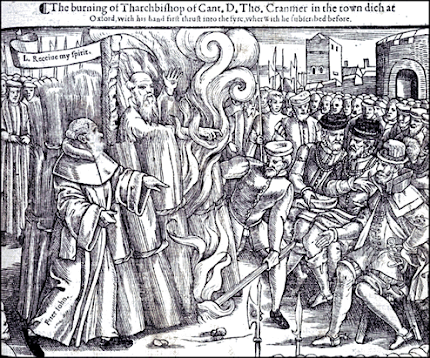
The burning of Tharchbishop of Cant. D. Tho. Cranmer in the town dich at Oxford, with his hand first thrust into the fyre, wherwith he subscribed before. [Click on the picture to see Cranmer's last words.]

Daily Bible Verse

Thursday, May 31, 2012

IS PROPOSITIONAL REVELATION ESSENTIAL TO EVANGELICAL SPIRITUAL FORMATION? gordon r. lewis*

As a result of revealed truth, there is not only analogical knowledge of God, but also some univocal (nonfigurative) knowledge of God. Hence a critical realism is possible. God’s image bearers can know some things as God knows them by common and special grace via the content of general and special revelation.  --Gordon R. Lewis

The following quote is from a paper published in the Journal of the Evangelical Theological Society. Gordon R. Lewis rightly points out that modern Evangelicals who try to synthesize postmodernism with revelation as history, neo-orthodoxy, and propositional revelation are in essence selling out the Bible:

Evangelicals earlier considered liberals to be “rationalists,” because they accepted and rejected the truth of biblical passages based on the assumptions of their autonomous reason. Now postmodernists call evangelicals “rationalists” because they affirm biblical propositions to be true. That makes Jesus Christ “a rationalist” in his view of the OT. Orthodox and evangelical believers have been “rationalists” in this sense for 2,000 years. Classical Christianity has affirmed its belief that the Bible’s indicative sentences conveyed true information about the real world and its real Creator.  (Page 281).

To affirm propositional revelation is not to claim omniscience. But some knowledge of reality is possible, since the eternal Word of God made the world and men and women in his image to rule it. Believers in propositional revelation need not assume with Immanuel Kant and his countless followers that the categories of God’s thought and of creation are totally different from those of the human mind. Neither are his principles of reasoning totally different than those of his image bearers’ logic. The Creator made and renews human minds to think his revealed thoughts after him (Col 3:10).  (Page 285).
 As a result of revealed truth, there is not only analogical knowledge of God, but also some univocal (nonfigurative) knowledge of God. Hence a critical realism is possible. God’s image bearers can know some things as God knows them by common and special grace via the content of general and special revelation. (Page 286).

  -- Gordon R. Lewis
I'm wondering if Bruce Demarest and Gordon R. Lewis have been influenced by Carl F. H. Henry and Gordon H. Clark's theology of propositional revelation?  If so, then this is a good thing since it would appear that Westminster California and Westminster Philadelphia have both gone over to a syncretism of neo-orthodoxy, revelation as history/God's acts in history, postmodernism, and narrative theology with propositional revelation and conservative Evangelical grammatical/historical methods of exegesis.  A good example of that is Mike Horton's new systematic theology in which he attempts to integrate the liberal theological methods with conservative Reformed views, an attempt which ultimately fails.  Mixing liberalism with faith always ends up in disaster.  (See:  A Critical Review:  Pilgrims on the Way).  Is it not odd that so-called Reformed theologians in the line of Cornelius Van Til call those who advocate propositional revelation "rationalists"?

I did at one time own a copy of Lewis' three volume Integrative Theology.  Although it has been awhile since I read that series, I highly recommend it to those who advocate the theology of Gordon H. Clark and Carl F. H. Henry.  Lewis was himself a trained philosophy and he more often than not agrees with the propositional revelation view advocated by David Broughton Knox, Gordon H. Clark, Carl F. H. Henry and other Evangelical and Reformed theologians of recent times.

Click here to read the paper by Dr. Gordon R. Lewis:  IS PROPOSITIONAL REVELATION ESSENTIAL TO EVANGELICAL SPIRITUAL FORMATION? gordon r. lewis

Wednesday, May 30, 2012

The Damnable Heresy of Arminianism

But we who believe the true gospel know that this issue lies at the heart of Christianity. The doctrines of grace are the basics of the Christian faith, not some higher theology that only seminarians are able to understand. It is a life and death issue; for if one is an Arminian, he is dead in his sins.  

--Outside the Camp....


{This article was written in 2012.  While my view has changed, I am leaving this in place because the criticisms of Arminianism are still valid.  I no longer believe that all Arminians are lost.  But it should be noted that even Gordon H. Clark said that if certain Arminians cross over into Pelagianism, that is a heresy that would be excluding from biblical Christianity.  I would add neo-orthodoxy and open theism and theological liberalism to that list of heresies.  Charlie J. Ray.  October 3, 2024.}


I generally do not agree with some of the extreme positions taken on the Outside the Camp website. However, the following article regarding Arminianism expresses my own view of the matter. Since Arminianism directly contradicts the Gospel on every point of the five points of the Remonstrandts, then it is difficult to see how anyone could be saved under that system of doctrine. Here is the article in its entirety: 


Is Arminianism a damnable heresy? Most people who say they believe the doctrines of grace would agree that Arminianism is a theological error. But as soon as one throws in the word "heresy," the number of people who would go that far drops off quite a bit. When one goes so far as to say that Arminianism is a damnable heresy (thus saying that all who believe in Arminianism are unregenerate), then the number of people who agree is narrowed to a very few. In fact, the "tolerant sovereign-gracers" would call such a person an unloving, divisive schismatic who is arguing over minute and complex theological issues. Believing the doctrines of grace is just part of their "tradition" or "heritage." Oh, the doctrines of grace are "precious truths," but they are not essential to Christianity; they are merely a "more Biblical perspective." Arminians are seen to be just "happily inconsistent" Christians who "just need a little different emphasis in their theology." Calling Arminians unregenerate is almost unheard of.

But we who believe the true gospel know that this issue lies at the heart of Christianity. The doctrines of grace are the basics of the Christian faith, not some higher theology that only seminarians are able to understand. It is a life and death issue; for if one is an Arminian, he is dead in his sins. It is an issue of truth versus lies; an issue of the true gospel versus another gospel; an issue of the true God versus a false god. In fact, the doctrines of grace are what differentiate Christianity from every other false religion.

What do Arminians believe?

(1) Arminians believe that, although God is the creator of the universe, He did not decree everything that comes to pass. This includes the belief that God did not choose before the foundation of the earth who would be saved and who would be damned. Instead, they say that God saw what would happen in the future and made His determinations based on what human beings did. 

What does the Scripture say about God's decree and control of everything that comes to pass?

"See now that I, I [am] He, and there [is] no other God with Me. I kill, and I keep alive. I wound and I heal, and there [is] no deliverer from My hand" (Deuteronomy 32:39). "Jehovah kills and keeps alive; He brings down and causes to go to Sheol. Jehovah brings down, and He gives riches; He brings low; yea, He lifts up high. He raises the poor from the dust; He lifts up the needy from the dunghill, to cause [them] to sit with nobles; yea, He causes them to inherit a throne of honor; for to Jehovah [are] the pillars of the earth; and He sets the habitable world on them" (1 Samuel 2:6-8). "Behold, He breaks down, and no one builds; He shuts against a man, and no one opens. Behold, He holds back the waters, and they dry up; and He sends them out, and they overflow the earth. With Him [is] strength and sound wisdom; the deceived and the deceiver are His. He causes wise men to go stripped; and He makes judges fools. He loosens the bonds of kings, and He binds their loins with a girdle; making priests walk [away] stripped; and He overthrows the mighty; turning aside the lip of the trusted men; and He takes away the reason of the aged. He pours scorn on nobles, and He loosens the girdle of the mighty; revealing deep things out of darkness; and He brings the shadow of death to light. He gives greatness to the nations, and He destroys them; spreading out the nations, and He leads them out. He takes away the heart of the heads of the people of the land; and He causes them to wander in a waste [in which is] no path. They grope in the dark, and [there] is no light; and He makes them stagger like a drunkard" (Job 12:14-25). "But He [is] in one [mind], and who can turn Him? Yea, His soul desires, and He does [it]. For He fulfilled my lot, and many like these are with Him" (Job 23:13-14). "But our God [is] in Heaven; He has done all that He has pleased" (Psalm 115:3). "For I know that Jehovah [is] great, and our Lord [is] above all gods. Every [thing] which Jehovah [was] pleased to do, He did, in the heavens and in the earth, and in the seas and all deep places. He causes the vapors to rise from the end of the earth; He makes lightnings for the rain; He brings the wind out of His storehouses" (Psalm 135:5-7). "The lot is cast into the lap, but all ordering of it [is] from Jehovah" (Proverbs 16:33). "[As] streams of waters, the king's heart [is] in the hand of Jehovah; He turns it wherever He desires" (Proverbs 21:1). "Have you not known? Have you not heard? Was it not told to you from the beginning? Did you not discern [from] the foundations of the earth? He who sits on the circle of the earth, even those living in it are like grasshoppers; He who stretches the heavens like a curtain, and spreads them like a tent to live in; who gives potentates into nothing. He makes judges of the earth as nothing. Yea, they shall not be planted; yea, they are not sown; yea, their stem [is] not taking root in the earth. And He shall also blow on them, and they shall wither, and the tempest shall lift them up like stubble. To whom then will you compare Me, or [am] I equaled, says the Holy One? Lift up your eyes on high and look: Who has created these? Who brings out their host by number? By greatness of vigor, and might of power, He calls them all by names; not one is lacking" (Isaiah 40:21-26). "Behold, the former things have come to pass, and I declare new things before they happen, I cause you to hear" (Isaiah 42:9). "I [am] Jehovah, and [there is] none else; there is no God except Me. I will clothe you, though you do not know Me, that they may know from the rising of the sun, and to its going down, that [there is] none besides Me; I [am] Jehovah, and there is none else; forming light, and creating darkness; making peace, and creating evil. I, Jehovah, do all these things" (Isaiah 45:5-7). "Remember former things from forever, for I [am] God, and no one else [is] God, even none like Me, declaring the end from the beginning, and from the past those things which were not done, saying, My counsel shall rise; and, I will do all My desire; calling a bird of prey from the east, the man of My counsel from a far off land. Yes, I have spoken; yes, I will cause it to come; I have formed; yes, I will do it" (Isaiah 46:9-11). "O house of Israel, can I not do to you as this potter? says Jehovah. Behold, as the clay in the potter's hand, [so are] you in My hand, O house of Israel" (Jeremiah 18:6). "Who [is] this speaking, and it happens [when] the Lord does not command it?" (Lamentations 3:37). "And all the trees of the field shall know that I, Jehovah, have brought down the high tree [and] have exalted the low tree, [and] have dried up the green tree, and have made the dry tree flourish. I, Jehovah, have spoken and acted" (Ezekiel 17:24).
 
Is a god who does not control all of his creation the God of Holy Scripture? And if it is not the God of Holy Scripture, is it a false god? What is God's attitude toward those who worship false gods?

If God is not in control of every action of every creature, including man, then He cannot make His promises come to pass, and He is not God.

What does Scripture say about the Arminian claim that God does not choose to save or damn individuals based solely upon His sovereign choice?

"And coming near, the disciples said to Him, Why do You speak to them in parables? And answering, He said to them, Because it has been given to you to know the mysteries of the kingdom of Heaven, but it has not been given to those. For whoever has, to him will be given, and he will have overabundance. But whoever does not have, even what he has will be taken from him. Because of this, I speak to them in parables, because seeing they do not see, and hearing they do not hear, nor do they understand. And the prophecy of Isaiah is fulfilled on them, which says, In hearing you will hear and in no way understand, and seeing you will see yet in no way perceive. For the heart of this people has grown fat, and they heard heavily with the ears, and they have closed their eyes, that they not see with the eyes, or hear with the ears, and understand with the heart, and be converted, and I heal them" (Matthew 13:10-15). "For even as the Father raises the dead, and gives life, so also the Son gives life to whomever He wills" (John 5:21). "All that the Father gives to Me shall come to Me, and the [one] coming to Me I will in no way cast out" (John 6:37). "And He said, Because of this, I have told you that no one is able to come to Me except it is given to him from My Father" (John 6:65). "And hearing, the nations rejoiced and glorified the Word of the Lord. And as many as were appointed to eternal life believed" (Acts 13:48). "But we know that [to] the [ones] loving God all things work together for good, [to] those being called according to purpose; because whom He foreknew, He also predestinated [to be] conformed to the image of His Son, for Him to be [the] First-born among many brothers. But whom He predestinated, these He also called; and whom He called, these He also justified; and whom He justified, these He also glorified" (Romans 8:28-30). "for [the children] not yet being born, nor having done any good or evil, that the purpose of God according to election might stand, not of works, but of the [One] calling, it was said to her, The greater shall serve the lesser; even as it has been written, I loved Jacob, and I hated Esau. What then shall we say? Is there not unrighteousness with God? Let it not be! For He said to Moses, I will have mercy on whomever I will have mercy, and I will pity whomever I will pity. So, then, [it is] not of the [one] willing, nor of the [one] running, but of the [One] showing mercy, of God. For the Scripture says to Pharaoh, For this very thing I raised you up, so that I might display My power in you, and so that My name might be publicized in all the earth. So, then, to whom He desires, He shows mercy. And to whom He desires, He hardens. You will then say to me, Why does He yet find fault? For who has resisted His will? Yes, rather, O man, who are you answering against God? Shall the thing formed say to the [One] forming [it], Why did You make me like this? Or does not the potter have authority over the clay, out of the one lump to make one vessel to honor, and one to dishonor? But if God, desiring to demonstrate His wrath, and to make His power known, endured in much long-suffering vessels of wrath having been fitted out for destruction, and that He make known the riches of His glory on vessels of mercy which He before prepared for glory, whom He also called, not only us, of Jews, but also out of nations" (Romans 9:11-24). "Blessed [is] the God and Father of our Lord Jesus Christ, who blessed us with every spiritual blessing in the heavenlies with Christ, even as He elected us in Him before [the] foundation of [the] world, for us to be holy and without blemish before Him in love, predestinating us to adoption through Jesus Christ to Himself, according to the good pleasure of His will, to [the] praise of [the] glory of His grace in which He favored us in the [One] having been loved" (Ephesians 1:3-6). "in whom we also have been chosen to an inheritance, being predestinated according to [the] purpose of the [One] working all things according to the counsel of His [own] will" (Ephesians 1:11). "But we ought to thank God always concerning you, brothers, beloved by the Lord, because God chose you from the beginning to salvation in sanctification of [the] Spirit and belief of [the] truth, to which He called you through our gospel, to obtain the glory of our Lord Jesus Christ" (2 Thessalonians 2:13-14). "the [One] having saved us and having called [us] with a holy calling, not according to our works, but according to [His] own purpose and grace given to us in Christ Jesus before eternal times" (2 Timothy 1:9). "Then to you who believe [belongs] the preciousness. But to disobeying ones, [He is the] Stone which those building rejected; this One became [the] Head of the Corner, and a Stone-of-stumbling, and a Rock-of-offense to the [ones] stumbling, being disobedient to the Word, to which they were also appointed" (1 Peter 2:7-8).

A God who makes decisions based on what man does is not God. Do Arminians believe in God? 

(2) Arminians believe that the fall of Adam did not make man totally unable to come to God. They believe that man was affected by the fall, but only to the extent that it is now difficult for men to come to God but not impossible. What does Scripture say? 

"But we are all as the unclean [thing], and all our righteousnesses are as a menstruation cloth. And we all fade as a leaf, and like the wind our iniquities take us away. And [there is] not one who calls on Your name, who stirs himself up to take hold of You. For You have hidden Your face from us, and have melted us away into the hand of our iniquities" (Isaiah 64:6-7). "No one is able to come to Me unless the Father who sent Me draws him, and I will raise him up in the last day" (John 6:44). "What then? Do we excel? Not at all! For we have charged both Jews and Greeks before, all [with] being under sin; according as it has been written, [There is] not a righteous one, not even one! [There is] not [one] understanding; [there is] not [one] seeking God. All turned away, [they] became worthless together, not [one is] doing goodness, not so much as one!" (Romans 3:9-12). "For the ones that are according to flesh mind the things of the flesh. And the ones according to Spirit [mind] the things of the Spirit. For the mind of the flesh [is] death, but the mind of the Spirit [is] life and peace; because the mind of the flesh [is] enmity towards God; for it is not being subjected to the Law of God, for neither can it [be]. And those being in the flesh are not able to please God" (Romans 8:5-8). "But a natural man does not receive the things of [the] Spirit of God, for they are foolishness to him, and he is not able to know [them], because they are spiritually discerned" (1 Corinthians 2:14).

From these Scriptures, would you conclude that men have the free will to either choose good or evil? Is the Arminian view a Christian view of unregenerate man? If it is not Christian, then what is it?

(3) Arminians believe that when the Holy Spirit intends to regenerate a man's heart, the man has the ability to resist the Holy Spirit. Not only do they believe this, but some also believe that once a man is regenerated, even though God wants him to go to heaven, he can lose his salvation and end up in hell. These beliefs show one thing: The view that man is more powerful than God. Man can thwart God's plan. Man is on the throne, and God is subservient to the choices of man. This is incredible blasphemy. Reader, are you getting the full impact of this? Think about it for a moment: A god that is dependent upon man -- a god that is frustrated by the actions of man. Who in the world would call these people Christians? The following are some Scriptures to expose these notions as blasphemous lies: 

"All that the Father gives to Me shall come to Me, and the [one] coming to Me I will in no way cast out" (John 6:37). "My sheep hear My voice, and I know them, and they follow Me. And I give eternal life to them, and they shall not perish to the age, never! And not anyone shall pluck them out of My hand. My Father who has given [them] to Me is greater than all, and no one is able to pluck out of My Father's hand" (John 10:27-29). "But we know that [to] the [ones] loving God all things work together for good, [to] those being called according to purpose; because whom He foreknew, He also predestinated [to be] conformed to the image of His Son, for Him to be [the] First-born among many brothers. But whom He predestinated, these He also called; and whom He called, these He also justified; and whom He justified, these He also glorified" (Romans 8:28-30). "But He confirming us and anointing us with you in Christ is God, even He having sealed us, and having given the earnest of the Spirit in our hearts" (2 Corinthians 1:21-22). "in whom also you, hearing the Word of Truth, the gospel of your salvation, in whom also believing you were sealed with the Holy Spirit of promise, who is an earnest of our inheritance, to [the] redemption of the purchased possession, to [the] praise of His glory" (Ephesians 1:13-14). "being persuaded of this very thing, that the [One] having begun a good work in you will finish [it] until [the] day of Jesus Christ" (Philippians 1:6).

(4) Arminians believe that Jesus Christ died for every single human being without exception, including those who are and who will end up burning in hell. These blasphemers believe that the precious blood of Jesus, shed for the remission of sins, has no power to save in and of itself. This should anger us Christians with a holy anger. This should stir our souls to cry out against this lie from the pit of hell.

The atoning work of Christ is at the very heart of the gospel. If one gets the atonement wrong, one gets the gospel wrong. We who are Christians believe in salvation conditioned on the work of Christ alone. That means that we believe that it is the work of Christ that makes the only difference between salvation and damnation. That also means that we believe that the work of Christ ensures the salvation of all whom Christ represented. Do Arminians believe this, or do they believe in salvation conditioned on the sinner?

Let us briefly go over some terms with which all of us should be familiar, and how they relate to the topic at hand. 

First, atonement. Atonement means reconciliation. Christ's blood atoned -- it achieved reconciliation between God and the people for whom Christ died. If Christ died for everyone, which is what the Arminians say, then every single person has been reconciled to God. And if every single person has been reconciled to God, then when God sends people to hell, He is a liar.

Second, propitiation. To propitiate means to appease or to pacify. Christ was a propitiatory sacrifice; He appeased God's wrath when He became sin for His people and incurred the judgment for that sin. If Christ died for everyone without exception, then God's wrath against every single person's sin has been appeased. However, if God sends even one person to hell whose sins have been punished, then God is punishing twice for the same sins -- once when Jesus died, and now a second time when people are being punished in hell. So has God's wrath really been appeased? If God judges anyone to hell for whom Christ died, then this nullifies Christ as propitiation.

Third, redemption. To redeem means to pay the price for a possession so as to rescue or deliver that possession. Ransom is another word that is used. Christ's blood paid the price for His people's sins and bought His people as His very own. If Christ died for everyone without exception, every single person has been bought with Christ's blood and has been claimed as His own. What, then, are blood-bought sinners doing in hell? To think that some people believe that some human beings who were bought by the blood of Christ, whose sins have been paid for, are being tormented in hell is utterly repugnant. It is spitting in Christ's face. Of what account is Christ's blood? The precious blood of Christ is trampled underfoot by these God-haters.

For whom did Christ die? The Scriptures cannot be more clear:

"And she will bear a son, and you shall call His name Jesus, for He shall save His people from their sins" (Matthew 1:21). "Even as the Son of Man did not come to be served, but to serve, and to give His life a ransom for many" (Matthew 20:28). "I am the Good Shepherd! The Good Shepherd lays down His life on behalf of the sheep" (John 10:11). "Even as the Father knows Me, I also know the Father; and I lay down My life for the sheep" (John 10:15). "But you do not believe for you are not of My sheep, as I said to you. My sheep hear My voice, and I know them, and they follow Me. And I give eternal life to them, and they shall not perish to the age, never! And not anyone shall pluck them out of My hand" (John 10:26-28). "Then take heed to yourselves and to all the flock, in which the Holy Spirit placed you [as] overseers, to shepherd the assembly of God which He purchased through [His] own blood" (Acts 20:28). "For I delivered to you in the first place what I also received, that Christ died for our sins, according to the Scriptures" (1 Corinthians 15:3). "Husbands, love your wives, even as Christ also loved the assembly and gave Himself up on its behalf" (Ephesians 5:25). "For this reason He ought by all means to become like [His] brothers, that He might become a merciful and faithful high priest in the things respecting God, in order to make propitiation for the sins of [His] people" (Hebrews 2:17).

What conclusions can we come to from this study?

Romans 1:16-17 says that the gospel, which is the power of God unto salvation, reveals the righteousness of God. Romans 10:3 says that those who are ignorant of this righteousness of God revealed in the gospel are unregenerate. Mark 16:16 says that those who do not believe the gospel are unregenerate. 2 John 9 says that those who do not abide in the doctrine of Christ are unregenerate. Galatians 1:6-9 says that anyone who preaches a different gospel than the gospel of the Apostles is unregenerate. Do Arminians believe the gospel? Are Arminians ignorant of the righteousness of God revealed in the gospel? Do Arminians abide in the doctrine of Christ? Do Arminians believe and preach a different gospel? Is a gospel that tells people that they have the ability to make a decision for Christ, that tells people that God needs us to cooperate with Him in order for us to be saved, that tells people that Christ's blood paid the price for the sins of everyone in the whole world -- is that the true gospel or a different gospel?

Arminians have created a god of themselves. The god of self is on the throne. Glory is given to man and not to God. In order to put self on the throne, you must relegate God to an impotent, helpless, weak, changeable being, and that is exactly what Arminians do. 

Arminians have an impotent god whose will is not accomplished without human cooperation. When humans refuse to cooperate with His "plan," God has to either go to "Plan B" or give up the plan altogether.

Arminians have an impotent atonement in which Christ's blood does not ensure the salvation of all for whom He died. The work of Christ does not make the only difference between salvation and damnation; instead, Jesus died to save no one in particular. Thus, it is up to the sinner to make the difference. Redemption, then, is not people being "bought by the blood of Christ" unto salvation, but it is a "take it or leave it" redemption. They believe that some blood-bought sinners will go to hell.

Arminians believe that, since God foresaw which people would believe, He chose them to be saved. This makes salvation dependent upon the merit of man and not upon God's grace. It also makes room for the gospel of self-esteem, which says that there was something of worth in me that God saw, and thus He chose me.

Arminians believe that an unregenerate sinner is not totally dead in sins. They believe that an unregenerate sinner can reach out to God. The truth is that a dead man cannot reach out unless a miracle of regeneration takes place.

Arminians believe in decisional regeneration; the Holy Spirit waits and pleads impotently for the sinner to make a decision and only when the sinner decides to follow Jesus does the work of regeneration happen in the sinner's heart. This gives rise to "evangelism" based on getting as many people as possible to "make a decision for Christ." It looks at the number of people who came forward as a measure of success.

Arminians believe that, since everyone has the potential to come to Christ, we must do everything within our power to get them to make a decision. This gives rise to unbeliever-centered evangelism rather than God-centered evangelism. In order to attract the unbeliever, gimmicks are used to appeal to the unbeliever, or the service is "user-friendly" and makes the unbeliever feel as comfortable as possible. God is not preached as a Holy, Almighty Lord to Whom the sinner is commanded to bow, but He is preached as someone who needs the sinner to come to Him. 

Arminians believe that we need to be doing good works because it keeps us from falling away, as opposed to doing good works out of obedience and love and gratitude for the God who chose us not based on anything that we have done.

Arminians believe that the only difference between someone who goes to heaven and someone who goes to hell is not what Christ has done, but is what the heaven-bound person has done for himself.

Read the words of the world-famous heretic, Billy Graham: "The prayer needed is not that Christ may accept you, but rather that you will accept Christ. You do not have to wait for Christ to accept you. He is waiting to see the evidence of your faith in accepting him. The decision is yours, not Christ's. He decided in favor of you when he died for you on the cross. Now you must decide for him. ... Christ will not enter your life in opposition to your beliefs. As soon as he sees that you believe in him and trust in his promise, he will enter. ... [T]he initial step is one of absolute faith on your part" (from the March 1979 My Answer, as quoted in the Jan/Feb 1982 issue of The Trinity Review). This is blasphemy that comes from the father of lies, and unless God sees fit to save him, Billy Graham will go to hell.

What then should our response be as believers?

First, we must judge righteous judgment. We must call a liar a liar and an idolater an idolater. This will not win any popularity contests, but it is totally biblical. Arminianism is a lie. Arminianism is wickedness. Arminians are liars. Arminians are wicked sinners. They are not my brothers, and they are not my sisters. Second, if we truly believe that the christ of Arminianism is not the Christ of Holy Scripture and that Arminians are not Christians, then we must be separate from them.

"Do not be unequally yoked [with] unbelievers. For what partnership does righteousness [have] with lawlessness? And what fellowship does light [have] with darkness? And what agreement does Christ [have] with Belial? Or what part does a believer [have] with an unbeliever? And what agreement does a temple of God [have] with idols? For you are a temple of [the] living God, even as God said, I will dwell in them and walk among [them], and I will be their God, and they shall be My people. Because of this, come out from among them and be separated, says [the] Lord, and do not touch [the] unclean thing, and I will receive you. And I will be a Father to you, and you will be sons and daughters to Me, says [the] Lord Almighty" (2 Corinthians 6:14-18). "And have no fellowship with the unfruitful works of darkness, but rather even reprove [them]" (Ephesians 5:11).

2 Timothy 3:1-7 gives us a description of wickedness in the last days: "But know this, that in [the] last days grievous times will be [upon us]. For men will be lovers of themselves, money-lovers, braggarts, arrogant, blasphemers, disobedient to parents, unthankful, unholy, without natural feeling, unyielding, slanderers, without self-control, savage, haters of good, betrayers, reckless, puffed up, lovers of pleasure rather than lovers of God, having a form of godliness, but denying the power of it; even turn away from these. For of these are those creeping into houses and leading silly women captive, [the ones] having been heaped with sins, being led away by various lusts, always learning, but never being able to come to a full knowledge of [the] truth" (2 Timothy 3:1-7).

Are Arminians lovers of themselves? Do they hold to a form of godliness but deny its power, always learning and never able to come to the knowledge of the truth? 

Psalm 1 gives the description of those who do not walk in the counsel of Arminians or stand in the path of Arminians or sit in the seat of Arminians and says that Arminians will not stand in the assembly of the righteous. 2 John 1:11 says that those who consider Arminians to be their brothers in Christ are participants in the evil deeds of the Arminians and are thus just as unregenerate as the Arminians. 

Third, we must present a bold witness to the world and to professing Christianity. We are different than the church down the road. It does make a difference. And the world and other professing Christians should be able to see that difference. We believe in a sovereign God who has decreed every single thing that has ever come to pass and will ever come to pass. We believe that the work of Christ alone ensures the salvation of all whom He represented and is what makes the difference between salvation and damnation. 

Fourth, we must confront others who profess to be Christians about these basics of the faith. We must not let a relationship with a professing Christian even start without a confrontation of this type. If they are not saved, God may use this confrontation to change their hearts and grant them repentance. If they are saved, there is fellowship with them in the truth.

Fifth, we must recognize Arminianism that comes in the guise of sovereign grace. There are very well-known people out there who claim to believe the doctrines of grace who are totally Arminian in their evangelism. They are putting forth the lie that, although redemption is particular to the elect, true gospel preaching tells people that God loves everyone, truly desires that everyone be saved, and shows grace to everyone in the "offering" of the gospel, whereas 2 Corinthians 2:15-16 makes it clear that preaching is for the purpose of saving some and hardening others. The gospel is not an offer -- it is God's promise to save His people conditioned on the atoning blood and imputed righteousness of Jesus Christ alone. Some will say that Christ's atonement is "sufficient for all but efficient for the elect." This is nothing more than universal atonement in disguise. Some will say that salvation is conditioned on faith and that the Holy Spirit enables the person to meet that condition. This is nothing more than a version of salvation conditioned on the sinner. If salvation is conditioned in any way to any degree on the sinner, even if God enables the person to meet the condition, then it is not salvation conditioned on the work of Christ alone, and it is a false gospel.

Sixth, we must not be proud that we are believers. In a study such as this in which a certain segment of professing Christianity is exposed as wicked, it is inevitable that some will see this as pride. But exposing wickedness should not come from pride. It should come from obedience to God's Word. And we must always remember that if it were not for the grace of God, we, too, would be God-hating Arminians. The grace that God has bestowed upon us should make us fall on our faces in the dirt in humility, knowing that we have done nothing to deserve this salvation. We should also be in constant praise and wonder at the grace of Almighty God toward us. It should make us live a life of gratitude and love for God, and this gratitude and love must translate into obedience of God's commands. We do not obey for the same reason the Arminian obeys. The Arminian is obeying because he believes his final glory is conditioned on his obedience. We obey out of love for a God who chose us before the foundation of the world and who saved us and will keep us saved for His own glory.

After hearing all this, someone may ask, "But don't Arminians believe that Jesus Christ is God?" Our response should be, "What kind of god do Arminians say that Jesus is?" Someone else may ask, "But don't Arminians believe that Christ died on the cross for our sins?" Our response should be, "Do Arminians believe that Christ's blood atoned, redeemed, and propitiated? If not, what in the world does an Arminian mean by 'Christ died on the cross for our sins?'" Arminians say biblical phrases. They talk of Christ's death for sinners. They talk of grace. They even talk of the sovereignty of God. But when you confront them on what they really mean, you find that their house is built on sand.

Christians are to contend earnestly for the faith which was once delivered to all the saints, as God says in Jude 3. The latter part of Isaiah 48:11 says,"I will not give My glory to another." The first part of Isaiah 42:8 says the same thing: "I [am] Jehovah; that is My name; and I will not give My glory to another." May we live with a holy zeal to give God all the glory, and, as God says in 2 Corinthians 10:5, let us demolish arguments and every high thing lifting up itself against the knowledge of God, and let us bring into captivity every thought into the obedience of Christ.

by Marc D. Carpenter
www.outsidethecamp.org


 The Damnable Heresy of Arminianism

Christians against civil partnerships and gay marriage. - The Petition Site

Christians against civil partnerships and gay marriage. - The Petition Site

aztexan: Christianity: The Intelligible Axiom

Contrary to the unity commended by Scripture, the World Council, the National Council of Churches, and the Blake-Pike proposals envisage denominational mergers without any significant doctrinal agreement. This is consistent with their anti-intellectualism which leaves them no Gospel.  --Gordon H. Clark


The following excerpt from Gordon H. Clark's Christian Philosophy was posted on AZTexan's blog. I hope he will forgive me for borrowing this without asking. But Evangelical ecumenicalism is as bad as any of the liberal ecumenical movements. In other words, the National Association of Evangelicals has led to all sorts of theological errors.  The National Association of Evangelicals is as full of errors as any "liberal" ecumenical organization.

 Here is the quote from Dr. Clark:

 ... The whole attempt to disparage knowledge and logic, whether the attempt be that of the contemporary liberals or that of the anti-intellectual pietists, is clearly contradictory to Scripture.

The Scripture places a noticeable emphasis on knowledge. In Ephesians 1:17-18 the Apostle prays that "God may give you the spirit of wisdom and revelation in divine knowledge, the eyes of your understanding being enlightened." 1 John 5:20 says, "We know that the Son of God is come and has given us an understanding, that we may know him that is true." The same apostle records the words of our Lord, "This is life eternal, that they might know you, the only true God and Jesus Christ, whom you have sent." 1 Corinthians 15:34 gives a warning against ignorance: "Awake to righteousness and sin not, for some have no knowledge of God."

The Old Testament too commends knowledge. The stated purpose of the Proverbs of Solomon was to give subtlety to the simple and knowledge to young men. The fear of the Lord is the beginning or chief part of knowledge, but fools despise wisdom and instruction. And there are many other exhortations to knowledge.

To refer to a matter of contemporary interest and to illustrate how intellectualism or a respect for knowledge entails practical conclusions that contrast sharply with other types of religion, we may note that the ecumenical unity approved by the New Testament is unity of doctrine and knowledge. There is no great command to establish organizational unions, but we read with some frequence, "I beseech you that you all speak the same thing, and that there be no divisions among you, but that you be perfectly joined together in the same mind and in the same judgment" (1 Corinthians 1:10). Or, again, "Fulfill my joy, that you be likeminded, having the same love, being of one accord, of one mind" (Phillipians 2:2). Contrary to the unity commended by Scripture, the World Council, the National Council of Churches, and the Blake-Pike proposals envisage denominational mergers without any significant doctrinal agreement. This is consistent with their anti-intellectualism which leaves them no Gospel.

In addition to these Neo-orthodox groups, the pietists with their claims to individual guidance and additional revelations, and the saccharine devotional writers who malign dead orthodoxy and cold intellectualism, also exhibit a fundamental misunderstanding of Christianity when they draw their sharp distinction between the head and the heart. The head, for them, represents knowledge and dry theology; the heart is all the exciting emotionalism of hillbilly evangelism. But in Scripture there is no contrast whatever between head and heart. The view is a strictly modern innovation that conflicts with Biblical psychology and reflects a wrong notion of true religion. Depreciation of understanding, knowledge, reason, and logic not only stimulates an evil ecumenism but also leads to serious errors in theology, errors concerning human nature, sin, and therefore errors concerning the way of salvation.

Religion, or to speak clearly, the Christian religion is not an affair of the emotions, at least no more so than politics and economics are, but fundamentally an acceptance of an intelligible message.

The acceptance of this message is offered as a first principle, an axiom or postulate on which a superstructure of knowledge can be erected.... -

Gordon H. Clark From the lecture entitled "The Axiom of Revelation" Christian Philosophy (Works vol. 4). 318f.

Click here to see the original post:  aztexan: Christianity: The Intelligible Axiom

Tuesday, May 29, 2012

The Bondage of the Will

Sect. 167.—I SHALL here draw this book to a conclusion: prepared if it were necessary to pursue this Discussion still farther. Though I consider that I have now abundantly satisfied the godly man, who wishes to believe the truth without making resistance. For if we believe it to be true, that God fore-knows and fore-ordains all things; that He can be neither deceived nor hindered in His Prescience and Predestination; and that nothing can take place but according to His Will, (which reason herself is compelled to confess;) then, even according to the testimony of reason herself, there can be no "Free-will"—in man,—in angel,—or in any creature!  Martin Luther, The Bondage of the Will.


 The Bondage of the Will

Message 1, Questions & Answers #1 from Suffering and the Sovereignty of God: 2010 Winter Conference at Ligonier Academy Conference by Various Teachers from Ligonier Ministries


While R. C. Sproul is certainly not perfect, this video of the question and answer session is very much in line with my own views regarding the Gospel and the Evangelicals and Catholics Together and the Manhattan Declaration.  I'm not sure who the other minister is in the session but he seems to be orthodox as well on this point.  Rome and Eastern Orthodoxy are not preaching the Gospel but another gospel.  (Galatians 1:6-9).  In fact, Rome has officially condemned the Gospel.

What the other minister alluded to is that Arminianism is also another Gospel.  Charles Wesley and John Wesley were adamant opponents of Calvinism and said that it was a false gospel.  In fact, the true situation is the other way around.  Arminianism, according to the Synod of Dort 1618-19, is a heresy.  Anyone who endorses any of the five points of the Remonstrandts, including their assertion of univeral atonement rather than particular atonement, is in essence denying a focal point of the Gospel.  Jesus died particularly and only for the elect; otherwise we would have to say that Christ died for the reprobates whose souls were already in hell from the time of creation up to the point of the cross.  (1 Peter 2:8; Romans 9:11-13).  The Old Testament saints were saved by faith in Christ looking forward to the Messiah and His atoning work on the cross for all of God's elect.  (Revelation 13:8; John 10:11, 15).

 Message 1, Questions  Answers #1 from Suffering and the Sovereignty of God: 2010 Winter Conference at Ligonier Academy Conference by Various Teachers from Ligonier Ministries

Tuininga’s Kingdoms and the Reformed Tradition | The Calvinist International

Brad Littlejohn critiques the two kingdoms theology of Westminster West and East here. Littlejohn is a "Reformed" Anglican who is studying for his Ph.D.

On further examination, however, it would appear that Littlejohn is a closet Federal Visionist and pushes for a Reformed "catholicity".  He also pushes for a "mystical presence" in the Lord's supper, code for Tractarianism.  I wonder how "reformed" his theology really is? 

Click here to read his article: Tuininga’s Kingdoms and the Reformed Tradition | The Calvinist International

Biologos contributors to present case against young earth creationism at PCA’s 40th GA « Johannes Weslianus

It is a short step from theistic evolution to neo-orthodoxy.

Biologos contributors to present case against young earth creationism at PCA’s 40th GA « Johannes Weslianus

Anglicans Ablaze: Pat Robertson Says The Episcopal Church Is Becoming 'Apostate'

Anglicans Ablaze reports that Pat Robertson thinks the Anglican Communion will declare The Episcopal Church to be apostate:
In remarks made on the 700 Club on Wednesday, Robertson stated that "the whole Episcopal Church in America has left its roots" and that it being declared apostate "is on the way."

Robert H. Lundy, communications officer for the American Anglican Council, a conservative movement hoping to return The Episcopal Church to "an apostolic faith," told The Christian Post that he agreed with Robertson's assessment.
Although I agree that The Episcopal Church is apostate, the Anglican Communion will not declare TEC to be apostate.  Why not?  Well, the Anglican Communion itself is apostate and theologically liberal, particularly in England where the Archbishop of Canterbury heads up the council of bishops.  In the UK there is a strong push for the acceptance of openly homosexual ministers and bishops as well as the ordination of women.  None of this has been accepted as of yet but it is merely a matter of time before that happens in the United Kingdom.

The Global South, including the Sydney Anglicans, is also under assault by those promoting the immorality of the gay/lesbian/transgender agenda.  In Africa most of the provinces are morally conservative but unfortunately Evangelicalism and Reformed theology is no longer dominate but in fact Anglo-Catholic theology has taken the upper hand even in the Global South.  Sydney is probably the only province that still stands against the theology of glory and the semi-papist theology of the Tractarian movement.  Even in Sydney Evangelicals are too liberal because they insist that Anglo-Catholics are not lost but are simply separated brethren.

If Roman Catholicism is a false religion, it logically follows that Anglo-Catholicism is a false religion and that those who are caught up in those false gospels need conversion to the true Gospel of sovereign grace through our Lord and Savior Jesus Christ.  Of course, most Evangelicals are Arminians and are lost themselves--which explains why the Evangelicals and Catholics Together movement is alive and well.  Even Albert Mohler is no longer consistent on this point, even participating in a conservative Anglo-Catholic conference (see Mere Anglicanism) in South Carolina a couple of years ago and signing the Manhattan Declaration!  (See also:  AlbertMohler.com:  When the Lights Go Out:  The Death of a Denomination).

Pat Robertson is an Arminian and a Charismatic.  He thinks conservative Anglo-Catholics and Roman Catholics are saved and on their way to heaven.  In short, Pat Robertson is as lost as any "apostate" Episcopalian and so is the pope.

There is only one Gospel and those who preach another gospel are leading people astray.  (Galatians 1:6-9; Acts 4:10, 12; John 14:6; Romans 3:23-25; Jude 1:3).  Where in the following video by Archbishop Rowan Williams do you hear any appeal to the final authority of Scripture or the 39 Articles of Religion?


To see the original article at Anglicans Ablaze click here:

 Anglicans Ablaze: Pat Robertson Says The Episcopal Church Is Becoming 'Apostate'

Monday, May 28, 2012

Calvin: The Efficacy of the Blood of Christ

Book IV, Chapter 1, Section 2

We declare that we believe in God, both because our mind reclines upon him as true, and our confidence is fully satisfied in him. This cannot be said of the Church, just as it cannot be said of the forgiveness of sins, or the resurrection of the body. Wherefore, although I am unwilling to dispute about words, yet I would rather keep to the proper form, as better fitted to express the thing that is meant, than affect terms by which the meaning is causelessly obscured. The object of the expression is to teach us, that though the devil leaves no stone unturned in order to destroy the grace of Christ, and the enemies of God rush with insane violence in the same direction, it cannot be extinguished,—the blood of Christ cannot be rendered barren, and prevented from producing fruit. Hence, regard must be had both to the secret election and to the internal calling of God, because he alone “knoweth them that are his” (2 Tim. 2:19); and as Paul expresses it, holds them as it were enclosed under his seal, although, at the same time, they wear his insignia, and are thus distinguished from the reprobate. But as they are a small and despised number, concealed in an immense crowd, like a few grains of wheat buried among a heap of chaff, to God alone must be left the knowledge of his Church, of which his secret election forms the foundation.D103 Nor is it enough to embrace the number of the elect in thought and intention merely. By the unity of the Church we must understand a unity into which we feel persuaded that we are truly ingrafted. For unless we are united with all the other members under Christ our head, no hope of the future inheritance awaits us. Hence the Church is called Catholic or Universal (August. Ep. 48), for two or three cannot be invented without dividing Christ; and this is impossible. All the elect of God are so joined together in Christ, that as they depend on one head, so they are as it were compacted into one body, being knit together like its different members; made truly one by living together under the same Spirit of God in one faith, hope, and charity, called not only to the same inheritance of eternal life, but to participation in one God and Christ. For although the sad devastation which everywhere meets our view may proclaim that no Church remains, let us know that the death of Christ produces fruit, and that God wondrously preserves his Church, while placing it as it were in concealment. Thus it was said to Elijah, “Yet I have left me seven thousand in Israel” (1 Kings 19:18).


D103:  Here Calvin provides a basis for the concept, “the invisible Church.” The term “invisible” refers to the fact that a knowledge of those who are truly members of Christ’s body is known to God alone and cannot with certainty be ascertained by men (except for themselves, through their effectual calling). (see also section 7)

Calvin, J. (1997). Institutes of the Christian religion. Bellingham, WA: Logos Research Systems, Inc.

Sunday, May 27, 2012

Calvinism According to John Calvin ("From The Horse's Mouth" Series) - YouTube


Amazingly only a critic of Calvinism recognizes that John MacArthur, Paul Washer, and others are "inconsistent" Calvinists and "if you do not agree with Calvin you are not a Calvinist"!  I am a Calvinist and I DO agree with the quotes in this video.   The truth is controversial.  The fact is those who agree with "free will" are in agreement with Pelagianism, Erasmus and Pighius--not the Protestant Reformation or the Bible.  Luther's Bondage of the Will and Calvin's Institutes--primary documents of the Reformation--refute free will and establish God's absolute sovereignty and that all things that happen are ordained of God's sovereign decrees.

Calvinism According to John Calvin ("From The Horse's Mouth" Series) - YouTube

Thursday, May 17, 2012

Ascension Day Collect and Lessons

The Collect

GRANT, we beseech thee, Almighty God, that like as we do believe thy only-begotten Son our Lord Jesus Christ to have ascended into the heavens; so we may also in heart and mind thither ascend, and with him continually dwell, who liveth and reigneth with thee and the Holy Ghost, one God, world without end. Amen.

1 The former account I made, O Theophilus, of all that Jesus began both to do and teach, 2 until the day in which He was taken up, after He through the Holy Spirit had given commandments to the apostles whom He had chosen, 3 to whom He also presented Himself alive after His suffering by many infallible proofs, being seen by them during forty days and speaking of the things pertaining to the kingdom of God. 4 And being assembled together with them, He commanded them not to depart from Jerusalem, but to wait for the Promise of the Father, "which," He said, "you have heard from Me; 5 "for John truly baptized with water, but you shall be baptized with the Holy Spirit not many days from now." 6 Therefore, when they had come together, they asked Him, saying, "Lord, will You at this time restore the kingdom to Israel?" 7 And He said to them, "It is not for you to know times or seasons which the Father has put in His own authority. 8 "But you shall receive power when the Holy Spirit has come upon you; and you shall be witnesses to Me in Jerusalem, and in all Judea and Samaria, and to the end of the earth." 9 Now when He had spoken these things, while they watched, He was taken up, and a cloud received Him out of their sight. 10 And while they looked steadfastly toward heaven as He went up, behold, two men stood by them in white apparel, 11 who also said, "Men of Galilee, why do you stand gazing up into heaven? This same Jesus, who was taken up from you into heaven, will so come in like manner as you saw Him go into heaven." (Acts 1:1-11 NKJ)

14 Later He appeared to the eleven as they sat at the table; and He rebuked their unbelief and hardness of heart, because they did not believe those who had seen Him after He had risen. 15 And He said to them, "Go into all the world and preach the gospel to every creature. 16 "He who believes and is baptized will be saved; but he who does not believe will be condemned. 17 "And these signs will follow those who believe: In My name they will cast out demons; they will speak with new tongues; 18 "they will take up serpents; and if they drink anything deadly, it will by no means hurt them; they will lay hands on the sick, and they will recover." 19 So then, after the Lord had spoken to them, He was received up into heaven, and sat down at the right hand of God. 20 And they went out and preached everywhere, the Lord working with them and confirming the word through the accompanying signs. Amen. (Mark 16:14-20 NKJ)

Collects, Epistles, and Gospels -- Easter season.

Tuesday, May 15, 2012

Worship: Evangelical or Reformed?

While I agree with this piece by Dr. Robert Godfrey on the differences between Evangelical and Reformed worship, he never once mentions the contrast between a biblical liturgy and ad hoc liturgy practiced by Arminians and Evangelicals. Sadly, most Reformed churches these days no longer recite the creeds or have a biblical confession of sin and a Gospel absolution of sins. In short, the Reformed Anglicans have something the Presbyterians do not have: a biblical and reformed and common liturgy. The advantages of the 1662 Book of Common Prayer over ad hoc liturgies are many.

The primary advantage is that memorizing key biblical passages by rote repetition drills them deep into the memory and psyche of the people. Reciting the decalogue every time communion is served drives home the moral obligations of God's moral law and the need for miserable sinners to cry out for God's mercy, forgiveness, and grace. The Prayer Book teaches a proper view of the self not as righteous but as unrighteous--no matter how holy we may think we are. The genius of the late Archbishop Thomas Cranmer of the English Reformation was in teaching the five solas of the Reformation through a common, consistent and biblical liturgy. Modern "reformed" denominations are indistinguishable from the Evangelicals. In fact, liberal Presbyterians often retain the gloria patri while conservative Presbyterians have all but gone broadly evangelical. Would that all Presbyterians would return to something close to the 1662 Book of Common Prayer. Just saying.

Click here to read the article by Dr. Godfrey:  Worship: Evangelical or Reformed?

A Peek Inside The Westboro Baptist Church : NPR

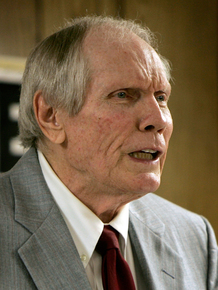
Fred Phelps, Pastor of Westboro Baptist Church
Thanks be to God for freedom of religion and free speech. But how much longer will that freedom be granted given that the country has gone over to the socialists, atheists, and the communists? Not long when a sitting president of the United States endorses what was never intended by the founding fathers or the Constitution. The idea of "gay" marriage is so foreign to the Christian worldview and universal morality that this controversy was never anticipated by the framers of the U.S. Constitution and the Bill of Rights. While some folks think the Westboro Baptist Church is a bunch of ignorant bigots, this article proves that is far from true. In fact, Westboro has roots in the sovereign grace doctrines of the old line Primitive Baptist churches. All of its members--or most of them--are college educated and far from ignorant. Imagine that? Intellectuals and lawyers who disagree with the propaganda of the politically incorrect left? Click here to read the full story:  A Peek Inside The Westboro Baptist Church : NPR

Probably more legalistic than I would be comfortable with.  See also:  Westboro's Doctrinal Statement

AlbertMohler.com – The Compassion of Truth: Homosexuality in Biblical Perspective

AlbertMohler.com – The Compassion of Truth: Homosexuality in Biblical Perspective

Franklin Graham: Obama Has ‘Shaken His Fist’ at God

Franklin Graham: Obama Has ‘Shaken His Fist’ at God

Responses to President Obama’s Statement on Same-sex Marriage

Responses to President Obama’s Statement on Same-sex Marriage

Monday, May 14, 2012

National Primitive Baptist Convention of the U.S.A. - Wikipedia, the free encyclopedia


This past Sunday I visited a small Primitive Baptist church in Bowling Green, Florida, called Macedonia Primitive Baptist Church.  The church is part of the black community in our area and part of a larger black denomination of Primitive Baptists. Unfortunately, like many black denominations, the National Primitive Baptists have adopted a more Arminian Baptist approach and some aspects of the Pentecostal/Charismatic movement, including the laying on of hands for healing and speaking in tongues. While I did not observe any of this first hand, the pastor did drop several oblique references to such beliefs and practices. 

The National Primitive Baptist Convention is Primitive Baptist in name only and is no longer in fellowship with the old line Primitive Baptists.  I did notice that this church uses grape juice for communion rather than wine as they had a bottle of Welches' grape juice under a clear glass covering on the communion table.  Truly old line Primitive Baptists do not have Sunday school and they advocate what is commonly called "hardshell" Calvinism, including absolute predestination and the five points of Calvinism.  Also, Primitive Baptists use fermented wine for communion, which takes place usually about once a year.

On the positive side, I did meet several folks I knew from my past, including Russell Snelling.  Living in a small community like Bowling Green everyone knows something about most of the other residents if not everyone.  

Needless to say I cannot endorse this church since it is no longer Calvinist but would fall more into the broadly Evangelical category, including semi-Arminianism. 

You can read more about the National Primitive Baptist Convention here:  National Primitive Baptist Convention of the U.S.A. - Wikipedia, the free encyclopedia

The Anglican Debacle: Roots and Patterns : Anglican Church League, Sydney, Australia

Dr. Mark Thompson,Moore Theological College
Although this article is fairly accurate, one has to wonder why Dr. Thompson thinks that the Arminian, John Wesley, was somehow a friend of Evangelical and Reformed Anglicanism? The Arminians were always on the side of Archbishop Laud and the closet papists. That would include the Second Awakening Evangelicals of the 18th century who were Arminians. Make no mistake about it but the Arminians are no more a friend of the Gospel of grace than the Anglo-Catholics or the liberals.  Billy Graham, for example, in his twilight years "mellowed out".  That means that Graham no longer knows what he believes or why.  He basically adopted a liberal view that Roman Catholics and those who have never heard the Gospel are saved by works or "by the light they have."  That's way different from saying that the elect are saved by faith alone, by grace alone, and through the means of Gospel preaching alone.  (Acts 4:10, 12; Ephesians 2:8, 9; Titus 3:5-7; John 14:6; Romans 4:3).

The most perspicacious insight expressed by Dr. Thompson is when he rightly points out the deception of Anglo-Catholics when they try to re-interpret the 39 Articles of Religion to fit their semi-papist theology:

However, the real seeds of the problem we now face lie in the nineteenth century. John Henry Newman’s infamous Tract 90, published in 1841, encouraged Anglicans to read the Thirty-nine Articles as a Catholic document.2 In this way he opened the door to the possibility that you might publicly assent to the Articles while reinterpreting them to say what you wanted them to say. What he did in the interests of a more Catholic version of Anglicanism others would do in the interests of a more liberal version before very long. As one scholar put it, ‘whether he intended to or not, he taught us to lie’.


 Click here to read Dr. Thompson's article:  The Anglican Debacle: Roots and Patterns : Anglican Church League, Sydney, Australia

Sunday, May 13, 2012

Congregation of The Falls Church Loses Court Battle for Historic Property

Anglicans Ablaze provided the link to this story:

In 2006, The Falls Church and six sister congregations in Northern Virginia voted (overwhelmingly) to pull out of the Episcopal Church because, in our view, it had drifted so far from orthodox Christianity that we could not remain in good conscience.
Click here to read the story: Congregation of The Falls Church must begin again - The Washington Post

Thursday, May 10, 2012

Evolution’s End? President Obama calls for Same-Sex Marriage : Anglican Church League, Sydney, Australia

Evolution’s End? President Obama calls for Same-Sex Marriage : Anglican Church League, Sydney, Australia

Is the Megachurch the New Liberalism? Albert Mohler Comments

Albert Mohler rightly points out the doctrinal minimalism of megachurches and the general tendency for Evangelicalism to accomodate itself to the larger culture in order to draw in new members. Serial remarriage is now commonly accepted among Evangelicals due to no fault divorce. Will gay marriage now be accepted by so-called "conservative" Evangelical Christians? It looks that way judging from a recent sermon series by pastor Andy Stanley, the son of Southern Baptist pastor, Dr. Charles Stanley.

God's moral law has no power to save anyone and no one living has any power to obey God's law sufficiently to justify themselves before God.  But is grace a license to sin after conversion?  I doubt that even Martin Luther would have agreed with that view.  Luther did continually emphasize that Christians are no longer under the law or the curse of sin and that those who kept emphasizing law keeping as the basis for salvation were in effect making the sacrifice of Christ void and justifying themselves by their own righteousness.  On the the other hand, the true Christian is justified by Christ and Christ alone.  Luther's emphasis was that correct doctrine comes first and afterwards God will work through grace and the Holy Spirit to help Christians live in accordance with God's law--albeit never for justification or salvation.

Andy Stanley rightly points out that we are still sinners and miserable sinners after conversion.   He fails, however, to distinguish between election and reprobation due to his blatant Arminianism--except for the one point of Calvinism of the perseverance of the saints.  But if Albert Mohler is correct that Andy Stanley is deliberately downplaying homosexuality as a sin while condemning adultery then it is a natural inference to conclude that megachurches are moving toward minimizing homosexuality and fornication as sinful behavior and incompatible with true conversion.   The 39 Articles of Religion expresses the view of Calvin, Luther and Cranmer on this issue:
ALBEIT that good works, which are the fruits of faith and follow after justification, cannot put away our sins and endure the severity of God's judgement, yet are they pleasing and acceptable to God in Christ, and do spring out necessarily of a true and lively faith, insomuch that by them a lively faith may be as evidently known as a tree discerned by the fruit.

Click here to read Dr. Mohler's article:  Is the Megachurch the New Liberalism?

Monday, May 07, 2012

Martin Luther: Galatians 2:20

Galatians 2:20

Such is our misery that, when temptation or death comes, we soon set Christ aside and consider our own past life and what we have done. Unless we are raised up again by faith, we must perish. We must therefore learn in such conflicts and terrors of conscience to forget ourselves and set the law, our past life, and all our deeds aside, for they drive us only to consider ourselves. We must learn to turn our eyes wholly to the brass serpent—Jesus Christ crucified—and believe firmly that he is our righteousness and life. Then we must not fear the threats of the law, sin, death, and divine judgment, for Christ, on whom our eyes are fixed and in whom we live, who also lives in us, is Lord and conqueror of the law, sin, death, and all evil. In him we find offered most certain consolation, and in him victory is given to us.

So I do not live in my own person, but Christ lives in me. The I who no longer lives is the person who has the law and is bound to do what it requires as a certain person separate from Christ. This person Paul rejects. As he is separate from Christ, he belongs to death and hell. That is why Paul says Christ lives in me. He is my form, my perfection, adorning and beautifying my faith. We cannot conceive spiritually how closely Christ is united to us. Christ lives this life in me that I now live; he himself is this life that I now live. Therefore, Christ and I are one in this respect.

Christ living in me abolishes the law, condemns sin, and destroys death, for all these things must vanish at his presence. Christ is everlasting peace, consolation, righteousness, and life; and to these the terror of the law, heaviness of mind, sin, hell, and death must give way. So Christ, living and remaining in me, takes away and swallows up all evils that trouble me. This is why I am set free from the terror of the law and sin, am separate from myself, and am transferred to Christ and his kingdom, which is a kingdom of grace, peace, joy, life, salvation, and eternal glory. While I remain in him, what evil is there that can harm me?


Luther, M. (1998). Galatians. The Crossway classic commentaries (105–106). Wheaton, Ill.: Crossway Books.

Sunday, May 06, 2012

Martin Luther: Faith Is Not a Work

XVI. But you say: How can I trust surely that all my works are pleasing to God, when at times I fall, and talk, eat, drink and sleep too much, or otherwise transgress, as I cannot help doing? Answer: This question shows that you still regard faith as a work among other works, and do not set it above all works. For it is the highest work for this very reason, because it remains and blots out these daily sins by not doubting that God is so kind to you as to wink at such daily transgression and weakness. Aye, even if a deadly sin should occur (which, however, never or rarely happens to those who live in faith and trust toward God), yet faith rises again and does not doubt that its sin is already gone; as it is written I. John ii: "My little children, these things I write unto you, that ye sin not. And if any man sin, we have an Advocate with God the Father, Jesus Christ, Who is the propitiation of all our sins." And Wisdom xv: "For if we sin, we are Thine, knowing Thy power." And Proverbs xxiv: "For a just man falleth seven times, and riseth up again." Yes, this confidence and faith must be so high and strong that the man knows that all his life and works are nothing but damnable sins before God's judgment, as it is written, Psalm cxliii: "In thy sight shall no man living be justified"; and he must entirely despair of his works, believing that they cannot be good except through this faith, which looks for no judgment, but only for pure grace, favor, kindness and mercy, like David, Psalm xxvi: "Thy loving kindness is ever before mine eyes, and I have trusted in Thy truth"; Psalm iv: "The light of Thy countenance is lift up upon us (that is, the knowledge of Thy grace through faith), and thereby hast Thou put gladness in my heart"; for as faith trusts, so it receives. See, thus are works forgiven, are without guilt and are good, not by their own nature, but by the mercy and grace of God because of the faith which trusts on the mercy of God. Therefore we must fear because of the works, but comfort ourselves because of the grace of God, as it is written, Psalm cxlvii: "The Lord taketh pleasure in them that fear Him, in those that hope in His mercy." So we pray with perfect confidence: "Our Father," and yet petition: "Forgive us our trespasses"; we are children and yet sinners; are acceptable and yet do not do enough; and all this is the work of faith, firmly grounded in God's grace.

Luther, Martin (2009-10-04). A Treatise on Good Works (Kindle Locations 406-421). Public Domain Books. Kindle Edition.


--
Glory be to the Father, and to the Son : and to the Holy Ghost; As it was in the beginning, is now, and ever shall be : world without end. Amen.

John Calvin on the Incarnation and the Two Natures of Christ

They must certainly admit, that as on account of his mother he is called the Son of David, so, on account of his Father, he is the Son of God, and that in some respect differing from his human nature. The Scripture gives him both names, calling him at one time the Son of God, at another the Son of Man.  --John Calvin


6. But if his filiation (if I may so express it) had a beginning at the time when he was manifested in the flesh, it follows that he was a Son in respect of human nature also. Servetus, and others similarly frenzied, hold that Christ who appeared in the flesh is the Son of God, inasmuch as but for his incarnation he could not have possessed this name. Let them now answer me, whether, according to both natures, and in respect of both, he is a Son? So indeed they prate; but Paul’s doctrine is very different. We acknowledge, indeed, that Christ in human nature is called a Son, not like believers by gratuitous adoption merely, but the true, natural, and, therefore, only Son, this being the mark which distinguishes him from all others. Those of us who are regenerated to a new life God honours with the name of sons; the name of true and only-begotten Son he bestows on Christ alone. But how is he an only Son in so great a multitude of brethren, except that he possesses by nature what we acquire by gift? This honour we extend to his whole character of Mediator, so that He who was born of a Virgin, and on the cross offered himself in sacrifice to the Father, is truly and properly the Son of God; but still in respect of his Godhead: as Paul teaches when he says, that he was “separated unto the gospel of God (which he had promised afore by his prophets in the Holy Scriptures), concerning his Son Jesus Christ our Lord, which was made of the seed of David according to the flesh; and declared to be the Son of God with power,” ( [Rom. 1:1–4] ). When distinctly calling him the Son of David according to the flesh, why should he also say that he was “declared to be the Son of God,” if he meant not to intimate, that this depended on something else than his incarnation? For in the same sense in which he elsewhere says, that “though he was crucified through weakness, yet he liveth by the power of God,” ( [2 Cor. 13:4] ), so he now draws a distinction between the two natures. They must certainly admit, that as on account of his mother he is called the Son of David, so, on account of his Father, he is the Son of God, and that in some respect differing from his human nature. The Scripture gives him both names, calling him at one time the Son of God, at another the Son of Man. As to the latter, there can be no question that he is called a Son in accordance with the phraseology of the Hebrew language, because he is of the offspring of Adam. On the other hand, I maintain that he is called a Son on account of his Godhead and eternal essence, because it is no less congruous to refer to his divine nature his being called the Son of God, than to refer to his human nature his being called the Son of Man. In fine, in the passage which I have quoted, Paul does not mean, that he who according to the flesh was begotten of the seed of David, was declared to be the Son of God in any other sense than he elsewhere teaches that Christ, who descended of the Jews according to the flesh, is “over all, God blessed for ever,” ( [Rom. 9:5] ). But if in both passages the distinction of two natures is pointed out, how can it be denied, that he who according to the flesh is the Son of Man, is also in respect of his divine nature the Son of God?

Institutes of the Christian Religion, Book 2: Ch. 14: Section 6

Saturday, May 05, 2012

A Question for PCUSA Conservatives: Why Now? - Reformation21 Blog


William B. Evans, commenting on the recent controversy in the Presbyterian Church USA over the ordination of openly homosexual men and women:
Ultimately, however, the mainline Presbyterian debacle of 2011 points to the profound connection between doctrine and praxis. Or, to phrase it a bit differently, it illustrates the dangers not only of liberal doctrinal latitudinarianism but also of evangelical doctrinal minimalism. Even as PCUSA liberals were busy dismantling the confessional heritage of the church, evangelicals were repeatedly stepping back and stepping back and stepping back from decisive confrontation in the interests of "gospel proclamation" and the "salvation of souls." Now, tragically, these same evangelicals find themselves with their backs to the wall. But let's not forget that Christ's "Great Commission" in Matthew 28:18-20 includes more than "make disciples of all nations," for Christ declares that the Church is also to be "teaching them to observe all that I have commanded you." 

 A Question for PCUSA Conservatives: Why Now? - Reformation21 Blog

Support Reasonable Christian Ministries with your generous donation.