Martyred for the Gospel

Martyred for the Gospel
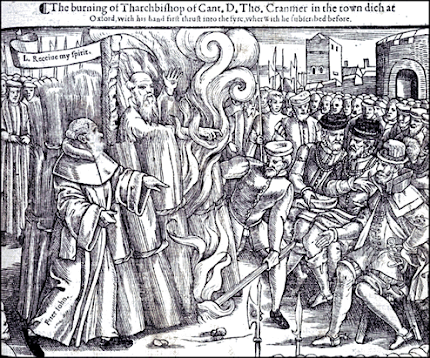
The burning of Tharchbishop of Cant. D. Tho. Cranmer in the town dich at Oxford, with his hand first thrust into the fyre, wherwith he subscribed before.

Bible Gateway Verse of the Day

Daily Bible Verse

Collect of the Day

1662 Book of Common Prayer

The Twenty-second Sunday after Trinity.

The Collect.

LORD, we beseech thee to keep thy household the Church in continual godliness; that through thy protection it may be free from all adversities, and devoutly given to serve thee in good works, to the glory of thy Name; through Jesus Christ our Lord. Amen.

Sunday, September 28, 2008

The White Horse Inn Gets It Wrong This Time

Acts 17:5-9 (ESV)
5 But the Jews were jealous, and taking some wicked men of the rabble, they formed a mob, set the city in an uproar, and attacked the house of Jason, seeking to bring them out to the crowd. 6 And when they could not find them, they dragged Jason and some of the brothers before the city authorities, shouting, “These men who have turned the world upside down have come here also, 7 and Jason has received them, and they are all acting against the decrees of Caesar, saying that there is another king, Jesus.” 8 And the people and the city authorities were disturbed when they heard these things. 9 And when they had taken money as security from Jason and the rest, they let them go.[1]


While I greatly admire Dr. Michael Horton and The White Horse Inn program, I strongly disagreed with the last episode, "Christianity and Politics 2." It is most certainly true that we need a separation between church and state. However, it does not follow that the church should remain silent on pressing moral issues in our society at large nor does it follow that the two kingdoms theology means that the kingdom of God should not forcefully advance against the kingdom of darkness.

Horton and his political cronies would rather that Christians keep their mouths shut and keep their opinions private as in England. What they neglected to say is that in Great Britain and Europe Christianity is dying while here in the United States Christianity is thriving.

If Jesus and Paul had taken that advice, Christianity would not exist. The Bible says that Jesus and Paul stood up and challenged the civil society at large and both paid for it with their lives. Jesus and Paul did not keep the Gospel to themselves or keep quiet in public. In fact, they spoke openly before large crowds and Paul even addressed pagans and philosophers in large crowds at Mars Hill.

I might agree with Horton when he insinuated that the Anglican Communion is splitting over the wrong issue. Homosexual priests and bishops are no less dangerous than denying the trinity, the deity of Christ, the doctrine of justification by faith alone, or the penal substitutionary view of the atonement. We should be just as concerned about pelagianism as we are about homosexual marriage.

However, it does not follow that, because the Evangelical movement is full of heterodoxy and heresies like semi-pelagianism and the word of faith movement, we should clean house before we tackle issues like abortion and homosexual marriage in the public arena. This is about as stupid as telling a Christian that he or she should attain absolute moral perfection before claiming to be a Christian. This is the same sort of hypocritical argument unbelievers use to silence Christians. We are saved by grace alone through faith alone and not by moral perfection and the idea that we must have a perfect church before the church is qualified to speak out on immorality in the public arena is just dumb.

Secondly, if Christianity is merely a private religion relegated to the private arena, then we might as well all quit and stay home. No, as Christians we are responsible not just for the church but for our neighbor also. William Wilberforce fought in the political arena against slavery! This goes directly against what Horton and crew told us we should do. The illustration about ending apartheid in South Africa is also a good example of churches involved in political issues. If the other Reformed churches had not disfellowshipped the Reformed church in South Africa, they would not have experienced pressure to repent from their heresy of apartheid. The same is true here in the United States. Christians and churches here which endorse abortion and the murder of the innocent children in the womb should be excommunicated and disfellowshipped until they repent. Any Christian, regardless of political affiliation, should be publicly disfellowshipped if he or she is pushing for political positions that oppose Christianity and Christian morality.

How does it make spiritual, theological, or moral sense for a Christian to oppose racism against blacks in church but vote for apartheid, Jim Crow, or segregation in the political arena? In the same way, it is hypocritical for a politician to say that he or she is a Christian and disapproving of abortion and gay marriage in the church while pushing for abortion and gay marriage in the public arena. How can you be a saint in church and a devil in politics? No, the Christian is to maintain a consistent worldview, not a schizophrenic one. There is only one kingdom for the Christian and every Christian should not only be advancing the Gospel message but every Christian should be caring for his or her neighbor by standing for Christian values and morality in the public arena. There is no dichotomy between the Gospel in church and the Gospel in the world.

Not only should we fight against sexual immorality at home and in the church but we should fight against vices that destroy our society. We should fight pornography and prostitution and drug abuse because these sins destroy the traditional family and cause tremendous suffering for children and other victims. We should fight against gay marriage because it undermines God's purposes for the family. And we should fight poverty and social injustices wherever we find them. We always have the poor with us but that does not excuse us from fighting poverty! While we may not win every fight, good is always worth fighting for. Giving up the fight because the world has its own kingdom makes about as much sense as not preaching the Gospel because the world is pagan.

If we take Horton's advice, we should have just allowed the world to continue with the Holocaust against the Jews. We should have allowed slavery to go on unchallenged because there are two kingdoms. Horton reasons that abortion is only relevant to the church and not in the public arena. We should just allow the unborn to go on being murdered and we should pat on the back the duplicitous Christians who push for abortion rights in public but say they do not approve of abortion. Personally, I do not care if we do it by a constitutional amendment or by some other means. However, as long as we allow our nation to continue to murder the unborn, we are participating in genocide that is every bit as serious as the genocide in Rwanda or Bosnia or Kosovo. To pretend that this one issue is less important than any other issue betrays a callousness and a hardness of heart which should trouble any born again Christian. A Christian with no remorse and no regret and no concern for the oppression and murder of any human being is no Christian at all.

I suppose going by that logic we could worship Christ privately in church and participate in a lynching of an Evangelical Christian in public? I wonder if Horton also thinks that Christian pastors should not have the freedom to preach against homosexuality? If Canada is any indicator it might soon be a hate crime for Christians to preach against homosexuality in church, on television or the radio.

Horton's political philosophy is not only naive, it is stupid. And even more telling, Horton is interfering in the political realm by the very fact that he did a radio show on this topic! And he invited two politicians on his program. So what makes him any different from James Dobson or Charles Colson? I personally do not like the theology of Dobson or Colson. They are both heterodox on theological issues like justification by faith alone, etc. However, I would not for one minute take away anyone's right to speak out about their morality in the public arena. Liberal churches are pushing their gay marriage issues and abortion issues and they are on the offensive against conservative theology in the public arena as well. To ignore the culture war is to surrender and hope the enemy does not shoot you between the eyes.

I for one will continue to speak out and to be involved in the political arena and I will encourage every other Christian to do so as well. I could care less what party you belong to. However, no true Christian could vote for any candidate who endorses slavery or apartheid or segregation or racial hatred. By that analogy, then, we can also say that no true Christian can in good conscience support the pro-choice side of the political issue. No true Christian can in good conscience undermine our society by voting for laws that attack Christian values and the traditional family. It is precisely because our nation came from a worldview that valued religious freedom and a morality that is based in the Christian worldview that we are blessed with democracy and prosperity today. It is because we have morality that we can judge other nations as violating human rights against humanity. When we give up the battle for a nation that is leavened by Christianity and a Christian worldview, then we are giving up our nation to the very evils that we say we do not believe in.


Yes, civil religion is wrong. There should be a separation between church and state. However, that is not the same thing as saying that we ought to preach the Gospel privately and let the rest of the world go to hell because there are two kingdoms. I cannot for the life of me imagine the apostle Paul telling the Corinthian church to allow abortion or homosexuality to go unchallenged in the world at large. No, conversion is bound to influence the whole of life and our participation in it. Practicing our Christianity everywhere means that we should temper the world with good, not to surrender to evil because there are more of them than us. There may come a time when Christians face martyrdom again. If that time comes, we should face death willingly and without compromise.


May the peace of God be with you!


Charlie


[1] The Holy Bible : English standard version. 2001. Wheaton: Standard Bible Society.

Friday, September 26, 2008

Why I Am Supporting John McCain and Sarah Palin

This election year is proving to be as controversial as the last two elections were. However, if you're a conservative Christian and you are concerned about Christian family values, the freedom of religion, and the freedom of speech, you should be voting for John McCain. The Democrats still have the pro-choice (read infanticide) plank in their party platform. The Democrats are still radically opposed to biblical teaching like the prohibitions against fornication, adultery and homosexuality.


While I admire the Democrats for their concern for social justice issues, they still don't get it. Christians are not going to allow them to run over the Bible and spit all over the place without a fight. I'm continually amazed by the hatred leveled against Christians who dare to say that the Bible is true and that sin is still sin. Everywhere we look the media is on the attack against Christianity. In sitcoms, TV movies, dramas, evening news and just about every talk show you see there is some positive image of sexual immorality being promoted as if it were not a stench before a holy God. We commonly see people living together, depictions of male homosexuals and lesbians as happy and well adjusted "families," while Christians are depicted as wackos who bomb abortion clinics and shoot abortion doctors and post pictures of aborted babies in the bedrooms of their girl friends and wives who murdered their unborn child. Yes, that was on a recent rerun of the Law and Order police drama from NBC.


The last time I checked the Bill of Rights still guarantees that I have the freedom of speech and the freedom of religion. When it becomes a crime to preach against sinful behaviors like homosexuality, then I will gladly go to jail in defense of the Gospel. They put Paul and Silas in jail for preaching the Gospel as well. I see in the future a totalitarian intolerance against Christianity rising up. It is partly the fault of biblically illiterate "evangelicals" who don't have a clue what the Bible really says about anything.


If the tide is to be turned, then good Christians must become more involved in the political process. I do not believe in civil religion nor should there be a state church. However, at the moment the liberals want to preempt the discussion and make liberal "christianity" and relativism the state religion. Atheism and every other opponent of religious freedom is on an aggressive march against Christianity and all that we stand for. If there are any who still care, this can be prevented if every Bible believing Christian will get out and vote for what is right.


I have no idea if John McCain is a genuine Christian or not. But the one thing I do know is that even if I don't agree with all of his political philosophy, I do agree with his views on the socially conservative values of the traditional Christian worldview. I don't like the pentecostal/charismatic thing either. However, at least Sarah Palin is a social conservative and opposes abortion on demand. Until the Democrats get the message that the culture war is not going to end nor will Christians agree to a false truce, we must continue to take the fight to them by voting for social conservatives wherever they can be found. If they happen to be mostly Republican, what can I say? I would gladly vote for a Democrat who is truly a social conservative and friendly to the traditional Judeo-Christian values upon which this nation was founded. I do not know of any. If you do, please post a comment and let me know?


My endorsement goes to John McCain because of the social issues. He will appoint conservative justices to the Supreme Court who will protect the rights of every religious minority, INCLUDING Evangelical Christians!


Charlie

Why I Am a Calvinist

I will not be long nor belabor the point. However, the primary reason I am a Calvinist is that I have realized that I have a limited control over my environment, circumstances and my direction in life. Yes, I have a free will in matters of choices when it comes to clothes, jobs, and getting married. But even here God's will and providence is overriding. As the Bible says, we ought not to brag about where we are going or what we are going to do but we ought to say, "If it be thy will." (See James 4:13-17).

When I was a child I felt helpless and was glad I had a father and a mother to protect me. I soon realized that I was not the same as the other children. There were times when the other children were better provided for while I and my brothers and sisters did without. Especially after my father died when I was 12 and leaving my mother as a widow with 7 children, I realized that circumstances and events in my life were out of my control. God, I realized, was in control and had a secret plan which I could not see.

I did not choose my parents. I did not choose their financial situation or how many brothers and sisters I would have. I didn't choose what geographical area we would live or where I would be born. I did not choose which day of the week or the hour of the day I would be born upon. I did not choose to be male. I didn't choose what century I would be born in or what language I would speak. I didn't choose my race nor did I choose the faith or religion of my parents. I did not choose what country on the face of the earth where I would be born and raised.

I could go on and on. I didn't even choose Christianity. God chose it for me! I didn't know much of anything when a lady from down the street in Anniston, Alabama invited me to church when I was 8 years-old. I didn't choose the denomination or the message that morning. God did all that. The fact that it was a pentecostal church was irrelevant. The message that morning was one of law and gospel and how sinners are under God's wrath until they are converted and come to faith. But behind all of this, God was working and effectually calling me to the Christian faith. I had no idea where all that would lead. I didn't realize that I would later go to Bible college or seminary or become a Calvinist.

However, the one thing I do realize is that it was not really my choice at all. God, who is all powerful and all wise, knew what He was doing and where He would lead me. It was God who elected me before creation. It was God who made me in my mother's womb and who knew all the days of my life before I lived even one day of them. It was God who planned that I would hear the Gospel at age 8 and be awakened to the Christian faith! No, I didn't cooperate because I had no idea what the Gospel was! I came to life from the dead because it was God Himself who raised me from spiritual death, opened my eyes to see and my ears to hear the Gospel of Jesus Christ. It was God who elected me, regenerated me, and converted me to faith by repentance. Yes, from beginning to end, it was God Himself who saved me (Ephesian 1:3-13). I did nothing to save myself or contribute to it. And God's predestination is a sweet comfort to me because I know that Jesus died for me specifically and by name! He didn't just die for everyone in general. I'm not just another number in the crowd. God's love is for me in particular and not just for everyone in general. I don't have to wonder if God is going to disown me or reject me or get rid of the adoption papers! No! I know beyond all doubt that God will see through to the end what He began for me before I was ever thought of by my parents, before the creation of Adam and Eve.

The paradox is this. Modern science has discovered the vastness of the universe. The universe is more vast than man has ever considered before. Billions of light years separate the galaxies and farthest reaches of space. I am relatively insignificant in light of the size of the earth and even less significant in light of the grandeur and sheer size of the known universe. And God Himself is even more infinite than anything in His universe. And yet.......? God loves ME and I belong to HIM. And He calls me by NAME (John 10:3). I'm not just a microbe on the dirt to Him. He loved me so much that He planned to send Jesus to die for my sins and Jesus knew my name and that I would be one of His sheep before the foundation of the world(Revelation 13:8).

If any would denigrate so precious a salvation, he or she is either a fool or just plain ignorant! For God so loved ME that He gave His one and only Son for ME! (John 3:16-18). God has His elect all over the world and He loves them just as He loves me(John 11:51-52; 1 Peter 1:1; 2 Peter 1:1-4; 1 John 2:2). The Lord knows His own (2 Timothy 2:19).

I am a Calvinist because I know that I am totally dependent on God for everything that I am, everything I have, and everything I shall be in this life and in the next. Every breath I breathe and every heartbeat I have from one microsecond to the next is sustained and given by God Himself in His providence and care. At any moment He could cut me off and leave without life and without redemption. While I deserved justice and I deserve to be separated from God for all eternity, God sent His one and only Son, Jesus Christ to live a perfect life in my place and to merit eternal life where I could only sin and fall short. Where I could not pay the penalty or redeem myself from God's justice and His righteous wrath against me, Jesus died to pardon my sins and satisfy God's justice against me. Jesus reconciled me to the Father where I was separated by my sins and trespasses and He adopted me in the family of God to be in communion with Him and with His people forever.

Yes, it is true for those who believe. God's will is for us to worship Him and to glorify Him and what follows naturally after that is that we will enjoy Him and His company and fellowship forever. Soli gloria Deo!!! Glory be to God alone!
1 Peter 2:21-25 (ESV)21 For to this you have been called, because Christ also suffered for you, leaving you an example, so that you might follow in his steps. 22 He committed no sin, neither was deceit found in his mouth. 23 When he was reviled, he did not revile in return; when he suffered, he did not threaten, but continued entrusting himself to him who judges justly. 24 He himself bore our sins in his body on the tree, that we might die to sin and live to righteousness. By his wounds you have been healed. 25 For you were straying like sheep, but have now returned to the Shepherd and Overseer of your souls. [1]

[1] The Holy Bible : English standard version. 2001. Wheaton: Standard Bible Society.

Thursday, September 25, 2008

Justification by Faith Alone Is Still the Issue

The facade of the common cause movement has not yet been fully revealed. However, as soon as the split from the liberal side of the Anglican Communion is completed, we will see how Anglo-Catholics treat the Evangelical and Reformed side of the movement. My question is how can two traditions co-exist peacefully when one side preaches the Gospel and the other preaches a false gospel of works, merits, and infused righteousness?

The sooner Evangelicals wake up to the truth the sooner the break from the ungodly Anglo-Catholic movement can take place. The lie being perpetuated today is that Roman Catholicism, Anglo-Catholicism and Eastern Orthodoxy are somehow compatible with the mongergistic Augustinianism of the Protestant Reformation. Even the "Catholics" do not believe this. Their real motivation is to assimilate Evangelicals and Protestants by sleight of hand, deception, and gradual weakening of the Protestant position. The "Catholic" side is essentially assuming a triumphalistic position by default and hoping Protestants are stupid enough to cave to their demands.

However, the English Reformers were willing to give their very lives for the sake of the Gospel of grace and for the doctrines of grace. Can we who are Reformed dare to take such grace for granted? And even more to the point, the Lord Jesus Christ Himself died to pay the penalty for our sins and was raised from the dead for our justification. He shed His precious blood to set us free from man's traditions and false religion. We dare not take His once and for all time sacrifice for granted.

Wednesday, September 24, 2008

Are There Romanizing Germs in the Prayer Book?

"We may be quickened in our inquiry by remembering that Romanizing germs are seeds, not merely of false dogmatism or of unsound doctrine, resulting only in harmless heresy, but of spiritual death to every organization in which they are allowed to root and grow. They choke, in due time, the most precious and fundamental truths of our faith. They change the sinner's sure and steadfast hope into a rope of sand. Salvation in Christ is no longer finished. Justification by faith ceases to bring peace. The grace of God does not flow freely and fully. [8/9] The Lord Jesus is not a personal Saviour. The Holy Ghost does not work, as the wind blows, where He listeth. The holy priesthood is abrogated. The blood of the Lamb is not the mighty power by which the world, the flesh, and the devil are overcome."


(The following article was borrowed from Project Canterbury. You can see the original page by clicking the title link above. I think you will see the relevance of this article when you think about the common cause partnerships being made in co-belligerence against the theological liberalism in the Anglican Communion today. However, the question should rightly be asked, "Are there other enemies of the Gospel besides theological liberalism?" I answer in the affirmative since Anglo-Catholicism and Roman Catholicism are essentially apostate in their mutual attack against the Gospel and against the authority of Holy Scripture as the final authority in matters of faith and practice. The following article exposes the truth that liturgy does indeed matter and this is precisely why the 1979 Book of Common Prayer and the 1928 Book of Common Prayer should be rejected in favor of the 1662 Book of Common Prayer. And even here, the author points out that there are seeds of Romanism that need to be revised! I hope you will prayerfully read the article in its entirety. Charlie.)

Project Canterbury

Are There Romanizing Germs in the Prayer-Book?

By Franklin Rising.

New York: no publisher, 1868.

INTRODUCTORY NOTE.


This Tract is designed to be suggestive rather than exhaustive; to lead the way to thoughtful consideration and wise agitation, rather than to coerce conviction by attempted completeness of statement. The vital importance of the subject which it treats, the popular ignorance of the facts which it presents, and the general reluctance among those most nearly concerned to become acquainted with those facts, or to give due weight to them when known, are some of the reasons which have led to its publication. It is sent forth in these times of growing confusion with a due sense of the responsibility which is involved, and with the earnest prayer that the Blessed Spirit will commend its words to the hearts and consciences of the clergy and laity of the Protestant Episcopal Church, so far as those words accord with the divine mind and will, and that He will bless this sincere effort to advance the cause of evangelical truth, and the glory of the Lord Jesus Christ.

NEW YORK, August, 1868.

ARE THERE ROMANIZING GERMS IN THE PRAYER-BOOK?

I. A MUCH--LOVED FRIEND.


THE BOOK OF COMMON PRAYER has been cherished by many generations with a fond attachment, which has, with some, risen to the dignity of religious veneration. The purity and beauty of its diction, the deep spirituality of much of its devotional language, the singular wisdom which marks many of its arrangements, the blessed memories which hallow it, the tender associations which enrich it, its potent influence for good during three centuries, the precious communion of saints of which it is a strong bond;--these features and more have rightly enshrined it in many hearts, and made its utterances household words in many lands.

But as no human character, however lovely, is without its infirmities, so is no human composition, however noble, without its defects. Blind love for the Prayer-Book may assert that it can not be improved, and thus may show an over-fond appreciation of its merits. Intelligent affection will see and confess its faults, with the hope that they may be remedied, to the end that its friends may be multiplied and its influence increased. It stands to reason that a Service Book, born of the necessities of the sixteenth century, can not be adapted in every respect to the changed circumstances of the nineteenth. Not a few, therefore, of the Prayer-Book's best friends unite in desiring its amendment, that it may meet the demands of this busy, versatile, and advanced age. They would make it more comprehensive in its scope, that, instead of being a lord in our Christian household, it may become once more a servant.

Such amendment, however, would involve no question of right and wrong. It would pertain only to relative usefulness, and could not, therefore, be very seriously thought of in this time of conflict, when the great verities of our faith are in peril, and the salvation of many souls hangs upon the issue.

The inquiry which we now propose goes far deeper. It touches the [5/6] question of right and wrong. It asks, and in so doing may startle many, ARE THERE ROMANIZING GERMS IN THE PRAYER-BOOK? Left to ourselves, we should have chosen for this thankless task an hour of greater repose in the church of our love than is the present. But, pressed hard by a sense of duty, and spurred on by thickening calamities in our body ecclesiastic, we have no option but to intrude a question which, fairly considered, must increase the sad embarrassments and the weighty responsibilities of the times in which we live.

It is claimed as one of the chief advantages of a Liturgy, that it indoctrinates those whom it guides in worship. The wise Selden said: "To know what was generally believed in all ages, the way is to consult the Liturgies." [Table-Talk, P. 96.] Assuming this as indisputably true, one is led to ask, What if a Formulary indoctrinates with error? Manifestly, the great enemy of souls reaps the advantage. We feel quite sure, therefore, that every one in our communion who loves divine truth will cheerfully follow us in the proposed inquiry. If the answer is in the negative, growing anxieties in the minds of many of our clergy and laity may be confidently and joyfully dismissed. But if we are compelled to make an affirmative reply, then we must thoughtfully consider in what way we can best bring the Prayer-Book into accord with the word of God--Romanism, in its every phase, being assumed to be contrary thereto.

Is not the Bible as the meridian sun before whom moon and stars veil their faces? Or, is it not as an oriental king, in whose presence every mouth kisses the dust? Its light, being celestial, is ineffable; its authority, being divine, is supreme. Though the Prayer-Book is to be ranked among the chief and best of human compositions, is it not to be examined by the brightness of this celestial light, and must it not submit itself to the test of this supreme authority? Is it not our part to prove all things by the divine standard, and to hold fast that which is good?

II. WHAT IS MEANT BY ROMANIZING GERMS?


A GERM is defined to be the "Ovary or seed-bud of a plant; the fruit yet in embryo." The process of germination matures in the bringing forth fruit after its own kind or seed. In every department of life, the inexorable divine law is obeyed: "The fruit-tree yielding fruit after his kind, whose seed is in itself." Grapes bring forth grapes, and thorns beget thorns. Every germ prophesies of its fruit. The fruit points back with unerring exactness to its germ.

ROMANIZING GERMS are certain seminal doctrines, which, being [6/7] implanted and taking root, in due time spring up and bear Romanism as their fruit. It may be modified by the soil which nourishes it, and by the circumstances of its growth. It is Romanism still, and is the natural development of the germ.

WHAT IS ROMANISM? It is not necessary to gather proof of its character, but simply to sketch its well-known features. It is that manifestation of false doctrine, that apostasy from the truth, which finds its most potent and logical embodiment in the Papal system, but which, in subtler, less defined, and, therefore, more dangerous forms, is found among every Christian people. Rome might be lapped up with volcanic fire. Romanism would still live in some minds, and would express itself in some ecclesiastical organizations. It is emphatically the religion of the carnal heart, speaks derisively of the life of God in the soul of man as "vital piety," and, proportionately to the degree of its development, is condemned by, as it opposes itself to, the word of God. It hates and tries to extinguish the light which reveals its darkness.

ITS TWO PROMINENT FEATURES ARE:


1. A continued attempt to be reconciled to the Lord by propitiatory offerings. This is the real significance of the mass, and of Eucharistic views kindred thereto, whereby is denied the sufficiency of the one Sacrifice upon the Cross.

2. An exalting of the claims of human nature, by something done or added by human will. This uncovers the secret spring of penance, priestly power, and the intercession of saints, whereby the divine sacrifice for our sins is supplemented and perfected by human merit.

Hence, with righteous severity, Romanism is characterized as an apostasy from the simplicity of truth, or oneness of salvation which is in Christ. It originates and sets forth a dual salvation, in which both Christ and man bear part. In this way, it deceives, ensnares, and destroys many souls.

ITS RESULTS ARE THREEFOLD.


1. An objective religion, in which the heavenly kingdom of God is degraded to a worldly, ecclesiastical organization; and spiritual worship of God is changed into formal religiousness.

2. An exclusive priesthood, which puffs itself with pride; arrogates divine power as the one-appointed steward of God's mysteries; claims the right to deal with divine gifts and human necessities according to its own will; and, affecting to stand between the Saviour and the sinner, puts far from the Saviour His redeemed ones, and hides from the sinner his glorious Redeemer.

3. A class of religionists who are never at peace, because their salvation is always in abeyance, who do not enjoy the unrestricted fellowship of the Saviour because of the priests who intervene, and are ever under bondage to priestcraft and superstition in the degree of the development of their Romanism.

[8] These two prominent features, and their threefold results, mark Romanism as PAGANIZED Christianity; wherein the ministry becomes a dominant priesthood; the people, unsatisfied worshipers, bowing before images of wood and altars of stone; the sacraments, magical rites with potent incantations; the word of God, sibylline oracles full of mystery, except to those who commune with the Unseen One, and who, sitting upon a tripod, speak from amid smoke and darkness to waiting, anxious men. A sad picture this of poor humanity, turning away from the all-sufficient Saviour, and aspiring with vain frenzy to aid Him in His saving work!

We have dwelt at this length, upon the well-known characteristics of Romanism, that there may be no mistake, and no lack of definiteness in our minds as to the fruit which Romanizing germs invariably bring forth.

We need scarcely add, that by ROMANIZING GERMS IN THE PRAYER-BOOK, we mean those seeds of doctrine implanted in that Formulary, which, when duly developed, yield the fruit already indicated.

The seeds of Romish doctrine which we would name are three:

1. The Bible is not the sole rule of Faith.

2. The ministry is an exclusive priesthood with supernatural powers.

3. The sacraments, when administered by this priesthood, are of singular efficacy.


Our limited space will not allow us to prove, but compels us to assume, as historic fact, that these seeds of doctrine, when developed, have uniformly germinated in Romanism. The supplementing of the Bible by human tradition as the Rule of Faith, and the acceptance of the sacerdotal and sacramental theories, logically result in a dual salvation, compounded of divine and human merit, and in a worldly hierarchy ruling over restless consciences. The history of the Romish system, traced back to its beginning, brings us to these seminal dogmas. In pursuing our inquiry, therefore, these doctrines will be the objects of our quest. We shall search for them, not in the ripeness of their fruit, but in their germinal forms; in single expressions, rather than in well-defined articles; in hints, rather than in statements. In other words, we shall look for those little seeds which, when dropped in some minds and hearts, and not hindered in their growth, must, following the law of their nature, bring forth the half-blown Romanism so abundant among us. It will, of course, be constantly kept in mind that these seeds are implanted in our otherwise Protestant Formulary.

We may be quickened in our inquiry by remembering that Romanizing germs are seeds, not merely of false dogmatism or of unsound doctrine, resulting only in harmless heresy, but of spiritual death to every organization in which they are allowed to root and grow. They choke, in due time, the most precious and fundamental truths of our faith. They change the sinner's sure and steadfast hope into a rope of sand. Salvation in Christ is no longer finished. Justification by faith ceases to bring peace. The grace of God does not flow freely and fully. [8/9] The Lord Jesus is not a personal Saviour. The Holy Ghost does not work, as the wind blows, where He listeth.

The holy priesthood is abrogated. The blood of the Lamb is not the mighty power by which the world, the flesh, and the devil are overcome.

O Thou glorious One! anoint our eyes that we may see Thy beauty and perfectness, and desire no priest, no sacrifice, no intercessor, no saviour, but THEE.

III. REASONS WHY ROMANIZING GERMS SHOULD BE EXPECTED IN THE PRAYER­BOOK.

THE bare suggestion of our inquiry will, doubtless, shock many who, from their childhood, have not allowed entrance to a doubt as to the doctrinal truthfulness of the Prayer-Book. To such we would name some well-known historical facts as reasons why we should be agreeably surprised if, in carefully pursuing our inquiry, we did not find some Romanizing germs.

The Continental Reformation was spiritual in its origin, and its after political aspect was simply incidental. Luther, Farel, and others like them, sorely pressed with a sense of their own sins, found in the Lord Jesus a personal Saviour, and then awoke and startled Europe by their proclamation of the free grace of the Gospel.

The English Reformation was, however, political rather than spiritual in its origin. The reins of its progress were kept well in hand by the civil authorities. While the German princes rallied, with drawn sword, for the defense of the Gospel and the Reformers, the Kings and Queens of England, (excepting, perhaps, Edward VI.,) viewed and regulated the Reformation with reference to the peace of the state and the stability of their thrones. When we trace the course of British history in Reformation times, it does not disappoint us that a kingdom which was all Romish did not at once, under royal leadership, seeking to assert its own supremacy, become, by a sudden transformation, all Protestant.

Henry VIII. simply warred against the Pope of Rome, and himself became Pope of England. When the Papal legate set his face toward Rome, the surging sea sounded upon the shore of Henry's island kingdom the swelling song of freedom from the Italian Pope's supremacy. Released from ecclesiastical bondage, earnest men began to search more diligently and boldly for the truth, and God gave them Edward VI. and the Gospel. During the reign of this pious prince, the Reformers attained what was for them, sedulously trained for years as they had been in Romish error, a glorious measure of divine truth. Discerning clearly such fundamental doctrines as justification by faith, they did not at once get entirely rid of all the Romish deceits. Every body knows that they continually progressed in their knowledge of divine things. When we appeal to their statements, we are careful to keep in mind the dates at which these were written. Creeping flames enwreathed their martyr brows, [9/10] and became their chariot of translation before the old leaven of error was altogether purged away.

If any find fault with this judgment, even they must confess that, when the Edwardian Reformers compiled the First and Second Books of Edward VI., they simply cast out all the error and put in all the truth which the exigence of the times would allow. As Calamy witnesses in their behalf:

"They rather got what they could obtain, than fixed things as they apprehended they should be; and they intended to go much further in conformity to Scripture, rather than designed their settlement as a continuance."

The Royal Proclamation of November 8th, 1547, admonished the Reformers--

"To stay and quiet themselves as men content to follow authority, and not enterprising to run before, and so, by their rashness, to become the greatest hinderers."

Thus animated and controlled, within three years the First Prayer-Book was revised. The issue from the press of the Second was delayed until sundry mistakes could be corrected, and a rubric, explanatory of kneeling at the Communion, could be added. So that we may safely conclude that, had the Prayer-Book been an original production instead of a provisional compilation, or had the Edwardian Reformers lived three years longer, a Third book would have been issued, and the subsequent appeals for revision would have been, as far as their labours were concerned, less frequent. When death knocked at the door of the studio where these diligent sculptors were at work, they dropped their chisels, took a last fond look at their nobly conceived but half-wrought statue, and, making speed to obey the summons which was of God, left that statue to be finished in perfect symmetry by other hands.

The ease with which the greater part of England fell back into Romish error during Bloody Mary's short reign showed how superficial had been the work of the Reformation in Edward's time. Burnet, speaking of Mary's career, says that--

"The old leaven had gone deep into the body of the nation."

Jewel testifies that--

"Superstition had made most extraordinary progress."

Froude writes--

"of the teachings of the Reformation, which had passed away like a dream."

When Elizabeth came to the throne, being a sagacious politician and not an over-thorough Protestant, she enthroned the spirit of compromise, and so held the undivided allegiance of her subjects. She retained eleven of her sister's Romish counsellors and added eight Protestant ones of her own selection. She had framed such a "Liturgy as neither Protestant nor Romanist could except against." As Hume says: "She struck out ever thing that could be offensive." Papists "repaired to their parish churches without doubt or scruple," and priests officiated at the parochial [10/11] altars. The Liturgy was published early in Elizabeth's reign, when there was hope of compromise with Rome, and hence is Romish. The Articles of 1562 were not formally published until 1571, at which time a coolness had sprung up between Elizabeth and the Pope, and hope of compromise was gone, and hence are Protestant. So that we are compelled to conclude that the Reformation, as taken up and forwarded under Elizabeth's auspices, could not have been radically Protestant, nor the Liturgy, its written expression, altogether free from Romish taint.

James I. made some changes in the Prayer-Book, which, if we except the addition to the Catechism, were unimportant. The Hampton Court and Savoy Conferences, however, the temper of both of which is well known, showed clearly that the reactionary tide had fairly set in. Charles II. commanded it to flow on. The changes made in 1662 may appear to some, like Dean Goode, trifling and unimportant, but by others are regarded as vital and fundamental. The Royal Commission of 1689 sought to bring back our venerated Formulary nearer to the spirit of the Second Book of Edward of 1552, but the effort failed. When our American Church was organized, the alterations made were proposed by the two historic parties, and were of course antagonistic in their character. So that we can not fairly assert that the Prayer-Book which we now use is the one left us by the Edwardian Reformers. When interpreting the amended portions, we can not, of course, refer to those worthies any more than we can properly appeal to Hamilton and Jefferson to explain the amendments recently made to the Federal Constitution. The spirit of 1552 must testify of those parts of the Prayer-Book which have come down from that year. The spirit of the Elizabethan period of the Restoration and of the American Revolution must interpret the alterations then made.

Hence there are certainly good historic reasons why we should expect to find Romanizing germs in the Prayer-Book. When we reflect upon the diverse influences which have controlled the various revisions, we must be prepared to admit the probable truth of an historian's statement:

"The inevitable result of their successive manipulations is either open incongruity or studious ambiguity."

The Prayer-Book itself furnishes us an additional reason. It contains some significant alternative forms, which are regarded as expressions of diverse doctrinal views, and about which the two historic parties in our Church have ever ranged themselves. One of these parties is generally thought to be Romish in its tendencies. Is it not fair to presume that the chosen formula is used because it is doctrinally more acceptable than the rejected one?

When we call to mind that there always have been two antagonistic schools of theology within our Church, that both appeal to the Prayer-Book, and that it is the recognized standard of doctrine to both clergy [11/12] and laity, there is some prima facie evidence that it contains both Protestant and Romanizing germs. It was a strange admission made by Dr. Bayford, Gorham's own counsel, that "Roman Catholics might conform to the Church of England without violating their consciences." He doubtless called to mind the Elizabethan period, when Roman Catholics did use it. In view of these historic facts, we feel that we show no lack of loyalty to the Prayer-Book when we assert that there are cogent reasons why we should expect to find in it Romanizing germs.

IV. THE DOCTRINE OF THE RULE OF FAITH.

THREE DOCTRINES have been named as the elements to which Romanism may ultimately be reduced. Certain reasons also have been given to show that the germs of these doctrines may be expected in the Prayer-Book. It remains for us to ascertain, by careful investigation, whether or not this expectation is to be realized. Each of these three doctrines will, in turn, be made the subject of our investigation. The first one is fundamental, and is put in this dogmatic form, THE BIBLE IS NOT THE SOLE RULE OF FAITH! What is the teaching of the Prayer-Book on this point? The first paragraph of Article VI. reads thus:

"Holy Scripture containeth all things necessary to salvation; so that whatsoever is not read therein, nor may be proved thereby, is not to be required of any man, that it should be believed as an article of the Faith, or be thought requisite or necessary to salvation."

To the same effect are the questions put at the ordination of "priests" and the consecration of bishops. With it accords the Subscription made by every clergyman. The Exhortation in the Ordinal confirms the same, as does Article XX., namely:

"The Church hath power to decree rites or ceremonies, and authority in controversies of Faith; and yet it is not lawful for the Church to ordain any thing that is contrary to God's word written; neither may it so expound one place of Scripture, that it be repugnant to another. Wherefore, although the Church be a witness and a keeper of Holy Writ, yet, as it ought not to decree any thing against the same, so besides the same ought it not to enforce any thing to be believed for necessity of salvation."

Thus far the Prayer-Book doctrine of the rule of faith is the very opposite of the Romish dogma. It proclaims the Bible to be in itself a sufficient revelation of the finished salvation which is in Christ Jesus, and of the way by which the sinner may appropriate to himself this priceless gift. It further recognizes the right and duty of private judgment when it declares that nothing is to be ordained by the Church contrary to God's word written; that the ministry are to teach nothing as necessary to eternal salvation but that which they are persuaded may be concluded and proved by the Scriptures; that they are to banish and drive away all erroneous and strange doctrine contrary to God's word, and to [12/13] minister the doctrine, sacraments, and discipline of Christ according to the commandments of God.

It will be seen at once that the Bible is thus made the higher law of the Church, and that no doctrine is to be believed and no law is to be obeyed which may seem to any one, seriously exercising the right of private judgment, to offend God's word. It may be added that our present effort to test the Prayer-Book by the Bible is plainly in the line of loyal service.

Were this the whole teaching of the Prayer-Book, we might thankfully rest here with the assurance that there is in it no trace of the Romanizing germ.

But, pushing our investigations further, we find that the TRADITIONS OF MEN (using the word traditions as comprehensive of what has been delivered) are united with the Holy Scriptures to instruct us in four important respects. These four teachers, who are introduced into our theological class-room arm in arm with God's word, are the APOCRYPHA, the HOMILIES, the ANCIENT AUTHORS, the ANCIENT CANONS. Their departments are, respectively, MORALITY, DOCTRINE, POLITY, and DISCIPLINE. With so formal an introduction, we may fairly conclude that they are entitled to our consideration, that their teachings are worthy of our confidence, and that our Church approves of what they may declare. If Holy Scripture is the ultimate standard, are not these traditions authoritative expositors? So that it seems obligatory either to ignore part of the Church's doctrine, or else to reject the Fathers. Is not our Church, then, built upon the foundation of the Apostles, Prophets, and Fathers? If it gives more Holy Scripture to the people than any other Protestant body, does it not also give more of the traditions of men?

Let us examine this matter more particularly. The concluding paragraph of Article VI. reads thus:

"And the other books (as Hierome saith) the Church doth read for example of life and instruction of manners; but yet doth it not apply them to establish any doctrine; such are these following:" (Here are named the Apocryphal books.)

Observe the first clause, "And the other books." What other books? Those which, being uninspired, had yet been made a part of the Romish canon. They are here rejected from the Canon, and yet are exalted above other works of a like character, such as the Epistles of Clement and the Apocryphal Gospels. Such honor is put upon them that portions of them are appointed to be read on certain saints' days in place of selections from Holy Scripture. Thus in our Church on St. Barnabas's Day the congregation listen to the Book of Wisdom, and in the Church of England, on November twenty-third, to the remarkable story of BEL AND THE DRAGON. In the Offertory, two sentences from Tobit are inserted between those from St. John and Proverbs, as of equal authority. Is not this an enthroning of the traditions of men side by side with the word of God, that we may have authoritatively [13/14] commended to us, "for example of life and instruction of manners," what the Lord has not written?

Again, Article XXXV., OF THE HOMILIES, reads thus:

"The second Book of Homilies, the several titles whereof we have joined under this Article, doth contain a godly and wholesome doctrine, and necessary for these times, as doth the former Book of Homilies, which were set forth in the time of Edward the Sixth; and therefore we judge them to be read in churches by the ministers, diligently and distinctly, that they may be understanded of the people."

Our American Book has added this qualification:

"This Article is received in this Church, so far as it declares the Books of Homilies to be an explication of Christian doctrine, and instructive in piety and morals. But all references to the constitution and laws of England are considered as inapplicable to the circumstances of this Church; which also suspends the order for the reading of said Homilies in churches, until a revision of them may be conveniently made, for the clearing of them, as well from obsolete words and phrases, as from the local references."

It is to be noted of this qualifying paragraph that it suspends the order for reading the Homilies in churches until they can be revised, in order to clear them of obsolete words and phrases, as well as local references. No revision of their doctrinal teaching, however, is hinted at. Every deacon at his "making" promises "to read Holy Scriptures and Homilies in the Church." This reading is to be diligent and distinct, that they may be understanded of the people. The Evangelical Knowledge Society publishes an abridged edition of them with a eulogistic introduction. The American Church Missionary Society announces its object to be "to extend and build up the kingdom of our Lord Jesus Christ, in accordance with the principles and doctrines of the Protestant Episcopal Church as set forth in her Articles, Liturgy, and Homilies." So that the Homilies are to be regarded as authoritative expositions of the subjects of which they treat. Accordance with them is made an article of our faith. In view of what has been previously said, it must be concluded that in the opinion of the Church they are at one with, and throw light upon, Holy Scripture.

Once more: the Preface to the Ordinal contains the well-known clause:

"It is evident unto all men, diligently reading Holy Scripture and ancient authors, that from the Apostles' time there have been these Orders of Ministers in Christ's Church--Bishops, Priests, and Deacons."

That is to say, our polity appeals to a "double witness." It is conceded that it is not until ancient authors are allowed to testify that Episcopacy first becomes unmistakably an historic fact, and that without such testimony Holy Scripture is not so clear or conclusive in reference to the primitive form of church government as some might desire. According to Article VI., Episcopacy is not, then, to be laid upon our consciences as a doctrine necessary to be believed, though we may cordially accept it as an historic fact, testified to by ancient authors. Thus our polity, so far as any would make it to be of divine origin, rests for its authority upon the traditions of men.

[15] Still again: in "the form of ordaining or consecrating a bishop," the presiding bishop says:

"Brother, forasmuch as the Holy Scripture and the ancient canons command, that we should not be hasty in laying on hands," etc.

Here also we find the traditions of men linked with the Holy Scripture to regulate our discipline.

Now, for the sake of illustration, let us take a devout young man who has been trained under the potent influence of the Prayer-Book. For it he has a real veneration, and in the exercise of his ministry desires to obey religiously all its requirements. Under its directions he studies the traditions of men, that he may the better understand the Divine Word. Unlike many of his brethren, he does not neglect or reject what his Prayer-Book commends. So he studies the Apocrypha "for example of life and instruction of manners," the Homilies for doctrine, the Ancient Authors for polity, the Ancient Canons for discipline. He naturally concludes that they rightly interpret the Sacred Word. Growing distrustful of his own opinion, and reverencing more and more his appointed teachers, he adds to their number, that he may be enriched by the wisdom of others. Jerome is quoted by the Prayer-Book as authority for the use of the Apocrypha; he quotes Irenaeus and Augustine for some other usage. Moreover, he reads "The Story of Susanna," "Of Bel and the Dragon," "The rest of the Book of Esther." True, he would not count them fit for his Sunday school library, but then they are approved by Rome; and he ventures to add for his own edification the Legends of the Saints, certified by the same seal. The Homilies of Cranmer and his associates are excellent but are not the Homilies of Chrysostom and the saints of his time as weighty? The Ancient Authors testify to the fact of Episcopacy, why should they not of its prerogatives? The Ancient Canons command on one point of discipline, why not on another?

Is it not easy to understand how such a young man might, by gradual logical steps, in lapse of time develop from the Prayer-Book's fourfold appeal to the traditions of men such doctrine as this:

"Divine, or, as it is called, Catholic, faith is a gift of God and a light of the soul, illuminated by which a man assents fully and unreservedly to all which Almighty God has revealed and which He proposes to us by His Church to be believed, whether written or unwritten." [Manual of Instr. for Confir. Classes, by Dr. Dix, p. 30.]

This point having been reached, it follows as a necessary sequence that the sacramental and sacerdotal ideas with which all patristic writings are surcharged will be accepted and proclaimed. Were there any hesitation about such acceptance and proclamation, it would probably be removed by some statements of the Homilies which are to this effect:
The Apocryphal books are described as "the infallible and undeceivable word of God." Baptism and justification are used as synonymous terms. Baptism is spoken of as the "fountain of regeneration." We are said to [15/16] be "washed in our baptism from the filthiness of sin." Matrimony is denominated a sacrament. The Fathers are appealed to as authorities. The primitive Church is recommended to be followed as most incorrupt and pure.

If it be said that these references do not fairly represent the evangelical spirit of the Homilies, it may be answered that they form an integral part thereof, and are to be read diligently and distinctly, that they may be understanded of the people. Some who read them without evil intent make such use of them as indicated above.

To conclude: in the PRAYER-BOOK DOCTRINE OF THE RULE OF FAITH we find a twofold Romanizing germ: First, the traditions of men are made authoritative; and, second, the traditions thus exalted contain more or less seeds of Romish doctrine.

V. THE DOCTRINE OF THE MINISTRY.

WE are now to examine the Prayer-Book Doctrine of the Ministry, to learn whether it contains the germ of the second element of Romanism heretofore named, namely, THE MINISTRY IS AN EXCLUSIVE PRIESTHOOD WITH SUPERNATURAL POWERS. In this examination we shall speak of the name, the function, and the character of the ministerial office.

I. The Name.--The Prayer-Book uses one generic term, MINISTER, and three specific terms expressive of THREE ORDERS, namely, bishop, priest, and deacon. These latter terms are used where some proper official act is to be performed. The ordinary, though not invariable, usage of "minister" is when any of the three orders may officiate. At the Savoy Conference, it was urged by the nonconformist divines, that as minister was used in the absolution rubric (as it then was) it should also be used in all other places. The Bishops' answer was: "It is fit that some such word as priest should be used for these offices, (Absolution, the Lord's Supper, etc.,) and not minister, which signifies at large every one that ministers in holy things, of what order soever he be."

Though this word, "minister," is eminently Scriptural, having been applied to our Lord and his Apostles, it has come to be a distinctively Protestant term, and first found its way into the Church of England in the second Prayer-Book of Edward VI., in 1552. Since then it has been an ecclesiastical nomad, against which many hands have been lifted up. Between it and "priest" there has been a continued strife for the mastery. One has successively given place to the other. In the Book of 1589, (Elizabeth died in 1603,) minister alone was used. In the Book of 1637, prepared for Scotland, "presbyter," or "minister," occurs everywhere in place of "priest" or "curate." In the other Books, minister and priest share the honors. And so is it at this day.

A deacon has been well defined as a "probationary priest." A bishop [16/17] may, without disrespect, be called a "promoted priest." So that "minister" and "priest" may be regarded as two representative terms. The first is generic, the second is specific. Minister conveys the idea of an ambassadorship, and is the Christian expression of the prophetic office. This is the idea taught in Article XXIII., and in the exhortation and questions in the Ordinal. The term "priest" has a more specific sense, and implies particular functions of the ministry. This is inferred from the history of the word, and from its substitution for minister in certain places.

What is its history? As every one knows, it is a contraction of rrpeor,Qurepoc, [sic] through the Anglo-Saxon proestre, and is found in this abbreviated form in all modern languages but the Spanish. So that presbyter and priest were, in mediaeval times, used synonymously, and signified one (or an elder) who officiated in holy things. The famous Presbyter or Prester John was spoken of also as Priest John. The Wickliffe, Tyndal, and Rheims translations render presbuteroV, in Titus i: 5, "priests." And the Douay version adds this note: "To establish priests, that is to say, bishops--as the same are called bishops, v. 7--and as St. Chrysostom and others observe, it is evident from this place that the word presbyter was used to signify either priests or bishops."

But when the sacerdotal theory was imported into the Christian Church, this word priest, which comes of such worthy ancestry, received a new significance. The ministry became a priesthood, the presbyter or prester or priest grew into a veritable priest. New functions were borrowed from the heathen religions and the Jewish ritual. Intercession and sacrifice became the chief offices. The word "priest" has not, for several hundred years, changed its meaning. A Protestant priest, a Romish priest, a Jewish priest, a heathen priest, have kindred character. To say that "priest" is a contraction of presbuteroV does not get rid of the difficulty. The derivation is undoubted, but the meaning is unalterably changed. If it be claimed (as we do not grant) that this meaning is not intended by the Prayer-Book, it is certainly unfortunate that such a word should be used, and that a locus standi should be thus given to those who claim for it the accepted significance.

But is there not some ground for this latter claim?

The Greek word for the Hebrew one, which signifies a Jewish priest, iereuV, is translated in the Septuagint, and is applied in the New Testament to the holy priesthood who offer unto God spiritual sacrifices, to the priests of the old dispensation, to the Lord Jesus Christ as our great High Priest, and in a single instance (Acts 14:13) to the priests of Jupiter, who would have done sacrifice with the people to Paul and Barnabas, ministers of the Lord. The Vulgate consistently translates iereuV by sacerdos, and diakonoV by minister, and thus draws a distinction which, to say the least, seems to exist in the Prayer-Book. The Prayer-Book, it will be remembered, is a compilation. Parts of it are taken from the old Uses of Sarum, York, etc., in all of which, with the exception of a single [17/18] place in the Use of York, the word sacerdos occurs, and is rendered in our book priest, perhaps for the same reason that "mass" was retained in the First Book of Edward. But while that has been expunged, this has been retained. IereuV, sacerdos, and priest are thus in the line of direct descent. It is of no trifling importance to the people to know whether he who stands before them in the robes of the sacred office is a priest to intercede with God in their behalf, or a minister to proclaim to them the message which is from God.

II. The most important question in this connection remains to be considered. What are the functions attributed to the "priesthood" by the Prayer-Book? The priest may, of course, do whatever is appointed to the deacon, but there are certain official acts to be wrought by the priest to which the deacon can only aspire.

(I.) The first of these is: "The Declaration of Absolution, or Remission of Sins. To be made by the Priest alone, standing; the People still kneeling." This rubric has undergone many historic changes. The First Book of Edward contained no Absolution. In the Second Book it appears with this rubric, "Absolution, to be pronounced by the Minister alone." In 1604, the words, "or remission of sins," were added after absolution. In the Prayer-Books of 1627, 1638, and 1660, "minister" gave way to "priest." This change does not seem to have been authorized until 1661 or 1662. Some claim that this objectionable word (for objectionable it seems to be, even to those who consider it synonymous with presbyter) was surreptitiously introduced by Laud. As Laud was executed in 1645, this claim, if substantiated, would avail nothing. For the real significance of "priest" in this rubric, we must consult the reactionary spirit of 1662. We refer our readers to the writings of Sheldon and his associates.

An intimation of this significance is given by a trifling alteration. Some "ministers" had fallen into the habit of reading the Absolution on their knees. The word "standing" was introduced, as Bishop Andrews said, because the priest pronounced the Absolution "authoritatively."

In the order for Morning and Evening Prayer, the Absolution is general in its character, because spoken to a mixed company of penitents and impenitents. In the English office for the Visitation of the Sick, the declaration, being made to individuals, becomes positive: "I absolve thee." Happily, we are free from this phrase, but the original Absolution remains and is faithfully used. The insertion of "declaration" does not materially change its character. Morinus tells us that, for the first twelve centuries, absolution was given by an optative or precatory form. Palmer writes: "Sacerdotal benediction of penitents was in the earliest time conveyed in the form of a prayer to God for their absolution." [Ritual, etc., i. 215.] So that our Declaration is simply abreast of the first twelve centuries, which cover the formative period of the Romish system. And the question returns, if this is "only a declaration," why may not a deacon or layman read it, [18/19] after having interceded for the forgiveness of sins? The Proposed Book tries to answer this puzzling question by the following rubric: "A Declaration, to be made by the Minister alone, standing, concerning the Forgiveness of Sins." We object not to the Declaration in itself; but to the limiting its use to the "priest."

(2.) The second priestly function is the power, perhaps it ought to be called the privilege, of conferring Baptismal Regeneration, of which we shall hereafter speak more particularly. "In the absence of the priest," a deacon may baptize infants. In the Romish Church, in the absence of either priest or deacon, even nurses may exercise this function, which implies some delegation of priestly power to deacons and nurses because of the importance of the baptismal rite.

(3.) The consecration of the elements, and their due oblation, in the celebration of the Lord's Supper.

(4.) The bestowal of the benediction.

It is often claimed that these peculiar functions are limited to the priesthood simply as a matter of church order. But the exclusion pertains to the idea of the supernatural priestly power. This is clearly taught by the Ordinal. When a deacon is "made," the bishop uses these words:

"Take thou authority to execute the office of a Deacon in the Church of God committed unto thee: in the Name of the Father, and of the Son, and of the Holy Ghost. Amen."

Seemingly the special gift of the Holy Ghost is not needed for the due exercise of the diaconate. At any rate, it is not conferred, nor even prayed for. But when a priest is ordained, the Veni, Creator Spiritus is said or sung over him, and this form is most commonly used:

"Receive the Holy Ghost for the Office and Work of a Priest in the Church of God, now committed unto thee by the Imposition of our hands. Whose sins thou dust forgive, they are forgiven; and whose sins thou dost retain, they are retained. And be thou a faithful Dispenser of the Word of God, and of His Holy Sacraments: in the Name of the Father, and of the Son, and of the Holy Ghost. Amen."

Who can deny that the person thus ordained is called to exercise higher and different functions than belong to him who is made a deacon?

So much hinges upon this form of ordination, that it is necessary to dwell longer upon it. Its most, though not only, objectionable words are:

"Whose sins thou dost forgive, they are forgiven; and whose sins thou dost retain, they are retained."

This clause was not used during the first thousand years of the history of the Church, when the form consisted simply of a prayer for the Holy Ghost. Morinus publishes sixteen of the most ancient Forms of Ordination, in fifteen of which it does not occur. It was first found in a book belonging to the Cathedral of Mayence, in the thirteenth century. It was introduced in the darkest days of media?val superstition, because of the increase of priestly power imparted by the deeply significant words. They are avowedly used because they are Christ's words. [19/20] They are not, then, a prayer, nor can "sins" refer, as Wheatley says, to ecclesiastical censures. We incline rather to accept the Bishop of Oxford's assertion:

"All this is the most blasphemous frivolity, if it be not the deepest truth."

And Fisher writes with heartfelt earnestness:

"There is an assumption of spiritual power amply sufficient not only to countenance, but even to justify the most extravagant claims that any priesthood, whether Roman or Anglican, has ever hitherto advanced." [Liturgical Purity our Rightful Inheritance, pp. 52, 53.]

III. The character of the ministerial office remains to be considered. As we have seen, it is denominated a priesthood, and priestly functions are assigned it. A priesthood implies a direct and exclusive succession. Priests, and "promoted priests," hold in their hands the right to exercise the office. This is the character attributed by the Prayer-Book, in the Preface to the Ordinal, in the various prayers which recognize the Three Orders in Christ's Church, and by the phrase, "lawful minister," in the Office for Private Baptism of Infants. It is most explicitly stated in the Institution Office,t thus:

"O Holy Jesus, who hast purchased to Thyself an Universal Church, and hast promised to be with the ministers of Apostolic Succession to the end of the world." [Though the Institution Office is not legally a part of the Prayer-Book, it is so commonly published with it, even by the Evangelical Knowledge Society, that it may, for our present purpose, be regarded as a part.]

This "Apostolic Succession" implies far more than the historic succession of the ministry. It means a tactual succession whereby grace is communicated from one to another for the exercise of "sacerdotal functions" in a "sacerdotal connection." [Vide Institution Office.] The form for consecrating a bishop clearly states it:

"Then the Presiding Bishop and Bishops present shall lay their Hands upon the Head of the Elected Bishop, kneeling before them, the Presiding Bishop saying:

"Receive the Holy Ghost for the Office and Work of a Bishop in the Church of God, now committed unto thee by the Imposition of our hands: in the Name of the Father, and of the Son, and of the Holy Ghost. Amen. And remember that thou stir up the grace of God, which is given thee by this Imposition of our hands: for God hath not given us the spirit of fear; but of power, and love, and soberness."

In accordance with this view, exclusiveness is the prevailing practice of our Church. All ministers are reordained. Priests who are of the Succession, though they be Roman or Greek, are not reordained. A noteworthy circumstance is, however, often strangely overlooked. A man can not communicate the grace of an office which he never held. Who is bold enough to assert that Paul, and Peter, and James, and John were "priests"? The "priests" of the so-called "Apostolic" Succession must therefore derive their official grace from some other source than the Apostles of our Lord Jesus Christ. Does it come from any of the various orders specified in the prayer used in consecrating bishops, namely:

"Some Apostles, some Prophets, some Evangelists, some Pastors and Doctors"?

[21] In the Prayer-Book Doctrine of the Ministry, we grieve to say that we find a SECOND ROMANIZING GERM. Its name, priest; its functions, priestly, that is to say, supernatural; its character, an exclusive priesthood--contain the seed of the more developed Romish dogma. Its influence upon the clergy and laity is most manifest. There has been startling progress made in the direction of sacerdotalism. For illustration:

In 1552, priests were thus ordained:

"Receive the Holy Ghost! Whose sins," etc., (as above.)

In 1662, the form was made to read:

"Receive the Holy Ghost for the Office and Work of a Priest in the Church of God, now committed unto thee by the Imposition of our hands. Whose sins," etc., in which the tactual succession is clearly recognized.

In 1552, a Bishop or Archbishop was thus consecrated:

"Take the Holy Ghost, and remember that thou stir up the grace of God, which is in thee, by Imposition of hands," etc.

In 1662, it was changed as it now reads:

"Receive the Holy Ghost for the Office and Work of a Bishop in the Church of God, now committed unto thee by the Imposition of our hands, in the Name of the Father, and of the Son, and of the Holy Ghost. Amen. And remember that thou stir up the grace of God, which is given thee by this Imposition of our hands."

Thus distinctly stated is the dogma of transmitted grace.

In 1662, the suffrage in the Litany, "Bishops, Pastors, and Ministers," was changed to "Bishops, Priests, and Deacons."

It does not surprise us, in view of what we have said, to read the following logical deductions from the Prayer-Book doctrine.

Maskell says:

"The members of the Church of England, by God's blessing, well know that none but a priest can stand in their stead before the Holy Table, and offer in their behalf the solemn prayers and praises of the office of the Lord; that none but a priest can consecrate the elements. . . . A denial of the Christian sacrifice leads easily to the denial of the priesthood." [Liturgy of Church of England p. cxiv.]

In the Priests' Prayer-Book, a favorite manual with some, published in 1864, is found the following form of Absolution, to be used in the confessional:

"Our Lord Jesus Christ, who bath left power to His Church to absolve all sinners who truly repent and believe in Him, of His great mercy, forgive thee thine offenses, and by His authority, committed to me, I absolve thee from all thy sins."

Even Goode, who is ever slow to acknowledge that any thing in the Prayer-Book is not ultra-Protestant, says of the Ordination Form:

"The existence of such language in the Prayer-Book leaves it open here (unfortunately, I think) to adopt a papistical interpretation."

When with the eye of faith we behold our Great High Priest within the Holy of Holies, an all-sufficient sacrifice for our sins; when we gaze [21/22] upon Him exalted to be a Prince and a Saviour for to give repentance to Israel and forgiveness of sins; when we call to mind the royal priesthood whom He has chosen to offer unto Him the sacrifice of praise and thanksgiving continually; when we realize the finished salvation which is in Him, and the freeness of His grace as it flows from Him to the believer: we can not but wish that the Prayer-Book would set over us a Gospel ministry, whose designated functions would be to point us to Him who has reserved to Himself the precious privilege of conferring the gifts of His grace, and pronouncing the forgiveness of our sins.

VI. THE DOCTRINE OF THE SACRAMENTS.

BAPTISM.

THE Doctrine of Baptism is beset with more difficulties than either of the two doctrines already considered, for two reasons: First, its representative terms have been subjects of protracted discussion. Second, the views prevailing in our communion with regard to it are not, on the whole, crystallized in well-defined forms. We shall try to steer our way amid these difficulties with as steady a hand as possible.

The Romish dogma is expressed with sufficient explicitness by the current phrase, BAPTISMAL REGENERATION. By the act of Baptism, when administered by a priest or his deputy in due form, the grace of the Holy Spirit is conferred, the heart of the baptized is regenerated or born again, the benefits of Christ's death are insured. The unbaptized, cut off from these gifts, are lost. Baptismal regeneration means thus, in plain words, salvation by baptism. We do not stop to prove, but simply assume, that this is contrary to God's word.

What is the GERM of this element of Romanism? Keeping clear of all theological controversy, we feel that the following statement is a true description of it:

In Baptism, when duly administered, a seed of grace, or "habit of righteousness," is deposited by the Holy Spirit. It may die, or it may live and bear fruit. The result is not so much a change of heart as of condition. There is a quasi-bestowal of the Holy Spirit, but the gift may be despised. This quasi-bestowal, whether despised or not, is regeneration or new birth. The future operation of the Holy Ghost is called renovation.

At this point we suppose the sacramentarian neophyte to begin, and by the very force of the unsatisfactory indefiniteness of this germ to move on by gradual steps to the fulness of the Romish dogma.

After this statement in regard to the germ, in quest of which we are now to proceed, we desire, even at the risk of appearing to be a biased examiner, to urge two objections to our Baptismal Office. The first is, [22/23] that it is not fashioned after the Scriptural model of neutrality as to doctrine; that is to say, it is not a precept to be obeyed, an act to be done, but rather a doctrinal formula, a means of grace to be administered and received. And second, that its doctrinal statements are so integral a part of the service that every baptized person, however illiterate, must become a party thereto.

We can not, however, admit that its doctrine is ill-defined or confused in expression. On the contrary, we hold that the service is positive in its declarations, logical in its sequent steps, and remarkably contrived to declare with great distinctness the doctrine involved. Objection to it belongs to its structure as much as to any of its expressions. It is an ecclesiastical monograph on the doctrine of Baptism.

Indeed, none deny that an undeveloped or modified form of baptismal regeneration, to say the least, is written upon its face. The stress of conscience under which many who use it are put, and the increasing attempts to prove that its real meaning is hidden and is the reverse of what its face indicates, simply demonstrate that its manifest sense offends the Scriptural ideas of the objectors. It is earnestly submitted whether the numerous discussions which centre about the baptismal offices have not arisen from the vain attempts of some to square their doctrine with their present advanced knowledge of divine truth.

The word "regenerate" conveys the central idea of these offices. We can not agree that this word has lost its ancient, or rather, its original meaning. We have failed to obtain from those who hold this view any satisfactory historic proof of such changes. It is, indeed, no longer used by all synonymously with "baptize," because all the Christian world does not now believe, as it once did, that the "baptized" are "regenerated." While regeneration means now the new or second birth, as it has always meant since it was imported from Scripture into our theological nomenclature, its efficient, operative cause is by many no longer thought to be "the grace of Baptism," but "the grace of the Holy Spirit." Not the power of the Holy Spirit in Baptism, but independent of Baptism. As the word remains in its former connection, it is not surprising that some have sought to give it a meaning which exigency demands, but which neither its history nor its etymology will allow.

Moreover, the Prayer-Book does not seem to leave much room for doubt upon this point. In Article XXVII. regeneration is used synonymously with new birth, and is a translation of the Latin renati. The explanatory clauses in the Baptismal Offices are many, and full: namely,
"Wash him, sanctify him with the Holy Ghost.""Being delivered from Thy wrath.""Steadfast in faith, joyful through hope, rooted in charity.""May be born again, and made an heir of everlasting salvation.""May receive the fullness of Thy grace."

"It hath pleased Thee to regenerate this infant with Thy Holy Spirit; to receive him for Thine own child by adoption," etc.

"Receive remission of sin by spiritual regeneration."

[24] The Confirmation Office says of the regenerate:
"Hath given unto them forgiveness of all their sins."

The collect for Christmas-day reads:

"Grant that we, being regenerate, and made Thy children by adoption and grace, may daily be renewed by Thy Holy Spirit."

In the English Office for Private Baptism we read:

"Who, being born in original sin, and in the wrath of God, is now, by the laver of Regeneration in Baptism, received into the number of the children of Gcd and heirs of everlasting life."

(The substitute for this in the American Prayer-Book will be presently noted.)

The following proposed Prayer for Confirmation Service was passed unanimously by the House of Bishops in 1820:

"Almighty and everliving God, who hast vouchsafed in Baptism to regenerate these Thy servants, by water and the Holy Ghost, thus giving a title to all the blessings of Thy covenant of grace and mercy in Thy Son Jesus Christ, and now dost graciously confirm unto them, ratifying the promises then made, and their holy privileges," etc.

If, after this recital of these explanatory clauses, it is still asserted that regeneration or new birth means only some ecclesiastical change, we are constrained to inquire, What ideas of "the state of salvation" are prevailing among us?

Having thus settled our view of this central word, "Regeneration," as meaning what is expressed in Scripture by "born again," we pass on to speak particularly of the structure of the Public Office for Infants built about it.

(l.) The first feature to be noted is the vital importance of what is called "HOLY BAPTISM." The people are to be admonished "that they defer not the baptism of their children longer than the first or second Sunday next after their birth, or other holy day falling between, unless upon a great and reasonable cause." As this precludes the attendance of mothers in most cases, the matter must be urgent. In case of the sickness of an infant, supposed, of course, to be when it is under fourteen days old, so much of the service is to be used "as the time and present exigence will suffer." This phrase has reference not so much to the proprieties of a sick-room as to the possible nearness of death, and to avoid what a lord chief-justice spoke of "as the risk of the calamity of children dying unbaptized." In England, this is a calamity; for the Burial Service may not be read over them any more than over suicides and the excommunicated. English mothers, who, perhaps, have sent their babes to the Font before they themselves have recovered enough to be "churched," are comforted by this rubric:

"It is certain, by God's word, that children which are baptized, dying before they commit actual sin, are undoubtedly saved."

Those who delay "this charitable work" until they are able to take part in it must then write as the epitaph of their unbaptized babes, "Lost," though Jesus said, "Of such is the kingdom of heaven."

Our American book is not so harsh. It omits this rubric, and, in the [24/25] Burial Service, adds "adults" after unbaptized. It does not, however, change the principle of the vital importance of baptism, as set forth in the urgency of its immediate administration to puling babes. It modifies the application of the principle so far as to express no judgment about ··unbaptized infants," and to deny to unbaptized moralists, as to suicides and the excommunicated, the burial rites given cheerfully to baptized libertines, murderers, and adulterers!

(2.) The Public Office for Infants has a distinctly declared object. Its Exhortation sets forth the necessity of regeneration; its first prayer, given in two forms, is for the rich spiritual blessings which regeneration comprehends; its selection from Scripture, and the exposition thereof, set forth the willingness of Jesus to grant these blessing:.; prayer is again offered for the gift of the Holy Spirit and new birth; the sponsors are assured that Jesus will hear and answer their prayers; the promise is then exacted of them, not as the dondition of the fulfillment of Christ's part, but as their bounden duty, that the child shall renounce the devil and his works, believe God's word, and obediently keep his commandments; prayer is then offered for regeneration, in the burial of the old Adam and raising up of the new man, etc.; for the sanctification of the water, and that the child baptized therein may receive the fullness of grace, etc.

Thus the object declared in the beginning is sought by successive steps.

(3.) This object is declared to be GAINED. After the sanctified water is applied, the child is crossed as Christ's faithful soldier and servant, to continue so until his life's end. The blessed deed is done! The priest officially declares the child's regeneration; and is so sure about it, that he invites the congregation to unite with him in giving hearty thanks to God for the happy result. What is this result?

"That it hath pleased Thee to regenerate this infant with Thy Holy Spirit, to receive him for Thine own child by adoption, and to incorporate him into Thy Holy Church."

Is not this a spiritual change? He is spoken of in the following exhortation as a Christian. As soon as he can say the Creed, the Lord's Prayer, and the Ten Commandments, and is sufficiently instructed in the other parts of the Church Catechism, (not when he is spiritually recreated,) he is to be confirmed and to partake of the Lord's Supper. He is taught to say, as soon as he can repeat the words:

"In baptism, wherein I was made a member of Christ, the child of God, and an inheritor of the kingdom of heaven,"

and to

"heartily thank his Heavenly Father, who bath called him to this state of salvation."

There is no word in the Prayer-Book which hints at the possibility of his after-conversion. He is treated as a converted or Christian child.

After a child has been baptized, may not a simple-hearted mother, who believes that ministers do not make a mock of or trifle about holy things, and do not say one thing when they mean another, do not express absolutely what they mean conditionally, nestle her babe to her bosom, and [25/26] sing, as a gentle lullaby, the words of George Wither, quoted by Attorney-General Roundell Palmer, in his Book of Praise:

"Though thy conception was in sin,
A sacred bathing thou hast had;
And though thy birth unclean hath been,
A blameless babe thou now art made.
Sweet baby, then forbear to weep;
Be still, my dear; sweet baby, sleep."

(4.) Regeneration, the object sought and gained in the vitally important rite of Baptism, implies the opus operatum. A protest against this Romish idea was inserted, in 1553, in the Article on Baptism. It was withdrawn in 1571, (Queen Elizabeth's reign,) and has not since been restored. In which respect we have ceased to be Protestant. The opus operatum is implied in the phrase, "Sanctify the water," or, as the adult service has it, "the element of water," "to the mystical washing away of sin." In the Liturgy of 1549, there were two prayers for the consecration of the baptismal water, the first of which read thus:

"Who hast ordained the element of water for the regeneration of Thy faithful people, . . . sanctify this fountain of baptism," etc.

The second prayer was like the one now in use down to the word "grant," and then began:

"Grant that all thy servants which shall be baptized in this water, prepared for the ministration of Thy Holy Sacrament, may receive," etc.

Bucer objected to such a consecration of the water, and these objectionable prayers were omitted from the Second Book. But the second one, changed as we now have it, was restored in 1662, the work of the reactionary divines.

The phrase, "Sanctify the element of water," etc., is the basis of the opus operatum theory, and is a relic of the old pagan idea of transelementation. It assumed "that the high powers and prerogatives of spiritual life are associated intrinsically with the forms of matter; and that, by consequence of the supposed descent of the Holy Spirit upon the baptismal waters, they acquire an inherent and all-efficacious virtue to wash away sin and to implant within the soul the living principle of spiritual life." A striking illustration of it is given by Prescott, in his description of Aztec Baptism: "After the head and lips of the infant were touched with water, a name was given to it, and the goddess Cioacoatl, who presided over child-birth, was implored, 'that the sin which was given to us before the beginning of the world might not visit the child, but that, cleansed by these waters, it might live and be born anew.'" The old Latin Liturgy has it, and others might be quoted to the same effect: "O God, whose Holy Spirit was in the very rudiments of the world borne above the waters, that the nature of waters might even then receive the power of sanctifying." This will explain the allusions in the first prayer [26/27] to Noah and his family, to Israel in the Red Sea, and to the Lord Jesus in the Jordan. The Gothic and other liturgies explain it:

"O God! who sanctified the Fount of Jordan"for the salvation of souls."

Ambrose wrote:

"The Lord was baptized, not seeking to be cleansed, but to cleanse the waters; that, being washed by the flesh of Christ, who knew no sin, they might have the privilege of washing. And, therefore, doth he, who cometh to the laver of Christ, put away all sin."

Jewel quotes, with seeming approval, from Ambrose: "The Holy Ghost cometh down and halloweth the water." Tertullian spoke of Christianity as "a religion of water." Cranmer wrote, "Grace cometh by water." This idea of transelementation is expressed in the old symbol, still in use, of a Font upon which the Holy Ghost is descending. Hence, also, comes the modern custom of covering and consecrating fonts.

What we have here affirmed of the Public Office for Infants acquires additional force from the construction of the Private Office. Sanctified water is applied to the sick child without the intervention of sponsorial promises, and the same result of regeneration is brought to pass. The Public Office was used for many years before these promises were introduced. The change made in our American Book in the form of certificate--"Who is now, by baptism, incorporated into the Christian Church," instead of, "Is now, by the laver of regeneration in baptism," etc.--indicated some uneasiness at the explicitness of the English form. It is, however, inconsistent with what precedes and follows it in the Office. The previous and succeeding prayers acknowledge what this certificate declares, and more. The less can not include the greater. Therefore we are obliged, by the force of logic, to admit that this certified statement is incomplete, or that incorporation into the Christian Church implies spiritual regeneration.

When Dean Goode wrote to Mr. Spurgeon that the baptismal service involved questions of "what might be called historic theology," he seemed to us to yield every thing. For baptismal regeneration was the prevailing belief among all classes of theologians for years after the Reformation. Nearly all, if not all, of the catechisms framed at that time are tainted with it. For illustration: Cranmer said:

"The second birth is by the water of baptism, which Paul calleth the bath of regeneration, because our sins be forgiven us in baptism, and the Holy Ghost is poured into us."

Again:

"He that is baptized may assuredly say, I am in a sure belief that I am made a Christian man."

Bucer said:
"Baptism is the laver of regeneration, whereby I am washed from sin and grafted in Christ the Lord, and have put Him upon me."

Jewel quotes with approval the fathers who speak of baptism as

"The heavenly washing;' "The fount of regeneration."

[28] The prayers of Queen Elizabeth have such expressions as these:

"Washing of holy baptism;" "Regeneration of holy baptism."

These quotations might be multiplied indefinitely. Taken as representatives of a class, they certainly give reason for our assertion that the Edwardian reformers, as a body, believed in baptismal regeneration, and thus believed because, their thoughts being absorbed in controversies about the Lord's Supper, they did not have time to clear from their minds the Romish deceits about baptism. Or, should we admit Dean Goode's view, that they were Calvinists, and that to them the promises of God centred in baptism, as Cranmer said, "were knit and joined into the water," we must likewise admit their conclusion, that the promises of God in baptism are made unto the elect, limit our administration to the children of such--at any rate, of professing believersand distinguish between the regenerate and the predestinate, which would not help us out of our present difficulty.

But suppose we admit, for argument's sake, that Cranmer and his associates did not believe in baptismal regeneration, a new obstacle stands in our way.

The Prayer of Thanksgiving was added in 1662, at which time the idea of transelementation, as we have already seen, was restored. The opinions of Gunning, Morley, and others of the reactionary divines are on record. In reply to exceptions of the reforming party, they made answer as follows:

"The effect of a child's baptism depends neither upon their own present, actual faith and repentance, (which the Catechiser says expressly they can not perform,) nor upon the faith and repentance of their natural parents, or pro-parents, or of their godfathers or godmothers, but upon the ordinance and institution of Christ."

Again:

"Seeing that God's sacraments have their effects when the received cloth not tenere obicem, put any bar against them, which children can not do, we may say in faith of every child that is baptized that it is regenerated by God's Holy Spirit."

Before we reach our conclusion, we must call attention to another fact. Though Rome had a Baptismal Office for Adults, the Edwardian reformers, for some unexplained reason, framed none. The Church was without one until 1662--that ill-fated time, when our present service was fashioned by those who believed that "baptism is our spiritual regeneration." It was fashioned closely after the Office for Infants, the opening exhortations and prayers being the same, the exhortation being more sacramental, the prayer of thanksgiving being changed. Though adults are supposed to truly repent and to come unto God by faith, yet they occupy, before the font, the same status as infants. Both are alike subject to the wrath of God, and are to undergo the process of regeneration, that that wrath may be removed. The reason for this is evident. The infant places no bar, by reason of his tender age. The adult removes the bar by his repentance and faith. To each, baptism becomes the instrument of [28/29] regeneration. They alike receive the finished. salvation of Christ, not in the secret place from Christ Himself, but from the priest at the font, in the presence "of the Church." We leave to others the laborious task of reconciling this logical and natural interpretation of the Baptismal Offices with the word of God and with Article XXVII.

Having been led, by the importance of our subject, to dwell at this length upon the Doctrine of Baptism, we hesitate to tarry longer to examine one question closely connected with its practical aspects; yet it will not do to pass it by. It is this: How can evangelical men use these offices, and yet remain faithful to the truth as it is in Jesus? We would answer, in their behalf, that few of them administer baptism heartily; some under protest; some refuse; the majority of them apologize for their action, by putting a non-natural sense upon the offices. When asked to explain them, they explain them away. The most common justifying apologies are these:

(I.) The Robertsonian idea that the child's answer in the Catechism is declarative of its condition at birth as a child of God, etc., because of Christ's bloodshedding. But this in no wise accords with the language of the Office.

(2.) Some say that the baptismal language is used sacramentally. But this word is indefinite in its meaning, and darkens counsel.

(3.) Others claim that the regeneration is simply "historical, hypothetical, ecclesiastical." But, as we have already shown, this falls far short of the real significance.

(4.) Another class hold that the service really turns on the sponsorial office. Yet the sick child is regenerated when there are no sponsors. It seems puerile to assert that, in such cases, the sponsorial promises are taken for granted. If they are essential, why are they not used instead of the sanctifying prayer? If they are taken for granted, why are they afterward exacted? Moreover, is there any rubric which requires that sponsors shall be believers? Is there any Scriptural foundation for the theory of prevenient grace? Can one human soul be surety for another? Is not Jesus our only surety? Is it a tenable Protestant position to make so important a service as the baptismal hinge upon what can not be proven directly from Scripture? Wheatley declares that sponsors are spiritual guardians, appointed that children may not apostatize. They stand, then, not to impute, but to preserve faith!

(5.) What is called the "charitable hypothesis," and is so generally adopted, seems to have been first employed in the seventeenth century by those whose views of election made the Offices unacceptable. It supposes that the minister, not being able to judge the hearts of men, charitably concludes that all the prayer offered is sincere, and that the Lord answers sincere prayer. In other words, the child is regenerated because of faithful prayer at baptism. Yet, where in the whole service is there one word implying doubt? Could any declaration be more positive: "Seeing now, dearly beloved, that this child is regenerate;" "We yield [29/30] Thee hearty thanks, most merciful Father, that it hath pleased Thee to regenerate this infant with thy Holy Spirit"? Every evangelical minister, then, speaks to his congregation with a mental reservation, and heartily thanks God for doing what he does not believe, in all cases, is done! Is it possible that the servants of God, who, above all others, are to provide things honest before all men, are compelled to resort to such equivocation, and that public offices can be framed only on such a principle? If we suppose that this hypothesis is good when applied to the minister, what has charity to do with the child's own declaration, "Wherein I was made," etc.? Are we to teach our children to lie? What son or daughter of an evangelical clergyman, with a Webster's Dictionary at hand, can be easily taught that "made" means "sealed"? It is also to be remembered that, though the Church is said to charitably hope regeneration of all the baptized, it does not hesitate to judge all unbaptized adults worthy to be cast out with the excommunicate. If, as is claimed, all our services are designed for believers, is it not because they assume that all who use them are baptized?

Here are no less than five different explanations, all or any one of which destroys the unity of the Baptismal Service, and violates its plain letter. They are so constantly obtruded as to suggest great sensitiveness of conscience behind them. They have been unceasingly offered, but without relieving many of a sore burden which the service imposes. Some have outgrown the scruples of their consciences, but every new generation is obliged to pass through the same struggles as those who have gone before. The world is slow to believe that popular devotional formularies are so recondite in their meaning that a vast amount of historical lore is necessary for their right interpretation, and has been quick to style these various explanations "traditional, evasive expedients," bad in principle and unsatisfactory in result.

However satisfactory to the clergy these expedients may be, the laity, for the most part, are ignorant of or unwilling to accept them.

Godly men, in other years and lands, have had such doubts as are herein expressed. The pious Simeon said:

"In the Baptismal Service we thank God for having regenerated the baptized infant by His Holy Spirit. Now, from hence it appears that, in the opinion of our reformers, regeneration and remission of sins did accompany baptism."

Macaulay reckoned as

"Sophistical that peculiar form of mental aberration which refuses to recognize in the plain wording of the Baptismal Service the regenerating virtue of the sacrament."

Baptist Noel says:

"I once labored hard to convince myself that our reformers did not and could not mean that infants are regenerated by baptism. But no reasoning avails. The language is too plain." [Church and State, p. 418.]

The venerated Bishop Meade once wrote:

"Why could not another prayer on the same plan be introduced into the Baptismal Service, and [30/31] allowed to be used in the place of the one which we now must use, but which I never do without because its plain, literal meaning contradicts my belief?" [Bishop John's Memoir, p. 162.]
We are compelled to choose between two interpretations: One is the non-natural, offends many consciences, and results in a confused, deceiving formulary. The other is natural, logical, convincing to those who accept it. It teaches what Hagenbach asserts to be the teaching of the divines of the Church of England, "the doctrine of baptismal regeneration with caution." It is a part of what Dean Alford has recently called "a piece of the original scarlet . . . which was tolerated for old customs' sake, and for the sake of those who cared for it." Is not Neal's word historically true: "Neither among the Eastern Offices of Baptism, all of which I know well--Constantinopolitan, Copto-Jacobite, Armenian, Syro-Jacobite, Ethiopic, Nestorian--nor, to the best of my belief, among those of the West, is there one which so unequivocally asserts the unconditional regeneration of an infant as our own Office "?

So have we found in the Doctrine of Baptism a THIRD ROMANIZING GERM. The Holy Spirit's teaching during the past three hundred years has led many away from the old Romish dogma, but the expression of it still remains to distress those who have renounced the dogma, and yet are compelled to use the ancient formula which teaches it.

VII. THE DOCTRINE OF THE SACRAMENTS, (CONTINUED.)THE LORD'S SUPPER.

IT will be kept in mind that during the progress of the English Reformation the Doctrine of the Lord's Supper was a leading subject of thought and discussion. By consequence, the views of the Edwardian reformers became especially clear on this subject. Their sturdy refusal to bow the knee idolatrously in the mass was, with some of them, the occasion, if not the cause, of their martyrdom. The Office for the Administration of the Lord's Supper, which they left behind them, was singularly Protestant in its character and lucid in its doctrinal statements. In it they threw no mystery about this Christian feast. Had we to-day the same service which they inserted in the Second Book of Edward, we should feel constrained to write only approving words. Even with the significant changes made in Elizabeth's reign, by the reactionary divines in 1662, and when our American Book was adopted, we might still pass over the Communion Office without serious censure, provided that the prevailing spirit of our Church were Protestant. But when the very air of our Christian home is surcharged with Romanizing [31/32] tendencies, we are constrained to object to what might, at other times, be innocuous.

There is much truth in the statement that, in 1662,

"Without any change of features which would cause alarm, a new spirit was breathed into our Communion Service."

This will be readily seen, if we state our objections to the present Office, and illustrate them by the changes which have been made.

I. We regard as unfortunate the use of the Scriptural language, "Eat my flesh and drink my blood," as it is used in some parts of the service. This particular language we hold to have no reference to the Lord's Supper. The blessed truth of which it is the expression is especially suitable to commemoration at that time. But the language has been so perverted by the Romish Church, and made to refer to the Communion, that the present position which it has in the Prayer-Book favors this erroneous application. In the First Book of Edward, the first clauses of the sentences of Administration, "The Body of our Lord Jesus Christ," etc., "The Blood," etc., were used. In the Second Book, these were dropped, and the second clauses, "Take and eat this," etc., "Drink this," etc., were introduced. The two were united by Elizabeth, and remain unto this day. They are constantly used to sanction high views of this sacrament.

II. We object to the Consecration and Oblation of the Elements, and to the Invocation. It is remarkable that in the Second Book of Edward there was NO PROVISION FOR CONSECRATION, and there was, therefore, NO OBLATION; and what now follows the Invocation, "And we earnestly desire Thy fatherly goodness," etc., is found after the prayer offered, when all have communicated.

In the present English Book the form of Consecration begins, "Almighty God, our Heavenly Father, who of Thy tender mercy," etc., and ends with, "Do this, as oft as ye shall drink it, in remembrance of me."

After the Lord's Prayer, these words are found as a form of prayer: "O Lord and Heavenly Father, we Thy humble servants earnestly desire Thy fatherly goodness to accept our sacrifice of praise and thanksgiving," etc. The prayer which we now have before the Gloria in Excelsis is used in the English Book as an alternate form.

Observe, now, the significant changes made in our American Book. The Oblation and Invocation, which, at the instance of Bucer and Martyr, had been dropped from the First Book of Edward (which retained the word "mass") and were not restored in 1662, were imported from that Book to our own, through the Scottish Office, at the urgent solicitation of Bishop Seabury. The reason is given by an incident related of Bishop Seabury in Bishop White's Memoirs. He refused, at a meeting of the General Convention, to lead in the celebration of the Lord's Supper, because he did not deem the old form equivalent to a consecration. Hence we have in our service:

(I) The Consecration of the Elements, which is done by a priest, who [32/33] is to lay his hands upon all the bread, and upon every vessel in which there is any wine, that he may consecrate them. "If the consecrated bread and wine is spent before all have communicated, the priest is to consecrate more. What remaineth of the consecrated element is to be reverently placed upon the table."

(2.) The Oblation:

"Do celebrate and make here before Thy Divine Majesty, with these Thy holy gifts, which we now offer unto Thee, the memorial Thy Son bath commanded us to make."

(3.) The Invocation, a part of which reads:

"And, of Thy almighty goodness, vouchsafe to bless and sanctify, with Thy Word and Holy Spirit, these Thy gifts and creatures of bread and wine; that we, receiving them according to Thy Son our Saviour Jesus Christ's holy institution, in remembrance of His death and passion, may be partakers of His most blessed Body and Blood."

In reference to these three features, we are to keep in mind (a) that the churches of Constantinople and, all the East omit the ceremony of taking the bread into the hands. [Palmer, Ritual, etc., ii. 9.] (b.) That the word "oblations" was introduced into the Prayer for Christ's Church Militant by the sacramentarian divines of 1662, and that it is not found elsewhere in the English Book. Its meaning in our Book is too plain to need exposition, especially when we remember that in the Scottish Office the words, "Which we now offer unto Thee," were always printed in capitals. (c.) The Invocation reminds us of the old Clementine form:

"Send down Thy Holy Spirit, the witness of the sufferings of the Lord Jesus, that He may make this bread the Body of Thy Christ, and this cup the Blood of Thy Christ."

III. We object to the doctrinal phrase,

"But also to be our spiritual food and sustenance in that Holy Sacrament."

It was inserted in 1662 instead of these words, "But also to be our spiritual food and sustenance, as it is declared unto us as well by God's Word as by the Holy Sacrament of His blessed Body and Blood." Whereby this sacrament, as a means of grace, is put on an equality with the word of God and not above it.

IV. In the English Book, there is a rubric which declares the reason for kneeling, "and that it is a signification of our humble and grateful acknowledgments of the benefits of Christ therein given to worthy receivers, and for the avoiding of such profanation and disorder in the Holy Communion as must otherwise ensue," and "that thereby no adoration is intended, or ought to be done, either unto the sacramental bread or wine there bodily received, or unto any corporal presence of Christ's natural flesh and blood."

As marking the growth of the sacramentarian theory, it is to be noted that the word "corporal" in the above rubric was substituted in 1662 for [33/34] "real and essential." Thus room was made for the entrance of the consubstantiation idea which now so extensively prevails among us. If this be the reason for the omission of the rubric from our Book, we may rejoice at what we should otherwise regret.

V. Instead of the rubric which now provides that "the minister and other communicants shall reverently eat and drink what remains of the consecrated bread and wine," it was provided thus, in 1552: "If any of the bread and wine remain, the curate shall have it to his own use."

VI. It is provided that the communion shall be administered first to the clergy, and then to the people. The reason for this is thus explained in the Book of 1552, and all cause to suppose that the exaltation of the priesthood is thereby intended is removed:

"Then shall the minister first receive the communion in both kinds himself, and next deliver it to the other ministers, if there be any present, (that they may kelp the chief minister,) and after that to the people in their hands, kneeling."

These changes are sufficient to illustrate the statement that some apparently trivial but really significant changes have been made in the Communion Office, and that they have been in a direction away from the Protestant simplicity of the Edwardian reformers, and toward the Romish dogma of transubstantiation, the Lutheran idea of consubstantiation being the intermediate step.

While in times of steadfast adherence to the truth we should not be disposed seriously to object to our present service, we feel that now, in the use of Scriptural language in a wrong connection, in the consecration and oblation of the elements, in the invocation, in the reverent handling and eating of what remaineth, in the doctrinal phrase alluded to, in the want of explanation of the reasons for kneeling, and for the participation by the clergy before the people, we have seeds which under certain circumstances will germinate into Romish error. Such germination is to be expected in view of the soil made ready by the Romanizing compost furnished by the Doctrines of the Rule of Faith, of the Ministry, and of Baptism. An illustration of this is given by Bishop Overall, who, in commenting on the words,

"Most humbly beseeching Thee to grant that, by the merits and death of Thy Son Jesus Christ, and through faith in His blood, we, and all Thy whole Church, may obtain remission of our sins, and all other benefits of His passion," remarks:

"This is a plain oblation of Christ's death once offered, and a representative sacrifice cf it for the sins and for the benefit of the whole world, of the whole Church."

So we find in the Doctrine of the Lord's Supper a FOURTH ROMANIZING GERM.

VIII. THE CATECHISM.

WE propose to dismiss the Catechism with a few words. We regard it as a fruitful source of Romanizing doctrine, and as the instrument most useful in instilling in the minds of the young the germinal ideas of the sacerdotal and sacramentarian theories. We have, however, already dwelt so long upon our important theme that we ought not to tarry longer. Besides, we have already incidentally touched upon one at least of the Catechism's most objectionable features. We shall content ourselves, therefore, with some brief statements about it.

1. Its two aspects are sacramental and legal.

In the original Catechism, which ended with the exposition of the Lord's Prayer, there were thirteen questions and answers. Of these, five related to baptism. In the unauthorized addition made by Bishop Overall, in 16o4, (which includes all that follows the exposition of the Lord's Prayer,) twelve questions and answers were suffixed, every one of which refers to the two sacraments. So that out of twenty-five questions, SEVENTEEN are sacramental.

Of the eight that remain, one relates to the Creed, three to the Decalogue, and two to the Lord's Prayer. About all which there is a legal cast.

So that a child is taught what baptism is and what it has done for him; the things to be believed and the duties to be discharged by him as a baptized child; and the qualifications for, and the benefits to be reaped by, partaking of the Lord's Supper. This is the instruction which he is to learn before being confirmed. Left to this, he would know but little of the finished salvation which is in Christ, and of the precious grace which flows from Him to every believing soul.

2. This "instruction" is framed in the scholastic, patristic language formerly so much in vogue. Take as an illustration the qualifications for baptism: "Repentance, whereby they forsake sin"--the scholastic expression for reformation of manners and habits; "and Faith," not in the Lord Jesus Christ, as a personal Saviour, but that kind of belief which appropriates "the promises of God made to them in that sacrament." Whatever may be the meaning of this latter phrase, it certainly makes baptism the fountain of expectant hope.

3. This Catechism contains no reference to the Bible as the Rule of Faith, nor any to it as a book which has an existence, except in the citation of the place whence the Decalogue is taken. If it be said that the Catechism does not claim to be a complete manual of instruction, it is answered that it does set forth the things most important to be learned by children, to the end that they may be prepared to ratify their baptismal vows. A just inference is, that a participation in the sacraments is [35/36] more vital than a knowledge of the word of God; and that there are duties to be done rather than riches of grace to be enjoyed.

We commend Cranmer's Catechism of 1553 as a marked contrast, in some points of Christian doctrine, to our present manual. The large number of catechisms issued by the Evangelical Knowledge Society, and by other publishing houses, as well as by individuals, show how great is the want which they are designed to meet. The different character of the teaching they set forth is a standing protest against that which every clergyman is commanded to teach his children at least once a month. Doubtless, if the Catechism were less frequently taught, our people would less easily be led into Romanizing error.
Here we rest in our inquiry. Other points might be examined. There are rubrics, usages, and some parts of our prescribed formulary which might be brought forth to strengthen what has been already said. They will, however, readily suggest themselves to those who accept our view of the fundamental doctrines already considered. We hasten to a conclusion by offering some practical suggestions.

IX. MEN AND BRETHREN, WHAT SHALL WE DO?

IN view of what has been thus far said, we feel constrained to affirm that, THERE ARE ROMANIZING GERMS IN THE PRAYER-BOOK. They are imbedded in our otherwise Protestant formulary. They are found in the Doctrines of the Rule of Faith, of the Ministry, of Baptism, and of the Lord's Supper. Developed according to the fixed law of germination, they bring forth fruit after their own kind, such as: The Bible is not the sole Rule of Faith; the Ministry is an exclusive priesthood; Baptism is an instrument of regeneration; the Lord's Supper is an expression of Consubstantiation.

It is a noteworthy fact, that during three hundred years a large and influential sacerdotal party have existed within our Church, and come down to our time in uninterrupted succession. Their rallying cry has been these very doctrines. They have vindicated them by appealing to the natural interpretation of the Occasional Offices, our popular theological formulas. Embodied in the various members of that party, we see these Romanizing germs in their several degrees of development. Here is "the minister," who has, as yet, adopted no element of the priesthood but its "exclusiveness," has just begun to inwrap the sacraments in mystery, and to link together, as peers, the Bible and the Prayer-Book. There is a "priest," who, having taken the successive steps of sacramentarianism and sacerdotalism, places a crucifix above "the altar," reverently crosses himself as he passes out, and, closing the door of his vestry-room behind him, looks [36/37] wistfully across the street to the open door of Rome. Between this minister and that priest are many in transitu from the ministry of the Gospel to the priesthood of Romanism. To deny this, is to deny that the sun is shining in heaven, and that the ocean is dashing upon the sands of every shore.

This sacerdotal party are neither small in number nor aliens in our ecclesiastical commonwealth. Nor yet is their influence on the decline. They have been an integral part of our Church from its beginning. They have ever been numerous and influential enough to mould its prevailing sentiments, and, as we have seen, to establish their own doctrinal status by material changes in the Book of Common Prayer. Their growth, and the acceptance of their peculiar doctrines, have been at least coequal with the extension of the Church. Indeed, to the eyes of many they seem like a flowing tide gathering force, and sweeping away clergy and laity, churches, institutions, and dioceses. The evangelical party, the true representatives of the Protestant Edwardian Reformation, with all their societies and earnestness, have been as impotent to stay this tide as Canute on Britain's sands. They have, on the other hand, felt the power of this overshadowing influence, and have become in some degree infected with semi-sacerdotalism and semi-sacramentarianism, which has dashed their courage, weakened the force of their convictions, and unjointed their armor of aggressiveness.

Such a result must have some efficient cause. Searching for this cause, we are struck with the mighty influence of the Prayer-Book among us. It is the chief teacher of our clergy and laity. It is to most of them the ultimate standard of doctrine, and has demonstrated the power of a liturgy to indoctrinate. A "Prayer-Book churchman" is a current phrase ex· pressive of this fact. Dr. Pusey and his friends have ever declared in all sincerity that they have "made their way" by the Prayer-Book. It seems like folly to assert that a large body of our people, intelligent as they are, have been led to adopt a doctrinal system, the very opposite of that which they believe is taught by the Prayer-Book, their much-loved Formulary. The present position and influence of the sacerdotal party can, in our opinion, be accounted for in only one satisfactory way: they are built upon, and are the outgrowth of; the Romanizing germs in the Prayer-Book. So long as these remain, disciples thereof will multiply.

Another fact is here important to be observed. The Prayer-Book has less influence with the evangelical than with the sacerdotal party. Not because the former love it less, but because they exalt the Bible more. We are firmly convinced that clear views of Bible truth have led to the non-natural interpretation of the Offices. Yet how often have the Gospel teachings of the pulpit been neutralized by the instructions of the Prayer-Book! The Offices for Baptism, the Lord's Supper, and Ordination have implanted in many Romanizing germs which have warped them from Gospel simplicity. The constant repetition of the declaration of baptismal regeneration has forced many to believe, at last, what has been so often [37/38] spoken in unbelief. Defections from evangelical truth among us are to be traced to the insidious influence of the Offices. The testimony of the Articles has been but little felt, because they have been a sort of clerical dessert, (some decline dessert,) while the Offices have been daily food. Crowning with honor the evangelical heroes who have fought valiantly in the past, we can not forget that their victories have not been final, because the enemy have ever retreated and intrenched themselves impregnably behind the Offices. Humiliating as it is to confess all this, we feel that nothing is to be gained, and much may be lost, by attempting to conceal what is patent to the world.

Tracing the history of the sacerdotal party, we see, without surprise, their gradual but progressive Romeward development of doctrine. The Romanizing germs first sprang up in our own Church in the form of conservative High-Churchism. The warm spring-tide brought out the buds of Tractarianism. The summer called forth the blossoms of Ritualism. The autumnal season will see the full-blown flowers of Romanism. The law of germination is exact and inexorable. There is no process of reaction. This year's buds and blossoms may be blasted. They will come again next year, unless the germinal life is killed. One marvels, therefore, to see how busy are some Sacerdotalists in plucking the blossom of Ritualism from the plant of High-Churchism, as if it were of abnormal growth, and not the natural efflorescence. One grows sad while observing the many Evangelicals who try to stay the tide of High-Churchmanship by quoting the Prayer-Book.

In view of these facts, we are forced to regard the Prayer-Book as the fountain whence flows that stream of Romanizing influences which is rapidly growing into a mighty river, and, with its many branches, penetrating our whole Church.

We cheerfully accord to the sacerdotal party entire conscientiousness of conviction. Their doctrinal views doubtless seem to them in entire accordance with the Bible and the Book of Common Prayer.

This does not hinder us from expressing our earnest dissent from these doctrines, and our deep anxiety and sorrow at their existence and propagation. We hold them to be at variance with the unspeakably precious fact of the finished salvation which is in Christ, of the glorious, immediate fellowship of every believer with his risen Lord, and of the heavenly character of the Christian church. They deeply concern the future growth and very existence of our Church, the peace of mind of many of its ministers, the allegiance of a large body of the laity, the common interests of Protestantism, the salvation of many souls, and the glory of the Divine Saviour. They result in an ecclesiastical organism, in an exclusive priesthood, in sacramental efficacy, in patristic authority; which are to our eye the sure signs of spiritual death, the marks of a candlestick whose light has gone out, of a church that has a name to live but is dead. This being so, the fact that the Prayer-Book contains germs of [38/39] these destructive doctrines intrudes upon us in these embarrassing times the very serious and momentous question, MEN AND BRETHREN, WHAT SHALL WE DO?

Evidently, something must be done. The glory of the Edwardian Reformation, which is, as the Puritans said, "Worthy to be had in everlasting remembrance with gratitude and honor," is paling before the sickly glare of a Romanizing revival. Jesus, in the person of His truth, stands in the market-place stripped of His beautiful garments, while many who come and go pass Him by, seeking of men, at a great price, the salvation which He bestows freely.

Romanism, like a subtle poison, is coursing through our body ecclesiastic. Racking pains, partial paralysis, intestinal ulceration, general debility, testify of the poison's hold and power.

An increasing number of the clergy are struggling under stress of conscience, tortured with doubts as to their duty. They love the Church too much to abandon its communion and ministry, except as a last resource. They do not wish to get rid of their scruples by outgrowing them. Yet they can not, without deep pain, use parts of some of the Occasional Offices. They shrink from the continued repetition of unsatisfactory explanations. They regard with alarm the influence of the Prayer-Book upon many of the souls committed to their charge. This stress of conscience dulls their enthusiasm and abates their influence. Upon them the highest interests of truth and of our Church, as well as their own usefulness and happiness, press LITURGICAL REVISION as the great objective point of action.

So important a question is not to be got rid of by ignoring, poohpoohing, or postponing it. In spite of the many and vast difficulties with which it bristles, it must be boldly seized and manfully handled. A calm, courageous consideration of it, and an humble but earnest looking unto the Lord for His promised wisdom, will, doubtless, solve many perplexing questions.

Indeed, immense progress will be made toward a solution when our clergy and laity can be persuaded to give due attention to this momentous question. To this end, our first great need, after prayer, is AGITATION. Let us agitate, AGITATE, and AGITATE, without fear and with wisdom, in private conversation, through the press, in the pulpit, on the platform, until the moral sense of the evangelical party is thoroughly aroused; until they realize that, being within our Church the sole surviving heirs of the spirit of the Edwardian Reformation, it rests upon them to take up that Reformation where it was interrupted by Mary, and to present to the world the precious gift of a purely evangelical liturgy. Upon their banner they need to inscribe, so that he who runs may read, such principles as these, which the Protestant portion of the Prayer-Book expresses:

THE BIBLE THE SOLE RULE OF FAITH.

THE MINISTRY AN AMBASSADORSHIP, COMING DOWN IN UNINTERRUPTED HISTORICAL SUCCESSION FROM APOSTOLIC TIMES, DERIVING ITS AUTHORITY AND POWER FROM CHRIST.

[40] THE SACRAMENTS PLEDGES OF DIVINE LOVE AND OF HUMAN FAITH. THE SALVATION TO WHICH THE BIBLE, MINISTRY, AND SACRAMENTS POINT FINISHED IN CHRIST JESUS.

All subordinate questions of polity and discipline range themselves under these leading doctrines.

There can be, in the lapse of time, but one issue to such a movement--VICTORY. When, since the world began, have the servants of God contended earnestly for His truth and their cause been uncrowned with triumph?

Many deprecate, others shrink from, the agitating conflict which must precede the victory. What soul was ever awakened except by the thrust of the sword of the Spirit? What nation has ever risen to a height of moral dignity but by the blood-marked path of war? What reformation has ever been consummated but by earnestly contending for the faith once delivered to the saints? As The London Times justly observed in reference to Liturgical Revision:

"What controversy that such an attempt may raise can ultimately be so disastrous to the Church as the settled determination of millions to have nothing to do with the Prayer-Book as it is?"

Apart from this consideration, the interests of truth demand of us this agitation. Were the system of error which we now write against outside of our communion, we might not feel called upon to go out of our way to meddle with it. But it is firmly lodged in our own household. It meets us in our lying down and rising up. It contests with us our right to dwell within except by sufferance. We can not use or give a Prayer-Book without, in some sense, becoming a party to its errors. While we do not propose to yield, in any wise, our right of inheritance vested in the Protestantism of the Prayer-Book, yet we must acknowledge that our right is not undisputed. The conflict does not regard matters of mere policy, or expediency, or power. It concerns truth, and is, therefore, vital. In the evangelical and sacerdotal parties are embodied two opposing systems of doctrine, and the rival spirits of the Reformation. To suppose that such fellowship will ever exist between them as to lead one to labor for the advancement of the other is idle. An armed neutrality is the highest kind of peace which can be expected to exist between them. The question which the future is to decide, is not, whether this or that man is to be made bishop, but whether this or that system of doctrine is to prevail. That issue is in the Lord's hands, and we are called upon to decide with reference to it.

Some may urge that the present time is not favorable.

Our simple answer is this: Is any hour unpropitious for proclaiming and defending the truth? Are we ever released from this solemn duty? Truth needs no stratagems for her preservation. She shows her fair face on the battle-field. Her enemies flee away. She is more valuable than gold or precious stones, and far outweighs such interests as church unity, evangelical societies, vested rights, personal ease, and position.

[41] Past years have sounded in evangelical ears one ill-fated word--WAIT. The evangelical party has waited long, patiently, submissively, hopefully; sacrificed much to preserve outward unity and inward peace, and to prove their loyalty to the Prayer-Book. What has been the result? They have reached a time when they must be true to their convictions or abandon them; make bold and large demands in behalf of the truth, or else renounce it.

Many years ago, Hervey wrote these words concerning the Prayer-Book:

"There are some passages so justly exceptionable that every bishop will tell you that he wishes to have them expunged; and yet I know not for what political or timid reason it continues just as it did. Had our first reformers been thus indolent, we still had been papists."

In the years that have passed, what has been done to reverse this sad fact:

"The Prayer-Book deeply disquiets the consciences of many godly ministers and people"?

Is not the condition of such ministers and people worse now than then, because of the more highly developed Romanizing sentiment about them?

Still further it may be asked, Would not a revision to-day be less Protestant than it would have been twenty years ago? Will it not be still less Protestant if it takes place twenty years hence, supposing the policy of the future to be as in the past, Micawber-like? Have we power to hinder such revision if the dominant party resolve to make it? What, then, is our hope of diffusing evangelical truth throughout our communion, of relieving distressed consciences, of preventing a Romanizing revision, but in such agitation in reference to the Romanizing germs in the Prayer-Book as will call attention to the doctrines which they naturally develop, and will prepare the way for their extirpation.

Those who sympathize with the sentiments of this tract do not now desire to interfere with those who prefer the Prayer-Book as it is, provided their own convictions of duty can be satisfied in some other way. They realize the vast difficulties which surround Liturgical Revision in so divided a church as our own. They would be content, until there is a further development of Romanizing germs, if there was granted them a reasonable liberty in the use of the objectionable parts of the Prayer-Book. For illustration: Suppose that all the Occasional Offices were popularly recognized to be optional, as the "Visitation of the Sick" now is; or that other Offices were prepared and duly set forth for such as might desire to avail themselves thereof. A precedent for this latter course might be borrowed from the fifteenth century, less free than our own, in the Uses of York, Sarum, Rome, Gaul, etc., or from the Sunday-School liturgies, Thanksgiving Services, and Forms for the Laying of Corner-Stones in our own time.

The outward unity of the Church would not be broken. The essentials of the Word, Ministry, and Sacraments would remain as now. The [41/42] unimportant manner of the Form of Administration only would vary. Augustine said: "Unity of belief is not infringed by variety of certain ordinances." Gregory wrote: "When the faith of the Holy Church is one, a difference in the customs of the Church doth no harm." Such liberty would then mark this century as has characterized the Church in all ages. The bestowal of it would be a generous act on the part of those who are in authority. It would be making good the oft-repeated boast that we are a comprehensive church, by proving that there is room within it for the free exercise of more than one class of opinions.

If it be urged that the Ritualists would make the same demand, we say heartily in reply, Let their demand be granted. If we are to have indeed a comprehensive church, let all shades of thought be free to develop themselves. We have enough confidence in the power of the truth to be without fear as to the ultimate result. But if we are not to have a comprehensive church, we ought to know it, that we may no longer "compromise honor and morality by the recital of common creeds and the use of a common ritual."

We have expressed herein the deep convictions of many clergy and laity who yield to none in their devotion to our Church as embodying liturgical worship and the Protestant faith. The Romanizing germs in the Prayer-Book are an offense to their consciences. They feel that they have a right to claim such relief as, not being unreasonable in itself, may be granted without yielding any essential of the faith or destroying the unity of the Church. If they are denied this relief, it will be necessary for them to seek it wherever they can find it. Their stress of conscience will not allow them to rest content in their present status. They feel the force of what a living writer has said:

"If any cause can generate schism in a church, it is a denial of its liberties. When liberties are conceded, men do not struggle to assert them. They even content themselves without any obtrusive exercise of them."

On St. Bartholomew's Day, 1662, two thousand clergymen, including such men as Baxter, Owen, Alleine, Howe, Flavel, Poole, went out from the Church of England, because relief to their conscientious convictions was denied. They and others like them are able to repeat the words of Chillingworth:

"The true reason (of separation) is not so much because you maintain errors and corruptions, but because you impose them."

And of Jeremy Taylor:

"Whether of the two is the schismatic? he that makes unnecessary and (supposing the state of things) inconvenient impositions, or he that disobeys them, because he can not, without doing violence to his conscience, believe them; he that parts communion, because without sin he could not entertain it, or they that have made it necessary for him to separate by requiring such conditions, which to no man are simply necessary, and to him in particular are either sinful or impossible?"

There is nothing new in the position here assumed. Stillingfleet, Burnet, Tillotson, Porteus, Shirley, and a multitude of others agree substantially with these words of Hervey:

[43] "I know that multitudes of pious men would labor in the Established Church, if they could get over these difficulties; and that consequently many thousands in the Establishment are deprived of their labors by means of these obstacles. I know that many conscientious ministers have gone heavily all their days, because they know not how to act--whether to use expressions which they did not approve, or to drop the use of them; or to relinquish the sphere of usefulness which they held in the Church, or leave a church which, with these small exceptions, they loved and admired above any upon earth."

We simply re-echo the cry of every century since the Reformation. Will a legislative body ever be found wise and generous enough to hearken to this cry?

Agitation, with reference to future action, and the exercise of a reasonable liberty for present relief, are the practical measures which we suggest.

Having thus discharged what has pressed upon us as a duty, we send forth this tract, with the pressing question, MEN AND BRETHREN, WHAT SHALL WE DO?

Sunday, September 21, 2008

Christ Died for the Elect: Calvin's Commentary on John 11:51-52

That Jesus would die. First, the Evangelist shows that the whole of our salvation consists in this, that Christ should assemble us into one; for in this way he reconciles us to the Father, in whom is the fountain of life, (Psalm 36:9.) Hence, also, we infer, that the human race is scattered and estranged from God, until the children of God are assembled under Christ their Head. Thus, the communion of saints is a preparation for eternal life, because all whom Christ does not gather to the Father remain in death, as we shall see again under the seventeenth chapter. For the same reason Paul also teaches that Christ was sent, in order that he might gather together all things which are in heaven and in earth, (Ephesians 1:10.)


Wherefore, that we may enjoy the salvation brought by Christ, discord must be removed, and we must be made one with God and with angels, and among ourselves. The cause and pledge of this unity was the death of Christ, by which he drew all things to himself; but we are daily gathered by the Gospel into the fold of Christ.


52. And not for that nation only. The Evangelist means that the reconciliation effected by Christ is also extended to the Gentiles. But how comes it that they who, in consequence of being wretchedly scattered and wandering, became the enemies of God, are here called the children of God? I answer, as has been already said, God had in his breast children, who in themselves were wandering and lost sheep, or rather who were the farthest possible from being sheep, but, on the contrary, were wolves and wild beasts. It is therefore by election that he reckons as the children of God, even before they are called, those who at length begin to be manifested by faith both to themselves and to others. (John Calvin, Commentary on the Gospel of John, chapter 11:51-52).


It is clear from the above quote that Calvin says that God will assemble the elect as one communion of the elect. He refers to the whole world as including the elect who are in God's bosom and will be manifested when they come to faith. Also, it should be noted that the text says that Jesus will die for that nation, i.e., Israel, AND for those scattered abroad. Calvin says this means that the election also includes Gentiles scattered abroad. Obviously, John would also include Jews scattered abroad in the diaspora. So the elect are those who are both Jews and Gentiles. And to be even more to the point, the text says that Jesus died for the nation of Israel and for those scattered in the world. This initially sounds like a general atonement. However, the text particularizes this as "the children of God" who will be gathered into one. In John 10:16 Jesus says, "And I have other sheep that are not of this fold. I must bring them also, and they will listen to my voice. So there will be one flock, one shepherd." (John 10:16, ESV) While the "whole human race is estranged," Calvin concludes that only the "children of God" are called to one body under the headship of Christ!


In other words, the "children of God" is particularized as the "elect." There are those who will be gathered as one who are both Jews and and Gentiles. But not everyone is included in this group for whom Christ died. Calvin makes this clear when he says that "because all whom Christ does not gather to the Father remain in death..." It therefore follows that Calvin is particularizing the atonement only to those whom Christ has gathered to the Father.


Also, please note that Calvin sees the "one" group, "the children of God," as the "communion of saints." In other words, Christ died for the communion of saints, the elect. To further confirm this view that Christ died for the elect only in Calvin's view, let us examine his comment on Ephesians 5:25.


And gave himself for it. This is intended to express the strong affection which husbands ought to have for their wives, though he takes occasion, immediately afterwards, to commend the grace of Christ. Let husbands imitate Christ in this respect, that he scrupled not to die for his church. One peculiar consequence, indeed, which resulted from his death, — that by it he redeemed his church, — is altogether beyond the power of men to imitate. (John Calvin, Commentary on Ephesians, chapter 5:25).


So the question for those who say that John Calvin taught an unlimited or univeral atonement is how can Calvin say that those who do not believe remain in death and that Christ died for those who are elect in God's bosom before they are manifested by their faith? Why does Calvin particularize and say that Christ died for His church? Surely the church does not include the whole world? Rather, the purpose of Christ's death is to gather into one communion or flock those of the human race who are hidden in God's breast before they are manifested as part of His election. According to Calvin, though the elect are enemies of God and under His wrath before they are regenerated and converted, He still loves them while they are yet weak and in their sins (compare Romans 5:6-11).


In the comment on Romans 5:10 Calvin says:


But the Apostle seems here to be inconsistent with himself; for if the death of Christ was a pledge of the divine love towards us, it follows that we were already acceptable to him; but he says now, that we were enemies. To this answer, that as God hates sin, we are also hated by him his far as we are sinners; but as in his secret counsel he chooses us into the body of Christ, he ceases to hate us: but restoration to favor is unknown to us, until we attain it by faith. Hence with regard to us, we are always enemies, until the death of Christ interposes in order to propitiate God. And this twofold aspect of things ought to be noticed; for we do not know the gratuitous mercy of God otherwise than as it appears from this — that he spared not his only-begotten Son; for he loved us at a time when there was discord between him and us: nor can we sufficiently understand the benefit brought to us by the death of Christ, except this be the beginning of our reconciliation with God, that we are persuaded that it is by the expiation that has been made, that he, who was before justly angry with us, is now propitious to us. Since then our reception into favor is ascribed to the death of Christ, the meaning is, that guilt is thereby taken away, to which we should be otherwise exposed.


Clearly, John Calvin means that election shows that God will manifest His love for us after we are converted, though we remain under His wrath from the human perspective until our election is manifested by regeneration and faith. God has pledged His love for the elect by sending Jesus to die for our sins! So it follows logically that Calvin's view is that the non-elect are not in the Father's bosom in eternal election and are not part of the one children of God to be manifested by faith at some point, the same communion and the same church composed of elect individuals for whom Christ died. If the death of Christ is a pledge to the elect, it follows that it cannot be a pledge to those who are not elect in the Father's breast beforehand! The Israel of God (Galatians 6:16) is composed of the elect, both Jews and Gentiles from every nation, tribe and tongue in the whole world and it is precisely for the church, the elect, that Christ died.


In his comment on Ephesians 1:7-8, Calvin further clarifies that he believes the "blood of Christ" is efficacious for the redemption and salvation of the elect. It follows that if the elect are predestined and in the Father's bosom from eternity and that only the elect will subsequently believe and manifest their election, then it is the blood of Christ that makes this possible. Calvin goes so far as to say that the blood of Christ needs no help from us to become effective! In other words, Calvin is disputing the semi-pelagian view that we contribute to what Christ did on the cross by shedding His precious blood for sinners:


7. In whom we have redemption. The apostle is still illustrating the material cause, — the manner in which we are reconciled to God through Christ. By his death he has restored us to favor with the Father; and therefore we ought always to direct our minds to the blood of Christ, as the means by which we obtain divine grace. After mentioning that, through the blood of Christ, we obtain redemption, he immediately styles it the forgiveness of sins, — to intimate that we are redeemed, because our sins are not imputed to us. Hence it follows, that we obtain by free grace that righteousness by which we are accepted of God, and freed from the chains of the devil and of death. The close connection which is here preserved, between our redemption itself and the manner in which it is obtained, deserves our notice; for, so long as we remain exposed to the judgment of God, we are bound by miserable chains, and therefore our exemption from guilt, becomes an invaluable freedom.


According to the riches of his grace. He now returns to the efficient cause, — the largeness of the divine kindness, which has given Christ to us as our Redeemer. Riches, and the corresponding word overflow, in the following verse, are intended to give us large views of divine grace. The apostle feels himself unable to celebrate, in a proper manner, the goodness of God, and desires that the contemplation of it would occupy the minds of men till they are entirely lost in admiration. How desirable is it that men were deeply impressed with “the riches of that grace” which is here commended! No place would any longer be found for pretended satisfactions, or for those trifles by which the world vainly imagines that it can redeem itself; as if the blood of Christ, when unsupported by additional aid, had lost all its efficacy. (Calvin, Commentary on Ephesians, chapter 1:7-8).


When one takes the entire body of Calvin's works as a whole, it cannot be legitimately questioned that Calvin believed that Christ died for the communion of saints, the church, and the elect. For Calvin, the communion of saints is composed only of the elect who are manifested by their faith. For Calvin the blood has efficacy to accomplish what God intended without any help from us! And according to Calvin, election occurs in the bosom of the Father in eternity preceding our creation and our natural birth and existence. God accomplishes the salvation of the elect and without any help from the lost sinner. It is all of grace from beginning to end. That would include election, redemption/atonement, effectual calling, regeneration, conversion/repentance/faith, and justification! This cannot be doubted by any who carefully read his commentaries. Those who say that Calvin contradicts himself ignore the harmony and systematic flow of his theology and thought. Which leads one to wonder if their out of context quotes have an agenda that not only goes against the body of Calvin's work, but against the later historical developments that necessitated a clarification of Calvin's overall thought, i.e. the Canons of Dordt.


May the peace of God be with you!


Charlie


[1]
[1] The Holy Bible : English standard version. 2001. Wheaton: Standard Bible Society.

Saturday, September 20, 2008

The Wittenburg Door Promotes Homosexuality and Liberal Theology

I wrote the following comment to the editor of the online version of The Wittenburg Door, which is part of the Trinity Foundation, dedicated to exposing the fraudulent claims of TV evangelists and prosperity preachers. However, recently, the Trinity Foundation has tried to get the government to interfere in church finances so that the prosperity preachers cannot misuse the funds they raise. While on the surface this seems to be a worthy cause, now that John Bloom has confessed that he is against the Gospel or "anti" Christian, it seems to me that the real agenda of The Wittenburg Door is to attack conservative Christian values and to attack the conservative theology of the Bible. If you don't believe me, here is the e-mail I sent and Bloom's response. You can click on the link above to see the original article I commented on.


Dear John Bloom,


I have enjoyed reading your lampoons and satire of the television evangelists and the promoters of the prosperity gospel since I was a student at Southeastern College of the Assemblies of God, Lakeland, Florida around 1990. Your work to stop the abuses of television evangelists who exploit the poor and utilize loopholes in the law for their own personal wealth and aggrandizement is commendable.


However, that is where the accolades stop. Frankly, I'm appalled that you can even pretend to be a "Christian" when your magazine is obviously a promoter of liberal theology and social engineering. Since when did you get the right to re-write the Holy Bible so that sin isn't sin anymore? It is the very height of hypocrisy to pretend to be "righteous" while promoting ungodliness. Yes, I'm speaking about your views on sexual ethics and sexual immorality. The last time I checked the Bible still says that marriage is between one man and one woman. Sexual activity outside of a monogamous and heterosexual marriage was, is and always will be a sin worthy of excommunication and of exclusion from the kingdom of God. Yes, that includes the sin of homosexuality. ( http://www.wittenburgdoor.com/what-if-jesus-told-you-to-have-more-sex ).


Isn't it wonderful that you get to verbally abuse conservative Christians online because you have no morals? Those of us who are conservative actually believe that we will be judged by every idle word that we utter. It naturally follows that we must not verbally abuse our enemies no matter how offensive or how abusive they may be towards us. While I am no longer a Pentecostal, I am still a conservative Christian and a Calvinist. Yes, I believe God has predestined the reprobate to hell. Maybe that's you? I hope and pray that God will open your eyes before it is too late.


May God have mercy on us all,


Charlie J. Ray


P.S. I have removed the link to your magazine from my blog:


************


Here is Bloom's response:


Dear Charlie J. Ray,


The article you refer to is a review of a film that has a rather ridiculous premise about original sin. We didn't make the film, nor did our correspondent, Becky Garrison, endorse it. Since the founding of the Door in 1971, we've tried to keep up with all pop culture references to the gospel and other spiritual matters and this was another attempt along those lines. We don't hold our writers to a doctrinal creed, however, and if Becky had decided to make some statement about homosexuality, we would have been fine with that. There are many different views and positions present within Christianity today, and the Door reflects that. We don't single out anyone as reprobate, we leave that to God.


Sincerely,


John Bloom


Web Editor


**************


Here's my response to his response:


Thanks for the confirmation.

Jesus DID teach doctrine. You're as bad as the TV evangelists you exposed. You're both reprobates.

Charlie

Friday, September 19, 2008

Barack Obama and Black Nationalism

Do you believe for one moment if John McCain or Sarah Palin had absolutely any connection whatsoever with a racist nationalist movement that the political left would ignore it or ask us to pretend it did not exist? Yet, as the facts stand, Senator Barack Obama, despite his denials to the contrary, has politcal connections to the Nation of Islam. Where there is a smoking gun there is evidence the gun was shot.

Where does the trail lead? Despite Senator Obama's denials, the fact that he had a close relationship with Reverend Jeremiah Wright and the United Church of Christ, where he was a member for over ten years, shows that Obama sat under this sort of racist ranting without leaving the church. If Obama was offended by the racist remarks of Jeremiah Wright, why did not Obama leave the church way before he ran for President of the United States?

How could Obama not see that some of Rev. Wright's remarks came directly from Louis Farrakhan, especially the idea that the U.S. government was somehow responsible for spreading AIDS in the black communities in order to exterminate the black race? How ridiculous is this charge? It has absolutely no basis in fact and seems to be a symptom of paranoia.

The Democrats have a double standard here. If McCain had connections to the KKK or any other white "nationalist" group, he would be immediately attacked, and rightly so, as being a closet racist. However, Obama can have Nation of Islam advisors like Cynthia K. Miller and Jennifer Mason without any fear of political retribution just by virtue of the fact that he is black and a Democrat. Another questionable connection that the liberal media outlets will not inform you about is the connection that Tony Rezko, with whom Barack Obama has had a questionable relationship, was also in partnership with Elijah Muhammed's son, Jabir. (Elijah Muhammed, now deceased, was the founder of the Nation of Islam in Chicago).

Also, Louis Farrakhan has a mansion in Barack Obama's district and this is openly Nation of Islam territory and many observers say that Obama could not have a chance of winning election without the approval of the Nation of Islam. Put this together with the fact that Jeremiah Wright and his church, part of the United Churches of Chirst, gave Louis Farrakhan a lifetime achievement award and what do you get? You get a political candidate named Barack Obama who is politically indebted to a black nationalist and racist organization which teaches that white people are devils and that the U.S. government and Jews are out to exterminate black people.

You figure it out. Is there a double standard among Democrats or not? How can ABC, CBS, and NBC ignore the evidence and the obvious connection between Obama, his church, and the Nation of Islam? I can only conclude that the New York Times and these other "liberal" media outlets are so biased that they have become merely organs of propaganda rather than truly objective sources of news. When facts like Obama's connection to the Nation of Islam is completely ignored because of a political agenda of liberal media then one can only conclude that the truth is irrelevant to them so long as their agenda is further promoted. What is the difference between this sort of propaganda and the propaganda of Nazism or Communism? None!

The Democratic Party has not only appropriated a pro-death policy for unborn children but now it has revealed that it is willing to nominate a black man with known connections to black racism. How can anyone with a conscience fail to see this is wrong?

Monday, September 15, 2008

The Common Denominator: Downgrading the Perfect Law of God

What is it that Arminians, Roman Catholics, Eastern Orthodox adherents, followers of Finney, semi-pelagians, and pelagians all have in common? It is the doctrine that sin is merely a voluntary transgression of a known moral law. While this sounds good, at the root of it the emphasis is on human ability and not on God's grace. All of the above will say that God's perfect law does condemn us all because since Christ came we are under a lower law, the law of Christ. As if now that we are under grace we are now excused from keeping the whole of God's perfect law. While Arminians, Roman Catholics and the Eastern Orthodox will admit prevenient grace (i.e. a semi-pelagian view where a synergistic view is taken), both pelagianism and Finneyism deny that a prevenient grace is necessary since men are born with a blank slate and possess natural ability to do what is right.


Men may now keep a law that they themselves have invented out of thin air so that they may appear before other men as sinless or in a state of entire sanctification. However, the Scriptures teach that no man is without sin and even 1 John tells born again Christians that if they deny that they have sinned they make God to be a liar (see 1 John 1:8-10).


Any time that we begin to place man at the center of our theology rather than God, there is a tendency to soft-pedal and downgrade the Bible and the doctrines of grace. And the slippery slope most always leads to a liberalism of one kind or another. I think the Down-Grade Controversy among the Presbyterians and Baptists in Spurgeon's time applies here:


Some who abandoned the faith did so openly, Shindler said. But many purposely concealed their skepticism and heresy, preferring to sow seeds of doubt while posing as orthodox believers. "These men deepened their own condemnation, and promoted the everlasting ruin of many of their followers by their hypocrisy and deceit; professing to be the ambassadors of Christ, and the heralds of his glorious gospel, their aim was to ignore his claims, deny him his rights, lower his character, rend the glorious vesture of his salvation, and trample his crown in the dust."[5]


Many of those who remained true to the faith were nevertheless reluctant to fight for what they believed in. Evangelical preaching was often cold and lifeless, and even those who held to sound doctrine were careless about where they drew the line in their associations with others: "Those who were really orthodox in their sentiments were too often lax and unfaithful as to the introduction of heretical ministers into their pulpits, either as assistants or occasional preachers. In this way the Arian and Socinian heresies were introduced into the Presbyterian congregations in the city of Exeter."[6]


Thus within only a few decades, the Puritan fervor that had so captured the soul of England gave way to dry, listless apostate teaching. Churches became lax in granting membership privileges to the unregenerate. People who were, in Shindler's words, "strangers to the work of renewing grace" nevertheless claimed to be Christians and were admitted to membership—even leadership—in the churches. These people "chose them pastors after their own hearts, men who could, and would, and did, cry 'Peace, peace,' when the only way of peace was ignored or denied."[7] The Down-Grade Controversy


This observation among the Puritans of Spurgeon's time ought to be taken seriously as a warning to Anglicans today as well. Joining in common cause with Anglo-Catholics and other semi-pelagians, who deny justification by faith alone and who also deny the bondage of the will, only opens the door for more heresies which undermine the doctrines of grace and invite a future degradation of the church and even outright apostasy.

Friday, September 12, 2008

Paradise Lost: Why the Left Loves Muhammad

(Click on the link to see the original blog post at American Thinker. While I might not agree with everything in following article, the author makes a valid point about the political philosophy of the left as not only hostile to conservative theology but as promoting atheistic materialism).

January 27, 2007

Paradise Lost; Why the Left Loves Muhammad By Timothy Birdnow

"For who can yet believe, though after loss, that all these puissant legions, whose exile hath emptied Heaven, shall fail to reascend Self-raised, and repossess their native seat?"

John Milton
Paradise Lost
Book one, verses 631-634

Conservatives seem baffled by the animosity held by liberals towards Christians and Jews. Christianity requires the believer submit to authority, accept the rule of government, be charitable to his fellow; in short, be a model citizen. Ditto the Jews, who held these requirements even longer than the Christians. Why are liberals so hostile to both? For that matter, why do liberals seem so smitten with that 7th century holdover known as Islam? Why do those on the Left seem less than eager to defend our freedom and way of life from the ravages of Islamic Jihad?To understand this, it is necessary to examine the intellectual underpinnings of modern Liberal thought. We must begin with Jean-Jacques Rousseau, Godfather of modern liberalism, in his treatise The Social Contract:

"MAN is born free; and everywhere he is in chains."

Why? George Bush, of course, but also because

"It was in these circumstances that Jesus came to set up on earth a spiritual kingdom, which, by separating the theological from the political system, made the State no longer one, and brought about the internal divisions which have never ceased to trouble Christian peoples. As the new idea of a kingdom of the other world could never have occurred to pagans, they always looked on the Christians as really rebels, who, while feigning to submit, were only waiting for the chance to make themselves independent and their masters, and to usurp by guile the authority they pretended in their weakness to respect. This was the cause of the persecutions."What the pagans had feared took place. Then everything changed its aspect: the humble Christians changed their language, and soon this so-called kingdom of the other world turned, under a visible leader, into the most violent of earthly despotisms."Several peoples, however, even in Europe and its neighborhood, have desired without success to preserve or restore the old system: but the spirit of Christianity has everywhere prevailed. The sacred cult has always remained or again become independent of the Sovereign, and there has been no necessary link between it and the body of the State. Mahomet held very sane views, and linked his political system well together; and, as long as the form of his government continued under the caliphs who succeeded him, that government was indeed one, and so far good."

So, Christianity and Judaism, by giving the World Separation of Church and State, destroyed the old pagan order and splintered the power of the collective will. To those who believe in this collective and the exercise of the will of society over the individual, there can be no worse crime. The results were ‘the most violent of earthly despotisms' while the Islamic world, that model of theocratic benevolence, offered a government ‘so far good'".

(It is ironic that the Left would use that very Christian concept of separation between Church and State as a tool to eliminate the author of this division.)

Those who would revolutionize society, who would remake America in their own neo-pagan, atheistic mold, find the fundamental weakening of the power of the State intolerable (since it is only by that power that their will can triumph), and would prefer to institute a system more akin to that of Muhammad. They admire Islam for maintaining the ancient regime, although they ultimately plan to displace Allah with a Man-centered deity.

Of course, the liberal also hates being constrained in any way, and traditional morality flows, as they perceive it, from the Church down. By raising Islam as an alternative to Christendom, the liberal hopes to bludgeon the keepers of morality. Islam can help with the dirty work of crushing the usurper ideologies of Christianity and Judaism, and then, of course, their turn will come.

Then, too, we can look to Schopenhauer and Nietzsche, who believed not in the rationality of Christendom, but in a mythical Greek paradise ruled by "Dionysian" creative forces - emotionalism and irrationality. These forces were vanquished by the rise of Socratic intellectualism and the coming of Christianity. Nietzsche argued further against a fixed reality in his unpublished work `On Truth and Lies in a Nonmoral Sense', claiming that what we think of as truth is merely a convention agreed upon by society, thus freeing Man from the tyranny of concrete reality.

This wild spirit, this vision of the anti-mind slithers throughout liberal thought and can be seen in numerous left-wing positions; being soft on crime, spiritual environmentalism, their admiration for dictators such as Castro and Mao, and in their current love affair with radical Islam. Terrorism is the ultimate irrational force, a violence aimed at random destruction and mayhem. It holds kinship with the bloodlust of the Marxists and Nazis, and, as such, is a ``creative force`` by Nietzschean standards. (Oh, and Nietzsche also hated Christians and Jews, and was a prime inspiration for National Socialism; copies of Thus Spoke Zarathustra were issued to German soldiers during World War One, gaining the interest of a certain corporal...)

A return to the "good old days" of the 7th Century, to a time before paradise was lost to the tyranny of Judeo-Christian intellectualism seems preferable to modern liberals, who have flatly rejected Hobbes` view of primitive life as solitary poor, hard, nasty, brutish, and short. We especially see this in the neo-paganism of the environmentalist movement; they dream of a lost pastoral Eden where mankind could be free of the drudgery of industrial life and the endless intellectual toil. A great many on the Left wish to overthrow the current order, replacing it with this twisted Nietzschean/Rousseauian mirage stolen from the Book of Genesis.

Of course, to those who do not believe in a concrete reality, as many liberals do not, one system is as good as another, and we have no right to judge the Moslem on how he conducts his affairs. Since the Jihadist's reality is equally valid as the Westerner's, we are practicing moral Imperialism if we force our Judeo-Christian moral law on them. This is exacerbated by the fact that they are Third World peoples; many liberals, deep in their hearts, are pulling for what they perceive as the underdog - in this case the terrorist murdering thug-at the expense of their own culture. A racist, sexist, homophobic, power-mad society such as ours deserves to be taught a lesson! Even if the teacher is racist, sexist, homophobic, and power-mad, they aren't Western, Christian, or White! They aren't Dick Cheney! Power to the people!

There is a strain of masochism involved here as well; the white liberal perceives himself as having unfairly benefited from his station in life, having lived well on the backs of the poor. Somebody must be punished for this! He will flagellate himself in his mind, and will support those who will punish his country, because justice demands retribution, and America has lived far too well. If we must endure terrorist attacks to atone for our sins, so be it! Perhaps we should do the decent thing and die; let others have their turn at the table.

Here Socialist thinking comes into play; there is only so much to go around, and we have been hogging it for too long. For those in the Arab world to live better, we must exit the stage. It's only fair!

The Liberal ultimately believes that the culture we have built, the triumph of Judeo-Christian values, is diseased and must be erased. If Islam can do their work for them, so be it. Islam, like the State under Marx, will ultimately wither away, and the paradise which predated Christ and Abraham can be restored. At least they like to think so.

Much like Milton's fallen angels, they believe they have been dispossessed of their rightful station by a tyrannical spiritual entity, and they are determined to repossess their native seat-the fallen pastoral paradise promised them by Rousseau and Nietzsche-via the triumph of their Collective Will. This is their prime mover, their principle motivation. It is why they were so enraged at the loss of their political power, and why they hate the ``usurper`` George W. Bush; they were driven out before they could attain paradise. This concept-lifted from Christian doctrine-that History has an ultimate end in a Humanistic Eden cannot be overstressed; the Left is consumed with this. They feel that, by losing their political power, they have been cast into the Lake of Fire.

"They, looking back, all the eastern side beheld
of Paradise, so late their happy seat,
waved over by that flaming brand, the gate
with dreadful faces throng`d, and fiery arms."
Paradise Lost(Book XVII, verses 642-644)


Timothy Birdnow blogs at Birdblog.

Thursday, September 11, 2008

Is the War on Terror "Warmongering"?

(You can download an mp3 of the Jim Lehrer Newshour on the PBS by clicking on the title link above).

I get irritated when I hear closet communists and socialists spouting propaganda against the security of our country at taxpayers' expense. Tonight on the Jim Lehrer Newshour I heard Martin Espada, a poet and professor at the University of Massachusetts, Amherst, say that the war on terror is an excuse for "warmongering." I cannot understand how fighting back against the militant groups which perpetrated a terrorist attack against our nation is somehow "warmongering."

First of all, the war on terror is meant to protect the security of our nation and to make sure that such terrorist attacks never happen again. The only way to ensure that is to have both a homeland security program and to attack the enemy where he lives. Therefore, it is not unreasonable to defend our nation by tracking down the Al Qaeda terrorists in Afghanistan and in Iraq. While I might agree that the intelligence used to justify the invasion of Iraq was bad information, it is also true that Sadaam Hussein refused to comply with the UN inspectors who were trying to make sure he did not have weapons of mass destruction. Just on that point alone the war could be considered justified. However, when we look at the SCUD missile attacks against Israel and Hussein's poor human rights record, I believe the war could still be considered a just war.

We should never forget that 2,974 American citizens died in the 9/11 attack and there was no provocation by the United States at the time of that attack. Even worse, the vast majority of those killed were civilians. Personally, I think this sort of propaganda, which only encourages further terrorist attacks against our nation, should not be paid for with taxpayers' money. If Professor Espada wishes to condemn our nation as a "warmonger" simply because we struck back hard against those who attacked us, then perhaps he should not hold a job that is paid for by government funds? Let him support himself. Why should I pay for his position? And if PBS continues to attack the security of our nation by putting this sort of undermining propaganda on the air, we should stop giving government funds to support the extremely liberal network.

Not only does such traitorous talk undermine our efforts to stop terrorism in the world, it makes us all less secure. Despite the extreme hatred of Bush on the left side of the aisle, President Bush has kept his promise that we would not suffer another terrorist attack on his watch. PBS and Jim Lehrer, like the rest of the liberal media do not get it. When they say stupid things like this against policies that have obviously worked, they lessen the chances for Barack Obama's election.

And if the liberal left wants to discuss the loss of civil liberties, perhaps they should look in the mirror? Is it not the left which wants to silence the right of Christians to teach and preach their morality publicly? If Canada is any indication, it might be against the law very soon to preach that homosexual behavior is morally wrong and sinful before Almighty God. It might be that the left will appoint Supreme Court justices who will further redact and reinterpret the Constitution so that religious freedoms and the freedom of speech of Christians is further curtailed and silenced? Have we forgotten that they used the racketeering laws to silence Christians from protesting in the front of abortion clinics?

The Christians and social conservatives in this nation were up in arms in the last two elections and proved that the attacks of the left against the cultural, spiritual, and religious values of theologically and morally conservative Christians and other religions actually did the opposite of what the left intended. They wanted to demoralize social conservatives and theological conservatives on the political right and those independent of the right. Instead, the liberal left played right into the Republicans' hands. What happened is that social conservatives were mobilized from the grassroots up because they recognized that godless socialism is openly hostile to Christianity. Apparently, the liberal left still has not learned its lesson and a good trip to the woodshed is in order again this election year.

We on the Christian side of the issue not only have the Declaration of Independence, the U.S. Constitution, and the Bill of Rights on our side. We also have the Bible and God on our side. While it might appear that we who are social conservatives are weak and can be defeated, I believe God has other plans. This modern social engineering and socialist atheism predominating the liberal media is not the basis for our country and this is borne out by the founding documents as anyone with eyes can read. As Sarah Palin said, every single human being on this planet has certain inalienable rights that are God given.


If Christians wish to continue to enjoy the religious freedoms granted to us in the Bill of Rights, we cannot sit back and do nothing. It is imperative that we vote for what is right and that we speak up against the liberal attack on our civil rights. Christians more than ever need to unite and mobilize to elect officials who will protect the freedoms for which so many Americans have died. It is increasingly obvious that the left wishes to turn our nation into a socialism where atheism is the dominate religion and Christianity has been silenced by totalitarian oppression and by the liberal left's propaganda machine.


May the peace of God be with you!

Monday, September 08, 2008

C. S. Lewis and Liberal Theology

In a comment to my article refuting her theology as expressed in a Christianity Today article (note the link in the title), Edith Humphrey cited C. S. Lewis as a justification for her position. Given that modern Evangelicals are often enamored with Lewis, we ought to recognize that Lewis' writings are a mixed bag. I have seen unorthodox views expressed by Lewis that border on pelagianism and others that are outright liberal. Mrs. Humphrey has kindly revealed one of Lewis' unorthodox and heretical positions.

In her comment posted to my article, Humphrey says that salvation is apart from an explicit conversion to Christ and faith in Christ appropriated by individuals: "Aslan tells him that all that he has done, in error, for the sake of Tash, was really done for Aslan."

"This doesn't mean that the young warrior is accepted because of his goodness, but because of Aslan's goodness. But it does mean that our hearts and our actions will, when we see the Lord, match with his mercy."

If C.S. Lewis intended to suggest that unreached people will be saved by some implicit faith they don't know they have, then Lewis is clearly on the liberal side of things. Apparently, this is the view taken by Edith as well. However, the Apostle Paul clearly says that salvation comes only from hearing and hearing by the Word of God by faith. (Romans 1:16-21; Romans 10:10-19).

Jesus Christ is the only way of salvation (John 5:24; 14:6). Without evangelism and world missions those who have not heard the Gospel will most certainly perish. There is no salvation apart from an EXPLICIT conversion to faith in Jesus Christ, not some hidden, unknown faith. This is gnosticism and mysticism, not Christianity!

Saturday, September 06, 2008

An Appeal to Evangelicals

[The following statement of faith was produced by the Alliance of Confessing Evangelicals. The remarks in this document are highly accurate regarding the discussions with Roman Catholics and since Anglo-Catholicism is in near agreement with Rome on most of these issues, including the doctrine of justification by faith alone and imputed righteousness, it is a compelling charge against Anglican Evangelicals who have made ungodly alliances with Anglo-Catholics in common cause statements and even in mergers with Anglo-Catholic cointinuing churches.]


"We agree with the Reformers that justification by faith alone is the article by which the church stands or falls and is indeed the article by which we stand or fall."


The Alliance Response to the second ECT document, "The Gift of Salvation"


In the first week of October 1997, a coalition of individual Roman Catholics and Evangelical Protestants issued a joint statement of their common understanding of the Christian Gospel titled "The Gift of Salvation." It was an earnest attempt to state the message of salvation in language acceptable to heirs of the Protestant Reformation and to answer some of the objections that were raised to an earlier document known as "Evangelicals and Catholics Together" produced by many of the same people. On the surface, this new statement seems greatly improved, and in some respects it is. However, we are profoundly distressed by its assertions and omissions, which leave it seriously flawed. We understand it to be expressed in terms that are consistent with historic Roman Catholic theology, while failing adequately to express the essential Protestant understanding of the gospel, and we plead with our fellow evangelicals not to be misled by this new initiative but instead to hold firm to the doctrine of "justification by grace alone because of Christ alone through faith alone," which is the biblical Gospel.

Some Recent History

The first of these two documents, "Evangelicals and Catholics Together," was a call to the Christian world to form a united front against the destructive influences of secular culture in such areas as ethics, statism, and the relativization of truth. In the context of this call to co-belligerency in the common sphere of cultural life, which we heartily endorse, "Evangelicals and Catholics Together" affirmed a unity of faith among Roman Catholics and Evangelicals. Included in this common faith was an affirmation that we are justified by grace through faith because of Christ.

Many Christians were unsettled by that affirmation chiefly because of the historic controversy between Protestants and Roman Catholics regarding the doctrine of justification by faith alone (sola fide). Pleas were made to the signatories to provide greater clarity to this matter. The second document attempts to do this. Unlike the first effort, "The Gift of Salvation" tries to clarify the unity of faith that was asserted earlier. It emphasizes the grace of God in salvation, the atonement of Christ, and that the gift of justification is received through faith.

But there is nothing new in this language from a Roman Catholic perspective. Rome has always maintained that salvation is based upon grace, upon the work of Christ and upon faith. The Council of Trent called faith the initiation (initium), foundation (fundamentum) and root (radix) of justification. "The Gift of Salvation" clearly acknowledges that justification is central to the scriptural account of salvation.

What is striking about this document is the joint affirmation by the signatories that "we understand that what we here affirm is in agreement with what the Reformation traditions have meant by justification by faith alone (sola fide)." This statement would seem to indicate that the co-signers agree in affirming the biblical and Reformation doctrine of sola fide. If such is the case, we rejoice. However, although it is said that certain affirmations are "in agreement with" sola fide, sola fide itself is not stated.

"The Gift of Salvation" says that:


1) Justification is received through faith,

2) Justification is not earned by good works or merits of our own,

3) Justification is entirely God's gift,

4) In justification God declares us to be his friends on the basis of Christ's righteousness alone, and

5) Faith is not mere intellectual assent but an act of the whole person, issuing in a changed life.


Each of these points agrees with sola fide. Yet separately and together they fall short of both the biblical and Reformation doctrine of sola fide, which is our concern.


Imputed or Infused Righteousness


Why do they fall short? Central and essential to the biblical doctrine of justification and to the Reformation doctrine of sola fide is the concept of the "imputation" of the righteousness of Christ to the believer. Historically Rome has always contended that the basis of justification is the righteousness of Christ, but it is a righteousness that is "infused" into the believer rather than being "imputed" to him. This means that the believer must cooperate with and assent to that gracious work of God, and only to the extent that Christ's righteousness "inheres" in the believer will God declare the person justified.


Protestants disagree, pointing to the critical difference between "infused" righteousness and "imputed" righteousness. Sola fide affirms that we are justified on the basis of Christ's righteousness for us, which is accomplished by Christ's own perfect active obedience apart from us, not on the basis of Christ's righteousness in us. Thus, the good news of the Gospel is that we do not have to wait for righteousness to be accomplished in us before God counts us justified in his sight. He declares us to be just on the basis of Christ's imputed righteousness.


Without the imputation of righteousness the Gospel is not good news because we can never know if we are standing before God in a justified and therefore saved state. We will have to wait for some ultimate, but by no means guaranteed, salvation. The Gospel is not good news if believers may face thousands of years in purgatory before they come at last to heaven.


Toward the end of "The Gift of Salvation" the signers acknowledge that there are questions that require further and urgent exploration. Among these are purgatory, indulgences, merit and the language of imputed righteousness. But if the matter of imputed righteousness remains on the table for further discussion, not to mention purgatory, the matter of indulgences, and the need for human merit of some kind, the Reformation doctrine of justification is not being affirmed in this document, whatever it may claim. Thus, the document is dangerously ambiguous.


The historic controversy over imputed versus infused righteousness is a vital, essential matter that posits irreconcilable views of justification. The difference between being justified by inherent righteousness (no matter how acquired) and being justified by the imputation of Christ's righteousness alone does not admit to compromise. Nor do we view it as a matter that provokes a "needlessly divisive dispute," which "The Gift of Salvation" strongly implies it does. We see it as the heart of the Gospel, without which the Gospel is no true Gospel at all.


The signatories have been careful to declare that they are not speaking for their respective communities but from and to them. But it must also be recognized that they are speaking about their communities. We want no one in those communities to be misled into thinking that what is affirmed in "The Gift of Salvation" is the historic doctrine of sola fide.


The Problem of Ambiguity


In the discussion that followed the release of "Evangelicals and Catholics Together" one of the participants in the drafting of the document repeatedly said that the parties to the declaration agreed to the words of the document but understood their meaning differently. When this occurs we maintain that the "agreement" is not really agreement and the declaration of unity is at best misleading and at worse fraudulent.


Attempts to bring harmony via ambiguous formulas were attempted in the past, most notably at the Diet of Ratisbon in 1541. On this occasion Rome switched from declaring sola fide a "novelty" to arguing that it was always the position of the church. Nevertheless, the "agreement" at Ratisbon quickly unraveled over the issue of imputed versus infused righteousness.


At Ratisbon the differences between the Roman Catholic and Protestant doctrines seemed to resolve itself into this one point, and even on this both sides had some views in common. It seemed that there was no radical or irreconcilable difference between them. Yet when they came to explain what they meant by their choice of words it became obvious that they were contending for two opposite and irreconcilable methods of justification: one by an inherent, the other by an imputed righteousness; one by the personal obedience of the believer, the other by the vicarious obedience of Christ; one by the ongoing work of the Holy Spirit in us, the other by Christ's finished work for us.


Ratisbon demonstrated that there can be no honest compromise between the Roman Catholic and the Protestant doctrines of justification. Therefore, any agreement made on the basis of mutual concession can only be made by using ambiguous expressions and can amount to nothing more than a meaningless truce, sure to be broken by either party as soon as the subject is brought again into serious discussion.


The true legacy of Ratisbon was not unity but the anathemas of the Council of Trent (1545-1563). Seven months of deliberation were devoted to the doctrine of justification in the sixth session, and the end result was to pronounce anathemas on Protestant teaching. Sadly, the Canons and Decrees of Trent still form the clearest expression of the Roman Catholic doctrine of justification, as evidenced by the recent Catholic Catechism. The efforts of some recent Roman Catholic theologians to distance themselves from Trent and dialogues with representatives of other communions have nevertheless not altered official Roman Catholic teaching.


The irony is that while "Evangelicals and Catholics Together" expressed concern over the relativization of truth in our day it has led(in "The Gift of Salvation") to a relativizing of the most important truth of all, namely, the Gospel itself. At least some of the Roman Catholic signatories of these two documents have declared their continuing commitment to the teaching of the Council of Trent, as they should if they are truly Roman Catholics.


Faith Alone


"The Gift of Salvation" declares that "faith is not merely intellectual assent but an act of the whole person, involving the mind, the will, and the affections, issuing in a changed life." We agree that faith is not merely intellectual assent and that saving faith includes the whole person and that it issues in a changed life. But this formula fails to address the actual controversy about saving faith. The Reformers believed that we are justified by faith alone because only faith receives and rests upon the imputed righteousness of Christ alone and appropriates his righteousness as the sole ground of our acceptance by God. True faith is immediately effectual in securing justification. Though faith works by love and produces the fruits of righteousness, its justifying efficacy is due solely to its embracing Christ.


Saving faith, according to the Bible, is not only a necessary condition but is a sufficient condition for justification. Rome declares that a person can have such faith without being justified if a person commits a mortal sin. Such sin is deemed mortal because it kills the grace of justification, even if faith remains intact. Thus, Rome teaches that one can have faith without justification, which is a clear and persistent denial of sola fide.


The Call to Evangelize


We are also distressed by the way "The Gift of Salvation" speaks about evangelism. The document says, "We commit ourselves to evangelizing everyone. We must share the fullness of God's saving truth with all, including members of our several communities. Evangelicals must speak the gospel to Catholics and Catholics to Evangelicals." On the surface this sounds like a statement Evangelicals should endorse. But it is another case of ambiguity, one which tends to undermine evangelical missionary efforts in dominantly Roman Catholic countries, and elsewhere.


"Evangelizing" here does not mean preaching the gospel with a view to converting those who hear, because to preach the gospel to Roman Catholics would mean proclaiming it to those who are already within the church and therefore already in the process (in Roman Catholic theology there can be nothing else) of being saved.


True heirs of the Reformation insist that evangelizing means preaching the Gospel of Christ's all-sufficient atoning work to lost people, in the churches as well as outside of them, so they might repent of their sin, trust Christ alone for their salvation and not perish in God's judgment.


Evangelicals and Evangelicals Together


Sadly the publication of "Evangelicals and Catholics Together" and now "The Gift of Salvation" has provoked a severe controversy within the ranks of professing Evangelicals. It has divided Evangelicals from Evangelicals. To the degree it has done this, it has disrupted much of the unity once enjoyed by Evangelicals and has revealed that the unity we thought we had was not as deep as we believed.


Many of us have been engaged in ministry for years and have had a policy of co-operating with Evangelicals of many different communions and persuasions. We are deeply committed to the cause of Evangelical unity. We believe that one of the great strengths of historic Evangelicalism has been the ability to set aside non-essential differences as we work together for a common mission. But the heart and soul of that unity has been and must remain our unswerving commitment to Christ and his Gospel. We believe that indeed it is the Gospel that is the power of God unto salvation. Unity apart from the Gospel is not biblical unity. In these troubled times we dare not compromise the Gospel in the slightest degree.


We celebrate not only the common Gospel we share, but we honor the communion of saints, particularly those who for the sake of the Gospel in all ages have endured persecution, suffered want and deprivation, and have given their lives for the sake of and in defense of the Gospel. Our times require the same commitment.


We believe that there is value in dialogue with Roman Catholics and other groups, but we protest against declaring that Evangelicals and Roman Catholics share a common faith and mission as long as crucial issues related to justification, such as imputation, "...the normative status of justification in relation to all Christian doctrine,...[and] diverse understandings of merit, reward, purgatory, and indulgences; Marian devotion and the assistance of the saints in the life of salvation; and the possibility of salvation for those who have not been evangelized" ("The Gift of Salvation"), remain unresolved. We are concerned for the flock of Jesus that it may not be confused or misled by ambiguous views of the Gospel. We are concerned about the missionary enterprise of Evangelicals as they bring the Gospel to the nations.


We are concerned for the task of evangelism, being convinced that without the evangel there is no authentic evangelism. We agree with the Reformers that justification by faith alone is the article by which the church stands or falls and is indeed the article by which we stand or fall.


We stand together on these truths. We call on all true Evangelicals to stand with us.

Alliance of Confessing Evangelicals:


John H. Armstrong (Reformation and Revival Ministries)

Alistair Begg (Parkside Church, Cleveland)

James M. Boice (Tenth Presbyterian Church, Philadelphia)

W. Robert Godfrey (Westminster Theological Seminary, California)

John D. Hannah (Dallas Theological Seminary)

Michael S. Horton (Alliance of Confessing Evangelicals)

Rosemary Jensen (Bible Study Fellowship)

J. A. O. Preus, III (Concordia Theological Seminary, St. Louis)

R. C. Sproul (Ligonier Ministries)

Gene E. Veith (Concordia University, Wisconsin)

©1998 Alliance of Confessing Evangelicals This document may be freely printed, copied and distributed for individual use, but permission must first be granted for publication in books or periodicals of any kind. If you are unable to download this on-line version of the document, you may call or write our office and request that a copy to be sent to you, or to anyone you designate.

Alliance of Confessing Evangelicals

Box 2000

Philadelphia, PA 19103

215-546-3696

Friday, September 05, 2008

Sola Fide: The Doctrine by Which the Church Stands or Falls


The doctrine of justification defines who God is: He is the one who was in Christ reconciling the world; He is the one who justifies through faith in Christ (Rom. 3:26). Therefore any concept of God that denies this and believes in a god who has to be reconciled by what man does is idolatrous, even if it manages to include Christ in its scheme: 'Whoever falls from the doctrine of justification is ignorant of God and is an idolater. Therefore it is all the same whether he then returns to the Law or to the worship of idols; it is all the same whether he is called a monk or a Turk or a Jew or an Anabaptist. For once this doctrine is undermined, nothing more remains but sheer error, hypocrisy, wickedness, and idolatry, regardless of how great the sanctity that appears on the outside.' Therefore the doctrine of justification is rightfully called the articulus stantis et cadentis ecclesiae, the article with which the church stands or falls. This formulation is not Luther's, but he certainly has the content. 'When this article stands, the church stands, when it falls, the church falls.' (WA 40 III, 352, 3)


[From:Luther and Justification, by the Reverend Roland F. Ziegler. The Reverend Roland F. Ziegler is an Assistant Professor of Systematic Theology at Concordia Theological Seminary, Fort Wayne, Indiana.]


I will make this brief. However, regarding the emphasis of Luther and the other Reformers on justification by faith alone, which includes Richard Hooker, the great Anglican theology, I have to wonder how Evangelical Anglicans can seriously call Anglo-Catholics and various other heretics "good Christian men"? Clearly our justification is an imputed righteousness and a declared righteousness and to confuse the biblical doctrine with an ungodly view of infused righteousness and a gospel of merits is to destroy the very Gospel itself.


While it is important to fight immorality, it is equally important to fight against false religions and heresy! Those who advocate good works and good morals are no better than Muslims or Buddhists or various other world religious which teach that being good will earn you a justification before God in the final judgment. Such a view makes the cross of Jesus Christ completely and totally irrelevant and unnecessary!


It is the very height of hypocrisy to claim to be an "Evangelical" Anglican or Christian of any denomination while at the same time agreeing with papists, tractarians, and various other "christians" who claim that good works will merit your salvation before God in the judgment! There is only one Gospel and those who teach another gospel are in effect workers of iniquity and idolatry since it places man and not God at the center of their theology. Luther had it right when he said that theology should begin and end with Jesus Christ and not with ourselves or with the law.


There is only one way to obtain the peace of God which passes all understanding:


" Therefore, since we have been justified by faith, we have peace with God through our Lord Jesus Christ. Through him we have also obtained access by faith into this grace in which we stand, and we rejoice in hope of the glory of God." (Romans 5:1-2, ESV) [1]


The Thirty-Nine Articles of Religion are equally clear that justification is by faith alone and nothing we do can merit anything for us:


Of the Justification of Man


We are accounted righteous before God, only for the merit of our Lord and Saviour Jesus Christ by faith, and not for our own works or deservings. Wherefore that we are justified by faith only is a most wholesome doctrine, and very full of comfort; as more largely is expressed in the Homily of Justification.


De Hominis Iustificatione


Tantum propter meritum Domini ac Servatoris nostri Jesu Christi, per fidem, non propter opera et merita nostra, iusti coram Deo reputamur. Quare sola fide nos iustificari, doctrina est saluberrima, ac consolationis plenissima; ut in Homilia de Iustificatione hominis Fusius explicatur.


Provenance


May the peace of God be with you!


[1] The Holy Bible : English standard version. 2001. Wheaton: Standard Bible Society.


The Canterbury Trial, by Gerald Bray

[The following article was published in Touchstone Magazine in 2003. The words of Rev. Gerald Bray have proven to be prophetic indeed. Compromising with theological liberalism and with Anglo-Catholicism leads only to further corruption of the Gospel and to even more heresy. As Bray points out, the problem lies with the antichristian head of the Anglican Communion, Archbishop Rowan Williams!]


The Canterbury Trial


Gerald Bray on Rowan Williams & Evangelicals


On July 23, 2002, Prime Minister Tony Blair revealed what had by then become one of the worst-kept secrets in recent British history, when he announced that the archbishop of Wales, Dr. Rowan Williams, would succeed Dr. George Carey as the archbishop of Canterbury and thus become the presiding bishop, not only of the Church of England, but of the entire Anglican Communion.

Six months of arduous (and at times malodorous) campaigning by his friends had landed Dr. Williams the “top job.” His fan club had gone to extraordinary lengths, both to praise him to the skies and to dismiss the claims of any potential rivals. We were told that he stands head and shoulders above any other bishop in the church, that he has a brilliant intellect, that he is deeply spiritual, that he alone will turn the church around in the direction in which it now needs to go.

When it dawned on the general public that the inevitable was about to happen, a group of leading Evangelicals wrote to the Prime Minister, pleading for a last-minute intervention that would stop the bandwagon in its tracks. To no one’s surprise, they failed, though they did succeed in showing everyone where the main opposition to Dr. Williams is likely to come from in the next few years.

American readers may find the conflict instructive. Between Evangelicals and Dr. Williams there is a great gulf fixed, which will not be bridged by any conciliatory remarks on his part (none of which have been forthcoming so far, incidentally), or even by the usual wobbling on the left wing of the Evangelical constituency, which has already manifested itself in some quarters.

The nature of this gulf is theological, but it is also intellectual, psychological, temperamental, and cultural. However one looks at it, there is almost no point of contact between Dr. Williams and the Evangelical world, and he shows no sign of any desire to establish the kinds of links that would be needed to gain Evangelical trust and support.

When interviewed in The Times shortly before the official announcement of his appointment, Dr. Williams described Evangelicals as people who bang tambourines and sing “Blessed Assurance,” and he let it be known that every once in a while he too feels the urge to join in. One would like to know precisely when he last felt that urge, and even more, where he went to satisfy it, since there are precious few Evangelical churches that match his description of them, but the tone of thinly veiled contempt that lies behind such remarks came across loud and clear.

Williams’s Outlook

Those who want to familiarize themselves with Dr. Williams’s overall theological outlook need go no further than the collection of essays he recently published under the title On Christian Theology. There it emerges that his chief guide to things Evangelical is none other than James Barr, whose notoriously inaccurate and bitter book Fundamentalism he seems to take as an obvious statement of fact.

Had the Evangelical letter-writers mentioned above read this collection of essays beforehand, they would have found Dr. Williams’s reply to their approach clearly stated on page 58:

[S]o far from the literal or historical sense [of Scripture] being a resource of problem-solving clarity, as it might appear to be for the fundamentalist, an area of simple truthfulness over against the dangerously sophisticated pluralism of a disobedient Church, it may rather encourage us to take historical responsibility for arguing and exploring how the gospel is going to be heard in our day.

In other words, what the Bible says is not authoritative for us today. Rather, what the ancient text does is provide a locus of theological conversation, a challenge to our minds to work out how we can and should experience the divine in our own historical context.

Readers familiar with the development of academic theology since the Enlightenment will see that this is a clear, indeed forceful, statement of the most deeply secular theology imaginable. Dr. Williams justifies this theology in traditionalist terms, on the basis of the incarnation of Christ, a belief that states that the divine is fully involved with, and revealed in, the everyday life of the world. Of course it is necessary now, as it was then, to penetrate beyond superficial details and discover the essential heart of the mystery, but for this task Scripture is of limited use.

Those who call themselves Christians continue to believe that Jesus is the most helpful guide in this respect—the fullest expression (so far at least) of what it means to be truly human. Nevertheless, Christians must always be open to hear the voice of those who are unable to find the deepest meaning of life in the person and work of Jesus, and to proclaim their solidarity with all who are trying to make sense of their universe, as long as they display the appropriate degree of intellectual maturity and integrity in doing so. From this perspective, Iris Murdoch and John Hick are fellow travelers in search of the meaning of life, while John Stott and J. I. Packer are, as “fundamentalists,” not even on the radar screen.

In Dr. Williams’s world, Evangelicals simply do not measure up to his criteria of what a theologian is. They are not mature, because they turn the Bible into an idol and worship it, instead of using its resources to plumb the spiritual depths of the human heart. They are not intellectual, because they are always trying to simplify things for general consumption, instead of creating sentences of labyrinthine complexity alone adequate to the subtleties and ambiguities of the situation and honestly admitting that “problem-solving clarity” is not to be had. Worse still, Evangelicals lack integrity, because although they have been fully exposed to the bright lights of modern social, psychological, and philosophical theories, they have chosen to ignore them.

In his world, opinions that were acceptable for an Athanasius or a Thomas Aquinas, who lived before the age of Enlightenment, are impossible for a modern person, and Evangelicals who persist in thinking otherwise are flying in the face of known facts—proof (if any were needed) of their lack of integrity. A community that thinks of John Stott and J. I. Packer as spiritual guides, while ignoring or disparaging the likes of Iris Murdoch and John Hick, is not a fellowship in which Dr. Williams is likely to feel at home, and we must not be surprised if he stays away from it as much as possible.

Wake-Up Call

Dr. Williams’s appointment to Canterbury is nothing less than a wake-up call to Evangelicals in the Church of England. For a generation, we have fondly imagined that the increasing numbers of Evangelicals—it has long been said that well over half of all ordinands are Evangelicals—would mean greater influence, and that over time the church would move in our direction. Instead, what we see is an institution that has fallen into the hands of pressure groups whose interests lie about as far from Evangelical concerns as it is possible to get.

There should be no misunderstanding about this. Dr. Williams’s fan club is heavily infiltrated by feminist and homosexual activists, who have a very clear agenda for the kind of change in the church that they wish to bring about.

In the normal course of events, Dr. Williams, who is only 52, may likely be archbishop until 2020, long enough to see a number of women bishops appointed and long enough for the opposition to the ministry of practicing homosexuals to wither away. He is known to favor both these causes (doubters, please read p. 289 of On Christian Theology) and although the first will require a painful process of legislation that may be interrupted by the insensitivities of off-message traditionalists, the second will easily emerge by stealth.

Bishops who are prepared to ordain practicing homosexuals are now free to do so, since it is inconceivable that Dr. Williams would try to discipline someone for doing no more than what he himself has already done. A critical mass of such people will quickly build up, and without a word being said by anyone, the climate of opinion in the General Synod (the Church of England’s governing body, composed of the bishops and of clergy and laity elected to it) will have changed beyond recognition before the wider public has even noticed.

The Crown Appointments Commission—the committee, headed by the two archbishops, that (in absolute secrecy) chooses all diocesan bishops in the Church of England—already has a homosexual activist in its ranks, and it is not hard to imagine what the next round of episcopal appointments will look like. The ideal candidate, in fact, will be an “open” Evangelical who can claim to represent that wing of the church while at the same time bending to the gods and goddesses of political correctness on everything that really matters.

Two days after Dr. Williams’s appointment was announced, Bishop Gavin Reid, a well-known “open” Evangelical chosen as a suffragan bishop by Dr. Carey himself, wrote to The Times saying that Dr. Williams’s move to Canterbury may be a sign that it is time for Evangelicals to rethink our position on homosexual practice! If Bishop Reid were thirty years younger, he would be a leading diocesan in no time, and there will certainly be enough men of his caliber to fill the depleting episcopal ranks over the next five to ten years.

Evangelicals in the Church of England must wake up. Whether we like it or not, the battle for the Church of England’s soul will be fought out in the General Synod, not least in the next elections, to be held in 2005, where Dr. Williams’s troops will be out in force. Will we develop a counter-strategy to defeat them, or will we simply bury our heads in the sand yet again, and let the forces of postmodernity subvert and destroy what is left in the Church of England of the Christian faith revealed to us in God’s holy Word?

This is the stark choice we face, and we may perhaps be grateful to Dr. Williams and his supporters for making us face it as clearly as we now must.

Gerald Bray is Anglican Professor of Divinity at Beeson Divinity School, Birmingham, Alabama. He is the author of Biblical Interpretation: Past and Present (InterVarsity Press) and has edited several volumes of The Ancient Christian Commentary on Scripture. This article is a slightly adapted version of an editorial Dr. Bray wrote for the Church Society’s quarterly Churchman, which he also edits.

Thursday, September 04, 2008

Confessing Evangelicals: Reformed Anglicans

"The need today is neither for a therapeutic church nor for a political church but for a confessing church, one that will boldly confess the claims of Christ in the face of the heresies and heterodoxies of our age. A truly confessing church will eventually draw up a confession of faith that will pinpoint the areas of danger to the integrity of the church's message and mission. Confessions are not as such infallible, but they may infallibly express the will of God for a particular situation in the history of the church. In a time when the church's trumpet is becoming indistinct and its ministry is vacillating in confusion, prophets are needed who will make visible the lines between the church and the world."


Donald Bloesch (1)


There those in the Anglican communion today and in the past who revel in the brevity of the Thirty-Nine Articles of Religion. Is it not marvelous that we are not like those silly Puritans and Presbyterians who dot every i and cross every t? At the risk of sounding redundant and using a cliche let me say that those who forget the past are doomed to repeat it. In particular what comes to mind here in the United States is the Second Great Awakening. One of the revivals of the 19th century was the Cane Ridge Revivals in Bourbon County, Kentucky. I became familiar with this revival through my study of evangelism in college and, later, because I attended Asbury Theological Seminary, Wilmore, Kentucky. Wilmore is a few miles south of Lexington while Cane Ridge is on the north side. While Asbury Seminary is an Evangelical and Wesleyan seminary affiliated with several denominations representing the Wesleyan holiness movement of the 19th century, the other seminary in town is Lexington Theological Seminary which is affiliated with the more liberal Disciples of Christ denomination.


The 1801 Cane Ridge Revival is popular with Methodists and Wesleyans because of its association with Peter Cartwright. Pentecostals revere the revival because there were outbreaks of glossolalia and mass conversions and thus claim it as part of their heritage as well. While the meetings were a mixture of denominations including Baptists, Methodists, and Presbyterians, the organization of the event was planned by the Presbyterians. Because of the success of the revival some Presbyterians wanted to preserve the ecumenical spirit and retain in membership those who were converted there.


Barton Stone was ordained with the Presbyterian church but soon found himself in disagreement with the Westminster Confession of Faith as it expounded the catholic doctrine of the Trinity and as it explained the doctrine of total depravity. At the Cane Ridge Revival, Stone began to teach his views to the displeasure of the presbytery. Stone was expelled and later joined with Alexander Campbell, who was from a Reformed Baptist background. To make a long story short, out of this union eventually developed the Disciples of Christ, the Church of Christ, and the Christian Church. The Disciples of Christ felt that creeds, confessions of faith, etc., tended to impose on Scripture doctrines that were not there and that such creeds and confessions actually caused divisions leading to denominationalism. They saw such divisions as harmful to conversion of those outside the church.


Unfortuately, this has led to the current liberal theology of the Disciples of Christ. Of course, Barton Stone's anti-trinitarian and pelagian heresies were the genesis of the movement. The affinity here of Charles Finney's original association with the Presbyterians and his subsequent denial of the doctrine of total depravity should not be missed and one has to wonder if Finney was influenced by Stone? The point I wish to make here, however, is that an overreaction to a superb confession of faith from the Protestant Reformation led to the perversion of Scripture. The swan song of the Disciples of Christ and the other denominations arising out of this tradition is, "No creed but the Bible." The irony here is that this statement is itself a creed that is not found in the Bible!


At this point the Roman Catholics and the Orthodox and the Anglo-Catholics will say that the blame is on the doctrine of Sola Scriptura. However, a proper understanding of Sola Scriptura from the Reformed and Protestant theology is that the church is a secondary source of authority under the final authority of the Scriptures. Tradition is not equal to Scripture but Scripture is above tradition. That being said, the church is a guardian of the Scriptures and at the same time always correcting itself and reforming itself in accordance with the Scriptures. Not every doctrine is explicitly spelled out in Scripture but is instead necessarily implied and implicit in the total teaching of Scripture, including the doctrine of the Trinity.


The lesson to be learned for Evangelicals should be obvious here. Confessions of faith are necessary to preserve the true, catholic, and orthodox Christian faith. As Bloesch argues, a catholic and Evangelical Christianity is possible and necessary. Where I disagree with Bloesch is that he is so concerned with being ecumenical and "catholic" that he is willing to sacrifice too much of the particularity of a confession of faith. For example, he thinks the Cambridge Declaration is too sectarian!


What is distressing to me is that Evangelical Anglicans seem to revel in having the brevity of the Thirty-Nine Articles. Usually this is an out for those of them who refuse to acknowledge the Calvinistic bent of the articles. As Iain Murray noted in the previous article on this blog, the real issue in the Anglican Communion today for Evangelicals is not homosexual clergy or women ministers per se, though that is certainly a shared concern, but rather the issue is an unreasonable union with the enemies of the Gospel. Anglo-Catholics re-interpret the Thirty-nine Articles of Religion so as to make them of non-effect. While the Articles particularly condemn Roman Catholic and Anglo-Catholic views, this is somehow skirted and ignored by both Anglo-Catholics and Evangelicals in order to justify an unholy union between parties that are incompatible and historically opposed the one to the other.


The result of misreading the Anglican confession of faith or the Thirty-Nine Articles of Religion is a latitudinarianism which sacrifices particularization of biblical doctrine for the sake of ecumenical fellowship and "catholic" union. Even Bloesch, despite the strong quote above, equivocates back and forth between particularization and overgeneralization. This is a natural tension between induction and deduction. However, when generalization wins out the Gospel becomes so ambiguous and generalized as to become no gospel at all.


If we observe the current state of the Anglican Communion worldwide, we can see that theological liberalism dominates in the United States, Canada and the United Kingdom, while a conservative brand of Anglo-Catholicism dominates in Africa and the rest of the world. Anglican Evangelicals have lost the war to both theological liberalism and Tractarianism. From my perspective, Anglican Evangelicalism has lost its prophetic edge and has become dominated by the charismatic movement and by a capitulation to the triumphalistic theology of Anglo-Catholicism. Evangelicals are forced de facto to come to partnerships on Anglo-Catholic terms and not the other way around. This same sort of triumphalistic attitude is displayed by the theological liberals toward the more morally and socially conservative Anglo-Catholics in the United States and Africa.


The problem as I see it is that Evangelicals in general and Anglican Evangelicals in particular have lost touch with the five solas of the Protestant Reformation and with their confessional heritage expressed in documents like the Thirty-Nine Articles of Religion (Anglican), the Westminster Standards, the Three Forms of Unity (Reformed), and the Augsburg Confession (Lutheran). Particularization of doctrine and a thorough exposition of the fundamentals and essentials of Evangelical Anglicanism is necessary to its future survival. For this reason, the Thirty-Nine Articles of Religion need to be restored to a primary position of a true confession of faith. Furthermore, Anglican Evangelicals need to recall their roots in the theology of Bishop J. C. Ryle and the Reformed Anglican tradition.


If Anglican Evangelicals wish to be "catholic", they should seek to adhere to strict confessions of faith common to those Evangelicals who wish to recover and restore Evangelicalism's roots in the Protestant Reformation. Unfortunately, Donald Bloesch wishes to include Roman Catholicism, Eastern Orthodoxy, and Anglo-Catholicism as among the catholic churches today. He equivocates between condemning their views on infused righteousness and seeing them as legitimate Christian churches. Unfortunately, the Protestant Reformation and the Council of Trent do not leave this option open to us and the doctrinal divisions have never been resolved even by Vatican II or by the dialogue between the Roman Catholic Church and Lutherans. In fact, no resolution has ever been reached that has reversed any of the divisions that occurred in the Protestant Reformation. Those who say otherwise are merely fooling themselves. The Roman Catholic Church is merely trying to beguile and deceive Protestants into moving toward Rome just as Anglo-Catholics take the upper hand and force Evangelicals to join partnerships on Anglo-Catholic terms and not the other way around.


As Iain Murray put it so succinctly in the previous article: "The current Anglican evangelical response to homosexuality (at least the only one that gets publicity), while being faithful to Scripture on that point, is by-passing more fundamental issues." (See http://www.banneroftruth.org/pages/articles/article_detail.php?1470) So what is the way out for Anglican Evangelicals? I would contend that they should return to their English Reformation roots, which includes an Augustinian and Calvinistic theology as expressed in the Thirty-Nine Articles. While this doctrine is not explicitly "Five Point" Calvinism, the implication is most certainly there since it also includes a statement on double predestination (Article XVII, Of Predestination and Election). I would also recommend that Anglicans adhere to the Reformed standards as a secondary source of confessional theology, i.e. the Westminster Standards and the Three Forms of Unity. And finally, I would recommend that Anglicans adhere to the Cambridge Declaration, the Lausanne Covenant, The Gospel of Jesus Christ: An Evangelical Celebration, and other worthy Protestant and Evangelical confessions of faith (see http://www.tmch.net/lesson1.pdf).


While I would agree that we do not need a voluminous confession of faith, watering down the essentials and compressing doctrinal statements into extremely short or even non-existent statements of faith leads to the sort of theological heresy we see in the anti-trinitarian views of the Disciples of Christ and of some theologically liberal Anglicans. As Donald Bloesch states above, we need prophets today who are unwilling to compromise the Gospel for the sake of fellowship and ecumenical unity.


May the peace of God be with you!


[End note: The real irony is that Donald Bloesch claims to be "Evangelical" while at the same time promoting a Barthian theology of Scripture. Bloesch also has adopted a semi-universalistic theology of salvation whereby the reprobate receive a second chance in hell so that hell has fewer suffering torment forever. Bloesch also adopts a general atonement while claiming to be "Reformed." The only doctrine of the atonement which is truly Reformed is the particularistic view of atonement, which is applied only to the elect. Bloesch misquotes Calvin on this point where Calvin says that we should not limit how many many be saved and that the atonement is sufficient for the sins of the whole world. However, this takes Calvin out of context because Calvin meant that we do not know how many people living at this time will prove themselves to be elect by coming to faith in Jesus Christ at some point in their lives. This is not a hypothetical election but a real one. Calvin means to say that we should not limit our evangelistic efforts because the Bible clearly says that we are to invite everyone to salvation and God is able to save any of them. We leave the saving to God and we do the preaching of the Word, which is the means by which God saves the elect who were chosen before the foundation of the world.

At any rate, I find it incredible that InterVarsity Press, which is supposed to be an "Evangelical" publishing organization, would print a book which in fact attacks the biblical doctrine of hell as the punishment of the "final" judgment. The Bible nowhere says there is a second chance in hell. For it is appointed unto man once to die and then the judgment. (Hebrews 9:27).]


1. Donald Bloesch. The Church: Sacraments, Worship, Ministry, Mission. (Downers Grove: IVP Academic, 2002). Pages 34-35.

Wednesday, September 03, 2008

"The Church of England in Crisis," by Iain Murray


The above heading should give no satisfaction to any evangelical Christian. Some of the finest literature in the evangelical heritage comes from gospel ministers of the Church of England, and a considerable number of evangelicals continue to belong to that denomination today. The crisis to which we refer has arisen from more than one direction; one major cause has been the fact that no discipline has been exercised within the Anglican communion (led by the Archbishop of Canterbury) on the Church of Canada and the Episcopal Church USA for their allowance of practising homosexual clergy. This has prompted the withdrawal of some evangelicals from these sections of Anglicanism and their realignment with the Province of the South Cone (which covers six South American countries), whose Primate, Archbishop Gregory Venables, remains in communion with Canterbury. By this means the disaffected — of whom Dr Jim Packer is the best known — support their claim to remain Anglican.


Justification for this procedure requires a re-examination of what it means to be ‘Anglican’. The historic definition has treated membership in the Church of England as adherence to the Church as by law established in Britain, under the sovereign as ‘Supreme Governor’ and in communion with the See of Canterbury. As the denomination spread into the Dominions, and the overseas provinces ceased to be simply colonial attachments, the definition has been slowly modified. In June of this year, however, a step was taken to redefine ‘Anglican’ in a fundamental manner. Some 1,200 Anglican delegates, including Archbishops Venables (South Cone), Akinola (Nigeria), Orombi (Uganda) and Jensen (Sydney), met at Jerusalem, and took the name ‘GAFCON’ (Global Anglican Future Conference). The primary aim was ‘to promote the gospel as we Anglicans have received it’; this included adhering to the name ‘Anglican’ while disowning large numbers identified with that title and perhaps even Canterbury itself.2 The proposal that emerged was the formation of a new structure which would stand for genuine Anglicanism, that is, for the ‘tenets of orthodoxy which underpin our Anglican Identity’. For this purpose the Primates attending the Jerusalem gathering were encouraged to ‘form a Council’.


Within weeks of the Jerusalem Conference the majority of the General Synod of the Church of England, meeting in York, while not directly addressing the GAFCON proposal, determined that nothing like it would be acceptable. At that Synod a motion that clergy be allowed to remove themselves from the oversight of female bishops (whose existence is now in view), to be under the oversight of another diocese, was decisively rejected. No such accommodation is to be allowed. Evangelicals, however, were not seen as the main sufferers from this decision. It was Anglo-Catholic clergy who took the lead in resisting the appointment of female bishops; many evangelicals voted with them, not necessarily because they were against female bishops, but because the Anglo-Catholics represent ‘orthodox Christology and morality’ and were therefore judged worthy of support.


The alignment of evangelicals with Anglo-Catholics at York was not incidental. It is part of the current Anglican evangelical policy and underlies the GAFCON platform. The participants at Jerusalem did not designate themselves as ‘evangelicals’, but as ‘confessing Anglicans’. The ‘Declaration’ issued by the Conference shows why the latter term was adopted. For centuries evangelicals have appealed to the Thirty-nine Articles as affirming the Protestantism of the Church of England, particularly the Articles which deny the ‘Romish Doctrine of Purgatory’ (22), other ‘sacraments’ (25), ‘the sacrifices of masses’ (31), and the jurisdiction of ‘the Bishop of Rome’ (37). For Anglo-Catholics those statements have long been the most serious barrier to any re-union with Roman Catholicism, and if evangelicals were to enjoy their partnership there was no way that commitment to all the Articles could be required. Consequently Anglo-Catholics were accommodated in the GAFCON Declaration by the words, ‘We uphold the Thirty-nine Articles as containing the true doctrine’ – ‘containing’ is the escape clause that allows for choice on which of the Articles express ‘the true doctrine’. Yet simultaneously the Declaration allows no escape clause when it comes to points Anglo-Catholics regard as necessary truths. Evangelicals have long had problems with certain points in the Book of Common Prayer (1662), yet the Declaration says: ‘We rejoice in our Anglican sacramental and liturgical heritage . . . we uphold the 1662 Book of Common Prayer as a true and authoritative standard of worship.’ And there is to be no equivocation over Episcopacy: ‘We recognise that God has called and gifted bishops, priests and deacons in historic succession to equip all the people of God . . . We uphold the classic Anglican Ordinal as an authoritative standard of clerical orders.’3


The GAFCON Declaration identifies liberal theology as an enemy of the gospel, but it is not the only enemy. The historic Anglican evangelical position was to recognize danger from two directions: secular rationalism on the one hand and false religion on the other — the unbelief of the world and the misbelief which makes sacraments, priests, and the Pope necessary for salvation. From both directions the authority of Scripture is attacked. In an anxiety to remain ‘Anglican’, the new evangelical policy is one of common cause with Anglo-Catholics whose doctrinal deviation from Roman Catholicism is minimal; the price for such co-operation is that some fundamental truths have to be left unstated, while episcopacy is treated as though it was of first importance. This has led to the oddity of supposing it to be necessary for clergy to be under a bishop even though his diocese is thousands of miles distant.


Even as the GAFCON Declaration was beginning to circulate there were signs of disunity among the participants. Dr Packer has called on Archbishop Rowan Williams of Canterbury to resign, alleging that with regard to homosexuality he pretends to believe what he does not in fact believe; but Archbishop Venables – the Primate to whom Packer now answers – when asked if he endorsed Packer’s words, said he did not. Archbishop Jensen urged his bishops not to attend the Lambeth Conference (held in July), and has said, ‘If you continue in fellowship you are endorsing the lie and are complicit in it.’ On the other hand Archbishop Venables attended the Lambeth Conference, believing ‘there is more need for dialogue’. A still more fundamental issue facing the GAFCON movement is the question how they can claim to be the true Anglicans while not wishing to be a breakaway from the majority in the Anglican communion. Point 11 of the GAFCON Declaration says, ‘We recognise the orders and jurisdiction of those Anglicans who uphold orthodox faith and practice’, but what of the others (including the Archbishop of Canterbury)? ‘We reject the authority of those churches and leaders who have denied the orthodox faith.’ Packer has called for the Declaration to be a litmus test: ‘I would like to see it established as a basis for orthodoxy and missionary action. Anglican provinces who didn’t come along with this would be in the outer circle of limited communion for not identifying with Anglican orthodoxy.’ How can this be said, while at the same time it is repeatedly asserted by GAFCON leaders that their proposed structure would not be, in Jensen’s words, ‘a Church within a Church’? ‘It is not the formation of an alternative group’, Venables insists, and goes on: ‘We are not taking power over anybody, we are just bringing things together.’ The contradiction inherent in these statements is palpable. It lays GAFCON open to such critics as the Bishop of Durham who ask by what authority this Jerusalem grouping (an ‘unaccountable body’), has set itself up as the custodian of orthodoxy. When asked how the existence of GAFCON’S proposed ‘Primates’ Council’ was to be justified, Jensen replied, ‘First of all they have authority because they have been elected by their own people.’ His answer takes us to the crux of the problem. As an evangelical, holding to Scripture, Jensen has no difficulty in appealing to the election of the people. But when did Anglican Episcopacy ever find its warrant in ‘the people’, and where is there any trace of such a thing in the Ordinal which the GAFCON declaration means to uphold?


It seems to us that the desire to redefine Anglicanism, and to sustain Anglo-Catholic support, has led to an inconsistent appeal to Scripture. It was good to hear Archbishop Orombi of Uganda asserting that the great issue was the authority of Scripture, not homosexuality, but confidence in GAFCON is undermined by the way that authority has been inconsistently used. We regret also, that instead of making appeal to Scripture sufficient, the GAFCON spokesmen follow the ecumenical practice when they write, ‘We believe the Holy Spirit has led us.’4


So far we have heard no Anglican evangelicals resident in England speaking on behalf of GAFCON and few of them appear to have been at the Jerusalem Conference. But it would be a strange new ‘Anglicanism’ that is not in communion with the Church of England and the See of Canterbury. Further, in all the current discussions there is one momentous issue left in silence. The Bill of Rights (1689) and the Act of Settlement (1700) secure that the British sovereign cannot be a Roman Catholic. The repealing of this legislation may well be close and, given the current religious climate, there can be no expectation the change will be prevented. Does that matter? Does the cause of Christ depend on acts of Parliament? I do not raise the matter to pursue that question but rather to point out that such a change would radically affect the meaning of ‘Church of England’. What kind of church would it be to have a Roman Catholic as its ‘Supreme Governor’? Or could a multi-faith sovereign – as Prince Charles has said he wishes to be – hold that position? The annulment of the Acts of 1689 and 1700 would entail more than the removal of a religious test for the monarch. The idea that the Church of England is ‘the national Church’ is, for many, already a fiction. A major dismantling of what has been the established Church may well take place, and what comes out of it is likely to have some favourable relation to the Church of Rome. The question Dr Lloyd-Jones pressed in 1966 is the more relevant today: ‘Are evangelicals prepared to be of a Church that would include the Church of Rome?’ Anglo-Catholics have no problem in answering that question, but it will be too late for Anglican evangelicals to return to the position of Bishop Ryle and say: ‘I maintain that the Established Church of England had better be disestablished, disendowed, and broken in pieces, than re-united with the Church of Rome.’5


The current Anglican evangelical response to homosexuality (at least the only one that gets publicity), while being faithful to Scripture on that point, is by-passing more fundamental issues.


Notes:


1. An abbreviated version of this article was published in Evangelicals Now, September 2008.


2. ‘While acknowledging the nature of Canterbury as an historic see, we do not accept that Anglican identity is determined necessarily through recognition by the Archbishop of Canterbury’ (GAFCON Final Statement). In this article I do not mean to overload the text with references to sources. The relevant web-sites can easily be found and other quotations come from the Church of England Newspaper (July 4, 2008) and Evangelicals Now (July and August 2008). The web-site of South Cone Province shows its Anglo-Catholic sympathies and contains the statement, ‘The Archbishop of Canterbury is the focus of unity’.


3. Speaking of the way Tractarianism (the origin of Anglo-Catholicism in the Church of England) assimilates with Roman Catholic belief, an evangelical leader of the 19th Century wrote: ‘The two systems proceed onwards by many of the same steps. Beginning with Tradition, they go on to Justification by infused righteousness, the authority of the Fathers, the Catholic Church the interpreter of Scripture, salvation by sacraments not by faith, the sacrifice of the Eucharist’ etc. [J. Bateman, Life of Daniel Wilson, Bishop of Calcutta (John Murray: London, 1860), vol. 2, p. 213.


4. Even worse is the way the writer of ‘GAFCON Takes Off!’ the lead article in Evangelicals Now (August 2008), thinks there was a succession of ‘miracles’ in the Jerusalem Conference.


5. John Charles Ryle, Charges and Addresses (repr. Edinburgh; Banner of Truth, 1978), p. 170. ‘Reunion with Rome means the abolition of our Thirty-nine Articles’ (p. 169).


By Iain H. Murray