Martyred for the Gospel

Martyred for the Gospel
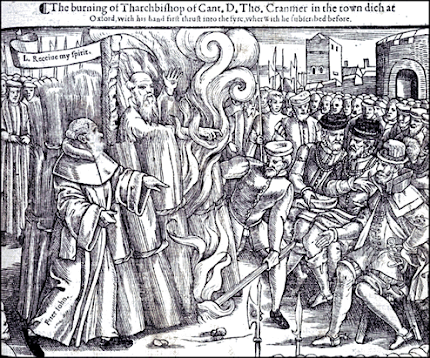
The burning of Tharchbishop of Cant. D. Tho. Cranmer in the town dich at Oxford, with his hand first thrust into the fyre, wherwith he subscribed before.

Bible Gateway Verse of the Day

Daily Bible Verse

Collect of the Day

1662 Book of Common Prayer

The Twenty-second Sunday after Trinity.

The Collect.

LORD, we beseech thee to keep thy household the Church in continual godliness; that through thy protection it may be free from all adversities, and devoutly given to serve thee in good works, to the glory of thy Name; through Jesus Christ our Lord. Amen.

Sunday, June 28, 2009

What's Wrong with the 1928 Book of Common Prayer? by Robin Jordan

"The 1928 Prayer Book was adopted at the time the Anglo-Catholic and Broad Church movements were the dominant schools of thought in the Protestant Episcopal Church and the book reflects their doctrinal emphases."

[The following article is used by permission from The Heritage Anglican Network, by Robin Jordan, a Reformed Anglican and a free lance writer who lives in Kentucky.]

What's Wrong with the 1928 Book of Common Prayer?

By Robin G. Jordan

Introduction


In this article I seek to answer from a Reformed perspective the question, "What's wrong with the 1928 Book of Common Prayer?" Classical Anglican Evangelicalism had disappeared from the Protestant Episcopal Church by 1900. The 1928 Prayer Book was adopted at the time the Anglo-Catholic and Broad Church movements were the dominant schools of thought in the Protestant Episcopal Church and the book reflects their doctrinal emphases. At the 1925 General Convention Anglo-Catholics and Broad Churchmen united to remove the Thirty-Nine Articles from the American Prayer Book. They adopted a resolution dropping the Articles from the Prayer Book. However, they were thwarted by the denomination's Constitution that required an amendment of the Constitution to abolish the Articles. The resolution, which required the ratification of a successive General Convention, was quietly dropped at the 1928 General Convention.

The 1928 Book of Common Prayer was the first major revision of the American Prayer Book. It goes far toward undoing the work that was accomplished for the Anglican Church at the Reformation. Many things rejected by the sixteenth century Reformers because of their inconsistency with biblical and Reformation doctrine, are introduced into the Prayer Book.

Morning and Evening Prayer


The 1928 Book of Common Prayer dilutes the American Prayer Book's doctrine of sin. The ten penitential sentences that had survived the 1892 revision of the American Prayer Book are reduced to three each in Morning and Evening Prayer and placed under the season of Lent. This eliminates an important evangelistic element from Morning and Evening Prayer. Samuel Luenberger draws to our attention:

"The text of our sentences are so compiled that they let one discern for himself the way to overcome sin through repentance. The following texts from the twelve quotations occupy a particularly important position: Ezekiel 18:27; Psalm 51:3.9, and 17; Joe; 2:13, etc.

"The very first quotation from Ezekiel 18 shows the way to prevail over sin:

"When the wicked man turneth away from his wickedness that he hath committed, and doeth that which is lawful and right, he shall save his soul alive." [1]

In its use of Sentences for the Seasons the 1928 Book of Common Prayer imitates the 1928 English Revised Book of Common Prayer and the 1929 Scottish Book of Common Prayer, both which are much more Catholic in tone than 1662 Book of Common Prayer.

The Evangelicals in the Church of England and the British Parliament rejected the 1928 English Revised Prayer Book because it modified the doctrine of the Church of England, and replaced the biblical-Reformation theology of the 1662 Book of Common Prayer with unreformed Catholic doctrine. The upper house of Convocation would defy Parliament and authorized its use in Dioceses where the Ordinary consented to its use. The Scottish Episcopal Church has historically been more High Church and Catholic than the Church of England, preserving such customs as the wearing of eucharistic vestments during the Communion Service and the elevation of the consecrated host during the Prayer of Consecration. The 1929 Scottish Prayer of Consecration included an Epiclesis invoking the Holy Spirit upon the bread and the wine so that the eucharistic elements should "become" the Body and Blood of Christ. Like the 1928 Prayer of Consecration, the 1929 Scottish Prayer of Consecration is derived from the 1764 Scottish Non-Juror Prayer of Consecration.

The 1928 Prayer Book permits the substitution of a short Invitation for the Exhortation in Morning and Evening Prayer with its view of man "in a strictly evangelical-Reformation way as one who wishes to disguise his sinfulness and lives with a propensity for avoiding God." [2]

A short Absolution taken from the medieval Sarum breviary may be used in lieu of Cranmer's fuller Absolution. This short Absolution, as well as a simplified Confession, is offered as an alternative at both Morning and Evening Prayer in the 1928 English Revised Prayer Book and the 1929 Scottish Prayer Book. As we shall see, the short Absolution is one of number of features that the 1928 Prayer Book shares with these books.

The 1928 Prayer Book permits the omission of the first Lord's Prayer or the second Lord's Prayer at Morning Prayer. In the 1552 Prayer Book the first Lord's Prayer forms a part of a sequence that begins with the penitential sentences. Cranmer's Absolution does not make sense if the first Lord's Prayer is omitted. The 1928 Prayer Book permits the omission of the Exhortation, the Confession, the Absolution, and the first Lord's Prayer at Evening Prayer. This represents a significant departure from the Reformed form of Evening Prayer of the 1552 Prayer Book and a return to the unreformed Catholic form of the medieval Sarum breviary and the 1549 Prayer Book.

Invitatories for optional use in the form of medieval Antiphons are prefixed to the Venite. Cranmer had omitted Invitatories from the 1552 Book of Common Prayer because they were interpolated between the successive verses of the Venite and other passages of Scripture and broke the continual course of the reading of the Scripture. (See The Preface in the 1552 Prayer Book). With the Sentences for the Seasons that replace the penitential sentences, they give further emphasis to the Seasons. In the 1928 Prayer Book observance of the Church Year overshadows repentance at Morning and Evening Prayer. This is just one of a number of ways that the 1928 Prayer Book minimizes the gravity of sin.

The Holy Communion


The revised Order for the Holy Communion includes elements that quite definitely bring it into line with the medieval Roman Mass. Among the changes that 1928 Prayer Book introduced are the following:

1. The opening rubrics of the 1928 Order for Holy Communion direct the priest to stand before the Holy Table, his back turned to the congregation. This is how the priest stood at the medieval Roman Mass. This position, commonly referred to as the "eastward position," is associated with the unreformed Catholic and Roman doctrinal views that presbyters are a sacrificing priesthood and the Mass is a sacrifice.

2. The rubrics direct the priest to offer the bread and wine and then place them upon the Holy Table at the Offertory. An offering of the bread and wine during the Prayer of Consecration had already been incorporated into the American Prayer Book with the adoption of the Scottish Non-Juror Prayer of Consecration in 1789. The two offerings of the bread and wine, one at the Offertory and the other during the Canon or Prayer of Consecration are taken from the medieval Roman Mass and are associated with the doctrines of the Sacrifice of the Mass and Transubstantiation.

3. The Prayer for the State of Christ's Church contains a petition for the departed. This is also a feature of the 1928 English Revised Prayer Book and the 1929 Scottish Prayer Book.

4. After the Sursum Corda the rubrics direct the priest to "turn to the Holy Table" with his back turned to the congregation—the eastward position associated with the doctrine of the Sacrifice of the Mass.

5. The 1928 Prayer of Consecrations closely follows the pattern of the medieval Roman Canon, except the latter has no Epiclesis.

6. The theology of the 1928 Prayer of Consecration represents a modification of the theology of the 1764 Scottish Non-Juror Prayer of Consecration. 1764 Scottish Non-Juror Communion Office was the work of two elderly Scottish Non-Juror bishops. They were the last of the surviving Usagers, a Scottish Non-Juror church party that taught that the Eucharist is a sacrifice. They believed that Christ had not offered himself as an atoning sacrifice for our redemption on the cross but at the Last Supper. He had only been slain on the cross.

"The Eucharist is both a Sacrament and a Sacrifice. Our Lord instituted the Sacrifice of the Eucharist when He began to offer Himself for the sins of all men, i.e. immediately after eating His Last Passover. He did not offer the Sacrifice upon the Cross; it was slain there but was offered at the Institution of the Eucharist." [3]

Bishop Thomas Deacon in his Comprehensive View describes a proper celebration of the Eucharist from this standpoint. The priest, he writes

"does as Christ did…he next repeats our Saviour's powerful words "This is my Body," "This is my Blood" over the Bread and Cup. The effect of the words is that the Bread and Cup are made authoritative Representations or symbols of Christ's crucified Body and of His Blood shed; and in consequence they are in acapacity of being offered to God as the great Christian Sacrifice….God accepts the Sacrifice and returns it to us again to feast upon, in order that we may be thereby partakers of all the benefits of our Saviour's Death and Passion. The Bread and Cup become capable of conferring these benefits on the priest praying to God the Father to send the Holy' Spirit upon them. The Bread and Cup are thereby made the Spiritual, Life-giving Body and Blood of Christ, in Power and Virtue." [4]

The theology of the 1928 Prayer of Consecration is far removed from the Reformed theology of the 1552 and 1662 Prayers of Consecration or even the theology of the 1549 Canon. In the latter prayer the Epiclesis precedes the Words of Institution and there is no Oblation, or offering of the bread and wine.

6. The 1928 Prayer of Consecration contains an invocation of the Holy Spirit upon the bread and wine that, as both Martin Bucer and Stephen Gardiner drew to Cranmer's attention, suggest that the bread and wine undergo some kind of change other than a change in use. For this reason and the following reason the invocation of the Holy Spirit was dropped by Cranmer from the 1552 Book of Common Prayer. An invocation of the Holy Spirit upon the bread and wine is a feature of the 1928 English Revised Prayer Book and the 1929 Scottish Prayer Book.

7. Bucer also objected to the invocation of the Holy Spirit upon inanimate objects. There was no warrant for the practice in the Bible. It also represented a departure from Biblical practice. In the Bible the Holy Spirit is invoked only upon people. The Holy Spirit also descends only upon people. Now where do we find in Scripture the invocation of the Holy Spirit upon inanimate objects.

The blessing of Matthew 26:26-29, Mark 14:22-25, and 1 Corinthians 10:16 refers to the Jewish practice of blessing God over a cup of wine as a form of thanksgiving and not to the blessing of the wine itself. This is clear from Luke 22:17-20:

"And he received a cup, and when he had given thanks, he said, Take this, and divide it among yourselves: for I say unto you, I shall not drink from henceforth of the fruit of the vine, until the kingdom of God shall come. And he took bread, and when he had given thanks, he brake it, and gave to them, saying, This is my body which is given for you: this do in remembrance of me. And the cup in like manner after supper, saying, This cup is the new covenant in my blood, even that which is poured out for you."

And 1 Corinthians 11:23-26:

"For I received of the Lord that which also I delivered unto you, that the Lord Jesus in the night in which he was betrayed took bread; and when he had given thanks, he brake it, and said, This is my body, which is for you: this do in remembrance of me. In like manner also the cup, after supper, saying, This cup is the new covenant in my blood: this do, as often as ye drink it, in remembrance of me. For as often as ye eat this bread, and drink the cup, ye proclaim the Lord's death till he come."

It is not an example of Jesus pronouncing God's blessing upon an inanimate object—a cup of wine.

In the 1552 Communion Service in the prayer, "Almighty God oure heavenly father, whiche of thy tender mecye…," the priest humbly asks God that those receiving the bread and wine may be partakers of Christ's Body and Blood. In the 1552 Baptismal Office in the prayer, "Almightie euerliving God, whose most dearely beloued sonne Jesus Christ…," the priest humbly asks God that all his servants who are to be baptized in the water, may receive the fullness of his grace and ever remain in the number of his faithful and elect children. There is no invocation of the Holy Spirit or God's blessing upon the bread and wine or the water in the font.

8. Nowhere in Scripture do we read that Jesus commanded the disciples to celebrate and make a memorial before God with the bread and wine or to offer them to God. Jesus instructed the disciples to eat the bread and drink the cup in remembrance of him. He said nothing about celebrating and making a memorial before God as if God needed to be reminded of what he had done. Paul speaks of proclaiming Christ's death with the bread and the cup until he comes again. But he is not speaking of proclaiming to God but to our fellow men.

9. The 1928 Prayer of Consecration contains the words: "…with these thy gifts, which we now offer unto thee…." It also contains the words: "And though we be unworthy to offer unto Thee any sacrifice, yet we beseech Thee to accept this our bounden duty and service." The Reformers rejected the doctrine that the priest offers a sacrifice of Christ's Body and Blood. Cranmer therefore removed from the 1552 Prayer Book all expressions that taught a presence of Christ in the consecrated elements, and all expressions that implied the offering of them as a sacrifice. For this reason Cranmer removed the word "Altar," and all words in the Prayer of Consecration relating to any offering of a sacrifice by the priest. The Reformers also discarded eucharistic vestments such as the chasuble.

10. The rubrical permission to sing a hymn immediately before the distribution of the Communion permits the singing of the Agnes Dei. Coming where it does, it suggests a presence of Christ in the Bread and Wine as a result of the words of Consecration, and for this reason it was removed by Cranmer from the 1552 Prayer Book. This suggestion is further strengthened by the placement of the Lord's Prayer and the Prayer of Humble Access immediately before the distribution of the Communion. For the same reason they were moved by Cranmer to different positions in the 1552 Prayer Book, the Lord's Prayer to a position immediately after the distribution of the Communion and the Prayer of Humble Access to a position immediately after the Sanctus.

Baptism


The 1928 Book of Common Prayer also changes the baptismal theology of the American Prayer Book.

1. The opening sentence of the Exhortation of the Baptismal Office "forasmuch as all men are born and conceived in sin" has been omitted.

2. The 1928 Prayer Book drops the Flood Prayer that had been in the Book of Common Prayer since the 1549 Prayer Book and in the American Prayer Book since 1789. The Flood Prayer teaches that God has "sanctified the element of water to the mystical washing away of sin" through Our Lord's baptism in the River Jordan. For this reason the form for the private baptism of infants in the 1552, 1559, 1604, and 1662 Prayer Books does not contain a blessing of the water used in baptism.

One cannot make even the slightest alteration in a text without affecting the doctrine of the text. Dropping the Flood Prayer that stresses God's sanctification of the element of water for the purpose of baptism is as serious an alteration of doctrine in the 1928 Prayer Book as the addition of prayers for the departed.

3. The biblical language of the Prayer for the Baptismal Candidate has been watered down.

4. The 1928 Prayer Book recasts the prayer "Almighty, everliving God, whose most dearly beloved Son, etc…" along the lines of the Prayer of Consecration in the service of Holy Communion. This recasting emphasizes the priestly blessing of the water in the font. This is also a feature of the 1928 English Revised Prayer Book and the 1962 Canadian Prayer Book.

The rubrics of 1928 Prayer Book do permit private baptism even by a baptized layperson in cases of dire emergency without a blessing of the water since its omission would have gone against Catholic tradition but its inclusion does not counterbalance the recasting of "Almighty, everliving God, whose most dearly beloved Son, etc…".

5. The signing of the newly baptized with the cross upon the forehead, a practice that Evangelicals view as without warrant in the Bible, to which they have long objected, and which was optional in the 1892 Office of Baptism, is made mandatory.

6. The 1928 Book of Common Prayer gives liturgical expression to the unreformed Catholic doctrine that a bishop in a line of succession going back to the apostles, through the imposition of hands, has the power to confer upon an ordinand in turn the power to convert the substance of the eucharistic elements into the substance of the Body and Blood of Christ (Transubstantiation) and to impart to the element of water the power to regenerate the human soul (Baptismal Regeneration).

The Thirty-Nine Articles rejects the doctrine of Transubstantiation. Evangelicals and Anglo-Catholics are sharply divided over the doctrine of Baptismal Regeneration. The Privy Council, the highest judicial authority for the Church of England at the time, ruled against Bishop Henry Philpotts and the doctrine of Baptismal Regeneration in the Gorham decision in 1850. The Privy Council ruled that Baptismal Regeneration was not a doctrine of the Church of England and Bishop Philpotts should not have denied a living to George Gorham in the Diocese of Exeter because Gorham did not believe that the grace of regeneration invariably accompanied the act of baptism.

Baptismal Regeneration was one of the latent Catholic doctrines in the 1789 Book of Common Prayer that, with the growth and increased influence of Tractarianism in the then Protestant Episcopal Church, prompted Bishop George David Cummins and conservative Evangelical clergy and laypersons to leave the Protestant Episcopal Church in 1873 and to form the Reformed Episcopal Church.

The Catechism


The 1928 Book of Common Prayer replaces the Prayer Book Catechism with two Offices of Instruction. The Second Office articulates a view of Confirmation, which has no real basis in the Bible and is not found in the Reformed Prayer Book of 1552, the classical Anglican Prayer Book of 1662, or the first two American Prayer Books of 1789 and 1892. It is a sacramental view of Confirmation that differs from the catechetical view of Confirmation that was held by the English Reformers and is given liturgical expression in these four Prayer Books. It is also a view of Confirmation over which Anglicans are sharply divided.

Confirmation


The 1928 Prayer Book omits the preface to the Office of Confirmation that was a feature of the 1662, 1789, and 1892 Offices of Confirmation and which emphasizes the catechetical nature of Confirmation. The presentation of the candidates for Confirmation to the bishop is modeled upon that of the presentation of candidates for ordination. The 1928 Prayer Book includes Acts 8 as an optional reading. This particular reading and what it means is the subject of much heated debate.

Burial of the Dead


The biblical language of the Burial Office has been diluted. The Burial Office includes a number of prayers for the departed.

Ordination


In the Ordinal there is a significant change in the form of the question put to the deacon concerning the Bible. Instead of being asked, "Do you unfeignedly believe all the Canonical Scriptures of the Old and New Testaments?" the candidate is asked "Are you persuaded that the Holy Scriptures contains all Doctrine required as necessary for salvation through faith in Jesus Christ?" The candidate is no longer required to affirm a blanket belief in the teachings of the Bible.

Consecration of a Church or Chapel


In the Form for the Consecration of a Church or Chapel any reference to God's anger or wrath has been expunged

Conclusion


From a Reformed perspective the 1928 Book of Common Prayer suffers from a number of serious theological defects. This rules out the use of the 1928 Prayer Book in public worship in an Anglican church that is Reformed in its doctrine. If prayers and liturgical material are used from the 1928 Prayer Book, great care should be taken to see that their doctrine conforms with the biblical-Reformation doctrine of the Thirty-Nine Articles, the 1662 Book of Common Prayer, and the 1661 Ordinal.

Anglicans have long recognized how we pray reflects and shapes what we believe. What good does it do to preach one thing when the liturgy that we are using and the worship practices that we have adopted teach another? Both our preaching and our liturgy and worship practices need to convey the same message.

Endnotes:


[1] Samuel Leuenberger, Archbishop Cranmer's Immortal Bequest The Book of Common Prayer of the Church of England: An Evangelistic Liturgy, (Grand Rapids, Michigan: William B. Eerdmans Publishing Company, 1990) 152.
[2] Leuenberger, 153.
[3]Henry Broxap, The Late Non-Jurors, "Appendix II Non Juror Doctrine and Ceremonies" (Cambridge 1928), 1, appendix on the Internet at: http://anglicanhistory.org/nonjurors/broxapapp2.pdf

[4] Broxap, 1-2.


The Third Sunday after Trinity.

The Collect.

O LORD, we beseech thee mercifully to hear us; and grant that we, to whom though hast given an hearty desire to pray, may by thy mighty aid be defended and comforted in all dangers and adversities; through Jesus Christ our Lord. Amen.

It's OK to be Heterosexual

The Third Sunday after Trinity.
The Collect.
O LORD, we beseech thee mercifully to hear us; and grant that we, to whom though hast given an hearty desire to pray, may by thy mighty aid be defended and comforted in all dangers and adversities; through Jesus Christ our Lord. Amen.

George Whitefield's Sermon on Justification

[The following guest sermon is presented by the Calvinist Anglican, the Reverend George Whitefield. Mr. Whitefield is not ashamed to point out that our justification by faith alone is the teaching of divine revelation in Holy Scripture. How can modern Anglicans neglect so great salvation purchased for us in Jesus Christ? How can Evangelicals abandon the very Gospel itself in order to be in communion with those who promote self righteousness and salvation by works rather than the imputed righteousness of Christ?]


Of Justification by Christ.


A Sermon

by

Rev. George Whitefield


"But ye are justified." 1 Corinthians vi. 11


The whole verse is: "And such were some of you; but ye are washed, but ye are sanctified, but ye are justified in the name of our Lord Jesus Christ, and by the Spirit of our God."


It has been objected by some, who dissent from, nay, I may add, by others also, who actually are friends to the present ecclesiastical establishment, that the ministers of the Church of England preach themselves, and not Christ Jesus the Lord; that they entertain their people with lectures of mere morality, without declaring to them the glad tidings of salvation by Jesus Christ. How well grounded such an objection may be, is not my business to inquire. All I shall say at present to the point is, that whenever such a grand objection is urged against the whole body of the clergy in general, every honest minister of Jesus Christ should do his utmost to cut off all manner of occasion, from those who desire an occasion to take offence at us; that so by hearing us continually sounding forth the Word of truth, and declaring with all boldness and assurance of faith, "that there is no other name given under heaven, whereby they can be saved, but that of Jesus Christ," they may be ashamed of this their same confident boasting against us.


It was an eye to this objection, joined with the agreeableness and delightfulness of the subject—for who can but delight to talk of that which the blessed angels desire to look into?—that induces me to discourse a little on that great and fundamental article of our faith, namely, our being freely justified by the precious blood of Jesus Christ. "But ye are washed, but ye are sanctified, but ye are justified, in the name of our Lord Jesus Christ, and by the Spirit of our God."


The words beginning with the particle "but", have plainly a reference to something before. It may not therefore be improper, before I descend to particulars, to consider the words as they stand in relation to the context. The apostle, in the verses immediately foregoing, had been reckoning up many notorious sins,—drunkenness, adultery, fornication, and such like, the commission of which, without a true and hearty repentance, he tells the Corinthians, would entirely shut them out of the kingdom of God. But then, lest they should, on the one hand, grow spiritually proud by seeing themselves differ from their unconverted brethren, and therefore be tempted to set them at nought, and say with the self conceited hypocrite in the prophet, "Come not nigh me, for I am holier than thou;" or, on the other hand, by looking back on the multitude of their past offences, should be apt to think their sins were too many and grievous to be forgiven, he first, in order to keep them humble, reminds them of their sad state before conversion, telling them in plain terms, "such (or as it might be read, these things) were some of you." Not only one, but all that sad catalogue of vices I have been drawing up, some of you were once guilty of; but then, at the same time, to preserve them from despair, behold he brings them glad tidings of great joy: "But ye are washed; but ye are sanctified, but ye are justified in the name of our Lord Jesus Christ, and by the Spirit of our God."


The former part of this text, our being sanctified, I have in some measure treated of already. I would not enlarge on our being freely justified by the precious obedience and death of Jesus Christ: "But ye are justified in the name of our Lord Jesus Christ."


From which words I shall consider three things:


FIRST, What is meant by the word justified.


SECONDLY, I shall endeavour to prove that all mankind in general and every individual person in particular, stands in need of being justified.


THIRDLY, That there is no possibility of obtaining this justification, which we so much want, but by the all perfect obedience, and precious death of Jesus Christ.


FIRST, I am to consider what is meant by the word justified.


"But ye are justified," says the apostle, which is, as though he had said, you have your sins forgiven, and are looked upon by God as though you never had offended Him at all, for that is the meaning of the word justified, in almost all the passages of Holy Scripture where this word is mentioned. Thus, when this same apostle writes to the Romans, he tells them that "whom God called, those he also justified." And that this word justified implies a blotting out of all our transgressions is manifest from what follows,—"them he also glorified," which could not be if a justified person was not looked upon by God, as though he never had offended Him at all. And again, speaking of Abraham's faith, he tells them, that "Abraham believed on Him that justifies the ungodly," who acquits and clears the ungodly man; for it is a law term, and alludes to a judge acquitting an accused criminal of the thing laid to his charge. Which expression the apostle himself explains by a quotation out of the Psalms: "Blessed is the man to whom the Lord imputeth no sin." From all which proofs, and many others that might be urged, it is evident, that by being justified we are to understand, being so acquitted in the sight of God, as to be looked upon as though we never had offended Him at all. And in this sense we are to understand that article, which we profess to believe in our creed, when each of us declare in his own person, I believe the forgiveness of sins.


This leads me to the SECOND thing proposed, to prove that all mankind in general and every individual person in particular, stands in need of being justified.


And indeed the apostle supposes this in the words of the text: "But ye are justified," thereby implying that the Corinthians (and consequently all mankind, there being no difference, as will be shown hereafter) stood in need of being justified.


But not to rest in bare suppositions, in my farther enlargement on this head, I shall endeavour to prove, that we all stand in need of being justified on account of the sin of our natures, and the sin of our lives.


FIRST, I affirm that we all stand in need of being justified, on account of the sin of our natures: for we are all chargeable with original sin, or the sin of our first parents. Which, though a proposition that may be denied by a self-justifying infidel, who "will not come to Christ that he may have life", yet can never be denied by anyone who believes that St. Paul's epistles were written by divine inspiration; where we are told, that "in Adam all died;" that is, Adam's sin was imputed to all; and lest we should forget to make a particular application, it is added in another place, "that there is none that doeth good (that is, by nature) no, not one. That we are all gone out of the way, (of original righteousness) and are by nature the children of wrath." And even David, who was a man after God's own heart, and, if any one could, might surely plead an exemption from this universal corruption, yet he confesses, that "he was shapen in iniquity, and that in sin did his mother conceive him." And, to mention but one text more, as immediately applicable to the present purpose, St. Paul, in his epistle to the Romans, says, that "Death came upon all men, for the disobedience of one, namely, of Adam, even upon those, (that is, little children) who had not sinned after the similitude of Adam's transgression;" who had not been guilty of actual sin, and therefore could not be punished with temporal death, (which came into the world, as this same apostle elsewhere informs us, only by sin), had not the disobedience of our first parents been imputed to them. So that what has been said in this point seems to be excellently summed up in that article of our church, where she declares that "Original sin standeth not in the following of Adam, but it is the fault and corruption of every man, that naturally is engendered of the offspring of Adam; whereby man is very far gone from original righteousness, and is of his own nature inclined to evil, so that the flesh lusteth always contrary to the spirit. Original Sin therefore in every person born into this world deserveth God's wrath and damnation."


I have been more particular in treating of this point, because it is the very foundation of the Christian religion. For I am verily persuaded, that it is nothing but a want of being well grounded in the doctrine of original sin, and of the helpless, nay, I may say, damnable condition, each of us comes into the world, that makes so many infidels oppose this truth, and so many who call themselves Christians, so very lukewarm in their love and affections to Jesus Christ. It is this, and I could almost say this only, that makes infidelity abound among us so much as it does. For, alas! we are mistaken if we imagine that men now commence or continue infidels, and set up corrupted reason in opposition to divine revelation merely for want of evidence, (for I believe it might easily be proved, that a modern unbeliever is the most credulous creature living;) no, it is only for want of an humble mind, of a sense of their original depravity, and a willingness to own themselves so depraved, that makes them obstinately shut their eyes against the Light of the glorious Gospel of Christ. Whereas, on the contrary, were they but once pricked to the heart with a due and lively sense of their natural corruption and liableness to condemnation, we should have them no more scoffing at divine revelation, and looking on it as an idle tale. They would cry out with the trembling jailer, "What shall I do to be saved?" It was an error in this fundamental point that made so many resist the evidence the Son of God himself gave of His divine mission, when he tabernacled amongst us. Every word He spake, every action He did, every miracle he wrought, proved that he came from God. And why then did so many harden their hearts, and would not believe His report? Why, He Himself informs us, "They will not come unto me that they may have life:" They will obstinately stand out against those means God had appointed for their salvation. And St. Paul tells us, "that if the gospel be hid, it is hid to them that are lost, in whom the God of this world hath blinded the eyes of them which believe not, lest the light of the glorious gospel of Christ, who is the image of God, should shine upon them." 2 Cor. iv. 3 4.


If it be asked, how it suits with the divine goodness, to impute the guilt of one man's sin, to an innocent posterity? I should think it sufficient to make use of the apostle's words: "Nay, but O man, who art thou that repliest against God? Shall the thing formed say to him that formed it, why hast thou made me thus?" But to come to a more direct reply—persons would do well to consider that in the first covenant God made with man, Adam acted as a public person, as the common representative of all mankind, and consequently we must stand or fall with him. Had he continued in his obedience, and not eaten the forbidden fruit, the benefits of that obedience would doubtless have been imputed to us. But since he did not persist in it, but broke the covenant made with him, and us in him, who dares charge the righteous Judge of all the earth with injustice for imputing that to us also?


I proceed, SECONDLY, to prove that we stand in need of being justified, on account of the sin of our lives.


That God, as He made man, has a right to demand his obedience, I suppose is a truth no one will deny: that he hath also given us both a natural and a written law, whereby we are to be judged, cannot be questioned by any one who believes St. Paul's epistle to the Romans to be of divine authority. For in it we are told of a law written in the heart, and a law given by Moses; and that each of us hath broken these laws, is too evident from our sad and frequent experience. Accordingly the Holy Scriptures inform us that "there is no man which liveth and sinneth not;" that "in many things we offend all;" that "if we say we have no sin we deceive ourselves," and such like. And if we are thus offenders against God, it follows, that we stand in need of forgiveness for thus offending Him, unless we suppose God to enact laws, and at the same time not care whether they are obeyed or no, which is as absurd as to suppose that a prince should establish laws for the proper government of his country, and yet let every violator of them come off with impunity. But God has not dealt so foolishly with His creatures. No, as he gave us a law, He demands our obedience to that law, and has obliged us universally and perseveringly to obey it, under no less a penalty than incurring His curse and eternal death for every breach of it. For thus speaks the Scripture; "Cursed is he that continueth not in all things that are written in the law to do them;" as the scripture also speaketh in another place, "The soul that sinneth, it shall die." Now it has already been proved, that we have all of us sinned, and therefore, unless some means can be found to satisfy God's justice, we must perish eternally.


Let us then stand a while, and see in what a deplorable condition each of us comes into the world, and still continues, till we are translated into a state of grace. For surely nothing can well be supposed more deplorable, than to be born under the curse of God; to be charged with original guilt; and not only so, but to be convicted as actual breakers of God's law, the least breach of which justly deserves eternal damnation. Surely this can be but a melancholy prospect to view ourselves in, and must put us upon contriving some means whereby we may satisfy and appease our offended judge. But what must those means be? Shall we repent? Alas! there is not one word of repentance mentioned in the first covenant: "The day that thou eatest thereof, thou shalt surely die." So that, if God be true, unless there be some way found out to satisfy divine justice, we must perish; and there is no room left for us to expect a change of mind in God, though we should seek it with tears. Well then, if repentance will not do, shall we plead the law of works? Alas! "By the law shall no man living be justified: for by the law comes the knowledge of sin." It is that which convicts and condemns, and therefore can by no means justify us; and "all our righteousnesses (says the prophet) are but as filthy rags." Wherewith then shall we come before the Lord, and bow down before the most high God? Shall we come before Him with calves of a year old, with thousands of rams, or ten thousands of rivers of oil? Alas! God has showed thee, O man, that this will not avail. For he hath declared, "I will take no bullock out of thy house, nor he goat out of thy fold: for all the beasts of the forests are mine, and so are the cattle upon a thousand hills." Will the Lord then be pleased to accept our first born for our transgression, the fruit of our bodies for the sin of our souls? Even this will not purchase our pardon: for he hath declared that "the children shall not bear the iniquities of their parents." Besides, they are sinners, and therefore, being under the same condemnation, equally stand in need of forgiveness with ourselves. They are impure, and will the Lord accept the blind and lame for sacrifice? Shall some angel then, or archangel, undertake to fulfil the covenant which we have broken, and make atonement for us? Alas! they are only creatures, though creatures of the highest order and therefore are obliged to obey God as well as we; and after they have done all, must say they have done no more than what was their duty to do. And supposing it was possible for them to die, yet how could the death of a finite creature satisfy an infinitely offended justice? O wretched men that we are! Who shall deliver us? I thank God, our Lord Jesus Christ.


Which naturally leads me to the THIRD thing proposed, which was to endeavour to prove, that there is no possibility of obtaining this justification, which we so much want, but by the all perfect obedience and precious death of Jesus Christ, "But ye are justified in the name of our Lord Jesus Christ."


But this having been in some measure proved by what has been said under the foregoing head, wherein I have shown that neither our repentance, righteousness, nor sacrifice, no not the obedience and death of angels, themselves, could possibly procure justification for us, nothing remains for me to do under this head, but to show that Jesus Christ has procured it for us.


And here I shall still have recourse "to the law and to the testimony." For after all the most subtle disputations on either side, nothing but the lively oracles of God can give us any satisfaction in this momentous point. It being such an inconceivable mystery, that the eternal only begotten Son of God should die for sinful man, that we durst not have presumed so much as to have thought of it, had not God revealed it in His holy word. It is true, reason may show us the wound, but revelation only can lead us to the means of our cure. And though the method God has been pleased to take to make us happy may be to the infidel a stumbling block, and to the wise opiniator and disputer of this world, foolishness; yet wisdom, that is, the dispensation of our redemption, will be justified, approved of, and submitted to, by all her truly wise and holy children, by every sincere and upright Christian.


But to come more directly to the point before us. Two things, as was before observed, we wanted, in order to be at peace with God.


1. To be freed from the guilt of the sin of our nature.


2. From the sin of our lives.


And both these (thanks be to God for this unspeakable gift) are secured to believers by the obedience and death of Jesus Christ. For what says the scripture?


1. As to the FIRST, it informs us, "as by the disobedience of one man, (or by one transgression, namely, that of Adam) many were made sinners; so by the obedience of one, Jesus Christ (therein including His passive as well as active obedience) many were made righteous." And again, "As by the disobedience of one man, judgment came upon all men unto condemnation;" or all men were condemned on having Adam's sin imputed to them; "so by the obedience of one, that is, Jesus Christ, the free gift of pardon and peace came upon all men, (all sorts of men) unto justification of life." I say all sorts of men; for the apostle in this chapter is only drawing a parallel between the first and second Adam in this respect, that they acted both as representatives; and as the posterity of Adam had his sin imputed to them, so those for whom Christ died, and whose representative he is, shall have His merits imputed to them also. Whoever run the parallel farther, in order to prove universal redemption, whatever arguments they may draw for the proof of it from other passages of scripture, if they would draw one from this for that purpose, I think they stretch their line of interpretation beyond the limits of Scripture.


2. Pardon for the sin of our lives was another thing, which we wanted to have secured to us, before we could be at peace with God.


And this the Holy Scriptures inform us, is abundantly done by the death of Jesus Christ. The evangelical prophet foretold that the promised Redeemer should be "wounded for our transgressions, and bruised for our iniquities; that the chastisement of our peace should be upon him; and that by His stripes we should be healed," Isaiah liii. 6. The angels at His birth said, that he should "save his people from their sins." And St. Paul declares that "this is a faithful saying, and worthy of all acceptation, that Jesus Christ came into the world to save sinners." And here in the words of the text, "Such (or, as I observed before, these things) were some of you; but ye are washed, &c." and again, "Jesus Christ is the end of the law for righteousness to every one that believeth." And, to show us that none but Jesus Christ can do all this, the apostle St. Peter says, "Neither is there salvation in any other; for there is no other name under heaven given among men, whereby we must be saved, but the name of Jesus Christ."


How God will be pleased to deal with the Gentiles, who yet sit in darkness and under the shadow of death, and upon whom the sun of righteousness never yet arose, is not for us to inquire. "What have we to do to judge those that are without?" To God's mercy let us recommend them, and wait for a solution of this and every other difficult point, till the great day of accounts, when all God's dispensations, both of providence and grace, will be fully cleared up by methods to us, as yet unknown, because not revealed. However, this we know, that the judge of all the earth will, most assuredly, do right.


But it is time for me to draw a conclusion.


I have now, brethren, by the blessings of God, discoursed on the words of the text in the method I proposed. Many useful inferences might be drawn from what has been delivered; but as I have detained you, I fear, too long already, permit me only to make a reflection or two on what has been said, and I have done.


If then we are freely justified by the death and obedience of Jesus Christ, let us here pause a while; and as before we have reflected on the misery of a fallen soul, let us now turn aside and see the happiness of the believing soul. But alas! how am I lost to think that God the Father, when we were in a state of enmity and rebellion against Him, should notwithstanding yearn in His bowels towards us His fallen, His apostate creatures. And because nothing but an infinite ransom could satisfy an infinitely offended justice, that should send His only and dear Son Jesus Christ (who is God, blessed for ever, and who had lain in His bosom from all eternity) to fulfil the covenant of works, and die a cursed, painful, ignominious death, for us and for our salvation! who can avoid crying out, at the consideration of His mystery of godliness? "Oh the depth of the riches of God's love" to us His wretched, miserable and undone creatures! "How unsearchable is his mercy, and his ways past finding out!" Now know we of a truth, O God, that thou hast loved us, "since thou hast not withheld thy Son, thine only Son Jesus Christ," from thus doing and dying for us.


But as we admire the Father sending, let us likewise humbly and thankfully adore the Son coming, when sent to die for man. But O! what thoughts can conceive, what words express the infinite greatness of that unparalleled love, which engaged the Son of God to come down from the mansions of His Father's glory to obey and die for sinful man! The Jews, when he only shed a tear at poor Lazarus' funeral, said, "Behold how he loved him." How much more justly then may we cry out, Behold how he loved us! When he not only fulfilled the whole moral law, but did not spare to shed His own most precious blood for us.


And can any poor truly convicted sinner, after this, despair of mercy? What, can they see their Saviour hanging on a tree, with arms stretched out ready to embrace them, and yet, on their truly believing on Him, doubt of finding acceptance with Him? No, away with all such dishonourable, desponding thoughts. Look on His hands, bored with pins of iron; look on His side, pierced with a cruel spear, to let loose the sluices of His blood, and open a fountain for sin, and for all uncleanness; and then despair of mercy if you can! No, only believe in Him, and then, though you have crucified Him afresh, yet will He abundantly pardon you; "though your sins be as scarlet, yet shall they be as wool; though deeper than crimson, yet shall they be whiter than snow."

The Third Sunday after Trinity.
The Collect.
O LORD, we beseech thee mercifully to hear us; and grant that we, to whom though hast given an hearty desire to pray, may by thy mighty aid be defended and comforted in all dangers and adversities; through Jesus Christ our Lord. Amen.

Saturday, June 27, 2009

The Elephant in the Tent Comments

[The following is an e-mail response to a bishop of a continuing Anglican denomination which purports to be Evangelical and Reformed. I have removed the name to protect anonymity.]

----- Original Message -----
To:
Sent: Saturday, June 27, 2009 10:09 AM
Subject: Re: The Elephant in the Tent

Hi, _________
Pentecostalism is indeed a serious error. In fact, it developed out of the Wesleyan-Holiness movement, which is itself Arminian. Arminianism pretends to believe the supernatural but instead places the central focus on man's "free will." Sound familiar? In essence, Arminianism is a return to semi-pelagianism. Thus, Arminians and Pentecostals have no problem integrating with Anglo-Catholicism, Roman Catholicism and Eastern Orthodoxy.

Pentecostalism is not a more powerful enemy of the Gospel. It is merely another facet of the same attack. The enemy comes against God's church like a flood from every direction but God will raise a banner against it.

Likewise, the church growth movement is a spiritual stepchild of Pentecostalism. It focuses on techniques, business management, advertising, and popular music rather than right liturgy, right doctrine, and Holy Scripture. This is why I have a problem with so-called "seeker sensitive" theology. Many so-called "Reformed" churches are really using Arminian approaches because of a pragmatic focus rather than focusing on theological precision and Scriptural authority.

Pentecostalism and Anglo-Catholicism are compatible precisely because both focus on man's ability rather than God's sovereignty. Truly Reformed Anglicanism is incompatible with Anglo-Catholicism, Pentecostalism, Arminianism, Eastern Orthodoxy, and Roman Catholicism.

While there is no perfect church either locally or universally, we must always be about the business of reforming the church. If your desire as a bishop is the Gospel rather than numerical success and growth, then I believe God will bless your efforts. The Gospel requires a commitment to doctrinal purity rather than ecumenical tolerance. There is a tension between communion and purity but at some point the commitment to doctrinal purity has to win over tolerance.


"Jude, the servant of Jesus Christ, and brother of James, to them that are sanctified by God the Father, and preserved in Jesus Christ, and called: Mercy unto you, and peace, and love, be multiplied. Beloved, when I gave all diligence to write unto you of the common salvation, it was needful for me to write unto you, and exhort you that ye should earnestly contend for the faith which was once delivered unto the saints." (Jude 1-3, KJV)

The rector at my own church seems to be Reformed as far as I can tell. The problem is his theology is often imprecise, which he thinks is great and I think is sloppy. As I have contended many times, the only basis for fellowship are the five solas of the Reformation and a confessional commitment of some sort so that we know precisely and exactly where a church stands on the issues.

There are those who have criticized me for belonging to a local church which is "officially" part of The Episcopal Church. However, since I cannot find even one Anglican Mission in America church or any other Anglican denomination or local church in my area which is Reformed at all, then I have settled on what is less than perfect. At least the rector is a product of the Sydney Anglicans, which is a Calvinistic and Reformed diocese. Likewise, the vestry here has agreed to allow me to teach an adult Sunday school class where I will systematically teach the doctrines of grace from the Scriptures and go through the 39 Articles showing how they were derived from the Scriptures.

I no longer take the Pentecostal view of success which is pragmatic results in numerical growth, wealth, and popularity. My measure of success is Scriptural growth and the maturity of God's people. One man plants, another waters, but God gives the increase (1 Corinthians 3:5-10). If I can reach just one person with the doctrines of grace and that one person truly understands the Gospel of grace, then I view that as a success.

Arminianism and its Pentecostal stepchild are both departures from the Protestant and English Reformation because the English and Continental reformations were Augustinian, not Arminian or Semi-Pelagian to any degree. Salvation is all of grace from beginning to end and the 39 Articles uphold that scriptural doctrine. Arminianism is in fact directly contradicted in Article 17.

Since I spent at least ten years in the Pentecostal movement, you're preaching to the choir here. I already know that Pentecostalism is a false religion. They pretend that man's free will enables men to do miracles simply by claiming by faith that they can do so. Nevermind that the only evidences they can give are anecdotal or their own testimony or word. Try the spirits to see if they are of God (1 John 4:1). While I would not say that I was not a Christian at that time, it is despite their false teachings and not because of it that I am saved today. There is an element of truth even in false preaching. God can and does lead his elect through false teaching to get them where they need to be later on. My journey took a wrong turn but God got me here.

True faith is a supernatural gift preceding conversion, repentance, and baptism. Baptism itself is merely the outward sign or ceremony confirming what the Spirit of God has already done in regeneration. That does not make baptism optional, though it does mean that baptism is not absolutely necessary for salvation when circumstances prevent it. In fact, baptism does not save at all. What it does is serve as a confirmation of our faith for ourselves and for the congregation and the universal church at large.

I do appreciate your input and feedback.

Sincerely in Christ,

Charlie

[I neglected to mention that the 1928 BCP is Anglo-Catholic. Any God fearing Anglican should use the 1662 BCP minus the prayers for the queen. Regarding Pentecostalism see my article on Cessationism.]

----- Original Message -----
From:
Sent: Saturday, June 27, 2009 8:55 AM
Subject: Re: The Elephant in the Tent

Dear Rev. Ray,

While I have spoken against Anglo-popery amongst neo-con Anglicans for years, I have come to believe that there another, much more potent enemy of the Gospel amongst us. It is pentecostalism.

I find no one willing to address this issue, even amongst Calvinist/Reformed confessing Anglicans. There are 10 ACNA congregations within a 50 mile radius of my house. Some are AMiA, some are "African connection" CANA, one is even in the APA at the moment but still advertises an ACNA connection. ALL are charismatic in worship and theology.

I have seen Duncan in "high praise" at "high mass" - I have seen Rogers "speaking in tongues" - I have seen several AMiA bishops doing both. One AMiA official, formerly a local TEC priest, confessed to me some time ago, "Charlie, I really don't care about Prayer Books or the ordination of women... all I want to do is be a charismatic Episcopal priest."

One very large CANA parish in Alabama approached the PEC seeking membership and oversight. They were tired of their African connection and wary of the forthcoming ACNA - they even preferred to use the accursed 1928 BCP and 1940 hymnal! As soon as they found out our position on charismania, they ran.

The silence of evangelicals and confessing Anglicans on this issue is deafening. It reminds me of the silence of the neo-cons on the matter of the number of homosexual clergy - deacons and presbyters that is - already in their ranks. Why do they only find gay bishops objectionable and why, oh why, do peopale continue to refer to Gene Robinson as the "first openly gay bishop" in TEC? Has no one ever Googled Otis Charles or read a biography of Paul Moore?

Down the rabbit hole once again,
________


On Fri, Jun 26, 2009 at 9:02 AM, Charlie J. Ray <cranmer1959@gmail.com> wrote:
The Second Sunday after Trinity.
The Collect.
O LORD, who never failest to help and govern them who thou dost bring up in thy stedfast fear and love; Keep us, we beseech thee, under the protection of thy good providence, and make us to have a perpetual fear and love of thy holy Name; through Jesus Christ our Lord. Amen.

Friday, June 26, 2009

Local Churches to Avoid

Never join a church which hides its beliefs. If there is no formal statement of faith, avoid the church at all costs!

Secondly, if the statement of faith is so bare bones that it says practically nothing, avoid the church at all costs. We vote with our feet. Never give a thumbs up for a church which might or might not be orthodox, evangelical and reformed in doctrine.

Thirdly, make sure that the church still believes its own confession of faith. Often an official adherence to a confessional faith is no guarantee that the church still preaches and teaches the Scriptures from which such a confession is derived.

Sound advice.

Peace,

Charlie

The Elephant in the Tent

[The following article is from SydneyAnglicans.net]

Robert Ian Williams:

Classic quote from Archbishop Duncan, " It was a miracle that those who believe the ordination of women was a grave error along with those who see it as being justified by Scripture can work together towards mission."

So it is possible for Word of God as given to St Paul to be re-evaluated on women but not on gays!

"This is a reformed church," proclaimed Duncan.

In defiance of Reformed Anglicanism all the following are found in ACNA.....

Prayers for the dead
Invocation of the Saints
Requiem Masses
Eucharistic reservation
Adoration and worship of the Communion elements.

All tolerated in the Anglican Church in North America.

THIS IS a GREAT reformation according to Duncan ...yet the doctrines of Rome (thrown out at the birth of the Anglican reformation) are all back in place. Despite the fact the Church has in Roman Catholic understanding no valid orders to celebrate them!

[Note: Robert Ian Williams is a convert to Roman Catholicism. We Reformed Anglicans thank him for making our point for us. Anglo-Catholics are neither Reformed nor Roman Catholic. See: Anglo-Catholicism: Why the Reformed Episcopal Church, the Anglican Communion Network, and the American Anglican Council Are Wrong.]

Robert Tong
June 24th, 2009

The Washington Times of June 17 under the banner of 'New Anglican Church poses dilemma' commented that the inauguration of the Anglican Church in North America (ACNA) posed a "dilemma for the worldwide Anglican Communion over who represents Anglicanism in the United States and Canada".

The formation of ACNA is a direct challenge to the legitimacy of The Episcopal Church (TEC). Four dioceses have left TEC: San Joaquin in California, Quincy in Illinois; Fort Worth in Texas and Pittsburgh in Pennsylvania. The new Province includes 11 Northern Virginia parishes, some of which pre-date the American War of Independence. It is no surprise then that TEC is litigating over millions of dollars worth of property.

Reaction to the election of Gene Robinson and the authorising of same-sex blessings forced the commissioning of the Windsor Report and the establishment of the Archbishop of Canterbury's Panel of Reference. Two of the Panel's references were the Church of the Redeemer in Florida Diocese and St John's Shaughnessy in the Diocese of New Westminster, Canada. Despite visits from panel members and week-long conversations, both references failed to provide any meaningful help to the congregations. The Florida congregation and some 20 other Florida clergy ejected by the bishop have now found a new home in the new province. St John's, with other Canadian churches grouped as the Anglican Network in Canada, has also found lodging in the new province.

The ACNA has an average attendance of 100,000, which is more than the number of Anglicans in 13 of the 38 provinces of the Anglican Communion. So far seven provinces recognise ACNA in place of TEC. There is no formal process of recognition in the Anglican Communion by any of the so-called 'instruments of communion'.

The GAFCON Primates' Council has welcomed ACNA as fulfilling the Jerusalem Declaration aspiration, 'we believe the time is now ripe for the formation of a province in North America for the federation currently known as Common Cause Partnership to be recognised by the Primates' Council'.

This new Province in North America provides a constitutional framework for the exercise of Christian ministry in accordance with Anglican principles and doctrines.

Can we pray that, under God's providential hand, the new province will be one where the Scriptures are studied with true understanding, false doctrines are driven out, and good works abound?


Robert Ian Williams 2 days, 7 hours ago
What price is this for evangelicals and the historic Reformed nature of Anglicanism?

A Compromised Consitution which affirms the 39 articles in their " literal and grammatical sense" and their role in defining doctrne and settling disputesbut allows their meaning to be ignored and flouted.

One of the Bishops subscribining is Jack Iker of Fort worth..he was recently at Walsingham, where he prayed to the Blessed Virgin Mary and claimed to preside at benediction..worship of the Holy Commumion elements. All such actions contradict the 39 articles.

Indeed the opening ceremony of ACNA took place in a Cathedral in Bedford, Texas where there is a tabernacle, venerated statues and the smell of incense in the air. The Cathedral website advertises confessions and a Rosary prayer group. Within ACNA there are at least 200 such parishes and four dioceses of the most advanced Anglo-Catholic nature.

#1 of 6

Robin Grant Jordan 1 day, 14 hours ago
The constitution and canons the inaugural ACNA Provincial Assembly ratified on June 23, 2009 do establish an ecclesiastical structure that is from a conservative evangelical perspective Catholic in doctrine and order. To read more about the constitution and canons, go to the Heritage Anglican Network at:http://theheritageanglicannetwork.blogspot.com/ I have also posted several articles related to the inaugural Provincial Assembly at: http://anglicansablaze.blogspot.com/ After the ratification of the canons, Mr. Michael Howell, Director of Forward in Faith North America commented, "They're good, but by no means complete with regards our understanding of Catholic Faith and Order but... they're a good starting point."

#2 of 6

Robin Grant Jordan 17 hours, 30 minutes ago
For Sydney Anglicans who do not have time to read the articles on the Heritage Anglican Network and Anglicans Ablaze, I am providing a brief summary of how the ACNA constitution and canons affect them.

1. They make fools of Sydney Anglican leaders who have supported the ACNA, adopting doctrinal positions that these leaders do not hold nor teach and represent a repudiation of their doctrinal views.

2. Sydney Anglicans who are evangelical and Reformed in their doctrinal views and who take a job in North America would not be able to join an ACNA church without compromising their convictions.

3. Sydney Anglicans who are evangelical and Reformed in their doctrinal views and accept a ministerial or teaching position in the ACNA would not be able to minister or teach in the ACNA without compromising their convictions.

4. Entities like the Diocese of Sydney, More Theological College and the Anglican Church League would not be able to enter into ministry partnerships with the ACNA without subscribing unreservedly to its doctrinal positions, which include the recognition of other doctrinal authorities beside the Bible, the Creeds, and the Anglican formularies; recognition of seven sacraments; the Real Presence; baptismal regeneration; recognition of bishops and episcopacy as being of the essence of the Church; and tactual succession. These doctrinal positions, if not stated in the constitution and canons, are implied.

5. Under the ACNA definition of Anglican orthodoxy Sydney Anglicans are not orthodox Anglicans.

6. The ACNA includes some of the most vocal proponents of Sydney' expulsion from the Anglican Communion for lay and diaconal administration of the Lord's Supper.

To be continued.

#3 of 6

Robin Grant Jordan 17 hours, 26 minutes ago
Continued from above.

In the light of the foregoing Archbishop Jensen and the Standing Committee of the Diocese of Sydney may want to reconsider the welcome they extended to the "new province" and issue a statement calling upon the ACNA to take a more comprehensive position toward Reformed-evangelicals. However, there are those in the ACNA who might regard such a statement as meddling in the affairs of an autonomous province like their brethren in The Episcopal Church and become even more opposed to making the new church genuinely comprehensive as conservative Anglicans understand comprehensiveness. When members of the Provincial Council, the highest governing body in the ACNA, proposed that the partisan doctrinal position of one of the Fundamental Declarations in the constitution should be modified to make the new church more comprehensive, the Anglo-Catholic bishops were opposed to any substantive change. Those who made the proposal backed down out of fear of a church split. In this sense Anglo-Catholics leaders in the ACNA might be seen as holding the new church hostage with the other leaders tiptoeing around them lest they upset the former. To be fair to the Anglo-Catholics in the ACNA, there are also other dynamics operative in the new church.

#4 of 6

Robert Ian Williams 15 hours, 59 minutes ago
However the lip service to the 39 articles is appalling!

Plus the fact that the Reformed Episcopal Church had to reject its former position of welcoming non-episcopally ordained clergywithout re-ordination. Several evangelicals have walked out and mauinatain that the original evnagelicalism of tne REC has been subverted.

Just wait until the legal cases start going against ACNA big time.

#5 of 6

Robert Ian Williams 7 hours, 26 minutes ago
Classic quote from Archbishop Duncan, " It was a miracle that those who believe the ordination of women was a grave error along with those who see it as being justified by Scripture can work together towards mission.

So it is possible for Word of God as given to St Paul to be re-evaluated on women but not on gays!

This is a reformed church proclaimed Duncan.

In defiance of Reformed Anglicaism all the following are found in ACNA.....

Prayers for the dead
Invocation of the Saints
Requiem Masses
Eucharistic reservation
Adoration and worship of the Communion elements.

All tolerated in the Anglican Church in North America.

THIS IS a GREAT reformation according to Duncan ...yet the doctrines of Rome ( thrown out at the birth of the Anglican reformation) are all back in place. Despite the fact the Church has in Roman Catholic understanding no valid orders to celebrate them !

[One wonders how Robert Tong can make his views compatible with the more radical views of Phillip Jensen and others in Sydney?]

The Second Sunday after Trinity.
The Collect.
O LORD, who never failest to help and govern them who thou dost bring up in thy stedfast fear and love; Keep us, we beseech thee, under the protection of thy good providence, and make us to have a perpetual fear and love of thy holy Name; through Jesus Christ our Lord. Amen.

Tuesday, June 23, 2009

Comment on the Sola Fide Article at VOL?

Someone at the VOL site where my article on justification by faith alone is posted said the following:

"but the author seems to have forgotten that Anglo-Catholics are also his neighbors–the author cannot persuasively preach the love of Christ to nonChristians while holding such animosity toward Anglo-Catholics that he writes “those of us who are Reformed within Anglicanism must never accept a truce with Anglo-Catholics for any reason” or, as Dominic wrote, “Anglo-Catholicism and Protestantism are not and cannot be common bed-fellows.” Such attitudes are not Anglican and the negativity they convey should not be allowed to detract from the inaugural Assembly of the ACNA."

Blessings,

chaps+


Perhaps Mr. Chaps should realize that being Anglican is irrelevant. The real question is are you a genuinely born-again Christian? Have you been regenerated by the Holy Spirit? I'm quite sure the devil himself is a good Anglican. Perhaps he's even an ordained minister or a consecrated bishop?

The real question at hand is not how "tolerant" or "loving" someone is. The real question is how biblical and correct is your doctrine? If Anglo-Catholics are preaching a false gospel of works righteousness or justification by merits along with all the abominable idolatries like the worshipping of bread and wine, worship of Mary and the saints and prayers to the saints, then I do not see how polemically challenging such false doctrines is unloving. If Anglo-Catholics are lost and on the way to hell, then to give them the genuine Gospel is in fact an act of love and not one of hate. I challenge the lost to repent whether they be atheists, agnostics, muslims, Roman Catholics, Eastern Orthodox, mormons, buddhist, etc.

The difference between Anglo-Catholicism and the Gospel is made even more obvious by the vitriolic comments made about my article on sola fide, which is in fact a presentation of the biblical Gospel. It seems to me that Anglo-Catholics have no ethics and in fact deliberately lie about the implications of Augustinian theology and the Protestant Reformation which is the logical conclusion of both the Scriptures and Augustinian theology.

Since I don't have a valid username for VOL I am unable to post comments there. Seems the moderators who work with Mr. Virtue do not wish my input.

Charlie

Monday, June 22, 2009

Why Anglican? by Phillip Jensen

Why Anglican?

Posted by Phillip Jensen on Oct 03 2008 at 2:18 PM From The Dean >>

It is a strange phenomenon when your friends and enemies agree about you. But Sydney Anglicans enjoy this peculiarity. Neither friends nor enemies think we believe in Anglicanism.

Part of the reason is that Anglicanism is itself a strange phenomenon. Not even Anglicans agree about what it is. It can be defined sociologically or confessionally.

Described sociologically, it is the religion of the English people and their worldwide descendants. Anglicanism was, and still is, the national Church of England. So Anglicanism is the worldwide organization that has grown out of the national Church of England.

On this understanding, whatever the Church in England does or believes is Anglican. Similarly, the descendents of the English, scattered abroad as a result of Britain's erstwhile Empire, determine what is Anglican by whatever they do or believe. Sociological Anglicanism is about belonging not believing. You belong irrespective of what you believe or what you do.

So it is an irrelevance whether such a church departs from basic Christian teaching. Sociological Anglicanism does not even have to be Christian - just English. This gives modern Australians very little reason to either join or belong.

Anglican Christians have never believed in the sociological Anglicanism. We have always been Confessional Anglicans. We are Anglicans because we profess the Anglican beliefs of the Book of Common Prayer and the 39 Articles of Religion. These include the great creeds of the ancient worldwide church (the Apostles, Nicene and Athanasian Creeds).

The Prayer Book and 39 Articles of Anglicanism come from a particular historical context - the struggle of Thomas Cranmer in the sixteenth century Protestant Reformation. The Prayer Book underwent several minor editions before taking its final form in the seventeenth century. From 1662 till today it, and the 39 Articles, stand as the one touchstone of genuine Anglicanism.

There is no doubt what the Prayer Book and 39 Articles meant. The Oxford Professor Diarmard MacCullouch's acclaimed biography of Thomas Cranmer details precisely his beliefs. W. H. Griffith Thomas's commentary on the 39 Articles "The Principles of Theology" expounds their meaning. "The Tutorial Prayer Book" written last century by Charles Neil and J. M. Willoughby gives detailed explanation of every part of the Book of Common Prayer.

The original chaplains to the colony of Botany Bay professed belief in the Protestant Reformation as the one true Anglican theology. Sydney's Anglicans have continued to confess the same faith ever since. We are Anglicans today not because of sociology but because of our confession. We joined and remain Anglicans because we confess Anglican theology.

But such a set of beliefs makes us relaxed about some of the denominational distinctives that sociological Anglicans hold dear. They think that we are so relaxed that we do not believe in Anglicanism. They are angry because we continue to practice beliefs that they have long ago renounced. They are angrier still because we will not accept new beliefs and practices that are contrary to our confession.

Paradoxically we are so relaxed about denominational distinctives, that some of our non-Anglican Christian friends also doubt our belief in Anglicanism.

We welcome as brothers and sisters in Christ, people of different historical traditions but the same basic beliefs. We have more in common with them than with unbelieving members of sociological Anglicanism.

Evangelical Anglicans play a leading role in all manner of non-Anglican Christian ministries - from the Bible Society to the Scripture Union, from the Australian Fellowship of Evangelical Students to the Katoomba Conventions. Not all the students at Moore College are Anglican or training for Anglican ministry. We apply no pressure upon them to become Anglican. That is why some of our friends do not think we are Anglican. For we do not promote Anglicanism but happily share in our common Christian faith.

We sometimes forget to commend confessional Anglicanism to people. Yet it is worth saying that Anglicanism is our choice and that we believe it is a good choice. Being a confessional Anglican is a privilege and blessing for which we are thankful to God and hope others will enjoy.

Confessional Anglican theology rightly captures the heart of the Biblical message. It is very clear about the central truths of God and the way of salvation. It does not try to codify everything in the Bible and so it allows an appropriate level of liberty on issues of Christian freedom. Nevertheless, it clearly condemns false teaching and practice - the kind of false teaching and practice that sociological Anglicans now hold dear as genuine Anglicanism!

Out of confessional Anglican theology comes world mission. For it expresses a concern not only for the glory of God but also the salvation of mankind. This theological concern for world mission is the driving force behind our Diocesan mission.

Here then are two of the reasons for local Christians to become Sydney Anglicans: Theology and Mission.

The Second Sunday after Trinity.
The Collect.
O LORD, who never failest to help and govern them who thou dost bring up in thy stedfast fear and love; Keep us, we beseech thee, under the protection of thy good providence, and make us to have a perpetual fear and love of thy holy Name; through Jesus Christ our Lord. Amen.

Sunday, June 21, 2009

Christ Church Longwood: Sermons by David Knox

Click here for sermons at Christ Church Longwood, Florida. Our rector is David Knox, who is originally from the Sydney Diocese in Australia. The Sydney Anglicans are extremely evangelical and reformed. In fact, Sydney is so conservative and evangelical that they are seen as something of an anomaly in the Anglican Communion at large. Thank God for the remnant of true Christians within the apostate communion!

St. Andrews Cathedral: Sermons by Phillip Jensen

St. Andrews Cathedral, Sydney, Australia.

Phillip Jensen is the brother of Peter Jensen, who is the archbishop of the Sydney Diocese of the Anglican Church in Australia. Phillip's preaching is conservative, reformed, evangelical and confessional. I particularly recommend this sermon: Born and Baptised by the Spirit.

Reasonable Christian: Reasonable Christian: Sola Fide: The Protestant Doctrine of Justification by Faith Alone in the Thirty-nine Articles of Religion

Reasonable Christian: Reasonable Christian: Sola Fide: The Protestant Doctrine of Justification by Faith Alone in the Thirty-nine Articles of Religion

Reasonable Christian: Sola Fide: The Protestant Doctrine of Justification by Faith Alone in the Thirty-nine Articles of Religion

Virtue Online: Reasonable Christian: Sola Fide: The Protestant Doctrine of Justification by Faith Alone in the Thirty-nine Articles of Religion

Saturday, June 20, 2009

Christless Christianity


Michael Horton argues strongly that churches need to focus more on right belief and on the person and work of Jesus Christ rather than on "doing." Most pastors are more concerned with getting people to volunteer and "do" things for their local church. However, this is misplaced since without a real and solid understanding of our condemnation under the law of God we cannot understand the mercy and grace in the Gospel and the objective atonement where Christ died for the sins of His people. Only as Christians come to know their just due is damnation can they gratefully appreciate the forgiveness and propiation for their sins. And then and only then are they able to work for the cause of the Gospel out of a sense of devotion and gratitude rather than out of obligation, duty, and oppression. We begin to joyfully WANT to serve Christ when we truly understand how precious His shed blood really is.

Augustianism/Calvinism Versus Arminianism/Molinism

[The following exchange took place after I contacted the Society of Evangelical Arminians regarding their article satirizing "Stuff Young Calvinists Like." I am at a loss as to how this satirical piece is supposed to demonstrate "love" and an "irenic" spirit as the contact person proposes is the express the purpose of the SEA.]


Ron,

Three things.

1) Dordt and Westminster are not Scripture is absolutely correct. But it also follows from that Arminianism is not Scripture EITHER. It is an "interpretation" of Scripture and therefore fallible. Likewise no visible church on earth is infallible or inerrant. So by your reasoning no doctrine is binding because they are all fallible interpretations of Scripture. That is at least implied in your statement.

That being said, however, the church does have authority to interpret Scripture because it is established by God himself in the very Scriptures you mention. (See 1 Timothy 3:15-16). The church, according to the principles of the Protestant Reformation, should always be reforming itself and thus a common understanding of Scripture must be agreed upon. The principle of sola scriptura and the perspicuity of Scripture applies here.

Since the Dutch "Three Forms of Unity" (Belgic Confession, Heidelberg Catechism, Canons of Dordt) and the Westminster Standards (Westminster Confession, Westminster Larger Catechism, Westminster Shorter Catechism) are summaries of what the church believes the Scriptures infallibly teach, then it follows that they are infallible wherever they are faithful to the infallible Scriptures. Confessional standards are simply more detailed "creeds" which express what Christians "believe." The creeds are prefaced with the words, "I believe..."

Regarding the Synod of Dordt, the Remonstrandts first created the controversy by formulating 5 points of Remonstrance and by attacking the Calvinist doctrines which were at that time binding doctrine in all the Dutch churches. It is a bit silly for Arminians to cry over the Synod of Dordt when in fact the Arminians were in rebellion against biblical doctrine as it had been understood since the Reformation in the Dutch Calvinist churches. The Arminians were in fact challenging the Belgic Confession, which was a binding confession of faith. Confessions of faith are not in and of themselves infallible but they are binding upon the conscience of all members of a local, regional, universal church unless and until it can be proven that the document is unfaithful to Scripture. On this point the Arminians have not proven their case one whit.

"Episcopius was their chief speaker; and with great art and address did he manage their cause. He insisted on being permitted to begin with a refutation of the Calvinistic doctrines, especially that of reprobation, hoping that, by placing his objections to this doctrine in front of all the rest, he might excite such prejudice against the other articles of the system, as to secure the popular voice in his favor. The Synod, however, very properly, reminded him, that they had not convened for the purpose of trying the Confession of Faith of the Belgic Churches, which had been long established and well known; but that, as the Remonstrants were accused of departing from the Reformed faith, they were bound first to justify themselves, by giving Scriptural proof in support of their opinions. The Arminians would not submit to this plan of procedure because it destroyed their whole scheme of argument. However, the Synod firmly refused to make any concessions on this point of order. Day after day they were reasoned with and urged to come and scripturally defend their published doctrines. . . The Arminians would not submit to this course and were thus compelled to withdraw. Upon their departure, the Synod proceeded without them."

2) Molinism cannot be deistic? Molinism is essentially a more philosophically complex form of Arminianism proposing God's natural knowledge, middle knowledge, and free knowledge. However, sophisticated restatements of Arminianism do not solve the problems Molinism claims to solve. In fact, Molinism reinforces the sovereignty of God argument for Calvinists and Augustinians. If Molinism is true, then the Creator God is somehow dependent upon His creation in order to make what is actually existent occur. Thus, Molinism denies the Scriptural truth that God is self-existent and absolutely omnipotent. Any scheme which makes God dependent on creation is therefore either deistic or a capitulation to the open view of theism. (See

Middle Knowledge: A Reformed Critique Travis James Campbell).


3) I did not declare you a heretic. The Synod of Dort declared you and all Arminians as heretics from the Reformed faith and that was an almost unanimous decision of Calvinists all over the world at that time, including those invited to attend from the English church and the Swiss churches. While you may find the term "heretic" uncomfortable, the historical facts stand as they have occurred. We might debate regarding the level of heresy or class of heresy into which Arminianism falls. Are you a primary level heretic on the level of Roman Catholicism and Eastern Orthodoxy? Or are you a secondary heretic in which you remain within the Protestant visible church but with a deficient understanding of the Scriptures and the law and Gospel? I would contend that it is debatable but the evidence toward the primary level of heresy is gaining ground in some Reformed circles.

Confessions of faith are absolutely necessary in determining who is in fellowship or communion within the visible local/regional/universal churches. Otherwise, we would be in communion with everyone in the world who makes any illicit claim to being "Christian." We both know that is not the case. As Paul himself said:

"Do not be unequally yoked with unbelievers. For what partnership has righteousness with lawlessness? Or what fellowship has light with darkness? What accord has Christ with Belial? Or what portion does a believer share with an unbeliever? What agreement has the temple of God with idols? For we are the temple of the living God; as God said, "I will make my dwelling among them and walk among them, and I will be their God, and they shall be my people. Therefore go out from their midst, and be separate from them, says the Lord, and touch no unclean thing; then I will welcome you, and I will be a father to you, and you shall be sons and daughters to me, says the Lord Almighty." " (2 Corinthians 6:14-18, ESV)

As I said earlier in this discussion, Arminianism exalts man above God and is a move back toward the semi-pelagianism of the Roman Catholic system and the Eastern Orthodox system. While some Calvinists have argued that Arminianism is "semi-augustinian" and is faithful to the principles of the Synod of Orange, I would strongly disagree. At best Arminianism is semi-pelagian precisely because it claims that prevenient grace neutralizes total depravity/inability to one degree or another. In short, Arminianism leaves salvation up to capricious and sinful human beings and makes grace of no effect for the vast majority of mankind. A defective grace is pragmatically no different from withholding effectual grace for the end result is the same. The road to hell is broad and the way to salvation is narrow. I prefer to stand with the Scriptures in upholding the absolute sovereignty of God even over the free choices of sinful men. God is God and we are merely His creatures. (Romans 3:5-8; Romans 9:18-23).

The weight of Scripture, church history is against the Arminian view no matter how "popular" it may be. Sin is popular as well but that does not make sin desirable or true. I reiterate that the Protestant Reformation was an Augustinian movement and in no wise was it semi-pelagian or even semi-augustinian. Luther, Calvin, Bullinger, Zwingli, Cranmer and a host of other Reformers were all Augustinians. Surely this too bears heavily against Arminianism, Amyraldianism, Tractarianism/Anglo-Catholicism and a host of other divisive doctrines creating confusion and discord within the visible churches.

I am not nearly so "tolerant" as others since I believe biblical truth is more important than any principle of "tolerance" or "love." In closing, I might point out as well that even William Lane Craig concedes that middle knowledge is not biblical:

Since Scripture does not reflect upon this question, no amount of proof-texting can prove that God's counterfactual knowledge is possessed logically prior to his creative decree. This is a matter for theological-philosophical reflection, not biblical exegesis. Thus, while it is clearly unbiblical to deny that God has simple foreknowledge and even counterfactual knowledge, those who deny middle knowledge cannot be accused of being unbiblical. [Ibid., quoted on page 23].

While you claim that you base your view on exegesis, clearly William Lane Craig says otherwise. The theory of middle knowledge is a philosophical interpolation and not a scriptural argument. Calvinism/Augustinianism, on the other hand, simply takes the Bible as God's word on the matter. Scripture clearly teaches both God's sovereignty and sinful man's accountability for his actions as a free moral agent. While this makes those with a selective reading of Scripture uncomfortable, the bottom line is that Calvinism/Augustinianism/Thomism has the more plain understanding of the entire Bible and is a more complete and systematic exegesis of problem texts for both positions. Your position may make more "common sense" to those who are biblically illiterate in the pews but for anyone willing to read the Bible from cover to cover the implications are unequivocably Augustinian/Thomist and, by implication, Calvinist.

Any departure from the law and the Gospel is serious whether it be on the secondary level or on the primary level. Obviously, departures from the very Gospel itself are the most serious. (John 3:18, 36).

The 39 Articles of Religion, which is the "confession of faith" for the Anglican churches clearly sides with Augustinianism over against pelagianism and semi-pelagian views:

Article IX

Of Original or Birth Sin

Original sin standeth not in the following of Adam (as the Pelagians do vainly talk), but it is the fault and corruption of the nature of every man that naturally is engendered of the offspring of Adam, whereby man is very far gone from original righteousness, and is of his own nature inclined to evil, so that the flesh lusteth always contrary to the spirit; and therefore in every person born into this world, it deserveth God's wrath and damnation. And this infection of nature doth remain, yea, in them that are regenerated, whereby the lust of the flesh, called in Greek phronema sarkos (which some do expound the wisdom, some sensuality, some the affection, some the desire of the flesh), is not subject to the law of God. And although there is no condemnation for them that believe and are baptized, yet the Apostle doth confess that concupiscence and lust hath itself the nature of sin.

Article X

Of Free Will

The condition of man after the fall of Adam is such, that he cannot turn and prepare himself, by his own natural strength and good works, to faith and calling upon God. Wherefore we have no power to do good works pleasant and acceptable to God, without the grace of God by Christ preventing us that we may have a good will, and working with us when we have that good will.
It is indeed unfortunate that you do not wish to correspond further. However, I know that God's will shall be done with or without me. I am merely a creature who is temporarily passing through this world. Nothing can thwart God's eternal plans and decrees, of that I am most certain. (See Job 36:23; Isaiah 10:20-23).


Charlie


"For if we go on sinning deliberately after receiving the knowledge of the truth, there no longer remains a sacrifice for sins, but a fearful expectation of judgment, and a fury of fire that will consume the adversaries. Anyone who has set aside the law of Moses dies without mercy on the evidence of two or three witnesses. How much worse punishment, do you think, will be deserved by the one who has spurned the Son of God, and has profaned the blood of the covenant by which he was sanctified, and has outraged the Spirit of grace? For we know him who said, "Vengeance is mine; I will repay." And again, "The Lord will judge his people." It is a fearful thing to fall into the hands of the living God." (Hebrews 10:26-31, ESV)

----- Original Message -----
From: Ron Fay
Sent: Saturday, June 20, 2009 7:05 AM
Subject: RE: [Contact Us] Reasonable Christian

Charlie,

Three things.

1) Dordt and Westminster are not Scripture. Dordt was a horrible parody of a council in which no Arminians were allowed to speak and only 3 were allowed to attend. It compares to the fruitless ecumenical councils that excluded Trinitarians during the days of Constantius. Westminster is a confession and holds no authority either. Both are worthless in conversations.

2) Molinism cannot be deism in any sense since God perfectly and absolutely practices meticulous sovereignty at every step. How is that deism if He is constantly involved at every moment?

3) You declared me a heretic and showed once again that for a Calvinist, or at least you, theology is the gospel instead of Christ crucified. Nowhere in Scripture is your theology called the gospel. I would be very careful about declaring others unsaved. Unless you amend that statement, I will not be further responding to you.

God bless,

- Ron

________________________________________________
Ron C. Fay, PhD
Associate Pastor of Administration and Teaching
Cornerstone Community Church
Wadsworth, IL
roncfay@hotmail.com


Monday, June 15, 2009

James I. Packer's Last Crusade Revisited, Part 2

This is where Dr. Packer endorses the "Anglican Quadrilateral." I am assuming by this that he means the Anglo-Catholic "Chicago-Lambeth Quadrilateral." It is indeed disheartening to hear Dr. Packer endorse a document meant to undermine the Evangelical and Reformed theology of the Church of England, the 1662 Book of Common Prayer, the 39 Articles, the Ordinals and the homilies.

Sunday, June 14, 2009

James I. Packer's Last Crusade Revisited


This video was taken in Orlando, Florida on February 13, 2009 at the Wycliffe Hall/Reformed Theological Seminary lectures. Dr. James I. Packer is not only a good speaker but he has an excellent sense of humor. I do not always agree with Dr. Packer but without a doubt he has a winsome personality. Dr. Richard Turnbull, the principle of Wycliffe Hall at Oxford University is the gentleman who introduced Dr. Packer.

However history judges him Dr. James I. Packer has most certainly left an indelible mark upon the Evangelical church. May God grant us the grace to live for Christ and Christ alone!

Why I Signed..., by Rick Phillips

I thank Carl for providing the link to the Church of Scotland on-line petition, which I signed yesterday. Like Phil, I thought it was well-written and compelling. I think there are some good matters for reflection here, including points already made by Carl and Phil. Like Carl, I am generally concerned when Christians are more inflamed over matters of morality than doctrine, especially hot-button items for cultural Christianity like homosexuality. I, for one, consider the mainline abandonment of Scripture, Christ, and the gospel to be of ultimate significance: compared to attacks on the trinity, atonement, and inerrancy, homosexuality is a pretty small-fry issue.

[From Reformation 21: "Why I Signed, Too."

The Bread and Wine Are Not to be Adored

HEREAS it is ordained in this Office for the Administration of the Lord's Supper, that the Communicants should receive the same kneeling; (which order is well meant, for a signification of our humble and grateful acknowledgment of the benefits of Christ therein given to all worthy Receivers, and for the avoiding of such profanation and disorder in the holy Communion, as might otherwise ensue;) yet, lest the same kneeling should by any persons, either out of ignorance and infirmity, or out of malice and obstinacy, be misconstrued and depraved: It is hereby declared, That thereby no adoration is intended, or ought to be done, either unto the Sacramental Bread or Wine there bodily received, or unto any Corporal Presence of Christ's natural Flesh and Blood. For the Sacramental Bread and Wine remain still in their very natural substances, and therefore may not be adored; (for that were Idolatry, to be abhorred of all faithful Christians;) and the natural Body and Blood of our Saviour Christ are in Heaven, and not here; it being against the truth of Christ's natural Body to be at one time in more places than one."


Holy Communion, 1662 Book of Common Prayer

Photos from the 130th Anniversary of Christ Church, Longwood, Florida


Please click on the title above or click on Christ Church, Longwood, Florida to see the photos from the 130th anniversary of the church, which was June 7, 2009. The church was originally a mission parish established in 1879. Our rector is David Knox, who is a product of the Sydney Anglicans from Sydney, Australia. You can visit the official website of our church at Christ Church Longwood.

Saturday, June 13, 2009

Quote of the Day: Loraine Boettner on Limited Atonement

It will be seen at once that this doctrine necessarily follows from the doctrine of election. If from eternity God has planned to save one portion of the human race and not another, it seems to be a contradiction to say that His work has equal reference to both portions, or that He sent His Son to die for those whom He had predetermined not to save, as truly as, and in the same sense that He was sent to die for those whom He had chosen for salvation. These two doctrines must stand or fall together. We cannot logically accept one and reject the other. If God has elected some and not others to eternal life, then plainly the primary purpose of Christ’s work was to redeem the elect.

From "Limited Atonement."

Alistair McGrath: The Reformation

The following excerpt is from Modern Reformation Magazine:

Let me make another point about the problems the late medieval church had. Very often in the late medieval church there was a huge gap between the ordinary Christian and Scripture. In part, the reason was technological. Before the invention of printing, Scripture had to be copied out by hand, and that was expensive. Not every Christian believer could read. Christian believers were very often dependent on their priest for an understanding of Scripture. But with the Reformation came this glorious rediscovery that Scripture was like bread upon which you could feed, that it was living water, which you could drink and which would quench your thirst. It was a real move towards rediscovering the importance of Scripture for the church.

All kinds of developments took place to encourage this. For example, the development of exegetical sermons, of biblical commentaries and works of biblical theology, like Calvin's Institutes. There was a real rediscovery of Scripture and a realization that you did not need to rely upon your priest to understand Scripture, but you could go to Scripture directly. One of the great themes of the Reformation is that you can go to Scripture directly, read it, and be nourished by the word of God. This relieved people of the false teachings that the church was putting into circulation at the time. Reading Scripture is not merely about rediscovering the excitement of the Gospel. It's also about asking hard questions about what this religious teacher or that religious teacher is saying. Asking, "Where did this come from? Is this really biblical?" As the reformers began to open Scripture for their people, they began to rediscover that a lot of things in the late medieval church could not be justified on the basis of Scripture at all. The doctrine that Scripture was not easy to understand emerged in the late medieval church. Therefore God and his Providence provides the church to interpret Scripture to the people. By putting the church between Scripture and the people, the church takes control of Scripture. The Reformers were saying, "No, go back to Scripture, read it for yourself and ask, 'Where did these ideas come from?'" I think there is a central theme of the Reformation. That each and every believer has the right and the responsibility to ask, Where do these ideas that we hear from our pulpits come from? Are they justified in the light of Scripture? I think there is a need for us to rediscover that important reformation theme. Because even in today's church we have preachers who very often are saying things that may be what their congregations want to hear, which may be what they want to say, but that aren't well grounded in Scripture. There is a need for us to rediscover Scripture with a view to checking our preachers' art, lest they lead us astray. To my mind, one of the greatest curses of the modern church is the personality cult that seems to descend upon some preachers. Going back to Scripture is about going back to the Word of God and discovering what it is saying, rather than relying upon some preacher who may act as if he alone is the means of communication between God and his people. So I've addressed some of the problems that were there in the late medieval church. There were many, and there are many more I could mention.


[Modern Reformation Magazine: "The State of the Church Before the Reformation."

Prayer or Trespassing?

This picture is making the email rounds in our offices. on Twitpic

Cranmer's Doctrine of the Lord's Supper in its Gospel Context, by Roger Du Barry.

You won't want to miss this excellent article by Roger Du Barry. Du Barry accurately points out that Archbishop Thomas Cranmer's view was nowhere near transubstantiation or real presence. Rather, Cranmer's view is that the sacramental bread and wine are called the body and blood of Christ because they represent the body and blood and not that they are the actual body and blood of Christ by either transubstantiation, consubstantiation or real presence of any sort. Rather, the body and blood of Christ are sacramentally received by faith and faith alone. Essentially, the body of Christ is at the right hand of the Father in heaven and therefore cannot be present in the elements. Even the Lutheran view is excluded from Cranmer's view since the human nature cannot assume the divine nature without mingling the two natures together or confusing the two natures.

Click here to see the article: Cranmer's Doctrine of the Lord's Supper in its Gospel Context. The article is from The Churchman, 2006, 120/4 at the Church Society page.

The Inspiration of Scripture and How We Got the Bible


Recently someone asked the question, "Where did we get the Bible anyway and how do we know it came from God?" This is a good question to ask, especially if the question is asked by a Christian. It is never wrong to ask questions because when we have questions it forces us to think about our faith and to understand it better. As the church father Anselm once said, faith seeks understanding. The Christian who asks questions should then be drawn by the Holy Spirit to seek answers and to understand the Christian response to the question. Of course, no answer to the question we ask can ever fully satisfy every possible refutation of the Christian position. The unbeliever asks questions with the intention of justifying unbelief. The Christian, however, asks questions so that he or she can have a rationally justified foundation for his or her faith.


How we got the book we know as the Bible is a long and complicated history. In fact, the Holy Bible is composed of many writings and types of literature or genre of literature. Some of the books are historical narrative, others are poetry or wisdom literature. When we try to trace the original authors of the books and their historical dates and sources the process can be long and complicated. This does not mean that we know nothing about the original authors or the date and time of the various books' composition. There are many good resources available which can answer some of the questions Christians have about these issues. For example, there are introductory textbooks which summarize the background, date and author of the books of the Old Testament. Usually the title of such a textbook will be something like, "An Introduction to the Old Testament." The same thing is true of the New Testament. Introductory books will be something like, "An Introduction to the New Testament." These books give the student a summary of each book of the Bible and the cultural, historical, date of the writing of the book, and the most likely person who wrote it.


Another issue for us to consider is canonization. The "canon" of Scripture is the authoritative collection of the books together into the one book we know as the "Holy Bible." For one thing, the Bible was originally composed in the languages of the Hebrew people in Old Testament times, which was Hebrew and Aramaic, and in the New Testament the language of Koine Greek. As each of the books of the Bible were composed they gained a following among the religious leaders and became generally recognized as being inspired by God. The Old Testament writers wrote the very words of God as the Holy Spirit directed them. Though the writings are indeed the composition of prophets and apostles, they are also fully divine and are the very words of God himself. The majority of the 39 books of the Old Testament were fully canonized as an authoritative collection in the form we can recognize today at least as far back as the last book, Malachi. However, a major portion of the OT was in place by at least the time of the Babylonian exile in 586 B.C., although the Jewish religious leaders never officially "canonized" the Tanakh until the Council of Jamnia in the first century. Modern scholarship questions whether this council ever took place at all but the fact remains that the Hebrew canon gradually and definitively became solidified into the authoritative collection which both Jews and Christians recognize today. (Judaism has slightly different titles and ways of ordering the Tanakh but essentially the Christian Old Testament and the Tanakh are the same).


The story gets more complicated during the intertestamental period between the time of the Old Testament books and the writing and collection of the New Testament into a canon of 27 books. During the time between the writing of Malachi and the writing of the books of the New Testament there were many Jewish apocryphal and pseudepigraphal books such as The Assumption of Moses, The Book of Enoch, etc. These books heavily influenced both Jews and the later Christians. Several books of the New Testament either allude to apocryphal works or even quote from them. Jude, for example, mentions Enoch and has a couple of quotes from Enoch. This does not in any way mean that Enoch is an inspired book but it does indicate the influence of these books on Christian writers and that apparently God inspired the quotations to be included in the Bible.


Even though the New Testament books were in circulation for at least 300 or more years prior to their being canonized, they were always inspired by God even before the Christian churches in general accepted them as such. The Protestant position is that the church fallibly collected the books of the New Testament as we have them today. This means that the books of the Bible are infallible and inerrant as they are individually written. They are the very word of God. However, the Bible itself is a "fallible" collection or "canon." In other words, the church is not perfect and can make errors. It is possible that some books should have been included but were not. However, almost no one is arguing that even one of the books in the canon should not have been included, although Martin Luther once argued that the Epistle of James should not be included because Luther was concerned that James' emphasis on sanctification as a supernatural product of our justification by faith would lead some to think that Christians are saved or "justified" by good works rather than by a faith that is living and evidenced or "justified" by good works. In other words, justifying faith is justified before men by the good works it produces. But before God men are only justified by faith. In fact, even our sanctification is a gift of God (Philippians 2:13).


Another issue to be considered are the books which are in dispute between Protestants and Roman Catholics and the Eastern Orthodox churches. Protestants call these books the Apocrypha because both the Eastern churches and the Western churches of the 4th century said that these books were not to be considered equal to Scripture but instead were to be read only for background to the Bible. No doctrine was to be built upon them. Both Athanasius in the East and Jerome in the West said the same thing though neither were completely faithful to their statement that these books are only for public edification and not for dogmatic doctrinal teaching. It is for these reasons that the Church of England sided with the Protestants and included the following statement defining the books of the Bible:


Article VI

Of the sufficiency of the Holy Scripture for Salvation

Holy Scripture containeth all things necessary to salvation: so that whatsoever is not read therein, nor may be proved thereby, is not to be required of any man, that it should be believed as an article of the faith, or be thought requisite or necessary to salvation.

In the name of Holy Scripture, we do understand those Canonical books of the Old and New testament, of whose authority was never any doubt in the Church.

Of the names and number of the Canonical Books.

Genesis.
Exodus.
Leviticus.
Numbers.
Deuteronomy
Joshua.
Judges.
Ruth.
The First Book of Samuel.
The Second Book of Samuel.
The First Book of Kings.
The Second Book of Kings.
The First Book of Chronicles.
The Second Book of Chronicles.
The First Book of Esdras.
The Second Book of Esdras.
The Book of Esther.
The Book of Job.
The Psalms.
The Proverbs.
Ecclesiastes, or the Preacher.
Cantica, or Songs of Solomon.
Four Prophets the Greater.
Twelve Prophets the Less.
All the books of the New Testament, as they are commonly received, we do receive, and account them canonical.

And the other books (as Hierome saith) the Church doth read for example of life and instruction of manners; but yet doth it not apply them to establish any doctrine. Such are these following:

The Third Book of Esdras.
The Fourth Book of Esdras.
The Book of Tobias.
The Book of Judith.
The rest of the Book of Esther.
The Book of Wisdom.
Jesus the Son of Sirach.
Baruch the Prophet.
The Song of the Three Children.
The Story of Susanna.
Of Bel and the Dragon.
The Prayer of Manasses.
The First Book of Maccabees.
The Second Book of Maccabees.
[39 Articles of Religion, Article VI]


It would be impossible to discuss every detail of the issues dealing with the Bible. But it should be pointed out that even though the Bible is not a book of science or history or geography it is amazing that the historical narratives mention real individuals in history. For example, we know that Pontius Pilate and Herod Agrippa were real historical figures during the time of Jesus Christ. In the Old Testament period the Assyrians were confirmed as a real nation even though scholars had long argued that the Assyrians were mythological and did not exist in actual history. Today we know that is not so. Though there are admittedly some apparent contradictions in Scripture, these may yet be explained as we learn more and discover more archaeological evidences supporting the historical narratives in the Bible.


Finally, it should be mentioned that the doctrine of inspiration is a complicated issue as well since most conservative and confessing Evangelical Protestants believe in the verbal plenary view of inspiration. That is, every word of the Bible is fully inspired by God or literally "God breathed." Of course, the Bible records even the words of wicked men and even Satan. This does not mean that we follow the examples of the wicked but rather the sins of the wicked are infallibly and inerrantly recorded in Scripture by God himself to warn us of the consequences of such sins. Most Evangelicals take an incarnational view of Scripture. The Scriptures are fully divine because they are inspired by God but they are fully human as well because the books are written by completely and fully human individuals. They are not robots taken over by the Spirit of God yet God fully directs their thoughts and words such that the Bible is fully and completely the very words of God in written form. The Bible does not merely record words that contain God's word or which "become" God's word as we are inspired by them. No, the Bible is propositional truth in written form. It is God's very word whether we accept what it says or not. The Bible is the objective truth of God set forth in written form and anyone who can read can see what God has said to us.


The Bible is meant to lead us to salvation and is so plain that even a child can read it and understand it and be saved:


"But continue thou in the things which thou hast learned and hast been assured of, knowing of whom thou hast learned them; And that from a child thou hast known the holy scriptures, which are able to make thee wise unto salvation through faith which is in Christ Jesus. All scripture is given by inspiration of God, and is profitable for doctrine, for reproof, for correction, for instruction in righteousness: That the man of God may be perfect, throughly furnished unto all good works." (2 Timothy 3:14-17, KJV) 1


"We have also a more sure word of prophecy; whereunto ye do well that ye take heed, as unto a light that shineth in a dark place, until the day dawn, and the day star arise in your hearts: Knowing this first, that no prophecy of the scripture is of any private interpretation. For the prophecy came not in old time by the will of man: but holy men of God spake as they were moved by the Holy Ghost." (2 Peter 1:19-21, KJV) 2


While we do not have the original writings or original autographs of the original writers of the books of the Bible, we do have hundreds of manuscripts of the Old Testament dating back to the time of the Dead Sea Scrolls and we have literally thousands of Greek manuscripts of the New Testament dating as far back as the 2nd century, though most of the Greek manuscripts are much later. Textual criticism has for the most part established that the Bible is a highly accurate reflection of what was in the original autographs.


There is an amazing unity and flow through the canon of Scripture from Genesis all the way to Revelation. The basic organization of the Bible is creation, fall, redemption, and judgment. Some have argued that there is a scarlet thread which runs from the beginning of the Bible to the end. That is, there are references to Christ and his redeeming blood shed for sinners from the beginning of the Bible to the end. For the person who is a born-again Christian and who has a genuine faith in God and in Jesus Christ his Son, questions about the Bible lead us to a deeper understanding of our faith, who God is, and a deeper relationship with Jesus Christ. If God is there before creation, then it follows that He will reveal Himself as a personal and triune God, Father, Son and Holy Spirit both in creation or natural revelation and in special revelation in the Bible and in His Son Jesus Christ:


" For the wrath of God is revealed from heaven against all ungodliness and unrighteousness of men, who by their unrighteousness suppress the truth. For what can be known about God is plain to them, because God has shown it to them. For his invisible attributes, namely, his eternal power and divine nature, have been clearly perceived, ever since the creation of the world, in the things that have been made. So they are without excuse. For although they knew God, they did not honor him as God or give thanks to him, but they became futile in their thinking, and their foolish hearts were darkened." (Romans 1:18-21, ESV)


" Long ago, at many times and in many ways, God spoke to our fathers by the prophets, but in these last days he has spoken to us by his Son, whom he appointed the heir of all things, through whom also he created the world. He is the radiance of the glory of God and the exact imprint of his nature, and he upholds the universe by the word of his power. After making purification for sins, he sat down at the right hand of the Majesty on high," (Hebrews 1:1-3, ESV) 3


God's general revelation in the natural world, which is His creation, is not enough to bring us to saving faith. (See Article XVIII). We must be born-again and we must hear the Gospel preached. Thus, God's special revelation in His Son Jesus Christ is the central point in all of human history. Everything we know about Jesus is revealed to us in the special revelation of Holy Scripture. It behooves us, therefore, to listen to God's very words as they are recorded for us in the Holy Bible.


For further study see:


The Canon of Scripture.


The Chicago Statement on Biblical Inerrancy with Exposition.


The Inspiration of Scripture.


The Westminster Confession of Faith: Of the Holy Scripture.


1 The Holy Bible : King James Version. 1995 (electronic ed. of the 1769 edition of the 1611 Authorized Version.). Bellingham WA: Logos Research Systems, Inc.

2 Ibid.

3 The Holy Bible : English standard version. 2001. Wheaton: Standard Bible Society.

Sunday, June 07, 2009

Mark Driscoll on Predestination

Saturday, June 06, 2009

Podcast: Why Keep the 1662 Book of Common Prayer?

This podcast is from the The Prayer Book Society: Promoting the Continued Use of the 1662 Book of Common Prayer in the United Kingdom. It is sad that The Prayer Book Society of the USA is instead promoting the Anglo-Catholic prayer book or the 1928 BCP. It has been well said that the 1662 BCP is the most faithful to Cranmer's vision for the reformation of the English church according to Holy Scripture. Truly the aesthetic and theological foundations of the language of the 1662 BCP make it the most worthy prayer book for worship today. Those who wish to make worship profane and use everyday language do not realize the value of memorizing the beautiful language of the prayer book and the theological lessons to be internalized from it.

To hear Lord Hurd's discussion of his experience with the 1662 Book of Common Prayer in his upbringing, click here: PBS Podcast Episode 1: Lord Hurd of Westwell

1662 Prayer Book Society News

[The following news article is from the 1662 Prayer Book Society in England.]

18/05/2009 Prayer Books to Africa

HUNDREDS of copies of the 1662 Book of Common Prayer have been shipped across the globe to meet a growing demand for traditional church services in Africa.

The Prayer Book Society, which campaigns for the continued use of Cranmer’s liturgy, stepped in to help when a cathedral in Uganda made an appeal for help. The majority of Anglican services in Uganda are from the traditional book, and the Church is growing so rapidly that it cannot easily keep up with the demand for Prayer Books.

The shipment of 700 copies of the BCP is now in use at St John’s in Fort Portal after something of a tortuous journey. “They have been en route for several months”, explains Peter Bolton from the Prayer Book Society. “In fact, so long was the journey that Bishop Patrick Kyaligonza, who collected them from the docks, was merely the dean when the books left England.”

Surviving unscheduled trans-shipment, getting past the pirates, suffering a long delay in the port at Mombasa, the container of prayer books was monitored by Pat Morris who is in charge of the Friends of Teso which organised the shipment. Once they had landed safely in Soroti, the books were quickly retrieved by The Rev'd Boniface Esomu for the last leg of their journey.

The prayer books have been most warmly welcomed. “We are so appreciative of this gift and are looking forward to using the prayer books to enhance the ability of the congregation to participate actively in worship”, says Rt. Rev. Patrick Kyaligonza the Bishop of Ruwenzori. “Thank you so much for this contribution to our times of worship in the English services in our diocese.”

Generous members of the Prayer Book Society donated thousands of pounds to enable the books to be bought and sent to Uganda. “And it is refreshing to know that there are far more copies of the Book of Common Prayer in daily and weekly use now than there were in the first hundred years of the book’s life”, says Prayer Book Society Chairman Prudence Dailey.

The Society is aware of a big demand for prayer books from Anglicans around the world who cannot so easily afford to buy copies. It has therefore established a special fund to meet future requests. -end—

Friday, June 05, 2009

God Preserves His Church: Article 27 & 28 of the Belgic Confession

Article 27: Of the Catholic Christian Church.

We believe and profess, one catholic or universal Church, which is an holy congregation, of true Christian believers, all expecting their salvation in Jesus Christ, being washed by his blood, sanctified and sealed by the Holy Ghost. This Church hath been from the beginning of the world, and will be to the end thereof; which is evident from this, that Christ is an eternal King, which, without subjects, cannot be. And this holy Church is preserved or supported by God, against the rage of the whole world; though she sometimes (for a while) appears very small, and in the eyes of men, to be reduced to nothing: as during the perilous reign of Ahab, the Lord reserved unto him seven thousand men, who had not bowed their knees to Baal. Furthermore, this holy Church is not confined, bound, or limited to a certain place or to certain persons, but is spread and dispersed over the whole world; and yet is joined and united with heart and will, by the power of faith, in one and the same spirit.

Article 28: That every one is bound to join himself to the true Church.

We believe, since this holy congregation is an assembly of those who are saved, and that out of it there is no salvation, that no person of whatsoever state or condition he may be, ought to withdraw himself, to live in a separate state from it; but that all men are in duty bound to join and unite themselves with it; maintaining the unity of the Church; submitting themselves to the doctrine and discipline thereof; bowing their necks under the yoke of Jesus Christ; and as mutual members of the same body, serving to the edification of the brethren, according to the talents God has given them. And that this may be the more effectually observed, it is the duty of all believers, according to the word of God, to separate themselves from all those who do not belong to the Church, and to join themselves to this congregation, wheresoever God hath established it, even though the magistrates and edicts of princes were against it, yea, though they should suffer death or any other corporal punishment. Therefore all those, who separate themselves from the same, or do not join themselves to it, act contrary to the ordinance of God.

Opinion: The Slaying of a Baby Killer

I will not belabor this for long nor will I go into many details. However, judging from the Bible's emphasis on divine judgment, I would say that Dr. George Tiller was cut off by God Himself. Yes, the divine instrument was a human being who was misguided by his own hatred of abortion and the murder of unborn children. Scott Roeder committed a crime of murder in assassinating George Tiller. From the perspective of civil society and the rule of law, Roeder is a criminal and deserves to receive the full penalty for his crime.

Terrorism of any kind, vigilante justice of any kind is forbidden in Romans 13:1-7. Unfortunately, murdering Tiller will only increase the wickedness of those who support abortion. God often hardens the hearts of the wicked (Exodus 4:21; 7:3, 13; 9:12; 10:1, 20, 27; 11:10; 14:4, 8; 14:17) so that they do even more wickedness and bring even greater judgment upon themselves in the final judgment where we shall all stand before God (Psalms 1:5; 9:16; 75:7; Romans 2:2; 11:3; 2 Corinthians 5:10; 1 Peter 4:17; Jude 14, 15; Revelation 20:11-15). God often uses unjust nations to punish the nation of Israel in the Old Testament. Likewise, wicked kings were often assassinated in the Old Testament and such actions were ordained of God yet the person doing the assassination later faced judgment for his own sins and crimes against God and man. God even sends lying spirits to bring the wicked Ahab to battle to be killed by an arrow. (See 1 Kings 22:20-23; 29-38).

While George Tiller got what he deserved, it was a crime and unfortunately will only serve to make a martyr out of a murderer. How ironic. I strongly disagree with the terrorist tactics of the far right in the pro-life movement and the reason is that it is not only illegal and criminal but it actually does more to harm the effort to save the unborn because it gives a false legitimacy to the murders and promoters of the murders of unborn children.

Likewise, I admire Bill O'Reilly for using his platform to speak the truth bluntly concerning the immorality of the abortion mills and the assembly line nature of abortion clinics and the abortion industry. It is a travesty that a man like Tiller could become a multi-millionaire by legally murdering unborn children. The irony of this is beyond any stretch of the imagination. However, O'Reilly's rhetoric should be toned down since he could be accused of "inciting" the terrorist act committed by Roeder.

In my opinion, Tiller and other so-called "Christians" exposed themselves when they gave "memorial" services for unborn children murdered at their clinic. (See Wichita Memorial). This sort of reversal of biblical morality is predicted in the Bible, of course:

"Woe to those who call evil good and good evil, who put darkness for light and light for darkness, who put bitter for sweet and sweet for bitter! Woe to those who are wise in their own eyes, and shrewd in their own sight!" (Isaiah 5:20-21, ESV)[1]

Even though this criminal act of terrorism by Roeder put an end to the murder of tens of thousands of unborn babies, it will only incite the pro-murder side to even more liberal laws, more repression of religious freedom and freedom of speech. However, God has His own secret purposes behind all of this and nothing happens by chance (Deuteronomy 29:29; Proverbs 16:33). God has decreed whatsoever happens from before the foundations of the world and will accomplish His will even through the acts of terrorists. One could justly argue that even the 9/11/2001 attack was the judgment of God falling against this nation even though the act itself was a crime perpetuated by Islamic fundamentalists and terrorists.

" At the end of the days I, Nebuchadnezzar, lifted my eyes to heaven, and my reason returned to me, and I blessed the Most High, and praised and honored him who lives forever, for his dominion is an everlasting dominion, and his kingdom endures from generation to generation; all the inhabitants of the earth are accounted as nothing, and he does according to his will among the host of heaven and among the inhabitants of the earth; and none can stay his hand or say to him, “What have you done?”" (Daniel 4:34-35, ESV) [2]


[1] The Holy Bible : English standard version. 2001. Wheaton: Standard Bible Society.
[2] Ibid.

Abortionist Millionaire Shot Dead

http://www.virtueonline.org/portal/modules/news/article.php?storyid=10570

http://kgov.com/gallery/abortion/wichita-memorial/memorial.html