>

Martyred for the Gospel

Martyred for the Gospel
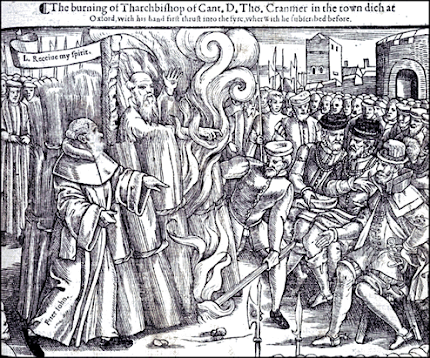
The burning of Tharchbishop of Cant. D. Tho. Cranmer in the town dich at Oxford, with his hand first thrust into the fyre, wherwith he subscribed before. [Click on the picture to see Cranmer's last words.]

Daily Bible Verse

Showing posts with label Continuationism. Show all posts

Wednesday, August 29, 2012

The Continuing Fiasco of the Anglican Orthodox Church, The Traditional Protestant Episcopal Church, and the Protestant Episcopal Church USA


It looks like the deception continues with the Traditional Protestant Episcopal Church.  Not only does the former denomination use the corrupt 1928 Book of Common Prayer but it also praises the 1549 Book of Common Prayer rather than the 1552 or the 1662 Book of Common Prayer.  The 1549 was not a fully reformed prayer book and does not represent Archbishop Thomas Cranmer's intended reforms.  The 1552 Book of Common Prayer is the most reformed prayer book and the 1662 prayer book is modeled after the 1552 with only a few minor concessions to the conservatives.


Also, it would appear that the Traditional Protestant Episcopal Church, headed by Bishop Charles Morley, has now merged with the Anglican Orthodox Church, headed by Jerry Ogles.  Both are small denominations and from reliable sources the rumors are that both tolerate high church Arminianism in their midst, which would negate their claim to be "Reformed" in any sense at all.  The Canons of Dort thoroughly rejected Arminianism as a heresy that was a move back towards Rome.

Click here to see the Wikipedia entry on the merger:  Traditional Protestant Episcopal Church

The article at Wikipedia claims that the split from the TPEC was over Calvinism.  It would appear that assessment is true since both the TPEC and the AOC claim to be "continuing churches".   Jerry Ogles, the bishop of the Anglican Orthodox Church, claims to be reformed but rejects the label of "Calvinist" because he is a dissimulator who wishes to play both sides of the fence with high church Arminians and low church Calvinists.  This is why the Tradition Protestant Episcopal Church has been welcomed with open arms in to the Anglican Orthodox Church.  It is fairly obvious that this is true since Ogles becomes easily angered when anyone dares to challenge his ambiguity on the issue of Arminianism and Calvinism.

The Traditional Protestant Episcopal Church split when the assisting bishop, Del Murray, objected to Bishop Morley's stance against Murray's more open views toward contemporary worship and the church growth movement.  Murray and his followers left and formed The Protestant Episcopal Church USA.   The PECUSA is not to be confused with The Episcopal Church (TEC), which is the mainline liberal denomination.

Stay tuned for further updates as I will be investigating the new group headed by Del Murray as time permits.  It is unclear at this time exactly where the PECUSA stands on the issue of Arminianism and Calvinism and the Tractarian heresy.  However, judging from the photos on the page the denomination is high church Arminian or Anglo-Catholic.  The Lord's Supper is called "Holy Eucharist" and there is the practice of the lifting up and adoration of the creatures of bread and wine.  See this photo from their page:


The Thirty-nine Articles of Religion forbids the lifting up and worshipping of the bread as if it were the read or true body of Christ.  (Cf. Article 28).  The fact of the matter is that Archbishop Cranmer rejected the doctrine of real presence and transubstantiation.  For Cranmer the only way to partake of the true body and blood of Christ was by a spiritual eating and drinking in the heart/mind/soul of the believer by faith.  The bread and wine remain bread and wine and are only called by the names of what they spiritually represent.  (Cf. Cranmer on Real Presence and Church Association Tract 025).  The sacraments are an object lesson to the Gospel.  The presence of Christ in the sacraments can only be possible because the Word or Holy Scriptures and the sacraments work in tandem to preach the Gospel message.  Real presence in the sacraments can only take place by the inward grace or gift of a true and lively faith.  Those who do not have faith do not partake of the body and blood of Christ but eat and drink only the empty signs. (Cf. Article 29). This view has been derogatorily referred to as "Zwinglianism" or "mere memorialism" but the fact of the matter is that the Consensus of Tigerinus reconciled the Calvinist view with the Zwinglian view and the English Reformers, including Archbishop Thomas Cranmer, were in full agreement with the consensus reached. 

From the brief examination above then it would appear that it would be ill advised for anyone to join in membership with the Anglican Orthodox Church, the Protestant Episcopal Church USA, or any other denomination claiming to be Anglican and Reformed but waffles on the issues of Arminianism, Anglo-Catholicism or the papist doctrine of real presence.

Anglicans who are Evangelical and Reformed continue to be forced to attend Presbyterian congregations and even there a broad tolerance for Arminianism prevails.  I would not personally recommend joining any congregation that teaches that Arminians are truly converted as this teaching is nothing more than semi-pelagianism and works righteousness.  The only other option for Anglicans might be the Missouri Synod of the Lutheran churches but many of the Lutheran doctrines are essentially a recapitulation to Arminianism, including a general atonement rather than particular atonement, resistible grace, etc.


Charlie J. Ray

Wednesday, January 11, 2012

Cessationists in Rebellion: Vincent Cheung's Charismatic Theology


I am pleased to announce that I have been condemned as a "rebel" by yet another Charismatic.  Yes, Vincent Cheung has said in public and in writing that those Christians who do not "practice" or believe in ongoing charismatic gifts today are "in rebellion against God".  You can see the article here:  Cessationism and Speaking in Tongues.  I would suggest that Cheung not try walking on the water over his head unless he can swim.  Click on this link as well:  Cessationism and Rebellion.

Unfortunately, Cheung tries to deflect criticism of his position by claiming that he is neither Reformed nor Charismatic (Cessationism and Speaking in Tongues, p. 2).  I would agree that he is not Reformed; but claiming that he is not Charismatic when practically everything he has written in defense of continuationism is identical to the same tired old arguments put forward by other Arminian and "Reformed" Charismatics is a good indicator that Cheung is simply trying to sidestep the obvious.


Also, he betrays a basic misunderstanding of the doctrine of Sola Scriptura when he out of hand dismisses the theological differences between particular Baptists and confessional Presbyterians:


A person might think that a Christian must either be Baptist or Presbyterian, and if a person affirms Baptist sacraments but Presbyterian government – or any one thing that is supposedly Baptist and another that is supposedly Presbyterian – then he must be wrong, simply on the basis that, according to him, these two categories are incompatible. But this is a poor argument, and does nothing to address whether this person's doctrine is right or wrong. It does, however, tell us that the critic's understanding of the Christian world is limited to a narrow conception of Baptists and Presbyterians. He is like a frog trapped at the bottom of a well, and his idea of the heavens is as small as the opening through which he views the sky. 

The Christian world is very broad. Just because a person believes in the biblical doctrine of predestination does not mean that he learned it from Calvin. Maybe he learned it from Augustine. Maybe he learned it from Hodge, or Shedd, or Berkhof. Maybe he learned it from Vincent Cheung, or you, or your pastor. How about this – maybe he read the Bible himself and learned it there! But…is it possible? Is it possible that a person can read biblical passages and actually learn biblical doctrines?  (Ibid.)

In this quote Cheung reveals his Anabaptist presuppositions.  In other words, Cheung thinks that the doctrine of the priesthood of believers and the right to private interpretation of Scripture means literally that every Christian is a lone ranger and reads the Scriptures in isolation from the church.  This could not be further from the truth.  The Reformed doctrine is not solo Scriptura but Sola Scriptura.  The right to private interpretation means that individuals read the Scriptures together as a church.  Since the Bible must be preached and interpreted there must be a standard by which to judge heresy from truth.  The Protestant Reformers held that standard to be ultimately Scripture alone.  But they realized that there is no perfect interpretation of Scripture.  As such there needed to be a correction to those who twisted the Scriptures to their own destruction (2 Peter 3:15-16).  That standard is the Westminster Confession and the Larger and Shorter Catechism for the English Presbyterian tradition.  For the Dutch Reformed the standard is the Three Forms of Unity and for Reformation Anglicans the standard is the Anglican Formularies (Thirty-nine Articles of Religion, 1662 Book of Common Prayer, and the Ordinal with the Homilies).  While the Reformed symbols or standards of doctrine are always subject to error and correction and that they draw their most certain warrant from Holy Scripture, this does not mean that we can then take the Reformed confessions lightly.  They are authoritative doctrinal statements and to depart from them is serious error.

Cheung, like most Pentecostals and Charismatics, focuses on experience while claiming he is focused on Scripture and reason.  However, the Pentecostal hermeneutic is that experience must be a vital part of exegesis of Scripture.  Thus, for the Pentecostal, only a person who has experienced the baptism with the Holy Spirit can properly understand the Scriptures and the ecstatic revelations made possible by believing the Scriptures.  For the Pentecostal/Charismatic, like the Roman Catholic, Scripture itself is insufficient.  Something extra is necessary for a move from the lower spiritual experience of conversion to a higher experience of total surrender, victory, and the higher life.  Cheung wishes to distance himself from the broader Pentecostal/Charismatic movement by denying that his theology is experiential.  However, in this attempt he only reveals himself to have a greater affinity with experiential religion than with the logical propositions of Holy Scripture and the Reformed confessions.


Roger Stronstad gives an outline of the Pentecostal approach to biblical interpretation in his article, Trends in Pentecostal hermeneutics, Enrichment Journal:


Charles F. Parham: Origins of the “Pragmatic” Hermeneutic

As Martin Luther is the fountainhead of Lutheranism, John Calvin of Reformed Theology, and John Wesley of Methodism, so Charles F. Parham stands as the fountainhead of Pentecostalism. Parham was not the first to speak in tongues. In one sense that honor goes to Miss Agnes N. 0zman.1 In another sense, the birth of the Pentecostal movement is the climax to the growing swell of charismatic experiences among various revival and Apostolic Faith movements.2 What makes Charles F. Parham the father of Pentecostalism, Topeka, Kansas, the locus of Pentecostalism, and Agnes Ozman, the first Pentecostal, is not the uniqueness of this experience, but the new hermeneutical/biblical understanding of this experience.

Charles F. Parham bequeathed to the Pentecostal movement its definitive hermeneutics, and consequently, its definitive theology and apologetics. His contribution arose out of the problem of the interpretation of the second chapter of Acts and his conviction that Christian experience in the 20th century “should tally exactly with the Bible, [but] neither sanctification nor the anointing that abideth … tallied with the 2nd chapter of Acts.”3 Consequently he reports, “I set the students at work studying out diligently what was the Bible evidence of the baptism of the Holy Ghost that we might go before the world with something that was indisputable because it tallied absolutely with the Word.”4 He tells the results of their investigation in the following words: “Leaving the school for three days at this task, I went to Kansas City for three days services. I returned to the school on the morning preceding Watch Night service in the year 1900.

“At about 10:00 o’clock in the morning I rang the bell calling all the students into the Chapel to get their report on the matter in hand. To my astonishment they all had the same story, that while there were different things occurring when the Pentecostal blessing fell, the indisputable proof on each occasion was, that they spoke with other tongues.”5

In Parham’s report we find the essential distinctives of the Pentecostal movement, namely, (1) the conviction that contemporary experience should be identical to apostolic Christianity, (2) the separation of the baptism in the Holy Spirit from sanctification (as Holiness movements had earlier separated it from conversion/incorporation), and (3) that tongues speaking is the indisputable evidence or proof of the baptism in the Holy Spirit.

The discovery that tongues speaking was the indisputable biblical proof of the baptism in the Holy Spirit was confirmed the next day in the experience of one of the students at Bethel Bible School, Agnes Ozman. She testifies: “The spirit of prayer was upon us in the evening. It was nearly seven o’clock on this first of January that it came into my heart to ask Bro. Parham to lay his hands upon me that I might receive the gift of the Holy Spirit. It was as his hands were laid upon my head that the Holy Spirit fell upon me and I began to speak in other tongues, glorifying God. I talked several languages, and it was clearly manifest when a new dialect was spoken.”6

Agnes Ozman was the first one but not the last one to speak in tongues in the Bible school. By January 3, 1901, other students, and soon even Parham himself, had spoken in tongues. When questioned about her experience, Miss Ozman “pointed out to them the Bible references, showing [she] had received the baptism according to Acts 2:4 and 19:1–6.”7

Observing the above  as an accurate description of the classical Pentecostal position we can see the same justification of experience in the Charismatic movement in general and particularly in the so-called "Reformed" Charismatics like Wayne Grudem and Vincent Cheung, although Cheung wants to deflect criticism by denying that he falls into the same category.  The basic premise of Pentecostal and Charismatic theology in general is that Christian experience should reduplicate the experience of first century apostolic Christianity as it is recorded in the Scriptures.  That logical proposition is that Scripture encourages and commands this reduplication.  Obviously Cheung agrees with the "command" to do miracles, speak in tongues, prophesy, predict the future, and have supernatural knowledge--which is impossible through natural means (words of knowledge and words of wisdom).  In short, Cheung, like most Charismatics, believes that the moral law commands modern Christians to "experience" all the gifts, including the active performance of miracles.   The fact that Cheung says that cessationists are "in rebellion against God" is proof enough of this.

Like other Charismatics, Cheung wishes to slip out of the grip of his opponents' critical evaluations of his view.  When pinned down on the fact that no man can do miracles at will he gives duplicitous answers evading the issue:

Do not put out the Spirit's fire; do not treat prophecies with contempt. (1 Thessalonians 5:19-20)

Verses 19-22 discuss the apostolic policy toward prophecy. Paul writes, "Do not treat prophecies with contempt," but he tells the Christians to "test everything."  Cessationism is the false doctrine that the manifestations of miraculous endowments such as those listed in 1 Corinthians 12 have ceased since the days of the apostles and the completion of the Bible. Although there is no biblical evidence for this position, a main motive for this invention is to secure the sufficiency of Scripture and the finality (completion) of Scripture. However, it has been shown that the continuation of miraculous manifestations does not in fact contradict these two doctrines or put them at risk.(1)  Thus cessationism is both unbiblical and unnecessary.

More than that, cessationism is also evil and dangerous. This is because if cessationism is false, then those who advocate this doctrine are preaching rebellion against the Lord.  The Bible commands Christians, "Follow the way of love and eagerly desire spiritual gifts, especially the gift of prophecy" (1 Corinthians 14:1). If cessationism is correct but we do not know it, then we could still safely obey this instruction, although we will not receive what we desire. That is, if prophecy has ceased but I think that it continues, then I could still desire the gift of prophecy in accordance with this command, but I will not receive the gift of prophecy. No harm is done. (2)

On the other hand, since the cessationist teaches that prophecy has ceased, then although the Bible says "desire spiritual gifts," he will not desire spiritual gifts, since the spiritual gifts are no longer in operation, and what gifts people think they have are necessarily false. This also applies to prophecy in particular. So although Paul says, "Do not treat prophecies with contempt," the cessationist must treat all prophecies with contempt, since he believes that prophecy has ceased, so that all prophecies today are false. His view toward prophecy must be "reject everything" instead of "test everything." But again, if cessationism is false, then this person would be preaching rebellion against the biblical commands to desire and test spiritual manifestations.  Since the commands "desire spiritual gifts," "do not treat prophecies with contempt," and "test everything" are revealed by divine and infallible authority, the cessationist must present an infallible argument to render them inapplicable for today. If he cannot provide this but he still advocates cessationism in the face of these explicit biblical commands, then is it not obvious that he has condemned himself before God, even if this person is right that the gifts have ceased? No Christian should dare follow such a person or believe his doctrine. If a person preaches cessationism but cannot prove it – if he cannot provide an infallible argument for it (since the command to desire spiritual manifestations is clear and infallible), then this means that he consciously preaches rebellion against some of the Bible's straightforward commands. Why then, should he not be removed from the ministry or even excommunicated from the church?
Since the arguments for cessationism are forced and feeble, and since the doctrine presents so great a danger, it is best to believe the Bible as it is written, and obey its commands as they are stated – that is, "desire spiritual gifts" and "test everything." This position is faithful to the direct statements of Scripture, but it requires courageous resistance to fallacious arguments, academic bullying, and church traditions.  (Vincent Cheung, Cessationism and Rebellion), page 2).

The logical fallacies of this short quote are so numerous as to require an extensive response.  But before pointing out the errors of Cheung's propositions it is to be noted that Cheung follows the proposition of Charles Parham, namely that our experience should be identical to the experiences of the apostolic church in the first century as it is recorded in Scripture.  That this is a non sequitur should be obvious enough.  Simply because Judas hanged himself according to the Scriptures does not mean that this narrative is the norm for modern Christians.  The old cliche, "Judas hanged himself, go and do likewise," is redundant here but applicable.  The unspoken premise of Cheung's syllogism is that continuationism is a fortiori the only possible exegesis of the Scriptures.  Of course, he does extensive back pedaling to deny this criticism but his use of Occam's razor as a justification for taking the leap of faith is no logical proof that Cheung's presuppositional interpretation of the text as inherently continuationist is actually the case.  Cheung's use of the razor analogy can be easily demonstrated in footnote number 2:

If prophecy has ceased but I think that it continues, I will desire it and fail to receive it, and then it is possible that I think that I have received it (and this is possible because I falsely think that it continues) and proceed to prophesy. This would be a false prophecy. There is indeed harm in this, but the problem is not in thinking that prophecy continues, but in thinking that I have the gift when I do not. So it is a related but separate issue, and it is addressed by Paul's instruction, that is, in testing the alleged prophecy, and not in imposing the unbiblical doctrine of cessationism.   (Ibid., page 2, footnote 2).

The logic of Cheung is speculative at best.  If the cessationist is wrong he is in rebellion against God's moral law.  If the continuationist is wrong he merely makes a sincere mistake but is not in fact in rebellion against God.  For Cheung the Charismatic view can cause harm but it is really not dangerous.   But Cheung's view again assumes that Scripture imposes normative moral commands in all times and at every point in history that the Christian is to practice the apostolic supernatural gifts that were given by God's sovereign providence in the first century church.  For Cheung a synergistic theology following that of the Wesleyan Arminian presuppositions of the holiness theology of Charles Parham and other Pentecostals is immediately evident.  The premise of a synergistic theology is that Christians have an inherent ability to obey a moral command to "seek the gifts", i.e. do the same miraculous and supernatural acts of the first century apostles.  If someone gives a prophecy that adds to Scripture or contradicts Scripture (Proverbs 30:5-6 KJV; Deuteronomy 4:2 KJV; Deuteronomy 12:32 KJV; Revelation 22:7 KJV, Revelation 22:19 KJV), Cheung does not see this as heresy but merely harmful.  Furthermore, simply asserting that someone should raise the dead or heal the sick does not mean that they have the ability to obey that command nor does it obligate God to act in accordance with the Christian's desires to heal the sick, raise the dead, or speak an unknown human language by supernatural means. The creature is not in control of the gifts distributed by the Holy Spirit.  God alone can give supernatural gifts and thus it is up to God whether or not any of these gifts actually happen.  (1 Corinthians 12:11).

It might be that Cheung is the one in rebellion since he is imposing a law or norm that the individual Christian is unable to obey.  Even Gordon H. Clark says that God is the ultimate cause of both good and evil.  Therefore, if God wants a supernatural gift to occur He needs no assistance from the believer.  If God wanted Christians to do miracles He could put that desire in their hearts and then do the miracles since He is God.  However, it is also possible that God could send a spirit of delusion to deceive the haughty and the proud.  He could cause Cheung and others to believe a lie.  If the miracles Cheung is advocating do not occur, that too is God's judgment.  (2 Thessalonians 2:11-12).

Cheung's answer is that the Bible simply says that we are to test the results of such claims:

Inherent in this biblical approach is protection against charismatic fanatics and false miracles. The Bible instructs us to "test everything," and since it is sufficient, it is able to expose counterfeit miracles and false prophecies. The answer is not to assert that the gifts have ceased, but to follow the instructions that the Bible has already given on the subject.  This position, that we should follow what Scripture says, would offer us perfect protection even if cessationism is correct. If prophecy has indeed ceased, then any prophecy today is false. Since the Bible is a sufficient revelation, the information in it will enable us to "test everything," so that any alleged prophecy today will either be tested, and finding it false, it will be condemned, or if the content is such that it is untestable, it will be ignored.  (Ibid., page 3).

Perhaps a better position is to note that not everything commanded in Scripture is normative for today.  When the Bible says that a man cannot have long hair no one today takes that as an absolutely normative command obligating the Christian man today to always have short hair.  (1 Corinthians 11:1-16).  Most women today refuse to attend worship services with their heads covered with a doily.  Are they then in rebellion against God?  Obviously most Christians today would not agree.  Therefore, Cheung's a fortiori assertion that cessationists are in rebellion against God is nothing more than an assumption or presupposition on his part.  Cheung offers nothing more than mere speculation to prove that cessationists are in rebellion.  "If this is true then that is true: now that is true,  therefore this is true" is the same logical fallacy employed by empirical science.  Basically, Cheung's error is asserting the conclusion in his premise.  Quoting the philosopher Bertrand Russell, John W. Robbins exposes this empirical reasoning as fallacious:

One of the problems of science is that it, unlike the Bible, is quite illogical.  In his essay, "Limitations of Scientific Method," the English mathematician, logician, and philosopher Bertand Russell made the following observation: 

All inductive arguments in the last resort reduce themselves to the following form:  "If this is true, then that is true:  now that is true, therefore this is true."  This argument is, of course, formally fallacious.  Suppose I were to say:  "If bread is a stone and stones are nourishing, then this bread will nourish me; now this bread does nourish me; therefore it is a stone, and stones are nourishing."  If I were to advance such an argument, I should certainly be thought foolish, yet it would not be fundamentally different from the argument upon which all scientific laws are based. 

That is to say, all scientific laws are based on fallacious arguments.  [John W. Robbins, Foreward to The Philosophy of Science and Belief in God, by Gordon H. Clark.  (Unicoi:  The Trinity Foundation), p. xi.]
Basically, Cheung's argument is an appeal not to Scripture but to experience subsequent to reading Scripture; that is, continuationism is an experience that Cheung asserts as being justified on the basis of his assumed exegesis of Scripture.  His view is the same as the Charismatic view, namely that experience is necessary for a proper interpretation of the text.  In making this appeal, then, Cheung's experientialism is subject to the same criticism Gordon H. Clark leveled against empirical science.

The truth is no Christian is obligated to believe Charismatic doctrine since such doctrine is eisogeting experience back into the text to make the text say what the Charismatic wants it to say.  The proper approach lets Scripture speak for itself in its own cultural context as it is addressed to its original audience.  Only when this is established can the text be made to properly apply to the Christian today.  Cheung wishes to skip this step and go straight from his own presupposed exegesis to application.   (See:  Interpretation of the Bible).

Contrary to Cheung, Scripture is sufficient for all that a Christian needs to know to be saved (2 Timothy 3:15; Romans 10:4-12).  Simple faith in Christ, His active obedience in living a sinless life, and His objective satisfaction for the sins of His elect on the cross are sufficient for salvation (1 Timothy 2:5-6).  It is not necessary to reconfirm what has already been confirmed by all the miracles of Jesus (Mark 16:20; Hebrews 2:4; Romans 15:18-19).  The same argument applies to the argument that the signs are necessary for edification (Ephesians 4:11-12).  Since Cheung is arguing for ongoing gifts as a "command" of God, the burden of proof is on him to show that his exegesis of Scripture is correct and that it is normative today.  Cheung has done nothing more than make empty assertions based on an unsupported presupposition.  As I have argued in other places, the only miracles the Christian is obligated to believe are those recorded in Scripture (See  Cessationism Versus Continuationism).  Cheung tacitly admits this since he says that everything today is to be tested by Scripture (1 John 4:1; Matthew 7:15; 1 John 2:18; 1 John 2:22; Jeremiah 29:8; 2 Peter 2:1).  How Cheung can say that the Christian who rejects continuationism is in rebellion against the moral law of God is indeed amazing.

Cheung says that it is unnecessary for him to produce any actual miracles or results.  By this dissimulation he wants to assert the bare command without guarantee that the results are obtained or even that the results can be falsified or verified.  Thus, for all practical purposes Cheung's view is irrational.  His premises are wrong and so are his conclusions.


Monday, August 11, 2008

Cessationism Versus Continuationism: Why The Pentecostal/Charismatic Attack On Reformed and Protestant Theology Fails


By Charlie J. Ray

As you may have noticed in my biographical sketch, I spent ten years or so within the Pentecostal/Charismatic camp and was a solid Arminian. However, over the years I began to feel manipulated and coerced, and any legitimate questions I had about the reality of so-called miracles and gifts, which were being claimed through stories and anecdotes, were either ignored or reprimanded by practically everyone in the movement from the top to the lowliest person in the pews. The short of it is that within the Pentecostal/Charismatic movement honest questioning of the theology, practices and "gifts" is discouraged, and anyone who dares to raise such questions is immediately shunned or "counseled" so that the "body" is not harmed.


While Pentecostals and Charismatics are advocating what they would call "power evangelism," made popular by the now deceased John Wimber of the Vineyard movement, I would contend that "power evangelism" and the signs and wonders movement actually undermines evangelism and the biblical accounts of miracles which took place in the ministry of Jesus and the apostles. If the poor quality of today's miracles and signs and wonders are the same sorts of signs and wonders recorded in the Bible, then we would have to question the resurrection, divine healing, and other biblical miracles, including the fulfillment of Old Testament prophecies in the coming of Jesus Christ. In fact, what we see today in the charismatic movement is a poor imitation of the genuine supernatural miracles recorded in Holy Scripture. I can say this with confidence because few if any miraculous healings performed by Pentecostal/Charismatic ministers either on the local level or on national television can be documented or substantiated. The vast majority of such miracles are either outright false or only partially true due to "evangelistic" exaggeration, as noted by Roger E. Olson, who is also a former Pentecostal and familiar with the practices of the movement. Olson comments:


"Still another aspect of Pentecostalism's dark side is its tendency to condone dishonesty on the part of influential and popular evangelists and ministers. One day I was browsing through the books at a publishers' overstock sale and came across the autobiography of a Pentecostal evangelist who held tent revival meetings in the small Midwestern city where I grew up. I remembered his rather farfetched sermon illustrations of miraculous occurrences in his life and ministry. The book contained a chapter on a miracle that supposedly happened during his revival in our town."


"When I read his account of the incident I was shocked but not surprised; I had encountered enough similar evangelistic stretchings of truth to know they are rampant in revivalist and perhaps especially in Pentecostal circles. According to the evangelist, a high wind caused by a tornado reduced buildings around his revival tent to rubble but left his tent undamaged. He even claimed that local television crews filmed the aftermath of the storm and his intact tent."


"What I vividly recall is a windstorm that sent men from our church to the tent in the middle of the night; they held it down as the winds whipped its sides. But no tornado touched down near it and no buildings around it were destroyed. I would have remembered if they had been. That evangelist is probably still traveling around telling his tall tales and whipping up fervor and offerings. Denominational leaders to whom he is accountable need to challenge his exaggerations and insist on honesty."


"To the best of my knowledge they have not done so. Playing fast and loose with truth is rampant in Pentecostal circles, and is excused and even joked about as "speaking evangelistically. " Numbers are inflated and stories of exaggerated if not invented. To be sure, many Pentecostal ministers are honest and truthful. One thinks of noted Full Gospel pastor, speaker and writer Jack Hayford, who was labeled "The Pentecostal Gold Standard" by Christianity Today. Would that all Pentecostal ministers were as squeaky clean and honest as Hayford. The movement's leaders could do more to ensure that."


"As a former insider, I know that Pentecostal leaders reading this article are defensively bristling at what they know is true about their movement. Telling it publicly either inside the movement or to outsiders is considered traitorous behavior. As one denominational leader told me, 'If you see a problem among the leaders you should pray to God about it and keep it to yourself; you have no business challenging them or making it public.' This is a common attitude among Pentecostals."


"A favorite Pentecostal saying is 'Touch not God's anointed' (a paraphrase of Psalm 105:15). The saying is meant to forbid criticism of the movement's leaders. When I was a boy the worst label my parents and Pentecostal relatives could put on a person within the movement was "critical" or "negative." Too often Full Gospel leaders insist on total, abject loyalty and uncritical acceptance of whatever they say. Too many Pentecostal organizations lack any structure for safe criticism of dysfunctional behavior, aberrant teaching or abusive practices on the part of leaders and powerful ministers." (From "The Dark Side of Pentecostalism," in The Christian Century).


I share the same experience with Olson concerning the Pentecostal movement. Any time I dared to ask questions about miracles or theology of individuals or ministries, I was immediately either ignored or brushed aside. Where is the accountability factor when testing the veracity of anecdotal claims to resurrections from the dead, missing limbs growing back, lost eyes being miraculously regenerated, deaf mutes who can now hear, etc.? None of these categories of anecdotal stories to my knowledge have been documented or verified to the satisfaction of both unbelieving and believing observers and critics. And this is precisely the problem with such anecdotal claims for miracles and healings. They are, for all practical purposes, unverifiable and therefore unfalsifiable as well. This puts such "miracles" beyond the purview of logical and reasonable examination and questioning.


While some Pentecostal and Charismatic scholars and leaders are attempting to bring a more biblical balance to the out of hand theology and practices of the movement in general, such attempts wind up failing to impress the Evangelical side. The most notable of such attempts is made by Wayne Grudem and John Piper, representatives of the Reformed side of the Charismatic movement. Grudem in particular is an articulate defender of the charismatic gifts for today and has written a definitive book on the subject of prophecy, The Gift of Prophecy in the New Testament and Today, (Wheaton: Good News, 2000, revised edition). Be that as it may, Grudem's attempt to show that prophecy is fallible and subject to Scriptural review and judgment essentially makes "prophecy" more "natural" than supernatural. In fact, Grudem's recommendation that Pentecostals and Charismatics stop prefacing their prophecies and interpretations of "prophetic" utterances in glossolalia with, "Thus saith the Lord...," and instead say, "This is what I believe the Lord is saying...." reveals the distinction between a truly apostolic declaration/revelation, as Grudem himself admits, and something that is lesser and subject to human fallibility. The short of it is that this sort of "prophecy" could be accepted by anyone and even preaching could be considered "prophecy" by this view. It does not require any sort of "supernatural" or "miraculous" gift but instead could be attributed to natural talents or gifts that are then utilized for ministry through the Spirit.


Moreover, Grudem and other more balanced charismatics even acknowledge that the vast majority of Evangelicals he knows are "open and seeking" such experiences yet have never experienced any miraculous events. In fact, Grudem wishes to redefine regular Evangelical descriptions of divine leading as "prophecy":


"That’s a hard first question because there is no one answer that fits every church. I am in a church, Scottsdale Bible Church in Arizona, that has about 7,000 people in it. I suppose its position would be “open but cautious.” Its heritage would be more from Dallas Seminary and Calvin Seminary and Bible Church background which has traditionally been more cessationist. In fact, in people’s actual prayer lives as well as in the personal conversation of the pastor in the pulpit to the congregation, people talk about the Lord leading them and guiding them in specific ways. Sometimes in ways it sounds very much like the gift of prophecy to me, but they don’t call it prophecy. They call it prompting or leading. I am thankful for all of that and I am very comfortable being in a home fellowship group where people pray and are willing to say how they think the Lord is leading them and guiding them as they pray and what He brings to their minds. And they don’t call it prophecy. But I’m thinking, 'That sure looks like prophecy to me!'" (From Continuationism).


Well, I'm thinking that it sure looks like Grudem is grabbing for straws to find the supernatural everywhere he looks. To lower the actual miracles to common everyday judgment calls and redefining that as "prophecy" does not serve to reinforce the scriptural accounts of prophecy, rather it denigrates and lowers the biblical standard to something that is actually naturalistic. Confusing the natural with the supernatural is inexcusable in my opinion.


Even more telling, at least from my perspective, is Grudem's admission that virtually none of the Evangelicals with the "open and seeking" position have indeed experienced a divine healing or miracle:


"I encounter students and pastors all the time who say 'I’m not persuaded by the cessationist arguments from Scripture but I’ve never seen any of these miraculous things in my life.' That is the most common comment that I hear about these things from people who are in mainstream Evangelical positions. And over the years as I’ve taught not only here at Phoenix Seminary but at other seminaries - adjunct at other seminaries - by far the most common view expressed among seminary graduates is open but cautious. They say 'I’m not convinced by the cessationist arguments but I really don’t know how to put these things into practice in my own church and I’ve never seen them happen.' Tim, the cessationist argument is not winning the day in terms of exegetical arguments or persuasiveness in the books published. I think it’s appealing to a smaller and smaller group of people." (From Continuationism).


While I might agree that some of the exegetical arguments supporting the cessationist view fail, I cannot agree that the continuationist arguments are any more successful. The fact of the matter is that the Bible is silent on the issue of both cessationism AND continuationism. It is only by an extremely biased reading of the New Testament texts can anyone justify the arguments for ongoing charismatic and miraculous gifts today. Furthermore, an appeal to sheer numbers is a logical fallacy. The book of Isaiah and the epistle to the Romans both make clear that God has a faithful remnant while the majority often goes astray. Be that as it may, I seriously doubt the accuracy of Grudem's assessment that the cessationist position is losing ground.


Furthermore, Grudem tacitly admits that there is a difference between the quality of the apostolic miracles recorded in Scripture and the "fallible" gift of prophecy being practiced today. After having spent over ten years in the charismatic movement and having practiced most of the "charismatic gifts" personally, I am convinced that Charismatics and Pentecostals are merely playing church. Essentially, they are trying to reproduce biblical miracles by emphasizing human manipulation of the "gifts" and human control over the operation of the gifts. The short of it is that the Arminian and Wesleyan emphasis on human cooperation and synergy takes precedence over a truly supernatural, monergistic act of God. I would contend that any so-called "Reformed" charismatic theology is a contradiction in terms and an oxymoron. A thoroughly monergistic view of the supernatural operation of the gifts of the Holy Spirit would say that the Spirit comes and goes as He pleases (see John 3:8; Romans 12:6; 1 Corinthians 12:11; Philippians 2:13) and not at the discretion of mouthy human beings who think God is at their disposal to perform miracles at their command.


A further illustration of the problem of exaggerated stories of healings and miracles comes from the recent revival services of Todd Bentley, the Canadian evangelist, in Lakeland, Florida. As is typical of Pentecostal/Charismatic miracle claims, not one of the evangelist's "miracles" could be confirmed:


"When asked to present evidence of the healings, Bentley promised to give 'Nightline' the names and medical records of three followers who would talk openly about his miracles. He never delivered. Instead, his staff gave 'Nightline' a binder filled with what he says are inspiring miracles, but with scant hard evidence. It offered incomplete contact information, a few pages of incomplete medical records, and the doctors' names were crossed out."


"When pressed further, Bentley provided the name of a woman in California who had a large tumor in her uterus that shrank after she saw Bentley. Her husband, however, told 'Nightline' that it could be a coincidence because she was still undergoing medical treatment. He said she was too tired to talk to us at the time but added that she was regaining her strength day by day.


The husband did provide some of his wife's medical records from a clinic in Tijuana, Mexico, where she went for cancer treatment after being turned away by American hospitals. They, however, insisted on obscuring the clinic's name and the names of the doctors."


"Not a single claim of Bentley's healing powers could be independently verified."


"Bentley, however, remains positive. 'I believe God is real and he's showing himself to his people,' he said. 'Yes, I believe the prayer of faith will save the sick.'" (From ABC's Nightline).


This is typical evasion by Pentecostals and Charismatics. When pressed for facts and documentation even the most credible of their leaders usually cannot produce. Admittedly, Todd Bentley is one of the fringe Charismatics but he is making huge profits at the expense of those who are in need of a true miracle, not a cheap imitation.


Sadly, most of the scholars of the Pentecostal and Charismatic movement make appeals to these sorts of ongoing "miracles" as proof that their continuationist exegesis of Scripture is confirmed in experience, which could not be further from the truth. Even more telling is that their attacks on the cessationist view of apostolic signs, wonders and miracles is based on an argument from silence.


When we examine the Bible we see many accounts of signs, wonders and miracles by Jesus and the apostles to confirm the Gospel message and the new covenant that God introduced at the birth of the Christian movement. However, there is not one verse that even comes close to saying that the charismatic gifts and the apostolic office accompanied by the power to perform signs, wonders and miracles would continue uninterrupted for an indefinite amount of time. The typical Pentecostal/Charismatic defense of this view actually centers on one particular passage from First Corinthians:


"8 Love never ends. As for prophecies, they will pass away; as for tongues, they will cease; as for knowledge, it will pass away. 9 For we know in part and we prophesy in part, 10 but when the perfect comes, the partial will pass away. 11 When I was a child, I spoke like a child, I thought like a child, I reasoned like a child. When I became a man, I gave up childish ways. 12 For now we see in a mirror dimly, but then face to face. Now I know in part; then I shall know fully, even as I have been fully known." (1 Corinthians 13:8-12, ESV).


While we must acknowledge that the apostolic office and apostolic miracles were still in operation in the time of Paul, it does not follow that Paul intended for all of his statements to be taken as universally applicable for all times and places. Even Pentecostal and Charismatics will acknowledge this fact when it comes to culturally conditioned statements made by Paul concerning food offered to idols, long hair by men, shaving women's heads, and women praying without their heads being covered. (See 1 Cor. 8:1ff; 1 Cor. 11:2-16). Moreover, the entire epistle of First Corinthians is dedicated to dealing with problems in the churches in Corinth. Based on chapter 4, one could reasonably determine that chapters 13 and 14 are not meant to defend the exercise of spiritual gifts but rather to correct the tendency of the Corinthians to follow the lead of the "super" apostles who were placing more emphasis on miracles and the supernatural than upon the Gospel itself. When this occurs it naturally turns the Christian faith into something more like magic or gnosticism.


In chapter 13, Paul is not saying that the gifts would not pass away. The emphasis of the chapter is to correct the arrogant attitude of those who are acting without love! They think they are so spiritual. They operate out of the natural man to try to reproduce the supernatural and fail miserably. 1 Corinthians 14 likewise emphasizes preaching and not some "naturalistic" and "fallible" view of prophecy as indicated by Grudem's theology in his book on prophecy in the New Testament. It seems more natural to see that 1 Corinthians 14's view of tongues and interpretation is dealing with speaking foreign human languages with an appropriate translation and not some supernatural language unknown to man. This is precisely why Paul emphasizes speaking with the mind and not in the language of angels, i.e. gibberish. It is only by an extremely convoluted exegesis can anyone justify speaking in "unknown" tongues from Paul's statements in 1 Cor. 14. In fact, when Paul says, "Do not forbid speaking in tongues," I believe he is in fact referring to foreign human languages and not glossolalia or unknown tongues. Paul is not encouraging speaking in glossolalia in the first part of the chapter, rather he is making a concession to the fanatics that if they must speak in gibberish, they should do it in their closets! Speaking in tongues is a sign to unbelievers because God sent conquering nations to take Israel captive. Therefore, it is not something Paul is encouraging! Those who refuse to believe God are the ones perpetuating this sort of fanatical and irrelevant theology. For Paul the priority is preaching the Gospel and this is confirmed several times over in 1 Corinthians. (See 1 Cor. 1:18-30; 1 Cor. 14:13-14). When Paul seems to be encouraging speaking in unknown tongues, he is speaking with irony because he is in fact encouraging just the opposite. It could be reasonably argued that Paul wishes to deal with the issue from an oblique angle rather than directly so that his corrections will be more easily accepted. For Paul, prophesying is practically identical with preaching.


Finally, 1 Corinthians 13 is not saying that the gifts would continue until Christ returned or until the New Testament canon would be closed. The chapter neither confirms continuationism nor cessationism since that is not the purpose or intent of Paul's comments. Rather, Paul is dealing with arrogance and a lack of love and emphasizes that love is what will endure forever, not spiritual pride! In fact, I would argue that Paul is saying that love is that which is perfect and when the perfect is come, these other "immature" imitations and partial views will pass away as unnecessary. Again, the argument Paul is making is against spiritual pride and immaturity.


That being said, it is obvious to all that the qualifications for the office of apostle can be met by no one today since there are no living witnesses to Christ's ministry and resurrection.  (Acts 1:21-26).  And even charismatics like Grudem admit this. He also admits that his view of the operation of spiritual gifts is "fallible." Therefore, Grudem is admitting that there is a distinction between what the apostolic office and ministry was authorized and empowered to do and what the average Christian is empowered and authorized to do. It is obvious to me and most other Christians that we do not have the power to do the same miracles that Jesus Christ did or what His authorized and chosen apostles did.


I could speak more of this issue and I realize that my criticism is brief and not a formal exegetical exposition of 1 Corinthians. There are places in 1 Corinthians 14 where Paul is speaking about natural languages and others where he is speaking about unknown languages. While it is difficult sometimes to follow Paul's line of thinking, the basic summary of the entire passage is that Paul prefers that we "prophesy" or "preach" in known human languages and pray in known languages, particularly in public. Everything should be done in decency and order. Furthermore, 1 Corinthians 13 in no way implies that Christians would retain apostolic office or apostolic authority to perform signs, wonders and miracles until Jesus Christ returns (i.e. the parousia). And from our own experience and the historical evidence of church history this shows itself out. Modern debunking of today's miracle claims by Pentecostals and Charismatics only further destroys their credibility.


Some Pentecostals and Charismatics advocate returning to a premodern worldview to support their theology of miracles. (Charles Kraft, Peter Wagner, etc.). They blame our lack of acceptance of their theology and their anecdotal miracles on our Enlightenment worldview and the effects of Rudolf Bultmann's demythologizing exegesis of Scripture. I would contend that returning to the dark ages would only open up Evangelicalism to ignorance and superstition. It is one thing to accept the biblical miracles at face value and quite another to accept modern miracle claims at face value. The difference is that the Bible is an infallible and inerrant record of God's miracles meant to confirm Jesus Christ as His Son and the Gospel as the only way of salvation. Since we have the inspired word of God on the matter, we do not need further signs and wonders. Furthermore, we are not obligated to accept modern miracle claims because they are "fallible" and are not the inspired word of God. We should test all things by Scripture to discover what is true.


If Pentecostals are going to argue that replicating biblical miracles persuades more people today, then the opposite seems to be happening. (Luke 16:29-31).  The majority of unbelievers remain unconvinced.  In fact, pseudo miracles do more damage because when these turn out to be untrue or greatly exaggerated the credibility of the minister, the message, and the entire movement is called into question. Sometimes new converts go back on their faith because they found out they were lied to or that the miracles were not what they thought. A relationship based on a lie is no relationship at all.

Moreover, Paul says that it is the foolishness of preaching that will convert the soul of the unbeliever, not miracles!  (1 Corinthians 1:22-25; Galatians 3:1-6).  Perhaps we should follow Paul rather than the "super apostles" of today?

Peace!! 


Postscript:  Miracles apart from the propositional truth claims of Scripture lead to deception.  The way to tell truth from error is the theology of the person claiming miracles as confirmation.  The Reformed Christian, according to Calvin, needs nothing more than Scripture.   (Luke 16:31).

Support Reasonable Christian Ministries with your generous donation.