>

Martyred for the Gospel

Martyred for the Gospel
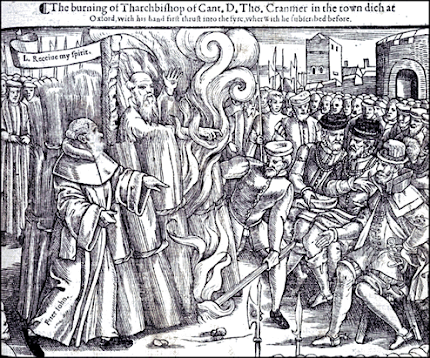
The burning of Tharchbishop of Cant. D. Tho. Cranmer in the town dich at Oxford, with his hand first thrust into the fyre, wherwith he subscribed before. [Click on the picture to see Cranmer's last words.]

Daily Bible Verse

Showing posts with label Justification. Show all posts

Tuesday, August 06, 2019

John Robbins Versus Dr. Gordon H. Clark: Justification and Sanctification


10 Therefore, brethren, be even more diligent to make your call and election sure, for if you do these things you will never stumble; 11 for so an entrance will be supplied to you abundantly into the everlasting kingdom of our Lord and Savior Jesus Christ.  2 Peter 1:10-11 NKJV

12 "Take heed to yourself, lest you make a covenant with the inhabitants of the land where you are going, lest it be a snare in your midst.
 13 "But you shall destroy their altars, break their sacred pillars, and cut down their wooden images
 14 `(for you shall worship no other god, for the LORD, whose name is Jealous, is a jealous God),
 15 "lest you make a covenant with the inhabitants of the land, and they play the harlot with their gods and make sacrifice to their gods, and one of them invites you and you eat of his sacrifice,
 16 "and you take of his daughters for your sons, and his daughters play the harlot with their gods and make your sons play the harlot with their gods.
 (Exodus 34:12-16 NKJV)

Question 97
What special use is there of the moral law to the regenerate?
Although they that are regenerate, and believe in Christ, be delivered from the moral law as a covenant of works, (Rom. 6:14, Rom. 7:4,6, Gal. 4:4–5) so as thereby they are neither justified (Rom. 3:20) nor condemned; (Gal. 5:23, Rom. 8:1) yet, besides the general uses thereof common to them with all men, it is of special use, to show them how much they are bound to Christ for his fulfilling it, and enduring the curse thereof in their stead, and for their good; (Rom. 7:24–25, Gal. 3:13–14, Rom. 8:3–4) and thereby to provoke them to more thankfulness, (Luke 1:68–69,74–75, Col. 1:12–14) and to express the same in their greater care to conform themselves thereunto as the rule to their obedience. (Rom. 7:22, Rom. 12:2, Tit. 2:11–14).
  7.      Neither are the forementioned uses of the law contrary to the grace of the Gospel, but do sweetly comply with it; (Gal. 3:21) the Spirit of Christ subduing and enabling the will of man to do that freely, and cheerfully, which the will of God, revealed in the law, requireth to be done. (Ezek. 36:27, Heb. 8:10, Jer. 31:33)


Personally, I do not like theological disputations because those who oppose the biblical view as summarized in the Westminster Standards are slippery eels who refuse to see the entire system of doctrine as one whole system from Genesis to Revelation.  When I quote Dr. Gordon H. Clark in context and directly from his books, the opponent goes to John Robbins instead.  I am beginning to see that Dr. Robbins was not in agreement with Dr. Clark on a whole host of issues, most especially the essential necessity of the whole ordo salutis, not just the initiation of the Christian life through regeneration and justification.  There must be a resulting cooperation in believing the Gospel and a resulting cooperation in a life of sanctification.  If there is no sanctification, there is no regeneration, and by implication, there never was any justification applied through a true and living faith.  Dr. Clark was very clear on this.  Essentially, most of the Robbins proselytes today are teaching one doctrine to the detriment of the whole system, namely justification by belief.  Justification is objective because it was accomplished on the cross.  But to receive the benefits of the atonement and justification accomplished and completed on the cross, one must first be unconditionally elected prior to creation, regenerated supernaturally by God the Holy Spirit in a monergistic resurrection, and then caused by God to cooperate in believing the Gospel.   (Ephesians 1:4-5, 11; John 3:3-8; Ezekiel 36:26-27; Romans 8:28-36 NKJV).

One cannot believe the Gospel without a supernatural and monergistic act of God, whereby the elect person is enabled to believe the preached word of God in the effectual call.  And at that point in time the justification of the cross is imputed to the elect person's account by means of belief and belief alone.  However, the Robbins proselytes want to dead stop everything at justification by faith or belief and that is it.  This is also how they can push for the oxymoronic view of Reformed libertarianism, which is really nothing more than secular libertarianism with a contradictory adjective tacked on the term libertarian.  Dr. Clark did not believe in imposing Calvinism on the entire nation.  What he did propose was that the Judeo-Christian worldview is not a religion and that the nation could legitimately impose the 10 axioms of the moral law or the Ten Commandments as the basis for religious freedom in our nation.  If the unbeliever wants to make stealing a crime, is that not taught in the Decalogue?  Likewise, Sunday should be a day that businesses give time off for everyone so they can go to the place of worship of their choice.  Instead what we see today is  libertarians and Marxists and secular humanists imposing work days on all seven days of the week.  As a result we are seeing the breakdown of the traditional family where both parents must work and the children end up as latchkey kids.  Worse, children today are being indoctrinated in public education and state universities with materialistic atheism, secular humanism, a biased and socialist view of American history, and a view of empirical science that more closely resembles a materialistic or pantheistic religion than an operationalist view of science.

In reading the Old Testament we can easily deduce that God intended for nations to worship Him and follow His ordinances.   Of course, in the Old Testament the only nation God selected was Israel.  We are told today that there is no chosen nation because the theocratic nation of Israel passed away with that nation.  That is true and it is taught in the Westminster Confession as such:

Chapter XIX  Of the Law of God
4.      To them also, as a body politic, He gave sundry judicial laws, which expired together with the state of that people; not obliging any other now, further than the general equity thereof may require. (Exod. 21, Exod. 22:1–29, Gen. 49:10, 1 Pet. 2:13–14, Matt. 5:17, 38–39, 1 Cor. 9:8–10).
The Westminster Confession of Faith. Oak Harbor, WA: Logos Research Systems, Inc., 1996. Print.
But what the Robbins proselytes neglect to see is that God requires obedience of the moral law by all nations and individuals and Romans 1:18-32 proves that libertarianism is just another manifestation of the lawlessness and wickedness of the nations of this world.  The Christian has a moral obligation to stand for the whole teaching of the Bible, not just for the doctrine of justification by means of faith alone.  (2 Timothy 3:15-17; Matthew 28:18-20).  All Scripture is profitable for doctrine and there is no dialectical contradiction between the moral law and the Gospel.  In fact, the Westminster Confession of Faith specifically states that the moral law has a purpose for both unbelievers and believers:


Question 96
What particular use is there of the moral law to unregenerate men?
The moral law is of use to unregenerate men, to awaken their consciences to flee from wrath to come, (1 Tim. 1:9–10) and to drive them to Christ; (Gal. 3:24) or, inexcusable, (Rom. 1:20, Rom. 2:15) and under the curse thereof. (Gal. 3:10)


Question 97
What special use is there of the moral law to the regenerate?
Although they that are regenerate, and believe in Christ, be delivered from the moral law as a covenant of works, (Rom. 6:14, Rom. 7:4,6, Gal. 4:4–5) so as thereby they are neither justified (Rom. 3:20) nor condemned; (Gal. 5:23, Rom. 8:1) yet, besides the general uses thereof common to them with all men, it is of special use, to show them how much they are bound to Christ for his fulfilling it, and enduring the curse thereof in their stead, and for their good; (Rom. 7:24–25, Gal. 3:13–14, Rom. 8:3–4) and thereby to provoke them to more thankfulness, (Luke 1:68–69,74–75, Col. 1:12–14) and to express the same in their greater care to conform themselves thereunto as the rule to their obedience. (Rom. 7:22, Rom. 12:2, Tit. 2:11–14)


Question 98
Where is the moral law summarily comprehended?
The moral law is summarily comprehended in the ten commandments, which were delivered by the voice of God upon Mount Sinai, and written by him in two tables of stone; (Deut. 10:4, Exod. 34:1–4) and are recorded in the twentieth chapter of Exodus.  The four first commandments containing our duty to God, and the other six our duty to man. (Matt. 22:37–40)

The Westminster Larger Catechism: With Scripture Proofs. Oak Harbor, WA: Logos Research Systems, Inc., 1996. Print.

The short of it is that those who emphasize only one portion of Scripture to the exclusion of all the rest are in fact teaching heresy and that is true whether the heresy is pelagianism or antinomianism in their manifold forms today.  We are not under the law as a covenant of works or to be justified.  But the Christian has a moral duty to obey Christ because love is obedience.  Without sanctification and the process of becoming more and more Christlike there is no true and living belief or any change of habits.  These are things that Dr. Clark said.  Now if Sean Gerety and the Trinity Foundation disagree with Dr. Clark they should say so openly instead of playing games of equivocation and dissimulation.  The Federal Visionists are good at double speak but apparently so are some of those who claim to follow the apologetics of the late Dr. Gordon H. Clark.  

The Westminster Larger Catechism clearly says that justifying faith has the other graces accompanying it, namely repentance and sanctification as well as a desire to attend church, study the Bible, pray, etc.


Question 73
How doth faith justify a sinner in the sight of God?
Faith justifies a sinner in the sight of God, not because of those other graces which do always accompany it, or of good works that are the fruits of it, (Gal. 3:11, Rom. 3:28) nor as if the grace of faith, or any act thereof, were imputed to him for his justification; (Rom. 4:5, Rom. 10:10) but only as it is an instrument by which he receiveth and applieth Christ and his righteousness. (John 1:12, Phil. 3:9, Gal. 2:16).

And the nail in the coffin of the antinomians is that assurance requires obedience as well.  There is an entire chapter on the assurance of salvation in the WCF.  And the WLC says:


Question 77
Wherein do justification and sanctification differ?
Although sanctification be inseparably joined with justification, (1 Cor. 6:11, 1 Cor. 1:30) yet they differ, in that God in justification imputeth the righteousness of Christ; (Rom. 4:6 ,8) in sanctification of his Spirit infuseth grace, and enableth to the exercise thereof; (Ezek. 36:27) in the former, sin is pardoned; (Rom. 3:24–25) in the other, it is subdued: (Rom. 6:6,14) the one doth equally free all believers from the revenging wrath of God, and that perfectly in this life, that they never fall into condemnation (Rom. 8:33–34) the other is neither equal in all, (1 John 2:12–14, Heb. 5:12–14) nor in this life perfect in any, (1 John 1:8,10) but growing up to perfection. (2 Cor. 7:1, Phil. 3:12–14).

Justification always results in a life of progressive submission to the Holy Spirit by way of the cooperation of the will.  (Proverbs 21:1). That process is always imperfect but without sanctification there can be no assurance of salvation.  None.  That is what Dr. Clark said as well.   Click on the links to the proof texts to the Catechism above.

In regards to nations, the Confession clearly says they have an obligation to obey the general equity of the moral law as summarized by the Decalogue:

Chapter XIX Of the Law of God

  5.      The moral law doth for ever bind all, as well justified persons as others, to the obedience thereof; (Rom. 13:8, 9, Eph. 6:2, 1 John 2:3–4, 7–8) and that, not only in regard of the matter contained in it, but also in respect of the authority of God the Creator, who gave it. (James 2:10, 11) Neither doth Christ, in the Gospel, any way dissolve, but much strengthen this obligation. (Matt. 5:17–19, James 2:8, Rom. 3:31)
  6.      Although true believers be not under the law, as a covenant of works, to be thereby justified, or condemned; (Rom. 6:14, Gal. 2:16, Gal. 3:13, Gal. 4:4–5, Acts 13:39, Rom. 8:1) yet is it of great use to them, as well as to others; in that, as a rule of life informing them of the will of God, and their duty, it directs and binds them to walk accordingly; (Rom. 7:12, 22, 25, Ps. 119:4–6, 1 Cor. 7:19, Gal. 5:14, 16, 18–23) discovering also the sinful pollutions of their nature, hearts, and lives; (Rom. 7:7, Rom. 3:20) so as, examining themselves thereby, they may come to further conviction of, humiliation for, and hatred against sin, (James 1:23–25, Rom. 7:9, 14, 24) together with a clearer sight of the need they have of Christ, and the perfection of His obedience. (Gal. 3:24, Rom. 7:24, Rom. 8:3–4) It is likewise of use to the regenerate, to restrain their corruptions, in that it forbids sin: (James 2:11, Ps. 119:101, 104, 128) and the threatenings of it serve to shew what even their sins deserve; and what afflictions, in this life, they may expect for them, although freed from the curse thereof threatened in the law. (Ezra 9:13–14, Ps. 89:30–34) The promises of it, in like manner, shew them God’s approbation of obedience, and what blessings they may expect upon the performance thereof: (Lev. 26:1–14, 2 Cor. 6:16, Eph. 6:2–3, Ps. 37:11, Matt. 5:5, Ps. 19:11) although not as due to them by the law as a covenant of works. (Gal. 2:16, Luke 17:10) So as, a man’s doing good, and refraining from evil, because the law encourageth to the one, and deterreth from the other, is no evidence of his being under the law; and not under grace. (Rom. 6:12, 14, 1 Pet. 3:8–12, Ps. 34:12–16, Heb. 12:28–29)
  7.      Neither are the forementioned uses of the law contrary to the grace of the Gospel, but do sweetly comply with it; (Gal. 3:21) the Spirit of Christ subduing and enabling the will of man to do that freely, and cheerfully, which the will of God, revealed in the law, requireth to be done. (Ezek. 36:27, Heb. 8:10, Jer. 31:33)

The Westminster Confession of Faith. Oak Harbor, WA: Logos Research Systems, Inc., 1996. Print.
I follow the confessional standards of Scripture and the Westminster Standards which summarize the teaching of the Bible.  I learned from reading Dr. Clark that he did not agree with libertarianism or with any view of grace that divorces justification from sanctification.   And here is a hint.  If the blogs you read never quote Scripture and the confessional standards to support their views, that is a giant red flag.  2 Timothy 3:15 teaches that the Old Testament Scriptures revealed the Gospel sufficiently to point to Christ and His ministry because when the apostle Paul wrote the second epistle to Timothy the New Testament had not yet been written nor had it been canonized into the Bible as the 66 books we know today.  There are 39 Old Testament books and 27 New Testament books.

See:  John Robbins Quick Quote.  God's Hammer Blog


Thursday, May 10, 2012

Is the Megachurch the New Liberalism? Albert Mohler Comments

Albert Mohler rightly points out the doctrinal minimalism of megachurches and the general tendency for Evangelicalism to accomodate itself to the larger culture in order to draw in new members. Serial remarriage is now commonly accepted among Evangelicals due to no fault divorce. Will gay marriage now be accepted by so-called "conservative" Evangelical Christians? It looks that way judging from a recent sermon series by pastor Andy Stanley, the son of Southern Baptist pastor, Dr. Charles Stanley.

God's moral law has no power to save anyone and no one living has any power to obey God's law sufficiently to justify themselves before God.  But is grace a license to sin after conversion?  I doubt that even Martin Luther would have agreed with that view.  Luther did continually emphasize that Christians are no longer under the law or the curse of sin and that those who kept emphasizing law keeping as the basis for salvation were in effect making the sacrifice of Christ void and justifying themselves by their own righteousness.  On the the other hand, the true Christian is justified by Christ and Christ alone.  Luther's emphasis was that correct doctrine comes first and afterwards God will work through grace and the Holy Spirit to help Christians live in accordance with God's law--albeit never for justification or salvation.

Andy Stanley rightly points out that we are still sinners and miserable sinners after conversion.   He fails, however, to distinguish between election and reprobation due to his blatant Arminianism--except for the one point of Calvinism of the perseverance of the saints.  But if Albert Mohler is correct that Andy Stanley is deliberately downplaying homosexuality as a sin while condemning adultery then it is a natural inference to conclude that megachurches are moving toward minimizing homosexuality and fornication as sinful behavior and incompatible with true conversion.   The 39 Articles of Religion expresses the view of Calvin, Luther and Cranmer on this issue:
ALBEIT that good works, which are the fruits of faith and follow after justification, cannot put away our sins and endure the severity of God's judgement, yet are they pleasing and acceptable to God in Christ, and do spring out necessarily of a true and lively faith, insomuch that by them a lively faith may be as evidently known as a tree discerned by the fruit.

Click here to read Dr. Mohler's article:  Is the Megachurch the New Liberalism?

Monday, December 06, 2010

Martin Luther's Commentary on Galatians

Chapter 1


The Occasion of the Letter


Paul had planted the pure teaching of the Gospel among the Galatians, and with it the righteousness of faith. But after he left, certain false teachers crept in who overthrew all that he had taught. The devil cannot but argue furiously against the true teaching and cannot rest as long as he sees any spark of it remaining. We too, simply because we preach the Gospel, suffer from the world, the devil, and his ministers all the mischief they can work against us on every hand.

The Gospel is a doctrine that teaches a far higher matter than the wisdom, righteousness, and religion of the world; it teaches free forgiveness of sins through Christ. But the world prefers its own things instead of the Creator and tries to get rid of sin, be delivered from death, and earn everlasting life in its own way. The Gospel condemns this. On the other hand, the world cannot abide things being condemned when it values them highly and likes them best; and therefore it claims that the Gospel is a seditious doctrine, full of errors, that it overthrows governments, countries, and empires, and therefore offends against God and the emperor, that it abolishes laws, corrupts good manners, and sets everybody free to do what they want. Therefore, with what appears to be holy and righteous zeal, the world persecutes this doctrine and abhors its teachers and adherents as the greatest plague on earth.

Moreover, preaching true doctrine overthrows the devil, destroys his kingdom, and wrests out of his hand the law, sin, and death (by which he has subjugated all mankind). In short, the devil’s prisoners are transferred from the kingdom of darkness into the kingdom of light and liberty. Will the devil permit all this? Will the father of lies not use all his force and ingenuity to obscure, corrupt, and utterly root out this doctrine of salvation and eternal life? Indeed, St. Paul complains in this and all his other letters that the devil shows himself skillful at this.

The Gospel is a doctrine that condemns all sorts of human righteousness and preaches the sole righteousness of Christ. To those who accept this, it brings peace of conscience and all good things; yet the world hates and persecutes it bitterly.

I have already said that the reason Paul wrote this letter was that after he left, false teachers among the Galatians destroyed what he had built with much hard work. These false apostles were Pharisees—men of authority, highly esteemed—who boasted that they belonged to the chosen people, that they were Abraham’s descendants (see Romans 9:4–6), that they had the promises and the fathers, and, finally, that they were ministers of Christ and scholars of the apostles, with whom they had been conversant and whose miracles they had seen. Perhaps they had even performed some miracles themselves, for Christ says that the wicked do perform miracles (see Matthew 7:22).

Moreover, these false apostles defaced St. Paul’s authority, saying, “Why do you rate Paul so highly? Why do you have him in such great reverence? He was merely the last of all those who were converted to Christ. But we are the disciples of the apostles; we knew them well. We saw Christ performing miracles and heard him preach. Paul came after us and is inferior to us. It would be impossible for God to allow us to go wrong when we belong to his holy people, are the ministers of Christ, and have received the Holy Spirit. Further, there are many of us, and Paul is on his own and neither knows the apostles nor has seen Christ. Indeed, for a long time he persecuted the church of Christ. Do you think God would allow so many churches to be deceived, just for Paul’s sake?”

When such persuasive men come into a country or city, people soon admire them, and those men deceive not only the simple but also the learned with their apparent godliness. They even deceive people who seem to be pretty well established in the faith. Thus Paul lost his authority among the Galatians, and his doctrine was brought under suspicion.

Against this boasting of the false apostles, Paul firmly asserts his apostolic authority. Although he does not do anything like it elsewhere, he will not give way to anyone, even to the apostles themselves, much less to any of their followers. To stop these men’s pharisaical pride and shameless boldness, he mentions what happened at Antioch, where he withstood Peter himself. He ignores any possible offense and plainly states that he was so bold as to accuse and reprove Peter, the chief of the apostles, who had seen Christ and knew him really well. “I am an apostle,” he says in effect, “and was not afraid to chide the pillar of all the rest.”


Luther, M. (1998). Galatians. The Crossway classic commentaries (24–26). Wheaton, Ill.: Crossway Books.


Sunday, December 05, 2010

Sanctified by Sacraments? or Justified by Faith Alone? John Robbins Responds

[The following is an excerpt from the late John Robbins of The Trinity Foundation.  Robbins gave a talk on the presuppositional apologetics of Gordon H. Clark.  Amazingly, he mentions the issue of sanctified by sacraments, which had come up in a discussion I had with someone offline.  To read the original article click on, An Introduction to Gordon H. Clark. Charlie.]

Salvation is by faith alone. Faith is belief of the truth. God reveals truth. Faith, the act of believing, is a gift of God. “By his knowledge, my righteous servant shall justify many.”

Clark’s view of salvation, reflected in the Westminster Confession’s chapter on justification, is at odds with most of what passes for Christianity today. Popular Christianity decries knowledge. Clark points out that Peter says that we have received everything we need for life and godliness through knowledge. James says the Word of Truth regenerates us. Paul says we are justified through belief of the truth. Christ says we are sanctified by truth.

There are three popular theories of sanctification today: sanctification by works, sanctification by emotions, sanctification by sacraments. The first, sanctification by works, is sometimes expressed by those who claim to be Reformed or Calvinist: They teach that we are justified by faith, but we are sanctified by works. Calvin had no such view, and the Westminster Confession refutes it. The second view, sanctification by emotions, is the view of the Pentecostal, charismatic, and holiness groups. Roman Catholic and other churches that believe in the magical power of sacraments to regenerate or sanctify hold the third view, sanctification by sacraments. But just as we are regenerated by truth alone, and justified through belief of the truth alone, we are sanctified by truth alone as well.

Nota Bene:  Robbins rightly points out that the idea that communicants are "sanctified" by the sacraments is a Roman Catholic idea and not a Reformed view.  One has to wonder where this idea comes from in Reformed circles?

--
Reasonable Christian Blog Glory be to the Father, and to the Son : and to the Holy Ghost; Answer. As it was in the beginning, is now, and ever shall be : world without end. Amen. 1662 Book of Common Prayer

Tuesday, November 16, 2010

YouTube - Oprah Winfrey: Jesus Did Not Come To Die On The Cross

YouTube - Oprah Winfrey: Jesus Did Not Come To Die On The Cross


Those who preach that Jesus is our example or that Jesus shows us how to live have more in common with Oprah's theology of self justification than with the biblical doctrine of justification by grace alone through faith alone. Jesus is objectively our salvation because His active and passive obedience is imputed to us. He lived a perfect life in our place and He died for our sins on the cross in our place. He died specifically for His elect, His sheep (John 10:11; 1 John 3:16). Those who confuse sanctification with justification are preaching salvation by congruent works, which is really no different from what Rome preaches.


Wednesday, July 07, 2010

Are Anglo-Catholics Saved?

One would think this question should not be controversial, particularly if one is an Evangelical Anglican or an Evangelical of any kind whatsoever.  However, that is no longer the case.  The term "Evangelical" for all practical purposes has been hijacked by the liberals and the neo-orthodox so that it has no real meaning anymore.  Many so-called "Evangelicals" will advocate the Gospel as one of many gospels allowed under the tent of Anglicanism or Evangelicalism.  The "broad church" movement or the "broad Evangelical" movement is really a sellout to ecumenicalism since the concern is not being faithful to what the Scriptures teach but rather being faithful to Anglicanism or faithful to a denomination.  

Moreover, the discipline of apologetics often means confronting weak Christians who have little to no understanding of what is essential to the Christian faith and what are merely matters of indifference or "adiaphora."  If Martin Luther, the Lutheran Reformer is correct, however, justification by faith alone is a non-negotiable doctrine which expresses the very Gospel message itself.  The true congregation, the true denomination stands or falls with this doctrine among several others.  By that definition alone then we can say that those professional ministers and official churches which deny sola fide or justification by faith alone through an imputed and legal declaration of righteousness are not saved because they are preaching another gospel.  Paul makes this clear when he says:

 I am astonished that you are so quickly deserting him who called you in the grace of Christ and are turning to a different gospel-- 7 not that there is another one, but there are some who trouble you and want to distort the gospel of Christ. 8 But even if we or an angel from heaven should preach to you a gospel contrary to the one we preached to you, let him be accursed. 9 As we have said before, so now I say again: If anyone is preaching to you a gospel contrary to the one you received, let him be accursed. 10 For am I now seeking the approval of man, or of God? Or am I trying to please man? If I were still trying to please man, I would not be a servant of Christ. 11 For I would have you know, brothers, that the gospel that was preached by me is not man's gospel. 12 For I did not receive it from any man, nor was I taught it, but I received it through a revelation of Jesus Christ. 13 For you have heard of my former life in Judaism, how I persecuted the church of God violently and tried to destroy it. 14 And I was advancing in Judaism beyond many of my own age among my people, so extremely zealous was I for the traditions of my fathers. (Galatians 1:6-14 ESV)
Those who say that there are different acceptable versions of the Gospel are really preaching a form of latitudinarianism.  There is absolutely no compatibility between the Anglo-Catholic gospel and the apostolic Gospel handed down to us in Holy Scripture. 

 ...yet we know that a person is not justified by works of the law but through faith in Jesus Christ, so we also have believed in Christ Jesus, in order to be justified by faith in Christ and not by works of the law, because by works of the law no one will be justified. 17 But if, in our endeavor to be justified in Christ, we too were found to be sinners, is Christ then a servant of sin? Certainly not! (Galatians 2:16-17 ESV)

 For all who rely on works of the law are under a curse; for it is written, "Cursed be everyone who does not abide by all things written in the Book of the Law, and do them." 11 Now it is evident that no one is justified before God by the law, for "The righteous shall live by faith." 12 But the law is not of faith, rather "The one who does them shall live by them." 13 Christ redeemed us from the curse of the law by becoming a curse for us--for it is written, "Cursed is everyone who is hanged on a tree"-- 14 so that in Christ Jesus the blessing of Abraham might come to the Gentiles, so that we might receive the promised Spirit through faith. (Galatians 3:10-14 ESV)


Friday, April 02, 2010

Fw: Imputed Righteousness Versus Transformational Righteousness

The following exchange took place by e-mail. As you can see, the members of the new Anglican Church in North America are as deficient in their understanding of the law and gospel as any liberal. For all practical purposes there is no difference. Most people are naturally born as pelagians. All the emphasis is on our holiness, our good works, our "transformation." Although it is true that the Protestant Reformers emphasized sanctification as much as anyone else, they were careful to establish justification by faith alone as the only ground and basis for our salvation. Sanctification follows from justification and not the other way around! Putting the cart before the horse is a good indication of heresy. The bottom line is that the vilest sinner can receive a full pardon the very moment he or she believes, apart from any subsequent good works. Good works are the evidence of true conversion and not the cause, ground or basis of our justification.
Charlie

Sent: Thursday, April 01, 2010 10:11 PM
Subject: Re: Imputed Righteousness Versus Transformational Righteousness

You wrote: "You think transformation trumps justification by faith alone."

Come on, Charlie, that is not what I wrote and not what I believe! Please re-read what I actually did write. It is amazing how you miss my very clear points. I said that they are inseparable--- one does not trump the other. You jump to conclusions without reading the whole thing.

No leader of the Reformation ever said that disobedience or lack of love or fruitlessness was unimportant. Just that it all starts with grace, and then faith (that grace makes possible). Obedience, fruit, and love follows. Inevitably, if the faith is real. No one in heaven will be untransformed. What does that tell you?


Is your faith real? Or are you just good at spouting words that suggest faith? Only God knows... I sure don't.


On Thu, Apr 1, 2010 at 9:08 PM, Charlie J. Ray <cranmer1959@hotmail.com> wrote:
Bruce,

The Protestant Reformation was over this very issue. You think transformation trumps justification by faith alone. It does not. Transformation = sanctification. Our justification is objective and absolutely perfect because of Christ's active obedience (sinless life) credited to us and because of his sacrifice/atonement/propitiation for our sins on the cross. The fact is justification is ABSOLUTELY OBJECTIVE and has ABSOLUTELY NOTHING to do with our sanctification. Justification is a forensic declaration of not guilty and we receive a full pardon the moment we believe. Transformation is inherent in the heart and is absolutely IMPERFECT and therefore can NEVER be the basis or ground for our justification before God now or in the final judgment. Sanctification is infused in the heart and is the result of a true and lively faith.


The 39 Articles clearly say that good works naturally proceed from a "true and lively faith." However that is not the same thing as saying that justification is transformational or that our good works justify us. They do not. They are merely the "evidence" of a true and lively faith and are as evident as the fruit on a tree. Your problem is you want to say that your Anglo-Catholic friends are saved because they do good works. The bottom line is conservative Roman Catholics and Anglo-Catholics are as lost as the liberals who live in gross immorality. Scripture makes it plain that only those who trust in Christ alone for salvation will be saved. It is true that if there is no "true and lively faith," I.e. a living faith that shows evidence of true conversion, then there is no justifying faith present either. But that is not the same thing as saying that good works contribute anything at all to our justification before God. Sanctification is relative and progressive and always falls short of the mark of 100%. God does not grade on a curve. He expects you to be ABSOLUTELY SINLESS. If you sin even by thinking a sinful thought, you deserve hell. This is why salvation is ALL of grace from beginning to end.


In fact, it is your works righteousness that actually leads to antinomianism. When the focus is on you and your own goodness the next thing you know you don't need God's mercy anymore. You have crossed over from grace to Phariseeism. And that leaves you focusing on this life, on this present culture, and the here and now rather than on eternity. The real question is not how good are you but have you trusted in Christ and Christ alone to save you apart from your own good works or merits? If not, then you are lost. It's as simple as that.


I am astonished that you are so quickly deserting him who called you in the grace of Christ and are turning to a different gospel-- 7 not that there is another one, but there are some who trouble you and want to distort the gospel of Christ. 8 But even if we or an angel from heaven should preach to you a gospel contrary to the one we preached to you, let him be accursed. (Galatians 1:6-8 ESV)


yet we know that a person is not justified by works of the law but through faith in Jesus Christ, so we also have believed in Christ Jesus, in order to be justified by faith in Christ and not by works of the law, because by works of the law no one will be justified. 17 But if, in our endeavor to be justified in Christ, we too were found to be sinners, is Christ then a servant of sin? Certainly not! 18 For if I rebuild what I tore down, I prove myself to be a transgressor. 19 For through the law I died to the law, so that I might live to God. 20 I have been crucified with Christ. It is no longer I who live, but Christ who lives in me. And the life I now live in the flesh I live by faith in the Son of God, who loved me and gave himself for me. (Galatians 2:16-20 ESV)


The fact that you are accusing me of antinomianism or lawlessness shows that I'm preaching the Gospel. Those who truly preach the Gospel are continually accused of antinomianism, although it is not true.


The irony here is that I uphold a higher moral standard than David Virtue who thinks that trans-sexuals are somehow justified in mutilating themselves. This is the beginning of the same liberalism you're protesting against.


It really does astonish me that you are 63, have graduated from an allegedly "reformed" seminary (Fuller), and you still do not have a "confessional" understanding of the doctrines of grace. Luther himself said that the true church stands or falls with the doctrine of justification by faith alone. Justification by faith alone is also taught in Articles 9-18 of the 39 Articles.


"Two men went up into the temple to pray, one a Pharisee and the other a tax collector. 11 The Pharisee, standing by himself, prayed thus: 'God, I thank you that I am not like other men, extortioners, unjust, adulterers, or even like this tax collector. 12 I fast twice a week; I give tithes of all that I get.' 13 But the tax collector, standing far off, would not even lift up his eyes to heaven, but beat his breast, saying, 'God, be merciful to me, a sinner!' 14 I tell you, this man went down to his house justified, rather than the other. For everyone who exalts himself will be humbled, but the one who humbles himself will be exalted." (Luke 18:10-14 ESV)


Until you come to see how sinful you are, Bruce, your soul is in danger of hell fire. There is absolutely nothing you contribute to your own salvation. It is completely a gift of God.


The peace of God be with you,


Charlie


Brothers, my heart's desire and prayer to God for them is that they may be saved. 2 For I bear them witness that they have a zeal for God, but not according to knowledge. 3 For, being ignorant of the righteousness of God, and seeking to establish their own, they did not submit to God's righteousness. 4 For Christ is the end of the law for righteousness to everyone who believes. (Romans 10:1-4 ESV)


Sent: Thursday, April 01, 2010 8:22 PM
Subject: Re: Imputed Righteousness Versus Transformational Righteousness


The two are intimately connected. I am sure you agree with this: No one who is sanctified has not already been justified. Yes, it all starts with justification by grace though faith.


I submit that everyone who is ultimately saved will have been both justified and sanctified. You seem to want to diminish and devalue sanctification beyond what scripture indicates.


(By the way, no one ever in my 63 years, except you, has ever accused me of being an RCC supporter.)


In the past, you have over-reacted to any hint of criticism by getting personal and rude. I hope that won't happen now. But that will not stop me from telling the truth: you are out of balance theologically.


I agree with your view of justification, it is very on target scripturally. However, you clearly want to avoid the other half of the issue that scripture also teaches. Your anti-catholic bias has blinded you; it has gotten in the way of your acceptance of the whole truth. I am not saying that the RCC view is more right than the Reformed view, it is not. But true ultimate reformation must incorporate both truths (justification and sanctification) to the degree that scripture does. No more, no less.


I can provide a lot of scriptures that make a very big deal about obedience (or "fruit of the spirit" or love) as vital to confirming the salvation process (John 15). Works don't save, but spiritual fruit confirm the reality of the faith that does save. "Saying" you have faith is a work that will not save. Having real faith always results in transformation and good works. (It is God working in us.) So faith and transformation are intimately connected and cannot be separated.


By the way, it is TEC that does not believe in the value of transformation: "God loves you just the way you are. Come and be accepted." But I hear the Word of God say, "Yes, I love you just the way you are, but I love you too much to leave you that way. Submit yourself to My transformational process."


Without faith, we can't get started, but faith is not the end of the process, it is only the beginning (1 Cor 13).


On Thu, Apr 1, 2010 at 10:58 AM, Charlie J. Ray <cranmer1959@hotmail.com> wrote:

Well, no. It is not half right. It is 100% right. Sanctification and justification are distinct from each other. We're talking about justification, not sanctification. To confuse the two is to become Roman Catholic. I would suggest that you read Articles 9-18 in the 39 Articles and also read Cranmer's sermon, Necessary Doctrine: Justification by Faith Alone.
Charlie


Sent: Thursday, April 01, 2010 9:58 AM
Subject: Re: Imputed Righteousness Versus Transformational Righteousness


Absolutely correct:


From God's grace.....Christ's work at the Cross provided legal, forensic, imputed righteousness, which we must receive by faith.


But only half right: If such 'faith' does not change our hearts and if it does not transform our lives, then it was never real; we never really believed and received the gracious gift of forgiveness and Holy Spirit Life. Scripture is very clear about this as well. There are hundreds of scriptures to back this up (far more than for Paul's teaching on imputed righteousness, which I also believe).


- Bruce


On Thu, Apr 1, 2010 at 9:31 AM, Charlie J. Ray <cranmer1959@hotmail.com> wrote:

Glory be to the Father, and to the Son : and to the Holy Ghost;
Answer. As it was in the beginning, is now, and ever shall be : world without end. Amen.


Friday, February 27, 2009

R. C. Sproul Comments on the Difference Between Justification and Salvation

Definitive sanctification breaks the power of sin so that we can make meager baby steps in progressive sanctification but even our progress is nothing compared to God's holiness. It would be like trying to walk across the universe starting from earth. In other words, it is impossible to trust our progress in sanctification as any basis whatsoever for assurance of salvation. It is only the cross of Jesus Christ that saves us and that salvation was objectively accomplished on the cross 2,000 years ago.  --Charlie J. Ray


[Note:  I have changed my views slightly since this article was posted originally.  I do believe now that assurance is attained from sanctification.  However, justification is still the ground and the basis for sanctification.  Sanctification results from justification.  The purpose of justification is our progress in sanctification.  However, justification is a forensic declaration based on the cross.  Sanctification is infused into the mind and heart and is subjective.  03/27/2015.  Charlie].

RC Sproul on Sanctification


Roman Catholic theology confuses justification with sanctification. On the other hand, many Evangelicals confuse justification with salvation as if the two were equivalent terms, resulting in an "incipient antinomianism" or lawlessness. In this video, R.C. Sproul explains that salvation is the point at which we repent, i.e. conversion; salvation is a process of sanctification (however imperfect that sanctification may be); and salvation is completed at the point of our death (often called "glorification"). Justification is a legal or forensic declaration of not guilty and the merits of Christ's perfect life are credited to us. Christ suffers in our place on the cross and bears all the penalty for our sins in the past, in the present, and in the future. This substitutionary atonement satisfies God's law, the just penalty of the law, and removes our guilt. The basis for our justification is not sanctification.

The sole basis for our justification is Christ and his holy life and his atoning death. However, our salvation includes all three aspects I mentioned earlier. That is, salvation is our justification, sanctification and our glorification. R.C. also mentions the ordo salutis. Roughly speaking, the ordo salutis is the logical and/or temporal order in which our salvation is unfolded. According to Reformed theology, this would be election, predestination, regeneration, conversion/repentance, justification, sanctification, and glorification.

One of the major issues leading to the division between Roman Catholicism and the Protestant Reformation is the distinction between justification and sanctification. Justification and sanctification must always be distinguished from each other. Justification is our legal declaration of "not guilty" based on the substitutionary atonement of Christ on the cross. Christ died for our sins to justify us before God in the final judgment. It is outside of us and it is an objective fact based on what Christ completed for us by meriting eternal life for us in his perfect obedience on earth and by dying in our place for our sins on the cross. Roman Catholicism committed the error of confusing sanctification, which is an inherent process inside our souls where we are made more and more like Christ as we live a Christian life, with justification.

The Roman Catholics can never be sure they are saved because they base their salvation on obedience rather than on justification by faith alone. For Roman Catholics justification is inherent in the soul and the sinner is made actually righteous through a subjective infusion of righteousness into the heart or mind. This flies in the face of Romans 7 where Paul clearly says that we remain sinners even after we have been legally declared righteous and begin the process of living a sanctified life. This is why low church Anglicanism has absolutely nothing in common with high church Anglicanism. High church Anglicanism commits the same theological error which the Roman Catholics have committed. It has confused justification with sanctification and ignores the fact that justification is a legal or forensic declaration and is absolutely not the process of being inherently and progressively sanctified in our walk with Christ.

Addendum: Salvation is all of God and even our sanctification is a monergistic work of God.  We do not "cooperate" with God's grace even in sanctification and it is only God who keeps us from falling away into apostasy.  God promises to keep the elect in spite of our capricious and sinful wills.  While definitive sanctification is imputed along with our justification, definitive sanctification is not sinless perfectionism (Wesleyan entire sanctification).  Definitive sanctification breaks the power of sin so that we can make meager baby steps in progressive sanctification but even our progress is nothing compared to God's holiness.  It would be like trying to walk across the universe starting from earth.  In other words, it is impossible to trust our progress in sanctification as any basis whatsoever for assurance of salvation.  It is only the cross of Jesus Christ that saves us and that salvation was objectively accomplished on the cross 2,000 years ago. Charlie  03/02/2012

[Addendum:  I don't erase older posts.  I have been reading Dr. Gordon H. Clark's books and my views have changed.  Dr. Clark says that regeneration and the perseverance of the saints are monergistic.  But sanctification is synergistic because it is God who works in us to cause us to both to will and to do according to His good pleasure.  Philippians 2:11-13.   Also, the Westminster Confession of Faith does say that obedience gives us an assurance of our salvation.  Charlie 3/22/2016]

Support Reasonable Christian Ministries with your generous donation.