>

Martyred for the Gospel

Martyred for the Gospel
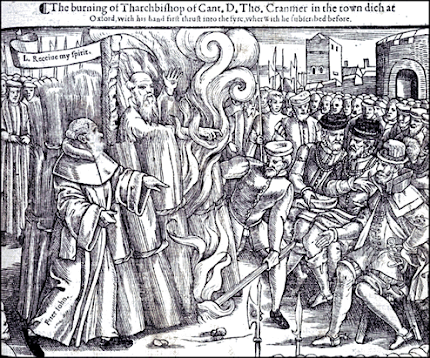
The burning of Tharchbishop of Cant. D. Tho. Cranmer in the town dich at Oxford, with his hand first thrust into the fyre, wherwith he subscribed before. [Click on the picture to see Cranmer's last words.]

Daily Bible Verse

Showing posts with label Legalism. Show all posts

Thursday, December 09, 2010

Legalism, Legalization, and Sanctification


[The following is a comment I posted over at Wes White's blog, Johannes Wesleyanus:  Surprised by Dope:  A Reply to All Souls].

Well said, Wes. I tend to lean more toward the libertarian side of things but then nothing you said is out of step with the whole of the Confession.

My only objection here is that I don’t believe that God will necessarily “bless” the believer who obeys the [moral] Law. After all, Christians still get sick, get divorced, and other tragic things when they might not deserve it from the perspective of their faithfulness to God, to Scripture, the Confession and the Church. Our good works are only acceptable to God after justification and then we do not do anything that is above and beyond the call of duty.  (See Article XIV, Of Works of Superogation).

Even though what you have written is on the mark, I have to agree somewhat with the author of the other article that too many church members are too proud and too judgmental. Should I quote it again?

For who sees anything different in you? What do you have that you did not receive? If then you received it, why do you boast as if you did not receive it? (1 Corinthians 4:7 ESV)

I’ve been around enough churches over the years to know that no one is as holy in person as they might appear from a distance. Visit your local vestry meeting sometime:)

Someone once said, “A judge is a law student who grades his own examination papers.” We tend to forget that sanctification is always relative in this life. But judging us by the standard of the first use of the law, God does not grade on a curve.

I like the way the 39 Articles put it because it is short and concise:

Article XII

Of Good Works

Albeit that good works, which are the fruits of faith and follow after justification, cannot put away our sins and endure the severity of God’s judgement, yet are they pleasing and acceptable to God in Christ, and do spring out necessarily of a true and lively faith, insomuch that by them a lively faith may be as evidently known as a tree discerned by the fruit.

Maybe I’m a bit sensitive to this since I have been around the Wesleyan Arminian circles before. The emphasis is mostly on outward conformity to cultural standards like don’t smoke; don’t go to theater; don’t wear long hair if you are a man; etc.

It seems to me that particular Baptists and even Presbyterians have missed out on some solid theology in the 1662 Book of Common Prayer because of the rejection of a formal liturgy. The Latin term, lex orandi, lex credendi applies here. What we pray we believe. If we are not told weekly that we have no inherent power to do what is commanded, then we tend to think we’re the ones doing it. We have to be careful not to fall into the synergism trap. Compatibilism and synergism are not the same thing at all.

That’s why after every command in the Decalogue the prayer book says: Lord, have mercy upon us, and incline our hearts to keep this law.

If the fall of Jimmy Swaggart proves anything at all it is that making resolutions and commitments and self-determinations not to sin is no guarantee that someone cannot fall into grievous sins. As proud idolaters and lawbreakers we begin to think that falling is what happens to someone else, not us. I would contend that it can and does happen because we forget that it is God Himself who sanctifies us. It is God who keeps us sanctified and keeps us to the end. Once we lose sight of that fact, legalism and pride are just around the corner.

Ashley Null, the Reformed Anglican scholar has said of Cranmer’s theology of repentance:

For Cranmer, the glory of God is to love the unworthy – that’s his fundamental theological tenet. He understood that medieval theology, despite its clear intellectual breadth and brilliance, had a distinct Achilles’ heel – its insistence that you had to be made personally worthy for salvation before God could accept you.

Cranmer believed that this emphasis on merit produced only two possible alternatives – either you had great pride that you were worthy – or you had great despair that you never could be worthy. Neither one, of course, inspired loving obedience. See Ashley Null.

I might also point out that the daily morning and evening prayer services have a biblical confession of sin that is harsh by modern standards. Most Presbyterian churches are big on damning pot smokers, town drunks, and other “sinners.” But they seem to have forgotten Scripture:

“Two men went up into the temple to pray, one a Pharisee and the other a tax collector. 11 The Pharisee, standing by himself, prayed thus: ‘God, I thank you that I am not like other men, extortioners, unjust, adulterers, or even like this tax collector. 12 I fast twice a week; I give tithes of all that I get.’ 13 But the tax collector, standing far off, would not even lift up his eyes to heaven, but beat his breast, saying, ‘God, be merciful to me, a sinner!’ 14 I tell you, this man went down to his house justified, rather than the other. For everyone who exalts himself will be humbled, but the one who humbles himself will be exalted.” (Luke 18:10-14 ESV)

Too many folks forget that simply because we have an obligation to strive toward holiness does not mean that we ever attain an acceptable level. We in our sinfulness tend to begin to think we’re a little better than the next person. Unfortunately, that is not the case. What am I saying? Basically, even the most sanctified Christian is no better than the town drunk when measured by the first use of the law. The third use of the law is always imperfect and is never the basis for right standing before God now or at the judgment. The barely sanctified new Christian is just as saved as the 80 year old pillar of the church who has no more youthful temptations. That’s grace.

While I agree that we should discipline those who are in open sin, I disagree with the tone of the majority of the remarks in your other post. Maybe we all need to sing Amazing Grace and go through all 18 stanzas?

Sincerely yours in Christ,

Charlie

WCF 16:6. Notwithstanding, the persons of believers being accepted through Christ, their good works also are accepted in Him;1 not as though they were in this life wholly unblameable and unreprovable in God’s sight;2 but that He, looking upon them in His Son, is pleased to accept and reward that which is sincere, although accompanied with many weaknesses and imperfections.3

——————————————————————————–

1 Eph. 1:6; 1 Pet. 2:5; Exod. 28:38; Gen. 4:4; Heb. 11:4.

2 Job 9:20; Ps. 143:2.

3 Heb. 13:20,21; 2 Cor. 8:12; Heb. 6:10; Matt. 25:21,23.

--
Reasonable Christian Blog Glory be to the Father, and to the Son : and to the Holy Ghost; Answer. As it was in the beginning, is now, and ever shall be : world without end. Amen. 1662 Book of Common Prayer

Thursday, September 02, 2010

What Is Legalism? by John Robbins

What Is Legalism?

 
John W. Robbins


Legalism is the notion that a sinner can, by his own efforts, or by the power of the Holy Spirit in his life, do some work to obtain or retain his salvation. Some legalists think man has free will and can perform good works if he just sets his mind to it, thereby obtaining the favor of God. This type of legalist thinks that a sinner can believe the Gospel on his own steam. Other legalists think that a sinner does not have free will, that any good he does is done by the power of the Holy Spirit dwelling in him, and it is these good deeds done by the power of the Holy Spirit that obtain or help obtain, retain or help retain, his salvation. Both types of legalists, but especially the latter, may acknowledge that Christ's work of obedience is necessary for salvation, but both deny that Christ's work is sufficient for salvation. Both types of legalists assert that to Christ's work must be added the works of the sinner, done either under his own steam, or by the power of the Holy Spirit. That is what makes them legalists: their shared belief in the incompleteness or insufficiency of the work of Christ outside of them. They may differ on what constitutes good works; they may differ on whether only God's law or church law as well is to be obeyed; but they agree that the work of Christ alone is insufficient for their final salvation.

Against The World. The Trinity Review, 1978-1988. [What Is Faith, John W. Robbins, pg. 121-122] John W. Robbins, Editor. The Trinity Foundation, P.O. Box 68, Unicoi, Tennessee 37692. (423) 743-0199 - FAX (423) 743-2005


Sunday, June 06, 2010

Emulating God's Character? Pelagianism Resurrected Evangelical Style

Above him stood the seraphim. Each had six wings: with two he covered his face, and with two he covered his feet, and with two he flew. 3 And one called to another and said: "Holy, holy, holy is the LORD of hosts; the whole earth is full of his glory!" 4 And the foundations of the thresholds shook at the voice of him who called, and the house was filled with smoke. 5 And I said: "Woe is me! For I am lost; for I am a man of unclean lips, and I dwell in the midst of a people of unclean lips; for my eyes have seen the King, the LORD of hosts!" (Isaiah 6:2-5 ESV)

But what comes out of the mouth proceeds from the heart, and this defiles a person. 19 For out of the heart come evil thoughts, murder, adultery, sexual immorality, theft, false witness, slander. (Matthew 15:18-19 ESV)

The heart is deceitful above all things, and desperately sick; who can understand it? (Jeremiah 17:9 ESV)

 
It never fails that Pharisees emphasize their own personal holiness, goodness and righteousness rather than their own unworthiness in comparison to Christ and to God's absolute holiness.  The old cliché, "What would Jesus do?", is based on the false assumption that sinful human beings can rival, equal or even excel above God's own holiness.  Pharisees love to emphasize the law of God and you will rarely hear them mention the doctrine of salvation by grace alone.  Why is this?  It is because they have an overly high opinion of themselves as inherently holy rather than inherently sinful and corrupt.  Even regenerated, justified and converted Christians retain the sinful nature and an inward corruption.
 
An Evangelical minister I know regularly emphasizes our faithfulness, our righteousness, and our emulation of God's character.  But he does so self-righteously since the Bible continually says that there is none righteous (Romans 3:10-12; 3:20-23).  In fact, the word emulation means:
 
–verb (used with object)
 
1.  to try to equal or excel; imitate with effort to equal or surpass: to emulate one's father as a concert violinist.
 
2.  to rival with some degree of success: Some smaller cities now emulate the major capitals in their cultural offerings.
Our efforts to emulate the character of God fall so short that the comparison is similar to a mentally challenged child trying to play Mozart on piano or violin.  The results come so far short as to not even resemble the original composition.  Human beings are totally corrupt to the point that the divine image is hardly recognizable anymore.  Even Christians retain this corruption (Romans 7:22-25).  This is the apostle Paul's personal "testimony" that he struggled with sin.  If you are struggling with sin, do not feel like the lone ranger.  Everyone is a sinner, even the best Christian you know.  All Christians sin in thought, word and deed on a daily basis--even those so deluded as to think they are no longer sinful.
 
The reason "Evangelical" Pharisees emphasize good works over and above justification by faith alone is that they do not really believe they are guilty of original sin or any actual sins.  They falsely assume a state of sinless perfection in this life.  And the definition of sin is always something along the Wesleyan holiness line that sin is only the violation of a known moral law.  This is especially strange since the 1662 Book of Common Prayer recommends daily Morning and Evening Prayer where we confess our sins twice a day.  And how does the 1662 Prayer Book define sin?  It defines sin as Scripture does; that is, sin is anything that fails to do what God commands, anything that violates God's moral law in thought, word or deed.  The distinction between temptation and sinful thoughts is a false one for sinful human beings.  Only the first Adam and Jesus Christ were tempted without sinning.  You see, even if we do not give in to temptation to sin in actual deeds, simply by contemplating what is sinful sinners have sinned in their thoughts.  Cursing, swearing, hating, lusting, coveting, worshipping the creature rather than the creator are all sinful thoughts as well as sinful deeds.  Jesus said that it is the heart that is wicked and out of the heart proceed all sinful actions.
 
Repent of your self-righteousness today and trust in the righteousness of Christ alone to save you.  Why?  Because you sin by thinking that your righteousness can equal that of God in your own sinful heart.  Those trusting in their own inherent righteousness to make themselves right with God are inwardly full of dead men's bones.  It is the righteousness that is outside of us that justifies us--the righteousness of Christ.
 

Indeed, I count everything as loss because of the surpassing worth of knowing Christ Jesus my Lord. For his sake I have suffered the loss of all things and count them as rubbish, in order that I may gain Christ 9 and be found in him, not having a righteousness of my own that comes from the law, but that which comes through faith in Christ, the righteousness from God that depends on faith-- (Philippians 3:8-9 ESV)

And as for all who walk by this rule, peace and mercy be upon them, and upon the Israel of God. (Galatians 6:16 ESV)

Those who count their own works as anything other than trash or rubbish have built their salvation on the false foundation of good works.  (1 Corinthians 3:11).  Unless we build on the foundation of Christ's active obedience and Christ's passive obedience we simply condemn ourselves.  (Romans 10:3; Titus 3:5; Philippians 3:9).
 
False prophets love to say, "Oh, I agree with you, brother," when confronted with their overly optimistic view of their own personal holiness.  But on closer examination they lead people to hell by teaching them that they are able to do what they are unable to do:  be absolutely sinless and holy.  We fall short of the mark no matter how holy we "think" we are.  That is why even the holiest and best Christians in and of themselves deserve hell.  It is only the sinless life of Christ that can make us holy and that holiness is not our inherent, subjective holiness.  Rather it is the objective holiness of Christ credited to our account.  This is why even the thief on the cross could be saved at the last instant  (Luke 23:39-43).  If personal holiness were the basis of salvation, then logically criminals and the wicked have no chance to be saved since they can never do enough penance to make themselves right with God.  But the clincher is that would also mean that no Christian at all could be saved since all have sinned and come short of the glory of God.  In other words, we are all law breakers, criminals, and sinners in God's eyes and all of us deserve hell as much as any murderer or adulterer.  Only by God's mercy and grace can anyone be made right with God, not by our own righteousness, emulation of Christ or God, or any other righteousness of our own heart.
 
Are you like the tax collector who went into the temple to pray?  Or are you like the Pharisee?  (Luke 18:10-14).  Choose today whether you will work your way to heaven or if you will trust only in God's mercy to save you, an unworthy, miserable sinner who can never repay the debt you owe to God.  (Matthew 18:24-34).  Pharisees exalt themselves above others who owe less than they themselves owe.  Beware of being overly righteous lest you yourself be lost:
 

Be not overly righteous, and do not make yourself too wise. Why should you destroy yourself? 17 Be not overly wicked, neither be a fool. Why should you die before your time? (Ecclesiastes 7:16-17 ESV)

Therefore let anyone who thinks that he stands take heed lest he fall. (1 Corinthians 10:12 ESV)


The 1662 Book of Common Prayer puts it like this:

DEARLY beloved brethren, the Scripture moveth us, in sundry places, to acknowledge and confess our manifold sins and wickedness; and that we should not dissemble nor cloak them before the face of Almighty God our heavenly Father; but confess them with an humble, lowly, penitent, and obedient heart; to the end that we may obtain forgiveness of the same, by his infinite goodness and mercy. And although we ought, at all times, humbly to acknowledge our sins before God; yet ought we chiefly so to do, when we assemble and meet together to render thanks for the great benefits that we have received at his hands, to set forth his most worthy praise, to hear his most holy Word, and to ask those things which are requisite and necessary, as well for the body as the soul. Wherefore I pray and beseech you, as many as are here present, to accompany me with a pure heart, and humble voice, unto the throne of the heavenly grace, saying after me;

A general Confession to be said of the whole Congregation after the Minister, all kneeling.
 
ALMIGHTY and most merciful Father; We have erred, and strayed from thy ways like lost sheep. We have followed too much the devices and desires of our own hearts. We have offended against thy holy laws. We have left undone those things which we ought to have done; And we have done those things which we ought not to have done; And there is no health in us. But thou, O Lord, have mercy upon us, miserable offenders. Spare thou them, O God, who confess their faults. Restore thou them that are penitent; According to thy promises declared unto mankind in Christ Jesu our Lord. And grant, O most merciful Father, for his sake; That we may hereafter live a godly, righteous, and sober life, To the glory of thy holy Name. Amen.

The Absolution, or Remission of sins, to be pronounced by the Priest alone, standing; the people still kneeling.
 
ALMIGHTY God, the Father of our Lord Jesus Christ, who desireth not the death of a sinner, but rather that he may turn from his wickedness, and live; and hath given power, and commandment, to his Ministers, to declare and pronounce to his people, being penitent, the Absolution and Remission of their sins : He pardoneth and absolveth all them that truly repent, and unfeignedly believe his holy Gospel. Wherefore let us beseech him to grant us true repentance, and his Holy Spirit, that those things may please him, which we do at this present; and that the rest of our life hereafter may be pure, and holy; so that at the last we may come to his eternal joy; through Jesus Christ our Lord.
 
 
If Evangelicals do not sin daily, then why would the English Reformers call for this confession to be said "daily throughout the year"?  (See The Order for Morning and Evening Prayer).  All the glory goes to God alone for our salvation.  We get none of the credit, none of the glory, and none of the worship due to God alone.  Our righteousness is before God as filthy rags, no matter how deluded we might be into thinking that we are "faithful" with the same "faithfulness" that Christ possessed.  (Isaiah 64:6).  Only as we humble ourselves in the sight of the Lord (James 4:10) and trust in the alien righteousness of Christ imputed to us can we be saved.  Otherwise, we are as lost as any other false religion which attempts to reach heaven by self effort, self righteousness, and good works.  (Romans 5:1-10).


  Glory be to the Father, and to the Son : and to the Holy Ghost;

    Answer. As it was in the beginning, is now, and ever shall be : world without end. Amen.


Support Reasonable Christian Ministries with your generous donation.