>

Martyred for the Gospel

Martyred for the Gospel
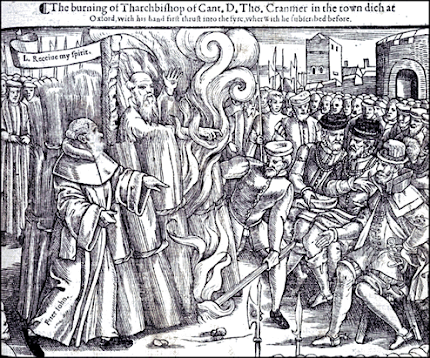
The burning of Tharchbishop of Cant. D. Tho. Cranmer in the town dich at Oxford, with his hand first thrust into the fyre, wherwith he subscribed before. [Click on the picture to see Cranmer's last words.]

Daily Bible Verse

Showing posts with label Martin Luther. Show all posts

Wednesday, December 04, 2013

Martin Luther on Good Works


"Now all these works are done outside of faith, therefore they are nothing and altogether dead."

  -- Martin Luther


I. We ought first to know that there are no good works except those which God has commanded, even as there is no sin except that which God has forbidden. Therefore whoever wishes to know and to do good works needs nothing else than to know God's commandments. Thus Christ says, Matthew xix, "If thou wilt enter into life, keep the commandments." [Matthew 19:16].  And when the young man asks Him, Matthew xix, what he shall do that he may inherit eternal life, Christ sets before him naught else but the Ten Commandments. Accordingly, we must learn how to distinguish among good works from the Commandments of God, and not from the appearance, the magnitude, or the number of the works themselves, nor from the judgment of men or of human law or custom, as we see has been done and still is done, because we are blind and despise the divine Commandments.  [Cf. Matthew 19:29.  It is Jesus who uses the word "inherit," not the young ruler.  --Charlie]

II. The first and highest, the most precious of all good works is faith in Christ, as He says, John vi.  [John 6:29]. When the Jews asked Him: "What shall we do that we may work the works of God?" He answered: "This is the work of God, that ye believe on Him Whom He hath sent." When we hear or preach this word, we hasten over it and deem it a very little thing and easy to do, whereas we ought here to pause a long time and to ponder it well. For in this work all good works must be done and receive from it the inflow of their goodness, like a loan. This we must put bluntly, that men may understand it.


We find many who pray, fast, establish endowments, do this or that, lead a good life before men, and yet if you should ask them whether they are sure that what they do pleases God, they say, "No"; they do not know, or they doubt. And there are some very learned men, who mislead them, and say that it is not necessary to be sure of this; and yet, on the other hand, these same men do nothing else but teach good works. Now all these works are done outside of faith, therefore they are nothing and altogether dead. For as their conscience stands toward God and as it believes, so also are the works which grow out of it. Now they have no faith, no good conscience toward God, therefore the works lack their head, and all their life and goodness is nothing. Hence it comes that when I exalt faith and reject such works done without faith, they accuse me of forbidding good works, when in truth I am trying hard to teach real good works of faith.

Luther, Martin (2009-10-04). A Treatise on Good Works (Kindle Locations 207-223). Public Domain Books. Kindle Edition.

Thursday, October 31, 2013

Reformation Day, Martin Luther Movie, 1953


The issue of Luther's day was not liberty of conscience in the progressive and revisionist version of history.  Rather, Martin Luther stood for the doctrine of sola Scriptura.  Scripture is the final authority in all matters of theological dispute, not the church or even the civil government.  Scripture interprets itself.  Where one passage is unclear other plain passages clarify the more difficult passages.  Since revelation is rational and logical, it is perfectly perspicuous and plain such that even the plow boy and the small child can read and understand the Scriptures and come to saving faith.  (2 Timothy 3:15-17).

Friday, July 26, 2013

Martin Luther: Without Compromise: Justification by Faith Alone

"For I know this, that after my departure savage wolves will come in among you, not sparing the flock. 30 "Also from among yourselves men will rise up, speaking perverse things, to draw away the disciples after themselves. 31 "Therefore watch, and remember that for three years I did not cease to warn everyone night and day with tears. (Acts 20:29-31 NKJ)

Then Jesus said to them, "Take heed and beware of the leaven of the Pharisees and the Sadducees." (Matthew 16:6 NKJ)

I attended a Bible study last night which was hosted by an Evangelical friend who is also ordained as an Episcopal minister or presbyter.  He recently lost his job as a rector of a small Episcopal congregation here in central Florida.  The reason being that the Anglo-Catholics and the Arminians did not like his preaching the law of God.

Unfortunately, they are mostly right because in the four or five years I have attended the church I have not heard him preach even one sermon on justification by faith alone.  Even worse, he despises the Westminster Confession of Faith and any other attempt to systematize the propositional truth claims revealed in Holy Scripture.

There is nothing wrong with teaching doctrinal sermons now and then.  When is the last time you heard a Evangelical minister preach a sermon on the Trinity?

Be that as it may, this pastor "claims" to be a Calvinist of sorts.  Oddly enough, he never says that from the pulpit.  He is in fact an Amyraldian.  Unfortunately, that wee bit of irrationalism concatenates into everything else he believes.  In other words, if your theology is not logically consistent and systematic through and through, you have an out to endorse nonsense and even heresy.  My Evangelical friend thinks that Anglo-Catholics are "Christians" and that the conservative and "orthodox" Anglo-Catholics are saved and that they are good "churchmen".  I strongly and vehemently and adamantly disagree for the following reasons:

1.  Anglo-Catholics deny the doctrine of Sola Scriptura.  Sola Scriptura is the doctrine that Scripture alone is the final authority in all matters and faith and practice.  Like Roman Catholics the Anglo-Catholics and Tractarians equate church tradition with the special and divine revelation of God that we find in Scripture.  For Papists and Tractarians the term "divine revelation" applies to both Scripture and church tradition.  The doctrine of Sola Scriptura is a non-negotiable doctrine of the Protestant Reformation.  Unless Scripture is the final authority the door is wide open to all kinds of revisionism and progressivism, including the aberrations we see in Rome where there are prayers to the saints; Mary is elevated to the place of co-mediator with Christ; and the Pope is seen as the "vicar" or "representative of Christ on earth.  Tractarians evolved in two directions: liberal and conservative.  The conservatives agree with Rome on most issues.  The liberals evolved into the direction that social justice issues are under their control as "representatives" of Christ on earth.  This is how they can justify their inclusiveness views on homosexuality and socialist progressivism.  After all, Scripture is not the final authority for them.  The church is the final authority when tradition is elevated to the level of Scripture.  That much is clear upon observing the practical results in both the Roman Catholic Church and the Anglo-Catholic tradition.

2.  Anglo-Catholics reject the doctrine of justification by faith alone.  For the Anglo-Catholic, like the Papist, justification is by faith plus works or faith plus obedience.  Their perennial attack on the doctrine of justification by faith alone centers on their anthropocentric view of everything.  Theology from below always exalts man above God, the creature above the Creator.  Scripture, however, clearly shows that all men without exception are wicked and sinful (Genesis 6:5; Romans 3:10-23).  God does not lower the standards of the absolute demands of the moral law so that men can pretend to be holy.  The law of contradiction applies here.  Either you are or you are not.  The law of excluded middle applies here as well.  There is no middle ground between justification by faith alone and justification by faith plus works.  This issue is the central issue of the Protestant Reformation.

On those two points alone Anglo-Catholics, like the Papists, are heretics.  Their churches are synagogues of satan every bit as much as any modern day cult like the Mormons, the Jehovah's Witnesses, or some prosperity gospel Charismatic cult.

Therefore, I must strongly castigate anyone--including my Evangelical friend--who willfully and deliberately endorses heresy by suggesting that these wolves are in any way whatsoever "Christian" men.  They are not.  They are deceivers out to mislead God's elect and they are to be avoided and shunned at all cost:

Then Jesus said to them, "Take heed and beware of the leaven of the Pharisees and the Sadducees." (Matthew 16:6 NKJ)

"How is it you do not understand that I did not speak to you concerning bread?-- but to beware of the leaven of the Pharisees and Sadducees." 12 Then they understood that He did not tell them to beware of the leaven of bread, but of the doctrine of the Pharisees and Sadducees. (Matthew 16:11-12 NKJ)

"Beware of false prophets, who come to you in sheep's clothing, but inwardly they are ravenous wolves. 16 "You will know them by their fruits. Do men gather grapes from thornbushes or figs from thistles? (Matthew 7:15-16 NKJ)

Martin  Luther, the father of the Lutheran side of the Protestant Reformation said that justification by faith alone is the one doctrine by which a true church or congregation stands or falls:

I myself can hardly believe that I was so verbose as this book shows when I publicly expounded this letter of St. Paul to the Galatians. However, I can see that all the thoughts that I find in this treatise are mine, so I must confess that I uttered all of them, or perhaps more than all of them. The one article of faith that I have most at heart is the faith of Christ. All my studies in divinity, by day and night, continually go back and forth from him, by him, and to him. Yet I could not attain anything near the height, breadth, and depth of such high and inestimable wisdom; there appear here only some poor and bare beginnings, fragments, as it were. Therefore, I am ashamed that such a barren and simple commentary should be published on such a worthy apostle and chosen instrument of God.

But then again, I consider the infinite and horrible profanation and abomination that has always raged in the church of God, and still today continues to rage against this one sure foundation, our justification (that is to say, that it is not by ourselves, nor by our works, which are less than ourselves, but by Jesus Christ, the Son of God, that we are redeemed from sin, death, the devil, and are made to share eternal life), and I am compelled to throw away all shame and to be bold above measure.

In paradise, Satan shook this rock of faith (Genesis 3:5) when he persuaded our first ancestors that they could be like God by their own wisdom and power, abandoning true faith in God, who had given them life and promised to continue it. After a while this liar and murderer, true to form, stirred up brother to murder brother, for no other reason than that his godly brother had offered by faith a more excellent sacrifice, and he offered up his own works without faith, which had not pleased God (see Genesis 4).

There followed a most intolerable persecution of Satan against this faith by Cain’s sons, until God had to purge the world by means of the Flood, defending Noah, the preacher of righteousness. Even so, Satan continued his work in Noah’s third son, Ham, and in innumerable others. After this, the whole world grew mad against this faith (as St. Paul says in Acts 14:15–16), inventing an infinite number of idols and strange religions by which people went their own way, trusting in works to please gods and goddesses without Christ’s help and seeking by their own works to redeem themselves from evils and sins. The example and writings of all nations demonstrate this.

Martin Luther, Galatians, Crossway Classic Commentaries (Wheaton, IL: Crossway Books, 1998), 14–16.


The doctrine of justification by faith alone is  not a matter of indifference or adiaphora.  It is non-negotiable, essential doctrine.  Without justification by faith alone there is no salvation.  Therefore for anyone, including my Evangelical pastor friend, to say that Anglo-Catholics are "good Christian men" or good "churchmen" is patently false.  It reveals a confusion on the part of irrationalists who try to smooth over lies as if they were acceptable to any degree at all.  To sell out an entire congregation to the Anglo-Papists simply because you're more faithful to the organization and your concerns for your own severance pay is to compromise the Gospel for selfish reasons.  Those who truly trust God are willing to preach the Gospel no matter the cost! 

I am a sinful man who deserves hell.  But when I realized that the Assemblies of God was an apostate church and a cultic synagogue of satan leading millions of people to hell, I resigned and counted the cost.  When I realized that the Reformed Episcopal Church had sold out to the heresies and the false teachings of the Anglo-Papists, I resigned and counted the cost.  True ministers of the Gospel are willing to sacrifice themselves just as Christ gave himself for the church.  They are not hirelings who are more concerned with supporting themselves financially than they are with preaching the truth to a lost and dying generation.

"For which of you, intending to build a tower, does not sit down first and count the cost, whether he has enough to finish it-- 29 "lest, after he has laid the foundation, and is not able to finish, all who see it begin to mock him, 30 "saying,`This man began to build and was not able to finish?' 31 "Or what king, going to make war against another king, does not sit down first and consider whether he is able with ten thousand to meet him who comes against him with twenty thousand? 32 "Or else, while the other is still a great way off, he sends a delegation and asks conditions of peace. 33 "So likewise, whoever of you does not forsake all that he has cannot be My disciple. (Luke 14:28-33 NKJ)

"But a hireling, he who is not the shepherd, one who does not own the sheep, sees the wolf coming and leaves the sheep and flees; and the wolf catches the sheep and scatters them. 13  "The hireling flees because he is a hireling and does not care about the sheep. 14 "I am the good shepherd; and I know My sheep, and am known by My own. (John 10:12-14 NKJ)


Saturday, March 09, 2013

Doctrine or Moralism? Which Is It? Luther the Logician

Luther thundered, “Unless I am convinced by Scriptures and plain reason [for Luther, this meant logic], my conscience is captive to the Word of God. I cannot and I will not recant anything. Here I stand, I can do no other!”

Those who want to downplay doctrines, that is, truth, might agree with Erasmus. In a letter to Louvain, Erasmus testified of himself, “I for my part would prefer to be deceived in a good many things rather than to fight for the truth in so great a universal tumult” (35). “Christianity, to Erasmus, was essentially morality.. . . Erasmus recognizes no organic dependence of practice upon faith. Peace in the Church was of more value than any doctrine” (43). Does this not sound remarkably like many neo-evangelical churches today-peace at the price of truth?
 
The opposite was true of Luther: “Christianity was to Luther a dogmatic religion, or it was nothing” (44). Fundamental to upholding a doctrinal Christianity is the upholding of logic. If logic is ignored or denigrated, no doctrine can be known to be true or false. Luther was himself a rigorous logician. In 1508, he lectured in Aristotelian logic at the University of Wittenberg (21). Roland Bainton wrote of Luther, “Reason in the sense of logic he employed to the uttermost limits” (47). At the Diet of Worms in 1521, Luther was ordered to recant his teachings on threat of excommunication. Luther thundered, “Unless I am convinced by Scriptures and plain reason [for Luther, this meant logic], my conscience is captive to the Word of God. I cannot and I will not recant anything. Here I stand, I can do no other!”  (Godwell Andrew Chan, Trinity Review, January 1996).

Saturday, July 21, 2012

The Bondage of the Will: Luther's Judgment Against Erasmus, Cornelius Van Til, Ambiguity and Paradox

"Let us, if we must do it, trifle with ambiguities in other things that are of no moment, as nuts, apples, pence, and other things which are the toys of children and of fools: but in religion, and weighty matters of state, let us shun, with all possible care, an ambiguity, as we would shun death or the devil!"  -- Martin Luther

St. Augustine says, 'philosophers ought to speak freely on difficult points, fearing no offence: but we (says he) must speak to a certain rule.' And therefore, he blames the use of the term fortune, or fate, both in himself and others. For even though the person may by fortune mean the divine mind, the agent of all things, from which nature is known to be distinctly different, and thus may not think impiously, yet, says he, 'Let him hold his sentiment, but correct his expression. 

And even to suppose that Augustine did not say this, and never had any certain rule according to which he expressed himself, yet nature will tell us, that every profession, sacred as well as profane, uses certain terms of its own, and avoids all ambiguities. For even common tradesmen, either reprove or condemn, or hold up to ridicule, the man who speaks of his own trade in the technical terms (as they are called) peculiar to the trade of another. With how much greater force will this apply to things sacred, where certain salvation, or eternal perdition is the consequence, and where all must be taught in certain and proper terms! Let us, if we must do it, trifle with ambiguities in other things that are of no moment, as nuts, apples, pence, and other things which are the toys of children and of fools: but in religion, and weighty matters of state, let us shun, with all possible care, an ambiguity, as we would shun death or the devil! 

Our king of ambiguity, however, sits upon his ambiguous throne in security, and destroys us stupid Christians with a double destruction. First, it is his will, and it is a great pleasure to him, to offend us by his ambiguous words: and indeed he would not like it, if we stupid blocks were not offended. And next, when he sees that we are offended, and have run against his insidious figures of speech, and begin to exclaim against him, he then begins to triumph and rejoice that the desired prey has been caught in his snares. For now, having found an opportunity of displaying his rhetoric, he rushes upon us with all his powers and all his noise, tearing us, flogging us, crucifying us, and sending us farther than hell itself; saying, that we have understood his words calumniously, virulently, satanically; (using the worst terms he can find;) whereas, he never meant them to be so understood. 

In the exercise of this wonderful tyranny, (and who would think that this Madam ambiguity could make so much ado, or who could suppose that any one would be so great a madman as to have so much confidence in a vain figure of speech?) he not only compels us to put up with his all-free prerogative of using ambiguities, but binds us down to the necessity of keeping silence. He plainly designs all the while, and wishes us to be offended, that he, and his herd of Epicureans with him, may have a laugh at us as fools: but on the other hand, he does not like to hear that we are offended, lest it should appear that we are true Christians. Thus must we suffer wounds without number, and yet, not utter a groan or a sigh! 

We Christians, however, who are to judge, not meats and drinks only, but angels and the whole world, and who actually judge, even now, not only do not bear with this tyranny of ambiguities, but on the contrary, oppose to it our liberty of pronouncing a two-fold condemnation. The first is, as I have already observed, we condemn all the ambiguous expressions of Erasmus, and interpret them against himself: as Christ saith, "Out of thine own mouth will I judge thee, thou wicked servant." Again, "By thine own words shalt thou be condemned: for wherefore hast thou spoken against thine own soul?" "Thy blood be upon thine own head." The second condemnation is, we condemn and curse again and again his glosses and 'convenient interpretations,' by which, he not only does not correct his ungodly expressions, but even defends them: that is, he laughs at us twice as much in his after interpretations, as he does in his first expressions.

The Bondage of the Will: Letter Concerning Erasmus of Rotterdam

Tuesday, May 29, 2012

The Bondage of the Will

Sect. 167.—I SHALL here draw this book to a conclusion: prepared if it were necessary to pursue this Discussion still farther. Though I consider that I have now abundantly satisfied the godly man, who wishes to believe the truth without making resistance. For if we believe it to be true, that God fore-knows and fore-ordains all things; that He can be neither deceived nor hindered in His Prescience and Predestination; and that nothing can take place but according to His Will, (which reason herself is compelled to confess;) then, even according to the testimony of reason herself, there can be no "Free-will"—in man,—in angel,—or in any creature!  Martin Luther, The Bondage of the Will.


 The Bondage of the Will

Thursday, April 19, 2012

Martin Luther: Do Not Mix Law With Grace

Martin Luther comments on Galatians 2:18,

By the grace of Christ we believe in justification, and we are sure that we are justified and accounted righteous before God purely by faith in Christ. Therefore, we do not mix the law and grace, faith and works, but keep them completely separate. Every Christian should carefully maintain this difference between the law and grace, not in letters and syllables, but in practice and inner experience, so that when people say good works should be done, and the example of Christ is to be followed, we may be able to judge rightly and say, “All these things I will do gladly. But what follows from this? Will you be saved and obtain everlasting life? Not so. I agree that I ought to do good works, to suffer trouble and affliction patiently, and to shed my blood, if necessary, for Christ’s cause. But I am not justified by this, nor do I obtain salvation by it.”
 
We must not let good works come into the matter of justification, as do those people who say that doers of good works, even by those being punished for their sins, deserve everlasting life. These people comfort those who are brought to the place of execution, telling them they must suffer this shameful death willingly and patiently, and that if they do so, they will merit forgiveness of sins and everlasting life. What a horrible claim this is, that thieves, murderers, robbers should be so wretchedly seduced in extreme anguish and distress, that at the very point of death they should refuse the Gospel and sweet promises in Christ, which are the only thing that can bring comfort and salvation, and should be commanded to hope for pardon of their sins if they willingly and patiently endure this death for their mischievous deeds! This simply heaps destruction and perdition on people who are already most wretchedly afflicted; by giving false confidence in their own death, it leads them onto an open road to hell.
 
Thus such hypocrites clearly show they understand not a thing about grace, the Gospel, or Christ. Rejecting Christ, they attribute more to human traditions than to the Gospel. But Paul says we are justified only by faith in Christ, without the law. After we are justified and possess Christ by faith and know we have his righteousness and life, there is no doubt that we will not be idle but will produce good fruit just as a good tree does. Believers have the Holy Spirit, and where the Holy Spirit lives, he will not allow people to be idle but stirs them up to piety and godliness and true religion, to the love of God, to the patient suffering of affliction, to prayer, to thanksgiving, to the exercise of love toward everyone.


Luther, M. (1998). Galatians. The Crossway classic commentaries (97). Wheaton, Ill.: Crossway Books.

Friday, April 13, 2012

Martin Luther: Quote of the Day: The Law/Gospel Distinction

From Luther's commentary on Galatians 2:14,

14. When I saw that they were not acting in line with the truth of the gospel. This is a wonderful example of such excellent men and pillars of the church. Only Paul has his eyes open and sees the offense of Peter, Barnabas, and the other Jews who were hypocrites along with Peter. On the other hand, they do not see their own offense; rather, they think they are right to bear with the weakness of the Jews. So it was very necessary for Paul to criticize them and not hide their offense. So he accuses Peter, Barnabas, and the others of swerving from the truth of the Gospel. It is significant that Peter is accused by Paul as someone who had fallen from the truth of the Gospel. He could not be more grievously reprehended, and yet he suffered it patiently and no doubt acknowledged his offense. Peter, Barnabas, and other Jews had the Gospel but were not walking uprightly according to it. They preached the Gospel but established the law, though this would abolish the Gospel.

Anyone who can judge rightly between the law and the Gospel should thank God and know that he is a true theologian. In times of temptation, I confess that I myself do not know how to do this as I ought. The way to discern the one from the other is to place the Gospel in heaven and the law on the earth, to call the righteousness of the Gospel heavenly and the righteousness of the law earthly, and to put as much difference between the righteousness of the Gospel and of the law as God has made between heaven and earth, between light and darkness, between day and night. If it is a question of faith or conscience, let us utterly exclude the law and leave it on the earth; but if we are dealing with works, let us light the lantern of works and of the righteousness of the law. The sun and light of the Gospel and grace should shine in the day, and the lantern of the law in the night.

So if your conscience is terrified with the sense of sin, remember that you are still on earth. Let the donkey labor there and carry the burden laid upon him; that is, let the body and its members be subject to the law. But when you climb up to heaven, leave the donkey with its burden on the earth, for the conscience has nothing to do with the law or its observance or earthly righteousness. Thus the donkey remains in the valley, but the conscience climbs the mountain with Isaac, knowing nothing at all of the law or its observance, but only looking to the remission of sins and pure righteousness offered and freely given to us in Christ.

Conversely, in civil matters obedience to the law must be severely required. There nothing must be known concerning the Gospel, conscience, grace, forgiveness of sins, heavenly righteousness, or Christ himself, but only Moses, with the law and its observance. If we keep this distinction carefully, neither the one nor the other will pass its bounds. The law will remain outside heaven—that is, outside the heart and conscience; and conversely, the liberty of the Gospel will remain outside the earth—that is, outside the body and its members. As soon as the law and sin come into heaven (that is, into the conscience), let them be thrown out straightaway, for the conscience, being terrified by God’s wrath and judgment, ought to know nothing of the law and sin, but only Christ. And on the other hand, when grace and liberty come into the earth (that is, into the body), then say, “You should not live in the dregs and garbage heap of this physical life; you belong to heaven.”

This distinction between law and Gospel was confused when Peter persuaded the believing Jews that they must be justified by the Gospel and the law together. Paul would not allow this, and so he reproved Peter, not so Peter might be reproached, but so he might again establish a clear distinction between the two—namely, that the Gospel justifies in heaven, and the law on earth.


Luther, M. (1998). Galatians. The Crossway classic commentaries (82–84). Wheaton, Ill.: Crossway Books.

Monday, March 19, 2012

Martin Luther: Quote of the Day: Good Works

The younger Martin Luther.
"Truly good works are not self-elected works of monastic or any other holiness, but such only as God has commanded, and as are comprehended within the bounds of one's particular calling, and all works, let their name be what it may, become good only when they flow from faith, the first, greatest, and noblest of good works." (John 6:29.)

Luther, Martin (2009-10-04). A Treatise on Good Works (Kindle Locations 84-86). Public Domain Books. Kindle Edition. 

Of course John 6:29 clearly says that even our faith is a work of God in us.  The good works that save us are the good works of God on our behalf through Jesus Christ.  And only the works that follow after faith are pleasing to God, though these works can never withstand the severity of God's judgment.  (See Article XII of the Thirty-nine Articles).   Even after conversion good works do not serve to justify the believer or vindicate the believer before God whatsoever.  Good works merely show to other men and the church that we have a valid profession of faith--nothing more and nothing less (James 2:18; 3:13; 1 Corinthians 5:1-5)


[Note:  You can download a Kindle reader for your laptop for free at Amazon.com.  This book and several other theological works are available for free download.  There are several from Martin Luther's works available for free download.  Charlie]

Friday, March 02, 2012

Martin Luther on Faith and Reading the Word


So we continually teach that the knowledge of Christ and of faith is not a human work but simply the gift of God, who creates faith and maintains it in us. Just as he first gives faith to us through the Word, so afterwards he exercises and increases it, strengthens it, and makes it perfect in us by the Word. Therefore, the greatest service that we can give to God, the very sabbath of sabbaths, is to exercise ourselves in true godliness, diligently listening to the Word and reading it.

Conversely, there is nothing more dangerous than to be weary of the Word. Anyone who is so cold that he thinks he knows enough and begins gradually to loathe the Word has lost Christ and the Gospel, and what he thinks he knows, he attains only by speculation.   (Commentary on Galatians 1:11, 12).


Luther, M. (1998). Galatians. The Crossway classic commentaries (58). Wheaton, Ill.: Crossway Books.

Friday, February 17, 2012

Martin Luther Comments on Galatians 1:7

"Note carefully that every teacher of works and of the righteousness of the law is a troubler of the church and of people’s consciences. The more holy the heretics seem to be outwardly, the more mischief they do. If the false apostles had not been endued with notable gifts, great authority, and a show of holiness and had not boasted they were Christ’s ministers, the apostles’ disciples, and sincere preachers of the Gospel, they could not so easily have defaced Paul’s authority and led the Galatians astray."  Martin Luther


Galatians 1:7

7. Which is really no gospel at all.


Evidently some people are throwing you into confusion. Here again he excuses the Galatians and most bitterly reproves the false apostles. This is like saying, “You Galatians are assured that the Gospel you received from me is not the true and sincere Gospel, and therefore you think you are doing the right thing by accepting that new gospel that the false apostles teach and that seems to be better than mine. I do not so much accuse you of this fault as those disturbers who trouble your consciences and pull you out of my hand.” Here you see once more how vehement the apostle is against those deceivers, and with what harsh words he describes them, calling them troublers of the churches who do nothing but seduce and deceive innumerable poor consciences, occasioning horrible mischief and calamities in the congregations. We also see this great enormity today, to the great grief of our hearts; yet we are no more able to remedy it than Paul was at that time.

This passage proves that those false apostles had reported Paul to be an imperfect apostle and also a weak and erroneous preacher. Therefore, he again calls them here troublers of the church and overthrowers of the Gospel of Christ. Thus the false apostles condemned Paul, and Paul condemned them. Such fighting and condemnation is always in the church, especially when the doctrine of the Gospel flourishes; wicked teachers prosecute, condemn, and oppress godly people, and conversely, godly people reprove and condemn the ungodly.

Note carefully that every teacher of works and of the righteousness of the law is a troubler of the church and of people’s consciences. The more holy the heretics seem to be outwardly, the more mischief they do. If the false apostles had not been endued with notable gifts, great authority, and a show of holiness and had not boasted they were Christ’s ministers, the apostles’ disciples, and sincere preachers of the Gospel, they could not so easily have defaced Paul’s authority and led the Galatians astray.

Now the reason the apostle sets himself so sharply against them is that in addition to faith in Christ they taught that circumcision—that is, the keeping of the law—was necessary to receive salvation. Paul himself testifies to this in chapter 5; and Luke, in Acts 15:1, says the same thing. So the false apostles earnestly and obstinately argued that the law ought to be observed. Stubborn Jews immediately joined them and so afterwards easily persuaded people who were not established in the faith that Paul was not a sincere teacher, because he disregarded the law and preached a doctrine that abolished and overthrew it. It seemed to them very strange that the law of God should be completely taken away and that the Jews, who had always until that time been regarded as God’s people and to whom the promises had been given, should now be rejected. Indeed, it seemed even stranger to them that the Gentiles, wicked idolaters, should attain the glory and dignity of being the people of God without being circumcised and without the works of the law—that is, by grace and faith in Christ alone.


Luther, M. (1998). Galatians. The Crossway classic commentaries (50–51). Wheaton, Ill.: Crossway Books.

Support Reasonable Christian Ministries with your generous donation.