>

Martyred for the Gospel

Martyred for the Gospel
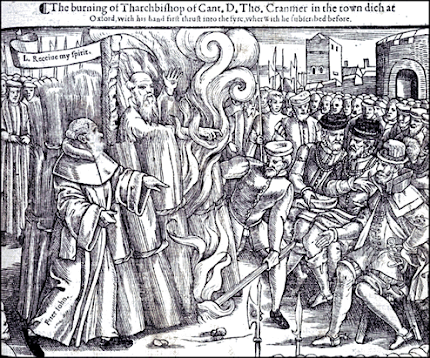
The burning of Tharchbishop of Cant. D. Tho. Cranmer in the town dich at Oxford, with his hand first thrust into the fyre, wherwith he subscribed before. [Click on the picture to see Cranmer's last words.]

Daily Bible Verse

Showing posts with label Catechism. Show all posts

Thursday, January 19, 2012

J. I. Packer's Continued Crusade: Catechism Classes


{This article is pirated from Christianity Today without their express permission.  Sue me!  Click here to read the full article:  Small Groups and Heresy}

Note: J. I. Packer is the award-winning author of numerous books, including the classic Knowing God. SmallGroups.com recently had the chance to speak with Dr. Packer as part of an editors' panel in the offices of Christianity Today International.

Do churches and small groups have a responsibility to fight heresy when laypeople teach others?

Yes, churches are responsible for weeding out heretical teaching, and that's pretty clear from the New Testament. In those early days of Christianity out in the pagan world, there were any number of cults and any number of false views. And in the Pastoral Epistles we see individuals who are held up as solemn warnings—"Don't go their route."

Let me also say that it's my firm conviction that churches ought to foresee this unhappy possibility of heresy getting in when lay-folk are leading. And they should counter the possibility by what in the history of the church has been called "catechesis." We hardly hear of it these days, but in the second and third centuries A.D.—and indeed for some centuries after—it's rather amazing to discover that inquirers into the faith were fed into catechetical classes.

Can you explain a little more about the process of catechesis?

First, there are other ways of doing catechesis than by question and answer, which is what we are used to when we think of catechizing children. Catechesis is the teaching of the truths that Christians live by, and linked with that it's the teaching of how to live by those truths. It's a practical, pastoral discipline of instruction.

In the second and third centuries, the inquirers didn't have any Christian background—they didn't have any kind of theistic background even. They were polytheists who came out of various pagan cults. And so the catechists had to begin at the beginning and take them through the whole body of Christian doctrine.

We know from surviving catechetical materials that they taught not by separating truths from each other in order to focus on them in isolation. Rather, they taught the whole Christian view of Christianity—God's great economy of grace for the salvation of sinners—and the syllabus was essentially the themes of the Apostle's Creed.

And you feel that the practice of catechesis would be beneficial in modern churches, as well?

Yes. If we could recover catechesis as a regular element of church life, well, we'd be anticipating a lot of these problems with heresy and other troubles. We'd be constantly sustaining orthodoxy and reminding people of what the Christian faith is when you put it all together as a single ball of wax.  And in the absence of catechesis you do find laypeople who believe themselves to have a teaching gift—and perhaps have impressed the church as having a teaching gift— but allow themselves to deviate.

In your opinion, what should churches do when they identify someone who may be leading others astray?

Don't let them go on doing it, first and foremost. It seems to me that the responsibility of the small group is to let it be known that a leader is saying some things that appear to be unsound, unbiblical, or untrue. And that complaint must go up to the leadership of the congregation, whatever form the leadership takes. As an Anglican I'm thinking in terms of the rector; all bucks stop on the rector's desk. But there will always be a leadership group in any congregation.

Well, the complaint goes up to the leadership group, and it's the leadership group's responsibility in the first instance to handle it—which means that they ask the person who's been making waves to explain him or herself. And then according to the way the offender reacts to the corrective response, well, you take it from there. You hope that the errorist will allow him or herself to be put straight. Sometimes it happens that way and sometimes it doesn't.
What kinds of heretical beliefs have you found to be common in the church today?
 
What is common in this post-Christian age is all the various forms that are taken by the fantasy, and it's a very potent fantasy, that all religions are somehow one. Somehow they are the same religion. Somehow they are all of them pointing to the top of the same mountain, and as we climb we become more and more aware that we're getting closer to everybody else who is climbing by other paths—Muslim, Buddhist, Hindu, or whatever—and when we get to the top, we shall find that we're totally together.  It's a sweet dream, but the early Christians rejected it out of hand. And, I think, so should we.

Going back to the topic of catechism, is it still possible to do catechesis or guard against heresy as effectively when so many of our modern churches are so large?

I think it would be possible if the will was there.  I mean, if you have a megachurch, what's important is the infrastructure. You've got to develop an infrastructure which takes in all the people, thousands of them, to give them such basic instruction as they all need. Of course, it's easier to arrange an infrastructure for a congregation of about 100, but the principle is the same even though the work is harder.

You break people down into learning groups, call them classes or whatever you choose, and you have persons who are gifted and know their stuff as catechists. The catechists teach the faith as the integrated unity that it is in Scripture. They don't teach isolated points of doctrine; they teach the whole Christian story as it's brought together, and they teach the creeds. And as they go along they sort out the inquirers and they dispel the errors.

—J. I. Packer; copyright 2011 by the author and Christianity Today International.

--
Reasonable Christian Blog Glory be to the Father, and to the Son : and to the Holy Ghost; Answer. As it was in the beginning, is now, and ever shall be : world without end. Amen. 1662 Book of Common Prayer

Sunday, November 06, 2011

Quote of the Day: Heidelberg Catechism Project


“If the people in a church do not believe the first question and answer to the Heidelberg Catechism, then everything else they may say or do doesn’t matter”. — Bishop Karl Ludwig of the Hungarian Reformed Calvin Synod


To read more click here: Heidelberg Catechism Project


Tuesday, August 16, 2011

A Comment to Anglicans Ablaze

(See:  Robert Duncan on the Ordinal)

Robin, that was an excellent analysis of the situation. I appreciate your candor. However, in my view one of the most flawed parts of the 1979 book of alternative services--as the late Peter Toon called it--is the Catechism. The Catechism of the 1979 book is out and out pelagian and nowhere acknowledges the doctrine of original sin, actual sin, or the depravity of the human race.

One could legitimately ask, "Whatever happened to sin?"

OK, so it does mention sin but it defines sin as following the bad example of Adam for all practical purposes:

Human Nature

Human Nature
Q. What are we by nature?
A. We are part of God's creation, made in the image of God.

Q. What does it mean to be created in the image of God?
A. It means that we are free to make choices: to love, to create, to reason, and to live in harmony with creation and with God.

Q. Why then do we live apart from God and out of harmony with creation?
A. From the beginning, human beings have misused their freedom and made wrong choices.

And: Sin and Redemption

Sin and Redemption
Q. What is sin?
A. Sin is the seeking of our own will instead of the will of God, thus distorting our relationship with God, with other people, and with all creation.

Q. How does sin have power over us?
A. Sin has power over us because we lose our liberty when our relationship with God is distorted.

You'll notice above that sin is not inborn or imputed but something we willfully do, which leads to distortion. That's Pelagianism. It's what we "do" that makes us sinful and not what Adam did that makes the human race sinful. (See: Catechism: 1979 Book of Alternative Services)

Secondly, sin has power over us after we distort the relationship by sinning. This is another direct contradiction to the 39 Articles, Article 9:

Of Original or Birth Sin

Original sin standeth not in the following of Adam (as the Pelagians do vainly talk), but it is the fault and corruption of the nature of every man that naturally is engendered of the offspring of Adam, whereby man is very far gone from original righteousness, and is of his own nature inclined to evil, so that the flesh lusteth always contrary to the spirit; and therefore in every person born into this world, it deserveth God's wrath and damnation. And this infection of nature doth remain, yea, in them that are regenerated, whereby the lust of the flesh, called in Greek phronema sarkos (which some do expound the wisdom, some sensuality, some the affection, some the desire of the flesh), is not subject to the law of God. And although there is no condemnation for them that believe and are baptized, yet the Apostle doth confess that concupiscence and lust hath itself the nature of sin.

As bad as the ritualism is, the Catechism of the 79 book is worse in my opinion because it teaches directly against the doctrines of salvation in Articles 9-18 of the 39 Articles of Religion. That might be why the 39 Articles are relegated to fine print in the back of the 79 book so as to be merely a history piece and not binding doctrine.

Peace!

Charlie
--
Reasonable Christian Blog Glory be to the Father, and to the Son : and to the Holy Ghost; Answer. As it was in the beginning, is now, and ever shall be : world without end. Amen. 1662 Book of Common Prayer

Friday, May 21, 2010

1662 Catechism: Part Three


Question.
 

THE same which God spake in the twentieth Chapter of Exodus, saying, I am the Lord thy God, who brought thee out of the land of Egypt, out of the house of bondage.
    I. Thou shalt have none other gods but me.
    II. Thou shalt not make to thyself any graven image, nor the likeness of any thing that is in heaven above, or in the earth beneath, or in the water under the earth. Thou shalt not bow down to them, nor worship them: for I the Lord thy God am a jealous God, and visit the sins of the fathers upon the children unto the third and fourth generation of them that hate me, and shew mercy unto thousands in them that love me, and keep my commandments.
    III. Thou shalt not take the Name of the Lord thy God in vain: for the Lord will not hold him guiltless that taketh his Name in vain.
    IV. Remember that thou keep holy the Sabbath-day. Six days shalt thou labour, and do all that thou hast to do; but the seventh day is the Sabbath of the Lord thy God. In it thou shalt do no manner of work, thou, and thy son, and thy daughter, thy man-servant, and thy maid-servant, thy cattle, and the stranger that is within thy gates. For in six days the Lord made heaven and earth, the sea, and all that in them is, and rested the seventh day: wherefore the Lord blessed the seventh day, and hallowed it.
    V. Honour thy father and thy mother, that thy days may be long in the land which the Lord thy God giveth thee.
    VI. Thou shalt do no murder.
    VII. Thou shalt not commit adultery.
    VIII. Thou shalt not steal.
    IX. Thou shalt not bear false witness against thy neighbour.
    X. Thou shalt not covet thy neighbour's house, thou shalt not covet thy neighbour's wife, nor his servant, nor his maid, nor his ox, nor his ass, nor any thing that is his.


  Glory be to the Father, and to the Son : and to the Holy Ghost;
    Answer. As it was in the beginning, is now, and ever shall be : world without end. Amen.

Thursday, May 20, 2010

1662 Catechism: Part Two

Catechist
Rehearse the Articles of thy Belief.
Answer.

I BELIEVE in God the Father Almighty, Maker of and earth:
    And in Jesus Christ his only Son our Lord, Who was conceived by the Holy Ghost, Born of the Virgin Mary, Suffered under Pontius Pilate, Was crucified, dead, and buried, He descended into hell; The third day he rose again from the dead, He ascended into heaven, And sitteth at the right hand of God the Father Almighty; From thence he shall come to judge the quick and the dead.
    I believe in the Holy Ghost; The holy Catholick Church; The Communion of Saints; The Forgiveness of sins; The Resurrection of the body; And the Life everlasting. Amen.
    Question. What dost thou chiefly learn in these Articles of thy Belief?
    Answer. First, I learn to believe in God the Father, who hath made me, and all the world.
    Secondly, in God the Son, who hath redeemed me, and all mankind.
    Thirdly, in God the Holy Ghost, who sanctifieth me, and all the elect people of God.


  Glory be to the Father, and to the Son : and to the Holy Ghost;
    Answer. As it was in the beginning, is now, and ever shall be : world without end. Amen.

Wednesday, May 19, 2010

Part One of the Catechism: 1662 Book of Common Prayer


A Catechism

That is to say, an Instruction to be Learned of Every Person, Before he be Brought to be Confirmed by the Bishop.


QUESTION. What is your Name?
    Answer. N. or M.
    Question. Who gave you this Name?
    Answer. My Godfathers and Godmothers in my Baptism; wherein I was made a member of Christ, the child of God, and an inheritor of the kingdom of heaven.
    Question. What did your Godfathers and Godmothers then for you?
    Answer. They did promise and vow three things in my name. First, that I should renounce the devil and all his works, the pomps and vanity of this wicked world, and all the sinful lusts of the flesh. Secondly, that I should believe all the Articles of the Christian Faith. And thirdly, that I should keep God's holy will and commandments, and walk in the same all the days of my life.
    Question. Dost thou not think that thou art bound to believe, and to do, as they have promised for thee?
    Answer. Yes verily: and by God's help so I will. And I heartily thank our heavenly Father, that he hath called me to this state of salvation, through Jesus Christ our Saviour. And I pray unto God to give me his grace, that I may continue in the same unto my life's end.


  Glory be to the Father, and to the Son : and to the Holy Ghost;
    Answer. As it was in the beginning, is now, and ever shall be : world without end. Amen.


Support Reasonable Christian Ministries with your generous donation.