>

Martyred for the Gospel

Martyred for the Gospel
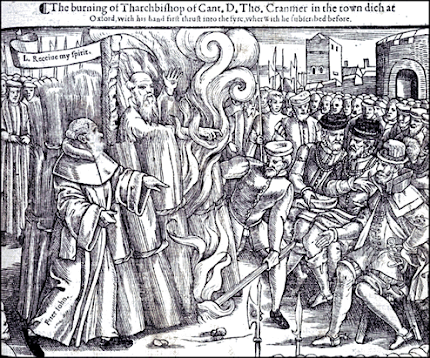
The burning of Tharchbishop of Cant. D. Tho. Cranmer in the town dich at Oxford, with his hand first thrust into the fyre, wherwith he subscribed before. [Click on the picture to see Cranmer's last words.]

Daily Bible Verse

Showing posts with label Doctrine. Show all posts

Thursday, January 19, 2012

J. I. Packer's Continued Crusade: Catechism Classes


{This article is pirated from Christianity Today without their express permission.  Sue me!  Click here to read the full article:  Small Groups and Heresy}

Note: J. I. Packer is the award-winning author of numerous books, including the classic Knowing God. SmallGroups.com recently had the chance to speak with Dr. Packer as part of an editors' panel in the offices of Christianity Today International.

Do churches and small groups have a responsibility to fight heresy when laypeople teach others?

Yes, churches are responsible for weeding out heretical teaching, and that's pretty clear from the New Testament. In those early days of Christianity out in the pagan world, there were any number of cults and any number of false views. And in the Pastoral Epistles we see individuals who are held up as solemn warnings—"Don't go their route."

Let me also say that it's my firm conviction that churches ought to foresee this unhappy possibility of heresy getting in when lay-folk are leading. And they should counter the possibility by what in the history of the church has been called "catechesis." We hardly hear of it these days, but in the second and third centuries A.D.—and indeed for some centuries after—it's rather amazing to discover that inquirers into the faith were fed into catechetical classes.

Can you explain a little more about the process of catechesis?

First, there are other ways of doing catechesis than by question and answer, which is what we are used to when we think of catechizing children. Catechesis is the teaching of the truths that Christians live by, and linked with that it's the teaching of how to live by those truths. It's a practical, pastoral discipline of instruction.

In the second and third centuries, the inquirers didn't have any Christian background—they didn't have any kind of theistic background even. They were polytheists who came out of various pagan cults. And so the catechists had to begin at the beginning and take them through the whole body of Christian doctrine.

We know from surviving catechetical materials that they taught not by separating truths from each other in order to focus on them in isolation. Rather, they taught the whole Christian view of Christianity—God's great economy of grace for the salvation of sinners—and the syllabus was essentially the themes of the Apostle's Creed.

And you feel that the practice of catechesis would be beneficial in modern churches, as well?

Yes. If we could recover catechesis as a regular element of church life, well, we'd be anticipating a lot of these problems with heresy and other troubles. We'd be constantly sustaining orthodoxy and reminding people of what the Christian faith is when you put it all together as a single ball of wax.  And in the absence of catechesis you do find laypeople who believe themselves to have a teaching gift—and perhaps have impressed the church as having a teaching gift— but allow themselves to deviate.

In your opinion, what should churches do when they identify someone who may be leading others astray?

Don't let them go on doing it, first and foremost. It seems to me that the responsibility of the small group is to let it be known that a leader is saying some things that appear to be unsound, unbiblical, or untrue. And that complaint must go up to the leadership of the congregation, whatever form the leadership takes. As an Anglican I'm thinking in terms of the rector; all bucks stop on the rector's desk. But there will always be a leadership group in any congregation.

Well, the complaint goes up to the leadership group, and it's the leadership group's responsibility in the first instance to handle it—which means that they ask the person who's been making waves to explain him or herself. And then according to the way the offender reacts to the corrective response, well, you take it from there. You hope that the errorist will allow him or herself to be put straight. Sometimes it happens that way and sometimes it doesn't.
What kinds of heretical beliefs have you found to be common in the church today?
 
What is common in this post-Christian age is all the various forms that are taken by the fantasy, and it's a very potent fantasy, that all religions are somehow one. Somehow they are the same religion. Somehow they are all of them pointing to the top of the same mountain, and as we climb we become more and more aware that we're getting closer to everybody else who is climbing by other paths—Muslim, Buddhist, Hindu, or whatever—and when we get to the top, we shall find that we're totally together.  It's a sweet dream, but the early Christians rejected it out of hand. And, I think, so should we.

Going back to the topic of catechism, is it still possible to do catechesis or guard against heresy as effectively when so many of our modern churches are so large?

I think it would be possible if the will was there.  I mean, if you have a megachurch, what's important is the infrastructure. You've got to develop an infrastructure which takes in all the people, thousands of them, to give them such basic instruction as they all need. Of course, it's easier to arrange an infrastructure for a congregation of about 100, but the principle is the same even though the work is harder.

You break people down into learning groups, call them classes or whatever you choose, and you have persons who are gifted and know their stuff as catechists. The catechists teach the faith as the integrated unity that it is in Scripture. They don't teach isolated points of doctrine; they teach the whole Christian story as it's brought together, and they teach the creeds. And as they go along they sort out the inquirers and they dispel the errors.

—J. I. Packer; copyright 2011 by the author and Christianity Today International.

--
Reasonable Christian Blog Glory be to the Father, and to the Son : and to the Holy Ghost; Answer. As it was in the beginning, is now, and ever shall be : world without end. Amen. 1662 Book of Common Prayer

Sunday, July 03, 2011

Is the Doctrine and Life of Christ Important to Being a Faithful Christian? The White Horse Inn

 
July 3, 2011
Doctrine & Life
Who is Jesus, and why should he be worshipped? Was his death merely an example of self-sacrifice, or did he actually atone for the sins of the world? These are crucial doctrinal questions, yet many Christians in our time say they are not interested in theology or doctrine, but prefer instead to focus on what Jesus can do for us in our lives today. Is it possible to be a faithful Christian without being concerned about doctrine? (Originally broadcast June 11, 2006

Doctrine & Life: The White Horse Inn 


Saturday, August 14, 2010

Does the Bible Teach "Doctrine"?

Does the Bible Teach “Doctrine”?

Recently I came across a website criticizing Kenneth Copeland Ministries as dishonest, lacking Christian character, and misusing donated funds. Unfortunately, the person criticizing Copeland was essentially calling the kettle black. Why? For starters, the only objection this person had was that Copeland lacked Christian “character”. But is that the only problem with Copeland? For many Pentecostals and Charismatics the word “doctrine” is anathema because they view “doctrine” as something that divides Christians unnecessarily. But is that actually the case and if so is this a good thing? Let's examine this issue closer.

First of all, is it true that the Bible is not concerned about doctrine as is often assumed by Pentecostals and Charismatics? What does the Bible have to say about “doctrine”? If we do a search of the English Standard Version with just about any Bible software or Bible website we get the following results:

Job 11:4; Romans 16:17; Ephesians 4:14; 1 Timothy 1:3,10; 1 Timothy 4:6; 1 Timothy 6:3; Titus 1:9; Titus 2:1,10; Hebrews 6:1-2

I got those search results by doing a word search for “doctrine.” I am often accused of being too “educated” by Pentecostals and Charismatics. But as anyone can see it does not take a seminary degree to look up terms with a Bible concordance or computer search. Strong's Exhaustive Concordance is a good resource for this if one is accustomed to using the King James Version of the Bible.

Exactly what is “doctrine” anyway? The New Testament was originally written in the common Greek trade language of the first century, also called Koine Greek. The word used in the Greek New Testament for “doctrine” in the above verses is “didache” (pronounced did-ahk-ay). The Greek word is διδαχή. (Hebrews 6:2, “instruction”). If we consult any Greek lexicon (or dictionary) we can get information about the term didache like where it occurs in the Bible, what it means in different contexts within the Greek New Testament. Essentially, context is how the word is used in a particular verse of the Bible within that paragraph and passage (pericope).

Many resources are available online. For example, we can use the King James Version to find every occurrence of the word “doctrine” in the KJV and then find the Strong's number for that English word. We then look up the number in the Greek dictionary in the back of the hard copy of the concordance or we can use the online version at most Bible websites, including Bible Gateway. Here are the appropriate links where I have done the work for you: KJV Search Results for “doctrine” at Bible Gateway. Also, we can search Strong's Exhaustive Concordance Online in either the King James Version or the New American Standard Bible. Simply enter the word “doctrine” in the search window and hit “enter”. When the results come up just click on the verse reference and then check the “Strong's numbers” box at the top. When the reference is displayed we will see the key words displayed in blue. Just click on the blue highlighted word “doctrine” and we will then be given the definition of the Greek or Hebrew term for that verse in the lexicon at the back of Strong's Exhaustive Concordance. We can also use this for the NASB. In the first reference we are given the reference for Deuteronomy 32:2 and the word “leqach” is in Hebrew because the Old Testament is written in Hebrew. We can also see a word count of how many times that word occurs in the Old Testament and the appropriate verse references. The Greek definition is given for the reference in Matthew 7:28 KJV.

And it came to pass, when Jesus had ended these sayings, the people were astonished at his doctrine: (Matthew 7:28 KJV)

If we click on the blue highlighted word after clicking on the reference for Matthew 7:28 the results for the Greek word “didache” come up. We can click on the “interlinear” box to see a comparison between the KJV and the NIV as well. Noting the definition of the Greek word “didache” we can see that it is almost synonymous with “teaching” or “instruction”.

So do Pentecostals “teach” or “instruct” people? Yes! We can therefore conclude that Pentecostals and Charismatics do in fact teach “doctrine”. It is a bit hypocritical for Pentecostals and Charismatics to criticize other denominations for emphasizing doctrine when they are teaching their own distinctive doctrines like the “baptism with the Holy Spirit as evidenced by the initial physical sign of speaking in tongues.”

The real issue here is not whether or not we should teach and preach “doctrine” but what our doctrine should be. How we interpret and understand the Bible as a harmonious whole and how we interpret the particulars of a given verse or passage in its own particular context and in the context of the Bible as a whole is important. In fact, doctrine is so important that it could determine whether a person spends eternity in heaven or in hell. Some doctrines are non-negotiable. Several of these non-negotiable doctrines are: The trinity, the incarnation of Jesus Christ, the inspiration of Scripture, the substitutionary atonement, the virgin conception of Jesus Christ, justification by faith alone, Scripture alone is the final authority, and other doctrines not listed here. The reason Pentecostals and Charismatics wish to vilify other denominations is their triumphalistic emphasis on ecstatic experience above any emphasis on “doctrine”. In this way they can short circuit any intellectual analysis of their own position while at the same time denouncing the doctrines of other denominations. In short, this is highly hypocritical and even an outright deception since they themselves teach “doctrine”. The question is whose doctrine is most biblical?

The Bible itself says that Jesus came teaching and preaching and that He contradicted the “traditions of men” (Mark 7:7). (Also see Matthew 4:23; 7:28-29; 9:35; 13:54; 21:23; 26:55; 28:20; Mark 1:21; 1:39; 11:17-18; Luke 4:15; 23:5; John 18:19-20) So anyone who adds to God's Word is teaching something that has not been divinely revealed as God's very words (2 Peter 1:19-21; 2 Timothy 3:16-17; Deuteronomy 4:2; 12:32; Isaiah 8:20; Revelation 22:18). If we are not preaching the Bible then we are essentially preaching the “traditions of men”. On this point I would place Pentecostals and Charismatics on the same playing field as Roman Catholics since both want to add new revelations and traditions and ecstatic experiences to God's revealed Word, the Holy Scriptures. All we need to know to be saved is recorded in Holy Scripture and the Scriptures are sufficient to lead anyone to saving faith in Jesus Christ (2 Timothy 3:15; 2:15; Romans 9:33; 10:5-11).

We do not need a pope or an infallible church to tell us what the Bible says. Anyone who can read can know the Bible for themselves. (John 5:38-39; Acts 17:11; 2 Timothy 3:15; Luke 24:27). In fact, we do not need a super-spiritual Pentecostal or Charismatic preacher to tell us what the Bible says either:

And this is the promise that he made to us--eternal life. 26 I write these things to you about those who are trying to deceive you. 27 But the anointing that you received from him abides in you, and you have no need that anyone should teach you. But as his anointing teaches you about everything, and is true, and is no lie--just as it has taught you, abide in him. (1 John 2:25-27 ESV)

The idea that the preacher or teacher has some inside “revelation knowledge” from God is to add to God's inspired Word and to introduce a form of modern day gnosticism. Any plow boy with a Bible can know everything necessary to salvation. There is no need for “secret” interpretations to be revealed from some preacher or teacher who has a direct phone line to God which we allegedly do not have. Another warning sign of a false preacher or teacher is when there is no doctrinal statement posted online. This is a red flag right away since it means the teacher has something to hide and wants us to blindly follow their teachings or doctrines without questioning the authority from which they are drawn. Any minister who discourages someone from reading and studying the Bible for themselves is probably a false teacher or a false prophet.


May the peace of God be with you! (Romans 15:33).


Charlie


[See also: Confessions of Faith].

--
Reasonable Christian Blog Glory be to the Father, and to the Son : and to the Holy Ghost; Answer. As it was in the beginning, is now, and ever shall be : world without end. Amen. 1662 Book of Common Prayer

Support Reasonable Christian Ministries with your generous donation.