 |
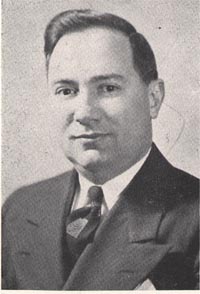
| The late Gordon H. Clark. |
[3/17/2013. My views about Clark's alleged Nestorianism have changed. I no longer believe Clark erred in his book, The Incarnation. I do stand by the authority of the creeds and confessions insofar as they reflect the teaching of Scripture.
Note #2. On my blog I have decided not to delete earlier articles, even when my views change. I no longer believe that Clark's view is wrong or Nestorian. However, the problem still remains as to exactly how the union in the one man, Jesus Christ takes place. The word for "person" in English is "hypostasis" in Greek, while in Latin it is "persona." As Clark points out in The Incarnation, these terms did not mean faculty psychology the way the modern era views this. What needs to be done is a better hammering out of the union between the human person of Jesus Christ and the divine Logos. Clark solved the problem from the aspect of not confusing the two natures/persons. But I think more work needs to be done on the union aspect. Any remarks below criticizing Clark's view I will let stand even though I'm no longer convinced that Clark was wrong or that he was a NestorianCharlie, June 15, 2013.]
Recently the
God's Hammer blog again brought up the issue of the infallibility and inerrancy of Scripture versus the Reformed contention that church councils and synods may and do err. (See:
Calvin on the Human Fallibility in the Councils). While Sean Gerety does not reject the Reformed Confessions as authoritative, he does post comments by Hugh McCann, who apparently thinks that Scripture is the only authority and that creeds and confessions "necessarily err" and have no authority whatsoever. As Forrest Gump once said, "Stupid is as stupid does." The Anabaptist position rejects the authority of creeds and confessions, not the Reformed position. I find it odd that a so-called Clarkian blog would post Anabaptist comments without any rebuke whatsoever.
I call it as I see it. The fact is without an interpretation Scripture is without any authority. Although all interpretations of Scripture are necessarily fallible and may be in error, it does not follow that no creed or confession has any secondary authority for matters of church discipline. If that be the case then we could not prosecute heretics or condemn heresies since there would be no agreement on a logical or rational basis for determining what is necessary and essential for unity of belief and doctrine in the local congregation and in the denominations at large.
Either the Trinity is essential doctrine or it is not. Simply because certain Clarkians wish to throw out the Nicene creed, the Definition of Chalcedon, and the Athanasian creed does not make their opinions infallible. It is highly selective for Clarkians to open the door to Nestorianism while condemning Federal Visionists and Arminians on the basis of the Reformed confession. Why? Because the Westminster Standards uphold the Definition of Chalcedon and the theology of both the Nicene creed and the Athanasian creed.
That can easily be demonstrated here:
3. It belongeth to synods and councils,
ministerially to determine controversies of faith, and cases of conscience; to
set down rules and directions for the better ordering of the public worship of
God, and government of His Church; to receive complaints in cases of
maladministration, and authoritatively to determine the same: which decrees and
determinations,
if consonant to the Word of God, are to be received with,
reverence and submission; not only for their agreement with the Word, but also
for the power whereby they are made, as being an ordinance of God appointed
thereunto in His Word.
1
1 Acts 15:15,19,24,27,28,29,30,31; Acts 16:4; Matt. 18:17-20 Westminster Confession of Faith, Chapter 31:3.
As indicated, the confession says that synods and councils do have authority, albeit that authority is subject to Scriptural authority. Furthermore, the Confession upholds that Jesus Christ is one person:
2. The Son of God, the second person in
the Trinity, being very and eternal God, of one substance and equal with the
Father, did, when the fulness of time was come, take upon Him man's nature,1 with all the essential
properties and common infirmities thereof, yet without sin;2 being conceived by the power of
the Holy Ghost, in the womb of the Virgin Mary, of her substance.3 So that two whole, perfect, and
distinct natures, the Godhead and the manhood, were inseparably joined together
in one person, without conversion, composition, or confusion.4 Which person is very God, and very
man, yet one Christ, the only Mediator between God and man.5
In light of the above, the onus or burden of proof lies with Clarkians to prove that Gordon H. Clark and John Robbins did not violate the Westminster Confession of Faith by adopting the two person view that Jesus Christ is not two natures united in one Person but rather two persons united in some yet to be described and "mysterious" way. Ironically, Clark's view leaves us without any propositional or logical explanation for how Jesus Christ can be unified as both God and man. The problem dealt with by the early church was how Jesus could be both God and man at the same time without dividing God and man. Both the Westminster Standards and the Three Forms of Unity uphold that Jesus MUST be both God and man in order to be the mediator of the new covenant and to pay the penalty for sins:
Article 19: Of the Hypostatic Union or of the Two Natures in the Person of Christ
We believe that by this conception the person of the Son of God is inseparably united and joined with the human nature,[1]
so that there are not two sons of God, nor two persons, but two natures
united in one single person. Each nature retains its own distinct
properties: His divine nature has always remained uncreated, without
beginning of days or end of life (Heb 7:3), filling heaven and earth.[2]
His human nature has not lost its properties; it has beginning of days
and remains created. It is finite and retains all the properties of a
true body.[3] Even though, by His resurrection, He has given immortality to His human nature, He has not changed its reality,[4] since our salvation and resurrection also depend on the reality of His body.[5]
However, these two natures are so closely
united in one person that they were not even separated by His death.
Therefore, what He, when dying, committed into the hands of His Father
was a real human spirit that departed from His body.[6] Meanwhile His divinity always remained united with His human nature, even when He was lying in the grave.[7]
And the divine nature always remained in Him just as it was in Him
when He was a little child, even though it did not manifest itself as
such for a little while.
For this reason we profess Him to be true God
and true man: true God in order to conquer death by His power; and true
man that He might die for us according to the infirmity of His flesh.
[1] Jn 1:14; Jn 10:30; Rom 9:5; Phil 2:6, 7. [2] Mt 28:20. [3] 1 Tim 2:5. [4] Mt 26:11; Lk 24:39; Jn 20:25; Acts 1:3, 11; Acts 3:21; Heb 2:9. [5] 1 Cor 15:21; Phil 3:21. [6] Mt 27:50. [7] Rom 1:4. (Belgic Confession of Faith).
Article 18 of the Belgic confession asserts that Jesus has a "reasonable human soul". If Gordon H. Clark meant only that the Logos has assumed a truly human soul into the Godhead via the incarnation there would be no objection. But exactly what Clark meant is still a mystery. Ironically, Gordon H. Clark equated the Westminster Standards with biblical Christianity.
I do not have my copy of
Christian Philosophy with me but I believe in that book Clark says that the Westminster Standards are the best systematic exposition of the propositional truths of the inerrant and infallible Scriptures. I can, however, show that John Robbins thought that the Westminster Standards were the best summary of Scriptural teaching:
Three very useful guides for studying the Bible are the Westminster Standards, consisting of the Westminster Confession of Faith, the Larger Catechism, and the Shorter Catechism, all written in the 1640s. The Westminster Confession remains the best summary of the Bible yet written. The Confession
summarizes in 33 short chapters the teaching of Scripture on everything
from Scripture itself to the Last Judgment. Dr. Gordon Clark’s
commentary on the Confession, What Do Presbyterians Believe? is the best short introduction to what the Bible teaches. You as a young Christian should read What Do Presbyterians Believe?
and the Scripture verses cited in it very early in your studies. This
will give you an introduction to the whole system of truth taught in
Scripture and will enable you to see the forest, not merely the trees.
The Catechisms will help you grasp the definitions of important terms in Scripture, such as justification, adoption, predestination, and alone, as well as understand such basic items as the Ten Commandments and the Lord’s Prayer. A useful study guide to the Westminster Confession is Dr. W. Gary Crampton’s Study Guide to the Westminster Confession. (See: A Guide for Young Christians).
It is highly hypocritical for Clarkians to condemn other heresies like the Federal Vision, Arminianism, Oneness Pentecostalism, et. al., while selectively exempting departures from the Reformed symbols by Gordon H. Clark, John Robbins, and Robert L. Reymond. Clark and Robbins denied the unity of the person of Christ as both God and man while Reymond denies the eternal generation of the Son of God from the Father. Reymond's position is wrong because he overlooks the fact that the Nicene creed and the Athanasian creed both assert the aseity of the Son of God.
Scripture upholds the unity of Jesus Christ and the Logos as one Person:
In the beginning was the Word, and the Word was with God, and the Word was God. 2 He was in the beginning with God. 3 All things were made through Him, and without Him nothing was made that was made. (John 1:1-3 NKJ)
And the Word became flesh and dwelt among us, and we beheld His glory, the glory as of the only begotten of the Father, full of grace and truth. 15 John bore witness of Him and cried out, saying, "This was He of whom I said,`He who comes after me is preferred before me, for He was before me.'" (John 1:14-15 NKJ)
No one has seen God at any time. The only begotten Son, who is in the bosom of the Father, He has declared Him. (John 1:18 NKJ)
For there is one God and one Mediator between God and men, the Man Christ Jesus, (1 Timothy 2:5 NKJ)
If Jesus Christ is really two persons and not one person, then logically He cannot be ONE mediator between God and men. Ironically, then, Clark's view is hopelessly irrational and raises more problems than it solves. It is true that God cannot suffer on the cross. But it is equally true that the hypostatic union cannot be severed. What Clark did not explain or define is how his alleged two persons view avoids the logical problem of separating Christ from Christ. Either Christ is God in the flesh OR what we have is a mere man who possesses divine propositions. A further problem with Clark's view is that he makes no distinction in
The Incarnation between communicable and incommunicable attributes/propositions. The divine propositions are not communicable to men. But in the case of Jesus Christ these divine propositions are there and they are in union with Him as one Person according to the Westminster Confession and the Belgic Confession. I could add the Anglican Formularies here but the Puritans irrationally reject the Anglican Formularies as Reformed theology, which assertion is absolutely untrue. Simply because the Anglo-Catholics have attempted to pervert the teaching of the
39 Articles of Religion and the
1662 Book of Common Prayer, it does not follow that these documents are not Reformed.
Article 17, for example teaches the doctrine of double predestination.
In conclusion, then, I assert that although the Reformed symbols "may" err, no one is allowed an exception to subscription to what are essential doctrines of the Christian faith. If Clarkians wish to prove that the Westminster Standards, Three Forms of Unity, and the Anglican Formularies are in error when they endorse the union of Christ as both God and man in one Person then Clarkians must follow due process of canon law to do so. Otherwise, their position is essentially Anabaptist and not Reformed. Reformed theology, according to the Westminster Confession (31:3) says that the church does have authority to hold Reformed synods and councils and that these councils and synods have the authority to settle doctrinal controversies. Unfortunately, even Reformed synods err as the liberal mainline Presbyterian denominations demonstrate. Even more recently the Presbyterian Church in America and the Orthodox Presbyterian Church have refused to discipline ministers who teach the
Federal Visionist heresies. But Clarkians who condemn other heresies--while committing their own theological errors without any solid logical propositions settling all the problems raised by their views--are contradicting the axiom that Scripture IS the Word of God and the axiom that the Westminster Standards are the best summary of the teaching of the infallible and inerrant Holy Scriptures. (2 Timothy 3:15-17; 2 Peter 1:19-21; 2 Peter 3:15-16; Jeremiah 23:29). While I consider myself a Clarkian because I uphold Scripture as consisting of logical and doctrinal propositions, I am not obligated to contradict the Reformed articles of faith or the doctrines they uphold. Although Scripture is the infallible and inerrant Word of God, Scripture of necessity requires an interpretation and a systematic exposition which functions as a rule of faith. In short, some sort of doctrinal consensus on what Scripture teaches is absolutely necessary if there is to be one faith, one baptism and one religion (Ephesians 4:4-6; Philippians 1:27; 1 Timothy 4:13).
Even Gordon H. Clark and John Robbins acknowledged this. Without an interpretation Scripture remains incomprehensible and therefore irrational. Scripture requires a rational and reasonable interpretation and cannot function as revelation without a systematic exposition of the propositions revealed within the canon of Scripture. Salvation itself is impossible without special revelation that is coherent, comprehensive, congruent, rational, and logical in verbal and propositional form. Would that the internet proponents of Clark's theology and apologetics were as logical as Clark himself was. Verbal plenary inspiration and special revelation in propositional form must be known to be of value to the church and to individual members of the church.
Addendum:
Demolishing the Stronghold of a False Christology, audio sermon by Dr. Robert L. Reymond. Dr. Reymond clearly upholds the Definition of Chalcedon in this sermon and says that it is dangerous to reject the christology of the Definition. In light of that, my association of Dr. Reymond with Dr. Clark and Dr. Robbins above may have been hasty and misplaced.




 Posts
Posts


