>

Martyred for the Gospel

Martyred for the Gospel
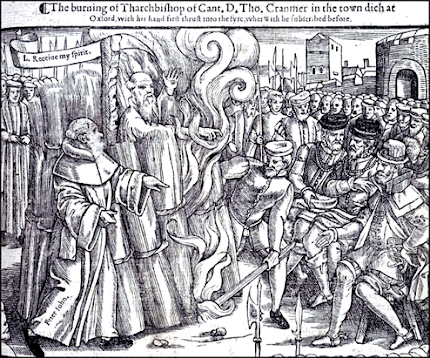
The burning of Tharchbishop of Cant. D. Tho. Cranmer in the town dich at Oxford, with his hand first thrust into the fyre, wherwith he subscribed before. [Click on the picture to see Cranmer's last words.]

Daily Bible Verse

Showing posts with label Confessions of faith. Show all posts

Saturday, October 06, 2012

Carl Trueman Bloviates on the Reformed Standards of Preference

"Evangelical" liberalism and ecumenicalism never ceases to amaze me.  For neo-Calvinists the Reformed Standards or "Symbols" are no long a standard for judging heresy and false teaching by identifying Arminianism and other semi-pelagian views as heretical.  Rather the Reformed confessions are merely a preferred standard for Presbyterianism.  In other words, Carl Trueman thinks that Arminians ought to join Arminian churches and Presbyterians ought to join Reformed denominations.  The problem here is that Trueman is conceding that Arminianism is a legitimate reading of Scripture.  It is not.  Calvinism IS the Gospel.  Those who advocate other gospels are lost.  Since clearly the Scriptures uphold the doctrines of sovereign grace there cannot be an ambiguous interpretation of Scripture where mutually contradictory truth claims are made.  Either God decrees election and reprobation unconditionally or the semi-pelagian or pelagian view is true.  Both cannot be true since these are mutually exclusive truth claims and one view, namely Calvinism, is a better reading and intepretation of Scripture.  Scripture IS the Word of God, not a matter of man's opinion.  Arminianism is a false religion because it makes an idol out of human freedom and libertarian free will.  Arminianism denies the doctrine of total inability due to the fall of Adam.  (Romans 3:10-23; Romans 5:12-14).

Click here to hear Carl Trueman's talk at the Reformed Forum:  Creeds and Confessions in the Contemporary Church - Reformed Forum

Monday, February 06, 2012

Anglicanism and How Many Points?

  Sanctify them in the truth; your word is truth. (John 17:17 ESV)


Recently in reconsidering several issues regarding what constitutes the so-called Reformed center, a term which attempts to reify exactly what Reformed theology is in actuality, I revisited the Riddleblog, a blog owned by Kim Riddlebarger of The White Horse Inn.  Kim is an expert on the issue of eschatology and amillennialism.  I happen to agree with amillennialism since it appears to be the best explanation of the apocalyptic material in the book of Revelation.  However, what particularly caught my attention was Dr. Riddlebarger's refutation of Dr. John MacArthur's dispensational attack on the Reformed faith while at the same time claiming to be a "five point Calvinist".  Dr. Riddlebarger rightly points out that Calvinism is way more than simply the five points of Calvinism.  (See, A Reply to John MacArthur).  Essentially, Dr. Riddlebarger says that Baptists are not Reformed, despite the fact that they may adhere to the five points of Calvinism.  Anyone familiar with the Canons of Dort knows that it is part of the Three Forms of Unity, which would include the Heidelberg Catechism and the Belgic Confession, both of which flatly reject MacArthur's Baptist view of the sacraments, his rejection of covenantal theology, and his premillennial dispensationalism.

Unfortunately,  particular Baptists get many other things wrong as well,  They are particularly prone to associate with Arminian Baptists since being Baptist trumps the Canons of Dort.  So on this aspect Baptists are not really in full agreement with the so-called five points of Calvinism either.  I might add that the Sydney Anglicans are inconsistent here as well since the Synod of Dort equally condemned the view that the atonement is in any sense all universal rather than particular to the elect.

This raises other issues as well.  I should point out here that the so-called "Clarkian apologetics" crowd is not a unified group either.  Many of them are non-cessationists or particular Baptists and outright reject confessional theology, something Gordon H. Clark with which Clark himself would have never agreed.  (See: Scripturalism).  They make this huge leap in logic based on the fact that in Clark's last book, The Incarnation, he repudiated his earlier affirmation of the Westminster Confession's view that Christ is one person but two.  (See: Was Clark a Nestorian?) From that one point many in the so-called "Clarkian" crowd jump to premature Anabaptist conclusions that therefore all confessional theology is up for grabs.  Question everything in creeds and confessions they say.

But that was not the position taken by Clark.  His view was thoroughly confessional and presupposed that the Westminster Standards were the best representation of biblical Christianity.  Although Clark, like all Reformed theologians, affirmed that Scripture is the final authority and that creeds and confessions possibly err, he did not adopt the sort of skepticism toward the creeds and Reformed standards which we see the particular Baptists and non-cessationists taking, particularly those who claim to be Scripturalists in the line of Gordon H. Clark.

In short, it is my contention that non-cessationists, particular Baptists, and others in sympathy with subjective and ecstatic leadings of the Spirit common to the Anabaptist tradition, are not truly Scripturalists at all.  They are a curious offshoot of Clark's Scripturalism.  Furthermore, the principle of Sola Scriptura is not subject to solipsism or hyper-individualism or a rejection of confessional Reformed theology.  (See:  How Many Points?, by Richard Muller).

There are many divisions in the wider Reformed and Protestant tradition.  Theonomy and reconstruction adopt a post millennial view that exalts the law above the Gospel and social transformation above the doctrines of grace.  Baptists reject creeds and confessions and adopt views very similar to the Anabaptists, including a legalistic view of "Lordship salvation".  Ironically, some so-called "Clarkians" like Kenneth Talbot are both Van Tilian and theonomic and Clarkian--as if the two go together???

The Anglican tradition suffers from a similar form of schizophrenic disjunction with the Anglican Formularies.  Ango-Catholicism, Tractarianism, and high church Arminianism are heretical perversions of the English Reformation.  But it is my contention that theonomy, dispensationalism, the Lordship salvation controversy, non-cessationism, future vindication, and assorted other theological errors could be avoided were more pastors, theologians and plow boys familiar with the Reformed standards.  My study of both Scripture and the various Reformed confessions of faith and catechisms has greatly enriched my understanding of theology and the Bible.

While I have a great appreciation for the Scripturalism of Gordon H. Clark and for the work of The Trinity Foundation regarding their stand for the doctrine of justification by faith alone, I do not and cannot adopt an Anabaptist attitude toward the Westminster Standards, the Three Forms of Unity, or the Anglican Formularies.  Unfortunately, the advocates of Clark's Scripturalism these days have little to do with Clark's rejection of the continuation of the gifts of the Spirit or with Clark's own position that the Westminster Standards best represent biblical Christianity:

Definition of Christianity
It is essential therefore to define Christianity more exactly by a specific doctrinal system.  Romanism is not what is meant.  By Christianity we shall mean, to use common names, what is called Calvinism.  Or, to be most specific, the definition of Christianity shall be the articles of the Westminster Confession.   With such a definite basis, it will no longer be necessary to spin dizzily in a whirlpool of equivocal disputation.  Now we can look at what we are talking about.  ["Is Christianity a Religion? in Christian Philosophy, volume 4, The Works of Gordon Haddon Clark, (Unicoi:  Trinity Foundation, 2004), p. 122.]


I would contend that if Anglicans actually believed what the Anglican Formularies teach then there would be much less disputation.  This is also true regarding the those who "claim" to follow the apologetics of Dr. Clark.  If they were confessional presbyterians there would be much less confusion and disputation.  Unfortunately even Sean Gerety is much more willing to compromise confessional Calvinism as it is expressed in the Westminster Standards--for the sake of a facade of unity among Clarkians on other issues like the neo-nestorianism of Clark's final book--than to stand for what Clark himself defined as biblical Christianity:  the articles of The Westminster Confession.

I would contend that for Anglicans biblical Christianity is expressed in the Anglican Formularies, which do teach the five points of Calvinism in incipient form and further developed in the Lambeth Articles of 1595, the Irish Articles, and the Westminster Standards.  While Calvinism is much more than adhering to the five points of Calvinism, Anglicanism is much more than some generic wishy washy Amyraldianism or Arminianism.  It is solidly Augustinian, Reformed, and Calvinist as that is expressed in the Formularies, Lambeth Articles, the Irish Articles, and the Westminster Standards which are drawn from them.

Although it is true that Reformation Anglicans are not Puritans or Presbyterians, it can be said that we have much more in common with the confessional view of Presbyterians or the Dutch Reformed than with particular Baptists--or even with the Clarkian Baptists masquerading under the guise of the "five points".


Sincerely in Christ,


Charlie


Friday, January 27, 2012

Dr. Calvin Beisner Comments: elephant room | discernment | association | TD Jakes | James MacDonald

The following is from Here I Blog:

I asked Facebook friend, author and scholar, Dr. E. Calvin Beisner7, who has published two books on the Trinity, his thoughts on Jakes’ comments in the above interview. Beisner replied:

Far, far, far too little evidence there to justify reclassifying Jakes as Trinitarian granted all he’s said before and his continuing to consider United Pentecostals his Christian brothers. Nothing quoted there falls outside what any reasonably sly and sophisticated United Pentecostal could say. Let Jakes clearly and explicitly affirm such clear Trinitarian statements as the Nicene Creed, the Symbol of Chalcedon, the Athanasian Creed, or even just Warfield’s summary–There is but one God; the Father, and the Son, and the Holy Spirit each is God; the Father, the Son, and the Holy Spirit each is a distinct Person–and then let him also repudiate the anti-Trinitarian statements of United Pentecostalism and other modalist sects, and it’ll be time to declare him converted to the true God. My impression is that Jakes is simply out to gain the trust of larger groups than the Oneness and Pentecostal crowd in which he’s been at home.


I beg to differ with Dr. Beisner on one point.  With the downplaying of "essential doctrine" in Pentecostal circles, it has now become generally accepted that the trinity and oneness issue is considered a matter of adiaphora.  The Society for Pentecostal Studies has removed all trinitarian doctrinal statements so that oneness pentecostals could participate since they could not in good conscience sign such a doctrinal statement in order to join the society.  See:  Wikipedia:  Society for Pentecostal Studies.

Click here to read the whole article: elephant room | discernment | association | TD Jakes | James MacDonald


Click here to read the transcript of the Elephant Room interview with T. D. Jakes: The Elephant Room II


Wednesday, September 09, 2009

Confess or Die: How Historic Confessions of Faith Can Save the Church

The Anglican Church League has posted audio files online from several past conferences, the most recent being Confess or Die: How Historic Confessions of Faith Can Save the Church. You will especially want to hear the lecture given by the academic dean of Moore Theological College, Mark Thompson, The 39 Articles and Global Anglicanism.


I am firmly committed to the 39 Articles as confession of faith, not simply a constitutional document with no theological implications. As Thompson says in the lecture, Gerald Bray upholds the plain teaching of the Articles as Protestant and Calvinistic.


This lecture by Mark Thompson is a must hear. Thompson points out several problems with adherence to the 39 Articles as a Confession of Faith. There are always those who "falsely" subscribe. True subscription depends on the integrity of the person subscribing. Also, he points out that Tract 90 opened the door for essentially a "postmodern" reading of the Articles, which are clearly Protestant and Calvinistic. It occurred to me that those who promote Anglo-Catholic views open the door for the sort of postmodern reading of Scripture itself which twists the authority of Scripture in such a way that homosexuality becomes a blessed gift of God instead of immorality and an abomination before God. This lecture by Thompson is particularly interesting in light of the book I posted by the late David Broughton Knox, Thirty-Nine Articles: The Historic Basis of Anglican Faith.


I would like to post also the comments of bishop of a continuing Anglican church in England who e-mailed me with this account of his experience of ordination in the Church of England:


Dear Mr Ray,

Thank you for reproducing Broughton Knox' on the Articles, and for your clear and helpful comments. There are additional ways of avoiding the Articles of Religion. Ever since the earliest days of the Reformation the common way has been, and is, for a candidate for ordination or to an incumbency to swear conformity lightly, shifting ground after as circumstances suit, like the Vicar of Bray'. The second is 'Mental Reservation'. This has increased since it was used by the earliest Anglo Catholics. It was to swear as a Protestant whilst mentally rejecting. This was Newman's advice and example. He held much of the position of Rome, whilst publicly swearing to being a Protestant, and advised his young men to do likewise. When ordaining me the diocesan bishop asked me if I believed the Articles, quickly adding he did not expect me to. I replied I would not have sought ordination if I had not. A third way was quickly adopted by the Anglo-Catholic movement in order to get over the public outcry and indignation and charge of dishonesty caused by 'Mental Reservation'. A man entered a parish as a true Protestant and in some cases as soon as three weeks later, introduced Mass practices, abhorrent to the congregation, thus causing a huge rift and the emptying of the church, as the bishops refused the congregation redress. This marked the end of Church Discipline. The problem was that the State Church finally enforced this by the secular courts. Bishop Ryle took several to court, but shortly the courts washed their hands of this and refused to allow further prosecutions to be brought. The Anglo-Catholic method for justifying themselves was then to say the had believed the Articles all along, but interpreted them. This was other than according to their natural and intended sense. They therefore wrote the 'Tracts for the Times', reinterpreting the Articles in a Roman sense. One was the infamous 'Tract 90', which said that Article 31 calling the central teachings of the masses of Rome 'blasphemous fables and dangerous deceits', was only meaning one bad Mass the writer had seen on some occasion, but did not mean the Mass in general. This method is as old as the Reformation, Gardiner interpreting 'alms and oblations' in the Communion Office. The only way the Articles can be defended and discipline maintained is by the living work of the Holy Spirit, a deep and real work in the deceitful and deceiving human heart.


Yours sincerely,

****


Interestingly, in his lecture Mark Thompson points out that in the 1970s the Church of England changed its oath of subscription to something more vague allowing that the 39 Articles points to the same faith of the creeds and the Scriptures. Thus, one could ascribe to that "faith" but not the plain and literal meaning of the Articles themselves as a Protestant and Calvinistic document.

See also the Confess or Die website.


Charlie

Support Reasonable Christian Ministries with your generous donation.