>

Martyred for the Gospel

Martyred for the Gospel
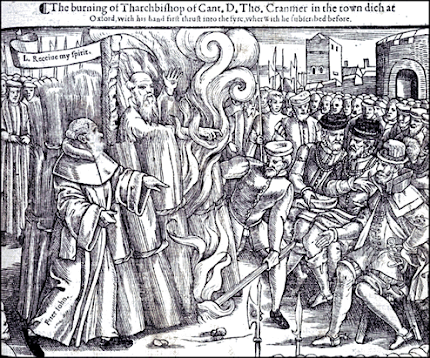
The burning of Tharchbishop of Cant. D. Tho. Cranmer in the town dich at Oxford, with his hand first thrust into the fyre, wherwith he subscribed before. [Click on the picture to see Cranmer's last words.]

Daily Bible Verse

Showing posts with label Anabaptist theology. Show all posts

Sunday, April 29, 2012

Fading Lines in the Sand « God's Hammer

Ironically, the lines in the sand are fading at God's Hammer as well. Apparently the Reformed Confessions only apply when they contradict Van Tilian theology or the Federal Visionists. Everything else is open season--at least according to the Anabaptist theology of Hugh McCann, who has open access at God's Hammer.  I guess he kissed the pope's ring?

Fading Lines in the Sand « God's Hammer

Monday, March 19, 2012

John Calvin: The Superiority of Scripture

1. Those who, rejecting Scripture, imagine that they have some peculiar way of penetrating to God, are to be deemed not so much under the influence of error as madness. For certain giddy men  have lately appeared, who, while they make a great display of the superiority of the Spirit, reject all reading of the Scriptures themselves, and deride the simplicity of those who only delight in what they call the dead and deadly letter. But I wish they would tell me what spirit it is whose inspiration raises them to such a sublime height that they dare despise the doctrine of Scripture as mean and childish. If they answer that it is the Spirit of Christ, their confidence is exceedingly ridiculous; since they will, I presume, admit that the apostles and other believers in the primitive Church were not illuminated by any other Spirit. None of these thereby learned to despise the word of God, but every one was imbued with greater reverence for it, as their writings most clearly testify. And, indeed, it had been so foretold by the mouth of Isaiah. For when he says, “My Spirit that is upon thee, and my words which I have put in thy mouth, shall not depart out of thy mouth, nor out of the mouth of thy seed, nor out of the mouth of thy seed’s seed, saith the Lord, from henceforth and for ever,” he does not tie down the ancient Church to external doctrine, as he were a mere teacher of elements; he rather shows that, under the reign of Christ, the true and full felicity of the new Church will consist in their being ruled not less by the Word than by the Spirit of God. Hence we infer that these miscreants are guilty of fearful sacrilege in tearing asunder what the prophet joins in indissoluble union. Add to this, that Paul, though carried up even to the third heaven, ceased not to profit by the doctrine of the law and the prophets, while, in like manner, he exhorts Timothy, a teacher of singular excellence, to give attention to reading ( [1 Tim. 4:13] ). And the eulogium which he pronounces on Scripture well deserves to be remembered—viz. that “it is profitable for doctrine, for reproof, for correction, and for instruction in righteousness, that the man of God may be perfect,” ( [2 Tim. 3:16] ). What an infatuation of the devil, therefore, to fancy that Scripture, which conducts the sons of God to the final goal, is of transient and temporary use? Again, I should like those people to tell me whether they have imbibed any other Spirit than that which Christ promised to his disciples. Though their madness is extreme, it will scarcely carry them the length of making this their boast. But what kind of Spirit did our Saviour promise to send? One who should not speak of himself ( [John 16:13] ), but suggest and instil the truths which he himself had delivered through the word. Hence the office of the Spirit promised to us, is not to form new and unheard-of revelations, or to coin a new form of doctrine, by which we may be led away from the received doctrine of the gospel, but to seal on our minds the very doctrine which the gospel recommends.

Institutes of the Christian Religion.  Book I, Chapter 9, Section 1.

Monday, February 06, 2012

Anglicanism and How Many Points?

  Sanctify them in the truth; your word is truth. (John 17:17 ESV)


Recently in reconsidering several issues regarding what constitutes the so-called Reformed center, a term which attempts to reify exactly what Reformed theology is in actuality, I revisited the Riddleblog, a blog owned by Kim Riddlebarger of The White Horse Inn.  Kim is an expert on the issue of eschatology and amillennialism.  I happen to agree with amillennialism since it appears to be the best explanation of the apocalyptic material in the book of Revelation.  However, what particularly caught my attention was Dr. Riddlebarger's refutation of Dr. John MacArthur's dispensational attack on the Reformed faith while at the same time claiming to be a "five point Calvinist".  Dr. Riddlebarger rightly points out that Calvinism is way more than simply the five points of Calvinism.  (See, A Reply to John MacArthur).  Essentially, Dr. Riddlebarger says that Baptists are not Reformed, despite the fact that they may adhere to the five points of Calvinism.  Anyone familiar with the Canons of Dort knows that it is part of the Three Forms of Unity, which would include the Heidelberg Catechism and the Belgic Confession, both of which flatly reject MacArthur's Baptist view of the sacraments, his rejection of covenantal theology, and his premillennial dispensationalism.

Unfortunately,  particular Baptists get many other things wrong as well,  They are particularly prone to associate with Arminian Baptists since being Baptist trumps the Canons of Dort.  So on this aspect Baptists are not really in full agreement with the so-called five points of Calvinism either.  I might add that the Sydney Anglicans are inconsistent here as well since the Synod of Dort equally condemned the view that the atonement is in any sense all universal rather than particular to the elect.

This raises other issues as well.  I should point out here that the so-called "Clarkian apologetics" crowd is not a unified group either.  Many of them are non-cessationists or particular Baptists and outright reject confessional theology, something Gordon H. Clark with which Clark himself would have never agreed.  (See: Scripturalism).  They make this huge leap in logic based on the fact that in Clark's last book, The Incarnation, he repudiated his earlier affirmation of the Westminster Confession's view that Christ is one person but two.  (See: Was Clark a Nestorian?) From that one point many in the so-called "Clarkian" crowd jump to premature Anabaptist conclusions that therefore all confessional theology is up for grabs.  Question everything in creeds and confessions they say.

But that was not the position taken by Clark.  His view was thoroughly confessional and presupposed that the Westminster Standards were the best representation of biblical Christianity.  Although Clark, like all Reformed theologians, affirmed that Scripture is the final authority and that creeds and confessions possibly err, he did not adopt the sort of skepticism toward the creeds and Reformed standards which we see the particular Baptists and non-cessationists taking, particularly those who claim to be Scripturalists in the line of Gordon H. Clark.

In short, it is my contention that non-cessationists, particular Baptists, and others in sympathy with subjective and ecstatic leadings of the Spirit common to the Anabaptist tradition, are not truly Scripturalists at all.  They are a curious offshoot of Clark's Scripturalism.  Furthermore, the principle of Sola Scriptura is not subject to solipsism or hyper-individualism or a rejection of confessional Reformed theology.  (See:  How Many Points?, by Richard Muller).

There are many divisions in the wider Reformed and Protestant tradition.  Theonomy and reconstruction adopt a post millennial view that exalts the law above the Gospel and social transformation above the doctrines of grace.  Baptists reject creeds and confessions and adopt views very similar to the Anabaptists, including a legalistic view of "Lordship salvation".  Ironically, some so-called "Clarkians" like Kenneth Talbot are both Van Tilian and theonomic and Clarkian--as if the two go together???

The Anglican tradition suffers from a similar form of schizophrenic disjunction with the Anglican Formularies.  Ango-Catholicism, Tractarianism, and high church Arminianism are heretical perversions of the English Reformation.  But it is my contention that theonomy, dispensationalism, the Lordship salvation controversy, non-cessationism, future vindication, and assorted other theological errors could be avoided were more pastors, theologians and plow boys familiar with the Reformed standards.  My study of both Scripture and the various Reformed confessions of faith and catechisms has greatly enriched my understanding of theology and the Bible.

While I have a great appreciation for the Scripturalism of Gordon H. Clark and for the work of The Trinity Foundation regarding their stand for the doctrine of justification by faith alone, I do not and cannot adopt an Anabaptist attitude toward the Westminster Standards, the Three Forms of Unity, or the Anglican Formularies.  Unfortunately, the advocates of Clark's Scripturalism these days have little to do with Clark's rejection of the continuation of the gifts of the Spirit or with Clark's own position that the Westminster Standards best represent biblical Christianity:

Definition of Christianity
It is essential therefore to define Christianity more exactly by a specific doctrinal system.  Romanism is not what is meant.  By Christianity we shall mean, to use common names, what is called Calvinism.  Or, to be most specific, the definition of Christianity shall be the articles of the Westminster Confession.   With such a definite basis, it will no longer be necessary to spin dizzily in a whirlpool of equivocal disputation.  Now we can look at what we are talking about.  ["Is Christianity a Religion? in Christian Philosophy, volume 4, The Works of Gordon Haddon Clark, (Unicoi:  Trinity Foundation, 2004), p. 122.]


I would contend that if Anglicans actually believed what the Anglican Formularies teach then there would be much less disputation.  This is also true regarding the those who "claim" to follow the apologetics of Dr. Clark.  If they were confessional presbyterians there would be much less confusion and disputation.  Unfortunately even Sean Gerety is much more willing to compromise confessional Calvinism as it is expressed in the Westminster Standards--for the sake of a facade of unity among Clarkians on other issues like the neo-nestorianism of Clark's final book--than to stand for what Clark himself defined as biblical Christianity:  the articles of The Westminster Confession.

I would contend that for Anglicans biblical Christianity is expressed in the Anglican Formularies, which do teach the five points of Calvinism in incipient form and further developed in the Lambeth Articles of 1595, the Irish Articles, and the Westminster Standards.  While Calvinism is much more than adhering to the five points of Calvinism, Anglicanism is much more than some generic wishy washy Amyraldianism or Arminianism.  It is solidly Augustinian, Reformed, and Calvinist as that is expressed in the Formularies, Lambeth Articles, the Irish Articles, and the Westminster Standards which are drawn from them.

Although it is true that Reformation Anglicans are not Puritans or Presbyterians, it can be said that we have much more in common with the confessional view of Presbyterians or the Dutch Reformed than with particular Baptists--or even with the Clarkian Baptists masquerading under the guise of the "five points".


Sincerely in Christ,


Charlie


Thursday, January 27, 2011

Pyromaniacs: Open Letter to Michael Horton

Unfortunately, some particular Baptists don't think the Law/Gospel distinction is important or that doctrine matters. What really matters is that you have some sort of behavioral change. (See Frank Turk's article at Pyromaniacs: Pyromaniacs: Open Letter to Michael Horton). I guess the morality gospel trumps the Gospel of Jesus every time in the mind of the self-justifying Pharisees. Unfortunately, Frank Turk does not understand the systematic nature of the Reformed confessions and standards as a whole. He would rather proof text out of context and create straw man arguments that prove the Reformed faith is "antinomian". It really goes to show how deeply ingrained the Anabaptist worldview is in the United States. As R. Scott Clark pointed out recently, it is a reflection of a rejection of authority of any kind and an overemphasis on individualism over and above any confessional commitments within a congregational or denominational setting.  (See:  Sister Aimee and the Anabaptist Nation).

What is especially amazing is that Turk thinks the hortatory subjunctive somehow escapes the classification of "Law" as in the Law/Gospel distinction. He says:

The first is a general complaint: I think you fellows have taken the right-minded theological distinction "Law and Gospel" too far; you have made all of human life and God's interactions with man into either an imperative or an indicative — missing the point that some things in life (especially in the Christian life, and in Christian theological anthropology) fall under the subjunctive mood.

For example, Hebrews 12:1 says, "Therefore, since we are surrounded by so great a cloud of witnesses, let us also lay aside every weight, and sin which clings so closely, and let us run with endurance the race that is set before us, looking to Jesus, the founder and perfecter of our faith, who for the joy that was set before him endured the cross, despising the shame, and is seated at the right hand of the throne of God." Now, I realize that the hortatory subjective is a way to "command one's self" as they say, but let's recognize something here: that kind of command is not external or decreed but in fact internal and voluntary, speaking to a willingness and not merely to submission to some exterior force or authority. Here the writer of Hebrews — someone we must agree is not a pelagian or syncretist or closet Roman Catholic or any sort of denier of the Gospel — really says, "somehow we can relate to the life of faith, and relate to Christ himself, and want to do what the faithful have always done."

There is much to be gained from the Law/Gospel, imperative/indicative distinction in Scripture, but not everything is resolved by it. And one of the things which is not resolved by it is what manner of people the Gospel makes us - which is actually part and parcel of the Good News.


There are several problems with Turk's position here. The one that immediately jumps out, however, is his understanding of the subjunctive mood. He seems to not be aware that the hortatory subjunctive is indeed a command as almost every Greek grammar I consulted indicates. It is not a reflexive command back to one's self, as Turk thinks.  Rather it is a command to others.  It's not expressed in the singular but the plural. In other words, the hortatory subjunctive is still an expression of the Moral Law and does not therefore escape the Law and Gospel distinction:


160. The Hortatory Subjunctive. The Subjunctive is used in the first person plural in exhortations, the speaker thus exhorting others to join him in the doing of an action. HA. 866, 1; G. 1344; B. p. 209; WM. p. 355; G.MT. 255, 256.
Heb. 12:1; diV u`pomonh/j tre,cwmen to.n prokei,menon h`mi/n avgw/na, "let us run with patience the race that is set before us."
1 John 4:7; avgaphtoi,( avgapw/men avllh,louj, "beloved, let us love one another."

(See: Syntax of the Moods and Tenses in New Testament Greek, by Ernest De Witt Burton).


What part of "doing an action" does Turk not understand? Anything in Scripture associated with "doing" is "Law". That is not to say that the Reformed position or the Lutheran position is antinomian. It is simply an insistence that justification is always and forever based and founded upon faith alone and not upon any action that we take or "do". Another example of a Greek grammar that says the hortatory subjunctive carries an imperatival force is:

a. Hortatory Subjunctive (a.k.a. Volitive) [let us]

1) Definition

The subjunctive is commonly used to to exhort or command oneself and one’s associates. This use of the subjunctive is used “to urge some one to unite with the speaker in a course of action upon which he has already decided.” Since there is no first person imperative, the hortatory subjunc­tive is used to do roughly the same task. Thus this use of the subjunctive is an exhortation in the "first person plural". The typical translation, rather than "we should" . . . is "let us . . . ."

On five occasions, the first person singular is also used in a hortatory way. The force is akin to asking permission for the verbal action. "Let me" or "per­mit me" brings out its meaning. The key to the singular hortatory usage is the presence of a;fej (“permit” [aorist imperative of avfi,hmi]) or the adverb deu/ro (“come”) preceding the subjunctive.

(See: Greek Grammar Beyond the Basics, by Daniel B. Wallace, p. 464).


You will note that both of the above grammars indicate that the hortatory subjunctive is a command and Wallace further particularizes by telling us that when the verb is used in the first person plural it is a command. This is true because Greek has no other way to express the imperative in the first person since "there is no first person imperative". In short, this is precisely where Frank Turk misses the boat. He proposes a third option to avoid the category of Law, hoping to sidestep the Law/Gospel distinction. Instead he falls into the trap of confusing Law with Gospel. While it is good to avoid antinomianism, the Reformed position is clearly not antinomian simply because it insists on the Law/Gospel distinction.

A further problem with Turk's view is this comment:

. . . but let's recognize something here: that kind of command is not external or decreed but in fact internal and voluntary, speaking to a willingness and not merely to submission to some exterior force or authority.
I guess by that comment that Turk also rejects the doctrine of Sola Scriptura since the Bible is an exterior force or authority that is outside of our inward experience?  This is a perfect example of Anabaptist thinking.  Basically the individual justifies himself through his own experience.  It is subjectivism carried to the extreme.  This sort of thinking is precisely what Michael Horton was refuting in his book, Christless Christianity.  The description below the video at that link says,

Christless Christianity guides the reader to a greater understanding of a big problem within the American religious setting, namely the creeping fog of countless sermons in churches across the country that focus on moralistic concerns and personal transformation rather than the theology of the cross.

I could not agree with Horton's assessment more.  R. Scott Clark talks about this as well in the discussion about Sister Aimee at the Reformed Forum.

Not only is Turk's article a straw man argument against the Reformed position but Turk's understanding of Greek grammar leaves much to be desired. For a better understanding of the Law/Gospel issue you might want to listen to this edition of The White Horse Inn: Law and Gospel. If you doubt that Michael Horton is not an antinomian, you might want to read the Heidelberg Catechism: Lord's Day 32-45. Ironically, Turk claims to be a "reformed" Baptist. I found it amusing that at the bottom of the page there is this disclaimer:


Disclaimer

The opinions expressed in this blog do not necessarily represent the views of all contributors. Each individual is responsible for the facts and opinions contained in his posts. Generally, we agree. But not always.


Unfortunately, having "strong opinions" does not necessarily coincide with having true, right or accurate opinions on the matter. Baptists cannot bind each other's consciences because they do not accept creeds or confessions. It's no wonder that they cannot reach any consensus among themselves. But then, the Reformed denominations cannot enforce their own confessions of faith as the current situation with the Federal Visionists illustrates. And who could forget the divisions within Anglicanism?

[To view the above Greek terms you will need to download and install the Bibleworks Greek fonts.]


Support Reasonable Christian Ministries with your generous donation.