>

Martyred for the Gospel

Martyred for the Gospel
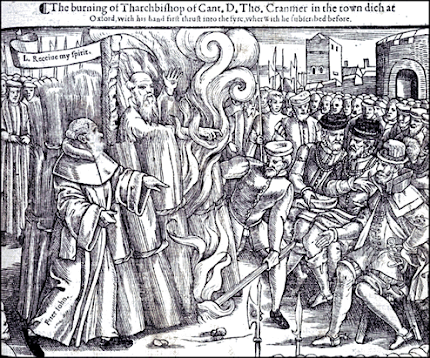
The burning of Tharchbishop of Cant. D. Tho. Cranmer in the town dich at Oxford, with his hand first thrust into the fyre, wherwith he subscribed before. [Click on the picture to see Cranmer's last words.]

Daily Bible Verse

Showing posts with label Calvinism. Show all posts

Wednesday, November 06, 2013

Dr. Mark Thompson: The Sydney Family Album


An aberration within the Anglican communion worldwide, the Sydney Diocese of the Australian Anglican Church has often been accused of "puritanism," "fundamentalism," and other "dirty words," as the last archbishop, Dr. Peter Jennings, liked to say.  However, the evangelical and calvinist nature of Anglicanism in Sydney is to be applauded.  

Although I have a few theological disagreements with Dr. Thompson, namely his Amyraldian view of the atonement, Moore Theological College should be held in high regard for its theological stand for the Bible.

Click here to read more:   The Sydney Family Album

Thursday, October 24, 2013

George C. Scott: Calvinism Versus Positive Confession and Arminianism


I got a big laugh out of this one.  The world just cannot accept the plain teaching of Scripture.  It's clip from You Tube called Calvinism in three minutes.  Forgive the profanity.  But it illustrates the ignorance of most people when it comes to Scripture and the fact that Calvinism is Christianity.


Friday, June 21, 2013

Exodus International Closes Down

Exodus International was questionable from the get go, in my opinion.  Ex-homosexuals are the last persons who should be trying to minister to homosexuals who want to stop living in their immorality.   Of course, the media are celebrating this event because they think homosexuality is something good, not a perversion of God's created order.  You can look for conservative Christianity to be further marginalized because of the visibility of this parachurch ministry and its very public closing.

Of course, it was founded on a faulty premise to begin with.  Psychology and manipulation can never change a rebel's heart and mind.  Only God can convert a lost soul.  Homosexuality, like drug addiction, is a difficult bondage to break.  Anyone who truly repents of that terrible perversion is a miracle of God's sovereign grace.

To read the story, click here:   Exodus Internation Closes Down

Charlie

Monday, September 24, 2012

Reasonable Christian: Re: Charlie: My Conversion to the Doctrines of Sovereign Grace and My Departure from the Arminian/Pentecostal/Charismatic Movement

This is a rather lengthy response to an e-mail message asking why I think that the Five Points of the Canons of Dort "work for me".  Notice the author of the e-mail places authority in subjectivism and not in the objective revelation of Scripture, which is fully inspired of God.  The fact is the issue is not pragmatism, which is an American phenomenon, but special revelation and propositional truth.  If Scripture is THE final Word of God and special revelation which is necessary for saving faith, it follows that we better accept and assent to what it says.  (John 12:48-50; John 10:35).

Although it is not immediately apparent in my remarks in the linked article, the deciding factor for me in rejecting both Pentecostalism and Wesleyan Arminianism remains the doctrine of Sola Scriptura.  Scripture alone IS God's Word.  Click here to read my remarks:  Reasonable Christian: Re: Charlie: My Conversion to the Doctrines of Sovereign Grace and My Departure from the Arminian/Pentecostal/Charismatic Movement

Thursday, August 09, 2012

A Short Testimony: Why I Became a Calvinist

[Nota bene:  I have removed the name of the person I messaged in Facebook because it is not an essential point to know in regards to my response to the question of why I became a Calvinist.  I am not big on testimonies but this seems to come up often so here is another explanation.  --Charlie J. Ray]

Hi XXXX,

The WHNT?  I'm not sure what you're referring to there, XXXXX.  But my story is a long one.  I grew up here in the South, the Bible belt.  I've been reading the KJV since I was 8 and I learned the Lord's prayer in school from the first grade onward.

My parents were not Christians or church goers but I visited many churches over the years.  We moved from Georgia to Alabama and then to Florida where I came into contact with the Presbyterian church here in Wauchula, Florida.  In 1976 or so that church pulled out of the Presbyterian Church USA over women's ordination and went with the Presbyterian Church in America.  The PCUSA now ordains homosexuals--which is what women's ordination naturally leads to.

Anyway, to answer your question, it was reading the Bible from cover to cover for many years that laid the foundation for my belief in God's absolute sovereignty over all things.  At first, I fell away from my faith during my early adulthood.  Then at age 25 I visited a pentecostal church here.  It was an Assemblies of God church.  I thought that they believed in miracles because they believed in God's sovereignty.  How wrong I was.  It took me many years to see that that was far from the truth.  The idea that God needs our cooperation to do a miracle or heal is just silly....

Anyway, to make a long story short, I felt called to ministry and matriculated at an Assemblies of God college in Lakeland, Florida where we read J. I. Packer's book, Knowing God.  That piqued my interest and even as a child I had questioned why God had allowed my father to die when I was 12.  I remember reading the Encyclopedia Britannica article on the issue of predestination and the debate between the supralapsarians and the infralapsarians and how the Remonstrants or Arminians had arisen from that debate.

I wasn't ready yet to admit that Arminianism was wrong since I had been caught up in the A/G.  But I did question the Arminian view of Romans 9 and John 3, 6 and other places. 

I went on to Asbury Seminary, a Wesleyan Arminian and holiness school.  While there I heard Dr. Jerry Walls argue in a Christian philosophy class that compatibilism was false and "libertarian free will" was true.  But I knew just enough to know that neither Calvin nor Luther believed in free will and this seemed blatantly contradictory to God's sovereignty over evil.  I was rejecting Walls' view already.

Two other factors were clinchers.  The first was a seminar on Calvin's Institutes of the Christian religion by Professor Thomas O'Malley of Asbury.  O'Malley meant to criticize Calvin's logical thought and that when Calvin ran into a logical dead end he appealed to "mystery".  At the time I didn't know it but this was an indirect slam against Cornelius Van Til's theology of paradox, which is only a couple of steps away from neo-orthodoxy.  Van Til was a Calvinist at Westminster Seminary, by the way.

Anyway, it struck me that Arminians have an even greater mystery and problem.  O'Malley convinced me that Calvin at least tried to solve all the logical problems that reading Scripture apparently presented.  But Arminians simply read into the Scriptures a view that they think solves the problem of evil.  The trouble is the Arminian solution is rationalistic and introduces mystery from the get go!  For example, how can God foreknow what is certain to happen in the future without determining it?  That is, God foreknows that certain persons would do a good work of believing the Gospel out of their own cooperation with a common grace that allegedly neutralizes the depravity of man.

But Luther said that nothing happens by contingency and that all things happen because God has determined them.  This extends even to the fall of Adam and the destiny of men and angels.  Not even Adam had libertarian free will prior to the fall.  He lost his free will in one sense when he rebelled but in another sense--God's decrees--Adam never had libertarian free will whatsoever.

And the other event that finally pushed me over the edge was meeting James R. White online.  OK, offline.  That was around 1995 just before I graduated from Asbury with my M.Div.  I met James White in a Bible forum on Fidonet.  Back then the BBS or bulletin board offline packet system was all there was.  The internet had not yet been invented by Al Gore (tongue in cheek).  I was already leaning in the Calvinist direction.  So I found this Calvinist in Fidonet and decided to play the devil's advocate with him.  I argued the best Arminian arguments I knew to defeat the plain meaning of Romans 9 (i.e. Jacob and Esau and Pharaoh were metonymy and represented nations and not individuals).  We also debated John 3 on being born again and John 6 on the effectual call (6:37-44, 65).  White convinced me that the Arminian interpretation of these passages was not only illogical but completely contradictory.

In short, I came to accept compatibilism as the best explanation of the apparent conflict in Scripture between God's absolute sovereignty and man's accountability for breaking God's moral law.  I began to study Reformed theology and the Reformed confessions and the Scriptures from that perspective.  The rest is history.  Since then I've also become a Scripturalist and an advocate of the propositional truth of Scripture from the perspective of Gordon H. Clark's theology and presuppositional apologetics.

Sorry for the long explanation but in a nutshell, that is it.

Sincerely yours in Christ,

Charlie J. Ray

Romans 5:1-2, 6-11; Ephesians 1:1-12; 2:1-10

See also:  My Conversion to the Doctrines of Grace and

Top Ten Reasons Why I Am No Longer Pentecostal

When Tragedy Strikes

Monday, March 05, 2012

Calvinism Is the Gospel


A Defense of Calvinism as the Gospel


by Prof David J. Engelsma

The term, "Calvinism," is not the name by which we Calvinists prefer to have our faith called; nor do we prefer to call ourselves "Calvinists." Calvin was the name of a man, a great servant of God, John Calvin. He was one of the Reformers by whom the Holy Spirit reformed the Church in the 16th century. To call ourselves "Calvinists" and our faith "Calvinism" leaves the impression that we follow a man and that these beliefs are the invention of a man. In fact, these terms originally were terms of derision used by our enemies, as were also the names, "Christian," and "Protestant." Therefore, from the very beginiing, Calvinists called themselves "Reformed," or "Presbyterian." Thus, they deliberately distinguished themselves from the other great branch of the Protestant Reformation, the Lutheran Church, which did call itself by the name of a man (contrary to the wishes of Luther himself).

Nevertheless, "Calvinism" and "Calvinist" are useful terms, today. They are widely known, even though that be, in part, through the attack upon, and reproach of, Calvinism by its enemies. Also, the name, "Calvinist," is embraced by persons and churches who are not Reformed, or Presbyterian, but who confess those tenets of Calvinism which they call "the doctrines of grace." "Calvinism" has come to stand for certain doctrines, a certain system of truth. We have no objection to calling these doctrines "Calvinism" as long as two things are clearly understood. First, it must be understood that not the man, John Calvin, but Holy Scripture is the source of them. Second, it must be understood that we who embrace these truths are not disciples of a man, Calvin, but are concerned exclusively to follow God's eternal Son in our flesh, Jesus Christ, exactly by confessing these doctrines.

There are different ways of viewing Calvinism. Some have discovered political implications in Calvinism, e.g., strong opposition to every form of tyranny. Others have found Calvinism important for economics. Max Weber thought to trace the spirit of capitalism to Calvinism, indeed, to Calvinism's doctrine of double predestination. We could examine Calvinism as a total world-and-life-view. It is more, much more, than a set of doctrines, and certainly much more than five points of doctrine. Like humanism or Marxism, Calvinism is a world-and-life-view with which a man takes a stand in every area of human life. Also, Calvinism involves one with the Church, the instituted Church, and is not only the personal beliefs of the individual; it is through and through ecclesiastical. With the early Church, Calvinism fervently holds that "outside the Church is no salvation."

At its heart, however, Calvinism is theology, true religion; and this means doctrine. This is how we will be viewing Calvinism, here. We limit ourselves to a consideration of Calvinism as the Gospel.

Calvinism is the Gospel. Its outstanding doctrines are simply the truths that make up the Gospel. Departure from Calvinism, therefore, is apostasy from the Gospel of God's grace in Christ. Our defense of Calvinism, then, will proceed as follows. First, we will show that Calvinism is the Gospel. This is necessary because of its detractors, who criticize it as a perversion of the Gospel. Second, we will defend it as the Gospel. In doing this, we carry out the calling that every believer has from God. Paul wrote that he was "set for the defense of the Gospel" (Philippians 1:17). I Peter 3:15 calls every believer to give an answer, an "apology," or defense, to everyone who asks us a reason for the hope that is in us. As the name indicates, Calvinism is a certain teaching associated with John Calvin; it refers to Biblical doctrines that he propounded.

Calvin was a Frenchman, born in 1509 and died at 55 in 1564, who lived during the Reformation of the Church, a contemporary of Martin Luther. He was converted from Roman Catholicism early in his life, "by a sudden conversion," he tells us in his preface to his commentary on the Psalms, "since I was too obstinately devoted to the superstitions of Popery to be easily extricated from so profound an abyss of mire," and labored on behalf of the Protestant Faith all the rest of his life. He lived and worked in Geneva, Switzerland as a pastor and theologian. His labor was prodigious. He preached almost daily; did an immense pastoral work; carried on a massive correspondence; and wrote commentaries, tracts, and other theological works. He is remembered especially for his great work on Christian theology, Institutes of the Christian Religion (which still exercises great influence, which every professing Protestant could profitably read, and which every critic of Calvinism ought to have studied, if he wishes to be taken seriously), and for his commentaries on almost every book of the Bible. Calvin's Protestant contemporaries recognized his outstanding gifts, especially in theology and exposition of Scripture. They referred to him simply as "the Theologian."

Calvin's influence in all the world, already during his lifetime and ever afterwards, was tremendous. Luther, of course, stands alone, as the founder of the Protestant Reformation. But Calvin, benefiting from Luther, outstripped even Luther in influencing the Church of Christ in all the world.

In the history of the Church, Calvinism is the name for the faith of the Reformed and Presbyterian branch of the Protestant Reformation. These Churches were called "Reformed" in Germany, France, Switzerland, and the Netherlands. In England, Scotland, and the north of Ireland, they were called "Presbyterian." This faith was early expressed in written confessions, or creeds. Among the confessions of the Reformed Churches are the Heidelberg Catechism, the Belgic Confession of Faith, and the Canons of Dordt. The great Presbyterian creeds are the Westminster Confession of Faith and the Westminster Catechisms. All of these confessions are in essential agreement.

The Reformed and Presbyterian Churches insisted that the teaching embodied in these creeds, that which is now called Calvinism, was the revelation of God in Holy Scripture. Calvinism bases itself on Scripture. It holds fully the Protestant principle of sola scriptura (Scripture alone). The doctrine of Scripture is the very foundation of Calvinism. It is a mistake, therefore, to define Calvinism apart from its belief concerning Scripture.

The Bible is the only authority in and over the Church. It is this because it is the inspired Word of God, as II Timothy 3:16 claims: "All Scripture is given by inspiration of God, and is profitable for doctrine, for reproof, for correction, for instruction in righteousness." As such, Scripture is the "infallible rule" (Belgic Confession, Article VII). It may not be ignored, questioned, or subjected to criticism, but must be received, believed, and obeyed. This is vital for Calvinism because Calvinism teaches many things about which man complains, "These are hard sayings, who can hear them?" For Calvinism, the question is not, "will men in the 20th century like these things?" But the question is, "Does the Word of God say so?"

Calvinism is concerned to proclaim the Scriptures. The preaching of Scripture, both within the Church and outside the Church, is the central interest of Calvinism. It is false to conceive of Calvinism as a theoretical, abstruse science carried on by heady intellectuals in ivory towers. With the entire Reformation, it wanted, and wants today, to preach the Gospel, which is the power of God unto salvation to every one who believes.

Calvinism, then, can rightly be viewed as certain basic doctrines, the so-called "five points of Calvinism." But even here, a word of caution is in order. Historically, it is something of a misnomer to call these doctrines "Calvinism." On these doctrines, there was no difference between Luther and Calvin. These two leading Reformers were in agreement in their teaching on the doctrines of predestination, the depravity of the fallen man, and justification by faith alone. Indeed, almost without exception, all of the Reformers embraced what we now call "Calvinism." Besides, the "five points of Calvinism," as five particular doctrines that distinguish Calvinism, originated after Calvin's death. They were formulated by a Synod of Reformed Churches in the Netherlands, in 1618-l619, the Synod of Dordt, in response to an attack on these five doctrines by a group within the Reformed Churches that were known as the Remonstrants, or Arminians. This Synod set forth, confessed, explained, and defended these five truths in the Canons of the Synod of Dordt. But it was Calvin who developed these truths, systematically and fully; and therefore, they came to be called by his name.

Total depravity is one of the five points of Calvinism. This doctrine teaches that man, every man, is by nature sinful and evil -- only and completely sinful and evil. There is in man, apart from God's grace in Christ, no good and no ability for good. By "good" is meant that which pleases God, namely, a deed that has its origin in the faith of Jesus, its standard in the Law of God, and its goal in God's glory. From conception and birth, every man is guilty before God and worthy of everlasting damnation. This is man's plight because of the fall of the entire human race m Adam, as Romans 5:12-21 teaches: "Wherefore, as by one man sin entered into the world, and death by sin; and so death passed upon all men, for that all have sinned..." Not only is every man guilty from conception and birth, but he is also corrupt, or depraved. This depravity is total. One aspect of this misery of man is the bondage, or slavery, of man's will. The will of every man, apart from the liberating grace of the Spirit of Christ, is enslaved to the Devil and to sin. It is willingly enslaved, but it is enslaved. It is unable to will, desire, or choose God, Christ, salvation, or the good. It is not free to choose good.

It is not Calvinism, that God forces men to sin or that men sin unwillingly, but that the natural man's spiritual condition is such that he cannot think, will, or do anything good. On this doctrine, Luther and Calvin were in perfect agreement. Luther, in fact, wrote a book called The Bondage of the Will in which he asserted that the fundamental issue of the Reformation, the basic difference between genuine Protestantism and Roman Catholicism, is this issue, whether the will of the natural man is bound or free. Calvinism shows itself as pure Protestantism by its confession concerning the will in the Westminster Confession of Faith, Chap. IX, 3, 4:

Man, by his fall into a state of sin, hath wholly lost all ability of will to any spiritual good accompanying salvation; so as a natural man, being altogether averse from that good, and dead in sin, is not able, by his own strength, to convert himself, or to prepare himself thereunto. When God converts a sinner, and translates him into the state of grace, he freeth him from his natural bondage under sin, and by his grace alone enables him freely to will and to do that which is spiritually good....

Another of the five points of Calvinism is the truth of limited atonement. There is deliverance for fallen men only in Jesus Christ, God's eternal Son in our flesh. This deliverance occurred in the death of Christ on the cross. His death was atonement for sins, inasmuch as He satisfied the righteousness of God, suffering the penalty of God's wrath in our stead who deserved that wrath because of our sins. Jesus' death was efficacious; it saved! It saved everyone for whom He died. It removed, in full, the punishment of everyone in whose stead Jesus died. He atoned for some, particular men, not for all without exception His atonement was limited as regards the number of men for whom He died and whom He redeemed. They are "His people" (Matthew 1:21); His "sheep" (John 10:15: "I lay down my life for the sheep"); and "as many as (the Father) hast given (Jesus)" (John 17:2).

It is not Calvinism, that any, even one, who seeks salvation will be denied, but that the death of Jesus saved, that it was efficacious, that it was not in vain.

The Lord Jesus, by his perfect obedience and sacrifice of himself, which he through the eternal Spirit once offered up unto God, hath fully satisfied the justice of his Father; and purchased not only reconciliation, but an everlasting inheritance in the kingdom of heaven, for all those whom the Father hath given unto him. To all those for whom Christ hath purchased redemption, he doth certainly and effectually apply and communicate the same ... (Westminster Confession of Faith, Chap. VIII, 5, 8)

Irresistible grace, or efficacious grace, is a third of the five points of Calvinism. This doctrine refers to the actual saving of fallen men by the Holy Spirit, in applying to them the redemption accomplished on the cross. This work of salvation is wholly the work of God; it takes place by grace alone. Negatively, this means two things. First, the salvation of a man is not something that any man deserves, or makes himself worthy of, in any way. Second, salvation is not a work that man accomplishes, in whole or in part. Man does not co-operate with God in bringing about his salvation. Positively, that salvation takes place by grace alone means that salvation is freely given to men by God, merely out of His love and goodness. Also, it means that this salvation is accomplished by God's power, the Holy Spirit. He regenerates; He calls; He gives faith; He sanctifies; He glorifies. This work of saving and the power of grace by which the Holy Spirit performs this work are efficacious. In carrying out this work, the Spirit and His grace do not make a man's salvation possible, but effectually save him. It is not on the order of a mere attempt by God that depends, ultimately, on the man whom God tries to save and that may, therefore, be frustrated and come to naught; but it is on the order of a work of creation that sovereignly and unfailingly makes the man whom God is pleased to save a new creature in Jesus Christ.

It is not Calvinism, that God forces men, kicking and screaming, into heaven, but that God makes a man willing, who before was unwilling. In the Canons of Dordt, the Reformed believer describes the saving work of irresistible grace this way:

...it is evidently a supernatural work, most powerful, and at the same time most delightful, astonishing, mysterious, and ineffable; not inferior in efficacy to creation, or the resurrection from the dead... so that all in whose heart God works in this marvelous manner, are certainly, infallibly, and effectively regenerated, and do actually believe ... (III,W,12)

The doctrine of the perseverance of saints, or "eternal security," as some call it, follows from the truth of irresistible grace. Not one person to whom God gives the grace of the Holy Spirit will perish, because that grace and Spirit preserve him unto the perfect salvation of the Day of Christ.

It is not Calvinism, that one may do as he pleases and still be saved, or that a saint can never fall into sin. Against the charge that the doctrine of perseverance implies that one may do as he pleases and still go to heaven, Calvinism replies that the Holy Spirit preserves us by sanctifying us, by strengthening our faith, and by giving us the gift of endurance. As for the "melancholy falls" of Christians, the saints can, and sometimes do, fall into sin, even "great and heinous sins," but the indwelling Spirit, never wholly withdrawn from them, brings them to repentance. Calvinism imparts to all true believers the inestimably precious comfort of the "certain persuasion, that they ever will continue true and living members of the church; and that they experience forgiveness of sins, and will at last inherit eternal life" (Canons of Dordt, V, 9).

All of the salvation described above has its source in God's eternal election. The truth of election is another of the characteristic Calvinistic doctrines. God has from eternity elected, or chosen, in Christ, some of the fallen human race - a certain, definite number of persons - unto salvation. This choice was unconditional, gracious, and free; it was not due to anything foreseen in those who were chosen. Reprobation is implied. God did not choose all men; but He rejected some men, in the eternal decree. It makes no essential difference whether one views reprobation as God's passing by some men with His decree of election in eternity (which is, in fact, a Divine decision about their eternal destiny), or whether one views it as a positive decree that some men perish in their sin, their unbelief and disobedience. Election and reprobation make up predestination, the doctrine that God has determined the destiny of all men from eternity. This truth is regarded, not inaccurately, as the hallmark of Calvinism. The very heart of the Reformed Church is election, God's gracious choice of us sinners, guilty and depraved, worthy only of damnation, unto salvation.

Election is the fountain of all salvation! As such, it is the ultimate, decisive, convincing proof and guarantee that salvation is gracious - that salvation does not depend upon man, but upon God; that salvation is not man's idea, but God's; that salvation is not man's work, but God's; that salvation is not due to man's decision for God, but to God's eternal decision for man.

This is how Calvin himself viewed predestination - as the final, conclusive, incontrovertible testimony to, and guarantee of, gracious salvation. Therefore, in his definitive edition of the Institutes (1559), Calvin treated predestination at the end of Book III, after his treatment of redemption in Christ and his treatment of the application of redemption by the Holy Spirit. Calvin wrote:

We shall never feel persuaded as we ought that our salvation flows from the free mercy of God as its fountain, until we are made acquainted with His eternal election, the grace of God being illustrated by the contrast - viz, that He does not adopt promiscuously to the hope of salvation, but gives to some what He denies to others" (III, 21, 1).

This is Calvinism!

This is the Gospel!

The Gospel proclaims man's misery as total depravity, including the bondage of his will. Ephesians 2:1 diagnoses the spiritual condition of the sinner, prior to the quickening of the Spirit of Christ, thus: "dead in trespasses and sins." Spiritually dead, the sinner is lacking all good, any ability for good, and both the power and the inclination to effect a change in this condition. Himself is helpless and his condition, hopeless - the helplessness and hopelessness of death. Romans 8:7-8 passes the same judgment upon fallen man: "Because the carnal mind is enmity against God; for it is not subject to the law of God, neither indeed can be. So then they that are in the flesh cannot please God." The "carnal mind" is human nature as it is by virtue of natural birth. Its condition is such that it is incapable of being in subjection to God's law. Those who are in the flesh are those who are not born again by the Spirit of Christ, those who are outside of Christ. Their spiritual condition is such that they are incapable of pleasing God; all that they are able to do is sin. For a sinner to will and to do of God's good pleasure, God must work in him both the willing and the doing, by the Spirit of Jesus Christ (Philippians 2:13).

The Gospel proclaims the death of Christ as a death that effectively redeems some men, rather than as a death that merely makes salvation possible for all men. Scripture teaches limited atonement. Jesus Himself taught this about His own death in John 10:15 "... and I lay down my life for the sheep." A little further in the same chapter, the Lord specifically states that some men are not included among "the sheep": "But ye believe not, because ye are not of my sheep, as I said unto you" (John 10:26). He died for some men, "the sheep," in distinction from other men, who are not of His sheep. Jesus described His death similarly in Matthew 20:28: "Even as the Son of man came not to be ministered unto, but to minister, and to give his life a ransom for (Greek: 'in the stead of') many." The important point is not so much that He spoke of those for whom He died as "many," not as "all," as it is that he spoke of His death as the ransom given in the stead of others. By dying, He paid the ransom-price to God on behalf of many sinners. He did this by taking their place, giving up his own life where theirs was forfeit. The effect of this death is that everyone for whom He died is freed from sin, death, and hell. Not one for whom He died will perish. None may perish, for the ransom is paid. This Gospel (and there is no other) was preached already by the evangelistic prophet, Isaiah, in Isaiah 53: the suffering Christ bears away the iniquities of God's people by being smitten of God as their substitute.

The Gospel proclaims an irresistible grace, as the power that saves elect sinners. It cannot be otherwise, if the sinner is "dead in trespasses and sins." Having taught this in Ephesians 2:1, the apostle goes on to teach irresistible grace in verses Ephesians 2:4, 5: "But God, who is rich in mercy, for his great love wherewith he loved us, even when we were dead in sins, hath quickened us together with Christ, (by grace ye are saved)." The saving of the sinner, in every case, is God's raising him from the dead, comparable to Jesus' wonders of raising the physically dead. Now two things are true about resurrection: it is the act of God alone, in which the one who is raised does not cooperate; and it is effectual - God never fails to accomplish the resurrection of any whom He purposes to raise. In verse Ephesians 2:10 of this chapter, Paul likens the work by which we were saved to the work of creation, thus making dear that this work is exclusively the work of God the Creator, and not at all the work of the creature that is created: "For we are his workmanship, created in Christ Jesus unto good works ..." Jesus explained that salvation takes place by the sovereign drawing-power of Almighty God, in John 6:44: "No man can come to me, except the Father which hath sent me draw him."

The Gospel proclaims the perseverance of the saints. Jesus said, "My sheep hear my voice and I know them, and they follow me: And I give unto them eternal life; and they shall never perish, neither shall any man pluck them out of my hand. My Father, which gave them me, is greater than all; and no man is able to pluck them out of my Father's hand. I and my Father are one" (John 10:27-30). Jesus gives eternal life to every one of His sheep; and not one of those saints shall ever perish. It is impossible that anyone could pluck a saint out of God's hand, that is, cause a regenerated child to fall away to perdition. The reason is not the strength of the saints, but the power of the grace of God ("my Father ... is greater than all"). These words of Jesus make plain that the comforting truth of perseverance depends upon election and irresistible grace. The saints persevere, because the Father gave them to Jesus and because Jesus gives (not: tries to give, but: gives) them eternal life.

As the source and foundation of salvation, the Gospel proclaims Divine election. This truth is on the very face of the entire Old Testament Bible: God chose Israel unto salvation, rejecting the other nations. The mediator of the old covenant tells Israel, "the LORD thy God hath chosen thee to be a special people unto himself, above all people that are upon the face of the earth. The LORD did not set his love upon you, nor choose you, because ye were more in number than any people; for ye were the fewest of all people: But because the LORD loved you ..." (Deut. 7:6-8).

In perfect harmony with this obvious truth of the old covenant, the Mediator of the new covenant traces every aspect of His salvation back to Divine election. His life-giving death stems from election: "that he should give eternal life to as many as thou hast given him" (John 17:2). His priestly pity and intercessory prayer are regulated by election: "I pray for them: I pray not for the world, but for them which thou hast given me; for they are thine" (John 17:9). His saving revelation of the truth to men depends upon election: "I have manifested thy name unto the men which thou gavest me out of the world..." (John 17:6). The coming of men to Him in true faith is effected by election: "All that the Father giveth me shall come to me..." (John 6:37). His preservation of men in faith and His resurrection of these men in glory are due to election: "... that of all which he bath given me I should lose nothing, but should raise it up again at the last day" (John 6:39).

Election has a prominent place in the Gospel preached by the apostles. It is the cause of the salvation of every one who is saved, and the source of every blessing of salvation: "... the God and Father of our Lord Jesus Christ... hath blessed us with all spiritual blessings ... according as he hath chosen us in him before the foundation of the world ." (Ephesians 1:3,4). Upon eternal predestination was forged the golden (and unbreakable) chain of salvation: "Moreover whom he did predestinate, them he also called: and whom he called, them he also justified: and whom he justified, them he also glorified" (Romans 8:30). The entire river of the mercy of God in Jesus flows out of His will of election; and the sovereign graciousness of this will is illustrated by this, that God hardens some men according to His eternal decree of reprobation: "Therefore hath he mercy on whom he will have mercy, and whom he will he hardeneth" (Romans 9:18).

There can be no ignoring of these doctrines, called "Calvinism"; if they are not preached and confessed, they are denied. Every preacher, every Church, every member of every Church must take a stand regarding them, and does take a stand. It is impossible not to. For they are writ large on the pages of Scripture, as essential elements of the gospel. Whoever rejects Calvinism embraces the only alternative to Calvinism - a system of doctrine that is opposed to Calvinism in every point.

Does a man reject total depravity? Then he believes that fallen, natural man yet retains some good and some ability for good, specifically a will that is able to make a decision for Christ; that man outside of Christ is not dead in sins, but merely sick, that is, not dead, but alive.

Does a man reject limited atonement? Then he believes that Jesus died for each and every human being without exception. Because both Scripture and the hard facts of life teach that some men do perish in hell, this advocate of universal atonement believes that the death of Jesus did not actually atone for sins at all, but merely made atonement possible; that the cross was not the payment of the ransom in the stead of every one for whom Christ died, but merely an example of love; that the suffering of the Son of God did not effectually satisfy the justice of God by bearing sins away, but merely...? Did what? Anything at all? And if not, was He really the eternal Son of God in the flesh?

Does a man reject irresistible grace? Then he believes that God's call to salvation and the grace of the Holy Spirit depend upon the acceptance of the sinner by the exercise of his "free will," so that God's grace can be defeated and fail. Further, he believes that, whenever a sinner does come to Jesus in true faith and receives salvation, this is not due to the grace of God, but to the good will of the sinner.

Does a man reject the perseverance of saints? Then he believes that every believer can fall away and perish at any time, including himself.

Does a man reject predestination? Then he believes that the ultimate source and foundation of salvation is man's choice, decision, and will.

In the end, there are two, and only two, possible faiths. The one maintains that all mankind lies in death; that God in free and sovereign grace eternally chose some; that God gave Christ to die for those whom He chose; that the Holy Spirit regenerates them and calls them efficaciously to faith; and that the Spirit preserves these elect, redeemed, and reborn sinners unto everlasting glory. This is Calvinism.

The other faith maintains that fallen man retains some spiritual ability for good, some life; that God's choice of men depends upon their exercise of the ability for good that is in them; that Christ's death depends upon that good in man; and that the attainment of final glory depends upon that good in man. This is the enemy of Calvinism. This is the enemy of the Gospel! For Calvinism proclaims salvation by grace; the other faith preaches salvation by man's will and works and worth.

Calvinism is the Gospel! God's Gospel is the message of wholly gracious salvation. This does not mean that Calvinism is unoffensive. On the contrary! Calvin himself took note, long ago, of the offensiveness of the truth that he taught, with reference specifically to total depravity:

I am not unaware how much more plausible the view is, which invites us rather to ponder on our good qualities than to contemplate what must overwhelm us with shame - our miserable destitution and ignominy. There is nothing more acceptable to the human mind than flattery... if a discourse is pronounced which flatters the pride spontaneously springing up in man's inmost heart, nothing seems more delightful. Accordingly, in every age, he who is most forward in extolling the excellence of human nature, is received with the loudest applause. (Institutes, II:1:2)

But the offensiveness of Calvinism to men is nothing other than the offense of the cross of Christ. In Galatians 5:11, Paul speaks of "the offense of the cross," an offense that ceases only in the preaching of a cross-denying heresy. The cross of Christ, which is the very heart of the Gospel, is not pleasing to man, or acceptable to him. "But we preach Christ crucified, unto the Jews a stumblingblock, and unto the Greeks foolishness" (I Corinthians 1:23). The cross, as the cross of the eternal Son of God in our flesh, shows the extent of fallen man's misery: he can be saved only by the death of the Son of God. Words finally fail to do justice to the greatness of the misery of the sinner, brought out by the cross: utterly lost, completely ruined, totally depraved. The cross shows that salvation is of the Lord, wholly of Divine grace, and not at all of man. As the cross of the Prince of life, the cross is powerful to save. Nothing and no one can nullify or defeat the blood and Spirit of Christ crucified. The Gospel of the cross is this message: "So then it is not of him that willeth, nor of him that runneth, but of God that sheweth mercy" (Romans 9:16).

Just because this is the message of Calvinism, Calvinism is offensive to men. It is offensive to proud man to hear that he is spiritually dead, totally devoid of anything pleasing to God, unable at all to save himself, nothing more than a child of wrath. But this is the judgment passed upon him in Calvinism - and in the Gospel. It is offensive to proud man to hear that salvation is exclusively God's free gift and sovereign, gracious work. But this is what Calvinism - and the Gospel - proclaim.

Just because of this, Calvinism is good news! It is Gospel, glad tidings! As the message of grace, it comforts us and all those who, by the grace of the Spirit, believe in Christ. Only this message provides hope for lost, sinful, and otherwise hopeless men. There is salvation, only because salvation is gracious.

Defending Calvinism is simply a matter of defending the Gospel. Therefore, we do not defend it apologetically, or defensively, or even as if its fortunes were doubtful, dependent on our defense. As the truth of God, Calvinism stands, and will stand - victorious, invincible. God Himself maintains it; and God Himself sends it forth on an irresistible course of conquest throughout the world.

Calvinism is the Gospel for every age. It is the truth for which and by which the Reformation of the Church of Jesus Christ took place in the 16th century. The Gospel has not changed since that time; Jesus Christ in His truth is the same yesterday, and today, and for ever. But the truth of the Gospel is largely lost and buried in the Protestant Churches in our day, including many who pride themselves on being "fundamental" and "evangelical." The Gospel is perverted by a message that is essentially the same as that message against which the Reformation fought and which on its part bitterly opposed the Reformation. In those days, Rome preached a salvation that had to be earned by man's own works, as indeed it still preaches today; Rome taught that men were righteous before God, in part, by their own works, as indeed it still teaches today. In our day, the Protestant Churches teach and preach that salvation depends upon man's own will; they proclaim that the sinner must achieve his own salvation by willing. This "gospel" of much of Protestantism and the "gospel" of Rome are one and the same. Essentially, there is no difference between them. This is the reason why many Protestant Churches, preachers, evangelists, and people find it possible to co-operate closely with the Roman Catholic Church, especially in the work of evangelism; and this is the reason why a great reunion with Rome on the part of many Protestants is in the offing. Rome says, "Salvation depends upon man working;" modern Protestantism says, "Salvation depends upon man willing." Both are saying the same thing: "Salvation depends upon man." The apostle lumps both of these variations of the same basic doctrine together in Romans 9:16, and condemns them: "So then it is not of him that willeth, nor of him that runneth, but of God that sheweth mercy."

Having condemned these heresies, Paul declares that the source of our salvation is God showing mercy - only God showing mercy; he proclaims that salvation depends upon God showing mercy - only upon God showing mercy. This is the message of Calvinism; and because it is, our defense of Calvinism is a bold, uncompromisingly, unashamed defense. We say of Calvinism what B. B. Warfield once said of it: "the future of Christianity - as its past has done - lies in its hands."

We repudiate the false accusations made against Calvinism, and the caricatures made of it. Men say of Calvinism that it is destructive of good works and of the law of God, that it produces careless Christians. Men say that it is destructive of zeal for preaching and missions. Men say that it is terrifying to poor consciences, that it is cold and hard, and that Calvinists are all head and no heart. These are old charges, hoary with age. You will find them, almost word-for-word, lodged against the apostle, Paul, and the Gospel that he preached (cf. Romans 3:8; 3:31; 6:1f.; and 9:19ff.).

Would that men were not so ready to accept the caricature of Calvinism contrived by its enemies, but rather let Calvinism speak for itself, in its confessions. Read the Heidelberg Catechism, or the Westminster Catechisms, and see for yourself whether Calvinism is hard and cold and cruel, or whether it is warm and comforting. Read the Belgic Confession, or the Westminster Confession of Faith, and see whether Calvinism goes lightly over the law of God and over the good works of the Christian man, or whether it trembles before the law, stresses sanctification, and insists on the necessity of good works. Read the Canons of Dordt, the Reformed creed that is unsurpassed in its statement of predestination and in its defense of salvation by grace alone, and see whether Calvinism cuts the nerve of a lively preaching of the Gospel, including the serious call of the Gospel to all who come under the preaching. See also the tenderness of the Reformed Faith towards penitent sinners, and its deep pastoral concern for afflicted consciences.

At the same time, we Reformed people and churches must refute the caricatures of Calvinism by our life and deeds. This also belongs to an "apology for Calvinism." We do well to take heed to ourselves, as well as to our doctrine. Are we zealous for good works? Are we ready to preach the Gospel to every creature and to give an answer to every man that asks us a reason for the hope that is in us? Do we manifest ourselves as joyful, hopeful, confident saints? This we will do, by God's grace, if we live out of the truth of Calvinism, that is, the Gospel.

We have a powerful motive for defending Calvinism. For one thing, as the Gospel it is the only hope for sinful men - the only power of God unto salvation, the only means of the gathering and preserving of the Church.

Even more compelling, Calvinism glorifies God. The glory of God is the heartbeat of Calvinism, and the heart of hearts of every Calvinist. Calvin's enemies have always seen this and have sneered at him as "that God-intoxicated man." Calvinism gives the magnificent answer to the question, "What is the chief end of man?": "Man's chief end is to glorify God, and to enjoy him for ever." (Westminster Shorter Catechism, Quest. 1). But the glory of God is the goal of the Gospel, that is, the goal of God Himself through the Gospel: "...to the praise of the glory of his grace" (Ephesians 1:6). His glory He will not give to another (Isaiah 42:8). "Of Him, and through Him, and to Him are all things;" to Him, therefore, be glory for ever. (Romans 11:36)


--  Glory be to the Father, and to the Son : and to the Holy Ghost; As it was in the beginning, is now, and ever shall be : world without end. Amen.

Sunday, February 19, 2012

John Piper: Promoter of Semi-Arminian Common Grace

I do not fully endorse everything Monty Collier posts on YouTube. However, in this case he nails Piper.


Millard Erickson on Universal Atonement

The Jeremy Lin Problem - NYTimes.com

I am constantly amused when atheists, liberals, and socialists pretend to be experts in Christian theology, morality and ethics and try to triumphalistically "lord it" over the Christian community. The focus of this article is the accusation that Jeremy Lin is a hypocrite because sports are based on winning, victory, and overcoming adversity. As if losing is a virtue? Is is somehow un-Christian to be financially successful or to become a star of some kind? If so, I suppose all Christians should quit their jobs and become hermits on a pillar somewhere or bury ourselves in the earth so as to be in the earth but not "of the earth"?

The silliness of this editorial is just amazing. Christians are not supposed to do well at Harvard, be intellectuals, or kick the asses of pagans on the basketball court. Go figure!  (Psalm 144:1 ESV).

Maybe Mr. David Brooks should learn a bit about the Reformed/Calvinist confessions of faith and their understand of Scripture before he pretends to know the internal values, doctrines, morality and ethics of that theological tradition?

For example the Bible clearly does teach that Christians can win battles and be successful. The story of David, the shepherd boy who defeats a grown man and a giant with a rock and a slingshot, is a classic underdog story. (1 Samuel 17:26). Not only did David defeat Goliath but he went on to become the king of Israel and become a wealthy man. Although David did fall into various traps and many sins because of his success, the Scriptures tell us that David was a man after God's own heart. (1 Kings 11:4). In short, David was elect before the foundation of the world while Saul was rejected and reprobate from the foundation of the world. (Romans 9:11-13; Ephesians 1:4,5; 1 Peter 2:8).

It might be that Brooks is reading into the Jewish Scriptures more than the Old Testament allows.  Maybe it is Brooks' liberalism and his anti-Christian biases that allows him to suggest that winning is somehow irreconcilable with Christian faith?  Maybe Brooks would like to apply that ethic to Israel?  If so, the Six Day War would have never happened and the Jewish nation would have never been.  If Israel followed Brooks' mistaken ethic perhaps they should simply lie down and let the Palestinians exterminate them?  Those are strong words I know.  But the point is that there is nothing wrong in and of itself with sports, competition or success.  That principle carries over to the principle of just war.

Oddly enough it seems that Jewish theologians are now borrowing from the Christian understanding of the adamic nature or sinful nature:
The odds are that Lin will never figure it out because the two moral universes are not reconcilable. Our best teacher on these matters is Joseph Soloveitchik, the great Jewish theologian. In his essays “The Lonely Man of Faith” and “Majesty and Humility” he argues that people have two natures. First, there is “Adam the First,” the part of us that creates, discovers, competes and is involved in building the world. Then, there is “Adam the Second,” the spiritual individual who is awed and humbled by the universe as a spectator and a worshipper. 

Soloveitchik plays off the text that humans are products of God’s breath and the dust of the earth, and these two natures have different moral qualities, which he calls the morality of majesty and the morality of humility. They exist in creative tension with each other and the religious person shuttles between them, feeling lonely and slightly out of place in both experiences.


To read Brooks' article click here: The Jeremy Lin Problem - NYTimes.com


Monday, February 06, 2012

Dr. Michael Horton - For or Against Calvinism, Part 1 - Listen to Free Online White Horse Inn Christian Radio Broadcasts


Two episodes of The White Horse Inn are absolutely necessary for every Calvinist and Arminian to hear. Part one is Roger Olson's presentation. In this part, Olson admits that if Scripture says something he disagrees with, then it is OK to reinterpret the plain meaning of the text to fit with his rational presuppositions. Passages like Romans 9, Acts 2:23; 4:27-28; 1 Peter 2:8 cannot possibly support the Calvinist view. Why? Because Olson has presupposed that Scripture cannot possibly teach what it "plainly" teaches!

Basically libertarian free will is a compromise with the semi-pelagianism of the Papists and the Eastern Orthodox. Scripture, for the Reformed position, is the final authority, not reason exalted above Scripture. God is absolutely sovereign. Psalm 115:3.

Click here to hear Part 1: Dr. Michael Horton - For or Against Calvinism, Part 1 - Listen to Free Online White Horse Inn Christian Radio Broadcasts

And here to hear Part 2: Dr. Michael Horton - For or Against Calvinism, Part 2 - Listen to Free Online White Horse Inn Christian Radio Broadcasts

Anglicanism and How Many Points?

  Sanctify them in the truth; your word is truth. (John 17:17 ESV)


Recently in reconsidering several issues regarding what constitutes the so-called Reformed center, a term which attempts to reify exactly what Reformed theology is in actuality, I revisited the Riddleblog, a blog owned by Kim Riddlebarger of The White Horse Inn.  Kim is an expert on the issue of eschatology and amillennialism.  I happen to agree with amillennialism since it appears to be the best explanation of the apocalyptic material in the book of Revelation.  However, what particularly caught my attention was Dr. Riddlebarger's refutation of Dr. John MacArthur's dispensational attack on the Reformed faith while at the same time claiming to be a "five point Calvinist".  Dr. Riddlebarger rightly points out that Calvinism is way more than simply the five points of Calvinism.  (See, A Reply to John MacArthur).  Essentially, Dr. Riddlebarger says that Baptists are not Reformed, despite the fact that they may adhere to the five points of Calvinism.  Anyone familiar with the Canons of Dort knows that it is part of the Three Forms of Unity, which would include the Heidelberg Catechism and the Belgic Confession, both of which flatly reject MacArthur's Baptist view of the sacraments, his rejection of covenantal theology, and his premillennial dispensationalism.

Unfortunately,  particular Baptists get many other things wrong as well,  They are particularly prone to associate with Arminian Baptists since being Baptist trumps the Canons of Dort.  So on this aspect Baptists are not really in full agreement with the so-called five points of Calvinism either.  I might add that the Sydney Anglicans are inconsistent here as well since the Synod of Dort equally condemned the view that the atonement is in any sense all universal rather than particular to the elect.

This raises other issues as well.  I should point out here that the so-called "Clarkian apologetics" crowd is not a unified group either.  Many of them are non-cessationists or particular Baptists and outright reject confessional theology, something Gordon H. Clark with which Clark himself would have never agreed.  (See: Scripturalism).  They make this huge leap in logic based on the fact that in Clark's last book, The Incarnation, he repudiated his earlier affirmation of the Westminster Confession's view that Christ is one person but two.  (See: Was Clark a Nestorian?) From that one point many in the so-called "Clarkian" crowd jump to premature Anabaptist conclusions that therefore all confessional theology is up for grabs.  Question everything in creeds and confessions they say.

But that was not the position taken by Clark.  His view was thoroughly confessional and presupposed that the Westminster Standards were the best representation of biblical Christianity.  Although Clark, like all Reformed theologians, affirmed that Scripture is the final authority and that creeds and confessions possibly err, he did not adopt the sort of skepticism toward the creeds and Reformed standards which we see the particular Baptists and non-cessationists taking, particularly those who claim to be Scripturalists in the line of Gordon H. Clark.

In short, it is my contention that non-cessationists, particular Baptists, and others in sympathy with subjective and ecstatic leadings of the Spirit common to the Anabaptist tradition, are not truly Scripturalists at all.  They are a curious offshoot of Clark's Scripturalism.  Furthermore, the principle of Sola Scriptura is not subject to solipsism or hyper-individualism or a rejection of confessional Reformed theology.  (See:  How Many Points?, by Richard Muller).

There are many divisions in the wider Reformed and Protestant tradition.  Theonomy and reconstruction adopt a post millennial view that exalts the law above the Gospel and social transformation above the doctrines of grace.  Baptists reject creeds and confessions and adopt views very similar to the Anabaptists, including a legalistic view of "Lordship salvation".  Ironically, some so-called "Clarkians" like Kenneth Talbot are both Van Tilian and theonomic and Clarkian--as if the two go together???

The Anglican tradition suffers from a similar form of schizophrenic disjunction with the Anglican Formularies.  Ango-Catholicism, Tractarianism, and high church Arminianism are heretical perversions of the English Reformation.  But it is my contention that theonomy, dispensationalism, the Lordship salvation controversy, non-cessationism, future vindication, and assorted other theological errors could be avoided were more pastors, theologians and plow boys familiar with the Reformed standards.  My study of both Scripture and the various Reformed confessions of faith and catechisms has greatly enriched my understanding of theology and the Bible.

While I have a great appreciation for the Scripturalism of Gordon H. Clark and for the work of The Trinity Foundation regarding their stand for the doctrine of justification by faith alone, I do not and cannot adopt an Anabaptist attitude toward the Westminster Standards, the Three Forms of Unity, or the Anglican Formularies.  Unfortunately, the advocates of Clark's Scripturalism these days have little to do with Clark's rejection of the continuation of the gifts of the Spirit or with Clark's own position that the Westminster Standards best represent biblical Christianity:

Definition of Christianity
It is essential therefore to define Christianity more exactly by a specific doctrinal system.  Romanism is not what is meant.  By Christianity we shall mean, to use common names, what is called Calvinism.  Or, to be most specific, the definition of Christianity shall be the articles of the Westminster Confession.   With such a definite basis, it will no longer be necessary to spin dizzily in a whirlpool of equivocal disputation.  Now we can look at what we are talking about.  ["Is Christianity a Religion? in Christian Philosophy, volume 4, The Works of Gordon Haddon Clark, (Unicoi:  Trinity Foundation, 2004), p. 122.]


I would contend that if Anglicans actually believed what the Anglican Formularies teach then there would be much less disputation.  This is also true regarding the those who "claim" to follow the apologetics of Dr. Clark.  If they were confessional presbyterians there would be much less confusion and disputation.  Unfortunately even Sean Gerety is much more willing to compromise confessional Calvinism as it is expressed in the Westminster Standards--for the sake of a facade of unity among Clarkians on other issues like the neo-nestorianism of Clark's final book--than to stand for what Clark himself defined as biblical Christianity:  the articles of The Westminster Confession.

I would contend that for Anglicans biblical Christianity is expressed in the Anglican Formularies, which do teach the five points of Calvinism in incipient form and further developed in the Lambeth Articles of 1595, the Irish Articles, and the Westminster Standards.  While Calvinism is much more than adhering to the five points of Calvinism, Anglicanism is much more than some generic wishy washy Amyraldianism or Arminianism.  It is solidly Augustinian, Reformed, and Calvinist as that is expressed in the Formularies, Lambeth Articles, the Irish Articles, and the Westminster Standards which are drawn from them.

Although it is true that Reformation Anglicans are not Puritans or Presbyterians, it can be said that we have much more in common with the confessional view of Presbyterians or the Dutch Reformed than with particular Baptists--or even with the Clarkian Baptists masquerading under the guise of the "five points".


Sincerely in Christ,


Charlie


Monday, January 24, 2011

Osiander Accuses Calvin of being a Zwinglian!

"But Osiander, spurning this spiritual union, insists on a gross mixture of Christ with believers; and, accordingly, to excite prejudice, gives the name of Zuinglians to all who subscribe not to his fanatical heresy of essential righteousness, because they do not hold that, in the supper, Christ is eaten substantially. For my part, I count it the highest honor to be thus assailed by a haughty man, devoted to his own impostures; though he assails not me only, but writers of known reputation throughout the world, and whom it became him modestly to venerate."


10. Moreover, lest by his cavils he deceive the unwary, I acknowledge that we are devoid of this incomparable gift until Christ become ours. Therefore, to that union of the head and members, the residence of Christ in our hearts, in fine, the mystical union, we assign the highest rank, Christ when he becomes ours making us partners with him in the gifts with which he was endued. Hence we do not view him as at a distance and without us, but as we have put him on, and been ingrafted into his body, he deigns to make us one with himself, and, therefore, we glory in having a fellowship of righteousness with him. This disposes of Osiander’s calumny, that we regard faith as righteousness; as if we were robbing Christ of his rights when we say, that, destitute in ourselves, we draw near to him by faith, to make way for his grace, that he alone may fill us. But Osiander, spurning this spiritual union, insists on a gross mixture of Christ with believers; and, accordingly, to excite prejudice, gives the name of Zuinglians to all who subscribe not to his fanatical heresy of essential righteousness, because they do not hold that, in the supper, Christ is eaten substantially. For my part, I count it the highest honor to be thus assailed by a haughty man, devoted to his own impostures; though he assails not me only, but writers of known reputation throughout the world, and whom it became him modestly to venerate. This, however, does not concern me, as I plead not my own cause, and plead the more sincerely that I am free from every sinister feeling. In insisting so vehemently on essential righteousness, and an essential inhabitation of Christ within us, his meaning is, first, that God by a gross mixture [—mixture such as the victuals we eat.] transfuses himself into us, as he pretends that there is a carnal eating in the supper; And, secondly that by instilling his own righteousness into us, he makes us really righteous with himself since, according to him, this righteousness is as well God himself as the probity, or holiness, or integrity of God. I will not spend much time in disposing of the passages of Scripture which he adduces, and which, though used in reference to the heavenly life, he wrests to our present state. Peter says, that through the knowledge of Christ “are given unto us exceeding great and precious promises, that by them ye might be partakers of the divine nature,” ( 2 Pet. 1:4 ); [—Osiander implies from this that God has mingled his essence with ours.] as if we now were what the gospel promises we shall be at the final advent of Christ; nay, John reminds us, that “when he shall appear we shall be like him, for we shall see him as he is” (1 John 3:2). I only wished to give my readers a slender specimen of Osiander, it being my intention to decline the discussion of his frivolities, not because there is any difficulty in disposing of them, but because I am unwilling to annoy the reader with superfluous labour.
  Institutes of the Christian Religion, Book III, Chaper 11, Section 9.

[See Andreas Osiander.  For a valuable discussion of Osiander see Coffee with Calvin.]
--
Reasonable Christian Blog Glory be to the Father, and to the Son : and to the Holy Ghost; Answer. As it was in the beginning, is now, and ever shall be : world without end. Amen. 1662 Book of Common Prayer
Saturday, July 17, 2010

Re: Charlie: My Conversion to the Doctrines of Sovereign Grace and My Departure from the Arminian/Pentecostal/Charismatic Movement

Hi Dean,

Since you asked, I am replying somewhat at length, though not in as much detail as I would like since that would involve doing extensive research and documentation.  Also, I have decided to post my response as a   blog article at Reasonable Christian.  I hope you will not be offended by that decision.

Actually, my own questions started early on.  Before I became a Christian I read widely in the basic of different religions.  I read C. S. Lewis', Mere Christianity, and I read Mary Baker Eddy and Christian Science along with some Ralph Waldo Emerson, who was into the New Age Movement of the 19th century.  I also read some of the Carlos Castenada books, with its hero being Don Juan, the Yaqui Native American medicine man.

Also, as a teen I believed in mysticism to some degree because of my interest in Carlos Castenada, and I experimented with hallucinogenic drugs like psilocybe cubensis mushrooms.   So when I rededicated my life to Christ at age 24 I naturally gravitated toward a Pentecostal church.  I had been converted at age 8 at a Church of God in Alabama so I looked for a Pentecostal church in Wauchula, Florida.  It turned out to be an Assemblies of God church.

I was eager to see the promised miracles, the financial success, and all the other rubbish they promise you.  Unfortunately, they never materialized.  Of course I did see God work providentially by answering prayers and giving long term healing, etc.  But not once did I ever see what one could call a supernatural miracle.  Even those proclaimed healed of cancer eventually died.  The excuse was usually that the sick person lost their faith, which is why they lost their healing.

That was in the mid 80's during the height of the Jimmy Swaggart era.  So having some familiarity with the old line classical pentecostals I gravitated to that side of things, not yet willing to give up altogether on the "supernatural."  I had already noticed the almost direct link between the Word of Faith movement (Kenneth Hagin/Kenneth Copeland, et. al.) and what I had read of Christian Science in high school. 

Then around 1987, Rev. James Hennessy, the president of Southeastern College of the Assemblies of God in Lakeland, Florida, came and preached a service at our church.    (The college is no longer a ministerial or Bible college but has become a liberal arts college called Southeastern University).  I felt an immediate call to go to college and become an Assemblies of God minister, so I did matriculate in 1988.  The Lakeland, Florida connection has to do with the college I attended.  Carpenter's Home Church and the fallen pastor, Karl Strader, whose church collapsed after his son, Dan Strader, bilked millions from gullible retirees at the Carpenter's Home retirement community, played a signification part in my rejection of Pentecostalism and the charismatic movement.  During my time in college there was a church split over the hyper-Charismatic teaching of Karl Strader and his endorsement of the Jim Bakker ministries and other extreme charismatics.  Jimmy Swaggart openly challenged Bakker and Strader.  The Assemblies of God leadership was unable to bring about any reconciliation and the classical Pentecostals left to start Victory Assembly of God, known as Victory Church now.  While Carpenter's Home Church no longer exists, Victory Church is now a mega-church of over 2,500 members.

While I was in college at Southeastern I discovered that I was not the only one who questioned some of the extremes of the movement.  One of our professors was Terris Neuman, who was a graduate of Fuller Theological Seminary in California.  He recommended a book called, A Different Gospel, by D. R. McConnell, a new testament professor at Oral Roberts University.  In that book McConnell documented the blatant plagiarism of Kenneth Hagin.  Hagin, it turned out, had  not received his teaching by direct revelation or "revelation knowledge" from Jesus at all!  Rather his ideas were outright copied word for word from a Baptist healing evangelist of the 1940's called E. W. Kenyon.  (This is now all openly admitted by all Charismatics/Pentecostals since it is irrefutable).  So then the question is where did E. W. Kenyon get his doctrine? 

It turns out that E. W. Kenyon went to Emerson College in Boston, Massachusetts to be trained in public speaking and oratory.   While there he was exposed to Christian Science and New Thought ideas, which were rampant at Emerson at that time.  Kenyon was duped into believing that denying reality and creating one's own reality in Hindu, god-like fashion was a real possibility.  And, why not combine this with Christianity?  It would make a great evangelistic tool if people could become successful and healthy and at the same time become Christians.

Unfortunately, Kenyon's theology of Christ made Jesus merely a Spirit-filled man and a demigod.  That is, the humanity of Christ was emphasized at the expense of His deity, an error that continues in the Pentecostal/Charismatic movement to this day.  This is how they can say that YOU can do the SAME works that Jesus did and perform miracles at will--if you just have enough faith, if you have an abundant filling with the Spirit, if your life is sufficiently transformed, etc., etc.  In other words, it's a combination of the super spirituality of the  Wesleyan holiness movement and the Wesleyan doctrine of entire sanctification with Christian Science/New Thought.  Rather than focusing on the absolute sovereignty of God and God's absolute deity, the Pentecostal/Charismatic movement is hyper-Arminian, overly pietistic/transformationalist AND adds two major heresies:  1)  Jesus is just one of us--only He has an abundance of the infilling of the Spirit rather than Jesus is 100% God in the flesh (the hypostatic union of the divine nature with 100% human nature in one person, Jesus Christ).  2) Christian Science/New Thought.  [See Jesus and Miracles, by John Calvin.  See also:  Kenosis.]. 

Basically, Christian Science teaches that we are little gods, an idea borrowed from Hinduism via Emerson and others.  We can do miracles if we just believe hard enough.  This physical world is evil and an illusion.  Therefore we can change our physical and spiritual reality by thinking the proper thoughts to get rid of disease, poverty, failure, bad relationships, etc.  Just as dogs have puppies and cats have kittens, Christians are little Jesus's or little gods.  They proof text this from Psalm 82:6.  As usual, however, they do not read the whole Psalm in context.  Pentecostals are notorious for reading their own experiences back into the text.  Psalm 82:7 says the "gods" will die like mere men.   Some god, huh?  The context is earthly rulers, not divine beings.  (There are many other books about the inherent gnosticism of the Word of Faith movement.  You will find a complete bibliography in the back of McConnell's book.)

The other issue that pushed me to reject Pentecostalism and the Charismatic movement was the lack of miracles!  Now that is ironic, is it not?  I noticed that time after time when miracles were claimed there was no documentation to support those healings except in extremely rare cases.  But miracles, according to them, happen all the time and are everywhere if you just believe!  But where are they?  Testimonials are just anecdotal evidence.  But such testimonies are unreliable since the majority of folks have agreed that the emperor has new clothes, even if he is really walking around butt naked.  In other words, there is massive peer pressure to agree that there are miracles despite all evidence to the contrary.

This is just a summary of what led me away but I will jump to the last piece of the puzzle that pushed me to reject the Pentecostal view.  It was the issue of libertarian free will.  Yes, I said "libertarian free will."  I had some familiarity with John Calvin before going to college and seminary.  In college I read J. I. Packer's book, Knowing God, which greatly impressed me.  Also, we used Dr. Henry Thiessen's Systematic theology.  Later when I went to Asbury Theological Seminary, which is an Evangelical and Wesleyan holiness seminary, I took a class in Christian philosophy with Jerry Walls.  In that class Walls was defending the doctrine of libertarian free will, the Arminian view.  He attacked Calvin's doctrine of God's sovereignty and said that it made humans into robots with free will being only an illusion.  He called Calvin's view "compatibilism", which apparently was the view taught by his professor, Alvin Plantinga, a liberal reformed professor at Notre Dame where Walls earned his Ph.D. in philosophy.  After listening to Walls' lectures, I came out siding with Calvin.  How can God be God if men can frustrate His decrees?  [See Bondage of the Will, by Dr. Martin Luther].

The other class I took in seminary was a seminar on The Institutes of the Christian Religion, taught by Dr. Thomas O'Malley, whose affiliation was Evangelical United Brethren prior to that denomination's uniting with the United Methodist Church, the merger of several denominations which gave it the name of "United" Methodist.  Anyway, O'Malley basically tried to use the Institutes to show how silly Calvin was and how often Calvin appealed to mystery when he reached the end of a logical course of reasoning.  Unfortunately, I noticed that Arminians tend to much quicker than John Calvin stop following the revelation of God in Holy Scripture and the propositional truths recorded in reasonable and logical statements.  In other words, the hyper-Arminians tend to appeal to MORE mystery than Calvin in order to justify their extreme fascination with human freedom, libertarian free will, and man's sovereignty.  If the Arminian view is true, then man is virtually a little god and saves himself by doing and by cooperating with God.  I came out of that seminar, as I had with Walls' class, siding with Calvin rather than Arminius or Wesley!

And finally, the issue that broke the camel's back was Romans 9 and John 3 and 6.  I got into a debate on the fidonet bbs around 1994 with Dr. James White, the director of Alpha and Omega Ministries.  Yes, he is the Reformed Baptist fellow.  (Fidonet was an offline bulletin board system developed before Al Gore invented the internet!)  Hah!  At any rate, I presented all the Arminian arguments I knew  to defeat James White in a debate on the exegesis and interpretation of Romans 9 and John chapters 3 and 6.  I was still undecided at this point, even after the two classes I mentioned to you.  But James White devastated any last vestiges of Arminianism for me in those offline debates.  The idea that Romans 9 is merely archetypal references to tribes of people rather than individuals was so overwhelmingly wrong that I could not refute Dr. White.  Likewise, the plain text of John 3 and 6 clearly shows that God is sovereign in drawing individuals to salvation.

This is a brief summary of my path to sovereign grace.  I could say much more.  But basically I could not escape the fact that life is full of tragedies that are outside of our control.  Either God is in control of evil and catastrophes or they happen by chance, or the devil is God's equal and the cause of such things.   That would basically mean there are two gods and God is not Almighty!  Dualism is also rampant in Pentecostal/Charismatic circles in the spiritual warfare movement.  So at first reluctantly and later enthusiastically, I had to admit that I had been spiritually deceived, duped, abused and manipulated by those in the Pentecostal/Charismatic movement.  Most of them are sincere, but they are sincerely wrong.  Many have bought into the arguments of Dr. Charles Kraft and his view that western civilization does not see miracles because they do not believe.  (See Christianity with Power).  His idea is that we would see more miracles if we simply adopt a pre-modern worldview and return to a non-critical, superstitious worldview of third world countries.

The idea that I was not fully on board with the whole Charismatic thing is just plain wrong.  I was an outright fanatic about it at one time and I was fully on board with the movement from at least 1985 to around 1995.  I did street ministry, jail ministry, and participated in every wacko seminar on spiritual warfare and healing I could find.  I was hoping to see it was all true.  I believed if I just believed hard enough it would all be true.  But what I found and had to finally admit was that it was all an illusion, smoke and mirrors, and magic tricks of manipulation and misdirection.  I have never seen anyone literally raised from the dead and I sincerely doubt anyone else has either.  With the track record of Benny Hinn and the other television evangelists who cannot provide any documented miracles or even videos of such "miracles" taking place, I think I am on solid ground.

I have to believe that Pentecostalism/Charismaticism has more in common with Rome than with Scripture, especially since authority resides in modern day apostles and prophets with "revelation knowledge" no one else has access to.  In fact, the movement leads to Rome or Eastern Orthodoxy as this fellow testifies:  Christianity with Power and Jeffrey Holton.  I have found that miracle claims today, like those in Calvin's day, are meant to lead people away from the plain teaching of Scripture and toward an elitist, semi-gnostic view that only a few have the "hidden" secrets to the Bible, fame, fortune and healing.  Sorry but I do not buy it.  We are all prophets, priests and kings and anyone can read the Bible and know God.  (See Revelation 5:9-10; 1 Peter 2:9).  There is no secret or inside knowledge hidden there which only the Charismatics have access to.  In Calvin's day the Roman Catholics used miracles to deny the Scriptures.  Today it is the Charismatics doing the same thing.  If you read Calvin's Dedication concerning miracles, you will see right away why focusing on miracles rather than God's revelation in Scripture and Jesus Christ is wrong.  (See 2 Timothy 3:15-17; 2 Peter 1:19-21; 2 Peter 3:15-16; 2 Corinthians 11:3-4). 

In closing, I think Calvin's words are still applicable to today's situation with various Roman Catholics, Eastern Orthodox, and with the Pentecostal/Charismatic movement.  If we study God's Word the counterfeit movements become obvious to all:


 Their requiring miracles of us is altogether unreasonable; for we forge no new Gospel, but retain the very same whose truth was confirmed by all the miracles ever wrought by Christ and the apostles. But they have this peculiar advantage above us, that they can confirm their faith by continual miracles even to this day. But the truth is, they allege miracles which are calculated to unsettle a mind otherwise well established, they are so frivolous and ridiculous, or vain and false. Nor, if they were ever so preternatural [supernatural], ought they to have any weight in opposition to the truth of God, since the name of God ought to be sanctified in all places and at all times, whether by miraculous events, or by the common order of nature. This fallacy might perhaps be more specious, if the Scripture did not apprize us of the legitimate end and use of miracles. For Mark informs us, that the miracles which followed the preaching of the apostles were wrought in confirmation of it, and Luke tells us, that “the Lord gave testimony to the word of his grace,” when “signs and wonders” were “done by the hands” of the apostles. Very similar to which is the assertion of the apostle, that “salvation was confirmed” by the preaching of the Gospel, “God also bearing witness with signs, and wonders, and divers miracles.”  But those things which we are told were seals of the Gospel, shall we pervert to undermine the faith of the Gospel? Those things which were designed to be testimonials of the truth, shall we accommodate to the confirmation of falsehood? It is right, therefore, that the doctrine, which, according to the evangelist, claims the first attention, be examined and tried in the first place; and if it be approved, then it ought to derive confirmation from miracles. But it is the characteristic of sound doctrine, given by Christ, that it tends to promote, not the glory of men, but the glory of God.  Christ having laid down this proof of a doctrine, it is wrong to esteem those as miracles which are directed to any other end than the glorification of the name of God alone. and we should remember that Satan has his wonders, which, though they are juggling tricks rather than real miracles, are such as delude the ignorant and inexperienced. Magicians and enchanters have always been famous for miracles; idolatry has been supported by astonishing miracles; and yet we admit them not as proofs of the superstition of magicians or idolaters. With this engine also the simplicity of the vulgar was anciently assailed by the Donatists, who abounded in miracles. We therefore give the same answer now to our adversaries as Augustine gave to the Donatists, that our Lord hath cautioned us against these miracle-mongers by his prediction, that there should arise false prophets, who, by various signs and lying wonders, “should deceive (if possible) the very elect.” and Paul has told us, that the kingdom of Antichrist would be “with all power, and signs, and lying wonders.”  But these miracles (they say) are wrought, not by idols, or sorcerers, or false prophets, but by saints; as if we were ignorant, that it is a stratagem of Satan to “transform” himself “into an angel of light.”
[From Dedication of the Institutes of the Christian Religion, by John Calvin.  1536.]

By this standard alone we can see that the Word of Faith movement has more in common with false teachers than with Scripture.  It is the Bible alone that is the final authority and not the Pope, Kenneth Hagin or anyone else.  Unfortunately, the Word of Faith movement has infiltrated classical Pentecostalism and the Charismatic movement to the point that there is no practical difference at all.  This is why I am no longer a Pentecostal or a Charismatic.  God is really God!

 "You shall have no other gods before me. 4 "You shall not make for yourself a carved image, or any likeness of anything that is in heaven above, or that is in the earth beneath, or that is in the water under the earth. 5 You shall not bow down to them or serve them, for I the LORD your God am a jealous God, visiting the iniquity of the fathers on the children to the third and the fourth generation of those who hate me, 6 but showing steadfast love to thousands of those who love me and keep my commandments. (Exodus 20:3-6 ESV)
As for accepting the full TULIP, I can only say that as a complete system Calvinism is the only theology that is completely faithful to the full teaching of Scripture regarding man's absolute accountability AND God's absolute sovereignty.  Both are equally true.  Arminians wish to dismiss God's sovereignty in favor of libertarian free will.  But the cost is that they divorce half the Scriptures and make man sovereign over God.   This sort of thinking leads to all sorts of absurdities, heresies, and false religion as anyone can see.  God is God and will share His glory with no one.

I hope this helps.  Please forgive the length of my response.

Sincerely yours in Christ,

Charlie J. Ray

Reasonable Christian Blog Glory be to the Father, and to the Son : and to the Holy Ghost; Answer. As it was in the beginning, is now, and ever shall be : world without end. Amen. 1662 Book of Common Prayer

On 7/16/2010 11:36 PM, Dean Daniels wrote:
YADDA CHARLIE-
We have recently befriended each other on Facebook. I have seen several of your posts and I was interested in your reasoned migration from charismatic>Calvinist.
My own doctrinal migration (from 1970-now) follows as Lutheran-ELCA>CalvinistPlymouthBrethren>JesusPeopleHomeBibleStudy>Non-DenominationalCharismaticParachurch>LongSabatical(no church)>Mixed Denominational Meetings (MacLaurin.Org at UniversityMinnesota) which is the group I am currently with comprised of home meetings and each members continuing to go to their home churches (EvangelicalFree, LutheranEvang, Covenant, Plymouth Brethren, OpenDoor, AG and more etc). Our current group is half charismatic and the debates are...um...fun!
The charismatic group I was with back in the 90's was very suspicious of the "Toronto Blessing" so it fallows that I would not have been any more impressed with the Lakeland Revival either - and I see Lakeland FL was listed in your bio - so I assume this had some direct impact on you. We felt both 'events' were led by charletans.
I would be interested in your reason(s) or rationale for determining that Calvinism - especially FULL-ON TULIP - was an answer for you.
-DEAN DANIELS

--
"A detective story generally describes six living men discussing how it is that a man is dead. A modern philosophic story generally describes six dead men discussing how any man can possible be alive." ~ G.K. Chesterton

Support Reasonable Christian Ministries with your generous donation.