>

Martyred for the Gospel

Martyred for the Gospel
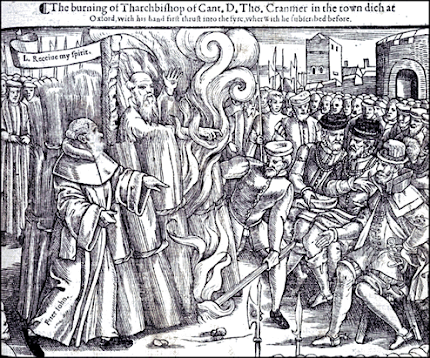
The burning of Tharchbishop of Cant. D. Tho. Cranmer in the town dich at Oxford, with his hand first thrust into the fyre, wherwith he subscribed before. [Click on the picture to see Cranmer's last words.]

Daily Bible Verse

Showing posts with label Word of Faith. Show all posts

Monday, December 16, 2024

A Short-Term Mission Trip to Nicaragua: Part Three


“The critique of secular views continues to ethics. Here too, Clark contends, secular philosophy fails. He briefly dispatches Kantianism before addressing utilitarianism. As he has written elsewhere, a major problem is that the calculations required by utilitarianism are impossible. The ‘still greater difficulty’ in calculating the greatest good of the greatest number is establishing the normative proposition in the first place; why ought man to seek the greatest good for the greatest number? This cannot be established by observation. Referencing Hitler and Stalin, Clark writes, ‘The greatest good of the greatest number is a principle for tyrants.’ (p. 46) Among critiques of other philosophies, Clark writes that Existentialism fails of ‘establishing values or norms of conduct.’ (p. 53) Existentialism’s freedom of choice, he contends, ‘totally unrestricted, empties life of all meaning.’ (p. 54) Sartre ‘can command us to choose, as insistently as he wants, but he can give us no idea of what to choose.’ (p. 54) Secular ethics, Clark concludes, ‘do not justify a single norm of conduct.’ (p. 54).”  Doug Douma.  “GHC Review 17: The Philosophy of Gordon H. Clark.”  A Place for Thoughts Blog.  December 2, 2018.


A Short-Term Mission Trip to Nicaragua:  Part 3


Purposely, I did not go straight to the point in this article because I wanted to give some background.  My excursion into Pentecostalism was a good detour.  It was good because it showed me the shallow and vacuous nature of experientialism and existentialism.  As an avid reader and an interest I had in the supernatural and in psychology, I once bought a few books from the Psychology Today magazine.  Several of those articles had to do with Christian Science and the possibility of healing the body through self-affirming positive thinking.  Later, that knowledge proved helpful in my beginning to question what was being taught at my church, Forida’s First Assembly of God, Wauchula, Florida.  I neglected to mention in an earlier post that allegedly the first Assembly of God church in the entire state of Florida was established in Wauchula.  I do not know the dates, though.

At any rate, one of the assistant pastors at the church at that time was a disciple of Kenneth Hagin and the Word of Faith movement.  I had questions but due to peer pressure and not being informed enough to be able to refute the teaching or doctrine, I kept quiet.  I came from a poor background, so the prosperity gospel was both enticing and disturbing.  If true, it could get me out of living from paycheck to paycheck to having more financial security.  Fortunately, I was wise enough to see through it all.

After two years of being a new convert at my church, I felt the call to ministry.  The point of that decision came when Dr. James Hennessy came to preach at our church.  He was the president of Southeastern College of the Assemblies of God at that time.  As I mentioned in a previous post, Southeastern changed its name to Southeastern University to reflect a change to a liberal arts emphasis.  Southeastern is located in Lakeland, Florida.  I matriculated there in 1988.

There were several challenges at the college.  The first one is that I learned that the Word of Faith movement was actually based in Christian Science and New Thought.  The professor of New Testament theology at that time was Dr. Terris Neuman.  Neuman recommended that we read a book by D. R. McConnell titled, A Different Gospel.  (See:  Updated edition of 1994).  In that book, McConnell confirmed my suspicions that the Word of Faith movement was not Pentecostal at all.  Instead, it was rooted in Christian Science as taught by Mary Baker Eddy and New Thought as disseminated by Phineas P. Quimby.  The thesis of McConnell’s book was that Kenneth Hagin had plagiarized almost word for word the writings of E. W. Kenyon, a Baptist evangelist of the 1940s.  Kenyon had done studies in rhetoric and public speaking at Boston College in Massachusetts.  While there Kenyon adopted the Christian Science views being propagated there and incorporated them into his preaching.  Kenyon became a faith healer, though not necessarily a full blown Pentecostal.

The position of the most of the professors at Southeastern, who were mostly Pentecostal preachers with higher theological degrees, was classical Pentecostalism, not necessarily the more radical Charismatic views being taught in the third wave.  While I was a student, one of the megachurches in Lakeland split over this very issue.  At the time Jimmy Swaggart had not yet had a moral failure publicly.  Swaggart had been critical of the Charismatic movement, Jim and Tammy Bakker, and Karl Strader.  The Rev. Karl Strader, who is now deceased, was the pastor of Carpenter’s Home Church, Lakeland, Florida, which was a megachurch of over 2,000 members with a sanctuary that could seat 10,000.  Strader built his ministry on the Charismatic movement and the Word of Faith prosperity Gospel.  There was also a radio station called W.C.I.E. at FM 91.5.  The classical Pentecostals finally split and started King’s Way Assembly of God, now the largest A/G church in the area.  After a scandal a few years later, Carpenter’s Home Church lost most of its members and the radio station was sold to Moody Broadcasting.  Karl Strader’s son, Daniel Strader, went to prison for over 30 years.  The building itself was later bulldozed and no longer exists.

For a time, then I investigated alternatives to the prosperity gospel.  My faculty adviser at the time was Dr. Michael Dusing.  Dusing pushed a more leftist view of the Evangelicals for Social Action and other ministries for the poor.  Unfortunately, Dusing was also a proponent of a postmodernist view of truth because he still believed in the classical Pentecostal views on miracles, healing and supernatural Spirit empowered ministry as taught in classical Pentecostal theology.  Another emphasis of Pentecostal theology is what is called experiential exegesis.  Most of the professors at Southeastern, including the classical professors, was that the early Pentecostals interpreted Scripture according to their ecstatic experiences of speaking in glossolalia and experiencing supernatural miracles of healings, tongues and interpretation of tongues, etc.  Most of them believed in anywhere from seven to nine supernatural gifts which went beyond just the gift of teaching.

I have since that time totally rejected existentialism, experiential theology, and the entire Pentecostal/Charismatic movement.  I will save the reasons for that for a later post.  However, to get to the point of this series of posts and the title, I was impressed by the providence of God to go on a short-term mission trip to Nicaragua in 1989.  I will cover that in the next post, the Conclusion.  Stay tuned.

See:  Part 1, and Part 2Conclusion.


Monday, September 24, 2012

Reasonable Christian: Re: Charlie: My Conversion to the Doctrines of Sovereign Grace and My Departure from the Arminian/Pentecostal/Charismatic Movement

This is a rather lengthy response to an e-mail message asking why I think that the Five Points of the Canons of Dort "work for me".  Notice the author of the e-mail places authority in subjectivism and not in the objective revelation of Scripture, which is fully inspired of God.  The fact is the issue is not pragmatism, which is an American phenomenon, but special revelation and propositional truth.  If Scripture is THE final Word of God and special revelation which is necessary for saving faith, it follows that we better accept and assent to what it says.  (John 12:48-50; John 10:35).

Although it is not immediately apparent in my remarks in the linked article, the deciding factor for me in rejecting both Pentecostalism and Wesleyan Arminianism remains the doctrine of Sola Scriptura.  Scripture alone IS God's Word.  Click here to read my remarks:  Reasonable Christian: Re: Charlie: My Conversion to the Doctrines of Sovereign Grace and My Departure from the Arminian/Pentecostal/Charismatic Movement

Thursday, January 26, 2012

T. D. Jakes and the Elephant Room Controversy

 "But because I tell the truth, you do not believe Me. Which of you convicts Me of sin? And if I tell the truth, why do you not believe Me? He who is of God hears God’s words; therefore you do not hear, because you are not of God.”" (John 8:45-47, NKJV)


 I posted the following comment over at the Daniel's Place blog.  Daniel is a student at Westminster Seminary, California.  He has been covering the controversy over the invitation extended to the heresiarch T.D. Jakes to speak at The Elephant Room.  You can see Daniel's article by clicking here: News: James MacDonald resigns from TGC .


I agree that inviting T. D. Jakes to the Elephant room is a tacit endorsement of Jakes' theology. But I hate to break this news to you. The fact is the vast majority of Pentecostals and Charismatics these days NO LONGER REGARD ONENESS PENTECOSTAL TEACHING AS HERESY. Excuse me for yelling:) But I think this emphasis needs to be made. Basically, the Charismatic movement is more concerned about spreading Pentecostalism and Charismatic teaching than about correct doctrine on the ESSENTIALS OF THE CHRISTIAN FAITH. For example, The Society for Pentecostal Studies, which publishes a theological journal called, Pneuma, does not require belief in the trinity or triunity of three persons in one divine nature. That can be easily demonstrated in the compromise of their original doctrinal statement here: Wikipedia: The Society for Pentecostal Studies. The short of it is that Pentecostals and Charismatics are compromised from the get go because their emphasis on the "gifts of the Spirit" and the "baptism with the Holy Spirit" trumps the orthodox and essential doctrine of the trinity. I've been saying this for several years now and I'm wondering why so few are listening?

The fact that T.D. Jakes enjoys such mainstream popularity among Charismatics and Pentecostals and on "Christian" TV is proof enough that the movement as a whole is cultic, heterodox, and heretical. Yes, you heard me right.

Another indication of this sort of heterodoxy is the widespread acceptance of the Word of Faith doctrines on health, wealth and prosperity--doctrines which come from Christian Science and New Thought. Included in that package are extremely heretical doctrines on the incarnation of Christ and His deity. Word of Faith teachers say that Christ is not fully God but is simply a "Spirit-filled man". They also teach that Jesus was demonized on the cross and that He suffered for three days in hellfire.

It is beyond my comprehension why anyone who considers themselves Reformed in theological perspective would want to lead others into this heretical and heterodox movement. I'm thinking here of "non-cessationists" like John Piper, Wayne Grudem, Vincent Cheung, Mark Driscoll, Vern Poythress, and others. This wrong emphasis is akin to saying it's ok to be Mormon! In fact, the Word of Faith movement also incorporates some Mormon doctrine since Kenneth Hagin taught that God has a "spiritual" body, i.e. a spiritualized physical body.

I could go on but I'll stop there. The short of it is that I think Evangelicals in general are way too gracious toward Pentecostalism and Charismatic theology because of the fear of losing support.

Sincerely yours in Christ,

Charlie

Addendum:  I know some of you think I am overgeneralizing since some Pentecostal and Charismatic churches take a strong stand against modalism and the Word of Faith movement.  However, to take a strong stand against false teaching while continuing to fellowship with heretics is duplicitous.  This sort of dissimulating compromise reveals that Pentecostals and Charismatics are more concerned with ecumenicalism than with Scriptural truth.  But if the souls of millions of adherents are at stake, why invite false teachers to lead them astray?  That is the question at issue here.  It is impossible to follow false teaching while at the same time following the truth. 


Saturday, July 17, 2010

Re: Charlie: My Conversion to the Doctrines of Sovereign Grace and My Departure from the Arminian/Pentecostal/Charismatic Movement

Hi Dean,

Since you asked, I am replying somewhat at length, though not in as much detail as I would like since that would involve doing extensive research and documentation.  Also, I have decided to post my response as a   blog article at Reasonable Christian.  I hope you will not be offended by that decision.

Actually, my own questions started early on.  Before I became a Christian I read widely in the basic of different religions.  I read C. S. Lewis', Mere Christianity, and I read Mary Baker Eddy and Christian Science along with some Ralph Waldo Emerson, who was into the New Age Movement of the 19th century.  I also read some of the Carlos Castenada books, with its hero being Don Juan, the Yaqui Native American medicine man.

Also, as a teen I believed in mysticism to some degree because of my interest in Carlos Castenada, and I experimented with hallucinogenic drugs like psilocybe cubensis mushrooms.   So when I rededicated my life to Christ at age 24 I naturally gravitated toward a Pentecostal church.  I had been converted at age 8 at a Church of God in Alabama so I looked for a Pentecostal church in Wauchula, Florida.  It turned out to be an Assemblies of God church.

I was eager to see the promised miracles, the financial success, and all the other rubbish they promise you.  Unfortunately, they never materialized.  Of course I did see God work providentially by answering prayers and giving long term healing, etc.  But not once did I ever see what one could call a supernatural miracle.  Even those proclaimed healed of cancer eventually died.  The excuse was usually that the sick person lost their faith, which is why they lost their healing.

That was in the mid 80's during the height of the Jimmy Swaggart era.  So having some familiarity with the old line classical pentecostals I gravitated to that side of things, not yet willing to give up altogether on the "supernatural."  I had already noticed the almost direct link between the Word of Faith movement (Kenneth Hagin/Kenneth Copeland, et. al.) and what I had read of Christian Science in high school. 

Then around 1987, Rev. James Hennessy, the president of Southeastern College of the Assemblies of God in Lakeland, Florida, came and preached a service at our church.    (The college is no longer a ministerial or Bible college but has become a liberal arts college called Southeastern University).  I felt an immediate call to go to college and become an Assemblies of God minister, so I did matriculate in 1988.  The Lakeland, Florida connection has to do with the college I attended.  Carpenter's Home Church and the fallen pastor, Karl Strader, whose church collapsed after his son, Dan Strader, bilked millions from gullible retirees at the Carpenter's Home retirement community, played a signification part in my rejection of Pentecostalism and the charismatic movement.  During my time in college there was a church split over the hyper-Charismatic teaching of Karl Strader and his endorsement of the Jim Bakker ministries and other extreme charismatics.  Jimmy Swaggart openly challenged Bakker and Strader.  The Assemblies of God leadership was unable to bring about any reconciliation and the classical Pentecostals left to start Victory Assembly of God, known as Victory Church now.  While Carpenter's Home Church no longer exists, Victory Church is now a mega-church of over 2,500 members.

While I was in college at Southeastern I discovered that I was not the only one who questioned some of the extremes of the movement.  One of our professors was Terris Neuman, who was a graduate of Fuller Theological Seminary in California.  He recommended a book called, A Different Gospel, by D. R. McConnell, a new testament professor at Oral Roberts University.  In that book McConnell documented the blatant plagiarism of Kenneth Hagin.  Hagin, it turned out, had  not received his teaching by direct revelation or "revelation knowledge" from Jesus at all!  Rather his ideas were outright copied word for word from a Baptist healing evangelist of the 1940's called E. W. Kenyon.  (This is now all openly admitted by all Charismatics/Pentecostals since it is irrefutable).  So then the question is where did E. W. Kenyon get his doctrine? 

It turns out that E. W. Kenyon went to Emerson College in Boston, Massachusetts to be trained in public speaking and oratory.   While there he was exposed to Christian Science and New Thought ideas, which were rampant at Emerson at that time.  Kenyon was duped into believing that denying reality and creating one's own reality in Hindu, god-like fashion was a real possibility.  And, why not combine this with Christianity?  It would make a great evangelistic tool if people could become successful and healthy and at the same time become Christians.

Unfortunately, Kenyon's theology of Christ made Jesus merely a Spirit-filled man and a demigod.  That is, the humanity of Christ was emphasized at the expense of His deity, an error that continues in the Pentecostal/Charismatic movement to this day.  This is how they can say that YOU can do the SAME works that Jesus did and perform miracles at will--if you just have enough faith, if you have an abundant filling with the Spirit, if your life is sufficiently transformed, etc., etc.  In other words, it's a combination of the super spirituality of the  Wesleyan holiness movement and the Wesleyan doctrine of entire sanctification with Christian Science/New Thought.  Rather than focusing on the absolute sovereignty of God and God's absolute deity, the Pentecostal/Charismatic movement is hyper-Arminian, overly pietistic/transformationalist AND adds two major heresies:  1)  Jesus is just one of us--only He has an abundance of the infilling of the Spirit rather than Jesus is 100% God in the flesh (the hypostatic union of the divine nature with 100% human nature in one person, Jesus Christ).  2) Christian Science/New Thought.  [See Jesus and Miracles, by John Calvin.  See also:  Kenosis.]. 

Basically, Christian Science teaches that we are little gods, an idea borrowed from Hinduism via Emerson and others.  We can do miracles if we just believe hard enough.  This physical world is evil and an illusion.  Therefore we can change our physical and spiritual reality by thinking the proper thoughts to get rid of disease, poverty, failure, bad relationships, etc.  Just as dogs have puppies and cats have kittens, Christians are little Jesus's or little gods.  They proof text this from Psalm 82:6.  As usual, however, they do not read the whole Psalm in context.  Pentecostals are notorious for reading their own experiences back into the text.  Psalm 82:7 says the "gods" will die like mere men.   Some god, huh?  The context is earthly rulers, not divine beings.  (There are many other books about the inherent gnosticism of the Word of Faith movement.  You will find a complete bibliography in the back of McConnell's book.)

The other issue that pushed me to reject Pentecostalism and the Charismatic movement was the lack of miracles!  Now that is ironic, is it not?  I noticed that time after time when miracles were claimed there was no documentation to support those healings except in extremely rare cases.  But miracles, according to them, happen all the time and are everywhere if you just believe!  But where are they?  Testimonials are just anecdotal evidence.  But such testimonies are unreliable since the majority of folks have agreed that the emperor has new clothes, even if he is really walking around butt naked.  In other words, there is massive peer pressure to agree that there are miracles despite all evidence to the contrary.

This is just a summary of what led me away but I will jump to the last piece of the puzzle that pushed me to reject the Pentecostal view.  It was the issue of libertarian free will.  Yes, I said "libertarian free will."  I had some familiarity with John Calvin before going to college and seminary.  In college I read J. I. Packer's book, Knowing God, which greatly impressed me.  Also, we used Dr. Henry Thiessen's Systematic theology.  Later when I went to Asbury Theological Seminary, which is an Evangelical and Wesleyan holiness seminary, I took a class in Christian philosophy with Jerry Walls.  In that class Walls was defending the doctrine of libertarian free will, the Arminian view.  He attacked Calvin's doctrine of God's sovereignty and said that it made humans into robots with free will being only an illusion.  He called Calvin's view "compatibilism", which apparently was the view taught by his professor, Alvin Plantinga, a liberal reformed professor at Notre Dame where Walls earned his Ph.D. in philosophy.  After listening to Walls' lectures, I came out siding with Calvin.  How can God be God if men can frustrate His decrees?  [See Bondage of the Will, by Dr. Martin Luther].

The other class I took in seminary was a seminar on The Institutes of the Christian Religion, taught by Dr. Thomas O'Malley, whose affiliation was Evangelical United Brethren prior to that denomination's uniting with the United Methodist Church, the merger of several denominations which gave it the name of "United" Methodist.  Anyway, O'Malley basically tried to use the Institutes to show how silly Calvin was and how often Calvin appealed to mystery when he reached the end of a logical course of reasoning.  Unfortunately, I noticed that Arminians tend to much quicker than John Calvin stop following the revelation of God in Holy Scripture and the propositional truths recorded in reasonable and logical statements.  In other words, the hyper-Arminians tend to appeal to MORE mystery than Calvin in order to justify their extreme fascination with human freedom, libertarian free will, and man's sovereignty.  If the Arminian view is true, then man is virtually a little god and saves himself by doing and by cooperating with God.  I came out of that seminar, as I had with Walls' class, siding with Calvin rather than Arminius or Wesley!

And finally, the issue that broke the camel's back was Romans 9 and John 3 and 6.  I got into a debate on the fidonet bbs around 1994 with Dr. James White, the director of Alpha and Omega Ministries.  Yes, he is the Reformed Baptist fellow.  (Fidonet was an offline bulletin board system developed before Al Gore invented the internet!)  Hah!  At any rate, I presented all the Arminian arguments I knew  to defeat James White in a debate on the exegesis and interpretation of Romans 9 and John chapters 3 and 6.  I was still undecided at this point, even after the two classes I mentioned to you.  But James White devastated any last vestiges of Arminianism for me in those offline debates.  The idea that Romans 9 is merely archetypal references to tribes of people rather than individuals was so overwhelmingly wrong that I could not refute Dr. White.  Likewise, the plain text of John 3 and 6 clearly shows that God is sovereign in drawing individuals to salvation.

This is a brief summary of my path to sovereign grace.  I could say much more.  But basically I could not escape the fact that life is full of tragedies that are outside of our control.  Either God is in control of evil and catastrophes or they happen by chance, or the devil is God's equal and the cause of such things.   That would basically mean there are two gods and God is not Almighty!  Dualism is also rampant in Pentecostal/Charismatic circles in the spiritual warfare movement.  So at first reluctantly and later enthusiastically, I had to admit that I had been spiritually deceived, duped, abused and manipulated by those in the Pentecostal/Charismatic movement.  Most of them are sincere, but they are sincerely wrong.  Many have bought into the arguments of Dr. Charles Kraft and his view that western civilization does not see miracles because they do not believe.  (See Christianity with Power).  His idea is that we would see more miracles if we simply adopt a pre-modern worldview and return to a non-critical, superstitious worldview of third world countries.

The idea that I was not fully on board with the whole Charismatic thing is just plain wrong.  I was an outright fanatic about it at one time and I was fully on board with the movement from at least 1985 to around 1995.  I did street ministry, jail ministry, and participated in every wacko seminar on spiritual warfare and healing I could find.  I was hoping to see it was all true.  I believed if I just believed hard enough it would all be true.  But what I found and had to finally admit was that it was all an illusion, smoke and mirrors, and magic tricks of manipulation and misdirection.  I have never seen anyone literally raised from the dead and I sincerely doubt anyone else has either.  With the track record of Benny Hinn and the other television evangelists who cannot provide any documented miracles or even videos of such "miracles" taking place, I think I am on solid ground.

I have to believe that Pentecostalism/Charismaticism has more in common with Rome than with Scripture, especially since authority resides in modern day apostles and prophets with "revelation knowledge" no one else has access to.  In fact, the movement leads to Rome or Eastern Orthodoxy as this fellow testifies:  Christianity with Power and Jeffrey Holton.  I have found that miracle claims today, like those in Calvin's day, are meant to lead people away from the plain teaching of Scripture and toward an elitist, semi-gnostic view that only a few have the "hidden" secrets to the Bible, fame, fortune and healing.  Sorry but I do not buy it.  We are all prophets, priests and kings and anyone can read the Bible and know God.  (See Revelation 5:9-10; 1 Peter 2:9).  There is no secret or inside knowledge hidden there which only the Charismatics have access to.  In Calvin's day the Roman Catholics used miracles to deny the Scriptures.  Today it is the Charismatics doing the same thing.  If you read Calvin's Dedication concerning miracles, you will see right away why focusing on miracles rather than God's revelation in Scripture and Jesus Christ is wrong.  (See 2 Timothy 3:15-17; 2 Peter 1:19-21; 2 Peter 3:15-16; 2 Corinthians 11:3-4). 

In closing, I think Calvin's words are still applicable to today's situation with various Roman Catholics, Eastern Orthodox, and with the Pentecostal/Charismatic movement.  If we study God's Word the counterfeit movements become obvious to all:


 Their requiring miracles of us is altogether unreasonable; for we forge no new Gospel, but retain the very same whose truth was confirmed by all the miracles ever wrought by Christ and the apostles. But they have this peculiar advantage above us, that they can confirm their faith by continual miracles even to this day. But the truth is, they allege miracles which are calculated to unsettle a mind otherwise well established, they are so frivolous and ridiculous, or vain and false. Nor, if they were ever so preternatural [supernatural], ought they to have any weight in opposition to the truth of God, since the name of God ought to be sanctified in all places and at all times, whether by miraculous events, or by the common order of nature. This fallacy might perhaps be more specious, if the Scripture did not apprize us of the legitimate end and use of miracles. For Mark informs us, that the miracles which followed the preaching of the apostles were wrought in confirmation of it, and Luke tells us, that “the Lord gave testimony to the word of his grace,” when “signs and wonders” were “done by the hands” of the apostles. Very similar to which is the assertion of the apostle, that “salvation was confirmed” by the preaching of the Gospel, “God also bearing witness with signs, and wonders, and divers miracles.”  But those things which we are told were seals of the Gospel, shall we pervert to undermine the faith of the Gospel? Those things which were designed to be testimonials of the truth, shall we accommodate to the confirmation of falsehood? It is right, therefore, that the doctrine, which, according to the evangelist, claims the first attention, be examined and tried in the first place; and if it be approved, then it ought to derive confirmation from miracles. But it is the characteristic of sound doctrine, given by Christ, that it tends to promote, not the glory of men, but the glory of God.  Christ having laid down this proof of a doctrine, it is wrong to esteem those as miracles which are directed to any other end than the glorification of the name of God alone. and we should remember that Satan has his wonders, which, though they are juggling tricks rather than real miracles, are such as delude the ignorant and inexperienced. Magicians and enchanters have always been famous for miracles; idolatry has been supported by astonishing miracles; and yet we admit them not as proofs of the superstition of magicians or idolaters. With this engine also the simplicity of the vulgar was anciently assailed by the Donatists, who abounded in miracles. We therefore give the same answer now to our adversaries as Augustine gave to the Donatists, that our Lord hath cautioned us against these miracle-mongers by his prediction, that there should arise false prophets, who, by various signs and lying wonders, “should deceive (if possible) the very elect.” and Paul has told us, that the kingdom of Antichrist would be “with all power, and signs, and lying wonders.”  But these miracles (they say) are wrought, not by idols, or sorcerers, or false prophets, but by saints; as if we were ignorant, that it is a stratagem of Satan to “transform” himself “into an angel of light.”
[From Dedication of the Institutes of the Christian Religion, by John Calvin.  1536.]

By this standard alone we can see that the Word of Faith movement has more in common with false teachers than with Scripture.  It is the Bible alone that is the final authority and not the Pope, Kenneth Hagin or anyone else.  Unfortunately, the Word of Faith movement has infiltrated classical Pentecostalism and the Charismatic movement to the point that there is no practical difference at all.  This is why I am no longer a Pentecostal or a Charismatic.  God is really God!

 "You shall have no other gods before me. 4 "You shall not make for yourself a carved image, or any likeness of anything that is in heaven above, or that is in the earth beneath, or that is in the water under the earth. 5 You shall not bow down to them or serve them, for I the LORD your God am a jealous God, visiting the iniquity of the fathers on the children to the third and the fourth generation of those who hate me, 6 but showing steadfast love to thousands of those who love me and keep my commandments. (Exodus 20:3-6 ESV)
As for accepting the full TULIP, I can only say that as a complete system Calvinism is the only theology that is completely faithful to the full teaching of Scripture regarding man's absolute accountability AND God's absolute sovereignty.  Both are equally true.  Arminians wish to dismiss God's sovereignty in favor of libertarian free will.  But the cost is that they divorce half the Scriptures and make man sovereign over God.   This sort of thinking leads to all sorts of absurdities, heresies, and false religion as anyone can see.  God is God and will share His glory with no one.

I hope this helps.  Please forgive the length of my response.

Sincerely yours in Christ,

Charlie J. Ray

Reasonable Christian Blog Glory be to the Father, and to the Son : and to the Holy Ghost; Answer. As it was in the beginning, is now, and ever shall be : world without end. Amen. 1662 Book of Common Prayer

On 7/16/2010 11:36 PM, Dean Daniels wrote:
YADDA CHARLIE-
We have recently befriended each other on Facebook. I have seen several of your posts and I was interested in your reasoned migration from charismatic>Calvinist.
My own doctrinal migration (from 1970-now) follows as Lutheran-ELCA>CalvinistPlymouthBrethren>JesusPeopleHomeBibleStudy>Non-DenominationalCharismaticParachurch>LongSabatical(no church)>Mixed Denominational Meetings (MacLaurin.Org at UniversityMinnesota) which is the group I am currently with comprised of home meetings and each members continuing to go to their home churches (EvangelicalFree, LutheranEvang, Covenant, Plymouth Brethren, OpenDoor, AG and more etc). Our current group is half charismatic and the debates are...um...fun!
The charismatic group I was with back in the 90's was very suspicious of the "Toronto Blessing" so it fallows that I would not have been any more impressed with the Lakeland Revival either - and I see Lakeland FL was listed in your bio - so I assume this had some direct impact on you. We felt both 'events' were led by charletans.
I would be interested in your reason(s) or rationale for determining that Calvinism - especially FULL-ON TULIP - was an answer for you.
-DEAN DANIELS

--
"A detective story generally describes six living men discussing how it is that a man is dead. A modern philosophic story generally describes six dead men discussing how any man can possible be alive." ~ G.K. Chesterton

Sunday, January 28, 2007

A Response to, "The Prosperity Gospel in Nigeria: A Re-Examination of the Concept, Its Impact, and an Evaluation"

(Note: Click on the title to see the article being discussed).

Although I am not familiar with the author of this article in the online theological journal, Cyberjournal For Pentecostal-Charismatic Research (http://www.pctii.org/cyberj/), I am familiar with pentecostal-charismatic theology in general and with the prosperity gospel in particular. Having spent ten years or more of my life within the pentecostal-charismatic movement, I feel that I am qualified to comment on the doctrinal aberrations and distinctions of various traditions within the broader movement. Additionally, my theological training was completed at Southeastern College of the Assemblies of God in Lakeland, Florida. (Now known as Southeastern University, a mostly liberal arts college). Although my seminary training was completed at Asbury Theological Seminary, I was a member of the Society for Pentecostal Studies for two years.

As a young pentecostal I at first accepted uncritically most of the things which were being taught in my new local church--which was a member of the Assemblies of God denomination--and in home prayer group meetings and Sunday school classes. Although I was well read in the Scriptures, I thought that these folks knew something that I did not since I was only a new Christian having recently accepted Jesus Christ as my savior at age twenty-five. But the longer I was a member of the church and the more I read Holy Scripture some things did not seem to agree with what the total context of Scripture seemed to say. However, I continued to set aside my reservations under extreme peer pressure and group control.

In my opinion the severe control tactics of pentecostal-charismatic groups approaches the level of spiritual abuse and maybe even the level of cults like the Moonies or the Mormons or Jehovah's Witnesses. Those who question the doctrines or practices of the group are severely attacked and forced out.

The theological roots of the pentecostal-charismatic movement lies within the Wesleyan holiness movement of the 19th century and its later influence upon those on the more Augustinian/Calvinist side of things in the so-called Keswick or Higher Life movement. The Wesleyan holiness movement further developed its theology from John Wesley's theology of entire sanctification, which was apparently an adaptation from the Anglican doctrine of confirmation and from an Eastern Orthodox doctrine of deification.

While Wesley's doctrine of justification by faith alone was taken from the Reformed views of the Moravians, his other doctrinal innovations came from a more semi-pelagian view of things via William Law and Eastern Orthodoxy. The real problem with Wesley's doctrine of entire sanctification, however, is that it leads to a division between ordinary Christians and those who are "carnal" or "baby" Christians. While Wesley himself never claimed to have attained the state of entire sanctification it is almost certain that he believed he was in such a state. Later holiness theology of the 19th century went beyond Wesley in saying that a second work of grace or entire sanctification could be instantaneously received much like a conversion experience, whereas Wesley taught that entire sanctification was a gradual process and at some culmination later a state of entire sanctification or sinless perfect was reached. Phoebe Palmer, a female lay preacher with the Free Methodist Church, is credited with making this innovation of an instantaneous experience of entire sanctification, thereby laying the groundwork for the pentecostal revival of the 20th century. The Keswick higher life movement borrowed from the Wesleyans and led to such groups as the Moody Bible Institute and the Christian Missionary Alliance.

All this essentially created two groups of Christians, those who were in the know and those who were barely saved by the skin of their teeth. A spiritual elite, if you will, and a not so spiritual second class level of Christians who needed more. This, combined with the extreme emphasis on eschatology and the end times, led to the emphasis on the restoration of all the New Testament spiritual gifts from the apostolic period, including the supernatural gifts of healing, miracles, signs, wonders, words of wisdom, words of knowledge, prophecy, tongues and interpretation, etc. This emphasis on hidden knowledge available only to the spiritual elite sounds an awful lot like gnosticism.

Which brings us to the beginning of a second innovation that sprang up out of the pentecostal revival. From the initial pentecostal revival beginning in Topeka, Kansas and the Bible institute run by Charles Parham to the spread to the Azusa Street Mission in Los Angeles, California with the black holiness preacher, William J. Seymour, the pentecostal movement was prone to heterodoxy and even outright heresy. In 1914 the Assemblies of God was forced to formulate a basic doctrinal statement emphasizing traditional trinitarian theology in response to the so-called "New Issue." The Jesus Only baptism movement had led directly to a denial of the trinity and the separation of many churches into several anti-trinitarian pentecostal groups.

A third heretical group arose from the theology of the 1940's healing movement under ministers like Kenneth Hagin and William Branham. Hagin in particular is known as the father of the Word of Faith movement. Hagin initially claimed to have received his doctrines by "revelation knowledge" or by direct revelation from God. Later, however, scholars like D.R. McConnell, formerly a professor of New Testament at Oral Roberts University, exposed the fact that Hagin had instead plagiarized word from word from works by E.W. Kenyon, a baptist minister who had accepted the doctrine of divine healing. The trouble was that Kenyon himself had syncretized his baptist theology with Christian Science and New Thought doctrines he had picked up while a student of oratory at Emerson College in Boston.

This extreme emphasis on visualization and speaking positive confessions sounds like Christian Science precisely because that is the original source of such aberrant thinking. If you will forgive the pun, the Word of Faith Movement is "stinking thinking" in and of itself! I would agree with D.R. McConnell that the Word of Faith movement is indeed a heresy of the first order and that those involved in the movement are in need of a conversion to Christ. The health and wealth gospel or prosperity gospel is really a different gospel and completely foreign to biblical theology.

When the charismatic renewal struck the mainline denominations in the 1960's, beginning with Dennis Bennett, a Episcopal minister in Van Nuys, California, the pentecostal theology of spirit baptism and spirit gifts was adapted by dropping the pentecostal insistence on the "initial physical evidence of speaking in tongues" as evidence of receiving the second work of grace or Spirit baptism. Unfortunately, liberal mainline converts to the charismatic movement did not forsake their tendencies to accommodate to culture and liberal theology. They also apparently had no problem with Christian Science or the Word of Faith movement as this was readily assimilated as well. Additionally, the traditional classical pentecostal denominations were one by one subdued by the charismatic movement, though they did "officially" stick to their doctrines of initial physical evidence and second or even third works of grace.

Thus, what we see today is a hodge podge of theology within the charismatic-pentecostal movement at large such that the prosperity gospel is almost synonymous with the charismatic-pentecostal movement. I might also mention that classical pentecostalism has been assimilated into the charismatic movement for the most part. Thus, most pentecostal churches look and sound more like charismatic churches than pentecostal churches. The former emphasis on biblical exposition has given way to an extreme emphasis on the supernatural to the point that experience is the source of doctrine rather than Scripture. It is therefore no surprise that heretical movements within the pentecostal-charismatic tradition have arisen many times since the turn of the twentieth century. I might mention the Latter Rain Movement, the oneness pentecostal movement, the Word of Faith Movement, Kingdom Now, the Shepherding Movement, etc., et. al.

What I find particularly troubling about the article referred to in the link in the title is that the author, Dr. George O. Folarin, seems to have no problem accepting the prosperity gospel as biblical. He as much as admits there are problems with the doctrine in statements like these:

A major problem with the prosperity gospel as presently practiced in Nigeria is that it is not fully delivering on its promises. There are still many sincere Christians who are financially poor, sick, and/or demon oppressed. For Christians who believe in the truth of Scripture, the fault cannot be with God and his promises. It must be the interpretations that prosperity gospel preachers use to justify the theology that are wrong. Some Christians tend to believe that in the attempt to provide answers to the existence of evil on earth despite belief in an all-powerful and all-good God, preachers of prosperity have sometimes ended up creating a truncated gospel of salvation. http://www.pctii.org/cyberj/cyberj16/folarin.html
The problem is that the prosperity gospel is based more on the confirmation by ecstatic experiences of charismatics or pentecostals than on a sound exposition of Holy Scripture. If Holy Scripture is the final word in matters of faith and doctrine, then experience must take a backseat to Scripture. Also problematic is the origin of the prosperity gospel in the Word of Faith movement, which is itself a syncretization of Christian Science and New Thought doctrines with Christianity.
Dr. Folarin also admits that many adherents, teachers and preachers within prosperity gospel circles have not been discipled in basic Bible theology or traditional Reformed understanding of the Holy Scriptures:
The prosperity gospel, as it stands, however, has serious weaknesses. Some of these are theological. These weaknesses are the results of the faulty hermeneutics that prosperity preachers adopt. Many of them never attended standard theological schools that could help them approach Bible interpretation more systematically. Unfortunately, many of them also never passed through good Sunday School classes that could have helped them in their formative years. Worse still, many prosperity preachers never underwent discipleship training after conversion. If they had been discipled, a fair grasp of biblical theology would have influenced their formulation of prosperity theology. http://www.pctii.org/cyberj/cyberj16/folarin.html


There are other serious flaws in the prosperity gospel, including its understanding of God and Satan as almost equals, which implies dualism rather than the sovereignty of God over all forms of evil (see Isaiah 45:7). The Word of Faith understanding of Jesus as merely a Spirit-empowered man sounds like they either have a deficient understanding of the hypostatic union or they have adopted a doctrine of kenosis which goes beyond merely the voluntary non use of the Son's divine prerogatives. Thus, the prosperity gospel denies the sovereignty of God and uses subtle deviations to describe a completely different Jesus from the Jesus described in Holy Scripture. (2 Corinthians  11:3-4; Galatians 1:8-10).  Other issues that go beyond the scope of this brief post could be mentioned. However, I will leave that for another day. It should suffice, however, to note that Anglicans who think the charismatic movement is somehow "conservative" have misplaced their loyalties and joined ranks with those advocating heterodoxies and even outright heresies. If Christ had not said, "Upon this rock I will build my church," I would have cause to despair.

May the peace of God be with you.

Support Reasonable Christian Ministries with your generous donation.