


From: God's Law: The Wisdom of IsraelWe have seen that the 10 Commandments serve as general summary statements of the unchanging moral standards of God which are innately known by every human being created in the image of God. We have also seen that the judicial case laws given to Israel function as extensions and applications of those same general principles. If these premises are accepted, then one must conclude that Israel’s case laws are still authoritative, in accordance with the principle of general equity, just as surely as man is bound by the law embedded in his conscience. The implications of this conclusion have bearing not only on the personal lives of individual Christians, but for the political and judicial spheres as well. If governing authorities function as ministers of God to suppress evil (Romans 13:1-6), they must have a standard for legislation that defines good and evil. To this end, there can be no greater standard or example than that which is provided by God Himself. In the words of John W. Robbins, “The Old Testament…is the oldest textbook in political freedom… Because the Bible is divinely revealed information, it furnishes us with the principles we need to defend a free society.”
Patrick T. Williams
Martyred for the Gospel
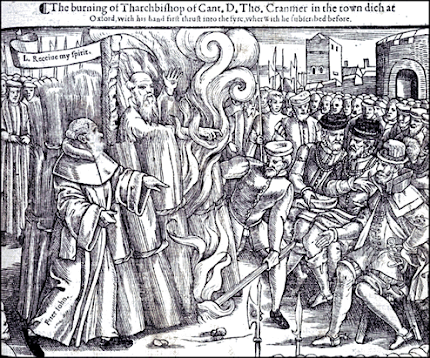
The burning of Tharchbishop of Cant. D. Tho. Cranmer in the town dich at Oxford, with his hand first thrust into the fyre, wherwith he subscribed before. [Click on the picture to see Cranmer's last words.]
Showing posts with label Decalogue. Show all posts
Showing posts with label Decalogue. Show all posts
Saturday, December 21, 2013
Patrick T. McWilliams: God's Law: The Wisdom of Israel


Thursday, July 25, 2013
Repost: Lutheran Order of the Decalogue
This is an article I wrote in 2009 on the Lutheran order of the decalogue. In particular, I wanted to repost this comment at the end of the article:
From: Why Luther Deletes the Second Commandment.Unfortunately, modern Evangelical Anglicans like many of those in the Sydney Diocese have sided with the modern church growth movement. They no longer use the prayer book or read the Decalogue during communion services. While they still recommend that ministers use the 1662 Book of Common Prayer or the Australian Prayer Book adopted in 1980, the use of liturgy to teach Scripture, creed, and evangelical theology is replaced with dumbed down "experiential" worship focusing on the subjective and ecstatic experience of the lay person rather than an intellectual grasp of the propositional truths of Holy Scripture. This blatantly anti-intellectual approach to worship downplays the didactic intent of Cranmer's liturgy and replaces it with what can only be described as an irrational and "liberal" view of worship. This sort of liturgical pragmatism may win short term gains in attendance and monetary rewards for the church but the long lasting effects of such an approach is pelagianism and liberalism, the very things Sydney claims to oppose. The same seems to be true in many Anglican congregations in the United Kingdom.The real purpose of the 1662 Book of Common Prayer is to teach the Evangelical faith and to evangelize all who attend the worship services by reading the penitential sentences or Scriptures in the Morning and Evening Prayer services and by reading both the Decalogue (law) and the Gospel in the liturgy itself. For Cranmer and the English Reformers real presence, veneration of images and the saints, and other departures from Scripture are not matters of indifference but matters central to the very Bible itself.
Tuesday, February 07, 2012
Darryl Hart: Escondido Theology Before Escondido
Darryl Hart has posted an article about John Frame's new book. Here is the lead in:
To read the rest of the article click here: Escondido Theology Before Escondido
In his new book, John Frame argues that two-kingdom theologians represent a novel development in the history of Reformed theology. In his introduction, he goes out of his way to explain that Escondido theologians reject Christendom. But this rejection creates a problem for 2k because the theologians of the sixteenth and seventeenth centuries taught that the magistrate had a duty to enforce the entire Decalague [sic]. “The two kingdoms view,” Frame writes, “goes beyond the Reformation theology in important ways. Indeed, except for the law/gospel dichotomy, its distinctive positions are American, not European.” (Frame also acknowledges that the roots of two kingdom theology are in Augustine’s City of God and Luther’s On Civil Authority. Go figure.) In fact, Frame goes out of his way to locate Meredith Kline as the source of these views.
To read the rest of the article click here: Escondido Theology Before Escondido
Subscribe to:
Posts (Atom)

 Posts
Posts


