>

Martyred for the Gospel

Martyred for the Gospel
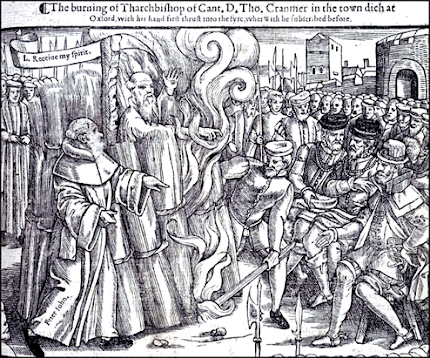
The burning of Tharchbishop of Cant. D. Tho. Cranmer in the town dich at Oxford, with his hand first thrust into the fyre, wherwith he subscribed before. [Click on the picture to see Cranmer's last words.]

Daily Bible Verse

Showing posts with label theonomy. Show all posts

Monday, June 12, 2017

Book Review: Calvin and the Whigs: A Study in Historical Political Philosophy


Book Review:  Calvin and the Whigs:  A Study in Historical Political Philosophy

“Like all other knowledge, our knowledge of God consists of certain propositions or truths. No doubt it is true that “that which God reveals of himself...is so rich and deep [presumably Bavinck means extensive and complicated] that it can never be fully known by any human individual.” But this is not because the knowledge of God is a peculiar and different type of knowledge: It is because life is too short to gain an understanding of the Bible. The defect lies in the shortness of human life, and often in the mediocrity of the man, not in the understandability of the revelation, for all Scripture is profitable for doctrine.”

Gordon H. Clark. The Trinity (Kindle Locations 1529-1533). The Trinity Foundation.

Ruben Alvarado.  Calvinism and the Whigs:  A Study in Historical Political Philosophy.  (Aalten:  Pantocrator Press, 2017).

The author of this work of historiography kindly sent me a review copy of the book.  But in keeping with my commitment to offer solid critical reviews as I have done before, I will simply say what I truly think.  His book purports to explicate the Huguenot point of view of political philosophy and to survey the evolution of political constitutionalism from the divine right of kings to a constitutionalism based on the Presbyterian or Calvinist view of political philosophy as advocated by the French Huguenots and their influence on the Dutch Reformed form of government as it existed under the Calvinist view of constitutionalism.  It is the thesis of the book that modern concepts of natural law are a departure from a more Christian worldview and political constitutionalism which, under the social contract theory of Hugo Grotius and John Locke, deteriorated into the secularist and anti-Christian civil religion of modernity.


As I am no expert in historiography I will only speak to what I can legitimately discern and deduce from the book based on the Calvinism of the late Dr. Gordon H. Clark as I can best understand his views.  At the outset I should acknowledge that I think Dr. Clark would have agreed that John Locke’s political philosophy and social contract theory ultimately leads to totalitarianism.  On that I can wholeheartedly agree with the author.


However, I should also point out that in my short life and due to the work load I have, I cannot claim to have time or resources to give a more detailed critique and review of Mr. Alvarado’s book.  While the quote from Dr. Clark above pertains to Bavinck’s doctrine of the unknowability of God, I think it also applies to how much learning is possible in this life.  It is not that I cannot learn more political philosophy and historiography but that in my short life of 57 years that has not been the primary focus of my personal studies after college and seminary.


I was troubled a bit by his giving credit in the foreward to the book to both Peter Leithart and Gary North for reviewing the manuscript.  I was troubled because Leithart is a promoter of the heresy of the Federal Vision and Gary North is an advocate of the theonomy movement.  From a Clarkian Scripturalist persepective this could indicate some presupposed biases on the part of the author.   However, in a Facebook message to me, Mr. Alvarado assured me that the reviews by Leithart and North were done several years ago prior to Leithart’s departure into the Federal Vision realm.  Also troubling was the use of the term “theocracy” to refer to the Calvinist form of government in Geneva and Holland.  I am not sure how Alvarado is defining theocracy.  Perhaps he means theonomic?  Technically speaking there are no prophets or apostles today nor were there any prophets in Geneva or Holland.  In order for there to be a true theocracy it would be required for there to be ongoing revelation from God as the case was with Moses, Joshua, and to a lesser extent, with the nation of Israel under the rule of David and Solomon, etc.  Since the Bible is the only special revelation from God today, political philosophy must be logically deduced from the Scriptures by good and necessary consequence.  (Westminster Confession of Faith 1:6).


The book is very detailed.  The problem with this is that I got bogged down in the inductive aspects of the book and the analysis.  But careful reading does yield several good points made by the author.  However, I was somewhat troubled by the fact that though the book is supposed to compare and contrast the Calvinist view of political constitutionalism and Whig political philosophy and constitutionalism, the author never fully defines either term.  On the one hand, he seems to say that the Calvinism of Geneva, Holland, and England under the Glorious Revolution are all Calvinist, he then proceeds to say that some Calvinists and Puritans under the Glorious Revolution were latitudinarians.  And on the other hand, even in the beginning of the book, Alvarado never defines exactly what a Whig is.  He simply presupposes that we all already know what a Whig is, although we are told that John Locke is a representative of the Whig political constitutionalism in England.  Also, to avoid any confusion, it should be pointed out that the Glorious Revolution is not the same event as the English Civil War or the Cromwellian Revolution.  (See also:  English Whig Party).


As best I can understand, however, it seems that the Whigs were a British political party who opposed the Tories.  The Whigs advocated for a constitutional government that compromised between the authority of a monarch and a more representative government of elected officials in the Parliament as opposed to the Tory advocacy for the divine right of absolute authority for the monarchy:  


This historiographical predilection presents Whigs as those who stood for progress, liberty, and parliamentary government; Tories, as those who stood for reaction, repression, and absolutist monarchy.  . . . The Whigs gained the predominance in England in 1688, in the wake of the so-called Glorious Revolution, in which William III of Orange assumed the throne, upon abdication of James II.  They proceeded to transform English society.  Their innovations proved so popular that England became the model of enlightened progress in Europe.  By the early nineteenth century everyone within the orbit of English politics and society had become permeated with their particular orientation, so much so that all the new political movements operated on terms the Whigs had established, thus in terms of post-Whig agendas, with this fundamental set of beliefs as common ground.  (Alvarado, pp. 1-2).


The basic thesis of the book is not about Calvin himself but about the theological and philosophical legacy of Calvin as it became known later as Calvinism.  In that view I would say that the book would have been better titled as Calvinism and the Whigs since Calvin himself predates the English Civil War, the Glorious Revolution, and Hugo Grotius and John Locke.  The author goes through a somewhat lengthy argument tracing the roots of constitutionalism and social contract theory all the way back to Augustine’s two kingdoms or two cities view of political and ecclesiastical authority or the two swords view of society.  According to the author, both Calvinism and Roman Catholicism have in common the two swords view and he then links together the Augustinians in both the papist camp and the Calvinist camp and says that both the papists and the Calvinists were favorable to a theocratic or theonomic view of the political constitutional system of government.


While I find his discussion of the development of Hugo Grotius’s natural law theory and the connection to John Locke’s social contract theory interesting and a fairly good analysis, it is troubling that the author thinks the problem originated with Grotius’s Arminianism and Locke’s latitudinarianism.  He overlooks the fact that Calvinism is deduced from the Bible.  The author in fact hardly ever mentions the Bible in his historiographical analysis or his analysis of political philosophy.  The main difference between Roman Catholicism and Calvinism is not latitudinarianism but the source of authority.  Calvinism derives its philosophy of political contract from the Bible, not from the church.  Roman Catholicism places the authority of the church above the authority of Scripture and emphasizes natural law every bit as much as Hugo Grotius and John Locke did.  This seems to be a typical error of theonomists in general where they think Roman Catholicism is a good thing and not part of the very latitudinarianism they complain about.  Furthermore, the author fails to see that placing the sacraments into the political realm and requiring political office holders to partake of the sacraments as keys to the kingdom opens the door for the very abuses that led to the halfway covenant in the Puritan colonies during the time of Jonathan Edwards and his grandfather:


This points, finally, to a subject which is universally neglected by modern historians because its importance is simply not recognized.  Perhaps the key issue of concrete debate during and after the Reformation concerned the nature of the sacrament of the Lord’s Supper.  . . . But the judicial element involved is neglected:  that the administration of the sacraments served to apply judicial decrees concerning inclusion in or exclusion from the Kingdom of Christ.  The ministers in applying these keys were acting in the place of Christ passing judgments in terms of His decrees.  Thus, the administration of the sacraments was considered “binding and loosing:” the application of the very judicial decree of Christ in a particular situation.  Precisely this power, the ramifications of which extend throughout a social order based in Christian faith, was what the secular and lay powers were concerned to remove.  And that explains the fierceness with which this debate was conducted.
Alvarado, pp. 172-173.

Worse, Alvarado has what can only be called a papist view of the sacraments here because the sacraments from a Calvinist perspective are held to be keys to the kingdom only in regards to church membership.  There is no necessary connection between election, regeneration, and church membership.  In fact, the invisible church is composed only of the elect while the visible church is fallible and has members who are both elect and reprobate.  The ministers of the Gospel and the Gospel sacraments are not vicars of Christ acting in the place of Christ.  The fact is the Westminster Confession of Faith outright denies that ministers are vicars of Christ.  Christ alone is the head of the church:

To these officers the keys of the kingdom of heaven are committed, by virtue whereof, they have power, respectively, to retain, and remit sins; to shut that kingdom against the impenitent, both by the Word, and censures; and to open it unto penitent sinners, by the ministry of the Gospel; and by absolution from censures, as occasion shall require. (WCF 30:2 WCS)

The Calvinist and Protestant view is that the Gospel and right belief in doctrinal matters is just as important as sanctification issues and the ministers are not the emphasis.  Rather, the Bible is the final authority, which is why Scripture is given the highest priority in the doctrinal and propositional system of theology deduced from the Bible by good and necessary consequence:

The whole counsel of God, concerning all things necessary for His own glory, man's salvation, faith and life, is either expressly set down in Scripture, or by good and necessary consequence may be deduced from Scripture: unto which nothing at any time is to be added, whether by new revelations of the Spirit, or traditions of men. Nevertheless, we acknowledge the inward illumination of the Spirit of God to be necessary for the saving understanding of such things as are revealed in the word; and that there are some circumstances concerning the worship of God, and government of the Church, common to human actions and societies, which are to be ordered by the light of nature, and Christian prudence, according to the general rules of the word, which are always to be observed. (WCF 1:6 WCS)

That being said, I found many of the points made during the discussion convincing.  I am not a theonomist or a supporter of theocracy.  However, it is worthwhile to consider that political philosophy should be deduced from the Bible since all knowledge begins with Scripture.  The author argues that when the role of the family in society is changed to individualism the result is a latitudinarianism whereby individual rights trump what is best for society as a whole.  On that point I can wholeheartedly agree but it should not be forgotten that God ordained the family in creation.  Natural law is nothing more than a form of utilitarian ethics whereby a plurality of individuals who emphasize individual freedom gain control and overpower the biblical values and principles upon which the society was originally founded.  It is literally true that whatever each person thinks is right becomes right.  But this overlooks the total depravity of the fallen human race and the noetic effects of sin  (Psalm 14:1-3; Romans 3:10-23; Romans 8:7).  This is another reason I object to the author’s downplaying of Roman Catholic complicity in latitudinarianism in the political realm, especially since Vatican II.  Basically the Roman Catholic Church is advocating full blown Pelagianism and not even semi-Pelagian anymore.


I object to the neo-orthodox views of the Van Tilian political philosophy whereby the church is to withdraw from the civic realm and allow the ungodly to rule the civic realm and the church should rule the ecclesiastical realm.  Ironically, theonomy originated with Cornelius Van Til’s theology and was promoted by Greg Bahnsen and others.  The author of this book is part of that theonomic philosophy and theology as far as I can tell.  Yet Van Til’s views also led to the very latitudinarianism to which theonomists object!  This is why you have the Westminster Seminary, California theology that emphasizes a total disconnect between the church and the political realm and another stream that originates from the Westminster Seminary, Philadelphia theology.  It is my opinion that both the disjunction between church and state that leads to the anti-Christian values of secular humanism and latitudinarianism and the theonomic view that emphasizes ecclesiastical militancy above biblical authority both lead to the same place.  That is unless our political philosophy is deduced from the Bible the end result will always be skepticism and totalitarianism.


Furthermore, I find it ironic that certain advocates of Clarkian Scripturalism have basically endorsed a form of secular humanism in reaction to their objections to Van Til’s theology and the theonomic views deduced from Van Til.  John Robbins, for example, worked for Ron Paul and supported Ron Paul’s political philosophy of libertarianism.  Every man literally does what is right in his own eyes.  Let it be said that Gordon H. Clark never agreed with libertarianism because it can never be deduced from the Bible.  On the other hand, theonomy is problematic because it leads to theological errors like the Federal Vision, semi-pelagianism, Arminianism and neo-orthodoxy.  The Westminster Seminary, California theology is equally problematic because it leads to antinomianism and latitudinarianism even more quickly.  Lee Irons and hiswife, Misty, for example, are spearheading LGBTQ rights in the civic realm due to the view that the two kingdoms are totally disjunctive and the one has nothing to do with the other.  Basically neo-orthodoxy leads to two extremes of what can only be called civil religion.  The theonomic civil religion endorses the latitudinarianism of theological pluralism and has no problem with the idolatries of Rome so long as biblical morality is loosely adhered to.  The antinomianism of the neo-orthodox views of Westminster California leads to endorsing perversion as a “natural” right in the civic realm and is therefore a form of atheism and secular humanism.  While the author does oppose the Westminster California endorsement of natural law, he seems to think that Roman Catholicism and Calvinism have something in common, which they do not.


I do recommend this book because the author does a good job of tracing the history of natural law and his explanation of what is wrong with natural law is worthy of consideration.  His view of the Dutch Calvinist government is also interesting.  However, he never mentions the fact that the cause of the fall of the Dutch Calvinist government can also be tied directly to the three points of common grace espoused by Abraham Kuyper, who also advocated for a peace treaty and co-belligerency between Calvinism and Rome.  The author seems to think that certain Calvinists rejected Calvin’s two sword view of the church and state and advocated latitudinarianism after the Glorious Revolution.  But the real problem is that the doctrine of common grace is semi-Arminian and raises natural revelation and natural law to the same level as biblical or special revelation and in fact undermines the Bible as the axiom for a solid epistemology for a Christian worldview and for a political theology and philosophy.  When common grace is emphasized above and beyond the special revelation of Scripture the result is skepticism because science and the arts gain equal authority to Scripture and it is not long before the very latitudinarianism that the author opposes results.  The Westminster divines were careful to exclude the traditions of men as a source of authority and it is troubling that Alvarado sees the Roman Catholic Church in such a positive light.  It in fact raises the question of whether or not Alvarado is in fact pushing a version of the Federal Vision heresy where culture and sacraments trump biblical Christianity?  Does he also disagree with the biblical definition of justification as do the Federal Visionists?


As I said before, the analysis of the historical development of secular humanism and social contract theory in the book is helpful.  But I cannot agree with the author that his brand of theocracy or theonomy is a solution to the problem.  As Dr. Gordon H. Clark so aptly pointed out:


By what right does a government exist?  Those who reject divine revelation base the state either on naked power and brutality, or on some sort of social contract, or on a natural development from the family.  Elsewhere I have argued in detail that the latter two reduce to the first;  with the result that secularism eventuates in dictatorship and totalitarian rule.  It is only in the Hebrew-Christian revelation, e.g. in the account of King Ahab and Naboth’s vineyard, that the rightful power of government is limited.

Dr. Gordon H. Clark.  “The Civil Magistrate,” in Essays on Ethics and Politics.  John Robbins, ed.  (Jefferson:  Trinity Foundation, 1992).   Pp. 22-23.

Wednesday, April 17, 2013

A. A. Hodge: The Judicial Law of Israel

I ran into another theonomist on Facebook.  Unfortunately, they cannot read the Westminster Confession for what it plainly says in Chapter 19 on The Law of God, paragraph:

4.  To them also, as a body politic, He gave sundry judicial laws, which expired together with the state of that people; not obliging any other now, further than the general equity thereof may require. (Exod. 21, Exod. 22:1–29, Gen. 49:10, 1 Pet. 2:13–14, Matt. 5:17, 38–39, 1 Cor. 9:8–10)

The Westminster Confession of Faith (Oak Harbor, WA: Logos Research Systems, Inc., 1996).
A. A. Hodge's commentary on the Westminster Confession of Faith says this about paragraph 4:

That the judicial laws of the Jews have ceased to have binding obligation upon us follows plainly, from the fact that the peculiar relations of the people to God as theocratical King, and to one another as fellow-members of an Old Testament Church State, to which these laws were adjusted, now no longer exist.

Hodge, A.A. (2011-02-17). A Commentary on The Westminster Confession of Faith With Scripture Proofs (Kindle Locations 3844-3846).  . Kindle Edition.
There is absolutely no mention of the moral law in relation to the judicial law or the ceremonial law.  If, as the theonomists assert, the judicial law is the same thing as the moral law, then surely the Westminster divines would have said so?  But instead the different paragraphs distinguish between the three types of law, namely the ceremonial law, the judicial law, and the moral law.  Christ has fulfilled the ceremonial law by sacrificing Himself as a propitiation for the sins of the elect individuals who belong to God.  The judicial law passed away with the Old Testament nation of Israel.  The moral law is forever binding, however.

As for the "general equity" clause, this is by no means meant to conflate the moral law with the judicial laws of the Old Testament nation of Israel.  Whatever it means, it cannot mean, therefore, what theonomists say it does.

Of course, it must be admitted that at the time the Westminster Confession was written there was no separation of church and state.  The state enforced both tables of the Decalogue (Exodus 20:1-17).  But even so it should be remembered that Geneva was not a theocracy.  The commentary by A. A. Hodge above makes that clear.

See also:  Article VII

Friday, November 16, 2012

Orthodox Semi-Pelagianism: Anglican Church in North America and Russian Orthodox Dialogue

 Oddly enough the Anglo-papists have more in common with other semi-pelagians in the Russian Orthodox Church than with the Evangelicals they "claim" to be a part of.  Go figure.  Rodney King theology at work: "Why can't we all just get along?"

On the other hand, Jesus and Paul seemed to have been exclusivist sectarians, not ecumenicalists.  That sort of thing could get you crucified or beheaded.  (Galatians 1:6-9; 2 Corinthians 11:3-4; John 12:25).

The Rev. Ray Sutton was once just a lowly bishop in a dwindling Evangelical continuing church called the Reformed Episcopal Church.  The REC is now a member of the Anglican Church in North America.  Although the REC was founded on Evangelical fellowship, it would appear that fellowship with papists and the eastern churches is more important that being faithful to the Anglican Formularies.  The Thirty-nine Articles of Religion clearly say that both Rome and the eastern churches are in serious error:

Article XIX

Of the Church

The visible Church of Christ is a congregation of faithful men, in the which the pure word of God is preached and the sacraments be duly ministered according to Christ's ordinance in all those things that of necessity are requisite to the same. As the Church of Jerusalem, Alexandria, and Antioch have erred: so also the Church of Rome hath erred, not only in their living and manner of ceremonies, but also in matters of faith.
My, how theonomy and reconstructionism deteriorates quickly into semi-pelagianism and idolatry.  It might also explain why the Federal Vision and Lordship Salvation errors are ravaging Presbyterianism.  The Reformed Episcopal Church was once solidly Reformed and Calvinistic. Theonomy and reconstructionist theology has lead that denomination into apostasy and the Anglo-Catholic/Tractarian error.  And folks like R. Scott Clark and Mike Horton dare to call folks like me "hyper-Calvinist"?  Go figure.  Even the Baptists are on board with this nonsense as Frank Turk of the Pyromaniacs blog is buddy buddy with none other than Doug Wilson, chief heresiarch of the Federal Vision error and also a theonomist/reconstructionist.  How the mighty have fallen.  (2 Samuel 1:19).


Click here to read the story:  Anglican Church in North America

See also:  Will the Real Ray Sutton Please Stand Up?

And:  Trinity Review:  Ecclesiastical Megalomania

Saturday, October 20, 2012

Painting with a Broad Brush: Evangelicalism and Reconstruction

See:  The Ten Commandments.


[The following is a response to an article, His Truth is Marching On, posted by Chris Smith at the alumni page for the University of California].

By Charlie J. Ray, M. Div.


Liberals just do not get it.  Like atheists who take out of context every Scripture that "appears" to contradict other Scriptures, political and theological liberals think that "all" Evangelicals are theonomists and reconstructionists simply because most Evangelicals believe in the moral law of God and that society should adhere to the moral law.  The distinction between  general principles/moral absolutes for a society and the detailed old testament case law advocated by theonomists in the United States is one that liberals fail to recognize.  They deliberately paint with a broad brush and overgeneralize Evangelicalism as a propaganda tactic.  If they can lump every Evangelical under the banner of theonomy or reconstruction it lends credibility to their agenda to marginalize and ostracize Evangelical religion.  A good example of this is seen in the quote from an online article from the University of Berkley, Rousas John Rushdoony's alma mater:

A small bear of a man with a white beard straight out of the Old Testament, Rushdoony named his headquarters the Chalcedon Foundation, after a 5th-century religious decree declaring God’s law supreme. He believed that modern America was in thrall to the false religion of secularism and that the only path to salvation was to reconstruct the nation according to Biblical law. It was a harsh vision: The federal government would be gutted, public education and Social Security abolished, debtors enslaved, and society reordered along patriarchal lines. Atheists, homosexuals, blasphemers, adulterers, incorrigible children, and a host of other offenders would be executed, as in the Old Testament. Once godly men had reclaimed the country, Jesus would return to usher in the new Kingdom.
Such extreme views made Rushdoony a bogeyman to the Left and marginalized him even among the Right. Nevertheless, many of his ideas have seeped into the conservative mainstream.
Rushdoony died in 2001 at age 84, but multiple candidates in this year’s Republican presidential primaries appeared to be channeling him. Minnesota Congresswoman Michele Bachmann, who has made Rushdoonian arguments on everything from taxes to homosexuality, called for the posting of the Ten Commandments in courtrooms, and for the nation to return to the Biblical principles upon which she says it was created. The country’s founders, she told a rally in 2003, “recognized the Ten Commandments as the foundation of our laws.”  From:  His Truth is Marching On | CAA

The fear that genuine Christianity strikes into the hearts of pagans and heathens in the liberal left is astounding.  Simply because of a few postmillennialist theonomists, Federal Visionists, and  reconstructionists the left thinks that "mainstream" Evangelicalism has been infiltrated by the evil of Christian morality.  Nevermind that the prohibition against murder and theft are also part of the Decalogue.  (Exodus 20:1-17).  The sixth commandment prohibits murder and the eighth commandment forbids murder.  And despite loosening morals in this country it is still generally considered wrong to commit adultery, which is prohibited in the seventh commandment.  Judging from the slippery slope fallacy then, all of America is in bondage to theonomy because murder and theft are criminal acts in the United States?  Even adultery is still considered morally wrong by the majority of Americans.  Moreover, the logic used by Chris Smith in the linked article is weak at best.  I hardly think that theonomy and reconstruction are singlehandedly responsible for the rise of the Moral Majority or the engagement of Evangelicals in the political processes of our nation.

For liberals the old line fundamentalists and dispensationalists were preferable to the new moral and political consciousness of a great majority of Evangelicals.  Harold Camping is the poster child for the liberal view on the separation of church and state because it is preferable that religious fanatics stay in the closet and withdraw into their private fortresses awaiting a rapture that never seems to arrive.  God forbid that anyone would agree with a postmillennialist view where the world becomes better and better until Christ returns!  No, I am not a postmillennialist.  My own view is amillennialist and I strongly disagree with postmillennialism for the simple reason that the Bible nowhere says the world will become better and better until Christ returns.  I am not a premillennialist or a pre-tribulation rapture person for similar reasons.  It is not taught anywhere in the Bible.  But the point is that postmillennialism has been around way before the Protestant Reformation.  If liberals should fear any church it ought to be the Roman Catholic principle of world domination and the pope's claim to be the vicar of Christ on earth.

Bill Moyer's interview with Rousas John Rushdoony was an attempt to say, "See?  These Evangelicals are 'all' crazy fanatics!  They want to stone homosexuals!"  The sad thing is these propaganda tactics and half truths score political points with those who do not understand Evangelicalism from the inside.  Straw man fallacies may be fallacious but history shows that repeating lies long enough by authority figures in the mainstream media establishes it as "fact" in the minds of the public at large whether or not it is true.  A good example of this is Adolf Hitler's campaign against the Jews where the Jews were said to be subhuman and unworthy of pity or human dignity.  The result of Hitler's propaganda dehumanizing the Jews was the genocide of over six million Jews, not to mention the millions of gypsies and other minority groups and political enemies of the Third Reich.  While the political left is not right wing, their propaganda campaign against religious freedom is a no-holds-barred attempt to make the United States a materialistic and atheistic secular state where religion is the opiate of the people and kept behind closed doors.  

On the other hand, there is no longer any shame or humiliation for acts that used to be considered taboo in society at large.  Now instead of ostracizing those who commit homosexual acts or live in homosexual relationships we see the shameless promotion of immorality as if Christian values are evil and gross perversion is the norm.  Where once abortion was considered the murder of an unborn human person, now we see abortion celebrated as a "woman's right" to kill her own offspring.  She gets off on a technicality.  The viable baby is only a "fetus" until it is actually born and that is true right on up until the moment of birth.  A child that could survive at the second or third trimester is just a "thing" dehumanized by the medical term "fetus".  When Roe v. Wade first became legislated by the Supreme Court in 1971, it was originally intended to be restricted to the first trimester.  Now that window is open for the entire nine months of pregnancy.  These abominations are not just opposed by theonomists and reconstructionists.  Most conservative Protestant, Catholic, and Eastern Orthodox churches oppose unjust laws that sanction the murder of the unborn, endorse perverse sexual deviancy, and attack traditional biblical morality regarding the family.

It is amusing that Mr. Smith is afraid of a handful of Evangelicals.  On the other hand, his lack of understanding of the diversity which exists in the Evangelical movement is alarming.  

In case Mr. Smith missed it, not every Evangelical is a theonomist or a reconstructionist, including me.  I have no intention of hiding away somewhere from the totalitarian left.  The left has virtually declared war on democracy, freedom, and religion.  The United States Constitution and the Bill of Rights are not atheistic documents but clearly founded on theistic principles.  The founding fathers guaranteed that the churches would not be taxed or suppressed by the government.  The fact that the Ten Commandments is engraved on the Supreme Court is proof enough that the moral law of God was intended to be part of the political process.  This is not establishing a particular church or denomination but simply recognizing that in general the views of the nation were pluralistic in regards to Christian denominations and churches.  What it did not mean and could never mean is that atheists have the right to censor, shut down, and silence any religious denomination.  The separation of church and state was not meant to create a materialistic, atheistic socialist state as we see the Democrats trying to do.  The principle of separation of church and state was meant to keep the state from interfering with religious freedom by either prohibiting religion or by establishing a state religion.  The attempt to make atheism the state "religion" is wrong because it make a particular a religious view, namely that there is no god, the established "religion" of the nation.  Mr. Smith does not get it that when Evangelicals are threatened with marginalization and even annihilation by a totalitarian leftist government they can and will utilize the political process to protect their rights.  

Moreover, Evangelicals in general are not theonomists.  They believe the Bible is the basis for the moral conscience of a nation and that certain moral precepts and principles are absolute.  Since the Ten Commandments and Christ's summary of the Decalogue in the two greatest commandments are general principles, it follows that they are not advocating all the particular criminal and civil laws and penalties of the old testament.  In fact, several of the Reformed confessions or doctrinal statements plainly state this principle:

THE Old Testament is not contrary to the New; for both in the Old and New Testament everlasting life is offered to mankind by Christ, who is the only Mediator between God and man, being both God and man. Wherefore there are not to be heard which feign that the old fathers did look only for transitory promises. Although the law given from God by Moses, as touching ceremonies and rites, do not bind Christian men, nor the civil precepts thereof ought of necessity to be received in any commonwealth; yet, notwithstanding, no Christian man whatsoever is free from the obedience of the commandments which are called moral.  [Thirty-nine Articles of Religion].

This is further substantiated because the Catechism of the 1662 Book of Common Prayer upholds the Ten Commandments as an outline of the moral law or principles that everyone is to live by in a civil society:
Question.
YOU said, that your Godfathers and Godmothers did promise for you, that you should keep God's commandments. Tell me how many there be?
    Answer. Ten.
    Question. Which be they?
Answer.
THE same which God spake in the twentieth Chapter of Exodus, saying, I am the Lord thy God, who brought thee out of the land of Egypt, out of the house of bondage. . . .  [Catechism].
Although it could be objected that the Ten Commandments are here in the context of the Anglican church and Christianity in general, it is not establishing a particular Christian denomination or church to abide by these principles in a nation at large.  While atheists and members of other world religions enjoy the same religious liberties as anyone else, the suppression of morality in favor of a utilitarian ethics ultimately undermines the very human rights that were produced by the Christian theism inherent in our founding documents.  It could be legitimately argued that in the Christian west democracy is a direct outgrowth of the Christian worldview.  Atheism leads ultimately to totalitarianism as anyone examining Communist China and the former Soviet Union can easily see.

The liberal left is not faithful to the democratic principles of the United States Constitution or the Bill of Rights.  Their agenda is to censor free speech, destroy conservative Christianity, and create a utilitarian socialist state.  Why would they be surprised that Christians would mobilize against such oppression and marginalization?  The title of the article is, "His Truth Is Marching On."  Beside the title is an oversized picture of Rushdoony.  The clear implication Chris Smith wants to convey is that it is Rushdoony's "truth" that is marching on.  For Evangelical Christians the only Person whose truth is marching on is the truth of Jesus Christ.  The Bible alone and Christ alone are our final authority, not Rousas John Rushdoony.  Until the left gets that message they will continue to be surprised by the resistance and the resiliency of conservative and Evangelical Christianity.  We will not withdraw from engagement with the political process.  Of that much the left can be absolutely sure.  It is the "secular theocracy" and postmodernist theocracy of the theological left that wants to establish religion.  Why would Evangelicals not oppose such blatant government attempts to establish a godless religion?

Thursday, March 29, 2012

Anglo-Papist Orthodoxy? AlbertMohler.com – ‘Mere Anglicanism’ and the Essence of Biblical Christianity

This audio is from 2009 and the Mere Anglicanism conference in Charleston, SC. Oddly enough, Mohler admires Rick Warren's support of Proposition 8 in California but not one word about Warren's ecumenicalism or his Arminianism. Also, Mohler is blatantly participating in an Episcopal conference predominated by "orthodox" Anglo-Papists. How can someone who claims to be a Calvinist endorse a soteriology that is papist???!


As the Episcopalian Church in the United States of America (ECUSA) has moved further into theological liberalism and away from biblical fidelity, many evangelical American Anglicans have ventured out in search of faithful church structures. In a special broadcast from the Mere Anglicanism Conference in Charleston (SC), Dr. Mohler welcomes Rev. Dr. William Dickson–rector of St. Andrews Episcopal Church in Forth Worth, TX–to the program to discuss the significance of these developments not only for Anglicans, but for evangelicals at large.

AlbertMohler.com – ‘Mere Anglicanism’ and the Essence of Biblical Christianity


Addendum:  Ironically, Mohler himself promotes morally conservative "civil religion":


Why I Signed the Manhattan Declaration


Further condemning evidence for compromise, Mohler thinks the Anglo-Papists are "Evangelical."  And in the discussion Mohler is duped into advocating the 1549 Book of Common Prayer as the ideal for Anglicanism.  What Mohler does not know is that though the 1549 BCP was edited by Cranmer it is NOT the most reformed prayer book.  Rather the 1552 BCP is the reformed standard that influenced the 1662 Book of Common Prayer, which is part of the Anglican Formularies.  The fact is that the 1549 BCP is upheld by the Anglo-Papists because they do not want to accept the 1552 reforms and the official 1662 Book of Common Prayer, nor do they accept the literal interpretation of the 39 Articles of Religion, which are Protestant.  I cannot believe that Mohler is so ignorant of the history of the English Reformation and the Tractarian controversy.

Wednesday, February 22, 2012

The President & The Prophet: Obama’s Unusual Encounter with Eric Metaxas - By Mark Joseph - The Corner - National Review Online

My remarks following are based on an article linked by the Aquila Report. As reported by Mark Joseph, President Obama was taken to task for his theological relativism on the issue of world religions and for his view that abortion is a viable choice for women with unwanted pregnancies. The speaker was Eric Metaxas. Unfortunately, the theologically liberal idea is that all religions have a core moralism that coincides. Basically, President Obama's theology is one that teaches that doctrine or special revelation is irrelevant as long as we all keep God's law. After all, we're all basically just good people.

Unfortunately, both Joseph and Metaxas have merely presented an Evangelical pietism that is as focused on a common moralism as that of the theological liberals. Evangelical pietists, although standing on the principle that Jesus Christ is the only way of salvation, diminish doctrine to a minimalism that is not that far removed from modernism and religious pluralism. Evangelicals and Catholics Together, the Manhattan Declaration, and other such documents are good examples of this. In fact, Joseph implies that "good" Roman Catholics are in because they believe in Jesus Christ and because they oppose abortion. Apparently, Joseph is unaware of the official Roman Catholic doctrine of implicit faith in other religions and that these other religions are not necessarily a cause for losing one's soul.

The short response here is that civil religion is as liberal and latitudinarian in some respects as the blatant religious pluralism and latitudinarianism of President of Obama. In the end, what unites Roman Catholics and Evangelicals is not a common doctrine of Jesus Christ and the cross, a common doctrine of Scripture, or a common doctrine of justification and the sacraments. What unites Roman Catholics and Evangelicals, according to Metaxas and Joseph is they are good Christians who uphold God's moral law which opposes the murder of the unborn. Of course abortion is infanticide. But how opposing murder makes one a Christian is a mystery. Many atheists and agnostics oppose abortion but that does not make them Christians.

What is problematic with this article is that it assumes Metaxas is some kind of prophet who foresaw the future. It does not require a divine revelation of the future to predict what President Obama might have been preparing to say at a prayer breakfast. Obama's background is in the liberal, mainline United Churches of Christ, a denomination that was once Reformed and Calvinist. Unfortunately, subjective pietism leads to this same loss of doctrinal and confessional standards--as any idiot can see when Protestants think Roman Catholicism is somehow akin to biblical Christianity and confessional Reformed theology. As the Westminster divines rightly saw in 1645, the pope is an anti-christ and the Roman Catholic Church is a synagogue of satan. Without realizing it Metaxas and Joseph are as liberal as Obama himself. Irony of ironies! Maybe Eric Metaxas ought to stick to Veggie Tales since his critique of Obama's theology is based on an anti-intellectualist perspective and a false Evangelical unity.

Click here to read the full article: The President & The Prophet: Obama’s Unusual Encounter with Eric Metaxas - By Mark Joseph - The Corner - National Review Online

Tuesday, February 07, 2012

Darryl Hart: Escondido Theology Before Escondido

Darryl Hart has posted an article about John Frame's new book. Here is the lead in:

In his new book, John Frame argues that two-kingdom theologians represent a novel development in the history of Reformed theology. In his introduction, he goes out of his way to explain that Escondido theologians reject Christendom. But this rejection creates a problem for 2k because the theologians of the sixteenth and seventeenth centuries taught that the magistrate had a duty to enforce the entire Decalague [sic]. “The two kingdoms view,” Frame writes, “goes beyond the Reformation theology in important ways. Indeed, except for the law/gospel dichotomy, its distinctive positions are American, not European.” (Frame also acknowledges that the roots of two kingdom theology are in Augustine’s City of God and Luther’s On Civil Authority. Go figure.) In fact, Frame goes out of his way to locate Meredith Kline as the source of these views.


To read the rest of the article click here: Escondido Theology Before Escondido


Friday, January 27, 2012

Fwd: New Book by Dr. John Frame "A Reformed Response to Escondido Theology"


Jesus answered, "My kingdom is not of this world. If My kingdom were of this world, My servants would fight, so that I should not be delivered to the Jews; but now My kingdom is not from here." (John 18:36 NKJ)

(See the ad from TheNiceneCouncil.Com which inspired this article here:  The Escondido Theology, by John Frame.  Charlie).


It looks like the neo-legalist Van Tilians and theonomists are up to more contumelious attacks against the doctrines of grace and the Gospel promises.  Legalists, being obsessed with their own ability to transform themselves and society, seem to think that only their efforts and thoughts and logic can possibly be correct.  I got a huge chuckle out of the following ad I received by e-mail from The NiceneCouncil.Com site concerning the new book by the multiperspectivalist "Reformed" writer, John Frame, The Escondido Theology.  We are told in the ad that, "Dr. Frame's insight and analysis clearly represents the Reformed Christian World and Life View because it is historically rooted in Calvinistic theology."

What is amusing about this bare assertion is that it makes a fallacious argument.  Simply asserting the conclusion that Frame's view "represents the Reformed Christian World . . . View" does not make it so.  If the premise is wrong then the conclusion is wrong as well.  First of all, the premise is that Frame's view "is historically rooted in Calvinistic theology."  But what does this mean?  Even the imminent church historian Carl Trueman of Westminster Theological Seminary, Philadelphia has acknowledged that there is no reified "Reformed tradition".  So how can Frame represent the entire Reformed Christian worldview if there is no such thing?  The fact is the Reformed tradition has from the beginning had competing factions and taken as a whole the movement is diverse and often at odds, including the divisions between modernists and traditionalists, between theonomists and two kingdoms theology, between confessional Reformed theology and the Federal Visionist/Auburn Avenue theology, between the advocates of neo-Kuyperian common grace and those who uphold classical Calvinist theology, and between the followers of Cornelius Van Til and the followers of Gordon H. Clark's Scripturalist presuppositional apologetics.

My advice to my readers is the same advice I received in college and seminary.  Do not trust secondary sources in forming your opinions about any position.  In other words, if you want to understand the two kingdoms theology then read the primary sources like Meredith Kline, Michael Horton, or R. Scott Clark.  Only after reading the primary sources can you then critically read the secondary source criticisms of the two kingdoms view.  I would say the same about Frame.  If you want to critique Frame, read Frame's works first and then read the criticisms made of Frame's work.  Unfortunately, John Frame's triperspectivalism or multiperspectivalism opens the door to subjectivism and relativism, which implies that Frame's views are less than biblically based propositional truth claims.  Although Frame places Scripture as the first premise of triperspectivalism, that is Scripture is the normative basis for the other two premises, the problem is that for Frame Scripture is not the final word on any matter at all. Obviously interpreting the Bible through the lens of triperspectivalist presuppositions like situational ethics and semi neo-orthodox existentialism as the the other two points of his theory makes Frame's presuppositional approach relativist and not Scripturalist. 

Gordon H. Clark's apologetics method is far superior since for Clark the logical propositions in Scripture are univocally God's thoughts on all matters of faith and practice.  Frame's approach, however, is inherently liberal since in the final analysis Frame makes the three branches of triperspectivalism equal in authority.  That is, for Frame Scripture is not the final authority but is simply one of three equals:  1) Scripture as the normative perspective, 2) Situational ethics as the situational perspective, and 3) Existential experience as the existential perspective.  It is this sort of thinking that has changed the focus of popular Reformed theology from the hereafter and transcendent theology to the here and now, this world, and transforming society.  Sound familiar? 


Yes, the social gospel, although on the left, had a similar emphasis on transforming society to make it more fair and equitable to the poor.  In doing so the doctrines of grace relating to the hereafter and where the soul would spend eternity were left by the wayside and a socialist, materialistic mentality took over to the point that Christianity for all practical purposes became simply an agnostic, atheist political organization rather than a metaphysical religion.

Although theonomists, reconstructionists, neo-legalists, and neo-Kuyperian Calvinists consider themselves as transforming society and fighting liberalism, they are in fact a right wing theocratic version of liberalism.  Ironically, the emphasis on the here and now, theology from below, and transforming society rather than preaching the Gospel and where the individual soul will spend eternity winds up leading in two undesirable directions.  On the one hand such thinking leads back to Rome and the papist mentality of ruling the world as vicars of Christ on earth.  On the other hand, theonomy, reconstruction, and neo-legalism leads to the very liberalism that theonomists "think" they are fighting against since ecumenicalism and co-belligerency in the political realm trumps the doctrines of grace (Galatians 1:6-9) and the promises of God (2 Corinthians 1:20).  These unforeseen consequences are indeed ironic. 

I would contend that transforming society has never been the focus of classical Reformed theology.  Jonathan Edwards' classic sermon, "Sinners in the Hands of an Angry God," is evidence enough of that.  The real question is, "Where will you spend eternity?"  (Matthew 16:15, 16).  The attempt to marginalize classical Calvinists and the biblical focus on the promises of God and eternity is a telling indictment against theonomy/reconstruction and its theological offshoot, the Federal Vision/Auburn Avenue heresy.

Wednesday, February 23, 2011

Chuck Colson: Advocate of the Manhattan Declaration and Latitudinarian "Evangelicalism"


Chuck Colson in an article posted at Christianity Today said:

An aversion to doctrine caused some thoroughly orthodox young evangelicals to decline to sign the Manhattan Declaration (which defends human life, traditional marriage, and religious liberty), even though the document is rooted in Scripture. As one young evangelical explained to me, "We don't like dogmatic statements that a lot of people have to sign." What about the Nicene Creed or the Westminster Confession of Faith?  [See link at Anglicans Ablaze: Doctrinal Bootcamp].

I almost choked on my coffee when I read that line.  Colson thinks that an "aversion" to doctrine caused folks like me not to sign the Manhattan Declaration?    I thought to myself, "Chuck, you have GOT to be kidding me????"   It is NOT an aversion to doctrine that caused many Reformed folks not to agree with the Manhattan Declaration.  In fact it was a CONCERN FOR DOCTRINE that caused us not to sign on the dotted line.  Why?  Because the Manhattan Declaration, like the other ecumenical documents endorsed by Colson, says that Roman Catholics and the Eastern Orthdox believe the same Gospel that Protestants believe.  That could not be further from the truth.  The fact is the anathemas of the 16th century canons of the Council of Trent still condemn Protestants.   To assume that Roman Catholics and other churches which teach faith plus good works as the basis for justification and salvation are "Christian" is to set naive people up to be deceived. 

One Presbyterian Church in America pastor recently told me that all that is necessary for salvation is that a church adheres to the three ecumenical creeds.   (See, How Far Has the PCA Fallen?) I guess that means that you don't need to believe that Scripture is the final authority?  Church tradition is an additional revelation alongside Scripture and you had better believe what the modern day apostles of Roman Catholicism and Eastern Orthdoxy tell you else you're violating God's Word revealed to them?

What exactly does the Manhattan Declaration say which is objectionable to born again and Reformed Christians?  Let me show you.  The Preamble says:

Christians are heirs of a 2,000-year tradition of proclaiming God's word, seeking justice in our societies, resisting tyranny, and reaching out with compassion to the poor, oppressed and suffering.

While fully acknowledging the imperfections and shortcomings of Christian institutions and communities in all ages, we claim the heritage of those Christians who defended innocent life by rescuing discarded babies from trash heaps in Roman cities and publicly denouncing the Empire's sanctioning of infanticide. We remember with reverence those believers who sacrificed their lives by remaining in Roman cities to tend the sick and dying during the plagues, and who died bravely in the coliseums rather than deny their Lord.

After the barbarian tribes overran Europe, Christian monasteries preserved not only the Bible but also the literature and art of Western culture. It was Christians who combated the evil of slavery: Papal edicts in the 16th and 17th centuries decried the practice of slavery and first excommunicated anyone involved in the slave trade; evangelical Christians in England, led by John Wesley and William Wilberforce, put an end to the slave trade in that country. Christians under Wilberforce's leadership also formed hundreds of societies for helping the poor, the imprisoned, and child laborers chained to machines.  [See, Read the Declaration].

Already we have confusion.  The Declaration says that "Christians" have advocated social justice and "resisted tyranny, reaching out with compassion to the poor, oppressed and suffering."  And who are these "Christians" Colson is talking about?  Apparently the pope  is included, the same popes who cursed and condemned Protestants and burned Protestants at the stake!   Colson lauds the "papal edicts of the 16th and 17th centuries" simply because they stood on the right side of the slavery issue.  Excuse me but who was it who decided to burn the English martyrs at the stake?  Has Colson not read Fox's Book of Martyrs?  I might add Colson conveniently glosses over the fact that John Wesley vehemently attacked both George Whitefield and Augustus Toplady for being Calvinists and preaching the doctrines of grace.  I wonder how Wesley related to William Wilberforce on a personal level since Wilberforce was also a committed Calvinist?

So what else is there in the Declaration to which I object on doctrinal grounds? 

DECLARATION

We, as Orthodox, Catholic, and Evangelical Christians, have gathered, beginning in New York on September 28, 2009, to make the following declaration, which we sign as individuals, not on behalf of our organizations, but speaking to and from our communities. We act together in obedience to the one true God, the triune God of holiness and love, who has laid total claim on our lives and by that claim calls us with believers in all ages and all nations to seek and defend the good of all who bear his image. We set forth this declaration in light of the truth that is grounded in Holy Scripture, in natural human reason (which is itself, in our view, the gift of a beneficent God), and in the very nature of the human person. We call upon all people of goodwill, believers and non-believers alike, to consider carefully and reflect critically on the issues we here address as we, with St. Paul, commend this appeal to everyone's conscience in the sight of God.  [Ibid.]
Did you get that?  Colson uses deliberately ambiguous terms to sucker and deceive Evangelicals.  The terms "Orthodox" and "Catholic" mean "right doctrine" and "universal" in some contexts.  No Christian would disagree that we need to believe the right doctrines or that we need to advocate a universally applicable Gospel to all nations (Matthew 28:18-20; Mark 16:15-16; Acts 1:8).  But Colson and the other authors of the Manhattan Declaration do not mean any of that here.  The reference is clearly to the Eastern Orthodox Church and the Roman Catholic Church.  The document conveniently overlooks the Great Schism of 1054 between the Eastern Orthodox Church and Rome over the issue of papal supremacy and it overlooks the Protestant Reformation as if neither of those cataclysmic events ever took place! 

The next paragraph sounds majestic but further confuses the Gospel by implying that basis for unity between Christians is not the Gospel and the Holy Scriptures but "moral" concerns:

While the whole scope of Christian moral concern, including a special concern for the poor and vulnerable, claims our attention, we are especially troubled that in our nation today the lives of the unborn, the disabled, and the elderly are severely threatened; that the institution of marriage, already buffeted by promiscuity, infidelity and divorce, is in jeopardy of being redefined to accommodate fashionable ideologies; that freedom of religion and the rights of conscience are gravely jeopardized by those who would use the instruments of coercion to compel persons of faith to compromise their deepest convictions.  [Ibid.]
And finally the punch line:

We are Christians who have joined together across historic lines of ecclesial differences to affirm our right—and, more importantly, to embrace our obligation—to speak and act in defense of these truths. We pledge to each other, and to our fellow believers, that no power on earth, be it cultural or political, will intimidate us into silence or acquiescence. It is our duty to proclaim the Gospel of our Lord and Savior Jesus Christ in its fullness, both in season and out of season. May God help us not to fail in that duty.  [Ibid.]
Did you get that?  The Manhattan Declaration says that the Eastern Orthodox Church, Roman Catholicism, and Evangelicals are all proclaiming "the Gospel of our Lord and Savior Jesus Christ in its fullness . . ."

And Chuck Colson has the nerve to say that R.C. Sproul is a young, orthodox and naive Evangelical who refused to sign the Manhattan Declaration because Sproul has an "aversion to doctrine"?  (See, Sproul:  Why I Did Not Sign the Manhattan Declaration).   The utter absurdity of such a statement is ridiculous.  It is not merely the young who have refused to sign.  Many of us have a mind and have rejected the Manhattan Declaration on doctrinal grounds and not because of an "aversion to doctrine". 

If the Manhattan Declaration is any indication, theological liberalism is setting in.  Colson's theology is latitudinarian at best.  Major "Evangelical" magazines are selling out the Gospel to a false gospel of good works and moralism.  If The Episcopal Church and the Anglican provinces in the UK and Canada are any indication we can clearly see where Colson's thinking leads.  It leads to theological and ecclesiastical relativism, modernism, liberalism and eventually apostasy.  Basically for Colson and his liberal cronies co-belligerency becomes accepting Roman Catholics and the Eastern Orthodox as "Christians" and as "brothers" in Christ.  But are they?  Not according to the historical evidence and the Reformed Confessions of Faith:  Westminster Standards, Three Forms of Unity, and the Anglican Formularies.  (The Anglican Formularies are The Thirty-nine Articles of Religion of 1571, the 1662 Book of Common Prayer, and the Ordinal, which is included in the 1662 Book of Common Prayer).

What is ironic is that the Westminster Confession of 1646 said that the Roman Catholic Church and Eastern Orthodoxy were "synagogues of satan" because of their level of doctrinal impurity.  It also said that the pope  was an "antichrist".   (See, Chapter 25. Of the Church.  Westminster Confession, 1646.  See also, Article 19 of the Thirty-nine Articles of Religion.  See also, Belgic Confession: Chapter 25, of the Marks of the True Church).

For Colson becoming a Christian is some vague Christianity of the last 2,000 years, presumably a Christianity that includes all the heresies of medieval Catholicism and Eastern Orthodoxy.  And even more disturbing, Colson expects Christians to blindly follow the leader to hell if necessary.  He uses the brainwashing techniques used in military boot camp as an illustration:

The psychology of boot camp is instructive. The first six weeks are spent—figuratively speaking, mostly—beating out of recruits every habit, attitude, and preconceived notion about life and the world. You are told you are worthless and are "not a special snowflake," as Campbell says. You are now part of the Marine Corps and will do what the drill instructor says. Period.  [Doctrinal Boot Camp].
If this sort of thinking does not alarm Calvinists, I wonder what would alarm them?  Colson reveals his true motive here.  He wants to brainwash Christians and have them blindly follow their pastors and other religious leaders without question.  He advocates "beating out" of new converts any tendency to read and study Scripture for themselves or think for themselves.  Such a view not only throws out the priesthood of believers but it totally rejects the doctrine of private interpretation of Scripture.   (See 1 John 4:1-3; John 5:39; 2  Timothy 3:15-17; 2 Timothy 2:15; 2 Peter 1:19-21; 2 John 1:7-11). Private interpretation does not exclude confessions of faith in writing or the creeds.  But it does mean that the Christian is to examine fallible documents by the Word of God and that would include examining the contents of sermons and testing those sermons by the creeds, confessions and by the ultimate and final rule of faith:  Holy Scripture.  Sola Scriptura!

Colson's view is more in line with the top down mentality of Roman Catholicism than with the Protestant Reformation.  One has to suspect that his view has been tainted by reconstructionism and theonomy, another theological error which Colson endorses.  In fact, the Manhattan Declaration and other ecumenical compromises are the perfect illustration of why theonomy and reconstructionism are in fact theological heresies.  Both emphasize the here and now and social action above the two kingdom theology of Scripture and therefore preach another gospel, which is no gospel at all.  (Galatians 1:6-9; 2 Corinthians 11:3-4).  Fact is, Roman Catholics and theonomy have more in common with each other than theonomy has in common with the true Gospel and biblical Christianity as it is expounded in the Westminster Standards, the Three Forms of Unity, and the Anglican Formularies.


May the peace of God be with you,

Charlie


Postscript:  Belgic Confession:  Chapter 25,  Of the Marks of the True Church


We believe that we ought to discern diligently and very carefully from the Word of God what is the true church, for all sects which are in the world today claim for themselves the name of church.[1] We are not speaking here of the hypocrites, who are mixed in the church along with the good and yet are not part of the church, although they are outwardly in it.[2] We are speaking of the body and the communion of the true church which must be distinguished from all sects that call themselves the church.


The true church is to be recognized by the following marks: It practises the pure preaching of the gospel.[3] It maintains the pure administration of the sacraments as Christ instituted them.[4] It exercises church discipline for correcting and punishing sins.[5] In short, it governs itself according to the pure Word of God,[6] rejecting all things contrary to it[7] and regarding Jesus Christ as the only Head.[8] Hereby the true church can certainly be known and no one has the right to separate from it.

Those who are of the church may be recognized by the marks of Christians. They believe in Jesus Christ the only Saviour,[9] flee from sin and pursue righteousness,[10] love the true God and their neighbour[11] without turning to the right or left, and crucify their flesh and its works.[12] Although great weakness remains in them, they fight against it by the Spirit all the days of their life.[13] They appeal constantly to the blood, suffering, death, and obedience of Jesus Christ, in whom they have forgiveness of their sins through faith in Him.[14]

The false church assigns more authority to itself and its ordinances than to the Word of God. It does not want to submit itself to the yoke of Christ.[15] It does not administer the sacraments as Christ commanded in His Word, but adds to them and subtracts from them as it pleases. It bases itself more on men than on Jesus Christ. It persecutes those who live holy lives according to the Word of God and who rebuke the false church for its sins, greed, and idolatries.[16]

These two churches are easily recognized and distinguished from each other.


[1] Rev 2:9. [2] Rom 9:6. [3] Gal 1:8; 1 Tim 3:15. [4] Acts 19:3-5; 1 Cor 11:20-29. [5] Mt 18:15-17; 1 Cor 5:4, 5, 13; 2 Thess 3:6, 14; Tit 3:10. [6] Jn 8:47; Jn 17:20; Acts 17:11; Eph 2:20; Col 1:23; 1 Tim 6:3. [7] 1 Thess 5:21; 1 Tim 6:20; Rev 2:6. [8] Jn 10:14; Eph 5:23; Col 1:18. [9] Jn 1:12; 1 Jn 4:2. [10] Rom 6:2; Phil 3:12. [11] 1 Jn 4:19-21. [12] Gal 5:24. [13] Rom 7:15; Gal 5:17. [14] Rom 7:24, 25; 1 Jn 1:7-9. [15] Acts 4:17, 18; 2 Tim 4:3, 4; 2 Jn 9. [16] Jn 16:2.


--
Reasonable Christian Blog Glory be to the Father, and to the Son : and to the Holy Ghost; Answer. As it was in the beginning, is now, and ever shall be : world without end. Amen. 1662 Book of Common Prayer

Support Reasonable Christian Ministries with your generous donation.