>

Martyred for the Gospel

Martyred for the Gospel
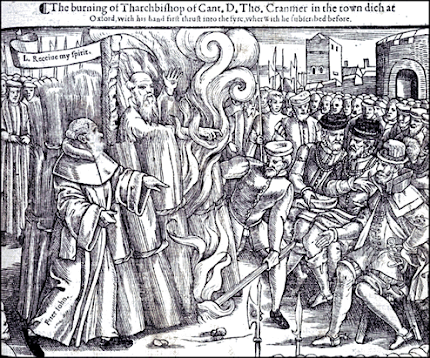
The burning of Tharchbishop of Cant. D. Tho. Cranmer in the town dich at Oxford, with his hand first thrust into the fyre, wherwith he subscribed before. [Click on the picture to see Cranmer's last words.]

Daily Bible Verse

Showing posts with label Evangelicalism. Show all posts

Saturday, December 14, 2024

A Short-Term Mission Trip to Nicaragua: Part Two


“The first and basic point in a Christian philosophy of education, or a Christian philosophy of anything, is Biblical authority.  Just as Platonism is defined by what Plato wrote, and not by the decadent skeptical Academy of later years, so the ultimate definition of Christianit not the decadent confusion of the liberal churches, not the pronouncements of the Pope, not the inconsistent opinions of a so-called Christian community, as is so frequently asserted in ecumenical circles, but what is written in the Bible.  . . .”  Dr. Gordon H. Clark.  A Christian Philosophy of Education.  1946.  3rd Ed.  (Trinity Foundation: Unicoi, 2000).  P. 86.


A Short-Term Mission Trip to Nicaragua:  Part 2


To avoid confusion, let me say upfront that I am no longer a Pentecostal, a Charismatic, or a continuationist.  I am a cessationist of the highest degree.  I totally repudiate the experiential theology of the classical Pentecostal movement, and I particularly dislike and reject the so-called third wave of the Pentecostal movement or the Charismatic movement.  My purpose in writing this article is to lay out the many reasons that I am no longer a Pentecostal.  I gave a brief testimonial of my first time going to church to show why I was early on influenced by the Pentecostal movement, as that is a major part of the Evangelical movement in the Bible belt South.  Fortunately, I would later learn that there were other options, particularly the Presbyterian churches.

Following my family history, it came to pass that my father lost his job at Friedman’s Jewelry Store as a watch and jewelry repairman because of the Timex watch and other modern innovations.  Our family had now grown to seven children.  I have three younger sisters and three younger brothers, being the eldest of the seven.  My father took new employment in central Florida working in the phosphate mines in Polk County.  Unfortunately, only a few years after moving to Florida, he was killed in a car crash south bound on U.S. 17 just north of the Hardee County line.

My mother was left as a widow with seven children, and I was only 12 and in the 6th grade at the time.  Fortunately, I had visited a Presbyterian church in Wauchula, Florida several times with our neighbors in Wauchula, Florida a year or two before moving to my hometown of Bowling Green, Florida.  It was there that I began to read about Calvinism and double predestination in the Encyclopedia Britannica that my father had purchased in Alabama before we moved to Florida.  Say what you will, but in the days prior to the internet the Encyclopedia Britannica was full of useful information. I followed the chain index and read about infralapsarianism and supralapsarianism; I read about the Synod of Dort and the Arminian Remonstrance, all at an early age.

Unfortunately, in Bowling Green there was no Presbyterian church.  The church I had attended in Wauchula was formerly part of the Presbyterian Church in the United States or PCUS.  But there was a controversy over the ordination of women as teaching elders in the early 1970s.  The pastor and the congregation of First Presbyterian Church voted to leave the PCUS and join with the new formed Presbyterian Church in America or PCA.  I was too young at the time to understand all the issues.  However, it left an indelible mark on my memories.  I later learned that Pastor Thoms had given up his retirement and other benefits because of his commitment to biblical truth.

Moving on to the story, my mother became an alcoholic a few years after my father passed away.  She did not attend church and did not profess to be a Christian.  I was left to care for my siblings, along with my two oldest sisters.  As time went on and in high school, I became involved with smoking marijuana and experimenting with other drugs.  I was not serving the Lord during this time.

Without airing too much dirty laundry let me say that I am not proud of that period of my life.  After high school this pattern continued.  At one point I almost dropped out of high school, but my mother and a few friends encouraged me to go back and graduate, which I did.  I opted not to go to college.  Instead, one of my mother’s many boyfriends after my father’s death helped me to get a job working at a phosphate mine in Brewster, Florida. 

After only a few years, that was not working out.  I started out working hard labor on the section crew, a crew of railroad maintenance workers which maintained about 11 miles of railroad tracks between the Fort Lonesome mine and the Brewster mine.  I bid on a dragline oiler job and went from working all day shift to working a rotating shift.  I got along well with my operator at first.  He even let me learn to swing and dig with the huge machine with the 45 cubic yard bucket.

As time went on, however, we had a falling out because I was caught sleeping on the job.  I left and joined the U.S. Navy for almost two years.  At that point, things did not work out for me, and I was given an honorable discharge because I was not suitable for military service.  I returned to work at the Brewster mine because I was a member of the union.  While I was gone, one of the foremen on the section crew had become a Christian.  He was a black man named Sam Johnson.  I later learned that he was illiterate.  He could not read or write.   However, he knew the Bible backwards and forwards.  He carried a Gideon’s pocket New Testament with the Psalms in the King James Version.  What a coincidence that was.  During break times he would witness to me.  He did so by handing me the Gideon’s New Testament and asking me to read a passage.  After I read it, he would then explain it to me, most likely as he had been taught by his pastor or someone in the Sunday school class at Mount Olive Missionary Baptist Church in Bradley Junction, just down the road from Brewster.

This was the beginning of a renewal of my Christian faith.  After a few more hardships, I began attending First Assembly of God, Wauchula, Florida.  I gave up my drug use and turned fully to God.

Here ends Part 2 of my story about my Christian faith and my short-term mission trip to Nicaragua in 1989.  Please read my next post tomorrow.


You can read Part 1 of my series here:  A Short-Term Mission Trip to Nicaragua:  Part 1

Part 3

Monday, August 08, 2016

Is There a Universally Recognized Human Right to Homosexual Immorality and Same Sex Marriage?


It is quite frustrating to see Evangelical theologians missing the whole point in their comments about homosexuality, transgenderism, and same sex marriage.  The vast majority of them are trying to find common ground with secular humanists who have invented their own facade which they call "human rights."  [See:  Is Same Sex Marriage a "Human Right"?]  The real question is who decides what these human rights are and how is the deduction made?  Is there an objective standard for determining morality?

This where I am strongly an advocate of the late Dr. Gordon H. Clark's presuppositionalism.  According to Dr. Clark's apologetics, everyone starts with undemonstrable and unprovable axioms or starting points.  This is clearly true of empirical science as well since empiricism is really based on logical positivism of one degree or another.  In fact, Dr. Clark went so far  as to say that empirical science is based on the fallacy of affirming the consequent.  Basically, a theory is a presupposition and the scientist finds every inductive evidence he or she can to affirm the theory.  So why is it that two scientists can examine the same inductive evidence with two different theories and come up with affirming conclusions for two different presupposed theories from the same evidence?  Even scientists are fideists.  [See:  Science and Truth].

The answer, of course, is that they have affirmed the conclusion beforehand.  If it is raining, the streets are wet.  The streets are wet, therefore it is raining.   If A, then B.  B, therefore A.  Of course there could many other factors involved that could cause the streets to be wet.

Logical positivism is self refuting because it says that only what can be learned from the five senses is legimately knowledge.  But the beginning premise is itself not capable of observation since it is an abstract proposition that can only be thought with the mind.  Do animals understand the proposition that 2 + 2 = 4?

To cut the argument short I would ask the question that if everyone--including scientists--begins with presupposed axioms, why would the world at large fault the Christian for beginning with the axiom of Scripture?  All knowledge for the Christian worldview begins with Scripture as the axiom.  Scripture is the God-breathed Word of God.  Every single word is fully inspired by God.  (2 Timothy 3:16; Matthew 4:4; 2 Peter 1:19-21; Psalm 119:89).

I keep repeating this point but it is worth repeating again.  Is the human mind just a product of chemistry in a body, a brain of grey matter?  Or is the human mind really a soul created by God through providence and natural generation?  Philosophers of science have yet to solve the mind/body problem.  Exactly how does the brain produce a thinking and sentient soul in the first place?  Yet we have psychologists and psychiatrists pronouncing yet another fallacy of affirming the consequent.  If there are genetic and biological predetermining factors that could cause homosexuality and transgender dysphoria, then there will be homosexuals and persons with transgender dysphoria.  There are actually homosexuals and transgender confused persons, therefore homosexuality and transgender dysphoria must be caused by genetic and biological predispositions of the human body.  But presupposing this is again affirming the consequent.  If A, then B.  B, therefore A.

The fact that no empirical scientist can demonstrate how a brain can manifest a thinking and sentient soul should raise questions about the logical fallacy of presupposing a confused individual was born with a man's body and a woman's mind or vice versa.  Just because a person has same sex attractions, does that prove that the person was biologically or genetically predetermined to that lifestyle or attraction?  The cause could be psychological disorders rather than genetics or biology.  Presupposing that the streets are wet because it is raining ignores the fact that the street could be wet because a water line broke some other place and flooded the area.   The same is true of presupposing the consequent and finding causes to support the consequent.  There could be any number of other causes underlying homosexuality and transgenderism.

Finally, do we know that there is some set of human rights that everyone universally is entitled to?  According to secular humanism these rights are "universally recognized."  But is that statement itself true?  Obviously not since every culture has different customs.  In ancient Greek and Roman societies sexual promiscuity and homosexuality and even pedophilia were commonly accepted practices.  In Christian societies these are taboos.  In short, presupposing a set of human rights based on popular opinion is a contradiction because there is no universally recognizable authority for developing a set of human rights.  Popular vote does not determine morality per se because morality is maleable and relative to each society.  Unless there is a deontological basis for morality there can be only a totalitarian determination of morality by the state.  For Christianity there is a higher authority than human opinions.  That authority is the Word of God, the Holy Scriptures.  We ought to obey the governing authorities and the civil authority.  (Romans 13:1-14).  But when the government commands Christians to accept homosexual marriage, transgenderism, and the murder of unborn babies, the Christian has a higher obligation to obey God rather than man.  (Acts 4:19, 5:29).  In recent comments President Obama said that Christians must accept the dogma of secular humanism and change the teaching of the Scriptures.  [See:  Christian Churches 'Must be Made to Affirm Homosexuality'].  The dogma of homosexual marriage and transgenderism is soon to be a legally enforced doctrine of the socialist state.  The same thing has been said by Hillary Clinton in regards to abortion.  Christians must accept the dehumanization of human babies or face legal sanctions, according to Clinton.  [See: Hillary Clinton: Force Christians to Change Their Religious Views to Support Abortion].

[Cf. Leviticus 18:22-23; Romans 1:27; 1 Corinthians 6:9-11; Genesis 19:5; Judges 19:22; Deuteronomy 22:5; Leviticus 19:28; 1 Kings 18:28]

I will ask this question again.  Which god is it that gives human beings the right to murder infants and practice perversions like homosexuality and mutilate their bodies to look like the opposite biological sex?  (2 Corinthians 4:3-6).  

Is Donald Trump any better?  No.  Trump is for using tax dollars to fund Planned Parenthood, which exists solely for women's health issues.   Of course, the term "women's health" in liberal jargon means the right to murder an infant in the womb at any stage of development from conception up to just prior to a normal birth at nine months.  Viability is not the determining factor but sheer dehumanization of a human person.  Even Hillary Clinton acknowledged that an unborn child is a person in a rare slip of the tongue:   [Hillary Clinton Admits That Abortion Kills a ‘Person’].   Donald Trump is a relativist in regards to morality as his affirmation of the LGBTQ lobby clearly shows.  Trump is no friend of Evangelical Christianity and to affirm his candidacy is the same as attacking Christianity since he would uphold totalitarian laws restricting religious freedom and theological dissent from the dogmas of the secular humanism state.

For the Christian the final authority in all matters of morality, faith, and practice is not the secularist state or socialism.  Instead the Christian is obligated to obey God when there is a conflict between state dogma and biblical deontological morality.  The Christian cannot in good conscience obey laws that command him or her to recognize a perversion as "marriage" or obey laws that command them to recognize a woman's right to murder her unborn baby at any stage after conception up to and including just prior to a normal birth.  The sixth commandment says, "Thou shalt not murder."   (Exodus 20:13).  The Bible is a book that is logical and propositional in nature and it is perfectly legitimate to logically deduce civil and judicial laws based on the morality revealed in the general principles of the Decalogue and the other moral laws revealed in Holy Scripture.  [See Westminster Confession of Faith, Chapter 1:6].

 6.      The whole counsel of God concerning all things necessary for His own glory, man’s salvation, faith and life, is either expressly set down in Scripture, or by good and necessary consequence may be deduced from Scripture: unto which nothing at any time is to be added, whether by new revelations of the Spirit or traditions of men. (2 Tim. 3:15–17, Gal. 1:8–9, 2 Thess. 2:2) Nevertheless, we acknowledge the inward illumination of the Spirit of God to be necessary for the saving understanding of such things as are revealed in the Word: (John 6:45, 1 Cor 2:9–12) and that there are some circumstances concerning the worship of God, and government of the Church, common to human actions and societies, which are to be ordered by the light of nature, and Christian prudence, according to the general rules of the Word, which are always to be observed. (1 Cor. 11:13–14, 1 Cor. 14:26, 40).   WCF 1:6.

In short, true Christians are at this time a small minority or remnant in the United States of America and around the world.  Most of the western countries are now openly socialist, materialistic, and hostile to biblical Christianity.  Persecution is just around the corner.  How much longer will the liberal media and the totalitarian state be content with religious freedom?  They are already willing to take away the second amendment right to bear arms.  The freedom of speech and freedom of religion is also on their hit list as relative to the socialist and secular humanist agenda to stamp out the archaic religions of the past and replace them with theological relativism and secular atheism.  Those who are supporting Trump are not offering a legitimate alternate but simply affirming the same result but with a different leader.  Trump is willing to equivocate and dissimulate to win the Evangelical vote.  But in the end Trump's agenda is no different from the agenda of the far left.  His only points of difference with them is on the issue of open borders and free trade or the Transpacific Partnership.  Other than that Trump is still a socially progressive liberal.  But the question is how is it progress when America is regressing to atheism and paganism rather than staying true to the Christian values deduced from the Bible?  It is the rule of law that is deduced logically from the Scriptures that has made our nation great and that has caused western civilization to advance peace around the world.  Instead the secularists want to exalt an intolerant pluralism that does not include the right to believe the Bible literally as it is logically and propositionally revealed from God himself.  The best summary of the system of propositional truth in the Holy Scriptures is the Westminster Confession of Faith.

Humans alone are created in the image of God.  Since God is a spiritual being with no body, it logically follows that the image of God cannot be a material body.   (John 4:24).  It is man's soul which is spiritual and immaterial and it is this spiritual and immaterial soul that is the image of God.  God, being Logic (John 1:1), enlightens every man with the ability to think.  (John 1:9).  Man is not a tabula rasa at birth but is innately endowed with the ability to reason, think logically, keep time, remember the past, and examine contingencies to predict various outcomes for future events.   [See:  The Image of God in Man, by Dr. Gordon H. Clark].  If morality is relative to culture, then morality changes with culture.  The basic premise of secular humanism is that deontological ethics deduced from the archaic Scriptures of Christianity is subject to revision.   Tomorrow it might be perfectly fine to eliminate subhuman homeless persons who have nothing to contribute to society.  Unborn babies are merely a source of human body parts used to enhance the lives of those better able to pay for this service and who have something more significant to contribute to a socialist utopia.  Any political or theological dissent based on an objective standard of morality is intolerable to the secularists.  Although they pretend to be tolerant the one thing they cannot tolerate is legislating morality.  Instead they prefer to legislate immorality and outlaw religious dissent based on the proposition that the Bible is the plenary and verbally inspired words of God and without error in every proposition recorded therein.

Thinking Christians need to stand for the truth and make it known that relativism and progressivism is not an option and that they are willing to suffer persecution if necessary.   Those so-called Evangelical  churches that are more concerned with not losing their tax exempt status--read state licensed or state controlled churches--are not faithful to the Scriptures but to the state.  This distinction will become even more evident as time goes on.

Some so-called Scripturalists are libertarians or libertines.  They believe the axiom that nothing is wrong except what harms another person.  But the Decalogue and the Scriptures disagree.  Leaving out the first table of the Ten Commandments is unconscionable.  Belief in the God of the Bible is the very bedrock of a democratic and constitutional Republic.  Without the Bible the rule of law means nothing.  I end with the question,  "How do you deduce a libertarian political philosophy from the logical and propositional system revealed in the Bible by good and necessary consequence?"

Charlie J. Ray, M.Div.


Wednesday, November 06, 2013

Dr. Mark Thompson: The Sydney Family Album


An aberration within the Anglican communion worldwide, the Sydney Diocese of the Australian Anglican Church has often been accused of "puritanism," "fundamentalism," and other "dirty words," as the last archbishop, Dr. Peter Jennings, liked to say.  However, the evangelical and calvinist nature of Anglicanism in Sydney is to be applauded.  

Although I have a few theological disagreements with Dr. Thompson, namely his Amyraldian view of the atonement, Moore Theological College should be held in high regard for its theological stand for the Bible.

Click here to read more:   The Sydney Family Album

Saturday, October 20, 2012

Painting with a Broad Brush: Evangelicalism and Reconstruction

See:  The Ten Commandments.


[The following is a response to an article, His Truth is Marching On, posted by Chris Smith at the alumni page for the University of California].

By Charlie J. Ray, M. Div.


Liberals just do not get it.  Like atheists who take out of context every Scripture that "appears" to contradict other Scriptures, political and theological liberals think that "all" Evangelicals are theonomists and reconstructionists simply because most Evangelicals believe in the moral law of God and that society should adhere to the moral law.  The distinction between  general principles/moral absolutes for a society and the detailed old testament case law advocated by theonomists in the United States is one that liberals fail to recognize.  They deliberately paint with a broad brush and overgeneralize Evangelicalism as a propaganda tactic.  If they can lump every Evangelical under the banner of theonomy or reconstruction it lends credibility to their agenda to marginalize and ostracize Evangelical religion.  A good example of this is seen in the quote from an online article from the University of Berkley, Rousas John Rushdoony's alma mater:

A small bear of a man with a white beard straight out of the Old Testament, Rushdoony named his headquarters the Chalcedon Foundation, after a 5th-century religious decree declaring God’s law supreme. He believed that modern America was in thrall to the false religion of secularism and that the only path to salvation was to reconstruct the nation according to Biblical law. It was a harsh vision: The federal government would be gutted, public education and Social Security abolished, debtors enslaved, and society reordered along patriarchal lines. Atheists, homosexuals, blasphemers, adulterers, incorrigible children, and a host of other offenders would be executed, as in the Old Testament. Once godly men had reclaimed the country, Jesus would return to usher in the new Kingdom.
Such extreme views made Rushdoony a bogeyman to the Left and marginalized him even among the Right. Nevertheless, many of his ideas have seeped into the conservative mainstream.
Rushdoony died in 2001 at age 84, but multiple candidates in this year’s Republican presidential primaries appeared to be channeling him. Minnesota Congresswoman Michele Bachmann, who has made Rushdoonian arguments on everything from taxes to homosexuality, called for the posting of the Ten Commandments in courtrooms, and for the nation to return to the Biblical principles upon which she says it was created. The country’s founders, she told a rally in 2003, “recognized the Ten Commandments as the foundation of our laws.”  From:  His Truth is Marching On | CAA

The fear that genuine Christianity strikes into the hearts of pagans and heathens in the liberal left is astounding.  Simply because of a few postmillennialist theonomists, Federal Visionists, and  reconstructionists the left thinks that "mainstream" Evangelicalism has been infiltrated by the evil of Christian morality.  Nevermind that the prohibition against murder and theft are also part of the Decalogue.  (Exodus 20:1-17).  The sixth commandment prohibits murder and the eighth commandment forbids murder.  And despite loosening morals in this country it is still generally considered wrong to commit adultery, which is prohibited in the seventh commandment.  Judging from the slippery slope fallacy then, all of America is in bondage to theonomy because murder and theft are criminal acts in the United States?  Even adultery is still considered morally wrong by the majority of Americans.  Moreover, the logic used by Chris Smith in the linked article is weak at best.  I hardly think that theonomy and reconstruction are singlehandedly responsible for the rise of the Moral Majority or the engagement of Evangelicals in the political processes of our nation.

For liberals the old line fundamentalists and dispensationalists were preferable to the new moral and political consciousness of a great majority of Evangelicals.  Harold Camping is the poster child for the liberal view on the separation of church and state because it is preferable that religious fanatics stay in the closet and withdraw into their private fortresses awaiting a rapture that never seems to arrive.  God forbid that anyone would agree with a postmillennialist view where the world becomes better and better until Christ returns!  No, I am not a postmillennialist.  My own view is amillennialist and I strongly disagree with postmillennialism for the simple reason that the Bible nowhere says the world will become better and better until Christ returns.  I am not a premillennialist or a pre-tribulation rapture person for similar reasons.  It is not taught anywhere in the Bible.  But the point is that postmillennialism has been around way before the Protestant Reformation.  If liberals should fear any church it ought to be the Roman Catholic principle of world domination and the pope's claim to be the vicar of Christ on earth.

Bill Moyer's interview with Rousas John Rushdoony was an attempt to say, "See?  These Evangelicals are 'all' crazy fanatics!  They want to stone homosexuals!"  The sad thing is these propaganda tactics and half truths score political points with those who do not understand Evangelicalism from the inside.  Straw man fallacies may be fallacious but history shows that repeating lies long enough by authority figures in the mainstream media establishes it as "fact" in the minds of the public at large whether or not it is true.  A good example of this is Adolf Hitler's campaign against the Jews where the Jews were said to be subhuman and unworthy of pity or human dignity.  The result of Hitler's propaganda dehumanizing the Jews was the genocide of over six million Jews, not to mention the millions of gypsies and other minority groups and political enemies of the Third Reich.  While the political left is not right wing, their propaganda campaign against religious freedom is a no-holds-barred attempt to make the United States a materialistic and atheistic secular state where religion is the opiate of the people and kept behind closed doors.  

On the other hand, there is no longer any shame or humiliation for acts that used to be considered taboo in society at large.  Now instead of ostracizing those who commit homosexual acts or live in homosexual relationships we see the shameless promotion of immorality as if Christian values are evil and gross perversion is the norm.  Where once abortion was considered the murder of an unborn human person, now we see abortion celebrated as a "woman's right" to kill her own offspring.  She gets off on a technicality.  The viable baby is only a "fetus" until it is actually born and that is true right on up until the moment of birth.  A child that could survive at the second or third trimester is just a "thing" dehumanized by the medical term "fetus".  When Roe v. Wade first became legislated by the Supreme Court in 1971, it was originally intended to be restricted to the first trimester.  Now that window is open for the entire nine months of pregnancy.  These abominations are not just opposed by theonomists and reconstructionists.  Most conservative Protestant, Catholic, and Eastern Orthodox churches oppose unjust laws that sanction the murder of the unborn, endorse perverse sexual deviancy, and attack traditional biblical morality regarding the family.

It is amusing that Mr. Smith is afraid of a handful of Evangelicals.  On the other hand, his lack of understanding of the diversity which exists in the Evangelical movement is alarming.  

In case Mr. Smith missed it, not every Evangelical is a theonomist or a reconstructionist, including me.  I have no intention of hiding away somewhere from the totalitarian left.  The left has virtually declared war on democracy, freedom, and religion.  The United States Constitution and the Bill of Rights are not atheistic documents but clearly founded on theistic principles.  The founding fathers guaranteed that the churches would not be taxed or suppressed by the government.  The fact that the Ten Commandments is engraved on the Supreme Court is proof enough that the moral law of God was intended to be part of the political process.  This is not establishing a particular church or denomination but simply recognizing that in general the views of the nation were pluralistic in regards to Christian denominations and churches.  What it did not mean and could never mean is that atheists have the right to censor, shut down, and silence any religious denomination.  The separation of church and state was not meant to create a materialistic, atheistic socialist state as we see the Democrats trying to do.  The principle of separation of church and state was meant to keep the state from interfering with religious freedom by either prohibiting religion or by establishing a state religion.  The attempt to make atheism the state "religion" is wrong because it make a particular a religious view, namely that there is no god, the established "religion" of the nation.  Mr. Smith does not get it that when Evangelicals are threatened with marginalization and even annihilation by a totalitarian leftist government they can and will utilize the political process to protect their rights.  

Moreover, Evangelicals in general are not theonomists.  They believe the Bible is the basis for the moral conscience of a nation and that certain moral precepts and principles are absolute.  Since the Ten Commandments and Christ's summary of the Decalogue in the two greatest commandments are general principles, it follows that they are not advocating all the particular criminal and civil laws and penalties of the old testament.  In fact, several of the Reformed confessions or doctrinal statements plainly state this principle:

THE Old Testament is not contrary to the New; for both in the Old and New Testament everlasting life is offered to mankind by Christ, who is the only Mediator between God and man, being both God and man. Wherefore there are not to be heard which feign that the old fathers did look only for transitory promises. Although the law given from God by Moses, as touching ceremonies and rites, do not bind Christian men, nor the civil precepts thereof ought of necessity to be received in any commonwealth; yet, notwithstanding, no Christian man whatsoever is free from the obedience of the commandments which are called moral.  [Thirty-nine Articles of Religion].

This is further substantiated because the Catechism of the 1662 Book of Common Prayer upholds the Ten Commandments as an outline of the moral law or principles that everyone is to live by in a civil society:
Question.
YOU said, that your Godfathers and Godmothers did promise for you, that you should keep God's commandments. Tell me how many there be?
    Answer. Ten.
    Question. Which be they?
Answer.
THE same which God spake in the twentieth Chapter of Exodus, saying, I am the Lord thy God, who brought thee out of the land of Egypt, out of the house of bondage. . . .  [Catechism].
Although it could be objected that the Ten Commandments are here in the context of the Anglican church and Christianity in general, it is not establishing a particular Christian denomination or church to abide by these principles in a nation at large.  While atheists and members of other world religions enjoy the same religious liberties as anyone else, the suppression of morality in favor of a utilitarian ethics ultimately undermines the very human rights that were produced by the Christian theism inherent in our founding documents.  It could be legitimately argued that in the Christian west democracy is a direct outgrowth of the Christian worldview.  Atheism leads ultimately to totalitarianism as anyone examining Communist China and the former Soviet Union can easily see.

The liberal left is not faithful to the democratic principles of the United States Constitution or the Bill of Rights.  Their agenda is to censor free speech, destroy conservative Christianity, and create a utilitarian socialist state.  Why would they be surprised that Christians would mobilize against such oppression and marginalization?  The title of the article is, "His Truth Is Marching On."  Beside the title is an oversized picture of Rushdoony.  The clear implication Chris Smith wants to convey is that it is Rushdoony's "truth" that is marching on.  For Evangelical Christians the only Person whose truth is marching on is the truth of Jesus Christ.  The Bible alone and Christ alone are our final authority, not Rousas John Rushdoony.  Until the left gets that message they will continue to be surprised by the resistance and the resiliency of conservative and Evangelical Christianity.  We will not withdraw from engagement with the political process.  Of that much the left can be absolutely sure.  It is the "secular theocracy" and postmodernist theocracy of the theological left that wants to establish religion.  Why would Evangelicals not oppose such blatant government attempts to establish a godless religion?

Sunday, August 12, 2012

C.S. Lewis: An Anglo-Catholic Latitudinarian and a Bridge to Rome

"The result is a generic Christianity that suits anyone anywhere who can in any way relate to God. Lewis bent over backwards trying to find common ground with all denominations, omitting any doctrine that may be deemed offensive."  -- J. Saunders


The Berean Beacon has once again made a solid argument against the popular view that C. S. Lewis was somehow an Evangelical.  The truth is Lewis was an advocate of a broad latitudinarianism and Anglo-Catholic theology.  J. Saunders wrote the following article about Lewis.  Here is a brief excerpt:

In 1952, C.S. Lewis published his theological work Mere Christianity, which originally began in 1942 as a three-part BBC radio broadcast. As the title suggests, Lewis focused on the mere or common ground he felt existed in Christianity and tried to restate a theology without controversy. The result is a generic Christianity that suits anyone anywhere who can in any way relate to God. Lewis bent over backwards trying to find common ground with all denominations, omitting any doctrine that may be deemed offensive. For this reason, Tolkien disparagingly labelled his friend “Everyman’s Theologian.” Even Mormons find his writings inoffensive.

“He [Lewis] is widely quoted from tried-and-true defenders of Mormon orthodoxy. It just shows the extraordinary acceptability and the usefulness of C.S. Lewis because, of course, most of what he says is perfectly acceptable to Mormons.” 6
Mere Christianity has long been regarded a classic exposition of the Christian faith, yet oddly enough, not one Bible verse is quoted in the first half of the book and only three partial verses in the latter half with no Bible references in the entire book. How can we present Christianity without its foundation – the Word of God?
To read the entire article click here:  C. S. Lewis: A Bridge to Rome

See also:  The Ruling Elder:  Was C. S. Lewis an Anglo-Catholic?

Wednesday, February 22, 2012

Carl F. H. Henry and Kenneth Kantzer Lectures on Evangelicalism

Dr. Carl F. H. Henry
The following links are at the Henry Center website of Trinity Evangelical Divinity School.  Please click on these links to see the videos of the lectures:

Know Your Roots:  Part 1:  Kenneth Kantzer

Know Your Roots:  Part 2:  Carl F. H. Henry

Know Your Roots:  Part 3:  D. A. Carson:  Q & A

Know Your Roots:  Part 4:  Discussion Continued


Unfortunately, the lecture of Kenneth Kantzer is overly optimistic about Neo-Evangelicalism and centers on a doctrinal minimalism that reduces Evangelicalism to an ecumenical unity that even includes Roman Catholics as having "Evangelicals" in the ranks of the Roman Catholic Church.  Unfortunately, the Roman Catholic Church still officially condemns the Gospel in the canons of the Council of Trent. 

Kantzer also confuses civil religion with biblical Christianity as if being a Christian is more about opposing abortion and pornography and homosexual marriage than promoting the law/gospel distinstinction and the ordinary means of grace.  Kantzer's lecture is typical of the theology of glory and social transformation rather than the eternal consequences for souls who reject the theology of the cross.

Carl F. H. Henry, a student of Gordon H. Clark believed that the Bible is literally the Word of God and consists of binding propositional truth claims in logical form.  Carl Henry's critique of Evangelicalism is much more pointed and biblical and Reformed in nature.  He does not give a blanket endorsement to any and every claim to be "Evangelical" but focuses on the doctrinal issues at stake.  See lecture number 2.  Yet, even Carl Henry was a bit too optimistic.  Cultural involvement is not necessarily a sure way to transform society. Henry himself overlooked the dangers of the Neo-Evangelical ecumenicalism that reduced the distinctions between Arminianism and Calvinism, Reformed and classical Protestant theology and the neo-paganism of the Pentecostal/Charismatic movement, and the differences between Rome and Geneva to merely issues of degree rather than absolute differences that separate true Christianity from false Christianity.

Henry's warning at the end of the lecture concerning the postmodernist view is applicable to Michael Horton's new systematic theology, which in my opinion gives away the bank to the postmodernists and the neo-orthodox view.

In Christ,

Charlie

Addendum:  After carefully listening to all four of these sessions, I have to say the entire thing is overly optimistic, particularly in light of the open hostility between Arminians and Calvinists and particularly the open hostility between Pentecostal/Charismatics and the Reformed side of things.  Evangelicalism is indeed a meaningless term and so is the term "Calvinist" these days.  The internecine theological and cultural wars within the Reformed traditon between the Clarkians and the Van Tilians, between the Federal Visionists and the more traditional Calvinists, and even the hostility between Lutherans and Calvinists all points to what is basically a facade of "unity" in Evangelicalism.  Basically, the only unity that exists is on the political front, a unity which is in name only as well.  As Westminster Seminary California likes to point out, any secularization of the church and accommodation to the culture is in the end detrimental to the Gospel.

I was particularly amused when Carl Henry called Jimmy Carter an "Evangelical".  If Carter is an Evangelical, then so is Barack Obama!  Carter was part of the "moderate" wing of the Southern Baptist Convention, which then left and started another denomination.  Basically, Kenneth Kantzer wound up being more honest in saying there is no real unity.  I think Carl Henry wound up being a Baptist and not a confessional Reformed theologian.  In the end his Baptist theology led him in the direction of a facade we call "broad Evangelicalism".  It is indeed 3,000 miles long and 1/4 inch deep.

Charlie

Thursday, February 09, 2012

Anglicans Ablaze: The Anglican Church in North America: An Alternative Episcopal Church

This is the latest article by Robin Jordan over at Anglicans Ablaze:


The fundamental declarations of the Anglican Church in North America, the doctrinal provisions of its canons, its Ordinal, and the two reports of its Prayerbook and Common Liturgy Taskforce clearly show that the Anglican Church in North America is following in the footsteps of the Episcopal Church. As I noted in my last article in the series on the ACNA theological lens and the guiding principles behind its proposed Prayer Book, the Anglican Church in North America may be described as an alternative Episcopal Church in which two groups are putting their ideas of ecclesiastical governance, church order, worship, and the like into practice.

These two groups represent two movements that influenced Episcopalianism in the twentieth century. The first movement is the Anglo-Catholic movement. Its origin may be traced to the Tractarian and Ritualist movements of the nineteenth century. The second movement is the Ancient-Future, or Convergence, movement. . . .


Click here to read the rest of the article: Anglicans Ablaze: The Anglican Church in North America: An Alternative Episcopal Church


The Two Kingdoms Theology and Ecumenical Contradictions


Jesus answered, "My kingdom is not of this world. If My kingdom were of this world, My servants would fight, so that I should not be delivered to the Jews; but now My kingdom is not from here." (John 18:36 NKJV)


The Two Kingdoms Theology and Ecumenical Contradictions

At the risk of being considered an isolationist, a fundamentalist, and a divisionist I have decided to write this article to discuss what I consider to be self-contradictory in regards to the two kingdoms theology of Michael Horton and others. While these theologians make strong statements about the separation of church and state and the two kingdoms, namely the kingdom of God and the kingdom of the world, these same men continually make ambiguous statements about what the kingdom of God actually is and who belongs to that kingdom.

The real issue comes down to this: who is in and who is out? Mike Horton did an entire campaign a couple of years ago about Christless Christianity and said that much of Evangelicalism is essentially pelagian due to the influence of Charles Finney. I applauded his efforts. But when Horton came under fire for his views by the wider Evangelical community he backed off that statement and said that Arminians are not really semi-pelagians or pelagian. In fact, Horton has had William Willimon, an Arminian, on the White Horse Inn and he has had David Virtue of VirtueOnline on the program as well. Virtue is an open advocate for Anglo-Catholicism, though he pretends to be an “Evangelical”. If Evangelicalism includes Anglo-Papists, the Eastern Orthodox, and Roman Catholics in addition to the semi-pelagian Arminians, then for all practical purposes the term “Evangelical” is meaningless. The great Anglican Reformed minister, Augustus Toplady called Arminianism, The Road to Rome. If the syncretism of the Pentecostal/Charismatic movement with Christian Science, the prosperity gospel, Word of Faith movement, oneness Pentecostalism, and charismatic Roman Catholicism is part of Evangelicalism, then we are in a world of trouble (2 Corinthians 4:4). Some theologians in the Reformed tradition claim to be non-cessationists. Unfortunately most of them compromise with the errors mentioned above in some way or another. (See Mike Horton: Reformed and Charismatic?).

In light of what I just pointed out above, I am wondering how Horton could appeal to a village green or a big tent if he really believes in the two kingdoms theology? Who actually belongs to the kingdom of God? According to Horton to belong to the village green or the big tent all you need to believe is that the Bible is inspired of God and that it is inerrant and that God is three persons in one divine nature, the statement of faith of the Evangelical Theological Society. (See Doctrinal Basis). Is Horton equating Evangelicalism, the village green, and the big tent with “the kingdom of God”? If so, what is his justification for universalizing what should be particularized by a systematic confessional theology based on a wholistic biblical theology? If all “Evangelical” religion leads to God and Evangelicalism is so heterodox as a whole, then how can it be anything other than a secularizing movement in the church, as Edmund P. Clowney put it in his article, The Politics of the Kingdom?

But this sort of reductionism on the part of Horton and other advocates of the 2k view is troubling. If he thinks that there are two kingdoms, would not the kingdom of God be defined by a systematic confession of what Scripture teaches as a whole? Horton's view of the village green reminds me of the Lambeth Quadrilateral of 1888. That statement was drafted by the Anglo-Catholics and reduced essential doctrine to four main points:

1. The Holy Scriptures, as containing all things necessary to salvation;
2. The Creeds (specifically, the Apostles' and Nicene Creeds), as the sufficient statement of Christian faith;
4. The historic episcopate, locally adapted.


Obviously the Protestant Reformers, being committed to the Scriptures as the final authority in all matters of faith and practice, would not have reduced the principle for fellowship and communion to the two utilized by Horton and the Evangelical Theological Society. Most Evangelicals reject apostolic succession and any sacerdotal interpretation of the two Gospel sacraments. The Tractarians, however, accept all seven of the papist sacraments whole hog. Evangelical and Reformed Anglicans totally reject the Anglo-Catholic interpretation of the 39 Articles of Religion, the sacraments or any other Papist spin put on the English Reformation.

Even the National Association of Evangelicals has for all practical purposes become just another liberal ecumenical organization and is dominated by Pentecostals and Charismatics. Practically all the Reformed churches immediately after the separation from Rome formulated detailed confessions of faith, not short, pithy reductions to minimalist requirements. If the Scriptures contain everything a Christian is required to believe, then obviously reducing it all down to “Jesus wept” is unconscionable. (John 11:35).

Some Evangelicals and some Reformed pastors and teachers say that the basis for fellowship should be the ecumenical creeds. But this is simply a reduction of the Lambeth Quadrilateral into a more tolerable form. Although the ecumenical or catholic creeds are essential to saving faith, they are not the only essentials for saving faith. Additionally, a proper understanding of the five solas of the Reformation and the Law/Gospel distinction are absolutely necessary to a proper understanding of soteriology. Calvinism and Arminianism are mutually exclusive of one another and cannot be teaching the same Gospel message since for Arminians man saves himself ultimately by his own efforts to cooperate with God.

It seems to me that the only true basis for fellowship is to adhere to one of the Reformed standards consistently and along with that to affirm the catholic creeds. Everything else leads to either liberalism or to Rome or worse. (Anglican Formularies; Three Forms of Unity; Westminster Standards).


--
Reasonable Christian Blog Glory be to the Father, and to the Son : and to the Holy Ghost; Answer. As it was in the beginning, is now, and ever shall be : world without end. Amen. 1662 Book of Common Prayer

Monday, July 05, 2010

Confessional Anglicanism and the History of Evangelical Anglicanism


[Nota bene: The following is an excerpt from an article in the Churchman, 106/3 1992, “Evangelicals and History,” by David Samuel. I particularly agree with his stance that the Bible must have a confessional interpretation or a formal statement by the church clearly outlining what we believe together as the body of Christ. In particular, Evangelical Anglicans ought not to be against the other Reformed confessions, including the Lambeth Articles of 1595, the Second Helvetic Confession, the Three Forms of Unity, and the Westminster Standards. To simply advocate the 39 Articles without further particularization leaves the door open to secondary heresies like Arminianism and Amyraldianism, neither of which were intended to be “allowed” by the 39 Articles or the Anglican Formularies. (See the Formula Consensus Helvetica). That makes about as much sense as saying that John Stott's view of annihilationism is “allowable” under the 39 Articles. That is far from the case. We are obligated to accept all that Scripture affirms wherever that may lead, including God's double decrees to election and reprobation. In fact, I would contend that election and reprobation are openly taught in Article 17 of the 39 Articles, although many refuse to accept the plain teaching of the text that those who are not elect are under God's “sentence.” I would contend that so-called Evangelicals who emphasize ecumenical unity with “orthodox” Anglo-Catholics have forgotten their history and have more in common with the papists than with the English Reformers. There is increasing evidence that the Sydney Anglicans and the Anglican Church League are following the example of the Reformed Episcopal Church where the “Anglican” Quadrilateral is emphasized above the Protestant Reformation. Oddly enough, it is James I. Packer who is also advocating the “Quadrilateral” above the Reformed confessions of faith. This can be clearly seen from this article at the Trinity School for Ministry, “A Case for Evangelical Anglicanism.” Obviously I strongly disagree with any emphasis on ecumenical relations with Anglo-Catholics, who are basically papists and hostile to the Five Solas of the English and Protestant Reformation.]


2. The second consequence of Keele has been to leave evangelicalism in the Church of England exposed and at the mercy of fashionable movements and theologies which have little Scriptural warrant about them. Historical waymarks are of great assistance in determining the right road to follow, but these were swept away by those who were intolerant of history. We have no need of them, was the cry; we have no need of the Thirty-nine Articles, we have the Bible and that is enough. But Bishop Ryle in his wisdom thought differently and warned many years ago of the danger of taking such a position. In his paper ‘The Importance of Dogma’ he wrote:

It is not enough to say, ‘We believe the Bible’. We must distinctly understand what the leading facts and doctrines of the Bible are; and this is exactly the point where Creeds and Confessions are useful. Those who care to study this subject will find it admirably handled in a Scotch book, entitled ‘Dunlop’s uses of Creeds and confessions of faith’. Burke’s speech in the House of Commons, on Archdeacon Blackburn’s petition, is also well worth reading ... He truly says, Subscription to Scripture alone is the most astonishing idea I ever heard, and will amount to no subscription at all.


It seems to me that Bishop Ryle was clearly right and that, paradoxically, the appeal to the Bible apart from the Confessions really represents a flight from the teaching of the Bible. That was so in the case of Archdeacon Blackburn’s petition, which was opposed by Burke in the House of Commons. That petition was presented on behalf of the Arian clergy who objected to the orthodox Trinitarian doctrines of the Thirty-nine Articles. They did not want to be bound by such teaching and so they wished to replace subscription to the Articles with subscription simply to the Bible. In this way they thought they would be free to follow their own beliefs. That was true of the Arian clergy of the eighteenth century, but why should evangelicals adopt a similar plea in the twentieth century? It seems to me that if you say you believe the Bible, sooner or later you must state what you believe the Bible teaches on God, man, sin, salvation and so forth. If you do that you will surely come up with something very much like the Thirty-nine Articles and the other Protestant Confessions of Faith. Why then should anyone seek to divide the confessions from Scripture unless in fact they are seeking to escape from the doctrines of Scripture, which are those of historical evangelicalism? By thus sweeping away those historical waymarks of evangelicalism the right path for contemporary evangelicals has been obliterated and the movement has been made vulnerable to the incursion of teaching from sects and heresies.

--
Reasonable Christian Blog Glory be to the Father, and to the Son : and to the Holy Ghost; Answer. As it was in the beginning, is now, and ever shall be : world without end. Amen. 1662 Book of Common Prayer

Sunday, March 23, 2008

Episcopal Stations of the Cross: Christianity Today Blows It Again

[Note:  Since this blog article was originally posted Edith Humphrey converted to the Eastern Orthodox Church.  The theology of the EOC churches is notably semi-pelagian and not monergistic.  Ironic that Dr. Humphrey remains a professor at a mainline "Presbyterian" seminary.  It only shows how far down a seminary and a denomination goes when it rejects Scripture as the final authority and the classical Reformed confessions of faith.  In the place of Scripture common grace, general revelation and reason become the ruling authority and from there relativism and irrationalism are the final word.  Note that Dr. Humphrey was at one time ordained with the Salvation Army.  Does anyone doubt that Arminianism leads to Rome or Constantinople?  Think again!  Click on the title above to see the Christianity Today article.  2/27/2012.  Charlie.]

In a recent critique, Christianity Today criticized the Episcopal Church for advocating a replacement of the traditional liturgy for the stations of the cross with goals for eliminating world poverty in the third millennium. While this was a worthy attempt at a critique, Christianity Today woefully blew it by distorting the Gospel themselves.

The author of the article, Susan Wunderink, quotes from Edith Humphrey, a professor at Pittsburgh Theological Seminary (Presbyterian Church USA, which is itself liberal) to show Humphrey's disagreement. However, in posting Humphrey's remarks Wunderink tacitly endorses Humphrey's own distortion of the Gospel in Matthew 25's parable of the sheep and the goats:

"Like the song, "God Has No Hands But Our Hands," it forgets the sovereignty of God," she said. "God does use us, but he's the initiator. It's so sad to see the gospel diluted to simply being kind to others. I don't think that a gospel like that really communicates the grandeur of God and what he's done for us in Christ."
So far so good. However on page two of the article, Humphrey goes on to say:
The Episcopalian materials urge meditation on Matthew 25, Jesus' parable of the sheep and the goats, as "the mandate of Episcopal Relief and Development." Humphrey emphasized that there is much justification for the principles of the Millennium Development Goals in Scripture, but said that's not the point of Jesus' parable. Jesus, she said, was talking about how he will honor non-Christians' mercy and service to his representatives.


"It simply shows to me a lack of care in using the Scriptures in context," Humphrey said.


And here is the problem with Professor Humphrey's criticism of the liturgy. She herself winds up distorting the Gospel by allowing that "non-Christians" are somehow going to be saved simply by the good works that they did in mercy to Christ's "representatives." This is just another example of how Christianity Today has implied that justification is by faith plus works or has attacked the doctrine of justification by faith alone (sola fide), a cornerstone of the Protestant Reformation and the very Gospel itself. It seems obvious to me that Miss Humphrey is supportive of the Anglo-Catholic tradition which denies the doctrine of justification by faith alone which is taught in Scripture and in the English Thirty-Nine Articles of Religion. Either that or her liberal theology has biased her against the exclusiveness of the way of salvation through the cross of Jesus Christ. It is indeed a sad day when an allegedly "evangelical" magazine pushes works righteousness as a means of justification before God for salvation.

The truth is that Matthew 25's parable of the sheep and the goats is directed to Christians in the visible church. By their fruits you will know who is a genuine Christian and who is not a genuine Christian (see Matthew 7:15-23). Likewise, in the final judgment many false Christians in the church will be exposed as goats and not sheep. Those who turn out to be false Christians will be lost. But this parable in no way implies that we are justified before God on the basis of our own merits, good works or any such thing. When interpreted in the total context of the Bible, including the pauline passages, sanctification is a necessary result of being justified by faith alone. However, sanctification is merely an outworking of a genuine conversion, the fruit of justification by faith alone. It is not and cannot be the means of justification before God for Christians or even non-Christians for that matter.

The fact that Jesus is talking about Christians is obvious from Matthew 25:34 where he refers to election from before the foundation of the world and verse 37 where he refers to them as "righteous." Since we know from Paul's apostolic teaching that the "righteous" are righteous by faith alone, then Matthew 25:37 cannot possibly refer to "non-Christians" as Miss Humphrey contends!

Miss Humphrey has betrayed her misunderstanding of the Gospel and so has Miss Wunderink by printing the comments without further criticism or remark. Miss Wunderink in effect has implied that Humphrey's remarks are correct, which they are not.

The Thirty-Nine Articles of Religion clearly disagrees with Humphrey's interpretation of the Gospel:
XI. Of the Justification of Man.
WE are accounted righteous before God, only for the merit of our Lord and Saviour Jesus Christ by faith, and not for our own works or deservings. Wherefore that we are justified by faith only is a most wholesome doctrine, and very full of comfort; as more largely is expressed in the Homily of Justification.

XII. Of Good Works.
ALBEIT that good works, which are the fruits of faith and follow after justification, cannot put away our sins and endure the severity of God's judgement, yet are they pleasing and acceptable to God in Christ, and do spring out necessarily of a true and lively faith, insomuch that by them a lively faith may be as evidently known as a tree discerned by the fruit.

XIII. Of Works before Justification.
WORKS done before the grace of Christ and the inspiration of the Holy Spirit, are not pleasant to God, forasmuch as they spring not of faith in Jesus Christ, neither do they make men meet to receive grace, or (as the School authors say) deserve grace of congruity: yea, rather for that they are not done as God hath willed and commanded them to be done, we doubt not but they have the nature of sin.
This is just another frustrating example of the ignorance of so-called "Evangelicals" who have no clue as to what the Gospel actually is. I am beginning to wonder if Christianity Today has any right to make any claims about the Gospel at all since the magazine is continually getting it wrong. I am by no means a "fundamentalist." I am merely a Protestant who holds firmly to the doctrines of the Bible and stands in the tradition of the Protestant Reformers.

May God have mercy!

Addendum:


Article XVIII


Of obtaining eternal salvation only by the name of Christ

They also are to be had accursed that presume to say that every man shall be saved by the law or sect which he professeth, so that he be diligent to frame his life according to that law and the light of nature. For Holy Scripture doth set out to us only the name of Jesus Christ, whereby men must be saved.
(See:  Stations of the Cross — Without the Cross  and Stations of the Millennium Development Goals
for the context of my comments and quotes for this article).

03/08/2012.  Addendum 2:  Since this story was written Edith Humphrey has converted to the Eastern Orthodox Church.  See:  Edith Humphrey:  About Me.  Apparently Pittsburg Theological Seminary does not have a problem with having professors on board who are not Protestant or Reformed or even Presbyterian.   See:  Pittsburgh Theological Seminary.  You will also notice that she was ordained with the Salvation Army for five years.  Does anyone doubt that Arminianism leads to Rome or Constantinople?  Think again.

Charlie

Addendum:  Matthew 7:21-23 makes it clear that the unrighteous think their works will justify them.  Only those who trust in the merits of Christ are truly justified and that justification is by means of the gift of faith alone.  The ground of justification is the objective work of Christ on the cross.  (John 19:30).

Support Reasonable Christian Ministries with your generous donation.