>

Martyred for the Gospel

Martyred for the Gospel
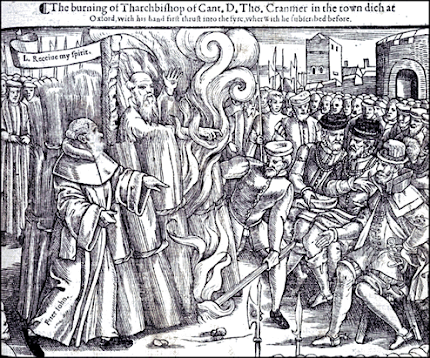
The burning of Tharchbishop of Cant. D. Tho. Cranmer in the town dich at Oxford, with his hand first thrust into the fyre, wherwith he subscribed before. [Click on the picture to see Cranmer's last words.]

Daily Bible Verse

Showing posts with label God's Sovereignty. Show all posts

Wednesday, April 22, 2015

Dr. Gordon H. Clark Quote of the Day: Is God Sovereign or Is God Subject to the Law?

"God establishes moral norms by sovereign decree."  --  Dr. Gordon H. Clark


In a recent exchange with another so-called Calvinist, I was challenged to show how God is not subject to His own nature as God.  The presupposition being that the law of God is superior to God because God is by nature subject to a moral law.  But as the late Dr. Gordon H. Clark pointed out, this is really the view of Plato who said that the demiurge is subject to the World of Ideas.  Calvin himself upheld the view that whatever God does is right because God is sovereign.  In my reading of Dr. Clark's book, Essays on Ethics and Politics, I came across the appropriate passage where Clark quotes Calvin to show that he did indeed embrace the ex-lex or apart from law view of God's sovereignty:

The Jewish Philosopher Philo, who lived at the time of Christ, though profoundly influenced by Plato, made an alteration that completely reversed Platonic and Liebnizian theology.  This alteration consisted in making God supreme and in placing the World of Ideas in God's mind.  Philo wrote, "God has been ranked according to the one and the unit; or rather, even the unit has been ranked according to the one God, for all number, like time, is younger than the cosmos."  In this quotation, Philo subjects mathematics to the thinking activity of God.  Similarly, God does not will the good because it is independently good, but on the contrary the good is good because God wills it.
To the same effect Calvin (Institutes, I, xvi, 1) wrote, "Augustine justly complains that it is an offense against God to inquire for any cause of things higher than his will."  Later (III, xxii, 2) he says, "how exceedingly presumptuous it is only to inquire into the causes of the Divine Will, which is in fact and is justly entitled to be cause of everything that exists.  For if it has any cause, then there must be something antecedent, on which it depends; which it is impious to suppose.  For the will of God is the highest rule of justice; so that what he wills must be considered just, for this very reason, because he wills it."
The sovereignty of God is the key to the basic problem of ethics.  Why is anything good, right, or obligatory?  Neither utilitarianism, nor pragmatism, nor emotionalism can give a rational answer.  Calvin has given the answer in very precise language:  "the will of God is the highest rule of justice; so that what he wills must be considered just, for this very reason, because he wills it."  God establishes moral norms by sovereign decree.
Dr. Gordon H. Clark.  "Ethics," in Essays on Ethics and Politics.  (Jefferson:  Trinity Foundation, 1992).  Page 92.

See also:  Essays on Ethics and Politics.

Sunday, August 25, 2013

Calvin's Calvinism: Quote of the Day: God Is Absolutely Sovereign


"If those clothe God with the garment of a tyrant, who refer the hardening of men even to His eternal counsel, we most certainly are not the originators of this doctrine. If they do God an injury who set His will above all other causes, Paul taught this doctrine long before us. Let these enemies of God, then, dispute the matter with the apostle. For I maintain nothing, in the present discussion, but what I declare is taught by him."  -- John Calvin

The following is a quote from John Calvin in Calvin's Calvinism, A Treatise of the Eternal Predestination of God, Section I.  Calvin's opponent is Pighius, a man who openly attacked the sovereignty of God and accused the Calvinist view of making God into a tyrant.   Here is Calvin's response:

Let us, however, be fully assured that the apostle, in the first place, here curbs with becoming gravity the licentious madness of these men, who make nothing of attacking openly the justice of God; and that, in the next place, he gives to the worshippers of God a more useful counsel of moderation, than if he had taught them to soar on eagles' wings above the forbidden clouds. For that soberness of mind which, regulated by the fear of God, keeps itself within the bounds of comprehension prescribed by Him, is far better than all human wisdom. Let proud men revile this sobriety if they will, calling it ignorance. But let this sober-mindedness ever hold fast that which is the height of all true wisdom; that by holding the will of God to be the highest rule of righteousness, we ascribe to Him His own proper and peculiar glory.

But Pighius and his fellows are not hereby satisfied. For, pretending a great concern for the honour of God, they bark at us, as imputing to Him a cruelty utterly foreign to His nature. Pighius denies that he has any contest with God. What cause, or whose cause is it, then, that Paul maintains? After he had adopted the above axiom "that God hardens whom He will and has mercy on whom He will" he subjoins the supposed taunt of a wicked reasoner: "Why doth He yet find fault? For who hath resisted His will?" (Rom. ix. 19.) He meets such blasphemy as this by simply setting against it the power of God. If those clothe God with the garment of a tyrant, who refer the hardening of men even to His eternal counsel, we most certainly are not the originators of this doctrine. If they do God an injury who set His will above all other causes, Paul taught this doctrine long before us. Let these enemies of God, then, dispute the matter with the apostle. For I maintain nothing, in the present discussion, but what I declare is taught by him. About these barking dogs, however, I would not be very anxious. I am the rather moved with an anxiety about some otherwise good men, who, while they fear lest they should ascribe to God anything unworthy of His goodness, really seem to be horror-struck at that which He declares, by the apostle, concerning Himself.

Now, we are holding fast, all the while, a godly purpose of vindicating the justice of God from all calumny. And the modesty of these timid ones would be worthy of all praise, if it were not the offspring of moroseness, inflated with a certain secret pride. For such men speak according to their own natural sense and understanding. But why do they fear to concede to the power of God that which is beyond the power of their own mind to comprehend, lest His justice should be endangered? Why, I say, is this? It is because they presume to subject the tribunal of God to their own judgment. Now Paul shows us that it is an act of intolerable pride in any man to assume to himself the judgment of his brother, because there is one Judge by whom we all stand or fall, and to whom every knee must bow. What madness is it, then, for a man to raise his crest against this only Judge Himself, and to presume to measure His infinite power by natural sense!

Saturday, December 15, 2012

The Recent School Shooting: Calvin's Calvinism - "A Defence of the Secret Providence of God" - Section III


"God's purpose is, by the wicked acts of men, to chastise some and to exercise the patience of others." -- John Calvin


Is God the author of sin and the evil acts of men?  Of course not.  But calumniators mendaciously attack the Scriptural doctrine of God's absolute sovereignty over even the evil acts of men.  If God is not in control of all that happens, then these stupid fools make both God and His elect subject to the attacks of evil doers and of Satan Himself--and there is nothing God can do about it if we take them at their word.  But God is not the primary cause of evil choices by men and demons.  He may be the "ultimate" cause of all that happens but free moral agents are not absolved from their own choices.  

Furthermore, God brings His own purposes to pass out of the many evil acts that happen in the world.  (Romans 8:28-32).  Calvin's remarks in Calvin's Calvinism and the Institutes of the Christian Religion  (Book I, Chapter 18:1-4) are pertinent to the recent shooting at an elementary school in Connecticut:

Let readers consider also, if they please, what I have written in my Commentary on the Second Chapter of the Acts of the Apostles. [Cf. Acts 2:23; Acts 4:27, 28] Men (I have there shown), when they commit theft or murder, sin against God because they are thieves and murderers, and because, in their theft and in their murder, there is wicked design. But God, who makes sovereign use of their wickedness, stands in an infinitely different, and in an all-high position above all men, and acts, and things. And the objects and ends of God are infinitely different from, and higher than, those of men. God's purpose is, by the wicked acts of men, to chastise some and to exercise the patience of others. Hence, in all these His uses of the evil doings of men, God never deviates in the remotest degree from His own nature; that is, from His own infinitely perfect rectitude. If, then, an evil deed is thus to be estimated according to its end and object, it is fully manifest that God is not, nor can be, the author of sin!  Calvin's Calvinism - "A Defence of the Secret Providence of God" - Section III

While we might not understand why God ordains such horrific events, it is beyond blasphemy of the Holy Spirit to accuse God of injustice in anything He does.  (Psalms 115:3).  We can only trust that God can and will bring good from the same evil acts that evil men meant for evil .  It is beyond all doubt that God will bring glory to Himself.  (Genesis 50:20; Psalm 76:10; Revelation 15:4).

God's peace be with all who believe the Gospel,

Charlie

Romans 5:1, 2; Romans 8:1, 2

Sunday, December 02, 2012

God's Sovereignty Over Evil

Often in reading John Calvin I come across unfamiliar words like "cavil" or "cavils."  Exactly what is a "cavil" anyway?  In the context of Calvin's Insitutes and Calvin's Calvinism a "cavil" is a trivial objection to the plain teaching of Holy Scripture on the issues of sovereign grace, unconditional election and absolute predestination.  Denying God's providence by appealing to general guidance of history over against God's being in control of all the details of history is a "cavil".  Denying that God controls the future but only "foreknows" the future is a "cavil."  Obviously, if God foreknew that Hitler would commit genocide against 6 millon Jews and millions of other ethnic minorities, saying that God merely "foreknew" this would happen does not resolve the dilemma of the problem of evil.  If God is omnipotent, then God is well able to prevent such atrocities.  Saying that God stood back and did nothing but merely "foreknew" this would happen does not remove the fact that ultimately the buck stops with God.  (Deuteronomy 29:29; Romans 11:33-36).

Logically, the only acceptable answer to this question is that God is perfectly just in permitting evil.  Nothing God does, including the decree to permit atrocities and evil acts of men and nations, is wrong.  To accuse the Creator of evil is to commit idolatry since we are mere creatures.  (Romans 9:19-22; Romans 3:3-8).  There is no law to which God is accountable since He is the source of the moral law and He is by nature holy, just, and perfect.  (Isaiah 45:7; Amos 3:6; Isaiah 46:9-11; Isaiah 14:24; Romans 9:11-23).

Charlie

Tuesday, October 02, 2012

The Editor at the Christian Classic Ethereal Library Pushes the Synagogue of Satan


-------- Original Message --------
Subject: [Christian Classics Ethereal Library newsletter] The CCEL Times 7.10 (October 1, 2012)
Date: Tue, 02 Oct 2012 03:52:26 -0400
From: Christian Classics Ethereal Library <ccelnews@calvin.edu>
To: Cranmer1959 <cranmer1959@gmail.com>

Andy Hanson, the editor of CCEL makes the outrageous claim that a Roman Catholic theologian of the 16th century was actually in agreement with Calvinism on the issue of the sovereignty of God.  This sort of dissimulation is disturbing to say the least.  The fact of the matter is that Rome's official doctrine does not allow for the absolute sovereignty of God since the official doctrine of Rome is semi-pelagian.  The best way to see this is to read Martin Luther's debate with Disiderus Erasmus in The Bondage of the Will.

What is particularly disturbing about all this is that Wheaton College is supposed to be an Evangelical school.  Arminianism, it would appear, does lead to Rome.  All Evangelicals who agree with Hanson should just become Roman Catholics and Papists.  This is why Arminianism is heresy.  It's also why the high church Arminians in the Anglican church are disengenuous when they "pretend" to not agree with the Anglo-Catholics.  Their real agenda is reunion with Rome, the synagogue of Satan.

While "replies to this address will not be read," replies can and will be made to such nonsense on my blog.  I pray that God will open the eyes of Evangelicals to this sort of deception by the enemy.  (2 Corinthians 4:3-4).  Sadly, even Billy Graham fell prey to this deception by the Roman Catholic Church.

Charlie

You can read Andrew Hanson's remarks in the CCEL newsletter here:


God is sovereign.
God is in charge of everything, including the little things.
Not a hair falls from our heads without God's divine will.
We must rest in God's grace, as we are totally unable to contribute to our salvation.
What word pops into people's minds when they hear Christians making the above statements? Calvinist. Usually these beliefs are associated with those of the Calvinist persuasion. However, Father de Caussade was a Roman Catholic Priest who taught that God is truly sovereign, and therefore our whole lives can be lived in the knowledge that all things are working for our good. We may not understand why God does things the way he does, or how our suffering can ultimately be for our good, but we can trust our benevolent Lord, who has decreed all things, is good and just. Reading Abandonment to Divine Providence will help the reader surrender to God's will. The result? Spiritual peace in the arms of a loving God.
Andy Hanson
CCEL Intern
Note: Abandonment to Divine Providence has recently made it into the top 12 in popularity at the CCEL.
Nota Bene:  Not only does this book have the imprimatur of Rome on the title page but reading the preface we discover that  Jean Pierre de Caussade was a member of the Society of Jesus.  A Jesuit!  Hello!  The Jesuits were in charge of the persecution of Protestants.  Ignatius Loyola was the worst of these Jesuits.  (See:  Roman Catholic and Protestant Martyrs Contrasted). 


--
Glory be to the Father, and to the Son : and to the Holy Ghost; As it was in the beginning, is now, and ever shall be : world without end. Amen. Visit 1662 Book of Common Prayer: Daily Prayer and Reasonable Christian Blog


Friday, April 06, 2012

Primitive Baptist Rebuke

I was praying about getting a minister to officiate at the graveside service for my nephew, Neil Moreno Ray, Jr.  Since I'm a classical and hardcore Calvinist, I wanted to find a Calvinist minister.  Many of my family members are buried at Payne's Creek Primitive Baptist Church in Bowling Green, Florida.  My brother decided to lay Bubba to rest there so I called a couple of the elders or pastors in the local Primitive Baptist churches. 

The first minister I called was Elder Lloyd Cunningham, pastor of Corinth Primitive Baptist Church in Berea, Florida.  As I described to him our situation and that my nephew may have been murdered or that he might have killed himself, Brother Cunningham rebuked me gently and said that there is no mention of suicide in the Bible.  In fact, God gives life and God takes it away.  No one can take their own life except that God takes their life.  (Job 12:10; Acts 17:28).  As I thought about it I realized that Brother Cunningham was absolutely right.  If someone takes their own life they are not the ones doing it because only God can take someone's life.  It is the Lord who gives and the Lord who takes away.  (Job 1:21).   God sends both grace to regenerate (John 3:3-8; 6:44, 65) and grace to repentance (Acts 11:18).  Only God can open the heart to the Gospel (Acts 16:14).  And it is God who elects (Romans 9:11-13; Ephesians 1:4, 5, 11) and God who reprobates (1 Peter 2:8; Romans 9:13, 17).

It is God who puts it into a man's heart to do what he does and yet God is not the agent who acts.  As the late Gordon H. Clark said, when a man shoots his wife it was God's will that he do so.  Yet man is a responsible moral agent and will give an account to God for everything he has done.   (Deuteronomy 29:29; Ezekiel 18:25-27; Isaiah 14:24; 46:10).  Nothing happens by mere chance.  (Proverbs 16:33; Proverbs 21:1).  God can send madness (Daniel 4:30-37; Deuteronomy 28:28) or God can send the light (Ephesians 1:18).  He can send blindness and hardness of heart as well.  (Matthew 13:13-17; Acts 28:26-28; Exodus 4:21).

Too many so-called Calvinists these days are not Calvinists at all.  They are closet Arminians.  While I may be hurting because of what happened to my nephew, ultimately God took Bubba's life.  Anyone who does not agree with that should logically become an atheist.  Why?  Because God is God and He does whatsoever He pleases (Psalm 115:3; Ephesians 1:11).  God answers to no one, not even me or you.  (Romans 3:4-9; 9:20; Job 40:1-4).

The Thirty-nine Articles of Religion confirm that the Church of England at one time believed in absolute predestination and the double decree to both election and to reprobation.  Not many Anglican ministers preach the Bible or the doctrines of the 39 Articles, which draw their most certain warrant from the Holy Scriptures.  Article 17 teaches the double decree and absolute predestination:
XVII. Of Predestination and Election.
PREDESTINATION to life is the everlasting purpose of God, whereby, before the foundations of the world were laid, He hath constantly decreed by His counsel secret to us, to deliver from curse and damnation those whom He hath chosen in Christ out of mankind, and to bring them by Christ to everlasting salvation as vessels made to honour. Wherefore they which be endued with so excellent a benefit of God be called according to God's purpose by His Spirit working in due season; they through grace obey the calling; they be justified freely; they be made sons of God by adoption; they be made like the image of His only-begotten Son Jesus Christ; they walk religiously in good works; and at length by God's mercy they attain to everlasting felicity.

    As the godly consideration of Predestination and our Election in Christ is full of sweet, pleasant, and unspeakable comfort to godly persons and such as feeling in themselves the working of the Spirit of Christ, mortifying the works of the flesh and their earthly members and drawing up their mind to high and heavenly things, as well because it doth greatly establish and confirm their faith of eternal salvation to be enjoyed through Christ, as because it doth fervently kindle their love towards God: so for curious and carnal persons, lacking the Spirit of Christ, to have continually before their eyes the sentence of God's Predestination is a most dangerous downfall, whereby the devil doth thrust them either into desperation or into wretchlessness of most unclean living no less perilous than desperation.

    Furthermore, we must receive God's promises in such wise as they be generally set forth in Holy Scripture; and in our doings that will of God is to be followed which we have expressly declared unto us in the word of God.
I believe that even someone like my nephew can be one of God's elect since salvation is all of God's sovereign grace and choice.  I shared the Morning Prayer Service with Bubba from the 1662 Book of Common Prayer a couple of months back.  There is a very clear presentation of the first use of the moral law and a clear presentation of the Gospel promises in those readings.   Only God can open blinded eyes or raise the spiritually dead to new life in Christ (2 Corinthians 5:17-21).  I can only trust that God broke through to Bubba and spoke to him during our time together that Sunday morning.  Salvation truly is an amazing grace.


ALMIGHTY God, Father of our Lord Jesus Christ, Maker of all things, judge of all men; We acknowledge and bewail our manifold sins and wickedness, Which we, from time to time, most grievously have committed, By thought, word, and deed, Against thy Divine Majesty, Provoking most justly thy wrath and indignation against us. We do earnestly repent, And are heartily sorry for these our misdoings; The remembrance of them is grievous unto us; The burden of them is intolerable. Have mercy upon us, Have mercy upon us, most merciful Father; For thy Son our Lord Jesus Christ's sake, Forgive us all that is past; And grant that we may ever hereafter Serve and please thee In newness of life, To the honour and glory of thy Name; Through Jesus Christ our Lord. Amen.

Then shall the Priest (or the Bishop, being present,) standing up, and turning himself to the people, pronounce this Absolution.
ALMIGHTY God, our heavenly Father, who of his great mercy hath promised forgiveness of sins to all them that with hearty repentance and true faith turn unto him; Have mercy upon you; pardon and deliver you from all your sins; confirm and strengthen you in all goodness; and bring you to everlasting life; through Jesus Christ our Lord. Amen.

Then shall the Priest say,
Hear what comfortable words our Saviour Christ saith unto all that truly turn to him.
COME unto me all that travail and are heavy laden, and I will refresh you. St. Matth. xi. 28.  (Matthew 11:28).
    So God loved the world, that he gave his only-begotten Son, to the end that all that believe in him should not perish, but have everlasting life. St. John iii. 16  (John 3:16).
Hear also what Saint Paul saith.
    This is a true saying, and worthy of all men to be received, That Christ Jesus came into the world to save sinners. 1 Tim. i. 15.  (1 Timothy 1:15).
Hear also what Saint John saith.
    If any man sin, we have an Advocate with the Father, Jesus Christ the righteous; and he is the propitiation for our sins. 1 St. John ii. 1.  (1 John 2:1).  (From the Lord's Supper, 1662 BCP).

Wednesday, February 01, 2012

Actress' Claim To Be Gay By Choice Riles Activists | Fox News


Well, you know, being politically correct is more important than truth. Ironically, homosexuals and transexuals argue that they have no choice in the matter of their sexual orientation, implying that they have no choice in their sexual behavior either. On the latter point there is much deliberate ambiguity on their part since even homosexuals advocate "safe sex" to prevent the spread of disease.

Of course, the Calvinist view is that gays are both predetermined to be gay and that they choose to be that way. Reprobation (Romans 1:28) is a divine decree from before the foundation of the world (1 Peter 2:8) and yet individuals have free moral agency (Ezekiel 18:23). Thus, homosexuals are right when they claim to be predetermined to their immorality (Leviticus 18:22; Romans 1:26, 27). But Christians are also correct when they say say that homosexuality is a choice. It's a matter of both/and, not either/or. God decrees to permit by secondary causes the immoral acts of evil men but the outcome is rendered absolutely certain since God is in control of all things that come to pass (Ephesians 1:11; Daniel 4:35).

The Westminster Confession of Faith says:

Chapter 3: Of God's Eternal Decree

1. God, from all eternity, did, by the most wise and holy counsel of His own will freely, and unchangeably ordain whatsoever comes to pass:1 yet so, as thereby neither is God the author of sin,2 nor is violence offered to the will of the creatures; nor is the liberty or contingency of second causes taken away, but rather established.3

See also: WLC 12 | WSC 7


--------------------------------------------------------------------------------

1 Eph. 1:11; Rom. 11:33; Heb. 6:17; Rom. 9:15,18.

2 James 1:13,17; 1 John 1:5.

3 Acts 2:23; Matt. 17:12; Acts 4:27,28; John 19:11; Prov. 16:33.

You can read A. A. Hodge's commentary on WCF chapter 3 by clicking here: God's Eternal Decree.

Hodge says:

The Confession in this section teaches that all the decrees of God are unconditional. All who believe in a divine government agree with Calvinists that the decrees of God relating to events produced by necessary causes are unconditional. The only debate relates to those decrees which are concerned with the free actions of men and of angels. The Socinians and Rationalists maintain that God cannot certainly foresee free actions, because from their very nature they are uncertain until they are performed. Arminians admit that he certainly foresees them, but deny that he determines them. Calvinists affirm that he foresees them to be certainly future because he has determined them to be so. The truth of the Calvinist view is proved-

(1) From the fact that, as shown above, the decrees of God determine all classes of events. If every event that comes to pass is foreordained, it is evident that there is nothing left undetermined upon which the decree can be conditioned.

(2) Because the decrees of God are sovereign. This is evident-(a) Because God is the eternal and absolute Creator of all things. All creatures exist, and are what they are, and possess the properties peculiar to them, and act under the very conditions in which they act, because of God's plan. (b) It is directly affirmed in Scripture (Dan. 4:35; Isa. 40:13,14; Rom. 9:15-18; Eph. 1:5).

(3) God's decree includes and determines the means and conditions upon which events depend, as well as the events themselves: "According as he hath chosen us in him before the foundation of the world, that we should be holy" (Eph. 1:4). "By grace are ye saved through faith; and that not of yourselves: it is the gift of God" (Eph. 2:8). "God hath from the beginning chosen you to salvation through sanctification of the Spirit and belief of the truth" (2 Thess. 2:13). In the case of Paul's shipwreck, God first promised Paul absolutely that not a life should be lost (Acts 27:24). But Paul said, verse 31, "Except these abide in the ship, ye cannot be saved."

(4) The Scriptures declare that the salvation of individuals is conditioned upon the personal act of faith, and at the same time that the decree of God with regard to the salvation of individuals rests solely upon "the counsel of his own will," "his own good pleasure." "For the children being not yet born, neither having done any good or evil, that the purpose of God according to election might stand, not of works, but of him that calleth," etc. (Rom. 9:11). "Being predestinated according to the purpose of him who worketh all things after the counsel of his own will" (Eph. 1:11; 1:5; Matt. 11:25,26).

4. The purpose of God is, with reference to all the objects embraced within it, certainly efficacious.

The decree of God is merely a purpose which he executes in his works of creation and providence. When it is said that all the decrees of God are certainly efficacious, it is not meant that they are the proximate causes of events, but that they render, under the subsequent economy of creation and providence, every event embraced in them absolutely certain.


Click here to read the Fox News story: Actress' Claim To Be Gay By Choice Riles Activists | Fox News


Tuesday, February 22, 2011

The Sola Panel | Responding to disaster


"God’s judgement is a very unpleasant subject to speak about or to preach about. But it is the most real factor in life. We are surrounded by the judgements of God, and we do ourselves or others no kindness by skating lightly over or ignoring the reality of judgement. However we must always speak of it as persons equally deserving of it, yet saved from it, I trust, by the love of the Lord Jesus Christ who bore it for us." --D. Broughton Knox--


The following is quoted from a radio talk given by D. Broughton Knox, an Evangelical Anglican who was part of the Sydney Diocese of the Anglican Church in Australia. It's taken from the Sola Panel website. The quote is from Volume III of the Selected Works, although no page numbers are given.


The Australian community suffered a severe shock when Darwin was devastated by a cyclone on Christmas Day. Now that the rescue operation has been completed and thoughts are turning to rehabilitation, we should reflect and assess what the disaster means. Hard on the heels of Darwin came the Hobart bridge tragedy, where further lives were lost suddenly and unexpectedly. In between the two events, newspapers have been reporting on the destruction of Pakistan (where thousands of people have lost their lives) and the famine in North Africa (which has brought death to tens of thousands, particularly in Ethiopia). Misfortune and sorrow overtake all of us during life, and sometimes we suffer more severely than others.

The Bible story of Job is an illustration: he was an excellent man—upright and generous—one who feared and reverenced God, as chapters 30 and 31 of the Book of Job make clear. Yet he suffered terrible misfortune: he lost all his property, he lost his family through a whirlwind, and he lost his own health for a long period of time. Yet it is plain that these events were under the control of God. Though they did not originate with God but with Satan, in the end they brought a very great blessing to Job in the form of deepening experience and fellowship with his Heavenly Father. So misfortune which overtakes Christians should be turned into blessings, for that is the purpose that God allows them. The only real blessing that counts in the end is a deepening experience of God, and we may rejoice in our trials if this is the outcome.

But there is a further very important point to stress. If looked at carefully, it will be seen that we deserve every misfortune that comes into our life (even though God intends it not for judgement, but for blessing). We deserve God’s judgement because we do not fear and reverence God in the way we should. We are not single-minded in serving God as, for example, our Lord Jesus Christ was. Anything short of his perfect character is wrong, and deserves correction and punishment. Thus we deserve the very misfortunes that overtakes us, and we should accept them as stepping stones back to God.

But we must not think that those who suffer are more deserving of judgement than those who escape; we all deserve it equally. This was the message that Jesus emphasized in the catastrophes that took place in the community during his ministry. Pilate the Roman governor had executed some Galileans, and Jesus asked his hearers whether they thought that these victims were more deserving of their fate than those who escaped. This would perhaps be the natural view, but our Lord repudiates it. I quote his words from Luke 13:2-3: “Do you think that these Galileans were worse sinners than all the other Galileans, because they suffered thus? I tell you, no; but unless you repent, you will all likewise perish.” Our Lord then went on to comment on another incident: it would seem that a tower had collapsed in Siloam and killed some of those standing close by. Jesus again asked his hearers, “[T]hose eighteen upon whom the tower of Siloam fell and killed them, do you think that they were worse offenders than all the others who dwelt in Jerusalem? I tell you, no; but unless you repent, you will all likewise perish.”1 We may conclude that those who suffered as a result of the cyclone in Darwin or the accident at Hobart were not necessarily any worse than their fellow citizens, but the point that Jesus underlined was that we all deserve judgement and we will all receive it unless we repent of our godlessness: “Unless we repent, we will all likewise perish”. Jesus’ words were literally and terribly fulfilled a few years later in the destruction of Jerusalem and in invasions by Roman armies, ravaging the countryside. His hearers suffered much more fearful and terrible deaths than the Galileans or those on whom the tower fell.

The lesson to us Australians should be plain: are we going to sink back into complacency, pleasure seeking, money making and sexual indulgence? Or will we repent and wake up to God, who controls all the events of life and our eternal destinies? Nothing happens purposelessly. The collapse of the tower of Siloam should have been a warning that all deserve the same fate. The loss of life and loss of property in Darwin and Hobart should be a warning to us too. We deserve the same judgement. Our Lord warns that unless we Australians repent and cleanse our lives and our society, we will all likewise perish—perish not only as a nation overwhelmed by some enemy, but perish also individually and eternally. That is what we deserve and that is what we will inevitably receive, unless we repent of our godlessness and selfishness, recognize Jesus as the Lord and saviour to whom we look for forgiveness and salvation, and hallow God’s name in our own lives as well as in our national life.

God’s judgement is a very unpleasant subject to speak about or to preach about. But it is the most real factor in life. We are surrounded by the judgements of God, and we do ourselves or others no kindness by skating lightly over or ignoring the reality of judgement. However we must always speak of it as persons equally deserving of it, yet saved from it, I trust, by the love of the Lord Jesus Christ who bore it for us.

Do you sense the justice and imminence of God’s judgement? Then repent, turn back to God, fear and honour him, acknowledge Jesus as the Lord and call on him, and he will save you, now and always. He will change you from being under God’s wrath into being in his presence so that even death, whenever it comes, will no longer be a part of God’s judgement. Instead death will be transformed into a gateway for fuller fellowship and joy in the presence of God.
1. Luke 13:4-5.

To view the original posting click here: The Sola Panel | Responding to disaster

D. Broughton Knox Selected Works: Volume III: The Christian Life. Tony Payne and Karen Beilharz, eds. (Kingsford: Matthias Media, 2006). Pp. 201-203.

Friday, December 03, 2010

A Barking Dog

"A dog barks when his master is attacked. I would be a coward if I saw that God's truth is attacked and yet would remain silent."
—John Calvin (1509-64) [Quoted from Jon Irenicus' blog, The Unrestricted Sovereignty of God].


Support Reasonable Christian Ministries with your generous donation.