>

Martyred for the Gospel

Martyred for the Gospel
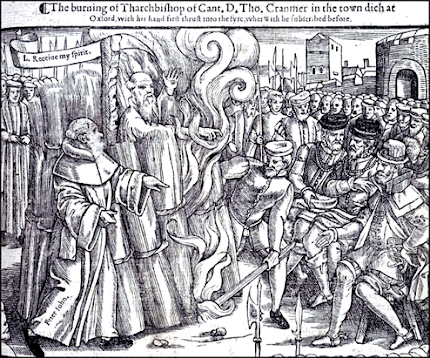
The burning of Tharchbishop of Cant. D. Tho. Cranmer in the town dich at Oxford, with his hand first thrust into the fyre, wherwith he subscribed before. [Click on the picture to see Cranmer's last words.]

Daily Bible Verse

Showing posts with label Libertarianism. Show all posts

Thursday, June 27, 2019

Gordon H. Clark Comments on Propaganda and History


"Though it may be impossible to fool all of the people all of the time, yet the large majority of the populace is so stupid, so forgetful, or so irresponsible that a moderately efficient propaganda machine, run by the government, a party, or a well organized political action group, can easily fool a sufficiently large number of people to keep itself in power for a long time."


"With amazing foresight he [Jacob Burckhardt] predicted that governments would no longer advance business and industry, but would disregard economic law and base their decisions with absolute brutality on political purposes."  


Dr. Gordon H. Clark

At the risk of quoting too much at once, I want to show how communist propaganda is not a new problem but an old one.  I will save the quote for later but Dr. Gordon H. Clark sounds almost prophetic in the passage from which I will quote in his book on historiography.  The fact is that there is no such thing as objective news or objective reporting of historical events.  History is chosen to be represented by the high points selected by those who control the mass media.  History is written as it occurs in the contemporary news but even the news can be fake as we have observed in recent times during the Trump administration.  It seems that postmodernism has taken over the profession of journalism and even historiography.  History has become so malleable as to be almost pure fiction.

Pure capitalism based on an atheistic materialism, however, is no better than communism or socialism.  Without the Bible as our beginning axiom there is nothing morally wrong with making lots of money selling pornography or performing perverse sex acts for huge sums of money.  So that pretty much does Atlas Shrugged and libertarianism in if you are a Christian.  Christianity is not a religion.  It is an entire worldview, a biblical, theological, logical and philosophical way of understanding everything.  

It is not a "theory" of everything but a rational way of interpreting the propositional system of truth revealed in the Bible and applying that logical and systematic way of viewing the world into practical application in the so-called sciences, including political science.  This is why pure capitalism divorced from God is immoral.  The Bible says that the love of money is the root of all kinds of evil.  (1 Timothy 6:10 NKJV).  Gambling is a sin because God commands man to work for a living and because man is commanded to be a good steward of the resources God provides him through providence.  Gambling is based on chance and the house always wins.  Entire cities and even states have been built on the so-called gaming industry.  The Las Vegas shooting that occurred on October 1, 2017 was perpetrated by a so-called high roller and over 58 victims were killed not including the suicide of the shooter. The man was retired and had a large nest egg saved of several million dollars.  At first the news reported that the man was winning big at the casinos.  But in the end it turns out that he had gambled away all of his savings except $250,000, which he left to his girlfriend.  Yet the news and the casinos and law enforcement could not figure out that the motive was apparently linked to the man's huge losses in the casinos.  Go figure.  This is just another example of the propaganda used in the media to excuse an industry that preys on gambling addicts.  Of course the addict has no excuse but neither do the executives in the gambling industry.  Profit for the sake of profit is evil.  Even Jesus condemned prostitution and greed.  In short, attaching the term "Reformed" or the term "Christian" to libertarianism only creates an oxymoron since the Bible nowhere says that our judicial or political system should be based on principles of greed or covetousness.

This is not to say that it is morally wrong to work to create wealth or to become wealthy.  (Psalm 112:1-3 NKJV). It just means that morality is the basis for honest capitalism, not deception or destroying others for one's own profit.  This is also why child pornography, human trafficking, prostitution, drug dealing and other forms of immorality have traditionally been considered vices and were against the judicial and criminal laws of our nation because vices exploit weaker individuals for pleasure or profit and such vices undermine both individual freedom and the moral fabric of society as a whole.  On the other hand, Christian liberty is guided by the moral law of God and is the result of regeneration.  There is no law against walking in the Holy Spirit.  (Galatians 5:22-25 NKJV).

But equally wrong is the totalitarian power grab by the progressive left in the United States.  Ronald Reagan, our former President, once said that if totalitarianism were to take hold in America it would be through the fascism of the socialist left.  While they do not want to own all private property they want so much government control as to make private enterprise almost obsolete.

The irony is that during World War II both the United States and Great Britain fought together to defeat the national socialism of the Nazi party in Germany.  For a time Winston Churchill did cooperate with Joseph Stalin to defeat Adolf Hitler but that was only for expediency in defeating the Nazis.  Churchill was certainly not naive.

Getting back to the original point of my post, however, I want to show how dishonest the political left and the mainstream media in our nation has become.  I will do that by quoting a lengthy passage from Dr. Gordon H. Clark's book, Historiography:  Secular and Religious:

History for the Sake of Philosophy
There is a third possible justification for studying history, one closely allied to but broader than the second.  The second mainly envisaged the utility of history in its bearing on politics.  But already hints have occurred that history stands in relation to other subjects as well:  Philosophy and religion, for example,.  The utility and justification of history may then be found in the position it holds as a part of an all embracing philosophy.
Dr. Gordon H. Clark, Historiography:  Secular and Religious. 1971.  Second edition.  (Jefferson:  Trinity Foundation,  1994).  P. 15.
Here Clark ties history to philosophy and religion and to an "all embracing philosophy," which I take to mean a worldview.  But his remarks on the propaganda tactics of the left are even more to the point:

History for the Sake of the Present
. . . . Whether such lessons [of history] are heeded is a quite different question.  It lowers us from the level of scholarship to that of common politics, where often enough it is the wrong lesson that is learned.  Though it may be impossible to fool all of the people all of the time, yet the large majority of the populace is so stupid, so forgetful, or so irresponsible that a moderately efficient propaganda machine, run by the government, a party, or a well organized political action group, can easily fool a sufficiently large number of people to keep itself in power for a long time.  During the thirties the British Labor Party and half of the Tories favored disarmament and business with Hitler.  Would anyone have imagined that after World War II the English people would have turned Churchill out of office, have held mass demonstrations against military defense, and have tried to do business with Russian and Chinese communists? 
In the United States the government began to impose controls on agriculture in the twenties.  For forty years now these controls have made the agriculture situation worse.  One might think that the obvious lesson is to remove the controls that have so aggravated the trouble.  But nearly everyone, except the farmers who in 1963 voted overwhelmingly against the Kennedy proposals, thinks that what is needed is more stringent controls.  The lesson that seems to have been learned is that controls always need more bureaucrats and therefore a top-heavy bureaucracy will use its political power to increase itself.  And besides, Lord Acton with his "Power tends to corrupt and absolute power corrupts absolutely" was only an aristocratic fuddy-duddy. 
Now, admittedly, voters know next to nothing about history, and very few people have even the least notion of a philosophy of history.  Yet the study of history may be justified by its present utility to the few scholars who are thereby enabled to silence their ideals in pessimistic despair and, like Jeremiah, offer their lamentations to a heedless and perverse generation.
Jacob Burckhardt saw clearly the . . . tendencies of democracy.  The masses are irresponsible and materialistic; they distrust the educated man and elect unscrupulous leaders who promise them everything.  Government then depends on managing the news.  The result is the totalitarian welfare state, from which and for which dictators arise.  Now, Jacob Burckhardt was not Senator Goldwater attacking President Kennedy.  He was a history professor who lived in the nineteenth century.  But even then he saw the rise of dictators because he understood that the so-called liberals had lost their sense of moral distinctions and were preparing the way for a criminal seizure of power.  With amazing foresight he predicted that governments would no longer advance business and industry, but would disregard economic law and base their decisions with absolute brutality on political purposes.
Ibid., Clark.  Pp. 13-14.
It is difficult not to be concerned about Clark's insights here when we apply them to today's political situation and the outrageous lies and propaganda being used to try to oust President Donald J. Trump from the executive office of the United States.  Not only is the left using every media outlet to attack Trump with political propaganda but they actually broke the law to spy on his campaign before he won the election and then tried to have him removed from office by using the same tactics by way off the secret FISA courts.  It was my opinion long ago that the FISA courts would be used as a political weapon by the leftists and Marxists in the Democrat party to attack political and religious conservatives, including Evangelical Christians.  My worst fears have come to pass.

The same kinds of fake news tactics are being used to spin the border crisis and to actually break long standing laws that prohibit illegal immigration.  The Marxist Democrat party does not want to close the border or support existing laws because they only care about political power, not the welfare of illegal immigrants or the welfare of America citizens.

I have never been so naive as to support civil religion.  But the fact that there are checks and balances in our political system is because no one individual or political party can be trusted to do the right thing.  All men are equally corrupted by sin.  That is why our founding fathers in this country created three equal branches of government to check the powers of the other two branches.  Unfortunately the founding fathers did not foresee the rise of Marxism and totalitarianism.  It seems to me that the great experiment of a constitutional and republican form of democracy has at last come to a point of collapse.  Unless God grants Americans the gift of the new birth and our country turns back to a political philosophy deduced from biblical principles I fear that chaos and anarchy may be on the way.  If so every citizen has a God given right to fight for freedom by force if necessary.  We ought to obey God rather than men.  (Acts 5:29).  We are to obey the judicial laws of the nation we live in but when the sodomite lobby makes Christianity against the law or when public schools teach communist dogma as the official state religion, it is time for Christians to rise up and to oppose the government by force if necessary.  (Romans 13:1-7). 


Thursday, August 09, 2018

Hyper-Calvinism, Common Grace, Libertarianism and the Simplicity of God (Part 1)


“. . . Do you believe that He foreknows against His will, or that He wills in ignorance? If then, He foreknows, willing, His will is eternal and immovable, because His nature is so: and, if He wills, foreknowing, His knowledge is eternal and immovable, because His nature is so.

From which it follows unalterably, that all things which we do, although they may appear to us to be done mutably and contingently, and even may be done thus contingently by us, are yet, in reality, done necessarily and immutably, with respect to the will of God.  . . .”  Dr. Martin Luther, 16th century father of the Protestant Reformation.


Hyper-Calvinism, Common Grace, Libertarianism and the Simplicity of God  (Part 1).

I know this seems to be a shotgun post meant to cover many topics.  But honestly the attacks on Calvinism as a system of propositional truths deduced from the Bible are coming from many points in the Evangelical world, and surprisingly that would even include some who consider themselves Clarkian Scripturalists.  Amazingly many of those who identify as Clarkian Scripturalists and associate themselves with the Trinity Foundation site are actually pushing the views of the late Dr. John Robbins, who by the way was not a trained theologian or Christian philosopher.  Robbins’s doctorate was earned in economics, not philosophy or Christian theology.  I am and will be forever grateful for the work that the Trinity Foundation has done in publishing Dr. Clark’s books and papers but that does not remove the fact that the ministry of the Trinity Foundation has had some significant departures from Dr. Gordon H. Clark’s theological and philosophical positions, including the idea that Clark was somehow in agreement with the foundationalism of Dr. Alvin Plantinga of the University of Notre Dame.  But I will come back to this later.  For now let me cover a few of my issues with the semi-Arminians.

Hyper-Calvinism

Since in the title I initially mentioned hyper-Calvinism, let me address that one first.  The popular misrepresentation of classical Calvinism as somehow part of a conspiracy called hyper-Calvinism and which started somehow with theologians like John Gill is so pervasive that it is almost impossible to have a rational discussion of the classical position with the vast majority of semi-Arminian Calvinists and neo-Calvinists today.  The most popular website eschewing hyper-Calvinism is one that has been run by Phil Johnson of the Grace to You ministry titled, “A Primer on Hyper-Calvinism,” originally posted in 1998.  Unfortunately, to prove his point, Johnson uses several straw man fallacies and sophistry to achieve his intended rebuttal.  Let’s take a look at that page and give a point by point rebuttal to Johnson’s rebuttal.


In his introduction Johnson misses the point completely by quoting Ezekiel 33:11.  The verse says that God does not desire the death of the wicked in any universal sense.  But what Johnson, the Arminians, and the semi-Arminian Calvinists fail to point out is that the verse is directed to the Old Testament nation of Israel, not to the other pagan nations.  The phrase “house of Israel” is mentioned 146 times in the entire Bible and of those occurrences over 82 of them are in the book of Ezekiel and not once does the term refer to all nations in general but only to the nation of Israel.  Most tellingly the term occurs in the very verse that Johnson contends is a universal “offer” to all the world rather than a specific address to the Old Testament church.  The Old Testament nation of Israel is a type of the visible church and so the promises and the threats addressed to the members of the visible church of the Old Testament do not apply to the pagan nations.  Of all the nations in the Old Testament, Israel alone received the covenant of grace and the promises warranted by that covenant as an outward sign.  (Deuteronomy 7:6-8).  The Bible over and over again demonstrates clearly that God does desire the death of the wicked in particular cases.  This would seem to refute the hypothetical universalism of common grace and the well meant offer advocates.  (1 Samuel 1:3; 2:25; 1 Kings 14:11; 2 Kings 9:10; 1 Peter 2:8; Romans 9:11-13).  Therefore, Ezekiel 33:11 is not a universal declaration that covers both the elect and the reprobate individuals in every nation.  Of course the promises given to Abram in Genesis 15 and 17 do extend the promises to the Gentile nations but with few exceptions that is not fulfilled until the Apostle Paul comes on the scene.  (Romans 11:13; 1 Timothy 2:7; 2 Timothy 1:11).  This does not mean that today we do not give a general call of the Gospel to anyone who will listen even though in the Old Testament dispensation of the eternal covenant of grace there was no general call of the Gospel given to the pagan nations.  (Matthew 28:18-20; Mark 16:15-16).  There are of course individual exceptions like Rahab the harlot and perhaps Jethro, the father-in-law of Moses, Ruth the Moabitess and others.  (See:  Joshua 6:17, 23, 25;  Exodus 18:1-12; Ruth 4:13-22). 


Johnson defines hyper-Calvinism as “ . . . a doctrine that emphasizes divine sovereignty to the exclusion of human responsibility.”  (Primer).  As his starting premise this probably does apply to certain of the Primitive Baptist groups and New Covenant theology groups which advocate an antinomian view that the Christian is under grace but not the moral law.  But it certainly does not apply to either Dr. Gordon H. Clark or those who consistently follow his Scripturalist views on dogmatic theology, though I think maybe John Robbins and certain of the Trinity Foundation advocates tend toward antinomianism.  Clark himself stood for the entire Westminster Confession of Faith as a system of propositional truth that could be harmonized as a whole system, not isolating any of the chapters from the rest of the system.  This is where even seminary educated Clarkians sometimes misunderstand Clark’s position or unintentionally misrepresent Clark.  The best example of this is Doug Douma’s article asking whether or not Clark thought Arminians were outright heretics.  (Clark and the Salvation of Arminians). Of course, in the interest of holding Evangelicals together as Protestants Clark would not condemn Arminians as guilty of adhering to a false religion or being part of a synagogue of Satan.  Although I disagree with Clark on this point, it is understandable that he would want to preserve at least some common ground with other Protestants.  But at the same time Clark did not say that there was a list of essential doctrines--like confessing that Jesus is Lord--which are necessarily salvific.  But Clark was also an outspoken critic of both Arminianism and semi-Arminianism.  In fact, he was so hated by the Arminians and dispensationalists at Wheaton College that he was fired or forced to resign because of it.  Ironically, the main opponent Clark faced at Wheaton was Dr. Henry Thiessen, a dispensationalist who later taught at Dallas Theological Seminary.  Another dispensationalist who was also a Reformed Episcopalian, W. H. Griffith Thomas, helped found Dallas Theological Seminary.   (See:  The Presbyterian Philosopher: The Authorized Biography of Gordon H. Clark, by Doug Douma).


Even more ironically, a Baptist, namely Phil Johnson, quotes an article by a high church Anglo-Catholic cleric, Peter Toon, to define hyper-Calvinism.  It is amazing how quickly baptistic Calvinists fall prey to those who want to draw Protestants back into communion with the Roman Catholic Church.  Peter Toon was part of the Continuing Anglican Movement, which is a modern spinoff of the Oxford Movement or high church Tractarian movement of the 19th century.  The best evidence that Peter Toon was an Anglo-Catholic was his membership in the Prayer Book Society and his support of the 1928 Book of Common Prayer, which is favored by conservative Anglo-Catholics.  The 1928 BCP has prayers for the dead among other things.


Another so-called Calvinist, Dr. J. I. Packer, has an agenda to compromise with Rome as well and has signed the Evangelicals and Catholics Together document, emphasizing sophistry and double talk in order to bring about a false compromise with the Roman Catholic Church.  Packer is also advocating compromise with high church Anglo-Catholics in the Anglican Church in NorthAmerica and their redefinition of the Thirty-nine Articles of Religion, which are clearly Protestant and Calvinist.  But following the Tractarians and the Anglo-Catholicism of John Henry Newman, Edward Pusey and others, Packer thinks that the Thirty-nine Articles of Religion can be interpreted as Roman Catholic and Protestant as a via media.  But that was never Archbishop Thomas Cranmer’s intention whatsoever.  Cranmer advocated the Five Solas of the Protestant Reformation, absolute predestination, and a Zwinglian view of the two Gospel sacraments.  (See: Thirty-nine Articles of Religion, Article 17.  Also see my blog post on Packer’s visit to Orlando, Florida on his last crusade:  Packer’s Last Crusade.)


This connection between self-identifying Calvinistic Baptists and dispensationalists with the Federal Vision movement is apparent especially between John Piper and James White, both of whom do not denounce Douglas Wilson as a heretic for promoting the objective covenant of grace, baptismal regeneration, conditional regeneration, and other doctrines of the Federal Vision heresy.  Piper even invited Wilson to promote his views at Piper’s Desiring God conference a  few years ago.  The connection between the Federal Vision and the Oxford Movement may not be immediately obvious but the emphasis on the visible church, visible signs as actually conveying grace, and the conditional and objective covenant are all in collusion with the papist view, the Tractarian and Ango-Catholic view, and other departures from the Bible and the Reformed confessional standards.  While Johnson may not be officially connected to Piper or White, his writings and public appearances affirm that he is more comfortable with the Arminians, the Federal Visionists, and even the Anglo-Catholics than with fellow Calvinists who uphold the Protestant Reformation and the system of propositional truth in the Bible.  This is a telling indictment of the compromises that many in the Reformed Baptist circles are willing to make.


Rather than go point by point refuting Johnson’s infamous attack on classical Calvinism, I will only briefly consider his objections and point the reader to a more substantial rebuttal written by a minister in the Covenant Reformed Churches in Ireland, Rev. Martyn McGeowen.  McGeown rejects Johnson’s first two points as irrelevant since the classical Calvinists do not reject duty faith or the obligation to believe the command to repent and believe the Gospel.  The first point of Johnson’s five points of hyper-Calvinism is vague and unclear.  


Before Johnson gives his own definition of hyper-Calvinism—a five-point definition, which, if true, would make the PRC and BRF three-point hyper-Calvinists—he quotes a dictionary. Apparently, whoever writes the theological dictionaries rules the theological landscape! However, theological dictionaries do not determine theology. The creeds do! They—not theological dictionaries—were officially adopted by the church.  (An Answer to Phil Johnson's "Primer on Hyper-Calvinism", by Rev. Martyn McGeown.)


McGeown is here absolutely right.  The Reformed standards are not determined by a single person who also happened to be a high church Anglo-Catholic, namely the late Peter Toon.  In fact there is not one shred of evidence that any of the Reformed creeds, confessions, or symbols made the well meant offer a binding doctrine and the same can be said for the free offer of the Gospel and the three points of common grace.  Through a clever bit of sophistry the semi-Arminians claim that the classical Calvinists in the PRCA, the British Reformed Fellowship, and the Covenant Reformed Churches in Ireland all reject the general call of the Gospel.  That is an absolute falsehood and the opponents on the other side should be ashamed of themselves for violating the ninth commandment and bearing false witness.  What is at issue is how the general call is issued and what is the theological language used in such a presentation?  It is wrong to tell an unconverted person that Jesus loves them and died for them on the cross for this can only be said if you are an Arminian or a semi-Pelagian.  Christ died only for the sheep.  Now after conversion it can be said that God loves that person and that Christ died on the cross for them and even then it could be wrong since there is always from a  human point of view the possibility of apostasy.  (1 John 2:19;  Hebrews 6:4-6; 10:26-29).  Since God’s perspective is eternal and timeless it is and was never possible that Judas Iscariot would be saved.  This offends those who reject the doctrine of double predestination and the necessity that God’s foreknowledge and predestination are one and the same thing.  In other words, equal ultimacy and double predestination are one and the same thing.  Further, the doctrine of libertarian free will does not get God off the hook since God would still be the cause of the fall by giving Adam the option to rebel and bring God’s curse on mankind.  Martin Luther’s book, The Bondage of the Will, does not affirm that sin is the cause of man’s loss of free will.  In fact, Luther argues just the opposite.  He said that God’s foreknowledge proves that the fall of Adam was of necessity and that this dashes the doctrine of libertarian free will on the rocks:


Sect. 9.—THIS, therefore, is also essentially necessary and wholesome for Christians to know: That God foreknows nothing by contingency, but that He foresees, purposes, and does all things according to His immutable, eternal, and infallible will. By this thunderbolt, "Free-will" is thrown prostrate, and utterly dashed to pieces. Those, therefore, who would assert "Free-will," must either deny this thunderbolt, or pretend not to see it, or push it from them. But, however, before I establish this point by any arguments of my own, and by the authority of Scripture, I will first set it forth in your words.

Are you not then the person, friend Erasmus, who just now asserted, that God is by nature just, and by nature most merciful? If this be true, does it not follow that He is immutably just and merciful? That, as His nature is not changed to all eternity, so neither His justice nor His mercy? And what is said concerning His justice and His mercy, must be said also concerning His knowledge, His wisdom, His goodness, His will, and His other Attributes. If therefore these things are asserted religiously, piously, and wholesomely concerning God, as you say yourself, what has come to you, that, contrary to your own self, you now assert, that it is irreligious, curious, and vain, to say, that God foreknows of necessity? You openly declare that the immutable will of God is to be known, but you forbid the knowledge of His immutable prescience. Do you believe that He foreknows against His will, or that He wills in ignorance? If then, He foreknows, willing, His will is eternal and immovable, because His nature is so: and, if He wills, foreknowing, His knowledge is eternal and immovable, because His nature is so.

From which it follows unalterably, that all things which we do, although they may appear to us to be done mutably and contingently, and even may be done thus contingently by us, are yet, in reality, done necessarily and immutably, with respect to the will of God. For the will of God is effective and cannot be hindered; because the very power of God is natural to Him, and His wisdom is such that He cannot be deceived. And as His will cannot be hindered, the work itself cannot be hindered from being done in the place, at the time, in the measure, and by whom He foresees and wills. If the will of God were such, that, when the work was done, the work remained but the will ceased, (as is the case with the will of men, which, when the house is built which they wished to build, ceases to will, as though it ended by death) then, indeed, it might be said, that things are done by contingency and mutability. But here, the case is the contrary; the work ceases, and the will remains. So far is it from possibility, that the doing of the work or its remaining, can be said to be from contingency or mutability. But, (that we may not be deceived in terms) being done by contingency, does not, in the Latin language, signify that the work itself which is done is contingent, but that it is done according to a contingent and mutable will—such a will as is not to be found in God! Moreover, a work cannot be called contingent, unless it be done by us unawares, by contingency, and, as it were, by chance; that is, by our will or hand catching at it, as presented by chance, we thinking nothing of it, nor willing any thing about it before.   

(The Bondage of the Will.   Section 9, The Sovereignty of God.  By Martin Luther).


This is at first a confusing piece to read.  But to put it simply let me say that our knowledge from a human perspective is limited to what we can know from one second to the next in the passing of one thought to the next in the mind.  Time is perceived because we have the passing of thoughts discursively in our minds.  But with God who is timeless there is no passing of thoughts from one thought to the next because God is eternally omniscient.  He foreknows the future not as an endless consideration of multiple contingencies and counterfactuals of which He must continually adjust in time.  On the contrary, God is eternally timeless and eternally omniscient because He knows all things at once in a direct and intuitive perspective.  He knows your entire life from beginning to end and whatever happens in your life is foreknown by God because He initiated it all when He created the universe on day one of creation.  As Dr. Gordon H. Clark once said, the first verse in the Bible that alludes to predestination is Genesis 1:1.  In fact, the crowd laughed when he said this in one of his lectures.  God is not subject to contingencies.  So even though God knows all possible outcomes, counterfactuals, and whatever else could influence an outcome of the actions of moral agents or even acts of nature, the one outcome that actualizes in providential time is the only possible outcome from God’s point of view because He eternally foreordained it.  Not only so but even the Westminster Confession of Faith says that in providence God governs all things so that the events that come to pass in time are in accordance with God’s one will and one eternal decree.


  1.      God the great Creator of all things doth uphold, (Heb. 1:3) direct, dispose, and govern all creatures, actions, and things, (Dan. 4:34–35, Ps. 135:6, Acts 17:25–26,28) from the greatest even to the least, (Matt. 10:29–31) by His most wise and holy providence, (Prov. 15:3, Ps. 104:24, Ps. 145:17) according to His infallible foreknowledge, (Acts 15:18, Ps. 94:8–11) and the free and immutable counsel of His own will, (Eph. 1:11) to the praise of the glory of His wisdom, power, justice, goodness, and mercy. (Isa. 63:14, Eph. 3:10, Rom. 9:17, Gen. 45:7, Ps. 145:7)

  2.      Although, in relation to the foreknowledge and decree of God, the first Cause, all things come to pass immutably, and infallibly; (Acts 2:23) yet, by the same providence, He ordereth them to fall out, according to the nature of second causes, either necessarily, freely, or contingently. (Gen. 8:22, Jer. 31:35, Exod. 21:13, Deut. 19:5, I Kings 22:28, 34, Isa. 10:6–7)

  3.      God, in His ordinary providence, maketh use of means, (Acts 27:31, 44, Isa. 55:10–11) yet is free to work without, (Hos. 1:7, Matt. 4:4, Job 34:10) above, (Rom. 9:19–21) and against them, (2 Kings 6:6, Dan. 3:27) at His pleasure.

  4.      The almighty power, unsearchable wisdom, and infinite goodness of God so far manifest themselves in His providence, that it extendeth itself even to the first fall, and all other sins of angels and men; (Rom. 11:32–34, 2 Sam. 24:1, 1 Chron. 21:1, 1 Kings 22:22–23, 1 Chron. 10:4, 13–14, 2 Sam. 16:10, Acts 2:23) and that not by a bare permission, (Acts 14:16) but such as hath joined with it a most wise and powerful bounding, (Ps. 76:10, 2 Kings 19:28) and otherwise ordering, and governing of them, in a manifold dispensation, to His own holy ends; (Gen. 50:20, Isa. 10:6–7, 12) yet so, as the sinfulness thereof proceedeth only from the creature, and not from God, who, being most holy and righteous, neither is nor can be the author or approver of sin. (James 1:13–14, 17, 1 John 2:16, Ps. 50:21) . . . .  (Chapter 4, Of Providence.  The Westminster Confession of Faith. Oak Harbor, WA: Logos Research Systems, Inc., 1996. Print.


Notice that in section 4 that God’s power ensures that whatever He has foreordained happens not by bare permission but that it happens exactly as God planned.  His plan is “joined with” almighty power so that “a most wise and powerful bounding, . . . and otherwise ordering, and governing of them, in a manifold dispensation to His own holy ends; . . .” so that whatever God wills comes to pass just as He intended.  In other words God’s teleological purposes cannot be thwarted because He knows all that will happen from beginning to end and He has predetermined all the secondary causes and contingencies and means to accomplish His eternal plan, purpose and will.  (See Isaiah 14:24; 46:9-11; Deuteronomy 29:29; Job 23:13; Acts 4:28; Proverbs 19:21; Proverbs 21:30; Daniel 4:35).  Those who reject equal ultimacy in the name of preserving human freedom, i.e. libertarian free will as opposed to human volition as a free moral agent, are in fact in opposition to Scripture and the Westminster Confession.  No man’s will is free from sin after the fall and even more to the point, no man’s will is free from God’s eternal will and providence.  God alone has a will free from any determinative contingencies outside Himself.  God is not the author of man’s sins because it is man who sins, not God.  But that does not mean that God is not the remote and ultimate cause of everything.  The Arminian and the Open Theist try to escape the implication that evil is ultimately part of God’s eternal plan and that moral evil by moral agents and natural disasters are both brought to pass by God’s providential governance of every single detail that happens in time.  If God foreordains the movement of the atoms and the most minute workings of nature to even the grandest scale of solar systems and galaxies, it surely is not beyond God’s power to cause Judas Iscariot and Pontius Pilate to bring about the crucifixion of Jesus Christ.   (Acts 4:27-28).

Here ends the first installment.  Look for part 2 in a couple of days.  In the next installment I will delve into the issue of common grace and how that conflicts with special revelation and the doctrine of propositional revelation, plenary verbal inspiration and the doctrine of the absolute infallibility and inerrancy of Holy Scripture.  Also, in reference to these doctrines I will compare and contrast the doctrine of libertarian free will with the political philosophy of libertarian governmental policies and how that cannot be in agreement with Reformed theology as deduced from Scripture and outlined by the Reformed confessions.

Also in future posts to this topic I will consider how the Trinity Foundation and the late Dr. John Robbins significantly differ from Dr. Gordon H. Clark on libertarian politics and on Plantinga's foundationalism.  Clark would have never agreed with foundationalism and in future posts I will compare and contrast Plantinga's views with Clark's view of Scripture as the beginning axiom of Christianity.

Charlie J. Ray, M. Div.


Sunday, April 15, 2018

Gordon H. Clark on Libertarianism


"The Libertarian movement has been usually anti-Christian. This folder uses very vague ambiguous language. But some of it is too explicit. It seems to hold that there should be no human governments at all."

"Anarchy is the worst possible form of society."  Dr. Gordon H. Clark


For those who advocate the secular philosophy of libertarianism under the rubric of "Reformed Libertarianism," Dr. Clark was at least on one occasion an outspoken critic:

March 5, 1980 

Dear Dr. Robbins,

Yesterday I received a letter with (1) a copy of the “Trinity Manifesto,” (2) “Christian Libertarianism,” (3) “Galatians Fellowship,” and (4) “Wood, Hay, and Stubble.” I am disturbed by the Libertarian folder. The Libertarian movement has been usually anti-Christian. This folder uses very vague ambiguous language. But some of it is too explicit. It seems to hold that there should be no human governments at all. “According to the Old Testament, God’s will in terms of his people is that He alone (not a government) should rule them. This I made explicit in many passages.” But first, God established Moses’ rule. The N.T. teaches us to honor the king, and be subject to the powers that be. This does not harmonize with the statement, “God not only preferred that we live without a government, he actually saw a government as a curse.” I would agree with Augustine that if man had not fallen, there would have been no civil government. But with sin, government is not just a curse, in so far as it limits freedom, but a blessing in that it restrains crime. Anarchy is the worst possible form of society. The pamphlet “stands behind the abolition of all laws against…drug use, pornography, and prostitution.” If you have any comments or knowledge concerning this movement, I wish you would let me hear what you have to say.
Cordially, Gordon H. Clark

Gordon H. Clark. Clark and His Correspondents: Selected Letters of Gordon H. Clark (Kindle Locations 3640-3655). The Trinity Foundation. Kindle Edition.

In other places Clark has affirmed his support of the principle of general equity and the responsibility of the civil magistrate to uphold the moral values of the Decalogue.  One such place was the question and answer session after his lecture on Puritan ethics.  Clark referred to the liberal and socialist view as "contemporary impuritans."  The Reformed Libertarian movement is therefore neither Reformed nor puritan.  Worse, it is is "impure".  I once asked Sean Gerety to show me from where in Scripture he could deduce libertarianism.  I never got an answer.

The Westminster Confession of Faith explicitly denies that moral anarchy is freedom whatsoever.  In fact, the WCF upholds the principle that all persons and governments are accountable to God and the moral law revealed in the Decalogue or Ten Commandments:

WCF 19.4  To them also, as a body politic, He gave sundry judicial laws, which expired together with the state of that people, not obliging any other now, further than the general equity thereof may require.1

WCF 19.5  The moral law doth for ever bind all, as well justified persons as others, to the obedience thereof;1 and that, not only in regard of the matter contained in it, but also in respect of the authority of God, the Creator, who gave it.2 Neither doth Christ, in the Gospel, any way dissolve, but much strengthen this obligation.3 (WCF 19:4-5 WCS)
Of course the standard response is that the WCF is not infallible Scripture.  So it is not.  But I have yet to see the biblical statement of faith of any self professed libertarian who claims to be a Christian.  If they could produce one, it would be fallible as well.  I would rather trust the Westminster divines who were all men of great learning and who were familiar with the issues of biblical exegesis, logic, and the Protestant Reformation.

Contemporary Impuritans

. . . The central cause of this widespread moral collapse, so it seems to me, is located in the decline of Puritan religion. This returns us to the main theme of religious rather than civil history. When the seminaries and churches declare that God is dead, or when, less extreme, they substitute for the Puritan God of the Ten Commandments a different concept of god, inconsistent with the Ten Commandments, it logically and factually follows that morality is changed, too. A man’s view of morality depends on his view of God or whatever his first principle may be. Different types of theology produce different types of morality.

And the clincher is that Clark, after delivering this lecture, was asked if he thought the judicial and civil laws of the United States of America should be based on the Ten Commandments.  He said yes.

Questions and Answers

A panel including Gordon H. Clark.

Moderator: Dr. Clark, should the federal and state governments of the U.S. include the ten commandments in their basic body of ordinances?
Moderator: This is in line with your Puritan ethics, I suppose.

Dr. Clark: If you make the franchise dependent on church membership, it results in great hypocrisy in the church. And it has proved deleterious in the case of the Puritans. Now, what was further in that question?

Moderator: Should we, should the federal and state governments of the U.S. include the ten commandments in their basic body of ordinances?

Dr. Clark: Well, yes I rather suppose so. And in fact it has been done done perhaps not completely. But people who say that you cannot legislate morality and people who say they don’t want Christian morality imposed on them, don’t seem to object to laws against theft.  Particularly if they’re the victims. And the law against theft of course comes from the ten commandments. So those who make these objections are inconsistent. They don’t follow the logic of their principles. I don’t see how they could sustain any laws.

The Gordon H. Clark Foundation:  Questions and Answers. A panel including Gordon H. Clark.

Clark was all for separation of church and state but not to protect the moral anarchists from the church but to protect the church from the civil government.  Christians should not take each other to court for this very reason.  He gives the example of a Baptist church where the majority of membership voted to leave the Southern Baptist Convention.  The minority of members of the sued in court and won the church property.  In more recent years Episcopal congregations left the mainline Episcopal Church or The Episcopal Church over the ordination of homosexual priests and the consecration of a homosexual bishop.  But the federal courts in every single case awarded the church property to the mainline denomination even though the local congregations had funded and built the properties in the majority of cases or had been there so long that the congregation had precedence over an over reaching hierarchy of bishops in the general synod.

Those who are promoting moral anarchy under the guise of libertarianism are not even in line with the biblical view in the Old Testament since the view there was not moral anarchy and libertarian or libertine politics but rather a confederacy.  It was only after Saul became king that the confederacy of the Hebrew tribes was united under a central government.  (See: Confederacy in the Bible).  Technically, after the conquest of the land and prior to the anointing of Saul as king the form of government of Israel was a confederation of the twelve tribes.  It was not God's command that the people should have a king until they rebelled against God's own sovereignty over them.  (1 Samuel 8:1-22).

Also, the libertarians forget that it was God's command that the Hebrews should drive out the immoral nations from the land so that their immorality would not become a snare to them to lead them away from God: 

And I will set thy bounds from the Red sea even unto the sea of the Philistines, and from the desert unto the river: for I will deliver the inhabitants of the land into your hand; and thou shalt drive them out before thee. 32 Thou shalt make no covenant with them, nor with their gods. 33 They shall not dwell in thy land, lest they make thee sin against me: for if thou serve their gods, it will surely be a snare unto thee. (Exodus 23:31-33 KJV)

Know for a certainty that the LORD your God will no more drive out any of these nations from before you; but they shall be snares and traps unto you, and scourges in your sides, and thorns in your eyes, until ye perish from off this good land which the LORD your God hath given you. (Joshua 23:13 KJV)

But we are not a theocracy they will complain.  Certainly we are not a theocracy since there are no longer prophets who receive direct oracles from God.  But we do have the Bible as our axiom and the moral principles of the Bible still apply today to both nations and individuals. 

VII. Of the Old Testament.

THE Old Testament is not contrary to the New; for both in the Old and New Testament everlasting life is offered to mankind by Christ, who is the only Mediator between God and man, being both God and man. Wherefore there are not to be heard which feign that the old fathers did look only for transitory promises. Although the law given from God by Moses, as touching ceremonies and rites, do not bind Christian men, nor the civil precepts thereof ought of necessity to be received in any commonwealth; yet, notwithstanding, no Christian man whatsoever is free from the obedience of the commandments which are called moral.

Does this mean that Dr. Gordon H. Clark was a theonomist or that he called for theocracy?  Hardly.  If you mean theonomy in the general sense of the term, the Reformed view is theonomic.  But this does not mean that theonomy as defined by the Westminster Confession of Faith is in agreement with the views of Van Til's student Greg Bahnsen or Rousas John Rushdoony, Gary North or other extremists who conflated the Old Testament judicial laws with the moral law and general equity.  The Reformed view is clearly against both libertarianism and the extremes of the theonomist and reconstructionist movement.  Theocracy is impossible today since there are no prophets or apostles and no continuation of God breathed revelation.  The canon of Scripture is closed.

Sunday, April 08, 2018

A Scripturalist Critique of Libertarianism


WCF 23.3  The civil magistrate may not assume to himself the administration of the Word and sacraments, or the power of the keys of the kingdom of heaven:1 yet he hath authority, and it is his duty, to take order, that unity and peace be preserved in the church, that the truth of God be kept pure and entire, that all blasphemes and heresies be suppressed, all corruptions and abuses in worship and discipline prevented or reformed, and all the ordinances of God duly settled, administered, and observed.2 For the better effecting whereof, he hath power to call synods, to be present at them, and to provide that whatsoever is transacted in them be according to the mind of God.3  (WCF 23:3 WCS)  [Westminster  Confession of Faith.]

“The sovereignty of God is the key to the basic problem of ethics. Why is anything good, right, or obligatory? Neither utilitarianism, nor pragmatism, nor emotionalism can give a rational answer. Calvin has given the answer in very precise language: ‘the will of God is the highest rule of justice; so that what he wills must be considered just, for this very reason, because he wills it.’ God establishes moral norms by sovereign decree.”  Dr. Gordon H. Clark.  “Ethics”.  The Gordon H. Clark Foundation.

“….And as for the “inviolability of personality,” man has no “rights” that are inviolable by God. God is the creator; man is a creature. “Who are you that replies against God?” Just return to chapter one on creation. Omnipotence settles the argument. ….”  Predestination.  Dr. Gordon H. Clark

“Thus the first understanding and use of the Law is to restrain the wicked. For the devil reigns in the whole world and drives men to all sorts of shameful deeds. This is why God has ordained magistrates, parents, teachers, laws, shackles, and all civic ordinances, so that, if they cannot do any more, they will at least bind the hands of the devil and keep him from raging at will.”  Martin Luther

A Scripturalist Critique of Political Libertarianism

In an email exchange with another blogger who self identifies as a Clarkian Scripturalist I was informed that libertarianism in his opinion is the best system of political philosophy in regards to government.  Moreover, the American system of government is subject to a right or proper interpretation of the founding documents, including the Declaration of Independence and the United States Constitution and Bill of Rights.  Liberals and progressives interpret the Constitution and the Bill of Rights as changing with time and open to new interpretations and applications in regards to changes in culture and the United States’s changing values and mores.  In addition conservative pundits interpret the Constitution and the Bill of Rights as a matter of immutable principles that anchor the government to certain and absolute values which cannot change with time, culture or revisionary historical interpretations.  What ultimately matters is what was intended by the founding fathers who wrote and signed the Constitution and the Bill of Rights.  But in regards to Clarkian Scripturalism the founding document for any political system or philosophy must be Scripture.  According to the late Dr. Gordon H. Clark, the basis for all knowledge is the beginning axiom of Holy Scripture.  Knowledge does not begin with human reason, empiricism, or solipsistic opinions of individual persons but with the truth of God as He has logically revealed Himself and His preceptive will in the propositional revelation of Holy Scripture.  (2 Timothy 3:16; John 10:35; Isaiah 8:20; Matthew 4:4; Romans 13:1-5).

In this paper I intend to examine the beginning axiom of the secular philosophy of libertarianism as that has been adopted and revised by Reformed or Calvinistic libertarians and compare and contrast that dogmatic political philosophy with the Calvinism which is deduced from Scripture and  which is summarized by the system of theology in the Westminster Confession of Faith.  Before I do that, however, I want to discuss Gordon H. Clark’s theology and philosophy of knowledge. 

I.                 Scripturalism and Epistemological Systems of Thought.

According to Dr. Clark, all knowledge must be propositional.  This sounds puzzling to those who are unfamiliar with Dr. Clark’s writings.  However, John 1:1 tells us that in the beginning the second Person of the Godhead, the Word, was with God and the Word was God. Most readers of the Scriptures understand that this is the Pre-incarnate Christ.  The Koine Greek word used for the Word in the text is Logos.  This word can also be translated as rationality, intellectual thought, reason, or logic.  From this verse Dr. Clark deduced the proposition that God is Logic.  In other words, logic is how God thinks.  It should be noted clearly there that logic is not subject to temporality or the passing of one thought to the next in God’s eternally immutable mind because God knows all the propositions that can possibly be known and He knows them all at once.  Furthermore, since propositions can be arranged in systematic form, God knows every possible proposition in every possible combination as these can be arranged into an immeasurable system of knowledge.  God is absolutely omniscient.  The human creature, on the other hand, can only think discursively and sequentially in time.  That is, man thinks one thought after another while God thinks the whole system as one comprehensive whole.  From the human perspective this is immeasurable and incomprehensible but not absolutely beyond understanding since man can know certain propositions God knows at single points of coincidence if not exhaustively and comprehensively.  Only God is absolutely omniscient and never learns anything new.  He knows the end from the beginning in every single detail.  (Isaiah 46:9-11; Ephesians 1:11). 

Furthermore, since man is created in God’s image and the image of God is spiritual (John 4:24), it follows that the image of God is rationality and the ability to think intelligibly.  (John 1:9).  Even the unbelieving reprobate person has the ability to think despite the noetic effects of total depravity.  The fall of Adam means that mankind thinks irrational and sinful thoughts instead of thinking pure and holy and logical thoughts.  (Philippians 4:8-9; 2 Corinthians 10:5).  In fact, it is the inborn depravity of the soul inherited by natural generation that predetermines fallen mankind to a sinful corruption and disposition from birth.  (Romans 1:18-32; 3:10-23; Psalm 51:5; Psalm 58:3; Psalm 11:5).

Moreover, mankind in general is held accountable both as individual men and as collective groups of men in regards to nations and other organizations.  In other words, the propositional system of epistemological foundations applies everywhere as a total worldview rather than simply making mankind only isolated individuals held accountable as individuals.  The idea that Adam acted solely for himself is called the heresy of Pelagianism.  The Bible does not teach that everyone is a sinner because of their own decisions to sin whereby they become sinners by following Adam’s bad example.  Rather the Bible teaches that Adam is our federal representative in regards to original sin being imputed to all of Adam’s progeny.  Scripture teaches that a real corruption of the human soul is spiritually inherited by natural general from Adam and passed on to each successive generation.  (Psalm 51:5; 58:5).  In the same way, sin affects not only individuals who are held accountable to God but nations and churches are also held accountable for their collective sins as a corporate group.  (Westminster Larger Catechism 35, 53; Judges 11:27; Ezekiel 11:8-13).  God judges nations and the Bible overwhelmingly upholds this in both the Old and New Testaments.  (Psalm 67:4; Psalm 82:8; Isaiah 2:4; Micah 4:3).  In other words, God controls not just individuals but entire nations through His providential governance of all things.  (Westminster Confession of Faith, chapter 5).

II.               Definition of Libertarianism.

There are likely to be different particular definitions of Libertarianism.  However, for the purposes of this paper I will focus on the definition given by Christians who support the political philosophy of libertarianism.  I will also speculate on their motivations for taking this position and whether or not their reasons accomplish the goals they think Christian libertarianism will accomplish in regards to peace among competing worldviews in the political and civil realm.


In regards to the economic issues, capitalism, free enterprise, and private ownership of property I fully agree with the biblical implications of limited government and the United States Constitution and Bill of Rights.  It should be noted that much of the founding documents were deduced from the Bible and its influence through the Magna Carta and, in the United States, the Westminster Standards.  The real issue for me here is the alleged “rights” of the wicked to live as they please under the auspices of a secular humanist philosophy of morality and values.  I will further elaborate on this in later sections of this paper.  (See:  “Humanism and Its Aspirations: Humanist Manifesto III, a Successor to the Humanist Manifesto of 1933”.)

For now, I will try to give an accurate explanation of the Christian libertarian philosophy of political science as that is espoused by certain Christians who profess to follow the Scripturalism of the late Dr. Gordon H. Clark.  One of the founders of this point of view was the late Dr. John W. Robbins, who was at one time a theonomist himself but later adopted the political libertarianism of Ron Paul.  Robbins also served as one of Ron Paul’s advisors during Paul’s presidential campaign.  Other advocates of this point of view are C. Jay Engel, Doug Douma, and Sean Gerety.  


What is the most basic axiom of Christian libertarianism?  This is difficult to ascertain but I will attempt to pull together a few stated propositions from the Reformed Libertarian website.  However, it should be noted the site does not follow the logical implications of the law of contradiction since it seems to continually use fallacious arguments that contradict both the Bible and the Westminster Confession of Faith.  It should be noted that Dr. Gordon H. Clark was a strict subscriptionist to the WCF and that nowhere does the Bible or the WCF advocate moral libertarianism as it is defined by libertines and antinomians.   The problem is that most often these Christian libertarians conflate the issues of economic liberty, personal property, and free enterprise with the issue of moral anarchy as if the two are two equally ultimate implications of a generic “liberty”.  But is it so?


If the so-called Reformed libertarian view was restricted to the economic and capitalist point of view that private property and free enterprise are the foundations of free society I would have no objections.  But the problem is that the Reformed libertarian view is not biblical and it is therefore not Reformed either.  In short, the point of libertarianism in general is not political freedom but moral license and the libertine position of antinomianism and moral relativism.  To each of these points of view and propositions anyone even remotely familiar with Dr. Gordon H. Clark’s writings should know that equivocation and dissimulation is being used to justify a point of view that Clark himself would have strongly opposed.  Appealing to Clark as an authority for an antinomian point of view is also a logical fallacy called appealing to authority.  Unfortunately, Clark would have opposed moral anarchy as advocated by all forms of libertarianism.


But to show that my accusation against Reformed libertarianism is accurate I will quote from a primer on Reformed libertarianism.  I do not know who wrote the piece since the author is not named on the page.  But the article flatly states that the government should not enforce any moral point of view whatsoever:

Thus, there is a hard and fast rubric for determining where the libertarian thinker will stand on a variety of so-called “policy issues.”  If a given action in society is not a violation of the above principle, then no aggressive force is required to address it.  The “aggressive force” that addresses crimes in society can also be referred to with the phrase “The Sword.”  Those who legitimately “wield The Sword” must do so justly, that is, in response to an actual crime or in self-defense.  The sword-bearer has been referred to in history as a “magistrate” or “government,” and we think it is monumentally helpful to make a distinction between the just sword-wielder and sword-wielder that thrives in corruption and criminality.  We have explained the logic of this distinction here and here (in which we cite Augustine).

The purpose of “civil law” (as opposed to moral law —which details what is required of man to be right with God) is to make men right with each other by seeking the avoidance of actual conflict in society, given our world of scarce resources and mutually exclusive wants.  We agree with J. Gresham Machen when he wrote:

There are vast departments of life with which they [civil laws] should have nothing whatever to do.  They are exceeding their God-given function when they seek to enforce inward purity or purity of the individual life, since theirs is the business only of enforcing –and that in necessarily imperfect fashion — that part of righteousness which concerns the relations between man and man.

In all this, we understand precisely what is meant when society advocates for something to be “illegal.”  And thus we also know what it means when we say something should be “legal.”  All we are referring to, once we honestly consider the situation, is that “illegal” means that the use of aggression is justified against a given activity and “legal” means that the use of aggression is not justified to prevent it.  As we have stated before in a review of an essay,

Baptist Isaac Backus who, opposing the  “interrelation of church and state” of a certain paedobaptist, stated: “Therefore the dignity of [Christ’s] government is maintained not by carnal but by spiritual weapons….

The rubric by which we determine the legitimacy of punishment against the criminal is the criminal’s transgression against the person and property of another individual.  Beyond that, in our estimation, the Christian ought to use all sorts of “spiritual weaponry;” that is, we must use persuasion and instruction to speak truth into the life of those around us, especially those in sin.  To use Backus’ vocabulary, “The question between us is not whether it be the duty” to act ethically and obey God’s commands, but rather, the question is “whether that duty ought to be enforced by the sword.”

This serves to address the concern that, in allowing a variety of immoral deeds to go unpunished, we are in effect refusing to make it plain that these deeds are wrong. But in the same sense that most would agree that lying is both immoral yet should not be illegal, so there are many things which require “spiritual weaponry” and not the sword of the state. God will have his own vengeance in due time.


The basic error of this position is that the government is said not to enforce moral values whatsoever and everyone is free to make their own moral decisions without any interference from the government.  But this implies moral relativism at best.  How can the government not enforce values of any kind whatsoever?  One only needs to see the enforcement of the LGBTQ agenda on the nation as a whole to see that there is no such thing as moral neutrality.  Is abortion a non-issue for Christians since Christians are only morally accountable for their own individual actions?  Does the Christian have a moral obligation to resist the government enforced immorality of laws that encourage and promote licentiousness and immorality?  (Acts 5:29).  According to the premise of the above post, Christians should only be concerned with their own personal morality and leave society to its own amoral, moral or immoral values.  But if the basic principle of libertarianism is do no one no harm, is it harmful to allow a society to self-destruct by defying God’s moral law and using widespread propaganda to undermine traditional Christian family values in order to seduce your children and family members into immorality and licentiousness?  Should government run education be teaching communism, socialism, homosexuality, sexual promiscuity, and moral relativism at tax payers’ expense?  And further, does propagating gambling and other moral vices undermine the moral fabric of a safe community?   The basic error of libertarianism is its hostility to the Christian worldview.  It is my contention therefore that libertarians are not advocating freedom of conscience but another form of totalitarianism that basically accepts the propaganda of the left that homosexual marriage should be the moral norm of a “free” society.  The subtilty of this deception makes it sound convincing on a superficial examination but the implications of endorsing a society that endorses moral relativism is that it enforces an immoral system of values on the Christian and attempts to undermine the very liberty of conscience that Reformed Libertarians claim to support.

Futhermore, what is the motivation for libertarianism?  Reformed Libertarians seem to think that the secular humanist manifesto is more authoritative than the moral law of God and that following secularist axioms which place the rights of individuals above God’s moral law is the way to achieve peace in society.  But it is my contention that both the Bible and the Reformed Confessions deny this.  Even worse, the idea that government can be neutral seems to imply the common grace position, not the confessional teaching that all mankind is totally depraved and fallen in Adam.  There is no one who does good, not even one.  (Romans 1:18-21; Romans 3:10-12).  The thoughts of the wicked are continually wicked all the time.  (Genesis 6:5).

To make things even worse, some of those who claim to be confessionally Reformed openly advocate New Covenant Theology, not the confessional and covenantal theology of the Westminster Standards.  One Baptist who advocates for the NCT is Brandon Adams who mistakenly says that the Old Covenant is abolished:

2) The civil penalties that were given to Israel were given as part of the Old Covenant, specifically as covenant curses (Deut 27:26; 21:22-23). Its purpose was to create a holy, earthly kingdom as a type of the holy, heavenly kingdom of Christ. Israelites were given explicit authority to execute God's judgment upon sin with the iron sword in order to purge the physical holy land where God physically dwelt, of evil. They were thus not violating the moral law when they executed adulterers because God is free to judge as He pleases. However, the Old Covenant has been abolished. No one is under it today.   [Stated in the comments under the article, “What Is Reformed Libertarianism?”]

The WCF in contradistinction from Brandon Adams’s view says that there is one covenant of grace that is revealed under various and sundry dispensations of the one covenant of grace:

WCF 7.6  Under the gospel, when Christ the substance1 was exhibited, the ordinances in which this covenant is dispensed are the preaching of the Word, and the administration of the sacraments of Baptism and the Lord's Supper,2 which, though fewer in number, and administered with more simplicity and less outward glory, yet in them it is held forth in more fulness, evidence, and spiritual efficacy,3 to all nations, both Jews and Gentiles;4 and is called the New Testament.5 There are not therefore two covenants of grace differing in substance, but one and the same under various dispensations.6 (WCF 7:6 WCS)
……6.   Gal. 3:14,16; Acts 15:11; Rom. 3:21,22,23,30; Ps. 32:1; Rom. 4:3,6,16,17,23,24; Heb. 13:8.

[Addendum:  The covenant of works is also binding since the time that the moral law was given to Adam in the garden of Eden.  The moral law is forever binding on all, although believers are not under the moral law as a means of justification before God or as a covenant of works.  See:  WCF 7:2; 19:1, 6; WLC 30; WLC 97.]

To avoid becoming too distracted with other details I will now move on to the next section of this paper and compare and contrast the biblical and confessional view of political philosophy with the secular view that the Reformed libertarians are endorsing.  Although I consider the term Reformed libertarian an oxymoron and an outright contradiction of the Reformed and confessional view of the civil magistrate, I will retain this term for the sake of an easier identification of what I am refuting.

III.              Comparison and Contrast.

How does libertarianism compare to Reformed theology and how do the two differ in regards to a political philosophy of government?  It should first be noted that that the Westminster Confession of Faith was written during a time when there was no secularist attack against the free exercise of religious freedom and no attempt to relegate Christianity to the closet or private practice.  The WCF upholds the civil magistrate as a legitimately appointed authority to prosecute heresies as defined by Scripture and the church:

WCF 23.3  The civil magistrate may not assume to himself the administration of the Word and sacraments, or the power of the keys of the kingdom of heaven:1 yet he hath authority, and it is his duty, to take order, that unity and peace be preserved in the church, that the truth of God be kept pure and entire, that all blasphemes and heresies be suppressed, all corruptions and abuses in worship and discipline prevented or reformed, and all the ordinances of God duly settled, administered, and observed.2 For the better effecting whereof, he hath power to call synods, to be present at them, and to provide that whatsoever is transacted in them be according to the mind of God.3 (WCF 23:3 WCS)
WCS Notes (WCF 23:3)

Notes: 
1 2 Chron. 26:18
2 Matt. 16:19; 1 Cor. 4:1,2
3 John 18:36; Mal. 2:7; Acts 5:29
4 Isa. 49:23
5 Ps. 105:15; Acts 18:14-16
6 2 Sam. 23:3; 1 Tim. 2:1; Rom. 13:4

It logically follows therefore that the Westminster divines were opposed to libertarianism as defined by the so-called Reformed libertarians above.  Even if we concede that the American version of the WCF amended and revised this section, the American version does not advocate an absolute separation of church and state in regards to morality and religious freedom.  In fact, the religious freedom advocated by the American revision only advocates the freedom of Christian churches to differ with one another within the framework of a Protestant and Christian denominationalism within the broader Evangelicalism of Protestant denonominations.  This would exclude churches like the Roman Catholic Church and the Eastern Orthodox Church which advocate that there is only one true church or communion of faith.  Even the Eastern Orthodox Church rejects papal supremacy, the main issue underlying the Great Schism of the 11th century.

The American revision of chapter 23 reads:

Civil magistrates may not assume to themselves the administration of the Word and Sacraments;1 or the power of the keys of the kingdom of heaven;2 or, in the least, interfere in matters of faith.3 Yet as nursing fathers, it is the duty of civil magistrates to protect the Church of our common Lord, without giving the preference to any denomination of Christians above the rest, in such a manner that all ecclesiastical persons whatever shall enjoy the full, free, and unquestioned liberty of discharging every part of their sacred functions, without violence or danger.4 And, as Jesus Christ hath appointed a regular government and discipline in his Church, no law of any commonwealth should interfere with, let, or hinder, the due exercise thereof, among the voluntary members of any denomination of Christians, according to their own profession and belief.5 It is the duty of civil magistrates to protect the person and good name of all their people, in such an effectual manner as that no person be suffered, either upon pretense of religion or infidelity, to offer any indignity, violence, abuse, or injury to any other person whatsoever; and to take order, that all religious and ecclesiastical assemblies be held without molestation or disturbance.6 (WCF 23:3 WCS)

Notice that the American version does not endorse libertarianism but rather an interdenominational tolerance between Evangelical and Protestant churches.  Nowhere does this revision advocate atheism, secular humanism, or religious pluralism among world religions such as Islam, Buddhism, Taoism, Roman Catholicism, Judaism, or various other religious sects such as Mormonism.  In fact, it is the duty of the civil magistrate to protect the church from society and from the government which would make totalitarian laws that interfere with or suppress the public expression of religious beliefs.
Secular humanism, secular libertarianism and Reformed libertarianism are all agreed that in the public realm the church should not advocate Christian morality or values and that atheist and secular government should be the norm instead.  Reformed libertarians are in full agreement that God should be divorced from a secular government and that only concern is pragmatic peace between all parties on an amoral and values neutral playing field.

The axiom of secularism is do no harm to others.  The problem with this is who decides what is harmful to others and who enforces these moral norms?  Also, since Scripturalism advocates the view that epistemological knowledge begins with Scripture, why are so-called Scripturalists advocating a form of liberty deduced from a secular philosophy of political science rather than from the Bible or from a propositional system of knowledge deduced from the Bible and the propositional revelation in Scripture?

Conclusion.

Much more could be said.  However, in regards to the libertarian view that man has certain rights independent of God it should be pointed out that even Thomas Jefferson rejected this view when he said that men are endowed with certain unalienable rights from their Creator.  The moral law of God is innate in man such that man is without excuse even when he denies God and God’s morality.  (Romans 1:18-21; Romans 2:1-16; Romans 3:4-8).  Although it is impossible in such a short paper to give quotes and references to everything Clark said in rejection of licentiousness and libertine philosophy the fact is Clark absolutely rejected libertarianism.  According to Clark, before God man has no rights that he can demand of his Creator:


Jeremiah 32:17 reads, “Ah, Lord God,…there is nothing too hard for you.” Ten verses later the text uses a rhetorical question, “Behold, I am the Lord,… Is there anything too hard for me?” Come to think of it, this sentiment is a familiar one, not original with Jeremiah, for Genesis 18:14 reads, “Is anything too hard for the Lord?” Now, what does “anything” include? Of course it includes Sarah’s bearing a son at an old age. It also includes the capture of Jerusalem by the Chaldeans; for these two events are those specified in the contexts. But the principle itself is far wider. When God wanted to convince Abraham and Sarah that they would have a son, he did not say, “I can give you a son”; he said, “I can do anything.” Therefore, the general principle applies to anything and everything. It follows, therefore, that God can control the will of man. And as for the “inviolability of personality,” man has no “rights” that are inviolable by God. God is the creator; man is a creature. “Who are you that replies against God?” Just return to chapter one on creation. Omnipotence settles the argument. Therefore, God can control man’s will, and the examples show that he does.

Gordon H. Clark. Predestination (Kindle Locations 1803-1811). The Trinity Foundation. Kindle Edition.

It logically follows that if God cannot do anything that violates man’s “rights” as a creature then surely God would not violate man’s rights by causing a nation to advocate a system of government that upholds the general principles of Christianity in regards to morality and ethical values.  The idea that the wicked are morally neutral has more in common with atheism or the Arminian doctrine of common grace than with the biblical doctrine of God’s sovereignty over the nations.  Even Martin Luther, the father of the Protestant Reformation and the advocate of justification by faith alone, did not reject the authority of the civil magistrate to enforce the morality of the Decalogue:

Here one must know that there is a double use of the Law. One is the civic use. God has ordained civic laws, indeed all laws, to restrain transgressions. Therefore every law was given to hinder sins. Does this mean that when the Law restrains sins, it justifies? Not at all. When I refrain from killing or from committing adultery or from stealing, or when I abstain from other sins, I do not do this voluntarily or from the love of virtue but because I am afraid of the sword and of the executioner. This prevents me, as the ropes or the chains prevent a lion or a bear from ravaging something that comes along. Therefore restraint from sins is not righteousness but rather an indication of unrighteousness. Therefore just as a rope holds a furious and untamed beast and keeps it from attacking whatever it meets, so the Law constrains an insane and furious man lest he commit further sins. This restraint makes it abundantly clear that those who have need of it—as does everyone who is outside Christ—are not righteous but unrighteous and insane, whom it is necessary to tame with the rope and with prison to keep them from sinning. Therefore the Law does not justify.

"Thus the first understanding and use of the Law is to restrain the wicked. For the devil reigns in the whole world and drives men to all sorts of shameful deeds. This is why God has ordained magistrates, parents, teachers, laws, shackles, and all civic ordinances, so that, if they cannot do any more, they will at least bind the hands of the devil and keep him from raging at will. Therefore just as ropes and chains are bound upon men who are possessed and in whom the devil is ruling powerfully, to keep them from harming someone, so the whole world, which is possessed by the devil and is being led headlong into every crime, has the magistrate with his ropes and chains, that is, his laws, restraining its hands and feet lest it rush headlong into all sorts of evil. If it does not permit itself to be restrained this way, it will pay with the price of its head.

This civic restraint is extremely necessary and was instituted by God, both for the sake of public peace and for the sake of preserving everything, but especially to prevent the course of the Gospel from being hindered by the tumults and seditions of wild people. Paul is not discussing that civic use here (Galatians 3.19); it is indeed very necessary, but it does not justify. For as a possessed person is not free and mentally balanced just because his hands and feet are bound, so when the world is most restrained from external acts of disgrace by the Law, it is not righteous on that account but remains unrighteous. In fact, this very restraint indicates that the world is wicked and insane and that it is driven by its prince, the devil; otherwise there would be no need for it to be kept from sinning by laws.

#MartinLuther LW26:308-309


It is my contention therefore that it is not wrong for the civil government to restrain all kinds of evil, including the moral evils of pornography, gambling, homosexuality, incest, pedophilia, and various other vices which violate the moral law of God.

Let every soul be subject unto the higher powers. For there is no power but of God: the powers that be are ordained of God. 2 Whosoever therefore resisteth the power, resisteth the ordinance of God: and they that resist shall receive to themselves damnation. 3 For rulers are not a terror to good works, but to the evil. Wilt thou then not be afraid of the power? do that which is good, and thou shalt have praise of the same: 4 For he is the minister of God to thee for good. But if thou do that which is evil, be afraid; for he beareth not the sword in vain: for he is the minister of God, a revenger to execute wrath upon him that doeth evil. 5 Wherefore ye must needs be subject, not only for wrath, but also for conscience sake. (Rom. 13:1-5 KJV)

Support Reasonable Christian Ministries with your generous donation.