 |
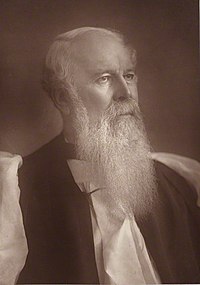
| Bishop J. C. Ryle |
DISTINCTIVE
VESTMENTS
BY
REV. CANON J. C. RYLE
VICAR
OF STRADBROKE
WHAT
is the meaning of the expression which heads this paper? What are
these “distinctive vestments,” about which there is so much
controversy among Churchmen? Are they of any real importance? Ought
they to be formally sanctioned or not? To these questions it is
proposed in this paper to supply an answer. “Distinctive
Vestments,” then, are certain articles of ministerial dress, which
some clergymen wish to be allowed to wear in the celebration of the
Lord’s Supper, and declare they cannot be satisfiedunless they are
allowed. It is asserted that these vestments are specially and
peculiarly connectedwith the office which the clergyman performs in
that sacrament, and that he ought to be allowed to wear them in that
part of his ministrations, if in no other.
Now,
what are these famous “Vestments” to which such importance is
attached? It may be useful to have our minds clearly informed about
this. A surplice, a hood, and a scarf, most people understand. But
what are these “distinctive vestments?” They are described in the
Directorium Anglicanum, and in Dr. Blakeney’s admirable work on the
Prayer Book, a book which every faithful Churchman ought to read in
the present day. The three principal vestments are these:
1.
The alb: a linen garment, fitting close to the body, reaching to the
feet, and bound with a girdle.
2.
The chasuble: a silken robe, worn over the alb, richly embroidered,
and open in front.
3.
The cope: a garment of a circular form, something like a poncho, with
an opening for the head, cut
out at the sides for the arms, leaving a straight pendent piece
behind and before.
Such
are the articles of dress which are disturbing the Church of England
at the present time. Such is the apparel which many tell us is almost
essential for the right celebration of the Lord’s Supper. Such are
the “distinctive vestments,” which, it is commonly reported, many
members of Convocation are actually prepared to advise Parliament to
sanction! Now the grave question which I want all faithful Churchmen
in this day to consider is this:—Is there any real objection to
these articles of dress being worn by those clergymen who like them,
in celebrating the Lord’s Supper? Is there any good and solid
reason why clergymen; who, beside a surplice,
a hood, and a scarf, wish to wear an alb, a chasuble, and a cope,
should not be allowed to wear them? Let us see. The first idea of
many innocent and simple-minded Churchmen is to let every clergyman
do as he likes, and to allow the widest liberty and
toleration.—“Where is the use,” they say, “of making such a
stir about a mere question of outward apparel? Why not let people
alone, if they are earnest and hard-working clergymen? Why not allow
them to indulge their taste? What can it really signify in the end?
How can a few chasubles, and copes, and albs do any harm to the
Church of England?”—To all who talk and think in this way I
venture to offer a few plain facts about these “vestments,” which
cannot be disputed, and I invite them to consider them well. Most of
them are historical facts, which any intelligent reader can verify
for himself. I challenge all who are disposed to make light of the
“vestment” question, to look these facts fairly in the face.
Church
Association Tract 033 Page 2 of 4
1.
It is a fact that there is not the slightest proof in Scripture, that
any “distinctive vestments” were worn, or considered necessary
for the due celebration of the Lord’s Supper, in the days of the
Apostles. These “vestments” are purely and entirely an invention
of a later age and of uninspired men. The gorgeous dress of the
high-priest in the Mosaic dispensation was never meant to be a
pattern to the Christian Church. It was part of a typical system,
which was ordained for a special purpose, and was intended to pass
away.
2.
It is a fact that the use of these “distinctive vestments” is one
of the many distinctive marks of the Church of Rome. That unhappy
Church connects them closely with that crowning error and blasphemous
delusion in her theological system—the sacrifice of the Mass!
3.
It is a fact that in the beginning of the English Reformation, when
our Reformers were only half enlightened, the use of these
distinctive vestments was expressly ordered. The first Prayer Book of
Edward the VIth, put forth in 1549, contains the following words in
the rubric before the Communion Service:—“The priest shall put
upon him the vestment appointed for the ministration of the Holy
Communion, that is to say, a white alb plain, with a vestment or
cope.”
4.
It is a fact that, as soon as our Reformers saw Scriptural truth
fully and clearly, they expressly forbade the clergy to use these
“distinctive vestments.” The second Prayer Book of Edward the
VIth, put forth in 1552, contains the following words at the
beginning of the morning service, “The priest shall wear neither
alb, vestment, nor cope,—but he shall have and wear a surplice
only.”
5.
It is a fact that when the English Reformation was begun over again
in the difficult days of Elizabeth, after Bloody Mary’s destructive
reign, the only rubric put forth about the ministers’ dress,
expressly omits to mention the “distinctive vestments,” and only
directs, in vague and general language, “such ornaments to be used
as were in use in the second year of Edward VI.”—But that these
“ornaments” did not mean the famous Popish “vestments,” as
some assert now-a-days, is made
as nearly certain as possible by two historical facts. One is, that
in the first year of her reign, Elizabeth issued “injunctions”
ordering ministers to “wear such seemly habits as were most
commonly received in the LATTER DAYS of King Edward VI.”—The
other is, that in 1564, the Queen issued “advertisements,” in
which it is ordered that “every minister saying prayers or
administering sacraments shall wear a comely surplice.” Neither in
the injunctions or advertisements are the alb, the cope, or the
chasuble mentioned.—Cardwell’s Documentary Annals, vol. i. p.
193, 292.
6.
It is a fact that in 1569, Archbishop Parker, the first primate under
Elizabeth, issued “Articles of inquiry” for the whole province of
Canterbury, containing the following question:—“Whether your
priests, curates, or ministers do use in the times of the celebration
of divine service to wear a surplice, as prescribed by the Queen’s
injunctions and the book of Common Prayer.”—CardweIl’s
Documentary Annals, vol. i. 321.
7.
It is a fact that in 1576 Archbishop Grindal, the second primate
under Elizabeth, issued “articles of inquiry” for the whole
province of Canterbury, in which he expressly asks “whether all
vestments, albs, tunicles, &c., and such other relics and
monuments of superstition and idolatry, be utterly defaced, broken
and destroyed.”—Parker Society, Grindal’s Remains, p. 159. The
same inquiry was made by Aylmer, Bishop of London in 1577, and by
Sandys, Archbishop of York in 1578. Whether it is in the least
likely that such an imperious Sovereign as Queen Elizabeth would have
allowed such inquiries to be made, if the “ornaments rubric”
legalized the vestments, is a question I leave to any one of common
sense to answer!
8.
It is a fact that the Canons of 1604 say nothing about “distinctive
vestments,” as essential to the due celebration of the Lord’s
Supper. The 58th canon simply orders that “Every minister saying
the public prayers, or ministering the sacraments, or other rites of
the Church, shall wear a decent and comely surplice.” This canon is
the more remarkable, because the 24th canon orders the cope to
Church
Association Tract 033 Page 3 of 4
be
worn “in cathedrals” by those who administer the communion.
However much we may regret that the “cope” is sanctioned in
cathedrals, it must be remembered that the chasuble and not the cope,
is peculiarly the sacrificial garment. The use of the chasuble is not
ordered.
9.
It is a fact that at the last revision of our Prayer Book, in the
year 1662, nothing whatever was done to restore the “distinctive
vestments,” and not a word was added to our rubrics that could
justify the use of them.
10.
It is a fact that for nearly three hundred years these “distinctive
vestments” have never been used in the parish churches of the
Church of England. Whatever some men may please to say, in the
present day, about the lawfulness of alb, chasuble or cope, there is
no getting over the fact that all custom is dead against them, and
that from the first days of Queen Elizabeth they have been disused
and laid aside.
11.
It is a fact that the attempt to revive the use of “distinctive
vestments,” in the celebration of the Lord’s Supper, is a thing
of entirely modern date. It began with a party in the Church, which
boldly avows its desire to unprotestantize the Church of England. It
is pressed forward and supported almost entirely by those churchmen
who, both in doctrine and practice, are making unmistakeable
approaches toward the Church of Rome, and regard the Lord’s Supper
as a sacrifice.
12.
Last, but not least, it is a fact that the principal advocates of the
Ritualistic movement in the Church of England, distinctly and
expressly avow that the “distinctive vestments” in the Lord’s
Supper are not taken up and pressed upon us as a mere matter of
taste, but as sacrificial garments and the outward expression of an
inward doctrine. That doctrine is nothing less than the Romish
doctrine of a real corporal presence, a real sacrifice, a really
sacrificing priest, and a real altar in the sacrament of the Lord’s
Supper. That this is the fact any one may satisfy himself by reading
the evidence of Mr. Bennett, the Vicar of Frome, given before the
Royal Commissioners in 1867, (First report, p. 72.) Mr. Bennett, in
reply to a question, distinctly told the Commissioners that “the
use of the chasuble involved the doctrine of sacrifice,” and that
“he considered he offered a propitiatory sacrifice in the Lord’s
Supper.”
I
lay these twelve facts before my readers, and commend them to their
serious attention. I entreat them, mark, learn, and inwardly digest
them. I unhesitatingly assert, in the face of these facts, that it is
impossible to defend the use of the “distinctive vestment’s” in
the celebration of the Lord’s Supper, either by Scripture, the
Prayer Book, the law of the land, or custom. Reason and common sense
alike, condemn them. I assert furthermore that it is no trifling
matter to allow any clergyman to use these vestments, that the
allowance will be the concession of a great principle, and that any
effort that may be made, either in Convocation or Parliament, to
obtain sanction for them, ought to be firmly resisted by every
faithful Churchman.
I
now call on every one who really loves the Church of England to use
every effort to prevent “distinctive vestments” being sanctioned
by the law of the land. If any doubting, hesitating, peace loving
Churchman asks me why, I offer him the following reasons:
(a.)
Because the “distinctive vestments” are utterly without warrant
of Scripture, are not in the slightest degree essential to the due
celebration of the Lord’s Supper, and are not of the slightest use
to the souls of Christian worshippers.
(b.)
Because the “distinctive vestments” were deliberately rejected
and expressly forbidden by the English Reformers at the brightest
period of the Reformation, and to sanction the use of them again
would be an insult to the memory of the very men who were martyred at
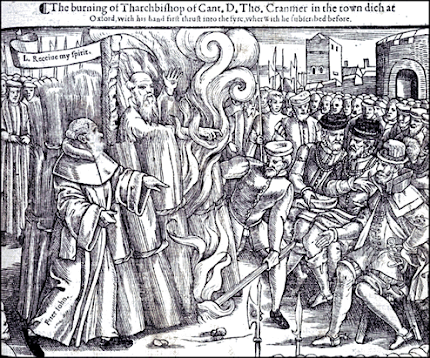
Oxford and Smithfield.
Church
Association Tract 033 Page 4 of 4
(c.)
Because the Church of England has done well enough without the
“distinctive vestments” for three hundred years, and at the
present time does not need more “ornaments,” but more preaching
the Gospel and more holy living among its ministers.
(d.)
Because the immense majority of the laity do not want the
“distinctive vestments” to be worn by the clergy, and are quite
satisfied with the customary surplice and hood. They wish for no
innovation in the dress of ministers, and are likely to regard the
sanction of them with annoyance and disgust. In short, the
“vestments” may bring on secession, disruption and
disestablishment.
(e.)
Because the “distinctive vestments” are avowedly connected with
one of the worst and most dangerous doctrines of the Church of
Rome—viz., the sacrifice of the mass; and the sanction of them
would therefore be displeasing to God, because highly dishonouring to
the priestly office and finished work of our Lord Jesus Christ.
(f.)
Because the adoption of the “distinctive vestments” is justly
calculated to give great offence to the whole body of English
nonconformists, and is likely to alienate them more and more from the
Established Church, and to render reunion and comprehension
impossible.
(g.)
Because the sanction of the “distinctive vestments” would be a
public declaration to the whole world, that the clergy of the Church
of England wish to go back from the pure and Scriptural principles of
Protestantism, on which the Church was first established, and to make
a nearer approach to the Church of Rome, from which their forefathers
seceded. In short, the “vestments” are a direct retrograde step
towards Popery.
(h.)
Because the sanction of “distinctive vestments” will more than
ever separate the clergy of the Church of England into two opposing
parties—those who wear sacrificial garments at the Lord’s table,
and those who do not wear them. So far from the liberty to wear them
promoting peace, it will only increase and multiply our “unhappy
divisions.”
(i.)
Because the sanction of “distinctive vestments” will only please
a small minority of restless Churchmen, who have long avowed their
dislike to Protestantism, while it will seriously offend that large
mass of English people who are deeply attached to the principles of
the Reformation. For these reasons I now call on all Churchmen who
love the old Church of England, on all English Christians who love
Christ, on all who dislike priestcraft or sacerdotalism, to unite as
one man inresisting the efforts now being made to obtain a legal
sanction for the use of “distinctive vestments” in the
Established Church, at the Lord’s Supper. For peace sake let us be
ready to concede much.
On
indifferent matters let us allow the utmost liberty to men’s
consciences. But we must never give up Christ’s truth,—If any
persons want to have the sacrament of the Lord’s Supper formally
declared to be a sacrifice, or want a sacrificial dress to be
formally legalised at the Communion table of the Church of England,
let us resolve firmly, that we will never, never, never consent.—Let
our common watchword throughout England and Wales be this,—a
Protestant Established Church, or else no Established Church at all!
No compromise with Popery, whatever be the consequence! No peace
with Rome! Those that want “the mass” ought to go outside the
Church of England.
See also: Church Association Tracts




 Posts
Posts


