>

Martyred for the Gospel

Martyred for the Gospel
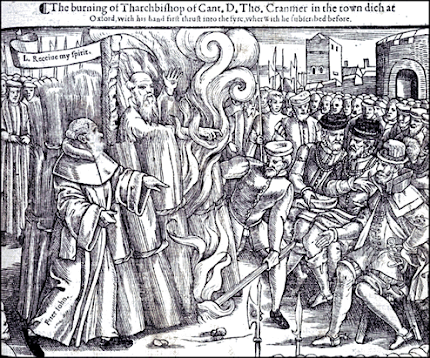
The burning of Tharchbishop of Cant. D. Tho. Cranmer in the town dich at Oxford, with his hand first thrust into the fyre, wherwith he subscribed before. [Click on the picture to see Cranmer's last words.]

Daily Bible Verse

Showing posts with label Confessional Theology. Show all posts

Thursday, May 21, 2015

What Do Reformed Christians Believe? Part 1

I have been negligent of late in writing for my blog due to my discussions and debates on Facebook.  You can visit my Facebook groups at Reformed Anglicans for Scripturalism and Calvinism Defended Against All.  That being said, I want to start a new series of articles where I will compare and contrast the Anglican Formularies (Thirty-nine Articles of Religion, the 1662 Book of Common Prayer, the Anglican Homilies), the Westminster Standards (Westminster Confession of Faith, the Larger and Shorter Catechisms), and the Three Forms of Unity (The Belgic Confession, the Heidelberg Catechisms, and the Canons of Dort).  Wherever pertinent I will also interact with other Reformed confessional documents and/or Protestant Reformation era theologians or the Anglican and Puritan divines.  In short, I may appeal to other resources besides the primary ones.

I will try to provide a bibliography for my sources at a future date.  For now I want to state upfront that my primary theological resources will be the writings of Dr. Gordon H. Clark or Dr. Carl F. H. Henry.  In particular, I will be making frequent reference to Dr. Clark's book, What Do Presbyterians Believe? 1965.  2nd Edition.   John W. Robbins, ed.  (Unicoi: Trinity Foundation, 2001).

To begin this discussion two issues first come to mind.  The first one is what do we believe and why do we believe it?  The short answer is that all knowledge must start somewhere.  As the late Dr. Gordon H. Clark correctly pointed out, the beginning of Christian knowledge--and in fact all other knowledge as well--is the Bible.  The axiom for Christianity and the Christian worldview is that Scripture alone is the Word of God. (2 Timothy 3:16).  Also, it should be pointed out that every epistemological system begins with unproven starting points.  To begin in the middle of an argument and to presuppose the system is in essence an axiom.  Even the scientific worldviews espoused by empiricism, logical positivism, and secular humanism do not being with empirically verifiable starting points but instead begin with unproven axioms that are considered to be self-evident.  Even Thomas Jefferson most famously began the Declaration of Independence with an axiom: 
We hold these truths to be self-evident, that all men are created equal, that they are endowed by their Creator with certain unalienable Rights, that among these are Life, Liberty and the pursuit of Happiness.  The Declaration of Independence.

Rather than jumping into the philosophical and theological issues, however, I have chosen to start with the Bible and the Reformational era confessions of faith which effectually summarize the system of propositional truths contained within the Scriptures.  Of all the confessions, only the Westminster Confession begins with the doctrine of Scripture or sola Scriptura.  Chapter 1 is called "Of the Holy Scriptures.  Every denomination has a written or unwritten confession of faith or what the churches in that denomination believe the Bible says.  That being the case the Westminster Confession of Faith is no different.  The exception is that the Protestant Reformers and the Puritan divines were careful to make a detailed exposition of the system of theology in the Bible with pertinent and appropriate proof texts.

I want to begin with what the 1647 Westminster Confession and the Larger and Shorter Catechisms have to say about Scripture.  I will be breaking this down into manageable portions.  If you wish to read the entire context you will need to refer to an online edition of the appropriate confessions:

THE WESTMINSTER CONFESSION OF FAITH


CHAPTER I—Of the Holy Scripture

  1.      Although the light of nature, and the works of creation and providence do so far manifest the goodness, wisdom, and power of God, as to leave men inexcusable; (Rom. 2:14–15, Rom. 1:19–20, Ps. 19:1–3, Rom. 1:32, Rom. 2:1) yet they are not sufficient to give that knowledge of God, and of his will, which is necessary unto salvation. (1 Cor. 1:21, 1 Cor. 2:13–14) Therefore it pleased the Lord, at sundry times, and in divers manner, to reveal Himself, and to declare that His will unto His Church; (Heb. 1:1) and afterwards, for the better preserving and propagating of the truth, and for the more sure establishment and comfort of the Church against the corruption of the flesh, and the malice of Satan and of the world, to commit the same wholly unto writing: (Prov. 22:19–21, Luke 1:3–4, Rom. 15:4, Matt. 4:4,7,10, Isa. 8:19–20) which maketh the Holy Scripture to be most necessary; (2 Tim. 3:15, 2 Pet. 1:19) those former ways of God’s revealing His will unto His people being now ceased. (Heb. 1:1–2)


The Westminster Confession of Faith (Oak Harbor, WA: Logos Research Systems, Inc., 1996).

First of all, please note that the Confession does not disregard general revelation or natural revelation.  The apostle Paul tells us this as well in Romans 1:18-21.  But general revelation cannot tell us enough information for saving faith.  That is why we need special revelation in Holy Scripture.  The evidentialists and empiricists wish to start with science; the rationalists wish to start with pure reason; and the neo-orthodox wish to begin with irrationalism.  But the Christian must begin with the axiom of Scripture for the simple reason that God only speaks in Scripture.  The doctrine of the Trinity cannot be deduced logically from a rock or a tree, although some substance abuse programs like Alcoholics Anonymous seem to think that your higher power can be a rock or a leaf.  I have often wondered how a rock or a leaf could make an alcoholic stop drinking?  If that be the case, would not A.A. be superfluous?

What is general or natural revelation anyway?  General or natural revelation is what God has revealed in nature or creation.  It might also include what man can know only from his being a created being in God's image and likeness.  Man has the innate light of reason and logic built into his soul because God is Himself a spirit (John 4:24) and because God is the very essence of Logic.  (John 1:1).  Man is not his body but is instead a spirit or soul living in a body.  When the body dies the soul lives on.  (Matthew 10:28; 2 Corinthians 5:6, 8).  Indeed John 1:9 does not refer to salvation but is instead the light that God grants to all men by virtue of man's being created in God's image.  (Genesis 1:27).  As the late Dr. Gordon H. Clark liked to say, "Man is the image of God."  Obviously, however, the noetic effects of sin causes man's ability to reason to be affected as well.  That's why the apostle Paul says in Romans 1:18 that man suppresses the truth in unrighteousness.

The distinction between general and special revelation is further delineated in the Westminster Larger Catechism, question 2:

Question 2

How doth it appear that there is a God?
The very light of nature in man, and the works of God, declare plainly that there is a God; (Rom. 1:19–20, Ps. 19:1–3, Acts 17:28) but his word and Spirit only do sufficiently and effectually reveal him unto men for their salvation. (1 Cor. 2:9–10, 2 Tim. 3:15–17, Isa. 59:21)


The Westminster Larger Catechism: With Scripture Proofs. (Oak Harbor, WA: Logos Research Systems, Inc., 1996).

The very light of nature in man would include John 1:9 and the references in Romans 2 to the Gentiles having the law of God written in their hearts:


Romans 2:12–16 (NKJV)
12 For as many as have sinned without law will also perish without law, and as many as have sinned in the law will be judged by the law 13 (for not the hearers of the law are just in the sight of God, but the doers of the law will be justified; 14 for when Gentiles, who do not have the law, by nature do the things in the law, these, although not having the law, are a law to themselves, 15 who show the work of the law written in their hearts, their conscience also bearing witness, and between themselves their thoughts accusing or else excusing them) 16 in the day when God will judge the secrets of men by Jesus Christ, according to my gospel.

Notice, however, that Paul is not saying that the Gentiles can be saved by keeping the law of God.  Far from it!  His point is rather that even the Gentiles have some form of morality and this is due to their being created in the image and likeness of God and having the moral law of God written in their hearts.  But to prove this does not entail saving faith, Paul says:

 
Romans 3:9–11 (NKJV)
9 What then? Are we better than they? Not at all. For we have previously charged both Jews and Greeks that they are all under sin. 10 As it is written: “There is none righteous, no, not one; 11 There is none who understands; There is none who seeks after God.

The fact of the matter is that the Scriptures alone can tell us what to believe unto saving faith.  Paul says this in 2 Timothy 3:15 and Jesus Himself emphasized Scripture many times over in the Gospels.  (John 10:35; Matthew 4:4; Luke 24:44-46).

The Thirty-nine Articles of Religion emphasize the sufficiency of Scripture over against the Roman Catholic view that Scripture is insufficient to provide enough information or understanding for saving faith.  Rome teaches that the Scriptures needs an infallible interpretation in order to be understood toward saving faith.  And Rome supplies the magisterium and the so-called deposit of faith to interpret the Scriptures for the church.  But if an infallible and inerrant Bible cannot be understood, how would believers then understand the many so-called infallible and inerrant magisterial pronouncements of Rome and the papal bulls?  After all, when the pope speaks authoritatively it is supposed to be the voice of Christ.  Article 6 says:

VI. Of the sufficiency of the Holy Scriptures for Salvation.
HOLY Scriptures containeth all things necessary to salvation: so that whatsoever is not read therein, nor may be proved thereby, is not to be required of any man, that it should be believed as an article of the faith, or be thought requisite or necessary to salvation. In the name of Holy Scripture, we do understand those Canonical books of the Old and New testament, of whose authority was never any doubt in the Church.  Article 6

Therefore, no Christian is obligated to believe what Rome says that is not demonstrated in, of and by the Holy Scriptures alone.  The same can be said for any Protestant denomination which tries to go beyond what is written in the Holy Scriptures.  (1 Corinthians 4:6).


Due to a shortage of time today, I will end here for now.  But much more needs to be said in regards to the doctrine of Scripture.  So I will continue this tomorrow.


Belgic Confession of Faith

Article 3
The Written Word of God

We confess that this Word of God was not sent nor delivered by the will of man, but that holy men of God spake as they were moved by the Holy Ghost, as the apostle Peter saith.1 And that afterwards God, from a special care which He has for us and our salvation, commanded His servants, the prophets2 and apostles,3 to commit His revealed Word to writing; and He Himself wrote with His own finger the two tables of the law.4 Therefore we call such writings holy and divine Scriptures.

1 2 Pet. 1:21
2 Ex. 24:4; Ps. 102:19; Hab. 2:2
3 2 Tim. 3:16; Rev. 1:11
4 Ex. 31:18

Thursday, June 28, 2012

Beware! The Naked Bible » MSH

Heresiarch, Michael Heisner, Logos.com


Logos just gave me a free study bible connected to the Lexham Bible and the Lexham Bible Dictionary. "Wonderful!" I thought. But then I wanted to find out the theological biases of the editors and commentators in the Faith Life Bible. Oh, oh. Here's what I found. It's connected an individual editor named Michael Heisner, who apparently works for Logos.

Like most heretics he sides with the Anabaptists and the Radical Reformation.  Creeds have almost no authority whatsoever and neither do confessions of faith.  The Bible is really just a Rorschach inkblot where the reader responds however he feels like responding.  Forget logic.  Forget doctrine.  Just go with the force, Luke!

I knew it was too good to be true.  Be wary of those bearing free gifts on the internet.  It usually comes with heretical baggage!  Here is Heisner's irrational self-contradiction:

While I’m not anti-creedal, I am opposed to treating creeds as though they are the final word on articulating biblical theology. Creeds are selective, historically-conditioned, limited by their context and the resources available to their formulators, and often agenda-driven. I’m more concerned with what the text says and what it can sustain in the way of interpretation than I am with creeds, especially if they are recent (read: English-Bible based and flavored with the hermeneutics of 20th century evangelicalism). I also have what I think is a healthy disdain for the trendiness of academia and its own brand of self-assured dogmatics.  I’d be a happier guy if every graduate student in biblical studies and theology was forced to take courses in logic and critical thinking.  That’ll happen right after the Cubs win the World Series.
If Heisner really believed in logic he would know that the Bible requires an interpretation and ALL interpretations are therefore fallible.  Perhaps he has never heard of Gordon H. Clark and Clark's axiom that the Bible is the Word of God and the Westminster Standards are the best systematic and logical summary of Christian doctrine.  If we take Heisner's view, that would mean that there is no consensus or authority for the Bible since for there to be any authority at all there must be a standard for doctrine.  Essential doctrine is still fallibly systematized by men.  That's where official creeds and confessions come into play.  Heisner would have us to believe his opinion trumps logic, creeds, confessions, and even Scripture!  Is he the pope?  It would do us well to remember this:


Article VIII


Of the Three Creeds

The three Creeds, Nicene Creed, Athanasius' Creed, and that which is commonly called the Apostles' Creed, ought thoroughly to be received and believed; for they may be proved by most certain warrants of Holy Scripture.

De Tribus Symbolis

Symbola tria, Nicaenum, Athanasii, et quod vulgo Apostolorum appellatur omnino recipienda sunt et credenda; Scripturarum testimoniis probari possunt.

Provenance

Composed by the English reformers in 1552/3.
If Heisner thinks there is no creed or confession that can be "proved from most certain warrants of Holy Scripture," then that would apply to his own lone ranger "confession" or "creed" as well.  The word for "creed" comes from the Latin verb, "credo," or "I believe."  Christian, what do you believe?  "I believe in God the Father Almighty, maker of heaven and earth . . ."  Heisner's view is on the same level as that of Michael Servetus.  There is no certainty for what Scripture means except as a subjective and individualistic reading.  For Heisner the principle for interpreting Scripture implies solo scriptura, not sola Scriptura.

The heading of the page at the Naked Bible site says:  "The Naked Bible: Biblical theology, stripped bare of denominational confessions and theological systems."  I guess it's stripped bare of any authority except Michael Heisner's lone ranger opinion--which, by the way, isn't worth the electrons on your computer screen!

In reading the Lexham Bible Dictionary it seems at first reading that the biases of the editors and the commentators is not Reformed for Calvinistic.  In that regard I would offer a word of caution and the same goes for Heisner's notes in the Faithlife Study Bible.

My recommendation if you are looking for a good free study Bible is to go with the NET Bible, which interacts with original language issues of translation and textual criticism from a more Reformed or Calvinistic perspective.  Daniel Wallace is one of the editors there.

Click here to read more about the Faithlife Study Bible as it is based on the Naked Bible:  The Naked Bible » MSH

Wednesday, May 30, 2012

aztexan: Christianity: The Intelligible Axiom

Contrary to the unity commended by Scripture, the World Council, the National Council of Churches, and the Blake-Pike proposals envisage denominational mergers without any significant doctrinal agreement. This is consistent with their anti-intellectualism which leaves them no Gospel.  --Gordon H. Clark


The following excerpt from Gordon H. Clark's Christian Philosophy was posted on AZTexan's blog. I hope he will forgive me for borrowing this without asking. But Evangelical ecumenicalism is as bad as any of the liberal ecumenical movements. In other words, the National Association of Evangelicals has led to all sorts of theological errors.  The National Association of Evangelicals is as full of errors as any "liberal" ecumenical organization.

 Here is the quote from Dr. Clark:

 ... The whole attempt to disparage knowledge and logic, whether the attempt be that of the contemporary liberals or that of the anti-intellectual pietists, is clearly contradictory to Scripture.

The Scripture places a noticeable emphasis on knowledge. In Ephesians 1:17-18 the Apostle prays that "God may give you the spirit of wisdom and revelation in divine knowledge, the eyes of your understanding being enlightened." 1 John 5:20 says, "We know that the Son of God is come and has given us an understanding, that we may know him that is true." The same apostle records the words of our Lord, "This is life eternal, that they might know you, the only true God and Jesus Christ, whom you have sent." 1 Corinthians 15:34 gives a warning against ignorance: "Awake to righteousness and sin not, for some have no knowledge of God."

The Old Testament too commends knowledge. The stated purpose of the Proverbs of Solomon was to give subtlety to the simple and knowledge to young men. The fear of the Lord is the beginning or chief part of knowledge, but fools despise wisdom and instruction. And there are many other exhortations to knowledge.

To refer to a matter of contemporary interest and to illustrate how intellectualism or a respect for knowledge entails practical conclusions that contrast sharply with other types of religion, we may note that the ecumenical unity approved by the New Testament is unity of doctrine and knowledge. There is no great command to establish organizational unions, but we read with some frequence, "I beseech you that you all speak the same thing, and that there be no divisions among you, but that you be perfectly joined together in the same mind and in the same judgment" (1 Corinthians 1:10). Or, again, "Fulfill my joy, that you be likeminded, having the same love, being of one accord, of one mind" (Phillipians 2:2). Contrary to the unity commended by Scripture, the World Council, the National Council of Churches, and the Blake-Pike proposals envisage denominational mergers without any significant doctrinal agreement. This is consistent with their anti-intellectualism which leaves them no Gospel.

In addition to these Neo-orthodox groups, the pietists with their claims to individual guidance and additional revelations, and the saccharine devotional writers who malign dead orthodoxy and cold intellectualism, also exhibit a fundamental misunderstanding of Christianity when they draw their sharp distinction between the head and the heart. The head, for them, represents knowledge and dry theology; the heart is all the exciting emotionalism of hillbilly evangelism. But in Scripture there is no contrast whatever between head and heart. The view is a strictly modern innovation that conflicts with Biblical psychology and reflects a wrong notion of true religion. Depreciation of understanding, knowledge, reason, and logic not only stimulates an evil ecumenism but also leads to serious errors in theology, errors concerning human nature, sin, and therefore errors concerning the way of salvation.

Religion, or to speak clearly, the Christian religion is not an affair of the emotions, at least no more so than politics and economics are, but fundamentally an acceptance of an intelligible message.

The acceptance of this message is offered as a first principle, an axiom or postulate on which a superstructure of knowledge can be erected.... -

Gordon H. Clark From the lecture entitled "The Axiom of Revelation" Christian Philosophy (Works vol. 4). 318f.

Click here to see the original post:  aztexan: Christianity: The Intelligible Axiom

Sunday, April 29, 2012

Logic and the Reformed Symbols

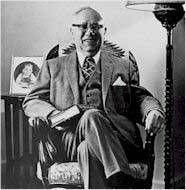
The late Gordon H. Clark.
 [3/17/2013.  My views about Clark's alleged Nestorianism have changed.  I no longer believe Clark erred in his book, The Incarnation.  I do stand by the authority of the creeds and confessions insofar as they reflect the teaching of Scripture.

Note #2.   On my blog I have decided not to delete earlier articles, even when my views change.  I no longer believe that Clark's view is wrong or Nestorian.  However, the problem still remains as to exactly how the union in the one man, Jesus Christ takes place.  The word for "person" in English is "hypostasis" in Greek, while in Latin it is "persona."  As Clark points out in The Incarnation, these terms did not mean faculty psychology the way the modern era views this.   What needs to be done is a better hammering out of the union between the human person of Jesus Christ and the divine Logos.  Clark solved the problem from the aspect of not confusing the two natures/persons.  But I think more work needs to be done on the union aspect.  Any remarks below criticizing Clark's view I will let stand even though I'm no longer convinced that Clark was wrong or that he was a NestorianCharlie, June 15, 2013.]

Recently the God's Hammer blog again brought up the issue of the infallibility and inerrancy of Scripture versus the Reformed contention that church councils and synods may and do err.   (See:  Calvin on the Human Fallibility in the Councils).  While Sean Gerety does not reject the Reformed Confessions as authoritative, he does post comments by Hugh McCann, who apparently thinks that Scripture is the only authority and that creeds and confessions "necessarily err" and have no authority whatsoever.  As Forrest Gump once said, "Stupid is as stupid does."  The Anabaptist position rejects the authority of creeds and confessions, not the Reformed position.  I find it odd that a so-called Clarkian blog would post Anabaptist comments without any rebuke whatsoever.

I call it as I see it.  The fact is without an interpretation Scripture is without any authority.  Although all interpretations of Scripture are necessarily fallible and may be in error, it does not follow that no creed or confession has any secondary authority for matters of church discipline.  If that be the case then we could not prosecute heretics or condemn heresies since there would be no agreement on a logical or rational basis for determining what is necessary and essential for unity of belief and doctrine in the local congregation and in the denominations at large.

Either the Trinity is essential doctrine or it is not.  Simply because certain Clarkians wish to throw out the Nicene creed, the Definition of Chalcedon, and the Athanasian creed does not make their opinions infallible.  It is highly selective for Clarkians to open the door to Nestorianism while condemning Federal Visionists and Arminians on the basis of the Reformed confession.  Why?  Because the Westminster Standards uphold the Definition of Chalcedon and the theology of both the Nicene creed and the Athanasian creed.

That can easily be demonstrated here:

3. It belongeth to synods and councils, ministerially to determine controversies of faith, and cases of conscience; to set down rules and directions for the better ordering of the public worship of God, and government of His Church; to receive complaints in cases of maladministration, and authoritatively to determine the same: which decrees and determinations, if consonant to the Word of God, are to be received with, reverence and submission; not only for their agreement with the Word, but also for the power whereby they are made, as being an ordinance of God appointed thereunto in His Word.1

1 Acts 15:15,19,24,27,28,29,30,31; Acts 16:4; Matt. 18:17-20  Westminster Confession of Faith, Chapter 31:3.


As indicated, the confession says that synods and councils do have authority, albeit that authority is subject to Scriptural authority.  Furthermore, the Confession upholds that Jesus Christ is one person:

2. The Son of God, the second person in the Trinity, being very and eternal God, of one substance and equal with the Father, did, when the fulness of time was come, take upon Him man's nature,1 with all the essential properties and common infirmities thereof, yet without sin;2 being conceived by the power of the Holy Ghost, in the womb of the Virgin Mary, of her substance.3 So that two whole, perfect, and distinct natures, the Godhead and the manhood, were inseparably joined together in one person, without conversion, composition, or confusion.4 Which person is very God, and very man, yet one Christ, the only Mediator between God and man.5
See also: WLC 36-37 | WSC 21-22


In light of the above, the onus or burden of proof lies with Clarkians to prove that Gordon H. Clark and John Robbins did not violate the Westminster Confession of Faith by adopting the two person view that Jesus Christ is not two natures united in one Person but rather two persons united in some yet to be described and "mysterious" way.  Ironically, Clark's view leaves us without any propositional or logical explanation for how Jesus Christ can be unified as both God and man.  The problem dealt with by the early church was how Jesus could be both God and man at the same time without dividing God and man.  Both the Westminster Standards and the Three Forms of Unity uphold that Jesus MUST be both God and man in order to be the mediator of the new covenant and to pay the penalty for sins:


Article 19: Of the Hypostatic Union or of the Two Natures in the Person of Christ

We believe that by this conception the person of the Son of God is inseparably united and joined with the human nature,[1] so that there are not two sons of God, nor two persons, but two natures united in one single person. Each nature retains its own distinct properties: His divine nature has always remained uncreated, without beginning of days or end of life (Heb 7:3), filling heaven and earth.[2] His human nature has not lost its properties; it has beginning of days and remains created. It is finite and retains all the properties of a true body.[3] Even though, by His resurrection, He has given immortality to His human nature, He has not changed its reality,[4] since our salvation and resurrection also depend on the reality of His body.[5]
 
However, these two natures are so closely united in one person that they were not even separated by His death. Therefore, what He, when dying, committed into the hands of His Father was a real human spirit that departed from His body.[6] Meanwhile His divinity always remained united with His human nature, even when He was lying in the grave.[7] And the divine nature always remained in Him just as it was in Him when He was a little child, even though it did not manifest itself as such for a little while.

For this reason we profess Him to be true God and true man: true God in order to conquer death by His power; and true man that He might die for us according to the infirmity of His flesh.

[1] Jn 1:14; Jn 10:30; Rom 9:5; Phil 2:6, 7. [2] Mt 28:20. [3] 1 Tim 2:5. [4] Mt 26:11; Lk 24:39; Jn 20:25; Acts 1:3, 11; Acts 3:21; Heb 2:9. [5] 1 Cor 15:21; Phil 3:21. [6] Mt 27:50. [7] Rom 1:4.  (Belgic Confession of Faith).

Article 18 of the Belgic confession asserts that Jesus has a "reasonable human soul".  If Gordon H. Clark meant only that the Logos has assumed a truly human soul into the Godhead via the incarnation there would be no objection.  But exactly what Clark meant is still a mystery.  Ironically, Gordon H. Clark equated the Westminster Standards with biblical Christianity.


I do not have my copy of Christian Philosophy with me but I believe in that book Clark says that the Westminster Standards are the best systematic exposition of the propositional truths of the inerrant and infallible Scriptures. I can, however, show that John Robbins thought that the Westminster Standards were the best summary of Scriptural teaching:

Three very useful guides for studying the Bible are the Westminster Standards, consisting of the Westminster Confession of Faith, the Larger Catechism, and the Shorter Catechism, all written in the 1640s. The Westminster Confession remains the best summary of the Bible yet written. The Confession summarizes in 33 short chapters the teaching of Scripture on everything from Scripture itself to the Last Judgment. Dr. Gordon Clark’s commentary on the Confession, What Do Presbyterians Believe? is the best short introduction to what the Bible teaches. You as a young Christian should read What Do Presbyterians Believe? and the Scripture verses cited in it very early in your studies. This will give you an introduction to the whole system of truth taught in Scripture and will enable you to see the forest, not merely the trees. The Catechisms will help you grasp the definitions of important terms in Scripture, such as justification, adoption, predestination, and alone, as well as understand such basic items as the Ten Commandments and the Lord’s Prayer. A useful study guide to the Westminster Confession is Dr. W. Gary Crampton’s Study Guide to the Westminster Confession.  (See:  A Guide for Young Christians).

It is highly hypocritical for Clarkians to condemn other heresies like the Federal Vision, Arminianism, Oneness Pentecostalism, et. al., while selectively exempting departures from the Reformed symbols by Gordon H. Clark, John Robbins, and Robert L. Reymond.   Clark and Robbins denied the unity of the person of Christ as both God and man while Reymond denies the eternal generation of the Son of God from the Father.  Reymond's position is wrong because he overlooks the fact that the Nicene creed and the Athanasian creed both assert the aseity of the Son of God.

Scripture upholds the unity of Jesus Christ and the Logos as one Person: 

 In the beginning was the Word, and the Word was with God, and the Word was God. 2 He was in the beginning with God. 3 All things were made through Him, and without Him nothing was made that was made. (John 1:1-3 NKJ)

 And the Word became flesh and dwelt among us, and we beheld His glory, the glory as of the only begotten of the Father, full of grace and truth. 15 John bore witness of Him and cried out, saying, "This was He of whom I said,`He who comes after me is preferred before me, for He was before me.'" (John 1:14-15 NKJ)

 No one has seen God at any time. The only begotten Son, who is in the bosom of the Father, He has declared Him. (John 1:18 NKJ)

 For there is one God and one Mediator between God and men, the Man Christ Jesus, (1 Timothy 2:5 NKJ)

If Jesus Christ is really two persons and not one person, then logically He cannot be ONE mediator between God and men.  Ironically, then, Clark's view is hopelessly irrational and raises more problems than it solves.  It is true that God cannot suffer on the cross.  But it is equally true that the hypostatic union cannot be severed.  What Clark did not explain or define is how his alleged two persons view avoids the logical problem of separating Christ from Christ.  Either Christ is God in the flesh OR what we have is a mere man who possesses divine propositions.  A further problem with Clark's view is that he makes no distinction in The Incarnation between communicable and incommunicable attributes/propositions.  The divine propositions are not communicable to men.  But in the case of Jesus Christ these divine propositions are there and they are in union with Him as one Person according to the Westminster Confession and the Belgic Confession.  I could add the Anglican Formularies here but the Puritans irrationally reject the Anglican Formularies as Reformed theology, which assertion is absolutely untrue.  Simply because the Anglo-Catholics have attempted to pervert the teaching of the 39 Articles of Religion and the 1662 Book of Common Prayer, it does not follow that these documents are not Reformed.  Article 17, for example teaches the doctrine of double predestination.

In conclusion, then, I assert that although the Reformed symbols "may" err, no one is allowed an exception to subscription to what are essential doctrines of the Christian faith.  If Clarkians wish to prove that the Westminster Standards, Three Forms of Unity, and the Anglican Formularies are in error when they endorse the union of Christ as both God and man in one Person then Clarkians must follow due process of canon law to do so.  Otherwise, their position is essentially Anabaptist and not Reformed.  Reformed theology, according to the Westminster Confession (31:3) says that the church does have authority to hold Reformed synods and councils and that these councils and synods have the authority to settle doctrinal controversies.  Unfortunately, even Reformed synods err as the liberal mainline Presbyterian denominations demonstrate.  Even more recently the Presbyterian Church in America and the Orthodox Presbyterian Church have refused to discipline ministers who teach the Federal Visionist heresies.  But Clarkians who condemn other heresies--while committing their own theological errors without any solid logical propositions settling all the problems raised by their views--are contradicting the axiom that Scripture IS the Word of God and the axiom that the Westminster Standards are the best summary of the teaching of the infallible and inerrant Holy Scriptures.  (2 Timothy 3:15-17; 2 Peter 1:19-21; 2 Peter 3:15-16; Jeremiah 23:29).  While I consider myself a Clarkian because I uphold Scripture as consisting of logical and doctrinal propositions, I am not obligated to contradict the Reformed articles of faith or the doctrines they uphold.  Although Scripture is the infallible and inerrant Word of God, Scripture of necessity requires an interpretation and a systematic exposition which functions as a rule of faith.  In short, some sort of doctrinal consensus on what Scripture teaches is absolutely necessary if there is to be one faith, one baptism and one religion (Ephesians 4:4-6; Philippians 1:27; 1 Timothy 4:13).

Even Gordon H. Clark and John Robbins acknowledged this.  Without an interpretation Scripture remains incomprehensible and therefore irrational.  Scripture requires a rational and reasonable interpretation and cannot function as revelation without a systematic exposition of the propositions revealed within the canon of Scripture.  Salvation itself is impossible without special revelation that is coherent, comprehensive, congruent, rational, and logical in verbal and propositional form.  Would that the internet proponents of Clark's theology and apologetics were as logical as Clark himself was.  Verbal plenary inspiration and special revelation in propositional form must be known to be of value to the church and to individual members of the church.

Addendum:  Demolishing the Stronghold of a False Christology, audio sermon by Dr. Robert L. Reymond.  Dr. Reymond clearly upholds the Definition of Chalcedon in this sermon and says that it is dangerous to reject the christology of the Definition.  In light of that, my association of Dr. Reymond with Dr. Clark and Dr. Robbins above may have been hasty and misplaced.


Friday, April 13, 2012

Unconfessional Reformed Anathemas

I've been thinking lately about the state of Christ's church on earth.  The Roman Catholic Church is a synagogue of satan and the pope is an antichrist.  The Eastern churches are synergistic and semi-pelagian.  The Arminians teach a form of semi-pelagian synergism that is essentially a works based religion where election and perseverance are conditional on man and not on God's mighty power and sovereignty.

Even worse the so-called "Reformed" churches these days are to one degree or another liberal.  Most have either deleted or added to the classical confessions of faith which are supposed to provide a catholic or universal basis for Christian doctrine and fellowship.  Most modern Reformed churches have either caved to a form of semi-neo-orthodoxy or semi-Arminianism (read three points of common grace, God's unfulfilled desire to save the reprobate, the well meant offer).

So-called "calvinistic" Baptists or "particular" Baptists are unconfessional and essentially Anabaptist since they place as much emphasis on personal revelations and leadings of the "spirit" as they do on Scripture.  Basically, Baptists have more in common with Pentecostals than with Presbyterians or Anglican Reformed believers.  Any emphasis on "believers" baptism is an outright denial of unconditional election since this ignores the fact that God elects prior to the foundation of the world, not at the moment someone receives Christ by faith.  Credo-baptism has more in common with decisional conversion or the altar call conversion of Charles Finney than with the paedo-baptism taught by the foreshadow of infant circumcision in the Old Testament.  The overemphasis on individual conversion ignores that God works through the church as His normative appointed instrument or means of saving His elect.  The OT church was the nation of Israel and the NT church was established at the day of Pentecost and the outpouring of the Holy Spirit.  (Acts 2:1-4; 38-39).

Anglicans are no better.  The vast majority of them are either Arminian or Anglo-Catholic or liberal.  The odds of finding a biblical Anglican congregation is about nil.  

Although I greatly admire the Primitive Baptists, they think that God's elect can remain in false churches or religions and that the elect do not need conversion.  This makes about as much sense as universalism.  All roads lead to God?   (Acts 4:10, 12; John 14:6; John 5:24-25; John 6:37-44, 65).  God has appointed preaching as the normative means for saving His elect.  (Romans 10:7-17).  How this escapes the Primitive Baptists I do not know.  But again, Baptists are closer to the Anabaptists than to truly Reformed theology.

And when I point out the Reformed confessions in a theological discussion on Facebook I am indirectly called "impatient" and "intolerant" by those who claim to be intolerant of heresy and Arminianism.  It seems to me that "belonging" to a social club is more important than biblical truth for most "Reformed" believers.

As I have said before, if I have to stand alone for the truth expressed in Scripture and the Reformed confessions, so be it.  If the semi-Arminian "Calvinists" wish to condemn traditional and classical Calvinism as "hyper-Calvinism" so be it.  Unfortunately, not one of the Reformed confessions makes common grace or the free offer of the Gospel a doctrinal standard.  Those are Arminian doctrines, not Reformed doctrines.

 But when He saw the multitudes, He was moved with compassion for them, because they were weary and scattered, like sheep having no shepherd. 37 Then He said to His disciples, "The harvest truly is plentiful, but the laborers are few. 38 "Therefore pray the Lord of the harvest to send out laborers into His harvest." (Matthew 9:36-38 NKJ)

Tuesday, February 07, 2012

David Van Drunen Rejoinder


In a response to a negative review of his book, Living in God’s Two Kingdoms: A Biblical Vision for Christianity and Culture, David Van Drunen said:

The first is that though Scripture provides guidance for thinking and acting in all areas of life, for most academic subjects Scripture provides only general guidance. The Bible sets certain parameters for approaching the various disciplines, but it does not give us specific or exhaustive information about, say, chemistry or literature or economics. To delve deeply into these subjects requires investigation of the world around us (natural revelation) and a measure of wisdom and good judgment. I imagine that Dordt College professors would agree with this claim, and implement it in their classrooms all the time. My writing on education is not a screed against Christian education, as Zylstra suggests, but wrestles with the implications of facts like this. It is something that every Christian teacher and scholar must take into account.


If only some of the Anabaptist fanatics who "claim" to be Clarkian could understand this. Gordon H. Clark himself said that the Westminster Confession is the best expression of the Christian faith in systematic form. (Christian Philosophy, p. 122). The Bible is not an exhaustive commentary on music, the arts, science, mathematics or even modern judicial law. It is a textbook on God's revealed will and dogmatic doctrine that is specific to saving faith and other issues. Scripture only indirectly speaks to matters of general revelation or natural revelation and "natural" law. Inferring more than the Bible actually says about formal logic and other philosophical issues falls as much into the category of general or natural revelation as does science. If only Baptists and non-cessationists were more logical they would be confessionally reformed and covenantal.

As much as I agree with Clark's Scripturalism, it seems to me that some Clarkians have forgotten the distinction between special revelation and general revelation. Scripture is indeed a set of propositional truth claims set forth in logical form. However, logic, strictly speaking, is a philosophical concept and therefore falls into the category of natural revelation, as does the many inferences drawn from Scripture by Clarkians in the areas of government, politics, and the sciences. Clark himself debunked the various secular theories of philosophy and said that only presupposing Scripture gives philosophy any credibility whatsoever.

One Baptist who "claims" to be "Clarkian" or Scripturalist recently said that a man can infallibly know all the logical propositions in the Scriptures. That must be a tall order. I cannot even remember all of the commandments, much less all the promises in Scripture--and I sure do not claim to know even a majority of the doctrinal propositions in the Scriptures. I do hope I have a firm grasp on the essential propositions, though. Jesus Christ is both God and man in one person. That much I know Scripture teaches. (John 1:1, 18; 2 John 1:7-11).

Unfortunately, Gordon H. Clark insisted at the end of his life that Jesus was two persons. That sort of irrational reasoning is self-contradictory in my opinion. (1 Timothy 2:5; 1 Timothy 3:16; John 1:1,14,18; Titus 2:13; John 20:28; Matthew 16:16). Not even Clark infallibly knew all the propositions God knows. Nor did Clark know all the propositions of the Scriptures. Obviously Clark thought he erred earlier in his career when he affirmed the Reformed confessional view that Christ is one person and two beings/natures, one being divine and the other being human, perfectly united but not mixed or confused or separated. Some Clarkians love to pretend that the noetic effects of sin do not affect the intellect. But that is not what Clark taught either. What he said was that knowledge itself is objective and one does not need to be a regenerate Christian to understand a particular proposition made by Scripture, such as David was the king of Israel. How that translates to an infallible knowledge of all the propositions of the Scriptures I have no idea.

Article II, Of the Word, or Son of God, which was made very man

The Son, which is the Word of the Father, begotten from everlasting of the Father, the very and eternal God, and of one substance with the Father, took man's nature in the womb of the blessed Virgin, of her substance: so that two whole and perfect natures, that is to say, the Godhead and manhood, were joined together in one person, never to be divided, whereof is one Christ, very God and very man, who truly suffered, was crucified, dead, and buried, to reconcile His Father to us, and to be a sacrifice, not only for original guilt, but also for all actual sins of men.


To read Dr. Van Drunen's rejoinder, click here: Westminster Seminary California


Monday, February 06, 2012

Anglicanism and How Many Points?

  Sanctify them in the truth; your word is truth. (John 17:17 ESV)


Recently in reconsidering several issues regarding what constitutes the so-called Reformed center, a term which attempts to reify exactly what Reformed theology is in actuality, I revisited the Riddleblog, a blog owned by Kim Riddlebarger of The White Horse Inn.  Kim is an expert on the issue of eschatology and amillennialism.  I happen to agree with amillennialism since it appears to be the best explanation of the apocalyptic material in the book of Revelation.  However, what particularly caught my attention was Dr. Riddlebarger's refutation of Dr. John MacArthur's dispensational attack on the Reformed faith while at the same time claiming to be a "five point Calvinist".  Dr. Riddlebarger rightly points out that Calvinism is way more than simply the five points of Calvinism.  (See, A Reply to John MacArthur).  Essentially, Dr. Riddlebarger says that Baptists are not Reformed, despite the fact that they may adhere to the five points of Calvinism.  Anyone familiar with the Canons of Dort knows that it is part of the Three Forms of Unity, which would include the Heidelberg Catechism and the Belgic Confession, both of which flatly reject MacArthur's Baptist view of the sacraments, his rejection of covenantal theology, and his premillennial dispensationalism.

Unfortunately,  particular Baptists get many other things wrong as well,  They are particularly prone to associate with Arminian Baptists since being Baptist trumps the Canons of Dort.  So on this aspect Baptists are not really in full agreement with the so-called five points of Calvinism either.  I might add that the Sydney Anglicans are inconsistent here as well since the Synod of Dort equally condemned the view that the atonement is in any sense all universal rather than particular to the elect.

This raises other issues as well.  I should point out here that the so-called "Clarkian apologetics" crowd is not a unified group either.  Many of them are non-cessationists or particular Baptists and outright reject confessional theology, something Gordon H. Clark with which Clark himself would have never agreed.  (See: Scripturalism).  They make this huge leap in logic based on the fact that in Clark's last book, The Incarnation, he repudiated his earlier affirmation of the Westminster Confession's view that Christ is one person but two.  (See: Was Clark a Nestorian?) From that one point many in the so-called "Clarkian" crowd jump to premature Anabaptist conclusions that therefore all confessional theology is up for grabs.  Question everything in creeds and confessions they say.

But that was not the position taken by Clark.  His view was thoroughly confessional and presupposed that the Westminster Standards were the best representation of biblical Christianity.  Although Clark, like all Reformed theologians, affirmed that Scripture is the final authority and that creeds and confessions possibly err, he did not adopt the sort of skepticism toward the creeds and Reformed standards which we see the particular Baptists and non-cessationists taking, particularly those who claim to be Scripturalists in the line of Gordon H. Clark.

In short, it is my contention that non-cessationists, particular Baptists, and others in sympathy with subjective and ecstatic leadings of the Spirit common to the Anabaptist tradition, are not truly Scripturalists at all.  They are a curious offshoot of Clark's Scripturalism.  Furthermore, the principle of Sola Scriptura is not subject to solipsism or hyper-individualism or a rejection of confessional Reformed theology.  (See:  How Many Points?, by Richard Muller).

There are many divisions in the wider Reformed and Protestant tradition.  Theonomy and reconstruction adopt a post millennial view that exalts the law above the Gospel and social transformation above the doctrines of grace.  Baptists reject creeds and confessions and adopt views very similar to the Anabaptists, including a legalistic view of "Lordship salvation".  Ironically, some so-called "Clarkians" like Kenneth Talbot are both Van Tilian and theonomic and Clarkian--as if the two go together???

The Anglican tradition suffers from a similar form of schizophrenic disjunction with the Anglican Formularies.  Ango-Catholicism, Tractarianism, and high church Arminianism are heretical perversions of the English Reformation.  But it is my contention that theonomy, dispensationalism, the Lordship salvation controversy, non-cessationism, future vindication, and assorted other theological errors could be avoided were more pastors, theologians and plow boys familiar with the Reformed standards.  My study of both Scripture and the various Reformed confessions of faith and catechisms has greatly enriched my understanding of theology and the Bible.

While I have a great appreciation for the Scripturalism of Gordon H. Clark and for the work of The Trinity Foundation regarding their stand for the doctrine of justification by faith alone, I do not and cannot adopt an Anabaptist attitude toward the Westminster Standards, the Three Forms of Unity, or the Anglican Formularies.  Unfortunately, the advocates of Clark's Scripturalism these days have little to do with Clark's rejection of the continuation of the gifts of the Spirit or with Clark's own position that the Westminster Standards best represent biblical Christianity:

Definition of Christianity
It is essential therefore to define Christianity more exactly by a specific doctrinal system.  Romanism is not what is meant.  By Christianity we shall mean, to use common names, what is called Calvinism.  Or, to be most specific, the definition of Christianity shall be the articles of the Westminster Confession.   With such a definite basis, it will no longer be necessary to spin dizzily in a whirlpool of equivocal disputation.  Now we can look at what we are talking about.  ["Is Christianity a Religion? in Christian Philosophy, volume 4, The Works of Gordon Haddon Clark, (Unicoi:  Trinity Foundation, 2004), p. 122.]


I would contend that if Anglicans actually believed what the Anglican Formularies teach then there would be much less disputation.  This is also true regarding the those who "claim" to follow the apologetics of Dr. Clark.  If they were confessional presbyterians there would be much less confusion and disputation.  Unfortunately even Sean Gerety is much more willing to compromise confessional Calvinism as it is expressed in the Westminster Standards--for the sake of a facade of unity among Clarkians on other issues like the neo-nestorianism of Clark's final book--than to stand for what Clark himself defined as biblical Christianity:  the articles of The Westminster Confession.

I would contend that for Anglicans biblical Christianity is expressed in the Anglican Formularies, which do teach the five points of Calvinism in incipient form and further developed in the Lambeth Articles of 1595, the Irish Articles, and the Westminster Standards.  While Calvinism is much more than adhering to the five points of Calvinism, Anglicanism is much more than some generic wishy washy Amyraldianism or Arminianism.  It is solidly Augustinian, Reformed, and Calvinist as that is expressed in the Formularies, Lambeth Articles, the Irish Articles, and the Westminster Standards which are drawn from them.

Although it is true that Reformation Anglicans are not Puritans or Presbyterians, it can be said that we have much more in common with the confessional view of Presbyterians or the Dutch Reformed than with particular Baptists--or even with the Clarkian Baptists masquerading under the guise of the "five points".


Sincerely in Christ,


Charlie


Support Reasonable Christian Ministries with your generous donation.