>

Martyred for the Gospel

Martyred for the Gospel
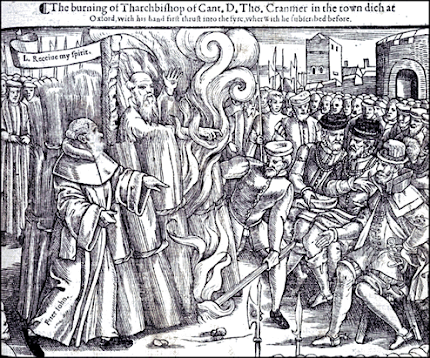
The burning of Tharchbishop of Cant. D. Tho. Cranmer in the town dich at Oxford, with his hand first thrust into the fyre, wherwith he subscribed before. [Click on the picture to see Cranmer's last words.]

Daily Bible Verse

Showing posts with label propositional truth. Show all posts

Sunday, April 15, 2018

Michael Horton's Theological Contradictions and Weak Calvinism


Every word of God is pure: he is a shield unto them that put their trust in him. (Proverbs 30:5 KJV)

“The notion of analogy begins quite simply and innocently in Aristotle.”   Dr. Gordon H. Clark

"In no case does a prophet put his words forward as his own words. That he is a prophet at all is due not to choice on his own part, but to a call of God, obeyed often with reluctance; and he prophesies or forbears to prophesy, not according to his own will but as the Lord opens and shuts his mouth . . . and creates for him the fruit of the lips . . . In contrast with the false prophets, he strenuously asserts that he does not speak out of his own heart . . ., but all that he proclaims is the pure word of Jehovah."  Benjamin B. Warfield


Michael Horton’s Theological Contradictions and Weak Calvinism

Some years ago when I began listening to The White Horse Inn I will concede that I thought Mike Horton was a sincere Calvinist and that his stand for the doctrine of justification by faith alone was brilliant.  We are constantly told that the doctrine of justification by faith alone is the doctrine by which the true visible churches stand or fall.  I say “visible” churches because from a Calvinist perspective the invisible church is composed of only those elected from before the foundation of world.  (Matthew 25:34; Ephesians 1:4-5; 2 Thessalonians 2:13; Isaiah 53:11; Revelation 13:8).  But when Martin Luther wrote against Disiderus Erasmus of Rotterdam on the issue of libertarian free will, Luther did not say that justification by faith alone was the central issue.  He said that predestination was the central issue.  But I will return to this later in this blog post. 

Unfortunately, those who follow the theology and apologetics of the now deceased professor at Westminster Theological Seminary, Philadelphia, Pennsylvania, Dr. Cornelius Van Til, see almost everything in the Bible as apparently contradictory.  Because of Van Til’s adherence to idealism as his philosophical starting point, Van Til rejected the doctrine that logic and propositional revelation is how God lowers himself to our human level.  Instead, Van Ti contended that God is totally incomprehensible or beyond understanding to the human person, by which he meant that man can know nothing God knows except by analogy.  From this Van Til contended that the Bible is analogical revelation and not propositional revelation. 

The distinguishing characteristic between very non-Christian theory of knowledge on the one hand, and the Christian concept of knowledge on the other hand, is, therefore, that in all non-Christian theories men reason univocally, while in Christianity men reason analogically. By this distinction we mean that every non-Christian theory of method takes for granted, that time and eternity are aspects of one another, and that God and man must be thought of as being on the same plane. God and man must be thought of as correlative to one another. God and man work under a system of logic that is higher than both, and that exists in independence of both. The law of contradiction is thought of as existing somehow in independence of God and man or at least as operating in both God and man on the same level.

In contrast to this, Christianity holds that God existed alone before any time existence was brought forth. He existed as the self-conscious and self-consistent being. The law of contradiction, therefore, as we know it, is but the expression on a created level of the internal coherence of God’s nature. Christians should therefore never appeal to the law of contradiction as something that, as such, determines what can or cannot be true. . . .

Cornelius Van Til.  An Introduction to Systematic Theology. (The Presbyterian and Reformed Publishing Company: Phillipsburg, NJ, 1979).  Chapter 2.A.2.  [Logos Bible Software edition.  The page numbers didn’t show when I copied the quote.]

Of course, Van Til is using a propositional statement and the law of contradiction to deny Gordon H. Clark's view of revelation as propositional and subject to the law of contradiction.  Worse, Van Til is essentially and explicitly denying that the Bible is true.  Whether this was his intention or not is not the issue.  The fact remains that Van Til has openly denied the Bible is the direct revelation of God in written form.  Secondly, Van Til misrepresented Clark's view since Clark held that God is in the simplicity of His being Logic itself.  The eternal Logos is the second Person of the Trinity.  The law of contradiction is not something external to God to which God is subject. (John 1:1).

It is often contended by the Van Tilian camp that univocalism is the doctrine of modernists who make logic a magisterial lord over the Scriptures.  While this is somewhat true because the modernists used rationalism to explain away the inspiration of the Bible, biblical inerrancy, and the supernatural miracles of the Bible—including the virgin birth and the deity of Christ in His incarnation as a human being--in regards to the Fundamentals of the faith it is a non sequitur.

If the Bible is not univocally the very words of God, the implication is obviously neo-orthodoxy, not Reformation Christianity.  But liberals do not accept the doctrine of plenary verbal inspiration or the doctrine of absolute biblical inerrancy.  For example, the modernists in the early part of the 20th century rejected the virgin birth on the basis that miracles in the Bible do not make logical sense in regards to modern science and empirical observation.  So in the Auburn Affirmation the liberals in the Presbyterian Church of the United States of America denied the fundamental doctrines of the Bible including the supernatural conception of Jesus Christ and his natural birth from the virgin Mary, his physical and bodily resurrection, and the absolute truth of the Bible because of the divine inspiration of the Scriptures.  Later the new modernists or the neo-orthodox liberals who followed the teachings of Karl Barth, Emil Brunner, Rudolf Bultmann and other irrationalists adopted a similar view when they said that the Bible only “contained” the word of God but was not the actual words of God.  

Dr. Gordon H. Clark, in contrast to Van Til and his followers, said that the Bible is literally the very words of God in written form and to deny this is to invite equivocation, ambiguity, and sophistry on the part of those who wish to hide their liberal leaning views.  Clark pointed this out in his remarks on the Auburn Affirmation in his book, What Do Presbyterians Believe?

With the introduction of modernism into our churches in the nineteenth century and with the coming of neo-orthodoxy in the twentieth, an appearance of loyalty to the Bible and to the Confession has been attempted by emphasizing certain words in the standards, by failing to mention others, and by misinterpreting the whole.  Thus unbelieving ministers made the double claims that they themselves accepted the Confession as originally intended, while the fundamentalists were inventing theories never before heard of.

Against the fundamentalists, who insisted on the inerrancy of the Bible, the modernists asserted that the Confession does not say the Bible is inerrant.  And today neo-orthodoxy loudly insists that the word of God is found in the Bible, perhaps only in the Bible, but that not everything in the Bible is true.  These modernists could appeal to the Shorter Catechism, Question 2:  “What rule hath God given to direct us how we may glorify God and enjoy him?  Answer:  The word of God, which contained in the Scriptures of the Old and New Testaments, is the only rule to direct us how we may glorify and enjoy him.”  Does it not say that the word is contained in the Scriptures?  Somewhere, but not everywhere, between Genesis and Revelation, the word of God is to be found.  This is their contention.  But if now we wish to know whether or not this was the view of the Reformers, whether not this is the position of the Presbyterian standards, and whether or not it is the teaching of the Scriptures themselves, which the standards summarize, we need only read other parts of the Confession. . . .

Dr. Gordon H. Clark.  What Do Presbyterians Believe?  (Trinity Foundation:  Unicoi, 1965). Pp. 15-16.

In fairness to Van Til, the doctrine of Scripture as analogical revelation is not exactly the same as the neo-orthodox view that not everything in the Bible is inerrant or inspired by God.  However, the practical result of denying propositional revelation and the law of contradiction is irrationalism.  If all Scripture is paradoxical or apparently contradictory, does it not follow that nothing in the Bible is rationally understandable and therefore cannot be systematically arranged into a dogmatic system that is logically consistent?  

I should also point out that the fundamentalists mentioned by Dr. Clark in the above quote were “B. B. Warfield, William G. Moorehead, E. Y. Mullins, and a score of others” who wrote articles in “twelve booklets called The Funamentals.”  (Clark, ibid.  P. 14).  Yet Dr. Michael Horton disparages “fundamentalists” in his writings, among whom Horton includes Dr. Carl F. H. Henry and Dr. Gordon H. Clark:

. . . We must recall that the Bible was generated in the context of a covenantal drama.  The script includes the speaking parts of unfaithful covenant servants, whose speech is nevertheless judged and corrected by the covenant Lord with the unfolding dialogue.   . . .
Similar to the early Christological heresy of Docetcism, which denied the reality of Christ’s full humanity, is a well-established historical tendency that one may discern in church history to downplay the humanity of Scripture.  Some ancient theologians spoke of the biblical writers as mere “flutes” on which the Spirit played or “secretaries” through whom he dictated his revelation.  Such analogies became literal theories in fundamentalism.  J. I. Packer refers to the comment of J.W. Burgon:  “Every book of it, every chapter of it, every word of it, every syllable of it, every letter of it, is the direct utterance of the Most High.” 16  W.A. Criswell expressed the same view:  “Each sentence was dictated by God’s Holy Spirit. . . .  Everywhere in the Bible we find God speaking.  It is God’s voice, not man’s.”17  Fundamentalism and Protestant orthodoxy are distinct traditions, and nowhere can this be more clearly seen than in their differing emphases concerning biblical inspiration.

Dr. Michael Horton.  The Christian Faith:  A Systematic Theology for Pilgrims on the Way.  (Zondervan: Grand Rapids, 2011).  Pp. 161-162.

The first point to be noticed in Dr. Horton’s comments is on page 161 where in contending that there are erroneous human remarks recorded infallibly and by the inspiration of the Bible he asserts that the Bible is a covenantal “drama”.  This description leaves one wondering if Horton accepts plenary verbal inspiration, propositional revelation and absolute biblical inerrancy.  And in fact in his comments on page 162 he uses the same tactics as the liberals by accusing the “fundamentalists” of thinking that God did not inspire human authors as instrumental means of writing His very words.  In short, Horton is equivocating here since B. B. Warfield himself asserted that the Bible is literally the very words of God.  The doctrine of dictation does not mean that God literally took control of the minds and hearts of the biblical writers as if their personalities had no part in what was written.  Rather the doctrine of dictation means that the biblical writers were so superintended by the Holy Spirit that even though what they wrote was written in their personal style and their words, their words were also the very words of God.

When evaluating the relationship of God’s activity and that of creatures in the production of Scripture, the doctrine of analogy already proves its merits.  If agency is univocal (the same thing) for God and for creatures, then the question is raised:  Who acts more?  Is God the author of Romans or is Paul?  However, if agency is analogical, then God’s activity in producing these texts is qualitatively different from human agency. 
Horton, Ibid. P. 162.

Dr. Gordon H. Clark gave a thorough critique of Thomas Aquinas’s view of Scripture and revelation as analogical.  His examination of the Thomist view shows that the doctrine of analogy makes for a view that truth is two fold, not univocal.  If there is more than one truth or more than one logic, the door is opened wide for the abuses of equivocation, sophistry, and dissimulation because the obvious implication is that there is no such thing as absolute truth and if there is absolute truth God alone can know it.  Neither here on earth nor in heaven will a human being be able to understand or comprehend anything God knows at any single point because  God is the Creator and creatures,  according to the Van Tilian philosophy of idealism, can know nothing God knows at any single point.

The notion of analogy begins quite simply and innocently in Aristotle. He notes that when we call a book a medical book, and when we call an instrument a medical instrument, and when we call a man a medical man, the predicate medical does not bear exactly the same sense in the three instances. The term is not equivocal, as is the case when we call Argos the dog of Ulysses and when we call Sirius the dog in the sky; but on the other hand, the term is not strictly univocal. It is analogical. 

This simple distinction was elaborated by the Scholastics and the Neoscholastics into a complicated theory, in which, it would seem, the original situation no longer serves as a solid basis. The motivation and intricacies of the theory are seen most clearly in the arguments for the existence of God and our knowledge of him. God, according to the Thomists, is an absolutely simple being; but a simple, eternal, and immaterial being cannot constitute an object proportionate to our human understanding. Simplicity and eternity are not factors in our world of experience, and therefore we have no positive concept of them. To say that God is eternal means nothing more than that God is not temporal. What eternity positively means remains unknown to the human mind. What man has in this instance may be called negative knowledge. 

Similarly, when we call God wise and when we call a man wise, the term does not bear the same sense. God’s wisdom is not distinct from his essence or his being; but the wisdom of man is. In general, there is no affirmation whatever that can be made of God and of man in the same sense. The reason for this impossibility is not only that the predicates do not bear the same meaning in both cases, but that, far more radically, the copula is bears two different senses. In God essence and existence are identical: What God is and that God is are the same. In every case other than God this is not so. Accordingly, when we say God exists and when we say man or dog exists, the term exist does not mean the same thing. Therefore, no term, not even the copula, can be used univocally of God and man. 

Now, if the only alternative to univocal predication were equivocal predication, knowledge of God derived by abstraction from experience would be patently impossible. When words are used equivocally there is no definite relationship between the meanings, and knowledge of God would be in a state similar to a knowledge of Sirius that would be based on an experience of Ulysses’ dog. To avoid this fatal difficulty, the Thomists are forced to find some intermediate between univocal and equivocal predication, and they appeal to analogy. Between Argos and Sirius there is no resemblance, but in the case of God, man resembles God, they say, though God does not resemble man.17 This resemblance permits us to attach some meaning to the statement God is, so that we are neither in complete ignorance, nor limited to negative knowledge, but have an analogical if not a univocal knowledge. Thus empiricism in its Thomistic form attempts to escape the limits of experience.

Gordon H. Clark. A Christian View of Men and Things.  (Kindle Locations 4528-4550). The Trinity Foundation. Kindle Edition.

The problem with Van Tililans is that they not only reject experience but they also reject propostional revelation and the internal logical consistency of the biblical revelation.  Irrationality seems to predeominate and Horton’s refusal to define his terms or rationally harmonize his views with Scripture or define what he means by the term qualitative demonstrates adequately that he has no clear commitment to divine truth or divine revelation. 

Moreover, if there is a difference between God’s providence and the human agency involved in the writing of the Scriptures, would not that difference be an actual difference between the definition of God as an absolute and timeless being and the definition of a human being as limited to the realm of the created universe, created time, and discursive thinking?  Since God is timeless, omniscient and never learns anything new, how would God not know what the biblical writers would write?  Furthermore, since God can indeed control the minds, wills, thoughts and actions of humans without violating their psychological agency, intellect or volition, how does it follow that fundamentalists are advocating “mechanical dictation”?  (Proverbs 21:1).  B. B. Warfield said that the Scriptures are the very words of God but denied that this is mechanical dictation:

The process of revelation through the prophets was a process by which Jehovah put His words in the mouths of the prophets, and the prophets spoke precisely these words and no others. So the prophets themselves ever asserted. “Then Jehovah put forth his hand, and touched my mouth,” explains Jeremiah in his account of how he received his prophecies, “and Jehovah said unto me, Behold, I have put my words in thy mouth” (Jer. 1:9; cf. 5:14; Isa. 51:16; 59:21; Num. 22:35; 23:5, 12, 16). Accordingly, the words “with which” they spoke were not their own but the Lord’s: “And he said unto me,” records Ezekiel, “Son of man, go, get thee unto the house of Israel, and speak with my words unto them” (Ezk. 3:4). It is a process of nothing other than “dictation” which is thus described (2 S. 14:3, 19), though, of course, the question may remain open of the exact processes by which this dictation is accomplished. The fundamental passage which brings the central fact before us in the most vivid manner is, no doubt, the account of the commissioning of Moses and Aaron given in Ex. 4:10–17; 7:1–7. Here, in the most express words, Jehovah declares that He who made the mouth can be with it to teach it what to speak, and announces the precise function of a prophet to be that he is “a mouth of God,” who speaks not his own but God’s words. Accordingly, the Hebrew name for “prophet” (nābhīʾ), whatever may be its etymology, means throughout the Scriptures just “spokesman,” though not “spokesman” in general, but spokesman by way of eminence, that is, God’s spokesman; and the characteristic formula by which a prophetic declaration is announced is: “The word of Jehovah came to me,” or the brief “saith Jehovah” (נאם יהוה, neʾum Yahweh). In no case does a prophet put his words forward as his own words. That he is a prophet at all is due not to choice on his own part, but to a call of God, obeyed often with reluctance; and he prophesies or forbears to prophesy, not according to his own will but as the Lord opens and shuts his mouth (Ezk. 3:26 f.) and creates for him the fruit of the lips (Isa. 57:19; cf. 6:7; 50:4). In contrast with the false prophets, he strenuously asserts that he does not speak out of his own heart (“heart” in Biblical language includes the whole inner man), but all that he proclaims is the pure word of Jehovah.

Warfield, Benjamin B. The Works of Benjamin B. Warfield: Revelation and Inspiration. Vol. 1. Bellingham, WA: Logos Bible Software, 2008. Print.  Pp. 19-20.  Chapter I, Section  III.

While in other places, Horton speaks approvingly of Warfield, here Horton disparages Warfield as a fundamentalist by implication.  Horton seems to be outright denying that God is in absolute providential control of what was written in the Bible.  Can it not be that God can control human agency through secondary means without violating the human will yet what is spoken or written through the prophets is the very words of God?  Or is the Bible just a covenantal drama or an inspired story as the neo-orthodox theologians contend?  Is God the author of Scripture or is He not the author of Scripture?  

Basically it boils down to this.  Since all knowledge is propositional, it follows that the Bible is propositional revelation.  Propositional revelation, as the late D. Broughton Knox once said, is the only revelation there is.  Even Peter’s great confession that Jesus is the Son of the living God cannot be deduced or adduced from empirical experience.  His confession is divine revelation.  And so the argument is that we do not prove the Bible is true by empirical evidences, historical evidences, or by rationalism.  Rather we accept the Scriptures as the axiom.  Since everyone starts with unproven axioms—whether they admit it or not—we as Christians are on solid ground by basing the Christian worldview on the axiom of Scripture.   The apologetic approach is not demonstrating the truth of the Bible by reason, experience, or history but rather showing the absurdity of the many contradictions in other worldviews based on other axioms which cannot produce an epistemology that is internally logical, consistent, harmonious, and without contradictions.  Christianity is the best worldview precisely because it is divine revelation from God who is Logic.  (John 1:1, 9).  Van Til and his many followers have unwittingly opened the door to compromise, equivocation, and neo-orthodoxy.  

While it is true that some of Clark’s students—including Edward Carnell and Paul Jewett—later went into apostasy, the reasons were not that they continued in what they learned from Dr. Clark.  On the contrary, the reasons for their rejection of biblical authority were that they also rejected Dr. Clark’s rational and logical emphasis on the law of contradiction, propositional and systemic epistemology, and deducing from Scripture by good and necessary consequence all the doctrines of the Christian faith.  They rejected Dr. Clark’s view that all truth is innate in God’s eternal mind.  If we know any propositions that are true, God must know those same truths since He is omniscient.  This does not mean that we know everything God knows.  But if God knows that Jesus is the Son of the living God, we can univocally know that proposition on that single point even if we cannot know every single proposition that can be deduced from that one proposition.  (Matthew 16:15; Mark 8:29; Luke 9:20).  Holy Scripture is not an analogical revelation but a univocal revelation from God in propositional form.  Scripture is the Word of God.  (2 Timothy 3:16).

All the truth of the revelation of Scripture existed in God's mind before He ever created.  God predestined the Bible would be the way we could know Him and His will.  Not one word of it fails.

Saturday, August 24, 2013

The Bible As Truth, by Dr. Gordon H. Clark


"Certainly, the burden of proof lies on those who deny the propositional construction of truth. Their burden is twofold. Not only must they give evidence for the existence of such truth, but first of all they must make clear what they mean by their words. It may be that the phrase nonpropositional truth is a phrase without meaning."  -- Dr. Gordon H. Clark


The following article is posted at the Trinity Foundation in The Trinity Review.


Editor’s note: “The Bible As Truth” was first published in Bibliotheca Sacra (April 1957) and reprinted in God’s Hammer: The Bible and Its Critics (1995). The Bible and its system of truth are still under attack today, even from so-called conservative theologians. The church needs to be brought back to its only authority–the Bible, for the Bible alone is the Word of God.


In a game of chess a player can become so engrossed in a complicated situation that, after examining several possibilities and projecting each one as far ahead as he is able, he finally sees a brilliant combination by which he may possibly win a pawn in five moves, only to discover that it would lose his queen. So, too, when theological investigations have been pursued through considerable time and in great detail, it is possible to overlook the obvious. In the present state of the discussions on revelation, it is my opinion that what needs most to be said is something obvious and elementary. This paper, therefore, is a defense of the simple thesis that the Bible is true.

This thesis, however, does not derive its main motivation from any attack on the historicity of the Bible narratives. The destructive criticism of the nineteenth century still has wide influence, but it has received a mortal wound at the hand of twentieth-century archaeology. A new form of unbelief, though it may be forced to accept the Bible as an exceptionally accurate account of ancient events, now denies on philosophical grounds that it is or could be a verbal revelation from God. So persuasive are the new arguments, not only supported by impressive reasoning but even making appeals to Scriptural principles, which every orthodox believer would admit, that professedly conservative theologians have accepted them more or less and have thus betrayed or vitiated the thesis that the Bible is true.

Because the discussion is philosophical rather than archaeological, and hence could be pursued to interminable lengths, some limits and some omissions must be accepted. Theories of truth are notoriously intricate, and yet to avoid considering the nature of truth altogether is impossible if we wish to know our meaning when we say that the Bible is true. For a start, let it be said that the truth of statements in the Bible is the same type of truth as is claimed for ordinary statements, such as: Columbus discovered America, two plus two are four, and a falling body accelerates at thirty-two feet per second per second. So far as the meaning of truth is concerned, the statement “Christ died for our sins” is on the same level as any ordinary, everyday assertion that happens to be true. These are examples, of course, and do not constitute a definition of truth. But embedded in the examples is the assumption that truth is a characteristic of propositions only. Nothing can be called true in the literal sense of the term except the attribution of a predicate to a subject. There are undoubtedly figurative uses, and one may legitimately speak of a man as a true gentleman or a true scholar. There has also been discussion as to which is the true church. But these uses, though legitimate are derivative and figurative. Now, the simple thesis of this paper is that the Bible is true in the literal sense of true. After a thorough understanding of the literal meaning is acquired, the various figurative meanings may be investigated; but it would be foolish to begin with figures of speech before the literal meaning is known.

This thesis that the Bible is literally true does not imply that the Bible is true literally. Figures of speech occur in the Bible, and they are not true literally. They are true figuratively. But they are literally true. The statements may be in figurative language, but when they are called true the term true is to be understood literally. This simple elementary thesis, however, would be practically meaningless without a companion thesis. If the true statements of the Bible could not be known by human minds, the idea of a verbal revelation would be worthless. If God should speak a truth, but speaks so that no one could possibly hear, that truth would not be a revelation. Hence the double thesis of this paper, double but still elementary, is that the Bible–aside from questions and commands–consists of true statements that men can know. In fact, this is so elementary that it might appear incredible that any conservative theologian would deny it. Yet there are some professed conservatives who deny it explicitly and others who, without denying it explicitly, undermine and vitiate it by other assertions. The first thing to be considered, then, will be the reasons, supposedly derived from the Bible, for denying or vitiating human knowledge of its truths.


The Effect of Sin on Man’s Knowledge

The doctrine of total depravity teaches that no part of human nature escapes the devastation of sin, and among the passages on which this doctrine is based are some which describe the effects of sin on human knowledge. For example, when Paul in 1 Timothy 4:2 says that certain apostates have their conscience seared with a hot iron, he must mean not only that they commit wicked acts but also that they think wicked thoughts. Their ability to distinguish right from wrong is impaired, and thus they give heed to seducing spirits and doctrines of devils. Therefore, without in the least denying that sin has affected their volition, it must be asserted that sin has also affected their intellect. And though Paul has in mind a particular class of people, no doubt more wicked than others, yet the similarity of human nature and the nature of sin force the conclusion that the minds of all men, though perhaps not to the same degree, are impaired. Again, Romans 1:21, 28 speak of Gentiles who become vain in their imaginations and whose foolish hearts were darkened; when they no longer wanted to retain God in their knowledge, God gave them over to a reprobate mind. In Ephesians 4:17 Paul again refers to the vanity of mind and the darkened understanding of the Gentiles, who are alienated from the life of God through ignorance and blindness. That ignorance and blindness are not Gentile traits only but characterize the Jews also, and therefore the human race as a whole, can be seen in summary condemnation of all men in Romans 3:10-18, where Paul says that there is none who understands. And, of course, there are general statements in the Old Testament: “the heart is deceitful above all things, and desperately wicked” (Jeremiah 17:9).

These noetic effects of sin have been used to support the conclusion that an unregenerate man cannot understand the meaning of any sentence in the Bible. From the assertion “there is none who understands,” it might seem to follow that when the Bible says, “David...took out a stone...and struck the Philistine in his forehead,” an unbeliever could not know what the words mean.

The first representative of this type of view, to be discussed here, are centered in the faculty of Westminster Theological Seminary in Philadelphia, Pennsylvania. Cornelius Van Til and some of his colleagues prepared and signed a document in which they repudiate a particular statement of the unregenerate man’s epistemological ability. A certain professor, they complain, “makes no absolute qualitative distinction between the knowledge of the unregenerate man and the knowledge of the regenerate man” (The Text of a Complaint, page 10, column 2). This statement not only implies that an unbeliever finds it less easy to understand that David smote the Philistine, but in asserting an absolute qualitative distinction between whatever knowledge he derives from that statement and the knowledge a regenerate man derives, the quotation also suggests that the unregenerate man simply cannot understand propositions revealed to man.

In another paper, two of Van Til’s associates declare that it is “erroneous” to hold that “regeneration...is not a change in the understanding of these words” (A. R. Kuschke, Jr., and Bradford, A Reply to Mr. Hamilton, 4). According to them, it is also erroneous to say, “when he is regenerated, his understanding of the proposition may undergo no change at all [but] that an unregenerate man may put exactly the same meaning on the words...as the regenerate man” (6). Since these are the positions they repudiate, their view must be precisely the contradictory; namely, an unregenerate man can never put exactly the same meaning on the words as a regenerate man, that regeneration necessarily and always changes the meaning of the words a man knows, and that the unregenerate and regenerate cannot possibly understand a sentence in the same sense. These gentlemen appeal to 2 Corinthians 4:3-6, where it is said that the Gospel is hidden to them that are lost, and to Matthew 13:3-23, where the multitudes hear the parable but do not understand it. These two passages from Scripture are supposed to prove that a Christian’s “understanding is never the same as that of the unregenerate man.”

As a brief reply, it may be noted that though the Gospel be hidden from the lost, the passage does not state that the lost are completely ignorant and know nothing at all. Similarly, the multitudes understood the literal meaning of the parable, though neither they nor the disciples understood what Christ was illustrating. Let us grant that the Holy Spirit by regeneration enlightens the mind and leads us gradually into more truth, but the Scripture surely does not teach that the Philistines could not understand that David had killed Goliath. Such a view has not been common among Reformed writers; just one, however, will be cited as an example. Abraham Kuyper, in his Encyclopedia of Sacred Theology (110-111), after specifying eight points at which we are subjected to error because of sin adds:

The darkening of the understanding...does not mean that we have lost the capacity of thinking logically, for so far as the impulse of its law of life is concerned, the logica has [sic] not [italics his] been impaired by sin. When this takes place, a condition of insanity ensues...sin has weakened the energy of thought...[but] the universal human consciousness is always able to overcome this sluggishness and to correct these mistakes in reasoning.

In thus defending the epistemological ability of sinful man, Kuyper may have even underestimated the noetic effects of sin. Perhaps the human consciousness is not always able to overcome the sluggishness and correct mistakes in reasoning. The point I wish to insist on is that this is sometimes possible. An unregenerate man can know some true propositions and can sometimes reason correctly.

To avoid doing an injustice to Van Til and his associates, it must be stated that sometimes they seem to make contradictory assertions. In the course of their papers, one can find a paragraph in which they seem to accept the position they are attacking, and then they proceed with the attack. What can the explanation be except that they are confused and are attempting to combine two incompatible positions? The objectionable one is in substantial harmony with Existentialism or Neo-orthodoxy. But the discussion of the noetic effects of sin in the unregenerate mind need not further be continued because a more serious matter usurps attention. The Neo-orthodox influence seems to produce the result that even the regenerate man cannot know the truth.


Man’s Epistemological Limitations

That the regenerate man as well as the unregenerate is subject to certain epistemological limitations, that these limitations are not altogether the result of sin but are inherent in the fact that man is a creature, and even in glory these limitations will not be removed, is either stated or implied in a number of Scriptural passages. What these limitations are bears directly on any theory of revelation, for they may be so insignificant that man is almost divine, or they may be so extensive that man can understand nothing about God. First, a few but not all of the Scriptural passages used in this debate will be listed: “Can you search out the deep things of God? Can you find out the limits of the Almighty?” (Job 11:7); “Behold, God is great, and we do not know him, nor can the number of his years be discovered” (Job 36:26); “Such knowledge is too wonderful for me; it is high, I cannot attain it” (Psalm 139:6); “for my thoughts are not your thoughts, nor are your ways my ways” (Isaiah 55:8-9); “Oh, the depth of the riches both of the wisdom and knowledge of God! How unsearchable are his judgments and his ways past finding out! For who has known the mind of the Lord? Or who has become his counselor?” (Romans 11:33-34); “Even so no one knows the things of God except the Spirit of God” (1 Corinthians 2:11).

These verses are simply samples, and many similar verses are easily remembered. Several of them seem to say that it is impossible for man to know God. We cannot search him out; we know him not; I cannot attain this knowledge; God’s thoughts are not ours; no none knows the mind of the Lord; and no one knows the things of God. It could easily be concluded that man is totally ignorant and that no matter how diligently he searches the Scripture, he will never get the least glimmering of God’s thought. Of course, in the very passage which says that no man knows the things of God, there is the strongest assertion that what the eye of man has not seen and what the heart of man has never grasped has been revealed to us by God’s Spirit “that we might know the things that have been freely given to us by God.” It will not be surprising, therefore, if some attempts to expound the Biblical position are as confused actually as the Biblical material seems to be. With many statements of such theologians we all ought to agree; but other statements, misinterpreting the Scripture in the interest of some esoteric view of truth, ought to be rejected.


Man’s Knowledge in Relation to God’s

The professors above referred to assert, “there is a qualitative difference between the contents of the knowledge of God and the contents of the knowledge possible to man” (The Text, 5:1). That there is a most important qualitative difference between the knowledge situation in the case of God and the knowledge situation for man cannot possibly be denied without repudiating all Christian theism. God is omniscient; his knowledge is not acquired, and his knowledge, according to common terminology, is intuitive while man’s is discursive. These are some of the differences and doubtless the list could be extended. But if both God and man know, there must with the difference be at least one point of similarity; for if there were no point of similarity, it would be inappropriate to use the one term knowledge in both cases. Whether this point of similarity is to be found in the contents of knowledge, or whether the contents differ, depends on what is meant by the term contents. Therefore, more specifically worded statements are needed.

The theory under discussion goes on to say: “We dare not maintain that his knowledge and our knowledge coincide at any single point” (The Text, 5:3). The authors repudiate another view on the same grounds that “a proposition would have to have the same meaning for God as for man” (7:3). These statements are by no means vague. The last one identifies content and meaning so that the content of God’s knowledge is not its intuitive character, for example, but the meaning of the propositions, such as David killed Goliath. Twice it is denied that a proposition can mean the same thing for God and man, and to make it unmistakable they say that God’s knowledge and man’s knowledge do not coincide at any single point. Here it will stand repetition to say that if there is not a single point of coincidence, it is meaningless to use the single term knowledge for both God and man. Spinoza in attacking Christianity argued that the term intellect as applied to God and as applied to man was completely equivocal, just as the term dog is applied to a four-legged animal that barks and to the star in the sky. In such a case, therefore–if knowledge be defined–either God knows and man cannot, or man knows and God cannot. If there is not a single point of coincidence, God and man cannot have the same thing, namely, knowledge.

After these five professors had signed this cooperative pronouncement, some of them published an explanation of it in which they said: “Man may and does know the same truth that is in the divine mind...[yet] when man says that God is eternal he cannot possibly have in mind a conception of eternity that is identical or that coincides with God’s own thought of eternity” (A Committee for the Complainants, The Incomprehensibility of God, 3). In this explanatory statement, it is asserted that the same truth may and does occur in man’s mind and in God’s. This of course means that there is at least one point of coincidence between God’s knowledge and ours. But while they seem to retract their former position in one line, they reassert it in what follows. It seems that when man says God is eternal, he cannot possibly have in mind what God means when God asserts his own eternity. Presumably the concept eternity is an example standing for all concepts, so that the general position would be that no concept can be predicated of a subject by man in the same sense in which it is predicated by God. But if a predicate does not mean the same thing to man as it does to God, then, if God’s meaning is the correct one, it follows that man’s meaning is incorrect and he is therefore ignorant of the truth that is in God’s mind.

This denial of univocal predication is not peculiar to the professors quoted, nor need it be considered particularly Neo-orthodox. Although the approach is different, the same result is found in Thomas Aquinas. This medieval scholar, whose philosophy has received the papal sanction, taught that no predicate can univocally be applied to God and created beings. Even the copula is cannot be used univocally in these two references. When therefore a man thinks that God is good or eternal or almighty, he not only means something different from what God means by good or eternal or almighty, but, worse (if anything can be worse) he means something different by saying that God is. Since as temporal creatures we cannot know the eternal essence of God, we cannot know what God means when he affirms his own existence. Between God’s meaning of existence and man’s meaning there is not a single point of coincidence.

The Scholastics and Neo-scholastics try to disguise the skepticism of this position by arguing that although the predicates are not univocal, neither are they equivocal, but they are analogical. The five professors also assert that man’s “knowledge must be analogical to the knowledge God possesses” (The Text, 5:3). However, an appeal to analogy–though it may disguise–does not remove the skepticism. Ordinary analogies are legitimate and useful, but they are so only because there is a univocal point of coincident meaning in the two parts. A paddle for a canoe may be said to be analogical to the paddles of a paddle-wheel steamer; the canoe paddle may be said to be analogous even to the screw propeller of an ocean liner; but it is so because of a univocal element. These three things–the canoe paddle, the paddle wheel, and the screw propeller–are univocally devices for applying force to move boats through water. With a univocal element, even a primitive savage, when told that a screw propeller is analogous to his canoe paddle, will have learned something. He may not have learned much about screw propellers and, compared with an engineer, he is almost completely ignorant–almost but not quite. He has some idea about propellers, and his idea may be literally true. The engineer and the savage have one small item of knowledge in common. But without even one item in common, they could not both be said to know. For both persons to know, the proposition must have the same meaning for both. And this holds equally between God and man.

If God has the truth and if man has only an analogy, it follows that he does not have the truth. An analogy of the truth is not the truth; even if man’s knowledge is not called an analogy of the truth but an analogical truth, the situation is no better. An analogical truth, except it contain a univocal point of coincident meaning, simply is not the truth at all. In particular (and the most crushing reply of all) if the human mind were limited to analogical truths, it could never know the univocal truth that it was limited to analogies. Even if it were true that such was the case; he could only have the analogy that his knowledge was analogical. This theory, therefore, whether found in Thomas Aquinas, Emil Brunner, or professed conservatives is unrelieved skepticism and is incompatible with the acceptance of a divine revelation of truth. This unrelieved skepticism is clearly indicated in a statement made in a public gathering and reported in a letter dated March 1, 1948, to the Directors of Covenant House. The statement was made, questioned, and reaffirmed by one of the writers mentioned above that the human mind is incapable of receiving any truth; the mind of man never gets any truth at all. Such skepticism must be completely repudiated if we wish to safeguard a doctrine of verbal revelation.


Truth Is Propositional

Verbal revelation–with the idea that revelation means the communication of truths, information, propositions–brings to light another factor in the discussion. The Bible is composed of words and sentences. Its declarative statements are propositions in the logical sense of the term. Furthermore, the knowledge that the Gentile possesses of an original revelation can be stated in words: “Those who practice such things are worthy of death.” The work of the law written on the hearts of the Gentiles results in thoughts, accusations, and excuses which can be and are expressed in words. The Bible nowhere suggests that there are any inexpressible truths. To be sure, there are truths which God has not expressed to man, for “the secret things belong to the Lord our God”; but this is not to say that God is ignorant of the subjects, predicates, copulas, and logical concatenations of these secret things. Once again we face the problem of equivocation. If there could be a truth inexpressible in logical, grammatical form, the word truth as applied to it would have no more in common with the usual meaning of truth than the Dog Star has in common with Fido. It would be another case of one word without a single point of coincidence between its two meanings. The five professors, on the contrary, assert, “we may not safely conclude that God’s knowledge is propositional in character.” And a doctoral dissertation of one of their students says: “It appears a tremendous assumption without warrant from Scripture and therefore fraught with dangerous speculation impinging upon the doctrine of God to aver that all truth in the mind of God is capable of being expressed in propositions.” To me, the tremendous assumption without warrant from Scripture is that God is incapable of expressing the truth he knows. And that his knowledge is a logical system seems required by three indisputable evidences: first, the information he has revealed is grammatical, propositional, and logical; second, the Old Testament talks about the wisdom of God and in the New Testament Christ is designated as the Logos in whom are hidden all the treasures of wisdom and knowledge; and third, we are made in the image of God, Christ being the light that lights every man.

Certainly, the burden of proof lies on those who deny the propositional construction of truth. Their burden is twofold. Not only must they give evidence for the existence of such truth, but first of all they must make clear what they mean by their words. It may be that the phrase nonpropositional truth is a phrase without meaning.

What I apprehend to be this confusion as to the nature of truth has spread beyond the group criticized above. The thought of Edward J. Carnell would presumably not find favor with them, and yet on this point he seems to have adopted much the same position. Consider his argument in A Philosophy of the Christian Religion (450-453). He begins by distinguishing two species of truth: first, “the sum total of reality itself,” and second, “the systematic consistency or propositional correspondence to reality.” It is not irrelevant to the argument to consider the correspondence theory of truth, but it might lead to a discussion too extended for the immediate purpose. Suffice it to say that if the mind has something which only corresponds to reality, it does not have reality; and if it knows reality, there is no need for an extra something which corresponds to it. The correspondence theory, in brief, has all the disadvantages of analogy. Carnell illustrates the first species of truth by saying, “The trees in the yard are truly trees.” No doubt they are, but this does not convince one that a tree is a truth. To say that the trees are truly trees is merely to put literary emphasis on the proposition, the trees are trees. If one said the trees are not truly trees, or, the trees are falsely trees, the meaning would simply be, the trees are not trees. In such illustrations no truth is found that is not propositional, and no evidence for two species of truth is provided. Carnell then describes a student taking an examination in ethics. The student may know the answers, even though he himself is not moral. But the student’s mother wants him not so much to know the truth as to be the truth. Carnell insists that the student can be truth. Now, obviously the mother wants her son to be moral, but what meaning can be attached to the phrase that the mother wants the son to be the truth? Let it be that thinking is only preparatory to being moral, as Carnell says, not what can be meant by being the truth; that is, what more can be meant than being moral? The student could not be a tree. It seems therefore that Carnell is using figurative language rather than speaking literally. He then refers to Christ’s words, “I am...the truth.” Now, it would be ungenerous to conclude that when Christ says “I am...the truth,” and then the student may be said to be the truth, that Christ and the student are identified. But to avoid this identification, it is necessary to see what Christ means by his statement. As was said before, the Bible is literally true, but not every sentence in it is true literally. Christ said, “I am the door”; but he did not mean that he was made of wood. Christ also said, “This is my body.” Romanists think he spoke literally; Presbyterians take the sentence figuratively. Similarly the statement, “I am...the truth,” must be taken to mean, I am the source of truth; I am the wisdom and Logos of God; truths are established by my authority. But this could not be said of the student, so that to call a student the truth is either extremely figurative or altogether devoid of meaning.

Carnell also says: “Since their systems [the systems of thought of finite minds] are never complete, however, propositional truth can never pass beyond probability.” But if this is true, it itself is not true but only probable. And if this is true, the propositions in the Bible, such as David killed Goliath and Christ died for our sins, are only probable–they may be false. And to hold that the Bible may be false is obviously inconsistent with verbal revelation. Conversely, therefore, it must be maintained that whatever great ignorance may characterize the systems of human thought, such ignorance of many truths does not alter the few truths the mind possesses. There are many truths of mathematics, astronomy, Greek grammar, and Biblical theology that I do not know; but if I know anything at all, and especially if God has given me just one item of information, my extensive ignorance will have no effect on that one truth. Otherwise, we are all engulfed in a skepticism that makes argumentation a waste of time.

In the twentieth century it is not Thomas Aquinas but Karl Barth, Emil Brunner, the Neo-orthodox, and Existentialists who are the source of this skepticism to the detriment of revelation. Brunner writes:

Here it becomes unmistakably clear that what God wills to give us cannot be truly [eigentlich] given in words, but only by way of a hint [hinweisend].... Therefore because he [Jesus] is the Word of God, all words have a merely instrumental significance. Not only the linguistic vessel of words, but also the conceptual content is not the thing itself, but only its form, vessel, and means.

The utter skepticism of this position–in which not only verbal symbols but the conceptual content itself is not what God really wills to give us–is disguised in pious phrases about a personal truth, or Du-Wahrheit, distinct from the subject-predicate relation called Es-Wahrheit. God cannot be an object of thought; he cannot be a Gegenstand for the human mind. Truth, instead of being a matter of propositions, is a personal encounter. Whatever words God might speak, Brunner not only reduces to hints or pointers, but he also holds that God’s words may be false. “God can, if he wishes, speak his Word to man even through false doctrine.” This is the culmination, and the comment should be superfluous.

In conclusion, I wish to affirm that a satisfactory theory of revelation must involve a realistic epistemology. By realism in this connection, I mean a theory that the human mind possesses some truth–not an analogy of the truth, not a representation of or correspondence to the truth, not a mere hint of the truth, not a meaningless verbalism about a new species of truth, but the truth itself. God has spoken his Word in words, and these words are adequate symbols of the conceptual content. The conceptual content is literally true, and it is the univocal, identical point of coincidence in the knowledge of God and man.

- See more at:   The Bible As Truth

Nota Bene:

The original article was published here:   Gordon H. Clark, "The Bible As Truth," Bibliotheca Sacra 114.454 (April-June 1957): 157-170.

Sunday, March 10, 2013

J. Gresham Machen: Quote of the Day

If the Jesus who in the Gospels is represented as rebuking the Pharisees and as speaking the parables is not a real historical person living at a definite point in the world's history, then there is no way of distinguishing history from fiction.

Machen, J. Gresham (2012-11-22). The Origin of Paul's Religion (Kindle Locations 33-35).  . Kindle Edition.

Sunday, September 09, 2012

Roman Catholic Apostasy: Is Certainty a Bad Thing? Certainty, Infallibility, and the Reformed Tradition - Called to Communion

Faith consists in the knowledge of God and Christ ( [John 17:3] ), not in reverence for the Church. And we see what a labyrinth they have formed out of this implicit faith—every thing, sometimes even the most monstrous errors, being received by the ignorant as oracles without any discrimination, provided they are prescribed to them under the name of the Church.  --John Calvin


Roman Catholic Apostasy, by Charlie J. Ray

An allegedly "former" Reformed person who converted to Roman Catholicism said the following:

 He made it quite plain, however, that the office of discerning good from bad belongs exclusively to the ordained ministry.  Those who obey this rule are the elect, those who disobey the reprobate.  Calvin says:

We see that those who have charge of the word of God, their office is to discern what is good in order to approve it and what is bad in order to condemn it.  And when men submit themselves to the doctrine that we preach, we [should] regard them as those in whom God is working [i.e., the elect].  On the contrary, those who draw themselves back, we [must] hold them in derision. [3]

David Anders, the author of this piece over that the Called to Communion page, obviously wants to proof text from Calvin out of context.  Seriously, does he really expect any classical Calvinist to buy into this line of bull?  First of all, Calvin wrote against the Pentecostals of his day who where experts in being "led by the Spirit" and following after extrabiblical dreams, visions, and revelations.  It would be no surprise that Calvin emphasized an educated and ordained ministry to properly preach and rightly divide God's Holy Scriptures.  (2 Timothy 2:15).  Furthermore, an ordained ministry would be needed in order to properly administer the two Gospel sacraments, which are visible signs of the inward grace of faith.  Word and sacrament go together precisely because they build up the saints in their most holy faith.  (Colossians 2:7; Jude 1:20; Ephesians 4:11-14).


Calvin may have recommended the office of an ordained ministry of Word and Sacrament.  But he most certainly did not elevate the ordained minister above God's written Word nor did Calvin reject the doctrine of the priesthood of believers:

But there is still another reason why that institution ought not to be drawn into a precedent. Every one knows that the high priest was a type of Christ; now, the priesthood being transferred, that right must also be transferred. To whom, then, was it transferred? certainly not to the Pope, as he dares impudently to boast when he arrogates this title to himself, but to Christ, who, as he alone holds the office without vicar or successor, does not resign the honour to any other. For this priesthood consists not in doctrine only, but in the propitiation which Christ made by his death, and the intercession which he now makes with the Father ( [Heb. 7:11] ).  Institutes of the Christian Religion, Book 4, Chapter 6, Section 2.  [Cf. 1 Peter 2:9; Revelation 5:10]
The priesthood of believers does not mean that anyone can believe anything they want but that there is a common confession of faith that we all confess together as a church.  The Roman Catholic claim to infallibility of their invented and man-made traditions only creates an additional "revelation" that itself must need an infallible interpretation ad infinitum.  If Scripture is not plain or clear enough for men to understand then we might as well all give up and go home.  But the plow boy who reads and understands the Bible knows more than the pope.

Ironically, Mr. Anders would have us believe that his new synagogue of satan which is headed up by the antichristian pope, somehow offers to us "certainty".  On the contrary, Rome does not even require faith for salvation since it teaches the doctrine of "implicit faith".  How ignorance of the Gospel can lead to saving faith I have no idea.  That is particulary true in light of Acts 4:10-12 and John 14:6.  Regarding implicit faith and being saved in ignorance in the papist church, Calvin said:

3. I indeed deny not (so enveloped are we in ignorance), that to us very many things now are and will continue to be completely involved until we lay aside this weight of flesh, and approach nearer to the presence of God. In such cases the fittest course is to suspend our judgment, and resolve to maintain unity with the Church. But under this pretext, to honor ignorance tempered with humility with the name of faith, is most absurd. Faith consists in the knowledge of God and Christ ( [John 17:3] ), not in reverence for the Church. And we see what a labyrinth they have formed out of this implicit faith—every thing, sometimes even the most monstrous errors, being received by the ignorant as oracles without any discrimination, provided they are prescribed to them under the name of the Church. This inconsiderate facility, though the surest precipice to destruction, is, however, excused on the ground that it believes nothing definitely, but only with the appended condition, if such is the faith of the Church. Thus they pretend to find truth in error, light in darkness, true knowledge in ignorance. Not to dwell longer in refuting these views, we simply advise the reader to compare them with ours. The clearness of truth will itself furnish a sufficient refutation. For the question they raise is not, whether there may be an implicit faith with many remains of ignorance, but they maintain, that persons living and even indulging in a stupid ignorance duly believe, provided, in regard to things unknown, they assent to the authority and judgment of the Church: as if Scripture did not uniformly teach, that with faith understanding is conjoined.  Institutes of the Christian Religion, Book 2, Chapter 3, Section 3.
Calvin's answer to Mr. Anders' alleged "certainty" in an ambiguous and top-heavy church focused on human idolatry is devastating.  Anyone looking for certainty in doctrinal matters need look no further than the self-interpreting Word of God (2 Peter 1:19-21; 2 Timothy 3:15-17).  Anyone looking for certainty of their salvation need look no further than the cross.  Salvation was accomplished outside of us on the cross 2,000 years ago when Christ said, "It is finished."  (John 19:30).  Looking to Rome for certainty of salvation is most certainly foolish since Rome teaches that no one can know they are saved until they have passed through purgatory and actually have entered the pearly gates.

James White of Alpha and Omega Ministries makes an excellent point to refute unlimited atonement.  Those who say that unlimited atonement is necessary for assurance of salvation ignore the fact that most Arminians insist along with Rome that salvation can be "lost".  If such is the case then there can be no certainty whatsoever!  And the reason for this, according to Louis Berkhof, who is quoted by White, is that it is necessary to keep folks in suspense so they will keep coming to the church for forgiveness and thus support the church.  The church, in other words, needs to keep holding the carrot out in front of the jackass to keep him moving in the direction the church wants the jackass to go:

The Council of Trent states: "If any one saith, that he will for certain, of an absolute and infallible certainty, have that great gift of perseverance unto the end,-unless he have learned this by special revelation; let him be anathema." Rome's theologians have no problem considering such a statement a fundamental of Roman Catholic dogma. Reformed theologian Louis Berkhof points out that such uncertainty is necessary for the Roman system:

"[T]he Roman Catholic church makes the forgiveness of sins dependent, not on an immediate divine act of pardon once for all, but on the sacrament of penance that must be repeated after every mortal sin, and on the absolution of the priest. With every new deadly sin the state of grace is lost. It can only be restored by the sacrament of penance, and is lost again whenever a new mortal sin is committed. But this is not the only thing that makes assurance impossible. The confessional itself is hedged about with all kinds of uncertainties. The orders of the functioning priest may not be genuine, and this would make his absolution ineffectual. His intention may be at fault, and this would introduce another element of uncertainty. Then, too, the confessor may be ambiguous, equivocal, or indeterminate. He may overlook some of his sins and fail to mention them to the priest, in which case they would not be forgiven. It is no wonder therefore that, according to the church at Rome, the assurance of salvation is quite out of the question. But the Roman Catholic church even goes a step farther: it regards personal assurance as undesirable. The real reason for this is, in all probability, that the church greatly profits by keeping the souls of the faithful in constant suspense.  [James R. White, Assurance of Salvation, Roman Catholicism, and Calvinism].


This reminds me of the age-old riddle, "How do you keep an idiot in suspense?"  Of course you never answer the riddle, which leaves the other person scratching his head for the answer until the eureka moment hits home and he realizes that he himself is that idiot in suspense!  I cannot help but compare this to the Lordship salvation issue, which James White himself preaches, as just another way of keeping idiots in suspense?  Yes, giving folks an absolute certainty of truth by telling them to believe the plain teaching of Scripture is dangerous.  They might realize that salvation truly is free and the ministers would all be out of a job!  Such false teachers have more in common with Rome than anything else and it is no surprise when some of their followers connect the dots and head for the synagogue of satan across the river.


Charlie J. Ray


Click here to see the article by David Anders:  Is Certainty a Bad Thing? Certainty, Infallibility, and the Reformed Tradition - Called to Communion

Wednesday, May 30, 2012

aztexan: Christianity: The Intelligible Axiom

Contrary to the unity commended by Scripture, the World Council, the National Council of Churches, and the Blake-Pike proposals envisage denominational mergers without any significant doctrinal agreement. This is consistent with their anti-intellectualism which leaves them no Gospel.  --Gordon H. Clark


The following excerpt from Gordon H. Clark's Christian Philosophy was posted on AZTexan's blog. I hope he will forgive me for borrowing this without asking. But Evangelical ecumenicalism is as bad as any of the liberal ecumenical movements. In other words, the National Association of Evangelicals has led to all sorts of theological errors.  The National Association of Evangelicals is as full of errors as any "liberal" ecumenical organization.

 Here is the quote from Dr. Clark:

 ... The whole attempt to disparage knowledge and logic, whether the attempt be that of the contemporary liberals or that of the anti-intellectual pietists, is clearly contradictory to Scripture.

The Scripture places a noticeable emphasis on knowledge. In Ephesians 1:17-18 the Apostle prays that "God may give you the spirit of wisdom and revelation in divine knowledge, the eyes of your understanding being enlightened." 1 John 5:20 says, "We know that the Son of God is come and has given us an understanding, that we may know him that is true." The same apostle records the words of our Lord, "This is life eternal, that they might know you, the only true God and Jesus Christ, whom you have sent." 1 Corinthians 15:34 gives a warning against ignorance: "Awake to righteousness and sin not, for some have no knowledge of God."

The Old Testament too commends knowledge. The stated purpose of the Proverbs of Solomon was to give subtlety to the simple and knowledge to young men. The fear of the Lord is the beginning or chief part of knowledge, but fools despise wisdom and instruction. And there are many other exhortations to knowledge.

To refer to a matter of contemporary interest and to illustrate how intellectualism or a respect for knowledge entails practical conclusions that contrast sharply with other types of religion, we may note that the ecumenical unity approved by the New Testament is unity of doctrine and knowledge. There is no great command to establish organizational unions, but we read with some frequence, "I beseech you that you all speak the same thing, and that there be no divisions among you, but that you be perfectly joined together in the same mind and in the same judgment" (1 Corinthians 1:10). Or, again, "Fulfill my joy, that you be likeminded, having the same love, being of one accord, of one mind" (Phillipians 2:2). Contrary to the unity commended by Scripture, the World Council, the National Council of Churches, and the Blake-Pike proposals envisage denominational mergers without any significant doctrinal agreement. This is consistent with their anti-intellectualism which leaves them no Gospel.

In addition to these Neo-orthodox groups, the pietists with their claims to individual guidance and additional revelations, and the saccharine devotional writers who malign dead orthodoxy and cold intellectualism, also exhibit a fundamental misunderstanding of Christianity when they draw their sharp distinction between the head and the heart. The head, for them, represents knowledge and dry theology; the heart is all the exciting emotionalism of hillbilly evangelism. But in Scripture there is no contrast whatever between head and heart. The view is a strictly modern innovation that conflicts with Biblical psychology and reflects a wrong notion of true religion. Depreciation of understanding, knowledge, reason, and logic not only stimulates an evil ecumenism but also leads to serious errors in theology, errors concerning human nature, sin, and therefore errors concerning the way of salvation.

Religion, or to speak clearly, the Christian religion is not an affair of the emotions, at least no more so than politics and economics are, but fundamentally an acceptance of an intelligible message.

The acceptance of this message is offered as a first principle, an axiom or postulate on which a superstructure of knowledge can be erected.... -

Gordon H. Clark From the lecture entitled "The Axiom of Revelation" Christian Philosophy (Works vol. 4). 318f.

Click here to see the original post:  aztexan: Christianity: The Intelligible Axiom

Support Reasonable Christian Ministries with your generous donation.