>

Martyred for the Gospel

Martyred for the Gospel
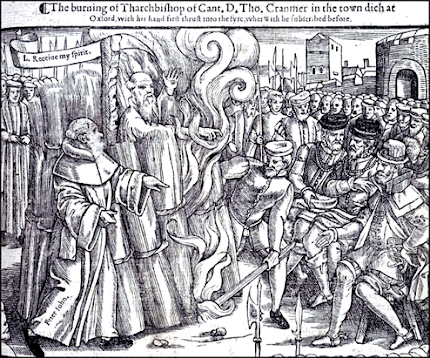
The burning of Tharchbishop of Cant. D. Tho. Cranmer in the town dich at Oxford, with his hand first thrust into the fyre, wherwith he subscribed before. [Click on the picture to see Cranmer's last words.]

Daily Bible Verse

Showing posts with label Sola Scriptura. Show all posts

Saturday, September 27, 2025

Should Women Be Ordained to the Office of Deacon?


In addition to these elements of liberty, which particularly concern us in our individual lives, Christian liberty includes liberty of conscience in the face of tyrannical ecclesiastical organizations.  Some years ago a young man presented himself to a Presbytery for ordination.  As he was known to believe that the boards and agencies of that church were infiltrated with modernism, he was asked if he would support the boards regardless of what they did.  When the young man declined to make any such blind promise, the Presbytery refused to ordain him.  

Dr. Gordon H. Clark.  Essays on Ethics and Politics.  John Robbins, ed.  (Jefferson:  Trinity Foundation, 1992).  P. 21.


Should Women Be Ordained to the Church Office of Deacon?  A Response to the ARP


The Reformed view of Scripture is that Scripture and Scripture alone is the final authority in all matters of faith, practice and controversy in the local church or session, the presbytery, and the general assembly.  It is easy to prove this by the fact that the Westminster Confession of Faith says so in the very first chapter:


WCF 1.8  The Old Testament in Hebrew (which was the native language of the people of God of old), and the New Testament in Greek (which, at the time of the writing of it was most generally known to the nations), being immediately inspired by God, and, by His singular care and providence, kept pure in all ages, are therefore authentical; so as, in all controversies of religion, the Church is finally to appeal unto them. But, because these original tongues are not known to all the people of God, who have right unto and interest in the Scriptures, and are commanded, in the fear of God, to read and search them, therefore they are to be translated into the vulgar language of every nation unto which they come, that the Word of God dwelling plentifully in all, they may worship Him in an acceptable manner; and, through patience and comfort of the Scriptures, may have hope. (WCF 1:8 WCS)

WCF 1.9  The infallible rule of interpretation of Scripture is the Scripture itself: and therefore, when there is a question about the true and full sense of any Scripture (which is not manifold, but one), it must be searched and known by other places that speak more clearly.

WCF 1.10  The supreme Judge, by which all controversies of religion are to be determined, and all decrees of councils, opinions of ancient writers, doctrines of men, and private spirits, are to be examined, and in whose sentence we are to rest, can be no other but the Holy Spirit speaking in the Scripture.

 (WCF 1:9-10 WCS)  [See:  Westminster Confession of Faith, Chapter 1].

In a recent inquirers class which I attended, the lead pastor or teaching elder, Dr. Neil Stewart, told me in a private conversation that he agreed with me that women should not be ordained as deacons.  That being said, he claimed that the other side has convincing arguments, and that they would win the debate with me should I try to argue with them.  I would like to accept that challenge.  To Dr. Stewart, I challenge him to prove me wrong or produce someone else who can prove me wrong when I say that the Bible unequivocally denies the ordination of women to any church office whatsoever, including the of office deacon.

I am aware that there are differences of opinion among various denominations on the issue.  However, denominations and opinions are irrelevant when they are not the final authority.  The first thing that I notice is that everyone has a different opinion in defining the office of a deacon.  The argument from the other side that women should be ordained as deacons leans heavily into equivocation on the definitions of various church offices.  Their other arguments depend on bad biblical exegesis and the highly controversial “science” of textual criticism.  The principle of the analogy of faith, however, requires that the plain passages of Scripture must prevail over arguments from silence and tendentious arguments which assert the consequent in the premise.

This discussion will be brief but to the point.  Additionally, I will respond to an article posted by Thomas Schreiner at the Gospel Coalition.  The article can be read here:  Does the Bible Support Female Deacons? Yes.  You might ask, why does it matter?  That answer to that question should be obvious.  However, since some will say it is not obvious I will state the issue clearly.  All of the doctrines of the Bible fit together in harmony.  There are no contradictions in the Bible because God is Logic (John 1:1).  Does God breathe out irrational propositions that do not agree with other propositions in the Bible?  Does God breathe out confusion in the Bible?  The Bible is the written word of God.  Once we begin to question one principle of the Scriptures, the rest begins to collapse as well.  Liberal activists infiltrate conservative churches with an agenda.  Their mode of operation is called utilitarianism.  The end justifies the means.  These activists have no problem with outright lying, equivocation, dissimulation or relativism.  Their agenda is to muddy the waters so that once they have a foothold a further compromise can be gained.  Often this takes several generations to take hold.  Even in the Bible we see a cycle of good kings and bad kings in the nation of Israel.  (See 1 & 2 Kings and 1 & 2 Chronicles KJV). 

Many mainline Reformed denominations have gone liberal for good reason.  Once a seed is planted that produces bad fruit, it later produces a harvest of entirely bad fruit.  I grew up in Florida.  To illustrate this point from an agricultural point of view, citrus groves and cattle ranches are an important part of the Florida economy.  When citrus canker infects an orange grove the entire grove must be pulled up by the roots, and the trees must be burned to prevent the spread of the disease to other citrus groves.  A few years ago, there was a scare about mad cow disease that infects the brains of bovines.  Once a herd is infected the entire herd has to be quarantined and put down to prevent the spread of the disease.  Obviously, that approach does not work with Evangelical and Reformed churches and denominations.  That being said, we must take a stand when compromise enters a local session or congregation.  Once the disease takes hold in one session or presbytery, the next thing is that the entire denomination or general assembly is infected with the divisive heresy.  As the Scripture says, a little leaven leavens the whole lump.  (1 Corinthians 5:5-6; Galatians 5:7-9 KJV).

My first point will be to define the office of a deacon as it is defined in the Bible.  There are those who will argue that the deacon is not a teaching office or an office that asserts authority over men.  But the biblical evidence for that argument is weak at best and based on asserting the consequent at worst.  According to the apostle Paul, the qualifications for the office of an elder and a deacon are exactly the same qualifications regarding the biological gender of the person taking the office:

A bishop then must be blameless, the husband of one wife . . .  (1 Tim. 3:2 KJV) 

Let the deacons be the husbands of one wife . . .  (1 Tim. 3:12 KJV)

According to the principle of the plain text of Scripture being the primary source of biblical authority and interpretation of the text, it should be obvious to everyone that however we define the offices of elder and deacon, both offices require male leadership as the qualification.  However, the naysayers, in this case Thomas Schreiner, try to flip the script and proclaim the exact opposite using obscure biblical references and a questionable exegesis of 1 Timothy 3:1-15.

I will skip over the definition of a teaching elder since that is not in dispute here.  Teaching elders must be apt to teach and preach the word of God.  There is another issue here that I cannot delve into in this discussion.  That issue is the presbyterian church office of “ruling” elder.  I see no such office mentioned in the text.  Of course, the dispute is over different kinds of church polity or church government.  The most basic forms of church polity are congregational, associational, presbyterial, and episcopal.  I am committed to the presbyterian form of church government as it is expressed in the Westminster Standards:  The Westminster Confession of Faith, the Larger Catechism, and the Shorter Catechism.  That being said, church officers, presbyters and synods can and often do err:

WCF 31.4  All synods or councils, since the Apostles' times, whether general or particular, may err; and many have erred. Therefore they are not to be made the rule of faith, or practice; but to be used as a help in both. (WCF 31:4 WCS)  [Westminster Confession, Chapter 31].

What exactly is the office of a deacon according to the Holy Scriptures.  The definition of the office of deacon cannot be divorced from the very first appointment of deacons in the church after the inauguration of the New Testament church on the day of Pentecost.  After Jesus ascended into heaven on the fortieth day after His resurrection, the disciples and the apostles gathered in the upper room to choose another apostle to replace Judas Iscariot and to discuss the promise given by Jesus.  (Acts 1:1-4, 8-15).  Ten days later on the day of Pentecost the Holy Spirit came to empower the New Testament church to be witnesses of Him (Acts 1:8; 2:1-42).  The first thing that happened after Peter’s sermon was that 3,000 of the Jews gathered for the feast of booths on the day of Pentecost were converted by the Holy Spirit, baptized by water, and added to the church (Acts 2:41).  The next thing that happened is that those who gladly received the message of the Gospel continued hearing the Old Testament Scriptures preached and taught in conjunction with the breaking of bread or the sacrament of the Lord’s supper or the table of the Lord.  (Luke 24:27; Acts 2:14-36; Acts 2:35, 42).  The text here does not say who administered the two sacraments of baptism and the Lord’s supper.  However, we can infer from the evidence that the apostles administered both and that due to the huge numbers of persons—namely 3,000 new converts—that there must have been some delegation of the administration to the other disciples and the lesser apostles.  There is no mention of women being involved in the administration of either of the two sacraments here.

The next problem for those who advocate for women being ordained to the office of the diaconate is that the very first ordination service of deacons exactly specifies who was chosen to be deacons:

Wherefore, brethren, look ye out among you seven men of honest report, full of the Holy Ghost and wisdom, whom we may appoint over this business. 4 But we will give ourselves continually to prayer, and to the ministry of the word. 5 And the saying pleased the whole multitude: and they chose Stephen, a man full of faith and of the Holy Ghost, and Philip, and Prochorus, and Nicanor, and Timon, and Parmenas, and Nicolas a proselyte of Antioch: 6 Whom they set before the apostles: and when they had prayed, they laid their hands on them. (Acts 6:3-6 KJV)

One would think that if the apostles had intended to ordain women as deacons of any kind whatsoever that we would see a prescription for the ordination of women deacons in the Scriptures.  But we see none of that and for good reason.  There were no women ordained to the diaconate in the New Testament church as recorded in Scripture.  Of course, this is an argument from silence, according to the other side.

Thomas Schreiner, for example says:

. . .  another argument in support of female deacons is from silence, but it’s an important one. The argument goes like this: If the reference is to the wives of deacons, why does Paul omit a reference to the wives of elders, particularly since elders exercise pastoral oversight and overall leadership in the church? It would seem the character of the wives of elders would be even more important than the wives of deacons—and thus focusing on the wives of deacons, but not on the wives of elders, is strange. Yet if the reference is to female deacons, we have an elegant explanation for why the wives of elders aren’t mentioned—for the wives of deacons aren’t included either. In other words, Paul isn’t referring to wives at all, but to female deacons.  (Does the Bible Support Female Deacons? Yes).

Although this paper is not about Bible translations or the reasoned eclecticism approach to textual criticism, the thrust of Schreiner’s argument for the ordination of women to the office of deacon is derived from the New International Version of the Bible:

The issue is addressed directly in only two verses (Rom. 16:1; 1 Tim. 3:11), and the meaning of both is disputed. The disagreement surfaces in English translations. Romans 16:1 in the NIV reads, “I commend to you our sister Phoebe, a deacon of the church in Cenchreae.” The CSB translates the same verse, “I commend to you our sister Phoebe, who is a servant of the church in Cenchreae.” (Ibid.).

The other argument that Schreiner proposes is based on the fact that the Greek verse leaves out the pronoun that the women were the wives of the deacons; but this is assumed from the both the text and the fact that in the Scriptures there is not a single instance of females being ordained or having hands laid upon them in an ordination service as noted above in Acts 6:3-6.  It is an historical fact that Schreiner’s position has never been taken by any of the Reformed denominations prior to recent times when the cultural accommodation of the liberals had infiltrated mainline Reformed denominations in the 20th century.  The only exception that I was able to find was the Reformed Presbyterian Church of North America, which affirmed women as deacons in 1888 according to Bryan Schneider at the Gentle Reformation blog.  (Women and the Deacon’s Office).  According to the history given by Schneider, one activist congregation decided to push the issue by ordaining one single woman to the office of the diaconate.  ( See:  An Extremely Brief History).

As stated by the late Dr. Gordon H. Clark, the issue of ordination of women to the office of deacons is that it is an issue of women being in authority over men in the church:

To quote, the Form of Government, V, 5 says, “The formal steps by which a young man becomes an ordained minister....” It does not say “a young person,” and it does not say “a young man or woman.” Since even a few years ago, no one advocated the ordination of women, this reference to a man rather than a woman was neither emphasized nor repeated. At V, 8, the Form of Government simply says, “The qualifications of both teaching elders and ruling elders....” “Laymen, ordained to the eldership” is another phrase. It is also said that these elders have “a certain ruling or governing authority.” The section on deacons is not so explicit. Had women been envisioned as possible candidates it would have had to be explicit. The Report takes the position that Scripture allows the ordination of women as deacons but prohibits their ordination as elders. If this were the Reformed Presbyterian position, the Form of Government would have had to state the difference explicitly, clearly, and emphatically. It does not do so. What is explicitly said is, “The minister shall then propound to the elder- or deacon-elect the following questions: See Section 3 of this chapter.”

Thus, pastors, elders, and deacons all take the same vows, with the one exception that pastors assent to question 8; while other ministers-not pastors, elders, and deacons-assent to question 9. None of these nine vows explicitly mentions authority to teach. But if this authority is assumed for an elder, it is also assumed for a deacon, because ruling elders, deacons, and non-pastoral ministers are treated as a single class. Then further, in V, 9, d, upon the ordination of a deacon, the minister says, “We give you the right hand of fellowship to take part of this office with us.” Note that this is not an ordination of deacons-elect by previously ordained deacons, with the idea that then elders are ordained by elders. Such might indeed greatly distinguish elders from deacons. It is the minister who says to the deacon-elect, “We give you the right hand of fellowship to take part of this office with us.”

But the clinching formula is that which the Form of Government imposes on the congregation: “Do you, the members of this church, acknowledge and receive this brother as a ruling elder (or deacon) and do you promise to yield him all that honor, encouragement, and obedience in the Lord to which ... the Constitution of this Church entitles him?”

At this point it seems proper to conclude that the Report bases its thesis on a mistaken view of Reformed Presbyterian government. The Reformed Presbyterian Church, Evangelical Synod does not distinguish between an elder and a deacon by the latter’s lack of ecclesiastical authority. On the contrary, it explicitly asserts this authority. The application to women-in the light of Scripture yet to be discussed-is automatic. Ignoring our constitution the Report continues, “If this distinction is maintained, there need be no question of setting women in authority over men by ordaining them as deacons.” But if this unconstitutional distinction were maintained, there would be no need or reason to ordain either men or women deacons. Ordination is induction into an authoritative order. This now returns the discussion from the ordination of women as deacons to the fundamental question of ordination.  (Dr. Gordon H. Clark, The Ordination of Women).

To be fair, Gordon Clark did concede a possible compromise that there could be a ministry of deaconesses as long as it was not an ordained office in the church.  That’s because, as he argued in the paper, deacons do exercise authority by administering the sacraments of baptism and the Lord’s supper.  But Tim Keller got around this by "commissioning" both men and women as deacons.  He simply changed the language to get around the PCA book of common order.

This is the issue that troubles me about the Associate Reformed Presbyterian Church.  Like the RPCNA, the ARP affirms women not as a special category of lay ministry called deaconess but as a lifelong appointment to the office of the male diaconate, leaving the decision to each local session or congregation.  (See:  FORM OF GOVERNMENT of the ASSOCIATE REFORMED PRESBYTERIAN CHURCH, 2023, section 8.4.  P. 42).   Anyone wishing to join an ARP congregation that affirms women to the male office of the diaconate is required to agree to at least several vows.  The foremost vow that troubles me is:

Congregational vows to deacons:

“Do you, the members of this congregation, acknowledge and receive these fellow members as deacons, and do you promise to give them all the honor, encouragement, and assistance in the spirit of love to which their office, according to the Word of God and the Standards of this Church, entitles them?” (Synod 2021)  [See:  FORM OF GOVERNMENT of the ASSOCIATE REFORMED PRESBYTERIAN CHURCH, 2023, P. 48

I am unable to acknowledge any woman as a legitimate appointment to the male only office of the diaconate.  Thus, I would be unable to take the vows of membership as well.  That's because, as you can see below, that I would be vowing to obey the church by accepting women as deacons.  That I could never do.

When a congregation votes on any particular issue, the vast majority of the time it is simply a rubber stamp of what the church officers have already decided.  That’s because if half of the congregation approves by a voice vote, it is a done deal and there can be no dissent from the floor or any discussion, particularly in very large churches.  So, for all practical purposes most sessions are run by an authoritarian style of leadership.  (See:  Imperious Presbyterianism, by Kevin Reed).  In order to become a member of an Associate Reformed Presbyterian session or congregation the inquirer must take the following vows:

i.  Do you profess that you are a sinner in the sight of God; that you deserve His punishment; that you are unable to save yourself; and that you are without hope of salvation except for God's love and mercy?

ii. Do you believe in the Lord Jesus Christ as the Son of God and the Savior of sinners; and do you receive and trust in Him alone for your salvation?

iii. Do you accept the Bible, comprised of the Old and New Testaments, as the written Word of God; and that it is the only perfect rule of faith and how to live?

iv.  Do you promise to trust in the guidance and strength of the Holy Spirit so that you can live all of life as a Christian, following the example set by Jesus Christ?

v.  Do you promise to exercise faithful stewardship of God's resources entrusted to you for the furtherance of God's Kingdom and purposes?

vi.  Do you accept that the doctrines and principles of the Standards of the Associate Reformed Presbyterian Church are founded upon the Scriptures?

vii.  In loving obedience, do you submit yourself to the government and discipline of this church, promising to seek the peace, purity, and prosperity of this congregation as long as you are a member of it?  (ARP Form of Government, pp. 25-26).

Vow number v is troublesome because it precedes the two vows that are linked to the promise to affirm women as part of the male diaconate.  So, I must tithe and support the church first, then consider if I want to vow to obey the church?  Vow number vi contradicts Westminster Confession 1:6 which says that the confession is deduced from the Bible by good and necessary consequence, not that the standards are founded on the Bible.  The word “founded” is a weasel word in my opinion.  If vow iii is taken at face value, then the church member has a moral obligation to oppose the church whenever the church violates the clear teaching of the Bible on doctrinal matters that are above matters of indifference or adiaphora.

The problem with ordaining women to any male office is that it is a direct violation of the Scriptural prohibition of women being in authority over men in the visible church.  (1 Timothy 2:12; 1 Corinthians 14:34; Titus 2:5; Genesis 3:16.  All proof texts are from the KJV).  A further problem for the innovationists is that John Calvin did not agree with ordaining women to male only offices in the church:

For my own part, though I do not deny that the order of deacons might sometimes be the nursery out of which presbyters were taken, yet I take Paul’s words as meaning, more simply, that they who have discharged this ministry in a proper manner are worthy of no small honour; because it is not a mean employment, but a highly honourable office. Now by this expression he intimates how much it is for the advantage of the Church to have this office discharged by choice men; because the holy discharge of it procures esteem and reverence.  (Commentary on 1 Timothy 3:13).

Furthermore, Calvin contradicts Thomas Schreiner’s argument that a missing pronoun makes the verse ambiguous enough to allow for women deacons:

Likewise the wives He means the wives both of deacons and of bishops, for they must be aids to their husbands in their office; which cannot be, unless their behavior excel that of others.

Let the deacons be Since he mentioned wives, he lays down the same injunction about deacons as he had formerly down about bishops; namely, that each of them — satisfied within having but one wife — shall set an example of a chaste and honorable father of a family, and shall keep his children and his whole house under holy discipline. And this refutes the error of those who understand this passage as referring to domestic servants.  (Calvin, 1 Timothy 3:11).

It is true that Calvin says that Phoebe had an office in the church but Calvin never calls Phoebe a deacon as Schreiner does in his article cited above.  (See:  Calvin, Romans 16:1).  The word for servant in the Bible is the same word as the word for deacon.  However, even if the Greek word is in the masculine gender, it does not necessarily refer to a male office of the diaconate according to the proponents of females being elected to the diaconate.

Lastly, I would like to respond to the charge that those who oppose the ordination of women to any church office as being mean-spirited and uncharitable.  In the light of the current situation where mainline Reformed denominations have in the past gone completely over to the social justice gospel of the temporal here and now, it seems to me that the compromises made for the sake of peace end up in the frog in the kettle analogy.  The frog does not realize that the water is boiling until it is too late to hop out of the pot.  Even the venerable and late presbyterian minister, Dr. R. C. Sproul was compromised early on in his vocation.  He admits that he was ordained with the United Presbyterian Church, which later became part of the Presbyterian Church, U.S.A. where women were indeed ordained as teaching elders.  Sproul by his own account disagreed with the ordination of women because of the biblical prohibition of women being in authority over men.  He tried to compromise by asking for an exception that he would not participate in the ordination services for women but that he would submit to their authority after they had been ordained.  The liberals would not compromise and forced Sproul to resign peaceably.  (See:  Table Talk:  Women’s Ordination and R.C. Sproul).

I have recently thought again about becoming a member of First Presbyterian Church in Columbia, South Carolina.  I had forgotten about an earlier study I had done in regards to the issue of the ordination of women when I was considering joining the ARP church plant in Lexington, South Carolina.  I wrote a letter to the pastor of the church plant, whose name is Jeff Tell.   You can read the three part series on my blog at:  Reasonable Christian:  Should Women Be Ordained to Ministry?  Part 1, Part 2, Part 3.  (See also:  An Open Letter to Pastor Jeff Tell). 

As proof that the ARP has problems with liberalism, I can cite and even quote a minister who helped to craft the resolutions for the ordination of women as deacons in the ARP.  His name is Dr. William B. Evans, who resigned from the ARP and was received in good standing into the Presbyterian Church U.S.A. not too long ago.

Although I disagree with the doctrine of common grace as outlined by the three points of common grace, and I disagree with the free offer of the gospel, I do like the preaching and teaching of R.C. Sproul, Derek Thomas, and Neil Stewart.  Probably the most conservative Reformed pulpit in my area is First Presbyterian Church in Columbia, SC.  But I cannot join there or support that church due to the fact that it would violate my conscience and the written word of God to vow to uphold an unbiblical mandate for women to be ordained to the male office of the diaconate.  While Dr. Stewart did say to me in private that he also disagrees with the ordination of women to the diaconate, apparently, he is contradicting himself.  I say that because he has for several times presided over the ordination of deacons which included two or three women.  The same can be said of the two previous pastors from the Ligonier background, namely Derek Thomas and Sinclaire Ferguson.  Both men read the ordination vows for the ordination of both males and females to the office of deacon.  Is the ordination of women just a matter of adiaphora or indifference?  I do not agree.  Also, if women are not in authority in the office of the diaconate, neither are any of the men.  Why ordain anyone to the office of deacon at all?

As Dr. Gordon H. Clark pointed out, if there is no authority over anyone in the congregation, why ordain either men or women?  R.C. Sproul was willing to submit to women in authority, unfortunately, and he openly admitted as much in the linked article from Table Talk.  This is disappointing because doctrine matters.  Finally, since excommunication and the keys to the kingdom are exercised by teaching elders, ruling elders, and--by delegation to deacons in the matter of serving the outward signs of the Lord’s supper--deacons are likewise in authority over members of the congregation as well as visitors.

In the modern era it is difficult to keep unqualified persons from partaking of the Lord’s supper or table in very large congregations unless the excommunicated person is well known.  For all practical purposes, church membership is a useless endeavor because the church member has no say in what the elders and church officers decide to do in the session or in the presbytery.  Church officers lord it over the congregation, and those who have any legitimate disagreements are invited to peaceably withdraw or to peaceably not join, which is what Dr. Neil Stewart suggested in my case.  However, since I believe in the priesthood of believers, even a lay person has the moral duty to disagree publicly with equivocation, compromise, and dissimulation wherever it happens in supposedly Evangelical or Reformed churches or denominations.  The peace of the church depends on church discipline both individually and corporately.  Unfortunately, most denominations are more concerned about sex scandals, their political standing with the government, and individual immorality than with the biblical mandate to continually reform the church according to the doctrine of Sola Scriptura.

Since I am unable in good conscience to agree with ordaining women, I cannot vow to support any woman who is wrongly ordained to a position of authority over men in any church office, whether it be teaching elder, ruling elder or deacon.  The slippery slope might be a fallacious way of arguing, but it seems to me that the example of William B. Evans makes it apparent that the agenda of liberal presbyters in the Associate Reformed Presbyterian Church is to finally get to the point of ordaining women to the offices of teaching elder and ruling elder.  Why else would Evans join the Presbyterian Church U.S.A. and be accepted into membership by women presbyters?  It is good that R.C. Sproul left the Presbyterian Church U.S.  But why did he try to compromise to stay?  A better question is why did Sinclaire Ferguson, Derek Thomas, and Neil Stewart all ordain women to a male only office of deacon in the Associate Reformed Presbyterian Church?  Also, why did Sproul invite these men to be part of the Ligonier Ministries if he was opposed to women in church offices?  The answer is that Sproul and Ligonier compromised on this issue and said that deacons do not exercise authority.  But if that is so, why did Stephen preach to the Jews, causing him to be martyred?  (Acts 6:5-8:2 KJV)

The qualifications for deacons found in 1 Timothy 3:8–13 overlap in many ways with the qualifications for elders given in verses 1–7. Those who are ordained as deacons must be honest and run their households well. There has been debate within the Reformed tradition as to whether Paul allows for women to be deacons, but regardless of the position one takes, the Apostle stresses that deacons must “not [be] greedy for dishonest gain” (v. 8).

"The Vocation of Deacon."  Ligonier. 

The problem, as I pointed out above, is that the office of deacon is not a matter of adiaphora.  Stephen was chosen because he was able to preach and to perform miracles.  There were no female deacons chosen.  Gordon H. Clark was correct again. 

The Associate Reformed Presbyterian Church has a position paper arguing for ordaining women to the male only office of deacon, but says that ordaining women to the offices of teaching elder or ruling elder is forbidden because it would split the church.  That's because those who could not in good conscience vow to support the authority of women would be forced out:

First of all, the unity of the church is threatened in that moves to ordain women to the offices of minister and elder in the context of Presbyterian polity will eventually result in the exclusion of those who cannot, for reasons of conscience, assent to the new policy. W. B. Evans has written:

While traditionalists have often been tolerant of progressive thinking, they themselves are often not tolerated once women’s ordination is instantiated in a denomination. That has been the trend in the Church of Scotland, the PCUSA and elsewhere. The pattern here is for conservatives to be grandfathered for a time, but sooner or later ordination requirements are rewritten to include support for women’s ordination. This is due primarily, not to liberal meanspiritedness, but to the logic of Reformed polity. The offices of minister and elder are the foundation of the polity, and everybody has to own the polity, to accept the ground rules of the game. Reformed churches cannot tolerate the presence of those who would challenge, even implicitly, the legitimacy of a large group of officeholders.32

Women in the Life of the Church:   A Position Paper Approved by the General Synod of the Associate Reformed Presbyterian Church.  June 2005.  P. 14.

Ironically, as stated above, Evans left the ARP and joined the PCUSA because he could not tolerate the influx of ministers from the Reformed Theological Seminary in Charlotte, NC.  Those ministers, according to Evans, oppose the ordination of women deacons.  I am unable to become a member of any ARP church that ordains women deacons because of the vow that new members must take to support women deacons.

What's worse is that Evans actually lied about his agenda, which was to ordain women to all offices of the church.  Evans is the author of the quote in the ARP position paper above.  Will the ARP split over this issue?  Maybe not if the ARP is willing to reverse its unbiblical position to ordain women to the office of deacon. 


Soli Deo Gloria.

Charlie J. Ray


Further Resources:

Women in the Life of the Church.  A Position Paper Approved by the General Synod of the Associate Reformed Presbyterian Church.  June 2005.

PCA Historical Center.  Reformed Presbyterian Church, Evangelical Synod.  OVERTURE N:  RECONSIDERATION OF WOMEN DEACONS.  [156th General Synod Minutes, 16 June 1978, pp. 133-134; Documents of Synod, pp. 156-157.]

PCA Historical Center.  Dr. Gordon H. Clark.  The Ordination of Women.  (Dr. Clark’s view prevailed and to this day, the Presbyterian Church in America does not ordain women to any church office, including the office of deacon.  The RPCES merged with the PCA in 1978 or so and shortly thereafter, Dr. Clark withdrew and joined the Covenant Presbytery.)

 Did the RPCES have Deaconesses? Yes and No.  Posted on November 22, 2021, by Zachary Groff.  By Jared Nelson | November 22, 2021.

The Case Against Deaconesses.  Robert Vandoodewaard.  Table Talk:  February 2024.  

Dr. William B. Evans:  The Ecclesial Presbyterian.  A Change in Ecclesial Affiliation for the Ecclesial Calvinist!

Reasonable Christian:  Should Women Be Ordained to Ministry?  Part 1, Part 2, Part 3.  (See also:  An Open Letter to Pastor Jeff Tell). 

R. Scott Clark:  Heidelblog:  Two Conference Talks Worth Hearing: Ligon Duncan And Tim Keller On Women And The Diaconate  [Toward the end of this audio in the question and answer session, Tim Keller openly said that if the BCO did not forbid it that he and his session would ordain women as deacons.  Listen at the 1:18:00 mm to the end.  @presbycast.  You have to ask why there are no men in Keller's church if the church is so large?  Maybe his pragmatism only works on women?]

A Historical and Biblical Examination of Women Deacons.  Brian Schwertley 

The PCA Goes Back to Where It Started: Women's Ordination.  Sarah Eekhoff Zylstra.  The Aquila Report.  June 29, 2016.

The Problem with Commissioning Deaconnesses.  Zachary Garris.  May 1, 2025.

Thursday, October 31, 2013

Reformation Day, Martin Luther Movie, 1953


The issue of Luther's day was not liberty of conscience in the progressive and revisionist version of history.  Rather, Martin Luther stood for the doctrine of sola Scriptura.  Scripture is the final authority in all matters of theological dispute, not the church or even the civil government.  Scripture interprets itself.  Where one passage is unclear other plain passages clarify the more difficult passages.  Since revelation is rational and logical, it is perfectly perspicuous and plain such that even the plow boy and the small child can read and understand the Scriptures and come to saving faith.  (2 Timothy 3:15-17).

Wednesday, July 17, 2013

R. Scott Clark and the Quest for Illegitimate Religious Uncertainty


"First, the infallibility mentioned is not ours, as if we are infallible. The infallibility belongs to the promises of God. There is no hint here that we rise to the level of the inspired authors of the Bible"  -- Gordon H. Clark


Dr. Scott Clark does not believe that the Bible is univocally the very inspired words of God.  He is a skeptic when it comes to Scripture.  His view is essentially the neo-orthodox view of Scripture as revelation only in a secondary sense.  The Bible "contains" or "frames" the Word of God but is not itself the direct revelation of God in written form.  For Scott Clark the Bible is questionable and anyone who actually believes the Bible is direct, univocal revelation is on a quest for "illegitimate" religious certainty  (QIRC). 

He attacks biblical Christianity and the doctrine of sola Scriptura by insisting on imposing uncertainty on the inspired Scriptures:

The first aspect of the QIRC is that it is not satisfied with being a mere image-bearer, an analogue of God. It wants more. It wants to know what God knows, the way he knows it. It seeks to bend the line of analogy into a line of intersection with God’s intellect. It effectively denies Isaiah 55:8–9:
For my thoughts are not your thoughts,
neither are your ways my ways, declares the Lord.
For as the heavens are higher than the earth,
so are my ways higher than your ways
and my thoughts than your thoughts.
If we know what God knows, the way he knows it, then his thoughts are our thoughts and his ways are no longer higher than ours, at least not always. Intersection is not analogy.  [The QIRC-er Must Be Right].
Ironically, Scott Clark contradicts himself because he is claiming he is right while disparaging those who claim to be right.  This is typical contradiction for Van Tilians.  The law of contradiction does not apply to them--at least that is the implication.

But you did get what he said in the quote above?  He said that you cannot know anything God knows, not even in the Bible.  So become an agnostic and wonder about things I guess?  But Scott Clark seems to be absolutely sure that there is no absolute truth.  How ironic that Clark agrees with the liberals and the neo-orthodox and attacks biblical Christianity as "fundamentalism".

I have no need to deny Scripture.   Scripture alone is the Word of God, notwithstanding the Van Tilian denial of the absolute truths revealed in propositions in the Holy Scriptures.  The more I learn about Van Tilian theology the more I come to the conclusion that Van Tilians are enemies of Scripture and of the Gospel.

Scott Clark openly admits that he does not read or consider the views of Clarkians:

Thus, for my part, I’ve resolved not to argue with QIRC-ers (though I fall from this resolve occasionally). Who can argue with someone who knows what God knows, the way he knows it? [Ibid.]
A better question is why bother arguing with someone who absolutely knows that no one knows the Scriptures are the very words of God in written form?  Such blatant denial of the doctrine of plenary-verbal inspiration, infallibility, and inerrancy of Scripture is glossed over in the name of ecumenical fellowship.  Of course, Scott Clark "knows" absolutely that Gordon H. Clark was wrong, does he not?  Liberals absolutely know that there are no absolutes and Van Tilians absolutely know that Scripture is not univocally God's revelation.

But for the record, Gordon H. Clark never asserted infallibility of men on any level.  He acknowledged that Scripture alone is infallible:

 A final note on this point returns us to the Romanists. The Council of Trent said that it would require supernatural revelation to know whether one was predestinated to eternal life. These directions in the Bible on how to attain assurance show that without extraordinary revelation, simply by the right use of the ordinary means, we may attain to the assurance of faith.

A third point concerning assurance is one that is logically implied by what has already been said. Yet it deserves an explicit mention. The Westminster Confession puts the matter very strongly. “This certainty is not a bare conjectural and probable persuasion, grounded upon a fallible hope; but an infallible assurance of faith, founded upon the divine truth of the promises of salvation, the inward evidences of those graces unto which these promises are made, the testimony of the Spirit of adoption witnessing with our spirits that we are the children of God: which Spirit is the earnest of our inheritance, whereby we are sealed to the day of redemption” (17:2).

Though the wording is very clear, it may be necessary in this age to point out two places where a misunderstanding may arise. First, the infallibility mentioned is not ours, as if we are infallible. The infallibility belongs to the promises of God. There is no hint here that we rise to the level of the inspired authors of the Bible. This would be a reversal to the Romish position that a supernatural revelation is necessary. All that is necessary is the Scripture. The second point at which a misunderstanding may occur is the reference to the Spirit witnessing with our spirits. Here too, the same idea is involved. The Spirit witnesses with our spirits as we study the Bible. He does not witness to our spirits, as if giving an additional revelation. Aside from these two matters, the Westminster Confession is clear.

Gordon H. Clark (2013-03-04T05:00:00+00:00). What Is The Christian Life? (Kindle Locations 3388-3403). The Trinity Foundation. Kindle Edition.

It follows that if Van Tilians do not believe the Bible teaches all we need to know in propositional statements and that Scripture is not univocally the Word of God, then we must need some sort of existential encounter to know what God says?  If so, then how would we know anything?  Van Tilians reduce Scripture to analogy and subjectivity for good reason.   That reason is that they are on a quest for illegitimate religious uncertainty.  (QIRU).


Charlie

Friday, April 05, 2013

Gordon H. Clark Quote of the Day: The System of Doctrine Cannot Be Reduced to Five Spiritual Laws

Evangelism is the exposition of the Scripture. God will do the regenerating.  -- Gordon H. Clark

It is impossible to teach the system of doctrine in five minutes, or to reduce it to five spiritual laws, recently discovered by psychology. The Christian message is the whole Bible; it is the whole counsel of God. All of it must be taught, not just a small part, for it is all profitable for doctrine, for reproof, for correction, for instruction in righteousness. It is by taking heed thereto that a young man may cleanse his way. Evangelism is the exposition of the Scripture. God will do the regenerating.

Gordon H. Clark (2013-03-04T05:00:00+00:00). What Is The Christian Life? (Kindle Locations 3802-3807). The Trinity Foundation. Kindle Edition.

Sunday, September 09, 2012

Roman Catholic Apostasy: Is Certainty a Bad Thing? Certainty, Infallibility, and the Reformed Tradition - Called to Communion

Faith consists in the knowledge of God and Christ ( [John 17:3] ), not in reverence for the Church. And we see what a labyrinth they have formed out of this implicit faith—every thing, sometimes even the most monstrous errors, being received by the ignorant as oracles without any discrimination, provided they are prescribed to them under the name of the Church.  --John Calvin


Roman Catholic Apostasy, by Charlie J. Ray

An allegedly "former" Reformed person who converted to Roman Catholicism said the following:

 He made it quite plain, however, that the office of discerning good from bad belongs exclusively to the ordained ministry.  Those who obey this rule are the elect, those who disobey the reprobate.  Calvin says:

We see that those who have charge of the word of God, their office is to discern what is good in order to approve it and what is bad in order to condemn it.  And when men submit themselves to the doctrine that we preach, we [should] regard them as those in whom God is working [i.e., the elect].  On the contrary, those who draw themselves back, we [must] hold them in derision. [3]

David Anders, the author of this piece over that the Called to Communion page, obviously wants to proof text from Calvin out of context.  Seriously, does he really expect any classical Calvinist to buy into this line of bull?  First of all, Calvin wrote against the Pentecostals of his day who where experts in being "led by the Spirit" and following after extrabiblical dreams, visions, and revelations.  It would be no surprise that Calvin emphasized an educated and ordained ministry to properly preach and rightly divide God's Holy Scriptures.  (2 Timothy 2:15).  Furthermore, an ordained ministry would be needed in order to properly administer the two Gospel sacraments, which are visible signs of the inward grace of faith.  Word and sacrament go together precisely because they build up the saints in their most holy faith.  (Colossians 2:7; Jude 1:20; Ephesians 4:11-14).


Calvin may have recommended the office of an ordained ministry of Word and Sacrament.  But he most certainly did not elevate the ordained minister above God's written Word nor did Calvin reject the doctrine of the priesthood of believers:

But there is still another reason why that institution ought not to be drawn into a precedent. Every one knows that the high priest was a type of Christ; now, the priesthood being transferred, that right must also be transferred. To whom, then, was it transferred? certainly not to the Pope, as he dares impudently to boast when he arrogates this title to himself, but to Christ, who, as he alone holds the office without vicar or successor, does not resign the honour to any other. For this priesthood consists not in doctrine only, but in the propitiation which Christ made by his death, and the intercession which he now makes with the Father ( [Heb. 7:11] ).  Institutes of the Christian Religion, Book 4, Chapter 6, Section 2.  [Cf. 1 Peter 2:9; Revelation 5:10]
The priesthood of believers does not mean that anyone can believe anything they want but that there is a common confession of faith that we all confess together as a church.  The Roman Catholic claim to infallibility of their invented and man-made traditions only creates an additional "revelation" that itself must need an infallible interpretation ad infinitum.  If Scripture is not plain or clear enough for men to understand then we might as well all give up and go home.  But the plow boy who reads and understands the Bible knows more than the pope.

Ironically, Mr. Anders would have us believe that his new synagogue of satan which is headed up by the antichristian pope, somehow offers to us "certainty".  On the contrary, Rome does not even require faith for salvation since it teaches the doctrine of "implicit faith".  How ignorance of the Gospel can lead to saving faith I have no idea.  That is particulary true in light of Acts 4:10-12 and John 14:6.  Regarding implicit faith and being saved in ignorance in the papist church, Calvin said:

3. I indeed deny not (so enveloped are we in ignorance), that to us very many things now are and will continue to be completely involved until we lay aside this weight of flesh, and approach nearer to the presence of God. In such cases the fittest course is to suspend our judgment, and resolve to maintain unity with the Church. But under this pretext, to honor ignorance tempered with humility with the name of faith, is most absurd. Faith consists in the knowledge of God and Christ ( [John 17:3] ), not in reverence for the Church. And we see what a labyrinth they have formed out of this implicit faith—every thing, sometimes even the most monstrous errors, being received by the ignorant as oracles without any discrimination, provided they are prescribed to them under the name of the Church. This inconsiderate facility, though the surest precipice to destruction, is, however, excused on the ground that it believes nothing definitely, but only with the appended condition, if such is the faith of the Church. Thus they pretend to find truth in error, light in darkness, true knowledge in ignorance. Not to dwell longer in refuting these views, we simply advise the reader to compare them with ours. The clearness of truth will itself furnish a sufficient refutation. For the question they raise is not, whether there may be an implicit faith with many remains of ignorance, but they maintain, that persons living and even indulging in a stupid ignorance duly believe, provided, in regard to things unknown, they assent to the authority and judgment of the Church: as if Scripture did not uniformly teach, that with faith understanding is conjoined.  Institutes of the Christian Religion, Book 2, Chapter 3, Section 3.
Calvin's answer to Mr. Anders' alleged "certainty" in an ambiguous and top-heavy church focused on human idolatry is devastating.  Anyone looking for certainty in doctrinal matters need look no further than the self-interpreting Word of God (2 Peter 1:19-21; 2 Timothy 3:15-17).  Anyone looking for certainty of their salvation need look no further than the cross.  Salvation was accomplished outside of us on the cross 2,000 years ago when Christ said, "It is finished."  (John 19:30).  Looking to Rome for certainty of salvation is most certainly foolish since Rome teaches that no one can know they are saved until they have passed through purgatory and actually have entered the pearly gates.

James White of Alpha and Omega Ministries makes an excellent point to refute unlimited atonement.  Those who say that unlimited atonement is necessary for assurance of salvation ignore the fact that most Arminians insist along with Rome that salvation can be "lost".  If such is the case then there can be no certainty whatsoever!  And the reason for this, according to Louis Berkhof, who is quoted by White, is that it is necessary to keep folks in suspense so they will keep coming to the church for forgiveness and thus support the church.  The church, in other words, needs to keep holding the carrot out in front of the jackass to keep him moving in the direction the church wants the jackass to go:

The Council of Trent states: "If any one saith, that he will for certain, of an absolute and infallible certainty, have that great gift of perseverance unto the end,-unless he have learned this by special revelation; let him be anathema." Rome's theologians have no problem considering such a statement a fundamental of Roman Catholic dogma. Reformed theologian Louis Berkhof points out that such uncertainty is necessary for the Roman system:

"[T]he Roman Catholic church makes the forgiveness of sins dependent, not on an immediate divine act of pardon once for all, but on the sacrament of penance that must be repeated after every mortal sin, and on the absolution of the priest. With every new deadly sin the state of grace is lost. It can only be restored by the sacrament of penance, and is lost again whenever a new mortal sin is committed. But this is not the only thing that makes assurance impossible. The confessional itself is hedged about with all kinds of uncertainties. The orders of the functioning priest may not be genuine, and this would make his absolution ineffectual. His intention may be at fault, and this would introduce another element of uncertainty. Then, too, the confessor may be ambiguous, equivocal, or indeterminate. He may overlook some of his sins and fail to mention them to the priest, in which case they would not be forgiven. It is no wonder therefore that, according to the church at Rome, the assurance of salvation is quite out of the question. But the Roman Catholic church even goes a step farther: it regards personal assurance as undesirable. The real reason for this is, in all probability, that the church greatly profits by keeping the souls of the faithful in constant suspense.  [James R. White, Assurance of Salvation, Roman Catholicism, and Calvinism].


This reminds me of the age-old riddle, "How do you keep an idiot in suspense?"  Of course you never answer the riddle, which leaves the other person scratching his head for the answer until the eureka moment hits home and he realizes that he himself is that idiot in suspense!  I cannot help but compare this to the Lordship salvation issue, which James White himself preaches, as just another way of keeping idiots in suspense?  Yes, giving folks an absolute certainty of truth by telling them to believe the plain teaching of Scripture is dangerous.  They might realize that salvation truly is free and the ministers would all be out of a job!  Such false teachers have more in common with Rome than anything else and it is no surprise when some of their followers connect the dots and head for the synagogue of satan across the river.


Charlie J. Ray


Click here to see the article by David Anders:  Is Certainty a Bad Thing? Certainty, Infallibility, and the Reformed Tradition - Called to Communion

Monday, March 19, 2012

John Calvin: The Superiority of Scripture

1. Those who, rejecting Scripture, imagine that they have some peculiar way of penetrating to God, are to be deemed not so much under the influence of error as madness. For certain giddy men  have lately appeared, who, while they make a great display of the superiority of the Spirit, reject all reading of the Scriptures themselves, and deride the simplicity of those who only delight in what they call the dead and deadly letter. But I wish they would tell me what spirit it is whose inspiration raises them to such a sublime height that they dare despise the doctrine of Scripture as mean and childish. If they answer that it is the Spirit of Christ, their confidence is exceedingly ridiculous; since they will, I presume, admit that the apostles and other believers in the primitive Church were not illuminated by any other Spirit. None of these thereby learned to despise the word of God, but every one was imbued with greater reverence for it, as their writings most clearly testify. And, indeed, it had been so foretold by the mouth of Isaiah. For when he says, “My Spirit that is upon thee, and my words which I have put in thy mouth, shall not depart out of thy mouth, nor out of the mouth of thy seed, nor out of the mouth of thy seed’s seed, saith the Lord, from henceforth and for ever,” he does not tie down the ancient Church to external doctrine, as he were a mere teacher of elements; he rather shows that, under the reign of Christ, the true and full felicity of the new Church will consist in their being ruled not less by the Word than by the Spirit of God. Hence we infer that these miscreants are guilty of fearful sacrilege in tearing asunder what the prophet joins in indissoluble union. Add to this, that Paul, though carried up even to the third heaven, ceased not to profit by the doctrine of the law and the prophets, while, in like manner, he exhorts Timothy, a teacher of singular excellence, to give attention to reading ( [1 Tim. 4:13] ). And the eulogium which he pronounces on Scripture well deserves to be remembered—viz. that “it is profitable for doctrine, for reproof, for correction, and for instruction in righteousness, that the man of God may be perfect,” ( [2 Tim. 3:16] ). What an infatuation of the devil, therefore, to fancy that Scripture, which conducts the sons of God to the final goal, is of transient and temporary use? Again, I should like those people to tell me whether they have imbibed any other Spirit than that which Christ promised to his disciples. Though their madness is extreme, it will scarcely carry them the length of making this their boast. But what kind of Spirit did our Saviour promise to send? One who should not speak of himself ( [John 16:13] ), but suggest and instil the truths which he himself had delivered through the word. Hence the office of the Spirit promised to us, is not to form new and unheard-of revelations, or to coin a new form of doctrine, by which we may be led away from the received doctrine of the gospel, but to seal on our minds the very doctrine which the gospel recommends.

Institutes of the Christian Religion.  Book I, Chapter 9, Section 1.

Tuesday, July 20, 2010

What Do We Mean by Sola Scriptura?

What Do We Mean by
Sola Scriptura?

by Dr. W. Robert Godfrey


There are two main issues that divide Protestant Catholics from Roman Catholics. Both groups claim to be catholic, that is, part of the apostolic, universal church of Jesus Christ. Roman Catholics believe we Protestants departed from that church in the sixteenth century. Protestant Catholics believe they departed earlier.

The theme of this opening chapter is one of the issues that still divides us: the source of religious truth for the people of God. (The other main issue, that of how a man is made right with God, has been dealt with in the book Justification by Faith ALONE!, published by Soli Deo Gloria in 1995.) As Protestants we maintain that the Scripture alone is our authority. Our Roman opponents maintain that the Scripture by itself is insufficient as the authority of the people of God, and that tradition and the teaching authority of the church must be added to the Scripture.

This is a solemn topic. This is no time for games. We must be searching for the truth. God has declared that whoever adds to or takes away from His Word is subject to His curse. The Roman church has declared that we Protestants are accursed (“anathematized”) for taking away the Word of God as found in tradition. We Protestants have declared that the Roman church is a false church for adding human traditions to the Word of God. Despite sincere debates by fine apologists over the course of nearly 500 years, the differences remain basically as they were in the sixteenth century. I will not say much new here, but we must continue to pursue the truth.

In spite of the difficulty of this undertaking, I am eager to join that historic train of Protestant apologists to defend the doctrine that the Scripture alone is our ultimate religious authority. I believe that it can be shown that this position is the clear position of Scripture itself. And I hope that, by the grace of God, those committed to the Roman doctrine of tradition will come to see the tragic error of denigrating the sufficiency and perspicuity of God’s own inspired Word.

Let me begin with certain clarifications so as not to be misunderstood. I am not arguing that all truth is to be found in the Bible, or that the Bible is the only form in which the truth of God has come to His people. I am not arguing that every verse in the Bible is equally clear to every reader. Nor am I arguing that the church — both the people of God and the ministerial office — is not of great value and help in understanding the Scripture. As William Whitaker stated in his noble work: “For we also say that the church is the interpreter of Scripture, and that the gift of interpretation resides only in the church: but we deny that it pertains to particular persons, or is tied to any particular see or succession of men.”1

The Protestant position, and my position, is that all things necessary for salvation and concerning faith and life are taught in the Bible clearly enough for the ordinary believer to find it there and understand.

The position I am defending certainly is what is taught in the Bible itself. For example, Deuteronomy 31:9 states: “Moses wrote down this law. . . .” Moses instructed the people by writing down the law and then ordering that it be read to them “so they can listen and learn to fear the Lord your God and follow carefully all the words of this law,” Deuteronomy 31:9, 12.

Moses declared to all Israel: “Take to heart all the words I have solemnly declared to you this day, so that you may command your children to obey carefully all the words of this law. They are not just idle words for you, they are your life,” Deuteronomy 32:46, 47.

Notice the clear elements in these passages:

  1. The Word of which Moses spoke was written.
  2. The people can and must listen to it and learn it.
  3. In this Word they can find life.

The people do not need any additional institution to interpret the Word. The priests, prophets, and scribes of Israel certainly function to help the people ministerially. But the Word alone was sufficient for salvation. The prophets, who were indeed inspired, came very much in the spirit of Micah who said, “He has shown you, O man, what is good,” Micah 6:8. The function of the prophets and priests was not to add to or even clarify the law; rather, they applied it to the people who were sinfully indifferent.

If this principle of the sufficiency and clarity of the Word is true in the Old Testament, we can assume that it is all the more true in the New. The New Testament gloriously fulfills what the Old Testament promises. But we do not have to assume it; rather, the New Testament makes clear that the character of Scripture is to be sufficient and clear. One example of that is found in 2 Timothy 3, 4. Here Paul writes to his younger brother in the faith, Timothy. He writes that Timothy — who was instructed in the faith by his mother and grandmother — has also learned all about Paul’s teaching (3:10). Timothy has been mightily helped by all sorts of oral teaching, some of it apostolic. Yet Paul writes these words to Timothy:

And indeed, all who desire to live godly in Christ Jesus will be persecuted. But evil men and impostors will proceed from bad to worse, deceiving and being deceived. You, however, continue in the things you have learned and become convinced of, knowing from whom you have learned them; and that from childhood you have known the sacred writings which are able to give you the wisdom that leads to salvation through faith which is in Christ Jesus. All Scripture is inspired by God and profitable for teaching, for reproof, for correction, for training in righteousness; that the man of God may be adequate, equipped for every good work. I solemnly charge you in the presence of God and of Christ Jesus, who is to judge the living and the dead, and by His appearing and His kingdom: preach the word; be ready in season and out of season; reprove, rebuke, exhort, with great patience and instruction. For the time will come when they will not endure sound doctrine; but wanting to have their ears tickled, they will accumulate for themselves teachers in accordance to their own desires; and will turn away their ears from the truth, and will turn aside to myths. But you, be sober in all things, endure hardship, do the work of an evangelist, fulfill your ministry. (2 Timothy 3:12; 4:5)

You see, Paul reminds Timothy that the Scriptures are able to make him wise unto salvation in Christ Jesus (2 Timothy 3:15). He teaches that the Scriptures are useful for teaching, reproof (rebuking), correcting, and training in righteousness (2 Timothy 3:16). Because the Scriptures have this character, they thoroughly equip the man of God for every good work (2 Timothy 3:17). So Paul tells Timothy that he must preach this Word, even though the time is coming when people will not want to hear it, but rather will want teachers to suit their fancy, who will instruct them in myths rather than the truth of the Word (2 Timothy 4:1-4).

The force and clarity of the Apostle’s teaching here are striking. In spite of the rich oral teaching Timothy had, he is to preach the Scriptures because those Scriptures give him clearly all that he needs for wisdom and preparation to instruct the people of God in faith and all good works. The Scripture makes him wise for salvation, and equips him with everything he needs for doing every good work required of the preacher of God. The sufficiency and clarity of the Word are taught in this one section of Scripture over and over again. John Chrysostom paraphrased the meaning of Paul’s words to Timothy this way: “You have Scripture for a master instead of me; from there you can learn whatever you would know.”2

I have listened to several taped debates on this topic. Often Protestant apologists have cited 2 Timothy 3 against Roman opponents. The usual response of Catholic apologists is to repeatedly assert that 2 Timothy 3 does not teach sufficiency. Sometimes they will refer to James 1:4, Matthew 19:21, or Colossians 1:28 and 4:12 as parallel texts, claiming that the word “complete” in 2 Timothy 3:17 does not mean sufficient. But such passages are not parallel; a completely different Greek word is used. Where 2 Timothy 3:17 uses exartizo, which has to do with being fitted for a task, these other passages use the Greek word teleios, which has reference to maturity or having reached a desired end.

Repeated assertions do not prove a point; that is only a propaganda technique. Our opponents need to answer in a responsible, thorough way.

The confidence that Paul had in the Scriptures, and which he taught Timothy, was clearly understood by the great church father, Augustine. In his treatise to prepare leaders of the church in an understanding of the Bible (0n Christian Doctrine), Augustine wrote: “Among those things which are said openly in Scripture are to be found all those teachings which involve faith, the mores of living, and that hope and charity which we have discussed.”3

We should not be surprised that the Apostle Paul, the Old Testament, and the greatest teacher of the ancient church held to the sufficiency and perspicuity of Scripture. It is the position that Jesus took in one of the most important moments of his life. At the beginning of his public ministry, Jesus faced the focused temptation of the devil in the wilderness. He faced the temptation as the Son of God, but also as the second Adam and the true Israel. And how did He face that temptation? He did not appeal to the oral tradition of Israel; He did not appeal to the authority of the rabbis or Sanhedrin; He did not even appeal to His own divinity or the inspiration of the Holy Spirit. Our Savior, in the face of temptation, turned again and again and again to the Scriptures. “It is written,” He said.

The Scriptures made Him wise; they equipped Him for every good work. They were clear, as He implied that even the evil one knew. When the devil quoted the Scripture, Jesus did not turn to some other authority. Rather Jesus said, “It is also written.”

When the evil one or his representatives misuse the Bible, or imply that it is unclear, Jesus teaches us that we must look more deeply into the written Word, not away from it.

Roman apologists will attempt to convince us that these texts of Scripture do not mean what they clearly say. Let me anticipate some of their arguments and prepare you for some of the ways they tend to respond.

1. The Word of God. First, they will try to say that the phrase “the Word of God” can mean more than just the Bible. I have already granted that. The question before us is whether today anything other than the Scriptures is necessary to know the truth of God for salvation. The Scripture texts I have cited show that nothing else is needed. Our opponents need to show not that Paul referred to his preaching as well as his writing as the Word of God — I grant that; they need to show that Paul taught that the oral teaching of the apostles would be needed to supplement the Scriptures for the Church through the ages. They cannot show that because Paul did not teach that, and the Scriptures as a whole do not teach that!

2. Tradition. Our Roman opponents, while making much of tradition, will never really define tradition or tell you what its content is. Tradition is a word that can be used in a variety of ways. It can refer to a certain school of understanding the Scriptures, such as the Lutheran tradition. It can refer to traditions — supposedly from the apostles — that are not in the Bible. It can refer to developing traditions in the history of the church that are clearly not ancient in origin. Usually, in the ancient fathers of the church, the word “tradition” refers to the standard interpretation of the Bible among them. And we Protestants value such traditions.

But what do Roman apologists mean when they assert the authority of tradition? Historically, they have not agreed among themselves about the nature and content of tradition. For example, one has said that tradition does not add anything to Scripture. But almost all Roman apologists, for over three hundred years after the Council of Trent, argued that tradition does add to the Scriptures. Some Roman apologists believe that all binding tradition was taught by the apostles, while others believe that tradition evolves and develops through the centuries of the church so that there are traditions necessary for salvation that were never known to the apostles. It is impossible to know what the real Roman position is on this matter.

The Second Vatican Council expressed itself with deliberate ambiguity: “This tradition which comes from the apostles develops in the Church with the help of the Holy Spirit. For there is a growth in the understanding of the realities and the words which have been handed down. . . . For as the centuries succeed one another, the Church constantly moves forward toward the fulness of divine truth until the words of God reach their complete fulfillment in her.”4 What does that mean? It certainly does not give us any clear understanding of the character or content of tradition.

Rome usually tries to clarify its position by saying that its authority is Scripture, tradition, and church together. Vatican II declared: “It is clear, therefore, that sacred tradition, sacred Scriptures and the teaching authority of the Church, in accord with God’s most wise design, are so linked and joined together that one cannot stand without the others, and that all together and each in its own way under the action of the one Holy Spirit contribute effectively to the salvation of souls.”5

In fact, however, if you listen carefully, you will notice that the real authority for Rome is neither Scripture nor tradition, but the church. What is the Scripture, and what does it teach? Only the church can tell you. What is tradition, and what does it teach? Only the church can tell you. As the Roman theologian John Eck said, “The Scriptures are not authentic, except by the authority of the church.”6 As Pope Pius IX said at the time of the First Vatican Council in 1870, “I am tradition.”7 The overwhelming arrogance of such a statement is staggering. But it confirms our claim that, for Rome, the only real authority is the church: sola ecclesia.

Now Protestantism arose in the sixteenth century in reaction to such claims and teachings of the Roman church. In the Middle Ages, most within the church had believed that the Bible and the tradition of the church taught the same, or at least complementary, doctrines. But as Luther and others studied the Bible with a greater care and depth than the church had done in centuries, they began to discover that tradition actually contradicted the Bible. They discovered that, for example:

    (1) The Bible teaches that the office of bishop and presbyter are the same office (Titus 1:5-7), but tradition says they are different offices.

    (2) The Bible teaches that all have sinned except Jesus (Romans 3:10-12, Hebrews 4:15), but tradition says that Mary was sinless.

    (3) The Bible teaches that Christ offered His sacrifice once for all (Hebrews 7:27, 9:28, 10:10), but tradition says that the priest sacrifices Christ on the altar at mass.

    (4) The Bible says that we are not to bow down to statues (Exodus 20:4, 5), but tradition says that we should bow down to statues.

    (5) The Bible says that all Christians are saints and priests (Ephesians 1:1; 1 Peter 2:9), but tradition says that saints and priests are special castes within the Christian community.

    (6) The Bible says that Jesus is the only Mediator between God and man (1 Timothy 2:5), but tradition says Mary is co-mediator with Christ.

    (7) The Bible says that all Christians should know that they have eternal life (1 John 5:13), but tradition says that all Christians cannot and should not know that they have eternal life.

The Reformers saw that the words of Jesus to the Pharisees applied equally to their day: “You nullify the Word of God for the sake of your tradition” (Matthew 15:6).

The Reformers also discovered that tradition contradicted tradition. For example, the tradition of the Roman church teaches that the pope is the head of the church, a bishop over all bishops. But Gregory the Great, pope and saint at the end of the ancient church period, said that such a teaching came from the spirit of Antichrist (“I confidently affirm that whosoever calls himself sacerdos universalis, or desires to be so called by others is in his pride a forerunner of Antichrist”)8

More directly related to our discussion is the evident tension in tradition about the value of reading the Bible. The Index of Forbidden Books of Pope Pius IV in 1559 said:

Since experience teaches that, if the reading of the Holy Bible in the vernacular is permitted generally without discrimination, more damage than advantage will result because of the boldness of men, the judgment of the bishops and inquisitors is to serve as guide in this regard. Bishops and inquisitors may, in accord with the counsel of the local priest and confessor, allow Catholic translations of the Bible to be read by those of whom they realize that such reading will not lead to the detriment but to the increase of faith and piety. The permission is to be given in writing. Whoever reads or has such a translation in his possession without this permission cannot be absolved from his sins until he has turned in these Bibles.9

In marked contrast, Vatican II stated: “Easy access to sacred Scripture should be provided for all the Christian faithful. . . Since the word of God should be available at all times, the Church with maternal concern sees to it that suitable and correct translations are made into different languages, especially from the original texts of the sacred books.”10 Does tradition believe that the Bible is dangerous or helpful? The Bible did prove dangerous in the sixteenth century; most who read it carefully became Protestants!

Such discoveries about tradition led the Reformers back to the Bible. There they learned that the Scriptures must stand as judge of all teaching. The Scripture teaches that it is the revelation of God, and is therefore true in all that it teaches. But nowhere does the Scripture say that the church is true in all it says. Rather, although the church as a whole will be preserved in the faith, wolves will arise in the church (Acts 20:29, 30), and even the man of lawlessness will sit at the heart of the church teaching lies (2 Thessalonians 2:4).

3. This brings us to our third concern, the church and the canon. Our Roman opponents will use the word “ church” repeatedly. Those of us who are Protestants will normally be inclined to interpret their use of the word “church” as referring to the body of the faithful. But that is not the way they characteristically use the word. When they refer to the authority of the church, they mean the infallible teaching authority of councils and popes. That view of the church they take from the Middle Ages and in a romantic way read back into the ancient church period. So notice very carefully how they use the word “church.” And remember that neither the Scriptures, nor the great majority of the fathers of the ancient church period, understand the authority of the church in the way they do.

Let me offer as an illustration two examples from the work of Augustine, often quoted against the Protestant position on the question of the authority of the church. At one point in his debate with the Pelagians, a bishop of Rome sided with Augustine, and Augustine declared, “Rome has spoken, the matter is settled.” Later, however, another pope opposed Augustine on this subject, and Augustine responded by saying, “Christ has spoken, the matter is settled.” Augustine did not bow to the authority of the bishop of Rome, but turned to the word of Christ to evaluate the teaching of Rome.

Another statement of Augustine’s, often cited by Roman apologists, reads: “I would not have believed had not the authority of the catholic church moved me.” That seems very strong and clear. But in another place Augustine wrote: “I would never have understood Plotinus had not the authority of my neo-Platonic teachers moved me.” This parallel shows that Augustine is not talking about some absolute, infallible authority in the church, but rather about the ministerial work of the church and about teachers who help students understand.

Let us look at the church further by raising a related issue: the canon of Scripture. Romanists will try to make much of the issue of the canon. They will tell you that the Bible alone cannot be our authority because the Bible does not tell us what books are in the Bible. They will argue that the church must tell us what books are in the Bible. When they say the church tells us, they mean popes and councils must tell us. This implies that we did not have a Bible until Pope Damasus offered a list of the canon in 382, or, perhaps, until 1546 when the Council of Trent became the first “ecumenical”council to define the canon. But of course the people of God had the Bible before 1546 and before 382.

In the first place, the church always had Scripture. The apostolic preaching and writing of the first century repeatedly verified its teaching by quoting from the Old Testament. The quotations from, and allusions to, the Old Testament abound in the New Testament. The New Testament does not reject the Old, but fulfills it (Romans 1:2; Luke 16:29; Ephesians 2:19, 20). The church always had a canonical foundation in the Old Testament.

In the second place, we can see that the apostles sensed that the new covenant inaugurated by our Lord Jesus would have a new or augmented canon. Canon and covenant are interrelated and interdependent in the Bible (see Meredith G. Kline, The Structure of Biblical Authority). Peter testifies to this emerging canon when he includes the letters of Paul as part of the Scriptures (2 Peter 3:16).

In the third place, we must see that the canon of Scripture is, in a real sense, established by the Scripture itself, because the canonical books are self-authenticating. As God’s revelation, they are recognized by the people of God as God’s own Word. As Jesus said, “I am the good shepherd; I know My sheep and My sheep know Me. They . . . will listen to My voice” (John 10:14-16). In the deepest sense we cannot judge the Word, but the Word judges us. “For the word of God is living and active. Sharper than any double-edged sword, it penetrates even to dividing of soul and spirit, joints and marrow; it judges the thoughts and attitudes of the heart” (Hebrews 4:12). The self-authenticating character of the canon is demonstrated by the remarkable unanimity reached by the people of God on the canon.

In the fourth place, we must see that historically the canon was formed not by popes and councils; these actions simply recognized the emerging consensus of the people of God as they recognized the authentic Scriptures. Indeed, whatever criteria were used by popes and councils to recognize the canon (authorship, style, content, witness of the Spirit, etc.), these same criteria were available to the people of God as a whole.

We can see this basic understanding of the formation of the canon stated in The New Catholic Encyclopedia which states: “The canon, already implicitly present in the apostolic age, gradually became explicit through a number of providential factors forming and fixing it.”11

We can also see this basic approach to the canon reflected in the words of Augustine, writing in his important treatise entitled On Christian Doctrine. This treatise was written between 396 and 427 — after the supposedly authoritative decision of Pope Damasus on the canon, and after a council held in Hippo had discussed the canon. Augustine wrote:

In the matter of canonical Scriptures he should follow the authority of the greater number of catholic Churches, among which are those which have deserved to have apostolic seats and receive epistles. He will observe this rule concerning canonical Scriptures, that he will prefer those accepted by all catholic Churches to those which some do not accept; among those which are not accepted by all, he should prefer those which are accepted by the largest number of important Churches to those held by a few minor Churches of less authority. If he discovers that some are maintained by the larger number of Churches, others by the Churches of weightiest authority, although this condition is not likely, he should hold them to be of equal value.12

This statement shows that Augustine did not look to popes or councils for the solution of the question of the canon. He recognized the variety among churches, and the appropriateness of a plurality of churches. He urged all students of Scripture to examine the question and to look for the emerging consensus among the people of God. Like Augustine, we do not disparage the value of the witness of the people of God to the canon. We value the ministry of the church in this as in all things. But we deny that the church in its offices or councils authoritatively establishes the Scripture on the basis of some knowledge or power not available to Christians generally. The character of the canonical books draws the people of God to them.

4. Unity. Notice how Catholics use the word “unity.” They will suggest that we Protestants disprove our claim of the clarity of the Scripture by our failure to agree about the meaning of the Scripture. We recognize that Protestants are divided into various denominations. But all Protestants who are heirs of the Reformation are united in understanding the gospel and in respecting one another as brothers in Christ. We have all found the same gospel clearly in the Bible.

When we discuss unity and authority, let us be certain that we are making fair and accurate comparisons. Our Roman opponents will want to compare Roman theory with Protestant practices. That is not fair. We must compare theory with theory or practice with practice. In practice, neither group has the agreement we should have. Remember that while Rome is united organizationally, it is just as divided theologically as is Protestantism broadly understood. The institution of an infallible pope has not created theological unity in the Roman church. Rather, Roman theologians are constantly disagreeing with each other as to what the popes have taught, and as to whether those teachings are in fact proclaimed ex cathedra, and are therefore infallible. The modern state of the Roman church really has shown that the institution of the papacy has not made clear the necessary content of Christian truth. I suspect that every honest member of the Roman church will have to acknowledge that.

As early as the seventeenth century the Reformed theologian Francis Turretin noted the serious theological divisions in the Roman church and asked why the pope did not settle these disputes if his office was so effective.13 Such theological problems are certainly much greater today than in Turretin’s day and the question remains unanswered as to why the pope is so ineffective.13

We should not be surprised that there are divisions in the church. Christ and His apostles predicted that there would be. The Apostle Paul told us that such divisions are useful. He wrote: “No doubt there have to be differences among you to show which of you have God’s approval” (1 Corinthians 11:19). Differences should humble us and drive us back to the Scriptures to test all claims to truth. If we do not accept the Scriptures as our standard and judge, there is indeed no hope for unity.

The church must have a standard by which to judge all claims to truth. The church must have a standard of truth by which to reform and purify itself when divisions arise. The church cannot claim that it is that standard and defend that claim by appealing to itself. Such circular reasoning is not only unconvincing; it is self-defeating. Rome’s argument boils down to this: we must believe Rome because Rome says so.

The Bible tells us that the Word of God is the light that enables us to walk in the ways of God. Listen to Psalm 119:99, 100, 105, 130: “I have more insight than all my teachers, for I meditate on Thy statutes. I have more understanding than the elders, for I obey Thy precepts. Thy word is a lamp unto my feet and a light for my path. The unfolding of Thy words gives light; it gives understanding to the simple.”

Roman opponents usually object to an appeal to Psalm 119 on the grounds that it speaks of the Word of God, not of the Bible, and therefore could include in its praise tradition as well as Scripture. But their argument is irrelevant to our use of Psalm 119, because we are using it to prove the clarity, not the sufficiency of Scripture! The Psalmist is saying here that the light of the Word shines so brightly and clearly that if I meditate on it and obey it, I am wiser than any teacher or elder. The simple can understand it. The Word is like a strong flashlight in a dark forest. It enables me to walk on the path without tripping.

We must listen to the Scriptures so that we will act as God’s Word teaches us to act. Consider the story of Paul in Berea, Acts 17:10-12. Paul preached there in the synagogue and many Jews responded to his preaching with eagerness. We are told that after they listened to Paul each day they examined the Scriptures to see if what Paul said was true. How did Paul react? Did he say that the Scriptures were not clear, and that only he as an apostle or the rabbis or the Sanhedrin could tell them what the Scriptures really meant? Or did he say that they should not expect to find the truth in the Scriptures because they were incomplete and needed to be supplemented by tradition? Or did he say that they were insulting his apostolic authority, and that they should simply submit to him as the infallible interpreter of the Bible? Or did Paul say that they should defer to Peter as the only one who could interpret the Bible? No! He did not say any of these things. The practice of the Bereans is praised in the Bible. They are called noble because they evaluated everything on the basis of the written Word of God.

If we would be faithful children of God, if we would be noble, we must proceed as the Bereans did. We must follow the example of Moses and Paul and our Lord Jesus. Do not rest your confidence on the wisdom of men who claim infallibility. Stand rather with the Apostle Paul who wrote in 1 Corinthians 4:6, "Do not go beyond what is written."


NOTES

  1. William Whitaker, A Disputation on Holy Scripture (Cambridge,: University Press, 1849) P. 411.
  2. Cited in Whitaker, p. 637.
  3. Augustine, On Christian Doctrine trans. by D.W. Roberston, Jr. (New York: Liberal Arts Press, 1958) 11:9.
  4. The Documents of Vatican II, ed. waiter M. Abbott (New York: Herden and Herden, 1966) p. 116. Dei Verbum, 8.
  5. Ibid., p. 118.
  6. John Eck, Enchiridion of Commonplaces, trans. by Ford Lewis Battles, (Grand Rapids: Baker, 1979) P. 13.
  7. Jesef Rupert Geiselmann, The Meaning of Tradition (Montreal: Palm Publishers, 1966)p. 16, note on pp. 113,114.
  8. Cited in Cambridge Medieval History, section written by W. H. Hutton, edited by H. M. Gwatkin and J. P. Whitney,(New York: The MacMillan Co., 1967) 11:247.
  9. James Townley, Illustrations of Biblical Literature, Vol. 2 (London: printed for Longman, Hurst, Rees, Orme, and Brown, 1821) p. 481
  10. Documents of Vatican II, PP. 125,126.
  11. Cited in a tape by William Webster entitled “The Canon,” available from Christian Resources, 304 West T Street, Battleground, WA 98604. This tape is part 3 of a 16 tape series entitled Roman Catholic Tradition: Its Roots and Evolution.
  12. On Christian Doctrine, Book 2 section VIII, trans. by D. W. Roberston, Jr. (New York.: Liberal Arts Press, 1958) p. 41.
  13. Francis Turretin, Institutes of Elenctic Theology, Vol. 1, trans. by George Musgrave Giger, ed. by James T. Dennison, Jr. (Phillipsburg: P & R, 1992) p. 156.

Author

Dr. W. Robert Godfrey is President of Westminster Theological Seminary in Escondido, California. He is also Professor of Church History. He received the A.B., M.A., and Ph.D. degrees from Stanford University, and the M.Div. degree from Gordon-Conwell Theological Seminary. He has taught at Westminster Theological Seminary (both in Pennsylvania and California) for over twenty years. He is an ordained minister in the Christian Reformed Church. Dr. Godfrey was a contributor to John Calvin: His Influence on the Western World; Reformed Theology in America; and Scripture and Truth. He edited the Westminster Theological Journal for several years, and is a frequent speaker at Christian conferences. Dr. Godfrey is a native of California. He and his wife Mary Ellen have three children: William, Mari, and Robert.

___________________________

 This article originally appeared as Chapter I in Sola Scriptura! The Protestant Position on the Bible, Don Kistler, General Editor and published by Soli Deo Gloria Publications.


Return to the Home Page Return to the Main Highway 

Return to Calvinism and the Reformed Faith Index Return to Calvinism and the Reformed Faith Index

Return to Roman Catholicism Archive Return to the Roman Catholic Archive

Go to the Resource Page

:-) <——

--
Reasonable Christian Blog Glory be to the Father, and to the Son : and to the Holy Ghost; Answer. As it was in the beginning, is now, and ever shall be : world without end. Amen. 1662 Book of Common Prayer

Support Reasonable Christian Ministries with your generous donation.