>

Martyred for the Gospel

Martyred for the Gospel
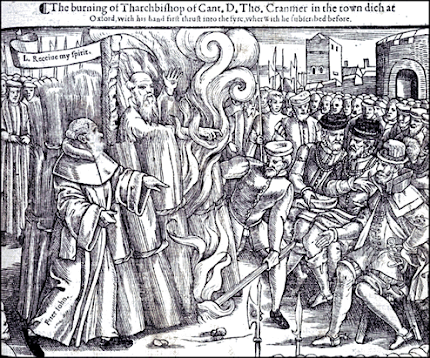
The burning of Tharchbishop of Cant. D. Tho. Cranmer in the town dich at Oxford, with his hand first thrust into the fyre, wherwith he subscribed before. [Click on the picture to see Cranmer's last words.]

Daily Bible Verse

Showing posts with label Westminster Confession of Faith. Show all posts

Tuesday, April 15, 2025

Reasonable Christian YouTube Channel


This is a discussion of the doctrine of Sola Scriptura as it is outlined in the first chapter of the Westminster Confession of Faith:  Reasonable Christian:  Sola Scriptura and Predestination.
Tuesday, April 01, 2025

Open Letter to Pastor Jeff Tell: Lexington ARPC Church Plant


I have been retired since October of last year.  Since my job required lots of travel, I was not a member of any local church in my area, namely Lexington, South Carolina.  In fact, the only church that was traditional and even remotedly resembled a truly Reformed Presbyterian church is First Presbyterian Church in Columbia.  The problem there is that the church is very large, and the other problem is that the ARPC allows for the ordination of women to the office of deacon.  FPC, being an Associate Reformed Presbyterian session or church, allows for the ordination of women, also.  That is the reason that I did not become a member there, despite the fact that the preaching generally sound and Reformed.  The current pastor is Dr. Neil Stewart.

The ARPC has a church planting program and a new church is being planted in Lexington and the pastor chosen to do the work is Jeff Tell.  Unfortunately, the church plant is being conducted along the lines of the pragmatic church growth movement, following the example of the Presbyterian Church in America or PCA.  The PCA is at best a mix of truly reformed churches and churches formed under the church growth model, which focuses on dumbing down doctrinal distinctives.  One of the largest PCA churches in my area is Lexington Presbyterian Church, which supported the Revoice heresy of accepting "celibate" homosexuals as members and as teaching elders.

There have been warning signs at the new ARPC church plant in Lexington.  I sent a couple of emails to the pastor to register my complaints.  He did answer me once or twice.  After that it became silence.  So my only option now is to publicly address the complaints.  I cannot and do not support any church that openly discourages new members from agreeing with the doctrinal standards, namely the Westminster Confession of Faith and the Larger and Shorter Catehisms.

I wrote the following letter to Pastor Jeff Tell by way of email:

Dear Jeff,

I am not sure that I know exactly what to say about this church plant.  So, I will just give my opinion so far.

First, I was troubled by your suggestion that new members need not concern themselves with what the ministers are required to subscribe to in regards to the doctrinal standards of the denomination.  I think you said that they could just flip through the Westminster Standards.  The other red flag is that this edition has no biblical proof texts given to support the doctrinal positions.


The first chapter of the Westminster Confession of Faith makes it clear that the most important doctrine of any presbyterian church is the doctrine of Sola Scriptura.  So your remark that the new members need not concern themselves with points iii through vii was disturbing.

The point that most bothers me is point vii.  I cannot and never will promise to obey any church or church official who contradicts what the Bible plainly and univocally says.  I say this because the ARPC has officially allowed local sessions to ordain women to the male only office of deacon as prescribed by 1 Timothy 3:12.  In fact, as I studied the history of the decision of the general synod of 1969, it came to my attention that the moderator of the 2005 synod was Rev. William B. Evans, a supporter of the doctrine of the ordination of women.  Evans recently retired from Erskine College and transferred his ordination to the liberal mainline denomination, the Presbyterian Church USA.


I have been following the denominational issues of several Presbyterian denominations for many years by reading the Aquila Report online.  So, I am well aware of the "moderates" and liberals within the ARPC.  One of Evans' complaints was the influence of Ligonier and Reformed Theological Seminary, Charlotte, NC, according to his blog:  A Change in Ecclesiastical Affiliation.

The other deal breaker for me is that the church pamphlet keeps putting quotes from Tim Keller, a self-avowed promoter of the woke view of social justice, also known as social Marxism.  Keller is passed on, but his views on the doctrinal standards were liberal to say the least.  He promoted a version of the Revoice homosexual celibacy view in the Presbyterian Church in America.  He also promoted the theistic evolution view of Biologos.

In this week's pamphlet, the quote from Keller was completely wrong.  First, off, the covenant of grace began with the protoevangelium in Genesis 3:16.  [The correct citation is Genesis 3:15, not 3:16.  Sorry for the error.]  Later God expanded on this covenant of grace with the covenant of Abram in Genesis 15.  So, when Keller makes the generalization that "ancient covenants were marked  by an oath-sign in which the curse of disobeying the covenant was made clear . . .," the statement is clearly casuistry and equivocation meant to mislead novices.  The covenant of works was initiated in the garden of Eden and is still in effect until the consummation, except for those who are unconditionally elected in eternity, effectually called by monergistic regeneration, and given the gift of saving faith.


[The following was not included in the letter to Pastor Tell.  It is the quote from Tim Keller in the church pamphlet  that I found to be misleading:

"The Lord's Supper was a covenant-making ceremony, in which Jesus created a new people and entered into covenant with them as their Lord.  Ancient covenants were marked by an oath-sign in which the curse of disobeying the covenant was made clear, but Jesus shows us that this time, he takes on the curse for breaking the covenant himself.  He will take the cup of God's wrath so we can have the cup of fellowship and blessing."]

In fact, the doctrinal standards specifically state that even the elect are not under the law as covenant of works.  However, the moral law does tell them how they are to live as Christians:

WCF 19.6  Although true believers be not under the law as a covenant of works, to be thereby justified or condemned; yet is it of great use to them, as well as to others; in that, as a rule of life, informing them of the will of God and their duty, it directs and binds them to walk accordingly; discovering also the sinful pollutions of their nature, hearts, and lives; so as, examining themselves thereby, they may come to further conviction of, humiliation for, and hatred against sin; together with a clearer sight of the need they have of Christ, and the perfection of His obedience. It is likewise of use to the regenerate, to restrain their corruptions, in that it forbids sin; and the threatenings of it serve to show what even their sins deserve, and what afflictions in this life they may expect for them, although freed from the curse thereof threatened in the law. The promises of it, in like manner, show them God's approbation of obedience, and what blessings they may expect upon the performance thereof, although not as due to them by the law as a covenant of works: so as a man's doing good, and refraining from evil because the law encourageth to the one, and deterreth from the other, is no evidence of his being under the law, and not under grace. (WCF 19:6 WCS)


As you can see, the Confession actually says that believers are still under the moral law as a rule for living out the Christian life.  Unregenerate persons are still under the moral law as a covenant of works:


WCF 19.5  The moral law doth for ever bind all, as well justified persons as others, to the obedience thereof; and that, not only in regard of the matter contained in it, but also in respect of the authority of God, the Creator, who gave it. Neither doth Christ, in the Gospel, any way dissolve, but much strengthen this obligation. (WCF 19:5 WCS)  See also: 19:1-2.


Finally, as far back as 1995 when I graduated from Asbury Seminary with the M. Div. I took a church growth class with George Hunter, III.  I am well aware of the church growth pragmatism approach to church planting.   In those days, I was still a classical Pentecostal.  I was appalled at the dumbing down of Wesleyan theological distinctives recommended by Hunter.  The end result of refusing to preach theological distinctives and the whole counsel of God in the inerrant, infallible, and God-breathed Scriptures is a church full of novices at best, and unconverted persons who have no understanding of the Bible whatsoever.


I became a Calvinist in 1992 or so precisely because of the Pentecostal emphasis on spiritual experiences and personal piety over against any intellectual understanding of the Bible or the Christian faith.  Donald McGavran's denomination has one creed:  No creed but the Bible.  The early Pentecostals after the 1906 Azusa Street Revival had no doctrinal confessions of faith until the Oneness Pentecostal controversy around 1914.


Moreover, over the past 6 or 7 years that I have resided in Lexington, SC, I have visited just about every church that has claimed to be "Reformed".  Most of them were either PCA or ARP, except for Saxe Gotha.  Lexington Presbyterian Church, last I visited there, was pushing the Revoice controversy.  The other PCA churches, though smaller, were also following the pragmatic church growth pattern that decidedly dumbed down doctrine.

It came down to attending First Presbyterian Church, Columbia because that church at least has traditional worship with conservative preaching and the right administration of the sacraments.  However, I could not in good conscience join FPC because the session ordains women to the church office of deacon.  Your church plant, otoh, does not follow the regulative principle of worship and instead replicates the charismatic and emotive style of worship meant to de-emphasize the Bible as the final authority.

Your church plant gave a glimmer of hope that there would be solid preaching by expository sermons, along with solid opportunities for Christian education by way of Sunday school classes with competent instructors.  I realize that it takes time to develop these programs.  However, it is not looking good.  

The other problem, as I see it, is that your new members class does not emphasize the doctrinal standards whatsoever.  Instead, you're following Tim Keller's re-interpretation of the doctrinal standards, the Navigators, etc.  The Navigators were Arminian in orientation as I recall.   In more conservative sessions of various Presbyterian denominations, children who were baptized as infants are required to go through the Shorter Catechism class prior to becoming communicant members who partake of the Lord's table.  There should be some basic understanding of the doctrinal standards required to join a local session, including the Larger Catechism.  Glossing over the catechism is not healthy, imo.


While fellowship is important, I do not think that church picnics and church fellowship is what makes for a healthy church.  Community and family can be found anywhere, including the local bar or another religion.  As you said in the sermon from the previous week, the temptation for church planters is to take shortcuts.  Well, the church growth movement itself is just a huge shortcut.  Healthy churches are based on solid biblical preaching, doctrinal preaching, and the right administration of the sacraments.  Without the preaching of the word the sacraments are meaningless.  

In short, anyone can nominally claim to be reformed or that their church is reformed.  However, the term reformed needs to have a definition.  Reformed In Name Only or RINO does not meet that requirement.

As it stands now, I will not be joining the church as a member.


For I have not shunned to declare unto you all the counsel of God. (Acts 20:27 KJV)

And that from a child thou hast known the holy scriptures, which are able to make thee wise unto salvation through faith which is in Christ Jesus. 16 All scripture is given by inspiration of God, and is profitable for doctrine, for reproof, for correction, for instruction in righteousness: 17 That the man of God may be perfect, throughly furnished unto all good works. (2 Tim. 3:15-17 KJV)


Sincerely yours in Christ,


Charlie J. Ray, M. Div.

P.S.  I do a blog at www.reasonablechristian.blogspot.com.  


Addendum:  I was unaware that Jesus created a new people when He established the sacrament of the Lord's supper.  1 Corinthians 11:23-32.  The new church is also administering the Lord's supper weekly and in at least one church pamphlet referred to is as a "eucharist."  The term eucharist is code for real presence, consubstantiation, and transubstantiation.  The Calvinist and Zwinglian view reached a consensus rejecting the eucharistic view of the sacrament.  The Consensus of Tigurinus was written by John Calvin himself.


There are 7 vows that a person must make in order to become a member of the new Lexington Associate Presbyterian Church according to the handouts given in the new member class:


i.  Do you profess that you are a sinner in the sight of God; that you deserve His punishment; that you are unable to save yourself; and that you are without hope of salvation except for God's love and mercy?

ii. Do you believe in the Lord Jesus Christ as the Son of God and the Savior of sinners; and do you receive and trust in Him alone for your salvation?


iii. Do you accept the Bible, comprised of the Old and New Testaments, as the written Word of God; and that it is the only perfect rule of faith and how to live?


iv.  Do you promise to trust in the guidance and strength of the Holy Spirit so that you can live all of life as a Christian, following the example set by Jesus Christ?


v.  Do you promise to exercise faithful stewardship of God's resources entrusted to you for the furtherance of God's Kingdom and purposes?


vi.  Do you accept that the doctrines and principles of the Standards of the Associate Reformed Presbyterian Church are founded upon the Scriptures?


vii.  In loving obedience, do you submit yourself to the government and discipline of this church, promising to seek the peace, purity, and prosperity of this congregation as long as you are a member of it? 


The doctrines of the Westminster Confession of Faith are not "founded upon the Scriptures.  The doctrines of Bible are summarized by the Westminster Confession of Faith, and the Westminster Confession of Faith is "deduced" from the Bible "by good and necessary consequence" or inference.  See WCF 1:6.


Wednesday, February 12, 2025

Update: Biblical Inerrancy


I recently posted an updated editor's note on an old post here:

[Editor's note:

Since I wrote this article, I came to a different conclusion.  Apparently, 1 John 5:7 does have several Byzantine texts supporting that reading.  See:  First John 5:7.  The article is written by a proponent of the reasoned ecleticism approach to textual criticism.  Notice that he deceptively mentions that only one Byzantine manuscript dating to 1352 A.D. contains the Comma Johanneum "in the text."  But then he acknowledges several other ancient mss where it is included in the margins of the page.  This could happen as a commentary on the text.  That's what the textual critics want you to believe.  But is this a common practice in those mss where it is written in the margins?  No one comments on that aspect of the evidence.  The other possibility is that the scribe accidentally left that part of the verse out and it was written in later in the margins.  Remember that there was no verse numbering at that time yet.  The bottom line here is that the Westminster Confession 1:8 referred to providential preservation of the Masoretic Text and the Textus Receptus as the original languages that were to settle all matters of faith and practice.  I recommend reading the Reformation Bible Society's position on providential preservation.  February 12, 2025.]

You can read the original article with the editor's note here:  


Biblical Inerrancy, Plenary Verbal Inspiration, and Textual Criticism: Is There an Apparent Contradiction?


Wednesday, February 20, 2019

Logical, Biblical, Theological, and Historical Problems with "Reformed" Libertarianism


“At this point we have an illustration of the utter falsity of the popular notion that philosophy has no practical effect upon the lives of the people, that it does not make any difference what a man believes in the sphere of ultimate reality.  For the whole tendency that we are fighting today has underlying it a definite theory.  Ultimately underlying it, I suppose, is the theory of the behaviorists—that . . . poetry and art and moral responsibility and freedom are delusions -- that mechanism rules all.  It is a mistake we are told to blame the criminal . . .”  --J. Gresham Machen


“That this country needs to replenish its moral resources seems too obvious to need saying, but so few people seem to care that it cannot be said enough.”  Dr. Gordon H. Clark


9 Even him, whose coming is after the working of Satan with all power and signs and lying wonders, 10 And with all deceivableness of unrighteousness in them that perish; because they received not the love of the truth, that they might be saved. 11 And for this cause God shall send them strong delusion, that they should believe a lie: 12 That they all might be damned who believed not the truth, but had pleasure in unrighteousness. (2 Thess. 2:9-12 KJV)


Logical, Biblical, Theological, and Historical Problems with “Reformed” Libertarianism
Charlie J. Ray, M. Div.

In light of my many disagreements with certain self-avowed proponents of the apologetics of the late Dr. Gordon H. Clark I am compelled to write a response to the oxymoronic term "Reformed" libertarian.  It is my opinion that the term Reformed libertarian as defined by the advocates of that political philosophy misrepresent the actual positions of the late Dr. J. Gresham Machen and Dr. Gordon H. Clark by revisionist readings of what both of these men said and that such revisions are out of the historical context, cultural context, and the body of work of both men.  Moreover, libertarianism as a whole leaves out God and seeks only to emphasize individual freedom at the expense of the moral law of God.  The real issue is that the Bible does not emphasize libertarian free will at all and by implication the Bible does not emphasize libertarian political philosophy either.  Even more importantly, the Bible does not just deal with individual accountability but also corporate and governmental accountability.  Nations, denominations, and churches as well as individuals come under God’s judgment many times over in Holy Scripture.  (Revelation 19:15; Psalm 110:6; 1 Corinthians 6:2; Psalm 2:8; Daniel 7:14; Matthew 28:18-20; Romans 13:1-4).

Ironically, the page that defines Reformed libertarianism places a quote from the late Dr. John Robbins at the top of the page and then proceeds to contradict the quote in the body of the definition below the quote:

[One] misconception is that the Ten Commandments… apply only to private individuals and not to governments. This notion, which has absolutely no foundation in Scripture, illustrates how far we have gone toward deifying government, for it is attributing divine qualities to rulers to say that they in their official (or private) capacities are exempt from the law. –John Robbins  (What Is Reformed Libertarianism?)

The great error of so-called “Reformed” Libertarianism is that it teaches a form of antinomianism disguised by a false proposition of Christian liberty.  My first objection is that the Decalogue or Ten Commandments does not teach only justice on the human level.  That is, the Decalogue teaches two tables of the moral law, not just one table of the moral law.  The first four commandments relate to how man is to relate to God his Creator.  The definition given in the post on Reformed libertarianism only mentions doing no harm to other individuals and completely neglects the effects of individual sins and individual crimes on society as a whole.  When individual liberty emphasizes the right to commit sins without any legal ramification from the judicial law appointed in a nation the result is the undermining of Christianity and Christian liberty and in fact results in secular humanism and a totalitarian regime.  This is the point of limited government argued by J. Gresham Machen and Gordon H. Clark.  Neither of these men supported pornography or gambling, although it is true that Machen disagreed with the prohibition of alcohol laws.  But it does not follow that Machen would have agreed with making vices like gambling, prostitution, and pornography legal.  It seems strange to me that so-called Christians of any kind would agree with enslaving women in the sex trade, pornography, and other forms of degradation of the image of God.

It is true that theonomists have accused everyone who does not agree with them of being antinomian.  Perhaps this is a bit of an overstatement and the theonomist/reconstructionist movement has had its own problems—due more to the irrationalism of Cornelius Van Til, accommodation to culture, cobelligerence with Rome, common grace, conflating judicial and moral law, and a tendency to produce heresies like the Federal Vision than to the actual moral law itself.  But it seems that fake Clarkians have produced their share of heresies as well.  One Facebook “Clarkian” is now an advocate for hyper-preterism and denies the future bodily resurrection in the final judgment.  Another denies that the Westminster Confession of Faith calls for Christians to organize churches and denominations and to rightly administer the sacraments while rightly preaching the Gospel.  Add to this list the heresy of a political philosophy which endorses godless secularism, atheism, and moral relativism.  Any nation that does not uphold a Judeo-Christian worldview is asking for God’s judgment to fall upon it.  To be clear I am not a theonomist or a reconstructionist.  But I will say that both the Bible and the Westminster Standards uphold the moral law of God as the standard by which judicial laws will be judged and consequently so will the nations passing judicial legislation that promotes, subsidizes, and encourages the violation of God’s moral law—including both tables of the law.

J. Gresham Machen opposed the philosophy of relativism and in fact stated his objection to the immorality of the laws promoting sin, rebellion and crime in the following example:

“At this point we have an illustration of the utter falsity of the popular notion that philosophy has no practical effect upon the lives of the people, that it does not make any difference what a man believes in the sphere of ultimate reality.  For the whole tendency that we are fighting today has underlying it a definite theory.  Ultimately underlying it, I suppose, is the theory of the behaviorists—that the human race has at last found itself out, that it has succeeded in getting behind the scenes, that it has pulled off from human nature those tawdry trappings in which the actors formerly moved upon the human stage, that we have discovered that poetry and art and moral responsibility and freedom are delusions -- that mechanism rules all.  It is a mistake, we are told, to blame the criminal; the criminal is exactly what he is obliged to be, and good people are obliged to be exactly what they are.  In other words, liberty is a delusion and human beings are just somewhat complicated machines.”  

[J. Gresham Machen.  3rd edition.  Education, Christianity, and the State.  (Trinity Foundation:  Unicoi, 2004).  Pp. 88-89.]

Machen’s opposition to the Department of Education was that the state would use such uniformity and conformity to institutionalize immorality and crime while using totalitarian laws to suppress Christianity:

Doctor Machen.  Mr. Chairman and gentlemen of the committee, there are two reasons why a man may be opposed to a bill which is introduced in Congress.  One reason is that he thinks that it will not accomplish its purpose.  The other reason is that he thinks that the purpose that it is intended to accomplish is an evil purpose.

For the latter reason that I am opposed to the bill which forms the subject of this hearing.  The purpose of the bill is made explicit in the revised form of it which has been offered by Senator Means, in which it is expressly said that the [proposed] Department of (public) Education—with the assistance of the advisory board to be created—shall attempt to develop a more uniform and efficient system of public common school education.  The Department of Education, according to that bill, is to promote uniformity in education.  That uniformity in education under central control, it seems to me, is the worst fate into which any country can fall.  That purpose I think is implicit also in the other form of the bill, and it is because that is the very purpose of the bill that I am opposed to it.  

[Ibid., J. Gresham Machen.  Pp. 99-100.]

In short, Machen is more concerned with freedom of thought in the education of the youth of the country rather than a government enforced uniformity of thought.  His remarks are prophetic in regards to the doctrine of common core and the Marxism now being taught in public schools, colleges and universities.  But this is because Machen favored classical education and the instruction in the classical languages like Greek, Latin, and Hebrew as well as learning foreign languages.  Another reason he gives for opposing public education is that there should be competition among schools rather than a socialistic emphasis on equality of outcomes.  For Machen idiosyncrasies are to be embraced rather than rejected. 

But this is a far cry from what libertarians want.  Their emphasis is moral relativism and anarchy in society with a false premise that what individuals do does no harm to society or to the community.  Is pornography really harmless to individuals or their families?  Does pornography lead to worse sins like prostitution?  And does not prostitution and pornography undermine the purpose of Christian marriage and the procreation which God commanded in the creation of Adam and Eve?  (Genesis 1:27; 2:18-25).  According to the article posted at the Reformed Libertarian site morality is optional when it comes to judicial laws so long as no harm is done to one’s neighbor.  But the article never defines what is considered harmful to one’s neighbor.  Is it harmful to your neighbor to allow laws that encourage and promote homosexuality, incest, bestiality, infanticide, and mutilation of the human body in order to change from one physical and biological sex to another and all subsidized by federal or state taxes?

Amazingly the political philosophy of the Reformed Libertarian not only opposes the teaching of Scripture but also the Westminster Standards.  The Scriptures clearly teach that nations are to obey God and the Westminster divines upheld the same principle or axiom because the Scriptures teach that axiom.  The  Reformed Libertarian has only one moral law:

The central proposition of our school of libertarian thought is this: “no person should violate the life and property of another human being unless that other human being has first violated the life and property of another,” and we define the libertarian as any person who assents to that proposition, and gives no exception to any individual, State, Congressional body, or corporation.  All are bound in the same way to this moral rule.

It is my contention that this axiom of Reformed libertarianism is not Reformed at all.  Instead it is a direct contradiction of both Scripture and the Westminster Confession of Faith.  The Confession clearly upholds the moral law of God as supreme over every nation and every person whether or not that person believes it or not.  That’s because Scripture leaves every nation and every person without excuse.  (Romans 1:18-32; Romans 3:1-23).  The WCF says:

CHAPTER XIX. Of the Law of God

GOD gave to Adam a law, as a covenant of works, by which he bound him, and all his posterity, to personal, entire, exact, and perpetual obedience; promised life upon the fulfilling, and threatened death upon the breach of it; and endued him with power and ability to keep it.a

a.      Gen. 1:26,27; Gen. 2:17; Rom. 2:14,15; Rom. 10:5,12,19; Gal. 3:10,12; Eccl. 7:29; Job 28:28.

Westminster Assembly. The Westminster Confession of Faith: Edinburgh Edition. Philadelphia: William S. Young, 1851. Print.


It seems to me that the WCF says that all of Adam’s descendants are obligated to obey the moral law of God, expressed here as the covenant of works.  The law of God is written in man’s heart at creation and no one is excused by any claims to ignorance of said moral law.  (Romans 2:17).  Since nations are composed of individuals, the magistrates have a moral obligation to pass laws that uphold God’s moral law, including laws that allow for the observation of the Christian Sabbath and laws that allow for religious freedom, not laws that suppress Christianity and promote immorality.  

CHAPTER XXIII.  Of the Civil Magistrate

III. The civil magistrate may not assume to himself the administration of the word and sacraments, or the power of the keys of the kingdom of heaven: e yet he hath authority, and it is his duty, to take order, that unity and peace be preserved in the church, that the truth of God be kept pure and entire, that all blasphemies and heresies be suppressed, all corruptions and abuses in worship and discipline prevented or reformed, and all the ordinances of God duly settled, administered, and observed. f For the better effecting whereof, he hath power to call synods, to be present at them, and to provide that whatsoever is transacted in them be according to the mind of God. g

Westminster Assembly. The Westminster Confession of Faith: Edinburgh Edition. Philadelphia: William S. Young, 1851. Print.

But the Reformed libertarian opposes the suppression of moral evil and says instead that evil should be tolerated and even encouraged by the government:

This serves to address the concern that, in allowing a variety of immoral deeds to go unpunished, we are in effect refusing to make it plain that these deeds are wrong. But in the same sense that most would agree that lying is both immoral yet should not be illegal, so there are many things which require “spiritual weaponry” and not the sword of the state. God will have his own vengeance in due time.  [What Is Reformed Libertarianism?]  [Lying is against the law since there are perjury and obstruction of justice laws in place by the way.]

The article also quotes a Baptist, Isaac Backus, who asks whether or not morality should be enforced by the sword?  But does not the Ten Commandments say that murder and thievery are immoral and are there not laws against murder and stealing?  If we follow Backus’s theory there should be no laws against anything.  But obviously Romans 13 contradicts Backus’s Anabaptist moral relativism in the civil realm.  Paul clearly says that the government can enforce morality.  And more to the point the Westminster divines thought that there was nothing wrong with having the civil magistrate enforce laws against immorality and even heresy.  If we say that the Westminster Confession teaches theonomy should we then reject what the Confession plainly says?  I think not.

Albeit it is next to impossible to overturn the Marxist laws in effect in the United States today unless God Himself should intervene, nevertheless the Christian has a moral obligation to participate in the legislative process so that Christianity will be promoted, not secular humanism, atheism, or Marxism.   The libertarian philosophy is anti-Christian and so are those who claim to be “Reformed” while opposing the Judeo-Christian worldview in the realm of civil government.

There are those who try to make the late Gordon H. Clark a moral relativist who opposed blue laws, laws against prostitution and pornography, etc.  I contend, however, that they are reading into Clark what is not there.  Clark was a teetotaler and opposed the use of alcohol by seminarians but he was presumably in agreement with Machen on the issue of Prohibition.  [Doug Douma says Clark was in favor of Prohibition.]  The Bible nowhere says that social drinking is immoral in and of itself.  But the same cannot be said for homosexuality and fornication.  Clark would have opposed laws that promote prostitution, gambling, alcoholism, and pornography.  In fact, Clark attributed dereliction and homelessness to alcoholism.  It can be easily demonstrated that Clark was in favor of blue laws by anyone who reads his brief commentary on the Westminster Confession.  In debating a Seventh Day Adventist, who did in fact oppose blue laws or Sunday laws, Clark says:

Although the place of worship is immaterial, and although worship may be offered to God at any time, God has set apart a special time in which worship is obligatory.  From the creation of Adam the calendar has been arranged in seven-day weeks, and God commanded Adam to keep the seventh day holy in commemoration of God’s completion of his creative work.

With the resurrection of Christ the day of rest and worship was changed from the seventh to the first day of the week.  Who changed it?  The Roman church claims to have authorized the change; and the Seventh Day Adventists refuse to worship on the first day because the Roman church had no authority to change God’s command.

However, while some imperial edict of the fourth century may be cited as authorizing this change, the change was made not by any emperor or pope, but by the immediate disciples of Christ.  1 Corinthians 16:2 . . .  A Seventh Day Adventist told me that this did not indicate any offering at a service on the first day of the week, but on the contrary meant that on the first day each worshiper was to put aside what he intended to give the next seventh day.  But consider:  if a man is paid his wages at the end of the working week—Friday night—and then worships on Saturday, it seems strange to admonish him to put aside his offering on the next morning.

[Dr. Gordon H. Clark.  What Do Presbyterians Believe?  2nd edition.  (Trinity Foundation: Unicoi, 2001).   P. 199.]

Now if Dr. Clark was opposed to blue laws here would be a perfect place to express his disagreement.  Instead he points out that Christian workers in the New Testament apostolic era were not working on the first day of the week and that such practice was legally supported by an edict in the 4th century.  It is the Seventh Day Adventist who was opposed to making the first day of the week a day off for Christian worship, not Dr. Clark.  His objection was to changing the Sabbath back to the Jewish Sabbath, not the judicial edict allowing for Christian worship on the first day of the week. 

 In his follow up comment on WCF XXI:VIII.  Of Religious Worship and the Sabbath Day he says:

Another attack on the Christian Sabbath and on Christianity looms on the horizon.  The advocates of calendar reform propose to abolish the regular sequence of seven-day weeks.  Their recent proposal is to have every week begin on Monday and to put a Sunday at the end of the week.  This is just a nasty way of expressing contempt for the day of Resurrection, but by itself it would cause no religious hardship.  The anti-Christian part of the proposal is to insert a day at the end of each year, which would be neither a Sunday, a Monday, Tuesday, nor any other week day.  The result of such an arrangement would be as follows:  the year would end on a Sunday; then comes No-Day; then comes Monday.  Hence the following Sunday would be eight days after the previous Sunday, in stead of seven.  A Christian then would be required to worship on Saturdays that year, on Fridays the following year, and so on, with all the economic penalty and social hostility an atheistic nation would impose on this obedience to God.

Perhaps a more immediate danger lies in Senator Dirksen’s anti-Christian proposal to hold national elections on the Lord’s Day.  This would be an effective way of disenfranchising Christians.  Apparently the time of the antichrist is approaching.  [Clark, Ibid.  P. 201.]

I have been told that Dr. Clark’s son-in-law, Dwight Zeller, said that Dr. Clark was definitely opposed to blue laws.  Apparently, Mr. Zeller has not read What Do Presbyterians Believe?  Obviously, if the calendar were changed by legal decree or edict, Dr. Clark considers that an affront to Christianity.  But the Reformed libertarian position is that the law that does no harm to an individual is permissible.  Since laws against the Sabbath are not harmful to the individual, the law is desirable under the separation of church and state according to the Reformed libertarian position.  Secondly, if a law were passed making national elections on Sunday it would mean that Christians could not support magistrates who would pass laws in favor of the Judeo-Christian worldview and the Ten Commandments.  If Clark were a libertarian why does he associate such laws with the antichrist and not as something favorable to the libertarian view?  It is general knowledge that blue laws were not just in the southern Bible belt states but were in effect nationwide in the 20th century.  It is only toward the end of the 20th century do we begin to see the erosion of laws protecting Sunday as a day of rest and worship as well as a day when a family could be sure to have time together.  

Moreover, having church members work on Sunday undermines church attendance and the financial support of the local church.  It could cost a person their job to claim a religious reason to not work on Sunday or it could come at a very definite financial cost even if the company recognizes the employees’ right to religious freedom.

The evidence that Clark believed that the government should enforce biblical morality is extensive.    Another example comes from his lecture on Puritan ethics in a section he calls "Contemporary Impuritans":

We need very much to replenish those reserves today. That this country needs to replenish its moral resources seems too obvious to need saying, but so few people seem to care that it cannot be said enough. The list of American deficiencies can begin with riots, the looting, the arson, and the murders in Detroit, Newark, and many, too many, other cities. These riots did not just happen spontaneously. They were prepared. Remember the plot uncovered in Philadelphia to put cyanide in the soldiers’, policemen’s, and firemen’s coffee. But while these riots were prepared for by Communists and pro-Communists, like Stokely Carmichael, H. Rap Brown, and Martin Luther King, of sainted memory, there has been a much longer preparation of indifference to mounting crime. The government officials whose responsibility it is to protect life and property are dilatory, because for years the increase of violent crime has been encouraged by liberal theories of penology, a perverted judicial development that has hamstrung the police and prosecutors, and a general sympathy with the criminal instead of his victim.

In addition to the increase of unorganized crime, there is also the tremendous power of the Mafia. Not only does it deal in prostitution, narcotics, and gambling, but more recently it has infiltrated legitimate businesses to confiscate their assets, all of which entails the bribery and intimidation of government officials and a few murders when necessary.

Narcotics were just mentioned. Below the level of heroin there is LSD, glue, marijuana, alcohol, tobacco, barbiturates, sleeping pills, and tranquilizers. The halls of scholarship also, where claims to seek truth are proudly made, the halls of scholarship also are tainted with moral and intellectual decay. Professor Carl Van Doren, a few years ago, shamed us all on television by being able to answer a stupendous array of questions on all sorts of topics. Hailed into court, he denied under oath that he had been coached. He was then convicted of perjury. After his conviction, the students at Columbia voted to have him returned to the faculty. They shared their professor’s devotion to truth.

[Dr. Gordon H. Clark.  “The Puritans and Situation Ethics,” in The Trinity Review, January, February 1989.]

At the time that Dr. Clark was alive pornography was still illegal and so was gambling and prostitution.  Yet we have fake Christians and fake Calvinists today asserting that Clark would have agreed with their institutionalizing immorality in the judicial laws of our land under the rubric of the false dichotomy of Marxism that there is an absolute separation of church and state.  Need I remind the reader that Clark lectured on the topic of Christianity where he specifically says that Christianity is a philosophical and theological worldview and not a religion?  In fact, he even says that religion is a meaningless term since it could also be argued that godless religions such as Buddhism and communism exist.  Atheism and secular humanism are also godless religions and appear to be very organized.  Thus the idea or proposition that the government should not enforce religion is self-contradictory!  Every nation promotes some form of religion, including the communist nations.  The difference is that in America until recent times religious pluralism was our official position where freedom of religion was the default position.  In modern times, however, Marxism has taken over and Christianity has become something to be suppressed and relegated to the privacy of one’s home.   State approved churches preach doctrines of LGBTQ and free sex while Christian churches are infiltrated by liberal reporters looking for an excuse to charge the pastor with bigotry and hate crimes.  The LGBTQ lobby has already begun to push for legislation making it mandatory that Christians refer to homosexuals as good people rather than perverts and for Christians to refer to transvestites and those who have undergone cosmetic sex change operations as the biological sex they have tried to impersonate artificially.  Not only is this anti-Christian but it violates both the freedom of religion and the freedom of speech. 

Reformed libertarianism therefore is an enemy of true Christianity and supports the evil agenda of social Marxism and the legislation of laws that oppose freedom and liberty of conscience.  Those who support evil cannot be Christian.  Christians should support laws that uphold the Ten Commandments, religious freedom, and the Sabbath day.  Why should secular humanism, atheism or Marxism be the official dogmatic religion of the state?

13 And he had power to give life unto the image of the beast, that the image of the beast should both speak, and cause that as many as would not worship the image of the beast should be killed. 16 And he causeth all, both small and great, rich and poor, free and bond, to receive a mark in their right hand, or in their foreheads: 17 And that no man might buy or sell, save he that had the mark, or the name of the beast, or the number of his name. (Rev. 13:15-17 KJV)


Sunday, March 05, 2017


CHAPTER II—Of God, and of the Holy Trinity


  1.      There is but one only, (Deut. 6:4, 1 Cor. 8:4–6) living, and true God, (1 Thess. 1:9, Jer. 10:10) who is infinite in being and perfection, (Job 11:7–9, Job 26:14) a most pure spirit, (John 4:24) invisible, (1 Tim. 1:17) without body, parts, (Deut. 4:15–16, John 4:24, Luke 24:39) or passions; (Acts 14:11,15) immutable, (James 1:17, Mal. 3:6) immense, (1 Kings 8:27, Jer. 23:23–24) eternal, (Ps. 90:2, 1 Tim. 1:17) incomprehensible, (Ps. 145:3) almighty, (Gen. 17:1, Rev. 4:8) most wise, (Rom. 16:27) most holy, (Isa. 6:3, Rev. 4:8) most free, (Ps. 115:3) most absolute; (Exod. 3:14) working all things according to the counsel of His own immutable and most righteous will, (Eph. 1:11) for His own glory; (Prov. 16:4, Rom. 11:36) most loving, (1 John 4:8,16) gracious, merciful, long-suffering, abundant in goodness and truth, forgiving iniquity, transgression, and sin; (Exod. 34:6–7) the rewarder of them that diligently seek Him; (Heb. 11:6) and withal, most just, and terrible in His judgments, (Neh. 9:32–33) hating all sin, (Ps. 5:5–6) and who will by no means clear the guilty. (Nah. 1:2–3, Exod. 34:7).

  2.      God hath all life, (John 5:26) glory, (Acts 7:2) goodness, (Ps. 119:68) blessedness, (1 Tim. 6:15, Rom. 9:5) in and of Himself; and is alone in and unto Himself all-sufficient, not standing in need of any creatures which He hath made, (Acts 17:24–25) nor deriving any glory from them, (Job 22:2–3) but only manifesting His own glory in, by, unto, and upon them. He is the alone fountain of all being, of whom, through whom, and to whom are all things (Rom. 11:36) and hath most sovereign dominion over them, to do by them, for them, or upon them whatsoever Himself pleaseth. (Rev. 4:11, 1 Tim. 6:15, Dan. 4:25, 35) In His sight all things are open and manifest, (Heb. 4:13) His knowledge is infinite, infallible, and independent upon the creature, (Rom. 11:33–34, Ps. 147:5) so as nothing is to Him contingent, or uncertain. (Acts 15:18, Ezek. 11:5) He is most holy in all His counsels, in all His works, and in all His commands. (Ps. 145:17, Rom. 7:12) To Him is due from angels and men, and every other creature, whatsoever worship, service, or obedience He is pleased to require of them. (Rev. 5:12–14).

  3.      In the unity of the Godhead there be three persons, of one substance, power, and eternity: God the Father, God the Son, and God the Holy Ghost: (1 John 5:7. Matt 3:16–17, Matt. 28:19, 2 Cor. 13:14) the Father is of none, neither begotten, not proceeding; the Son is eternally begotten of the Father; (John 1:14, 18) the Holy Ghost eternally proceeding from the Father and the Son. (John 15:26, Gal. 4:6).

Sunday, August 07, 2016

WCF Chapter 1: Of the Holy Scriptures

THE
WESTMINSTER
CONFESSION OF FAITH


CHAPTER I—Of the Holy Scripture

  1.      Although the light of nature, and the works of creation and providence do so far manifest the goodness, wisdom, and power of God, as to leave men inexcusable; (Rom. 2:14–15, Rom. 1:19–20, Ps. 19:1–3, Rom. 1:32, Rom. 2:1) yet they are not sufficient to give that knowledge of God, and of his will, which is necessary unto salvation. (1 Cor. 1:21, 1 Cor. 2:13–14) Therefore it pleased the Lord, at sundry times, and in divers manner, to reveal Himself, and to declare that His will unto His Church; (Heb. 1:1) and afterwards, for the better preserving and propagating of the truth, and for the more sure establishment and comfort of the Church against the corruption of the flesh, and the malice of Satan and of the world, to commit the same wholly unto writing: (Prov. 22:19–21, Luke 1:3–4, Rom. 15:4, Matt. 4:4,7,10, Isa. 8:19–20) which maketh the Holy Scripture to be most necessary; (2 Tim. 3:15, 2 Pet. 1:19) those former ways of God’s revealing His will unto His people being now ceased. (Heb. 1:1–2)
  2.      Under the name of Holy Scripture, or the Word of God written, are now contained all the books of the Old and New Testaments, which are these,
 
OF THE OLD TESTAMENT

Genesis      Ecclesiastes
Exodus      The Song of Songs
Leviticus      Isaiah
Numbers      Jeremiah
Deuteronomy      Lamentations
Joshua      Ezekiel
Judges      Daniel
Ruth      Hosea
I. Samuel      Joel
II. Samuel      Amos
I. Kings      Obadiah
II. Kings      Jonah
I. Chronicles      Micah
II. Chronicles      Nahum
Ezra      Habakkuk
Nehemiah      Zephaniah
Esther      Haggai
Job      Zechariah
Psalms      Malachi
Proverbs

OF THE NEW TESTAMENT

The Gospels according to      Thessalonians I
Matthew      Thessalonians II
Mark      To Timothy I
Luke      To Timothy II
John      To Titus
The Acts of the Apostles      To Philemon
Paul’s Epistles to the Romans      The Epistle to Hebrews
Corinthians I      The Epistle of James
Corinthians II      The first and second Epistles of Peter
Galatians      The first, second and third Epistles of John
Ephesians      The Epistle of Jude
Philippians      The Revelation of John
Colossians

All which are given by inspiration of God to be the rule of faith and life. (Luke 16:29, 31, Eph. 2:20, Rev. 22:18–19, 2 Tim. 3:16)
  3.      The books commonly called Apocrypha, not being of divine inspiration, are no part of the canon of the Scripture, and therefore are of no authority in the Church of God, nor to be any otherwise approved, or made use of, than other human writings. (Luke 24:27, 44, Rom. 3:2, 2 Pet. 1:21)
  4.      The authority of the Holy Scripture, for which it ought to be believed, and obeyed, dependeth not upon the testimony of any man, or Church; but wholly upon God (who is truth itself) the author thereof: and therefore it is to be received, because it is the Word of God. (2 Pet. 1:19, 21, 2 Tim. 3:16, 1 John 5:9, 1 Thess. 2:13)
  5.      We may be moved and induced by the testimony of the Church to an high and reverend esteem of the Holy Scripture. (1 Tim. 3:15) And the heavenliness of the matter, the efficacy of the doctrine, the majesty of the style, the consent of all the parts, the scope of the whole (which is, to give all glory to God), the full discovery it makes of the only way of man’s salvation, the many other incomparable excellencies, and the entire perfection thereof, are arguments whereby it doth abundantly evidence itself to be the Word of God: yet notwithstanding, our full persuasion and assurance of the infallible truth and divine authority thereof, is from the inward work of the Holy Spirit bearing witness by and with the Word in our hearts. (1 John. 2:20, John 16:13–14, 1 Cor. 2:10–12, Isa. 59:21)
  6.      The whole counsel of God concerning all things necessary for His own glory, man’s salvation, faith and life, is either expressly set down in Scripture, or by good and necessary consequence may be deduced from Scripture: unto which nothing at any time is to be added, whether by new revelations of the Spirit or traditions of men. (2 Tim. 3:15–17, Gal. 1:8–9, 2 Thess. 2:2) Nevertheless, we acknowledge the inward illumination of the Spirit of God to be necessary for the saving understanding of such things as are revealed in the Word: (John 6:45, 1 Cor 2:9–12) and that there are some circumstances concerning the worship of God, and government of the Church, common to human actions and societies, which are to be ordered by the light of nature, and Christian prudence, according to the general rules of the Word, which are always to be observed. (1 Cor. 11:13–14, 1 Cor. 14:26, 40)
  7.      All things in Scripture are not alike plain in themselves, nor alike clear unto all: (2 Pet. 3:16) yet those things which are necessary to be known, believed, and observed for salvation, are so clearly propounded, and opened in some place of Scripture or other, that not only the learned, but the unlearned, in a due use of the ordinary means, may attain unto a sufficient understanding of them. (Ps. 119:105, 130)
  8.      The Old Testament in Hebrew (which was the native language of the people of God of old), and the New Testament in Greek (which, at the time of the writing of it, was most generally known to the nations), being immediately inspired by God, and, by His singular care and providence, kept pure in all ages, are therefore authentical; (Matt. 5:18) so as, in all controversies of religion, the Church is finally to appeal unto them. (Isa. 8:20, Acts 15:15, John 5:39, 46) But, because these original tongues are not known to all the people of God, who have right unto, and interest in the Scriptures, and are commanded, in the fear of God, to read and search them, (John 5:39) therefore they are to be translated into the vulgar language of every nation unto which they come, (1 Cor. 14:6, 9, 11–12, 24, 27–28) that, the Word of God dwelling plentifully in all, they may worship Him in an acceptable manner; (Col. 3:16) and, through patience and comfort of the Scriptures, may have hope. (Rom. 15:4)
  9.      The infallible rule of interpretation of Scripture is the Scripture itself: and therefore, when there is a question about the true and full sense of any Scripture (which is not manifold, but one), it must be searched and known by other places that speak more clearly. (2 Pet. 1:20–21, Acts 15:15–16)
  10.      The supreme judge by which all controversies of religion are to be determined, and all decrees of councils, opinions of ancient writers, doctrines of men, and private spirits, are to be examined, and in whose sentence we are to rest, can be no other but the Holy Spirit speaking in the Scripture. (Matt. 22:29, 31, Eph. 2:20, Acts 28:25)

Westminster Confession of Faith

Support Reasonable Christian Ministries with your generous donation.