>

Martyred for the Gospel

Martyred for the Gospel
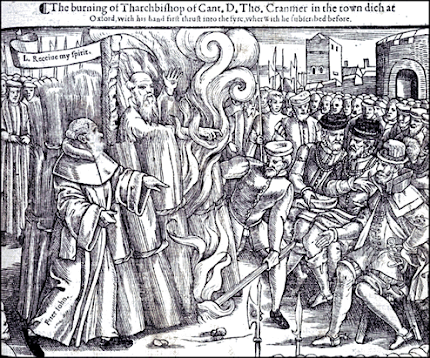
The burning of Tharchbishop of Cant. D. Tho. Cranmer in the town dich at Oxford, with his hand first thrust into the fyre, wherwith he subscribed before. [Click on the picture to see Cranmer's last words.]

Daily Bible Verse

Showing posts with label Reformed Libertarianism. Show all posts

Wednesday, February 20, 2019

Logical, Biblical, Theological, and Historical Problems with "Reformed" Libertarianism


“At this point we have an illustration of the utter falsity of the popular notion that philosophy has no practical effect upon the lives of the people, that it does not make any difference what a man believes in the sphere of ultimate reality.  For the whole tendency that we are fighting today has underlying it a definite theory.  Ultimately underlying it, I suppose, is the theory of the behaviorists—that . . . poetry and art and moral responsibility and freedom are delusions -- that mechanism rules all.  It is a mistake we are told to blame the criminal . . .”  --J. Gresham Machen


“That this country needs to replenish its moral resources seems too obvious to need saying, but so few people seem to care that it cannot be said enough.”  Dr. Gordon H. Clark


9 Even him, whose coming is after the working of Satan with all power and signs and lying wonders, 10 And with all deceivableness of unrighteousness in them that perish; because they received not the love of the truth, that they might be saved. 11 And for this cause God shall send them strong delusion, that they should believe a lie: 12 That they all might be damned who believed not the truth, but had pleasure in unrighteousness. (2 Thess. 2:9-12 KJV)


Logical, Biblical, Theological, and Historical Problems with “Reformed” Libertarianism
Charlie J. Ray, M. Div.

In light of my many disagreements with certain self-avowed proponents of the apologetics of the late Dr. Gordon H. Clark I am compelled to write a response to the oxymoronic term "Reformed" libertarian.  It is my opinion that the term Reformed libertarian as defined by the advocates of that political philosophy misrepresent the actual positions of the late Dr. J. Gresham Machen and Dr. Gordon H. Clark by revisionist readings of what both of these men said and that such revisions are out of the historical context, cultural context, and the body of work of both men.  Moreover, libertarianism as a whole leaves out God and seeks only to emphasize individual freedom at the expense of the moral law of God.  The real issue is that the Bible does not emphasize libertarian free will at all and by implication the Bible does not emphasize libertarian political philosophy either.  Even more importantly, the Bible does not just deal with individual accountability but also corporate and governmental accountability.  Nations, denominations, and churches as well as individuals come under God’s judgment many times over in Holy Scripture.  (Revelation 19:15; Psalm 110:6; 1 Corinthians 6:2; Psalm 2:8; Daniel 7:14; Matthew 28:18-20; Romans 13:1-4).

Ironically, the page that defines Reformed libertarianism places a quote from the late Dr. John Robbins at the top of the page and then proceeds to contradict the quote in the body of the definition below the quote:

[One] misconception is that the Ten Commandments… apply only to private individuals and not to governments. This notion, which has absolutely no foundation in Scripture, illustrates how far we have gone toward deifying government, for it is attributing divine qualities to rulers to say that they in their official (or private) capacities are exempt from the law. –John Robbins  (What Is Reformed Libertarianism?)

The great error of so-called “Reformed” Libertarianism is that it teaches a form of antinomianism disguised by a false proposition of Christian liberty.  My first objection is that the Decalogue or Ten Commandments does not teach only justice on the human level.  That is, the Decalogue teaches two tables of the moral law, not just one table of the moral law.  The first four commandments relate to how man is to relate to God his Creator.  The definition given in the post on Reformed libertarianism only mentions doing no harm to other individuals and completely neglects the effects of individual sins and individual crimes on society as a whole.  When individual liberty emphasizes the right to commit sins without any legal ramification from the judicial law appointed in a nation the result is the undermining of Christianity and Christian liberty and in fact results in secular humanism and a totalitarian regime.  This is the point of limited government argued by J. Gresham Machen and Gordon H. Clark.  Neither of these men supported pornography or gambling, although it is true that Machen disagreed with the prohibition of alcohol laws.  But it does not follow that Machen would have agreed with making vices like gambling, prostitution, and pornography legal.  It seems strange to me that so-called Christians of any kind would agree with enslaving women in the sex trade, pornography, and other forms of degradation of the image of God.

It is true that theonomists have accused everyone who does not agree with them of being antinomian.  Perhaps this is a bit of an overstatement and the theonomist/reconstructionist movement has had its own problems—due more to the irrationalism of Cornelius Van Til, accommodation to culture, cobelligerence with Rome, common grace, conflating judicial and moral law, and a tendency to produce heresies like the Federal Vision than to the actual moral law itself.  But it seems that fake Clarkians have produced their share of heresies as well.  One Facebook “Clarkian” is now an advocate for hyper-preterism and denies the future bodily resurrection in the final judgment.  Another denies that the Westminster Confession of Faith calls for Christians to organize churches and denominations and to rightly administer the sacraments while rightly preaching the Gospel.  Add to this list the heresy of a political philosophy which endorses godless secularism, atheism, and moral relativism.  Any nation that does not uphold a Judeo-Christian worldview is asking for God’s judgment to fall upon it.  To be clear I am not a theonomist or a reconstructionist.  But I will say that both the Bible and the Westminster Standards uphold the moral law of God as the standard by which judicial laws will be judged and consequently so will the nations passing judicial legislation that promotes, subsidizes, and encourages the violation of God’s moral law—including both tables of the law.

J. Gresham Machen opposed the philosophy of relativism and in fact stated his objection to the immorality of the laws promoting sin, rebellion and crime in the following example:

“At this point we have an illustration of the utter falsity of the popular notion that philosophy has no practical effect upon the lives of the people, that it does not make any difference what a man believes in the sphere of ultimate reality.  For the whole tendency that we are fighting today has underlying it a definite theory.  Ultimately underlying it, I suppose, is the theory of the behaviorists—that the human race has at last found itself out, that it has succeeded in getting behind the scenes, that it has pulled off from human nature those tawdry trappings in which the actors formerly moved upon the human stage, that we have discovered that poetry and art and moral responsibility and freedom are delusions -- that mechanism rules all.  It is a mistake, we are told, to blame the criminal; the criminal is exactly what he is obliged to be, and good people are obliged to be exactly what they are.  In other words, liberty is a delusion and human beings are just somewhat complicated machines.”  

[J. Gresham Machen.  3rd edition.  Education, Christianity, and the State.  (Trinity Foundation:  Unicoi, 2004).  Pp. 88-89.]

Machen’s opposition to the Department of Education was that the state would use such uniformity and conformity to institutionalize immorality and crime while using totalitarian laws to suppress Christianity:

Doctor Machen.  Mr. Chairman and gentlemen of the committee, there are two reasons why a man may be opposed to a bill which is introduced in Congress.  One reason is that he thinks that it will not accomplish its purpose.  The other reason is that he thinks that the purpose that it is intended to accomplish is an evil purpose.

For the latter reason that I am opposed to the bill which forms the subject of this hearing.  The purpose of the bill is made explicit in the revised form of it which has been offered by Senator Means, in which it is expressly said that the [proposed] Department of (public) Education—with the assistance of the advisory board to be created—shall attempt to develop a more uniform and efficient system of public common school education.  The Department of Education, according to that bill, is to promote uniformity in education.  That uniformity in education under central control, it seems to me, is the worst fate into which any country can fall.  That purpose I think is implicit also in the other form of the bill, and it is because that is the very purpose of the bill that I am opposed to it.  

[Ibid., J. Gresham Machen.  Pp. 99-100.]

In short, Machen is more concerned with freedom of thought in the education of the youth of the country rather than a government enforced uniformity of thought.  His remarks are prophetic in regards to the doctrine of common core and the Marxism now being taught in public schools, colleges and universities.  But this is because Machen favored classical education and the instruction in the classical languages like Greek, Latin, and Hebrew as well as learning foreign languages.  Another reason he gives for opposing public education is that there should be competition among schools rather than a socialistic emphasis on equality of outcomes.  For Machen idiosyncrasies are to be embraced rather than rejected. 

But this is a far cry from what libertarians want.  Their emphasis is moral relativism and anarchy in society with a false premise that what individuals do does no harm to society or to the community.  Is pornography really harmless to individuals or their families?  Does pornography lead to worse sins like prostitution?  And does not prostitution and pornography undermine the purpose of Christian marriage and the procreation which God commanded in the creation of Adam and Eve?  (Genesis 1:27; 2:18-25).  According to the article posted at the Reformed Libertarian site morality is optional when it comes to judicial laws so long as no harm is done to one’s neighbor.  But the article never defines what is considered harmful to one’s neighbor.  Is it harmful to your neighbor to allow laws that encourage and promote homosexuality, incest, bestiality, infanticide, and mutilation of the human body in order to change from one physical and biological sex to another and all subsidized by federal or state taxes?

Amazingly the political philosophy of the Reformed Libertarian not only opposes the teaching of Scripture but also the Westminster Standards.  The Scriptures clearly teach that nations are to obey God and the Westminster divines upheld the same principle or axiom because the Scriptures teach that axiom.  The  Reformed Libertarian has only one moral law:

The central proposition of our school of libertarian thought is this: “no person should violate the life and property of another human being unless that other human being has first violated the life and property of another,” and we define the libertarian as any person who assents to that proposition, and gives no exception to any individual, State, Congressional body, or corporation.  All are bound in the same way to this moral rule.

It is my contention that this axiom of Reformed libertarianism is not Reformed at all.  Instead it is a direct contradiction of both Scripture and the Westminster Confession of Faith.  The Confession clearly upholds the moral law of God as supreme over every nation and every person whether or not that person believes it or not.  That’s because Scripture leaves every nation and every person without excuse.  (Romans 1:18-32; Romans 3:1-23).  The WCF says:

CHAPTER XIX. Of the Law of God

GOD gave to Adam a law, as a covenant of works, by which he bound him, and all his posterity, to personal, entire, exact, and perpetual obedience; promised life upon the fulfilling, and threatened death upon the breach of it; and endued him with power and ability to keep it.a

a.      Gen. 1:26,27; Gen. 2:17; Rom. 2:14,15; Rom. 10:5,12,19; Gal. 3:10,12; Eccl. 7:29; Job 28:28.

Westminster Assembly. The Westminster Confession of Faith: Edinburgh Edition. Philadelphia: William S. Young, 1851. Print.


It seems to me that the WCF says that all of Adam’s descendants are obligated to obey the moral law of God, expressed here as the covenant of works.  The law of God is written in man’s heart at creation and no one is excused by any claims to ignorance of said moral law.  (Romans 2:17).  Since nations are composed of individuals, the magistrates have a moral obligation to pass laws that uphold God’s moral law, including laws that allow for the observation of the Christian Sabbath and laws that allow for religious freedom, not laws that suppress Christianity and promote immorality.  

CHAPTER XXIII.  Of the Civil Magistrate

III. The civil magistrate may not assume to himself the administration of the word and sacraments, or the power of the keys of the kingdom of heaven: e yet he hath authority, and it is his duty, to take order, that unity and peace be preserved in the church, that the truth of God be kept pure and entire, that all blasphemies and heresies be suppressed, all corruptions and abuses in worship and discipline prevented or reformed, and all the ordinances of God duly settled, administered, and observed. f For the better effecting whereof, he hath power to call synods, to be present at them, and to provide that whatsoever is transacted in them be according to the mind of God. g

Westminster Assembly. The Westminster Confession of Faith: Edinburgh Edition. Philadelphia: William S. Young, 1851. Print.

But the Reformed libertarian opposes the suppression of moral evil and says instead that evil should be tolerated and even encouraged by the government:

This serves to address the concern that, in allowing a variety of immoral deeds to go unpunished, we are in effect refusing to make it plain that these deeds are wrong. But in the same sense that most would agree that lying is both immoral yet should not be illegal, so there are many things which require “spiritual weaponry” and not the sword of the state. God will have his own vengeance in due time.  [What Is Reformed Libertarianism?]  [Lying is against the law since there are perjury and obstruction of justice laws in place by the way.]

The article also quotes a Baptist, Isaac Backus, who asks whether or not morality should be enforced by the sword?  But does not the Ten Commandments say that murder and thievery are immoral and are there not laws against murder and stealing?  If we follow Backus’s theory there should be no laws against anything.  But obviously Romans 13 contradicts Backus’s Anabaptist moral relativism in the civil realm.  Paul clearly says that the government can enforce morality.  And more to the point the Westminster divines thought that there was nothing wrong with having the civil magistrate enforce laws against immorality and even heresy.  If we say that the Westminster Confession teaches theonomy should we then reject what the Confession plainly says?  I think not.

Albeit it is next to impossible to overturn the Marxist laws in effect in the United States today unless God Himself should intervene, nevertheless the Christian has a moral obligation to participate in the legislative process so that Christianity will be promoted, not secular humanism, atheism, or Marxism.   The libertarian philosophy is anti-Christian and so are those who claim to be “Reformed” while opposing the Judeo-Christian worldview in the realm of civil government.

There are those who try to make the late Gordon H. Clark a moral relativist who opposed blue laws, laws against prostitution and pornography, etc.  I contend, however, that they are reading into Clark what is not there.  Clark was a teetotaler and opposed the use of alcohol by seminarians but he was presumably in agreement with Machen on the issue of Prohibition.  [Doug Douma says Clark was in favor of Prohibition.]  The Bible nowhere says that social drinking is immoral in and of itself.  But the same cannot be said for homosexuality and fornication.  Clark would have opposed laws that promote prostitution, gambling, alcoholism, and pornography.  In fact, Clark attributed dereliction and homelessness to alcoholism.  It can be easily demonstrated that Clark was in favor of blue laws by anyone who reads his brief commentary on the Westminster Confession.  In debating a Seventh Day Adventist, who did in fact oppose blue laws or Sunday laws, Clark says:

Although the place of worship is immaterial, and although worship may be offered to God at any time, God has set apart a special time in which worship is obligatory.  From the creation of Adam the calendar has been arranged in seven-day weeks, and God commanded Adam to keep the seventh day holy in commemoration of God’s completion of his creative work.

With the resurrection of Christ the day of rest and worship was changed from the seventh to the first day of the week.  Who changed it?  The Roman church claims to have authorized the change; and the Seventh Day Adventists refuse to worship on the first day because the Roman church had no authority to change God’s command.

However, while some imperial edict of the fourth century may be cited as authorizing this change, the change was made not by any emperor or pope, but by the immediate disciples of Christ.  1 Corinthians 16:2 . . .  A Seventh Day Adventist told me that this did not indicate any offering at a service on the first day of the week, but on the contrary meant that on the first day each worshiper was to put aside what he intended to give the next seventh day.  But consider:  if a man is paid his wages at the end of the working week—Friday night—and then worships on Saturday, it seems strange to admonish him to put aside his offering on the next morning.

[Dr. Gordon H. Clark.  What Do Presbyterians Believe?  2nd edition.  (Trinity Foundation: Unicoi, 2001).   P. 199.]

Now if Dr. Clark was opposed to blue laws here would be a perfect place to express his disagreement.  Instead he points out that Christian workers in the New Testament apostolic era were not working on the first day of the week and that such practice was legally supported by an edict in the 4th century.  It is the Seventh Day Adventist who was opposed to making the first day of the week a day off for Christian worship, not Dr. Clark.  His objection was to changing the Sabbath back to the Jewish Sabbath, not the judicial edict allowing for Christian worship on the first day of the week. 

 In his follow up comment on WCF XXI:VIII.  Of Religious Worship and the Sabbath Day he says:

Another attack on the Christian Sabbath and on Christianity looms on the horizon.  The advocates of calendar reform propose to abolish the regular sequence of seven-day weeks.  Their recent proposal is to have every week begin on Monday and to put a Sunday at the end of the week.  This is just a nasty way of expressing contempt for the day of Resurrection, but by itself it would cause no religious hardship.  The anti-Christian part of the proposal is to insert a day at the end of each year, which would be neither a Sunday, a Monday, Tuesday, nor any other week day.  The result of such an arrangement would be as follows:  the year would end on a Sunday; then comes No-Day; then comes Monday.  Hence the following Sunday would be eight days after the previous Sunday, in stead of seven.  A Christian then would be required to worship on Saturdays that year, on Fridays the following year, and so on, with all the economic penalty and social hostility an atheistic nation would impose on this obedience to God.

Perhaps a more immediate danger lies in Senator Dirksen’s anti-Christian proposal to hold national elections on the Lord’s Day.  This would be an effective way of disenfranchising Christians.  Apparently the time of the antichrist is approaching.  [Clark, Ibid.  P. 201.]

I have been told that Dr. Clark’s son-in-law, Dwight Zeller, said that Dr. Clark was definitely opposed to blue laws.  Apparently, Mr. Zeller has not read What Do Presbyterians Believe?  Obviously, if the calendar were changed by legal decree or edict, Dr. Clark considers that an affront to Christianity.  But the Reformed libertarian position is that the law that does no harm to an individual is permissible.  Since laws against the Sabbath are not harmful to the individual, the law is desirable under the separation of church and state according to the Reformed libertarian position.  Secondly, if a law were passed making national elections on Sunday it would mean that Christians could not support magistrates who would pass laws in favor of the Judeo-Christian worldview and the Ten Commandments.  If Clark were a libertarian why does he associate such laws with the antichrist and not as something favorable to the libertarian view?  It is general knowledge that blue laws were not just in the southern Bible belt states but were in effect nationwide in the 20th century.  It is only toward the end of the 20th century do we begin to see the erosion of laws protecting Sunday as a day of rest and worship as well as a day when a family could be sure to have time together.  

Moreover, having church members work on Sunday undermines church attendance and the financial support of the local church.  It could cost a person their job to claim a religious reason to not work on Sunday or it could come at a very definite financial cost even if the company recognizes the employees’ right to religious freedom.

The evidence that Clark believed that the government should enforce biblical morality is extensive.    Another example comes from his lecture on Puritan ethics in a section he calls "Contemporary Impuritans":

We need very much to replenish those reserves today. That this country needs to replenish its moral resources seems too obvious to need saying, but so few people seem to care that it cannot be said enough. The list of American deficiencies can begin with riots, the looting, the arson, and the murders in Detroit, Newark, and many, too many, other cities. These riots did not just happen spontaneously. They were prepared. Remember the plot uncovered in Philadelphia to put cyanide in the soldiers’, policemen’s, and firemen’s coffee. But while these riots were prepared for by Communists and pro-Communists, like Stokely Carmichael, H. Rap Brown, and Martin Luther King, of sainted memory, there has been a much longer preparation of indifference to mounting crime. The government officials whose responsibility it is to protect life and property are dilatory, because for years the increase of violent crime has been encouraged by liberal theories of penology, a perverted judicial development that has hamstrung the police and prosecutors, and a general sympathy with the criminal instead of his victim.

In addition to the increase of unorganized crime, there is also the tremendous power of the Mafia. Not only does it deal in prostitution, narcotics, and gambling, but more recently it has infiltrated legitimate businesses to confiscate their assets, all of which entails the bribery and intimidation of government officials and a few murders when necessary.

Narcotics were just mentioned. Below the level of heroin there is LSD, glue, marijuana, alcohol, tobacco, barbiturates, sleeping pills, and tranquilizers. The halls of scholarship also, where claims to seek truth are proudly made, the halls of scholarship also are tainted with moral and intellectual decay. Professor Carl Van Doren, a few years ago, shamed us all on television by being able to answer a stupendous array of questions on all sorts of topics. Hailed into court, he denied under oath that he had been coached. He was then convicted of perjury. After his conviction, the students at Columbia voted to have him returned to the faculty. They shared their professor’s devotion to truth.

[Dr. Gordon H. Clark.  “The Puritans and Situation Ethics,” in The Trinity Review, January, February 1989.]

At the time that Dr. Clark was alive pornography was still illegal and so was gambling and prostitution.  Yet we have fake Christians and fake Calvinists today asserting that Clark would have agreed with their institutionalizing immorality in the judicial laws of our land under the rubric of the false dichotomy of Marxism that there is an absolute separation of church and state.  Need I remind the reader that Clark lectured on the topic of Christianity where he specifically says that Christianity is a philosophical and theological worldview and not a religion?  In fact, he even says that religion is a meaningless term since it could also be argued that godless religions such as Buddhism and communism exist.  Atheism and secular humanism are also godless religions and appear to be very organized.  Thus the idea or proposition that the government should not enforce religion is self-contradictory!  Every nation promotes some form of religion, including the communist nations.  The difference is that in America until recent times religious pluralism was our official position where freedom of religion was the default position.  In modern times, however, Marxism has taken over and Christianity has become something to be suppressed and relegated to the privacy of one’s home.   State approved churches preach doctrines of LGBTQ and free sex while Christian churches are infiltrated by liberal reporters looking for an excuse to charge the pastor with bigotry and hate crimes.  The LGBTQ lobby has already begun to push for legislation making it mandatory that Christians refer to homosexuals as good people rather than perverts and for Christians to refer to transvestites and those who have undergone cosmetic sex change operations as the biological sex they have tried to impersonate artificially.  Not only is this anti-Christian but it violates both the freedom of religion and the freedom of speech. 

Reformed libertarianism therefore is an enemy of true Christianity and supports the evil agenda of social Marxism and the legislation of laws that oppose freedom and liberty of conscience.  Those who support evil cannot be Christian.  Christians should support laws that uphold the Ten Commandments, religious freedom, and the Sabbath day.  Why should secular humanism, atheism or Marxism be the official dogmatic religion of the state?

13 And he had power to give life unto the image of the beast, that the image of the beast should both speak, and cause that as many as would not worship the image of the beast should be killed. 16 And he causeth all, both small and great, rich and poor, free and bond, to receive a mark in their right hand, or in their foreheads: 17 And that no man might buy or sell, save he that had the mark, or the name of the beast, or the number of his name. (Rev. 13:15-17 KJV)


Sunday, April 15, 2018

Gordon H. Clark on Libertarianism


"The Libertarian movement has been usually anti-Christian. This folder uses very vague ambiguous language. But some of it is too explicit. It seems to hold that there should be no human governments at all."

"Anarchy is the worst possible form of society."  Dr. Gordon H. Clark


For those who advocate the secular philosophy of libertarianism under the rubric of "Reformed Libertarianism," Dr. Clark was at least on one occasion an outspoken critic:

March 5, 1980 

Dear Dr. Robbins,

Yesterday I received a letter with (1) a copy of the “Trinity Manifesto,” (2) “Christian Libertarianism,” (3) “Galatians Fellowship,” and (4) “Wood, Hay, and Stubble.” I am disturbed by the Libertarian folder. The Libertarian movement has been usually anti-Christian. This folder uses very vague ambiguous language. But some of it is too explicit. It seems to hold that there should be no human governments at all. “According to the Old Testament, God’s will in terms of his people is that He alone (not a government) should rule them. This I made explicit in many passages.” But first, God established Moses’ rule. The N.T. teaches us to honor the king, and be subject to the powers that be. This does not harmonize with the statement, “God not only preferred that we live without a government, he actually saw a government as a curse.” I would agree with Augustine that if man had not fallen, there would have been no civil government. But with sin, government is not just a curse, in so far as it limits freedom, but a blessing in that it restrains crime. Anarchy is the worst possible form of society. The pamphlet “stands behind the abolition of all laws against…drug use, pornography, and prostitution.” If you have any comments or knowledge concerning this movement, I wish you would let me hear what you have to say.
Cordially, Gordon H. Clark

Gordon H. Clark. Clark and His Correspondents: Selected Letters of Gordon H. Clark (Kindle Locations 3640-3655). The Trinity Foundation. Kindle Edition.

In other places Clark has affirmed his support of the principle of general equity and the responsibility of the civil magistrate to uphold the moral values of the Decalogue.  One such place was the question and answer session after his lecture on Puritan ethics.  Clark referred to the liberal and socialist view as "contemporary impuritans."  The Reformed Libertarian movement is therefore neither Reformed nor puritan.  Worse, it is is "impure".  I once asked Sean Gerety to show me from where in Scripture he could deduce libertarianism.  I never got an answer.

The Westminster Confession of Faith explicitly denies that moral anarchy is freedom whatsoever.  In fact, the WCF upholds the principle that all persons and governments are accountable to God and the moral law revealed in the Decalogue or Ten Commandments:

WCF 19.4  To them also, as a body politic, He gave sundry judicial laws, which expired together with the state of that people, not obliging any other now, further than the general equity thereof may require.1

WCF 19.5  The moral law doth for ever bind all, as well justified persons as others, to the obedience thereof;1 and that, not only in regard of the matter contained in it, but also in respect of the authority of God, the Creator, who gave it.2 Neither doth Christ, in the Gospel, any way dissolve, but much strengthen this obligation.3 (WCF 19:4-5 WCS)
Of course the standard response is that the WCF is not infallible Scripture.  So it is not.  But I have yet to see the biblical statement of faith of any self professed libertarian who claims to be a Christian.  If they could produce one, it would be fallible as well.  I would rather trust the Westminster divines who were all men of great learning and who were familiar with the issues of biblical exegesis, logic, and the Protestant Reformation.

Contemporary Impuritans

. . . The central cause of this widespread moral collapse, so it seems to me, is located in the decline of Puritan religion. This returns us to the main theme of religious rather than civil history. When the seminaries and churches declare that God is dead, or when, less extreme, they substitute for the Puritan God of the Ten Commandments a different concept of god, inconsistent with the Ten Commandments, it logically and factually follows that morality is changed, too. A man’s view of morality depends on his view of God or whatever his first principle may be. Different types of theology produce different types of morality.

And the clincher is that Clark, after delivering this lecture, was asked if he thought the judicial and civil laws of the United States of America should be based on the Ten Commandments.  He said yes.

Questions and Answers

A panel including Gordon H. Clark.

Moderator: Dr. Clark, should the federal and state governments of the U.S. include the ten commandments in their basic body of ordinances?
Moderator: This is in line with your Puritan ethics, I suppose.

Dr. Clark: If you make the franchise dependent on church membership, it results in great hypocrisy in the church. And it has proved deleterious in the case of the Puritans. Now, what was further in that question?

Moderator: Should we, should the federal and state governments of the U.S. include the ten commandments in their basic body of ordinances?

Dr. Clark: Well, yes I rather suppose so. And in fact it has been done done perhaps not completely. But people who say that you cannot legislate morality and people who say they don’t want Christian morality imposed on them, don’t seem to object to laws against theft.  Particularly if they’re the victims. And the law against theft of course comes from the ten commandments. So those who make these objections are inconsistent. They don’t follow the logic of their principles. I don’t see how they could sustain any laws.

The Gordon H. Clark Foundation:  Questions and Answers. A panel including Gordon H. Clark.

Clark was all for separation of church and state but not to protect the moral anarchists from the church but to protect the church from the civil government.  Christians should not take each other to court for this very reason.  He gives the example of a Baptist church where the majority of membership voted to leave the Southern Baptist Convention.  The minority of members of the sued in court and won the church property.  In more recent years Episcopal congregations left the mainline Episcopal Church or The Episcopal Church over the ordination of homosexual priests and the consecration of a homosexual bishop.  But the federal courts in every single case awarded the church property to the mainline denomination even though the local congregations had funded and built the properties in the majority of cases or had been there so long that the congregation had precedence over an over reaching hierarchy of bishops in the general synod.

Those who are promoting moral anarchy under the guise of libertarianism are not even in line with the biblical view in the Old Testament since the view there was not moral anarchy and libertarian or libertine politics but rather a confederacy.  It was only after Saul became king that the confederacy of the Hebrew tribes was united under a central government.  (See: Confederacy in the Bible).  Technically, after the conquest of the land and prior to the anointing of Saul as king the form of government of Israel was a confederation of the twelve tribes.  It was not God's command that the people should have a king until they rebelled against God's own sovereignty over them.  (1 Samuel 8:1-22).

Also, the libertarians forget that it was God's command that the Hebrews should drive out the immoral nations from the land so that their immorality would not become a snare to them to lead them away from God: 

And I will set thy bounds from the Red sea even unto the sea of the Philistines, and from the desert unto the river: for I will deliver the inhabitants of the land into your hand; and thou shalt drive them out before thee. 32 Thou shalt make no covenant with them, nor with their gods. 33 They shall not dwell in thy land, lest they make thee sin against me: for if thou serve their gods, it will surely be a snare unto thee. (Exodus 23:31-33 KJV)

Know for a certainty that the LORD your God will no more drive out any of these nations from before you; but they shall be snares and traps unto you, and scourges in your sides, and thorns in your eyes, until ye perish from off this good land which the LORD your God hath given you. (Joshua 23:13 KJV)

But we are not a theocracy they will complain.  Certainly we are not a theocracy since there are no longer prophets who receive direct oracles from God.  But we do have the Bible as our axiom and the moral principles of the Bible still apply today to both nations and individuals. 

VII. Of the Old Testament.

THE Old Testament is not contrary to the New; for both in the Old and New Testament everlasting life is offered to mankind by Christ, who is the only Mediator between God and man, being both God and man. Wherefore there are not to be heard which feign that the old fathers did look only for transitory promises. Although the law given from God by Moses, as touching ceremonies and rites, do not bind Christian men, nor the civil precepts thereof ought of necessity to be received in any commonwealth; yet, notwithstanding, no Christian man whatsoever is free from the obedience of the commandments which are called moral.

Does this mean that Dr. Gordon H. Clark was a theonomist or that he called for theocracy?  Hardly.  If you mean theonomy in the general sense of the term, the Reformed view is theonomic.  But this does not mean that theonomy as defined by the Westminster Confession of Faith is in agreement with the views of Van Til's student Greg Bahnsen or Rousas John Rushdoony, Gary North or other extremists who conflated the Old Testament judicial laws with the moral law and general equity.  The Reformed view is clearly against both libertarianism and the extremes of the theonomist and reconstructionist movement.  Theocracy is impossible today since there are no prophets or apostles and no continuation of God breathed revelation.  The canon of Scripture is closed.

Sunday, April 08, 2018

A Scripturalist Critique of Libertarianism


WCF 23.3  The civil magistrate may not assume to himself the administration of the Word and sacraments, or the power of the keys of the kingdom of heaven:1 yet he hath authority, and it is his duty, to take order, that unity and peace be preserved in the church, that the truth of God be kept pure and entire, that all blasphemes and heresies be suppressed, all corruptions and abuses in worship and discipline prevented or reformed, and all the ordinances of God duly settled, administered, and observed.2 For the better effecting whereof, he hath power to call synods, to be present at them, and to provide that whatsoever is transacted in them be according to the mind of God.3  (WCF 23:3 WCS)  [Westminster  Confession of Faith.]

“The sovereignty of God is the key to the basic problem of ethics. Why is anything good, right, or obligatory? Neither utilitarianism, nor pragmatism, nor emotionalism can give a rational answer. Calvin has given the answer in very precise language: ‘the will of God is the highest rule of justice; so that what he wills must be considered just, for this very reason, because he wills it.’ God establishes moral norms by sovereign decree.”  Dr. Gordon H. Clark.  “Ethics”.  The Gordon H. Clark Foundation.

“….And as for the “inviolability of personality,” man has no “rights” that are inviolable by God. God is the creator; man is a creature. “Who are you that replies against God?” Just return to chapter one on creation. Omnipotence settles the argument. ….”  Predestination.  Dr. Gordon H. Clark

“Thus the first understanding and use of the Law is to restrain the wicked. For the devil reigns in the whole world and drives men to all sorts of shameful deeds. This is why God has ordained magistrates, parents, teachers, laws, shackles, and all civic ordinances, so that, if they cannot do any more, they will at least bind the hands of the devil and keep him from raging at will.”  Martin Luther

A Scripturalist Critique of Political Libertarianism

In an email exchange with another blogger who self identifies as a Clarkian Scripturalist I was informed that libertarianism in his opinion is the best system of political philosophy in regards to government.  Moreover, the American system of government is subject to a right or proper interpretation of the founding documents, including the Declaration of Independence and the United States Constitution and Bill of Rights.  Liberals and progressives interpret the Constitution and the Bill of Rights as changing with time and open to new interpretations and applications in regards to changes in culture and the United States’s changing values and mores.  In addition conservative pundits interpret the Constitution and the Bill of Rights as a matter of immutable principles that anchor the government to certain and absolute values which cannot change with time, culture or revisionary historical interpretations.  What ultimately matters is what was intended by the founding fathers who wrote and signed the Constitution and the Bill of Rights.  But in regards to Clarkian Scripturalism the founding document for any political system or philosophy must be Scripture.  According to the late Dr. Gordon H. Clark, the basis for all knowledge is the beginning axiom of Holy Scripture.  Knowledge does not begin with human reason, empiricism, or solipsistic opinions of individual persons but with the truth of God as He has logically revealed Himself and His preceptive will in the propositional revelation of Holy Scripture.  (2 Timothy 3:16; John 10:35; Isaiah 8:20; Matthew 4:4; Romans 13:1-5).

In this paper I intend to examine the beginning axiom of the secular philosophy of libertarianism as that has been adopted and revised by Reformed or Calvinistic libertarians and compare and contrast that dogmatic political philosophy with the Calvinism which is deduced from Scripture and  which is summarized by the system of theology in the Westminster Confession of Faith.  Before I do that, however, I want to discuss Gordon H. Clark’s theology and philosophy of knowledge. 

I.                 Scripturalism and Epistemological Systems of Thought.

According to Dr. Clark, all knowledge must be propositional.  This sounds puzzling to those who are unfamiliar with Dr. Clark’s writings.  However, John 1:1 tells us that in the beginning the second Person of the Godhead, the Word, was with God and the Word was God. Most readers of the Scriptures understand that this is the Pre-incarnate Christ.  The Koine Greek word used for the Word in the text is Logos.  This word can also be translated as rationality, intellectual thought, reason, or logic.  From this verse Dr. Clark deduced the proposition that God is Logic.  In other words, logic is how God thinks.  It should be noted clearly there that logic is not subject to temporality or the passing of one thought to the next in God’s eternally immutable mind because God knows all the propositions that can possibly be known and He knows them all at once.  Furthermore, since propositions can be arranged in systematic form, God knows every possible proposition in every possible combination as these can be arranged into an immeasurable system of knowledge.  God is absolutely omniscient.  The human creature, on the other hand, can only think discursively and sequentially in time.  That is, man thinks one thought after another while God thinks the whole system as one comprehensive whole.  From the human perspective this is immeasurable and incomprehensible but not absolutely beyond understanding since man can know certain propositions God knows at single points of coincidence if not exhaustively and comprehensively.  Only God is absolutely omniscient and never learns anything new.  He knows the end from the beginning in every single detail.  (Isaiah 46:9-11; Ephesians 1:11). 

Furthermore, since man is created in God’s image and the image of God is spiritual (John 4:24), it follows that the image of God is rationality and the ability to think intelligibly.  (John 1:9).  Even the unbelieving reprobate person has the ability to think despite the noetic effects of total depravity.  The fall of Adam means that mankind thinks irrational and sinful thoughts instead of thinking pure and holy and logical thoughts.  (Philippians 4:8-9; 2 Corinthians 10:5).  In fact, it is the inborn depravity of the soul inherited by natural generation that predetermines fallen mankind to a sinful corruption and disposition from birth.  (Romans 1:18-32; 3:10-23; Psalm 51:5; Psalm 58:3; Psalm 11:5).

Moreover, mankind in general is held accountable both as individual men and as collective groups of men in regards to nations and other organizations.  In other words, the propositional system of epistemological foundations applies everywhere as a total worldview rather than simply making mankind only isolated individuals held accountable as individuals.  The idea that Adam acted solely for himself is called the heresy of Pelagianism.  The Bible does not teach that everyone is a sinner because of their own decisions to sin whereby they become sinners by following Adam’s bad example.  Rather the Bible teaches that Adam is our federal representative in regards to original sin being imputed to all of Adam’s progeny.  Scripture teaches that a real corruption of the human soul is spiritually inherited by natural general from Adam and passed on to each successive generation.  (Psalm 51:5; 58:5).  In the same way, sin affects not only individuals who are held accountable to God but nations and churches are also held accountable for their collective sins as a corporate group.  (Westminster Larger Catechism 35, 53; Judges 11:27; Ezekiel 11:8-13).  God judges nations and the Bible overwhelmingly upholds this in both the Old and New Testaments.  (Psalm 67:4; Psalm 82:8; Isaiah 2:4; Micah 4:3).  In other words, God controls not just individuals but entire nations through His providential governance of all things.  (Westminster Confession of Faith, chapter 5).

II.               Definition of Libertarianism.

There are likely to be different particular definitions of Libertarianism.  However, for the purposes of this paper I will focus on the definition given by Christians who support the political philosophy of libertarianism.  I will also speculate on their motivations for taking this position and whether or not their reasons accomplish the goals they think Christian libertarianism will accomplish in regards to peace among competing worldviews in the political and civil realm.


In regards to the economic issues, capitalism, free enterprise, and private ownership of property I fully agree with the biblical implications of limited government and the United States Constitution and Bill of Rights.  It should be noted that much of the founding documents were deduced from the Bible and its influence through the Magna Carta and, in the United States, the Westminster Standards.  The real issue for me here is the alleged “rights” of the wicked to live as they please under the auspices of a secular humanist philosophy of morality and values.  I will further elaborate on this in later sections of this paper.  (See:  “Humanism and Its Aspirations: Humanist Manifesto III, a Successor to the Humanist Manifesto of 1933”.)

For now, I will try to give an accurate explanation of the Christian libertarian philosophy of political science as that is espoused by certain Christians who profess to follow the Scripturalism of the late Dr. Gordon H. Clark.  One of the founders of this point of view was the late Dr. John W. Robbins, who was at one time a theonomist himself but later adopted the political libertarianism of Ron Paul.  Robbins also served as one of Ron Paul’s advisors during Paul’s presidential campaign.  Other advocates of this point of view are C. Jay Engel, Doug Douma, and Sean Gerety.  


What is the most basic axiom of Christian libertarianism?  This is difficult to ascertain but I will attempt to pull together a few stated propositions from the Reformed Libertarian website.  However, it should be noted the site does not follow the logical implications of the law of contradiction since it seems to continually use fallacious arguments that contradict both the Bible and the Westminster Confession of Faith.  It should be noted that Dr. Gordon H. Clark was a strict subscriptionist to the WCF and that nowhere does the Bible or the WCF advocate moral libertarianism as it is defined by libertines and antinomians.   The problem is that most often these Christian libertarians conflate the issues of economic liberty, personal property, and free enterprise with the issue of moral anarchy as if the two are two equally ultimate implications of a generic “liberty”.  But is it so?


If the so-called Reformed libertarian view was restricted to the economic and capitalist point of view that private property and free enterprise are the foundations of free society I would have no objections.  But the problem is that the Reformed libertarian view is not biblical and it is therefore not Reformed either.  In short, the point of libertarianism in general is not political freedom but moral license and the libertine position of antinomianism and moral relativism.  To each of these points of view and propositions anyone even remotely familiar with Dr. Gordon H. Clark’s writings should know that equivocation and dissimulation is being used to justify a point of view that Clark himself would have strongly opposed.  Appealing to Clark as an authority for an antinomian point of view is also a logical fallacy called appealing to authority.  Unfortunately, Clark would have opposed moral anarchy as advocated by all forms of libertarianism.


But to show that my accusation against Reformed libertarianism is accurate I will quote from a primer on Reformed libertarianism.  I do not know who wrote the piece since the author is not named on the page.  But the article flatly states that the government should not enforce any moral point of view whatsoever:

Thus, there is a hard and fast rubric for determining where the libertarian thinker will stand on a variety of so-called “policy issues.”  If a given action in society is not a violation of the above principle, then no aggressive force is required to address it.  The “aggressive force” that addresses crimes in society can also be referred to with the phrase “The Sword.”  Those who legitimately “wield The Sword” must do so justly, that is, in response to an actual crime or in self-defense.  The sword-bearer has been referred to in history as a “magistrate” or “government,” and we think it is monumentally helpful to make a distinction between the just sword-wielder and sword-wielder that thrives in corruption and criminality.  We have explained the logic of this distinction here and here (in which we cite Augustine).

The purpose of “civil law” (as opposed to moral law —which details what is required of man to be right with God) is to make men right with each other by seeking the avoidance of actual conflict in society, given our world of scarce resources and mutually exclusive wants.  We agree with J. Gresham Machen when he wrote:

There are vast departments of life with which they [civil laws] should have nothing whatever to do.  They are exceeding their God-given function when they seek to enforce inward purity or purity of the individual life, since theirs is the business only of enforcing –and that in necessarily imperfect fashion — that part of righteousness which concerns the relations between man and man.

In all this, we understand precisely what is meant when society advocates for something to be “illegal.”  And thus we also know what it means when we say something should be “legal.”  All we are referring to, once we honestly consider the situation, is that “illegal” means that the use of aggression is justified against a given activity and “legal” means that the use of aggression is not justified to prevent it.  As we have stated before in a review of an essay,

Baptist Isaac Backus who, opposing the  “interrelation of church and state” of a certain paedobaptist, stated: “Therefore the dignity of [Christ’s] government is maintained not by carnal but by spiritual weapons….

The rubric by which we determine the legitimacy of punishment against the criminal is the criminal’s transgression against the person and property of another individual.  Beyond that, in our estimation, the Christian ought to use all sorts of “spiritual weaponry;” that is, we must use persuasion and instruction to speak truth into the life of those around us, especially those in sin.  To use Backus’ vocabulary, “The question between us is not whether it be the duty” to act ethically and obey God’s commands, but rather, the question is “whether that duty ought to be enforced by the sword.”

This serves to address the concern that, in allowing a variety of immoral deeds to go unpunished, we are in effect refusing to make it plain that these deeds are wrong. But in the same sense that most would agree that lying is both immoral yet should not be illegal, so there are many things which require “spiritual weaponry” and not the sword of the state. God will have his own vengeance in due time.


The basic error of this position is that the government is said not to enforce moral values whatsoever and everyone is free to make their own moral decisions without any interference from the government.  But this implies moral relativism at best.  How can the government not enforce values of any kind whatsoever?  One only needs to see the enforcement of the LGBTQ agenda on the nation as a whole to see that there is no such thing as moral neutrality.  Is abortion a non-issue for Christians since Christians are only morally accountable for their own individual actions?  Does the Christian have a moral obligation to resist the government enforced immorality of laws that encourage and promote licentiousness and immorality?  (Acts 5:29).  According to the premise of the above post, Christians should only be concerned with their own personal morality and leave society to its own amoral, moral or immoral values.  But if the basic principle of libertarianism is do no one no harm, is it harmful to allow a society to self-destruct by defying God’s moral law and using widespread propaganda to undermine traditional Christian family values in order to seduce your children and family members into immorality and licentiousness?  Should government run education be teaching communism, socialism, homosexuality, sexual promiscuity, and moral relativism at tax payers’ expense?  And further, does propagating gambling and other moral vices undermine the moral fabric of a safe community?   The basic error of libertarianism is its hostility to the Christian worldview.  It is my contention therefore that libertarians are not advocating freedom of conscience but another form of totalitarianism that basically accepts the propaganda of the left that homosexual marriage should be the moral norm of a “free” society.  The subtilty of this deception makes it sound convincing on a superficial examination but the implications of endorsing a society that endorses moral relativism is that it enforces an immoral system of values on the Christian and attempts to undermine the very liberty of conscience that Reformed Libertarians claim to support.

Futhermore, what is the motivation for libertarianism?  Reformed Libertarians seem to think that the secular humanist manifesto is more authoritative than the moral law of God and that following secularist axioms which place the rights of individuals above God’s moral law is the way to achieve peace in society.  But it is my contention that both the Bible and the Reformed Confessions deny this.  Even worse, the idea that government can be neutral seems to imply the common grace position, not the confessional teaching that all mankind is totally depraved and fallen in Adam.  There is no one who does good, not even one.  (Romans 1:18-21; Romans 3:10-12).  The thoughts of the wicked are continually wicked all the time.  (Genesis 6:5).

To make things even worse, some of those who claim to be confessionally Reformed openly advocate New Covenant Theology, not the confessional and covenantal theology of the Westminster Standards.  One Baptist who advocates for the NCT is Brandon Adams who mistakenly says that the Old Covenant is abolished:

2) The civil penalties that were given to Israel were given as part of the Old Covenant, specifically as covenant curses (Deut 27:26; 21:22-23). Its purpose was to create a holy, earthly kingdom as a type of the holy, heavenly kingdom of Christ. Israelites were given explicit authority to execute God's judgment upon sin with the iron sword in order to purge the physical holy land where God physically dwelt, of evil. They were thus not violating the moral law when they executed adulterers because God is free to judge as He pleases. However, the Old Covenant has been abolished. No one is under it today.   [Stated in the comments under the article, “What Is Reformed Libertarianism?”]

The WCF in contradistinction from Brandon Adams’s view says that there is one covenant of grace that is revealed under various and sundry dispensations of the one covenant of grace:

WCF 7.6  Under the gospel, when Christ the substance1 was exhibited, the ordinances in which this covenant is dispensed are the preaching of the Word, and the administration of the sacraments of Baptism and the Lord's Supper,2 which, though fewer in number, and administered with more simplicity and less outward glory, yet in them it is held forth in more fulness, evidence, and spiritual efficacy,3 to all nations, both Jews and Gentiles;4 and is called the New Testament.5 There are not therefore two covenants of grace differing in substance, but one and the same under various dispensations.6 (WCF 7:6 WCS)
……6.   Gal. 3:14,16; Acts 15:11; Rom. 3:21,22,23,30; Ps. 32:1; Rom. 4:3,6,16,17,23,24; Heb. 13:8.

[Addendum:  The covenant of works is also binding since the time that the moral law was given to Adam in the garden of Eden.  The moral law is forever binding on all, although believers are not under the moral law as a means of justification before God or as a covenant of works.  See:  WCF 7:2; 19:1, 6; WLC 30; WLC 97.]

To avoid becoming too distracted with other details I will now move on to the next section of this paper and compare and contrast the biblical and confessional view of political philosophy with the secular view that the Reformed libertarians are endorsing.  Although I consider the term Reformed libertarian an oxymoron and an outright contradiction of the Reformed and confessional view of the civil magistrate, I will retain this term for the sake of an easier identification of what I am refuting.

III.              Comparison and Contrast.

How does libertarianism compare to Reformed theology and how do the two differ in regards to a political philosophy of government?  It should first be noted that that the Westminster Confession of Faith was written during a time when there was no secularist attack against the free exercise of religious freedom and no attempt to relegate Christianity to the closet or private practice.  The WCF upholds the civil magistrate as a legitimately appointed authority to prosecute heresies as defined by Scripture and the church:

WCF 23.3  The civil magistrate may not assume to himself the administration of the Word and sacraments, or the power of the keys of the kingdom of heaven:1 yet he hath authority, and it is his duty, to take order, that unity and peace be preserved in the church, that the truth of God be kept pure and entire, that all blasphemes and heresies be suppressed, all corruptions and abuses in worship and discipline prevented or reformed, and all the ordinances of God duly settled, administered, and observed.2 For the better effecting whereof, he hath power to call synods, to be present at them, and to provide that whatsoever is transacted in them be according to the mind of God.3 (WCF 23:3 WCS)
WCS Notes (WCF 23:3)

Notes: 
1 2 Chron. 26:18
2 Matt. 16:19; 1 Cor. 4:1,2
3 John 18:36; Mal. 2:7; Acts 5:29
4 Isa. 49:23
5 Ps. 105:15; Acts 18:14-16
6 2 Sam. 23:3; 1 Tim. 2:1; Rom. 13:4

It logically follows therefore that the Westminster divines were opposed to libertarianism as defined by the so-called Reformed libertarians above.  Even if we concede that the American version of the WCF amended and revised this section, the American version does not advocate an absolute separation of church and state in regards to morality and religious freedom.  In fact, the religious freedom advocated by the American revision only advocates the freedom of Christian churches to differ with one another within the framework of a Protestant and Christian denominationalism within the broader Evangelicalism of Protestant denonominations.  This would exclude churches like the Roman Catholic Church and the Eastern Orthodox Church which advocate that there is only one true church or communion of faith.  Even the Eastern Orthodox Church rejects papal supremacy, the main issue underlying the Great Schism of the 11th century.

The American revision of chapter 23 reads:

Civil magistrates may not assume to themselves the administration of the Word and Sacraments;1 or the power of the keys of the kingdom of heaven;2 or, in the least, interfere in matters of faith.3 Yet as nursing fathers, it is the duty of civil magistrates to protect the Church of our common Lord, without giving the preference to any denomination of Christians above the rest, in such a manner that all ecclesiastical persons whatever shall enjoy the full, free, and unquestioned liberty of discharging every part of their sacred functions, without violence or danger.4 And, as Jesus Christ hath appointed a regular government and discipline in his Church, no law of any commonwealth should interfere with, let, or hinder, the due exercise thereof, among the voluntary members of any denomination of Christians, according to their own profession and belief.5 It is the duty of civil magistrates to protect the person and good name of all their people, in such an effectual manner as that no person be suffered, either upon pretense of religion or infidelity, to offer any indignity, violence, abuse, or injury to any other person whatsoever; and to take order, that all religious and ecclesiastical assemblies be held without molestation or disturbance.6 (WCF 23:3 WCS)

Notice that the American version does not endorse libertarianism but rather an interdenominational tolerance between Evangelical and Protestant churches.  Nowhere does this revision advocate atheism, secular humanism, or religious pluralism among world religions such as Islam, Buddhism, Taoism, Roman Catholicism, Judaism, or various other religious sects such as Mormonism.  In fact, it is the duty of the civil magistrate to protect the church from society and from the government which would make totalitarian laws that interfere with or suppress the public expression of religious beliefs.
Secular humanism, secular libertarianism and Reformed libertarianism are all agreed that in the public realm the church should not advocate Christian morality or values and that atheist and secular government should be the norm instead.  Reformed libertarians are in full agreement that God should be divorced from a secular government and that only concern is pragmatic peace between all parties on an amoral and values neutral playing field.

The axiom of secularism is do no harm to others.  The problem with this is who decides what is harmful to others and who enforces these moral norms?  Also, since Scripturalism advocates the view that epistemological knowledge begins with Scripture, why are so-called Scripturalists advocating a form of liberty deduced from a secular philosophy of political science rather than from the Bible or from a propositional system of knowledge deduced from the Bible and the propositional revelation in Scripture?

Conclusion.

Much more could be said.  However, in regards to the libertarian view that man has certain rights independent of God it should be pointed out that even Thomas Jefferson rejected this view when he said that men are endowed with certain unalienable rights from their Creator.  The moral law of God is innate in man such that man is without excuse even when he denies God and God’s morality.  (Romans 1:18-21; Romans 2:1-16; Romans 3:4-8).  Although it is impossible in such a short paper to give quotes and references to everything Clark said in rejection of licentiousness and libertine philosophy the fact is Clark absolutely rejected libertarianism.  According to Clark, before God man has no rights that he can demand of his Creator:


Jeremiah 32:17 reads, “Ah, Lord God,…there is nothing too hard for you.” Ten verses later the text uses a rhetorical question, “Behold, I am the Lord,… Is there anything too hard for me?” Come to think of it, this sentiment is a familiar one, not original with Jeremiah, for Genesis 18:14 reads, “Is anything too hard for the Lord?” Now, what does “anything” include? Of course it includes Sarah’s bearing a son at an old age. It also includes the capture of Jerusalem by the Chaldeans; for these two events are those specified in the contexts. But the principle itself is far wider. When God wanted to convince Abraham and Sarah that they would have a son, he did not say, “I can give you a son”; he said, “I can do anything.” Therefore, the general principle applies to anything and everything. It follows, therefore, that God can control the will of man. And as for the “inviolability of personality,” man has no “rights” that are inviolable by God. God is the creator; man is a creature. “Who are you that replies against God?” Just return to chapter one on creation. Omnipotence settles the argument. Therefore, God can control man’s will, and the examples show that he does.

Gordon H. Clark. Predestination (Kindle Locations 1803-1811). The Trinity Foundation. Kindle Edition.

It logically follows that if God cannot do anything that violates man’s “rights” as a creature then surely God would not violate man’s rights by causing a nation to advocate a system of government that upholds the general principles of Christianity in regards to morality and ethical values.  The idea that the wicked are morally neutral has more in common with atheism or the Arminian doctrine of common grace than with the biblical doctrine of God’s sovereignty over the nations.  Even Martin Luther, the father of the Protestant Reformation and the advocate of justification by faith alone, did not reject the authority of the civil magistrate to enforce the morality of the Decalogue:

Here one must know that there is a double use of the Law. One is the civic use. God has ordained civic laws, indeed all laws, to restrain transgressions. Therefore every law was given to hinder sins. Does this mean that when the Law restrains sins, it justifies? Not at all. When I refrain from killing or from committing adultery or from stealing, or when I abstain from other sins, I do not do this voluntarily or from the love of virtue but because I am afraid of the sword and of the executioner. This prevents me, as the ropes or the chains prevent a lion or a bear from ravaging something that comes along. Therefore restraint from sins is not righteousness but rather an indication of unrighteousness. Therefore just as a rope holds a furious and untamed beast and keeps it from attacking whatever it meets, so the Law constrains an insane and furious man lest he commit further sins. This restraint makes it abundantly clear that those who have need of it—as does everyone who is outside Christ—are not righteous but unrighteous and insane, whom it is necessary to tame with the rope and with prison to keep them from sinning. Therefore the Law does not justify.

"Thus the first understanding and use of the Law is to restrain the wicked. For the devil reigns in the whole world and drives men to all sorts of shameful deeds. This is why God has ordained magistrates, parents, teachers, laws, shackles, and all civic ordinances, so that, if they cannot do any more, they will at least bind the hands of the devil and keep him from raging at will. Therefore just as ropes and chains are bound upon men who are possessed and in whom the devil is ruling powerfully, to keep them from harming someone, so the whole world, which is possessed by the devil and is being led headlong into every crime, has the magistrate with his ropes and chains, that is, his laws, restraining its hands and feet lest it rush headlong into all sorts of evil. If it does not permit itself to be restrained this way, it will pay with the price of its head.

This civic restraint is extremely necessary and was instituted by God, both for the sake of public peace and for the sake of preserving everything, but especially to prevent the course of the Gospel from being hindered by the tumults and seditions of wild people. Paul is not discussing that civic use here (Galatians 3.19); it is indeed very necessary, but it does not justify. For as a possessed person is not free and mentally balanced just because his hands and feet are bound, so when the world is most restrained from external acts of disgrace by the Law, it is not righteous on that account but remains unrighteous. In fact, this very restraint indicates that the world is wicked and insane and that it is driven by its prince, the devil; otherwise there would be no need for it to be kept from sinning by laws.

#MartinLuther LW26:308-309


It is my contention therefore that it is not wrong for the civil government to restrain all kinds of evil, including the moral evils of pornography, gambling, homosexuality, incest, pedophilia, and various other vices which violate the moral law of God.

Let every soul be subject unto the higher powers. For there is no power but of God: the powers that be are ordained of God. 2 Whosoever therefore resisteth the power, resisteth the ordinance of God: and they that resist shall receive to themselves damnation. 3 For rulers are not a terror to good works, but to the evil. Wilt thou then not be afraid of the power? do that which is good, and thou shalt have praise of the same: 4 For he is the minister of God to thee for good. But if thou do that which is evil, be afraid; for he beareth not the sword in vain: for he is the minister of God, a revenger to execute wrath upon him that doeth evil. 5 Wherefore ye must needs be subject, not only for wrath, but also for conscience sake. (Rom. 13:1-5 KJV)

Support Reasonable Christian Ministries with your generous donation.