>

Martyred for the Gospel

Martyred for the Gospel
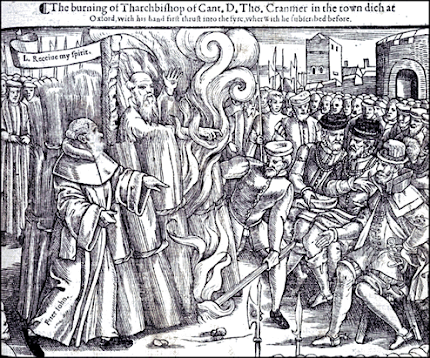
The burning of Tharchbishop of Cant. D. Tho. Cranmer in the town dich at Oxford, with his hand first thrust into the fyre, wherwith he subscribed before. [Click on the picture to see Cranmer's last words.]

Daily Bible Verse

Showing posts with label Scripturalism. Show all posts

Sunday, January 07, 2018

Was J. Gresham Machen a Libertarian?


Think not that I am come to destroy the law, or the prophets: I am not come to destroy, but to fulfil. For verily I say unto you, Till heaven and earth pass, one jot or one tittle shall in no wise pass from the law, till all be fulfilled. Whosoever therefore shall break one of these least commandments, and shall teach men so, he shall be called the least in the kingdom of heaven: but whosoever shall do and teach them, the same shall be called great in the kingdom of heaven. For I say unto you, That except your righteousness shall exceed the righteousness of the scribes and Pharisees, ye shall in no case enter into the kingdom of heaven.” (Matthew 5:17–20, KJV 1900)


It is often contended that J. Gresham Machen was a libertarian.  But one of the advocates of this point of view is George Marsden, a liberal on the faculty of the modern Princeton Theological Seminary.  Of course, Machen was opposed to Prohibition and publicly funded education because turning education over to the federal government or the state and local governments meant that children would be indoctrinated by the state at taxpayers' expense.

But does this mean that a theological conservative like J. Gresham Machen would support state sponsored lotteries, gambling on Indian reservations, prostitution in Las Vegas and other cities, or that Machen would support the "rights" of homosexuals to have state sponsored civil marriages or marriage in theologically liberal churches?  I do not think so.  Limited government is one thing and moral anarchy is quite another.  It is beyond any reasonable doubt that Machen would have been a product of his time and in the 1924-30 fundamentalist and modernist controversies Machen was decidedly against theological liberalism and moral relativism in the churches.  If this is true, what reasonable person would conclude that Machen would have favored moral relativism in society at large?  Really?  I think Machen would be rolling over in his grave at the idea that abortion, gay marriage, prostitution, pornography, and gambling should be granted the status of individual liberty or some unalienable right granted by the Creator mentioned in the Declaration of Independence.

Moral anarchy and progressivism are based in the cultural Marxism spawned by Hegelian philosophy and the dialecticalism of neo-orthodoxy. Logic must be curbed, don't you know?  Irrationalism is the fad of the day in both politics and liberal "Evangelicalism".  But God's moral law is an absolute condemnation of sin in society and in the individual, and all nations and individuals have an obligation to obey God's moral law.  Truth is universal and God's moral law is absolute.


Saturday, July 01, 2017

Incarnation Part 9


“Ectypal knowledge is true, but analogical. An analogy is parallel to, but does not intersect the original.”  R. Scott Clark.  Posted in the Puritan Board, “Analogically, Univocally, and Equivocally.”

“That there is a most important qualitative difference between the knowledge situation in the case of God and the knowledge situation for man cannot possibly be denied without repudiating all Christian theism. God is omniscient; his knowledge is not acquired, and his knowledge, according to common terminology, is intuitive while man’s is discursive.”  Gordon H. Clark


A Theological and Scripturalist Defense of Gordon H. Clark’s Two Person View of the Incarnation
Part  9
By Charlie J. Ray, M. Div.

I promised in my last post to delve into the doctrine of the Trinity.  Unfortunately the information in regards to the doctrine of the Trinity and how that relates to the Incarnation is a huge quantity of material the quality of which may or may not always be good.  That’s intended to be a pun, by the way.  While the following excursion may not seem at first glance to be related to the doctrine of the incarnation, I will follow the Clarkian Scripturalist view that all the propositions in a system of propositional truth are interrelated and all the parts fit together in harmony and consistency.  That’s why the doctrine of the Trinity and the doctrine of the Incarnation are good and necessary deductions that are not divorced from the rest of the system of theology deduced from the Bible.  (See: Westminster Confession of Faith 1:6).

This week I was listening to the first of four Heidelcast posts by Dr. R. Scott Clark of Westminster Theological Seminary, California.  During that lecture Scott Clark correctly distinguished between the sui generis of God and man as two different classes of beings.  Man is not God and God is not man.  However, during the lecture Scott Clark went off in what can only be called a neo-orthodox direction.  (See:  I Am That I Am, Part 1).  Scott Clark contends that we can know absolutely nothing that God knows just as God knows it.  Additionally, R. Scott Clark advocates that God’s theology and what is revealed in the Bible never intersect at any single point.  In short, the implication plainly stated is that the Bible is not God’s inspired Word nor is it the theology God knows.  Two parallel lines never intersect here or in eternity and thus the creature can know nothing God knows except by analogy.  R. S. Clark contends further that there is not a quantitative difference between God’s knowledge and our knowledge but rather there is a qualitative difference between man’s knowledge and God’s knowledge.  But I would like to know what this qualitative difference is?  Words need to be carefully defined.  


According to R. Scott Clark the qualitative difference is that we are creatures and God is the Creator.  We are also affected by the sinful nature and the noetic effects of that sinful nature.  R. S. Clark then contends that there is no quantitative difference between man and God because it is impossible for man to know anything that God knows.


But Gordon H. Clark contended that the difference between God and the creature is not only qualitative but quantitative.  However, even that is a bit of an oversimplification because Gordon Clark also said that man thinks discursively and is subject to the linear progression of time.  One thought passes to the next.  But in God’s eternal mind there is no passing of time and therefore God does not think in linear progression of time or one thought after another.  God knows all the propositions that can be known and all the relations between the propositions in that system of propositional truth in His mind and He knows them all at the same time.  So Gordon Clark did not confuse the creature with the Creator as his opponents continually assert.  It is fairly easy to demonstrate this from Clark’s own writings.  The fact of the matter is that Gordon Clark did not reject the qualitative difference between God and the creature because he distinguished between man’s knowledge as discursive and God’s knowledge as intuitive:

The professors above referred to assert, “there is a qualitative difference between the contents of the knowledge of God and the contents of the knowledge possible to man” (The Text, 5:1). That there is a most important qualitative difference between the knowledge situation in the case of God and the knowledge situation for man cannot possibly be denied without repudiating all Christian theism. God is omniscient; his knowledge is not acquired, and his knowledge, according to common terminology, is intuitive while man’s is discursive. These are some of the differences and doubtless the list could be extended. But if both God and man know, there must with the differences be at least one point of similarity; for if there were no point of similarity, it would be inappropriate to use the one term knowledge in both cases. Whether this point of similarity is to be found in the contents of knowledge, or whether the contents differ, depends on what is meant by the term contents. Therefore, more specifically worded statements are needed.

Gordon Clark. God's Hammer: The Bible and Its Critics (Gordon Clark) (Kindle Locations 651-659). The Trinity Foundation. Kindle Edition.

G. H. Clark contended that Van Til’s views amount to an equivocation or waffling back and forth between Reformed orthodoxy and Barthian neo-orthodoxy:

To avoid doing an injustice to Van Til and his associates, it must be stated that sometimes they seem to make contradictory assertions. In the course of their papers, one can find a paragraph in which they seem to accept the position they are attacking, and then they proceed with the attack. What can the explanation be except that they are confused and are attempting to combine two incompatible positions? The objectionable one is in substantial harmony with Existentialism or Neo-orthodoxy. But the discussion of the noetic effects of sin in the unregenerate mind need not further be continued because a more serious matter usurps attention. The Neo-orthodox influence seems to produce the result that even the regenerate man cannot know the truth.

Gordon Clark. God's Hammer: The Bible and Its Critics. (Gordon Clark) (Kindle Locations 623-628). The Trinity Foundation. Kindle Edition.

Moreover, R. Scott Clark and the Van Tilian theologians claim to derive their theology of analogy from Francis Turretin and begrudgingly acknowledge their debt to the theology of Thomas Aquinas’s view that theology is an analogical system rather than a system of propositional truth.  But it turns out that much of their theory is derived from Karl Barth and Soren Kierkegaard.  Kierkegaard was a huge influence on Barth and is usually identified as the father of modern existentialism and neo-orthodoxy.  It could be inferred that this theology came to certain of the Van Tilians through Martin Heinecken, a liberal Lutheran scholar from the mainline liberal Lutheran denomination called the Evangelical Lutheran Church in America.  In my re-reading of one of my Arminian systematic theology books from college this morning I came across this account from Millard Erickson of Barth’s theology of total transcendence and the relationship between Kierkegaard and Barth:

Karl Barth’s Model

In the twentieth century, a new major emphasis on God’s transcendence appeared in the thought and writing of Karl Barth, particularly in his early work, and most notably in his Romerbrief.  In that work he emphasized the Unknown God.  God is altogether other; immensely above the rest of the deities of the world of Paul’s day and all the deities which modern thought creates.

God is not an aspect of man or the best of human nature.  He is separated from man by an infinite qualitative distinction.  There is within man no spark of affinity with the divine, no ability to produce divine revelation, no remainder in him of a likeness to God.  Moreover, God is not involved in nature or conditioned by it.  He is free from all such limitations.  Nor is he really known by us.  He is the hidden one; he cannot be discovered by man’s effort, verified by man’s intellectual proofs, or understood in terms of man’s concepts.  Barth’s vigorous attack upon all forms of natural theology was an expression of his belief in divine transcendence.  Revelation comes only on God’s own initiative; and when it does come, it is not mediated through general culture.  It comes, in Barth’s language, vertically from above.  Man is never able in any way to make God his possession.

In the judgment of many theologians, including even the later Barth himself, Barth’s early view of transcendence was extreme.  Taken in its most literal form, it seemed to virtually cut off any real possibility of communication between God and man.  There was too severe a distinction between God and man . . .

Soren Kierkegaard’s Nonspatial Model

Soren Kierkegaard’s conception of divine transcendence was in many ways influential on Karl Barth.  While there are a few extreme elements in Kierkegaard’s thought, he offers some genuinely creative ways of expressing the idea of transcendence.  Two of them are what Martin Heinecken has expounded under the labels of qualitative distinction and dimensional beyondness.

By qualitative distinction is meant that the difference between God and man is not merely one of degree.  God is not merely like man but more so.  They are of fundamentally different kinds. Thus God cannot be known by taking the highest and best elements within man and amplifying them.  Being qualitatively distinct, God cannot be extrapolated from the ideas that man has nor from the qualities of man’s personality or character.  

Millard Erickson.  Systematic Theology.  (Grand Rapids: Baker, 1985).  Pp. 314-315.

From the above it can be legitimately inferred that if the Bible is not a logical and propositional revelation and communication between God and man is virtually and actually impossible, then the Bible is not really God’s inspired Word.  Van Tilians contradict themselves when they say that revelation is possible but only analogically so.  In fact, even though they acknowledge that the Bible is a rational revelation, they contend that logic is not essential to revelation.  Gordon H. Clark, on the other hand, said that the Bible teaches that God is Logic (John 1:1) and that because man is made in God’s image and likeness, man is an intellectual and logical and rational being.  (Genesis 1:27).  G. H. Clark rejected the view that the Bible is analogical revelation because the Bible only uses analogies and metaphors in certain passages of Scripture.  Not everything in the Bible is an analogy and even where there are analogies and metaphors utilized behind those analogies and metaphors there is a univocal and propositional truth.  What is analogical about the statement that David was the king of Israel?  Is that a straightforward proposition of historical fact or is it a mythological and analogical truth that only man knows?  After all, man and God cannot know the same thing.  Does God know that 2 + 2 = 4?  Or does man alone know 2 + 2 = 4?

R. Scott Clark continually uses the mantra of ectypal and archetypal knowledge as it was expressed by Francis Turretin.  He accuses Gordon H. Clark of ignoring this qualitative distinction between God’s knowledge and man’s knowledge.  But as I have shown above, Dr. Gordon H. Clark did acknowledge a qualitative and quantitative difference between God’s knowledge and man’s knowledge.  I would contend, however, that R. Scott Clark and other Van Tilians are reading their existentialist views into Francis Turretin and their dialectical and Barthian views cannot be proved from Turretin.  That’s because Turretin did not reject propositional revelation.  I also discovered that Turretin only mentions the ectypal and archetypal distinction in the Institutes of Elenctic Theology in regards to his rejection of rationalism, not as an acceptance of a Hegelian dialectic philosophy or a Kantian noumenalism where God is so completely transcendent as to be unknowable:

VI. True theology is divided into: (1) infinite and uncreated, which is God’s essential knowledge of himself (Mt. 11:27) in which he alone is at the same time the object known (epistēton), the knowledge (epistēmōn), and the knower (epistēmē), and that which he decreed to reveal to us concerning himself which is commonly called archetypal; and (2) finite and created, which is the image and ectype (ektypon) of the infinite and archetypal (prōtotypou) (viz., the ideas which creatures possess concerning God and divine things, taking form from that supreme knowledge and communicated to intelligent creatures, either by hypostatical union with the soul of Christ [whence arises “the theology of union”]; or by beatific vision to the angels and saints who walk by sight, not by faith, which is called “the theology of vision”; or by revelation, which is made to travellers [viz., to those who have not yet reached the goal and is called “the theology of revelation”] or the stadium).

Francis Turretin.  Institutes of Elenctic Theology.  Vol. 1.  Ebook.  “First Topic:  Theology”.  Translated by George Musgrave Giger.  James Dennison, editor.  (Phillipsburg:  Presbyterian and Reformed, 1997).  P. 49 in the ebook edition.

Reason is not the principle of faith. 

V. The reasons are: (1) The reason of an unregenerate man is blinded with respect to the law (Eph. 4:17, 18; Rom. 1:27, 28; 8:7). With respect to the gospel, it is evidently blind and mere darkness (Eph. 5:8; 1 Cor. 2:14). Therefore, it must be taken captive that it may be subjected to faith, not exalted that it may rule it (2 Cor. 10:3–5*). (2) The mysteries of faith are beyond the sphere of reason to which the unregenerate man cannot rise; and, as the senses do not attempt to judge of those things which are out of their sphere, so neither does reason in those things which are above it and supernatural. (3) Faith is not referred ultimately to reason, so that I ought to believe because I so understand and comprehend; but to the word because God so speaks in the Scriptures. (4) The Holy Spirit directs us to the word alone (Dt. 4:1; Is. 8:20; Jn. 5:39; 2 Tim. 3:15, 16; 2 Pet. 1:19). (5) If reason is the principle of faith, then first it would follow that all religion is natural and demonstrable by natural reason and natural light. Thus nature and grace, natural and supernatural revelation would be confounded.

Turretin, p. 64.  Ebook edition.


It should first be pointed out that Turretin predates both Kierkegaard and Barth.  Secondly, rejecting rationalism as the basis for faith is not the same thing as rejecting the Bible as an axiom which asserts a logical and propositional revelation.  Every theology has a starting point.  To start with God and not the Bible is to start with an unknown and undefined God.  The Bible, even according to Turretin, is not an irrational book.  Instead reason is necessary to understand the propositional revelation:


III. Having established this point, I say that to reason belongs the judgment of discretion in matters of faith, both subjectively (because it belongs to the intellect alone to know and distinguish these matters of faith) and normally; and indeed with respect to the truth of conclusions in all propositions (whether known by nature or by revelation), but with respect to the truth of propositions only in those known by nature and even then with this threefold caution. (1) That the judgment of reason not be considered as necessary, as if theology could not do without it. (2) That the word of God (where also these truths are revealed) be considered always as the primary rule and reason as the secondary. (3) That when the word adds something unknown to nature to a thing known by nature, then we should not judge of it by nature or reason, but by the word (not that the word and reason are at variance, but because reason is perfected by the word). But in things known only by revelation (as the mystery of the Trinity, of the incarnation, etc.), the only rule is the word of God, beyond or above which we must not be wise. 

IV. The question is not whether the mysteries of faith are above reason or whether reason can reach them. For we readily grant that there are things which far surpass the comprehension not only of men, but even of angels the disclosure of which was a work of supernatural revelation. We also grant that reason is not only incapable of discovering them without a revelation; not only weak in comprehending them after being revealed; but also slippery and fallible (readily pursuing falsehood for truth and truth for falsehood), and never believing the word of God and its mysteries unless enlightened by the grace of the Spirit. Rather the question is—Is there no use at all for it, and should we entirely reject the testimony of reason, as often as the truth or falsity of any doctrine is to be judged? This our opponents hold and we deny.

Turretin, p. 69.  Ebook edition.

Modernists and Socinians use reason to deconstruct Christianity because they also reject supernatural revelation.  So that was Turretin’s concern.  The problem with the Van Tilians is that they falsely accuse Gordon H. Clark of rationalism, which could not be further from the truth.  In fact, Clark begins with the axiom of Scripture.  Since it is Scripture that affirms that man is a rational creature unlike any of the other creatures and that God is Logic, it follows that reason is not to be rejected in deducing a propositional system of theology from the Scriptures.  If, as the Van Tilians contend, there can be no communication between God and man, then it would follow that Jesus in His incarnation as a real human person could not know anything God knows either.  Man is the image of God and God’s image is logic.

As these are complicated matters I will comment more on the doctrine of God and the Trinity in the next post and develop Dr. Clark’s view of propositional thinking from the Athanasian Creed and from the Scriptures as that relates to both the Trinity and the Incarnation.




Tuesday, May 10, 2016

A Few Thoughts on How God's Moral Law Relates to the Civil Magistrate


The central cause of this widespread moral collapse, so it seems to me, is located in the decline of Puritan religion.  This returns us to the main theme of religious rather than civil history.  When the seminaries and churches declare that God is dead, or when, less extreme, they substitute for the Puritan God of the Ten Commandments a different concept of god, inconsistent with the Ten Commandments, it logically and factually follows that morality is changed, too.  A man's view of morality depends on his view of God or whatever his first principle may be.  Different types of theology produce different types of morality.   

Dr. Gordon H. Clark.  Essays on Ethics and Politics.  John Robbins, ed. (Jefferson: Trinity Foundation, 1992   P. 167.

There is a constant danger for Christians who become involved in the political process.  But that applies equally to those who refuse to be involved in the political process.  Not speaking up when evil is dominating our nation is a violation of the command to preach the Gospel everywhere.  (2 Timothy 4:2).  The apostles said in Acts 5:28-29 that we ought to obey God rather than man when the political forces tell us to shut up and keep our faith in the closet.

However, the danger for the Christian who becomes involved in the political process is that his or her own theological system of thought and worldview could become compromised by watering down biblical principles and biblical theology for the sake of having an ecumenical common ground with unbelievers.  I am the first to admit that the danger of becoming a die hard Ted Cruz supporter, which I openly confess that I am, is that some people confuse the civil magistrate with the Bible and the result is what is usually called civil religion.  For example, Glenn Beck, a Mormon, is a strong advocate for God's moral law and for the United States Constitution.  But Glenn Beck is not a Christian.  Beck is strong on pro-life issues.  But I cannot in good conscience pray with Glenn Beck.  But on television I saw Ted Cruz praying with Glenn Beck.   Mark Levin, also a constitutional conservative, is Jewish and has a Pelagian view of free will.  Neither of these men are Christians.  So I cannot in good conscience pray with either of them.

Moreover, the American principle of religious pluralism is based solidly on the Bill of Rights and the First Amendment, which guarantees the separation of church and state.  That definition does not exclude Christians from public service in the government as Steven K. Bannon of Breitbart News contends.  Bannon is continually misquoting the Bible as if Jesus somehow advocated a complete disconnect between Christians and the government.  The verse in question was render unto Caesar.  It is disturbing to me when I hear the Bible misquoted and trashed in a thirty second sound byte for a liberal or pseudo-conservative cause.  But anyone who has ever read the Bible knows that render unto caesar was a political trap laid for Jesus by his political and eccesiastical opponents, the scribes and Pharisees:
14 When they had come, they said to Him, "Teacher, we know that You are true, and care about no one; for You do not regard the person of men, but teach the way of God in truth. Is it lawful to pay taxes to Caesar, or not?
 15 "Shall we pay, or shall we not pay?" But He, knowing their hypocrisy, said to them, "Why do you test Me? Bring Me a denarius that I may see it."
 16 So they brought it. And He said to them, "Whose image and inscription is this?" They said to Him, "Caesar's."
 17 And Jesus answered and said to them, "Render to Caesar the things that are Caesar's, and to God the things that are God's." And they marveled at Him. (Mark 12:14-17 NKJV)

I actually called into Bannon's radio program and was able to rebut his irrational argument on the air at the Patriot Channel, Sirius XM.   He did not much like being shown to be ignorant of the Bible.   I later learned that Bannon is a Roman Catholic.  He probably has not read the Bible much in his life.  For the Protestant the main emphasis is the preaching and teaching of the written Scriptures, which are the final authority in all matters of faith, practice and morality.  (2 Timothy 3:16; Matthew 4:4; Psalm 119:89; Isaiah 8:20).  This applies equally to how one does politics.  The Bible, according to Dr. Gordon H. Clark's Scripturalism, is the beginning axiom for Christianity and Christianity applies to all life, including the political realm.

I also called in to comment on Bannon's contention that "Evangelicals are voting for Donald Trump."  Well, the problem with this logically and Scripturally speaking is that if the term Evangelical is not specifically defined, then it is a meaningless term and you have said nothing other than that people in general have voted for Trump.  What they really mean is that from a civil religion point of view people who identify with some generic religious spirituality voted for Trump.  I pressed Bannon on this and asked him how he defined Evangelicalism.  His response was that Evangelicals were "self-identifying as Evangelicals in exit polls".  Well, if that is so, then the term is still meaningless because Bannon and the liberal press are just using a generic term as a propaganda device to manipulate an expected outcome and to persuade generally religious people to vote for the candidate favored by the press.  But the traditional definition of an Evangelical is someone who adheres to the five solas of the Protestant Reformation, the main one being Sola Scriptura or Scripture Alone.  Scripture is the final measure of truth in the political realm as well as in the private realm.  We know that murdering the unborn is murder because the Bible is propositional and logical revelation and because we can logically deduce that human babies have a right to live.  Thou shalt not murder is the principle upon which we base that inference.   (Exodus 20:13 KJV).  But here is a surprise for you.  God expects you to obey your elders and that expectation is the first commandment in the second table of the Decalogue.   Do not murder is commandment number six while the command to honor your parents and other elders is commandment number five.  (Exodus 20:12 KJV). The commandments are listed in a descending order of importance, though to break one commandment is to break them all. (James 2:10-11 KJV).

The idea that the Christian and Evangelical churches, moreover, cannot speak to political issues in their services or in sermons is understandable given the danger of civil religion, a tradition that started with the evangelist, Billy Sunday.  On the other hand, the theological doctrine of two kingdoms theology is foreign to the Protestant Reformers and to the Bible.  On that point, I can wholeheartedly agree with the reconstructionists and the theonomists.  But I am not theonomist or a reconstructionist because their theological system is inherently based on a confusion of the civil or judicial law of the Old Testament nation of Israel with the moral law of God.  The two are not the same thing at all.   (See chapter 19 of the Westminster Confession of Faith). 


The problem here is that the socialist left and the liberation theologians of the mainline liberal denominations are openly preaching the social sciences in their churches and in their sermons because they have replaced special revelation with general revelation or natural revelation.  According to the liberal model, God is totally transcendent and man can know nothing except what can be known from below.  We cannot know anything God knows because, as Kant said, we cannot know anything on the noumenal level.  We can only know what can be empirically observed from below and what we can establish by rational reason.  Kant called this the phenoumenal or phenominological realm--that is, what we can observe in natural phenomena.  But Kant did presuppose certain innate and pre-existing abilities in man such as the ability to think, to tell time, etc.  These are not learned but are innate in man, according to Immanuel Kant:

A large part of Kant’s work addresses the question “What can we know?” The answer, if it can be stated simply, is that our knowledge is constrained to mathematics and the science of the natural, empirical world. It is impossible, Kant argues, to extend knowledge to the supersensible realm of speculative metaphysics. The reason that knowledge has these constraints, Kant argues, is that the mind plays an active role in constituting the features of experience and limiting the mind’s access only to the empirical realm of space and time.

Matt McCormick, "Immanuel Kant: Metaphysics," in Internet Encyclopedia of Philosophy:  A Peer Reviewed Academic Resource.

The point being made here is that liberal mainline churches are preaching and teaching a form of theonomy but they are doing it from the perspective of the theological left.  Their theological views are deduced from a humanistic view of the social sciences and the empirical sciences, including their higher critical views of the Bible and textual criticism.  Their views are not deduced from the Bible except as the Bible is interpreted by means of their liberal and socially progressive presuppositions.

In African American churches there has been a long standing tradition of preaching on social justice issues since the days of slavery, when the slave who could read would read the Scriptures while another would expound on the text that he could not read.  Of course, times have changed.  But in this tradition you can still visit some black churches where one of the deacons or another lay person will read the text verse by verse while the minister then preaches on the text verse by verse.  Verse by verse is not a bad way to preach, by the way.  So if liberation theology, feminist theology, black liberation theology, socialism, the LGBT or homosexual issues can be openly preached in liberal churches and political applications of the social "sciences" like psychology, sociology, evolutionary sciences, etc., can be and are openly preached in liberal churches, why do Evangelicals think they cannot apply biblical principles to the same issues and do so as openly as the political and theological left does?  In effect, the left has established their liberal theology as the civil religion of our nation.  All religions lead to God, right?  They have confused the political doctrine of religious pluralism with establishing a theological liberalism and comparative religions as the official state religion.  Religion, according to this view is nothing more than man's cultural adaptations of existential angst to help someone cope with the vicissitudes of life.  Secular humanism is another established version of this state religion and said religion makes it heresy to disagree with the state dogmas on evolution, homosexuality, abortion, gun rights, religion as an opiate of the people and a whole host of other politically correct dogmas that are strictly enforced by our increasingly socialistic government.

For example, Barack Obama appealed to the Preamble of the Declaration of Independence to justify his endorsement of the Supreme Court decision to uphold the perversion of gay marriage.  He said that homosexuals have a "god given right" to marriage.   But is that what the Declaration of Independence said?  All agree that Thomas Jefferson was a deist and not a Christian theist or an Evangelical Protestant.  But why did Jefferson appeal to the axiom that all men are "created equal"?  The answer is that Jefferson believed in a supernatural creation.  While it is true that Jefferson rejected  the supernatural miracles of the Bible, he did not reject the biblical doctrine of creation and in fact he got his doctrine that all men are created from the Bible.  (Genesis 1-3).  Obama's progressive morality is therefore anachronistic and is not to be found in either the Bible or the Constitution.  The Bible without any doubt condemns homosexuality.  Of course, the liberals do not believe the Bible is inspired by God.  They consider it to be a product of human invention in order to deal with  man's experience of suffering.

Additionally, the Bible nowhere advocates the separation of church and state.  Although I agree in principle with the Constitution and the Bill of Rights, I do not agree with the liberal presupposition that religion cannot be an influence in political matters.  The theological left is extremely engaged, so it is hypocritical and a double standard to forbid Evangelicals from the same engagement.  There is no political test for public office.  That would mean that Ted Cruz and other Evangelicals deserve the same consideration for office as any theological liberal, any Roman Catholic, or any atheist.  

From a Clarkian Scripturalist perspective, the beginning axiom of Christianity is the Bible, not the social sciences, not philosophy or rationalism, nor even political science.  All of these other beginning axioms lead to atheism or skepticism.  The Bible alone leads to a consistent Christian worldview or epistemology.  Scripture alone literally is the beginning of all knowledge. 

Proverbs. 1:7  The fear of the LORD is the beginning of knowledge: but fools despise wisdom and instruction.  KJV

Proverbs 9:10 The fear of the LORD is the beginning of wisdom: and the knowledge of the holy is understanding.  KJV

2 Pet. 2:20  For if after they have escaped the pollutions of the world through the knowledge of the Lord and Saviour Jesus Christ, they are again entangled therein, and overcome, the latter end is worse with them than the beginning.  KJV


I have much more to say on this subject but I will close here for today.


Question 191

What do we pray for in the second petition?

In the second petition, (which is, Thy kingdom come, (Matt. 6:10) ) acknowledging ourselves and all mankind to be by nature under the dominion of sin and Satan, (Eph. 2:2–3) we pray, that the kingdom of sin and Satan may be destroyed, (Ps. 68:1,18, Rev. 12:10–11) the gospel propagated throughout the world, (2 Thess. 3:1) the Jews called, (Rom. 10:1) the fullness of the Gentiles brought in; (John 17:9,20, Rom. 11:25–26, Ps. 67) the church furnished with all gospel-officers and ordinances, (Matt. 9:38, 2 Thess. 3:1) purged from corruption, (Mal. 1:11, Zeph. 3:9) countenanced and maintained by the civil magistrate: (1 Tim. 2:1–2) and the ordinances of Christ may be purely dispensed, and made effectual to the converting of those that are yet in their sins, and the confirming, comforting, and building up of those that are already converted: (Acts 4:29–30, Eph. 6:18–20, Rom. 15:29–30,32, 2 Thess. 1:11, 2 Thess. 2:16–17) that Christ would rule in our hearts here, (Eph. 3:14–20) and hasten the time of his second coming, and our reigning with him for ever: (Rev. 22:20) and that he would be pleased so to exercise the kingdom of his power in all the world, as may best conduce to these ends. (Isa. 64:1–2, Rev. 4:8–11)


The Westminster Larger Catechism: With Scripture Proofs. (Oak Harbor, WA: Logos Research Systems, Inc., 1996).

Wednesday, February 17, 2016

Covetousness Is Worse Than Government Sanctioned Murder?


Strange as it may sound to modern ears used to hearing so much about the right to life, or the right to decent housing, or the right to choose, the Bible says that natural rights and wrongs do not exist: Only God's commands make some things right and other things wrong. -- John Robbins


It is truly amazing when a so-called Scripturalist becomes a libertarian and then says something that is just so far beyond the pale that it approaches the level of Donald Trump's ludicrous remarks.  The late Dr. Gordon H. Clark was a Puritan who upheld the Ten Commandments (Exodus 20:1-17) as the basis for civil and criminal law in our nation.  But we have Sean Gerety over at the God's Hammer blog completely rejecting the Decalogue as the basis for laws passed by the civil magistrate and replacing it with economic policy instead.  This is really nothing more than blatant liberalism and secular humanism.

Gerety says:
Many people think the worst and most pressing sin confronting our nation today is abortion.  After all, well over 54 million babies have been slaughtered since abortion on demand was first declared the “the law of the land” by the Supreme Court in 1973. Today we see videos of the butchers at Planned Parenthood wining and dining while discussing the price of fetal body parts to be sold for medical research that would have made the Nazis proud.  As grizzly and inhuman as wholesale legalized abortion is, the fact that abortion is legal doesn’t mean that a single baby must die.  A moral God fearing people would simply refuse to murder their own children.  Besides, the government isn’t lining up pregnant women forcing them to undergo abortions at gun point … at least not yet.

God's Hammer:  The Sins of Nations

Following this logic, criminal laws are unnecessary and should be done away with and so should jails and prisons.  After all, "a moral God fearing people would simply refuse...." to do anything wrong.  But how do we know what is right and wrong in the first place?  The only way to know right from wrong is from the revealed moral commands in the Bible. (Romans 3:20; 7:7). This is what both Dr. Gordon H. Clark said and what Dr. John Robbins said.  Gerety claims to be a Scripturalist and he claims to follow the theology and apologetics of John Robbins.  But even John Robbins would be appalled at Gerety's blatant disregard for the Ten Commandments and his disregard for Scripture:


Clark's ethical philosophy is also derived from the axiom of revelation. The distinction between right and wrong depends entirely upon the commands of God. There is no natural law that makes some actions right and others wrong. In the words of the Shorter Catechism, sin is any want of conformity unto or transgression of the law of God. Were there no law of God, there would be no right or wrong.
This may be seen very clearly in God's command to Adam not to eat the fruit of the tree of the knowledge of good and evil. Only the command of God made eating the fruit sin. It may also be seen in God's command to Abraham to sacrifice Isaac. God's command alone made the sacrifice right, and Abraham hastened to obey. Strange as it may sound to modern ears used to hearing so much about the right to life, or the right to decent housing, or the right to choose, the Bible says that natural rights and wrongs do not exist: Only God's commands make some things right and other things wrong.

John Robbins, "An Introduction to Dr. Gordon H. Clark,"  Trinity Review, July/August, 1993.

Further, it should be noted that the Decalogue or Ten Commandments is ordered in descending order of importance with the first four commandments, addressing what God commands in regards to Himself, taking priority over the second table of commandments, what God orders in regards to human relationships.  Although the fifth commandment is to honor one's parents and is more important than even the command not to murder, the command not to murder, commandment number six, is still a higher priority of importance than the command not to covet.  This is so simple that even a very young child can understand it.

The Westminster Confession of Faith clearly says that the obligation of the civil magistrates or civil authorities of nations is to uphold the moral law of God.  The only way to know this moral law is from the revealed commands in Holy Scripture:

CHAPTER XXIII—Of the Civil Magistrate

  1.      God, the supreme Lord and King of all the world, hath ordained civil magistrates to be under Him, over the people, for His own glory, and the public good: and, to this end, hath armed them with the power of the sword, for the defense and encouragement of them that are good, and for the punishment of evil doers. (Rom. 13:1–4, 1 Pet. 2:13–14)

  2.      It is lawful for Christians to accept and execute the office of a magistrate, when called thereunto: (Prov. 8:15–16, Rom. 13:1–2, 4) in the managing whereof, as they ought especially to maintain piety, justice, and peace, according to the wholesome laws of each commonwealth; (Ps. 2:10–12, 1 Tim. 2:2, Ps. 82:3–4, 2 Sam. 23:3, 1 Pet. 2:13) so, for that end, they may lawfully, now under the new testament, wage war, upon just and necessary occasion. (Luke 3:14, Rom. 13:4, Matt. 8:9–10, Acts 10:1–2, Rev. 17:14, 16)


The Westminster Confession of Faith (Oak Harbor, WA: Logos Research Systems, Inc., 1996).

It's not clear to me how Gerety decides what morals the government should be enforcing since according to his libertarian axiom, the Bible cannot be the basis for civil or criminal laws.  The only axiom of libertarianism is do not hurt anyone.  But isn't the murder of the unborn hurting babies and even the mother who murders the child?  The government selectively decides to enforce laws against stealing and certain instances of murder.  But the murder of the unborn is apparently not a violation of man's relative laws that change from one century to the next, one decade to the next, and one year to the next.  Maybe next year the government will decide that the execution of Evangelical Christians is a public good?

As for the government not forcing women to have abortions at gun point, Gerety's logic is again faulty.   That's because the government is forcing babies to die.  The unborn child is cruelly and maliciously murdered by government approved sanctions.  But the Declaration of Independence says that everyone has the right to life, liberty, and the pursuit of happiness.  Of course, Thomas Jefferson deduced these rights from the Bible.  And Jefferson rightly said that the self-evident axiom for a just government is that all men are "created equal".  Following the logic of Jefferson's argument, it would be just for a people to reject the authority of the government in regards to the abortion issue because it denies the rights of unborn children to live:

We hold these truths to be self-evident, that all men are created equal, that they are endowed by their Creator with certain unalienable Rights, that among these are Life, Liberty and the pursuit of Happiness.—That to secure these rights, Governments are instituted among Men, deriving their just powers from the consent of the governed.—That whenever any Form of Government becomes destructive of these ends, it is the Right of the People to alter or to abolish it; and to institute new Government, laying its foundation on such principles and organizing its powers in such form, as to them shall seem most likely to effect their Safety and Happiness.
The Declaration of Independence

And for those who who try to say that Jefferson was a forerunner of atheism, Jefferson clearly says that it is "nature's God" that entitles them to these rights.   (Romans 1:18-21).  Of course, natural revelation alone cannot lead to truth (2 Timothy 3:16-17; Matthew 4:4; Isaiah 8:20; Isaiah 55:11; Jeremiah 23:29).  The rocks cannot tell us what is right and wrong.  But it is very apparent that Jefferson deduces more from Scripture than from nature. 


Sean Gerety unwittingly places the rights of women above the unalienable rights of a child to live, have liberty, and to grow up to pursue happiness.  No one has any right to break God's law.  Governments and nations that break God's moral laws will suffer God's wrath at some point in the future.  His argument is therefore  no better than the arguments of liberals.


It is increasingly apparent that Evangelical Christians are more content to argue for their own comforts than to stand for what is right and true.  The reason the whole nation opposes an Evangelical Christian like Ted Cruz for the office of President of the United States is that everyone wants to decide for himself or herself what is right and wrong instead of believing that God alone has the authority to decide what is right and wrong (Deuteronomy 12:8).  Without the Scriptures right and wrong do not exist.  Instead what we have is arbitrary laws that men change from one minute to the next.  Donald Trump contradicts himself from one minute to the next and so do the reporters in the media.  But God's written Word never changes.  (Psalm 119:89).  God's moral law is as unchanging as God Himself because God is eternally immutable.  He is from everlasting to everlasting the same God who never changes His eternal plans or purposes (Psalm 90:1-6; James 1:17; Malachi 3:6; Numbers 23:19).


God can and does punish nations for their gross immorality.  There really is no reason for God to spare the United States of America.  He can wipe our nation out at any moment and there would be nothing we could do about it.  Having a strong military cannot protect a nation from God's wrath.  (Isaiah 31:1).


Psalm 59:5 (NKJV)
5 You therefore, O Lord God of hosts, the God of Israel, Awake to punish all the nations; Do not be merciful to any wicked transgressors. Selah
Amos 3:6 (NKJV)
6 If a trumpet is blown in a city, will not the people be afraid? If there is calamity in a city, will not the Lord have done it?

Of course, some who profess to be Christians and Scripturalists are more than willing to sacrifice unborn children in exchange for the creature comforts they will gain from having a robust economy, limited government, and libertarian licentiousness.  I would say that these people are not Christians or Scripturalists at all.


Ezekiel 33:6–9 (NKJV)
6 But if the watchman sees the sword coming and does not blow the trumpet, and the people are not warned, and the sword comes and takes any person from among them, he is taken away in his iniquity; but his blood I will require at the watchman’s hand.’ 7 “So you, son of man: I have made you a watchman for the house of Israel; therefore you shall hear a word from My mouth and warn them for Me. 8 When I say to the wicked, ‘O wicked man, you shall surely die!’ and you do not speak to warn the wicked from his way, that wicked man shall die in his iniquity; but his blood I will require at your hand. 9 Nevertheless if you warn the wicked to turn from his way, and he does not turn from his way, he shall die in his iniquity; but you have delivered your soul.

As Christians we are to warn the nation of God's coming judgment.  We cannot stand by and say nothing when millions of unborn children are murdered.  (2 Kings 23:10; Jeremiah 32:35).  And further, it our responsibility as Christians to stand against ungodly laws that take the lives of children who have no voice.  Sean Gerety ought to be ashamed to place women's right to murder their child above the right of the child to live.  God does not take this sort of thing lightly in my opinion.

And finally, has Gerety forgotten the doctrine of total depravity?  (Romans 3:10-23).  Only God can raise the spiritually dead.  (Ephesians 2:1-5).  The fact is God is sovereign and He has not ordained that entire nations will repent and believe.   In a civil society the criminal laws are to be based on the general equity of the Ten Commandments so that evil can be restrained by the sword of the civil authorities.   (Romans 13:1-5).  It is wishful thinking and even Pelagianism to think that people will just decide to become Christians and stop killing their babies.  It is our responsibility as Christians to stand against evil and to pass laws that preserve a Judeo-Christian value system in our nation.


Post Script:  In an earlier blog post I critiqued Gerety's liberalism and secularist views.  (See:  Sean Gerety and Co-belligerency with Van Tilians, Libertarians, Secular Humanists and Atheists.  See also:  Scripturalism, Libertarianism, Relativism and Sean Gerety).

Tuesday, June 23, 2015

What Is a Parable? A Clarkian Analysis of Dr. Robert A. Traina's Comment

It may truly be said that the context of each term of a book is the book itself.  --  Dr. Robert A. Traina


I never took any classes with Dr. Robert A. Traina.  However, when I was a young Pentecostal and Arminian student at Asbury Theological Seminary, Dr. Traina's book on inductive biblical exegesis, Methodical Bible Study, was a standard textbook and still is today in many seminaries across the nation.  At Asbury in the early 1990s I took several classes called English Bible, which were really a form of literary criticism and inductive Bible study.  My professors were Dr. Joseph Dongell and Dr. David Bauer.  Both men were very good at inductive Bible study and making the logical and literary connections in the text, despite their Wesleyan Arminian presuppositions which influenced their overall interpretations of the biblical texts.

However, there is a problem with inductive Bible study and the problem is that the systematic whole often gets lost in the overall context, despite the fact that inductive Bible study is supposed to fit with the context of the whole Bible as well as with the context of the book, chapter, pericope and the paragraph in which the verse occurs.  Also, without logic and the law of contradiction language itself has no particular meaning.  When equivocation and analogical analysis is the beginning axiom of literary criticism, and an appeal to the neo-orthodox view of Scripture as merely the framework for the keryma of the early church, then the problems with inductive Bible study from an Arminian and Evangelical perspective become paramount. Furthermore, I was shocked to discover that Wesleyans do not believe in plenary verbal inspiration, even though the doctrinal statement at Asbury purports to believe in the inerrancy of the Bible.  This an equivocation because it turns out that Asbury believes that only the theological concepts of the Bible are without error:

Asbury Theological Seminary, which is one of the preferred seminaries of The Wesleyan Church, has a helpful statement on inerrancy: the Bible is “without error in all that it affirms.”  The important question is thus, “What was God affirming when He inspired this particular passage?”  For example, was the point of Philippians 2:10 that the earth is flat and that there are beings under and above the earth: “that at the name of Jesus every knee might bow—of those in the skies and on the earth and under the earth”? . . .

* * *

The idea that the Bible is inerrant in all that it affirms captures the Wesleyan sense of inerrancy well.  Certainly God’s word could never be in error.  The challenge is in determining what the Bible affirms rather than in acknowledging its inerrancy.  Certainly when God’s Spirit truly reveals something to an individual through the words of Scripture, this affirmation will be without error.  And anything that God has authentically revealed to the Church, to a specific church group or specific individuals, is an affirmation without error.

 Ken Schenck, What Wesleyans Mean By Inerrancy.  [I took my summer Hebrew courses with Ken Schenck when he was still a professor at Asbury.  John Walters, another professor at Asbury, said openly that the concepts of the Bible are inspired and inerrant but not every single word of the Bible.]

Please note well that Schenck appeals directly to existential encounter and personal illumination rather than to an objective and propositional revelation in the Scriptures:

Certainly when God’s Spirit truly reveals something to an individual through the words of Scripture, this affirmation will be without error.  (Schenck, Ibid.).
Schenck's view is practically identical with the neo-orthodox view.  If the Bible is not an objective revelation instead of a framework that needs personal revelation, Christianity is completely destroyed.   [He also places more authority in the church than in the Holy Scriptures.  Whatever happened to sola Scriptura?]

Also, as an aside, I should mention that no literary analysis of the Bible can be done in exactitude without knowing the biblical languages sufficiently to read and exegete the syntactical information in the original languages.  Although this method works for the layman who is reading the Bible in an English translation, the layman should be comparing various translations to see what translation issues become immediately apparent.  A further complication is the issue of textual criticism and what is considered to have been originally in the autographs. (Logical Criticisms of Textual Criticism).  [Note well that when I was a student at Asbury from 1992-1995 Hebrew was no longer required for the fulfillment of the degree for a master of divinity.  As stated above, I had to do Hebrew as a summer elective.]

First of all, Dr. Traina does not properly define his terms when he makes a distinction between the concrete details of a parable and the spiritual main point of the parable.  What is a "spiritual truth"?  Dr. Traina never defines this term for us; and worse, his definition of Scripture is that Scripture is a two fold revelation of truth.   Also, he thinks that scholarly articles are necessary to interpret the text.  This is only true in a secondary sense because the Protestant principle of interpretation is that Scripture alone is the Word of God (2 Timothy 3:16).  Scripture interprets Scripture first and any difficult passage of Scripture is to be interpreted by other more plain Scriptures.  This second point is what is generally called by Reformed scholars the perspicuity of Scripture.

To show what I am talking about I will quote the lengthy passage from Dr. Traina's book on pages 148 to 149:

(4) Connotations of General Literary Forms

Some of the intepretative implications of general literary forms were indicated in their previous treatment.  The purpose of the discussion at this juncture is to supply one or two illustrations which will clarify some of the means by which the utilization of literary forms will have a serious bearing on exegesis, and to suggest articles and books which may be read in order to broaden the reader's understanding of their exegetical importance.

Let us consider, for example, one of the factors involved in the interpretative significance of the parabolic form.  As was indicated previously, the parable is based on an analogy between the physical narrative and a spiritual truth.  Now such an analogy does not imply that the spiritual truth and the physical illustration are absolutely identical, since spiritual and physical truth are on two different planes and can never be equated.  Nor need they be, for all that is demanded of an analogy is similarity at certain points.  In fact, it is safe to limit the place of intersection between the spiritual truth and the physical illustration to one main point.

If this analysis is true, one of the factors involved in the exegetical significance of the parabolic form become abundantly clear.  The physical aspects of the parable should never be pressed in all its particulars in order to discover its meaning.  For the parable may be likened to a husk containing a kernel.  The husk must be removed until the kernel alone remains, because it is for the sake of the kernel that the husk exists.  The kernel may be compared with the one, main spiritual truth for which the parable is given.  When this kernel is discovered, the physical aspect, like the husk, may be set aside.  For to treat the physical factor of the parable as identical with the spiritual truth it carries, and consequently to find spiritual meaning in every of the narrative, is to misuse the parabolic form."

Robert A. Traina.  Methodical Bible Study.  1952.  1980.  Reprint.  (Grand Rapids:  Francis Asbury/Zondervan, 1985).  Pp. 148-149.

Dr. Gordon H. Clark, on the other hand, defined his terms carefully.  He said that behind every metaphor, simile, and parable there is a logical proposition.  The term "spiritual truth" is vague and not carefully defined.  A logical proposition is a logical statement that is composed of a subject and a predicate joined by a copula.  Dr. Clark's example of this is, "David was the king of Israel."  Even a basic English grammar student can see what this means because the grammar of a sentence and a logical statement are exactly identical in this case.  Parables are therefore not a contradiction to the principle of propositional revelation when we say that all knowledge is propositional.  The distinction between literal and symbolic or literal and analogical is therefore misleading.

However, to say that we can set aside the parable once we know the "spiritual truth" is dangerous.  The parable stands as God's written word and the meaning of the parable cannot be understood apart from the symbolic statements that lead us to the propositional statement behind the parable.  Dr. Traina's statement that the parable is just a husk while the truth within is the kernel and that we can dispose of the husk is nothing more than neo-orthodoxy.  All Scripture is inspired by God and all Scripture is profitable for doctrine.  (2 Timothy 3:16; Matthew 4:4; John 10:35).  Scripture stands as a totality, a systematic whole and no parts of the Scriptures may be discarded as husks just because we think we have arrived at the proper interpretation of the text.

According to Roger Johnson, Bultmann "rejected every effort to identify keryma with any past confession of faith."  (Roger Johnson, "The Relation Between Theology and Proclamation," in Rudolf Bultmann:  Interpreting Faith for the Modern Era, (San Francisco:  Collins, 1987), p. 235).  Bultmann completely rejected not only dogmatics and systematic theology but also propositional revelation.  This means that systematic organization of basic Christian doctrines into creeds or extended confessional statements is impossible.  For Bultmann truth is an existential encounter between an individual person and what that person perceives God is saying to him through direct encounter:

Bultmann's consistent focus on the New Testament kerygma as the locus of faith suggested to some a very specific and limited formulation of that kerygma, as if it could be defined in terms of certain core New Testament beliefs:  e.g., the confession that Jesus is Lord, that God has raised up this Jesus who was crucified, etc.  Bultmann, however, rejected every effort to identify the kerygma with any particular past confession of faith.  Since the keryma is nothing else than God's word of address to a particular person, no formulation of it can ever be regarded as complete.  It will always find expression in new forms of speech appropriate to the concrete situation of the person addressed.   (Roger Johnson, Ibid.).

Bultmann in his own words rejects the doctrine of dogmatic theology and propositional truth or any idea that theology or biblical theology can be systematized into a summary of biblical doctrine:


The science called New Testament theology has the task of setting forth the theology of the New Testament; i.e. of setting forth the theological thoughts of the New Testament writings, both those that are explicitly developed (such as Paul's teaching on the Law, for example) and those that are implicitly at work in narrative exhortation, in polemic or consolation.  The question may be raised whether it is more appropriate to treat the theological thoughts of the New Testament writings as a systematically ordered unity--a New Testament system of dogmatics, so to say--or treat them in their variety, each writing or group of writings by itself, in which case the individual writings can be understood as members of an historical continuity.

The second procedure is the one chosen in the treatment here offered.  By this choice the opinion is expressed that there can be no normative Christian dogmatics, in other words, that it is not possible to accomplish the theological task once for all--the task which consists of unfolding that understanding of God, and hence of the world and man, which arises from faith, for this task permits only ever-repeated solutions, or attempts at solution, each in its particular historical situation.  Theology's continuity through the centuries consists not in holding fast to once formulated propositions but in the constant vitality with which faith, fed by its origin, understandingly masters its constantly new historical situation.  It is of decisive importance that the theological thoughts be conceived and explicated as thoughts of faith, that is: as thoughts in which faith's understanding of God, the world, and man is unfolding itself--not as products of free speculation or of a scientific mastering of the problems involved in "God", "the world", and "man" carried out by the objectifying kind of thinking.

Theological propositions--even those of the New Testament--can never be the object of faith; they can only be the explication of the understanding which is inherent in faith itself.  Being such explication, they are determined by the believer's situation and hence are necessarily incomplete. . . .  

Rudolf Bultmann, quoted in "The Relation Between Theology and Proclamation," Rudolf Bultmann:  Interpreting Faith for the Modern Era.  (San Francisco:  Collins, 1987).  Pp. 235-236.

The similarities between the Wesleyan rejection of plenary verbal inspiration and their affirmation of the theological concepts only should be apparent.  Bultmann calls the thoughts of the New Testament the kerygma but he rejects any attempt to systematize the doctrines of the Bible into creeds or confessions.  Although the Wesleyans do not go that far, it should be noted that John Wesley never wrote a systematic theology.  His 52 standard sermons serve as the only systematic theology Wesley ever produced.  Unfortunately, modern Evangelical Wesleyans have used this as an excuse to dismiss the systematic theology of the Reformed scholars as overly scholastic.  This same tendency to endorse both higher and lower biblical criticism and to reject propositional revelation and confessional dogmatics and systematics has infiltrated not only the Wesleyan seminaries but by and large the majority of the Reformed and Evangelical seminaries due to the influence of Cornelius Van Til, who largely agreed with the neo-orthodoxy of G. C. Berkouwer.  Van Til most famously said that all Scripture is apparently contradictory:

Now since God is not fully comprehensible to us we are bound to come into what seems to be contradiction in all our knowledge. Our knowledge is analogical and therefore must be paradoxical. -Van Til, The Defense of the Faith, 61.


while we shun as poison the idea of the really contradictory we embrace with passion the idea of the apparently contradictory. Van Til, 
Common Grace and the Gospel, 9.


All teaching of Scripture is apparently contradictory.  Ibid., 142.  (Quoted and cited by Patrick McWilliams, Cornelius Van Til vs. Zacharias Ursinus).

Dr. Traina at least acknowledges that inductive Bible study must have some connection to the overall structure of the book being studied and to the Bible as a whole:

. . . It may truly be said that the context of each term of a book is the book itself.


The purpose of emphasizing the complexity of contextual relations and their interpretative significance is to encourage the reader to be constantly on his guard lest he forget to utilize some important structural connections in the process of exposition.  For such an oversight will eventuate either in erroneous interpretation or at least incomplete interpretation.  In fact, it was because of this that the suggestion was made that an entire passage be observed before a serious attempt be made to interpret any of its parts.  It might even be added that the exegesis of each unit within a given book should remain tentative until the entire book is studied in order to give full consideration to the broader structural relations, which are frequently so important for proper exposition.  Traina, Ibid., pp. 145-146.

I will not quote Dr. Gordon H. Clark here because I have already quoted at length both Bultmann and Dr. Traina.  But suffice it to say that Dr. Clark believed that the Bible consists of propositional revelation that is univocally the very words of God.  These propositions in isolation would be meaningless apart from their systematic organization into a system of epistemological truth.  Verses of the Bible are not isolated aggregates that stand alone.   They appear in the total context of the pericope, chapter, book, and the whole Bible.  The old arguments between biblical theology, which is allegedly focused on inductive Bible study, and systematic theology is pertinent here because systematic theology is not merely proof texting out of context.  In fact, the proper exegesis of the proof texts is based on inductive study of the Bible and how all the parts fit together not only in a structural analysis of the biblical texts but also how all those parts fit together into a systematic summary of the doctrinal statements of the Bible.  Dr. Clark rejected the neo-orthodox distinction between kerygma and Scripture (Is There a Distinction Between Church Doctrine and Kerygma?, and  The Gospel Includes the Five Points of Calvinism), yet he supported proof texting as a legitimate method of supporting systematics and dogmatics.  Every scholar of Aristotle and Shakespeare proof texts those writers to show what their views were.  So why should Reformed Christians be prevented from proof texting?

The neo-orthodox attack on propositional revelation is prominent not only in Arminian seminaries but in practically every so-called Reformed seminary in the nation today.  Evangelicalism is infected with relativism and situational ethics and morality because it has as a movement rejected the dogmatic and systematic interpretation of Scripture as the univocal revelation of God in the very words of God.  Unless and until there is a return to classical Reformation theology and the doctrine of propositional and systematic revelation, the slide into apostasy will continue in Evangelicalism and in the so-called Reformed denominations.  While Asbury and other seminaries put on a show of their commitments to conservative theology and traditional Evangelicalism, the truth is that they equivocate significantly on the definitions of these terms.  Ken Schenck's article on biblical inerrancy cited above is just one example of that.  My own understanding of what Asbury stands for is that Asbury has long ago rejected the authority of Scripture and instead teaches neo-orthodox views of Scripture, including rejecting Genesis 1-11 as inspired myth rather than propositional revelation.  Reformed seminaries are now just as enamored with higher and lower biblical criticism as any openly liberal seminaries these days.

Charlie J. Ray, M. Div.


Support Reasonable Christian Ministries with your generous donation.