>

Martyred for the Gospel

Martyred for the Gospel
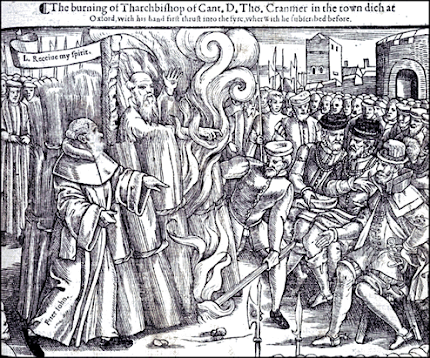
The burning of Tharchbishop of Cant. D. Tho. Cranmer in the town dich at Oxford, with his hand first thrust into the fyre, wherwith he subscribed before. [Click on the picture to see Cranmer's last words.]

Daily Bible Verse

Showing posts with label Incarnation. Show all posts

Sunday, August 16, 2026

An Update on a 2/11/2011 Blog Post: The Incarnation

I made a few remarks to update my change of views over time.  In February of 2011, I had an online dispute with a polemical supporter of Dr. Gordon H. Clark's views.  His name is Sean Gerety.  After many years of carefully studying Dr. Clark's books and articles, I have come to a different conclusion.  I made the following remarks on the top of the post this morning:

[08/16/2026.   I do not delete old posts from my blog in order to show how my views have evolved over time.  In the case of the accusations of Gordon H. Clark being called a Nestorian, this is really nothing new since the Lutherans think that most all Presbyterians are guilty of Nestorianism due to the fact that Presbyterians deny that the resurrection body of Christ is ubiquitous or present in, with, and under the communion elements of bread and wine.  Also, perhaps there is misunderstanding of Clark's view because Dr. Clark defined a person as the propositions that he thinks.  Proverbs 23:7.  According to Clark, all three Persons of the Trinity are omniscient and all three Persons are the same God.  The three Persons all know the same infinite propositions possible to aseity and deity.  The difference is stated well in the Athanasian creed.  The Father is not the Son or the Spirit.  The Son is not the Father or the Spirit.  And the Spirit is not the Father or the Son.  If the personal distinctions are actual distinctions between the Personal subsistences, then obviously the three Persons cannot think that they are the other two persons.


In regards to the incarnation, the Definition of Chalceon, 451 A.D., Clark noted that the creed says that Jesus had a reasonable human soul.  For Clark, human personality is therefore limited in every way that every other human is limited and finite.  God, on the other hand, being immutable, is not finite or limited in what He can know.  Therefore, when the divine Logos became incarnate in the human person of Jesus Christ, He did not replace the human and reasonable soul of Jesus Christ.  If so, that would be the heresy of Apollinarianism.  For Jesus to be a completely human person he must have a soul like other humans. 


On the other hand, if the divine Logos gave up the "free" exercise of His divine attributes, as contended by Millard Erickson, the Baptist theologian, and as contended by certain Assemblies of God Pentecostal theologians, then the Trinity would be short one of the Persons of the Godhead.  In other words, if God is immutable and all three Persons are fully and truly God, then it is impossible that the second Person of the Trinity laid aside His divine and incommunicable attributes or even the "free" exercise of the divine attributes.  That would violate divine immutability.  This is the heresy called the "kenosis" or "sub-kenotic" view of the incarnation.  Pentecostals favor this because they believe in the continuation of the apostolic gifts or charismatic gifts and want to say that Jesus did His miracles by faith and that modern day Pentecostals can perform miracles by following Jesus's good example of faith.


In order for Jesus to be both God and man, both the human nature and the divine nature must be preserved without separating the two natures or confusing the two natures.  Dr.  Clark was able to do this because of his definition of Person.  I think a better term might have been "mind."  The human mind or soul is fully human and not divine.  The divine mind of the Logos, the second Person of the Trinity, is always fully omniscient, omnipotent, and omnipresent.  So, there is no need for the Logos to change in order to become incarnate.  Jesus, the human person or human soul with a rational mind, had to grow in knowledge as every other human person or soul does.  How the two minds are united is through a spiritual union that violates neither of the two natures.  


When Clark denies the infinity of God in his final book, The Incarnation, he is not saying that God is not infinite in the way that David Engelsma thought he meant it.  What Clark meant was that there is nothing mysterious about what God knows.  For Clark, it is a moot point to argue that the archetypal knowledge of God is unknowable.  Both the Van Tilians and the Clarkians agree on that point.  The argument is rather over whether God knows exactly the same propositions that we know as humans in our finite ability to understand special revelation.  Of course God knows exactly what we know because by providence God controls our very thoughts.  While we cannot know everything God knows in His intuitive omniscience and timeless eternity, we can think God's thoughts after Him as He has revealed them to us on the discursive and temporal level.  Clark never uses the terms archetypal or ectypal; however Clark's distinction between God's intuitive knowledge and man's rational but discursive knowledge amounts to the same thing.


Personally, I think Van Til and Clark agreed on much more than the students of either apologist realize.  I am beginning to study Greg Bahnsen's views on apologetics.  I think Bahnsen, of all the students of Van Til, is probably the most logical.  Bahnsen emphasized logic as finite, but did not reject logic or propositional revelation in toto as some of the more extreme Van Tilians today do.  


At any rate, these are complex theological and philosophical issues.  I will try to comment more in the future.  I still think that Sean Gerety should show more charity to the Van Tilian side instead of being so polemical.  Perhaps the same humility should also apply to the more radical Van Tilians like R. Scott Clark of Westminster Seminary, California, and Scott Oliphant of Westminster Seminary, Philadelphia, Pennsylvania.]

You can read the original post at:  Attempt At Reconciliation Is Rejected

For a serious of posts that I wrote on the issue of Clark's view of the Incarnation see:


Although I mostly agree with Clark's biographer, Doug Douma, I think Douma is a bit off to say that the disagreement was about an impersonal nature of Christ.  Both sides of the issue agree that the human person of Christ was limited in the way that all humans are limited.  The Trinitarian view of God is that all three Persons of the Trinity are God, sharing the same divine nature.  So the divine nature is not impersonal.  It is tri-personal.  The Van Tilians emphasize the doctrine of perichoresis to show that all three Persons are the same God.  The same can be said about the incarnation.  The human nature of Christ is not impersonal because He has a genuine human soul that is rational.  Animals, not being the image of God, are not personal or rational beings, although animals do have some sort of soul and self-awareness.  You can read Douma's article here:  GHC Review 44: The Incarnation.

The problem I think that most Van Tilian critics have is that they have not taken the time to study Clark's view in detail.  To avoid making that same error, I have decided to take a year or more to study Van Til's works and the writings of those who studied under Van Til.  I think probably Greg Bahnsen and John Frame would qualify.  Scott Oliphant does not seem to be as objective as John Frame on Clark's views, although Frame gets things wrong as well.  I just bought a copy of Bahnsen's book, Van Til's Apologetics:  Readings and Analysis.  Hopefully, this will clarify the differences between Van Til and Clark.  It should be noted that several of those who studied under both Clark and Van Til agreed that in later years the two apologists reconciled, especially over the importance of the biblical doctrine of inerrancy.  One former student of Van and Clark reported that Clark was invited to speak at Van Til's retirement.


Friday, December 01, 2017

Keith Mathison's Response to John Frame's Mutualism


"First lessons in theology, no matter how elementary, do not dare to omit the Scriptural material on omniscience, immutability, and creation. But it would be unfair to the student to leave the impression that all is elementary and easy. While it is conceit to assert that the problem [immutability and divine simplicity] here is insoluble, for no one knows enough to set limits to the implications of Scripture, it is not conceit, it is not even modesty, it is but frustrating fact to acknowledge that even the better attempts to solve this problem leave much to be desired."   -- Dr. Gordon H. Clark


I am always learning but hopefully I am arriving somewhere closer to the truth.  Pun intended.  However, in studying the doctrine of the incarnation and the trinity, it has become all the more apparent to me that the problem of God's immutability, and how that can be understood in relation to the doctrine of the incarnation of Jesus Christ, is one that has not been completely solved even by the late Dr. Gordon H. Clark.  For example, in regards to the doctrine of creation Dr. Clark rightly asked the question of how an immutable God can "begin" to create?  If God is eternally timeless, then how does that work in regards to providential time?  After all, God is eternally omniscient and never learns anything new.  If God looks into the future to learn what will happen and then adjusts His providence to accommodate for contingencies and possibilities, is the future always in flux and is God ignorant of the future?

10. Immutability and Creation.

It would not do, however, to omit from this chapter a discussion of an extremely difficult point that besets the doctrine of creation. The difficulty lies in the apparent antithesis between divine immutability and the single, once­ for­ all act of creation, from which God rested on the seventh day. The history of theology has not overlooked this difficulty, but the solutions proposed are sometimes painfully superficial. 

Augustine did his best with the problem: How can the eternal and immutable produce the temporal and changing? The famous Passage in the Confessions (XI, 10, or 12) begins with the question of the Manichaeans: "What was God doing before he created the heaven and the earth?  If he were lazy and inactive, why, they ask, why did he not remain so for the rest of time, the same as before, doing nothing? If a change occurred in God, a new volition, to create what he had not yet created, how could there be a true eternity, when a volition occurred that had not occurred previously? Indeed, the will of God is not a creature; it precedes every creature; nothing is created without the preexisting will of the creator. The will of God belongs to the very substance of God. If in the divine substance, something comes forth that did not previously exist, that substance cannot be truly called eternal. And if God has always willed the existence of the creature, why is not the creature also eternal?" (cf. City of God, XI, 4­5).

The way the Manichaeans and Augustine understood the problem results in a solution that depends on a theory of time. The first word of Genesis, "in the beginning,” indicates a moment at which creatures first began to exist. Since, now, change defines time, time itself is a creature and began in the finite past. Hence it is wrong to picture God as doing nothing for a long time and then after this time creating the world. There was no time before creation. God is eternal, not temporal. A time preceding creation would pose the question, Why did God choose one moment, rather than an earlier or later moment, in which to create? In an infinite void time, every moment would be indistinguishable from every other. No one more than any other would contain a reason for choosing that one to be the moment of creation. This irrationality therefore precludes an infinite past of empty time. Similarly there could be no infinite empty space, for the same question reappears: Why did God create the world here rather than there? 

Quoted from:  Introduction to Theology, Chapter 4, Creation, by Dr. Gordon H. Clark.  (Pp. 29-30, pdf file). This is an unpublished chapter from an unpublished systematic theology written by Clark.  Thanks to Doug Douma for posting this on his blog, A Place for Thoughts.
Clark openly said that he had not solved this apparent contradiction between God's immutability and His providence in creation:

J. Oliver Buswell, Jr., in his A Systematic Theology of the Christian Religion (pp. 40, 42, 47­-48, 52­-53) solves the present problem by denying what previous theologians have called immutability. Buswell of course asserts that God is eternal, but he denies that eternity is timelessness. He objects to the idea of an eternal now, and disapproves of Augustine and Aquinas. Although he asserts that God is “unchangeable in his being,” he repudiates "a timeless mental and spiritual immobility.” He denies that God is "fully actualized," and asserts that God is (partly at least) potential; from which we must conclude that Buswell is conceiving of God as in a state of development. He says, "The implications of the doctrine that God is 'pure act,' 'fully realized', that in him there is 'no potentiality (dunamis)' are devastating."

Naturally there is no antithesis between a temporal, potential, developing God and an act of creation preceded by time.

First lessons in theology, no matter how elementary, do not dare to omit the Scriptural material on omniscience, immutability, and creation. But it would be unfair to the student to leave the impression that all is elementary and easy. While it is conceit to assert that the problem here is insoluble, for no one knows enough to set limits to the implications of Scripture, it is not conceit, it is not even modesty, it is but frustrating fact to acknowledge that even the better attempts to solve this problem leave much to be desired.  (Ibid., pp. 33-34, pdf file).

Moreover, I find it refreshing that there are at least a few defenders of old school Calvinism and classical Reformed theology out there.  Dr. Keith Mathison of Table Talk Magazine wrote the following critique of John Frame's review of James Dolezal's polemical work on divine simplicity. His observations in regards to Frame's theology of mutualism and divine immanence is a refreshing and encouraging theological tsunami that raises many valid points against assuming that all Scripture is apparently paradoxical:


Theologians even of the stature of the late Dr. Robert L. Reymond unwittingly introduced a form of mutualism into the doctrine of immutability when he objected to Dr. Gordon H. Clark's doctrine of divine impassibility and immutability.  The implications of Dr. James Dolezal's work for students of Dr. Gordon H. Clark are tremendously important.

I recently purchased both of James Dolezal's book on divine simplicity in Kindle format from the Amazon website and will be utilizing those books in my continuing defense of Gordon H. Clark's view of the incarnation as two persons.  Dolezal's books are available here:

God Without Parts:  Divine Simplicity and the Metaphysics of God's Absoluteness.


Of course, the theological debate between the Van Tilian school of apologetics and Clarkian apologetics continues to this day.  The trouble is that when the axiom of plenary verbal inspiration and biblical inerrancy is replaced with a thomist theology of analogy the tendencies toward neo-orthodoxy and Barthianism is notable.  Even worse, when Scripture is devalued as univocal and propositional revelation, the result is the undermining of every other doctrine as well.  The classical view that Scripture is an objective revelation from God is replaced by a theory that posits a twofold view of knowledge such that man can know nothing God knows whatsoever.  But is a theory of Scripture as analogy more neo-orthodox than Reformed?  I think the answer is yes. 

If there is a twofold theology of knowledge or epistemology the implication is that man's theological systems are all anthropocentric and not essentially based in direct divine and special revelation--that would be because Scripture is not univocally identical to what God knows.  If definitions mean anything at all, it would imply that knowledge has two different meanings and Van Tilians are using both definitions in equivocating and contradictory ways.

Another problem with Frame's approach is that he equivocates on the doctrine of plenary inspiration by advocating an axiom that from the outset makes Scripture irrational revelation.  The problem stated is that, when Cornelius Van Til said that all Scripture is apparently contradictory, he was presupposing an axiom of irrationality as his starting point for his theology.  The result of such contradictory thinking leaves the door wide open to outright contradictions in Frame's analogical system of doing theology and apologetics.  It is just fine to affirm both Arminianism and Calvinism since the contradictions can be resolved above the anvil in heaven and there is no need to try to resolve apparent contradictions and paradoxes here on earth.

For those who have unwittingly bought into a theology of paradox and contradictions, it does not matter that the distinction between the doctrine of predestination, or the divine decree, and the doctrine of providence has not been fully solved.  According to Van Til's thinking, it is fine to embrace contradictions.  Dr. Gordon H. Clark never said that he had solved every apparent paradox in regards to the Trinity and the Incarnation.  But he at least tried to solve those problems and give some logical considerations to possible solutions.  In regards to the Trinity, for example, Clark said only that God is three in one sense and one in another sense.  But he was quick to point out that Van Til's contention that God was both one Person and three Persons is an outright contradiction and a direct rejection of classical Reformed and confessional theology.  Van Til's view in fact would require that God is four persons, not three.

In regards to the Incarnation, Clark rightly pointed out that the Definition of Chalcedon 451 A.D. said that the divine Logos did not replace the human soul of Jesus Christ, but the Definition then went on to say in so many words that Christ was not a human person.  Unfortunately, Clark died before he could finish his final book.  Though many of the Van Tilians are quick to call Clark a Nestorian for positing that Christ was both a genuine human person and the incarnation of the divine Logos, a distinct Person of the Trinity, I do not think the charge stands justified on the basis of Clark's own work.  And it is ironic that it is the Van Tilians who are advocating another departure from classical Christian theism by adopting the contradiction of immanence and transcendence as another part of their analogical system based on the axiom of irrationalism and apparent contradiction here on earth.

For another review of Dolezal's book, All That Is in God, see:  Reformation 21:  All That Is in God, by Malcom Yarnell.

Keith Mathison's review of All That Is in God is here:  Table Talk:  Book Review.

Saturday, August 12, 2017

Incarnation Part 10: The Necessity of the Deity of Christ


"The ecclesiastical situation is similar to the political, where many Americans have advocated this or that part of communistic propaganda without knowing its source and aims. 

But put the question thus:  If the Virgin Birth is not an historical event, and if the body of Christ did not come out of the tomb, and if the Scriptures are often in error, what hope is there of long maintaining the deity of Christ?  Indeed, can one be said truly to believe in Christ if he denies these things?"   --Dr. Gordon H. Clark


The following words of Dr. Gordon H. Clark are a telling indictment of the current state of the Presbyterian and Reformed churches even in so-called "orthodox" or "conservative" Presbyterian denominations.  In fact, his words are almost prophetic since Dr. Clark passed away in 1985.  The situation today is even worse that it was in the mid 1980s.

Although the present temper of the churches with their doctrinal laxity and ecumenical obsession does not issue in explicit attacks on the Trinity, it would be a mistake to conclude that this doctrine more than others enjoys uniform acceptance.  Whether the Virgin Birth is rejected as an impossible biological miracle, or whether the creeds are eviscerated by making them symbolic, pointers, or myths, the very nature of the Godhead is called into question.
An attack against the citadel is not always frontal.  Sometimes the outer defenses are first put out of commission, one by one;  sometimes the foundations are undermined; sometimes the supplies are cut off.  This is not to suggest that all those who attack some doctrine or other intend to weaken their testimony to the deity of Christ.  It does not even imply that all those who deny the Virgin Birth are conscious enemies of trinitarianism.  The ecclesiastical situation is similar to the political, where many Americans have advocated this or that part of communistic propaganda without knowing its source and aims.
But put the question thus:  If the Virgin Birth is not an historical event, and if the body of Christ did not come out of the tomb, and if the Scriptures are often in error, what hope is there of long maintaining the deity of Christ?  Indeed, can one be said truly to believe in Christ if he denies these things?  Suppose one should say, I believe Napoleon was a real historical character who actually lived; but I reject the legendary accretions which say he put an end to the French revolution, became Emperor, fought Spain, Italy, Australia, invaded Russia, lost the battle of Waterloo, and was exiled on St. Helena.  But of course I believe in Napoleon!
Is this any more silly than to say, I believe in Jesus Christ, but of course miracles are impossible and the story of the resurrection is a kerygmatic myth?
There is either one Christ or there is none.  If Jesus was not the eternal Son of God, equal in power and glory with the Father, then let's have done with all talk about Christianity.  Let us admit honestly that we are Unitarians, Jews, Buddhists, or humanists.  But not Christians.  For the historical Jesus said, Upon this rock, of the deity of Christ, I will build my Church.  Some other organization may call itself a church, but it is not his.

Dr. Gordon H. Clark.  What Do Presbyterians Believe?  (Unicoi:  Trinity Foundation:  2001).  Pp. 34-35.

The doctrine of the incarnation of the eternal Logos in the human person of Jesus Christ is under attack on many fronts today, not least of which is the oblique attack on the doctrine of the plenary verbal inspiration of Scripture, the infallibility of Scripture, and the inerrancy of Scripture.  Some Evangelical theologians who still wish to be known as Evangelicals claim to believe in the same doctrine of plenary verbal inspiration of Scripture as Warfield and Hodge but on further examination they have changed the meaning of the term to fit with their implicit acceptance of neo-orthodoxy.  Since everything we know about Jesus Christ and the trinity is logically deduced from the Scriptures, it is a serious departure to change the meaning of a theological term that has traditionally been understood as the fact that God literally inspired every jot and tittle of Scripture and every single word of Scripture such that even quotes from pagan poets and apocryphal books are a God breathed record and meant to convey a propositional truth.  In fact, Scripture is not analogical but propositional.  That is, God reveals His written word to us in logical, rational, and propositional form so that a system of dogmatic truths can be deduced from the Scriptures:

6.  The whole counsel of God concerning all things necessary for His own glory, man’s salvation, faith and life, is either expressly set down in Scripture, or by good and necessary consequence may be deduced from Scripture: unto which nothing at any time is to be added, whether by new revelations of the Spirit or traditions of men. (2 Tim. 3:15–17, Gal. 1:8–9, 2 Thess. 2:2) . . . 
Westminster Confession of Faith.  Chapter 1:6

This is not to say that the Bible contains no analogies, no metaphors, no similes, no parables, no poetry, and no apocalyptic material.  Far from it.  But what it does mean is that behind every parable, every metaphor, every analogy there is a proposition that can be logically deduced from the text by a good exegesis of the text.  The Evangelical method of exegesis is the historical and grammatical method, not the neo-orthodox method where the Bible is simply a record or analogy of revelation and not revelation itself.  When the Westminster, California and Westminster, Philadelphia theologians say that only God knows the system of theology in His incomprehensible mind and we only have an analogical system of theology, they are in effect--whether they realize it or not--saying that the Bible is not really God's inspired Word in every single word at every single point but instead the Bible is merely a human record or a framework of God's unknowable revelation in God's mind.  Their position is that there is no single point at which God's written Word, the Holy Scriptures, and the system of theology in God's mind coincide.  Not one.  This is nothing more than neo-orthodoxy.

Dr. Gordon H. Clark came under attack when he was a professor at the fledgling Westminster Theological Seminary, Philadelphia, Pennsylvania because he dared to stand for the classical view that the Bible is univocally the very inspired words of God in every single jot and tittle, every word.  It was Dr. Clark's position that if we know anything that is true, then God must know that same truth just as we know it and vice versa.  If we can know nothing God knows then obviously we can never know the truth whatsoever.  Does God know that David was the king of Israel, that Jesus Christ was literally and physically raised from the dead or that 2 + 2 = 4?  And it logically follows if we know those same truths, then we know what God knows on that single point of coinciding truth as a propositional statement.  This does not imply that we are omniscient nor that we are prying into the secret mind of God since revelation is not secret but revealed!  (Romans 16:25-27; Deuteronomy 29:29).  All truth originates in God's mind, not in empirical science, logical positivism, rationalism, or a blank tabula rasa or blank tablet.

The doctrine of the incarnation is intimately tied to the doctrine of the Trinity.  In fact, the early church had not fully developed their understanding of the biblical propositions and through a series of church synods and councils further deductions from Scripture were made so that it became apparent that in order to sustain the doctrine of Christ as both God and man there must in fact be three Persons within the one divine being, divine nature, or Godhead.  Three personal distinctions within one divine being or nature does not imply three separate gods, however, because this would violate the monotheism of the Hebrew shema (Deuteronomy 6:4) and other proof texts.  (Mark 12:29; Deuteronomy 4:35; 1 Corinthians 8:4).


As Dr. Clark said many times, the Westminster Confession of Faith orders the doctrines of the propositional system in a descending order of importance.  The first three doctrines are:  1. Holy Scripture.  2.  The Holy Trinity.  3. Predestination.  Yet all three of these primary Presbyterian doctrines today are under attack in Evangelical denominations and Evangelical seminaries.  Creation is chapter 4 and Providence is in chapter 5.  Some churches just completely ignore these foundational doctrines and refuse to preach them.  Others outright attack them.  These preliminary doctrines lead up to the doctrine of the incarnation in chapter 8, Of Christ the Mediator.


So how can God be one God in essence and nature and yet three distinct persons within the one Godhead?  There is so much material on the doctrine of the Trinity that it would take several lifetimes to read and study it all in detail.  Here I will try to summarize the key points of the doctrine from a Clarkian and Scripturalist perspective and utilizing the classical Calvinist and Reformed theologians.


Since it is Scripture that defines God and His attributes as given in propositional form in the inspired texts, no doctrine of the Trinity can afford to dismiss Scripture as merely a record of God's revelation rather than revelation itself.  Although it is true that justification by faith alone or Sola Fide is the doctrine that Martin Luther said determines whether a church stands or falls, all the other doctrines in the Bible are equally important.  Without the doctrine of Scripture as fully inspired of God one cannot deduce the doctrine of justification in the first place.  The same can be said for the doctrine of the trinity and the doctrine of the incarnation.  Both of these doctrines are deduced from Scripture.  This is why Scripture or Sola Scriptura is primary in the Calvinist or Presbyterian system of dogma.  Every other doctrine flows out of Sola Scriptura.  Once the doctrine of plenary verbal inspiration, infallibility and inerrancy is undermined or rejected, everything else collapses.  There is no Christianity left--none at all.


To introduce the subject this treatise will begin with a chronological or historical approach, though eventually it will perforce become more logical than historical. At any rate we start with the Old Testament. This historical approach is not only convenient; it is pedagogically necessary also. Seminary students today, unless they came from Christian grade schools and high schools, have had little Scriptural or catechetical instruction. Accordingly, since the material out of which the doctrine of the Trinity is constructed is the Scriptural data, such passages must of necessity be kept in mind or else the discussion loses significance. Like any other treatise on the Trinity this one does not profess to give all the relevant material; it does profess to give more than some other volumes on Systematic Theology give. But the student must do some spade work of his own and is urged to search the Scriptures, for in them ye think (and think correctly) ye have eternal life.  [John 5:39].

Gordon H. Clark. The Trinity (Kindle Locations 77-83). The Trinity Foundation.


The biblical evidence for the doctrine of the trinity is extensive but the doctrine is only explicitly taught in the New Testament.  In Genesis 1:26 God says, Let us make man in our image.  Some have advocated the view that this verse teaches the trinity because the Hebrew word for God in that verse is Elohim, which is a plural word according to the Hebrew grammar.  But most scholars have interpreted this use of the word Elohim as a majestic plurality and not as a reference to the trinity:


Brown-Driver-Briggs
אֱלֹהִים2570 noun masculine plural (feminine 1 Kings 11:33; on number of occurrences of אֵל, אֱלוֺהַּ, אֱלֹהִים compare also Nesl. c,) 1 plural in number.
a. rulers, judges, either as divine representatives at sacred places or as reflecting divine majesty and power....
From Biblehub.com's Strong's numbering link.

I could go through all of the biblical data but I think any systematic theology from a Reformed perspective can do that adequately.  Also, you can read Dr. Clark's book, The Trinity, which is available in ebook and paperback at the Trinity Foundation site.

The needed emphasis on the unity of God precluded any understanding of the Godhead as a Trinity. There were hints, however. The plural Elohim might have suggested some sort of plurality in the divine being; but with the idea of three absent, and no explanation given, it was natural to understand the word as a plural of majesty. But may we not suppose that the use of the name Jehovah three times and three times only in Numbers 6:24-26 and Daniel 9:19 is something more than a rhetorical or liturgical flourish? The same phenomenon occurs also in Isaiah 33:22.
Some theologians see more Old Testament anticipations of the Trinity than others do. I. A. Dorner (System of Christian Doctrine, Volume I) surely overdoes it. He not only takes the frequent use of Davar as indicative of the Logos, he even sees this Word in Genesis 1:3, 6, 9 (God said). He also mentions Psalm 33:6, “By the word of the Lord were the heavens made;” Psalm 107:20, “He sent his word.” Rather obviously the ancient Hebrews could not see the Trinity in Genesis one; but Psalm 107 indeed suggests some sort of plurality.

Gordon H. Clark. The Trinity (Kindle Locations 90-104). The Trinity Foundation.

As this discussion will be lengthy, I hope the reader will pardon me for postponing the discussion of the Athanasian Creed until later.  Also, in a future post, since I came from a Pentecostal background, I want to spend a little time discussing the oneness Pentecostal view of the trinity and the incarnation and show why their view is not only heretical but self contradictory.  The oneness Pentecostal will say that Jesus is God.  But does their view lend itself to the full and complete deity of Jesus Christ?


Index to posts on Clark's view of the Incarnation.
 

Saturday, July 01, 2017

Incarnation Part 9


“Ectypal knowledge is true, but analogical. An analogy is parallel to, but does not intersect the original.”  R. Scott Clark.  Posted in the Puritan Board, “Analogically, Univocally, and Equivocally.”

“That there is a most important qualitative difference between the knowledge situation in the case of God and the knowledge situation for man cannot possibly be denied without repudiating all Christian theism. God is omniscient; his knowledge is not acquired, and his knowledge, according to common terminology, is intuitive while man’s is discursive.”  Gordon H. Clark


A Theological and Scripturalist Defense of Gordon H. Clark’s Two Person View of the Incarnation
Part  9
By Charlie J. Ray, M. Div.

I promised in my last post to delve into the doctrine of the Trinity.  Unfortunately the information in regards to the doctrine of the Trinity and how that relates to the Incarnation is a huge quantity of material the quality of which may or may not always be good.  That’s intended to be a pun, by the way.  While the following excursion may not seem at first glance to be related to the doctrine of the incarnation, I will follow the Clarkian Scripturalist view that all the propositions in a system of propositional truth are interrelated and all the parts fit together in harmony and consistency.  That’s why the doctrine of the Trinity and the doctrine of the Incarnation are good and necessary deductions that are not divorced from the rest of the system of theology deduced from the Bible.  (See: Westminster Confession of Faith 1:6).

This week I was listening to the first of four Heidelcast posts by Dr. R. Scott Clark of Westminster Theological Seminary, California.  During that lecture Scott Clark correctly distinguished between the sui generis of God and man as two different classes of beings.  Man is not God and God is not man.  However, during the lecture Scott Clark went off in what can only be called a neo-orthodox direction.  (See:  I Am That I Am, Part 1).  Scott Clark contends that we can know absolutely nothing that God knows just as God knows it.  Additionally, R. Scott Clark advocates that God’s theology and what is revealed in the Bible never intersect at any single point.  In short, the implication plainly stated is that the Bible is not God’s inspired Word nor is it the theology God knows.  Two parallel lines never intersect here or in eternity and thus the creature can know nothing God knows except by analogy.  R. S. Clark contends further that there is not a quantitative difference between God’s knowledge and our knowledge but rather there is a qualitative difference between man’s knowledge and God’s knowledge.  But I would like to know what this qualitative difference is?  Words need to be carefully defined.  


According to R. Scott Clark the qualitative difference is that we are creatures and God is the Creator.  We are also affected by the sinful nature and the noetic effects of that sinful nature.  R. S. Clark then contends that there is no quantitative difference between man and God because it is impossible for man to know anything that God knows.


But Gordon H. Clark contended that the difference between God and the creature is not only qualitative but quantitative.  However, even that is a bit of an oversimplification because Gordon Clark also said that man thinks discursively and is subject to the linear progression of time.  One thought passes to the next.  But in God’s eternal mind there is no passing of time and therefore God does not think in linear progression of time or one thought after another.  God knows all the propositions that can be known and all the relations between the propositions in that system of propositional truth in His mind and He knows them all at the same time.  So Gordon Clark did not confuse the creature with the Creator as his opponents continually assert.  It is fairly easy to demonstrate this from Clark’s own writings.  The fact of the matter is that Gordon Clark did not reject the qualitative difference between God and the creature because he distinguished between man’s knowledge as discursive and God’s knowledge as intuitive:

The professors above referred to assert, “there is a qualitative difference between the contents of the knowledge of God and the contents of the knowledge possible to man” (The Text, 5:1). That there is a most important qualitative difference between the knowledge situation in the case of God and the knowledge situation for man cannot possibly be denied without repudiating all Christian theism. God is omniscient; his knowledge is not acquired, and his knowledge, according to common terminology, is intuitive while man’s is discursive. These are some of the differences and doubtless the list could be extended. But if both God and man know, there must with the differences be at least one point of similarity; for if there were no point of similarity, it would be inappropriate to use the one term knowledge in both cases. Whether this point of similarity is to be found in the contents of knowledge, or whether the contents differ, depends on what is meant by the term contents. Therefore, more specifically worded statements are needed.

Gordon Clark. God's Hammer: The Bible and Its Critics (Gordon Clark) (Kindle Locations 651-659). The Trinity Foundation. Kindle Edition.

G. H. Clark contended that Van Til’s views amount to an equivocation or waffling back and forth between Reformed orthodoxy and Barthian neo-orthodoxy:

To avoid doing an injustice to Van Til and his associates, it must be stated that sometimes they seem to make contradictory assertions. In the course of their papers, one can find a paragraph in which they seem to accept the position they are attacking, and then they proceed with the attack. What can the explanation be except that they are confused and are attempting to combine two incompatible positions? The objectionable one is in substantial harmony with Existentialism or Neo-orthodoxy. But the discussion of the noetic effects of sin in the unregenerate mind need not further be continued because a more serious matter usurps attention. The Neo-orthodox influence seems to produce the result that even the regenerate man cannot know the truth.

Gordon Clark. God's Hammer: The Bible and Its Critics. (Gordon Clark) (Kindle Locations 623-628). The Trinity Foundation. Kindle Edition.

Moreover, R. Scott Clark and the Van Tilian theologians claim to derive their theology of analogy from Francis Turretin and begrudgingly acknowledge their debt to the theology of Thomas Aquinas’s view that theology is an analogical system rather than a system of propositional truth.  But it turns out that much of their theory is derived from Karl Barth and Soren Kierkegaard.  Kierkegaard was a huge influence on Barth and is usually identified as the father of modern existentialism and neo-orthodoxy.  It could be inferred that this theology came to certain of the Van Tilians through Martin Heinecken, a liberal Lutheran scholar from the mainline liberal Lutheran denomination called the Evangelical Lutheran Church in America.  In my re-reading of one of my Arminian systematic theology books from college this morning I came across this account from Millard Erickson of Barth’s theology of total transcendence and the relationship between Kierkegaard and Barth:

Karl Barth’s Model

In the twentieth century, a new major emphasis on God’s transcendence appeared in the thought and writing of Karl Barth, particularly in his early work, and most notably in his Romerbrief.  In that work he emphasized the Unknown God.  God is altogether other; immensely above the rest of the deities of the world of Paul’s day and all the deities which modern thought creates.

God is not an aspect of man or the best of human nature.  He is separated from man by an infinite qualitative distinction.  There is within man no spark of affinity with the divine, no ability to produce divine revelation, no remainder in him of a likeness to God.  Moreover, God is not involved in nature or conditioned by it.  He is free from all such limitations.  Nor is he really known by us.  He is the hidden one; he cannot be discovered by man’s effort, verified by man’s intellectual proofs, or understood in terms of man’s concepts.  Barth’s vigorous attack upon all forms of natural theology was an expression of his belief in divine transcendence.  Revelation comes only on God’s own initiative; and when it does come, it is not mediated through general culture.  It comes, in Barth’s language, vertically from above.  Man is never able in any way to make God his possession.

In the judgment of many theologians, including even the later Barth himself, Barth’s early view of transcendence was extreme.  Taken in its most literal form, it seemed to virtually cut off any real possibility of communication between God and man.  There was too severe a distinction between God and man . . .

Soren Kierkegaard’s Nonspatial Model

Soren Kierkegaard’s conception of divine transcendence was in many ways influential on Karl Barth.  While there are a few extreme elements in Kierkegaard’s thought, he offers some genuinely creative ways of expressing the idea of transcendence.  Two of them are what Martin Heinecken has expounded under the labels of qualitative distinction and dimensional beyondness.

By qualitative distinction is meant that the difference between God and man is not merely one of degree.  God is not merely like man but more so.  They are of fundamentally different kinds. Thus God cannot be known by taking the highest and best elements within man and amplifying them.  Being qualitatively distinct, God cannot be extrapolated from the ideas that man has nor from the qualities of man’s personality or character.  

Millard Erickson.  Systematic Theology.  (Grand Rapids: Baker, 1985).  Pp. 314-315.

From the above it can be legitimately inferred that if the Bible is not a logical and propositional revelation and communication between God and man is virtually and actually impossible, then the Bible is not really God’s inspired Word.  Van Tilians contradict themselves when they say that revelation is possible but only analogically so.  In fact, even though they acknowledge that the Bible is a rational revelation, they contend that logic is not essential to revelation.  Gordon H. Clark, on the other hand, said that the Bible teaches that God is Logic (John 1:1) and that because man is made in God’s image and likeness, man is an intellectual and logical and rational being.  (Genesis 1:27).  G. H. Clark rejected the view that the Bible is analogical revelation because the Bible only uses analogies and metaphors in certain passages of Scripture.  Not everything in the Bible is an analogy and even where there are analogies and metaphors utilized behind those analogies and metaphors there is a univocal and propositional truth.  What is analogical about the statement that David was the king of Israel?  Is that a straightforward proposition of historical fact or is it a mythological and analogical truth that only man knows?  After all, man and God cannot know the same thing.  Does God know that 2 + 2 = 4?  Or does man alone know 2 + 2 = 4?

R. Scott Clark continually uses the mantra of ectypal and archetypal knowledge as it was expressed by Francis Turretin.  He accuses Gordon H. Clark of ignoring this qualitative distinction between God’s knowledge and man’s knowledge.  But as I have shown above, Dr. Gordon H. Clark did acknowledge a qualitative and quantitative difference between God’s knowledge and man’s knowledge.  I would contend, however, that R. Scott Clark and other Van Tilians are reading their existentialist views into Francis Turretin and their dialectical and Barthian views cannot be proved from Turretin.  That’s because Turretin did not reject propositional revelation.  I also discovered that Turretin only mentions the ectypal and archetypal distinction in the Institutes of Elenctic Theology in regards to his rejection of rationalism, not as an acceptance of a Hegelian dialectic philosophy or a Kantian noumenalism where God is so completely transcendent as to be unknowable:

VI. True theology is divided into: (1) infinite and uncreated, which is God’s essential knowledge of himself (Mt. 11:27) in which he alone is at the same time the object known (epistēton), the knowledge (epistēmōn), and the knower (epistēmē), and that which he decreed to reveal to us concerning himself which is commonly called archetypal; and (2) finite and created, which is the image and ectype (ektypon) of the infinite and archetypal (prōtotypou) (viz., the ideas which creatures possess concerning God and divine things, taking form from that supreme knowledge and communicated to intelligent creatures, either by hypostatical union with the soul of Christ [whence arises “the theology of union”]; or by beatific vision to the angels and saints who walk by sight, not by faith, which is called “the theology of vision”; or by revelation, which is made to travellers [viz., to those who have not yet reached the goal and is called “the theology of revelation”] or the stadium).

Francis Turretin.  Institutes of Elenctic Theology.  Vol. 1.  Ebook.  “First Topic:  Theology”.  Translated by George Musgrave Giger.  James Dennison, editor.  (Phillipsburg:  Presbyterian and Reformed, 1997).  P. 49 in the ebook edition.

Reason is not the principle of faith. 

V. The reasons are: (1) The reason of an unregenerate man is blinded with respect to the law (Eph. 4:17, 18; Rom. 1:27, 28; 8:7). With respect to the gospel, it is evidently blind and mere darkness (Eph. 5:8; 1 Cor. 2:14). Therefore, it must be taken captive that it may be subjected to faith, not exalted that it may rule it (2 Cor. 10:3–5*). (2) The mysteries of faith are beyond the sphere of reason to which the unregenerate man cannot rise; and, as the senses do not attempt to judge of those things which are out of their sphere, so neither does reason in those things which are above it and supernatural. (3) Faith is not referred ultimately to reason, so that I ought to believe because I so understand and comprehend; but to the word because God so speaks in the Scriptures. (4) The Holy Spirit directs us to the word alone (Dt. 4:1; Is. 8:20; Jn. 5:39; 2 Tim. 3:15, 16; 2 Pet. 1:19). (5) If reason is the principle of faith, then first it would follow that all religion is natural and demonstrable by natural reason and natural light. Thus nature and grace, natural and supernatural revelation would be confounded.

Turretin, p. 64.  Ebook edition.


It should first be pointed out that Turretin predates both Kierkegaard and Barth.  Secondly, rejecting rationalism as the basis for faith is not the same thing as rejecting the Bible as an axiom which asserts a logical and propositional revelation.  Every theology has a starting point.  To start with God and not the Bible is to start with an unknown and undefined God.  The Bible, even according to Turretin, is not an irrational book.  Instead reason is necessary to understand the propositional revelation:


III. Having established this point, I say that to reason belongs the judgment of discretion in matters of faith, both subjectively (because it belongs to the intellect alone to know and distinguish these matters of faith) and normally; and indeed with respect to the truth of conclusions in all propositions (whether known by nature or by revelation), but with respect to the truth of propositions only in those known by nature and even then with this threefold caution. (1) That the judgment of reason not be considered as necessary, as if theology could not do without it. (2) That the word of God (where also these truths are revealed) be considered always as the primary rule and reason as the secondary. (3) That when the word adds something unknown to nature to a thing known by nature, then we should not judge of it by nature or reason, but by the word (not that the word and reason are at variance, but because reason is perfected by the word). But in things known only by revelation (as the mystery of the Trinity, of the incarnation, etc.), the only rule is the word of God, beyond or above which we must not be wise. 

IV. The question is not whether the mysteries of faith are above reason or whether reason can reach them. For we readily grant that there are things which far surpass the comprehension not only of men, but even of angels the disclosure of which was a work of supernatural revelation. We also grant that reason is not only incapable of discovering them without a revelation; not only weak in comprehending them after being revealed; but also slippery and fallible (readily pursuing falsehood for truth and truth for falsehood), and never believing the word of God and its mysteries unless enlightened by the grace of the Spirit. Rather the question is—Is there no use at all for it, and should we entirely reject the testimony of reason, as often as the truth or falsity of any doctrine is to be judged? This our opponents hold and we deny.

Turretin, p. 69.  Ebook edition.

Modernists and Socinians use reason to deconstruct Christianity because they also reject supernatural revelation.  So that was Turretin’s concern.  The problem with the Van Tilians is that they falsely accuse Gordon H. Clark of rationalism, which could not be further from the truth.  In fact, Clark begins with the axiom of Scripture.  Since it is Scripture that affirms that man is a rational creature unlike any of the other creatures and that God is Logic, it follows that reason is not to be rejected in deducing a propositional system of theology from the Scriptures.  If, as the Van Tilians contend, there can be no communication between God and man, then it would follow that Jesus in His incarnation as a real human person could not know anything God knows either.  Man is the image of God and God’s image is logic.

As these are complicated matters I will comment more on the doctrine of God and the Trinity in the next post and develop Dr. Clark’s view of propositional thinking from the Athanasian Creed and from the Scriptures as that relates to both the Trinity and the Incarnation.




Friday, May 05, 2017

Book Review: The Presbyterian Philosopher


Book Review: The Presbyterian Philosopher: The Authorized Biography of Dr. Gordon H. Clark

By Charlie J. Ray, M. Div.

Douglas Douma. The Presbyterian Philosopher: The Authorized Biography of Gordon H. Clark. (Eugene: Wipf and Stock, 2017). Ebook edition.

Douglas Douma has done us all a great service with the research and effort he has put into writing this biography of the late Dr. Gordon Haddon Clark, a controversial figure by all accounts. The reason for the controversy, however, is not what you might think. In fact, the reason Clark was a controversial figure is that he was unafraid to challenge bad theology and bad doctrine. Dr. Clark was one of the most ardent defenders of the doctrine of Sola Scriptura in the 20th century. He not only upheld the doctrine of the plenary verbal inspiration of the Holy Scriptures, following the old line Princeton theologians, but he also faithfully defended the doctrine of the infallibility and inerrancy of Scripture. Dr. Clark held that Scripture alone is the word of God and that because God is Logic (John 1:1) the Scriptures themselves are logical and propositional revelation from God and therefore perspicuous and plain precisely because God himself is intellectual, intelligible, and rational in his tri-personal being. If the Scriptures can mean anything, according to Dr. Clark, they mean nothing at all. That is, the Scriptures must have a definite meaning and exegesis. The Scriptures are not open to any and every exegetical interpretation.

We live in troubled times. Evangelicals have sold their Evangelical and Protestant birthright to mainline Protestant liberalism and neo-orthodoxy without even realizing what they have done. Although Dr. Clark would not like this illustration, he could be called the Mr. Spock of Presbyterianism. That's because Clark held that the Bible is not a book of psychological experiences, ecstatic experiences or emotionalism. According to Clark, replacing doctrine with psychological categories of thought undermines the dogmatic emphases of the Scriptures and leads ultimately to skepticism, liberalism, and even atheism. Even his friend and mentor, Dr. J. Gresham Machen, who was forced out of Princeton Seminary and the Presbyterian Church of the United States, said that liberal Christianity and classical Protestant Christianity are two different religions. For Dr. Clark the Bible is a rational revelation from God that can be understood logically and propositionally. Further, Clark held that propositions can be systematized; because logical propositions are all interrelated other propositions can be deduced from certain other propositions.

While Douglas Douma's book purports to be an authorized biography of the late Dr. Gordon H. Clark, it is much more than that. In fact, the book's first three chapters provide much biographical information. The heritage of Dr. Clark seems to have been a great influence on his theological formation prior to his going off to study philosophy at the University of Pennsylvania, an Ivy League school. Clark's grandfather and father were both Presbyterian ministers and Clark had numerous conversations on these matters with both men, not to mention that the young Gordon H. Clark had access to read many classical theological works written by the Puritans and the 19th century Calvinist theologians because of his father's extensive theological library. It should also be pointed out that Clark was an only child and had plenty of intellectual stimulation from both his parents.

The next few chapters deal with the ordination controversy and the theological issues behind the controversy. And several other chapters deal with Clark's views on empiricism and other issues. Unfortunately it is difficult to cover eighty years of Gordon Haddon Clark's life and fully deal with all of his philosophical views and theological views in such a brief book. Douma does an admirable job of doing this but I think he was too easy on the Van Tilians and probably had some influence from John Frame and Kenneth Talbot to soften the edge a bit. This is particularly true of Douma's assertion that the authors of the Complaint revised their view to say that there was some element of coincidence between the Bible and what God knows. But in the appendix of the book, Dr. Gordon H. Clark says the opposite is true. The retraction paper did not in any serious way deal with Dr. Clark's objections to Cornelius Van Til's doctrine of the incomprehensibility of God. In the body of the book, Douma says that the complainants retracted their attack on Dr. Clark's view that the Bible is univocally the very words of God. According to an email conversation I had with Douglas on this issue he said that the timeline was wrong and that Clark's paper presented in the appendix was written prior to the retraction written by the complainants. This does appear to be the case but there was an earlier retraction on mimeographed paper and it is to this earlier retraction that Clark responds in his paper. Since the supporters of Van Til continue to this day to mispresent Clark's views, I would contend that Clark's assessment of the earlier retraction most likely still applies to the later retraction. That's because Clark never again mentions any changes in Van Til's views. In his paper Clark says:

It is true that at one point the papers [sic] seems to withdraw from the position of the Complaint. On page 3 it says, "Truth is one. And man may and does know the same truth that is in the divine mind . . . " This statement is entirely acceptable because it flatly contradicts the Complaint. And if the paper as a whole consistently maintained this view, it too would be acceptable. But it is soon seen that this, which seems to be a retraction is but a temporary and superficial lapse from their fixed doctrines. The very same paragraph continues to say that man "cannot possibly have in mind a conception to eternity that is identical or that coincides with God's own thought of his eternity." This is nothing else than the doctrine of the Complaint over again. In the first lines of the paragraph they say that man can have the same truth that is in the divine mind, and immediately below they say that man cannot have the concept of eternity. The conception of eternity that the complainants have—not God's conception of eternity—is the conception of endless years. If this is not God's conception of eternity, it must follow that the complainants have the wrong conception of eternity. Man, according to them, cannot know that God is eternal; he can only know that God has endless duration. Endless duration is an analogy of eternity. God has the truth; man has only an analogy of the truth, and he can be quite sure that he does not have the truth itself.

Dr. Gordon H. Clark. "Appendix C. Studies of the Doctrine of the Complaint". Douglas Douma. The Presbyterian Philosopher: The Authorized Biography of Gordon H. Clark. (Eugene: Wipf and Stock, 2017). Ebook edition.

Nota Bene: I am unable to give an accurate page number due to the epub reader I am using.

Interestingly the proponents of Dr. Cornelius Van Til's theology continue to charge Clark with rationalism. Of course Dr. Clark was not a rationalist because he started with the axiom of Scripture, not with reason or rationalist arguments for God's existence.

Furthermore, Van Til claimed to reject both rationalism and irrationalism but in fact embraced both as his starting points. First, Van Til was an irrationalist because he said that man's logic does not apply to God because there is no point of coincidence or univocal knowledge between God and His creatures. Interestingly enough, by Van Til's own theology this would not be possible to know because that would be prying into the incomprehensibility of God as Van Til defines incomprehensibility as unintelligibility and unknowability. How does Van Til know that God has feelings and emotions or that God has no logical coincidence with "mere human logic"? And why do I say that Van Til was a rationalist? I say that because consistent with Van Til's Thomist views he tried to prove God exists by way of the transcendental argument for God's existence. Basically this is just another version of the ontological argument. Because we can conceive of no higher being than God then God must exist, otherwise we could not conceive of such a being with so many perfections.

The TAG is a transcendental argument that attempts to prove that God is the precondition for logic, reason, or morality. The argument proceeds as follows:

God (most often God is defined as the supreme entity found in Christianity), is a necessary precondition for logic and morality.

People know things (have logical, and moral intuitions).

Therefore, God exists.

Cornelius Van Til likewise wrote:

"We must point out ... that univocal reasoning itself leads to self-contradiction, not only from a theistic point of view, but from a non-theistic point of view as well... It is this that we ought to mean when we say that we reason from the impossibility of the contrary. The contrary is impossible only if it is self-contradictory when operating on the basis of its own assumptions."

— (A Survey of Christian Epistemology [Philadelphia: Presbyterian and Reformed, 1969], p. 204).

From: Wikipedia: "Transcendental Argument for the Existence of God".


It is not clear to me why Van Til thought that univocal revelation in the Bible is a self-contradiction. Did Van Til really believe the Bible is special revelation from God? And exactly what was Van Til arguing? That it is impossible for God to not exist? The "impossibility of the contrary" seems to mean that the assertion that God does not exist is an impossibility to the contrary. But why Van Til thought this was true still is not clear.

On the other hand, Dr. Clark thought that Van Til was advocating a version of the cosmological argument or the argument that God is the first cause of all things:

Some more quotes. "With regard to the existence of God and the truth of Christian theism, there is absolutely certain proof. There is a cogent theistic proof." Now, Frame's statement there is quite true, Van Til has said this over and over again. He doesn't accept Thomas' proof or any other proof. But he insists that there is an absolutely certain proof. A cogent theistic proof. And he indicates he means the cosmological proof not the ontological proof. And for some forty years now I've been bugging him to show me the proof, so I can see whether it is valid or not. He hasn't accommodated me as yet.

From the transcript of Clark's lecture, "John Frame and Cornelius Van Til".

The Gordon H. Clark Foundation.


Douma does not deal with these two issues in the book but I think the key to understanding the continuing controversy on the incomprehensibility of God is that Van Til, according to Dr. Gordon H. Clark, inadvertently stumbled into neo-orthodoxy without realizing it:

Student asks question at around 17:49 in the lecture: Um, how does Van Til . . . (garbled)?

Clark: "I hope to talk about Van Til before the class . . .before the semester is over but let me say this. My impression is--I could mention some differences between the two—but my impression is that in spite of the fact Van Til denies he is a neo-orthodox apologete, I think he has been very deeply influenced by neo-orthodoxy and unwittingly supports their position. But let that do for the present and I'll try to explain it further when we get to uh ….(garbled)."

From Clark's lecture, "Irrationalism". Posted at the Trinity Foundation: http://www.trinitylectures.org/MP3/Irrationalism.mp3

As Douma's book correctly points out, Clark held that incomprehensibility as it was defined by the classical Calvinist theologians like Hodge and the earlier Puritans was that God's knowledge is immeasurable, not that God was totally unintelligible. Van Til did a great disservice to the conservative Presbyterian cause by opening the door to irrationalism and neo-orthodox theology within the Evangelical Presbyterian churches and seminaries.

The strength of Douma's book is that he provides a detailed timeline for the ordination controversy and the participants involved on both sides. He also refutes the typical view that Clark left the Orthodox Presbyterian Church in a heated emotional outburst. Nothing could be further from the truth. As Douma points out, Clark only left because his supporters were attacked and forced out leaving him to defend himself alone. What other choice did he have other than leaving? Douma's account of the situation gives an insight into the man that I have not seen before and for this Douma is to be greatly commended.

Another strength of the book is that Douma accurately describes and explains in detail Clark's rejection of empiricism and logical positivism. Related to this is the issue of how sensations could produce impressions or perceptions. Clark emphatically rejected the view that sensations could produce sensory images that led to perceptions which in turn produced knowledge. My only question is how Clark understood the role of sensations since in the question and answer session at the end of his lecture on A Contemporary Defense of the Bible he stated that sensations could stimulate recollection by the mind.

Questioner: Dr. Clark let me ask a question to try to clarify this a bit. In your philosophy what exactly is the role of empiricism and sensory data?

There is role of empiricism in my philosophy. I am utterly anti-­empiricist. I've been trying to get that point across. And I give you the challenge again, show me how you get perception out of sensation.

Questioner: Well, I think that's not really what we're trying to get to.

Well, that's what I'm trying to get to.

Questioner: I understand. For example, a man, a scientist in a laboratory, he gathers data.

No he doesn't gather data. There are no such things as data in the science of physics.

Questioner: That's what they call it.

Some scientists don't know much science.

Questioner: Well, what would you consider they are gathering? What are they collecting in the laboratory? When they do run experiments.

They are not collecting. They are formulating a construction. They never discover anything. And every law of physics is false.

Questioner: What is the role, for example, when you read a book, you're using your eyes to read the book.

You don't even know you have a book in your hand.

Questioner: You assume you have a book.

Is that your assumption?

Questioner: Well, I wouldn't, yes sir that'd be my assumption.

Well then you deduce a lot of theorems from the assumption, "I have a book in my hand." Can you construct a philosophy on the assumption "I have a book in my hand?" Of course you can't appeal to sensation, because you're starting with a proposition "I have a book in my hand."

Questioner: Right, ok, when you read. What role does reading have in your philosophy?

Well I answered that a moment ago, but see you were offering an alternate point of view. You wish to base a philosophy on the proposition "I have a book in my hand."

Questioner: No, no. Taking your presupposition "the Bible is the word of God" that is your fundamental principle. In your philosophy, when you read, what role does reading have? When you see what role does seeing have?

A stimulus to recollection if you wish.

From: Transcript of "A Contemporary Defense of the Bible: Question and Answer Session".


The weakness of Douma's book, I think is that he downplays the continuing controversy between the Clarkian camp and the Van Tilian camp. While this could make the book more broadly appealing to a wider audience, I do not think it serves either party well. The book is endorsed by John Frame but as the lecture on John Frame and Cornelius Van Til shows, Clark was no fan of Frame or Van Til. In fact, the paper in Appendix C straightforwardly says that Van Til's view is not Reformed and that it is a departure from classical Reformed theology. Also, the anecdotal accounts of four meetings between Clark and Van Til later in life hardly means the two men reconciled. To the contrary, it seems to me that the rift between the two men was never reconciled and the audio evidence on Van Til's side of the issue confirms my view. Van Til on several occasions accused Clark of neo-orthodoxy, which is laughable at best. In another audio I heard, Van Til said that Clark was responsible for the neo-evangelical liberalism at Fuller Seminary and that Clark's apologetics amounted to positing "theories." Van Til apparently did not know the difference between a logical theorem deduced from an axiom and a conditional theory to be tested by empirical science. Obviously Clark completely rejected empiricism so it would be impossible for him to base his apologetics on empirical theories. For Clark all induction is false. I apologize for not providing quotes and time stamps to Van Til's remarks but one of the lectures was on The New Evangelicalism posted at Sermon Audio.


There is also a chapter on the issue of Clark's view of the Incarnation. Douma does an adequate job of explaining that controversy as well, though I think Clark's reasons for rejecting the one Person view of the Incarnation are more complicated than some interpreters of his work have indicated. Clark was not a Nestorian but his major concern was to reject the kenosis view of the incarnation and he contended that taking an Apollinarian view where an impersonal human nature receives the Logos as a replacement for the human soul of Christ implies the liberal doctrine of kenosis and in fact denies that Christ was both fully human and fully God.

I am greatly appreciative for all the information Douglas Douma has provided in regards to Clark's childhood, education, and marriage. He has truly brought to life a controversial figure. I highly recommend this book to both the supporters and opponents of Dr. Gordon H. Clark's apologetics, philosophy and theology.

For an excerpt of the book:


To purchase the book:


Support Reasonable Christian Ministries with your generous donation.