>

Martyred for the Gospel

Martyred for the Gospel
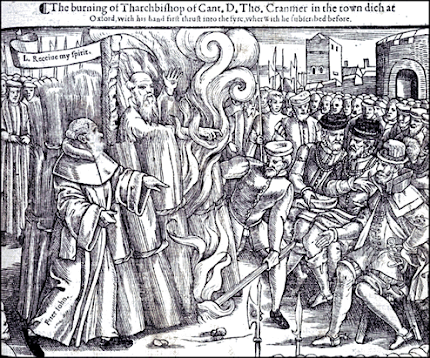
The burning of Tharchbishop of Cant. D. Tho. Cranmer in the town dich at Oxford, with his hand first thrust into the fyre, wherwith he subscribed before. [Click on the picture to see Cranmer's last words.]

Daily Bible Verse

Showing posts with label Reformed Theology. Show all posts

Thursday, April 03, 2025

The Reasonable Christian YouTube Channel


There is none that understandeth, there is none that seeketh after God. (Rom. 3:11 KJV)

Then they that gladly received his word were baptized: and the same day there were added unto them about three thousand souls. (Acts 2:41 KJV)

Praising God, and having favour with all the people. And the Lord added to the church daily such as should be saved. (Acts 2:47 KJV)

For I have not shunned to declare unto you all the counsel of God. (Acts 20:27 KJV)


For those who are interested, I have taken the bold step of starting a YouTube podcast.  This is my latest post about the church growth movment:

Church Growth or God's Providence?

As you might have gathered, I am critical of the Associate Reformed Presbyterian Church because of the influence of moderates and liberals within the denomination.

Thursday, May 21, 2015

What Do Reformed Christians Believe? Part 1

I have been negligent of late in writing for my blog due to my discussions and debates on Facebook.  You can visit my Facebook groups at Reformed Anglicans for Scripturalism and Calvinism Defended Against All.  That being said, I want to start a new series of articles where I will compare and contrast the Anglican Formularies (Thirty-nine Articles of Religion, the 1662 Book of Common Prayer, the Anglican Homilies), the Westminster Standards (Westminster Confession of Faith, the Larger and Shorter Catechisms), and the Three Forms of Unity (The Belgic Confession, the Heidelberg Catechisms, and the Canons of Dort).  Wherever pertinent I will also interact with other Reformed confessional documents and/or Protestant Reformation era theologians or the Anglican and Puritan divines.  In short, I may appeal to other resources besides the primary ones.

I will try to provide a bibliography for my sources at a future date.  For now I want to state upfront that my primary theological resources will be the writings of Dr. Gordon H. Clark or Dr. Carl F. H. Henry.  In particular, I will be making frequent reference to Dr. Clark's book, What Do Presbyterians Believe? 1965.  2nd Edition.   John W. Robbins, ed.  (Unicoi: Trinity Foundation, 2001).

To begin this discussion two issues first come to mind.  The first one is what do we believe and why do we believe it?  The short answer is that all knowledge must start somewhere.  As the late Dr. Gordon H. Clark correctly pointed out, the beginning of Christian knowledge--and in fact all other knowledge as well--is the Bible.  The axiom for Christianity and the Christian worldview is that Scripture alone is the Word of God. (2 Timothy 3:16).  Also, it should be pointed out that every epistemological system begins with unproven starting points.  To begin in the middle of an argument and to presuppose the system is in essence an axiom.  Even the scientific worldviews espoused by empiricism, logical positivism, and secular humanism do not being with empirically verifiable starting points but instead begin with unproven axioms that are considered to be self-evident.  Even Thomas Jefferson most famously began the Declaration of Independence with an axiom: 
We hold these truths to be self-evident, that all men are created equal, that they are endowed by their Creator with certain unalienable Rights, that among these are Life, Liberty and the pursuit of Happiness.  The Declaration of Independence.

Rather than jumping into the philosophical and theological issues, however, I have chosen to start with the Bible and the Reformational era confessions of faith which effectually summarize the system of propositional truths contained within the Scriptures.  Of all the confessions, only the Westminster Confession begins with the doctrine of Scripture or sola Scriptura.  Chapter 1 is called "Of the Holy Scriptures.  Every denomination has a written or unwritten confession of faith or what the churches in that denomination believe the Bible says.  That being the case the Westminster Confession of Faith is no different.  The exception is that the Protestant Reformers and the Puritan divines were careful to make a detailed exposition of the system of theology in the Bible with pertinent and appropriate proof texts.

I want to begin with what the 1647 Westminster Confession and the Larger and Shorter Catechisms have to say about Scripture.  I will be breaking this down into manageable portions.  If you wish to read the entire context you will need to refer to an online edition of the appropriate confessions:

THE WESTMINSTER CONFESSION OF FAITH


CHAPTER I—Of the Holy Scripture

  1.      Although the light of nature, and the works of creation and providence do so far manifest the goodness, wisdom, and power of God, as to leave men inexcusable; (Rom. 2:14–15, Rom. 1:19–20, Ps. 19:1–3, Rom. 1:32, Rom. 2:1) yet they are not sufficient to give that knowledge of God, and of his will, which is necessary unto salvation. (1 Cor. 1:21, 1 Cor. 2:13–14) Therefore it pleased the Lord, at sundry times, and in divers manner, to reveal Himself, and to declare that His will unto His Church; (Heb. 1:1) and afterwards, for the better preserving and propagating of the truth, and for the more sure establishment and comfort of the Church against the corruption of the flesh, and the malice of Satan and of the world, to commit the same wholly unto writing: (Prov. 22:19–21, Luke 1:3–4, Rom. 15:4, Matt. 4:4,7,10, Isa. 8:19–20) which maketh the Holy Scripture to be most necessary; (2 Tim. 3:15, 2 Pet. 1:19) those former ways of God’s revealing His will unto His people being now ceased. (Heb. 1:1–2)


The Westminster Confession of Faith (Oak Harbor, WA: Logos Research Systems, Inc., 1996).

First of all, please note that the Confession does not disregard general revelation or natural revelation.  The apostle Paul tells us this as well in Romans 1:18-21.  But general revelation cannot tell us enough information for saving faith.  That is why we need special revelation in Holy Scripture.  The evidentialists and empiricists wish to start with science; the rationalists wish to start with pure reason; and the neo-orthodox wish to begin with irrationalism.  But the Christian must begin with the axiom of Scripture for the simple reason that God only speaks in Scripture.  The doctrine of the Trinity cannot be deduced logically from a rock or a tree, although some substance abuse programs like Alcoholics Anonymous seem to think that your higher power can be a rock or a leaf.  I have often wondered how a rock or a leaf could make an alcoholic stop drinking?  If that be the case, would not A.A. be superfluous?

What is general or natural revelation anyway?  General or natural revelation is what God has revealed in nature or creation.  It might also include what man can know only from his being a created being in God's image and likeness.  Man has the innate light of reason and logic built into his soul because God is Himself a spirit (John 4:24) and because God is the very essence of Logic.  (John 1:1).  Man is not his body but is instead a spirit or soul living in a body.  When the body dies the soul lives on.  (Matthew 10:28; 2 Corinthians 5:6, 8).  Indeed John 1:9 does not refer to salvation but is instead the light that God grants to all men by virtue of man's being created in God's image.  (Genesis 1:27).  As the late Dr. Gordon H. Clark liked to say, "Man is the image of God."  Obviously, however, the noetic effects of sin causes man's ability to reason to be affected as well.  That's why the apostle Paul says in Romans 1:18 that man suppresses the truth in unrighteousness.

The distinction between general and special revelation is further delineated in the Westminster Larger Catechism, question 2:

Question 2

How doth it appear that there is a God?
The very light of nature in man, and the works of God, declare plainly that there is a God; (Rom. 1:19–20, Ps. 19:1–3, Acts 17:28) but his word and Spirit only do sufficiently and effectually reveal him unto men for their salvation. (1 Cor. 2:9–10, 2 Tim. 3:15–17, Isa. 59:21)


The Westminster Larger Catechism: With Scripture Proofs. (Oak Harbor, WA: Logos Research Systems, Inc., 1996).

The very light of nature in man would include John 1:9 and the references in Romans 2 to the Gentiles having the law of God written in their hearts:


Romans 2:12–16 (NKJV)
12 For as many as have sinned without law will also perish without law, and as many as have sinned in the law will be judged by the law 13 (for not the hearers of the law are just in the sight of God, but the doers of the law will be justified; 14 for when Gentiles, who do not have the law, by nature do the things in the law, these, although not having the law, are a law to themselves, 15 who show the work of the law written in their hearts, their conscience also bearing witness, and between themselves their thoughts accusing or else excusing them) 16 in the day when God will judge the secrets of men by Jesus Christ, according to my gospel.

Notice, however, that Paul is not saying that the Gentiles can be saved by keeping the law of God.  Far from it!  His point is rather that even the Gentiles have some form of morality and this is due to their being created in the image and likeness of God and having the moral law of God written in their hearts.  But to prove this does not entail saving faith, Paul says:

 
Romans 3:9–11 (NKJV)
9 What then? Are we better than they? Not at all. For we have previously charged both Jews and Greeks that they are all under sin. 10 As it is written: “There is none righteous, no, not one; 11 There is none who understands; There is none who seeks after God.

The fact of the matter is that the Scriptures alone can tell us what to believe unto saving faith.  Paul says this in 2 Timothy 3:15 and Jesus Himself emphasized Scripture many times over in the Gospels.  (John 10:35; Matthew 4:4; Luke 24:44-46).

The Thirty-nine Articles of Religion emphasize the sufficiency of Scripture over against the Roman Catholic view that Scripture is insufficient to provide enough information or understanding for saving faith.  Rome teaches that the Scriptures needs an infallible interpretation in order to be understood toward saving faith.  And Rome supplies the magisterium and the so-called deposit of faith to interpret the Scriptures for the church.  But if an infallible and inerrant Bible cannot be understood, how would believers then understand the many so-called infallible and inerrant magisterial pronouncements of Rome and the papal bulls?  After all, when the pope speaks authoritatively it is supposed to be the voice of Christ.  Article 6 says:

VI. Of the sufficiency of the Holy Scriptures for Salvation.
HOLY Scriptures containeth all things necessary to salvation: so that whatsoever is not read therein, nor may be proved thereby, is not to be required of any man, that it should be believed as an article of the faith, or be thought requisite or necessary to salvation. In the name of Holy Scripture, we do understand those Canonical books of the Old and New testament, of whose authority was never any doubt in the Church.  Article 6

Therefore, no Christian is obligated to believe what Rome says that is not demonstrated in, of and by the Holy Scriptures alone.  The same can be said for any Protestant denomination which tries to go beyond what is written in the Holy Scriptures.  (1 Corinthians 4:6).


Due to a shortage of time today, I will end here for now.  But much more needs to be said in regards to the doctrine of Scripture.  So I will continue this tomorrow.


Belgic Confession of Faith

Article 3
The Written Word of God

We confess that this Word of God was not sent nor delivered by the will of man, but that holy men of God spake as they were moved by the Holy Ghost, as the apostle Peter saith.1 And that afterwards God, from a special care which He has for us and our salvation, commanded His servants, the prophets2 and apostles,3 to commit His revealed Word to writing; and He Himself wrote with His own finger the two tables of the law.4 Therefore we call such writings holy and divine Scriptures.

1 2 Pet. 1:21
2 Ex. 24:4; Ps. 102:19; Hab. 2:2
3 2 Tim. 3:16; Rev. 1:11
4 Ex. 31:18

Wednesday, June 18, 2014

Who Says Liberal Churches Are Dying Out? Liberal Methodist Booked for Six Months

The common myth is that "conservative" Christianity is prevailing, prospering and growing both numerically and spiritually.  Unfortunately the propaganda does not seem to agree.  Some reports indicate that conservative denominations are losing active members as well.  And from the number of active supporters of social action/social gospel denominations--even if they are losing members--it would appear that liberal denominations are alive and well.  The Presbyterian Church USA, for example, has more active members than either the Presbyterian Church in America or the Orthdox Presbyterian Church, both conservative theologically.

Recently Frank Schaefer, a United Methodist pastor, was defrocked for refusing to agree not to perform any further gay marriages.  He refused.   Now he has been booked solidly for six months to speak at liberal congregations and gay events.  It would seem that he gained at least a temporary income base as a reward for his rebellion against the discipline of his denomination.  (See:  Frank Schaefer Headlines DC Gay Pride Event.)

While the visible church is supposed to be prophetic challenge to the world, it seems that the conservative churches are increasingly thinking that if the enemy cannot be beaten, why not join them?  After all, the cost of disagreeing with the propaganda of the secular humanists and socialists in popular media is that your denomination will be considered "fundamentalist" or "hyper-Calvinist" and no one will want to come to join your local congregations.  Since when did numbers or financial income determine the truth of the Scriptures?

Charlie

Monday, October 08, 2012

The Reformed Theological Roots of the Southern Baptist Convention

Today one would have a hard time finding a Calvinist majority in the Southern Baptist Convention.  However, the founders of the Southern Baptist Convention were predominately Calvinists.  If the current state of Arminian apostasy in the SBC is any indication, compromise with Arminianism leads to further error, not the establishment of the truth.  Tom Ascol explains on the Iron Sharpens Iron radio program that the theological roots of the SBC were unquestionably Calvinist despite the hostility of modern SBC leaders against it.   Click here to hear the program:  The Calvinist Roots of the SBC.  This link opens an MP3 playable file.

Saturday, February 11, 2012

Calvin on James 2:18-26: Justification by Faith Manifests Works

Calvin's Institutes, Book 3, Chapter 17
11. But they say that we have a still more serious business with James, who in express terms opposes us. For he asks, “Was not Abraham our father justified by works?” and adds “You see then how that by works a man is justified, and not by faith only,” ( [James 2:21, 24] ). What then? Will they engage Paul in a quarrel with James? If they hold James to be a servant of Christ, his sentiments must be understood as not dissenting from Christ speaking by the mouth of Paul. By the mouth of Paul the Spirit declares that Abraham obtained justification by faith, not by works; we also teach that all are justified by faith without the works of the law. By James the same Spirit declares that both Abraham’s justification and ours consists of works, and not of faith only. It is certain that the Spirit cannot be at variance with himself. Where, then, will be the agreement? It is enough for our opponents, provided they can tear up that justification by faith which we regard as fixed by the deepest roots:45  to restore peace to the conscience is to them a matter of no great concern. Hence you may see, that though they indeed carp at the doctrine of justification by faith, they meanwhile point out no goal of righteousness at which the conscience may rest. Let them triumph then as they will, so long as the only victory they can boast of is, that they have deprived righteousness of all its certainty. This miserable victory they will indeed obtain when the light of truth is extinguished, and the Lord permits them to darken it with their lies. But wherever the truth of God stands they cannot prevail. I deny, then, that the passage of James which they are constantly holding up before us as if it were the shield of Achilles, gives them the slightest countenance. To make this plain, let us first attend to the scope of the Apostle, and then show wherein their hallucination consists. As at that time (and the evil has existed in the Church ever since) there were many who, while they gave manifest proof of their infidelity, by neglecting and omitting all the works peculiar to believers, ceased not falsely to glory in the name of faith, James here dissipates their vain confidence. His intention therefore is, not to derogate in any degree from the power of true faith, but to show how absurdly these triflers laid claim only to the empty name, and resting satisfied with it, felt secure in unrestrained indulgence in vice. This state of matters being understood, it will be easy to see where the error of our opponents lies. They fall into a double paralogism, the one in the term [faith] , the other in the term [justifying] . The Apostle, in giving the name of [faith] to an empty opinion altogether differing from true faith, makes a concession which derogates in no respect from his case. This he demonstrates at the outset by the words, “What does it profit, my brethren, though a man say he has faith, and have not works?” ( [James 2:14] ). He says not, “If a man [have] faith without works,” but “if he say that he has.” This becomes still clearer when a little after he derides this faith as worse than that of devils, and at last when he calls it “dead.” You may easily ascertain his meaning by the explanation, “Thou believest that there is one God.” Surely if all which is contained in that faith is a belief in the existence of God, there is no wonder that it does not justify. The denial of such a power to it cannot be supposed to derogate in any degree from Christian faith, which is of a very different description. For how does true faith justify unless by uniting us to Christ, so that being made one with him, we may be admitted to a participation in his righteousness? It does not justify because it forms an idea of the divine existence, but because it reclines with confidence on the divine mercy.

See also, section 12:

Calvin's Institutes, Book 3, Chapter 17
12. We have not made good our point until we dispose of the other paralogism: since James places a part of justification in works. If you would make James consistent with the other Scriptures and with himself, you must give the word [justify] , as used by him, a different meaning from what it has with Paul. In the sense of Paul we are said to be justified when the remembrance of our unrighteousness is obliterated and we are counted righteous. Had James had the same meaning it would have been absurd for him to quote the words of Moses, “Abraham believed God,” &c. The context runs thus: “Was not Abraham our father justified by works when he had offered Isaac his son upon the altar? Seest thou how faith wrought with his works, and by works was faith made perfect? And the Scripture was fulfilled which saith, Abraham believed God, and it was imputed unto him for righteousness.” If it is absurd to say that the effect was prior to its cause, either Moses falsely declares in that passage that Abraham’s faith was imputed for righteousness or Abraham, by his obedience in offering up Isaac, did not merit righteousness. Before the existence of Ishmael, who was a grown youth at the birth of Isaac, Abraham was justified by his faith. How then can we say that he obtained justification by an obedience which followed long after? Wherefore, either James erroneously inverts the proper order (this it were impious to suppose), or he meant not to say that he was justified, as if he deserved to be deemed just. What then? It appears certain that he is speaking of the manifestation, not of the imputation of righteousness, as if he had said, Those who are justified by true faith prove their justification by obedience and good works, not by a bare and imaginary semblance of faith. In one word, he is not discussing the mode of justification, but requiring that the justification of believers shall be operative. And as Paul contends that men are justified without the aid of works, so James will not allow any to be regarded as justified who are destitute of good works. Due attention to the scope will thus disentangle every doubt; for the error of our opponents lies chiefly in this, that they think James is defining the mode of justification, whereas his only object is to destroy the depraved security of those who vainly pretended faith as an excuse for their contempt of good works. Therefore, let them twist the words of James as they may, they will never extract out of them more than the two propositions: That an empty phantom of faith does not justify, and that the believer, not contented with such an imagination, manifests his justification by good works.


[51 451 French, “Il suffit à nos adversaires s’ils peuvent deraciner la justice de foy, laquelle nous voulons estre plantee au profond du cÅ“ur.”—It is enough for our opponents if they can root up justification by faith, which we desire to be planted at the bottom of the heart.]
--


Reasonable Christian Blog Glory be to the Father, and to the Son : and to the Holy Ghost; Answer. As it was in the beginning, is now, and ever shall be : world without end. Amen. 1662 Book of Common Prayer

Sunday, February 05, 2012

Is Anglo-Catholicism a Via Media? Charles Pettit McIlvaine

Rev. Charles Pettit McIlvaine, Born Again Episcopalian.
[The following quote is from Oxford Divinity Compared with that of the Romish and Anglican Churches, with a Special View to the Illustration of the Doctrine of Justification by Faith, by Charles Pettit McIlvaine.  Click here to see the Google book:  Oxford Divinity Compared.]

"If any  man thirst let him come unto me and drink;" a mode of preaching Christ, that shall ever delight to proclaim to all people a full, perfect and ready salvation to the vilest sinner, whenever, in sickness or health, he turns unto God, truly repenting and believing in Jesus--a salvation which justifies perfectly, and immediately, on the act of a living faith, and which sanctifies perfectly, but progressively, as the necessary fruit of the same faith; a salvation so perfect and free, that, in the words of Hooker, "although in ourselves, we be altogether sinful and unrighteous, yet even that man that is impious in himself, full of iniquity, full of sin, him being found in Christ, through faith, and having his sins remitted through repentance, him God beholdeth with a gracious eye, putteth away his sin by not imputing it, taketh quite away the punishment due thereto by pardoning it, and accepteth him in Jesus Christ, as pefectly righteous as if he had fulfilled all that is commanded him in the Law."  --Charles Pettit McIlvaine.


Chapter II

STATEMENTS PREPARATORY TO THE RIGHT ESTIMATION OF THE OXFORD DOCTRINE OF JUSTIFICATION

Professions of Oxford Divines concerning the conformity of their doctrine with that of the Church of England--Their account of Ultra-Protestantism--Their identity of their system with that of Alexander Knox--The condemnation of the latter, as Romish and dangerous, by certain eminent divines, of diverse schools in the Church of England, before its development, at Oxford, had excited special interest.

Before proceeding any further, it is proper to state that the Divinity which we propose to examine, is loudly proclaimed by its advocates to be the middle path, the Via Media, of the Church of England, "distinct from the by-ways of Ultra-Protestantism on the one side, and neither verging towards, nor losing itself in, Romanism on the other."(1)  The formularies of the Church of England, and the writings of her standard Divines are often and confidently appealed to as exhibiting the precise doctrines of the system.  Now it is the simple question how far these pretensions are true, which we propose to institute.  But in order to estimate this Via Media aright, the first thing is to get a view of the opposing sides between which it proposes to pass.  Of the one side, viz. of Romanism, we are to speak particularly hereafter.  Of the other, ULTRA-PROTESTANTISM, a something which occurs with singular frequency in the works of these writers, what shall we say?  What is Ultra-Protestantism?  We have seen no definition.  But according to the use of Dr. Pusey, and others, the name seems to be applied to whatever is in religion, or relating to it, negatively, or positively, for, or against, only excepting Romanism or Oxfordism; embracing of cause and effect, doctrine and inference; from the case of those clergy of the Church of England, who are, "in the main, orthodox and sound, in spite of the natural tendency of their principles," through Lutheranism and Calvinism, and every grade of unromish dissent and heterodoxy, down to what is considered the result of the common tendency, an entire Rationalism, and Socinianism, ut nec pes, nec caput uni reddatur formae.  One would suppose that a coast so undefined would afford but little guidance in keeping the middle way, except when as mariners, under fear of hidden shoals and currents, on an unseen shore, keep as far away as possible.

Some specimens will help us judge how far the Via Media is really a middle way.

Dr. Pusey describes "a large portion" of the clergy of the Church of England as holding "Justification is not a gift of God through His sacraments, but the result of a certain frame of mind, of a going forth of themselves and resting themselves upon their Saviour; that this is the act whereby they think themselves to have been justified; and so as another would revert to his "baptism and engraffing into Christ, and thus his being in Christ, so do they this act whereby they were justified."  "They sever Justification from Baptism, and make it consist in the act of reliance upon the merits of Christ only; sin, according to them, is forgiven, at once, upon each renewal of this act: and in this they virtually substitute this act for Baptism; a man has no more to do with his past sins than he has with those remitted by baptism;" according to them "when men have been been once brought, in repentance to renounce their sins, and seek reconciliation through the free mercy of Christ--then their sins are done away, they are covered, they can appear no more; the handwriting is blotted out." This "apprehension of Christ's merits is to them a full remission of sins, completely effacing them."  "To revert to past sins is to doubt of Christ's mercy; to bear a painful recollection of it is to be under the bondage of the law; to seek to efface it by repentance is weakness of faith; to do acts of mercy or self-denial, or self-abasement, or to fast with reference to it, is to interfere with 'the freeness and the fulness of the Gospel:'  to insist upon them 'is place repentance in the stead of Christ.'" (2)

It is impossible not to see in this strange caricature, which really applies, in all respects, to no class of the clergy of England, that "the large portion" intended is that which is best known in this country by such names as Robinson, Scott, Venn, the two Milners, Simeon; of whose mode of exhibiting the way of salvation, the writings of such living divines as the present Bishop Wilson, of Calcutta, the two Bishops Sumner, the one of Winchester, the other of Chester, the Rev. G. S. Faber, &c. are fair examples.  True indeed the views of this most honourable and useful body of the English Clergy are very singularly overdrawn; one can hardly recognize them under the strained and warped features for which they are made to be accountable; but without doubt, the Ultra-Protestantism referred to in the above extracts, is intended to be understood as being displayed in the general mode which appears in that class of English divines, of representing "the nature and essence of the medicine whereby Christ cureth our disease, the manner of applying it, and the number and the power of the means."


Of such views, does Dr. Pusey write as follows:  "This abuse of the doctrine of justification by faith sears men's consciences now, as much as the indulgences of the Romish system did before.  It used to be said that 'the Romish was an easy religion to die in,' but even the Romish, in its corruptions, scarely offered terms so easy, at all events made not a boast of the easiness of its terms."  Then follows an evident preference of the Romish system, on the ground that if only "the stale dregs of the system of the ancient Church," it has the dregs--"something of the bitterness of the ancient medicine;" it still teaches men "to make sacrifices for the good of their souls; to accuse and condemn themselves, that so they might find mercy" through Christ--to be "punished in this world, that their souls might be saved in the Day of the Lord."  We are given distinctly to understand that "a large portion" of the English Clergy, is worse than even these stale dregs of the medicine of the ancient Church; because it stifles continually the strong emotions of terror and amazement which God has wrought upon the soul, and by an artificial wrought-up peace, checks the deep and searching agony, whereby God, as in a furnace, purifies the whole man, by the spirit of judgment and the Spirit of burning."  It is "a spurious system, misapplying the promises of the Gospel, usurping the privileges of baptism which it has not to confer, giving peace which it has not to bestow, and going counter to the whole tenor of Scripture, that every man shall be judged according to his works." (3)

The same singularly extravagant and most painful strain of condemnation is found everywhere in Mr. Newman's Lectures on Justification.  The following is a specimen.  He calls the righteousness of Christ imputed to us for Justification as held by the "large portion" of the English Clergy, above referred to, "an unreal righteousness and a real corruption," "bringing us in bondage to shadows"--"another gospel."  "Away then (he says) with this modern, this private, this arbitrary system, which promises liberty conspires against it; which abolishes sacraments; to introduce dead ordinances; and for the real participation of Christ, and justification through His Spirit, would at the very marriage  feast, feed us on shells and husks, who hunger and thirst after righteousness."(4)

It is not the purpose here to say a word, in argument, concerning all these wonderful and melancholy of morbid mind and spiritual discernment.  Whoever has paid any serious attention to the writings of the Clergy, thus professedly displayed, will need no help in estimating the justness of the condemnation.  But where there is no need of argument, there may be propriety in assertion; and sometimes there is a solemn duty in assertion, if only for the purpose of bearing our solemn testimony, whatever it may be worth, to some precious, but despised and reviled portion of the truth as it is in Jesus.  Such testimony, the present writer feels constrained to give, in this place,  after such an afflicting reprobation of what he most solemnly believes to be nothing else than "the glorious Gospel of the blessed God," our Saviour.  Denying entirely the justice of the draft of doctrine laid to the charge of the class of divines professedly described; but perceiving just enough of truth therein to mark distinctly who compose "the large portion" of Clergy whom our Oxford divines have thus represented as teaching for the way of salvation, "another gospel"--a spurious system--"an unreal righteousness and a real corruption,"--worse even than the system of indulgences in the Church of Rome; the author of these pages does earnestly hope that his name may be counted worthy to take part in their condemnation.  If the way here called another gospel, even that of Justification through the obedience and death of Christ, accounted unto us for righteousness, through the instrumental agency of a living faith, be not the only hope of the sinner, then he, for one, has no hope.  He has learned of no other "anchor of the soul sure and steadfast, which entereth to that within the veil."  He does hope that he may ever be identified with that divinity, that way of preaching Christ Jesus the Lord, which instead of a "reserve" in making known the precious doctrine of Atonement, instead of treating salvation by grace, through faith, as "a great secret," and keeping the secret out of the sight of the ungodly for fear of "an indelicate exposure of the sacred mystery," as these writers urge,(5) shall lift up the voice to the perishing and penitent, like the Master and Lord, when to the great multitudes, on the last day of the feast, He cried, "If any  man thirst let him come unto me and drink;" a mode of preaching Christ, that shall ever delight to proclaim to all people a full, perfect and ready salvation to the vilest sinner, whenever, in sickness or health, he turns unto God, truly repenting and believing in Jesus--a salvation which justifies perfectly, and immediately, on the act of a living faith, and which sanctifies perfectly, but progressively, as the necessary fruit of the same faith; a salvation so perfect and free, that, in the words of Hooker, "although in ourselves, we be altogether sinful and unrighteous, yet even that man that is impious in himself, full of iniquity, full of sin, him being found in Christ, through faith, and having his sins remitted through repentance, him God beholdeth with a gracious eye, putteth away his sin by not imputing it, taketh quite away the punishment due thereto by pardoning it, and accepteth him in Jesus Christ, as pefectly righteous as if he had fulfilled all that is commanded him in the Law.  Let it counted folly, or frenzy, or fury, whatsoever; it is our comfort and our wisdom." (6)  So testifies our admirable Hooker--most suredly an Ultra-Protestant, in the matter of Justification,  as branded, as others, with the hot denunication of these Oxford divines.

Click here to see Chapter II of Charles Pettit McIlvaine's book, Oxford Divinity Compared with that of the Romish and Anglican Churches....

[Addendum:  It would appear that the Lordship Salvation view as well as the view of the neo-legalists would be more in line with the Tractarians than with Canterbury or Geneva or Wittenberg on the issue of justification by faith alone.  The neo-legalists would appear to agree with the Tractarians that some sort of good works must be added to faith.  The Reformed view is that justifying faith is a living faith..   Charlie].


Footnotes:

1.  Pusey's Letter, page 14.
2.  Ibid., pp. 74, 8, 54, 5.
3.  Ibid., pp. 56-59.
4.  Lectures on Justification, p. 61.  Extremes meet.  Socinus calls the same doctrine, faeda, execranda, pernitiosa, detestanda.
5.  See No. 80, Tracts for the Times.
6.  Discourse of Justification, Paragraph 6.


--
Reasonable Christian Blog Glory be to the Father, and to the Son : and to the Holy Ghost; Answer. As it was in the beginning, is now, and ever shall be : world without end. Amen. 1662 Book of Common Prayer

Wednesday, January 11, 2012

Cessationists in Rebellion: Vincent Cheung's Charismatic Theology


I am pleased to announce that I have been condemned as a "rebel" by yet another Charismatic.  Yes, Vincent Cheung has said in public and in writing that those Christians who do not "practice" or believe in ongoing charismatic gifts today are "in rebellion against God".  You can see the article here:  Cessationism and Speaking in Tongues.  I would suggest that Cheung not try walking on the water over his head unless he can swim.  Click on this link as well:  Cessationism and Rebellion.

Unfortunately, Cheung tries to deflect criticism of his position by claiming that he is neither Reformed nor Charismatic (Cessationism and Speaking in Tongues, p. 2).  I would agree that he is not Reformed; but claiming that he is not Charismatic when practically everything he has written in defense of continuationism is identical to the same tired old arguments put forward by other Arminian and "Reformed" Charismatics is a good indicator that Cheung is simply trying to sidestep the obvious.


Also, he betrays a basic misunderstanding of the doctrine of Sola Scriptura when he out of hand dismisses the theological differences between particular Baptists and confessional Presbyterians:


A person might think that a Christian must either be Baptist or Presbyterian, and if a person affirms Baptist sacraments but Presbyterian government – or any one thing that is supposedly Baptist and another that is supposedly Presbyterian – then he must be wrong, simply on the basis that, according to him, these two categories are incompatible. But this is a poor argument, and does nothing to address whether this person's doctrine is right or wrong. It does, however, tell us that the critic's understanding of the Christian world is limited to a narrow conception of Baptists and Presbyterians. He is like a frog trapped at the bottom of a well, and his idea of the heavens is as small as the opening through which he views the sky. 

The Christian world is very broad. Just because a person believes in the biblical doctrine of predestination does not mean that he learned it from Calvin. Maybe he learned it from Augustine. Maybe he learned it from Hodge, or Shedd, or Berkhof. Maybe he learned it from Vincent Cheung, or you, or your pastor. How about this – maybe he read the Bible himself and learned it there! But…is it possible? Is it possible that a person can read biblical passages and actually learn biblical doctrines?  (Ibid.)

In this quote Cheung reveals his Anabaptist presuppositions.  In other words, Cheung thinks that the doctrine of the priesthood of believers and the right to private interpretation of Scripture means literally that every Christian is a lone ranger and reads the Scriptures in isolation from the church.  This could not be further from the truth.  The Reformed doctrine is not solo Scriptura but Sola Scriptura.  The right to private interpretation means that individuals read the Scriptures together as a church.  Since the Bible must be preached and interpreted there must be a standard by which to judge heresy from truth.  The Protestant Reformers held that standard to be ultimately Scripture alone.  But they realized that there is no perfect interpretation of Scripture.  As such there needed to be a correction to those who twisted the Scriptures to their own destruction (2 Peter 3:15-16).  That standard is the Westminster Confession and the Larger and Shorter Catechism for the English Presbyterian tradition.  For the Dutch Reformed the standard is the Three Forms of Unity and for Reformation Anglicans the standard is the Anglican Formularies (Thirty-nine Articles of Religion, 1662 Book of Common Prayer, and the Ordinal with the Homilies).  While the Reformed symbols or standards of doctrine are always subject to error and correction and that they draw their most certain warrant from Holy Scripture, this does not mean that we can then take the Reformed confessions lightly.  They are authoritative doctrinal statements and to depart from them is serious error.

Cheung, like most Pentecostals and Charismatics, focuses on experience while claiming he is focused on Scripture and reason.  However, the Pentecostal hermeneutic is that experience must be a vital part of exegesis of Scripture.  Thus, for the Pentecostal, only a person who has experienced the baptism with the Holy Spirit can properly understand the Scriptures and the ecstatic revelations made possible by believing the Scriptures.  For the Pentecostal/Charismatic, like the Roman Catholic, Scripture itself is insufficient.  Something extra is necessary for a move from the lower spiritual experience of conversion to a higher experience of total surrender, victory, and the higher life.  Cheung wishes to distance himself from the broader Pentecostal/Charismatic movement by denying that his theology is experiential.  However, in this attempt he only reveals himself to have a greater affinity with experiential religion than with the logical propositions of Holy Scripture and the Reformed confessions.


Roger Stronstad gives an outline of the Pentecostal approach to biblical interpretation in his article, Trends in Pentecostal hermeneutics, Enrichment Journal:


Charles F. Parham: Origins of the “Pragmatic” Hermeneutic

As Martin Luther is the fountainhead of Lutheranism, John Calvin of Reformed Theology, and John Wesley of Methodism, so Charles F. Parham stands as the fountainhead of Pentecostalism. Parham was not the first to speak in tongues. In one sense that honor goes to Miss Agnes N. 0zman.1 In another sense, the birth of the Pentecostal movement is the climax to the growing swell of charismatic experiences among various revival and Apostolic Faith movements.2 What makes Charles F. Parham the father of Pentecostalism, Topeka, Kansas, the locus of Pentecostalism, and Agnes Ozman, the first Pentecostal, is not the uniqueness of this experience, but the new hermeneutical/biblical understanding of this experience.

Charles F. Parham bequeathed to the Pentecostal movement its definitive hermeneutics, and consequently, its definitive theology and apologetics. His contribution arose out of the problem of the interpretation of the second chapter of Acts and his conviction that Christian experience in the 20th century “should tally exactly with the Bible, [but] neither sanctification nor the anointing that abideth … tallied with the 2nd chapter of Acts.”3 Consequently he reports, “I set the students at work studying out diligently what was the Bible evidence of the baptism of the Holy Ghost that we might go before the world with something that was indisputable because it tallied absolutely with the Word.”4 He tells the results of their investigation in the following words: “Leaving the school for three days at this task, I went to Kansas City for three days services. I returned to the school on the morning preceding Watch Night service in the year 1900.

“At about 10:00 o’clock in the morning I rang the bell calling all the students into the Chapel to get their report on the matter in hand. To my astonishment they all had the same story, that while there were different things occurring when the Pentecostal blessing fell, the indisputable proof on each occasion was, that they spoke with other tongues.”5

In Parham’s report we find the essential distinctives of the Pentecostal movement, namely, (1) the conviction that contemporary experience should be identical to apostolic Christianity, (2) the separation of the baptism in the Holy Spirit from sanctification (as Holiness movements had earlier separated it from conversion/incorporation), and (3) that tongues speaking is the indisputable evidence or proof of the baptism in the Holy Spirit.

The discovery that tongues speaking was the indisputable biblical proof of the baptism in the Holy Spirit was confirmed the next day in the experience of one of the students at Bethel Bible School, Agnes Ozman. She testifies: “The spirit of prayer was upon us in the evening. It was nearly seven o’clock on this first of January that it came into my heart to ask Bro. Parham to lay his hands upon me that I might receive the gift of the Holy Spirit. It was as his hands were laid upon my head that the Holy Spirit fell upon me and I began to speak in other tongues, glorifying God. I talked several languages, and it was clearly manifest when a new dialect was spoken.”6

Agnes Ozman was the first one but not the last one to speak in tongues in the Bible school. By January 3, 1901, other students, and soon even Parham himself, had spoken in tongues. When questioned about her experience, Miss Ozman “pointed out to them the Bible references, showing [she] had received the baptism according to Acts 2:4 and 19:1–6.”7

Observing the above  as an accurate description of the classical Pentecostal position we can see the same justification of experience in the Charismatic movement in general and particularly in the so-called "Reformed" Charismatics like Wayne Grudem and Vincent Cheung, although Cheung wants to deflect criticism by denying that he falls into the same category.  The basic premise of Pentecostal and Charismatic theology in general is that Christian experience should reduplicate the experience of first century apostolic Christianity as it is recorded in the Scriptures.  That logical proposition is that Scripture encourages and commands this reduplication.  Obviously Cheung agrees with the "command" to do miracles, speak in tongues, prophesy, predict the future, and have supernatural knowledge--which is impossible through natural means (words of knowledge and words of wisdom).  In short, Cheung, like most Charismatics, believes that the moral law commands modern Christians to "experience" all the gifts, including the active performance of miracles.   The fact that Cheung says that cessationists are "in rebellion against God" is proof enough of this.

Like other Charismatics, Cheung wishes to slip out of the grip of his opponents' critical evaluations of his view.  When pinned down on the fact that no man can do miracles at will he gives duplicitous answers evading the issue:

Do not put out the Spirit's fire; do not treat prophecies with contempt. (1 Thessalonians 5:19-20)

Verses 19-22 discuss the apostolic policy toward prophecy. Paul writes, "Do not treat prophecies with contempt," but he tells the Christians to "test everything."  Cessationism is the false doctrine that the manifestations of miraculous endowments such as those listed in 1 Corinthians 12 have ceased since the days of the apostles and the completion of the Bible. Although there is no biblical evidence for this position, a main motive for this invention is to secure the sufficiency of Scripture and the finality (completion) of Scripture. However, it has been shown that the continuation of miraculous manifestations does not in fact contradict these two doctrines or put them at risk.(1)  Thus cessationism is both unbiblical and unnecessary.

More than that, cessationism is also evil and dangerous. This is because if cessationism is false, then those who advocate this doctrine are preaching rebellion against the Lord.  The Bible commands Christians, "Follow the way of love and eagerly desire spiritual gifts, especially the gift of prophecy" (1 Corinthians 14:1). If cessationism is correct but we do not know it, then we could still safely obey this instruction, although we will not receive what we desire. That is, if prophecy has ceased but I think that it continues, then I could still desire the gift of prophecy in accordance with this command, but I will not receive the gift of prophecy. No harm is done. (2)

On the other hand, since the cessationist teaches that prophecy has ceased, then although the Bible says "desire spiritual gifts," he will not desire spiritual gifts, since the spiritual gifts are no longer in operation, and what gifts people think they have are necessarily false. This also applies to prophecy in particular. So although Paul says, "Do not treat prophecies with contempt," the cessationist must treat all prophecies with contempt, since he believes that prophecy has ceased, so that all prophecies today are false. His view toward prophecy must be "reject everything" instead of "test everything." But again, if cessationism is false, then this person would be preaching rebellion against the biblical commands to desire and test spiritual manifestations.  Since the commands "desire spiritual gifts," "do not treat prophecies with contempt," and "test everything" are revealed by divine and infallible authority, the cessationist must present an infallible argument to render them inapplicable for today. If he cannot provide this but he still advocates cessationism in the face of these explicit biblical commands, then is it not obvious that he has condemned himself before God, even if this person is right that the gifts have ceased? No Christian should dare follow such a person or believe his doctrine. If a person preaches cessationism but cannot prove it – if he cannot provide an infallible argument for it (since the command to desire spiritual manifestations is clear and infallible), then this means that he consciously preaches rebellion against some of the Bible's straightforward commands. Why then, should he not be removed from the ministry or even excommunicated from the church?
Since the arguments for cessationism are forced and feeble, and since the doctrine presents so great a danger, it is best to believe the Bible as it is written, and obey its commands as they are stated – that is, "desire spiritual gifts" and "test everything." This position is faithful to the direct statements of Scripture, but it requires courageous resistance to fallacious arguments, academic bullying, and church traditions.  (Vincent Cheung, Cessationism and Rebellion), page 2).

The logical fallacies of this short quote are so numerous as to require an extensive response.  But before pointing out the errors of Cheung's propositions it is to be noted that Cheung follows the proposition of Charles Parham, namely that our experience should be identical to the experiences of the apostolic church in the first century as it is recorded in Scripture.  That this is a non sequitur should be obvious enough.  Simply because Judas hanged himself according to the Scriptures does not mean that this narrative is the norm for modern Christians.  The old cliche, "Judas hanged himself, go and do likewise," is redundant here but applicable.  The unspoken premise of Cheung's syllogism is that continuationism is a fortiori the only possible exegesis of the Scriptures.  Of course, he does extensive back pedaling to deny this criticism but his use of Occam's razor as a justification for taking the leap of faith is no logical proof that Cheung's presuppositional interpretation of the text as inherently continuationist is actually the case.  Cheung's use of the razor analogy can be easily demonstrated in footnote number 2:

If prophecy has ceased but I think that it continues, I will desire it and fail to receive it, and then it is possible that I think that I have received it (and this is possible because I falsely think that it continues) and proceed to prophesy. This would be a false prophecy. There is indeed harm in this, but the problem is not in thinking that prophecy continues, but in thinking that I have the gift when I do not. So it is a related but separate issue, and it is addressed by Paul's instruction, that is, in testing the alleged prophecy, and not in imposing the unbiblical doctrine of cessationism.   (Ibid., page 2, footnote 2).

The logic of Cheung is speculative at best.  If the cessationist is wrong he is in rebellion against God's moral law.  If the continuationist is wrong he merely makes a sincere mistake but is not in fact in rebellion against God.  For Cheung the Charismatic view can cause harm but it is really not dangerous.   But Cheung's view again assumes that Scripture imposes normative moral commands in all times and at every point in history that the Christian is to practice the apostolic supernatural gifts that were given by God's sovereign providence in the first century church.  For Cheung a synergistic theology following that of the Wesleyan Arminian presuppositions of the holiness theology of Charles Parham and other Pentecostals is immediately evident.  The premise of a synergistic theology is that Christians have an inherent ability to obey a moral command to "seek the gifts", i.e. do the same miraculous and supernatural acts of the first century apostles.  If someone gives a prophecy that adds to Scripture or contradicts Scripture (Proverbs 30:5-6 KJV; Deuteronomy 4:2 KJV; Deuteronomy 12:32 KJV; Revelation 22:7 KJV, Revelation 22:19 KJV), Cheung does not see this as heresy but merely harmful.  Furthermore, simply asserting that someone should raise the dead or heal the sick does not mean that they have the ability to obey that command nor does it obligate God to act in accordance with the Christian's desires to heal the sick, raise the dead, or speak an unknown human language by supernatural means. The creature is not in control of the gifts distributed by the Holy Spirit.  God alone can give supernatural gifts and thus it is up to God whether or not any of these gifts actually happen.  (1 Corinthians 12:11).

It might be that Cheung is the one in rebellion since he is imposing a law or norm that the individual Christian is unable to obey.  Even Gordon H. Clark says that God is the ultimate cause of both good and evil.  Therefore, if God wants a supernatural gift to occur He needs no assistance from the believer.  If God wanted Christians to do miracles He could put that desire in their hearts and then do the miracles since He is God.  However, it is also possible that God could send a spirit of delusion to deceive the haughty and the proud.  He could cause Cheung and others to believe a lie.  If the miracles Cheung is advocating do not occur, that too is God's judgment.  (2 Thessalonians 2:11-12).

Cheung's answer is that the Bible simply says that we are to test the results of such claims:

Inherent in this biblical approach is protection against charismatic fanatics and false miracles. The Bible instructs us to "test everything," and since it is sufficient, it is able to expose counterfeit miracles and false prophecies. The answer is not to assert that the gifts have ceased, but to follow the instructions that the Bible has already given on the subject.  This position, that we should follow what Scripture says, would offer us perfect protection even if cessationism is correct. If prophecy has indeed ceased, then any prophecy today is false. Since the Bible is a sufficient revelation, the information in it will enable us to "test everything," so that any alleged prophecy today will either be tested, and finding it false, it will be condemned, or if the content is such that it is untestable, it will be ignored.  (Ibid., page 3).

Perhaps a better position is to note that not everything commanded in Scripture is normative for today.  When the Bible says that a man cannot have long hair no one today takes that as an absolutely normative command obligating the Christian man today to always have short hair.  (1 Corinthians 11:1-16).  Most women today refuse to attend worship services with their heads covered with a doily.  Are they then in rebellion against God?  Obviously most Christians today would not agree.  Therefore, Cheung's a fortiori assertion that cessationists are in rebellion against God is nothing more than an assumption or presupposition on his part.  Cheung offers nothing more than mere speculation to prove that cessationists are in rebellion.  "If this is true then that is true: now that is true,  therefore this is true" is the same logical fallacy employed by empirical science.  Basically, Cheung's error is asserting the conclusion in his premise.  Quoting the philosopher Bertrand Russell, John W. Robbins exposes this empirical reasoning as fallacious:

One of the problems of science is that it, unlike the Bible, is quite illogical.  In his essay, "Limitations of Scientific Method," the English mathematician, logician, and philosopher Bertand Russell made the following observation: 

All inductive arguments in the last resort reduce themselves to the following form:  "If this is true, then that is true:  now that is true, therefore this is true."  This argument is, of course, formally fallacious.  Suppose I were to say:  "If bread is a stone and stones are nourishing, then this bread will nourish me; now this bread does nourish me; therefore it is a stone, and stones are nourishing."  If I were to advance such an argument, I should certainly be thought foolish, yet it would not be fundamentally different from the argument upon which all scientific laws are based. 

That is to say, all scientific laws are based on fallacious arguments.  [John W. Robbins, Foreward to The Philosophy of Science and Belief in God, by Gordon H. Clark.  (Unicoi:  The Trinity Foundation), p. xi.]
Basically, Cheung's argument is an appeal not to Scripture but to experience subsequent to reading Scripture; that is, continuationism is an experience that Cheung asserts as being justified on the basis of his assumed exegesis of Scripture.  His view is the same as the Charismatic view, namely that experience is necessary for a proper interpretation of the text.  In making this appeal, then, Cheung's experientialism is subject to the same criticism Gordon H. Clark leveled against empirical science.

The truth is no Christian is obligated to believe Charismatic doctrine since such doctrine is eisogeting experience back into the text to make the text say what the Charismatic wants it to say.  The proper approach lets Scripture speak for itself in its own cultural context as it is addressed to its original audience.  Only when this is established can the text be made to properly apply to the Christian today.  Cheung wishes to skip this step and go straight from his own presupposed exegesis to application.   (See:  Interpretation of the Bible).

Contrary to Cheung, Scripture is sufficient for all that a Christian needs to know to be saved (2 Timothy 3:15; Romans 10:4-12).  Simple faith in Christ, His active obedience in living a sinless life, and His objective satisfaction for the sins of His elect on the cross are sufficient for salvation (1 Timothy 2:5-6).  It is not necessary to reconfirm what has already been confirmed by all the miracles of Jesus (Mark 16:20; Hebrews 2:4; Romans 15:18-19).  The same argument applies to the argument that the signs are necessary for edification (Ephesians 4:11-12).  Since Cheung is arguing for ongoing gifts as a "command" of God, the burden of proof is on him to show that his exegesis of Scripture is correct and that it is normative today.  Cheung has done nothing more than make empty assertions based on an unsupported presupposition.  As I have argued in other places, the only miracles the Christian is obligated to believe are those recorded in Scripture (See  Cessationism Versus Continuationism).  Cheung tacitly admits this since he says that everything today is to be tested by Scripture (1 John 4:1; Matthew 7:15; 1 John 2:18; 1 John 2:22; Jeremiah 29:8; 2 Peter 2:1).  How Cheung can say that the Christian who rejects continuationism is in rebellion against the moral law of God is indeed amazing.

Cheung says that it is unnecessary for him to produce any actual miracles or results.  By this dissimulation he wants to assert the bare command without guarantee that the results are obtained or even that the results can be falsified or verified.  Thus, for all practical purposes Cheung's view is irrational.  His premises are wrong and so are his conclusions.


Monday, April 12, 2010

Wednesday, February 10, 2010

Episcopalian, Anglican, and Evangelical: What Do These Terms Mean?


Episcopalian, Anglican and Evangelical: What Do These Three Terms Mean?

By Charlie J. Ray


The Ritualists represent themselves as Catholics, and say they are eager to revive the traditions and worship of the Primitive Church. This representation is contrary to the fact. The Church of England took that course at her Reformation; all that was pure, primitive, and Catholic, both in worship, faith, and order, she retained. She cast off only the fictions, idolatry, and error by which Roman Priest--craft and Italian ambition had disfigured the Apostolic faith. But the Reformation and the works of our Reformed Church is denounced by Ritualists as mutilated, Anti-christian, and a pestilent heresy, while, in fact, the Ritualists are merely reintroducing the ceremonies and dogmas which our fathers cast off as idolatrous and superstitious. When therefore they call themselves Catholics, they mean Romanists. – Bishop J. C. Ryle


Recently the Central Florida Diocese of the Episcopal Church had its forty-first annual convention at the Lakeland Center in Lakeland, Florida. I attended that event as a lay delegate representative for my local church or congregation, which is Christ Church, Longwood, Florida. The following Sunday our congregation had its own annual business meeting, which is the usual practice. During that meeting several members of the congregation were visibly upset because of a minor change made on the new church sign purchased by the vestry. The problem with the sign, according to the dissidents, is that it removed the word "Episcopal" from the sign.

As a way of explaining myself to both the members of our congregation and to those who read my blog, I want to tell the story of the evangelical side of the Anglican Communion world-wide and particularly of the evangelical side here in the United States. Unfortunately, the story is a long and complicated one. However, I will try to be as brief as possible in giving a historical and theological background for the issues at hand.

First of all, many Episcopalians are woefully uninformed about the polity of their own denomination. The Anglican Communion is a loosely organized association of local congregations around the world. The geographical area where that particular group of congregations reside is called a "province." So with that understanding we can see that The Episcopal Church is the title given to the province of the Anglican Communion here in the United States. So in general terms all who reside here in the United States and are part of the province called The Episcopal Church are called "Episcopalian" due to their membership in this province.

To make matters even more complicated there is now a new province here in the United States called the Anglican Church in North America. This new province, depending on who you ask, is officially Anglican and on an equal status with The Episcopal Church. In other words, there are two Anglican provinces here in the United States sharing the same geographical location. The complication, however, is that the Anglican Church in North America has not yet received full approval from the Anglican Consultative Council nor from Lambeth, the seat of the council of primates or leading bishops from the provinces of the Anglican Communion around the world. But since the Archbishop of Canterbury has no real political or ecclesiastical authority to force any of the consecrated primates or archbishops to follow his instructions, they are free to ordain and consecrate ministers around the world as they see fit.

To further complicate matters, the provinces of the Anglican Church of Canada, The Episcopal Church, and the Church of England in the United Kingdom have all gone in a theologically liberal direction. This is to say that the three provinces are either openly or secretly pushing progressivism. In other words, they wish to change the Anglican Communion and the secular and political governments of the entire world to reflect their ideas of social justice. To them the center of authority is not the Bible but human reason in the here and now. Eternal and transcendent revelation into the human realm via the Holy Scriptures and the divine man, Jesus Christ, is impossible in their view and therefore the Bible is merely a human book and is merely culturally relevant to its own place in history and time. To progressives and liberals, Jesus is merely a good teacher but not actually divine. He was sincere in claiming to be God but sincerely misled. Therefore, in their view the Bible contains things which are misogynist (against women), homophobic (against those born with a homosexual orientation), and judgmental (against those who practice progressive sexual ethics of any sort). So the progressives or liberals are willing to dissimulate and work secretly to undermine Scriptural authority. They wish to bring in openly homosexual ministers, bishops and deacons and they wish to push for homosexual rights in the church and in the secular realm, including making homosexual marriage not only legal world-wide in secular governments but also in the Anglican Communion. Furthermore, their agenda is to coerce all citizens of all countries globally to move toward their views of "tolerance", which is code for progressivism. In short, theological liberalism adopts a this-worldly socialism and tries to coerce all others to accept their views at any cost. It is a highly militant movement that has more in common with paganism than with biblical Christianity. Unfortunately, the Archbishop of Canterbury, Rowan Williams, is in my estimation either openly or at least secretly part of the progressive party. The evidence for this is there for anyone willing to look at his track record.

It is difficult to summarize briefly the various aspects of complicated state of affairs in the Anglican Communion and in the province of the United States. Things have moved so rapidly that the Lambeth Conference at Canterbury has been unable to keep up with the pace. The new Anglican Church in North America is legitimately Anglican as far as polity goes and has even been endorsed and received into full communion by the Sydney Diocese of the Anglican Church of Australia. Notice that I used two separate links. The Sydney Anglicans website is distinct from the website of the national provincial church, which is the Anglican Church of Australia. (See the Anglican Church League. The Sydney Anglican Diocese drew up this resolution accepting their full communion with the Anglican Church in North America: Resolution).

Traditionally, the Anglican Communion at large is supposed to be a mix of three main streams or traditions; the three traditions are the Anglo-Catholic tradition, the Evangelical tradition, and the Charismatic tradition. However, since the advent of Tractarianism in the 19th century, the Anglo-Catholic tradition has patronized the other two traditions and even dominated them by force and coercion. Charismatics in particular have roots in common with the Evangelical tradition but because their emphasis is on the subjective and ecstatic experiences of individuals they have no problem embracing Anglo-Catholicism. Anglo-Catholicism itself is divided into two major branches, the one being theologically and morally conservative and the other being theologically, sociologically progressive and liberal. (See Anglo-Catholic Social Theology).

The battle for the heart of Anglicanism is not a new one. From the time of the English Reformation and the break of Church of England from the dominance of the Roman Catholic Church there have been various parties within the Anglican Communion. Some have tried to push the idea that the Anglican Communion is a via media between Rome and Geneva, that is between the Roman Catholic Church and the Protestant Reformation as it is expressed in the Reformed or Calvinist side of the Protestant Reformation. While this is somewhat of an oversimplification and raises issues of its own, for the sake of brevity I will not go into all the details. However, the very heart of the English Reformation was something of a combination of Calvinism, Zwinglianism, and Lutheran theology, despite some remaining Roman Catholic conservatives who tried to keep the English Reformation within a Roman Catholic paradigm. Even after the original English Reformers were burned at the stake under the reign of Mary Tudor, there remained a strong Evangelical and Protestant party in the Church of England. When Elizabeth I came to the throne the English Reformation once again moved forward.

In particular the formularies of the Church of England became the doctrinal standards for the Anglican provinces world-wide, established under the colonization policies of England. The 1662 Book of Common Prayer, the Thirty-nine Articles, and the Ordinal were the official doctrine and practice of Anglicans everywhere. However, this all changed when the Tractarian movement started in England under the leadership of John Henry Neuman, John Keble, Edward Pusey, Isaac Williams and others. While the Church of England and the Anglican Communion did have some high church and Arminian elements prior to the Tractarians, none of them were openly papist or Roman Catholic. Neuman's Tracts for the Times were an attempt to re-interpret the obviously Protestant and Reformed nature of the Thirty-nine Articles and the 1662 Book of Common Prayer to make them more favorable to a Roman Catholic view. Neuman was dishonest in doing this and in fact capitalized on the emphasis on doctrinal minimalism as opposed to the more Puritan emphasis on spelling out detailed confessional and theological statements of faith and catechisms. Those who emphasize minimalism are unwittingly playing into the hands of 19th century Anglo-Catholicism and their Lambeth Quadrilateral, which calls for a doctrinal commitment to an emphasis on: 1. Holy Scripture (no mention of Scripture as the final authority in doctrinal matters). 2. The Creeds. 3. The Sacraments of Baptism and Holy Communion. 4. The historic episcopate locally adapted. While all this on the surface looks good, the Anglo-Catholics intended to downplay Scripture and exalt the church above it and the emphasis on the two sacraments was really a way to bring people to accept the other five "sacraments" that are really not sacraments. Also, point four shows that tradition is the guiding factor since the "historic" episcopacy does not and never did exist. Episcopacy is merely a preference that the Church of England and the Anglican communion prefers but apostolic succession and any historical proof of a continuous line of bishops all the way back to Peter is questionable.

Evangelicals rallied against Tractarianism in the 19th century. Leaders like the English bishop, J. C. Ryle and the American bishop, George David Cummins, who founded the Reformed Episcopal Church, said that Tractarianism was not biblical and was in fact divisive. For example, regarding the Tractarian movement, Ryle said:

The Ritualists represent themselves as Catholics, and say they are eager to revive the traditions and worship of the Primitive Church. This representation is contrary to the fact. The Church of England took that course at her Reformation; all that was pure, primitive, and Catholic, both in worship, faith, and order, she retained. She cast off only the fictions, idolatry, and error by which Roman Priest--craft and Italian ambition had disfigured the Apostolic faith. But the Reformation and the works of our Reformed Church is denounced by Ritualists as mutilated, Antichristian, and a pestilent heresy, while, in fact, the Ritualists are merely reintroducing the ceremonies and dogmas which our fathers cast off as idolatrous and superstitious. When therefore they call themselves Catholics, they mean Romanists. (Bishop J. C. Ryle).

Apparently, the reason for the separation of Evangelicals from the Protestant Episcopal Church in 1873 was not that they were merely forced out by heavy handed Anglo-Catholics, though that was certainly in the mix. The real issue is that the American Evangelicals rejected Anglo-Catholicism as ritualistic and idolatrous. The Tractarian high churchmen in return disciplined any Evangelical for sharing pulpits with other Evangelical denominations and sharing communion with other Evangelical denominations. This was due to the Anglo-Catholic emphasis on the historic episcopate rather than on biblical and apostolic doctrine. The reasons given for Bishop Cummins' separation from the Protestant Episcopal Church are given in his letter to the Anglo-Catholic bishop of the diocese of Kentucky, Benjamin Bosworth Smith:

NEW YORK, November 10, 1873.
TO THE RIGHT REVEREND BENJAMIN BOSWORTH SMITH, D.D., BISHOP OF THE PROTESTANT EPISCOPAL CHURCH IN THE DIOCESE OF KENTUCKY.
Rt. Rev. and Dear Bishop:--Under a solemn sense of duty, and in the fear of God, I have to tell you that I am about to retire from the work in which I have been engaged for the last seven years in the Diocese of Kentucky, and thus to sever the relations which have existed so happily and harmoniously between us during that time.
It is due to you, and to my many dear friends in the Diocese of Kentucky and elsewhere, that I should state clearly the causes which have led me to this determination.
I. First, then, you well know how heavy has been the trial of having to exercise my office in certain Churches in the Diocese of Kentucky where the services are conducted so as to symbolize and to teach the people doctrines, subversive of the "truth as it is in Jesus," and as it was maintained and defended by the Reformers of the Sixteenth Century.
On each occasion that I have been called upon to officiate in those Churches, I have been most painfully impressed by the conviction that I was sanctioning and endorsing, by my presence and official acts, the dangerous errors symbolized by the services customary in Ritualistic Churches.
I can no longer, by my participation in such services, be "a partaker of other men's sins," and must clear my own soul of all complicity in such errors.
2. I have lost all hope that this system of error now prevailing so extensively in the Church of England, and in the Protestant Episcopal Church in this country, can be or will be eradicated by any action of the authorities of the Church, legislative or executive. The only true remedy, in my judgment, is the judicious, yet thorough Revision of the Prayer Book, eliminating from it all that gives countenance, directly or indirectly, to the whole system of Sacerdotalism and Ritualism: a Revision after the model of that recommended by the Commission appointed in England under Royal Authority, in 1689, and whose work was endorsed by the great names of Burnet, Patrick, Tillotson, and Stillingfleet, and others, of the Church of England--a blessed work, which failed, alas! to receive the approval of Convocation, but was taken up afterwards by the Fathers of the Protestant Episcopal Church in the United States, and embodied in the Prayer Book of 1785, which they set forth and recommended for use in this country.
I propose to return to that Prayer Book, sanctioned by William White, and to tread in the steps of that saintly man, as he acted from 1785 to 1789.
3. One other reason for my present action remains to be given. On the last day of the late conference of the Evangelical Alliance, I participated in the celebration of the Lord's Supper, by invitation, in the Rev. Dr. John Hall's Church, in the City of New York, and united with Dr. Hall, Dr. William Arnot, of Edinburgh, and Prof. Dorner, of Berlin, in that precious Feast. It was a practical manifestation of the real unity of "the blessed company of all faithful people" whom God "hath knit together in one communion and fellowship, in the mystical body of His Son Jesus Christ."
The results of that participation have been such as to prove to my mind, that such a step cannot be taken by one occupying the position I now hold, without sadly disturbing the peace and harmony of "this Church," [i.e. the Protestant Episcopal Church] and without impairing my influence for good over a large portion of the same Church, very many of whom are within our own Diocese.
As I cannot surrender the right and privilege thus to meet my fellow-Christians of other Churches around the tables of our dear Lord, I must take my place where I can do so without alienating those of my own household of faith.
I, therefore, leave the communion in which I have labored in the sacred ministry for over twenty-eight years, and transfer my work and office to another sphere of labor. I have an earnest hope and confidence that a basis for the union of all Evangelical Christendom can be found in a communion which shall retain or restore a Primitive Episcopacy and a pure Scriptural Liturgy, with a fidelity to the doctrine of Justification by Faith only, Articulus stantis vel cadentis Ecclesiae, a position towards which the Old Catholics in Europe are rapidly tending, and which has already taken a definite form in "The Church of Jesus," in Mexico.
To this blessed work I devote the remaining years of life, content if I can only see the dawn of that blessed day of the Lord.
I am, dear Bishop, faithfully yours in Christ,
GEORGE DAVID CUMMINS.
My address for the present will be No. 2 Bible House, New York.
Amazing that the bishops in today's Reformed Episcopal Church have in fact become Anglo-Catholics or at least Anglo-Catholic sympathizers and participate in the very rituals that Cummins, Rev. Charles Cheney and other Reformed Episcopalians could not tolerate. The Evangelicals were not only forced to participate in high church sacerdotalism when in attendance at other churches in their diocese but they were forbidden by their Anglo-Catholic bishops to share the pulpit and communion with other Evangelicals in other denominational churches. The sort of situation exists today. Any Evangelical who dares to say that historic apostolic succession is unbiblical or merely a traditional preference which has no real authority is shunned and often attacked by the Anglo-Catholic hierarchy and powers that be. Sadly, this is true of the Reformed Episcopal Church today. Where once the REC stood hand in hand with Evangelicals the REC now defrocks Evangelical deacons and presbyters who uphold Scriptural authority as the only final and binding authority. Any Evangelical who dares to say that Anglo-Catholicism is sacerdotal idolatry is accused of being associated with Harold Camping, who says people should withdraw from organized denominations altogether. Camping's view is not the Reformed position since the Reformed Confessions uphold the organized church as a secondary authority which is to be submitted to Holy Scripture as the measure of necessary doctrine.

The problem as I see it is that when there is a combination of a high church ecclesiology and theology with a socialistic liberal theology what you wind up with is not only sacerdotalism but a sanctified sacerdotalism which sees homosexuality not as sinful but sees homosexuals as an oppressed minority and blessed of God rather than under God's just judgment and wrath. (See Romans 1:18ff; Leviticus 18:22; 20:13; 1 Corinthians 6:9-11). In other words, instead of the church submitting to Scripture we have the Scriptures submitted to the church. What happens when the church decides what Scripture really says, as opposed to the plain meaning of the text itself, is that if and when the church goes off into an accommodation to culture mode then the culture decides what is right and wrong rather than the culture being prophetically called to repentance in accordance with God's word. Instead of condemning sinful behavior as sinful the church now calls evil good and good evil. (See Isaiah 5:20-21). Rather we should be looking to Scripture to guide individual Christians and congregations as the final authority in all matters of doctrine and behavior. (Isaiah 8:20).

If the recent forty-first convention of the Central Florida Diocese of the Episcopal Church proves anything at all, it is that loyalty to denominations and the "historic episcopate" rather than loyalty and allegiance to Holy Scripture leads to the embracing of open immorality. Bishop John Howe has proved that he is more concerned with being loyal to an apostate denomination rather being faithful to God and to the Gospel. This is what we can expect when the emphasis is on apostolic succession, external communion and fellowship rather than emphasizing a true and lively faith and being truly born again as a true child of God. This can only happen if the Gospel of justification by faith alone is the center of our preaching and teaching. This can only happen if the cross of Jesus Christ is the center of our theology rather than ecclesiastical concerns and an idolatrous centering on human authority on earth rather than submitting to our Father who is in heaven.

The peace of God be with you!


Charlie

Glory be to the Father, and to the Son : and to the Holy Ghost;
Answer. As it was in the beginning, is now, and ever shall be : world without end. Amen.


http://www.eskimo.com/~lhowell/bcp1662/

http://www.reasonablechristian.blogspot.com/

Support Reasonable Christian Ministries with your generous donation.