>

Martyred for the Gospel

Martyred for the Gospel
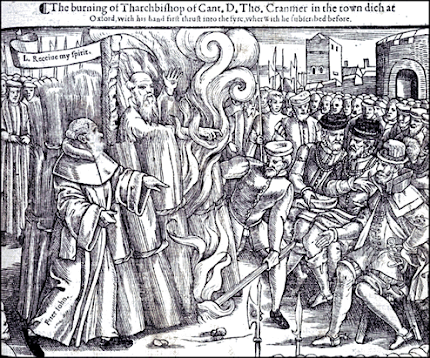
The burning of Tharchbishop of Cant. D. Tho. Cranmer in the town dich at Oxford, with his hand first thrust into the fyre, wherwith he subscribed before. [Click on the picture to see Cranmer's last words.]

Daily Bible Verse

Showing posts with label Sanctification. Show all posts

Saturday, December 25, 2021

For Those Professing Christians Who Struggle with Assurance of Salvation


Christ cannot be known without the sanctification of his Spirit: therefore faith cannot possibly be disjoined from pious affection.  John Calvin, Institutes  III:2:8.


Assurance of Salvation


As the Bible and the Westminster Standards affirm, there are sometimes new believers or even those who have believed for a significant length of time who struggle with assurance of salvation.  This is because no one is omniscient like God is omniscient.  For Dr. Gordon H. Clark, the technical definition of knowledge is that knowledge must be an absolute truth that is either a universal principle or an inspired revelation from God in Holy Scripture.  So if the Bible says that our Lord Jesus Christ was supernaturally conceived by the Holy Spirit in the womb of the virgin Mary, then that is an absolute truth and constitutes knowledge.

However, since our individual names are not written in the canonical Scriptures, we cannot "know" that we are saved or regenerate on the same level of knowledge as it is theologically and philosophically defined by Clark.  This is not to say that we know nothing at all in the sense of commonly accepted experience and facts.  Carpenters and block layers learn their job skills through years of accumulated experience but this is different from making experience the basis for an epistemological theory of knowledge itself.  Experiences vary from one person to another and such a  theory of knowledge would result in relativism, not dogmatism.  A presuppositional view of knowledge must begin with the Holy Scriptures, not with empiricism or commonly accepted views of knowledge as a system of constantly growing and learned skills.  In fact, Dr. Clark held the view that we are not born with a blank slate as empiricism or a Thomistic view of epistemology would affirm.  For Clark there can be no two-fold view of truth where only God knows His truth and we know only an analogical truth revealed as merely human truth.  This would negate the Bible as univocal truth from God and instead would replace the Bible with a neo-orthodox theory of Scripture as a framework of God's revelation and not revelation itself.

So in a pastoral sense, how are pastors to help the members of their congregation understand how to be assured of their salvation, especially when they are struggling with sins in their lives?  Is assurance merely a state of psychological certainty?  Or is assurance based on a change of habits?  Or is assurance based on an objective evaluation of the propositions of Scripture in tandem with an objective self examination of one's progress in sanctification?

Obviously there must be an adherence to the principle of justification by faith alone as the objective basis for any assurance of salvation and any progress in the process of sanctification.  Although justification and sanctification are distinct from one another, they cannot be divorced from one another either.  The Westminster Larger Catechism makes this clear:

WLC 70  What is justification? A. Justification is an act of God's free grace unto sinners,1 in which he pardoneth all their sins, accepteth and accounteth their persons righteous in his sight;2 not for any thing wrought in them, or done by them,3 but only for the perfect obedience and full satisfaction of Christ, by God imputed to them,4 and received by faith alone.5

WLC 71  How is justification an act of God's free grace? A. Although Christ, by his obedience and death, did make a proper, real, and full satisfaction to God's justice in the behalf of them that are justified,1 yet in as much as God accepteth the satisfaction from a surety, which he might have demanded of them and did provide this surety, his own only Son,2 imputing his righteousness to them,3 and requiring nothing of them for their justification but faith,4 which also is his gift,5 their justification is to them of free grace.6

WLC 72  What is justifying faith? A. Justifying faith is a saving grace,1 wrought in the heart of a sinner by the Spirit2 and word of God,3 whereby he, being convinced of his sin and misery, and of the disability in himself and all other creatures to recover him out of his lost condition,4 not only assenteth to the truth of the promise of the gospel,5 but receiveth and resteth upon Christ and his righteousness, therein held forth, for pardon of sin,6 and for the accepting and accounting of his person righteous in the sight of God for salvation.7

WLC 73  How doth faith justify a sinner in the sight of God? A. Faith justifies a sinner in the sight of God, not because of those other graces which do always accompany it, or of good works that are the fruits of it,1 not as if the grace of faith, or any act thereof, were imputed to him for his justification;2 but only as it is an instrument by which he receiveth and applieth Christ and his righteousness.3 (WLC 1:70-73 WCS)

***

WLC 75  What is sanctification? A. Sanctification is a work of God's grace, whereby they whom God hath, before the foundation of the world, chosen to be holy, are in time, through the powerful operation of his Spirit1 applying the death and resurrection of Christ unto them,2 renewed in their whole man after the image of God;3 having the seeds of repentance unto life, and all other saving graces, put into their hearts,4 and those graces so stirred up, increased and strengthened,5 as that they more and more die unto sin, and rise unto newness of life.6

WLC 76  What is repentance unto life? A. Repentance unto life is a saving grace,1 wrought in the heart of a sinner by the Spirit2 and word of God,3 whereby out of the sight and sense, not only of the danger,4 but also of the filthiness and odiousness of his sins,5 and upon the apprehension of God's mercy in Christ to such as are penitent,6 he so grieves for7 and hates his sins,8 as that he turns from them all to God,9 purposing and endeavouring constantly to walk with him in all the ways of new obedience.10

WLC 77  Wherein do justification and sanctification differ? A. Although sanctification be inseparably joined with justification,1 yet they differ, in that God in justification imputeth the righteousness of Christ,2 in sanctification his Spirit infuseth grace, and enableth to the exercise thereof;3 in the former, sin is pardoned;4 in the other, it is subdued:5 the one doth equally free all believers from the revenging wrath of God, and that perfectly in this life, that they never fall into condemnation;6 the other is neither equal in all,7 nor in this life perfect in any,8 but growing up to perfection.9

WLC 78  Whence ariseth the imperfection of sanctification in believers? A. The imperfection of sanctification in believers ariseth from the remnants of sin abiding in every part of them, and the perpetual lustings of the flesh against the spirit; whereby they are often foiled with temptations, and fall into many sins,1 are hindered in all their spiritual services,2 and their best works are imperfect and defiled in the sight of God.3

WLC 79  May not true believers, by reason of their imperfections, and the many temptations and sins they are overtaken with, fall away from the state of grace? A. True believers, by reason of the unchangeable love of God,1 and his decree and covenant to give them perseverance,2 their inseparable union with Christ,3 his continual intercession for them,4 and the Spirit and seed of God abiding in them,5 can neither totally nor finally fall away from the state of grace,6 but are kept by the power of God through faith unto salvation.7

WLC 80  Can true believers be infallibly assured that they are in the estate of grace, and that they shall persevere therein unto salvation? A. Such as truly believe in Christ, and endeavour to walk in all good conscience before him,1 may, without extraordinary revelation, by faith grounded upon the truth of God's promises, and by the Spirit enabling them to discern in themselves those graces to which the promises of life are made,2 and bearing witness with their spirits that they are the children of God,3 be infallibly assured that they are in the estate of grace, and shall persevere therein unto salvation.4

WLC 81  Are all true believers at all times assured of their present being in the estate of grace, and that they shall be saved? A. Assurance of grace and salvation not being of the essence of faith,1 true believers may wait long before they obtain it;2 and, after the enjoyment thereof, may have it weakened and intermitted, through manifold distempers, sins, temptations, and desertions;3 yet are they never left without such a presence and support of the Spirit of God as keeps them from sinking into utter despair.4
 (WLC 1:75-81 WCS)

I will leave it to the reader to consult the proof texts from the Edinburgh edition of the Westminster Confession of Faith.  If you do not have this edition, I highly recommend it as the Presbyterian Church in America and the Orthodox Presbyterian Church have both edited the confessional standards so that they fit with a more American view of civil government and other issues.  Also, the proof texts for certain doctrinal areas have been edited by both of these denominations.  I am quoting the entire series of questions for a reason and that reason is that there is a progression of thought from one question to another.  Anyone who reads the questions and answers in context and looks up the proof texts can see that the Westminster divines were concerned not to confuse justification with sanctification yet they were also concerned not to promote hypocrisy or false assurance by means of a lawless or antinomian faith.  Just as good works cannot justify anyone so lawlessness cannot sanctify anyone or give any assurance of salvation.  In short, it is better to have saving faith and not have assurance than to have a false assurance of salvation based on works righteousness or a false security while living a life of licentiousness.

After conversion we must begin somewhere.  That beginning is to study the Bible and grow in the grace and knowledge of our Lord and Savior Jesus Christ.  (2 Peter 3:18).  For a genuinely converted Christian to struggle with assurance there must be either past sins or a continuining struggle with current habitual sins interfering with that person's assurance.  An objective knowledge of the Bible must be the starting point for our study.  Dr. Clark referred to the book of Romans and to 1 John as the basis for attaining assurance of salvation.  I highly recommend Dr. Clark's chapter on assurance in the book, What Do Presbyterians Believe? The Westminster Confession Yesterday and Today, 1965, (Unicoi:  Trinity Foundation, 2001), second edition.  Also:  First John.   

According to Dr. Clark, saving faith is an intellectual assent to the Gospel message and a subsequent turning away from sin and turning to our Lord Jesus Christ.   For Clark saving faith is not a bare assent but a pious assent to the propositions of Holy Scripture.  Unfortunately I think Clark misunderstood Calvin when he cites Calvin's remarks in Institutes III:2:8 as a reference to emotion:

. . . Yet Calvin in just another line seems to require assent, for he says, “The assent which we give to the Divine word…is from the heart rather than the head, and from the affections rather than from the understanding. For which reason it is called ‘the obedience of faith,’… It is an absurdity to say that faith is formed by the addition of a pious affection to an assent of the mind; whereas even this assent consists in a pious affection.... Faith consists in a knowledge of Christ.” 

In this quotation from Calvin, note the emphasis on assent. Very good; and both against the late Arminians and with Calvin against the Romanists, this assent and faith are not products of our unaided efforts. The Spirit must make us willing. But the willing is assent. 

I regret that Calvin, a giant among pygmies, said that assent comes from the heart and not from the head. This distinction is unscriptural; the Bible nowhere opposes heart to head, for it does not mention this “head.” Naturally assent comes from the heart because all psychological actions of a person come from the heart. There is nothing else for them to come from. 

Aside from this unfortunate slip, Calvin proceeds to say that assent is the obedience of faith. Clearly obedience is a matter of volition. Assent then is an act of will. No pious additions are necessary, for the assent itself is already pious.

Gordon H. Clark. What Is The Christian Life? (Kindle Locations 3228-3238). The Trinity Foundation. Kindle Edition. 


Calvin's argument with the papist Roman Catholics is that the papists were accusing the Protestants of antinomianism due to the emphasis on justification by faith alone apart from good works.  The papists said that the Protestants were impious antinomians who had no obedience of faith and no love.  In other words, they accused Protestants of having a bare intellectual assent to propositions in the Scriptures with no subsequent piety or sanctification.  The Protestant critique of the papists, on the other hand, was that they conflated justification with sanctification thereby making justification and sanctification the same thing.  The papists insisted on justification by faith alone in regards to baptism but from that point on the papists insisted that faith that justifies must produce good works in order to continuously restore justification that is lost when a believer sins.  The papists denied that justification is a forensic and legal declaration instead of an infused righteousness that can be lost every time the believer sinned.  Calvin's argument is that saving faith is an intellectual assent that comes from the heart, not merely a bare assent without the involvement of the total person, including the mind, the will, and the affections.   By affections, Calvin does not mean the emotions but the totality of the soul much like Jonathan Edwards' definition of the affections.  Calvin's remarks show that he is rejecting the papist accusation that justification by faith alone is a mere or bare intellectual assent to the Gospel:

8. But before I proceed farther, it will be necessary to make some preliminary observations for the purpose of removing difficulties which might otherwise obstruct the reader. And first, I must refute the nugatory distinction of the Schoolmen as to formed and unformed faith.285 For they imagine that persons who have no fear of God, and no sense of piety, may believe all that is necessary to be known for salvation; as if the Holy Spirit were not the witness of our adoption by enlightening our hearts unto faith. Still, however, though the whole Scripture is against them, they dogmatically give the name of faith to a persuasion devoid of the fear of God. It is unnecessary to go farther in refuting their definition, than simply to state the nature of faith as declared in the word of God. From this it will clearly appear how unskillfully and absurdly they babble, rather than discourse, on this subject. I have already done this in part, and will afterwards add the remainder in its proper place. At present, I say that nothing can be imagined more absurd than their fiction. They insist that faith is an assent with which any despiser of God may receive what is delivered by Scripture. But we must first see whether any one can by his own strength acquire faith, or whether the Holy Spirit, by means of it, becomes the witness of adoption. Hence it is childish trifling in them to inquire whether the faith formed by the supervening quality of love be the same, or a different and new faith. By talking in this style, they show plainly that they have never thought of the special gift of the Spirit; since one of the first elements of faith is reconciliation implied in man’s drawing near to God. Did they duly ponder the saying of Paul, “With the heart man believeth unto righteousness,” (Rom. 10:10), they would cease to dream of that frigid quality. There is one consideration which ought at once to put an end to the debate, viz., that assent itself (as I have already observed, and will afterwards more fully illustrate) is more a matter of the heart than the head, of the affection than the intellect. For this reason, it is termed “the obedience of faith,” (Rom. 1:5), which the Lord prefers to all other service, and justly, since nothing is more precious to him than his truth, which, as John Baptist declares, is in a manner signed and sealed by believers (John 3:33). As there can be no doubt on the matter, we in one word conclude, that they talk absurdly when they maintain that faith is formed by the addition of pious affection as an accessory to assent, since assent itself, such at least as the Scriptures describe, consists in pious affection. But we are furnished with a still clearer argument. Since faith embraces Christ as he is offered by the Father, and he is offered not only for justification, for forgiveness of sins and peace, but also for sanctification, as the fountain of living waters, it is certain that no man will ever know him aright without at the same time receiving the sanctification of the Spirit; or, to express the matter more plainly, faith consists in the knowledge of Christ; Christ cannot be known without the sanctification of his Spirit: therefore faith cannot possibly be disjoined from pious affection.  (III:2:8).

Calvin, John. Institutes of the Christian Religion. Bellingham, WA: Logos Bible Software, 1997. Print.  Beveridge edition.

But I digress here.  The original purpose of this post was pastoral.  How does the pastor encourage new believers and long time believers who are struggling with assurance.  He must emphasize that no amount of spiritual growth could ever justify the believer.  Without this foundation there can be no true sanctification and no assurance.  Although sinful habits must be overcome, the doctrine of justification by faith alone is the beginning point for true assurance for without it there can be no assurance  attained.  That applies to Arminians and especially to papists:

Having the opinion that assurance is rare, Ryle extends its possibility to every Christian (103). He allows that Rome denies this possibility. True. And also, “the vast majority of the worldly and thoughtless Christians among ourselves oppose the doctrine.” Possibly true then, but very likely false now. However, Job 19:25-27, Psalm 23:4, 6, Isaiah 26:3, and 32:17, Romans 8:39 on to 1 John 5:19 insist that assurance is possible. Not only was assurance possible in apostolic times, but “many have attained to such an assured hope…even in modern times” (105). This certainly seems to be what the Bible teaches; but Ryle, at least so far, has not told us how to attain such assurance and how to distinguish it from careless presumption or from what Louis Berkhof calls “temporary faith,” so little temporary as to last a lifetime.

Gordon H. Clark. What Is The Christian Life? (Kindle Locations 738-745). The Trinity Foundation. Kindle Edition. 

One subhead under the general title of Sanctification or Holiness is Assurance. Calvin and the first generation of Reformers seem to have held that assurance is inseparable from faith. Whoever is not assured of his salvation is simply not saved. This view may have been encouraged by the severity of Romish persecution, the exuberance of a newly found faith, and the utter impossibility of finding assurance in penance and good works. But as the persecutions diminished and as calmer study could be undertaken, the Westminster divines, a full century later, wrote, “This infallible assurance doth not so belong to the essence of faith, but that a true believer may wait long, and conflict with many difficulties, before he is partaker of it” (XVIII, 3). 
 
I must confess I do not like the word infallible in this context. The Pope claims infallibility, but if this is a false claim, it seems strange that it can be asserted of a thousand or a million Protestants. One of the older divines, whose name I have forgotten, illustrated infallibility by the knowledge of a ship captain’s guiding his ship into a harbor. Though the captain was ignorant of many things, and mistaken about many others, he infallibly knew the channel. But is it not possible, as it actually happened in 1983 when a naval vessel struck a sand bar in San Francisco Bay, that a storm could have closed the previous channel? Scripture is infallible; nothing else is. We all can and we all do make mistakes. 
 
Ryle does not seem to realize this. Nor do many others. Those who are so assured about assurance do not seem to understand the difficulties. Once I had a very friendly conversation with a college professor who was strongly Arminian. I remarked that one difference between Calvinism and Arminianism was that the latter denied the possibility of assurance. “Not so,” he replied, “I’m right now completely assured of my salvation. If I should die this moment, I know I would go to Heaven. Of course,” he continued, “if I should live until tomorrow or next week, I do not know whether I shall be saved or not.” This raises the question of the value of assurance. Assurance of salvation does not mean that you will get to Heaven. Assurance that a good restaurant serves good food does not guarantee that it serves good food. My major professor in graduate school took his wife out one Saturday night to a restaurant which he had often patronized. Before the night was over, he had died of food poisoning. His assurance had been misplaced. Many people are assured of all sorts of things. Some are sure that drinking vinegar will cure warts. But assurance guarantees nothing.

Gordon H. Clark. What Is The Christian Life? (Kindle Locations 712-731). The Trinity Foundation. Kindle Edition. 
 
Perhaps someone will say that it is wrong to seek for a method of achieving assurance. It is a gift of God, we cannot earn it; there is nothing for us to do except to hope that God favors us. Well, it is true that assurance, like faith, is a gift of God, but though regeneration and faith can have no preparation on our part, assurance or at least sanctification requires certain actions by us. Perhaps method is not the proper term, but John tells us that “These things have I written unto you that believe on the name of the Son of God; that ye may know that ye have eternal life.” The usual exegesis of “these things” that John wrote is that faith, love, and obedience, while they do not automatically produce assurance, are nonetheless requirements for being a candidate, so to speak, to receive it. Actually love is one form of obedience, since it is commanded, and hence belief and overt obedience are the two prerequisites. 
 
There is, however, a difficulty. It is the same one Luther struggled with before he discovered the doctrine of justification. In Romanism he was supposed to earn his salvation by good works, penance, flagellation, and various monkish practices. But, being very sincere, he was troubled because he could never be sure that he had done enough. A similar difficulty arises here. If we wish to distinguish a valid assurance from a false assurance, how can we know that we have a sufficient theological knowledge and a sufficient degree of obedience to have met the requirements? Do we love deeply enough? Have we satisfied John’s criteria? Is there any devotional writer who has forthrightly faced this problem? It is hard to believe that none of them has thought of it. If as previously stated, Louis Berkhof’s temporary faith can last a lifetime, how can the true be identified in contrast with the false?

Gordon H. Clark. What Is The Christian Life? (Kindle Locations 754-768). The Trinity Foundation. Kindle Edition.

Dr. Clark rightly points out that assurance is problematic.  So if there is no absolute infallibility in regards to our assurance of salvation, where does that leave us?  The only place I know of is Scripture.  The words of comfort quoted just after the absolution in the communion service of the 1662 Book of Common Prayer say:

Hear what comfortable words our Saviour Christ saith unto all that truly turn to him:

Come unto me all that travail and are heavy laden, and I will refresh you.


Matthew 11:28–29 (KJV 1900)

28 Come unto me, all ye that labour and are heavy laden, and I will give you rest .

29 Take my yoke upon you, and learn of me; for I am meek and lowly in heart: and ye shall find rest unto your souls.

Also, at the point of regeneration and conversion God forgets all of our past sins and declares us righteous at that point:

Micah 7:18–20 (KJV 1900)

18 Who is a God like unto thee, that pardoneth iniquity, And passeth by the transgression of the remnant of his heritage? He retaineth not his anger for ever, Because he delighteth in mercy.

19 He will turn again, he will have compassion upon us; He will subdue our iniquities; And thou wilt cast all their sins into the depths of the sea.

20 Thou wilt perform the truth to Jacob, and the mercy to Abraham, Which thou hast sworn unto our fathers from the days of old.


Romans 5:1–9 (KJV 1900)

1 Therefore being justified by faith, we have peace with God through our Lord Jesus Christ:

2 By whom also we have access by faith into this grace wherein we stand, and rejoice in hope of the glory of God.

3 And not only so, but we glory in tribulations also: knowing that tribulation worketh patience;

4 And patience, experience; and experience, hope:

5 And hope maketh not ashamed; because the love of God is shed abroad in our hearts by the Holy Ghost which is given unto us.

6 For when we were yet without strength, in due time Christ died for the ungodly.

7 For scarcely for a righteous man will one die: yet peradventure for a good man some would even dare to die.

8 But God commendeth his love toward us, in that, while we were yet sinners, Christ died for us.

9 Much more then, being now justified by his blood, we shall be saved from wrath through him.

In closing, it should be noted that Clark does not stop with his remarks above but transitions over into a discussion of the doctrine of perseverance in faith to the end.  Furthermore, Clark asserts that saving faith is not a temporary faith but God imparts to the believer eternal life which never ends.  Of course, all of this is the gift of God, including the antecedent irresistible and effectual grace of regeneration.  Those who struggle with assurance are encouraged to study the Bible more closely and to study the system of theology outlined from the Bible in the Westminster Confession of Faith and the Larger Catechism.  There are also additional articles in the Edinburgh edition of the doctrinal standards.  In particular, there is an article in the Edinburgh edition of the Westminster Confession of Faith called, "The Sum of Saving Knowledge."  That article outlines what saving faith is and the evidences of true saving faith.  I highly recommend reading, "The Sum of Saving Knowledge," especially the last section, "The Evidences of True Faith."  While this is challenging given the looseness of the modern Evangelical churches, it is completely within the doctrinal standards of the Bible and the Westminster confessional standards. 

Monday, October 21, 2019

John Robbins's Bad Exegesis of Matthew 7:21-23


"He not only directs his discourse to them, to rouse them from the indifference, in which they lie asleep like drunk people, but also warns believers, not to estimate such masks beyond their proper value. In a word, he declares that, so soon as the doctrine of the Gospel shall have begun to bear fruit by obtaining many disciples, there will not only be very many of the common people who falsely and hypocritically submit to it, but even in the rank of pastors there will be the same treachery, so that they will deny by their actions and life what they profess with the mouth. “Whoever then desires to be reckoned among the disciples, must labour to devote himself, sincerely and honestly, to the exercises of a new life."  John Calvin


"Orthodox Protestants have always said that faith must produce good works. Faith, or what passes for faith, or what some people call faith, is dead without works."   Dr. Gordon H. Clark


Since my time is limited I will only make a few brief comments about John Robbins's hermeneutic that reads justification by faith alone into practically every passage of Scripture which emphasizes true conversion and the accompanying fruits of conversion.  Sean Gerety is a good example of someone who cares little about progressive sanctification and the other accompanying fruits which follow after a monergistic regeneration or the effectual call of the God.  In fact, I would argue that Gerety and others at the Trinity Foundation are more concerned with following the teachings of John Robbins than with following the system of logical and propositional truth that is deduced from the Bible.  Dr. Gordon H. Clark did not waver from the system of propositional truth which is summarized by the Westminster Confession of Faith.  Clark denied that saving faith is bare assent to the Gospel:

Protestants usually assert that Romanists make faith and salvation a matter of assent; the most frequent expression is that the Romanists make faith a matter of “bare” assent. It is common to declaim against “mere” intellectual faith. Bare and mere are of course pejorative adjectives, i.e., weasel words. It is unfortunate that many or most Protestant discussions on this subject, either in textbooks or encyclopedias, do not define their terms and explain what is meant. Assent, as has been seen, can be taken in several ways. Orthodox Protestants have always said that faith must produce good works. Faith, or what passes for faith, or what some people call faith, is dead without works. If this is what is meant by speaking of “mere” or “bare” assent, of course it is quite true. But I suspect that this is not what is meant.

Gordon H. Clark. What Is The Christian Life? (Kindle Locations 3042-3049). The Trinity Foundation. Kindle Edition. 

While it is true that the Westminster Confessional Standards are a fallible confession of faith and an extended creed of what Presbyterians believe, it is not true that departing from the confessional standards is optional.  The WCS are a secondary and authoritative summary of what we believe the Bible teaches.  This can be easily demonstrated from the Confession itself.  The first chapter of the Confession makes it clear that the doctrine of Sola Scriptura is the most important doctrine of Presbyterianism and Calvinism.  In section one we are told that the primary reason God gave us the Scriptures is that general or natural revelation is insufficient information for saving faith.  But we are also told that the Scriptures were put into writing for "the better preserving and propagating of the truth, and for the more sure establishment and comfort of the Church against the corruption of the flesh, and the malice of Satan and of the world . . ."  (Westminster Confession of Faith.  WCF 1:1).  It would be odd that the Westminster divines would put so much emphasis on the "sure establishment and comfort of the Church" if confessional creeds are merely optional resources of the church.  Dr. Clark made it clear that he adhered to the whole scope of Scripture and to the system of propositional truth that is laid out in summary form in the Westminster Standards:


Today many church leaders consider creeds as obstacles to ecumenical union.  It would please such men to hand over the discussions of creedal differences to those impractical fuddy-duddies, the theologians, while they themselves made the important organizational arrangements by which the right people would get the prominent positions.

There are other more humble people who sincerely believe that the adoption of a creed is an act of ecclesiastical presumption.  Therefore several denominations have no creed.  They insist on believing nothing.  There are others who regard creeds, not exactly as presumptions, but as unnecessary.  This would be the attitude of those who, though their zeal is unquestioned, find creeds, and Paul's epistles, intellectually heavy.

. . . The Westminster Confession was never intended to be either an empty form or an obstacle to church union.  With the other Reformed creeds, the Thirty-nine Articles, the Heidelberg Catechism, the Canons of the Synod of Dort, it was a statement of what all the ministers earnestly believed and faithfully preached.  These creeds were bonds of union, not causes of discord.  Discord comes when men of opposing views subscribe to the same verbal formula.  But these creeds were never intended to hide differences behind a veil of meaningless words.  On the contrary, the year before St. Bartholomew's massacre Bishop Jewel of the Anglican church wrote to Peter Martyr on the continent, "As to matters of doctrine we do not differ from you by a nail's breadth."

Dr. Gordon H. Clark.  What Do Presbyterians Believe?  The Westminster Confession Yesterday and Today.  1965.  Second Edition.  (Unicoi:  The Trinity Foundation, 2001).  Pp. 4-5.  

John Robbins's sermon on Matthew 7:21-23 is only half correct.  He correctly assesses that the Pharisees do not have a proper doctrinal understanding of the Bible when they place all the emphasis on outward works of righteousness rather than a genuine understanding of the Gospel of sovereign and free grace.  The Pharisees were outwardly clean but the inside of their souls was dirty just as the outside of the cup was clean and the inside filthy.  Jesus said that the Pharisees were whitewashed sepulchres but inwardly they were filled with the bones of dead men:

Matthew 23:23–31 (NKJV)
23 “Woe to you, scribes and Pharisees, hypocrites! For you pay tithe of mint and anise and cummin, and have neglected the weightier matters of the law: justice and mercy and faith. These you ought to have done, without leaving the others undone.
24 Blind guides, who strain out a gnat and swallow a camel!

25 “Woe to you, scribes and Pharisees, hypocrites! For you cleanse the outside of the cup and dish, but inside they are full of extortion and self-indulgence.


26 Blind Pharisee, first cleanse the inside of the cup and dish, that the outside of them may be clean also.
27 “Woe to you, scribes and Pharisees, hypocrites! For you are like whitewashed tombs which indeed appear beautiful outwardly, but inside are full of dead men’s bones and all uncleanness.
28 Even so you also outwardly appear righteous to men, but inside you are full of hypocrisy and lawlessness.
29 “Woe to you, scribes and Pharisees, hypocrites! Because you build the tombs of the prophets and adorn the monuments of the righteous,
30 and say, ‘If we had lived in the days of our fathers, we would not have been partakers with them in the blood of the prophets.’
31 “Therefore you are witnesses against yourselves that you are sons of those who murdered the prophets.

The problem with Robbins is that his view completely dismisses true piety as a necessary result of saving faith, a true and living faith.  He conflates the papist view with what orthodox Protestants have always taught, namely that a true and lively faith produces good works which can only please God because of the imputed righteousness of the cross.  Dr. Clark makes no such error.  As can be seen below, Robbins thinks the hypocrisy is believing false teaching, not living a life of hypocrisy:

Now, consider the irony of the exegetical situation. Proponents of Lordship Salvation such as Shepherd and MacArthur appeal to this passage in Matthew 7 to support their view that belief alone in the Lord Jesus Christ is not enough for salvation, that we must also practice the Lordship of Christ by faithfully performing works in order to be saved. Yet this passage clearly teaches that some of those who confess Jesus as Lord and perform amazing works will be excluded from the Kingdom of Heaven. Therefore, one may acknowledge the Lordship of Christ, perform many wonderful works, and still go to Hell. Jesus himself here warns us that many who confess his Lordship and perform many works will go to Hell. Obviously the passage does not mean what the Pope, MacArthur, and Shepherd think it means. It is not a contrast between mere believers (who are lost) and workers (who are saved), for Jesus himself says that the workers are lost.

John Robbins,  "Justification and Judgment,"  Trinity Review, November/December 2001.  P.  4

I have not read either edition of John MacArthur's book, The Gospel According to Jesus.  The first edition did have some confusing language about justification by faith alone and that edition was then revised after R. C. Sproul and others critiqued the book.  However, I think it is unjust of Robbins to lump MacArthur with Norman Shepherd and the Federal Vision/New Perspective on Paul crowd.  There are obviously huge differences between what MacArthur teaches and what the Shepherd/Federal Vision proponents teach.


Robbins correctly says that unless a person believes in the justification accomplished by Jesus Christ as the only basis or foundation for right standing in the final judgment that person has no assurance of salvation.  Final justification is not a matter of good works outweighing bad works and then God accepts a person on the basis of their meritorious works which become the deciding factor in their final salvation.  Final justification is and always will be the fact that Jesus lived a perfect life in our place and thus is our substitutionary righteousness in both his active obedience and his passive obedience.  His final sacrifice accomplished the actual justification of every believing and elect sinner.  (Romans 4:1-8; Hebrews 10:12-14).


What Robbins never mentions is that the Bible, the Reformed confessions, and Dr. Gordon H. Clark all say that faith without works is dead.  We do not justify ourselves by good works in order to be saved.  Instead saving faith knows that believers are justified by Christ alone and that said saving faith will produce good works.  Good works apart from faith cannot justify.  But if we are not to examine ourselves to see if we have genuine faith and obedience, why did the apostle Paul say that to partake of the Lord's supper without proper self examination would result in judgment?  (1 Corinthians 11:27-29;  2 Corinthians 13:5).  Worse for Robbins, John Calvin's exposition of Matthew 7:21-23 focuses on hypocrisy and true piety, not the doctrine of justification by faith alone:


Matthew 7:21. Not every one that saith to me, Lord, Lord. Christ extends his discourse farther: for he speaks not only of false prophets, who rush upon the flock to tear and devour, but of hirelings, who insinuate themselves, under fair appearances, as pastors, though they have no feeling of piety. This doctrine embraces all hypocrites, whatever may be their rank or station, but at present he refers particularly to pretended teachers, who seem to excel others. He not only directs his discourse to them, to rouse them from the indifference, in which they lie asleep like drunk people, but also warns believers, not to estimate such masks beyond their proper value. In a word, he declares that, so soon as the doctrine of the Gospel shall have begun to bear fruit by obtaining many disciples, there will not only be very many of the common people who falsely and hypocritically submit to it, but even in the rank of pastors there will be the same treachery, so that they will deny by their actions and life what they profess with the mouth. “Whoever then desires to be reckoned among the disciples, must labour to devote himself, sincerely and honestly, to the exercises of a new life.

Calvin, John, and William Pringle. Commentary on a Harmony of the Evangelists Matthew, Mark, and Luke. Vol. 1. Bellingham, WA: Logos Bible Software, 2010. Print.

The short of it all is that Robbins is so completely obsessed by his objection to the denial of justification by faith alone that he ignores the system of doctrine laid out in the Bible and summarized by the Reformed confessions.  His exegesis of Scripture is blinded by his objection to works righteousness to the point that he ignores the balanced system of logical  and propositional theology in the Bible.  Robbins never once mentions Matthew chapter 23 and how that relates to the verses he refers to in Matthew 7:21-23.


The Thirty-nine Articles of Religion put the matter succinctly:

XI. Of the Justification of Man.
WE are accounted righteous before God, only for the merit of our Lord and Saviour Jesus Christ by faith, and not for our own works or deservings. Wherefore that we are justified by faith only is a most wholesome doctrine, and very full of comfort; as more largely is expressed in the Homily of Justification. 
XII. Of Good Works. 
ALBEIT that good works, which are the fruits of faith and follow after justification, cannot put away our sins and endure the severity of God's judgement, yet are they pleasing and acceptable to God in Christ, and do spring out necessarily of a true and lively faith, insomuch that by them a lively faith may be as evidently known as a tree discerned by the fruit. 
XIII. Of Works before Justification. 
WORKS done before the grace of Christ and the inspiration of the Holy Spirit, are not pleasant to God, forasmuch as they spring not of faith in Jesus Christ, neither do they make men meet to receive grace, or (as the School authors say) deserve grace of congruity: yea, rather for that they are not done as God hath willed and commanded them to be done, we doubt not but they have the nature of sin.

And please note that Dr. Gordon H. Clark fully approved of the Thirty-nine Articles of Religion as a Reformed confession of faith.  The term "grace of congruity" refers to the scholastic doctrine that good works make men deserving to receive another grace that makes their good works meritorious in regards to their salvation.  The Thirty-nine Articles, following the  theology of Archbishop Thomas Cranmer, rejects any idea that good works makes anyone deserving to receive grace or meritorious grace which would be congruent with justification whatsoever.  The papists teach justification by faith plus good works because sins committed after baptism must be remitted by doing good works of penance or substituted by appeals to supererogatory works of the papist saints in the treasury in heaven.  In contradistinction, the Bible teaches justification by faith alone apart from good works.  Good works apart from saving faith cannot please God whatsoever.  This in no way denies that good works are a necessary evidence of a true and lively faith, however.


To further nail the point home I can quote from the Heidelberg Catechism to affirm that sanctification is a necessary evidence of a true and lively faith:

THE THIRD PART—OF THANKFULNESS
LORD’S DAY 32 
Question 86
  Since then we are delivered from our misery, merely of grace, through Christ, without any merit of ours, why must we still do good works?


  Because Christ, having redeemed and delivered us by his blood, also renews us by his Holy Spirit, after his own image; that so we may testify, by the whole of our conduct, our gratitude to God for his blessings,a and that he may be praised by us;b also, that every one may be assured in himself of his faith,c by the fruits thereof; and that, by our godly conversation others may be gained to Christ.d

Question 87
  Cannot they then be saved, who, continuing in their wicked and ungrateful lives, are not converted to God?


  By no means; for the holy scripture declares that no unchaste person, idolater, adulterer, thief, covetous man, drunkard, slanderer, robber, or any such like, shall inherit the kingdom of God.a


Historic Creeds and Confessions. electronic ed. Oak Harbor: Lexham Press, 1997. Print.

I can also cite and quote many places in the Westminster Confessional Standards to show that sanctification is a necessary evidence of saving faith and a true profession of faith.  I hope that this establishes the point that so-called Lordship Salvation has to be defined properly and if it is defined by the Scriptures and the Reformed creeds and confessions it simply means that those who live a life of lawlessness and wickedness have no assurance of salvation even if they have made a profession of faith.  That seems to be John Calvin's exegesis of Matthew 7:21-23.  The chapter on assurance of salvation in the WCF clearly says that false assurance is a danger.  (See WCF 18:1).

WCF 16:2  Of Good Works
2.      These good works, done in obedience to God’s commandments, are the fruits and evidences of a true and lively faith: (James 2:18, 22) and by them believers manifest their thankfulness, (Ps. 116:12–13, 1 Pet. 2:9) strengthen their assurance, (1 John 2:3, 5, 2 Pet. 1:5–10) edify their brethren, (2 Cor. 9:2, Matt. 5:16) adorn the profession of the gospel, (Tit. 2:5, 9–12, 1 Tim. 6:1) stop the mouths of the adversaries, (1 Pet. 2:15) and glorify God, (1 Pet. 2:12, Phil. 1:11, John 15:8) whose workmanship they are, created in Christ Jesus thereunto, (Eph. 2:10) that, having their fruit unto holiness, they may have the end, eternal life. (Rom. 6:22)
The Westminster Confession of Faith. Oak Harbor, WA: Logos Research Systems, Inc., 1996. Print.
Does chapter 16 of the WCF teach final justification?  I think not.  Yet the Westminster divines clearly said that justification is evidenced by sanctification unto holiness and good works which in tandem assure believers that they will inherit eternal life.  Robbins, on the contrary, seems to have been promoting the view of Baptists who teach once saved always saved.

[Addendum:  After having listened to John MacArthur's sermons many times on YouTube, I have come to the conclusion that Johnny Mac defines Lordship Salvation as living a progressively sanctified life after an elect person has been regenerated.  MacArthur does not mean that good works in any sense whatsoever justify the Christian on the final day of judgment.  But it follows that many will discover that their faith was a false profession of faith and that they were never converted.  That is different from the Federal Vision doctrine of a final justification by faith and works.  December 25th, 2021.]

Tuesday, August 06, 2019

John Robbins Versus Dr. Gordon H. Clark: Justification and Sanctification


10 Therefore, brethren, be even more diligent to make your call and election sure, for if you do these things you will never stumble; 11 for so an entrance will be supplied to you abundantly into the everlasting kingdom of our Lord and Savior Jesus Christ.  2 Peter 1:10-11 NKJV

12 "Take heed to yourself, lest you make a covenant with the inhabitants of the land where you are going, lest it be a snare in your midst.
 13 "But you shall destroy their altars, break their sacred pillars, and cut down their wooden images
 14 `(for you shall worship no other god, for the LORD, whose name is Jealous, is a jealous God),
 15 "lest you make a covenant with the inhabitants of the land, and they play the harlot with their gods and make sacrifice to their gods, and one of them invites you and you eat of his sacrifice,
 16 "and you take of his daughters for your sons, and his daughters play the harlot with their gods and make your sons play the harlot with their gods.
 (Exodus 34:12-16 NKJV)

Question 97
What special use is there of the moral law to the regenerate?
Although they that are regenerate, and believe in Christ, be delivered from the moral law as a covenant of works, (Rom. 6:14, Rom. 7:4,6, Gal. 4:4–5) so as thereby they are neither justified (Rom. 3:20) nor condemned; (Gal. 5:23, Rom. 8:1) yet, besides the general uses thereof common to them with all men, it is of special use, to show them how much they are bound to Christ for his fulfilling it, and enduring the curse thereof in their stead, and for their good; (Rom. 7:24–25, Gal. 3:13–14, Rom. 8:3–4) and thereby to provoke them to more thankfulness, (Luke 1:68–69,74–75, Col. 1:12–14) and to express the same in their greater care to conform themselves thereunto as the rule to their obedience. (Rom. 7:22, Rom. 12:2, Tit. 2:11–14).
  7.      Neither are the forementioned uses of the law contrary to the grace of the Gospel, but do sweetly comply with it; (Gal. 3:21) the Spirit of Christ subduing and enabling the will of man to do that freely, and cheerfully, which the will of God, revealed in the law, requireth to be done. (Ezek. 36:27, Heb. 8:10, Jer. 31:33)


Personally, I do not like theological disputations because those who oppose the biblical view as summarized in the Westminster Standards are slippery eels who refuse to see the entire system of doctrine as one whole system from Genesis to Revelation.  When I quote Dr. Gordon H. Clark in context and directly from his books, the opponent goes to John Robbins instead.  I am beginning to see that Dr. Robbins was not in agreement with Dr. Clark on a whole host of issues, most especially the essential necessity of the whole ordo salutis, not just the initiation of the Christian life through regeneration and justification.  There must be a resulting cooperation in believing the Gospel and a resulting cooperation in a life of sanctification.  If there is no sanctification, there is no regeneration, and by implication, there never was any justification applied through a true and living faith.  Dr. Clark was very clear on this.  Essentially, most of the Robbins proselytes today are teaching one doctrine to the detriment of the whole system, namely justification by belief.  Justification is objective because it was accomplished on the cross.  But to receive the benefits of the atonement and justification accomplished and completed on the cross, one must first be unconditionally elected prior to creation, regenerated supernaturally by God the Holy Spirit in a monergistic resurrection, and then caused by God to cooperate in believing the Gospel.   (Ephesians 1:4-5, 11; John 3:3-8; Ezekiel 36:26-27; Romans 8:28-36 NKJV).

One cannot believe the Gospel without a supernatural and monergistic act of God, whereby the elect person is enabled to believe the preached word of God in the effectual call.  And at that point in time the justification of the cross is imputed to the elect person's account by means of belief and belief alone.  However, the Robbins proselytes want to dead stop everything at justification by faith or belief and that is it.  This is also how they can push for the oxymoronic view of Reformed libertarianism, which is really nothing more than secular libertarianism with a contradictory adjective tacked on the term libertarian.  Dr. Clark did not believe in imposing Calvinism on the entire nation.  What he did propose was that the Judeo-Christian worldview is not a religion and that the nation could legitimately impose the 10 axioms of the moral law or the Ten Commandments as the basis for religious freedom in our nation.  If the unbeliever wants to make stealing a crime, is that not taught in the Decalogue?  Likewise, Sunday should be a day that businesses give time off for everyone so they can go to the place of worship of their choice.  Instead what we see today is  libertarians and Marxists and secular humanists imposing work days on all seven days of the week.  As a result we are seeing the breakdown of the traditional family where both parents must work and the children end up as latchkey kids.  Worse, children today are being indoctrinated in public education and state universities with materialistic atheism, secular humanism, a biased and socialist view of American history, and a view of empirical science that more closely resembles a materialistic or pantheistic religion than an operationalist view of science.

In reading the Old Testament we can easily deduce that God intended for nations to worship Him and follow His ordinances.   Of course, in the Old Testament the only nation God selected was Israel.  We are told today that there is no chosen nation because the theocratic nation of Israel passed away with that nation.  That is true and it is taught in the Westminster Confession as such:

Chapter XIX  Of the Law of God
4.      To them also, as a body politic, He gave sundry judicial laws, which expired together with the state of that people; not obliging any other now, further than the general equity thereof may require. (Exod. 21, Exod. 22:1–29, Gen. 49:10, 1 Pet. 2:13–14, Matt. 5:17, 38–39, 1 Cor. 9:8–10).
The Westminster Confession of Faith. Oak Harbor, WA: Logos Research Systems, Inc., 1996. Print.
But what the Robbins proselytes neglect to see is that God requires obedience of the moral law by all nations and individuals and Romans 1:18-32 proves that libertarianism is just another manifestation of the lawlessness and wickedness of the nations of this world.  The Christian has a moral obligation to stand for the whole teaching of the Bible, not just for the doctrine of justification by means of faith alone.  (2 Timothy 3:15-17; Matthew 28:18-20).  All Scripture is profitable for doctrine and there is no dialectical contradiction between the moral law and the Gospel.  In fact, the Westminster Confession of Faith specifically states that the moral law has a purpose for both unbelievers and believers:


Question 96
What particular use is there of the moral law to unregenerate men?
The moral law is of use to unregenerate men, to awaken their consciences to flee from wrath to come, (1 Tim. 1:9–10) and to drive them to Christ; (Gal. 3:24) or, inexcusable, (Rom. 1:20, Rom. 2:15) and under the curse thereof. (Gal. 3:10)


Question 97
What special use is there of the moral law to the regenerate?
Although they that are regenerate, and believe in Christ, be delivered from the moral law as a covenant of works, (Rom. 6:14, Rom. 7:4,6, Gal. 4:4–5) so as thereby they are neither justified (Rom. 3:20) nor condemned; (Gal. 5:23, Rom. 8:1) yet, besides the general uses thereof common to them with all men, it is of special use, to show them how much they are bound to Christ for his fulfilling it, and enduring the curse thereof in their stead, and for their good; (Rom. 7:24–25, Gal. 3:13–14, Rom. 8:3–4) and thereby to provoke them to more thankfulness, (Luke 1:68–69,74–75, Col. 1:12–14) and to express the same in their greater care to conform themselves thereunto as the rule to their obedience. (Rom. 7:22, Rom. 12:2, Tit. 2:11–14)


Question 98
Where is the moral law summarily comprehended?
The moral law is summarily comprehended in the ten commandments, which were delivered by the voice of God upon Mount Sinai, and written by him in two tables of stone; (Deut. 10:4, Exod. 34:1–4) and are recorded in the twentieth chapter of Exodus.  The four first commandments containing our duty to God, and the other six our duty to man. (Matt. 22:37–40)

The Westminster Larger Catechism: With Scripture Proofs. Oak Harbor, WA: Logos Research Systems, Inc., 1996. Print.

The short of it is that those who emphasize only one portion of Scripture to the exclusion of all the rest are in fact teaching heresy and that is true whether the heresy is pelagianism or antinomianism in their manifold forms today.  We are not under the law as a covenant of works or to be justified.  But the Christian has a moral duty to obey Christ because love is obedience.  Without sanctification and the process of becoming more and more Christlike there is no true and living belief or any change of habits.  These are things that Dr. Clark said.  Now if Sean Gerety and the Trinity Foundation disagree with Dr. Clark they should say so openly instead of playing games of equivocation and dissimulation.  The Federal Visionists are good at double speak but apparently so are some of those who claim to follow the apologetics of the late Dr. Gordon H. Clark.  

The Westminster Larger Catechism clearly says that justifying faith has the other graces accompanying it, namely repentance and sanctification as well as a desire to attend church, study the Bible, pray, etc.


Question 73
How doth faith justify a sinner in the sight of God?
Faith justifies a sinner in the sight of God, not because of those other graces which do always accompany it, or of good works that are the fruits of it, (Gal. 3:11, Rom. 3:28) nor as if the grace of faith, or any act thereof, were imputed to him for his justification; (Rom. 4:5, Rom. 10:10) but only as it is an instrument by which he receiveth and applieth Christ and his righteousness. (John 1:12, Phil. 3:9, Gal. 2:16).

And the nail in the coffin of the antinomians is that assurance requires obedience as well.  There is an entire chapter on the assurance of salvation in the WCF.  And the WLC says:


Question 77
Wherein do justification and sanctification differ?
Although sanctification be inseparably joined with justification, (1 Cor. 6:11, 1 Cor. 1:30) yet they differ, in that God in justification imputeth the righteousness of Christ; (Rom. 4:6 ,8) in sanctification of his Spirit infuseth grace, and enableth to the exercise thereof; (Ezek. 36:27) in the former, sin is pardoned; (Rom. 3:24–25) in the other, it is subdued: (Rom. 6:6,14) the one doth equally free all believers from the revenging wrath of God, and that perfectly in this life, that they never fall into condemnation (Rom. 8:33–34) the other is neither equal in all, (1 John 2:12–14, Heb. 5:12–14) nor in this life perfect in any, (1 John 1:8,10) but growing up to perfection. (2 Cor. 7:1, Phil. 3:12–14).

Justification always results in a life of progressive submission to the Holy Spirit by way of the cooperation of the will.  (Proverbs 21:1). That process is always imperfect but without sanctification there can be no assurance of salvation.  None.  That is what Dr. Clark said as well.   Click on the links to the proof texts to the Catechism above.

In regards to nations, the Confession clearly says they have an obligation to obey the general equity of the moral law as summarized by the Decalogue:

Chapter XIX Of the Law of God

  5.      The moral law doth for ever bind all, as well justified persons as others, to the obedience thereof; (Rom. 13:8, 9, Eph. 6:2, 1 John 2:3–4, 7–8) and that, not only in regard of the matter contained in it, but also in respect of the authority of God the Creator, who gave it. (James 2:10, 11) Neither doth Christ, in the Gospel, any way dissolve, but much strengthen this obligation. (Matt. 5:17–19, James 2:8, Rom. 3:31)
  6.      Although true believers be not under the law, as a covenant of works, to be thereby justified, or condemned; (Rom. 6:14, Gal. 2:16, Gal. 3:13, Gal. 4:4–5, Acts 13:39, Rom. 8:1) yet is it of great use to them, as well as to others; in that, as a rule of life informing them of the will of God, and their duty, it directs and binds them to walk accordingly; (Rom. 7:12, 22, 25, Ps. 119:4–6, 1 Cor. 7:19, Gal. 5:14, 16, 18–23) discovering also the sinful pollutions of their nature, hearts, and lives; (Rom. 7:7, Rom. 3:20) so as, examining themselves thereby, they may come to further conviction of, humiliation for, and hatred against sin, (James 1:23–25, Rom. 7:9, 14, 24) together with a clearer sight of the need they have of Christ, and the perfection of His obedience. (Gal. 3:24, Rom. 7:24, Rom. 8:3–4) It is likewise of use to the regenerate, to restrain their corruptions, in that it forbids sin: (James 2:11, Ps. 119:101, 104, 128) and the threatenings of it serve to shew what even their sins deserve; and what afflictions, in this life, they may expect for them, although freed from the curse thereof threatened in the law. (Ezra 9:13–14, Ps. 89:30–34) The promises of it, in like manner, shew them God’s approbation of obedience, and what blessings they may expect upon the performance thereof: (Lev. 26:1–14, 2 Cor. 6:16, Eph. 6:2–3, Ps. 37:11, Matt. 5:5, Ps. 19:11) although not as due to them by the law as a covenant of works. (Gal. 2:16, Luke 17:10) So as, a man’s doing good, and refraining from evil, because the law encourageth to the one, and deterreth from the other, is no evidence of his being under the law; and not under grace. (Rom. 6:12, 14, 1 Pet. 3:8–12, Ps. 34:12–16, Heb. 12:28–29)
  7.      Neither are the forementioned uses of the law contrary to the grace of the Gospel, but do sweetly comply with it; (Gal. 3:21) the Spirit of Christ subduing and enabling the will of man to do that freely, and cheerfully, which the will of God, revealed in the law, requireth to be done. (Ezek. 36:27, Heb. 8:10, Jer. 31:33)

The Westminster Confession of Faith. Oak Harbor, WA: Logos Research Systems, Inc., 1996. Print.
I follow the confessional standards of Scripture and the Westminster Standards which summarize the teaching of the Bible.  I learned from reading Dr. Clark that he did not agree with libertarianism or with any view of grace that divorces justification from sanctification.   And here is a hint.  If the blogs you read never quote Scripture and the confessional standards to support their views, that is a giant red flag.  2 Timothy 3:15 teaches that the Old Testament Scriptures revealed the Gospel sufficiently to point to Christ and His ministry because when the apostle Paul wrote the second epistle to Timothy the New Testament had not yet been written nor had it been canonized into the Bible as the 66 books we know today.  There are 39 Old Testament books and 27 New Testament books.

See:  John Robbins Quick Quote.  God's Hammer Blog


Tuesday, February 20, 2018

John Calvin: Regeneration as Process?


"Wherefore, in regard to the whole process of regeneration, it is not without cause we are called God’s “workmanship, created in Christ Jesus unto good works, which God has before ordained that we should walk in them,” (Eph. 2:10).  -- John Calvin,  Book III:3:21

John Calvin, Institutes of the Christian Religion (Bellingham, WA: Logos Bible Software, 1997).

"As spiritual death is nothing else than the alienation of the soul from God, we are all born as dead men, and we live as dead men, until we are made partakers of the life of Christ,—agreeably to the words of our Lord, “The hour is coming, and now is, when the dead shall hear the voice of the Son of God, and they that hear shall live.” (John 5:25.)"

"The Papists, who are eager to seize every opportunity of undervaluing the grace of God, say, that while we are out of Christ, we are half dead. But we are not at liberty to set aside the declarations of our Lord and of the Apostle Paul, that, while we remain in Adam, we are entirely devoid of life; and that regeneration is a new life of the soul, by which it rises from the dead."  --  John Calvin.  

Commentary on Ephesians 2:1.


Someone in Facebook posted the following comment by their pastor in the Orthodox Presbyterian Church:

As my Pastor explains:

Regeneration, as it is currently used, does properly refer to the initial act of the Spirit whereby one who is spiritually dead is made alive. It is also called effectual calling (WCF 10). Early reformers like Calvin used the term in a broader sense (including sanctification). “Conversion” is the term I argue that should be used to refer to that lifelong process whereby we are conformed into the image of Christ.

There is clearly a refinement in categories that goes on in Church history. Calvin, being early in the reformation, used the term in a broad sense. The later Arminian controversy helped refine what we confess concerning effectual calling/regeneration. It’s not that Calvin would have disagreed, it’s that he didn’t wrestle with that topic. It’s perfectly fine to point out his historical use of that term and to recognize what he meant by it. I think “conversion” is the term we need to reclaim in its historical use because it has been misused in the last few centuries.

There are at least two problems immediately evident by this pastor's commentary on Calvin.  First, although it is true that Calvin sometimes refers to regeneration as a lifelong process, Calvin is ambiguous here because he clearly says that the initial and effectual calling of the elect is a supernatural work of the Holy Spirit.  It is therefore misleading to say that Calvin taught that regeneration broadly included repentance, conversion and sanctification.  What Calvin says in the context of the passage is that God initiates regeneration as the supernatural intervention of God whereby God calls the elect to saving faith and He hardens the hearts of the reprobate.  This is equal ultimacy.  God decrees both election and reprobation and then works out both election and reprobation by secondary and proximate causes in His providence.  This is what distinguishes Christian occasionalism from Islamic occasionalism since Islam does not accept secondary causation or proximate causation. The following full quote I am using from the Henry Beveridge edition of the Institutes is not the same one quoted by the person in Facebook but this one is a better illustration of their pastor's contention that Calvin confused effectual calling with sanctification:


21. Moreover, that repentance is a special gift of God, I trust is too well understood from the above doctrine to require any lengthened discourse. Hence the Church323 extols the goodness of God, and looks on in wonder, saying, “Then has God also to the Gentiles granted repentance unto life,” (Acts 11:18); and Paul enjoining Timothy to deal meekly and patiently with unbelievers, says, “If God per adventure will give them repentance to the acknowledging of the truth, and that they may recover themselves out of the snare of the devil,” (2 Tim. 2:25, 26). God indeed declares, that he would have all men to repent, and addresses exhortations in common to all; their efficacy, however, depends on the Spirit of regeneration. It were easier to create us at first, than for us by our own strength to acquire a more excellent nature. Wherefore, in regard to the whole process of regeneration,D65 it is not without cause we are called God’s “workmanship, created in Christ Jesus unto good works, which God has before ordained that we should walk in them,” (Eph. 2:10)324 Those whom God is pleased to rescue from death, he quickens by the Spirit of regeneration; not that repentance is properly the cause of salvation, but because, as already seen, it is inseparable from the faith and mercy of God; for, as Isaiah declares, “The Redeemer shall come to Zion, and unto them that turn from transgression in Jacob.” This, indeed, is a standing truth, that wherever the fear of God is in vigor, the Spirit has been carrying on his saving work. Hence, in Isaiah, while believers complain and lament that they have been forsaken of God, they set down the supernatural hardening of the heart as a sign of reprobation. The Apostle, also, intending to exclude apostates from the hope of salvation, states, as the reason, that it is impossible to renew them to repentance (Heb. 6:6); that is, God by renewing those whom he wills not to perish, gives them a sign of paternal favor, and in a manner attracts them to himself, by the beams of a calm and reconciled countenance; on the other hand, by hardening the reprobate, whose impiety is not to be forgiven, he thunders against them.

John Calvin.  Institutes of the Christian Religion.  Translated by Henry Beveridge.  5th edition, 1599. (Bellingham, WA: Logos Bible Software, 1997).  Book III:3:21.


As the reader can clearly see in the full context, although Calvin does say that regeneration is a process, the context shows that regeneration in the more strict sense refers to God's absolute sovereignty in salvation from beginning to end.  It is God who works on the passive soul to raise the soul to new life and it is God who causes the elect to persevere in faith until the end.  God is able to complete what He began.  It is therefore completely misleading to assert by a blanket statement that Calvin did not distinguish between the effectual call and the life of continual repentance and sanctification as a process.  Even repentance is initiated by the sovereign grace of God even if the Christian is obligated to repent daily through their lifetime.

The second problem is the same as the first essentially.  Although conversion is a one time event where the person makes a decision to believe in Jesus Christ, it is also a lifelong commitment to being continually renewed and converted to Christ as a process.  The believer is saved.  The believer is being saved.  And the believer will be saved in the final judgment.  Clearly this pastor should have clarified himself instead of making a sweeping generalization in regards to Calvin's theology. As you can clearly see in the above quotation, Calvin said that God's sovereignty over salvation even extends to the voluntary apostasy of the reprobate who at one time appeared to be a solid believer.  Moderate Calvinists do not like the term equal ultimacy but the Bible clearly teaches that God is sovereign over both election and reprobation without Himself being the immediate or direct cause of evil.  Man is the author of his own sins even if God decreed their destruction in timeless eternity:

. . .on the other hand, by hardening the reprobate, whose impiety is not to be forgiven, he thunders against them. This kind of vengeance the Apostle denounces against voluntary apostates (Heb. 10:29), who, in falling away from the faith of the gospel, mock God, insultingly reject his favor, profane and trample under foot the blood of Christ, nay, as far as in them lies, crucify him afresh. Still, he does not, as some austere persons preposterously insist, leave no hope of pardon to voluntary sins, but shows that apostasy being altogether without excuse, it is not strange that God is inexorably rigorous in punishing sacrilegious contempt thus shown to himself. For, in the same Epistle, he says, that “it is impossible for those who were once enlightened, and have tasted of the heavenly gift, and were made partakers of the Holy Ghost, and have tasted the good word of God, and the powers of the world to come, if they shall fall away to renew them again to repentance, seeing they crucify the Son of God afresh, and put him to an open shame,” (Heb. 7:4–6). And in another passage, “If we sin willingly, after that we have received the knowledge of the truth, there remaineth no more sacrifice for sins, but a certain fearful looking for of judgment,” &c. (Heb. 11:25, 26). There are other passages, from a misinterpretation of which the Novatians of old extracted materials for their heresy; so much so, that some good men taking offense at their harshness, have deemed the Epistle altogether spurious, though it truly savors in every part of it of the apostolic spirit. But as our dispute is only with those who receive the Epistle, it is easy to show that those passages give no support to their error. First, the Apostle must of necessity agree with his Master, who declares, that “all manner of sin and blasphemy shall be forgiven unto men, but the blasphemy against the Holy Ghost shall not be forgiven unto men,” “neither in this world, neither in the world to come,” (Mt. 12:31; Luke 12:10). We must hold that this was the only exception which the Apostle recognized, unless we would set him in opposition to the grace of God. Hence it follows, that to no sin is pardon denied save to one, which proceeding from desperate fury cannot be ascribed to infirmity, and plainly shows that the man guilty of it is possessed by the devil.

John Calvin, Ibid.  Book III:3:21

The person who commits apostasy from the faith and is determined in that unbelief is committing the unpardonable sin and the proof is that they are never brought to repentance.  Calvin goes so far as to say that these determined apostates are possessed by the devil.

But to conclude, the OPC pastor was wrong to say that Calvin never wrestled with that topic, meaning the Arminian spin on regeneration and conversion.  But that is so obviously wrong because in fact Calvin did debate the semi-pelagianism of the Roman Catholic Church and it is clearly true that the Arminians agree with the Roman Catholic Church on the semi-pelagian view of salvation.  Calvin, on the other hand, is uncompromising in his insistence that salvation is all of God's grace from beginning to end.  Calvin clearly does not say that regeneration is merely synergistic cooperation of the human will with God's prescribed will as the Arminians and the Papists insist.  No, Calvin identifies the sovereignty of God as the initial cause of men being brought to saving faith and the sovereignty of God keeps the elect in the faith during their lives and all the way to the end.

Calvin clearly understood that regeneration was literally a resurrection from spiritual death and he specifically says so in his commentary on Ephesians 2:1:


As spiritual death is nothing else than the alienation of the soul from God, we are all born as dead men, and we live as dead men, until we are made partakers of the life of Christ,—agreeably to the words of our Lord, “The hour is coming, and now is, when the dead shall hear the voice of the Son of God, and they that hear shall live.” (John 5:25.)
The Papists, who are eager to seize every opportunity of undervaluing the grace of God, say, that while we are out of Christ, we are half dead. But we are not at liberty to set aside the declarations of our Lord and of the Apostle Paul, that, while we remain in Adam, we are entirely devoid of life; and that regeneration is a new life of the soul, by which it rises from the dead. Some kind of life, I acknowledge, does remain in us, while we are still at a distance from Christ; for unbelief does not altogether destroy the outward senses, or the will, or the other faculties of the soul. But what has this to do with the kingdom of God? What has it to do with a happy life, so long as every sentiment of the mind, and every act of the will, is death? Let this, then, be held as a fixed principle, that the union of our soul with God is the true and only life; and that out of Christ we are altogether dead, because sin, the cause of death, reigns in us.
John Calvin and William Pringle. Commentaries on the Epistles of Paul to the Galatians and Ephesians (Bellingham, WA: Logos Bible Software, 2010), pp. 219–220.

It is of course true that since the time of the Protestant Reformation much more theology has been deduced from Scripture which confirms that the doctrines of sovereign grace are revealed by God in the propositional revelation of God's written word, the Holy Scriptures.  (WCF 1:6).  It is also true that Reformed theologians since the time of Calvin have more fully developed Calvin's theology and the implications of it.  What is not true is to make a blanket statement like the one above that Calvin interpreted regeneration as the whole Christian life as if that is all Calvin said on the matter.  I think that position smacks of the Federal Vision heresy, which despite the denials of the Orthodox Presbyterian Church officials, is a problem in both the Presbyterian Church in America (PCA) and in the OPC.

My apologies to anyone I may have offended by my opposition to the ambiguous statement made by their pastor.  However, I think this is not an issue to be taken lightly, particularly since many Reformed churches are under attack from within by the proponents of the Federal Vision heresy and from within by broad Evangelicals who wish to downplay the doctrines of sovereign grace.

The peace of God be with you,

Charlie

Saturday, January 30, 2016

Gordon H. Clark: Saving Faith Results in Loving God and Obeying God


By this faith, a Christian believeth to be true whatsoever is revealed in the Word, . . . and acteth differently upon that which each particular passage thereof containeth; yielding obedience to the commands, trembling at the threatenings, and embracing the promises of God for this life, and that which is to come.  WCF 14:2

Here is the key to the paradoxes, the seeming contradictions, that arise from this chapter:  love or obedience is a good work that is inseparably connected with faith and regeneration.  It is neither the basis nor the means of justification; but a faith or an alleged faith that does not evidence itself in love or good works is not saving faith.  --Dr. Gordon H. Clark


. . . Although the law given from God by Moses, as touching ceremonies and rites, do not bind Christian men, nor the civil precepts thereof ought of necessity to be received in any commonwealth; yet, notwithstanding, no Christian man whatsoever is free from the obedience of the commandments which are called moral.  Article VII, Thirty-nine Articles of Religion  --Archbishop Thomas Cranmer.

In several Facebook discussion groups and other places on the internet I have encountered those who claim to follow the Scripturalism of Dr. Gordon H. Clark or that they are Calvinists but who also deny that sanctification is a process that follows after conversion.  But all the parts of Scripture are related to all the other parts and none of the Scriptures can be broken off from the whole of the Bible.  John 10:35.  Some hold that justification by faith means that the Christian is not under the law whatsoever.   But the truth is that Christians are not free from the moral law.  They are free from the penalty of the law and the requirements of the covenant of works as a means of justification.  No one could possibly meet the conditions to fulfull all the moral law as a covenant of works.  This is why justification is an objective and finished work of Christ on the cross as well as an eternal decree.

There are others who try to isolate Dr. Gordon H. Clark's explanation and definition of saving faith as knowledge plus intellectual assent from the rest of the Westminster Confession of Faith.  As I said in an earlier post, this would be a mistake since Dr. Clark viewed propositions as a part of a larger logical system.  Scripture can be summarized in a logical system and that logical system is the Westminster Confession of Faith.  Saving faith is not alone but is instead a part of the entire system of theological and biblical truth summarized in several of the Reformed confessions.

But just to be clear, Dr. Clark also said that love is not an emotion. He viewed love as obedience to the commands of Christ and the moral law of God.  Love cannot tell someone whether to side with the Russians or ISIS.  Love cannot tell someone right from wrong.  The only way to give the word love any meaning is to relate it to the commandments of God.  The following quote from Dr. Clark removes any confusion about justification by faith, what saving faith is, and what love is:

As a preliminary step in specifying the meaning of love, one may cite John 14:15, 21, and John 15:10, 14, where love, if not formally defined as obedience, is so closely connected with it that there seems to be no room for anything else.  1 John 2:3-5 supports this, and 1 John 5:2 says, "By this we know that we love (agapomen) the children of God, when we love God and keep his commandments."  It would seem therefore that the visible characteristic of love is obedience, and love itself is a desire to obey.  Is there any reason to suppose that Paul disagreed with John's concept of love?
"And if I have prophecy and know all the secrets and all knowledge, and if I have all faith so as to change the position of the mountains, but do not have love, I am nothing."
Again, Paul uses subjunctives in present general conditions, nothing implied:  a person without love, one who habitually refuses to obey the commandments, does not have knowledge and faith.  Surely Paul would not write a chapter to deny justification by faith alone and assert justification by obedience.  Here is the key to the paradoxes, the seeming contradictions, that arise from this chapter:  love or obedience is a good work that is inseparably connected with faith and regeneration.  It is neither the basis nor the means of justification; but a faith or an alleged faith that does not evidence itself in love or good works is not saving faith.   (Commentary on 1 Corinthians 13:1-2).

Dr. Gordon H. Clark.  First Corinthians:  A Contemporary Commentary.  (Jefferson:  Trinity Foundation, 1975).  P. 208

So for all those hyper-Calvinists and antinomians out there who deny that Christians have an obligation to obey God, it would seem that Scripture and the Westminster Confession disagree.  (Romans 6:1-2).  Saving faith results in a changed life, not a life that habitually and deliberately turns the grace of God into lasciviousness and disobedience.  (Jude 1:3-4; 1 John 3:4-6).  This is not to say that Christians reach sinless perfection.  They do not.  But ironically the antinomians believe they are sinless because they are no longer under the law and it is the law alone that can reveal that Christians and everyone else sins (Romans 3:19-20; 7:7).  Christians are not under the law as a covenant of works.  But they are under the law as their duty to live and love by faith in obedience to Christ and His Gospel.  (Romans 10:16; Isaiah 53:1; John 12:38; Romans 3:3).

Westminster Confession of Faith
Chapter 14  Of Saving Faith

2.      By this faith, a Christian believeth to be true whatsoever is revealed in the Word, for the authority of God Himself speaking therein; (John 4:42, 1 Thess. 2:13, 1 John 5:10, Acts 24:14) and acteth differently upon that which each particular passage thereof containeth; yielding obedience to the commands, (Rom. 16:26) trembling at the threatenings, (Isa. 66:2) and embracing the promises of God for this life, and that which is to come. (Heb. 11:13, 1 Tim. 4:8) But the principal acts of saving faith are accepting, receiving, and resting upon Christ alone for justification, sanctification, and eternal life, by virtue of the covenant of grace. (John 1:12, Acts 16:31, Gal. 2:20, Acts 15:11)

The Westminster Confession of Faith (Oak Harbor, WA: Logos Research Systems, Inc., 1996).

Even Archbishop Thomas Cranmer, who was the English Reformer who was burned at the stake by Bloody Mary or Mary Tudor, said the following in the revised Articles of Religion:


VII. Of the Old Testament.
THE Old Testament is not contrary to the New; for both in the Old and New Testament everlasting life is offered to mankind by Christ, who is the only Mediator between God and man, being both God and man. Wherefore there are not to be heard which feign that the old fathers did look only for transitory promises. Although the law given from God by Moses, as touching ceremonies and rites, do not bind Christian men, nor the civil precepts thereof ought of necessity to be received in any commonwealth; yet, notwithstanding, no Christian man whatsoever is free from the obedience of the commandments which are called moral.   Thirty-nine Articles of Religion

Support Reasonable Christian Ministries with your generous donation.