>

Martyred for the Gospel

Martyred for the Gospel
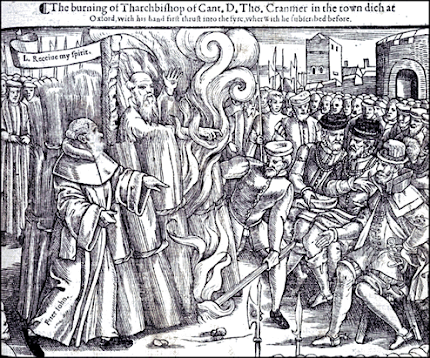
The burning of Tharchbishop of Cant. D. Tho. Cranmer in the town dich at Oxford, with his hand first thrust into the fyre, wherwith he subscribed before. [Click on the picture to see Cranmer's last words.]

Daily Bible Verse

Showing posts with label salvation. Show all posts

Tuesday, March 06, 2012

What Must I Do to Be Saved?

[From the Trinity Foundation.]


What must I do to be saved?

“What must I do to be saved?” is the question the Philippian jailer asked Paul and Silas. Paul and Silas answered with the Gospel: “Believe on the Lord Jesus Christ and you will be saved, you and your household” (Acts 16:30, 31). The Gospel is all of God’s grace and simple, but many stumble on it, for it goes against our desire to do something ourselves to save ourselves. Rather it is Good News, because Jesus has done it all – it is His person and work a person must look to and believe. Jesus is the Son of God, perfect and without sin, who suffered the punishment due to his people on the cross and the wrath of God due to them that they might enter into direct communion with God once again. This substitutionary sacrifice for his people’s sin, foreshadowed in the Old Testament, sealed eternal life through Jesus Christ our Lord for those who believe. What follows gives the Biblical content of what we believe about ourselves, Jesus, and what He did:

What is it a person needs to be saved from? 

(1) The wrath of God due to us because of the guilt of our sin  


For the wrath of God is revealed from heaven against all ungodliness and unrighteousness of men, who suppress the truth in unrighteousness. (Romans 1:18)
And he who does not believe the Son shall not see life, but the wrath of God abides on him. (John 3:36)
And to wait for His Son from heaven, whom He raised from the dead, even Jesus who delivers us from the wrath to come. (1 Thessalonians 1:10)
(2) The consequences of our sin: 


(A) Death  


And the Lord God commanded the man, saying, “Of every tree of the garden you may freely eat; but of the tree of the knowledge of good and evil you shall not eat, for in the day that you eat of it you shall surely die.” (Genesis 2:16, 17)


Therefore, just as through one man sin entered the world, and death through sin, and thus death spread through all men, because all sinned…so that as sin reigned in death, even so grace might reign through righteousness to eternal life through Jesus Christ our Lord…. For the wages of sin is death, but the gift of God is eternal life in Jesus Christ our Lord. (Romans 5:12, 21; 6:23)


Therefore I said to you that you will die in your sins; for if you do not believe that I am He, you will die in your sins. (John 8:24) 


(B) Condemnation  


For God did not send His Son into the world to condemn the world, but that the world through Him might be saved. He who believes in the Him is not condemned; but he who does not believe is condemned already, because he has not believed in the name of the only begotten Son of God. And this is the condemnation, that the light has come into the world, and men loved darkness rather than light, because their deeds were evil. For everyone practicing evil hates the light and does not come to the light, lest his deeds should be exposed. (John 3:17-20)
And the gift is not like that which came through the one who sinned. For the judgment which came from one offense resulted in condemnation, but the free gift which came from many offenses resulted in justification…. Therefore, as through one man’s offense judgment came to all men, resulting in condemnation, even so through one Man’s righteous act the free gift came to all men, resulting in justification of life. (Romans 5:16, 18)
Hear this from the books of Romans and Ephesians:


First the truth about all of us in our lost, sinful condition: 


As it is written: 

“There is none righteous, no, not one;
There is none who understands;
There is none who seeks after God.
They have all turned aside;
They have together become unprofitable;
There is none who does good, no, not one.”
“There throat is an open tomb;
With their tongues they have practiced deceit”;
“The poison of asps is under their lips”;
“Whose mouth is full of cursing and bitterness.”
“Their feet are swift to shed blood;
Destruction and misery are in their ways;
And the way of peace they have not known.”
“There is no fear of God before their eyes.”

Now we know that whatever the law says, it says to those who are under the law, that every mouth may be stopped, and all the world may become guilty before God. Therefore by the deeds of the law no flesh will be justified in His sight, for by the law is the knowledge of sin. (Romans 3:10-20)

And you He made alive, who were dead in trespasses and sins, in which you once walked according to the prince of the power of the air, the spirit who now works in the sons of disobedience, among whom also we all once conducted ourselves in the lust of our flesh, fulfilling the desires of the flesh and of the mind, and were by nature children of wrath, just as the others. (Ephesians 2:1-3)
And now the good news – the Gospel – showing us what God has done in Christ for his people:


But now the righteousness of God apart from the law is revealed, being witnessed by the Law and the Prophets, even the righteousness of God, through faith in Jesus Christ, to all and on all who believe. For there is no difference; for all have sinned and fall short of the glory of God, being justified freely by His grace through the redemption that is in Christ Jesus, whom God set forth as a propitiation by His blood, through faith, to demonstrate His righteousness, because in His forbearance God had passed over the sins that were previously committed, to demonstrate at the present time His righteousness, that He might be just and the justifier of the one who has faith in Jesus. Where is boasting then? It is excluded. By what law? Of works? No, but by the law of faith. Therefore we conclude that a man is justified by faith apart from the works of the law. Or is He the God of the Jews only? Is He not also the God of the Gentiles? Yes, of the Gentiles also, since there is one God who will justify the circumcised by faith and the uncircumcised through faith. Do we then make void the law through faith? Certainly not! On the contrary, we establish the law. (Romans 3:21-31)
But God, who is rich in mercy, because of His great love with which He loved us, even when we were dead in trespasses, made us alive together with Christ (by grace you have been saved), and raised us up together, and made us sit together in the heavenly places in Christ Jesus, that in the ages to come He might show the exceeding riches of His grace in His kindness toward us in Christ Jesus. For by grace have you been saved through faith, and that not of yourselves; it is the gift of God, not of works lest anyone should boast. For we are His workmanship, created in Christ Jesus for good works, which God prepared beforehand that we should walk in them. (Ephesians 2:4-10)
This same God-man conquered death for his people as he rose from the dead the third day, and after teaching and comforting the believers, he ascended into Heaven to sit at the right hand of the Father.


What are you to do? Believe what the Bible says about you – you are a sinner who deserves death and the wrath of God because of your sin. Believe what the Bible says about Jesus and what He did – He is the only begotten Son of God, the eternal Word who became flesh and was sinless and perfect; He was crucified on a cross and died bearing the sins of His people and rose again on the third day. 

For He made Him [Christ] who knew no sin to be sin for us, that we might become the righteousness of God in Him. (2 Corinthians 5:21)
Moreover, brethren, I declare to you the gospel which I preached to you, which also you received and in which you stand, by which also you are saved, if you hold fast that word which I preached to you—unless you believed in vain. For I delivered to you first of all that which I also received; that Christ died for our sins according to the Scriptures, and that He was buried, and that He rose again the third day according to the Scriptures.  (1 Corinthians 15:1-4)
But these are written that you may believe that Jesus is the Christ, the Son of God, and that believing you may have life in His name. (John 20:31)
If you would like prayer or do not have a Bible of your own and wish to receive one (no strings attached) please contact us at The Trinity Foundation, Post Office Box 68, Unicoi, Tennessee 37692, (423) 743-0199 – voice or (423) 743-2005 – fax, or email  trinityfound@aol.com. May it please the Lord to grant you salvation.


Essays for further reading:


--
Glory be to the Father, and to the Son : and to the Holy Ghost; As it was in the beginning, is now, and ever shall be : world without end. Amen.

Thursday, July 16, 2009

Chapter Four: The Teaching of the Articles: III. The Doctrine of Salvation

Part IV

Thirty-Nine Articles: The Historic Basis of Anglican Faith

A book by David Broughton Knox (Sydney: Anglican Church League, 1967). Revised 1976.

The author: Canon David Broughton Knox, B.A., A. L. C. D., B.D., M.Th., D. Phil. (Oxford), was Principal of Moore Theological College, Sydney, Australia. Ordained in 1941 he served in an English parish and as a chaplain in the Royal Navy before becoming a tutor at Moore College 1947-53. On leave in England he was tutor and lecturer in New Testament at Wycliffe Hall, Oxford 1951-53 and Assistant Curate in the parish of St. Aldale's, Oxford. He became Vice Principal of Moore College in 1954 and Principal in 1959. He was elected Canon of St. Andrew's Cathedral in 1960. His other books include "The Doctrine of Faith in the Reign of Henry VIII" (London: James Clarke, 1961).

David Broughton Knox also founded George Whitefield College in South Africa in 1989.


Chapter Four

The Teaching of the Articles

III: The Doctrine of Salvation

The Reformers' great concern was that the Church should know and preach the Gospel of the grace of God. The basis of the Gospel of grace is the doctrine that God has provided a full and complete ground of salvation in the death of Christ. This is affirmed in Article 31 and referred to in Articles 2, 15, and 28. Salvation becomes ours by way of God's promise (based on Christ's death) and our believing the promise. Article 7 refers to the promise; Article 11 refers to our response of faith. This latter Article states that God judges us worthy of ourselves but only on account of Christ's worthiness. Faith is the means by which we participate in this salvation -- faith in God known in the death and resurrection of Jesus. We make no contribution from ourselves to our salvation. From Beginning to end it is of God's grace. Our Justification, or our being accepted as worthy by God, does not wait on any 'work' of ours which we may accomplish in the time-process in which our life is set. It is simultaneous with our apprehension, in the inmost recess of our personality, of the grace of God in Christ and it precedes any action of our will from which 'works' flow. We are saved by God solely on the basis of Christ's 'works' and the means whereby God saves us is our believing His truth.

The knowledge that our salvation is of God and is not suspended, even in part, on the outcome of our own vacillating efforts is a doctrine full of great strength, nerving us to battle and endure for our Saviour even in the face of defeat. Article 11 'Of the Justification of Man', which succinctly states this key doctrine, deserves to be quoted in full. 'We are accounted righteous before God only for the merit of our Lord and Saviour Jesus Christ by Faith, and not for our own works or deservings: Wherefore, that we are justified by Faith only is a most wholesome Doctrine, and very full of comfort, as more largely is expressed in the Homily of Justification.' (The homily referred to is the third of the first book of the Homilies of the Church of England.)


The doctrine of salvation of a sinner entirely by the grace of God greatly enhances our understanding of the love of God, and redounds to God's glory; but it is not a doctrine which would have occurred to anyone if it were not taught in Scripture. All mankind is conscious from time to time of guilt, and it seems natural that the way, if any, to expiate guilt is by some action of our own, perhaps a sacrifice or prayer, perhaps more ascetic and painful action, perhaps reformation of life. But the Reformers saw that the Bible taught that none of these things was the ground, or shared in the ground, of our forgiveness and salvation. However, the biblical doctrine is so strange to our natural ideas, and the activity of our wills as the ground (or contributing vitally to the ground) of salvation is so congenial to human thought, that whenever the Bible is not carefully read and expounded, or whenever it is no longer regarded as authoritative, the Gospel of God's grace is lost (or at least obscured) and no longer has the liberating and exhilarating effect on our life that it should have.


Many of the Articles are devoted to cutting off the ways by which history showed the Gospel of God's grace could be eroded or diluted by the doctrine of salvation by our works. Articles 9 and 10 teach that human nature, since the advent of sin, no longer has the power to enable it to act in a way that is pleasing to God. Article 9 speaks of 'original or birth-sin', that bias of our nature which draws us to act against the will of God known to us in our conscience. God did not create mankind thus and it meets with God's disapproval. This bias towards in remains in us even after our adoption as God's children, so that the apostle Paul can speak of 'the sin which dwells in me' (Romans 7:17 ESV [R.S.V.]) and of the 'flesh' whose desires run counter to those of the Holy Spirit, so that we are not able to do what we would (Galatians 5:17). Such a nature is no satisfactory basis for winning our way to heaven by our own works. We are always in need of forgiveness.

Article 10 speaks of the weakness of our will, which of itself can never choose God. As fallen sinners our nature is self-centred, not God centred; though a moment's reflection shows that this is wrong in a creature -- in a being, that is, who is not self-sufficient but is contingent and dependent, as we know ourselves to be. However, we have not the strength of will to abandon this self-centredness of ourselves so as to become God-centred. Our wills simply serve our nature, which is now self-centred. They cannot change our basic nature. Such being the case, it is impossible that our will should be the means of our salvation.


Articles 9 and 10 make clear that in ourselves there remains no way by which we can begin to return to God. This idea is highly uncongenial to our natural way of thinking. It can only be maintained so long as it is recognized as clearly taught in Scripture, and so long as Scripture in its plain meaning remains authoritative for the Christian.


Article 11 states that the way of salvation is by the merit of Christ, though faith. Article 12 is a postscript to Article 11, explaining the place of good works and Christian conduct. Our salvation is not based on our conduct, but Christian conduct is the consequence of our salvation. Good works are an outward indication of our new relationship to God, 'By them a lively faith may be as evidently known as a tree discerned by the fruit.' However, our conduct is never as perfect as it should be; it can therefore never merit our salvation, for taken by itself it comes short, and so deserves God's condemnation.

If a Christian's life on earth is never free from the taint of the old nature, so that his acceptance with God always depends on his relationship with Christ and never on his works viewed in themselves (so much is stated in Article 12), it follows a fortiori that a man's life before he comes under the leading of the Holy Spirit as a Christian cannot win God's favour. This is stated in Article 13. The teaching of this Article has met with hostile comment in some modern Christian circles. This is through a misapprehension of the meaning of the language of the Article, which must be construed in close connection with Article 12. The latter states that the Christian's imperfect works are only (fully) pleasing to God because they are seen in the context of a Christian's standing in Christ. For in themselves these imperfections call out 'the severity of God's judgement', since God is holy. The imperfect works (and even the best are such) of those as yet outside of Christ do not share in the benefit of forgiveness that is through Christ. It is therefore inevitable that when brought to the bar of God's judgement such works must be described as 'not pleasant to God', for inevitably 'they have the nature of sin'. The Article is concerned to show that sinners cannot in any way merit God's salvation; this remains wholly a gift of God's grace and mercy. Merited salvation is not mercy but reward.


Article 14 makes clear that no Christian can exceed God's requirements, so as to put himself in God's debt. It is directed against the Roman Catholic doctrine of works of supererogation. At first sight it may seem extraordinary that any Christian should think that he can be better than God requires. yet the concept is inherent in salvation by merit. For this implies a standard to be attained, and if this is to be fixed within the capacity of the ordinary Christian to attain, plainly the more saintly can exceed it. The overplus of merit is then available for assignment, by papal indulgence, to penitents whose own merits come short of the standard. The Article, basing itself on Scripture, denies the possibility of exceeding God's requirements and says that the notion cannot be entertained without arrogancy and impiety. [Editor's note: See Luke 17:7-10 ESV].

Article 15 insists that no one but Christ attains to God's requirements. 'All the rest . . . offend in many things.'

Article 16 teaches that no sinner should despair, for there is always a place of forgiveness and restoration for those who repent.

Next Chapter


1662 Book of Common Prayer

Collect of the Day

The Fifth Sunday after Trinity.

The Collect.

GRANT, O Lord, we beseech thee, that the course of this world may be so peaceably ordered by thy governance, that thy Church may joyfully serve thee in all godly quietness; through Jesus Christ our Lord. Amen.

Support Reasonable Christian Ministries with your generous donation.