>

Martyred for the Gospel

Martyred for the Gospel
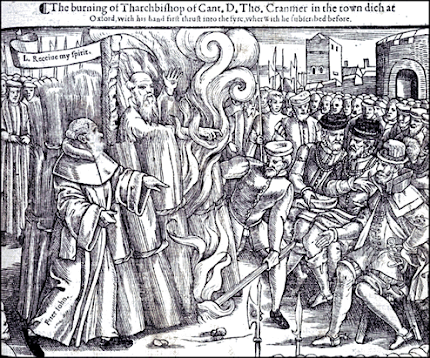
The burning of Tharchbishop of Cant. D. Tho. Cranmer in the town dich at Oxford, with his hand first thrust into the fyre, wherwith he subscribed before. [Click on the picture to see Cranmer's last words.]

Daily Bible Verse

Monday, October 18, 2010

Rand Paul and the Influence of Christian Reconstructionism | Religion Dispatches

Rand Paul and the Influence of Christian Reconstructionism | Religion Dispatches

Rand Paul is a Reconstructionist? The problem with the Theonomy/Reconstructionist point of view is that it has a tendency to confuse the judicial/civil laws of the Old Testament nation of Israel with the moral law. While the ceremonial/sacrificial laws of the Old Testament law have been fulfilled in Christ and the civil/criminal laws of the Old Testament nation of Israel passed away with the passing of that nation, the moral laws of both the Old Testament and the New Testament are still binding upon all men. Christians are not put in right standing by keeping the moral law but by believing in Jesus Christ alone, apart from good works. However, Christians are obligated to live a Christian life that is guided by the Ten Commandments and other moral laws stated in the Bible. No one keeps the moral law perfectly, thus the only way to be justified before God is by the perfect obedience and faithfulness of Christ and by His substitutionary death on the cross in the place of His elect people. Although the following article is posted at liberal/progressive "christian" site, I thought the critique of theonomy/reconstruction was fairly accurate. I do not endorse the theological liberalism otherwise espoused at that site.

Charlie


Rand Paul and the Influence of Christian Reconstructionism

Post by Julie Ingersoll


In April 2009, Republican Senate candidate Rand Paul spoke to the Campaign for Liberty rally to end the Federal Reserve, in front of the Federal Reserve building in Minnesota.

Paul cited libertarian icon Ayn Rand. But he drew on Christian Reconstructionist Gary North. He argued against centralized banking, explicitly not on the grounds that conservatives traditionally have (conspiratorially) but, instead, on the very grounds that North lays out in his book, Honest Money: Biblical Principles for Money and Banking.

In that book, North explains his view that the cause of the international debt crisis of the 1980s was the Federal Reserve System. The solution, he maintained, rested in eliminating that institution and moving to a hard money standard. It sounds familiar to Paul-ites, but for North it is all based in the biblical command to have “just weights and measures.” Paul, in very similar language, attributed our current debt and economic crises to the Federal Reserve and fractional reserve banking.

In the video of his Federal Reserve speech, a supporter behind Paul is holding a sign advocating a gold/silver money standard, with the title of North’s book.

North, the son-in-law of the late Christian Reconstructionist founder R.J. Rushdoony, worked on Rand’s father Ron Paul’s congressional staff decades ago, and remains a supporter of the former presidential candidate, whom he is encouraging to promote a home school curriculum.

The Pauls and North have connections to the Constitution Party, founded by Christian Reconstructionist Howard Phillips, also founder of the 1980s Christian right group the Conservative Caucus. Ron Paul has spoken at Constitution Party events and Phillips has spoken for Ron Paul in favor of his candidacy for president. Rand Paul went on to serve as the keynote speaker at a Minnesota Constitution Party event.

The stated goal of the Constitution Party is to reestablish America as a Republic organized around biblical principles and under the authority of Jesus Christ. An examination of the Constitution Party platform shows clearly the influence of this movement advocating not only positions on numerous issues that have long been developed and promoted by Rushdoony and his followers, but doing so in terms of the reasoning put forth by Reconstructionists.

It’s not only Reconstructionists who hold these views—they share them with the John Birch Society, the Libertarian movement, the Moral Majority, and others. And just because Paul has spoken at Constitution Party events doesn’t mean he supports every facet of Christian Reconstructionism. But Paul’s supporters like to claim he is a man of principle, whose principles are philosophically systematic, and who stands up for what he believes. There is an internal coherence to the positions taken by Reconstructionists and if Rand Paul shares some of their views, as well as the detailed framing of those views, it is worthwhile to better understand his wider belief system.

Reconstructionists criticize the “conflation” of spheres of government. They draw clear distinctions between various forms of government they believe to be delegated by God. There is self-government, and then there are three forms of institutional government: family, church and state. So when the Constitution Party platform uses the phrase “civil government,” it does so to draw a distinction between what the party sees as the mistaken idea that all government is civil government and its view that there are distinct biblical spheres of government—civil government being only one.

The Constitution Party platform opposes marriage and/or legal partnerships for gays and lesbians. No surprise there, but the plank regarding family articulates a notion of family as one of three governing institutions established by God. Likewise, the platform articulates support for Christian schooling and homeschooling. But it does so on the basis of Reconstructionist framing: the family is understood as a form of government, given by God, with a specific sphere of authority that includes the raising of children, without the interference of the civil government. Opposition to welfare, in the platform, is not based in more common conservative view, such as “welfare allows people to be lazy,” or “it’s unfair (or even inefficient) to tax productive people to care for those who are not.” Rather, it is based in the argument that welfare is more properly understood as charity and is legitimately within the authority of the church, not the civil government.

How can they be theocrats and libertarians? This has puzzled those of us who write on Reconstructionists who see evidence of both libertarian and theocratic tendencies. In other words, how can they advocate limited government and, at the same time, application of biblical Law?

An understanding of the subtleties of Christian Reconstruction is really helpful here. For Reconstructionists, the civil government’s authority is limited to protecting citizens from criminals. Family and ecclesiastical authority are established to uphold (and enforce) other aspects of biblical law. That’s not to say that any of these institutions are understood as functioning autonomously; all are under the authority of God and are to function according to biblical law. But each is independent of the others. So for libertarian Reconstructionists (as many of them are) limited government means limited civil government. Their form of libertarianism is distinct from the more libertine versions of libertarianism. They are much better described as theonomic than theocratic.


Sunday, October 17, 2010

Welcome! - The Anglo-Reformed Movement

Welcome! - The Anglo-Reformed Movement

It looks like the Reformation movement among Anglo-Reformed believers is gaining momentum. Hudson Barton has created a website for those interested in becoming part of this ministry for those who are more concerned with preserving the Gospel in the Anglican Communion. Click on the title above to check it out.


Charlie

Modern Roman Catholicism - ReformedForum.org

Modern Roman Catholicism - ReformedForum.org

This podcast discusses the changes that took place in the Roman Catholic Church after Vatican II and how there are as many factions within Roman Catholicism as there are in the Protestant/Evangelical side of Christianity. Postmodernism seems to be alive and well within the Roman Catholic Church, although theological conservatives in the RCC are not comfortable with this state of affairs. Incidentally, the Protestant Reformation and the Council of Trent are still in effect even though some Evangelicals and some Roman Catholics would try to gloss over the differences.


How Do I Know If I Am Elect?

How Do I Know If I Am Elect?

Stephen D. Doe


When people first begin to learn about the biblical doctrine of election, one question that often occurs to them is, “Am I elect?” And the more they think about whether or not they are elect, the more uncertain they become. So, if you believe in the doctrine of election, how do you know if you are elect?

The answer is really quite simple: You continue believing in Christ.

“But,” you reply, “you didn’t answer my question. I want to know if I am elect.”

So I will ask:

  • Do you believe that you have offended the all-holy Creator (Rom. 3:10-18; Ps. 51:1-4)?
  • Do you believe that your sins cry out to heaven itself for justice, and that you deserve to perish under the wrath of the God you have offended by your sins (Isa. 59:2-3; Ezek. 18:4)?
  • Do you believe that you are, in fact, dead in your sins and unable to make yourself alive (Eph. 2:1-3; Rom. 8:5-8)?
  • Do you believe that nothing you could ever do--no good deeds, no mighty acts of faith, no church attendance, no niceness of character will ever be sufficient to appease the wrath of your holy Creator against your sins (Mic. 6:6-7; Isa. 59:12-14)?
  • Do you believe that God, the God you have offended by your sins, has himself provided the way of escape through his Son, the Lord Jesus Christ (Titus 3:5-7; Col. 2:13)?
  • Have you been united to Christ by faith, a faith you did not earn, but received as a gift from God? Do you believe that, having been savingly joined by faith to the Son of God, your sins are finally and fully paid for, and that you are forgiven and declared righteous, as though you had never sinned (Gal. 2:16, 20; Rom. 8:1-4)?
  • Do you believe that, by the grace of God, having turned from your sins and turned to the Son of God to pay for your sins and to give you his own righteousness, you will be received by God as his own dear child, to be loved and blessed by him throughout eternity--that is, that you are saved by God’s unmerited grace (Rom. 3:21-28; 5:1-11)?

If you believe these things, you are exhibiting a key characteristic of the elect: the elect believe the gospel of Jesus Christ and continue in faith. The elect do not focus on their election, but rather on their Savior. The elect are saved from the wrath to come because God has chosen them to salvation through Jesus Christ (1 Thess. 5:9-10; cf. 2 Thess. 2:13). And that is what the gospel promises as well: the one who believes in the Son has eternal life and escapes the wrath of God (John 3:36).

Think back to the day of Pentecost. In Acts 2, we find Peter directing the crowds to consider, not election, but the Lord of glory whom they crucified. The elect will believe the gospel, but the reprobate will turn away from the gospel.

Paul points to the same truth in his great exposition of the blessings of election in Ephesians 1. But note what he says: “For he chose us in him [Christ] before the creation of the world to be holy and blameless in his sight. In love he predestined us to be adopted as his sons through Jesus Christ, in accordance with his pleasure and will” (Ephesians 1:4-5). Paul talks about election with reference to Jesus Christ. And we know Christ through the gospel.

In his book God-Centered Evangelism, R. B. Kuiper uses a wonderfully simple illustration (on page 38). He compares election to the foundation of a house. The foundation is there, essential but unseen. We enter a house, not through the foundation, but through the door. And Jesus Christ is the door. If we would enter the kingdom of God and be saved from our sins, it must be through him (John 10:9). So the Word of God directs us, again and again, to Christ.

We make our calling and election sure (2 Pet. 1:10) by living in the faith that what God has promised to do for those who believe in Jesus, he will most certainly do for us (Rom. 8:28-39; cf. Gal. 2:20; 1 Tim. 1:15). The elect are enabled by the power of God to believe the truth of the gospel, live by its promises, and keep on believing them.

How do I know if I’m elect? Believe what the elect believe, the gospel of God’s saving grace. (Read the Westminster Confession of Faith, chapter 3, section 6; chapter 10, sections 1-3; and chapter 18, sections 1-2.)


Mr. Doe is the pastor of Covenant OPC in Barre, Vermont. Reprinted from New Horizons, December 1999.  [This article was originally posted at the Orthodox Presbyterian Church website at New Horizons].

--
Reasonable Christian Blog Glory be to the Father, and to the Son : and to the Holy Ghost; Answer. As it was in the beginning, is now, and ever shall be : world without end. Amen. 1662 Book of Common Prayer

Wednesday, October 13, 2010

The Trinity Foundation - Pied Piper

The Trinity Foundation - Pied Piper

Re: Top Ten Reasons Why I Am No Longer Pentecostal

Dear Jerry,

In response to your comment about my article, Top Ten Reasons Why I Am No Longer Pentecostal, just let me say that having some ecstatic experience outside of your control does not prove anything, since you yourself acknowledge below that you are no longer a "believer."  So what is the point of claiming your "experience" was genuine when it has only driven you from Christ?  Since nothing you have written below is of a personal nature, I am posting my response on the blog.  Your diatribe against God and His Word deserves a response.  Frankly, I am not in the least interested in hearing your "testimony" or "story" about your excuse for your current state of rebellion against God.  The bottom line is there is no excuse.

Although I understand your frustration with man-made religion, I do not understand how you can translate this into your rebellion against God Himself.  God is not a "religion".  He just IS (Exodus 3:14-15).  Religion is usually man's attempt to reach up to God through man's own sinful thoughts and ways.  But true faith comes from God above and the true "religion" is revealed only in Jesus Christ and in the Holy Scriptures.  All other attempts to reach up to God are just the ways of rebels who think they get to tell God what to do (Isaiah 55:9-11). 

 Long ago, at many times and in many ways, God spoke to our fathers by the prophets, 2 but in these last days he has spoken to us by his Son, whom he appointed the heir of all things, through whom also he created the world. 3 He is the radiance of the glory of God and the exact imprint of his nature, and he upholds the universe by the word of his power. After making purification for sins, he sat down at the right hand of the Majesty on high, 4 having become as much superior to angels as the name he has inherited is more excellent than theirs. (Hebrews 1:1-4 ESV)
You seem to think that you have more authority than the Bible since you, like all rebels, place more faith in yourself and your own experiences than in Jesus Christ or the Holy Scriptures. (Psalm 82:6-8).  The Scriptures are THE standard by which we can know and understand God and His plan for the elect.  If you reject Jesus Christ and the Scriptures, what more can I say to you?

 Do your best to present yourself to God as one approved, a worker who has no need to be ashamed, rightly handling the word of truth. (2 Timothy 2:15 ESV)

 and how from childhood you have been acquainted with the sacred writings, which are able to make you wise for salvation through faith in Christ Jesus. 16 All Scripture is breathed out by God and profitable for teaching, for reproof, for correction, and for training in righteousness, 17 that the man of God may be competent, equipped for every good work. (2 Timothy 3:15-17 ESV)
 

Moreover, Pentecostals in general have no clue as to what the Bible teaches about God's Law, which can only condemn us all as sinners,  or the Gospel, which is God's promises to save the ungodly elect who deserve hell as much as everyone else does  (Romans 4:4-5; Romans 5:6-10).  Salvation is ALL of God's grace and nothing we "do" can save us (Ephesians 2:8-9; Titus 3:5-7).  Salvation is completely and totally a free gift.  Even believing in Jesus is not something we do but is a gift given to us.  Those who do not believe have not been regenerated and given that gift.

That is not to say that you are fenced out of the Gospel.  It just means that until you believe you cannot have any assurance that you have been born again and chosen by God to salvation.

If you think that I'm going to feel badly because you are an apostate from the Christian faith, you are mistaken.  You see simply because you were hurt by the false religion of Pentecostalism is no excuse before God.  All have sinned and fallen short of God's perfect mark (Romans 3:23).  Even those who have never heard the Gospel at all are without excuse.  Romans 1:18-21 says:

 For the wrath of God is revealed from heaven against all ungodliness and unrighteousness of men, who by their unrighteousness suppress the truth. 19 For what can be known about God is plain to them, because God has shown it to them. 20 For his invisible attributes, namely, his eternal power and divine nature, have been clearly perceived, ever since the creation of the world, in the things that have been made. So they are without excuse. 21 For although they knew God, they did not honor him as God or give thanks to him, but they became futile in their thinking, and their foolish hearts were darkened. (Romans 1:18-21 ESV)
If you harden your heart then it is simply God's judgment against you.  If, however, God has mercy on you then He will open your eyes to the fact that the Law of God reveals you are a sinner in rebellion against God and you are His enemy and God is your enemy (John 3:36).  Only when you realize that God owes you nothing but hell, then and only then can you receive the unconditional promises given to believers through the Gospel of Jesus Christ (2 Corinthians 1:20; Matthew 11:25-30).  As long as you continue to make demands of God you remain His enemy and an alien from the citizenship of heaven (Philippians 3:20).

I do pray that God will have mercy on you and give you the grace to believe and to receive the reconciliation purchased for God's elect through the blood of Jesus Christ shed for sinners on the cross.  Once you experience God's unconditional love for His elect, even while they are yet ungodly and in bondage to sin, you will be irresistibly drawn to saving faith (John 6:37-39, 44, 65-66).  However, if you continue to refuse to acknowledge God's just condemnation of you as a sinner and if you refuse the plan of salvation for God's elect in Christ, then the only result of that is your own self condemnation and God's just condemnation of you as a rebel against God (Romans 3:23; Romans 6:23).  The only thing God "owes" you is hell.

It might surprise you to know that having theological degrees does not translate into having a large church or a large income.  I am quite humbly employed, though I do know the Scriptures since I have been reading the Bible since I was eight-years old.   In fact, I cut my teeth on the King James Version.  No one else in my immediate family is a Christian.  I am the only one.  My father died when I was twelve-years-old and left my mother a widow with seven children, of whom I am the eldest.  If anyone should hate God and rebel, it is I.   In fact, I did rebel for many years until I joined a Pentecostal church in my home town.  When I discovered that the Pentecostals were charlatans and false prophets I could have returned to my rebellion.  Instead I kept my faith in Christ and looked for a church that rightly preached both the Law and the Gospel.  There are few if any Evangelical churches that truly "get it".  But that has not stopped me from believing the Holy Scriptures, which are in and of themselves sufficient for salvation.  A true church is one where the Gospel is rightly preached and the two sacraments (baptism and the Lord's supper) are rightly and duly administered.

I do pray that God will soften your heart and open your eyes to the truth (Acts 16:14; Ephesians 1:18).  If not, then the burden of your debt to God remains with you.  I have no power to convert a soul or to save anyone.  Only God can do that.

May God have mercy on your soul,

Charlie J. Ray

 And you were dead in the trespasses and sins 2 in which you once walked, following the course of this world, following the prince of the power of the air, the spirit that is now at work in the sons of disobedience-- 3 among whom we all once lived in the passions of our flesh, carrying out the desires of the body and the mind, and were by nature children of wrath, like the rest of mankind. 4 But God, being rich in mercy, because of the great love with which he loved us, 5 even when we were dead in our trespasses, made us alive together with Christ--by grace you have been saved-- 6 and raised us up with him and seated us with him in the heavenly places in Christ Jesus, 7 so that in the coming ages he might show the immeasurable riches of his grace in kindness toward us in Christ Jesus. (Ephesians 2:1-7 ESV)

 having the eyes of your hearts enlightened, that you may know what is the hope to which he has called you, what are the riches of his glorious inheritance in the saints, (Ephesians 1:18 ESV)
 
XVII. Of Predestination and Election.
PREDESTINATION to life is the everlasting purpose of God, whereby, before the foundations of the world were laid, He hath constantly decreed by His counsel secret to us, to deliver from curse and damnation those whom He hath chosen in Christ out of mankind, and to bring them by Christ to everlasting salvation as vessels made to honour. Wherefore they which be endued with so excellent a benefit of God be called according to God's purpose by His Spirit working in due season; they through grace obey the calling; they be justified freely; they be made sons of God by adoption; they be made like the image of His only-begotten Son Jesus Christ; they walk religiously in good works; and at length by God's mercy they attain to everlasting felicity.
    As the godly consideration of Predestination and our Election in Christ is full of sweet, pleasant, and unspeakable comfort to godly persons and such as feeling in themselves the working of the Spirit of Christ, mortifying the works of the flesh and their earthly members and drawing up their mind to high and heavenly things, as well because it doth greatly establish and confirm their faith of eternal salvation to be enjoyed through Christ, as because it doth fervently kindle their love towards God: so for curious and carnal persons, lacking the Spirit of Christ, to have continually before their eyes the sentence of God's Predestination is a most dangerous downfall, whereby the devil doth thrust them either into desperation or into wretchlessness of most unclean living no less perilous than desperation.
    Furthermore, we must receive God's promises in such wise as they be generally set forth in Holy Scripture; and in our doings that will of God is to be followed which we have expressly declared unto us in the word of God.


Reasonable Christian Blog Glory be to the Father, and to the Son : and to the Holy Ghost; Answer. As it was in the beginning, is now, and ever shall be : world without end. Amen. 1662 Book of Common Prayer

On 10/13/2010 6:58 AM, Jerry Newingham wrote:

I'd love to lay out for you what The Pentecostal Experience did for me, it was devastating to say the least. I've wished I had never had the experience..That experience started me on a long spiral downward.

 Despite all your educational accomplishments and degrees, and your claim to be a former "Charismatic/Pentecostal" yourself, it's very clear to me what you and others posting on your blog have described as their "Pentecostal experience" doesn't in any shape or form, in ANY measure or fashion, even remotely resemble what the experience was for me.

Quite frankly, skimming  through the comments on the subject, I seriously doubt those making the claim of having it, ever really did.

No offense meant, but that includes yourself. And I AM being objective and unbiased. I only have my own experience to measure against, and those experiences posted and mine don't line up at all.

I'm not the least bit religious today. There's just too much nonsense in the Bible taken literally, and it's insane. Too much of it doesn't add up. It isn't rational.

 But that's a different subject.

I wish I could tell you my story, it's nothing like you would expect, but I noticed a neat little stipulation you've made regarding emails, "All e-mails to me are considered in the public domain. I reserve the right to post them on the blog with appropriate theological responses. Anonymous comments may or may not be posted at the discretion of the blog "


Now for me that's just sad..Because for years I've been trying to find an intelligent, unbiased person i could talk to, but it's just about impossible. Not when it comes to Religion. Religious people can't be honest from the get go, because they are functioning from the restricted parameters of their beliefs. Atheists, while far more rational and clear thinking, come up short in being absolutely positive God doesn't exist. Agnostics are just plain wishy-washy. I on the other hand KNOW there's a God, but I think he's insane on a level beyond imagining, comprehension.

 I surely don't want what I share plastered on the internet for anyone and everyone to see. I'm looking for answers, nothing else.

I paused a moment to look back over your list of academic accomplishments. Now that I look further at your qualifications, I realize you're not that person. You're not someone I could talk to. Your beliefs are shaped and locked in to place. You've fenced yourself in with them, and can only filter anything I say to you through them.

I was going to delete this, but I'll go ahead and send it just so you know there's more to the subject of Pentecost, or "Charisma" (Sometimes I want to laugh out loud), with ramifications you haven't considered..

I'll add one more thing, when I had the experience, I didn't work myself into any semi-hypnotic state or suggestive state, or emotional state making me receptive for it to happen. If you want to know the truth, I was damned pissed off at the time. Pissed off, didn't want to be there, and the furthest thing from my mind was falling to the floor on my knees speaking in tongues.

But you ain't the guy for me to open up to, so don't bother responding. I'll keep looking or give it up. I hate dealing with religious people anyway.

Facebook (13) | Mark Butterfield II's Photos - Calvinist Cartoons

Facebook (13) | Mark Butterfield II's Photos - Calvinist Cartoons


Sunday, September 19, 2010

Gaspar Olevian Comments on Calvin's Institutes

Method and Arrangement, or Subject of the Whole Work

[From an Epitome of the Institutions, by Gaspar Olevian.]
IV. Since the Holy Spirit does not ingraft all men into Christ, or endue them with faith, and those whom he does so endue he does not ordinarily endue without means, but uses for that purpose the preaching of the Gospel and the dispensation of the Sacraments, together with the administration of all kinds of discipline, the Creed contains the following article, "I believe in the Holy Catholic Church", namely, that Church which, when lying in eternal death, the Father, by gratuitous election, freely reconciled to himself in Christ, and endued with the Holy Spirit, that, being ingrafted into Christ, it might have communion with him as its proper head; whence flow perpetual remission of sins, and full restoration to eternal life.
In other words, Christ saves the elect through the preaching of the Gospel and through the right administration of the two sacraments of baptism and the Lord's supper.  We ought to remember that being members of a local congregation is essential to spiritual well being.  These days finding a church committed to Scripture and the Reformation is hard to do.

The World's Ruined

The World's Ruined

The Anglican Way by Gerald Bray | Reformed Theology Articles at Ligonier.org

The Anglican Way by Gerald Bray | Reformed Theology Articles at Ligonier.org

Thursday, September 16, 2010

EV News :: Pope Protest Statement in Daily Telegraph

EV News :: Pope Protest Statement in Daily Telegraph

The Protestant Truth Society and Church Society are both protesting the pope's visit to the United Kingdom! Good for them! If only we could get them to protest against the Anglo-Catholics here in the Anglican Church in North America!


Monday, September 13, 2010

Meet Imam Rauf’s Partner, Faiz Khan, 9/11 Truther - The Corner - National Review Online

Meet Imam Rauf’s Partner, Faiz Khan, 9/11 Truther - The Corner - National Review Online

Stephen Charnock: The Moral Nature Does Not Necessarily Prepare for Regeneration

Moral nature seems to be a preparation for grace; if it be so, it is not a cause howsoever of grace, for then the most moral person would be soonest gracious, and more eminently gracious after his renewal, and none of the rubbish and dregs of the world would ever be made fit for the heavenly building. There seems to be a fitness in morality for the receiving special grace, because the violence and tumultuousness of sin is in some measure appeased, the flame and sparks of it allayed, and the body of death lies more quiet in them, and the principles cherished by them bear some testimony to the holiness of the precepts. But though it seems to set men at a greater nearness to the kingdom of God, yet with all its own strength it cannot bring the kingdom of God into the heart, unless the Spirit opens the lock. Yea, sometimes it sets a man further from the kingdom of God, as being a great enemy to the righteousness of the gospel, both imputed and inherent, which is the crown of the gospel: to imputed, as standing upon a righteousness of their own, end conceiving no need of any other; to inherent, as acting their seeming holiness neither upon gospel principles, nor for gospel ends, but in self-reflections and self-applauses. What may seem preparations to us in matters of moral life, may in the root be much distant and vastly asunder from grace; as a divine of our own illustrates it, two mountains whose tops seem near together may in the bottom be many miles asunder.  [From:  A Discourse of the Efficient of Regeneration].

biblical studies center ~ Gallant: No Creed But Christ?

biblical studies center ~ Gallant: No Creed But Christ?


O Timothy! Guard what was committed to your trust, avoiding the profane and vain babblings and contradictions of what is falsely called knowledge - by professing it, some have strayed concerning the faith. Grace be with you. Amen.


1 Timothy 6:20, 21


One Protestant denomination in North America has the actual motto, "no creed but Christ." "No confession but the Bible." In many contemporary church circles, it is an axiom that doctrine divides. Creeds and confessions are foreign to the spirit of the New Testament, we are told.

The most relevant response to the notion of "no creed but Christ" is that this statement itself is a creed! What is a creed? The word creed comes from the Latin credo, which simply means I believe. Those who proclaim "no creed but Christ" presumably believe the slogan, and thus undercut its intended meaning.

Today, "freedom of religion" means that nobody may tell you what to believe or what to disbelieve. Nobody may forbid you to spread your own brand of Christianity. Supposedly, it is not charitable to shoot down questionable doctrines. The main thing is getting along.

In a spiritual climate such as our own, it is important to ask, and answer biblically, the question: Is doctrine important? As important as unity is, the pages of Scripture are very clear that doctrine is very important. In fact, true unity, although it certainly does not imply uniformity at every minor point, is unity in the truth. Unity is founded upon a sharing of sound doctrine.

What is doctrine? It simply means "teaching." When we speak of "the faith," we are speaking of the body of truth contained in apostolic teaching. The divinity of Christ is doctrine. The Incarnation is doctrine. The atonement is doctrine. The believer's union with Christ is doctrine. All of these doctrines are necessary for true faith. The Christian faith is doctrinal: it is based upon real, objective truth. This truth must be vigorously defended: an elder must be "holding fast the faithful word as he has been taught, that he may be able, by sound doctrine, both to exhort and convict those who contradict" (Titus 1:9).

If this is part of the calling of church leadership, we must, at the very least, admit that there are confessional requirements for those who would lead the church.

Some would object that the Bible contains all the doctrine necessary for salvation, and thus further confessions are unnecessary. And although we would agree with the first statement, yet the second does not follow from it. It is altogether true that the Bible is self-sufficient. All that is necessary for life and godliness is disclosed within its pages. However, every pseudo-Christian cult and sect claims to be teaching the Bible. We do not accept a teaching simply because the one who holds it claims to speak for Scripture. Whether our confession is written or not, we, of necessity, judge his confession in terms of our own. Obviously, in such a case we believe our confession to be faithful to Scripture, while his is not. He must demonstrate, doctrinally, that he speaks for Scripture. The only question is, then, whether we will be open and upfront with our confession, stating ahead of time what confession we maintain.

Very early in the history of the Christian church, creeds and confessions of various lengths were formed. Some are quoted in Scripture, especially the pastoral epistles (1 Tim. 3:16; perhaps 1 Tim. 1:15; 2 Tim. 2:11-13). Some were formulated soon after; the so-called Apostles' Creed likely dates back (at least substantially) to the second century. In the centuries that followed, more creeds were written to combat heresy that was creeping into the Church. We think especially of the Nicene Creed, and the Symbol of Chalcedon, which were primarily developed by councils representing virtually all of the Christian Church. These creeds' central purpose was to defend the biblical doctrine of Christ's nature, because Arius and others were teaching heresy under the cover of biblical-sounding language. The Church was serious about her calling which is given in Jude 3: "contend earnestly for the faith which was once for all delivered to the saints."

It is precisely because the Bible is our sufficient manual of doctrine, then, that we hold to confessions. A good confession is good precisely because it is normed and formed by Scripture, and forbids heresy, which contradicts or twists that Scripture, confessing it to be outside the one true faith.

Confessions, whether written or no, are inescapable. The question is not, will we use a confession? There is no possibility of not using a confession, any more than there is a possibility of having no theology. That choice is simply not before us. The question is, will our confession echo Scripture, or twist and deny it? Will it be a good confession or a bad confession?

How will we determine the content of our confessional basis? Clearly, the confession must be derived from Scripture. That is the only way it can have any force. The confession needs to be biblical in order to guard the truth of Scripture.

God has given to His Church limited, but very real, authority. The Church is the "pillar and ground of the truth" (1 Tim. 3:15) - a fact which Paul follows up by citing a contemporary confession of that truth (v. 16). This means that confession is not incidental or optional to the Church. It is the nature of the Church to stand upon a confession of God's Word. The Church, as the pillar and ground of God's truth, has responsibility and authority to maintain the authority of Scripture by maintaining confessions that are formulated in terms of that Scripture.

On the other hand, the confessions, while authoritative, are not themselves the Scripture. The Bible stands over the churches; the confessions do not. The confessions possess authority precisely because the churches possess authority; Scripture possesses authority that is self-authenticating: it is the voice of God. The Bible stands over the churches as God's infallible voice, but the confessions proceed from the Church as man's fallible understanding of Scripture. This distinction is necessary to preserve us from embracing an idolatrous approach to the secondary standards. And it is this distinction which introduces the need for a "sympathetic/critical" approach to the confessions of the Church.

The confessions of the Church stand under the Scripture. This means that Scripture has authority to alter the contents of those confessions. However, this should only be done in the context of a sympathetic understanding of the men who wrote these confessions. This is especially true of confessions that are hundreds of years old, which have withstood the test of time and have guarded the churches for centuries. I think, for instance, of the Belgic Confession, which was formulated in the middle of the sixteenth century, and has served the churches on several continents over a period of four hundred years. We do not pretend it is infallible, but surely, it is the height of presumption to seek to change such a document without a good deal of humility and study, and cooperation among knowledgeable, godly church leaders, who can make decisions on behalf of confessionally-bound churches.

We must remember, confessions are: 1) a declaration of God's truth; and 2) a safeguard against error. If we may change them simply upon our own whims, then they provide no safeguard at all. Likewise, we are charging our spiritual fathers with inability to properly defend and declare the Word of God. It seems to me we ought to be extremely careful about such things. No one individual is greater than the Church. It is true, the majority can be wrong, even among those in authority. But the answer is not individualism, which leads to anarchy. Individualism implies that each person is free to formulate and promote his own confession. He may undermine the teaching of the God-ordained authority of the church. This is not the biblical way, the covenantal way.

God has not left it in the hands of individual Christians to develop and promote their own formulations of Christianity. The Church is the pillar and ground of the truth. The covenant body is charged with defending and proclaiming the one apostolic faith. Those who cannot submit to that faith, that apostolic doctrine, do not belong in the Church of Jesus Christ.

If we are serious about a long-term commitment to defending the faith, we must return to confessionally-based unity. We must protect the pulpits and the pews by confessing the truth of Scripture. Failing this, we are inviting a descent into error and doctrinal apostasy. We are promoting relativism rather than the absolute Truth of God's Word.


From: No Creed But Christ?

Obama's Hypocrisy and Double Standard


Those idiots on CNN don't have a clue. If we applied the same standards to Saudi Arabia, our ally in the Middle East, Saudi Arabia would be a "fundamentalist" Islamic nation. Why? Because Christianity is for all practical purposes against the law in Saudi. Try exercising religious freedom there or evangelizing and see where you wind up! Obama and his cronies are hypocrites who have a double standard.


Sunday, September 12, 2010

Saturday, September 11, 2010

Is President Barack Obama Using the Democratic Principle of Freedom of Religion to Promote Islam and Theological Liberalism?


“We have to make sure that we don't start turning on each other,” Obama said at his first full press conference since May. “And I will do everything that I can as long as I'm president of the United States to remind the American people that we are one nation under God. And we may call that God different names, but we remain one nation.”  President Barack Obama
Looks Mr. Obama thinks that all religions lead to God?  If so, that's religious liberalism.  It is one thing to say that everyone has a right to freedom of religion.  It is quite another thing to say that Muslims, Roman Catholics, Mormons, Buddhists and various other false religions all worship the same God that born again Christians worship.  There is only one God and His name is not Allah.


Friday, September 10, 2010

Re: Ecumenical Liberalism and Religious Hatred

Dear Sarah,

I do not wish to participate in ecumenical liberalism or any idea that all religions lead to God.  Furthermore, it is ironic that the pastor was condemned for exercising his religion freedom while the Islamic fundamentalists are praised and glorified in a monument to their "martyrdom" at the site of ground zero. 

If you really represent peace, then stand against the hate crime committed against the United States on September 11, 2001 and stand against the  mosque being built there.  This response is being posted to my blog to document my objection to this solicitation.

Sincerely yours,

Charlie

Reasonable Christian Blog Glory be to the Father, and to the Son : and to the Holy Ghost; Answer. As it was in the beginning, is now, and ever shall be : world without end. Amen. 1662 Book of Common Prayer

On 9/10/2010 12:23 PM, Cunningham, Sarah wrote:
Hi Charlie,  This is Zondervan author, Sarah Cunningham. A few author and blogger friends and I are putting together a blog campaign to try to spread goodwill via blogs on the anniversary of September 11th (tomorrow). This is to intentionally contrast the hate being spread by some in the name of Jesus. The FBI has issued a nationwide warning for hate crimes suspected on this day. (More info at the link below...)  This page offers links to build an easy post if you can help us. http://www.sarahcunningham.org/uncategorized/join-the-campaign-of-goodwill  Please pass it on. Tension is a great opportunity to speak grace and peace.  Thanks for bringing voice to the faith in our generation.:) Drop me a line anytime! Sarah  Sarah Cunningham Author of Picking Dandelions: A Search for Eden Among Life's Weeds, Dear Church: Letters From a Disillusioned Generation, and contributor to unChristian.  Join us at STORY: www.storychicago.com  

Luther and Justification - For the Life of the World

Luther and Justification - For the Life of the World


The doctrine of justification defines who God is: He is the one who was in Christ reconciling the world; He is the one who justifies through faith in Christ (Rom. 3:26). Therefore any concept of God that denies this and believes in a god who has to be reconciled by what man does is idolatrous, even if it manages to include Christ in its scheme: 'Whoever falls from the doctrine of justification is ignorant of God and is an idolater. Therefore it is all the same whether he then returns to the Law or to the worship of idols; it is all the same whether he is called a monk or a Turk or a Jew or an Anabaptist. For once this doctrine is undermined, nothing more remains but sheer error, hypocrisy, wickedness, and idolatry, regardless of how great the sanctity that appears on the outside.' Therefore the doctrine of justification is rightfully called the articulus stantis et cadentis ecclesiae, the article with which the church stands or falls. This formulation is not Luther's, but he certainly has the content. 'When this article stands, the church stands, when it falls, the church falls.' (WA 40 III, 352, 3).


Southeastern University | Irvin Ziemann

Southeastern University | Irvin Ziemann


Brother Irvin Ziemann was my biblical Greek professor for two years at Southeastern College of the Assemblies of God, now known as Southeastern University, Lakeland, Florida. Brother Ziemann is a truly humble man. He was probably one of two most influential professors in my spiritual formation at Southeastern. The other was my academic advisor and systematic theology professor, Dr. Michael Dusing, who is now the president of Trinity Bible College in Fargo, North Dakota. Although I am no longer Pentecostal, I have fond memories from my experience at Southeastern. In fact, I would credit part of that to Dr. Terris Neuman, who encouraged his students to read the D.R. McConnell book, A Different Gospel. That book forever changed the way I viewed the Charismatic movement and set me on a course toward a firm and solid biblical theology over against experiential theology.

I had been reading the Bible since I was eight years old and I was eager to learn, so naturally I wanted to give my faith a solid grounding and an intellectual foundation. Surprisingly, the intellectual foundations for Pentecostalism were the impetus which pushed me to further study in systematic theology, biblical theology, and confessional theology--all of which directed me toward the Reformed worldview. God is truly Lord of all and is providential in all that happens, including my experience with classical Pentecostal theology at Southeastern College of the Assemblies of God. By the way, one of the required reading textbooks for systematic theology was J. I. Packer's book, Knowing God. What a coincidence? I think not. Knowing that Packer was an Anglican and a Calvinist helped point me to the Anglican Formularies and my conversion to Reformed and Evangelical Anglicanism. Unfortunately, the Anglican Communion at large is mostly apostate for various reasons, but that is another post.

It is odd but I cannot say that I have the same fondness of memory for my experience at Asbury Theological Seminary.

May the peace of God be with you!

Charlie


Thursday, September 09, 2010

The Good Person Test

The Good Person Test

Judicial Warfare: Christian Reconstruction's Blueprints For Dominion, by Greg Loren Durand

Judicial Warfare: Christian Reconstruction's Blueprints For Dominion, by Greg Loren Durand

Does God Need Us? Taking a Hiatus from Blogging

Our sense of self importance is often over-inflated.  At times God reminds us of our temporal limitations in this world and of our impending mortality.  Those reminders occur when there is a calamity that threatens our financial security, our home, our family or our health.  We tend to forget that God is in control of every single detail of every event in our lives and nothing happens apart from His will.


We believe that the same God, after He had created all things, did not forsake them, or give them up to fortune or chance, but that He rules and governs them according to His holy will,1 so that nothing happens in this world without His appointment;2 nevertheless, God neither is the author of, nor can be charged with, the sins which are committed. For His power and goodness are so great and incomprehensible, that He orders and executes His work in the most excellent and just manner, even then when devils and wicked men act unjustly.3 And as to what He doth surpassing human understanding, we will not curiously inquire into it further than our capacity will admit of; but with the greatest humility and reverence adore the righteous judgments of God which are hid from us,4 contenting ourselves that we are disciples of Christ, to learn only those things which He has revealed to us in His Word without transgressing these limits. 

This doctrine affords us unspeakable consolation, since we are taught thereby that nothing can befall us by chance, but by the direction of our most gracious and heavenly Father, who watches over us with a paternal care, keeping all creatures so under His power5 that not a hair of our head (for they are all numbered), nor a sparrow, can fall to the ground, without the will of our Father,6 in whom we do entirely trust; being persuaded that He so restrains the devil and all our enemies that, without His will and permission, they cannot hurt us. And therefore we reject that damnable error of the Epicureans, who say that God regards nothing, but leaves all things to chance. [Belgic Confession:  Article 13, Of the Providence of God.]


1 John 5:17; Heb. 1:3; Prov. 16:4; Ps. 104:9, etc.; Ps. 139:2, etc.
2 Jas. 4:15; Job 1:21; 1 Kings 22:20; Acts 4:28; 1 Sam. 2:25; Ps. 115:3; 45:7; Amos 3:6; Deut. 19:5; Prov. 21:1; Ps. 105:25; Isa. 10:5-7; 2 Thes. 2:11; Ezek. 14:9; Rom. 1:28; Gen. 45:8; 1:20; 2 Sam. 16:10; Gen. 27:20; Ps. 75:7-8; Isa. 45:7; Prov. 16:4; Lam. 3:37-38; 1 Kings 22:34,38; Ex. 21:13
3 Matt. 8:31,32; John 3:8
4 Rom. 11:33-34
5 Matt. 8:31; Job 1:12; 2:6
6 Matt. 10:29-30
Modern Evangelicals tend toward Arminianism and even semi-pelagianism.  But they do not realize that their views on divine providence, that God allegedly leaves many things up to fallen man and to chance, is really deism or epicureanism rather than biblical doctrine.  But the fact is God is in control of every choice we make through secondary means.  In other words, He does not violate our will but yet the choice we make is absolutely certain.  How could God know the future if He is unsure of what choices we will make?  (Romans 1:10, 15:32; 1 Peter 4:19; James 4:12-16).  God even knows every hair on our head and when the sparrow will fall to the ground in death (Matthew 10:29-30).

When unemployment or sickness strikes we ought to continue to trust God even when things seem more difficult than we can bear.  God will never leave nor forsake His people, those chosen from before the foundation of the world (Ephesians 1:4-5, 11; Matthew 1:21; Hebrews 13:5; Joshua 1:5; Psalm 37:25; 2 Corinthians 4:9).  Even famines and natural disasters and wars and terrorist attacks are in God's sovereign control (Isaiah 45:7; Amos 3:6; Ezekiel 23:4, 9;  Deuteronomy 28:49-52).

The LORD your God has been around much longer than you or I have been around.  He does not need you or me to accomplish His will.  He did  quite well before you or I was born and He will do just as well without us.  To say that the Creator is in need of a mere creature to accomplish His will is arrogant and downright dangerous.  On the other hand, God does use us as instruments to accomplish His divine plan.  He works providentially through His appointed means, including the church, the preaching of the word and the adminstration of His two sacraments.  But let us not become arrogant and boastful as if God cannot accomplish His plan without us.  He could cut us off at any moment and be perfectly just in doing so (Romans 11:22; James 4:14; Job 7:7; Psalm 102:3).

You and I need not worry that God will fail simply because He has taken us off the front lines of the battle.  His Word will not return unto Him void but will accomplish that to which He sent it to do:

. . . so shall my word be that goes out from my mouth; it shall not return to me empty, but it shall accomplish that which I purpose, and shall succeed in the thing for which I sent it. (Isaiah 55:11 ESV)
I will be posting only occasionally for a time since my new job will have me out of town and on the road.  This is not to say that I am giving up on my blog ministry but only that I am trusting God to allow me time to post via hot spots and other means.

May God continue to bless the reformation movement in the Anglican Communion.  By this I mean a continuing move toward the theology of Holy Scripture and the Magisterial Protestant Reformation of the 16th century.  Let every Anglican profess the doctrines in the faith confessed by the Thirty-nine Articles of Religion and the 1662 Book of Common Prayer.  May God bless the Heritage Anglican movement in the United States and may His glory be exalted to Him alone!

Wednesday, September 08, 2010

Martin Luther on Standing Against the Pope

"Daily I feel how difficult it is to divest oneself of scruples long entertained. Oh! The pain it has cost me, though with the Scriptures before me, to justify myself to myself, for daring singly to set myself up against the Pope, and hold him as Antichrist! What tribulations have I not suffered! How often have I not addressed to myself in bitterness of the spirit the arguments of the Papists: 'Art thou alone wise? Are all others in error? Can they have been so many years deceived? What if thou deceivest thyself, and draggest along with thee in thy error so many souls to everlasting damnation?' Thus I used to argue within myself until Jesus Christ with His own, His infallible Word, fortified me, and strengthened my soul against such arguments, as a rock raised above the waves laughs their fury to scorn." (Letters, Vol. 2, p. 107.)
From:  Let Luther Speak for Himself.


What Every Catholic Should Know - Main

What Every Catholic Should Know


Trinity School for Ministry - Dr. Ashley Null

Trinity School for Ministry - Dr. Ashley Null: The Classical Anglican Understanding of Salvation

The Real Agenda of Islam: Shari'a Law


Ashley Null Speaks About Pelagianism

Ashley Null: The Constant Danger of Pelagianism

How might we better help people get in touch with their history when very little history is really taught in schools these days?

Well, I suppose one place to start is to help the Church better ...understand the Reformation so that we can tell our story to people more accurately.


The whole point of the Reformation is that the Church shouldn’t put on people burdens that they cannot bear. After all, just because you know something is right, that doesn’t mean you can do it. Apart for  [sic]  (from) the working of the Holy Spirit, our wills are bound to the deceitful devices and desires of our hearts.


Therefore, biblical preaching must always guard against an incipient Pelagianism which would turn God’s promise to renew us into tasks we must perform in order to please him. The Bible clearly states many dos and don’ts for human behaviour. However, just because our minds may understand how a Christian should live, that doesn’t mean that our wills can automatically fall in line.


As I said earlier, reason is not king in human beings, the heart is. Therefore, to change your actions, you must change your desires. But your desires will change, only if the Holy Spirit who wrote the Bible also writes his laws on your heart. Of course, biblical preaching must expound the dos and don’ts faithfully. Yet, if we hold up a standard, but do not make clear the means God has provided by which that standard may be met, we discourage people rather than being bearers of good news.


As we preach, we must constantly remind people that a new way of living is something God has promised to work in us, even as he continues to forgives [sic] (forgive) us our many short-comings along the way. As we preach, we must constantly remind people to turn in Christ through his Word and Sacraments, so that he can make the changes in them that they cannot make on their own. After all, true holiness is actually ever-increasing active dependence on God and his promises.


This Pelagian tendency is the reason why many people find Cranmer’s prayer book off putting. Pelagianism says that repentance is the work you must do to please God. When you abase yourself enough, when you feel guilty enough, when you have changed your ways enough, then God will decide you are worthy of being forgiven, then God will permit you to be called his child. When an Anglican Church preaches Pelagianism from the pulpit, people will hear it echoed in the penitential ethos of Cranmer’s liturgy.


So when the Confession asks people to acknowledge that they are ‘miserable sinners’, they hear, ‘If I grovel enough in self-loathing, then maybe God will accept me’. No wonder some people think that Cranmer’s God wants to make people miserable!


Sadly, that is the exact opposite of what Cranmer intended people to hear. He would want people to understand that repentance is a divine gift which God is pleased to work in them, not their work by which they make themselves pleasing to God. Indeed, they are already miserable because of their sins, but by coming to God they can experience real freedom.


Their sins may have put them under divine judgement and enslaved them to destructive habits which do not satisfy, but God has promised to rescue them. He will do for them what they cannot do for themselves. Because of Jesus, God will pardon them from their sin’s guilt and deliver them from its power. He will draw them into a new way of living, and he will make something beautiful out of the brokenness of their lives. Cranmer’s liturgy focusses  [sic] (focuses) on repentance, because this divine gift is truly good news.


Today our whole culture talks about addictions and how to break their power. The Church, however, often fails to realise that sin is the ultimate addiction, slowly destroying people, even as it draws them further and further away from God and their true selves. Cranmer and his fellow Reformers made no such mistake. They could face up to the gravity of sin, because they realised the superior power of God’s grace.


Human beings may be instinctively addicted to always having to prove their worth, but the cross of Christ shatters that lie. Human beings may fear they can never make the changes in their lives that are expected of Christians, but the Resurrection of Christ conclusively testifies to his power to make all things new. Human beings may feel rootless and estranged, but Christ has promised to prepare an eternal home for his people, even as he prepares them for it.


I think if the Church preaches these Reformations truths, people will hear good news indeed.


Monday, September 06, 2010

Thursday, September 02, 2010

What Is Legalism? by John Robbins

What Is Legalism?

 
John W. Robbins


Legalism is the notion that a sinner can, by his own efforts, or by the power of the Holy Spirit in his life, do some work to obtain or retain his salvation. Some legalists think man has free will and can perform good works if he just sets his mind to it, thereby obtaining the favor of God. This type of legalist thinks that a sinner can believe the Gospel on his own steam. Other legalists think that a sinner does not have free will, that any good he does is done by the power of the Holy Spirit dwelling in him, and it is these good deeds done by the power of the Holy Spirit that obtain or help obtain, retain or help retain, his salvation. Both types of legalists, but especially the latter, may acknowledge that Christ's work of obedience is necessary for salvation, but both deny that Christ's work is sufficient for salvation. Both types of legalists assert that to Christ's work must be added the works of the sinner, done either under his own steam, or by the power of the Holy Spirit. That is what makes them legalists: their shared belief in the incompleteness or insufficiency of the work of Christ outside of them. They may differ on what constitutes good works; they may differ on whether only God's law or church law as well is to be obeyed; but they agree that the work of Christ alone is insufficient for their final salvation.

Against The World. The Trinity Review, 1978-1988. [What Is Faith, John W. Robbins, pg. 121-122] John W. Robbins, Editor. The Trinity Foundation, P.O. Box 68, Unicoi, Tennessee 37692. (423) 743-0199 - FAX (423) 743-2005


Wednesday, September 01, 2010

"Common Grace Considered": The Teaching of "The Well-meant Offer" of Salvation" (42)

"Common Grace Considered": The Teaching of "The Well-meant Offer" of Salvation (42)

Stand Firm | [Bumped For Obvious Reasons] Anglicanism Upside Down Down Under? Understanding Lay Administration

Stand Firm | [Bumped For Obvious Reasons] Anglicanism Upside Down Down Under? Understanding Lay Administration


Looks like Anglo-Catholics are happy as long as the tide is running their way. And Sydney is happy to get along with everyone as long as everyone lets Sydney do their own thing. Of course, Sydney has knifed the Heritage Anglicans in America in the back. Unfortunately sacrificing the Americans has not appeased the almighty and majestic Anglo-Catholics who think they are literally the vicars of Christ on earth.


It's probably unchristian of me to say so, but Mark Thompson, "I told you so!" Although I see nothing wrong with lay presidency over the sacraments from a biblical perspective, it does go against even Evangelical and Reformed tradition to authorize lay persons to do this. Even the 18th and 19th century Methodists had circuit riders for this very reason.


No Wonder the Ugley Vicar is Mixed Up: He's Anglo-Catholic, Sydney Anglican and Evangelical All in One--Is that Possible??

Harmony with Belial? Can Conservative Evangelicals and Traditional Anglo-Catholics really work together?


Personal background

Can a Conservative Evangelical, then, feel any sympathy for or make any conciliatory gestures towards Anglo-Catholicism? At this point, a bit of personal background is relevant.

My own upbringing was orthodox Anglo-Catholic. And although my home church of St Luke’s Charlton has since shifted in a decidedly Liberal direction, I was brought up by people who, when they said the Creeds, believed what they were saying, without reserve or compromise.

My conversion to Christianity took place at the beginning of my final year at University, through the influence of the Christian Union, but I never felt the need to reject my early upbringing, which taught me much of what I needed to know.

Subsequently, my Christian path led through the Charismatic movement in the seventies and eighties and finally settled as Conservative Evangelical in the mid eighties.

And the seal was put on all this when I was able to spend a year at Moore Theological College in 1993, studying for a post-graduate diploma in theology. This not only gave me a much deeper (and, incidentally, broader) theological education but gave me first hand experience of Sydney Anglicanism.


The above is from John Richardson, owner of The Ugley Vicar blog.

YouTube - Alice Cooper on The Hour with George Stroumboulopoulos

YouTube - Alice Cooper on The Hour with George Stroumboulopoulos


YouTube - R.C. Sproul and Alice Cooper

YouTube - R.C. Sproul and Alice Cooper

YouTube - Alice Cooper on being a Christian

YouTube - Alice Cooper on being a Christian

While Alice Cooper's background seems to be Arminian, it does seem that he has a credible testimony to conversion. As I have said many times before, we ought not to follow celebrities. Christians can and do fail. We should follow Christ who lived a sinless life for us and died for our sins on the cross. The good thing about this is Alice says, "I'm not going to become a car salesman." I think Alice Cooper is probably one of the most solid celebrity Christians I have heard. This is a must hear testimony.


Support Reasonable Christian Ministries with your generous donation.