>

Martyred for the Gospel

Martyred for the Gospel
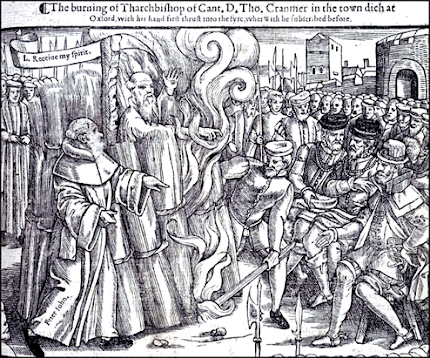
The burning of Tharchbishop of Cant. D. Tho. Cranmer in the town dich at Oxford, with his hand first thrust into the fyre, wherwith he subscribed before. [Click on the picture to see Cranmer's last words.]

Daily Bible Verse

Showing posts with label Biblical Inerrancy. Show all posts

Wednesday, February 12, 2025

Update: Biblical Inerrancy


I recently posted an updated editor's note on an old post here:

[Editor's note:

Since I wrote this article, I came to a different conclusion.  Apparently, 1 John 5:7 does have several Byzantine texts supporting that reading.  See:  First John 5:7.  The article is written by a proponent of the reasoned ecleticism approach to textual criticism.  Notice that he deceptively mentions that only one Byzantine manuscript dating to 1352 A.D. contains the Comma Johanneum "in the text."  But then he acknowledges several other ancient mss where it is included in the margins of the page.  This could happen as a commentary on the text.  That's what the textual critics want you to believe.  But is this a common practice in those mss where it is written in the margins?  No one comments on that aspect of the evidence.  The other possibility is that the scribe accidentally left that part of the verse out and it was written in later in the margins.  Remember that there was no verse numbering at that time yet.  The bottom line here is that the Westminster Confession 1:8 referred to providential preservation of the Masoretic Text and the Textus Receptus as the original languages that were to settle all matters of faith and practice.  I recommend reading the Reformation Bible Society's position on providential preservation.  February 12, 2025.]

You can read the original article with the editor's note here:  


Biblical Inerrancy, Plenary Verbal Inspiration, and Textual Criticism: Is There an Apparent Contradiction?


Friday, October 18, 2024

Logical Problems with Textual Criticism as Related to Biblical Inerrancy


Logical Problems with Textual Criticism as Related to Biblical Inerrancy


The ongoing disputes between the reasoned eclecticism text critics and the Byzantine Majority text critics has led to something of a comeback of the defense of the traditional and confessional view that the Masoretic Text and the Textus Receptus is the best representation of what the original autographs contained.  Some in the modern textual criticism camp, also known as reasoned eclecticism, have accused the confessional view supporters of being part of the King James Only controversy.  However, the confessionalists uphold only that the Westminster Confession of Faith affirms that the original Hebrew and Greek texts are the authentically preserved copies of what the original autographs contained:


VIII. The Old Testament in Hebrew (which was the native language of the people of God of old), and the New Testament in Greek (which at the time of the writing of it was most generally known to the nations), being immediately inspired by God, and by his singular care and providence kept pure in all ages, are therefore authentical;(a) so as in all controversies of religion the Church is finally to appeal unto them.(b) But because these original tongues are not known to all the people of God who have right unto, and interest in the Scriptures, and are commanded, in the fear of God, to read and search them,(c) therefore they are to be translated into the vulgar language of every nation unto which they come,(d) that the Word of God dwelling plentifully in all, they may worship him in an acceptable manner,(e) and, through patience and comfort of the Scriptures, may have hope.(f) 

[Westminster Confession of Faith.  Chapter 1.  Of the Holy Scripture.  Paragraph VIII.]


The recently formed Reformation Bible Society is in agreement with the Trinitarian Bible Society on the doctrine of the preservation of the authentical text.  The apparent controversy also includes the fact that the Reformation Bible Society and the Trinitarian Bible Society both prefer the authorized King James translation of the biblical texts.  Furthermore, the RBS and the TBS both affirm the Bomberg edition of the Masoretic Hebrew text and the Scrivener’s edition of the Textus Receptus Greek New Testament as the authoritative biblical texts.  There are very few differences between the Stephanus edition of the Textus Receptus and the Scrivener’s edition.  There are also a few minor differences between the Biblia Hebraica Stuttgartensia edition of the Hebrew Old Testament and the Bomberg edition, which dates to the Reformation period.

However, I wish to discuss the more pressing issue of biblical inerrancy in regards to these disputes.  This problem also relates to the dispute about the archetypal knowledge of God, known only to Himself, and the ectypal knowledge of God as it is revealed to humanity.  Suffice it to say that biblical revelation or special revelation is in the ectypal realm of epistemology.  The dispute between the late Dr. Gordon H. Clark and the late Dr. Cornelius Van Til had to do with this issue, although Gordon Clark never directly addressed the archetypal/ectypal distinction.  Clark’s view was that the Bible is univocally the very words of God, while Van Til argued that the Bible is only analogically the inspired word of God.  I have written numerous articles on my blog on this topic, so I will not go into great detail here.  Clark’s major concern was that the theologians in the Van Til camp had unwittingly crossed over into the liberal views promoted by neo-orthodoxy and Barthianism.  Emil Brunner was also a controversial theologian of neo-orthodoxy, though he disagreed with Barth’s rejection of natural revelation.

A further bit of information about Dr. Gordon H. Clark is that he was one of the founders of the Evangelical Theological Society in 1949.  In more recent times some critics of the society have said that the requirement of a commitment to biblical inerrancy to join the ETS is not meaningful because there is no other doctrinal statement to affirm in order to become a member.  The official doctrinal basis is stated as,

“The Bible alone, and the Bible in its entirety, is the Word of God written and is therefore inerrant in the autographs. God is a Trinity, Father, Son, and Holy Spirit, each an uncreated person, one in essence, equal in power and glory.”

[The Evangelical Theological Society.]

In fairness to Dr. Clark and the other founders, at the time of the establishment of the ETS, there were far less doctrinal differences between supporters of biblical inerrancy than what exists today.  Unfortunately, some modern members of the ETS society are less than orthodox by some accounts.  Moreover, a weakness of the Reformation Bible Society is that there is no mention of any requirement to affirm biblical inerrancy, since none of the required confessional statements mention inerrancy specifically.  The perceived advantage of limiting the ETS statement to biblical inerrancy and the trinity was perhaps misplaced.  However, the knife cuts both ways; The Reformation Bible Society should have some requirement for adherence to the fundamentals of the Evangelical faith in addition to the confessional requirements.  This is true because at the time of the Westminster Confession of Faith and other confessional statements plenary verbal inspiration and biblical inerrancy were not the issues that they are today.  In short, the problem goes way beyond the dispute over the providential preservation of the original autographs in the extant apographs.  The inspiration and the infallibility and the inerrancy of Scripture are at stake as well.

The accusation of some opponents of the Trinitarian Bible Society and the Reformation Bible Society that the two societies are essentially KJV only advocates is misleading.  The reason is that the KJVO or King James Only movement affirms that the KJV is an inspired and inerrant translation of the Bible from the original Hebrew and Greek.  The RBS and the TBS societies do not make that assertion.  They affirm that the Masoretic Text and the Textus Receptus authentically preserve the original autographs.  But even this distinction avoids a problem of all three major Evangelical positions.  The three major positions are:  1)  reasoned eclecticism;  2)  reasoned majority text reconstruction; and 3) the providentially preserved and authentical Hebrew and Greek manuscripts.  The problem of all three positions is that if only the original autographs--which no one possesses today--are the inspired autographs, then it logically follows that nothing we have today is the exact reduplication of the original inspired and inerrant autographs, including the “authentical” text. 

Although the confession affirms that the authentical text has been kept pure in all ages, it does not show how that reduplicates the originally inspired autographs.  By all accounts, there are minor differences or variants even between the Bomberg Masoretic Text and the later editions based on the Leningrad Masoretic Text such as the Biblia Hebraica Stuttgartensia.  Critics of the Textus Receptus have pointed out that there are several different editions dating back to the Complutensian Polyglot of 1514 and at least 5 editions of Erasmus’ Textus Receptus.  (See: Editions of the Textus Receptus.)   Additionally, there are variants between the many editions of the Textus Receptus of the Greek New Testament.  (See:  Variants between the Textus Receptus and the KJV.  See also:  TR variants.)

The problem here is that if we are to affirm the plenary verbal inspiration of the Bible and the inerrancy of the Bible, there are obviously spelling differences at a bare minimum, not counting the variations in wording.  The Bible obviously implies that there are no spelling errors in the text:

For verily I say unto you, Till heaven and earth pass, one jot or one tittle shall in no wise pass from the law, till all be fulfilled. (Matthew 5:18 KJV)

There are fewer variants in the editions of the Hebrew Masoretic Text, but variants do exist.  I do not have access to a Bomberg edition of the Hebrew Masoretic Text.  However, in the textual apparatus of the Biblia Hebraica Stuttgartensia there is a textual variant that supports the King James translation of Psalm 22:16.  Liberal critics have often attacked the KJV as using the Septuagint translation of the verse to support the prophecy of the crucifixion.  However, the variant reads as a verb for pierced rather than the word for lion.  The difference is between a yod, which would make the word mean lion, and a waw, which would render the Hebrew word as a verb, meaning pierced or dug. 

(Ps. 22:17 WTT)  כִּ֥י סְבָב֗וּנִי כְּלָ֫בִ֥ים עֲדַ֣ת מְ֭רֵעִים  הִקִּיפ֑וּנִי כָּ֜אֲרִ֗י יָדַ֥י וְרַגְלָֽי׃

The apparatus for the BHS lists this variant from the second edition of Kennicott, which is from the Bomberg edition of the Hebrew Masoretic Text:  כארוּ

Most of this evidence points to the fact that no one today has any original copy of the autographs.  Therefore, there must be a decision made as to the standard text of the Hebrew and Greek Bibles used for translation.  The Westminster Confession of Faith 1647 seems to indicate that that would be the first editions of the Masoretic Text available in that time and the editions of the Textus Receptus available to the Westminster divines of that period.  The variants in these editions are much fewer in number than either the reasoned eclecticism view of the modern textual critics or the Byzantine Majority approach of Maurice Robinson and William Pierpont.  In short, the critics who say that the KJV utilized the Greek translation of the Old Testament called the Septuagint or LXX to translate Psalm 22:16 are wrong.  The Bomberg edition of the Masoretic Text shows clearly that the KJV translators used only the Masoretic Text for the translation of this verse.

Furthermore, I would conclude that everyone involved in all three major positions are evading the fact that they are starting with unproved starting points.  Dr. Gordon H. Clark called these axioms.  He once said that everyone is a fideist.  By that he meant that everyone has presuppositions or unproved starting points.  Some critics call this circular reasoning.  But if so, then everyone is guilty of circular reasoning at some point in their arguments.  Clark was simply being honest.  Also, Clark once asked the question that if the atheist or the liberal has unproved starting points, why criticize the Christian for starting with the Bible as the main axiom?

Most critics of the late Dr. Gordon H. Clark’s apologetics fail to make a crucial distinction between his theological arguments and his apologetical arguments.  In some instances, Clark, utilizing his training in philosophy, uses a socratic method of argument.  In such instances, Clark liked to use the reductio ad absurdum approach.  This approach reduces the opponent’s objections to absurdity.  While Clark did not always build his own case to a point of undeniable proof, he was often successful at showing how the other side was blatantly contradictory.  On the confessional and fundamental doctrines and theology of the Christian faith as a system of propositional truth, Dr. Clark was without doubt extremely orthodox.  Clark, however, admitted that he sometimes made mistakes in logic.  Apologetics can get extremely detailed.  Clark liked to point out that there are many battle fronts in a war.  Not every individual can fight every battle front; so, there are limitations on what one person can do in one lifetime.  This does not even touch on the fact that many persons change their views on particular issues over time.  This was true of the church father, Augustine of Hippo, as well; his Retractions are evidence of this.

The short answer to all of this is that the Scriptures are self-authenticating.  In other words, it is a matter of faith to believe that what you are reading is God’s inspired, inerrant and infallible word.  The Westminster Confession of Faith says as much:

V. We may be moved and induced by the testimony of the Church to an high and reverent esteem of the holy Scripture;(a) and the heavenliness of the matter, the efficacy of the doctrine, the majesty of the style, the consent of all the parts, the scope of the whole (which is to give all glory to God), the full discovery it makes of the only way of man’s salvation, the many other incomparable excellencies, and the entire perfection thereof, are arguments whereby it doth abundantly evidence itself to be the Word of God; yet, notwithstanding, our full persuasion and assurance of the infallible truth, and divine authority thereof, is from the inward work of the Holy Spirit, bearing witness by and with the Word in our hearts.(b)

Westminster Confession of Faith:  Chapter 1, paragraph 5.  Of the Holy Scripture.

Notice here that the testimony of the church moves us to this conclusion.  Also, we learn from reading the Bible that the doctrine is efficacious.  The style is majestic.  All of the parts of Scripture consent to a unity, a scope of the whole.  “Notwithstanding, our full persuasion and assurance of the infallible truth, and divine authority thereof, is from the inward work of the Holy Spirit, bearing witness by and with the Word in our hearts.” 

Dr. Clark was once asked how the Christian knows that the Bible is the Word of God and not the Koran?  His answer was that the Christian has been born again and the Muslim has not been born again.  Can we prove any of this using evidentialism, empiricism, or unregenerate reasoning?  The answer is obviously no.

Herein lies another problem for the reasoned eclecticism utilized by Dr. James White, Dr. Daniel Wallace, and others.  The problem is that they are placing another authority above Scripture, namely the alleged “science” of textual criticism.  Is the Christian supposed to suspend his or her faith commitments in order to prove or disprove the portions of the Bible that critics question?  If so, then the Bible itself is always subject to question.  If there are one or two errors in the Bible, then the entire Bible is in question.

This raises another question:  which Bible translation is self-authenticating?  I for one do not trust the reasoned eclectic approach to Scripture.  I read mostly the New King James Version or the King James Version of the Bible.  That’s because the authorized King James Version has stood the test of time, despite some translation issues here and there.  Why would I trust a translation that has to constantly be revised according to an ever-changing science of textual criticism which never arrives at the truth?  Why presuppose that there are errors in the Bible?  A believer should instead presuppose that the Bible is God-breathed, without error, and infallible in every doctrinal point, especially the doctrine that God is the ultimate author of every single word of it.  Does the plowboy or the housewife need to read Greek and Hebrew or study textual criticism?  I doubt it.  Instead of questioning everything as James White and Dan Wallace does, why can’t we just presuppose that the confessional view established in Westminster Confession chapter 1 is true?  In that case, we need not consult modern translations to find out what the NKJV or the KJV and other translations based on the confessional view got wrong.  Presuppositionalism does not need to prove that the Bible is true.  Although technically speaking no translation is totally without error, we can trust that insofar as the KJV is faithful to the authentical texts in the Masoretic Text and the Textus Receptus it is the inspired and inerrant word of God for the reader.  The KJV is an acceptable translation for public preaching and teaching.

At some point the Christian must move on from evidentialism to a position of being convinced that the Bible is the inspired Word of God.  Without the Bible there is no Christianity at all.


The words of the LORD are pure words: as silver tried in a furnace of earth, purified seven times. 7 Thou shalt keep them, O LORD, thou shalt preserve them from this generation for ever. (Ps. 12:6-7 KJV)

In a future post I will examine the Chicago Statement on Biblical Inerrancy and point out what I think are weaknesses or errors in that document.  There needs to be more clarification on the doctrines of preservation, inspiration, and the infallibility and inerrancy of Scripture.


Thursday, October 03, 2024

Divine Simplicity, Incomprehensibility, Thomistic Dualism and Biblical Inerrancy

". . . 'The supreme Judge by which all controversies of religion are to be determined . . . can be no other but the Holy Spirit speaking in the Scripture.'  

"Unfortunately the visible churches that have descended from the Protestant Reformation, especially the larger and wealthier denominations, have to a considerable degree repudiated the Bible."

Gordon H. Clark.  What Do Presbyterians Believe?  pp. 24-25.

All scripture is given by inspiration of God, and is profitable for doctrine, for reproof, for correction, for instruction in righteousness: (2 Tim. 3:16 KJV)

Recently, I was listening to several YouTube videos on the issue of divine simplicity.  It became apparent to me that the Thomistic doctrine has a problem that Dr. Gordon H. Clark called a dual view of truth.  Most of the advocates of the modernized doctrine of divine simplicity have over-emphasized the transcendance of God to the point that nothing can be known of God's archetypal knowledge whatsoever.  Divine simplicity's most basic assertion is that all that is in God's archetypal being is God himself.  The attributes of God are therefore only identifiable from below or from an ectypal understanding of God. 

The Westminster Confession of Faith does indeed insist that God is not a collection of parts or a composite of parts.  The problem, however, is when these same theologians say that God's mercy and God's wrath are the same thing.  God is love.  (1 John 4:7-8).  Is God's love really the same thing as God's justice and God's wrath?  I don't think so.  But does the doctrine of divine simplicity entail that distinctions cannot be made in God's being without His being a composite of parts?  Dr. Gordon H. Clark defined God as the system of propositions that God thinks.  Within the Godhead or divine essence there are three distinct Persons: Father, Son, and Holy Spirit.  All three Persons are the same God.  If we take the divine simplicity model too far, that would imply that Cornelius Van Til's view of God as both one Person and Three Persons would not matter.  All that is God is God.  This would entail direct contradictions in the Godhead.

Although God is a simple Being, who cannot be divided into composite parts, does this mean that God cannot be defined?  If so, then we have a problem with Scripture, because it is from the propositions in the Bible that we know anything about God at all.  This raises another question.  Is God incomprehensible?  Before we can answer the question, the word "incomprehensible" must be defined.  Dr. Clark defined the word as immeasurable, not unknowable.  Typically, the neo-orthodox view has it that God is so totally transcendent that He cannot be known except through an existential encounter, not through a rational understanding of information in the Bible:

". . . Schleiermacher, Ritschl, and modernism substituted religious experience for the Word of God.  The neo-orthodox also deny the truth of the Bible and substitute something called an existential encounter.  They fail to tell us how this experience determines the number of the sacraments, the mode of baptism, the principles of church government, or even the doctrine of the Atonement. Without such information controversies of religion can be settled only by majority vote, that is, by the whims or ambitions of ecclesiatical politicians.  No wonder there is talk of church union with Rome.  Without information from God, men are left to their own devices."  

Dr. Gordon H. Clark.  What Do Presbyterians Believe?  The Westminster Confession Yesterday and Today.  1965.  (Trinity Foundation:  Unicoi, 2001).  P. 25. 

Frances Turretin did articulate a distinction between the archetypal and ectypal knowledge of God.  I cannot remember exactly what Gordon Clark said about this distinction, so that will have to wait for another blog post.  However, Clark and Cornelius Van Til had a serious disagreement over whether or not God's knowledge and our knowledge coincide at any single point.  Van Til said no, and Clark said yes.  In fact, Clark went further than that and insisted that the Bible is univocally the very words of God in a logical and propositional form.  Van Til, on the other hand, following Turretin and Aquinas, insisted that God's archetypal knowledge and our ectypal knowledge do not coincide at any single point.  Clark, utilizing the illustration of geometry, insisted that parallel lines continue into infinity and into eternity in both directions without ever intersecting at any single point.  Following this logic then, there could be no coincidence at any single point between God's knowledge and our knowledge whatsoever.  The implications of a Thomistic dualism, then, would be that the Bible is not really God-breathed or even the Word of God.  It could only be a human book based on human logic and a human existential encounter with God.  In other words, it would mean that only God knows any divine information, and this information is known only to God in His archetypal knowledge.

I have even heard Dr. James White say that only God knows what the original autographs say, and God knows this in His archetypal knowledge.  The problem here involves the doctrines of both divine inspiration and biblical inerrancy/infallibility.  If the Bible is merely a human book on the ectypal level, then it logically follows that it could contain errors.  The problem is even worse when we consider the issue of reasoned eclecticism in regards to the textual criticism of both the Old Testament and the New Testament.

Even Dr. Richard Mueller has not taken such a strong stance against any interaction between God's archetypal and God's ectypal knowledge:

The issue, here, is a direct reflection of the language of the Reformed prolegomena: the ultimate and therefore perfect archetypal theology is identical with the divine mind—all other theology is, at best, a reflection of this archetype, a form of ectypal theology. Ectypal theology in the human subject (in all systems of theology!) is not only finite and reflective but also limited by human sinfulness and by the mental capacities of the theologian.165 The human author of theology, thus, has little intrinsic authority. If theology is to be authoritative, its source (other than the mind of the theologian) must carry authority with it. That source cannot be the divine archetype, but it must stand in a more direct relation to that archetype than any utterly human effort: the doctrine of inspiration leads, therefore, in many of the orthodox systems, directly to the doctrine of the authority of Scripture.

Muller, Richard A. Post-Reformation Reformed Dogmatics: The Rise and Development of Reformed Orthodoxy;  Volume 2: The Cognitive Foundation of Theology. 2nd ed. Grand Rapids, MI: Baker Academic, 2003. Print.  Page 261.  [Emphasis is mine.]


The point here is that if the archetypal knowledge of God is known only to Him, how could ectypal knowledge be a reflection of what is totally unknowable?  Gordon H. Clark distinguished between God's intuitive knowledge and human discursive knowledge.  He also agreed with the proposition that the noetic effects of sin causes errors in logic and, most likely, in theology as well.  But is it really true that 2 + 2 = 4 is the same thing as God's love in God's archetypal knowledge?  How do you know? 

Now, as this relates to the issue of biblical inspiration and biblical inerrancy/infallibility, I would like to raise the problem of textual criticism, reasoned eclecticism, and presuppositional apologetics.  I will delve more into this issue in future posts.  However, for now I would like to ask a few questions.  If the original autographs are only a reflection of the archetypal knowledge of God and can only be known through ectypal reflection and condescension to the human level, and if we do not have the original autographs, does it not follow that there are at least two problems with the doctrine of biblical inspiration and biblical inerrancy?  First of  all, if we do not have the original autographs, we are left with either a reasoned eclectical reconstruction of the autographs by way of a fallible "science" of textual criticism, or we are left with an equally reasoned reconstruction of the autographs from the extant Byzantine majority texts.  Thus, both the critical eclecticism and the reasoned Byzantine text reconstruction are based on some form of textual criticism.  Both positions argue that the Masoretic Text of the Old Testament and the Textus Receptus of the New Testament are flawed.  

So, that logically means that no manuscripts extant today are without error.  How then can a theoretical biblical inerrancy exist at all?  Logically, it must be as unknowable as God's archetypal knowledge.  In that case, Bart Ehrman's argument that the autographs cannot be reconstructed must be true.  James White has argued that the autographs are available in the critical apparatus of the eclectic editions of the Greek New Testament.  But does this not lead to a form of relativism where the informed reader of the critical editions of the Greek New Testament picks and chooses which variant is the original?  Absolute truth is unchanging, yet we have a constantly changing series of translations based on an ever-changing eclectic Greek New Testament.   And, as Maurice Robinson has noted, the reasoned eclectic approach often stitches together disparate fragments to produce a text that does not exist in any extant manuscript of any kind.  The options keep changing from one variant to the next in a constant flux of possibilities, which leads to relativism, not certainty.

But is there another option?  Gordon H. Clark proposed that Scripture is the axiom of Christianity.  Without the Bible there is no basis for Christianity at all.  But more about this in a future post.


Thursday, July 25, 2024

Textual Criticism: The New Attack on the Inerrancy and the Infallibility of Scripture


"The fully developed liberal theologian could very well admit that Scripture itself asserts its own inerrancy. But then add that this is just another of the long list of Scriptural blunders. The theologian who has just begun to the edge away from the position of historic Protestantism and still wishes to be known as an evangelical, is more cautious. He is not willing to speak of a long list of Scriptural blunders. He has only two or three difficulties. Two or three insignificant places where the Bible has unfortunately missed the exact truth. But let me point out, with force, that the theological position is the same in both cases." 

"Whether the list of blunders is long or short., both these theologians contradict Christ who said, 'The Scripture cannot be broken.' The liberal and the pseudo­-evangelical both repudiate Christ as well as the Scripture."  Dr. Gordon H. Clark. 

[From a lecture given, "The Inerrancy of Scripture."] The Sermon Audio version is available here:  The Inerrancy of Scripture.]

Westminster Confession of Faith  1:8

The Old Testament in Hebrew, (which was the native language of the people of God of old,) and the New Testament in Greek, (which at the time of the writing of it was most generally known to the nations,) being immediately inspired by God, and by his singular care and providence kept pure in all ages, are therefore authentical . . .

Ever learning, and never able to come to the knowledge of the truth. (2 Tim. 3:7 KJV)

O Timothy, keep that which is committed to thy trust, avoiding profane and vain babblings, and oppositions of science falsely so called: 21 Which some professing have erred concerning the faith. Grace be with thee. Amen. (1 Tim. 6:20-21 KJV)

The Evangelicals who accept the "science" of textual criticism and who still affirm the doctrine of biblical inerrancy have a major problem.  The problem that should be apparent to everyone is that only the original autographs are the infallible, inerrant and absolutely inspired words of God.  No one is willing to take on this problem honestly.  Instead, what we get are clever dodges and evasive maneuvers.

Translations are not the exact inspired and inerrant words of God. Even the original Reformers and Puritans acknowledged that in all matters of doctrinal dispute we are to appeal to the original languages in the Greek and Hebrew manuscripts behind the text of cross-cultural translations, including English and the many other languages around the world.  A further problem is that we cannot reconstruct the original autographs using modern textual criticism.  I say this because obviously the presupposed axioms of the textual critical methods are unproven starting points which may or may not be accurate to the truth.  In short, textual criticism is a highly subjective and fallible process which is prone to errors of speculation and presumption.

Even the late Dr. Gordon H. Clark was not immune to this problem.  Anyone who has read his commentaries can see that he appealed to the textual critical apparatuses of the critical editions of the Greek New Testament.  But did he continue to follow that line of thought in his later years?  I would argue that he did not; because in his later years, he began to gravitate toward the Byzantine Majority Text as the basis for Scripture translations.  I would argue that he would have eventually come around to the confessional view advocated by the Reformation Bible Society.  Clark insisted that the Westminster Confession of Faith was the best summary of the Bible ever produced.  (See also:  WCF 1:6).

The confessional view basically says that the original autographs cannot be reconstructed, as even most of the modern textual critics, including Bart Ehrman acknowledge.  Evangelicals like James White and Daniel Wallace clearly lost their debates with Ehrman, both of which are posted on YouTube.  You can look them up for yourselves.

So where does that leave us?  James White insists that we can reconstruct the original autographs.  But he is duplicitous and equivocates on this point.  He also insists that only God in His archetypal knowledge knows what the actual canon of Scripture is and what the original autographs contained.  Yet, White loudly asserts that we have the original autographs in the many variants exant today.  This is obviously a contradiction.  Either we have the original autographs or we do not.  We do not.  So any reconstructed edition of the critical Greek New Testament is a matter of scholarly opinion, not an infallible and inerrant reconstruction of the original text of the New Testament.  The same can be said about the Old Testament Masoretic Text, which has problems of its own.

Also, White likes to disparage his opponents as King James Only.  That's basically the fallacy of the abusive ad hominem and gaslighting.  Dr. Jeff Riddle, the Reformed Baptist scholar who heads up the Reformation Bible Society, does prefer the King James Version for public preaching and teaching.  But Riddle is not King James Only because he publicly refutes the idea that any translation is the inspired Word of God.  Riddle affirms that only the original autographs are the inspired Word of God.

The confessional view as advocated by Riddle and the Reformation Bible Society is that the Westminster Confession of Faith and other Reformed Confessions affirm that the Textus Receptus is an accurate and providentially preserved reproduction of the original autographs, while simultaneously acknowledging that the TR is not the original autographs or absolutely an inerrant copy of the autographs.  The TR obviously has some minor variants.  But even the Puritans were aware of these, yet they asserted that all doctrinal disputes were to be resolved by appealing to these Greek manuscripts.  The same with the Hebrew Masoretic text--all doctrinal disputes were to be resolved by these Hebrew texts.

The doctrine of plenary verbal inspiration and the inerrancy of Scripture depends on having a providentially preserved Bible.  The Reformers were content with the Textus Receptus and the Masoretic Text.  We should likewise affirm what the Reformed confessions say, namely that God has providentially preserved the Bible:

VIII. The Old Testament in Hebrew, (which was the native language of the people of God of old,) and the New Testament in Greek, (which at the time of the writing of it was most generally known to the nations,) being immediately inspired by God, and by his singular care and providence kept pure in all ages, are therefore authentical;r so as in all controversies of religion, the Church is finally to appeal unto them.s But because these original tongues are not known to all the people of God, who have right unto and interest in the scriptures, and are commanded, in the fear of God, to read and search them,t therefore they are to be translated into the vulgar language of every nation unto which they come,u that the word of God dwelling plentifully in all, they may worship him in an acceptable manner,w and, through patience and comfort of the scriptures, may have hope.x


r Mat. 5:18. For verily I say unto you, Till heaven and earth pass, one jot or one tittle shall in no wise pass from the law, till all be fulfilled.


s Isa. 8:20. To the law, and to the testimony: if they speak not according to this word, it is because there is no light in them Acts 15:15. And to this agree the words of the prophets, as it is written. John 5:39. Search the scriptures; for in them ye think ye have eternal life: and they are they which testify of me: Ver. 46. For had ye believed Moses, ye would have believed me; for he wrote of me.


t John 5:39. Search the scriptures; for in them ye think ye have eternal life; and they are they which testify of me.


u 1 Cor. 14:6. Now, brethren, if I come unto you speaking with tongues, what shall I profit you, except I shall speak to you either by revelation, or by knowledge, or by prophesying, or by doctrine? Ver. 9. So likewise ye, except ye utter by the tongue words easy to be understood, how shall it be known what is spoken? for ye shall speak into the air. Ver. 11. Therefore, if I know not the meaning of the voice, I shall be unto him that speaketh a barbarian; and he that speaketh shall be a barbarian unto me. Ver. 12. Even so ye, forasmuch as ye are zealous of spiritual gifts, seek that ye may excel to the edifying of the church. Ver. 24. But if all prophesy, and there come in one that believeth not, or one unlearned, he is convinced of all, he is judged of all. Ver. 27. If any man speak in an unknown tongue, let it be by two, or at the most by three, and that by course; and let one interpret. Ver. 28. But if there be no interpreter, let him keep silence in the church; and let him speak to himself, and to God.


w Col. 3:16. Let the word of Christ dwell in you richly in all wisdom, teaching and admonishing one another in psalms, and hymns, and spiritual songs, singing with grace in your hearts to the Lord.


x Rom. 15:4. For whatsoever things were written aforetime, were written for our learning; that we through patience and comfort of the scriptures might have hope.


Westminster Assembly. The Westminster Confession of Faith: Edinburgh Edition. Philadelphia: William S. Young, 1851. Print.

Saturday, January 08, 2022

Fact Checking Preachers: Your Christian Duty?


Acts 17:11

“These were more noble than those in Thessalonica, in that they received the word with all readiness of mind, and searched the scriptures daily, whether those things were so.”

King James Version (KJV)


I am frequently on the road so I often listen to church services while I am driving.  Since I live in the Columbia, South Carolina area I frequently attend First Presbyterian Church in downtown Columbia.  I have lived here for around four years so I have visited many of the local Presbyterian churches in hopes of finding the most conservative one in my area.  Of course anyone to the right of moderate Evangelicalism is decried as an ignorant fundamentalist.  But as I recall that is the same label once applied to the lions of Princeton like B. B. Warfield, J. Gresham Machen, and Charles Hodge.  In more recent times the fake Evangelical leaders in moderate Calvinist circles have labeled the late Carl F. H. Henry and Gordon H. Clark as pesky fundamentalists.  Cornelius Van Til, however, attacked Henry and Clark as "neo-Evangelicals."  It becomes difficult to sort out all the disputes within the Evangelical Calvinist camp and sometimes I have to wonder if a few of them have gone outright heterodox or even heretical.

I personally do not like controversy.  However, when ministers in the pulpit make controversial remarks I am compelled to respond in some way.  Ministers after all are more accountable because they are the theological and moral influencers of the Evangelical movement in general and the Calvinist movement in particular.  

Since I attend mostly Calvinist worship services this one was particularly relevant.  (See:  James 3:1 KJV).  The KJV uses the term masters in verse 1.  A more accurate translation is teachers.  Those who preach and teach the word of God from the pulpit are subject to a greater examination and a greater condemnation from both the Lord and those who hold ministers accountable in the congregation.

A couple of weeks ago or so I was listening to the Sunday evening service of First Presbyterian Church when a newly ordained minister of counseling was delivering the sermon.  The denomination of First Presbyterian is Associate Reformed Presbyterian Church and the young minister's name is Joshua Squires.  His delivery style is pleasant and easy to hear.  However, I have a major objection to what he said in the sermon.  I cannot remember off hand which of the Gospels he was expositing from the pulpit but it was probably Matthew 4:1ff.  The minister insisted that Jesus must have took other sustenance during the forty days and forty nights that He fasted prior to His temptation in the wilderness or desert.

As God's providence would have it, I was able to attend the morning worship service on January the second, 2022.  Also by God's providence I happened to unwittingly sit in the pew just behind Josh Squires.  The lady sitting behind me knew that I do not attend weekly and insisted that Josh welcome me.  I then recognized him as one of the ordained teaching elders of the session.  So I waited until after the worship service ended and asked him about his remarks during the sermon in question.  I should probably mention that I was not dressed in formal attire since I am a blue collar worker.  

At any rate, the first response of Rev. Squire was animated and defensive.  I do not recall making any accusatory remarks as I was simply asking him what his rationale was for his remark about the possibility that Jesus took other sustenance rather than fasting completely without any food for forty days and forty nights.  I think I pointed out that the text does not say that Jesus took other sustenance.  He immediately got loud and insistent that the text did say so.  Unfortunately for him, this is not only an argument from silence but it could also be called "eisogesis" or reading into the text what is not there.  When I pointed this out to him he doubled down and became even more insistent that the text does say that Jesus took other sustenance.  

So I pressed the point even harder.  I asked him how he knew that the text said this since the plain reading of the text says no such thing?  He then defended his position by appealing to syntax and etymology, which I presume he got from either a commentary or a lexicon or a grammar of the Greek New Testament.  I then pointed out to him that only the Bible is the inspired and inerrant and infallible word of God.  (2 Timothy 3:16; John 10:35; 2 Peter 1:19-21).  I also pointed out that commentaries, lexicons, and grammars are not the inspired and inerrant and infallible word of God.  In other words, the men who write those books can err.   They are fallible and some of them can be and were unregenerate liberal theologians, especially so in some of the more technical lexical and grammatical works.

But here the young minister doubled down even more.  He insisted that the text does say that Jesus took other sustenance.  But the text plainly only says:

Matthew 4:2

“And when he had fasted forty days and forty nights, he was afterward an hungred.”

King James Version (KJV)

I later consulted the basic lexicon definition and the lexicon nowhere intimates or suggests that fasting allowed for the taking of basic sustenance.  Mr. Squires insisted that he would not want Jesus to be able to do anything he could not do himself since Jesus was obviously fully human.  But in the Old Testament Moses fasted from both food and water for forty days and forty nights.  (Exodus 34:27-28).  When I pointed this out to Squires he had no response.  I also asked him if he could walk on the water, heal the sick or feed the multitudes?  To his credit Squires said no.  The point I was making that no matter how hard you try, you cannot bring Jesus down to our level theologically.  Unfortunately this minister thought that appealing to authorities outside the Bible was a legitimate way to argue one's case.  Instead such an appeal is a logical fallacy called appealing to authority because when I confronted him that the text did not plainly say that Jesus took other sustenance he insisted that the text did say so and that many scholars agreed with him.  On the contrary, Luke says that Jesus ate nothing during His fast.  (Luke 4:1-2.  See also:  Was Jesus' Time in the Desert Literal?).

Although it is true that Jesus was fully human, that he was born a helpless baby, ate and drank real food and water, and had to learn new things just as human children do as they grow up, it cannot be denied that Jesus was also the divine Logos incarnate who learned nothing new, was not limited in location, being ubiquitous and omnipotent just as the other two Persons of the Trinity are.  God is one in nature or essence and three in subsisting Persons.  (Deuternomy 6:4; 1 Timothy 3:16; John 1:1; 2 Corinthians 13:14; Matthew 28:19; Matthew 3:16-17; Luke 9:35; John 1:32-33).

I guess the point here is that even if you insist that Jesus sustained Himself during His fast by eating small amounts of food rather than being supernaturally sustained by the Holy Spirit, you have a problem because we are not incarnate gods and Jesus was God incarnate!  I once debated a Free Methodist pastor who insisted that Jesus was susceptible to fall into sin during His temptation.  I insist otherwise.  The Arminians wish to emphasize the real humanity of Jesus to the extreme because they want to show that we have a natural ability to overcome sin; because Arminians believe in common or prevenient grace which neuters total depravity, they insist that libertarian free will makes it possible that anyone can become a Christian apart from God's sovereign and irresistible grace.  But mere possibility also makes it possible that no one will believe.  The temptation of Jesus could be a real temptation even if it were impossible for Him to fail.  

There are several reasons that it would be impossible for Jesus to fail.  The first one is that even if He were not God incarnate the providence of God is the carrying out of God's eternal decrees.  If God planned the end from the beginning, then it was never possible that Jesus would fail the test in the wilderness.  (Isaiah 46:9-11; Isaiah 14:24-27; Ephesians 1:11).  Also, since Jesus is the hypostatic union of two natures, divine and human, it logically follows that God cannot sin.  Now this gets into the two persons view of Gordon H. Clark.  If Jesus is truly a human person, then His temptation in the wilderness was very real.  On the other hand, if the divine Person of the Logos is incarnate in the hypostatic union between the human nature and human personality of Jesus, then the human nature and human person of Christ must be infallibly preserved by the divine Person and the divine nature of the Logos and, by implication, the entire Trinity.  That's because the divine nature cannot be divided into three separate gods or three separate Persons.  Each of the three Persons is a distinct subsistence within the one divine nature or Godhead.  (Colossians 1:19; 2:9).  

But one could ask, "How is the temptation real if Jesus had advantages that we do not have?"  This question ignores the fact that not only was Jesus God incarnate but He was also conceived by the Holy Spirit in the virgin's womb and He was born without any original sin.  Not only this but Jesus was sinless from birth and never once committed any willful sins in thought, word or deed.  (1 Peter 2:21-23; Isaiah 53:9; 2 Corinthians 5:21; 1 John 3:5; John 8:46; Hebrews 7:26).  Jesus was in all points tempted as we are.  (Hebrews 4:15).  But this does not mean that Jesus was tempted with every possible sin that humans have committed since the fall but that He was tempted with the same kinds of general sins.

However, I digress into a theological discussion of the implications of the young Presybterian minister's remarks.  Frankly, I was disappointed that he became so defensive and aggressive toward me.  I am obviously much older than him.  He did not respect me as an elder--although I am not an ordained elder--even if he mistakenly thought I was an ignorant layman, which I am not.  I told him that I had seminary education and that I thought his position was a slippery slope to deny the other miracles in the Bible.  He said that I was entitled to my opinion.  And since he had very disrespectfully laid down the gauntlet I did not relent.  I retorted that he was entitled to his opinion as well and that his opinion was just an opinion because only Scripture is the infallible and inerrant and inspired word of God.  Sermons and ministers are not infallible, inspired or inerrant and I remarked that he himself was not an infallible pope.

A further controversy occurred in the worship service that day.  The senior pastor, Derek Thomas, conducted an ordination of many male deacons and at least one female "deaconess."  He remarked that the Associate Reformed Presbyterian Church allows for individual sessions or churches to ordain female deaconesses.  He also remarked that the Presbyterian Church in America does not ordain female deaconesses.  Then he remarked that the ARP does not ordain homosexuals, alluding to the fact that the PCA now ordains male homosexual teaching elders who profess to be both celibate and born with an unchangeable homosexual orientation.  (1 Corinthians 6:9).  Thomas justified the ARP position by stating that there appears to be ambiguity in the text of the qualifications for elders and deacons in 1 Timothy 3:1ff.  His insistence that there is ambiguity in the text is based on the fact that there are no qualifications for the wives of teaching elders (1Timothy 3:1-7) while there are qualifications for the wives of deacons (1 Timothy 3:8-11).  He also said that the word for wives of deacons implies that they are deaconesses.  But in verse 11 the word for wives just means a married woman.  Thomas used the appeal to the ordination of women deaconesses on the same exegesis of other questionable and ambiguous texts such as Priscilla and Junia.  But these are ambiguous since the text could also be Junian, the masculine Greek word.  (See Romans 16:7 KJV).  Be that as it may, the plain text of 1 Timothy 3:12 says that the deacons are to be the husbands of one wife.  I fail to see how that is ambiguous at all unless you think that women can be the husband of a wife?

Derek Thomas does not support the ordination of women as teaching elders.  But he is inconsistent in doing so since it logically follows that his arguments for the ordination of deaconesses could also apply to the positions of ruling and teaching elders.  I might also point out that denominations that base their theology on ambiguity rather than the perspicuity of Scripture are on a trajectory toward the acceptance of homosexuality as well.  I rather think that logical propositions make it possible to logically deduce from the text what the logical implications of a proposition are.  If there were only male deacons ordained in the book of Acts, doesn't that imply that there were no female deacons?  If Jesus and all of His apostles were men, does that not imply logically that male leadership is the biblical norm and not just a cultural preference?  (Acts 6:1-6).

I will not be joining any denomination that allows for the ordination of women as deaconesses because the plain teaching of Scripture never prescribes it or mandates it, as even Derek Thomas acknowledged.  The Bible alone is the word of God.  (2 Timothy 3:16).  Basing morality and norms on ambiguity opens the door to all sorts of theological and moral compromises, including the two which I mention above, namely undermining biblical miracles, the deity and divinity of Jesus Christ as the Logos incarnate (1 Timothy 3:16), and making allowances which not only feminize the church but also contradict the command that only men should have theological authority over men and women in the church (1 Timothy 2:12).  Women should not be visiting the sick at home or any other such male duty since it calls for prayers and exercising authority over men in those households.  (James 5:14).  The word in James 5:14 is presbuteros, not the same thing as a deacon; but in practice the deacons of most churches fulfill this duty in the place of the elders when there are too many sick persons for the elders to visit them all.  (Acts 6:1-6).

This brings me back to the main point of this article, namely that laypersons are to hold their ministers accountable to the Bible, which is the only inspired and infallible and inerrant rule for faith and practice:

WCF 1.9  The infallible rule of interpretation of Scripture is the Scripture itself: and therefore, when there is a question about the true and full sense of any Scripture (which is not manifold, but one) , it must be searched and known by other places that speak more clearly.1

WCF 1.10  The supreme Judge, by which all controversies of religion are to be determined, and all decrees of councils, opinions of ancient writers, doctrines of men, and private spirits, are to be examined, and in whose sentence we are to rest, can be no other but the Holy Spirit speaking in the Scripture.1
 (WCF 1:9-10 WCS)  Westminster Confession of Faith

While laypersons often do not have the benefits of a seminary education, they can read the plain text of Scripture and compare Scripture with Scripture.  When general assemblies appeal more to their own books of order rather than to the final authority of Holy Scripture to justify their moral and theological compromises it is usually an indication that relativism and cultural accommodation is more important to them than doctrinal orthodoxy and purity.  We as Christians must search the Scriptures to see if what our ministers are telling us is true or false.  Any time a minister bases his arguments on ambiguities and the silence of the text it is an indication that he does not uphold the perspicuity of Scripture and the sufficiency of Scripture to interpret itself.  When a denomination allows for unbiblical ordinations in order to prevent church splits it is an indication that truth is secondary to a denomination.  The denominational associations of churches and presbyteries should only be unified by the word of God.  (1 Corinthians 1:9-10) and a strict adherence to a detailed Reformed confession of faith such as the Westminster Confession of Faith, Edinburgh edition, 1647.  Dr. Gordon H. Clark referred to the WCF as the most detailed summary of the system of propositional truths revealed in the Bible which has ever been produced.

Monday, February 12, 2018

Biblical Inerrancy, Plenary Verbal Inspiration, and Textual Criticism: Is There an Apparent Contradiction?


[Editor's note:

Since I wrote this article, I came to a different conclusion.  Apparently, 1 John 5:7 does have several Byzantine texts supporting that reading.  See:  First John 5:7.  The article is written by a proponent of the reasoned ecleticism approach to textual criticism.  Notice that he deceptively mentions that only one Byzantine manuscript dating to 1352 A.D. contains the Comma Johanneum "in the text."  But then he acknowledges several other ancient mss where it is included in the margins of the page.  This could happen as a commentary on the text.  That's what the textual critics want you to believe.  But is this a common practice in those mss where it is written in the margins?  No one comments on that aspect of the evidence.  The other possibility is that the scribe accidentally left that part of the verse out and it was written in later in the margins.  Remember that there was no verse numbering at that time yet.  The bottom line here is that the Westminster Confession 1:8 referred to providential preservation of the Masoretic Text and the Textus Receptus as the original languages that were to settle all matters of faith and practice.  I recommend reading the Reformation Bible Society's position on providential preservation.  February 12, 2025.]

Yesterday, Sunday morning, I visited an Associate Reformed Presbyterian Church in Cayce, South Carolina. I decided to go early enough to visit the Sunday school class, which was being taught by one of the elders. To my delight the class was studying the Westminster Shorter Catechism. The question being studied this day was question 6. Little did I know that this would become a source of controversy and debate in the class.


Question 6

How many persons are there in the Godhead?

There are three persons in the Godhead; the Father, the Son, and the Holy Ghost; and these three are one God, the same in substance, equal in power and glory. (1 John 5:7, Matt. 28:19)

The Westminster Shorter Catechism: With Scripture Proofs, 3rd edition. (Oak Harbor, WA: Logos Research Systems, Inc., 1996).

The issue came up that part of the verses that are in the King James translation are not in the modern translations. The King James Version in regards to 1 John 5:7 reads as follows:

7 For there are three that bear record in heaven, the Father, the Word, and the Holy Ghost: and these three are one. 8 And there are three that bear witness in earth, the Spirit, and the water, and the blood: and these three agree in one.

The Holy Bible: King James Version., electronic ed. of the 1769 edition of the 1611 Authorized Version. (Bellingham WA: Logos Research Systems, Inc., 1995), 1 Jn 5:7–8.

The problem is that verse 7 does not exist in the modern translations:

7 For there are three that testify: 8 the Spirit and the water and the blood; and these three agree.
The Holy Bible: English Standard Version (Wheaton, IL: Crossway Bibles, 2016), 1 Jn 5:7–8.

I could quote other modern translations but they all edit the text the same way. It should be remembered as well that the verse numbers were not part of the original autographs and were not in the manuscript copies handcopied and passed down to us.

There was a heated debate on the part of the elder teaching the class because I challenged him when he said that some people think the KJV is an inspired tranlsation. But then he seemed to imply that modern translations are inspired. He did not seem to know that the the original autographs alone are the inspired word of God and not the KJV or even modern translations. I further noted that some folks are so oriented to modern translations that they go to the opposite extreme and make dogmatic assertions that anyone who reads the KJV or the NKJV or other translations based on the Textus Receptus, or the Majority Text, or the byzantine textual family, must automatically be called King James Only advocates. That simply is not the case since not everyone who disagrees with the axioms of the proponents of the “science” of textual criticism takes the view that the KJV is an inspired translation. Some advocate the Majority Text as the basis for modern translations while not going to the extreme of saying that the KJV is an inspired translation.


The elder further stated that the NIV is the word of God. That is not technically correct since both the KJV and the NIV are translations of the word of God and one of the translations was based on the Textus Receptus edition of the Greek New Testament, which was an eclectic text collated by Desiderius Eramus, and the other translation, the NIV, was done from the eclectic Greek New Testament or the Nestle-Aland 26th edition and/or the United Bible Societies 4th edition. 


To further complicate matters, going beyond which text family is used for translation, is the issue of the theory of translation. Some translations use what is called the dynamic equivalency method where idioms and sayings in the original language do not exactly translate into modern English. In such cases the translators have decided to paraphrase the idiom into something more understandable in the receptor language of English. The NIV and the ESV both use the dynamic equivalency approach while the NASB is a more literal translation. It is my advice and opinion that anyone using a modern translation of the Bible should take the time to carefully study and read the preface to that translation, looking up terms or jargon not familiar to them. The presupposed biases of the translation committee should be duly noted. Furthermore, when reading the actual text of the translation be very careful to read the footnotes to the text, because this will alert the reader to issues of translation and issues of what the translators thought were textual issues relating to manuscript evidence of what they thought should or should not be in the Bible in the first place.  But deciding what the manuscript evidence indicates was in the missing original writings penned by the biblical writers is still a subjective call on the part of the textual critics.

Moreover, I have been mulling over another problem in regards to the doctrine of biblical inerrancy lately. The problem as stated from a Clarkian Scripturalist point of view is that we do not have the original autographs. This is particularly problematic since the axiom of Christianity is the inspired and infallible and inerrant Holy Scriptures. Since we do not have the original autographs and only the autographs are inerrant--that is without error--how can the Christian consistently claim to affirm absolute biblical inerrancy and not a limited inerrancy that depends on reconstructing the original text from extant manuscript evidence? It is the contention of both liberal and Evangelical textual critics that the Majority Text or Byzantine text family is late and therefore not the best representation of the what the autographs contained. Therefore as new evidence is brought forth from the extant manuscripts and other new discoveries, the contents of the Bible is subject to correction and redaction based on the opinions of text critics as those are laid out in an eclectic hodge podge of collected manuscript readings. In short, the contents of the Bible could change from one decade to the next depending on the subjective opinions of textual critics and the axioms of textual criticism.

If the contents of what is supposed to be the original text in the autographs changes, does this not imply that there are errors in the Bible? It is one thing to acknowledge that translations of the Bible into other languages can be in error, but quite another thing to say that the manuscript evidence is relative to our presupposed axioms of determining what should or should not be in the Bible. First of all, the committee on the translation of the King James version of 1611 acknowledged in the preface that the original languages were the true word of God:

There are infinite arguments of this right Christian and Religious affection in Your Majesty but none is more forcible to declare it to others than the vehement and perpetuated desire of the accomplishing and publishing of this work, which now with all humility we present unto Your Majesty. For when Your Highness had once out of deep judgment apprehended how convenient it was, that out of the Original Sacred Tongues, together with comparing of the labors, both in our own, and other foreign Languages of many worthy men who went before us, there should be one more exact Translation of the holy Scriptures into the English Tongue; Your MAJESTY did never desist to urge and to excite those to whom it was commended, that the work might be hastened, and that the business might be expedited in so decent a manner, as a matter of such importance might justly require.

The Holy Bible: King James Version., electronic ed. of the 1769 edition of the 1611 Authorized Version. (Bellingham WA: Logos Research Systems, Inc., 1995).

The King James translators recognized that in all matters of doctrinal controversy the original tongues or languages of the Bible were to decide the controversy but with the caveat that they recognized their own translation skills were not on the same level as the original inspired writings:

So that if, on the one side, we shall be traduced by Popish persons at home or abroad, who therefore will malign us, because we are poor instruments to make GOD’S holy Truth to be yet more and more known unto the people, whom they desire still to keep in ignorance and darkness; or if, on the other side, we shall be maligned by self-conceited Brethren, who run their own ways, and give liking unto nothing, but what is framed by themselves, and hammered on their anvil; we may rest secure, supported within by the truth and innocency of a good conscience, having walked the ways of simplicity and integrity, as before the Lord; . . .

The Holy Bible: King James Version., electronic ed. of the 1769 edition of the 1611 Authorized Version. (Bellingham WA: Logos Research Systems, Inc., 1995).

Ironically, however, some Evangelical textual critics like James White and Daniel Wallace claim to believe in biblical inerrancy while at the same time making dogmatic assertions about what passages of Scripture should or should not be included in the canonical text of Scripture. Canonical listing of books is not an infallible listing. But, is it the same thing to say that the contents of canonical books accepted since the 4th century are authoritative, while the books themselves contain errors or additions that should not be in the text, or subtractions where erroneous deletions of the inspired text occurred? I think not.

Another problem is that even modern attempts to define biblical inerrancy have glossed over the issue of textual criticism rather than dealing with the problem indepth:

Transmission and Translation

Since God has nowhere promised an inerrant transmission of Scripture, it is necessary to affirm that only the autographic text of the original documents was inspired and to maintain the need of textual criticism as a means of detecting any slips that may have crept into the text in the course of its transmission. The verdict of this science, however, is that the Hebrew and Greek text appear to be amazingly well preserved, so that we are amply justified in affirming, with the Westminster Confession, a singular providence of God in this matter and in declaring that the authority of Scripture is in no way jeopardized by the fact that the copies we possess are not entirely error-free.

Similarly, no translation is or can be perfect, and all translations are an additional step away from the autographa. Yet the verdict of linguistic science is that English-speaking Christians, at least, are exceedingly well served in these days with a host of excellent translations and have no cause for hesitating to conclude that the true Word of God is within their reach. Indeed, in view of the frequent repetition in Scripture of the main matters with which it deals and also of the Holy Spirit's constant witness to and through the Word, no serious translation of Holy Scripture will so destroy its meaning as to render it unable to make its reader "wise for salvation through faith in Christ Jesus" (2 Tim. 3:15).


The problem here should be obvious to anyone. Does the passage in John 8:1-11 of the woman caught in the act of adultery belong in the Bible? How about the longer ending to Mark 16:9-20? There are other passages as well but these come immediately to mind. Of course the textual critics say that deletions from the text make no major difference to saving faith and the Chicago Statement on Biblical inerrancy says the same thing. But is it really a non-issue that the Bible might contain erroneous passages that might not be in the original autographs? If the Scriptures cannot be broken (John 10:35) and the textual critics say that the Bible contains passages that are not inspired of God, how do we know who is right or wrong on this? Would not the text critics be claiming infallibility in their judgments about what the “science” of textual criticism can determine to be in the Bible and what should not be in the Bible? Some Evangelical textual critics like James White and Daniel Wallace have dogmatically stated that they would not preach on a passage of Scripture included in the modern translations in brackets because these passages most probably were not in the original autographs. That would include John 8 and the longer ending to Mark’s Gospel account.

Textual critics are therefore effectually operating as a magisterium. They claim to believe in biblical inerrancy while daring to tell the rest of us what is in all probability not in the text of Scripture. But is Scripture relatively the word of God or is it merely a probability?  (Proverbs 16:33). Or as the Bible says, is every single word of Scripture inspired of God?  (Matthew 4:4; 2 Timothy 3:16).  Do we have a plenary verbally inspired and inerrant text or is the text of Scripture subject to constant revision by the magisterium of liberal and Evangelical scholars every year? Can the Scriptures be broken? (John 7:23; 10:35).

As a Clarkian Scripturalist I prefer to start with the axiom of Scripture. Either the Bible is the Word of God or it isn’t. But this begs the question of which Greek text should be the basis for our translations of the Greek New Testament? Here I want to return to the issue of 1 John 5:7. The problem here is that the King James Version utilized the Textus Receptus, which was in turn based on Erasmus’s eclectic Greek New Testament. In the 16th century Erasmus only had access to a few Greek manuscripts available to him. But since that time literally thousands of late manuscripts in the Majority text or byzantine text family have been discovered. Furthermore, in Erasmus’s day 1 John 5:7 occurred only in the Latin Vulgate and could not be found in any Greek manuscript available to Erasmus. But when Erasmus refused to then include this verse in his eclectic Greek New Testament, the Roman Catholic scholars who were arguing for the verse to be included, suddenly produced a late Greek manuscript that did include the verse. Dr. Gordon H. Clark comments on the longer verse 7 of the KJV:

5:7 Because there are three witnesses.

The text: The Textus Receptus and the King James version contain several lines that are found in only one, and a very late, Greek manuscript. The words come from a fourth century Latin version. The story is that the Latin-reading ecclesiastics were incensed when Erasmus, in his first Greek edition, omitted the word in question. To defend himself Erasmus told them he would include the words if they could find a single Greek manuscript that had them. They quickly had a monk, so the story goes, write out a new manuscript in which he inserted his translation of the Latin into Greek. Compliant Erasmus thereupon inserted the words in his edition, and the King James Version strangely kept them.

The recent effort to restore the authority of the so-called Byzantine cursives as opposed to the uncials that the Christians for some reason did not see fit to reproduce, is not committed to the Textus Receptus in its entirety. The cursives do not support Erasmus’ verse, and it will be omitted if a new edition based on the majority of manuscripts appears.

Dr. Gordon H. Clark. First John: A Commentary. (Trinity Foundation: Jefferson, 1980). Pp. 156-157.

The New King James Version, unfortunately, does not follow Dr. Clark’s advice and includes the reading inserted into the Textus Receptus by Erasmus. Some scholars have noted that Erasmus had only six Greek manuscripts available to him:

Erasmus had been studying Greek New Testament manuscripts for many years, in the Netherlands, France, England and Switzerland, noting their many variants, but had only six Greek manuscripts immediately accessible to him in Basel.[6] They all dated from the 12th Century or later, and only one came from outside the mainstream Byzantine tradition. Consequently, most modern scholars consider his text to be of dubious quality. [8]

With the third edition of Erasmus' Greek text (1522) the Comma Johanneum was included, because "Erasmus chose to avoid any occasion for slander rather than persisting in philological accuracy", even though he remained "convinced that it did not belong to the original text of l John."[9] Popular demand for Greek New Testaments led to a flurry of further authorized and unauthorized editions in the early sixteenth century, almost all of which were based on Erasmus' work and incorporated his particular readings, although typically also making a number of minor changes of their own.[10]

Wikipedia: Textus Receptus.

The so-called Comma Johnneum is a reference to 1 John 5:7. Even Zane Hodges’ Greek New Testament, based on the Majority Text and not the Textus Receptus, does not include verse 7 of 1 John 5:

7 Ὅτι τρεῖς εἰσιν οἱ μαρτυροῦντες·3 8 τὸ Πνεῦμα καὶ τὸ ὕδωρ καὶ τὸ αἷμα, καὶ οἱ τρεῖς εἰς τὸ ἕν εἰσιν.

Zane Clark Hodges, Arthur L. Farstad, and William C. Dunkin, The Greek New Testament according to the Majority Text, 2nd ed. (Nashville: T. Nelson Publishers, 1985), 1 Jn 5:7–8.

So basically this one verse, 1 John 5:7, is the only verse in the Bible where the text critics can say definitively that this verse does not belong in the Bible. The other questionable passages and verses raised by the textual critics are in doubt based on the biases of the textual critics.

(See also: Dr. Gordon H. Clark, “Logical Criticisms of Textual Criticism.” Trinity Review.)

(For a weak defense of the inclusion of 1 John 5:7 in the text see:  Johannine Comma: 1 John 5:7)

Addendum:  See also:  Gordon H. Clark, "The Inerrancy of the Bible."   Audio transcript. 

Audio:  The Inerrancy of the Bible.


Tuesday, December 27, 2016

John Frame: Redefining Inerrancy and Infallibility


John Frame does not really believe in biblical infallibility or inerrancy because he equivocates on the doctrine by saying that the Bible is not literally true:

Shall we speak today of biblical "inerrancy?" The term does, to be sure, produce confusion in some circles. Some theologians have gone far astray from the dictionary meaning of "inerrant." James Orr, for example, defined "inerrant" as "hard and fast literality in minute matters of historical, geographical, and scientific detail."5 Well, if "inerrancy" requires literalism, then we should renounce inerrancy; for the Bible is not always to be interpreted literally. Certainly there are important questions of Bible interpretation that one bypasses if he accepts biblical inerrancy in this sense. 

"Is the Bible Inerrant?", by John Frame


Here Frame is equivocating because he says that the Bible overall is not literally true. He fails to say that the historical narratives are literally true while the parables have a literal and propositional meaning behind them. Of course, the Bible contains different genres of material, including history, gospel, poetry, parable, apocalytic material, etc. But to say that that all the Scriptures are not literally true is misleading and an equivocation. In short, Frame rejects the inerrancy and infallibility of Scripture while at the same time saying that he does believe in that doctrine. The problem is Frame is redefining the doctrine to fit with his departure from the classical definition of infallibility and inerrancy. James Orr, for example, taught a literal creation account, not that creation is an undefined truth beyond human comprehension.


I am not sure what Frame means by his statement that "the Bible is true" since Frame never defines what he means by his proposition that the Bible is true.


Now what is our alternative? Even "accuracy" and "reliability" have been distorted by theological pre-emption. "Correctness" seems too trivial to express what we want to say. So, although the term is overly technical and subject to some misunderstanding, I intend to keep the word "inerrant" as a description of God's Word, and I hope that my readers will do the same. The idea, of course, is more important than the word. If I can find better language that expresses the biblical doctrine to modern hearers, I will be happy to use that and drop "inerrancy." But at this moment, "inerrancy" has no adequate replacement. To drop the term in the present situation, then, can involve compromising the doctrine, and that we dare not do. God will not accept or tolerate negative human judgments concerning his holy Word. So I conclude: yes, the Bible is inerrant.


If the idea is more important than the word, why is John Frame redefining the word to mean something other than what the word has meant to Evangelicals and Calvinists since at least the time of the Protestant Reformation?

Saturday, June 25, 2016

Accommodation to Culture: Liberalism in the Southern Baptist Convention


"Heresy is basically intellectual; but it results in evil conduct just as orthodox belief produces sanctification. The reason deserves emphasis wherever people propose a non-doctrinal Christianity. What a man does is controlled by what he thinks. Lewd conduct is always the result of wrong ideas. Similarly orthodox theology inevitably produces good works."  -- Dr. Gordon H. Clark


First Baptist Church, Greenville, South Carolina to Accept Unrepentant Homosexuals into Membership.


I didn't take the time to research and verify that the story in the above link is accurate in associating First Baptist Church of Greenville, South Carolina with the Southern Baptist Convention.  However, taking the following story at face value, it would appear that some Baptists think that liberty of conscience means that Christians have no obligation to obey God's moral law.  Nothing could be further from the truth.  (Ezekiel 36:26-27).  Liberty of conscience has traditionally been interpreted to mean that no Christian is obligated to believe anything that cannot be demostrated or proved from Scripture.  It has never meant that the Bible means whatever you want it to mean.  Just as the prophets were moved by God to speak the very words of God and their words were not their own private interpretation of the revelation, so we as individuals cannot make the objective and propositional statements in Scripture say something we privately want it to say.  The word of God is perspicuous and clear and plain.  (2 Peter 1:18-21).

However, to be clear about the issues, Jim Dant, the senior pastor of First Baptist Church, Greenville, South Carolina is openly rejecting church discipline and the Bible and accepting unrepentant and open homosexuals into membership in his church.  Since the church is under a congregational form of government, it follows that the deacons and elders in the church as well as the congregation are all in full agreement with this outright rejection of God's written Word.  In light of the increasing apostasy of our nation and our Evangelical churches the following remarks of Dr. Gordon H. Clark are indeed prophetic.

Dr. Gordon H. Clark's commentary on 2 Peter 2:2.

2 Peter 2:2 (NKJV)
2 And many will follow their destructive ways, because of whom the way of truth will be blasphemed.


"For some unimportant verbal parallels see Romans 2:24, Psalm 119:30, and Acts 16:17, 19:9, 23. Heresy is basically intellectual; but it results in evil conduct just as orthodox belief produces sanctification. The reason deserves emphasis wherever people propose a non-doctrinal Christianity. What a man does is controlled by what he thinks. Lewd conduct is always the result of wrong ideas. Similarly orthodox theology inevitably produces good works. When the Jews attacked Paul's doctrine of justification by faith alone, he replied that justification necessarily produces sanctification. There is no such thing as dead orthodoxy. Right thinking is followed perforce by right living."

It is not enough, however, to condemn false doctrine. The evil conduct of heretics is usually more noticeable than their doctrinal divergences because uneducated Christians are often deceived by poor reasoning. Furthermore, immorality is an immediately pressing problem, and Peter in his situation must deal with it energetically. The verse says that the false teachers will make many disciples and the disciples will bring the Christian community into disrepute. So they did."

Dr. Gordon H. Clark. New Heavens, New Earth: A Commentary on First and Second Peter. 1967. 1972. Second Edition. (Jefferson: Trinity Foundation, 1993). P. 202-203.

Addendum:  Apparently this church and one other Baptist church in South Carolina have been disaffiliated from their association with the SBC over their position on gay marriage:  After Same Sex Wedding, Baptists Sever Ties with Greenville Church.

Support Reasonable Christian Ministries with your generous donation.