>

Martyred for the Gospel

Martyred for the Gospel
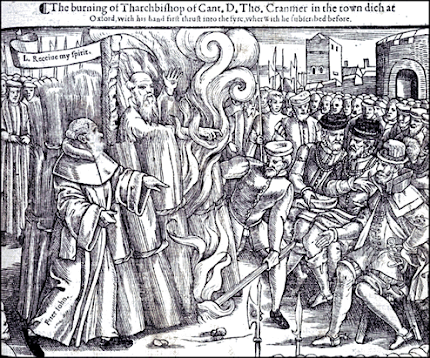
The burning of Tharchbishop of Cant. D. Tho. Cranmer in the town dich at Oxford, with his hand first thrust into the fyre, wherwith he subscribed before. [Click on the picture to see Cranmer's last words.]

Daily Bible Verse

Showing posts with label Bondage of the Will. Show all posts

Monday, December 23, 2019

From the Introduction to Packer's and Johnson's Translation of The Bondage of the Will


To become Christian a person must be born again, born into God’s family. We all were “children of wrath, even as others” (Ephesians 2:3), and we had to be reborn as children of God. Obviously this is something a man cannot do. When one is “born of the Spirit” (John 3:6), it is the work of the Spirit. A baby cannot initiate its birth. This is the act of its parents. No baby chooses or decides to be born. This is why the spiritual change from the death of sin to newness of life is pictured as a birth. The picture of resurrection teaches the same lesson. We are raised from the dead, but we do not raise ourselves; it is the act of God. Hence the will of man has nothing to do with this in the least. Arminian dependence on the human will simply makes salvation impossible. Some Arminians may have indeed been saved – by blessed inconsistency. But Arminian preaching, such as that of the evangelist Charles G. Finney, is an unmitigated tragedy. Earlier, as John Wesley sank deeper and deeper into his semi-Romish, anti-Biblical persuasion, George Whitefield wrote a letter of condemnation. It would prove instructive if contemporary Christians, who by and large have never learned the lessons of the Reformation, would read and consider carefully the warnings of the saintly George Whitefield.

Gordon H. Clark. Predestination (Kindle Locations 1334-1343). The Trinity Foundation. Kindle Edition. 


The following quote is from the conclusion of the introduction to J. I. Packer and O. R. Johnston's translation of Martin Luther's treatise, The Bondage of the Will.  However much modern semi-Calvinists try to water down the doctrine of absolute predestination, it is obvious that Luther himself believed that the bondage of the will to sin was in fact God's eternal will.  Luther said that all things happen of necessity, yet modern semi-Calvinists only want to talk about sovereign and eternal decrees of God in terms of unconditional election and neglect the fact that reprobation is also a divine decree that is eternal and irreversible.  Be that as it may, salvation is all of God and all of grace.  

Some of Luther's arguments are hard to follow unless the reader has some background in philosophy, logic, and the doctrinal issues Luther is discussing.  But be aware that Luther, unlike modern Van Tilian Calvinists and irrational Lutherans, did not reject the law of contradiction or systematic and propositional logic in doing theology.  What is interesting is how emphatic Packer and Johnston were at the time of this translation.  Unfortunately, Packer at the least has compromised and now seeks to have ecumenical union with the Roman Catholic Church and he has in reality become a compromiser with high church Anglo-Catholic and semi-Pelagian churchmen in the Anglican Church of North America where Packer is now an ordained minister.  Packer may not be active anymore due to his age.  I am sure he must be in his 90s by now.  The following extended quote was written by Packer and Johnston in conjunction presumably.

V. Conclusion
What is the modern reader to make of THE BONDAGE OF THE WILL?  That it is a brilliant and exhilarating performance, a masterpiece of the controversalist's difficult art, he will no doubt readily admit; but now comes the question, is Luther's case any part of God's truth? and if so, has it a message for Christians to-day?  No doubt the reader will find the way by which Luther leads him to be a strange new road, an approach which in all probability he has never considered, a line of thought which he would normally label 'Calvinistic' and hastily pass by.  This is what Lutheran orthodoxy itself has done (1); and the present-day Evangelical Christian (who has semi-Pelagianism in his blood) will be inclined to do the same.  But both history and Scripture, if allowed to speak, counsel otherwise.
Historically, it is a simple matter of fact that Martin Luther and John Calvin, and, for that matter, Ulrich Zwingli, Martin Bucer, and all the leading Protestant theologians of the first epoch of the Reformation, stood on precisely the same ground here.  [This would include Archbishop Thomas Cranmer, the father of the English Reformation.  Charlie.]  On other points, they had their differences; but in asserting the helplessness of man in sin, and the sovereignty of God in grace, they were entirely at one.  to all of them, these doctrines were the very life-blood of the Christian faith. A modern editor of Luther's great work underscores this fact:  'Whoever puts this book down without having realised that evangelical theology stands or falls with the doctrine of the bondage of the will has read it in vain.' (2)  The doctrine of free justification by faith only, which became the storm-centre of so much controversy during the Reformation period, is often regarded as the heart of the Reformers' theology, but this is hardly accurate.  The truth is that their thinking was really centred upon the contention of Paul, echoed with varying degrees of adequacy by Augustine, and Gottschalk, and Bradwardine, and Wycliffe, that the sinner's entire salvation is by free and sovereign grace only.  The doctrine of justification by faith was important to them because it safeguarded the principle of sovereign grace; but it actually expressed for them only one aspect of this principle, and that not its deepest aspect.  The sovereignty of grace found expression in their thinking at a profounder level still, in the doctrine of monergistic regeneration--the doctrine, that is, that the faith which receives Christ for justification is itself the free gift of a sovereign God, bestowed by spiritual regeneration in the act of effectual calling.  To the Reformers, the crucial question was not simply, whether God justifies believers without works of law.  It was the broader question, whether sinners are wholly helpless in their sin, and whether God is to be thought of as saving them by free, unconditional, invincible grace, not only justifying them for Christ's sake when they come to faith, but also raising them from the death of sin by His quickening Spirit in order to bring them to faith.  Here was the crucial issue;  whether God is the author, not merely of justification, but also of faith; whether, in the last analysis, Chrisitianity is a religion of utter reliance on God for salvation and all things necessary to it, or of self-reliance and self-effort.  'Justification by faith only' is a truth that needs interpretation.  The principle of SOLA FIDE is not rightly understood till it is seen as anchored in the broader principle of SOLA GRATIA.  What is the source and status of faith?  Is it the God-given means whereby the God-given justification is received, or is it a condition of justification which is left to man to fulfil?  Is it a part of God's gift of salvation, or is it man's own contribution to salvation?  Is our salvation wholly of God, or does it ultimately depend on something that we do for ourselves?  Those who say the latter (as Arminians later did) thereby deny man's utter helplessness in sin, and affirm that a form of semi-Pelagianism is true after all.  No wonder, then, that latter Reformed theology condemned Arminianism as being in principle a return to Rome (because in effect it turned faith into a meritorious work) and a betrayal of the Reformation (because it denied the sovereignty of God in saving sinners, which was the deepest religious and theological principle of the Reformers' thought).  Arminianism was, indeed, in Reformed eyes a renunciation of New Testament Christianity in favour of New Testament Judaism; for to rely oneself for faith is no different in principle from relying on oneself for works, and the one is as un-Christian and anti-Christian as the other.  In the light of what Luther says to Erasmus, there is no doubt that he would have endorsed this judgment.
These things need to be pondered by Protestants to-day.  With what right may we call ourselves children of the Reformation?  Much modern Protestantism would neither be owned nor even recognised by the pioneer Reformers.  THE BONDAGE OF THE WILL fairly sets before us what they believed about the salvation of lost mankind.  In the light of it, we are forced to ask whether Protestant Christendom has not tragically sold its birthright between Luther's day and our own.  Has not Protestantism to-day become more Erasmian than Lutheran?  Do we not too often try to minimise and gloss over doctrinal differences for the sake of inter-party peace?  Are we innocent of the doctrinal indifferentism with which Luther charged Erasmus?  Do we still believe that doctrine matters?  Or do we now, with Erasmus, rate a deceptive appearance of unity as of more importance than truth?  Have we not grown used to an Erasmian brand of teaching from our pulpits--a message that rests on the same shallow synergistic conceptions which Luther refuted, picturing God and man approaching each other almost on equal terms, each having his own contribution to make to man's salvation and each depending on the dutiful co-operation of the other for the attainment of that end?--as if God exists for man's convenience, rather than man for God's glory?  Is it not true, conversely, that it is rare to-day to hear the diagnosis of our predicament which Luther--and Scripture--put forward:  that man is hopeless and helpless in sin, fast bound in Satan's slavery, at enmity with God, blind and dead to to the things of the Spirit?  And hence, how rarely do we hear faith spoken of as Scripture depicts it--as it is expressed in the cry of self-commital with which the contrite heart, humbled to see its need and made conscious of its own utter helplessness even to trust, casts itself in the God-given confidence of self-despair upon the mercy of Christ Jesus--'Lord, I believe; help Thou my unbelief!'  Can we deny the essential rightness off Luther's exegesis of the texts?  And if not, dare we ignore the implications of his exegesis?
To accept the principles which Martin Luther vindicates in THE BONDAGE OF THE WILL would certainly involve a mental and spiritual revolution for many Christians at the present time.  It would involve a radically different approach to preaching and the practice of evangelism, and to most other departments of theology and pastoral work as well.  God-centred thinking is out of fashion to-day, and its recovery will involve something of a Copernican revolution in our outlook on many matters.  But ought we to shrink from this?  Do we not stand in urgent need of such teaching as Luther here gives us--teaching which humbles man, strengthens faith, and glorifies God--and is not the contemporary Church weak for the lack of it?  The issue is clear.  We are compelled to ask ourselves:  If the Almighty God if the Bible is to be our God, if the New Testament gospel is to be our message, if Jesus Christ is the same yesterday, to-day and forever--is any other position than Luther's possible?  Are we not in all honesty bound to stand with him in ascribing all might, and majesty, and dominion, and power, and all the glory of our salvation to God alone?  Surely no more important or far-reaching question confronts the church to-day.

Sola fide
Sola gratia
SOLA DEO GLORIA

J. I. Packer and O. R. Johnston, translators.  MARTIN LUTHER ON THE BONDAGE OF THE WILL:  A NEW TRANSLATION OF DE SERVIO ARBITRIO (1525):  MARTIN LUTHER'S REPLY TO ERASMUS OF ROTTERDAM.  (Old Tappan:  Fleming H. Revell, 1957).  Introduction, pp. 57-61.


Tuesday, June 02, 2015

Gordon H. Clark Quote of the Day: What Is Natural Liberty?


"Man's will 'is neither forced nor by any absolute necessity of nature determined.' These words were written to repudiate those philosophies which explain human conduct in terms of physico-chemical law.   . . . Man is not a machine; his motions cannot be described by mathematical equations as can the motions of the planets."  Dr. Gordon H. Clark

 
Many semi-Arminians in the neo-Calvinist camp, including the Van Tilians, assert that man is determined by God's decrees and that man has "free will" in the libertarian sense of the word and that this is a "paradox" that cannot be rationally explained or harmonized from Scripture.  They base this assumption on the Westminster Confession of Faith:


CHAPTER IX—Of Free-Will

  1.      God hath endued the will of man with that natural liberty, that it is neither forced, nor, by any absolute necessity of nature, determined to good, or evil. (Matthew 17:12, James 1:14, Deuteronomy 30:19).


The Westminster Confession of Faith (Oak Harbor, WA: Logos Research Systems, Inc., 1996).


Clark says, 


".....Now what does the Confession mean by natural liberty? Does a Presbyterian mean the same thing that a Romanist or an Arminian means, when they say that man is free? Are there various concepts of freedom?"

"Obviously there are various concepts of freedom, and some of them have little to do with the present topic. For example, we say today that American citizens are free men, but that the victims of communistic governments are not free. Freedom therefore has a political and an economic sense; but that is not what concerns us here. Reinhold Niebuhr in FAITH AND HISTORY writes pages on freedom; but none of it touches on free will."

"Closer to free will is the question whether or not the will of man is free from his intellect. Theologians in the past have discussed this at length. But that the will is free from the intellect is not what the Confession means by natural liberty. Calvin, for example, asserted that 'the intellect rules the will'; Charles Hodge said that man's 'will was subject to his reason,' and Robert J. Breckenridge taught that our primary conception of will includes the notion of its being directed by the intelligence. The theology behind all this may be a little intricate, and the matter is mentioned only to show that freedom from intellect is not what Presbyterians mean by the concept of freedom."

"What then does the Confession mean by the natural liberty of the will? The remainder of the section quoted answers this question as well as two lines can. Man's will 'is neither forced nor by any absolute necessity of nature determined.' These words were written to repudiate those philosophies which explain human conduct in terms of physico-chemical law. Although the Westminster divines did not know twentieth century behaviorism, nor even Spinoza, they very probably knew Thomas Hobbes, and they certainly knew earlier materialistic theories. That man's conduct is determined by inanimate forces is what the Confession denies. Man is not a machine; his motions cannot be described by mathematical equations as can the motions of the planets. His hopes, plans, and activities are not controlled by physical conditions. He is not determined by any absolute necessity of nature."

Dr. Gordon H. Clark. WHAT DO PRESBYTERIANS BELIEVE? 1965. 2nd edition. (Unicoi: Trinity Foundation, 2001). Pp. 105-106.

Of course, to reject logic is to reject the very propositional statements in Scripture that define Christianity as a system of doctrinal beliefs.  All knowledge is propositional.  The Westminster Confession of Faith does not teach the doctrine of free will as anyone who reads the following sections of chapter IX can see.  According to Dr. Clark, the order of importance of the doctrines in the Westminster Confession of Faith is a descending order, the most important doctrine being Scripture, the second most important doctrine is the Trinity, and the third most important doctrine is predestination or God's eternal decrees.  The doctrine of the bondage of the will does not occur until chapter IX.  But that by no means implies that the Westminster divines thought the doctrine of the bondage of the will was unimportant.

Section 3 makes it clear that free will was lost after the fall.  This definition of free will means freedom from slavery to sin.  Adam before the fall was able not to sin.  After the fall, Adam lost that ability not to sin and Adam and all his progeny lost the ability not to sin.  All are sinners from birth.


3.      Man, by his fall into a state of sin, hath wholly lost all ability of will to any spiritual good accompanying salvation: (Rom. 5:6, Rom. 8:7, John 15:5) so as, a natural man, being altogether averse from that good, (Rom. 3:10, 12) and dead in sin, (Eph. 2:1, 5, Col. 2:13) is not able, by his own strength, to convert himself, or to prepare himself thereunto. (John 6:44, 65, Eph. 2:2–5, 1 Cor. 2:14, Tit. 3:3–5)  [WCF 9:3].

The Westminster Confession of Faith (Oak Harbor, WA: Logos Research Systems, Inc., 1996).

The Thirty-nine Articles of Religion, the Reformation Anglican view of free will, also says that there is no free will after the fall of Adam:

X. Of Free Will.

THE condition of man after the fall of Adam is such, that he cannot turn and prepare himself, by his own natural strength and good works, to faith and calling upon God. Wherefore we have no power to do good works pleasant and acceptable to God, without the grace of God by Christ preventing us that we may have a good will, and working with us when we have that good will.

Article X.  Of Free Will.

The inability of man to obey God's command to repent and believe the Gospel is a moral inability and not a biological or chemical predetermination to act like animals.  Those who advocate that homosexuals and trans-sexuals are determined by the chemistry in their brain deny natural liberty.  Calvinists deny libertarian free will and assert that man cannot act contrary to God's decrees.  Isaiah 14:24, 27; 46:9-11; Daniel 4:35.


Saturday, September 14, 2013

Luther's Rebuke to Erasmus: Who Are You to Lecture God?


What! did that foolish and unwise God, know not what is necessary to be taught, until you His instructor prescribed to Him the measure, according to which He should be wise, and according to which He should command? What! did He not know before you told Him, that that which you infer would be the consequence of this His paradox?  -- Martin Luther

In reading through a section of Luther's Bondage of the Will I was reminded of Calvin's rebuke of Pighius in Calvin's Calvinism.  The modern dissimulators in today's Lutheran denominations would have us believe that Luther did not believe in double predestination but only in single predestination.  But Luther's denial of free will cuts the hearts of modern Lutherans because they do not want to believe God's Word which specifically denies that the reprobate have "a chance".  If God's will is immutable, then salvation of the elect is most certain and cannot be lost, and likewise, God's decree to reprobation cannot be reversed either.  Those who persist in unbelief and licentiousness are proved to be without free will but sentenced to be turned over to their own evil natures.  

Luther's turn of phrase with Erasmus is amusing, especially when Luther scolds Erasmus--and by implication the modern semi-pelagians, Arminians, and Lutherans--in the following quote:

Sect. 23.—IN the last part of your Preface, where you deter us from this kind of doctrine, you think your victory is almost gained. 

"What (you say) can be more useless than that this paradox should be proclaimed openly to the world—that whatever is done by us, is not done by Free-will, but from mere necessity. And that of Augustine also—that God works in us both good and evil: that He rewards His good works in us, and punishes His evil works in us." (You are mightily copious here in giving, or rather, in expostulating concerning a reason.) "What a flood-gate of iniquity (you say) would these things, publicly proclaimed, open unto men! What bad man would amend his life! Who would believe that he was loved of God! Who would war against his flesh!"

I wonder, that in so great vehemency, and contending zeal, you did not remember our main subject, and say—where then would be found "Free-will.[?]"

My friend, Erasmus! here, again, I also say, if you consider that these paradoxes are the inventions of men, why do you contend against them? Why are you so enraged? Against whom do you rail? Is there any man in the world, at this day, who has inveighed more vehemently against the doctrines of men, than Luther! This admonition of yours, therefore, is nothing to me! But if you believe that those paradoxes are the words of God, where is your countenance, where is your shame, where is, I will not say your modesty, but that fear of, and that reverence which is due to the true God, when you say, that nothing is more useless to be proclaimed than that Word of God! What! shall your Creator, come to learn of you His creature, what is useful, and what not useful to be preached? What! did that foolish and unwise God, know not what is necessary to be taught, until you His instructor prescribed to Him the measure, according to which He should be wise, and according to which He should command? What! did He not know before you told Him, that that which you infer would be the consequence of this His paradox? If, therefore, God willed that such things should be spoken of and proclaimed abroad, without regarding what would follow,—who art thou that forbiddest it?   (Bondage of the Will, The Sovereignty of God, Section 23).


Erasmus admitted the clear and plain teaching of God's Word in Romans 9, the passage to which Luther is referring.  So Luther flat scolds Erasmus for daring to lecture God!  Luther clearly had Scripture on his side:


The apostle Paul, in his Epistle to the Romans, discourses on these same things, not "in a corner," but in public and before the whole world, and that with a freely open mouth, nay in the harshest terms, saying, "whom He will He hardeneth." (Rom. 9:18.) And again, "God, willing to shew forth His wrath," &c. (Rom. 9:22.) What is more severe, that is to the flesh, than that word of Christ "Many are called but few chosen?" (Matt. 22:14.) And again, "I know whom I have chosen?" (John 13:18.) According to your judgment then, all these things are such, that nothing can be more uselessly spoken; because that by these things, impious men may fall into desperation, hatred, and blasphemy.

Here then, I see, you suppose that the truth and the utility of the Scripture are to be weighed and judged of according to the opinion of men, nay, of men the most impious; so that, what pleases them or seems bearable, should be deemed true, divine, and wholesome: and what has the contrary effect upon them, should at once be deemed useless, false, and pernicious. What else do you mean by all this, than that the words of God should depend on, stand on, and fall by, the will and authority of men? Whereas the Scripture, on the contrary saith, that all things stand and fall by the will and authority of God: and in a word, that "all the earth keeps silence before the face of the Lord." (Hab. 2:20.) He who could talk as you do, must imagine that the living God is nothing but a kind of trifling and inconsiderate pettifogger declaiming on a certain rostrum, whose words you may if you be disposed, interpret, understand, and refute as you please, because He merely spoke as He saw a set of impious men to be moved and affected.  (The Sovereignty of God, Section 23).


The reason that Luther is so adamant about his denial of free will is that Luther knows certainly that to deny the sovereignty of God in both election and reprobation is to undermine the security of the believer.  If salvation is left to the capricious wills of men, then there can be no assurance of salvation:

And how can you be certain and secure, unless you are persuaded that He knows and wills certainly, infallibly, immutably, and necessarily, and will perform what He promises? Nor ought we to be certain only that God wills necessarily and immutably, and will perform, but also to glory in the same; as Paul, (Rom. 3:4,) "Let God be true, but every man a liar." And again, "For the word of God is not without effect." (Rom. 9:6.) And in another place, "The foundation of God standeth sure, having this seal, the Lord knoweth them that are His." (2 Tim. 2:19.) And, "Which God, that cannot lie, promised before the world began." (Titus 1:2.) And, "He that cometh, must believe that God is, and that He is a rewarder of them that hope in Him." (Heb. 11:6.)

If, therefore, we are taught, and if we believe, that we ought not to know the necessary prescience of God, and the necessity of the things that are to take place, Christian faith is utterly destroyed, and the promises of God and the whole Gospel entirely fall to the ground; for the greatest and only consolation of Christians in their adversities, is the knowing that God lies not, but does all things immutably, and that His will cannot be resisted, changed, or hindered.  (Bondage of the Will, The Sovereignty of God, Section 12).
The Van Tilians who say that Scripture is full of apparent "paradoxes" are really just trying to soften God's Word so the Arminians and others will not be offended by the plain teaching of Scripture.  They are openly rebuked by Luther along with Erasmus himself.  Essentially, the Van Tilians and Neo-Calvinists cannot bring themselves to accept the plain teaching of Scripture in regards to the absolute sovereignty of God, and must therefore attempt to appease the objections of men rather than simply turning the world upside down:

How much better is it for us wretched men to ascribe unto God, who knoweth the hearts of all men, the glory of determining the manner in which, the persons to whom, and the times in which the truth is to be spoken. For He knows what is to be spoken to each, and when, and how it is to be spoken. He then, determines that His Gospel which is necessary unto all, should be confined to no place, no time; but that it should be preached unto all, at all times and in all places. And I have already proved, that those things which are handed down to us in the Scriptures, are such, that they are quite plain and wholesome, and of necessity to be proclaimed abroad; even as you yourself determined in your Paraclesis was right to be done; and that, with much more wisdom than you advise now. But let those who would not that souls should be redeemed, such as the Pope and his adherents—let it be left to them to bind the Word of God, and hinder men from life and the kingdom of heaven, that they might neither enter in themselves nor suffer others to enter:—to whose fury you, Erasmus, by this advice of yours, are perniciously subservient.   (Sovereignty of God, Section 21).

Luther is not speaking about the "free offer" here!  He is rebuking Erasmus for forbidding the preaching of the bondage of the will and double predestination!  If predestination and the double decrees of God are plainly taught in Scripture, why forbid to preach what God plainly wants to be preached to the whole world?!

Paul is speaking of facts, and the use of doctrine: that is, of those, who, seeking their own, had no consideration of the hurt and offence given to the weak. Truth and doctrine, are to be preached always, openly, and firmly, and are never to be dissembled or concealed; for there is no offence in them; they are the staff of uprightness.—And who gave you the power, or committed to you, the right, of confining the Christian doctrine to persons, places, times, and causes, when Christ wills it to be proclaimed, and to reign freely, throughout the world? For Paul saith, "the Word of God is not bound," (2 Tim. 2:9,) but Erasmus bounds [binds] the word. Nor did God give us the word that it should be had with respect of places, persons, or times: for Christ saith, "Go ye out into the whole world,": He does not say, as Erasmus does,—go to this place and not to that. Again, "Preach the Gospel to every creature." (Mark 16:15.) He does not say—preach it to some and not to others.  (Section 21).

That the entire treatise is devoted to predestination, God's sovereignty, and the doctrine of depravity and the bondage of the will logically requires that these doctrines not be hidden but openly proclaimed from every pulpit.  Sadly, that is not the case today.  Most of the neo-Calvinists today are nothing more than crypto-Arminians.

There is a war raging against God's Word.  Those who stand for the doctrines of sovereign grace can expect persecution by those who claim to be "tolerant."  But they are not tolerant.  They hate God's Word and do all they can in their power to hinder it and silence it:

Look into the Acts of the Apostles, and see what happened in the world on account of the word of Paul only (to say nothing of the other apostles): how he alone throws both the Gentiles and Jews into commotion: or, as the enemies themselves express it, "turns the world upside down." (Acts 17:6.) Under Elijah, the kingdom of Israel was thrown into commotion: as king Ahab complains. (1 Kings 18:17.) What tumult was there under the other prophets, while they are all either killed at once or stoned to death; while Israel is taken captive into Assyria, and Judah also to Babylon! Was all this peace? The world and its god (2 Cor. 4:4) cannot and will not bear the Word of the true God: and the true God cannot and will not keep silence. While, therefore, these two Gods are at war with each other, what can there be else in the whole world, but tumult?  (Section 19).

Friday, November 02, 2012

Luther on Free Will

The Bible teaches that faith itself is and has to be a gift of God, by grace, and not of self (Ephesians 2:8). It is safe to deduce that for Luther, any evangelist who advocates free will has not only “not yet comprehended any part of the Gospel,” but also that he has not yet preached the Gospel at all; his is a counterfeit gospel.


The Trinity Foundation - Luther on Free Will

Friday, June 22, 2012

Martin Luther on Free Will and the Bondage of the Will

Sect. 167.—I SHALL here draw this book to a conclusion: prepared if it were necessary to pursue this Discussion still farther. Though I consider that I have now abundantly satisfied the godly man, who wishes to believe the truth without making resistance. For if we believe it to be true, that God fore-knows and fore-ordains all things; that He can be neither deceived nor hindered in His Prescience and Predestination; and that nothing can take place but according to His Will, (which reason herself is compelled to confess;) then, even according to the testimony of reason herself, there can be no "Free-will"—in man,—in angel,—or in any creature! 

Hence:—If we believe that Satan is the prince of this world, ever ensnaring and fighting against the kingdom of Christ with all his powers; and that he does not let go his captives without being forced by the Divine Power of the Spirit; it is manifest, that there can be no such thing as—"Free-will!" 

Again:—If we believe that original sin has so destroyed us, that even in the godly who are led by the Spirit, it causes the utmost molestation by striving against that which is good; it is manifest, that there can be nothing left in a man devoid of the Spirit, which can turn itself towards good, but which must turn towards evil! 

Again:—If the Jews, who followed after righteousness with all their powers, ran rather into unrighteousness, while the Gentiles who followed after unrighteousness attained unto a free righteousness which they never hoped for; it is equally manifest, from their very works, and from experience, that man, without grace, can do nothing but will evil!

Martin Luther, Protestant Reformer.  The Bondage of the Will:  Conclusion

Tuesday, May 29, 2012

The Bondage of the Will

Sect. 167.—I SHALL here draw this book to a conclusion: prepared if it were necessary to pursue this Discussion still farther. Though I consider that I have now abundantly satisfied the godly man, who wishes to believe the truth without making resistance. For if we believe it to be true, that God fore-knows and fore-ordains all things; that He can be neither deceived nor hindered in His Prescience and Predestination; and that nothing can take place but according to His Will, (which reason herself is compelled to confess;) then, even according to the testimony of reason herself, there can be no "Free-will"—in man,—in angel,—or in any creature!  Martin Luther, The Bondage of the Will.


 The Bondage of the Will

Tuesday, March 20, 2012

Quotes Against Free Will

Psalm 33:10: "He maketh the devices of the people of none effect."
Psalm 81:12: "So I gave them up unto their own hearts’ lust: and they walked in their own counsels."
Proverbs 21:1: "The king’s heart is in the hand of the Lord, as the rivers of water: he turneth it whithersoever he will."
Proverbs 28:26: "He that trusteth in his own heart is a fool."
Ecclesiastes 7:20: "For there is not a just man upon the earth, that doeth good, and sinneth not."
Jeremiah 4:22: "For my people is foolish, they have not known me … they are wise to do evil, but to do good they have no knowledge."
John 1:13: "Which were born, not of blood, nor of the will of the flesh, nor of the will of man, but of God."
John 3:27: "A man can receive nothing, except it be given him from heaven."
John 6:44: "No man can come to me except the Father, which hath sent me, draw him: and I will raise him up at the last day."
John 6:65: "Therefore said I unto you, that no man can come unto me, except it were given unto him of my Father."
John 15:5: "I am the vine, ye are the branches: he that abideth in me, and I in him, the same bringeth forth much fruit; for without me ye can do nothing."
John 15:16: "Ye have not chosen me, but I have chosen you, and ordained you."
Romans 3:10-12: "As it is written, There is none righteous, no, not one: There is no that understandeth, there is none that seeketh after God. They are all gone out of the way, they are together become unprofitable; there is none that doeth good, no, not one."
Romans 5:6: "For when we were yet without strength, in due time Christ died for the ungodly."
Romans 7:18-19: "For I know that in me (that is, in my flesh) dwelleth no good thing: for to will is present with me; but how to perform that which is good I find not. For the good that I would I do not: but the evil which I would not, that I do."
Romans 8:7: "Because the carnal mind is enmity against God: for it is not subject to the law of God, neither indeed can be."
Romans 9:16: "So then it is not of him that willeth, nor of him that runneth, but of God that sheweth mercy."
Romans 10:20: "I was found of them that sought me not."
Ephesians 2:1: "And you hath he quickened, who were dead in trespasses and sins."
Ephesians 2:5: "Even when we were dead in sins, hath he quickened us together with Christ; (by grace ye are saved.)"
Philippians 2:13: "For it is God which worketh in you, both to will and to do of his good pleasure."
Colossians 2:13: "And you, being dead in your sins and the uncircumcision of your flesh, hath he quickened together with him, having forgiven you all trespasses."
Titus 3:3-5: "For we ourselves also were sometimes foolish, disobedient, deceived, serving divers lusts and pleasures, living in malice and envy, hateful, and hating one another. But after that the kindness and love of God our Saviour toward man appeared, Not by works of righteousness which we have done, but according to his mercy he saved us, by the washing of regeneration, and renewing of the Holy Ghost."
2) Before the Reformation
Augustine: "I once laboured hard for the free will of man, until the grace of God at length overcame me."
Bradwardine: "What multitudes, O Lord, do this day join hands with Pelagius in contending for free will and in fighting … free grace."
Waldensians: "Whosoever upholds free-will absolutely denies predestination and the grace of God."
3) Luther
"Free will is an empty term."
"Free-will cannot will good and of necessity serves sin."
"This is plainly to ascribe divinity to ‘free will.’"
“I frankly confess that, for myself, even if it could be, I should not want ‘free-will’ to be given me, nor anything to be left in my own hands to enable me to endeavour after salvation; not merely because in face of so many dangers, and adversities and assaults of devils, I could not stand my ground …; but because even were there no dangers … I should still be forced to labour with no guarantee of success … But now that God has taken my salvation out of the control of my own will, and put it under the control of His, and promised to save me, not according to my working or running, but according to His own grace and mercy, I have the comfortable certainty that He is faithful and will not lie to me, and that He is also great and powerful, so that no devils or opposition can break Him or pluck me from Him. Furthermore, I have the comfortable certainty that I please God, not by reason of the merit of my works, but by reason of His merciful favour promised to me; so that, if I work too little, or badly, He does not impute it to me, but with fatherly compassion pardons me and makes me better. This is the glorying of all the saints in their God” (The Bondage of the Will).

4) Calvin
"The Papists … hold that man, through his own free will, returns to God; and on this point is our greatest contest with them at this day."
"Concerning that this clown babbleth of free will, it is sufficiently rejected throughout the whole scripture."
"Faith is a special gift of God, which proceedeth not from our free will."
"Let that ethical philosophy therefore of free-will be far from a Christian mind."
"No free will of man can resist Him that willeth to save."
5) Reformation Confessions
Thirty-Nine Articles, X:
"The condition of Man after the fall of Adam is such, that he can not turn and prepare himself, by his own natural strength and good works, to faith, and calling upon God. Wherefore we have no power to do good works pleasant and acceptable to God, without the grace of God by Christ preventing us, that we may have a good will, and working with us, when we have that good will."
Heidelberg Catechism, Q. 8: "Are we then so corrupt that we are wholly incapable of doing any good, and inclined to all wickedness? A.  Indeed we are; except we are regenerated by the Spirit of God."
Belgic Confession, XIV:
"… we reject all that is taught repugnant to this, concerning the free will of man, since man is but a slave to sin; and has nothing of himself, unless it is given from heaven. For who may presume to boast, that he of himself can do any good, since Christ saith, No man can come to me, except the Father, which hath sent me, draw him? Who will glory in his own will, who understands, that to be carnally minded is enmity against God? Who can speak of his knowledge, since the natural man receiveth not the things of the spirit of God? In short, who dare suggest any thought, since he knows that we are not sufficient of ourselves to think anything as of ourselves, but that our sufficiency is of God? And therefore what the apostle saith ought justly to be held sure and firm, that God worketh in us both to will and to do of his good pleasure. For there is no will nor understanding, conformable to the divine will and understanding, but what Christ hath wrought in man; which he teaches us, when he saith, Without me ye can do nothing."
Canons of Dordt, III/IV:3:
"Therefore all men are conceived in sin, and by nature children of wrath, incapable of saving good, prone to evil, dead in sin, and in bondage thereto, and without the regenerating grace of the Holy Spirit, they are neither able nor willing to return to God, to reform the depravity of their nature, nor to dispose themselves to reformation."
Westminster Confession, IX – Of Free Will:
Man, in his state of innocency, had freedom and power to will and to do that which is good and well-pleasing to God; but yet mutably, so that he might fall from it. Man, by his fall into a state of sin, hath wholly lost all ability of will to any spiritual good accompanying salvation; so as a natural man, being altogether averse from that good, and dead in sin, is not able, by his own strength, to convert himself, or to prepare himself thereunto. When God converts a sinner, and translates him into the state of grace, he freeth him from his natural bondage under sin, and by his grace alone enables him freely to will and to do that which is spiritually good; yet so as that, by reason of his remaining corruption, he doth not perfectly nor only will that which is good, but doth also will that which is evil. The will of man is made perfectly and immutably free to do good alone in the state of glory only.
6) 16th Century
William Tyndale:
"they go and set up free-will with the heathen philosophers and say that a man’s free will is the cause why God chooseth and not another, contrary to all scriptures."
Robert Ferrar (Welsh Bishop of St. David's martyred in Carmarthen on 30 March, 1555) with ten other reforming ministers:
"... we disallow papistical doctrines of free will, of works of supererogation, of merits, of the necessity of auricular confession, and satisfaction to God-wards."
John Knox:
"… the general consent of all that sect is that God (by his foreknowledge, counsel, and wisdom) has no assured election, neither yet any certain reprobation, but that every man may elect or reprobate himself by his own free will, which he has (say they) to do good or evil … [All these things are] forged by their own brains, and polished by the finest of their wits, when yet in very deed they are but the rotten heresies of … Pelagius, long ago confuted by Augustine …"
John Knox:
"Ye [Anabaptists] be proud contemners of the free grace of God offered to man in Christ Jesus. For with the Pelagians and Papists ye are become teachers of free will, and defenders of your own righteousness" (An Answer to a Great Number of Blasphemous Cavillations Written by an Anabaptist and Adversary to God's Eternal Predestination [London: Thomas Charde, 1591], p. 121).

Jerome Zanchius:
"No free will of the creature can resist the will of God" (quoting Augustine).
7) 17th Century
Henry Ainsworth:
"we grant evil freewill (or freewill to evil) is remaining in all natural men: we believe that freewill to good, is from grace and regeneration."
Daniel Featley:
"many men have too much Free-will, and take to themselves too free liberty now a days to advance and maintain free will."
John Preston:
"not by the power of free will but by the infused grace of His spirit."
Peter Moulin:
"It is proved out of the holy scriptures that an unregenerate man is altogether destitute of the power and liberty of his will, in those things that pertain to faith and salvation."
John Owen:
"the whole Pelagian poison of free-will … a clear exaltation of the old idol free-will into the throne of God … That the decaying estate of Christianity have invented."
John Owen:
Free will is "corrupted nature's deformed darling, the Pallas or beloved self-conception of darkened minds" (Works, vol. 10, p. 150).
William Jenkyn:
"The bending of men's hearts to believe and persevere are the supernatural fruits of God’s eternal decree, and not the natural fruits of man’s depraved and frail free will."
John Trapp: "The friends of free will are the enemies of free grace."
Thomas Watson:
"This crown of free will is fallen from our head" and "If it be God’s purpose that saves then it is not free will."

Francis Turretin:

"The word "freewill" (as also "self-determining power" [autexousiou] used by the Greek Fathers) does not occur in Scripture … I Cor 7:37 does not mean freedom of the will."
8) 18th Century
Matthew Henry:
"The counsels and decrees of God do not truckle to the frail and fickle will of man."
Augustus Toplady:
“A man’s free will cannot cure him even of the toothache, or a sore finger; and yet he madly thinks it is in its power to cure his soul.”
George Whitefield:
"Man is nothing; he hath a free will to go to hell, but none to go to heaven, till God worketh in him" and "you dishonour God by denying election. You plainly make salvation depend, not on God’s ‘free grace’ but on Man’s ‘free will.’"
William Huntington:
"This brought me out of the free-will fog, and truth shone in my heart like a comet … from that moment I waged war against free will."

9) 19th Century
J. N. Darby, early leader of the Plymouth Brethren:
"This re-appearance of the doctrine of freewill serves to support that of the pretension of the natural man to be not irremediably fallen, for this is what such doctrine tends to. All who have never been deeply convicted of sin, all persons in whom this conviction is based on gross external sins, believe more or less in freewill" (Man’s So-called Freewill, p. 1).
10) Charles Spurgeon

"I will go as far as Martin Luther, where he says, ‘If any man ascribes anything of salvation, even the very least thing, to the free will of man, he knows nothing of grace, and he has not learned Jesus Christ rightly.’"
"Free-will doctrine—what does it? It magnifies man into God. It declares God’s purposes a nullity, since they cannot be carried out unless men are willing. It makes God’s will a waiting servant to the will of man, and the whole covenant of grace dependent on human action. Denying election on the ground of injustice, it holds God to be a debtor to sinners." "His will cannot be neutral or ‘free’ to act contrary to his nature."
"Free will has carried many souls to hell, but yet never a soul to heaven."

"I do not come into this pulpit hoping that perhaps somebody will of his own free will return to Christ. My hope lies in another quarter. I hope that my Master will lay hold of some of them and say, 'You are mine, and you shall be mine. I claim you for myself.' My hope arises from the freeness of grace, and not from the freedom of the will."

11) 20th Century
Arthur W. Pink:
"if the will is their servant then it is not sovereign, and if the will is not sovereign, we certainly cannot predicate ‘freedom’ of it."

Louis Berkhof:

"Freedom of the will is a psychological fiction."
John Gerstner:
"We have already shown that there is no such thing as free will. That’s a will-o’-the–wisp. You never make choices without reasons, not as a responsible or a rational person" (A Primer on Free Will, p. 11).
W. E. Best:
"God’s character is maligned by every person who believes in free will."

Gordon H. Clark:
"The Bible consistently denies free will."

R. C. Sproul:
"The neutral view of free will is impossible. It involves choice without desire."
James White: "Then why do you embrace Christ, and your moral Buddhist neighbour across the street does not? Are you smarter than he is? More spiritually sensitive? Better, in any way? What makes you to differ? Is the Holy Spirit working just as hard on him as He did on you? If so, why do you believe, and he does not? No matter how hard you try, you can’t avoid coming to the conclusion that, in a 'free will' system of salvation, those who believe do so because there is something different about them. If the Spirit is bringing equal conviction to bear upon each individual, the only deciding factor, given equality in everything else, is something in the person himself. I believe the only possible difference between the redeemed in heaven and the guilty, condemned, punished sinner in hell is a five-letter word ... It’s called 'grace.'"
Steven Houck:
"This free-willism is a serious error which is contrary to the Holy Scriptures."
Quotes Against Free Will

Friday, December 03, 2010

Prying into the Mystery of Reprobation

If, therefore, we are taught, and if we believe, that we ought not to know the necessary prescience of God, and the necessity of the things that are to take place, Christian faith is utterly destroyed, and the promises of God and the whole Gospel entirely fall to the ground; for the greatest and only consolation of Christians in their adversities, is the knowing that God lies not, but does all things immutably, and that His will cannot be resisted, changed, or hindered.   --Martin Luther


This mystery of his will God discovered to but a small number under the Old Testament; under the New, (the distinction between various peoples having been removed), he reveals himself to many, without any distinction of people. The cause of this dispensation is not to be ascribed to the superior worth of one nation above another, nor to their making a better use of the light of nature, but results wholly from the sovereign good pleasure and unmerited love of God. Hence they, to whom so great and so gracious a blessing is communicated, above their desert, or rather notwithstanding their demerits, are bound to acknowledge it with humble and grateful hearts, and with the apostle to adore, not curiously to pry into the severity and justice of God's judgments displayed to others, to whom this grace is not given. Canons of Dordt, 3rd & 4th Heads of Doctrine, Article Seven


The above is from the Canons of Dordt, The Third and Fourth Heads of Doctrine, Article Seven. I find the wording of this article particularly interesting, especially considering the objections to double predestination which are frequently raised by modern Lutherans, Amyraldian Anglicans, modern Arminians, and various other theological parties which are sympathetic to semi-pelagianism.

Their usual objection goes something like this: "God elects those who come to faith but we shouldn't preach double predestination because it might cause people to question God's goodness. It's better to leave some things to the theologians rather than preaching this from the pulpit." (See also, Deuteronomy 29:29). Unfortunately, that is not the view of the Dutch divines or even of the English divines. The 39 Articles of Religion clearly and explicitly teach double predestination in Article 17:

Article XVII
Of Predestination and Election

Predestination to life is the everlasting purpose of God, whereby, before the foundations of the world were laid, He hath constantly decreed by His counsel secret to us, to deliver from curse and damnation those whom He hath chosen in Christ out of mankind, and to bring them by Christ to everlasting salvation as vessels made to honour. Wherefore they which be endued with so excellent a benefit of God be called according to God's purpose by His Spirit working in due season; they through grace obey the calling; they be justified freely; they be made sons of God by adoption; they be made like the image of His only-begotten Son Jesus Christ; they walk religiously in good works; and at length by God's mercy they attain to everlasting felicity.

As the godly consideration of Predestination and our Election in Christ is full of sweet, pleasant, and unspeakable comfort to godly persons and such as feel in themselves the working of the Spirit of Christ, mortifying the works of the flesh and their earthly members and drawing up their mind to high and heavenly things, as well because it doth greatly establish and confirm their faith of eternal salvation to be enjoyed through Christ, as because it doth fervently kindle their love towards God: so for curious and carnal persons, lacking the Spirit of Christ, to have continually before their eyes the sentence of God's Predestination is a most dangerous downfall, whereby the devil doth thrust them either into desperation or into wretchlessness of most unclean living no less perilous than desperation.

Furthermore, we must receive God's promises in such wise as they be generally set forth in Holy Scripture; and in our doings that will of God is to be followed which we have expressly declared unto us in the word of God.

While it is true that the focus of the Scriptures and of Article 17 is divine election, it cannot be overlooked that Scripture and Article 17, in agreement with Scripture, teaches that God decrees reprobation. In fact the Article clearly says that reprobation is a "sentence" passed by God:

so for curious and carnal persons, lacking the Spirit of Christ, to have continually before their eyes the sentence of God's Predestination is a most dangerous downfall, whereby the devil doth thrust them either into desperation or into wretchlessness of most unclean living no less perilous than desperation.

There is no avoiding of the fact that the English divines, including Archbishop Thomas Cranmer who was a complete Augustinian and the author of the substance of these articles, said that reprobation is a "sentence" passed by God. There is no other reason for the wording of the article except to understand that this is a deliberate decree on God's part. And notice as well that the decree precedes the outworking of that decree. Those who refuse to repent understand that God has predetermined them to reprobation and to be damned. Although God is not thereby responsible for their rebellion, the fact that they refuse to repent shows clearly that God has hardened their hearts and decreed them to damnation. This is why it is a "sentence" and not merely a foreseen allowance.

The weight of Scripture favors election but Scripture does teach the decree to reprobation, which the English divines follow. To argue that Scripture allows other views is to attack not only Scripture but the Articles which follow Scriptural teaching on this point. To argue that the Articles are ambivalent is equivalent to arguing that the Scriptures are unclear and ambivalent, which in turn leads to theological liberalism.

That Scripture teaches the doctrine of a divine decree to reprobation is beyond dispute:

and "A stone of stumbling, and a rock of offense." They stumble because they disobey the word, as they were destined to do. (1 Peter 2:8 ESV)

What if God, desiring to show his wrath and to make known his power, has endured with much patience vessels of wrath prepared for destruction, (Romans 9:22 ESV)

For certain people have crept in unnoticed who long ago were designated for this condemnation, ungodly people, who pervert the grace of our God into sensuality and deny our only Master and Lord, Jesus Christ. (Jude 1:4 ESV)

though they were not yet born and had done nothing either good or bad--in order that God's purpose of election might continue, not because of works but because of him who calls-- 12 she was told, "The older will serve the younger." 13 As it is written, "Jacob I loved, but Esau I hated." (Romans 9:11-13 ESV)

The semi-pelagians think that somehow it is dishonoring to God and brings reproach on the Gospel to acknowledge from the pulpit and in public that God in fact has predetermined and decreed before the creation of the world that a huge mass of human beings would be reprobated and condemned to eternal hell--and all before they were born! But Paul answers that objection well:

As it is written, "Jacob I loved, but Esau I hated." 14 What shall we say then? Is there injustice on God's part? By no means! 15 For he says to Moses, "I will have mercy on whom I have mercy, and I will have compassion on whom I have compassion." 16 So then it depends not on human will or exertion, but on God, who has mercy. 17 For the Scripture says to Pharaoh, "For this very purpose I have raised you up, that I might show my power in you, and that my name might be proclaimed in all the earth." 18 So then he has mercy on whomever he wills, and he hardens whomever he wills. 19 You will say to me then, "Why does he still find fault? For who can resist his will?" 20 But who are you, O man, to answer back to God? Will what is molded say to its molder, "Why have you made me like this?" 21 Has the potter no right over the clay, to make out of the same lump one vessel for honorable use and another for dishonorable use? 22 What if God, desiring to show his wrath and to make known his power, has endured with much patience vessels of wrath prepared for destruction, 23 in order to make known the riches of his glory for vessels of mercy, which he has prepared beforehand for glory-- (Romans 9:13-23 ESV)

One is forced to ask what sort of god is it who does not know the future; has no control over the past, present or the future; cannot supernaturally intervene in the natural world (deism); and who is open to learn from what happens in history (open theism). Those who advocate some sort of compromise to soften God's absolute sovereignty over both natural calamities and human choices (Isaiah 45:7; Proverbs 21:1) unwittingly open the door to an idolatrous theology from below that focuses on man and this world rather than the eternal realm of a sovereign God who answers to no one (Daniel 4:35).

As much as many Evangelicals would like to compromise God's providence for the sake of evangelism, watering down God's word to persuade the wicked reprobate (Romans 9:13) is like trying to give medicine to a dead man. Dead men will not believe no matter how hard we try to persuade them. Even the venerable Martin Luther had sense enough to see that there is no free will and apart from God's irresistible grace no one will believe in the first place:

Sect. 9.—THIS, therefore, is also essentially necessary and wholesome for Christians to know: That God foreknows nothing by contingency, but that He foresees, purposes, and does all things according to His immutable, eternal, and infallible will. By this thunderbolt, "Free-will" is thrown prostrate, and utterly dashed to pieces. Those, therefore, who would assert "Free-will," must either deny this thunderbolt, or pretend not to see it, or push it from them. . . .

. . . You openly declare that the immutable will of God is to be known, but you forbid the knowledge of His immutable prescience. Do you believe that He foreknows against His will, or that He wills in ignorance? If then, He foreknows, willing, His will is eternal and immovable, because His nature is so: and, if He wills, foreknowing, His knowledge is eternal and immovable, because His nature is so.

From which it follows unalterably, that all things which we do, although they may appear to us to be done mutably and contingently, and even may be done thus contingently by us, are yet, in reality, done necessarily and immutably, with respect to the will of God. For the will of God is effective and cannot be hindered; because the very power of God is natural to Him, and His wisdom is such that He cannot be deceived. And as His will cannot be hindered, the work itself cannot be hindered from being done in the place, at the time, in the measure, and by whom He foresees and wills. If the will of God were such, that, when the work was done, the work remained but the will ceased, (as is the case with the will of men, which, when the house is built which they wished to build, ceases to will, as though it ended by death) then, indeed, it might be said, that things are done by contingency and mutability. But here, the case is the contrary; the work ceases, and the will remains. [From: The Bondage of the Will: The Sovereignty of God.

For Anglicans to argue that the 39 Articles leave open the question of divine decrees to election and reprobation is essentially a semi-pelagian argument which would deny in toto Articles 9-18. As even Luther saw, there is no such thing as free will and to attempt to base one's apologetics or evangelism on the persuasion of determined dead men is basically a waste of time. Odd how many Evangelicals side with Erasmus and against Luther on the issue of free will! I remember debating a former professor of mine online by the name of Lawson Stone. Lawson is an Old Testament professor at Asbury Theological Seminary. I objected to his essentially neo-orthodox doctrine of Genesis 1-11 and its irrationality, to which Lawson responded that it must have been predestined that he would make the error of which I was accusing him--along with the hyper-Arminianism of Asbury's holiness theology. I could not help but smile because although Lawson intended the remark to be a jab at predestination he actually spoke the truth. Although God does not violate the will of sinful man or force man to sin, it is equally true that God is in absolute control of all that happens. (See Westminster Confession, Of God's Eternal Decree). The Scriptures teach this plainly enough. (See 1 Kings 22:19-23, 30-35). It goes without saying that the current state of apostasy in the Anglican Communion around the world has also been decreed for God's own purposes (Romans 9:17-18). Those who reject the plain teaching of Scripture and exalt fallen reason above God's revelation have "before their eyes" only "the sentence of God's Predestination" to their "most dangerous downfall".

That the Anglican divines of Cranmer's time were Augustinian and not semi-pelagian is plain enough from the fact that we find no explicit statements advocating Arminianism or Amyraldianism in any of the confessions of faith of that time period. However, we have at least two documents in addition to the 39 Articles that explicitly teach the sovereignty of God and the bondage of the will, being the Lambeth Articles of 1595 and the Irish Articles of Religion.

Objectors to the doctrine of reprobation try to twist it around and say that we should not preach the decrees of God because it will hurt the Gospel message. But that is not how Luther saw it and it certainly was not how the Anglican divines saw it or how the Dutch divines saw it. What they said instead was preach the doctrine and do not question what the Scriptures say about the decree to reprobation! It is irreverent to place the concerns of sinful rebels above the truths clearly taught in the Holy Scriptures, including the doctrine of reprobation. Although we from below do not know who is elect or who is reprobate with any certainty until that person has died either in the faith or outside the faith, we are no less responsible to preach the entirety of the Scriptures in expositional form. That would include ALL Scripture from Genesis to Revelation. We cannot offer our people a Readers Digest version of the Bible for to do so would in fact be teaching only a partial counsel from God's will and not the full revelation. The Bible absolutely says that all Scripture is inspired of God and not just the parts that agree with our particular theological biases (2 Timothy 3:16-17; 2 Timothy 2:15; 2 Peter 1:19-21). We cannot offer our people an expurgated Bible or sermon series.

Luther put it well when he rebuked Erasmus:

Wherefore, their ridiculous play upon words, that all things take place from the necessity of the consequence, but not from the necessity of the thing consequent, amounts to nothing more than this—all things take place of necessity, but all the things that do take place are not God Himself. But what need was there to tell us this? As though there were any fear of our asserting, that the things done were God Himself, or possessed divine or necessary nature. This asserted truth, therefore, stands and remains invincible—that all things take place according to the immutable will of God! which they call the necessity of the consequence. Nor is there here any obscurity or ambiguity. In Isaiah he saith, "My counsel shall stand, and My will shall be done." (Isaiah 46:10) And what schoolboy does not understand the meaning of these expressions, "Counsel," "will," "shall be done," "shall stand?" (Ibid.)

According to Luther, if God does not determine even the reprobation of those who reject the Gospel message, neither can there be any assurance of salvation for any of the elect at all. Such thinking would mean that God's will is contingent and that therefore salvation itself is contingent:

And how can you be certain and secure, unless you are persuaded that He knows and wills certainly, infallibly, immutably, and necessarily, and will perform what He promises? Nor ought we to be certain only that God wills necessarily and immutably, and will perform, but also to glory in the same; as Paul, (Romans 3:4) "Let God be true, but every man a liar." And again, "For the word of God is not without effect." (Romans 9:6) And in another place, "The foundation of God standeth sure, having this seal, the Lord knoweth them that are His." (2 Timothy 2:19) And, "Which God, that cannot lie, promised before the world began." (Titus 1:2) And, "He that cometh, must believe that God is, and that He is a rewarder of them that hope in Him." (Hebrews 11:6)

If, therefore, we are taught, and if we believe, that we ought not to know the necessary prescience of God, and the necessity of the things that are to take place, Christian faith is utterly destroyed, and the promises of God and the whole Gospel entirely fall to the ground; for the greatest and only consolation of Christians in their adversities, is the knowing that God lies not, but does all things immutably, and that His will cannot be resisted, changed, or hindered.  (Ibid.)

Therefore, the true Anglican must stand with Luther, Calvin, Zwingli, Bullinger, Cranmer, Ridley, Hooper and a host of other Reformers on the doctrine of God's absolute sovereignty in salvation. To do otherwise is in fact to undermine the very Gospel itself. Salvation is completely a gift of God's mercy from beginning to end and God owes no one salvation. The whole point of Article 17 is not that we deserve God's grace but that God could have justly damned us from before the creation of the world. The fact that He has given us grace to believe shows that we are not under the sentence of His decree to reprobation. This doctrine should be preached from every Anglican pulpit because it is the very foundation of the Gospel message and the golden chain of salvation (Romans 8:28-30). Those who say that the Gospel is minimalist and why cannot we all get along are really saying that we should preach an expurgated version of the Bible and an expurgated message of the cross, which is no message at all:

For Christ did not send me to baptize but to preach the gospel, and not with words of eloquent wisdom, lest the cross of Christ be emptied of its power. 18 For the word of the cross is folly to those who are perishing, but to us who are being saved it is the power of God. 19 For it is written, "I will destroy the wisdom of the wise, and the discernment of the discerning I will thwart." 20 Where is the one who is wise? Where is the scribe? Where is the debater of this age? Has not God made foolish the wisdom of the world? 21 For since, in the wisdom of God, the world did not know God through wisdom, it pleased God through the folly of what we preach to save those who believe. 22 For Jews demand signs and Greeks seek wisdom, 23 but we preach Christ crucified, a stumbling block to Jews and folly to Gentiles, 24 but to those who are called, both Jews and Greeks, Christ the power of God and the wisdom of God. 25 For the foolishness of God is wiser than men, and the weakness of God is stronger than men. (1 Corinthians 1:17-25 ESV)

Whatsoever comes to pass happens precisely because God has determined it to be that way. That in no way removes personal guilt since God has created man with free moral agency. We are Anglicans because we believe that we are born in original sin and not merely with a clean slate as the Pelagians falsely teach. The only solution to the fall of man in general and the elect in particular is God's particular and irresistible grace:

Predestination to life is the everlasting purpose of God, whereby, before the foundations of the world were laid, He hath constantly decreed by His counsel secret to us, to deliver from curse and damnation those whom He hath chosen in Christ out of mankind, and to bring them by Christ to everlasting salvation as vessels made to honour. (See Romans 9:21-23) Article 17

This is the Gospel. To make man's salvation contingent on his own sinful efforts is to leave man in bondage to his own sin and to doom him to perdition. (See Article 9 and Article 10). If God does not literally elect and save us we will not be saved. This is why the minimalist view of the Anglican Formularies should be soundly rebuked. Essentially,  what they wish to do is to preach another gospel. I would include the Amyraldian position in that assessment since it virtually collapses into Arminianism upon a closer examination.  The fact is, if God chooses some out of fallen mankind  (Ephesians 1:4-5, 11), the obvious implication is God has "decreed" to pass over the reprobate and leave them in their own rebellion by nature (Ephesians 2:3).

May the peace of God be with you. (Romans 5:1-2)


(See also, Double or Nothing: Luther's Doctrine of Predestination.


Support Reasonable Christian Ministries with your generous donation.